Refine search
Actions for selected content:
1577 results in Control systems and optimization
14 - ★ Functions of Eigenvalues of Symmetric Matrices
- from Part III - Convex Functions
-
- Book:
- Essential Mathematics for Convex Optimization
- Published online:
- 22 October 2025
- Print publication:
- 26 June 2025, pp 212-217
-
- Chapter
- Export citation
16 - Convex Programming Problems and Convex Theorem of the Alternative
- from Part IV - Convex Programming, Lagrange Duality, Saddle Points
-
- Book:
- Essential Mathematics for Convex Optimization
- Published online:
- 22 October 2025
- Print publication:
- 26 June 2025, pp 235-248
-
- Chapter
- Export citation
21 - ★ Mathematical Programming Optimality Conditions
- from Part IV - Convex Programming, Lagrange Duality, Saddle Points
-
- Book:
- Essential Mathematics for Convex Optimization
- Published online:
- 22 October 2025
- Print publication:
- 26 June 2025, pp 284-296
-
- Chapter
- Export citation
Part I - Convex sets in Rn: From First Acquaintance to Linear Programming Duality
-
- Book:
- Essential Mathematics for Convex Optimization
- Published online:
- 22 October 2025
- Print publication:
- 26 June 2025, pp 1-80
-
- Chapter
- Export citation
Part III - Convex Functions
-
- Book:
- Essential Mathematics for Convex Optimization
- Published online:
- 22 October 2025
- Print publication:
- 26 June 2025, pp 151-232
-
- Chapter
- Export citation
12 - Subgradients
- from Part III - Convex Functions
-
- Book:
- Essential Mathematics for Convex Optimization
- Published online:
- 22 October 2025
- Print publication:
- 26 June 2025, pp 184-202
-
- Chapter
- Export citation
4 - General Theorem of the Alternative and Linear Programming Duality
- from Part I - Convex sets in Rn: From First Acquaintance to Linear Programming Duality
-
- Book:
- Essential Mathematics for Convex Optimization
- Published online:
- 22 October 2025
- Print publication:
- 26 June 2025, pp 45-59
-
- Chapter
- Export citation
Part II - Separation Theorem, Extreme Points, Recessive Directions, and Geometry of Polyhedral Sets
-
- Book:
- Essential Mathematics for Convex Optimization
- Published online:
- 22 October 2025
- Print publication:
- 26 June 2025, pp 81-150
-
- Chapter
- Export citation
13 - ★ Legendre Transform
- from Part III - Convex Functions
-
- Book:
- Essential Mathematics for Convex Optimization
- Published online:
- 22 October 2025
- Print publication:
- 26 June 2025, pp 203-211
-
- Chapter
- Export citation

Topology Optimization via L-Systems and Genetic Algorithms
- Bioinspired Encoding for Generative Design
-
- Published online:
- 13 June 2025
- Print publication:
- 24 April 2025
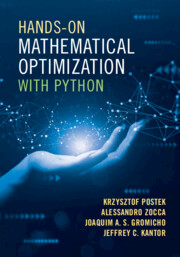
Hands-On Mathematical Optimization with Python
-
- Published online:
- 14 May 2025
- Print publication:
- 16 January 2025
-
- Textbook
- Export citation
References
-
- Book:
- Topology Optimization via L-Systems and Genetic Algorithms
- Published online:
- 13 June 2025
- Print publication:
- 24 April 2025, pp 281-292
-
- Chapter
- Export citation
Frontmatter
-
- Book:
- Topology Optimization via L-Systems and Genetic Algorithms
- Published online:
- 13 June 2025
- Print publication:
- 24 April 2025, pp i-iv
-
- Chapter
- Export citation
Appendix E - Conversion of Graphs to Volumetric Bodies for Three-Dimensional Analysis and Additive Manufacturing
-
- Book:
- Topology Optimization via L-Systems and Genetic Algorithms
- Published online:
- 13 June 2025
- Print publication:
- 24 April 2025, pp 277-280
-
- Chapter
- Export citation
5 - Arrangement L-system Interpretation
-
- Book:
- Topology Optimization via L-Systems and Genetic Algorithms
- Published online:
- 13 June 2025
- Print publication:
- 24 April 2025, pp 183-229
-
- Chapter
- Export citation
Appendix C - Classical Simplex-Based Approach to Ground Structure Optimization
-
- Book:
- Topology Optimization via L-Systems and Genetic Algorithms
- Published online:
- 13 June 2025
- Print publication:
- 24 April 2025, pp 265-272
-
- Chapter
- Export citation
1 - Introduction
-
- Book:
- Topology Optimization via L-Systems and Genetic Algorithms
- Published online:
- 13 June 2025
- Print publication:
- 24 April 2025, pp 1-24
-
- Chapter
- Export citation
6 - Multiphysical Applications
-
- Book:
- Topology Optimization via L-Systems and Genetic Algorithms
- Published online:
- 13 June 2025
- Print publication:
- 24 April 2025, pp 230-252
-
- Chapter
- Export citation
Appendix D - Increasing Structural/Networking Feasibility in Turtle-Constructed Graphs
-
- Book:
- Topology Optimization via L-Systems and Genetic Algorithms
- Published online:
- 13 June 2025
- Print publication:
- 24 April 2025, pp 273-276
-
- Chapter
- Export citation
3 - Introduction to L-systems and Turtle Graphics Interpretation
-
- Book:
- Topology Optimization via L-Systems and Genetic Algorithms
- Published online:
- 13 June 2025
- Print publication:
- 24 April 2025, pp 86-111
-
- Chapter
- Export citation
