To save content items to your account,
please confirm that you agree to abide by our usage policies.
If this is the first time you use this feature, you will be asked to authorise Cambridge Core to connect with your account.
Find out more about saving content to .
To save content items to your Kindle, first ensure no-reply@cambridge.org
is added to your Approved Personal Document E-mail List under your Personal Document Settings
on the Manage Your Content and Devices page of your Amazon account. Then enter the ‘name’ part
of your Kindle email address below.
Find out more about saving to your Kindle.
Note you can select to save to either the @free.kindle.com or @kindle.com variations.
‘@free.kindle.com’ emails are free but can only be saved to your device when it is connected to wi-fi.
‘@kindle.com’ emails can be delivered even when you are not connected to wi-fi, but note that service fees apply.
A self-taught authority on electromagnetic theory, telegraphy and telephony, Oliver Heaviside (1850–1925) dedicated his adult life to the improvement of electrical technologies. Inspired by James Clerk Maxwell's field theory, he spent the 1880s presenting his ideas as a regular contributor to the weekly journal, The Electrician. The publication of Electrical Papers, a year after his election to the Royal Society in 1891, established his fame beyond the scientific community. An eccentric figure with an impish sense of humour, Heaviside's accessible style enabled him to educate an entire generation in the importance and application of electricity. In so doing he helped to establish that very British phenomenon, the garden-shed inventor. Combining articles on the electromagnetic wave surface and electromagnetic induction with notes on nomenclature and the self-induction of wires, Volume 2 serves as an excellent source for both electrical engineers and historians of science.
First published in 1891, this memoir describes the life of the metallurgist and inventor Sidney Gilchrist Thomas (1850–1885), best-known for discovering the method of eliminating phosphorus from pig iron which revolutionised the commercial production of steel. Professing a desire to give a 'true' account of a life in contrast to the somewhat hagiographic approach of some contemporary writers, Thomas' biographer, R. W. Burnie, sets out to construct 'a brief history of a very striking and individual character'. The details of Thomas' short life are narrated in 22 chapters, beginning with his early education, his work as a schoolmaster and police clerk whilst studying law and chemistry at night, his career, and his work-related travels, which took him everywhere from central Europe to New Zealand. The memoir also includes a postscript which reveals that Thomas left his considerable fortune to workers in steel production.
William Thomson, first Baron Kelvin (1824–1907), is best known for devising the Kelvin scale of absolute temperature and for his work on the first and second laws of thermodynamics, though throughout his 53-year career as a mathematical physicist and engineer at the University of Glasgow he investigated a wide range of scientific questions in areas ranging from geology to transatlantic telegraph cables. The extent of his work is revealed in the six volumes of his Mathematical and Physical Papers, published from 1882 until 1911, consisting of articles that appeared in scientific periodicals from 1841 onwards. Volume 6, published in 1911, includes articles from the period 1867–1907. The chapters in the first part of the work focus on voltaic theory and radioactivity, while later ones examine navigation and tides.
Cornishman Richard Trevithick (1771–1833) was one of the pioneering engineers of the Industrial Revolution. Best remembered today for his early railway locomotive, Trevithick worked on a wide range of projects, including mines, mills, dredging machinery, a tunnel under the Thames, military engineering, and prospecting in South America. However, his difficult personality and financial failures caused him to be overshadowed by contemporaries such as Robert Stephenson and James Watt. This two-volume study by his son Francis, chief engineer with the London and North-Western Railway, was published in 1872, and helped to revive his neglected reputation. It places its subject in his historical and technical context, building on the work of his father, Richard Trevithick Senior, and the Cornish mining industry. It contains much technical detail, but is still of interest to the general reader. Volume 1 covers his predecessors, and early life, before examining his work thematically.
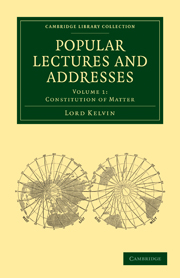
The mathematical physicist and engineer William Thomson, 1st Baron Kelvin (1824–1904) is best known for devising the Kelvin scale of absolute temperature and for his work on the first and second laws of thermodynamics. The lectures in this collection demonstrate an attempt by Baron Kelvin to formulate a physical model for the existence of ether. This concept of a medium for light propagation became prominent in the late nineteenth century, arising from the combination of Maxwell's equations stating that light is an electromagnetic wave with the demands of Newtonian physics that light must move in a unique reference frame. First published in 1904, Kelvin's lectures describe the difficulties inherent in this model. These problems with the concept of ether are credited for inspiring Einstein to devise the theory of special relativity and the photoelectric effect, both of which are central to modern physics.
William Thomson, Baron Kelvin (1824–1907), was educated at Glasgow and Cambridge. While only in his twenties, he was awarded the University of Glasgow's chair in natural philosophy, which he was to hold for over fifty years. He is best known through the Kelvin, the unit of measurement of temperature named after him in consequence of his development of an absolute scale of temperature. These volumes collect together Kelvin's lectures for a wider audience. In a convivial but never condescending style, he outlines a range of scientific subjects to audiences of his fellow scientists. The range of topics covered reflects Kelvin's broad interests and his stature as one of the most eminent of Victorian scientists. Volume 2 is mainly concerned with geology and was actually published last, in 1894. It includes additional lectures given between 1866 and 1893 that were not included in the other two volumes.
Silvanus P. Thompson (1851–1916) was a physicist and electrical engineer. A professor by the age of 27, he taught at University College, Bristol, and the City and Guilds Finsbury Technical College in London, and was a leading expert on the newly emerging subject of electrical lighting. This work, first published in 1884, is considered a classic in the field. In this third edition (1888), Thompson explains that he has updated much of the work, and made an important amendment in Chapter XIV about the introduction of magnetic circuits into theoretical arguments about energy production. The book begins with an explanation of how dynamos turn mechanical power into electricity, and moves on to discuss some historical background and theoretical aspects before giving detailed descriptions and illustrations of the many types of dynamo. It is an important source document for the field of electrical engineering at the end of the nineteenth century.
Sir James Prescott Joule (1818–1889) became one of the most significant physicists of the nineteenth century, although his original interest in science was as a hobby and for practical business purposes. The son of a brewer, he began studying heat while investigating how to increase the efficiency of electric motors. His discovery of the relationship between heat and energy contributed to the discovery of the conservation of energy and the first law of thermodynamics. Volume 1 of Joule's scientific papers was published in 1884. It is organised chronologically and reveals the range of Joule's interests and the development of his thought. The topics of the papers include the measurement of heat, voltaic batteries, electromagnets, specific heat, meteorology and thermodynamics. Joule's careful experiments in these areas were fundamental to the development of significant areas of twentieth-century physics, although he was slow to gain recognition from his contemporaries.
Cornishman Richard Trevithick (1771–1833) was one of the pioneering engineers of the Industrial Revolution. Best remembered today for his early railway locomotive, Trevithick worked on a wide range of projects, including mines, mills, dredging machinery, a tunnel under the Thames, military engineering, and prospecting in South America. However, his difficult personality and financial failures caused him to be overshadowed by contemporaries such as Robert Stephenson and James Watt. This two-volume study by his son Francis, chief engineer with the London and North-Western Railway, was published in 1872, and helped to revive his neglected reputation. It places its subject in his historical and technical context, building on the work of his Father, Richard Trevithick Senior, and the Cornish mining industry. It contains much technical detail, but is still of interest to the general reader. Volume 2 continues examining his work thematically, and includes his work in Peruvian mines.
William Thomson, Baron Kelvin (1824–1907), was educated at Glasgow and Cambridge. While only in his twenties, he was awarded the University of Glasgow's chair in natural philosophy, which he was to hold for over fifty years. He is best known through the Kelvin, the unit of measurement of temperature named after him in consequence of his development of an absolute scale of temperature. These volumes collect together Kelvin's lectures for a wider audience. In a convivial but never condescending style, he outlines a range of scientific subjects to audiences of his fellow scientists. The range of topics covered reflects Kelvin's broad interests and his stature as one of the most eminent of Victorian scientists. Volume 3, published in 1891, deals with the science of the seas and oceans, particularly as it relates to navigation, tides and magnetic forces.
In this first biography of the physicist Sir James Prescott Joule (1818–1889), his friend and collaborator Osborne Reynolds (1842–1912), Professor of Engineering at Owens College, Manchester, is keen to show how Joule, the son of a prosperous Salford brewer, was an 'ordinary' boy, enjoying regular walking trips to Snowdon, the Peaks and the Lakes; at the same time, he was greatly influenced by two years of tuition by John Dalton. His later experiments, observations and published papers are discussed and quoted at length. Reynolds stresses the influence Joule's work on heat and thermodynamics had on his contemporaries, but also that this 'amateur' scientist was often so far ahead of his time that his work was misunderstood or dismissed. Since publication of this book in 1892, only one other biography of Joule has appeared, and so it remains a vital source of first-hand information on his life and work.
William Thomson, first Baron Kelvin (1824–1907), is best known for devising the Kelvin scale of absolute temperature and for his work on the first and second laws of thermodynamics, though throughout his 53-year career as a mathematical physicist and engineer at the University of Glasgow he investigated a wide range of scientific questions in areas ranging from geology to transatlantic telegraph cables. The extent of his work is revealed in the six volumes of his Mathematical and Physical Papers, published from 1882 until 1911, consisting of articles that appeared in scientific periodicals from 1841 onwards. Volume 4, published in 1910, includes articles from the period 1867–1906. Themes covered in this book examine issues relating to water, such as hydrodynamics, tidal theory and deep sea ship waves.
Silvanus P. Thompson (1851–1916) was an engineer and physicist who researched aspects of electricity, magnets and optics. He spent his career teaching, first as a professor in Bristol and later in London, at the City and Guilds Finsbury Technical College, and he was a frequent public speaker on scientific matters. Over the course of his career he became especially interested in technical education, and produced many books that explained complicated scientific concepts with clarity, including his most famous work Calculus Made Easy. In this work, published in 1891, Thompson explains the importance and function of the electromagnet. Starting with the history and development of electromagnets, the work looks at the principle of the magnetic current, and gives detailed descriptions – including numerous technical illustrations – of electromagnetic motors and machine tools, providing an engaging guide to the latest forms of scientific knowledge at the end of the nineteenth century.
John Playfair (1748–1819) was a Scottish mathematician and geologist best known for his defence of James Hutton's geological theories. He attended the University of St Andrews, completing his theological studies in 1770. In 1785 he was appointed joint Professor of Mathematics at the University of Edinburgh, and in 1805 he was elected Professor of Natural Philosophy. A Fellow of the Royal Society, he was acquainted with continental scientific developments, and was a prolific writer of scientific articles in the Transactions of the Royal Society of Edinburgh and the Edinburgh Review. This four-volume edition of his works was published in 1822 and is prefaced by a biography of Playfair. Volume 3 includes articles on mathematics, physics, astronomy and naval tactics, revealing the range of Playfair's scientific interests.
Oliver Heaviside FRS (1850–1925) was a scientific maverick and a gifted self-taught electrical engineer, physicist and mathematician. He patented the co-axial cable, pioneered the use of complex numbers for circuit analysis, and reworked Maxwell's field equations into the more concise format we use today. In 1891 the Royal Society made him a Fellow for his mathematical descriptions of electromagnetic phenomena. Along with Arthur Kennelly, he also predicted the existence of the ionosphere. Often dismissed by his contemporaries, his work achieved wider recognition when he received the inaugural Faraday Medal in 1922. Published in 1912, this is the last of three volumes summarising Heaviside's enormous contribution to electromagnetic theory. It includes a review of his work on waves from moving sources, and an appendix on vector analysis that compares its merits to quaternions.
Sir David Brewster (1781–1868) was a Scottish physicist, mathematician, astronomer, inventor, and writer of international reputation. His biography of Sir Isaac Newton, published in 1855 and reissued in 1860, was the result of over twenty years' research, undertaken while publishing hundreds of scientific papers of his own. Brewster made use of previously unknown correspondence by Newton, and his own scientific interests, particularly in optics, meant that he was able to understand and explain Newton's work. It covered the many facets of Newton's personality and work, remaining the best available study of Newton for over a century. Brewster reveals much about the science of his own time in his handling of earlier centuries, and as a cleric was obviously uncomfortable about the evidence of Newton's unorthodox religious views and alchemical studies. Volume 2 covers the period from the dispute with Leibniz to Newton's death, and considers his posthumous reputation.
William Thomson, first Baron Kelvin (1824–1907), is best known for devising the Kelvin scale of absolute temperature and for his work on the first and second laws of thermodynamics, though throughout his 53-year career as a mathematical physicist and engineer at the University of Glasgow he investigated a wide range of scientific questions in areas ranging from geology to transatlantic telegraph cables. The extent of his work is revealed in the six volumes of his Mathematical and Physical Papers, published from 1882 until 1911, consisting of articles that appeared in scientific periodicals from 1841 onwards. Volume 5, published in 1911, includes articles from the period 1847–1908. Topics covered include thermodynamic and electrodynamic research, as well as some works on issues of geological physics such as the possible age of the sun's heat.
The Royal Society has been dedicated to scientific inquiry since the seventeenth century. In 1811, Thomas Thomson (1773–1852), a pioneering chemistry teacher who was elected a fellow of the society in the same year, undertook the project of writing a history of the organisation's illustrious past. In this book, published in 1812, Thomson explains how the group began in 1645, initiated by men who met once a week to discuss natural philosophy and mathematics. They were eventually granted a royal charter by Charles II in 1662. The society grew in number and prestige, and began publishing research in its Philosophical Transactions in 1665. Thomson's work focuses particularly on the development of the group's many scientific areas of interest and summarises various papers it published. He also includes a full list of the fellowship, from the society's foundation to 1812, and a copy of the society's original charter.
John Playfair (1748–1819) was a Scottish mathematician and geologist best known for his defence of James Hutton's geological theories. He attended the University of St Andrews, completing his theological studies in 1770. In 1785 he was appointed joint Professor of Mathematics at the University of Edinburgh, and in 1805 he was elected Professor of Natural Philosophy. A Fellow of the Royal Society, he was acquainted with continental scientific developments, and was a prolific writer of scientific articles in the Transactions of the Royal Society of Edinburgh and the Edinburgh Review. This four-volume edition of his works was published in 1822. Volume 1 includes a biography of Playfair, and his Illustrations of the Huttonian Theory of the Earth, which did much to popularise Hutton's ideas.
Thomas Stevenson (1818–1887) was the son of the engineer Robert Stevenson, and father of the writer Robert Louis Stevenson. Like his brothers David and Alan, he became a lighthouse designer, being responsible for over thirty examples around Scotland. Throughout his career he was interested in the theory as well as the practice of his profession, and published over sixty articles on engineering and meteorology. He was an international expert on lighthouses and harbour engineering. This work was first published in 1864 as a development of his article on harbours in the eighth edition (1857) of the Encyclopaedia Britannica, and considerably expanded in a second edition of 1874 which is reprinted here. Stevenson studied how the wind, waves and tides would act on the coastline and man-made structures, and the design of each harbour needed to take a wide range of factors into consideration.