To save content items to your account,
please confirm that you agree to abide by our usage policies.
If this is the first time you use this feature, you will be asked to authorise Cambridge Core to connect with your account.
Find out more about saving content to .
To save content items to your Kindle, first ensure no-reply@cambridge.org
is added to your Approved Personal Document E-mail List under your Personal Document Settings
on the Manage Your Content and Devices page of your Amazon account. Then enter the ‘name’ part
of your Kindle email address below.
Find out more about saving to your Kindle.
Note you can select to save to either the @free.kindle.com or @kindle.com variations.
‘@free.kindle.com’ emails are free but can only be saved to your device when it is connected to wi-fi.
‘@kindle.com’ emails can be delivered even when you are not connected to wi-fi, but note that service fees apply.
Ethics in Engineering Practice and Research is about professional responsibilities of engineers and applied scientists. It is about professional responsibilities: the character of problem situations in which those responsibilities must be fulfilled and the moral skills for fulfilling them. Interspersed throughout the text are open-ended scenarios that present ethically significant situations of the sort engineers and applied scientists commonly encounter. These have been set apart in centered boxes to aid the use of them in group discussion and for homework assignments. Also set apart from the text, in boxes, are fine points, which may enhance the reader's understanding but are not essential to the main argument. Most of these fine points concern philosophical issues.
How broadly should one share ideas? How readily should one copy the ideas of others? Does it matter what the ideas are or the human wants and needs that those ideas help meet?
The best-known philosophical argument for the existence of property rights is that of John Locke, mentioned in Section 4 of the introduction. Locke argued that people have some rights that are “natural” in the sense that they exist prior to any contracts or agreements; among these are certain property rights. The basic right for which Locke argues is the right to the fruits of one's labor. Locke assumes the right to one's own body and argues that if one performs work or mixes one's labor with some freely available material, one owns the product. Locke gives the example of gathering acorns leading to one's ownership of the resulting accumulation of acorns. (Acorns are nourishing although bitter tasting. They were plentiful in England, and sometimes people had subsisted on them.) Locke recognized that people might make trades and other agreements that lead to the acquisition of property rights other than those that are the direct fruits of one's labor.
By extension (and assuming one has a right to one's own mind or intellect parallel to one's right to one's body), one may argue that intellectual labor involved in the creation of research, artistic, and technological works provides the basis of property rights. If the creators of the product in question are paid for producing the product, then arguably the product and any resulting trademarks, patents, copyrights, or other property rights belong to the employer or client who paid them (although the creators still deserve credit as authors or inventors of those patented or copyrighted creations). Saying that patents and copyrights are “property rights” and therefore alienable allows that they may not reside with the creators of the items patented or copyrighted.
I want to die proud of having been an engineer. Since that can happen only if we engineers behave ethically, and since I see a connection between this book and gracious professionalism, I am very enthusiastic about Dr. Whitbeck's effort to help us think effectively and somewhat pragmatically about professional ethics. Everyone, professionals in particular, must expect ethically complex situations to arise. When that happens, each of us badly needs a self-image that includes conviction that our intellect and heart can help make choices that will dramatically affect the course of events. That point of view will not materialize out of the ether. It must be nurtured and encouraged. This book will help seasoned professionals clarify their approach to their own behaviors, and this book can profoundly affect those who face a messy situation for the first time.
You chose engineering with the hope of being able to address the need for energy sources that do not pollute the environment or contribute to climate change. Your interests have brought you to a project that addresses the fundamental drawback to solar energy: the lack of a cheap and efficient way to store that energy. Your R&D group has been looking to the photosynthesis of plants for a model of how this is accomplished. The group is making good progress on developing a process to use the sun's energy to split water into hydrogen and oxygen. These gases could later be recombined in a fuel cell to create electrical energy for a variety of uses including powering an automobile.
You have the technical work well in hand and you are confident that you are doing work that is likely to benefit society. However, you are wondering what it means that you are a professional and what the implications of being a professional are for the way you and other team members handle the rewards for making this breakthrough. (For example, what you owe to the company for which you previously worked and at which you first worked on a similar problem; what you should expect in the way of credit to you personally for the contribution you have made to this project.) Where do you begin finding out what you need to know about your rights and responsibilities as a professional?
Professions are those occupations that both require advanced study and mastery of a specialized body of knowledge, and undertake to promote, ensure, or safeguard some aspect of others??? well-being. This chapter examines the norms and standards of good conduct in professional practice. Ethical (and sometimes legal) requirements also exist for nonprofessionals when their work immediately affects the public good. For example, food handlers are bound by sanitary rules. Arguably, many moral rules apply equally in all work contexts. All should be honest, for example. What is distinctive about the ethical demands professions make on their practitioners is the combination of the responsibility for some aspect of others??? well-being and the complexity of the knowledge and information that they must integrate in acting to promote that well-being.
In the early 1850s the French diplomat and engineer Ferdinand de Lesseps (1805–1894) revived earlier French plans to build a canal through the Isthmus of Suez, and, thanks to his good relations with the Viceroy of Egypt, won approval for the project in the face of British and Turkish opposition. This 1870 lecture reveals de Lesseps' enchantment with the desert and its people, his determination to complete the canal, and his annoyance at British antagonism. By 1875, when this English translation by Sir Henry Wolff was published, the canal had been open for six years and the British position had shifted dramatically. The government bought Egypt's shares in the Canal Company, and Wolff was chosen by Disraeli to speak in Parliament in support of the purchase. De Lessep's book remains an invaluable source on the canal, the politics of the major powers, and European attitudes towards the Middle East.
Polymath Alexander von Humboldt (1769–1859), a self-described 'scientific traveller', was one of the most respected scientists of his time. Humboldt's wanderlust led him across Europe and to South America, Mexico, the U.S., and Russia, and his voyages and observations resulted in the discovery of many species previously unknown to Europeans. Originating as lectures delivered in Berlin and Paris (1827–1828), his multi-volume Cosmos: Sketch of a Physical Description of the Universe (1845–1860) represented the culmination of his lifelong interest in understanding the physical world. As Humboldt writes, 'I ever desired to discern physical phenomena in their widest mutual connection, and to comprehend Nature as a whole, animated and moved by inward forces.' Volume 1 (1846) investigates celestial and terrestrial phenomena, from nebulae to the temperature of the earth, as well as 'organic life'. Throughout, he stresses the method of, and limits to, describing the universe's physical nature.
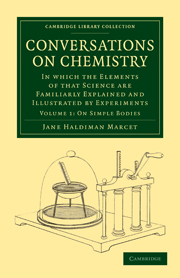
Jane Haldimand Marcet (1769–1858) was a pioneer in the field of education who wrote accessible introductory books on science and economics. Noting that women's education 'is seldom calculated to prepare their minds for abstract ideas', she resolved to write books that would inform, entertain and improve a generation of female readers. First published anonymously in 1805, her two-volume work Conversations on Chemistry swiftly became a standard primer going through sixteen editions in England alone, and is credited with having influenced the young Michael Faraday. Presented as a series of discussions between a fictional tutor, Mrs. Bryan, and her two female students, the flighty Caroline and earnest Emily, Conversations combines entertaining banter with a clear and concise explanation of scientific theories of the day. In Volume 1 the girls are introduced to 'Simple Bodies' through such colourful examples as hot air balloons and the spa waters of Harrogate.
Sir James Jeans' well-known treatise covers the topics in electromagnetic theory required by every non-specialist physicist. It provides the relevant mathematical analysis and is therefore useful to those whose mathematical knowledge is limited, as well as to the more advanced physicists, engineers and applied mathematicians. A large number of examples are given.
This 1893 publication is a central text in the work of the Nobel prize winning physicist Sir Joseph John Thomson (1858–1940). Intended as an extension of James Clerk Maxwell's Treatise on Electricity and Magnetism, it documents the important shift in Thomson's thinking towards the model of the atomic electric field, a theory that would eventually lead to his discovery of the electron. In Chapter 1, Thomson documents his experiments with Faraday tubes, using them to physically demonstrate a 'molecular theory of electricity'. Chapter 2 considers the discharge of electricity through gases, Chapter 3 theories of electrostatics, and Chapters 4–6 are primarily concerned with alternating currents. In addition to providing crucial insight into Thomson's evolving theory of the atom, Recent Researches underscores his commitment to experimental physics, which offers 'all the advantages in vividness which arise from concrete qualities rather than abstract symbols'.
The Royal Society has been dedicated to scientific inquiry since the seventeenth century and has seen a long line of illustrious scientists and thinkers among its fellowship. The society's Assistant Secretary and Librarian, Charles Richard Weld (1813–1869), spent four years writing this two-volume History of the Royal Society, published in 1848, which also includes illustrations by his wife, Anne. Weld's aim was to document the 'rise, progress, and constitution' of the society. He charts how the informal meetings of like-minded men engaged in scientific pursuits in the mid-1600s developed into a prestigious society that by 1830 counted as one of the world's most influential scientific institutions. Volume 1 covers the period to 1755, describing the society's origins and key moments in its growth, with a focus on its governance, benefactors and organisation. It also contains biographies of presidents including Samuel Pepys and Isaac Newton.
James Clerk Maxwell (1831–1879) was a Scottish physicist well-known for his extensive work with electromagnetism, colour analysis, and kinetic theory. Considered by many to be a giant in his field with significant influence on the physicists who would follow, Maxwell spent time as a professor at Aberdeen University, King's College, London, and Cambridge. This 1882 Life by his friend Lewis Campbell and natural philosopher William Garnett represents an important – and lengthy – investigation into Maxwell's life and thought. Part I is concerned with biographical matters while the second section focuses upon his scientific mind. A third part contains Maxwell's poetry, so included because the poems are 'characteristic of him' and have 'curious biographical interest'. At nearly 700 pages, the Life represents an important starting point for those curious about the state of theoretical physics and the person in whom it reached its culmination in the nineteenth century.
Arguably the most influential nineteenth-century scientist for twentieth-century physics, James Clerk Maxwell (1831–1879) demonstrated that electricity, magnetism and light are all manifestations of the same phenomenon: the electromagnetic field. A fellow of Trinity College Cambridge, Maxwell became, in 1871, the first Cavendish Professor of Physics at Cambridge. His famous equations - a set of four partial differential equations that relate the electric and magnetic fields to their sources, charge density and current density - first appeared in fully developed form in his 1873 Treatise on Electricity and Magnetism. This two-volume textbook brought together all the experimental and theoretical advances in the field of electricity and magnetism known at the time, and provided a methodical and graduated introduction to electromagnetic theory. Volume 2 covers magnetism and electromagnetism, including the electromagnetic theory of light, the theory of magnetic action on light, and the electric theory of magnetism.
Henry Cavendish (1731–1810), the grandson of the second duke of Devonshire, wrote papers on electrical topics for the Royal Society, but the majority of his electrical experiments did not become known until they were collected and published by James Clerk Maxwell a century later, in 1879, long after other scientists had been credited with the same results. Among Cavendish's discoveries were the concept of electric potential, which he called the 'degree of electrification'; an early unit of capacitance, that of a sphere one inch in diameter; the formula for the capacitance of a plate capacitor; the concept of the dielectric constant of a material; the relationship between electric potential and current, now called Ohm's Law; laws for the division of current in parallel circuits, now attributed to Charles Wheatstone; and the inverse square law of variation of electric force with distance, now called Coulomb's Law.
Arguably the most influential nineteenth-century scientist for twentieth-century physics, James Clerk Maxwell (1831–1879) demonstrated that electricity, magnetism and light are all manifestations of the same phenomenon: the electromagnetic field. A fellow of Trinity College Cambridge, Maxwell became, in 1871, the first Cavendish Professor of Physics at Cambridge. His famous equations - a set of four partial differential equations that relate the electric and magnetic fields to their sources, charge density and current density - first appeared in fully developed form in his 1873 Treatise on Electricity and Magnetism. This two-volume textbook brought together all the experimental and theoretical advances in the field of electricity and magnetism known at the time, and provided a methodical and graduated introduction to electromagnetism. Volume 1 covers the first elements of Maxwell's electromagnetic theory: electrostatics, and electrokinematics, including detailed analyses of electrolysis, conduction in three dimensions, and conduction through heterogeneous media.
Jeans's primary aim with the first edition of his book, originally published in 1904, was to 'develop the theory of gases upon as exact a mathematical basis as possible'. Twenty years later and those theories were being revolutionised by Quantum Theory. In this fourth edition, Jeans does not attempt to avoid the discoveries of this topical science, but rather exposes the many difficulties that classical theory was experiencing, and how those problems disappeared with Quantum Theory. This edition therefore offers a fascinating insight into a field of physics in transition between two great models of physical science.