Refine search
Actions for selected content:
213084 results in Engineering
Agardograph 5. Anthropometry and Human Engineering. A.G.A.R.D. Butterworths Scientific Publications, 1955. 123 pp. llustrated. 21s. - Agardograph 6. Collected Papers on Aviation Medicine. A.G.A.R.D. Butterworths Scientific Publications, 1955. 208 pp. Illustrated. 37s. 6d.
-
- Journal:
- The Aeronautical Journal / Volume 60 / Issue 541 / January 1956
- Published online by Cambridge University Press:
- 28 July 2016, p. 73
-
- Article
- Export citation
The High Speed Internal Combustion Engine. Sir Harry R. Ricardo. Blackie & Son Ltd. 1953. Fourth edition. 420 pp. 226 figures. 40s. net.
-
- Journal:
- The Aeronautical Journal / Volume 57 / Issue 511 / July 1953
- Published online by Cambridge University Press:
- 28 July 2016, pp. 471-472
-
- Article
- Export citation
Juan de la Cierva, Fellow, 1895-1936
-
- Journal:
- The Aeronautical Journal / Volume 41 / Issue 324 / December 1937
- Published online by Cambridge University Press:
- 28 July 2016, p. 1191
-
- Article
-
- You have access
- Export citation
The Operational Point of View
-
- Journal:
- The Aeronautical Journal / Volume 53 / Issue 460 / April 1949
- Published online by Cambridge University Press:
- 28 July 2016, pp. 299-304
-
- Article
- Export citation
To Perish Never. Henry Archer and Edward Pine. 188 pp. Cassell. 9s. 6d.
-
- Journal:
- The Aeronautical Journal / Volume 58 / Issue 528 / December 1954
- Published online by Cambridge University Press:
- 28 July 2016, p. 848
-
- Article
- Export citation
Recent Developments in the Structural Approach to Aeroelastic Problems
-
- Journal:
- The Aeronautical Journal / Volume 58 / Issue 522 / June 1954
- Published online by Cambridge University Press:
- 28 July 2016, pp. 403-421
-
- Article
- Export citation
A Method of Calculating Space Free Resonance Modes of an Aircraft
-
- Journal:
- The Aeronautical Journal / Volume 57 / Issue 510 / June 1953
- Published online by Cambridge University Press:
- 28 July 2016, pp. 420-422
-
- Article
- Export citation
Engineering Analysis (A Survey of Numerical Procedures). S. H. Crandall. McGraw-Hill, New York, 1956. 417 pp. Illustrated. 71s. 6d.
-
- Journal:
- The Aeronautical Journal / Volume 61 / Issue 558 / June 1957
- Published online by Cambridge University Press:
- 28 July 2016, p. 428
-
- Article
- Export citation
Air Flow: With Demonstrations on the Screen by Means of Smoke
-
- Journal:
- The Aeronautical Journal / Volume 36 / Issue 258 / June 1932
- Published online by Cambridge University Press:
- 28 July 2016, pp. 451-472
-
- Article
- Export citation
A Method of Measuring Post-Yield Strain
-
- Journal:
- The Aeronautical Journal / Volume 57 / Issue 505 / January 1953
- Published online by Cambridge University Press:
- 28 July 2016, pp. 49-51
-
- Article
- Export citation
The Normal Functions of Beam Vibration in Series Solutions of Static Problems
-
- Journal:
- The Aeronautical Journal / Volume 57 / Issue 512 / August 1953
- Published online by Cambridge University Press:
- 28 July 2016, pp. 527-529
-
- Article
- Export citation
-
The normal functions of beam vibration may be used in series to solve statical problems of beam flexure and the recent appearance of tables of these functions has rendered this method practicable. An outline is given of the procedure.
The simple equation of free flexural vibration of beams is
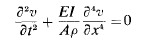 1
1 where v is the displacement, EI the flexural rigidity andAp the mass per unit length. The separation of variables and the application of appropriate boundary conditions at the ends x = 0 and x = l, gives the following normal functions ϕ(x).
Lightning and Aircraft. By G. C. Simpson, F.R.S. London: Meteorological Office, Professional Notes No. 66. H.M.S.O. Price 4d. net.
-
- Journal:
- The Aeronautical Journal / Volume 38 / Issue 285 / August 1934
- Published online by Cambridge University Press:
- 28 July 2016, p. 802
-
- Article
- Export citation
Numerical Methods. A. D. Booth. Butterworths Scientific Publications, 1955. Illustrated. 195 pp. 35s.
-
- Journal:
- The Aeronautical Journal / Volume 59 / Issue 538 / October 1955
- Published online by Cambridge University Press:
- 28 July 2016, p. 715
-
- Article
- Export citation
Meteorology and High Altitude Aviation
-
- Journal:
- The Aeronautical Journal / Volume 50 / Issue 430 / October 1946
- Published online by Cambridge University Press:
- 28 July 2016, pp. 787-810
-
- Article
- Export citation
The Weight of Seaplane Floats
-
- Journal:
- The Aeronautical Journal / Volume 53 / Issue 465 / September 1949
- Published online by Cambridge University Press:
- 28 July 2016, pp. 906-910
-
- Article
- Export citation
The Continuum And Other Types of Serial Order. E. V Huntington. Second edition. 1955. 80 pp. 1 dollar. - Almost Periodic Functions. A. S. Besicovitch 1954. 180 pp. 1 dollar 75. - Treatise on ThermoDynamics. Max Planck (Translated by Alexander Ogg) Third Ed. 1955. 297 pp. 1 dollar 75. - Advanced Dynamics of a System of Rigid Bodies. E. J. Routh Sixth Ed. 1955. 484 pp. 1 dollar 95. - The Dynamical Theory of Gases. Sir James Jeans. Fourth Ed. Dover Publications, New York, 1955. 444 pp. 2 dollars.
-
- Journal:
- The Aeronautical Journal / Volume 59 / Issue 536 / August 1955
- Published online by Cambridge University Press:
- 28 July 2016, p. 574
-
- Article
- Export citation
Methods of Mathematical Physics, Volume I. R. Courant and D. Hilbert. Interscience Publishers Inc., New York. 550 pp. Index. 75s. net.
-
- Journal:
- The Aeronautical Journal / Volume 58 / Issue 523 / July 1954
- Published online by Cambridge University Press:
- 28 July 2016, p. 514
-
- Article
- Export citation
Lothar Ahrens: “ Taschenwoerterbuch Flugwesen, Fuenfsprachig. ” (Aeronautical Pocket Dictionary in Five Languages, German—English—French—Italian—Spanish.) Berlin. 1939. Published by V. D. I. Verlag G.m.b.H. 576 pp. Price R.M. 12.—.
-
- Journal:
- The Aeronautical Journal / Volume 43 / Issue 345 / September 1939
- Published online by Cambridge University Press:
- 28 July 2016, p. 760
-
- Article
- Export citation
To the Editor of the JOURNAL of the ROYAL AERONAUTICAL SOCIETY
-
- Journal:
- The Aeronautical Journal / Volume 37 / Issue 276 / December 1933
- Published online by Cambridge University Press:
- 28 July 2016, p. 1054
-
- Article
- Export citation
Bird Flight. By Gordon C. Aymar. Published by John Lane. Price 12/6.
-
- Journal:
- The Aeronautical Journal / Volume 40 / Issue 311 / November 1936
- Published online by Cambridge University Press:
- 28 July 2016, p. 837
-
- Article
- Export citation
