To save content items to your account,
please confirm that you agree to abide by our usage policies.
If this is the first time you use this feature, you will be asked to authorise Cambridge Core to connect with your account.
Find out more about saving content to .
To save content items to your Kindle, first ensure no-reply@cambridge.org
is added to your Approved Personal Document E-mail List under your Personal Document Settings
on the Manage Your Content and Devices page of your Amazon account. Then enter the ‘name’ part
of your Kindle email address below.
Find out more about saving to your Kindle.
Note you can select to save to either the @free.kindle.com or @kindle.com variations.
‘@free.kindle.com’ emails are free but can only be saved to your device when it is connected to wi-fi.
‘@kindle.com’ emails can be delivered even when you are not connected to wi-fi, but note that service fees apply.
Sir Isaac Newton (1642–1727) was one of the greatest scientists of all time, a thinker of extraordinary range and creativity who has left enduring legacies in mathematics and physics. While most famous for his Principia, his work on light and colour, and his discovery of the calculus, Newton devoted much more time to research in chemistry and alchemy, and to studying prophecy, church history and ancient chronology. This new edition of The Cambridge Companion to Newton provides authoritative introductions to these further dimensions of his endeavours as well as to many aspects of his physics. It includes a revised bibliography, a new introduction and six new chapters: three updating previous chapters on Newton's mathematics, his chemistry and alchemy and the reception of his religious views; and three entirely new, on his religion, his ancient chronology and the treatment of continuous and discontinuous forces in his second law of motion.
This 1875 manual presents a detailed scientific picture of Greenland and its Arctic environment. Edited by the geologist Thomas Rupert Jones (1819–1911), it was prepared for the British Arctic Expedition of the same year in order to inform and instruct the explorers. The work presents previously ascertained information, ranging from astronomical data, including observations of the northern lights, through to material on plant and animal life. Sir George Nares (1831–1915), the expedition's leader, had hoped the North Pole could be reached. Though this proved impossible, a team of his men set a record for the furthest northern latitude attained at the time. Underpinning the expedition's gathering of important scientific and geographical results, this manual clarifies for modern readers the specific objectives of late Victorian polar research. Nares' official 1876 report and his 1878 two-volume account of the journey are also reissued in the Cambridge Library Collection.
Though much about his life is uncertain, Charles Frederick Partington is known to have lectured at the London Institution between 1823 and 1830 on a variety of technical topics, and he delivered some of the first lectures specifically designed for young people. He had a particular interest in the steam engine, and this book, reissued here in the first edition of 1822, was one of the earliest overviews of its history and development. A third edition appeared in 1826. Noting the excessive frequency with which 'the faults of any new invention are unjustly magnified, while its real advantages are seldom duly appreciated', the author is keen to act as evangelist. Detailed and illustrated descriptions of various early engines are included, comparing their characteristics and advantages. Also of note are Partington's descriptions of early attempts to mitigate the 'smoke and noxious effluvia which proceed from their capacious vomitories'.
Celebrated for his construction of the Eddystone Lighthouse near Plymouth, John Smeaton (1724–92) established himself as Britain's foremost civil engineer in the eighteenth century. A founder member of the Society of Civil Engineers, he was instrumental in promoting the growth of the profession. After his death his papers were acquired by the president of the Royal Society, Sir Joseph Banks, Smeaton's friend and patron. Using these materials, a special committee decided to publish 'every paper of any consequence' written by Smeaton, as a 'fund of practical instruction' for current and future engineers. These were published in four illustrated volumes between 1812 and 1814. Volume 2 contains Smeaton's reports on engineering works for bridges, including a proposal for the widening and improvement of London Bridge, as well as many plans for the creation or improvement of canals, mills and waterwheels.
A student of Trinity College and a member of the Cambridge Apostles, William Kingdon Clifford (1845–79) graduated as second wrangler in the mathematical tripos, became a professor of applied mathematics at University College London in 1871, and was elected a fellow of the Royal Society in 1874. The present work was begun by Clifford during a remarkably productive period of ill health, yet it remained unfinished at his death. The statistician and philosopher of science Karl Pearson (1857–1936) was invited to edit and complete the work, finally publishing it in 1885. It tackles five of the most fundamental areas of mathematics - number, space, quantity, position and motion - explaining each one in the most basic terms, as well as deriving several original results. Also demonstrating the rationale behind these five concepts, the book particularly pleased a later Cambridge mathematician, Bertrand Russell, who read it as a teenager.
This 1878 account of a scientific tour of Morocco and the Atlas mountains in 1871 was compiled from the journals of Sir Joseph Hooker (1817–1911) and his travelling companion, the geologist John Ball (1818–89). Their plan had been for Hooker to publish their findings soon after the journey, but his work as Director of Kew Gardens and President of the Royal Society, and Ball's frequent absences abroad, as well as his own writing commitments, caused delays. However, they argue that their information is unlikely to be out of date when, from a comparison with earlier accounts, 'no notable change is apparent during the last two centuries'. The botanical and geological interests of both men take centre stage in an engaging narrative which provides interesting details about the government, customs and daily life in an area which even in the late nineteenth century was little visited by Europeans.
From the 1850s onwards, the civil engineer Robert Henry Bow (1827–1909) became known for his expertise in structural analysis, publishing on the design of bridge and roof trusses, and working with the prolific railway engineer Sir Thomas Bouch (of later Tay Bridge infamy). In the first part of this 1873 publication, Bow describes 337 different truss structures, grouping them into four classes according to their structural characteristics: statically determinate, kinematically determinate, indeterminate, and other. In the second part, he describes a method for graphically analysing truss structures, based on the work of Thomas Maxwell and others, and applies this method to the structures listed in the first part. Perhaps of most interest to the working engineer are the explanations as to which structures are most efficient given typical material constraints, such as girders of uniform cross-section. The work remained a useful resource for practising engineers well into the twentieth century.
Many of the modern methods of structural analysis based on concepts of virtual work and energy were developed and popularised in Italy in the latter half of the nineteenth century. Building on the work of Luigi Menabrea, the mathematician Carlo Alberto Castigliano (1847–84) provided the first full proof of these methods in his 1873 dissertation while based in Turin. Equally important was his popularisation of the theory in his Théorie de l'équilibre des systèmes élastiques et ses applications (1879), in which he applied his theory to a wide range of important real-world cases. The work is here reissued in its 1919 English translation, by the consulting engineer and lecturer Ewart S. Andrews. Castigliano covers the basic theory of elastic stresses, introducing useful approximations; he then moves on to the analysis of real structures, including roof trusses, arches and bridges in both iron and masonry.
This story of an Indian garden was published in 1915. Its author, Kathleen L. Murray, was living in the remote north-eastern region of Bihar in the home of her brother, an indigo producer, and some of her musings on life and gardening in India had already been published in the periodical The Statesman. She viewed this work not as a guide, but 'merely a rambling record of some years in a garden' which combined European plants such as roses and sweet peas with natives such as cannas and beaumontias. Along with her gardening successes and failures over three years, the book provides insights into the life of the European woman in India - with no employment, and required to be both idle and aloof from the lives of the wider population. Murray's descriptive powers and enthusiasm for her garden make this book both enjoyable and evocative of imperial India.
Abandoning a promising career in the law, Barthélemy Faujas de Saint-Fond (1741–1819) enjoyed the encouragement of the eminent scientist Buffon in pursuing his love of natural history. His keen interest in rocks, minerals and fossils led to a number of important discoveries, among which was confirmation that basalt was a volcanic product. Appointed assistant naturalist at the natural history museum in Paris, he became a professor of geology in 1793, occupying this position until his death. This 1784 work begins with concise accounts of numerous varieties of basalt, describing the key features of each, before moving on to discuss several other volcanic products, including breccia and pozzolana. Of related interest, two other works by Faujas, Essai de géologie (1803–9) and the revised English edition of A Journey through England and Scotland to the Hebrides in 1784 (1907), are also reissued in the Cambridge Library Collection.
Celebrated for his construction of the Eddystone Lighthouse near Plymouth, John Smeaton (1724–92) established himself as Britain's foremost civil engineer in the eighteenth century. A founder member of the Society of Civil Engineers, he was instrumental in promoting the growth of the profession. After his death his papers were acquired by the president of the Royal Society, Sir Joseph Banks, Smeaton's friend and patron. Using these materials, a special committee decided to publish 'every paper of any consequence' written by Smeaton, as a 'fund of practical instruction' for current and future engineers. These were published in four illustrated volumes between 1812 and 1814. As a consulting engineer, Smeaton carried out surveys and reports of existing structures, as well as drawing up proposals for new designs. Volume 3 contains mainly reports relating to bridges and harbours, including work at such major ports as Aberdeen, Dover and Hull.
Originally published in 1952, this book is intended as an introductory guide to aerial mapping and photogrammetry. The main emphasis is on making maps during wartime, when accuracy is paramount and information may be minimal; Trorey had experience of this while serving with the Canadian Military Survey in WWII. This book will be of value to anyone with an interest in mapmaking.
Celebrated for his construction of the Eddystone Lighthouse near Plymouth, John Smeaton (1724–92) established himself as Britain's foremost civil engineer in the eighteenth century. A founder member of the Society of Civil Engineers, he was instrumental in promoting the growth of the profession. After his death his papers were acquired by the president of the Royal Society, Sir Joseph Banks, Smeaton's friend and patron. Using these materials, a special committee decided to publish 'every paper of any consequence' written by Smeaton, as a 'fund of practical instruction' for current and future engineers. These were published in four illustrated volumes between 1812 and 1814. Volume 1 contains correspondence with and reports for clients regarding waterworks, canals, bridges, lighthouses and other engineering works, including harbour improvements at Christchurch, Bristol and Whitby. It also contains descriptions of some of Smeaton's inventions, such as an improved fire engine.
Celebrated for his construction of the Eddystone Lighthouse near Plymouth, John Smeaton (1724–92) established himself as Britain's foremost civil engineer in the eighteenth century. A founder member of the Society of Civil Engineers, he was instrumental in promoting the growth of the profession. The Royal Society awarded him its Copley medal for research into wind and water power in 1759. After his death his papers were acquired by the president of the Royal Society, Sir Joseph Banks, Smeaton's friend and patron. Using these materials, a special committee decided to publish 'every paper of any consequence' written by Smeaton, as a 'fund of practical instruction' for current and future engineers. These were published in four illustrated volumes between 1812 and 1814. Published in 1814 using the original engraved plates, Volume 4 contains the papers that Smeaton published in the Royal Society's Philosophical Transactions, as well as related correspondence.
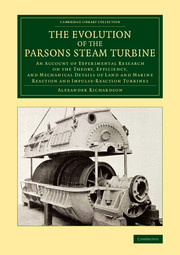
Responsible for the generation of most of the world's electricity, and with applications to sea and land transport, the steam turbine may be regarded as a pivotal invention in the creation of a technologically advanced modern society. Charles Parsons (1854–1931) built the first practical steam turbine in 1884, and he remained at the forefront of its development for nearly fifty years, as he saw his invention become first the prime means by which thermal energy could be turned into electricity, and then the power behind pioneering cruise liners and warships. Alexander Richardson (1864–1928), an engineer and politician, had access to the inventor's papers when writing this account of the turbine's history. Published in 1911, and featuring more than 170 illustrative plates, it provides a valuable insight into the development of a technology that revolutionised power generation, marine transport and naval warfare.
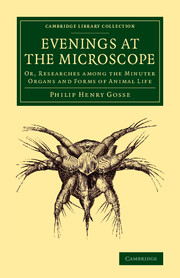
English zoologist Philip Henry Gosse (1810–88) spent several years studying the biodiversity of habitats in North America and the Caribbean. His Naturalist's Sojourn in Jamaica (1851) is reissued in this series. When he settled on the Devonshire coast, the area proved equally rich for research. In this 1859 publication, the deeply religious Gosse considers the 'Divine mechanics' of animal body parts and microorganisms seen through the lens of a microscope. He leads the reader through a selection of specimens ranging from a hog's bristle to the shoe-like protist Paramecium. Gosse's writing style, enlivened with anecdotes and literary references, earned him considerable appreciation among Victorian audiences. His entertaining text is complemented by more than 100 illustrations which showcase his draughtsmanship. While the work shares its year of publication with Darwin's groundbreaking Origin of Species, Gosse's religious views firmly shaped his interpretation of the specimens on show.
The Danish plant scientist Wilhelm Johannsen (1857–1927) is remembered for his experimental work on plant heredity, and as a founding figure of modern genetics. The terms 'gene', 'genotype' and 'phenotype' were first used by him. The results of his studies on beans supported theories advanced during the 1890s by the Dutch botanist Hugo de Vries, who had unknowingly replicated the work of Gregor Mendel, published in English translation in 1902 (also reissued in this series) by William Bateson. Johannsen's proposal that changes in heredity resulted from sudden mutations rather than from slow processes of natural selection was seen at the time as a threat to Darwinian theory, though later research showed otherwise. This influential book, first published in 1909 (with later editions in 1913 and 1926), is a revised, expanded German translation of a 1905 Danish book by Johannsen, itself based on a journal article originally published in 1903.
Seventh wrangler in the Cambridge mathematical tripos in 1826, Henry Moseley (1801–72) was adept at applying mathematical analysis to a wide variety of problems. Appointed professor of natural and experimental philosophy and astronomy at London's newly established King's College in 1831, he was instrumental in creating the institution's department of engineering and applied science. This 1843 textbook is based on the lectures in statics, dynamics and structures that he gave to students of engineering and architecture. Moseley draws on the latest continental work in mechanics, and the treatment of problems is mathematically sophisticated. Starting with basic statics and dynamics, Moseley covers topics of interest to both civil and military engineers, with sections on the theory of machines and on the stability of walls, arches and other structures. Notably, the American edition of this work was adopted as a textbook by the United States Military Academy at West Point.
First published in 1953, as the second edition of a 1928 original, this book supplies a detailed bibliography of Dr William Harvey, who described the workings of the circulatory system in his revolutionary 1628 treatise, De Motu Cordis. Keynes notes the various editions and translations of Harvey's three key works as well as miscellaneous writings and anthologies and their locations in libraries around the world. This book will be of value to anyone with an interest in Harvey.