To save content items to your account,
please confirm that you agree to abide by our usage policies.
If this is the first time you use this feature, you will be asked to authorise Cambridge Core to connect with your account.
Find out more about saving content to .
To save content items to your Kindle, first ensure no-reply@cambridge.org
is added to your Approved Personal Document E-mail List under your Personal Document Settings
on the Manage Your Content and Devices page of your Amazon account. Then enter the ‘name’ part
of your Kindle email address below.
Find out more about saving to your Kindle.
Note you can select to save to either the @free.kindle.com or @kindle.com variations.
‘@free.kindle.com’ emails are free but can only be saved to your device when it is connected to wi-fi.
‘@kindle.com’ emails can be delivered even when you are not connected to wi-fi, but note that service fees apply.
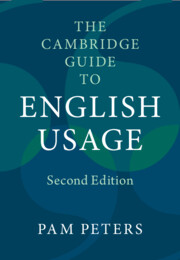
American and British English in the twenty-first century are still divided by a common language. Now in its second edition, this highly readable guide provides an authoritative reference to English usage, covering the differences, and some emerging similarities, between British, American and international English. It has been thoroughly updated and expanded to document hundreds of variable points of usage for the benefit of British and American readers, and for those seeking international forms of English for written communication, as first- or second-language users. It discusses the current status of each usage item with quantitative evidence from the NOW (News on the Web) corpus and contemporary research. Lively examples of usage are provided to capture aspects of twenty-first century culture world-wide. It also discusses issues in the use of personal names and ethnic naming practices, as well as sexist and homophobic words, and person-centred words for those living with a disability.
Presenting a newly developed comprehensive framework-Online Language Course Evaluation Framework (OLCEF)-this book is a guide on how to effectively evaluate online language courses. It includes a comprehensive overview of the essential components of an effective online language course and introduces the five key principles which form the evaluation process-pedagogical, language learning, social, cognitive, and technological. It describes in detail the three stages of the evaluation, providing an accessible guide for a step-by-step evaluation of an online language course. The book also includes an extensive review of the existing research, theories, evaluation frameworks and guidelines, and the authors' personal knowledge and experiences related to the evaluation of online language courses. Conveying practical advice in an accessible way and grounded in theory and research, it is essential reading for researchers and students in applied linguistics and language education, as well as instructors, administrators, and curriculum and instructional designers.
With university student populations becoming ever more diverse across the globe, it has become increasingly difficult for educators to presume that all students possess the necessary knowledge and skills in academic literacy to succeed in their academic studies. This timely book presents the argument for embedding academic literacies in higher education degree curricula. It supports an inclusive approach to student academic language development, where all students stand to benefit from instruction in the literacy practices specific to their disciplines. The book is split into two parts, with the first providing a number of thought-provoking perspectives on different aspects and interpretations of embedding. The second part provides a set of case studies that serve both to highlight how various theoretical frameworks inform different approaches to embedding, and to illustrate the real-word affordances and constraints at play that act as determinants of the shape, extent and success of embedding initiatives.
An essential foundation in applied linguistics, this accessible book is designed for language teachers and students of applied linguistics with a focus on foreign language education. Ideal for courses on second language acquisition and teaching, chapters cover the history of applied linguistics, as well as the essential topics of second language acquisition, language policy and planning, second language teaching, lexicology, lexicography, and translation. Each chapter ends with a useful summary and practical activities to consolidate and embed student understanding, while questions for reflection throughout encourage deeper engagement with the material. Suggested further readings and resources give students the opportunity to extend their learning and explore topics of interest. Highlighting the latest research in the field, and providing a unique dual focus on English and Spanish linguistics, this is the ideal textbook for those seeking to develop an up-to-date and rounded understanding of applied linguistics in relation to foreign language education.
Is a literary text an act of communication, and if so, how does it work? Relating works of literature to everyday utterances, this book focuses on the relationship between meaning and language in literary works. It uses an influential theory from linguistic pragmatics, relevance theory, to reveal a connection between literature and ordinary talk, while maintaining that the effect of literariness is achieved through exploiting the communicative options open to us more deeply and in more complex ways in poetry and prose fiction. It provides an accessible introduction to relevance theory and connects the theory to ideas in evolutionary cognitive psychology, whilst also comparing it to other approaches in stylistics, literary studies and pragmatics. This book also includes detailed analyses of literary texts, supported with linguistic descriptions of form, examining texts and textual features such as satire, first and third person narratives, sound-patterned poetry, comic rhymes, literary parodies and metaphor.
By building knowledge in a deliberate and systematic manner, we can gain a more complete understanding of a given research area relevant to corpus linguists. Specifically, empirically informed hypotheses (i.e., hypotheses that result from a synthesis of findings from all relevant prior studies) play a key role in this endeavor in that they enable us to test to what extent generalizations from previous research are consistent with our results, or if we need to make adjustments to our existing knowledge or theory. In this Element, we aim to provide a practical and accessible introduction to select statistical methods for evaluating such empirically informed hypotheses. In particular, we illustrate techniques from the broader null-hypothesis significance testing framework (e.g., equivalence testing), and structural equation modeling framework (e.g., measured variable path analysis), with the goal of encouraging knowledge building in a more principled and systematic manner in corpus linguistics.
Chinese language acquisition has been discussed from pedagogical and discoursal perspectives, however this innovative book presents a linguistic perspective on Chinese as a second language. Bridging theory and practice, it provides an authoritative, research-based foundation to enhance Chinese language teaching and learning methodologies globally. Bringing together 18 leading scholars to explore the linguistic underpinnings of Chinese language teaching and acquisition, the chapters cover key areas of language acquisition such as tone, prosody, Chinese characters, syntax, aspect, and pragmatic competence, and offer new theoretical perspectives, such as cognitive approaches, alongside practical applications. Combining the best scholarship from both Chinese and non-Chinese perspectives, it presents a unique, cross-cultural approach, reflecting global collaboration in the Chinese as a Second Language Research Association (CASLAR) community. Aiming to strengthen the theoretical foundations of language teaching, and advancing Chinese language teaching methodologies, this book is an essential resource for educators and students, as well as researchers.
This Element focuses on interactions between international assignees (IAs) and host country nationals (HCNs) by synthesizing three decades of empirical research using a combination of bibliometric, thematic, and content analyses. It delineates three major research streams in the field: language and communication; cultural adjustment; and IA-HCN relationships. Utilizing innovative mixed-methods review and analytical techniques, we shed light on the effects of language, communication, and cultural issues on IAs' and HCNs' adjustment, performance, learning, and career development. This Element reveals mixed effects of IA-HCN interactions, calling for further research to contribute to a more comprehensive understanding of IA-HCN interactions. It offers valuable insights into effective cultural adjustment strategies and guides the development of practices for managing international assignments and cultivating positive IA-HCN relationships.
This captivating book chronicles the three-year action research journey of a literacy teacher educator, showcasing the development, refinement, and progress of his teaching practices. Central to the book is a comprehensive examination of various literacy teaching strategies, including the genre-process approach, the integration of reading and writing, and the big idea framework. Additionally, this book delves into the process of literacy teacher development, examining the efficacy of different practical initiatives, such as the approach of lesson study and the explicit teaching of teacher reflection. The book further features the critical and rigorous self-evaluation that the author conducts across both cognitive and socio-affective realms through action research, highlighting its power for language teacher educators' continuing professional development. Equipping the reader with conceptual insights and practical tools to enhance teaching strategies and student engagement, it is essential reading for literacy teachers and teacher educators in L2 contexts.
Cancer is increasingly recognized as a complex, multidimensional social experience rather than purely a physical or biological disease. This, in turn, highlights the role of communication in cancer-related 'work' such as seeking and receiving a diagnosis, managing disclosure, and incorporating treatment and recovery into everyday life. Although an extensive body of work examining cancer and communication has investigated some of this complexity, the experiences of migrant women in Asia are currently underexplored. In this Element, I argue that the complexity of cancer diagnosis and disclosure for this group can be usefully examined from a perspective of intercultural communication. To support this argument, I investigate instances of intercultural communication that unfolded in a series of focus groups with Filipino migrant domestic workers diagnosed with cancer in Hong Kong.
Applied linguists' interests and values have expanded in synergy with evolving technologies over the past decades, and with the tools and concepts developed in other disciplines. This timely book explains applied linguists' interest in technology in connection with their study of language-related problems in the real world. The decades of history and intersections with other disciplines provide background for introducing 11 types of technology-mediated language learning activities, grounded in the research-practice interface characterizing applied linguistics. Examples of past research are interpreted through the lens of design-based research to examine how design principles are developed for language learning and language assessment. Concrete implications are outlined for language pedagogy and its evaluation, language teacher education, and technology studies in applied linguistics. These foundations of technology and language learning will animate a spirit of critical professional inquiry toward current and future digital technologies as they intersect with language learners.
A clear, practical introduction to the theory and practice of translanguaging, this book explores this innovative approach and shows how English language teachers can benefit from implementing multilingual pedagogy in the classroom. Whether you teach English as a foreign language (EFL), a second language (ESL), work in English medium instruction (EMI) or Content and Language Integrated Learning (CLIL), this engaging and accessible book will help you understand the key implications of translanguaging theory, and carry these over into practice in your classroom, whether this is in government-sponsored or private education, from primary to secondary, tertiary and adult contexts. As well as discussing important contextual differences, challenges and constraints that teachers frequently face across both the Global North and Global South, it includes many examples from real English language classrooms, exploring both teacher and learner translanguaging, and offering numerous suggestions, ideas and activities to evaluate critically for your own classroom practice.
Legal professionals in the United States increasingly have relied on dictionaries, both current and historical, in court cases. This practice is complicated because originalist jurists are often not well-versed in lexicographical principles that would provide a fuller view of historical reasoning. This Element first contextualizes several issues in early English dictionaries and eighteenth-century language that illustrate how using dictionaries from the Founding Era in questions of law can be problematic: the Element provides examples of words changing over time, explains methodology of devising and borrowing in definitions, details who the readers of such dictionaries were, and more. The Element then excerpts John Mikhail's essential article written in response to the court case CREW vs Trump to show how lexicographical methods and linguistic textual evidence can be better used in legal cases and analysis by triangulating meaning and identifying a prototypical definition.
This Element explores the concepts, benefits, and limitations of the use of AI in language learning, teaching, and assessment. It also looks at AI tools for language teaching and language teachers' roles and competencies required for AI-powered language teaching. In addition, it offers practical ideas for AI-powered language teaching and presents AI-powered language teaching activities based on an AI literacy framework, which highlights using AI creatively, critically, effectively, efficiently, and ethically. The Element examines challenges in AI-powered language teaching and provides teachers with actionable guidelines to overcome the challenges. It guides language teachers and teacher educators on how to develop AI competencies, how to select AI tools, and how to integrate the tools successfully into their teaching practices.
This Element provides an overview of the origins and development of forensic linguistics in the UK. It starts with a brief overview of early forensic linguistic research in the UK context, how some of the earliest work came about and the circumstances that allowed the field to develop and grow. Following this, the Element details the UK-based developments in the forensic analysis of texts, most notably through forensic authorship analysis and profiling. Section 3 outlines the research on spoken linguistic practices in legal contexts, using the order in which one might encounter these parts of the legal system (the emergency services, the police, the courts) as a structure. Section 4 looks at recent developments in the linguistic analysis of criminal and abusive behaviours in online contexts. Finally, the Element summarises the current state of forensic linguistics in the UK, pointing to key debates and potential future directions.
Translation plays a consequential role in how states govern, manage multilingual affairs, and project influence, yet this role is rarely examined through a comparative, state-centred framework. This Element introduces the State Translation Programme (STP) to analyse translation as state-organised action. Comparing China with Japan, Türkiye, the United States, South Korea, Canada, and Poland, it identifies three strategic modes: Architects build national capacity and identity, Influencers project soft power and shape external narratives, and Administrators manage internal coordination and multilingual governance. China stands out in comparative perspective in seeking to combine all three modes, a pattern this Element terms 'sovereign maximalism'. Tracing these governance functions from imperial dynasties to the contemporary People's Republic, the Element offers a framework for comparative analysis across translation studies and political science.
Now in its second edition, this handbook is a comprehensive and up-to-date resource that explores the applications of corpus-based research in linguistics. Since the first edition, corpus linguistics has evolved dramatically, and this edition has been fully updated to reflect these developments, with new chapters on emerging areas such as online language, legal discourse, and lexical complexity in learner language. Bringing together contributions from leading scholars, it critically evaluates methodologies, presents cutting-edge research, and includes empirical case studies that showcase corpus analysis in action. Each chapter surveys key studies, assesses methodological strengths and weaknesses, and highlights what corpus linguistics has uncovered about language variation and use. Covering topics ranging from phraseology to World Englishes, it serves as an essential reference for linguistics students, researchers, and educators. Whether you're new to corpus linguistics or an experienced scholar, this handbook provides valuable insights into the evolving role of corpora in linguistic research.
This Element explores the analysis of deception in written texts from a forensic linguistic perspective. It provides an overview of the evolution of deception research and philosophy, from its earliest conceptualisation as a sin against God, to cue leakage theories and pseudoscientific beliefs built on medieval concepts of deceptive behaviour, to current psychology and linguistic based approaches to identifying lying. This requires an appreciation of where linguistic analysis fits into the eight decades plus of deception research, which is addressed here: the relationships between deceptive intention and communication; between emotional states and the linguistic features claimed to represent them; and between language and linguistic analysis. This Element is written for the non-linguist professional, especially those engaged in investigative and inquisitorial contexts, to provide them with some knowledge to assess the strengths and limitations of approaches to analysing lying and deception as produced in written texts.