To save content items to your account,
please confirm that you agree to abide by our usage policies.
If this is the first time you use this feature, you will be asked to authorise Cambridge Core to connect with your account.
Find out more about saving content to .
To save content items to your Kindle, first ensure no-reply@cambridge.org
is added to your Approved Personal Document E-mail List under your Personal Document Settings
on the Manage Your Content and Devices page of your Amazon account. Then enter the ‘name’ part
of your Kindle email address below.
Find out more about saving to your Kindle.
Note you can select to save to either the @free.kindle.com or @kindle.com variations.
‘@free.kindle.com’ emails are free but can only be saved to your device when it is connected to wi-fi.
‘@kindle.com’ emails can be delivered even when you are not connected to wi-fi, but note that service fees apply.
This multidisciplinary study examines the complex relationships between two fundamental notions of the humanities and social sciences: discourse and knowledge. It accounts in detail for the general insight that in order to be able to produce and understand discourse, language users need vast amounts of knowledge of the world, and that most of this very knowledge is precisely acquired by discourse.
These symbiotic relationships between discourse and knowledge have partly been studied in nearly all disciplines of the humanities and social sciences, but until now a general integrative monograph dealing with the discourse–knowledge interface was lacking. This book for the first time offers such an integrated approach by systematically examining the myriad of related aspects of discourse and knowledge as they have been studied in epistemology, cognitive and social psychology, sociology, anthropology and linguistics.
Details of these aspects have been accounted for in many thousands of works on knowledge since Antiquity, and many hundreds if not thousands of books (and even more articles) on language and discourse published since the 1960s. This book cannot possibly come even close to studying the technical details of these earlier works. On the contrary, its aim is precisely to offer a broad, multidisciplinary perspective lacking in the more detailed earlier studies. In this final chapter, we summarize some general findings of our general, integrated approach.
Eleven years ago, on March 8, 2003, Tony Blair, then Prime Minister of Great Britain, introduced and then defended a motion in the House of Commons urging the Members of Parliament to, among other things,
(1) support(s) the decision of Her Majesty’s Government that the United Kingdom should use all means necessary to ensure the disarmament of Iraq’s weapons of mass destruction; offers wholehearted support to the men and women of Her Majesty’s Armed Forces now on duty in the Middle East.
After a debate of many hours, with the support of the Conservative Opposition, but against the position of many Labour and Liberal Members of Parliament (MPs), and defying huge public protests, British parliament voted to go to war against Iraq – as did the conservative governments in the USA and Spain, led by George W. Bush and José María Aznar, respectively. Defending his motion, and according to the official record in Hansard, Blair argued:
(2) It is that, with history, we know what happened. We can look back and say, “There’s the time; that was the moment; that’s when we should have acted.”
After a decade, we now know the consequences of that parliamentary decision and the ensuing war. Using his very words, we now also know “with history” that what Tony Blair in his motion presupposed to be true, namely that Iraq had weapons of mass destruction (WMDs) – a main reason to go to war, as the motion suggests – turned out to be false. Does this mean that Tony Blair lied in his motion? Or was he simply mistaken and ill-informed by the security services of the UK and the USA?
A relativist conception of knowledge associates the justification of beliefs with the variable criteria of epistemic communities. In the previous chapter, we have seen that such is the case for different communities of society, for instance for scientific or professional communities. In this chapter, we extend that argument to cultural communities, especially also those in non-Western societies.
Epistemic criteria and authorities in Ancient Greece, the European Middle Ages and in most Western and non-Western cultures today, have changed continuously. Indeed, one of the many ways to define culture would be in terms of its epistemic standards. What is knowledge about spirits or angels, or the assumed influence of one or more gods or ancestors in everyday life, for the members of one (sub)culture may be seen as superstition or mere religious belief by those of other (sub)cultures, as was the case in traditional anthropology talking about the beliefs of “savages” (e.g., in Frazer, 1910).
Whereas today, in many cultures, knowledge is defined as such by scientists or other experts, before and elsewhere it may have been what was declared as justified true belief by priests, gurus or school boards, as we know from creationist ideas about evolution in the USA. In that sense, all knowledge is local, indigenous or folk knowledge. Despite important differences between everyday and scientific thinking, between Our knowledge and Their knowledge, especially as to their contents and methods, the fundamental processes involved are very similar (Kuhn, 1996: 280).
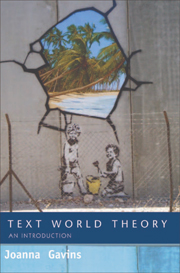
Text World Theory is a cognitive model of all human discourse processing. In this introductory textbook, Joanna Gavins sets out a usable framework for understanding mental representations. Text World Theory is explained using naturally occurring texts and real situations, including literary works, advertising discourse, the language of lonely hearts, horoscopes, route directions, cookery books and song lyrics. The book will therefore enable students, teachers and researchers to make practical use of the text-world framework in a wide range of linguistic and literary contexts. Features*An accessible and enabling course book which includes suggestions for exploration and further reading.*Draws on linguistics, cognitive science, psychology, philosophy, poetics and stylistics, and will be attractive to students and researchers working in all of these disciplines.*Each chapter provides a reader-friendly introduction to an aspect of Text World Theory and includes at least two practical applications of these ideas to real discourse examples.
'Identity' is a central organizing feature of our social world. Across the social sciences and humanities, it is increasingly treated as something that is actively and publicly accomplished in discourse. This book defines identity in its broadest sense, in terms of how people display who they are to each other. Each chapter examines a different discursive environment in which people do 'identity work': everyday conversation, institutional settings, narrative and stories, commodified contexts, spatial locations, and virtual environments. The authors describe and demonstrate a range of discourse and interaction analytic methods as they are put to use in the study of identity, including 'performative' analyses, conversation analysis, membership categorization analysis, critical discourse analysis, narrative analysis, positioning theory, discursive psychology and politeness theory. The book aims to give readers a clear sense of the coherence (or otherwise) of these different approaches, the practical steps taken in analysis, and their situation within broader critical debates. Through the use of detailed and original 'identity' case studies in a variety of spoken and written texts in order, the book offers a practical and accessible insight into what the discursive accomplishment of identity actually looks like, and how to go about analyzing it. Features:*Accessible introduction to the study of discourse and identity across a variety of contexts.*Interdisciplinary in scope, the book is relevant to a wide range of courses such as English language and linguistics, psychology, media, cultural studies, gender studies and sociology.*Each chapter includes a critical overview of work in the area, original case studies, practical instruction for analyses, points for further discussion and suggested reading.
This lively and accessible study of media and discourse combines theoretical reflection with empirical engagement, and brings together insights from a range of disciplines. Within media and cultural studies, the study of media texts is dominated by an exclusive focus on representation. This book adds long overdue attention to social interaction. The book is divided into two sections. The first outlines key theoretical issues and concepts, including informalisation, genre hybridisation, positioning, dialogism and discourse. The second is a sustained interrogation of social interaction in and around media. Re-examining issues of representation and interaction, it critically assesses work on the para-social and broadcast sociability, then explores distinct sites of interaction: production communities, audience communities and ‘interactivity’ with audiences. Key features* The book is rich with fascinating examples involving British and US media, including radio, television, magazines and newspapers and their Internet spin-offs.* It brings together insights from conversation analysis, critical discourse analysis, cultural studies and media anthropology.* It is key reading for advanced undergraduates and postgraduates doing media studies, communication and cultural studies and journalism studies.