To save content items to your account,
please confirm that you agree to abide by our usage policies.
If this is the first time you use this feature, you will be asked to authorise Cambridge Core to connect with your account.
Find out more about saving content to .
To save content items to your Kindle, first ensure no-reply@cambridge.org
is added to your Approved Personal Document E-mail List under your Personal Document Settings
on the Manage Your Content and Devices page of your Amazon account. Then enter the ‘name’ part
of your Kindle email address below.
Find out more about saving to your Kindle.
Note you can select to save to either the @free.kindle.com or @kindle.com variations.
‘@free.kindle.com’ emails are free but can only be saved to your device when it is connected to wi-fi.
‘@kindle.com’ emails can be delivered even when you are not connected to wi-fi, but note that service fees apply.
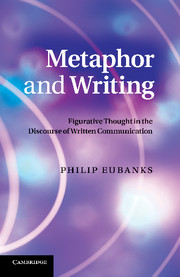
This volume explains how metaphors, metonymies, and other figures of thought interact cognitively and rhetorically to tell us what writing is and what it should do. Drawing on interviews with writing professionals and published commentary about writing, it argues that our everyday metaphors and metonymies for writing are part of a figurative rhetoric of writing - a pattern of discourse and thought that includes ways we categorize writers and writing; stories we tell about people who write; conceptual metaphors and metonymies used both to describe and to guide writing; and familiar, yet surprisingly adaptable, conceptual blends used routinely for imagining writing situations. The book will give scholars a fresh understanding of concepts such as 'voice', 'self', 'clarity', 'power', and the most basic figure of all: 'the writer'.
This book explains how everyday figures in the discourse of writing work with – and against – each other. It may seem that we already know plenty about our everyday figures for writing, that their very familiarity is what allows them to function. Yet the workings of even our most commonplace figures – to put thoughts onto paper, to find one's voice, to write clearly or forcefully or gracefully – can be poorly understood precisely because we make sense of them so automatically.
I suspect that is one reason that current scholarship has proceeded as it has. With only a few exceptions, scholarly work on familiar metaphors for writing, which is mostly in the field of writing studies, is based solely on introspection. Writing scholars have assumed, because they have an intuitive understanding of everyday writing metaphors, that their interpretations of them – and, more troubling, their interpretations of others' interpretations – require no further confirmation.
Typically, scholars have focused on one metaphor at a time, either pointing out a particular metaphor's strengths or shortcomings (e.g., voice or the Conduit Metaphor) or proposing a novel metaphor intended to clarify a particular question (e.g., Writing As Travel or Argument As Aikido). Certainly, these critiques and suggestions are valuable. But the introspective, one-metaphor-at-a-time approach does not take into account the ways that metaphors relate to other metaphors and to other figures.
By examining and extending student metaphors for composing, we gain valuable information not only about how students struggle with themselves to create a text but also how they struggle with their writing teacher over issues of power and authority.
Lad Tobin, “Bridging gaps: analyzing student metaphors for composing”
In this essay, I want to propose a shift away from such metaphors of territory and towards reconceiving rhetoric as something more like travel. What would change if we were to make such a shift? One thing that would change is our general understanding of the social context in which written texts have communicative function.
Gregory Clark, “Writing as travel, or rhetoric on the road”
Obviously, post-process theories that insist upon the radically situated nature of writing seem to embrace the conceptual metaphor of chaos rather than narrow conceptualizations of orderly writing (sometimes called “academic writing” as though there existed a single model for such artifacts).
Bonnie Lenore Kyburz, “Meaning finds a way: chaos (theory) and composition”
In the face of this negative history of grammatical mechanics in composition studies, therefore, I would like to suggest the mechanic as a figure for thinking about rhetoric and writing.
Jenny Edbauer Rice, “Rhetoric's mechanics: retooling the equipment of writing production”
Writing studies has long recognized the essential role of metaphor in shaping what we think about writing. In that sense, what I offer here is an addendum to an uncontroversial conclusion: If we want to think more carefully about who writers are, what writing is, and how writing affects our lives, we should pay attention to our figurative language and thought.
Dysgraphia is a form of agraphia, the total inability to write. It is seen in children who are slow to develop writing skills and in adults who acquire the syndrome due to brain injury.
Diane Walton Cavey, Dysgraphia: Why Johnny Can't Write
America's universities don't teach college kids how to write – at least, not how to write very well.
Stanley K. Ridgley, National Review Online
While it is impossible to make a competent writer out of a bad writer, and while it is equally impossible to make a great writer out of a good one, it is possible, with lots of hard work, dedication, and timely help, to make a good writer out of a merely competent one.
Stephen King, On Writing
If we hope to understand our important metaphors and metonymies for writing, we also have to understand the stories that license these figures. As I found in my earlier research on metaphors in the discourse of trade and business, metaphors are integrally associated with stories that provide rhetorical support – that make a given metaphor seem either true or false. When I asked a series of focus-group participants to discuss whether or not certain metaphors seemed true to them (e.g., Trade Is War, Trade Is A Game, Markets Are Containers, Trade Is A Journey), they persistently justified their responses by supplying stories of how trade works or how the world works.
The content of writing is speech, just as the written word is the content of print, and print is the content of the telegraph. If it is asked, “What is the content of speech?,” it is necessary to say, “It is an actual process of thought, which is in itself nonverbal.”
Marshall McLuhan, Understanding Media
Dear 'Owells –
I've struck it! And I will give it away – to you. You will never know how much enjoyment you have lost until you get to dictating your autobiography; then you will realize, with a pang, that you might have been doing it all your life if you had only had the luck to think of it. And you'll be astonished (& charmed) to see how like talk it is, & how real it sounds, & how well & compactly & sequentially it constructs itself, & what a dewy & breezy & woodsy freshness it has, & what a darling & and worshipful absence of the signs of starch, & flat iron, & labor & fuss & the other artificialities! Mrs. Clemens is an exacting critic, but I have not talked a sentence yet that she has wanted altered. […]
Everyone communicates, and a lot of people write, but few people dare to call themselves “writers.” If you feel like an impostor, take a deep breath and remind yourself of your unique purpose and how important it is. Or take on a fictional persona and write through that mask.
Eight ways to conjure your writing genie,Maximizing Meaning in Your Text (web tutorial)
What I have offered in the preceding chapters is not an exhaustive account of all of the figures we use to talk about and think about writing. Other figures come easily to mind. For instance, when we write arguments, we are sure to encounter Argument Is War – a metaphor brought to our attention by George Lakoff and Mark Johnson in their ground-breaking book, Metaphors We Live By. The metaphor of Flow is just as common, as is its corollary, Writer's Block. We often encounter metaphors of cooking, tasting, chewing, and swallowing. Metaphors of birth and nurturing abound. So do many, many more.
But my objective has not been to catalog all of the everyday figures that populate the discourse of writing. Instead, I hope to have described the conversation that shapes our ordinary figurative discourse about writing. All of the figures we use in order to think about writing operate in relation to that conversation. Once we understand the patterned way that conversation proceeds, we stand a good chance, I believe, of making sense of the countless metaphors and metonymies we use to describe writers and writing.
Knowing how to express yourself in clear, concise, and correct written English is a key factor for success in the twenty-first century. Writing with confidence and skill allows you to communicate your feelings, ideas, hopes, and fears. In this chapter, you'll explore why writing is so important, no matter who you are or what you do.
Laurie Rozakis, The Complete Idiot's Guide to Writing
Each time we categorize writing at the basic level rather than above or below it, we have to ask ourselves fundamental questions about what it means to able to write: If you are a writer, does that mean you are an expert at writing everything – novels, biographies, product manuals, press releases? If you know how to write, does that mean you are equally competent to write term papers and screenplays? Or do writer and to write refer to something narrower?
We encounter the same kinds of questions when we categorize texts. Some of us think that it is not possible, really, to write a book; it is only possible to write something more specific: a novel or a crime novel or, perhaps, a police procedural. Generally speaking, the more subordinate the category, the more specific – that is, nontransferable – the knowledge and skills. I have seen best-selling author Harlan Coben described as the “master of the soft-centered suburban thriller” (Wiegand 2007). A subordinate category indeed. And a very particular sort of writing expertise.
I argued in the previous chapter that we cannot make sense of the Conduit Metaphor unless we consider the metaphors that are closely related to it, most evidently Language Is Power. But that is only the beginning. We also need to ask: What stories license the Conduit Metaphor? And – just as important – what imaginative achievements would we sacrifice if we did not have the Conduit Metaphor?
The Conduit Metaphor has been denounced by scholars, in large part, because it has been associated with a story of writing and communication that certainly deserves to be criticized. It is a story of “good writing” in its narrowest conception: writing that flows in one direction only, from writer to readership, and is associated predominantly with values such as factual and grammatical correctness, precision, detachment, and objectivity. That narrow good-writer story ignores what makes many of us value most about writing: the possibility that writing can engage a reader – intellectually, emotionally, spiritually. In short, it is a story of impersonal skill rather than of rhetorical sensitivity.
Your job as a writer is much more than just selling your books, believe it or not. Your job – if you want to make a living at this, anyway – is to sell yourself.
Holly Lisle, Ten Steps to Finding Your Writing Voice
There's nothing to writing. All you do is sit down at a typewriter and open a vein.
Red Smith, Red: A Biography of Red Smith
The figure of self is closely related to voice and presents many of the same problems. As we have seen already, writing–speech–self metonymies operate pervasively and complexly. The voice is contiguous with language, which is contiguous with thought. The brain is part of the body, which is contiguous with the self – the mind, the soul, the spirit, the character, the personality. But even noticing this abundance of metonymies does not give us a rich enough sense of how we ordinarily bring together voice and self.
As with voice, recent scholarship on writing and the self rests on a strong assumption that most of us hold onto the naïve concept of a unitary, stable, independent core self. Such a self, writing scholars (and others) point out, is a fiction – if a convenient one – that ignores the multiple, fluid, and permeable discourses we actually use to construct our so-called “selves.”
I believe I can say, without overstating the case, that no element of our figurative rhetoric of writing is more important than the Conduit Metaphor. It is known by various names such as “the container metaphor,” “the transmission model,” “the code model,” and in Carolyn Miller's well-known formulation the “windowpane theory of communication.” According to the Conduit Metaphor, language contains meaning; speakers and writers use linguistic containers to send meaning to audiences; and, at the end of the line, audiences remove the unaltered meaning from its container. Many language scholars, including writing specialists, have raised objections to the Conduit Metaphor, objections that vary in motivation and rationale. What is most striking to me, however, is not the variety of analysis applied to the Conduit Metaphor but the nearly unanimous condemnation the metaphor elicits.
Almost universally, current language scholars object that language is fundamentally indirect, imprecise, contingent, and unstable; thus we never transmit a perfect representation of the “external” world through a secure pipeline leading from giver to receiver (e.g., Miller 1979; Bizzell 1982; Slack, Miller, and Doak 1993; Axley 1996; Weiss 1997; Prior 1998; Bowden 1999; Longo 2000; Evans 2003; Cowley and Love 2006; Krzeszowski 2006). In short, most of us have said that the Conduit Metaphor is wrong because language does not work the way the metaphor assumes.
First, try to be something, anything, else. A movie star/astronaut. A movie star/missionary. A movie star/kindergarten teacher. President of the World. Fail miserably. It is best if you fail at an early age – say, 14.
Lorrie Moore, “How to become a writer”
Dear Mr. Blue,
I always imagined that I would be a writer. Unfortunately, I just don't write and can't even seem to begin. This past winter the idea of becoming an architect jumped into my head. I want to believe that I have some great artistic calling and that when I hear the call it will be unmistakable. I do think architecture is fascinating, and I have passionate feelings about how things should be built, but it doesn't seem to fit my heart like the idea of writing a story does. What do you think? Do only great people get called?
Hearing Voices
Dear Hearing,
It strikes me that, more than enjoying the process, you may desire the outcome. You don't want to write, you want to have written. That isn't a calling; it's just plain covetousness. Get over it.
Garrison Keillor, Mr. Blue
Turn to almost any page in any book about writing, or listen to any conversation between people who care about writing, and you are likely to come across a metaphor that is familiar or striking – or both. In a single paragraph of the time-honored The Elements of Style, we encounter words that “ignite” and “explode in the mind,” prose that is like “music … capable of stirring the listener deeply,” writing that is done “clearly,” and writers who “steer by the stars” (Strunk and White 2008: 66).
Meaning, Discourse and Society investigates the construction of reality within discourse. When people talk about things such as language, the mind, globalisation or weeds, they are less discussing the outside world than objects they have created collaboratively by talking about them. Wolfgang Teubert shows that meaning cannot be found in mental concepts or neural activity, as implied by the cognitive sciences. He argues instead that meaning is negotiated and knowledge is created by symbolic interaction, thus taking language as a social, rather than a mental, phenomenon. Discourses, Teubert contends, can be viewed as collective minds, enabling the members of discourse communities to make sense of themselves and of the world around them. By taking an active stance in constructing the reality they share, people thus can take part in moulding the world in accordance with their perceived needs.