To save content items to your account,
please confirm that you agree to abide by our usage policies.
If this is the first time you use this feature, you will be asked to authorise Cambridge Core to connect with your account.
Find out more about saving content to .
To save content items to your Kindle, first ensure no-reply@cambridge.org
is added to your Approved Personal Document E-mail List under your Personal Document Settings
on the Manage Your Content and Devices page of your Amazon account. Then enter the ‘name’ part
of your Kindle email address below.
Find out more about saving to your Kindle.
Note you can select to save to either the @free.kindle.com or @kindle.com variations.
‘@free.kindle.com’ emails are free but can only be saved to your device when it is connected to wi-fi.
‘@kindle.com’ emails can be delivered even when you are not connected to wi-fi, but note that service fees apply.
Since democratization in 1996, political legitimacy has become the dominant issue in every presidential election in Taiwan. While the actual form of the debate varies, we can always grasp the gist with a nuclear theme: which political group that the presidential candidate represents can safeguard Taiwan's political sovereignty and meanwhile continue a fast-growing economy? On the surface, this question is not philosophical, and whoever proposes a convincing policy is more likely to win political legitimacy via an electoral victory. Deep down, however, many controversies associated with different political, ideological, and historical beliefs are entangled, and the battle for political legitimacy never ends with any particular election result. To understand the problem of political legitimacy in Taiwan, we have to identify the key dimensions of those controversies and explain how they affect the political trajectory in a given period of time.
The key dimensions of the political legitimacy problem can be characterized into four issue areas: (1) unification vs. independence, (2) Chinese vs. Taiwanese identity, (3) greater vs. lesser economic integration with China, and (4) the KMT's economic legacy vs. the DPP's antiauthoritarian legacy. These topics are closely related, and most of the time we can use the first term in each of these contrasts to describe the fundamental political views of KMT supporters, and the second term to describe the views of DPP supporters. Nevertheless, even among those who support the same political camp, discourses in these topics are easily malleable and reframed. Therefore, a proper characterization of this distinct political situation is crucial to illuminate how different power contenders justify their political legitimacy in running their presidential campaigns.
Over nineteen years of democracy in Taiwan, the political legitimacy crisis rose to a significant level during Chen Shui-bian's two-term presidency between 2000 and 2008. The most prominent sign was the intense polarized politics in which the political tension between supporters of the major contenders for power, the KMT and the DPP, was consistently high. Specifically, it was related to a deep political distrust in which each camp denied the other's right to rule. This sentiment was further aggravated by the electoral controversy in the 2004 presidential election and the subsequent political demonstrations. Some incidents even developed into serious political turmoil that could have jeopardized Taiwan's democracy. The crisis finally abated after KMT won a landslide victory under the leadership of Ma Ying-jeou in the 2008 presidential election.
Since the political handover in 1997, the government of the Hong Kong Special Administrative Region (HKSAR) has encountered repeated challenges to its governance and political legitimacy. Previous studies on the question of political legitimacy in Hong Kong found that the colonial government rested its legitimacy mainly on performance foundations, which were narrowly defined as maintaining good order, economic prosperity, and administrative efficiency. These studies further observed that not until the 1990s were such performance legitimacy foundations broadened to include maintaining the rule of law, the delivery of effective public policies, the protection of basic civic liberties, and the provision of social services and welfare.
This chapter nevertheless argues that before and after the 1990s, popular conceptions of political legitimacy in Hong Kong have always been mixed and beyond the narrowly defined performance foundations. In fact, recent developments in Hong Kong, most notably, the renowned “Umbrella Movement” in the fall of 2014, which had involved tens of thousands of young pro-democracy protestors, and other previous public actions, such as the Anti-National Education Protest in 2012, the siege at the Legislative Council building protesting the Guangzhou–Shenzhen–Hong Kong Express Rail in 2010, and the July 1 rally of half a million people against the national security bill in 2003, have provided further counter evidence against these early analyses. Despite Hong Kong's economic stability and growth over the decades, except for the few years during the Asian financial crisis, these social movements, especially those organized by the younger generations, have prompted further reflection on the definition of a legitimate government for the citizens of Hong Kong. This is an understanding that goes beyond performance standards and includes universal values such as a democratic government, equality, and policy fairness.
This chapter, based on survey results and the case of Anti-Express Rail Protest in 2010, aims to unravel the popular conceptions of political legitimacy in Hong Kong with a specific focus on the meanings of a legitimate government. In doing so, it argues against the once prevalent belief that the people of Hong Kong had endorsed a narrow concept of performance legitimacy. While it may be true that the idea of performance legitimacy prevailed during colonial times, other elements of political legitimacy also existed. Popular conceptions of political legitimacy in Hong Kong, as argued in this chapter, have instead been a hybrid, consisting of multiple and inconsistent standards.
By
Melissa S. Williams, University of Toronto,
Joseph Chan, Department of Politics and Public Administration at the University of Hong Kong,
Doh Chull Shin, University of California, Irvine
A political order enjoys legitimacy when its citizens or subjects have reason to believe that its claim to power is based on rightful authority, and its exercise of power can be justified according to accepted principles or norms. Political legitimacy is thus always a two-sided affair; intrinsically, it entails both empirical and normative dimensions. Understood from an empirical or sociological point of view, a state or regime is legitimate to the extent that its people accept its authority and see its actions as justifiable according to reasons they accept as valid. The normative dimension of legitimacy concerns the question of whether the norms by which the political order justifies its power ought to be regarded as valid norms. A state can enjoy sociological legitimacy without meeting coherent criteria of normative legitimacy. A state that can be rationally justified according to a particular conception of normative legitimacy may not be legitimate in the eyes of its people if they do not embrace the normative premises that underwrite this justification. To fully understand the dynamics of political legitimation in a given context requires attentiveness to both its empirical and normative aspects.
Yet despite repeated admonitions from scholars who study political legitimacy, most scholarly work on the concept tends to address its normative and empirical dimensions as separate enterprises. Political philosophers seek to identify the principles for evaluating the moral justifiability of political power. Empirical social scientists investigate the factors behind a people's acceptance or rejection of political elites’ claims to govern. Neither approach seems to be entirely satisfactory on its own. A purely normative approach that abstracts away from particular contexts in constructing an ideal theory of legitimacy is vulnerable to the challenge that it has little practical relevance. Legitimacy is about power relations between rulers and ruled; surely a consideration of the reasons that motivate agents in a particular order is relevant to evaluating the legitimacy of power relations in that order. Likewise, a social scientific approach that takes citizens’ statements of support for a state as indicators of political legitimacy has not shed much light on the state's legitimacy or illegitimacy if it has not also probed the normative principles according to which they believe the state's actions to be justified.
This volume grows out of a multiyear international research collaboration, East Asian Perspectives on Politics, whose broad purpose is to help advance the emerging field of comparative political theory. Our aim, like that of the growing number of scholars working on non-Western political thought, is to “deparochialize political theory,” that is, to decenter European traditions of thought in defining the parameters of our field. The project on East Asian Perspectives on Politics proceeded through a series of six workshops, held between 2010 and 2012, at leading universities in East Asia and Canada: Fudan University, the National University of Singapore, Seoul National University, the University of Hong Kong, Keio University, and the University of Victoria. The project has also received significant institutional support from the Centre for Ethics at the University of Toronto and the Peter Wall Institute at the University of British Columbia.
The project would not have been possible without the generous financial support and visionary leadership of the Shibusawa Ei'ichi Memorial Foundation, based in Tokyo, Japan. It is exceedingly rare for research foundations to take a chance on a research field that has not yet garnered widespread recognition in the academy. Comparative political theory has come into common parlance in the past several years, and a small but growing number of universities have designated the field as a target for faculty recruitment. But the field was barely on the horizon in 2005, when the Shibusawa Foundation sponsored a special panel on cross-cultural political thought at a colloquium at the University of Toronto. We are deeply indebted to the foundation, and in particular to its president, Masahide Shibusawa; its managing director, Jun'etsu Komatsu; and its research director, Masato Kimura.
We also owe an enormous debt of gratitude to the Social Sciences and Humanities Research Council of Canada for significant financial support for this project. This support not only made it possible to involve many Canadian scholars in the project but also to foster the work of talented younger scholars through the graduate workshops that accompanied each conference.
Thanks to the encouragement and sage guidance of Dr. Kimura, the initial panel discussion in Toronto led to a series of planning workshops for a more ambitious research collaboration.
Legitimacy is much more than a matter of theoretical or philosophical speculation; it rather constitutes the basis of very real differences in the empirical structure of domination. The reason for this fact lies in the generally observable need of any power, or even of any advantage of life, to justify itself.
– Max Weber
We have to speak of “multiple modernities,” different ways of erecting and animating the institutional forms that are becoming inescapable.
– Charles Taylor
INTRODUCTION
Political legitimacy is centrally concerned with the justification of political authority: what reasons do people have to obey the commands (comply with the law, follow the rules) of a political order? So understood, legitimacy is an intrinsically normative construct: not any reason counts toward legitimacy, but only reasons that are valid from a moral point of view. As Max Weber acknowledged, people have many different reasons to comply with the dictates of political power holders, but only some of these reasons – the normative ones – count toward the legitimacy of a regime. Hope of benefits and fear of sanctions constitute prudential reasons for obedience, but they do not reflect the people's judgment whether the political order is justified in its exercise of power. Thus while many interpreters of the distinction between empirical and normative accounts of political legitimacy characterize the former as “descriptive” and the latter as “prescriptive,” this is misleading. It makes perfect sense for empirical social scientists to seek to understand the degree to which a particular political order enjoys legitimacy in the eyes of its people, but to be meaningful this endeavor must take account of whether the people believe its power of command to be justifiable according to some normative principle that they endorse.
In Western intellectual traditions, theoretical accounts of political legitimacy are deeply connected to the circumstances of modernity. The connection between modernity and theories of political legitimacy is equally strong for the social scientific tradition inaugurated by Max Weber and for the normative tradition of political philosophy stretching from Locke and Rousseau to Rawls and Habermas.
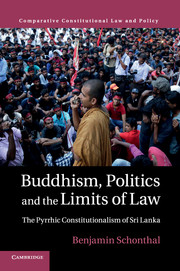
It is widely assumed that a well-designed and well-implemented constitution can help ensure religious harmony in modern states. Yet how correct is this assumption? Drawing on groundbreaking research from Sri Lanka, this book argues persuasively for another possibility: when it comes to religion, relying on constitutional law may not be helpful, but harmful; constitutional practice may give way to pyrrhic constitutionalism. Written in a lucid and direct style, and aimed at both specialists and non-specialists, Buddhism, Politics and the Limits of Law explains why constitutional law has deepened, rather than diminished, conflicts over religion in Sri Lanka. Examining the roles of Buddhist monks, civil society groups, political coalitions and more, the book provides the first extended study of the legal regulation of religion in Sri Lanka as well as the first book-length analysis of the intersections of Buddhism and contemporary constitutional law.
Edited by
Yun-chien Chang, Academia Sinica, Taipei, Taiwan,Wei Shen, Shandong University, People's Republic of China,Wen-yeu Wang, National Taiwan University
Edited by
Yun-chien Chang, Academia Sinica, Taipei, Taiwan,Wei Shen, Shandong University, People's Republic of China,Wen-yeu Wang, National Taiwan University
Edited by
Yun-chien Chang, Academia Sinica, Taipei, Taiwan,Wei Shen, Shandong University, People's Republic of China,Wen-yeu Wang, National Taiwan University
Edited by
Yun-chien Chang, Academia Sinica, Taipei, Taiwan,Wei Shen, Shandong University, People's Republic of China,Wen-yeu Wang, National Taiwan University