To save content items to your account,
please confirm that you agree to abide by our usage policies.
If this is the first time you use this feature, you will be asked to authorise Cambridge Core to connect with your account.
Find out more about saving content to .
To save content items to your Kindle, first ensure no-reply@cambridge.org
is added to your Approved Personal Document E-mail List under your Personal Document Settings
on the Manage Your Content and Devices page of your Amazon account. Then enter the ‘name’ part
of your Kindle email address below.
Find out more about saving to your Kindle.
Note you can select to save to either the @free.kindle.com or @kindle.com variations.
‘@free.kindle.com’ emails are free but can only be saved to your device when it is connected to wi-fi.
‘@kindle.com’ emails can be delivered even when you are not connected to wi-fi, but note that service fees apply.
The chapters in this volume put on display the difficulties lawyers, judges, and lawmakers continue to have making sense of custom as a source of law. These debates, whether about the lack of a workable definition, the instability of norms, the democracy deficit, the lack of fidelity to the strictly descriptive – rather than normative – nature of custom, or the unpredictability of courts, are not new. Despite the efforts of lawyers over the centuries to “solve” the problem of custom, publicists’ arguments today look little different from those of the medieval jurists, and the decisions of the International Court of Justice rather resemble those of premodern courts. As David Bederman pointed out not long ago in his book, Custom as a Source of Law, the discussion of custom has not advanced very far in all this time, and the uncertainties have come no closer to being resolved.
This chapter argues that the modern publicists’ problems with custom grow out of the efforts of the medieval jurists to fit custom into the hierarchy of law. Trained in formal law, lawyers and judges expect all legally binding rules to have the characteristics of rules found in statute books and judicial opinions. This sort of lawyerly bias has its origin in the twelfth century, when the European tradition of formal legal study began. But custom had a prelegal existence, and in this “natural” state it did not fit the mold of enacted law. Natural custom was fluid, uncertain, equitable, and communitarian – features of a system of social regulation that lawyers no longer equate with law. Instead, for nearly 900 years, jurists and judges have been trying to force custom to look like what they have been trained to believe law is, and for nearly 900 years they have failed. Natural custom might, in certain circumstances, have functioned as law, but it did not function like law.
At the root of the lawyers’ failure to fit the square peg of custom into the round hole of law lay the insistence on a definition of custom that may describe no phenomenon that truly existed in the real world of communities governing themselves bottom-up without enacted law. The definition Western legal systems inherited from the Romans and bequeathed upon the rest of the world is a legal fiction.
Immanuel Kant notoriously declared that it was a “scandal of philosophy” that it had not yet furnished us with a convincing proof of the existence of an external world. International lawyers have their equivalent occupational scandal: the failure to achieve clarity or consensus on the nature of customary international law. Custom, after all, is arguably the most fundamental source of international law, at least insofar as treaty law is itself embedded within a customary framework. This framework includes various principles bearing on the interpretation of treaties and arguably also the grundnorm of treaty law, pacta sunt servanda. Indeed, the international lawyer's scandal goes deeper. All of us, philosophers or not, standardly proceed on the basis that a world external to our senses exists. By contrast, assertions about customary international law are largely confined to international lawyers, although their being taken seriously occasionally has real practical consequences for others.
It is not enough to respond to this state of affairs with a knee-jerk pragmatism: the shop-worn thesis that customary international law works well enough “in practice” and so requires no explication “in theory.” After all, this simply presupposes that we already know what customary international law is, and merely shifts attention to whether it “works.” In any case, it is doubtful that anything can satisfactorily “work” in a discursive and legitimacy-claiming practice if its very nature remains stubbornly opaque or conceptually problematic. Equally, we should not be put off by the skeptical dogma that all of our moral-political ideas are infected with contradictions at their very core, so that the search for an explanation that makes good sense of them is doomed from the outset. Even the alluring consolations of intellectual resignation need to be earned by argument rather than mere fiat.
In this chapter, by drawing on, clarifying, and extending previous work, I try to sketch the argument that the pragmatists and skeptics take to be either unnecessary or impossible. I offer a moral judgment-based account (MJA) of customary international law, one that challenges the orthodox idea that there is a deep connection between custom and consent, and I mobilize the ensuing account in relation to human rights norms in particular.
Today there is great debate about just how long customary international law takes to form, and how it can be changed. Ranged on one side are those “traditionalists” who maintain that customary law requires both (1) consistent state practice, and (2) opinio juris sive necessitatis, a belief among states that a customary practice is legally binding. Moreover, these traditionalists argue that both elements must persist over some extended period of time. That is, state practice must be longstanding, and even the opinio juris must be well grounded and consistent through time. This long gestation period, in turn, gives customary norms permanence and rootedness. This same quality of rootedness can make customary law norms difficult to change. That is because for a norm to change, both elements must be modified, and this modification, too, ought to take some time under the traditional view.
According to the traditional view, customary international law is like a giant ocean liner. It takes a long time to get up to cruising speed, and once it is headed in a particular direction, much effort is required to cause it to change course. Furthermore, the traditional view also is not merely a jurisprudential one about what characteristics customary international law “has.” It also incorporates a normative dimension, and traditionalists argue that there are good reasons for making customary international law difficult to create, and difficult to modify.
Ranged against this traditional view is an army of new approaches to customary international law, all of which view it as a more dynamic process and as more susceptible to change. According to some of these theories, a new consistent state practice can arise very quickly; no particular duration of the practice is required to establish a corresponding new norm of customary international law. Likewise, opinio juris can be formed in an “instant,” or at least very quickly. And some theories minimize or dispense with either the state practice requirement or the opinio juris requirement, thus making it even easier for customary norms to be created, or changed, since only one element needs changing.
This clash of approaches and theories has left customary law in a jurisprudential crisis. We might dismiss this as just another academic conundrum, of little interest to practitioners, except that customary international law is assuming enormous importance practically in a wide variety of fields.
Large parts of the international economic order remain governed by “soft laws,” with the more notable exception of international trade and investment regulation. But because the trade and investment areas have been the result of treaty lawmaking, the role of custom has become concealed under a patchwork of treaty rules. Out of sight, custom is not only out of mind, but its utility is scorned. In other areas, such as the immunity of states from commercial claims, a combination of treaty, custom, and national laws has filled the gap in public international law regulation. By shifting attention from lawmaking to international economic law's “adjudicative aspects,” this chapter intends to, first, defend custom's continued importance in international economic law, particularly in the arbitral interpretation of investment treaty clauses, that is, in the protection of property and contracts. In contrast, custom's potential role in respect of trade-related treaty clauses is still largely unrealized. The chapter proceeds to discuss how questions about foreign sovereign immunity to commercial claims has been the result of minute domestic lawmaking, which in turn fashions detailed customary rules that are fleshed out in even greater detail by domestic courts. These illustrations from the trade, investment, and commercial spheres illustrate some of the ways in which custom continues to be useful, whether or not custom is as fully utilized – as in the trade area – as it should be.
Second, this chapter responds to current criticisms of custom's supposed deficiencies in making new international law, particularly in global economic regulation. It argues, against the grain of the current literature, that (i) custom is at least as susceptible as treaties to detailed customization in design, (ii) like treaties, customary lawmaking can also be formed through complex tradeoffs (and that custom is not simply achieved through “in-kind” reciprocity), and, finally, (iii) custom's lack of predictability is overstated. My contention is that custom is more useful than we might think in making new laws because the same diplomatic, organizational, and institutionalized methods that are used today to make and remake treaty laws also create custom and that these methods address many of the weaknesses that are usually attributed, in the abstract, to customary lawmaking.
Consider the great modern challenges to international society: global environmental protection, international public health, cybersecurity, financial crisis, and liberalization of movement of goods, services, and people. As will be explained in detail, it is unimaginable that customary international law (CIL) can provide effective mechanisms by which to address these challenges. Consider also some of the longer-term challenges: suppressing and regulating war, protecting human rights, and reducing poverty. While CIL has played an important role in regulating war and protecting human rights, this chapter argues that it has now done about all that it can do in those areas. It is time to focus the world's attention on more effective mechanisms by which to address all of these challenges. These more effective mechanisms will include treaty-based hard law and soft law.
CIL has not been around forever, and it responded to particular historical circumstances. While CIL had roots in Roman law, and while an early mention of a variant of modern CIL was contained in Francisco Suarez's De Legibus ac cleo legislatore, in 1612, Hugo Grotius is considered to have articulated the modern version of CIL later in the seventeenth century. CIL doctrine has changed over time since then, and there is no reason to think that it will not change in the future, and even that it will not be superseded by other mechanisms for international cooperation.
The demands made of international law up until the latter part of the twentieth century were quite different from those in view today. The law of coexistence, in Wolfgang Friedmann's dichotomy, provided the basis for diplomatic interaction that allowed for informal – nonlegal – give and take. As Friedmann explained in his seminal 1964 work, The Changing Structure of International Law, “The principal preoccupation of the classical international law, as formulated by Grotius and the other founders, was the formalization, and the establishment of generally acceptable rules of conduct in international diplomacy.” Note that these were formal rules designed to facilitate informal interaction. They formalized the process of diplomacy, not the substance of international cooperation. The law of coexistence was largely established by CIL. In the law of coexistence, states were equal, their interests were the same, and the rules did not need to change much to face new problems. CIL served these purposes reasonably well.
The International Law Commission (ILC or the Commission) has a mandate from the United Nations (UN) General Assembly (the UNGA or the General Assembly) to codify and progressively develop international law. During most of the ILC's history, the lion's share of its work product took the form of draft articles adopted by the UNGA as the basis for multilateral conventions. The ILC's activities received their principal legal effect during this period through the UN treaty-making process, rather than directly on the basis of the ILC's analysis of what customary international law (CIL or custom) does or should require.
In recent decades, however, the ILC has self-consciously limited its efforts to codify or progressively develop international law in the form of multilateral conventions. Instead, it has turned to other outputs – such as principles, conclusions, and draft articles, that it does not recommend be turned into treaties. Significantly, the Commission often claims that these outputs reflect CIL. For example, despite recommending that the General Assembly not base a treaty on the Draft Articles on State Responsibility, the ILC as well as many states and commentators assert that the draft articles largely reflect CIL.
This change in behavior presents a puzzle. If the ILC is still engaged in codification and progressive development, why has it changed the form of the work it produces? In this chapter, we argue that increasing political gridlock in the General Assembly – by which we mean a division of views over the substance of international norms and lack of enthusiasm for convening multilateral diplomatic conferences – has led the Commission to modify the form of its work to preserve its influence in shaping the evolution of international law. More specifically, we argue that the reduced likelihood of the General Assembly adopting draft articles as treaties closes off the primary mechanism of ILC influence. In addition, if the UNGA or member states reject an ILC recommendation that its draft articles become treaties, that rejection may suggest that the work product does not reflect existing custom – an alternative mechanism of ILC influence. To avoid these negative outcomes, we expect the ILC to turn to other outputs that allow it to continue to influence CIL without the General Assembly's approval.
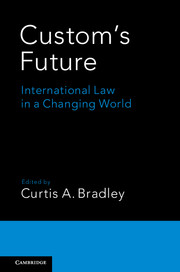
Although customary international law has long been an important source of rights and obligations in international relations, there has been extensive debate in recent years about whether this body of law is equipped to address complex modern problems such as climate change, international terrorism, and global financial instability. In addition, there is growing uncertainty about how, precisely, international and domestic courts should identify rules of customary international law. Custom's Future seeks to address this uncertainty by providing a better understanding of how customary international law has developed over time, the way in which it is applied in practice, and the challenges that it faces going forward. Reflecting an interdisciplinary mix of historical, empirical, economic, philosophical, and doctrinal analysis, and containing chapters by leading international law experts, it will be of use to lawyers, judges, and researchers alike.