To save content items to your account,
please confirm that you agree to abide by our usage policies.
If this is the first time you use this feature, you will be asked to authorise Cambridge Core to connect with your account.
Find out more about saving content to .
To save content items to your Kindle, first ensure no-reply@cambridge.org
is added to your Approved Personal Document E-mail List under your Personal Document Settings
on the Manage Your Content and Devices page of your Amazon account. Then enter the ‘name’ part
of your Kindle email address below.
Find out more about saving to your Kindle.
Note you can select to save to either the @free.kindle.com or @kindle.com variations.
‘@free.kindle.com’ emails are free but can only be saved to your device when it is connected to wi-fi.
‘@kindle.com’ emails can be delivered even when you are not connected to wi-fi, but note that service fees apply.
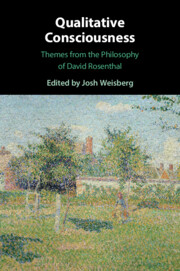
Qualitative consciousness is conscious experience marked by the presence of sensory qualities, like the experienced painfulness of having a piano dropped on your foot or the consciousness of seeing the brilliant reds and oranges of a sunset. Over his career, philosopher David Rosenthal has defended an influential theoretical approach to explaining qualitative consciousness. This approach involves the development of two theories – the higher-order thought theory of mental state consciousness and the quality-space theory of sensory quality. If the problem of explaining qualitative consciousness is divided into two more manageable pieces, the door opens to a satisfying explanation of what is seen by some to be an intractable explanatory puzzle. This interdisciplinary collection develops, criticizes, and expands upon themes inspired by Rosenthal’s work. The result is an exciting collection of new essays by philosophers and scientists, which will be of interest to all those engaged in consciousness studies.
Qualitative consciousness is conscious experience marked by the presence of sensory qualities, like the experienced painfulness of having a piano dropped on your foot, or the consciousness of seeing the brilliant reds and oranges of a sunset. Over his career, philosopher David Rosenthal has defended an influential theoretical approach to explaining qualitative consciousness. This approach involves the development of two theories – the higher-order thought theory of mental state consciousness and the quality space theory of sensory quality. If the problem of explaining qualitative consciousness is divided into two more manageable pieces, the door opens to a satisfying explanation of what is seen by some to be an intractable explanatory puzzle. This interdisciplinary collection develops, criticizes, and expands upon themes inspired by Rosenthal's work. The result is an exciting collection of new essays by philosophers and scientists, which will be of interest to all those engaged in consciousness studies.
This chapter begins with a review of insight problem solving done by infrahuman animals. This work started when Wolfgang Köhler performed his informal studies of chimpanzees over 100 years ago on Tenerife. Are chimps smart because they have large brains? The size of its brain seems to be only weakly related to an animal's intelligence. What seem to be more important are the mental mechanisms that an animal uses, including, or perhaps primarily, the animal’s ability to visualize physical and geometrical transformations, such as the ability to realize that one's reflection in a mirror is a 3D image of one’s body. This ability was tested extensively with both chimpanzees and monkeys. A more elaborate experimental design was subsequently used to test the chimps’ ability to perform visual-motor coordinations with a transformed camera image. Next, the problem-solving ability of crows, parrots, and hyenas is described, and this chapter ends with the presentation of results of experiments performed by chimps and monkeys on solving the traveling salesman problem (TSP). The TSP is one of the best-studied problems both in cognitive psychology and in computer science. Human performance on the TSP is discussed in detail in the following two chapters. You will discover how sophisticated, but naïve, human subjects are when confronted with solving the TSP.
This concluding chapter summarizes the key concepts discussed in this book. Once problem solving is accepted as any goal-directed activity, it becomes clear that problem solving can be viewed as a framework for discussing all of our cognitive functions. Mental representations are important not only because they can be changed and lead to insight. Abstract mental representations also lead to goal-directed actions in which mental functions can cause physical actions. The AI community is no longer surprised by this fact, so the time has come for the cognitive community to accept it, too. This book puts forth a conjecture that the symmetry of a problem representation is the key to solving problems intelligently, that is, the way humans solve them. Symmetry is essential in scientific discovery, in ordinary insight problems, and in combinatorial optimization problems as well. Combinatorial optimization problems have enormous search spaces, but humans know how to avoid performing search by using a direction. This is analogous to the way a least-action principle operates in physics. The path that requires the least effort can be produced in a step by step process where the next step is made without considering alternatives. All of this makes it clear, finally, why intuitive physics is real: mathematical concepts of symmetry and constrained optimization underlie both cognitive functions and the natural laws. These concepts have also been used in most engineering applications. This fact justifies the optimism that AI systems should be able to emulate human intelligence.