To save content items to your account,
please confirm that you agree to abide by our usage policies.
If this is the first time you use this feature, you will be asked to authorise Cambridge Core to connect with your account.
Find out more about saving content to .
To save content items to your Kindle, first ensure no-reply@cambridge.org
is added to your Approved Personal Document E-mail List under your Personal Document Settings
on the Manage Your Content and Devices page of your Amazon account. Then enter the ‘name’ part
of your Kindle email address below.
Find out more about saving to your Kindle.
Note you can select to save to either the @free.kindle.com or @kindle.com variations.
‘@free.kindle.com’ emails are free but can only be saved to your device when it is connected to wi-fi.
‘@kindle.com’ emails can be delivered even when you are not connected to wi-fi, but note that service fees apply.
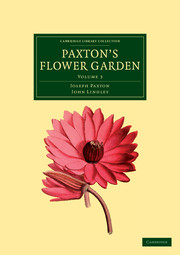
Best remembered today for his innovative design for the Crystal Palace of 1851, Joseph Paxton (1803–65) was head gardener to the Duke of Devonshire at Chatsworth by the age of twenty-three, and remained involved in gardening throughout his life. Tapping in to the burgeoning interest in gardening amongst the Victorians, in 1841 he founded the periodical The Gardener's Chronicle with the botanist John Lindley (1799–1865), with whom he had worked on a Government report on Kew Gardens. Paxton's Flower Garden appeared between 1850 and 1853, following a series of plant-collecting expeditions. Only three of the planned ten volumes were published, but with hand-coloured plates (which can be viewed online alongside this reissue) and over 500 woodcuts, the work is lavish. Volume 3 includes further studies of numerous orchids, and Captain Cook's account of the discovery of the pine that would take his name, Araucaria cookii (Captain Cook's Pine).
World population is forecast to grow from 7 to 9 billion by 2050, 1 in 6 is already hungry and food production must increase by 70-100% if it is to feed this growing population. No single solution will solve this problem but recent developments in the genetic technologies of plant breeding can help to increase agricultural efficiencies and save people from hunger in a sustainable manner, particularly in African nations where the need is greatest. These advances can rapidly incorporate new traits and tailor existing crops to meet new requirements and also greatly reduce the time and costs taken to improve local crop varieties. This book provides a collected, reliable, succinct review which deals expressly with the successful implementation of the new plant genetic sciences in emerging economies in the context of the interrelated key regulatory, social, ethical, political and trade matters.
Understanding how photosynthesis responds to the environment is crucial for improving plant production and maintaining biodiversity in the context of global change. Covering all aspects of photosynthesis, from basic concepts to methodologies, from the organelle to whole ecosystem levels, this is an integrated guide to photosynthesis in an environmentally dynamic context. Focusing on the ecophysiology of photosynthesis – how photosynthesis varies in time and space, responds and adapts to environmental conditions and differs among species within an evolutionary context – the book features contributions from leaders in the field. The approach is interdisciplinary and the topics covered have applications for ecology, environmental sciences, agronomy, forestry and meteorology. It also addresses applied fields such as climate change, biomass and biofuel production and genetic engineering, making a valuable contribution to our understanding of the impacts of climate change on the primary productivity of the globe and on ecosystem stability.
The rhythm of life on Earth includes several strong themes contributed by Kingdom Fungi. So why are fungi ignored when theorists ponder the origin of life? Casting aside common theories that life originated in an oceanic primeval soup, in a deep, hot place, or even a warm little pond, this is a mycological perspective on the emergence of life on Earth. The author traces the crucial role played by the first biofilms – products of aerosols, storms, volcanic plumes and rainout from a turbulent atmosphere – which formed in volcanic caves 4 billion years ago. Moore describes how these biofilms contributed to the formation of the first prokaryotic cells, and later, unicellular stem eukaryotes, highlighting the role of the fungal grade of organisation in the evolution of higher organisms. Based on the latest research, this is a unique account of the origin of life and its evolutionary diversity to the present day.
As I have shown above, there are several ways to synthesise prebiotic organic compounds, all of which seem to be realistic, though the extent of their contribution to the early Earth will in most cases depend on the exact environmental circumstances in the place and at the time that they arise. Nevertheless, any one or (most likely) all of the following processes will allow for the synthesis of at least some organic molecules that would contribute to making the Earth habitable (Bernstein, 2006; Cady, 2001; Ehrenfreund et al., 2002, 2005; Ehrenfreund & Cami, 2010; Zahnle et al., 2007, 2010):
Spark discharge synthesis: in practice this means lightning but also includes the effects of high energy solar radiation, especially UV, in the atmosphere. The outcome depends on the oxidation state of the atmosphere and on how much hydrogen is/was present; but although yields of organic products might be limited in the general atmosphere, considerable quantities of biogenic organic molecules could be made locally during volcanic eruptions (Parker et al., 2011).
Hydrothermal vent synthesis: high temperature chemistry in the water outflow of deep-ocean (black smoker) vents can generate interesting chemical pathways but the stability of amino acids and other compounds in these environments remains problematic, and such vents may actually purge the seawater of biogenic molecules. Cooler, alkaline (white smoker) vents support a wide range of organic synthesis and readily support production of bubbles bounded by an inorganic membrane across which a proton gradient is naturally established (Martin & Russell, 2007; Simoncini, Russell & Kleidon, 2011), which might be the primeval ancestor of chemiosmotic coupling; ‘an energy source that must have been available to emergent life’ (Russell, 2010).
Although fungal hyphae have few unique morphological features and most fungal structures are poor candidates for preservation over long periods of time as fossils, a respectable fossil record for fungi has been assembled in recent years. By far the most impressive fungi of the Ordovician/Devonian Period are specimens of the fossil genus Prototaxites, which were terrestrial organisms found from the mid Ordovician (460 million years ago) to the early Devonian, suggesting that they lasted a period of at least 40 million years (Boyce et al., 2007; Hueber, 2001). These fossils are among the ‘nematophyte phytodebris’ that constitutes the earliest evidence for terrestrial organisms. This ‘nematophyte phytodebris’ nomenclature was assigned in the middle of the nineteenth century and has no relevance to present-day understanding of taxonomy (that is, it does not necessarily indicate that the stuff was of plant origin); though it does indicate that confusion over the identification of the material is over 150 years old (see discussion in Hueber, 2001 and Taylor et al., 2010). Prototaxites specimens are generally large: over a metre wide (Wellman & Gray, 2000) and up to 8 m tall (Hueber, 2001) (Figs. 12.1 and 12.2; illustrated in colour in Moore et al., 2011, pp. 33–34). Prototaxites was also so common that it was a major component of these early terrestrial ecosystems, both in terms of abundance and diversity. Some of the earliest examples found were tree-like trunks constructed of interwoven tubes < 50 µm in diameter (concentrically arranged in transverse sections), and the fossils were interpreted to be small coniferous trees, though we now know that environments at the time Prototaxites was fossilised did not (yet) include large vascular plants.
In the narrative of life on Earth we have now reached the Archaean Eon (3.8 to 2.5 billion years ago); the age when chemistry came alive. During this period the Earth day increased from about 15 hours long to about 18 hours and the Sun brightened to 80% of its current level. At present, few data are available that are able to specify the atmospheric, oceanic or geological conditions on the early (prebiological) Earth. It can be reasonably assumed that conditions were very hostile due to volcanism, radiation, and continued bombardment by objects large and small from space; but it is likely that the average climate was temperate rather than extremely cold or hot (Kasting & Howard, 2006). As I have discussed in Chapter 6, there is no agreement on the gaseous composition of the primeval atmosphere apart from the general acceptance that oxygen was absent. According to Lazcano & Miller (1996): ‘atmospheric chemists mostly favor high CO2 + N2, whereas prebiotic chemists mostly favor more reducing conditions’. In fact high levels of carbon dioxide in the early atmosphere are indicated by the high level of carbonate minerals in rocks of that age.
One of the reasons for postulating reduced gases in the atmosphere of the early Earth is that such an atmosphere would have had a greenhouse effect, which would compensate for the dimmer Sun of the day and keep the Earth from freezing over (Sagan & Chyba, 1997). It is thought that there was a global glaciation in the mid Archaean, approximately 2.9 billion years ago, which might have been caused by a hydrocarbon haze shielding solar radiation, the haze resulting from methane photolysis after the newly evolved methanogens increased the atmospheric methane/carbon dioxide ratio. This glaciation ended as continued production of methane produced greenhouse warming. Subsequent to the success of photosynthetic organisms, increase in atmospheric oxygen decreased greenhouse warming by methane and probably caused global glaciation just after the end of the Archaean (approximately 2.4 billion years ago) in the early Palaeoproterozoic (Kasting & Howard, 2006). These glaciations show the fine balance required to avoid global freezing (‘snowball Earth’; see Fig. 11.2) primarily because of the faint early Sun. Sagan & Chyba (1997) calculated that an atmospheric mixing ratio of ammonia (the mixing ratio CX of a gas X is defined as the number of moles of X per mole of air) of only about 10–6 to 10–4 would have been sufficient on the early Earth to cause enough greenhouse warming to counteract the effects of reduced solar radiation.
In Chapter 4, I stated that ‘interstellar matter provides the raw material for the formation of stars and planets’ and it should now be evident that interstellar matter may well have also been important starting material for the origin of life on Earth (Bernstein, 2006; Chyba et al., 1990; Ehrenfreund & Cami, 2010; Ehrenfreund et al., 2002). In fact, in Hazen’s phrase:
The bottom line is that the prebiotic Earth had an embarrassment of organic riches derived from many likely sources. Carbon-rich molecules emerge from every conceivable environment. Amino acids, sugars, hydrocarbons, bases – all the key molecular species are there.
(Hazen, 2005, p. 127)
This being the case, and as there are so many plausible mechanisms for the synthesis of biogenic compounds in situ on planet Earth, it is surprising that so much attention has been given to the possibility that life came to Earth ready formed rather than originating here. The panspermia hypothesis claims that life exists throughout the Universe, with microbes drifting through interstellar and interplanetary space, transmitting life to the next habitable body they encounter. According to this view the Earth of long ago was colonised by microbes that had somehow escaped from their home planets to drift across the vast distances between the stars until they arrived on that primeval and sterile Earth. Panspermia should not be confused with pangenesis; the latter was Charles Darwin’s conjectural mechanism to explain heredity (he argued that inheritance depended on particles produced by each organ being transmitted from parent to offspring).