To save content items to your account,
please confirm that you agree to abide by our usage policies.
If this is the first time you use this feature, you will be asked to authorise Cambridge Core to connect with your account.
Find out more about saving content to .
To save content items to your Kindle, first ensure no-reply@cambridge.org
is added to your Approved Personal Document E-mail List under your Personal Document Settings
on the Manage Your Content and Devices page of your Amazon account. Then enter the ‘name’ part
of your Kindle email address below.
Find out more about saving to your Kindle.
Note you can select to save to either the @free.kindle.com or @kindle.com variations.
‘@free.kindle.com’ emails are free but can only be saved to your device when it is connected to wi-fi.
‘@kindle.com’ emails can be delivered even when you are not connected to wi-fi, but note that service fees apply.
With a focus on Hugo Blick’s Black Earth Rising(2018), this chapter maps how a larger justicestory develops around conflicting interpersonalrelations, while at the same time attending to thelarger geopolitical story and a darkness-basedcolonial imaginary. Attentive to the cartographicand subjective repositioning made possible by KateAshby’s locus of enunciation, we illustrate howthe international criminal justice regime andhumanitarian reason is entangled with violentshadow worlds that are revealed when she confrontsthe fraught exchanges within which values areocculted, institutions created, and personalrelationships built. Ultimately, these violentshadow worlds are brought to the fore when oneattends to the violence-laundering and implicitpractices of exchange along with what we call “theburying, burrowing, and blinding” practices thatBlack Earth Rising depicts. Through aninvestigative montage, the series providesinsights into shadow worlds behind and beneath thelarge geopolitical theater as well as the maps ofjustice, atrocity, and intimacy that connectRwanda, the Democratic Republic of the Congo, TheHague, France, London, and the U.S.
John Fletcher’s Rome is the first book to explore Fletcher’s engagement with classical antiquity. Fletcher was the most influential playwright of the Jacobean era, whose canon amounts to around 10 per cent of the extant plays of the early modern commercial theatre. Like his more celebrated contemporaries Shakespeare and Jonson, Fletcher wrote, alone or in collaboration, a number of Roman plays: Bonduca, Valentinian, The False One, and The Prophetess. Unlike Shakespeare’s or Jonson’s plays, however, Fletcher’s Roman plays have seldom been the subject of sustained critical discussion. This groundbreaking study examines these plays as a group for the first time, identifying disorientation as the unifying principle of Fletcher’s portrayal of imperial Rome. John Fletcher’s Rome argues that Fletcher’s dramatization of ancient Rome exudes a sense of scepticism regarding the authority of ancient models that is connected to his irreverent approach to classical texts. In doing so, the book sheds new light on Fletcher’s intellectual life, provides fresh insights into his vision of history, illuminates the interconnections between the Roman plays and the rest of his canon, and offers a corrective to dominant narratives that equate Shakespeare’s Rome with ancient Rome as perceived in the early modern imagination in general. As we approach the quatercentenary of Fletcher’s death in 2025, John Fletcher’s Rome offers a worthwhile reappraisal of a playwright who produced a dispirited yet vibrant dramatization of the ancient Roman world that shines as a uniquely gripping instance of the reception of the classical past on the early modern stage.
The conclusion briefly focuses on the recurrence of allusions to the Roman legend of Marcus Curtius in a number of plays in the canon as exemplifying Fletcher’s overall approach to classical texts, paradigms, and values as illustrated throughout the book, thereby rehearsing the main claims advanced in the previous chapters. It is argued that Fletcher’s predilection for the writings of the historians of Late Antiquity is decisive in shaping his bleak Roman world. The pessimistic vision of a disoriented imperial Rome that Fletcher offers in his dramatic works brings his Roman plays close to the Trauerspiel as described by Walter Benjamin, especially their grim depiction of a history devoid of purpose and transcendent meaning. Fletcher thus emerges as a more profound historical and political thinker than is traditionally acknowledged in scholarship. The conclusion also explores Fletcher’s irreverent classicism and his penchant for combining classical and contemporary texts and translations – as well as his fondness for using recently published books ¬– and how his approach to classical sources is connected with his broader attitude towards Roman exempla, especially as regards the women of classical antiquity, whose exemplarity he is not inclined to take at face value. Fletcher’s scepticism as to the passivity of the Roman women who populate his plays is also mirrored in his overall rejection of the precepts of stoicism, while his consistent de-solemnizing approach to the classics is even more excitingly exemplified by his treatment of Shakespeare as to all intents and purposes a classic.
The introduction offers some general remarks about John Fletcher’s career and canon, as well as about the reception of the ancient Roman past in the early modern English imagination; it then describes the scope of the book, its aims, and methodology, before illustrating the contents of each chapter. It concludes by arguing that the book seeks to contribute to the fields of Fletcher studies and the reception of classical materials on the early modern stage by offering fresh perspectives on the treatment of source materials in early modern drama, providing correctives to Shakespeare-centric studies of early modern visions of Rome, and intervening in discussions about early modern historiography, gender, collaboration practices, and the overall place of drama within the larger cultural field.
This chapter focuses on the contrast between Roman and non-Roman female characters in Fletcher’s Roman plays. The non-Roman women of the canon display superior dynamism, assertiveness, and complexity than the Roman women, who remain dependent on patriarchal values and male gazes, their roles being limited to those of wives, widows, or prostitutes. More than examples of chastity, virtue, or corruption, the non-Roman women instead wield actual power and accomplish actions that have a significant bearing on reality. Such an evident contrast fosters the impression that Fletcher and his collaborators found the women of ancient Rome hardly adequate for the development of their ideal ‘masculine’ female characters. Scepticism about the value system encoded by Roman female models also seeps from the allusions and appeals to Roman paragons that recur so frequently across the Fletcher canon, their largest share pointing to exempla drawn from the history of the Roman Republic and especially to Lucrece and Portia. The negative judgement of the Roman women’s passivity chimes with the canon’s general tendency either to shun or implicitly criticize the tenets of stoicism as they emerge in such plays as The Little French Lawyer, Valentinian, The Captain, and The Loyal Subject. This also reinforces the idea that Fletcher’s engagement with the Roman past may have influenced his thinking and dramatic craft when writing plays not set in ancient Rome. Just as with Fletcher’s choice of sources, which tends to privilege continental Renaissance publications over the classics and suggests little sense of his having found any solemnity in classical texts, these female exempla cannot be followed or adopted solely by virtue of their antiquity. In fact, it is their very antiquity that keeps them firmly stuck in the past, thereby making them unpalatable and hardly viable as guides for the present and the future.
This chapter describes and examines at length the ways in which Fletcher portrays Rome as a corrupted political reality facing irreversible decay, and how he depicts a Rome in crisis and profoundly unsettled by the lack of adequate political leaders and the apparent lack of interest on the part of the gods in human affairs. The only area left to Roman men to prove their virtus is the battlefield, but this emerges as insufficient to offset the violence, the opportunism, and the dejection that exude from the plays, which chimes with the wider scepticism as to the dependability of Roman models and exempla that pervades his canon. In general terms, Fletcher’s Roman plays depict a dissolving Rome that is prey to a deep sense of disorientation; in doing so, they express a pessimistic vision of history and human life, which makes them resemble in some respects the seventeenth-century German Trauerspiel, or mourning play (as opposed to Tragödie), as famously examined by Walter Benjamin. A fresh examination of Fletcher’s depiction of classical history reveals him as a much sharper observer of reality than is usually recognized, not only in the immediacy of the here and now but also in terms of the larger changes and tendencies that are continually at work in history and politics.
This chapter begins by providing an account of Fletcher’s education and then offers a thorough and systematic analysis of the ways in which Fletcher selected and approached his classical sources in the context of his writing practice, something that has never been done before in such a comprehensive way. This leads to the identification of a modus operandi that appears to have been distinctive to Fletcher’s deployment of the classics. Fletcher was fond of consulting works by historians of Late Antiquity (especially Greek ones) rather than those belonging to the ‘golden age’ of Latin historiography. This choice of unexpected sources seems to have had a role in determining the sense of disorientation that comes across as the cipher of Fletcher’s portrayal of Rome, especially insofar as those historians generally provided a depiction of Rome that tended to be more pessimistic than that offered by golden-age writers. This chapter then considers Valentinian and The Prophetess in close detail as two case studies that effectively exemplify Fletcher’s approach to his classical sources, which also characteristically entails what appears to have been a programmatic intention to combine well-known materials with recently published works. Finally, the chapter relates Fletcher’s de facto rejection of the grammar school canon in his dramatic writing to his depiction of scholars and learning in his plays, thereby shedding light on a potential connection between his life experiences and his portrayal of education.
The chapter offers a survey of the debt of the Fletcher canon to Shakespeare’s Roman plays in general and then focuses on Valentinian, Bonduca, The False One, and The Prophetess. Valentinian is in conversation with Julius Caesar. Bonduca is shown to refashion motifs from Cymbeline and Antony and Cleopatra. The False One draws upon both Julius Caesar and Antony and Cleopatra. The discussion of The Prophetess sheds light on Fletcher and Massinger’s appropriation of Julius Caesar and Antony and Cleopatra, particularly as concerns the depiction of Diocletian, who is modelled more after Shakespeare’s Antony than the historical emperor. Fletcher appears to put Shakespeare’s Roman plays on the same level as the accounts of the classical historians, interweaving Shakespeare’s dramatic retellings of Roman history with actual historical accounts. The Shakespearean example seems to direct the choices and decisions of the Fletcherian characters by bestowing on them a kind of prescience of future events. When Fletcher’s Roman plays are considered in the broader context of the King’s Men’s repertory, the possibility arises that the effect of this Shakespearean memory could have been enhanced if the same actors performed different roles in different plays. While Fletcher’s conversation with Shakespeare’s Roman plays spans his entire career, it intensifies in 1619–23, when he seems to have been attracted to previously unpublished plays and when work towards the publication of Shakespeare’s First Folio was under way. The chapter ends by wondering whether Fletcher might have had a role in the First Folio’s preparation
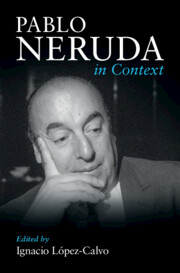
Pablo Neruda in Context includes forty-two essays by some of the main experts on Pablo Neruda's oeuvre that focus on how his places of residence and travel (Mexico, Argentina, Spain, France, Asia), the landmark event of the Cold War, as well as literary and political influences affected his poetic evolution. It also considers the other genres of his writing, including memoirs, letters, translation, and drama, as well as the musical and film adaptions of his work throughout the world. Other essays study his anti-colonial and ecocritical messages, his complicated relationships with women and other writers, as well as his take on race and the significance of his plausible assassination by Augusto Pinochet's military junta. The last section explores Neruda's poetry as world literature as well as his impressive reception in India, Japan, China, the Arab world, the Anglophone world, Russia and Eastern Europe, and his overall lasting legacy.
This book analyses three Shakespearean plays that mainly deal with abusive forms of banishment: King Richard II, Coriolanus and King Lear. These plays present with particular clarity the mechanism of the banishment proclamation and its consequences, that is, the dynamic of exclusion and its repercussions. Those repercussions may entail breaking the ban to come back illegally and seek revenge; devising strategies of deviation, such as disguise and change of identity; or resorting to mental subterfuges as a means of refuge. They may also lead to entropy – exhaustion, letting go or heartbreak. Each in its own way, they invite us to reflect upon the complex articulation between banishment and abuse of power, upon the strategies of resistance and displacement employed to shun or endure the painful experience of ‘deterritorialisation’; they put into play the dialectics of allegiance and disobedience, of fearlessly speaking and silencing, of endurance and exhaustion; they question both the legitimacy of power and the limits of human resistance. This study draws on French scholars in Shakespearean studies, and also on contemporary French historians, theorists, anthropologists, psychoanalysts, essayists and philosophers, who can help us read Shakespeare’s plays in our time. It thus takes into account some of the works of Roland Barthes, Michel Foucault, Gilles Deleuze and Felix Guattari, Gaston Bachelard, Marcel Detienne and Jean-Pierre Vernant, Boris Cyrulnik and Emmanuel Housset. The hope is that their respective intellectual approaches will shed specific kinds of light on Shakespeare’s plays and initiate a fruitful dialogue with Anglo-Saxon criticism.
Shakespeare’’s tutor: The influence of Thomas Kyd defines the early modern playwright Thomas Kyd’’s dramatic corpus and indicates where and how Kyd contributed to the development of Shakespeare’’s dramas. Scholars have yet to recognise the extent to which Kyd influenced Shakespeare, nor the full extent of his surviving dramatic corpus. This book collects and sifts a wide range of evidence in favour of an ‘‘enlarged’’ Kyd canon while introducing cutting-edge digital resources for authorship attribution purposes. Through a combination of computational and traditional literary-critical analysis, Darren Freebury-Jones makes a case for Kyd’’s authorship of six sole-authored plays: The Spanish Tragedy, Soliman and Perseda, King Leir, Arden of Faversham, Fair Em, and Cornelia. The book demonstrates the fibrous influence that Kyd exerted on Shakespeare’’s phraseology, verse style, and overall dramaturgy, and proposes that Shakespeare’’s dramatic output was, in part at least, dependent on processes of adaptation and collaboration with Kyd. A wealth of evidence indicates that Shakespeare and Kyd’’s relationship extended to revision and co-authorship in plays such as Henry VI Part One, Edward III, and the 1602 additions to The Spanish Tragedy. The book situates Kyd and Shakespeare’s plays in their original historical context: the narrow and intensely competitive as well as collaborative world of the London theatres. Dramatists such as Shakespeare were also actors, and would develop an intimate familiarity with plays in which they had performed. Ground-breaking in its implications for our understanding of Shakespeare’s dramatic development, the book aims to revolutionise our understanding of the early modern canon.