To save content items to your account,
please confirm that you agree to abide by our usage policies.
If this is the first time you use this feature, you will be asked to authorise Cambridge Core to connect with your account.
Find out more about saving content to .
To save content items to your Kindle, first ensure no-reply@cambridge.org
is added to your Approved Personal Document E-mail List under your Personal Document Settings
on the Manage Your Content and Devices page of your Amazon account. Then enter the ‘name’ part
of your Kindle email address below.
Find out more about saving to your Kindle.
Note you can select to save to either the @free.kindle.com or @kindle.com variations.
‘@free.kindle.com’ emails are free but can only be saved to your device when it is connected to wi-fi.
‘@kindle.com’ emails can be delivered even when you are not connected to wi-fi, but note that service fees apply.
This chapter demonstrates R’s capabilities for statistical analysis and data science applications. It covers data importing from CSV/TSV files into R dataframes and computing basic statistics (mean, median, mode, variance, standard deviation) using built-in functions.
The chapter explores data visualization with ggplot2, creating histograms, bar charts, pie charts, and scatterplots for effective data presentation. Key statistical concepts include correlation analysis to measure variable relationships and statistical inference through hypothesis testing.
Practical statistical tests covered include t-tests for comparing two group means and ANOVA for comparing multiple groups. The chapter emphasizes R’s strengths in statistical computing, providing hands-on examples with real datasets and demonstrating how to interpret results for data-driven decision making.
This introductory chapter defines data science as a field focused on collecting, storing, and processing data to derive meaningful insights for decision-making. It explores data science applications across diverse sectors including finance, healthcare, politics, public policy, urban planning, education, and libraries. The chapter examines how data science relates to statistics, computer science, engineering, business analytics, and information science, while introducing computational thinking as a fundamental skill. It discusses the explosive growth of data (the 3Vs: velocity, volume, variety) and essential skills for data scientists, including statistical knowledge, programming abilities, and data literacy. The chapter concludes by addressing critical ethical concerns around privacy, bias, and fairness in data science practice.
This chapter introduces R, a free, open-source programming environment designed for data analysis and statistical computing. It covers R installation through RStudio IDE and demonstrates fundamental programming concepts including basic syntax, mathematical operations, and logical operators.
Key topics include data types (numeric, integer, character, logical, factor), data structures (vectors, matrices, lists), control structures (if-else statements, for/while loops), and functions for code organization and reusability.
The chapter emphasizes R’s advantages for data science: powerful statistical capabilities, extensive package ecosystem, and built-in data handling features. It concludes with R Markdown, which enables creation of professional reports combining code, output, and documentation in a single document for reproducible research and presentation.
This chapter explores supervised learning techniques where algorithms learn from labeled training data to make predictions. It begins with logistic regression for binary classification problems, using the sigmoid function to output probabilities between 0 and 1. Softmax regression extends this to multi-class problems. The chapter covers k-nearest neighbors (kNN), which classifies data points based on their similarity to training examples. Decision trees use entropy and information gain to create interpretable classification rules, while random forests combine multiple decision trees to reduce overfitting through ensemble methods. Naive Bayes applies Bayes’ theorem with independence assumptions for probabilistic classification, particularly effective for text classification. Finally, support vector machines (SVM) find optimal decision boundaries by maximizing margins between classes. Each technique is demonstrated through hands-on Python examples using real datasets, showing practical applications in various domains from healthcare to finance.
Caleb Bernacchio and Robert Couch present an integrative account of business ethics from a neo-Aristotelian perspective. Engaging the Markets Failures Approach in Part I, they introduce the concept of 'eudaimonic efficiency' as a more realistic alternative to Pareto efficiency, before identifying several market virtues that promote human flourishing through mutually beneficial transactions. Turning to the firm in Part II, they identify a number of virtues that foster collaboration, support the development of a novel theory of value creation and associated strategic capabilities, and sustain effective corporate governance, contributing to the flourishing of customers, employees, and other stakeholders. In dialogue with Habermasian approaches to political CSR, Part III develops an account of stakeholder deliberation as an activity that contributes to eudaimonic efficiency by mitigating unjust harms stemming from negative externalities and other market failures. In doing this, they introduce an account of the virtues needed for effective deliberation between stakeholders.
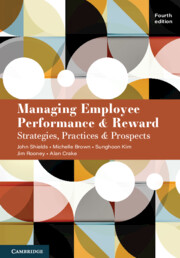
Managing Employee Performance and Reward: Strategies, Practices and Prospects covers two major components of human resource management: managing the performance of employees and how they are rewarded. The text's holistic approach focuses on two overarching objectives of an effective human resource management system: strategic alignment and employees' psychological engagement. The fourth edition has been streamlined to address more clearly the fundamental concepts, strategies and practices of performance and reward. A new chapter on pay negotiation and communication examines pay transparency policies and explores the factors affecting pay negotiation, with particular reference to gender and cultural identity. Each chapter includes discussion questions and 'reality checks' linking to the book's main themes of strategic alignment and psychological engagement. A new running case study takes students through realistic human resource management scenarios and encourages them to apply what they have learnt. Managing Employee Performance and Reward remains an indispensable resource for students and business professionals.
Our attention then turns to behaviourally based approaches to performance measurement involving the ‘rating’ (i.e. numerical scoring) of observable behaviours. By definition, behaviour is individual in nature, although multiple people may be involved in providing information on a given individual’s work behaviour. Here, we also consider the various sources of behavioural information, as well as how behavioural measurement can be implemented in order to shape employee behaviour in practice.We then explore the concepts and methods involved in the competency-based approach; an approach that, while also using behavioural measurement and information, is focused on using behavioural proxies to measure deep/submerged competencies that are assumed to predict high performance. Returning to points introduced in chapter 2, the final section provides practical insights regarding how results-based and behaviourally based measurement can be applied to support strategic alignment and psychological engagement. ‘Reality check’ inclusions invite you to consider how the practices covered in the chapter connect with each of these two overarching themes.
This chapter explores the historical, legal, and regulatory landscape of employment testing bias and fairness in Canada. Canada’s history of colonization and immigration has resulted in a multicultural society. In 1984, the landmark Abella Report, and the subsequent Employment Equity Act, established key protections for historically disadvantaged groups, shaping modern employment practices. The chapter discusses the jurisdictional complexities of employment law, detailing federal and provincial regulations that prohibit discrimination based on race, sex/gender, disability, and other characteristics. Legal frameworks (e.g., the Canadian Charter of Rights and Freedoms, the Canadian Human Rights Act, and the Employment Equity Act) define bias and fairness in employment testing. Key court case decisions illustrate legal principles guiding test validity and adverse impact. We also examine professional guidelines, burden of proof requirements, regulatory oversight, and emerging challenges such as AI-driven assessments and balancing validity with diversity. The legal landscape continues to evolve, with growing emphasis on fairness, transparency, and inclusion.
The Ghanaian employment space prioritizes procedural fairness, the basis on which the Labour Act, 2003 (Act 651) and the National Labour Commission were established. Other regulations govern certification and employment testing to uphold professional standards and worker rights. For instance, the Ghana Psychology Council regulates the certification and practice of psychologists who are also mindful of other guidelines such as the American Psychological Association (APA) Standards and Society for Industrial and Organizational Psychology (SIOP) Principles. The 1992 Constitution and the Labour Act, 2003 (Act 651) of Ghana further guarantee equality, prohibit employment discrimination based on race, sex, disability, religion, and age, with specific protection for children, the disabled, and women. For instance, women in Ghana are under-represented in the workplace, in response to which the Affirmative Action Law (Act 2024) was passed, aimed at improving equality and participation of women in decision making positions. With the increasing use of artificial intelligence in employment testing worldwide, Ghana has yet to establish formal regulations for the utilization of artificial intelligence in employee selection to ensure ethical standards and data protection.
This is a book about two activities integral to human resource management (HRM): managing employee performance and managing how employees are rewarded. As we shall see throughout the book, there is a close and complex interdependence between these two activities; so much so, that it makes little sense to consider them in isolation from each other. Equally, while the book’s central concerns are with performance and reward practices and processes, attention is also paid throughout to acknowledging and analysing the interconnectedness of these and other aspects of HRM. For example, performance management systems provide inputs into other human resource (HR) functions such as evaluating HR decisions regarding employee recruitment and selection, training and development, and employees’ psychological engagement and wellbeing.Chapter 1 introduces you to those ideas and concepts that are fundamental to a rounded understanding of employee performance and reward management and, equally, to well-informed and effective practice in these fields – from basic system aims and requirements to the concept of total reward management.
The chapter examines bias and fairness in employment testing in Italy, comparing the public and private sectors. Public sector hiring is strictly regulated, based on transparency, equality, and meritocracy, as stated in the Constitution. Hiring occurs through public competitions with standardized exams focused on qualifications and technical skills, with growing attention to soft skills. The private sector is more flexible, adapting selection to business needs and emphasizing practical skills, experience, and cultural fit, enabling quicker hiring. Private companies often use innovative methods, including AI tools and social media screening, and value diversity and international profiles. Italian labor laws, aligned with EU directives, prohibit discrimination based on sex/gender, ethnicity, religion, sexual orientation, or disability. Employers must ensure fair, compliant selection processes. Professional guidelines stress the use of valid, unbiased tools. The rise of technology in hiring highlights the need to manage algorithmic bias, with final decisions remaining a human responsibility.
This chapter explores some of the key practices, trends and issues associated with executive reward. We begin by considering the role of executives in corporate governance as well as three influential theories of executive motivation, behaviour and reward: tournament theory, agency theory and managerial power theory. We then review the main components of executive reward, as well asrecent trends in CEO reward level and composition in a number of developed countries. Attention then turns to the various short-term and long-term incentive plans and associated techniques, including performance targets or ‘hurdles’, currently applied to executives. Next, we examine the academic research evidence and arguments regarding the effectiveness of executive reward practices, particularly the extent of the association between company performance and executive pay outcomes. Applying a multi-stakeholder perspective, the concluding section canvasses some of the wider implications of executive reward practice, as well as outlining illustrative configurations for aligning executive performance management and reward with organisational strategic priorities in the case of listed for-profit firms.
This chapter explores the legal frameworks that govern employment testing in Australia, including federal and state anti-discrimination legislation, and evaluates their impact on employment testing in the country. Overall, despite the existence of legal protections for individuals from diverse demographic groups (e.g., culturally and linguistically diverse backgrounds, sex/gender, age), judicial scrutiny of discrimination in employment testing remains limited. Practical challenges, such as difficulties in gathering evidence of discrimination, and the prospect of limited financial compensation, may discourage legal action. Moreover, statistical evidence is neither widely used nor required to demonstrate discrimination, resulting in a regulatory environment where employment testing practices are often guided more by organizational discretion and international perspectives than by legal mandates. However, as hiring technologies continue to evolve, this chapter highlights the opportunity for stronger regulatory oversight and empirical rigor to ensure employment testing remains both equitable and legally defensible.