To save content items to your account,
please confirm that you agree to abide by our usage policies.
If this is the first time you use this feature, you will be asked to authorise Cambridge Core to connect with your account.
Find out more about saving content to .
To save content items to your Kindle, first ensure no-reply@cambridge.org
is added to your Approved Personal Document E-mail List under your Personal Document Settings
on the Manage Your Content and Devices page of your Amazon account. Then enter the ‘name’ part
of your Kindle email address below.
Find out more about saving to your Kindle.
Note you can select to save to either the @free.kindle.com or @kindle.com variations.
‘@free.kindle.com’ emails are free but can only be saved to your device when it is connected to wi-fi.
‘@kindle.com’ emails can be delivered even when you are not connected to wi-fi, but note that service fees apply.
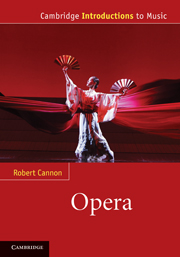
What is opera and how does it work? How has this dramatic form developed and what is its relevance in the modern world? Perfect for music students and opera-goers, this introductory guide addresses these questions and many more, exploring opera as a complete theatrical experience. Organised chronologically and avoiding technical musical terminology, the book clearly demonstrates how opera reflected and reacted to changes in the world around it. A special feature of the volume is the inclusion of illustrative tables throughout. These provide detailed, easy to follow analysis of arias, scenes and acts; visual guides to historical movements; and chronologies relating to genres and individual composers' works. Overall, the book fosters an understanding of opera as a living form as it encounters and uses material from an ever expanding repertoire in time, place and culture.
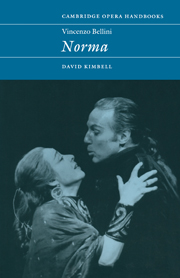
Norma is by common consent the finest of the ten operas composed during Vincenzo Bellini's short career, representing his genius more comprehensively than is usually the case with any single work by an operatic composer. This 1998 handbook provides the biographical and cultural context of the opera. It gives a full synopsis and an examination of the music and poetry, which is rooted in the aesthetics of early nineteenth-century Italian opera. Professor Kimbell suggests something of the impression Norma has made on our imaginations and sensibilities in the 165 years since it was first produced in Milan in December 1831. He considers the great interpretations of the eponymous leading role. His discussion also embraces Bellini's work more generally by presenting some of the critical reactions to his music.
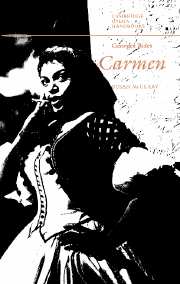
Bizet's Carmen is probably the best known opera of the standard repertoire, yet its very familiarity often prevents us from approaching it with the seriousness it deserves. This handbook explores the opera in a number of contexts, bringing to the surface the controversies over gender, race, class and musical propriety that greeted its premiere and that have been rekindled by the recent spate of film versions. Beginning with a study of the Mérimée story by Peter Robinson and an examination of the social tensions in nineteenth-century France that inform both that story and the opera, the book traces the latter through its genesis and reception. The central core of the book presents a close reading of the opera that offers new interpretive possibilities. The handbook concludes with discussions of four films based on the opera: Carmen Jones and the versions of Carmen by Carlos Saura, Peter Brook, and Francesco Rosi. The volume contains a bibliography, music examples, and a synopsis.
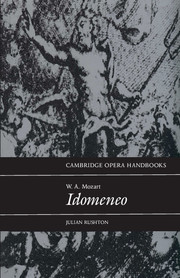
Idomeneo, by common consent Mozart's greatest opera seria, is a rich synthesis of the dramatic potentialities of Italian opera seria, French tragédie lyrique, and recent German opera. It was composed for the finest orchestra in Germany and some excellent singers. Mozart's relish of the challenge and his problems with some performers and the bureaucracy are uniquely documented in his letters home and these form the basis of a vivid account of the genesis of the opera. A detailed synopsis relates the musical and dramatic action of the opera. Further chapters trace the historical development of its subject matter 'from myth to libretto' and chart the opera's performance history, including a description of Richard Strauss's 1931 reworking. Later chapters consider the opera's general structure and the musical forms, and analyse passages of particular interest.
Mozart's enduring popularity, among music lovers as a composer and among music historians as a subject for continued study, lies at the heart of The Cambridge Mozart Encyclopedia. This reference book functions both as a starting point for information on specific works, people, places and concepts as well as a summation of current thinking about Mozart. The extended articles on genres reflect the latest in scholarship and new ways of thinking about the works while the articles on people and places provide historical framework, as well as interpretation. It also includes a series of thematic articles that cast a wide net over the eighteenth century and Mozart's relationship to it: these include Austria, Germany, aesthetics, travel, Enlightenment, Mozart as a reader and contemporaneous medicine, among others. The worklist provides the most up-to-date account in English of the authenticity and chronology of Mozart's compositions.
This essay explores how the soprano Caroline Carvalho (née Marie Félix-Miolan, 1827–95) perpetuated and extended the art of coloratura singing in the mid-nineteenth century. Creator of roles in sixteen operas, including five by Gounod, Carvalho achieved ‘superdiva’ status (Rutherford) by cultivating her voice – her ‘mécanisme prodigieux’ – to handle coloratura on a scale that explicitly invoked and rivalled the instrumental virtuosity of Paganini. In premièring the title role of Victor Massé's La Reine Topaze (1856), the soprano sang a variations aria based on the Carnival of Venice folk song and took one of the violinist's variations as a springboard to her own dazzling pyrotechnics. By allying her voice with the musical inventiveness of Paganini, who had achieved deific renown and artistic authority, Carvalho thereby acquired enough authority to catalyse a new genre, the valse-ariette. The popularity of a little-known aria that Gounod arranged for Carvalho, ‘Ah! Valse légère’ (based on the waltz chorus, ‘Ainsi que la brise légère’, from Act II of Faust, 1859), spurred a vogue for vertiginous waltz ariettes. Carvalho's association with this genre suggests even greater creative agency and indicates a shift in coloratura's signification from instrumentality to dance and the expressive body.
Responses to Korngold's 1920 opera Die tote Stadt have long been filtered through the lens of his later Hollywood career. To do so, however, not only risks misunderstanding the relationship between these two different spheres of the composer's output, but also ignores the opera's complex positioning within the gender discourses of early twentieth-century Vienna. This article offers a corrective to the clichéd view of Korngold the ‘pre-filmic’ opera composer by arguing that, in its treatment of the characters Marie and Marietta, Die tote Stadt draws on a tradition of ‘strangling blonde’ imagery from the nineteenth century in order to critique the gender theories of Otto Weininger (1880–1903), which were still current in the 1920s. As such, in its concern with the nature of femininity, Die tote Stadt also draws our attention to the modern woman who had just entered the composer's life, Luise (Luzi) von Sonnenthal.
What was the interplay between plumbing and the routines of audience behaviour at London's eighteenth-century opera house? A simple question, perhaps, but it proves to be a subject with scarce evidence, and even scarcer commentary. This article sets out to document as far as possible the developments in plumbing in the London theatres, moving from the chamber pot to the privy to the installation of the first water-closets, addressing questions of the audience's general behaviour, the beginnings in London of a ‘listening’ audience, and the performance of music between the acts. It concludes that the bills were performed without intervals, and that in an evening that frequently ran to four hours in length, audience members moved around the auditorium, and came and went much as they pleased (to the pot, privy or WC), demonstrating that singers would have had to contend throughout their performances with a large quantity of low-level noise.
Rameau's Platée owes much more to Aristophanes' comedy The Frogs than the frog chorus. The main character in The Frogs, Dionysus, may well have been the inspiration for many of the traits of the nymph Platée. Both rule over wetlands and their inhabitants, and both are subjected to extensive mockery. While Dionysus is a divine patron of the theatre, Platée is a visual metaphor for opera. Dionysus, disguised as Heracles, fails to measure up to the hero, exhibiting cowardly behaviour and physical weakness, just as Platée fails to speak and act as a satisfactory operatic heroine, the model for which is, arguably, Lully's Armide. The parodic elements in the debate between Aeschylus and Euripides over the nature and function of tragedy resonate with the parody of tragédie lyrique which lies at the heart of Rameau's opera.
In the first years of the twentieth century dramatists began looking for alternatives to the ‘hermetic’ drama, whether Naturalistic, Realistic, or Symbolist. Each of these was designed to draw the audience into an empathetic relationship with situations and characters so that they saw them and their dilemmas as inevitable and unchangeable. As Brecht wrote: ‘We would not wish to create the illusion of reality…Were one to create such an illusion that is all it would remain, and the audience would only see and consider it as such. Were the reality of life simply imitated then there would be nothing more to see or feel than in life itself. Which is not enough’ (Brecht, 1948: 38). What was needed was a dramaturgy that allowed the audience to understand that in every case a choice had been made and that there were alternatives. Brecht's aesthetic and dramaturgy were derived from Marxist dialectics and worked at two inter-locking levels:
The audience had to be enabled to read each action and decision as part of a man-made situation that was neither natural nor inevitable.
Each aspect of the action and its staging had to be made part of this process by declaring its own mechanism.
For Brecht this was part of a larger, Marxist, politic. But this kind of staging and dramatic theory produced a range of other applications. It allowed composers to separate out the different elements of which an opera was made so that coherence took place in the audience's consciousness. This shift is a hallmark of much late twentieth- and twenty-first-century opera (Table 17.1).