To save content items to your account,
please confirm that you agree to abide by our usage policies.
If this is the first time you use this feature, you will be asked to authorise Cambridge Core to connect with your account.
Find out more about saving content to .
To save content items to your Kindle, first ensure no-reply@cambridge.org
is added to your Approved Personal Document E-mail List under your Personal Document Settings
on the Manage Your Content and Devices page of your Amazon account. Then enter the ‘name’ part
of your Kindle email address below.
Find out more about saving to your Kindle.
Note you can select to save to either the @free.kindle.com or @kindle.com variations.
‘@free.kindle.com’ emails are free but can only be saved to your device when it is connected to wi-fi.
‘@kindle.com’ emails can be delivered even when you are not connected to wi-fi, but note that service fees apply.
How was Buridan’s thought shaped by its institutional setting and by pedagogical practice in the faculty of arts at the University of Paris? This essay argues that local circumstances are crucial not only for interpreting Buridan’s arguments, but also for understanding his larger contribution to the history of philosophy. Thus, we find that even working within the constraints of the arts curriculum, Buridan was always able to segue from established modes of instruction and prescribed topics to discuss philosophical problems of interest to him; in this he was no different from other arts masters of the period, and indeed, from university lecturers even today. But he also used his independence to embody, in ways he himself may not have fully understood, a new way of being a philosopher. Whereas a century earlier, Thomas Aquinas saw himself as a theologian and regarded philosophy as an activity proper to pagans such as Plato and Aristotle, Buridan sought to define what he was doing in contradistinction to theology, and on grounds we would now recognize as secular.
In the first two books of his massive commentary on Aristotle’s Physics (in the third and final redaction), Buridan pays ample attention to the composition of natural substances. Natural substances are composed of matter and (substantial) form. But what exactly does Buridan mean by the notions of “matter” and “(substantial) form”? Does matter possess some kind of being of its own? Is it pure potency? Does matter somehow possess a disposition (or “appetite”) to receive substantial forms, and what precisely are such forms? Buridan also offers a detailed account of the relation between natural substances and artificial things. How do artificial things (such as houses, tables, and axes) relate to the natural substances of which they are (somehow) made? What kind of change is involved in making an artifact and what kind of form makes an artifact the thing it is?
The prevailing view of Buridan’s theory of cognition and his epistemology is that he is a kind of externalist as well as a reliabilist. This essay argues that this reading is mistaken and that Buridan instead must be seen as a semantic and epistemic internalist. The essay develops the arguments for both these views. The first part of the essay supplements an argument already made by Claude Panaccio, but the second part is a new argument for why Buridan must be seen as an epistemological internalist. The essay also compares Buridan to later empiricists such as David Hume.
Scholars agree that Buridan’s commentary on the Nicomachean Ethics gives far more attention to Seneca’s works than other commentaries of the period do. Buridan cites Seneca on one topic after another, always respectfully and often with praise. But did his study of Seneca lead him to a generally negative view about the role of emotions in morality? On this topic scholars clearly disagree. One claims that there are hardly any positive references to the emotions in Buridan’s entire Ethics commentary. Buridan emphasizes instead that emotions must be repressed by the will. Another scholar claims, to the contrary, that Buridan is in no sense a disciple of Seneca. For example, he follows Aristotle in arguing that anger can have genuine value and should not be completely eliminated. This essay examines Buridan’s account of anger and his discussions of some other emotions to clarify his views on how emotions contribute to a virtuous life.
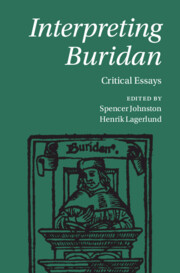
John Buridan (d. 1362) is one of the great thinkers of the later Middle Ages. He is perhaps best known for his contributions to logic, but the range of his thought is wide. This volume of new essays, written by leading Buridan scholars, places Buridan in his philosophical context and examines his writings on logic, modal logic, paradoxes, metaphysics, epistemology, and natural philosophy. It also introduces several new topics of discussion that have not so far been dealt with in scholarship on Buridan, such as his theory of knowledge, his view of artefacts, his conception of women, his writing on emotions, and his moral philosophy. Together the essays produce a rich picture of Buridan's thought and underline the continuing relevance of his philosophical concerns.
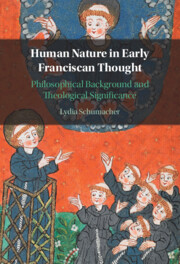
In this book, Lydia Schumacher challenges the common assumption that early Franciscan thought simply reiterates the longstanding tradition of Augustine. She demonstrates how scholars from this tradition incorporated the work of Islamic and Jewish philosophers, whose works had recently been translated from Arabic, with a view to developing a unique approach to questions of human nature. These questions pertain to perennial philosophical concerns about the relationship between the body and the soul, the work of human cognition and sensation, and the power of free will. By highlighting the Arabic sources of early Franciscan views on these matters, Schumacher illustrates how scholars working in the early thirteenth century anticipated later developments in Franciscan thought which have often been described as novel or unprecedented. Above all, her study demonstrates that the early Franciscan philosophy of human nature was formulated with a view to bolstering the order's specific theological and religious ideals.
This chapter treats the response of John of La Rochelle’s Summa de anima and the Summa Halensis to three major questions on the relationship between the body and the soul that were debated amongst early scholastic theologians who engaged with Greek and Arabic philosophical sources. These questions concern whether it is composed of matter and form; the union of the soul to the body; and whether there is a medium between the soul and the body. The chapter situates early Franciscan ideas about these issues in the context of those advocated by other major scholastic theologians at the time.
The introduction outlines the goals of the book in light of the state of research on early Franciscan thought, which tends to be described as a mere reiteration of the tradition of Augustine. The chapter explains how the book will challenge this assumption through a study of the work of John of La Rochelle and his Franciscan colleagues, who authored the so-called Summa Halensis, which drew extensively on medieval Islamic and Jewish philosophy to develop distinctly Franciscan positions on different aspects of human nature.
The conclusion summarizes the findings of every chapter with a view to bolstering the book’s main contention, namely, that early Franciscan thought on human nature is chiefly indebted to Islamic and Jewish sources originally written in Arabic rather than to Augustine. As the chapter re-iterates, the early Franciscan invocation of pseudo-Augustinian sources was part of a strategy for legitimizing the use of those newer philosophical sources. These in turn aided them in the construction of a unique tradition of philosophical thought, which accorded with the theological values of the Franciscan religious order.
This chapter briefly examines how the Summa Halensis approaches some of the main topics treated in this book – such as the soul’s relation to the body, cognition, and free will – in the case of angels which are not subject to the bodily limitations of humans but can nevertheless assume a human body in order to minister to humans on behalf of the divine.
This chapter turns from questions of cognition to those related to volition, and, in particular, to the preliminary movements of the sense appetite which lay the foundation for the work of free will. John departs from past precedent in describing these appetites as only partially due to the passive reception of sense data and as entailing an active if preliminary movement of the will towards or away from its objects. In this way, he seems to anticipate John Duns Scotus’ theory of the will and its affections.
This chapter traces the development of the psychology John of La Rochelle presents in his Tractatus and Summa de anima in the section on the rational soul in the Summa Halensis, which was not authored by John himself but clearly draws heavily on his thought. This work has often been said to offer a typically Augustinian theory of cognition, but the close examination of it in light of John’s writings suggests an at best tangential relationship with merely pseudo-Augustinian works, which were invoked as a means to legitimizing the use of Avicenna’s psychology.
This chapter intervenes in a longstanding debate about the origins of a psychological schema that is found in both of John’s works on the soul as well as in the Summa Halensis. This is the distinction between the material intellect, which is connected to the body, on the one hand, and the agent and possible intellects, which are separable from the body, on the other. Some past scholars have traced this scheme to Averroes’ distinction between a corruptible and an incorruptible intellect, while others have pointed out that there is insufficient evidence of Averroes’ influence at this time to support that attribution. The chapter gathers evidence which suggests that the scheme is a Latin scholastic invention which draws primarily on Avicenna and Aristotle rather than Averroes.