To save content items to your account,
please confirm that you agree to abide by our usage policies.
If this is the first time you use this feature, you will be asked to authorise Cambridge Core to connect with your account.
Find out more about saving content to .
To save content items to your Kindle, first ensure no-reply@cambridge.org
is added to your Approved Personal Document E-mail List under your Personal Document Settings
on the Manage Your Content and Devices page of your Amazon account. Then enter the ‘name’ part
of your Kindle email address below.
Find out more about saving to your Kindle.
Note you can select to save to either the @free.kindle.com or @kindle.com variations.
‘@free.kindle.com’ emails are free but can only be saved to your device when it is connected to wi-fi.
‘@kindle.com’ emails can be delivered even when you are not connected to wi-fi, but note that service fees apply.
iv.1.1 We must examine justice and injustice, the kinds of actions that they are concerned with, the kind of mean point that justice is, and what it is a mean between. iv.1.2 Let our investigation use the same method as our preceding discussions.
iv.1.3 Now we see that everyone wishes to speak of justice as the kind of state that makes people inclined to do just deeds, to act justly, and to wish for what is just. Injustice is spoken of in the same manner, as that which makes people do injustice and wish for what is unjust. So let this be laid down as our initial outline too.
iv.1.4 There is a disanalogy between kinds of knowledge and capacities on the one hand, and states on the other. It seems that with a capacity or a kind of knowledge, the same one encompasses opposites, whereas any state that is opposite to another does not encompass opposites. For example, opposite outcomes do not result from health, only healthy ones, since we say that someone walks healthily whenever he walks as a healthy person would.
i.1.1 The poet who declared his opinion at the god’s site in Delos, inscribing it on the gateway of the Temple of Leto, distinguished the good, the fine and the pleasant as not all belonging to the same thing. He wrote: ‘Finest is what is most just, best is being healthy, most pleasant of all is to attain what one desires.’ We should not agree with him. For happiness, being finest and best, is the most pleasant of all things.
i.1.2 There are many points of interest concerning each kind of object and nature that create difficulty and need examining. Some of these pertain only to our knowing, others pertain to the acquisition of the object and to actions as well. i.1.3 Regarding those that involve only theoretical philosophy, we must state, when the right opportunity presents itself, whatever is appropriate to the field of enquiry. i.1.4 First, however, we must examine what living well consists in and how it is to be achieved.
Do all who acquire this label get to be happy by nature, as with tallness and shortness and differences in skin colour? Or is it through learning, happiness being a kind of knowledge? Or is it through some sort of practice? After all, people acquire many qualities not by nature or learning but by habituation; bad qualities if they are badly habituated, good qualities if they are well habituated. Or is it in none of these ways, i.1.5 but in one or other of the following: by the influence of some divine force, like those people possessed by nymphs or gods, as if inspired; or by luck, since many people claim that happiness and good fortune are the same thing? i.1.6 Evidently it comes to be present in people in all or some or one of these ways. For pretty much everything one gets can be attributed to these sources, since actions based on thought can be grouped together with those that result from knowledge.
The opening line of the Nicomachean Ethics introduces one of Aristotle’s best-known contributions to philosophy: ‘Every skill and every enquiry, and similarly every action and rational choice, is thought to aim at some good.’ This captures an inspiring and optimistic view of human nature, as does the equally famous opening of the Metaphysics, ‘All human beings by nature desire to know.’ Striving for the good and striving for knowledge are two of the key elements of Aristotle’s profound view of what is significant in the life of human beings. Less well known is the emphasis Aristotle places on the role of pleasure, healthy pleasure at least, in a good human life. And that view is featured in the opening sentences of his other major work on happiness and successful human living, the Eudemian Ethics. Aristotle criticizes the wise old poet Theognis for driving a wedge between what is pleasant and what is fine and good. ‘We should not agree with him. For happiness, being finest and best, is the most pleasant of all things.’
Aristotle’s unexpected focus on the pleasantness of the happy life is just one of the many significant, though often subtle, differences between Aristotle’s two authoritative books on ethics, distinguished since antiquity by the epithets ‘Nicomachean’ and ‘Eudemian’. These labels allude to his son Nicomachus and his famous student Eudemus of Rhodes. The reason why these two labels were chosen to designate Aristotle’s two works on ethics, Aristotle’s motivation for writing two different books on the topic, and the relationships between them are all issues mired in uncertainty and controversy. Each of these questions demands proper discussion, but at the outset we want to draw attention to some important basic facts about Aristotle’s Eudemian Ethics which make it eminently worth reading and indeed studying with as much care and attention as we routinely devote to the Nicomachean Ethics. First and foremost, it is important to recognize that the Eudemian Ethics is a complete treatment of happiness and the good human life, and in our view it was probably the first one Aristotle wrote. And if this is so, then it clearly demands our attention as a discussion of fundamental human values written by one of the great philosophers of the western tradition. But the nature of the work has been controversial, and so we should begin with a bit of background.
v.1.1 Since we have in fact already said that one must choose the mean, and not the excess or the deficiency, and since the mean is as correct reasoning says it is, let us make some distinctions here. In all the states discussed, just as in other matters, there is a target which the rational person looks to as he intensifies and relaxes, and there is a defining limit for the mean states, which we say lie between the excess and the deficiency, being in accordance with correct reasoning. v.1.2 Now this claim is true, but not at all clear. For in other concerns governed by knowledge it is true to say that one ought to labour and to ease off neither too much nor too little, but moderately and as correct reasoning indicates. But assuming that this is all one has, one would be none the wiser about how to treat the body if one were to say ‘what medicine and the medical practitioner dictates’. v.1.3 That is why when it comes to the states of the soul this claim, though true, is not enough, but there must also be distinctions about what the correct reasoning is and what its defining limit is.
v.1.4 When we distinguished the virtues of the soul we said that some were virtues of character and some virtues of thought. We have dealt with the virtues of character; let us now discuss the others, after first saying something about the soul. v.1.5 Earlier, then, it was said that there are two parts of the soul, one rational and the other non-rational. Now we should make a similar division with regard to the rational part, and let it be postulated that there are two rational parts, one by which we contemplate the kinds of existing things whose starting points cannot be otherwise and the other by which we contemplate things which admit of being otherwise. For corresponding to objects which differ in kind there are also parts of the soul, different in kind, which naturally correspond to each kind of object, if it really is the case that they have knowledge in accordance with a kind of similarity and suitability. v.1.6 Let one of these be called ‘scientific’ and the other ‘calculative’; deliberation and calculation are the same and no one deliberates about things which do not admit of being otherwise. Consequently, the calculative is a single, distinct part of the rational part. v.1.7 One should, then, get a grasp of what the best state of each of these rational parts is. For this is the virtue of each and the virtue is relative to its proper function.
viii.1.1 One might wonder whether it is possible to use each thing both for its natural purpose and otherwise – and this either in itself or, on the other hand, incidentally. For example, an eye; one might use it to see or also otherwise, to mis-see, by displacing it so that one object appears as two. Both of these use it as an eye, because it is an eye, but there is another, incidental use; for instance, if it were possible to sell it or to eat it. viii.1.2 So too for knowledge. One can use it genuinely and also to make a mistake; for instance, when one voluntarily writes incorrectly one uses one’s knowledge as ignorance, as when one twists one’s hand out of place; and dancing girls sometimes use their feet as hands and vice versa.
viii.1.3 If all virtues are forms of knowledge it would also be possible to use justice as injustice and one would then commit injustice by performing unjust acts on the basis of justice, as one can also perform ignorant acts on the basis of knowledge. But if this is impossible, it is obvious that the virtues would not be forms of knowledge. And if it is not possible to be ignorant on the basis of knowledge, but only to make a mistake and to perform the same actions as are done on the basis of ignorance, then certainly one will also not do anything based on justice as though it were based on injustice. But again, if wisdom is knowledge and something that is true, then it too will behave in the same way. It would then be possible to act foolishly on the basis of wisdom and to make the same mistakes as a fool would make. But if the use of each thing as what it is were simple, then in acting that way people would also be acting wisely.
vii.1.1 We must investigate friendship, what it is and what qualities it has; who is a friend, and whether friendship is a term used univocally or in many ways; and if it is used in many ways, how many; and also how one should interact with a friend and what the justice associated with friendship is. This investigation is no less important than the investigation of what is fine and choiceworthy in character traits. vii.1.2 For it is a particular function of the political art to produce friendship; and people say that virtue is useful for this reason, since those who are treated unjustly by one another cannot be friends to each other. vii.1.3 Moreover, we all say that justice and injustice have a particular bearing on friends; and we think that the same man is both good and a friend, and that friendship is a state connected to character. And if one wants to bring it about that people not commit injustice it is a good idea to make them friends to one another, since true friends do not commit injustice. vii.1.4 But it is also the case that if they are just they will not commit injustice. Consequently justice and friendship are either the same thing or nearly so.
vii.1.5 In addition, we hold that a friend is one of the greatest goods and that friendlessness and isolation are most dreadful, since our whole life and our voluntary associations are bound up with friends. For we pass our days either with members of our household, or with our relatives, or with our companions, or with our children, parents or our wife. vii.1.6 And the private justice that deals with our friends is the only one that is up to us, while that which involves other relationships is subject to legislation and is not up to us.
iii.1.1 We have stated in general terms that the virtues involve mean points, that they are concerned with decision, and that their opposites are vices, and what these are. Now let us take the virtues individually and discuss them in sequence, beginning with courage.
iii.1.2 It is pretty much universally held both that being courageous is about one’s fears, and that courage is one of the virtues. Earlier, in our list, we distinguished fear and recklessness as opposites, and in fact these are in a way contrary to one another. iii.1.3 So clearly those who are described in terms of these states will likewise be contrary to one another – the coward, who is described in terms of being more fearful and less confident than one ought, and the reckless person, described in terms of being such as to be less fearful and more confident than one ought. This is where the term is derived from: the reckless person is named derivatively after recklessness.
iii.1.4 Courage is the best disposition with respect to fear and confidence. One should be neither like the reckless, who display deficiency with regard to the former and excess with regard to the latter, nor like cowards, who do the same, except not in the same respects but the other way around – they have a deficiency of confidence and an excess of fear. Hence it is clear that courage is the mean disposition between recklessness and cowardice, this being the best.
ii.1.1 Next we must discuss what follows, taking a new starting point. All good things are either within the soul or external to it, and the more choiceworthy of these are those within the soul, a distinction we also make in the exoteric works. For wisdom, virtue and pleasure are in the soul, and some or all of these are considered by everyone to be the goal. Of those in the soul, some are states or capacities, others activities and processes. ii.1.2 Let these distinctions be assumed and let it be assumed further, concerning virtue, that it is the best disposition or state or capacity of each of the things that have some use or function. This is clear from induction, since we consider things to be this way in all cases. For example, a cloak has a virtue, since it has a function and use, and its best state is its virtue. The same applies to a boat and a house, and so on, and hence to the soul, since it has some function.
Let us assume that the better state has a better function. And, ii.1.3 just as states are related to one another, let the functions that arise from them be so related. And let the function of each thing be its end. ii.1.4 So it is evident from this that the function is better than the state. For the end, being the end, is the best thing, since it has been laid down that what is best and ultimate is the end, and all the other things are for its sake. So it is clear that the function is better than the state and the disposition. ii.1.5 But ‘function’ has two senses. Some things have a function that is over and above their use. For example, the function of the builder’s art is not building but a house, and the function of the art of medicine is not healing or treating, but health. With other things, their use is their function. For example, the function of sight is seeing and the function of mathematical knowledge is studying. Hence, where a thing’s use is its function, the use is necessarily better than the state.
vi.1.1 Next we must make a fresh start and say that when it comes to character states there are three kinds to be avoided: vice, lack of self-control and brutishness. For two of them the opposite is obvious; one of them is called virtue and the other is called self-control. But when it comes to the opposite of brutishness it would be most fitting to call it superhuman virtue, a kind of heroic and divine virtue – as Homer portrays Priam saying about Hector that he was exceptionally good ‘and he did not seem to be a child of mortal man but rather of a god’. vi.1.2 So if, as people say, humans can become gods through an excess of virtue then the state which is the counterpart to brutishness would clearly be of this sort. For just as a brute beast has neither virtue nor vice so too a god has neither. The condition of a god is something more honourable than virtue and the other is a different kind of vice. vi.1.3 Since the occurrence of a ‘godlike’ man is rare – this is the term customarily used by the Spartans when they admire some man intensely; they say he is a ‘gawdlike’ man – in the same way a brutish man is also rare among human beings. It happens most often among barbarians but some cases also occur as a result of disease and deformity. We also use this word as a term of abuse for those humans who are excessively vicious.
vi.1.4 But we should discuss this sort of disposition later; we have already discussed vice. We need to discuss lack of self-control and softness and indulgence, as well as self-control and toughness. We shouldn’t suppose that each of these is concerned with the same states as virtue and wickedness, nor that they are a different kind altogether. vi.1.5 As in the other cases, we must set down what appears to be the case and, after first puzzling through those appearances, we must display all the reputable beliefs about these conditions, or if not all then most of them and the most important ones. We will have done a sufficient job at this if the difficulties are dissolved and the reputable beliefs remain.
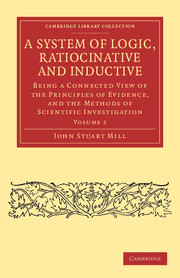
This two-volume work, first published in 1843, was John Stuart Mill's first major book. It reinvented the modern study of logic and laid the foundations for his later work in the areas of political economy, women's rights and representative government. In clear, systematic prose, Mill (1806–73) disentangles syllogistic logic from its origins in Aristotle and scholasticism and grounds it instead in processes of inductive reasoning. An important attempt at integrating empiricism within a more general theory of human knowledge, the work constitutes essential reading for anyone seeking a full understanding of Mill's thought. Continuing the discussion of induction, Volume 2 concludes with Book VI, 'On the Logic of the Moral Sciences', in which Mill applies empirical reasoning to human behaviour. A crucial early formulation of his thinking regarding free will and necessity, this book establishes the centrality of 'the social science' to Mill's philosophy.
British philosopher and economist John Stuart Mill (1806–73) is the author of several essays, including Utilitarianism (1863) - a defence of Jeremy Bentham's principle applied to the field of ethics - and The Subjection of Women (1869), which advocates legal equality between the sexes. This work, arguably his most famous contribution to political philosophy and theory, was first published in 1859, and remains a major influence upon contemporary liberal political thought. In it, Mill argues for a limitation of the power of government and society (democracy's 'tyranny of the majority') over the individual, and defines liberty as an absolute individual right. According to the still much debated 'harm principle', power against the individual can only be exercised to prevent harm to others. Full of contemporary relevance, this essay also defends freedom of speech as a necessary condition of social and intellectual progress.