To save content items to your account,
please confirm that you agree to abide by our usage policies.
If this is the first time you use this feature, you will be asked to authorise Cambridge Core to connect with your account.
Find out more about saving content to .
To save content items to your Kindle, first ensure no-reply@cambridge.org
is added to your Approved Personal Document E-mail List under your Personal Document Settings
on the Manage Your Content and Devices page of your Amazon account. Then enter the ‘name’ part
of your Kindle email address below.
Find out more about saving to your Kindle.
Note you can select to save to either the @free.kindle.com or @kindle.com variations.
‘@free.kindle.com’ emails are free but can only be saved to your device when it is connected to wi-fi.
‘@kindle.com’ emails can be delivered even when you are not connected to wi-fi, but note that service fees apply.
Kierkegaard's Concluding Unscientific Postscript is a classic of existential literature. It concludes the first and richest phase of Kierkegaard's pseudonymous authorship and is the text that philosophers look to first when attempting to define Kierkegaard's own philosophy. Familiar Kierkegaardian themes are introduced in the work, including truth as subjectivity, indirect communication, the leap, and the impossibility of forming a philosophical system for human existence. The Postscript sums up the aims of the preceding pseudonymous works and opens the way to the next part of Kierkegaard's increasingly tempestuous life: it can thus be seen as a cornerstone of his philosophical thought. This volume offers the work in a new and accessible translation by Alastair Hannay, together with an introduction that sets the work in its philosophical and historical contexts.
Samuel Clarke was by far the most gifted and influential Newtonian philosopher of his generation, and A Demonstration of the Being and Attributes of God, which constituted the 1704 Boyle Lectures, was one of the most important works of the first half of the eighteenth century, generating a great deal of controversy about the relation between space and God, the nature of divine necessary existence, the adequacy of the Cosmological Argument, agent causation, and the immateriality of the soul. Together with the other texts presented in this edition, it also provides the best introduction to Clarke's philosophical views, which, in addition to their intrinsic interest, are historically important for the light they shed both on the philosophical positions within the Newtonian circle and on the exchange between Clarke and Leibniz, the most famous philosophical controversy of the eighteenth century.
The third volume of The Cambridge Translations of Medieval Philosophical Texts will allow scholars and students access in English, to major texts that form the debate over mind and knowledge at the center of medieval philosophy. Beginning with thirteenth-century attempts to classify the soul's powers and to explain the mind's place within the soul, the volume proceeds systematically to consider the scope of human knowledge and the role of divine illumination, intentionality and mental representation, and attempts to identify the object of human knowledge in terms of concepts and propositions. The authors included are Henry of Ghent, Peter John Olivi, William Alnwick, Peter Aureol, William Ockham, William Crathorn, Robert Holcot, Adam Wodeham as well as two anonymous Parisian masters of arts. This volume will be an important resource for scholars and students of medieval philosophy, history, theology and literature.
Descartes' The World offers the most comprehensive vision of the nature of the world since Aristotle, and is crucial for an understanding of his later writings, in particular the Meditations and Principles of Philosophy. Above all, it provides an insight into how Descartes conceived of natural philosophy before he started to reformulate his doctrines in terms of a sceptically driven epistemology. Of its two parts, the Treatise on Light introduced the first comprehensive, quantitative version of a mechanistic natural philosophy, supplying a theory of matter, a physical optics, and a cosmology. The Treatise on Man provided the first comprehensive mechanist physiology. This volume also includes translations of material important for an understanding of the work: related sections from the Dioptrics and the Meteors, and an English translation of the complete text of The Description of the Human Body.
This work brings together, for the first time in English translation, Hegel's journal publications from his years in Heidelberg (1816–18), writings which have been previously either untranslated or only partially translated into English. The Heidelberg years marked Hegel's return to university teaching and represented an important transition in his life and thought. The translated texts include his important reassessment of the works of the philosopher F. H. Jacobi, whose engagement with Spinozism, especially, was of decisive significance for the philosophical development of German Idealism. They also include his most influential writing about contemporary political events, his essay on the constitutional assembly in his native Württemberg, which was written against the background of the dramatic political and social changes occurring in post-Napoleonic Germany. The translators have provided an introduction and notes that offer a scholarly commentary on the philosophical and political background of Hegel's Heidelberg writings.
Simone Weil's Leçons de Philosophie are derived from a course she taught at the lycée for girls at Roanne in 1933–4. Anne Reynaud-Guérithault was a pupil in the class; her notes are not a verbatim record but are a very full and, as far as one can judge, faithful rendering, often catching the unmistakable tone of Simone Weil's voice as well as the force and the directness of her thought. The lectures form a good general introduction to philosophy, ranging widely over problems about perception, mind, language, reasoning and problems in moral and political philosophy too. Her method of presentation is a characteristic combination of abstract argument, personal experience and literary or historical reference. Peter Winch points out in his introduction to the book some of the more systematic connections in her philosophical work (and between this philosophical work and her other concerns), and makes a number of suggestive comparisons between Simone Weil and Wittgenstein. The translation is by Hugh Price from the Plon edition of 1959. Dr Price has added some notes to explain references in the text that might be unfamiliar to English speaking students beginning philosophy.
Anne Conway was an extraordinary figure in a remarkable age. Her mastery of the intricate doctrines of the Lurianic Kabbalah, her authorship of a treatise criticising the philosophy of Descartes, Hobbes, and Spinoza, and her scandalous conversion to the despised sect of Quakers indicate a strength of character and independence of mind wholly unexpected (and unwanted) in a woman at the time. Translated for the first time into modern English, her Principles of the Most Ancient and Modern Philosophy is the most interesting and original philosophical work written by a woman in the seventeenth century. Her radical and unorthodox ideas are important not only because they anticipated the more tolerant, ecumenical, and optimistic philosophy of the Enlightenment, but also because of their influence on Leibniz. This fully annotated edition includes an introduction which places Conway in her historical and philosophical contexts, together with a chronology of her life and a bibliography.
Arthur Schopenhauer's The Two Fundamental Problems of Ethics (1841) consists of two groundbreaking essays: 'On the Freedom of the Will' and 'On the Basis of Morals'. The essays make original contributions to ethics and display Schopenhauer's erudition, prose-style and flair for philosophical controversy, as well as philosophical views that contrast sharply with the positions of both Kant and Nietzsche. Written accessibly, they do not presuppose the intricate metaphysics which Schopenhauer constructs elsewhere. This is the first English translation of these works to re-unite both essays in one volume. It offers a new translation by Christopher Janaway, together with an introduction, editorial notes on Schopenhauer's vocabulary and the different editions of his essays, a chronology of his life, a bibliography, and a glossary of names.
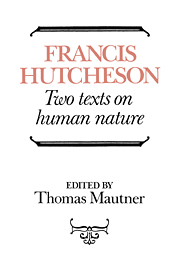
Francis Hutcheson (1694–1746) was the first major philosopher of the Scottish Enlightenment, and one of the great thinkers in the history of British moral philosophy. He firmly rejected the reductionist view, common then as now, that morality is nothing more than the prudent pursuit of self-interest, arguing in favour of a theory of a moral sense. The two texts presented here are the most eloquent expressions of this theory. The Reflections on our Common Systems of Morality insists on the connection between moral philosophy and moral improvement, and was a preview of his first major work, the Inquiry of 1725. The lecture On the Social Nature of Man, arguing against the psychological egoism of Hobbes, appears here in an English translation for the first time. Thomas Mautner's introduction and editorial apparatus provide a mass of new information, helping to give the reader a sense of the intellectual climate in which Hutcheson lived.
Hegel's letter to Immanuel Niethammer, dated April 19, 1817, indicates that he consciously intended his lengthy and for the most part positive review to help effect a reconciliation with Jacobi, whom his scathing remarks in Faith and Knowledge (1802) had deeply estranged. Hegel writes,
[A]s I see, the main letter I wrote to Munich reached its addressee, and I am very pleased at your news that I succeeded in expressing and fulfilling my intention in the review. I thank Jacobi warmly for the friendly welcome he gave to this essay. An Encyclopedia is supposed to be ready by Easter. 6 sheets of it are printed. Copies for you and Jacobi have been ordered. I do not begrudge God that he makes things so miserable for us, but rather that in the end he does not allow our achievements to reach the degree of perfection we wanted and of which we could have been capable.
Just a few months later, Hegel was instrumental in persuading the University of Heidelberg to grant Jacobi's close friend Jean Paul, the novelist, an honorary doctorate, and no doubt this new friendship between Hegel and Jean Paul also helped facilitate the rapprochement between Hegel and Jacobi. In any case, in a letter dated September 3, 1817, Jean Paul confirms Jacobi's impression of a convergence, writing, “Hegel has come much closer to you, except for just one point concerning the will.”
Friedrich Heinrich Jacobi's Works, Volume 3, Leipzig: Gerhard Fleischer, 1816. 568pp. + xxvi
The reviewer is pleased that a new volume of Jacobi's collected works has appeared so soon after the last, and wishes both that noble elder and his readers all the best for the uninterrupted continuation of their publication. This third volume contains four writings which, in the words of the preface, “to a certain extent originated simultaneously and are but divergent parts of a single whole that recapitulates itself differently in each of them.” They are: (1) Jacobi's Letter to Fichte, first published in 1799; (2) an essay which first appeared in Reinhold's Contributions (no. 31, 1801), with the title On Critical Philosophy's Attempt to Bring Reason to Understanding and to Transform Philosophy as Such; (3) On a Prophecy by Lichtenberg, first printed in 1801; and (4) the text On Divine Things and their Revelation, with a foreword written for this new edition. An interesting appendix of twenty-three letters to Johann Müller, Georg Forster, Herder, Kant (among them one from Kant to Jacobi), Privy Councillor Schlosser, J. G. Jacobi, and several unnamed recipients concludes the volume.
[SPINOZA]
One might have wished that in the order of publication of these collected works Jacobi's earlier Letters on the Doctrine of Spinoza5 had preceded the treatises contained in the present volume, for these Letters respond to an historical interest that is older and prior to the forms of philosophy dealt with by these treatises, namely the metaphysics of Leibniz and Wolff, which at the time of the Letters was at its last breath.
This work brings together, for the first time in English translation, Hegel's journal publications from his years in Heidelberg (1816–18), writings which have been previously either untranslated or only partially translated into English. The two years Hegel taught at the University of Heidelberg mark an unusually important transition in his life and thought. Following the closing of the University of Jena in the wake of Napoleon's famous victory at the Battle of Jena, Hegel was unable to find a university teaching position. After a decade in which he worked briefly as a newspaper editor and then as a gymnasium rector, Hegel returned to a university teaching position as Professor of Philosophy at Heidelberg in 1816. During his two years at Heidelberg, before he left to take up his final academic position in Berlin, Hegel brought to fruition a number of projects that characterize the mature phase of his work: he published the first version of his mature philosophical system, the Encyclopedia; served as editor of a journal, the Heidelberger Jahrbücher der Literatur (Heidelberg Yearbooks), which published two important contributions of his own; and began to give the first public lectures in which his developed social and political philosophy was on display.
The move to Heidelberg marked not only an important milestone for Hegel personally, but also came – as Hegel himself articulated it in this period – during a crucial generational shift in the larger political and philosophical climate in Germany and Europe. Hegel's generation, which had witnessed the beginning of the French Revolution twenty-five years before, had seen in the intervening years the swift overthrow of old philosophical systems as well as political upheavals stemming from Napoleon's rise and fall.
The task that was begun two and a half years ago – of introducing a representative constitution and thereby bringing to completion a German monarchy that has arisen in our time – awakened from its beginning such a universal interest in the German public that nothing could be more agreeable to it than the publication of the Proceedings of the Württemberg Estates Assembly. In place of the hopes which accompanied the beginning and the progress of this effort, there must appear at the end a result and the judgment of it. The thirty-three volumes with which this review is concerned of course do not yet contain the completion of the main goal, but they do form an historical whole. For, on the one hand, they present the progress up to the death of the king who founded the monarchy and who began the second step – the inner, free structuring of that monarchy – and the characteristic development of this event in its principal features falls within his reign. On the other hand, the work of the Estates appears to have been brought to completion, since a representative committee is finished with its draft of a constitution, which likewise has appeared in print.
Of course, these Proceedings present only one side of the efforts of that endeavor: the public efforts, insofar as they enter into the Estates Assembly.