To save content items to your account,
please confirm that you agree to abide by our usage policies.
If this is the first time you use this feature, you will be asked to authorise Cambridge Core to connect with your account.
Find out more about saving content to .
To save content items to your Kindle, first ensure no-reply@cambridge.org
is added to your Approved Personal Document E-mail List under your Personal Document Settings
on the Manage Your Content and Devices page of your Amazon account. Then enter the ‘name’ part
of your Kindle email address below.
Find out more about saving to your Kindle.
Note you can select to save to either the @free.kindle.com or @kindle.com variations.
‘@free.kindle.com’ emails are free but can only be saved to your device when it is connected to wi-fi.
‘@kindle.com’ emails can be delivered even when you are not connected to wi-fi, but note that service fees apply.
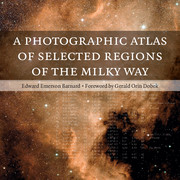
Edward Emerson Barnard's Photographic Atlas of Selected Regions of the Milky Way was originally published in two volumes in 1927. Together, these volumes contained a wealth of information, including photographic plates of the most interesting portions of the Milky Way, descriptive text, charts and data. Only 700 copies were printed, making the original edition a collector's item. Reproduced in print for the first time, this edition combines both volumes of Barnard's Atlas. It directly replicates Barnard's text, and contains high-resolution images of the original photographic plates and charts, reordered so that they can be seen together. It also includes a biography of Barnard and his work, a Foreword and Addendum by Gerald Orin Dobek describing the importance of the Atlas and additions to this volume, and a pull-out section with a mosaic of all 50 plates combined in a single panorama.
Packed with up-to-date astronomical data about the Solar System, our Galaxy and the wider Universe, this is a one-stop reference for astronomers of all levels. It gives the names, positions, sizes and other key facts of all the planets and their satellites; discusses the Sun in depth, from sunspots to solar eclipses; lists the dates for cometary returns, close-approach asteroids, and significant meteor showers; and includes 88 star charts, with the names, positions, magnitudes and spectra of the stars, along with key data on nebulae and clusters. Full of facts and figures, this is the only book you need to look up data about astronomy. It is destined to become the standard reference for everyone interested in astronomy.
An authoritative introduction for graduate students in the physical sciences, this textbook explains the wide variety of physical, chemical, and geological processes that govern the motions and properties of planets. The second edition of this award-winning textbook has been substantially updated and improved. It now contains a reorganized discussion of small bodies, including a detailed description of the Kuiper belt and asteroid belt; a significantly expanded chapter on extrasolar planets and what they tell us about planetary systems; and appendixes providing a glossary of acronyms, tables of key spacecraft, a summary of observing techniques, and a sampling of very recent images. With over 300 exercises to help students apply the concepts covered, this textbook is ideal for courses in astronomy, planetary science and earth science, and well suited as a reference for researchers. Color versions of many figures and movie clips supplementing the text are available at www.cambridge.org/9780521853712.
With a lively yet rigorous and quantitative approach, Frederick R. Chromey introduces the fundamental topics in optical observational astronomy for undergraduates. Focussing on the basic principles of light detection, telescope optics, coordinate systems and data analysis, students are introduced to modern astronomical observation techniques and measurements. Cutting-edge technologies such as advanced CCD detectors and adaptive optics are presented through the physical principles on which they are based, helping students understand the power of modern space and ground-based telescopes, and the motivations and limitations of future development. Discussion of statistics and measurement uncertainty enables students to confront the important questions of data quality. With a purposeful structure and clear approach, this is an essential resource for all students of observational astronomy. It explains the theoretical foundations for observational practices and reviews essential physics to support students' mastery of the subject. Student understanding is strengthened through over 120 exercises and problems.
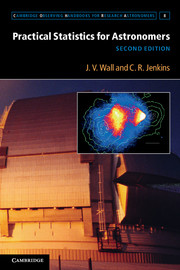
Astronomy needs statistical methods to interpret data, but statistics is a many-faceted subject that is difficult for non-specialists to access. This handbook helps astronomers analyze the complex data and models of modern astronomy. This second edition has been revised to feature many more examples using Monte Carlo simulations, and now also includes Bayesian inference, Bayes factors and Markov chain Monte Carlo integration. Chapters cover basic probability, correlation analysis, hypothesis testing, Bayesian modelling, time series analysis, luminosity functions and clustering. Exercises at the end of each chapter guide readers through the techniques and tests necessary for most observational investigations. The data tables, solutions to problems, and other resources are available online at www.cambridge.org/9780521732499. Bringing together the most relevant statistical and probabilistic techniques for use in observational astronomy, this handbook is a practical manual for advanced undergraduate and graduate students and professional astronomers.
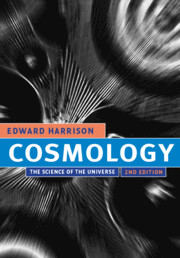
Cosmology: The Science of the Universe is an introduction to past and present cosmological theory. For much of the world's history, cosmological thought was formulated in religious or philosophical language and was thus theological or metaphysical in nature. However, cosmological speculation and theory is now a science in which the empirical discoveries of the astronomer, theoretical physicist, and biologist are woven into intricate models that attempt to account for the universe as a whole. Professor Harrison draws on the discoveries and speculations of these scientists to provide a comprehensive survey of mankind's current understanding of the universe and its history. Tracing the rise of the scientific method, the major aim of this book is to provide an elementary understanding of the physical universe of modern times. This second edition, originally published in 2000, has received high praise for Harrison's wide-ranging insights into the universe at large.
The Solar System is a complex and fascinating dynamical system. This is the first textbook to describe comprehensively the dynamical features of the Solar System and to provide students with all the mathematical tools and physical models they need to understand how it works. It is a benchmark publication in the field of planetary dynamics and destined to become a classic. Clearly written and well illustrated, Solar System Dynamics shows how a basic knowledge of the two- and three-body problems and perturbation theory can be combined to understand features as diverse as the tidal heating of Jupiter's moon Io, the origin of the Kirkwood gaps in the asteroid belt, and the radial structure of Saturn's rings. Problems at the end of each chapter and a free Internet Mathematica® software package are provided. Solar System Dynamics provides an authoritative textbook for courses on planetary dynamics and celestial mechanics. It also equips students with the mathematical tools to tackle broader courses on dynamics, dynamical systems, applications of chaos theory and non-linear dynamics.
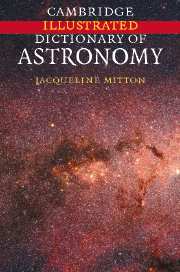
This lavishly illustrated new dictionary written by an experienced writer and consultant on astronomy provides an essential guide to the universe for amateur astronomers of all ages. Around 1300 carefully selected and cross-referenced entries are complemented by hundreds of beautiful colour illustrations, taken from space missions, the Hubble Space Telescope, and other major observatories on Earth and in space. Distinguished stellar illustrator Wil Tirion has drawn 20 new star maps especially for inclusion here. A myriad of named astronomical objects, constellations, observatories and space missions are described in detail, as well as biographical sketches for 70 of the most luminous individuals in the history of astronomy and space science. Acronyms and specialist terms are clearly explained, making for the most thorough and carefully assembled reference resource that teachers and enthusiasts of astronomy will ever need.
J. P. Nichol (1804–59), astronomer and political economist, was Regius Professor of Astronomy at the University of Glasgow. He brought astronomy to a non-scientific audience through his enthusiastic public lectures and astronomy books. His works include the popular Views of the Architecture of the Heavens (1837; also reissued in this series) in which he supported the nebular hypothesis, which in modified form is the model of star formation most widely accepted today. Neptune was (in 1846) the first planet to be discovered by mathematical prediction rather than empirical observation, and in this book, first published in 1855, Nichol describes that discovery to a lay readership. Part 1 is an exposition of the then current view of the solar system and the research and discoveries which led to that view; Part 2 is dedicated to Neptune; while the third part explains the controversies over the planet's discovery.