To save content items to your account,
please confirm that you agree to abide by our usage policies.
If this is the first time you use this feature, you will be asked to authorise Cambridge Core to connect with your account.
Find out more about saving content to .
To save content items to your Kindle, first ensure no-reply@cambridge.org
is added to your Approved Personal Document E-mail List under your Personal Document Settings
on the Manage Your Content and Devices page of your Amazon account. Then enter the ‘name’ part
of your Kindle email address below.
Find out more about saving to your Kindle.
Note you can select to save to either the @free.kindle.com or @kindle.com variations.
‘@free.kindle.com’ emails are free but can only be saved to your device when it is connected to wi-fi.
‘@kindle.com’ emails can be delivered even when you are not connected to wi-fi, but note that service fees apply.
A sky atlas is the counterpart to a topographic map – without it, we would find it very difficult to navigate an unknown terrain or sky. Since the beginnings of astronomy several thousand years ago, many attempts have been made to depict the night sky as accurately as possible. With the rapid progress of astrophotography in the twentieth century, photographic atlases have become available that provide a more natural view of large-scale star clouds and gas nebulae than hand-drawn (or even computer-generated) maps. Well-known examples are the Palomar Observatory Sky Survey and Hans Vehrenberg's Falkau Atlas and Atlas Stellarum.
In the past two decades, astrophotography has been revolutionized by the availability of large-format CCD cameras, which have a vastly higher quantum efficiency than photographic plates and film. As a result, images taken with a CCD camera and a standard 50 mm lens reach almost the same limiting magnitude (14m) as the venerable Atlas Stellarum. The present atlas is the result of state-of-the-art digital image acquisition and processing techniques, combining more than 3000 individual photographs into a uniquely detailed view of the night sky. Axel Mellinger did all the imaging and computer processing, while Ronald Stoyan identified and labeled the stars and deep sky objects.
We would like to thank all those who contributed to the success of this project.
This photographic star atlas shows the entire sky on 82 charts. The chart arrangement is shown on the endpapers, and a schematic depiction is given on page 9. The scale at the center of each field is 1° per cm (2.54° per inch) for all charts. Stars are shown down to approximately 14th magnitude.
Each two-page spread shows the original color image, as well as an inverted and labeled black and white copy. Brightness and contrast were individually optimized for each chart. Hence, charts of regions far from the Milky Way may show slightly fainter stars than those showing rich star fields inside the Milky Way. For printing, the original RGB files had to be converted to the CMYK color space, a process that in some cases may yield slight color shifts compared to the original image.
In order to emphasize extended faint emission nebulae, the inverted maps were created from the red channel images only. For this reason, the brightness of individual stars may differ from their appearance on the color images (red stars appear brighter on the black and white charts, green and blue stars fainter).
The star atlas lists 1593 deep sky objects, all of which can be identified on the photographs. Object designators are based on the catalog of the Eye & Telescope v3.0 software [Pfl2011], which features one of the best error-corrected object databases. In a few cases, these designators may differ from those found in non-corrected catalogs or planetarium software.
At the heart of this atlas is a huge panoramic image of the night sky. To capture the entire night sky, astrophotographer and physics professor Axel Mellinger traveled to remote, dark sites in South Africa, Texas, and the Huron-Manistee National Forest in Michigan. This is the story of how the panorama was created.
The plan
Taking a photograph of the entire night sky is no easy undertaking, and requires careful planning. The first important choice was for a suitable digital camera. In astrophotography, where long exposure times are required, the sensor chip must be cooled to temperatures of -20°C or less in order to keep the dark current low. After comparing several CCD cameras on the market, the SBIG STL-11000 was selected as the best compromise between sensor size and cost.
Its Kodak KA1-11002 chip has the same size as 35 mm film, i.e. 36 mm × 24 mm. It uses microlenses to enhance its quantum efficiency by directing light to the active pixel areas. The camera was fitted with a Minolta MD 1.4/50 mm lens, originally used on a 35 mm format film-based single-lens reflex camera. To improve the image quality, the lens was stopped down to f/4 for all exposures. The chosen combination of focal length and chip size resulted in a 40° × 27° field of view, i.e. 1080 square degrees. Since the sky has a total area of 41,253 square degrees, a complete all-sky panorama requires at least 38 fields.
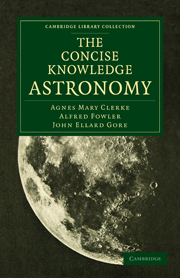
The Concise Knowledge Astronomy, published in 1898, was one of a series of popular reference books by experts. Agnes Clerke (1842–1907) was a successful author of books on astronomy and its history (three of her other works being reissued in this series), and her co-authors were astrophysicist Alfred Fowler, an internationally renowned expert in spectroscopy, and J. Elland Gore, a Fellow of the Royal Astronomical Society and expert on variable stars. Illustrated by over 100 photographs and drawings, the book aims to provide the educated non-specialist reader with an understanding of current astronomical knowledge. The application of new technologies, such as photography and spectroscopy, to astronomy in the nineteenth century had led to many new discoveries, and public interest in the subject had greatly increased. The book is divided into four parts - the history of astronomy, astronomical movements and instruments, the solar system, and sidereal astronomy.
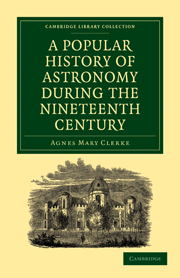
Agnes Mary Clerke (1842–1907) first published A Popular History of Astronomy in 1885. The work was received with widespread acclaim and brought Clerke an international reputation as a science writer. The History surveys the progress made in the field of astronomy during the nineteenth century. It is split chronologically into two parts, dealing with the first and the second half of the century. Part 1 focuses on the career of the astronomer William Herschel (1738–1822) and the development of sidereal astronomy; part 2 deals with the discovery of spectrum analysis and the progress of knowledge about sun spots and the magnetic disturbances which cause them. Clerke's work, a classic example of Victorian popular scientific literature, stands alongside Grant's earlier History of Astronomy in its success in popularising the subject. The work is important today for scholars researching the history of the discipline and its place in educated Victorian society.
The Sombrero galaxy (M104) is an interesting object for a dust energy balance study due to its very symmetric dust lane, its proximity and its (nearly edge-on) inclination of 84°. From a panchromatic radiative transfer analysis, including scattering, absorption and thermal dust re-emission, we construct a standard model for M104 accounting for observations in the optical wave bands (stellar SED, images and extinction profiles in the V and RC band). This standard model underestimates the observed dust emission at infrared wavelengths by a factor of ~ 3, similar to the discrepancy found in other energy balance studies of edge-on spirals. Supplementing this standard model with a young stellar component of low star formation activity in both the inner disk (SFR ~ 0.21 M⊙ yr−1) and dust ring (SFR ~ 0.05 M⊙ yr−1), we are capable of solving the discrepancy in the dust energy budget of the Sombrero galaxy at wavelengths shortwards of 100 μm. To account for the remaining discrepancy at longer wavelengths, we propose a secondary dust component distributed in quiescent clumps. This model with a clumpy dust structure predicts three-quarters of the total dust content to reside in compact dust clouds with no associated embedded sources.
We have carried out a detailed modeling of the dust Spectral Energy Distribution (SED) of the nearby, starbursting dwarf galaxy NGC 4214. A key point of our modeling is that we distinguish the emission from (i) HII regions and their associated photodissociation regions (PDRs) and (ii) diffuse dust. For both components we apply templates from the literature calculated with a realistic geometry and including radiation transfer. The large amount of existing data from the ultraviolet (UV) to the radio allows the direct measurement of most of the input parameters of the models. We achieve a good fit for the total dust SED of NGC 4214. In the present contribution we describe the available data, the data reduction and the determination of the model parameters, whereas a description of the general outline of our work is presented in the contribution of Lisenfeld et al. in this volume.
In the past five years systematic searches, serendipitous discoveries and archival searches have yielded over a dozen transients that are brighter than novæ but fainter than supernovæ. The observed properties of these “gap” transients tend to place them in distinct classes, some being about 100 times brighter than novæ and durations of nearly 100 days (e.g., M85 OT, PTF10fqs), while others (such as SN2002bj and PTF10bhp) nearly reach supernovæ luminosities but fade in five days. The state of theoretical understanding varies substantially across the class of objects, and is ripe for progress.
The present work shows the Spectral Energy Distributions (SEDs) in the infrared using the IRTF stellar library, obtained using models based on Single Stellar population Models (SSP). We have focused on the K band in order to compare with observables of elliptical galaxies. We also present the comparisons of our models with velocity dispersions, ages and metallicities obtained with models in the optical range.
We use Herschel Space Observatory and Spitzer Space Telescope 70-500 μm data along with ground-based optical and near-infrared data to understand how dust heating in the nearby face-on spiral galaxies M81, M83, and NGC 2403 is affected by the starlight from all stars and by the radiation from star-forming regions. We find that 70/160 μm flux density ratios tend to be more strongly influenced by star-forming regions. However, the 250/350 and 350/500 μm micron flux density ratios are more strongly affected by the light from the total stellar populations, suggesting that the dust emission at > 250 μm originates predominantly from a component that is colder than the dust seen at <160 μm and that is relatively unaffected by star formation activity. We conclude by discussing the implications of this for modelling the spectral energy distributions of both nearby and more distant galaxies and for using far-infrared dust emission to trace star formation.
Citizen Science is the act of collecting or analyzing data by enlisting the help of volunteers who may have no specific scientific training. The workshop discussed how “Citizen Science” fits into time-domain astronomy, what the roles of such volunteers might be, and how amateur astronomers can help in the new era of surveys.