To save content items to your account,
please confirm that you agree to abide by our usage policies.
If this is the first time you use this feature, you will be asked to authorise Cambridge Core to connect with your account.
Find out more about saving content to .
To save content items to your Kindle, first ensure no-reply@cambridge.org
is added to your Approved Personal Document E-mail List under your Personal Document Settings
on the Manage Your Content and Devices page of your Amazon account. Then enter the ‘name’ part
of your Kindle email address below.
Find out more about saving to your Kindle.
Note you can select to save to either the @free.kindle.com or @kindle.com variations.
‘@free.kindle.com’ emails are free but can only be saved to your device when it is connected to wi-fi.
‘@kindle.com’ emails can be delivered even when you are not connected to wi-fi, but note that service fees apply.
The gravitational-wave window onto the universe will open in roughly five years, when Advanced LIGO and Virgo achieve the first detections of high-frequency gravitational waves, most likely coming from compact binary mergers. Electromagnetic follow-up of these triggers, using radio, optical, and high energy telescopes, promises exciting opportunities in multi-messenger time-domain astronomy. In the decade, space-based observations of low-frequency gravitational waves from massive black hole mergers, and their electromagnetic counterparts, will open up further vistas for discovery. This two-part workshop featured brief presentations and stimulating discussions on the challenges and opportunities presented by gravitational-wave astronomy. Highlights from the workshop, with the emphasis on strategies for electromagnetic follow-up, are presented in this report.
We present the first far-infrared luminosity function in the AKARI Deep Field South, a premier deep field of the AKARI Space Telescope, using spectroscopic redshifts obtained with AAOmega. To date, we have found spectroscopic redshifts for 389 galaxies in this field and have measured the local (z<0.25) 90 μm luminosity function using about one-third of these redshifts. The results are in reasonable agreement with recent theoretical predictions.
We have carried out a detailed modelling of the dust heating and emission in the nearby, starbursting dwarf galaxy NGC 4214. Due to its proximity and the great wealth of data from the UV to the millimeter range (from GALEX, HST, Spitzer, Herschel, Planck and IRAM) it is possible to separately model the emission from HII regions and their associated photodissociation regions (PDRs) and the emission from diffuse dust. Furthermore, most model parameters can be directly determined from the data leaving very few free parameters. We can fit both the emission from HII+PDR regions and the diffuse emission in NGC 4214 with these models with “normal” dust properties and realistic parameters.
Results of a high-speed photometric study of dwarf novæ in the Catalina Real-time Transient Survey are given. A population of faint dwarf novæ near the orbital period minimum is detected. At the shortest periods there is a correlation between orbital period and outburst interval.
When Bob asked me a couple of days ago to give this talk, he said it should be “pithy and wise.” When I spoke to Aris the next day he said it should be “informal and funny.” Then Elizabeth spoke to me and said it would be great if it was “controversial and challenging.” I mentioned to Aris just before dinner that I had put a talk together, and he said “Oh, you've written a talk—I thought it would be something more spontaneous!” Faced with an obviously impossible spec, I did what any reasonable programmer would do and rewrote the spec myself. So what I'm going to talk about this evening is a reflection on my week in Oxford.
Starting from first principles, we construct a simple model for the evolution of energetic particles produced by supernovae in the starburst galaxy M82. The supernova rate, geometry, and properties of the interstellar medium are all well observed in this nearby galaxy. Assuming a uniform interstellar medium and constant cosmic-ray injection rate, we estimate the cosmic-ray proton and primary & secondary electron/positron populations. From these particle spectra, we predict the gamma ray flux and the radio synchrotron spectrum. The model is then compared to the observed radio and gamma-ray spectra of M82 as well as previous models by Torres (2004), Persic et al. (2008), and de Cea del Pozo et al. (2009). Through this project, we aim to build a better understanding of the calorimeter model, in which energetic particle fluxes reflect supernova rates, and a better understanding of the radio-FIR correlation in galaxies.
The longest-known class of pulsating variable stars, namely pulsating red giants, is also the one that involves the most complex physical processes. Pulsation, mass loss, nuclear synthesis, mixing, atmospheric and circumstellar chemistry and dust formation all interrelate with one another and make both the observational studies and the modelling efforts quite challenging. The paper outlines some of the current key questions, and recommends observational strategies.
We describe a new method that allows us to quantitatively characterize galactic satellites from analysis of disturbances in outer gas disks, without requiring knowledge of their optical light. We have demonstrated the validity of this method, which we call Tidal Analysis, by applying it to local spirals with known optical companions, including M51 and NGC 1512. These galaxies span the range from having a low mass companion (~ one-hundredth the mass of the primary galaxy) to a fairly massive companion (~ one-third the mass of the primary galaxy). This approach has broad implications for many areas of astrophysics – for the indirect detection of dark matter (or dark matter-dominated dwarf galaxies), and for galaxy evolution in its use as a decipher of the dynamical impact of satellites on galactic disks. Here, we present some preliminary results on the emergent SEDs and images, calculated along the time sequence of these dynamical simulations using the 3-D self-consistent Monte Carlo radiative transfer code RADISHE. We explore star formation prescriptions and how they affect the emergent SEDs and images. Our goal is to identify SED colors that are primarily affected by the galaxy's interaction history, and are not significantly affected by the choice of star formation prescription. If successful, we may be able to utilize the emergent UV-IR SED of the primary galaxy to understand its recent interaction history.
In a recent study based on the modelling of spatially resolved Spitzer and Herschel observations of the Large Magellanic Cloud (LMC), we have shown that the infrared (IR) to submillimetre (submm) grain opacities are systematically higher in the LMC than in our Galaxy. This discovery demonstrates an evolution of the dust properties with environment. Here, we discuss the consequences of this evolution on the modelling of SEDs of galaxies, emphasizing that the uncertainties on the grain properties can lead to erroneous interpretations of the structure of the interstellar medium (ISM) of galaxies, if no additional independent constraints are used.
The impact of non-thermal processes on the spectral energy distributions of galaxies can be dramatic, but such processes are often neglected in considerations of their structure and evolution. Particle acceleration associated with high mass star formation and AGN activity not only leads to very broad band (radio-γ-ray) emission, but may also produce very significant feedback effects on galaxies and their environment. The recent detections of starburst galaxies at GeV and TeV energies suggest that γ-ray instruments have now reached the critical level of sensitivity to probe the connection between particle acceleration and star-formation in galaxies. In this paper we will try to summarise this recent progress, put it into a multi-wavelength context and also discuss the prospects for more precise and sensitive γ-ray measurements with the upcoming CTA observatory.
Edge-on spiral galaxies offer a unique perspective on the vertical structure of spiral disks, both stars and the iconic dark dustlanes. The thickness of these dustlanes can now be resolved for the first time with Herschel in far-infrared and sub-mm emission. We present NHEMESES, an ongoing project that targets 12 edge-on spiral galaxies with the PACS and SPIRE instruments on Herschel. These vertically resolved observations of edge-on spirals will impact on several current topics.
First and foremost, these Herschel observations will settle whether or not there is a phase change in the vertical structure of the ISM with disk mass. Previously, a dramatic change in dustlane morphology was observed as in massive disks the dust collapses into a thin lane. If this is the case, the vertical balance between turbulence and gravity dictates the ISM structure and consequently star-formation and related phenomena (spiral arms, bars etc.). We specifically target lower mass nearby edge-ons to complement existing Herschel observations of high-mass edge-on spirals (the HEROES project).
Secondly, the combined data-set, together with existing Spitzer observations, will drive a new generation of spiral disk Spectral Energy Distribution models. These model how dust reprocesses starlight to thermal emission but the dust geometry remains the critical unknown.
And thirdly, the observations will provide an accurate and unbiased census of the cold dusty structures occasionally seen extending out of the plane of the disk, when backlit by the stellar disk. To illustrate the NHEMESES project, we present early results on NGC 4244 and NGC 891, two well studies examples of a low and high-mass edge-on spiral.
We present a simple, physically-motivated model to interpret consistently the emission from galaxies at ultraviolet, optical and infrared wavelengths. We combine this model with a Bayesian method to obtain robust statistical constraints on key parameters describing the stellar content, star formation activity and dust content of galaxies. Our model is now publicly available via a user-friendly code package, MAGPHYS at www.iap.fr/magphys. We present an application of this model to interpret a sample of ~1400 local (z<0.5) galaxies from the H-ATLAS survey. We find that, for these galaxies, the diffuse interstellar medium, powered mainly by stars older than 10 Myr, accounts for about half the total infrared luminosity. We discuss the implications of this result to the use of star formation rate indicators based on total infrared luminosity.
We use the full SED of a well observed dwarf galaxy, I Zw 18, to evaluate what inferences can be made about very high-redshift galaxies from their UV SED's alone.
Astronomical transients are intrinsically interesting objects to study. However, fast optical transients (μs time-scales) are a largely unexplored field of optical astronomy. Most optical observations use instruments that have integration times of the order of seconds and are thus unable to resolve fast transients. Current-generation atmospheric Cherenkov gamma-ray telescopes such as Veritas, which consists of four 12-m telescopes, have huge collecting areas, much larger than those of any existing optical telescopes. This paper outlines the benefits of using a Cherenkov telescope to detect optical transients, and the implementation of the Veritas Transient Detector (TRenDy), a dedicated multi-channel photometer based on field-programmable gate arrays which can be used on Veritas for such studies without interfering with gamma-ray observations.
Jeremiah Horrox (1618–1641) was one of the most interesting astronomers Britain has ever produced, and his tragically early death deprived the field of one of its most brilliant talents. In his short life he achieved much, having mastered the current state of astronomy at Cambridge University and going on to make important new calculations about the diameter and position of known planets, moons and stars. In the 1660s and 70s several prominent scientists, including Huygens, Newton and Flamsteed, took an interest in Horrox's discoveries and published his surviving treatises. This memoir of 1859 was part of a Victorian revival of interest in Horrox. It includes translation of his major work, Venus in Sole Visa, a draft of a treatise on the transit of Venus, in which he describes the conjunction of Venus with the sun, which he correctly calculated and observed in 1639.
James Ferguson (1710–1776) was a Scottish self-taught astronomer, instrument maker and artist. Of humble background, he became a highly successful lecturer on experimental philosophy and science. He became a Fellow of the Royal Society in 1763, received a royal pension, and is particularly remembered as an inventor and improver of astronomical and other scientific apparatus. These include a new type of orrery, clocks, and his astronomical rotula. His lectures and books were noted for their clear explanations for a general audience, and Astronomy Explained upon Sir Isaac Newton's Principles and Made Easy for Those Who Have Not Studied Mathematics (1756) was a bestseller. This autobiographical memoir, expanded by Ebenezer Henderson in 1867, also contains a full description of Ferguson's principal inventions, with many illustrations.
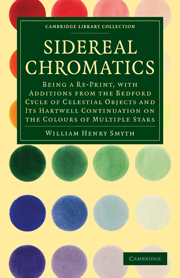
Admiral William Henry Smyth's Sidereal Chromatics (1864) represents a landmark achievement in nineteenth-century astronomy, offering the most precise observations of the colours of double stars yet recorded. An expansion upon his well-known Bedford Cycle of Celestial Objects, which garnered a gold medal from the Royal Astronomical Society, Sidereal Chromatics provides both a theory concerning the source of double-star colours and a method for determining their most exact description. Detailed charts compare Smyth's measurements of more than one hundred double stars with his own previously published observations and those of his fellow astronomer, Father Benedetto Sestini. This edition also includes Smyth's famous colour chart, an attempt to standardise the process of identifying double-star colours. Sidereal Chromatics ends with Smyth's plea to amateur astronomers to continue the effort of charting the heavens, aided by improved telescopes and works such as his, 'trustworthy treatises available to all men'.
This handbook by George Frederick Chambers (1841–1915), a young and enthusiastic amateur astronomer, became a best-seller soon after its publication in 1861 and made Chambers' reputation as a popular astronomy writer. The work is divided into ten parts covering the following topics: the planets of our solar system; eclipses; gravity and tides; phenomena including aberration and refraction; comets; chronological astronomy; stars; astronomical instruments; the history of astronomy; and meteoric astronomy. It is richly illustrated with photographs and woodcuts depicting a wide variety of astronomical phenomena. Chambers went on to become one of the leading amateur astronomers of the nineteenth century. The usefulness and accessibility of his practical advice ensured that his published works became indispensable for thousands of less famous amateurs. The Handbook, reissued in many editions, remains his most popular work and is a key text in the history of Victorian popular astronomical writing.
Six Months in Ascension, first published in 1878, contains an account by Isobel Sarah B. Gill of the 1877 scientific expedition to the island of Ascension, in the South Atlantic, undertaken to measure the distance of the sun from the earth by observing the opposition of the planet Mars. The expedition, funded by the Royal Astronomical Society, was led by Isobel's husband, the astronomer David Gill, with a heliometer and other scientific instruments provided by Lord Lindsay. Isobel accompanied the expedition as her husband's companion. Her account offers personal details and stories omitted from the scientific reports on the expedition written by her husband and colleagues and it contains beautiful descriptions of the island of Ascension. The book offers a rare view of the personal, practical and behind-the-scenes side of a nineteenth-century scientific expedition and provides a fascinating insight into the gender roles of learned Victorian society.
Sir John Frederick William Herschel (1792–1871) – astronomer, mathematician, chemist – was one of the most important English scientists of the nineteenth century. Son of the famous astronomer William Herschel and nephew of Caroline, he was persuaded by his father to pursue the astronomical investigations William could no longer undertake; John's subsequent career resulted in a knighthood and a lifetime of accolades. Outlines of Astronomy (1849), an updated and expanded version of his 1833 Treatise on Astronomy, went through eleven editions in two decades and was translated into several languages. Outlines examines terrestrial and celestial phenomena, providing the reader with a wide range of knowledge about the physical world as a whole. The work is an important textbook, the object of which 'is not to convince or refute opponents, nor to inquire … for principles of which we are all the time in full possession – but simply to teach what is known'.