To save content items to your account,
please confirm that you agree to abide by our usage policies.
If this is the first time you use this feature, you will be asked to authorise Cambridge Core to connect with your account.
Find out more about saving content to .
To save content items to your Kindle, first ensure no-reply@cambridge.org
is added to your Approved Personal Document E-mail List under your Personal Document Settings
on the Manage Your Content and Devices page of your Amazon account. Then enter the ‘name’ part
of your Kindle email address below.
Find out more about saving to your Kindle.
Note you can select to save to either the @free.kindle.com or @kindle.com variations.
‘@free.kindle.com’ emails are free but can only be saved to your device when it is connected to wi-fi.
‘@kindle.com’ emails can be delivered even when you are not connected to wi-fi, but note that service fees apply.
I WAS twelve years old when I first discovered Edward Emerson Barnard's famous work, A Photographic Atlas of Selected Regions of the Milky Way. In my continued explorations of the life of E. E. Barnard and his work, and through my personal discoveries of the cosmos, I noticed a striking set of parallels between his life and mine that made strong my devotion to his work. We were both born in December exactly 100 years apart: Barnard in 1857 and I in 1957. Barnard came from an impoverished family and grew up in civil unrest and war in America. My beginnings were much the same, and although the civil unrest was in Vietnam, it had permeated into everyday American life. At the age of nine, we both entered the workforce outside the home in an effort to financially assist our families. We both struggled through our education, always keeping a focus on our passion for astronomy. And, like Barnard, I've devoted my life to observational astronomy, with a fanaticism for the dark nebulosity within our Galaxy.
Barnard spent most of his astronomical career photographing the night sky. What he captured in those images provided greater detail than the eye could discern through the telescope. The most interesting regions found in these photographs were dark patches that Barnard called “black holes”; unique objects that are, of course, not the black holes that astronomers refer to today, but masses of dust and gas silhouetted against the brightness of the Milky Way.
This second part of the Atlas has been provided to aid in the convenient use and study of the photographs contained in Part I, for reasons which were stated in notes by Professor Barnard as follows:
When comparing astronomical photographs made with long exposures with star charts I have frequently had much trouble through the want of an approximate position, in identifying stars and other objects on the photographs. Also, very often, the colors of the stars so change their relative intensities that they are not easily recognized on the chart. The photographs in the present work are intended as pictures of the sky and it would have been impossible to mark co-ordinates on them without spoiling their pictorial value. It was therefore decided to make a map, with co-ordinates, corresponding to each photograph and on the same scale. Though this has required much work, the charts assist greatly in the approximate location of any object shown on the photographs. They have been of great service to me in studying the photographs and I believe will be a welcome addition to the Atlas.
The photographs are not all enlarged in the same proportion, and therefore are not uniform in scale. All of the fainter stars shown on the Durchmusterung charts were not put on the diagrams, but it is believed enough of them are given to permit a ready identification of objects in any part of a photograph. Four stars on each photograph, located near the corners, were identified and used for determining its scale and for locating the system of co-ordinate lines. The epoch 1875.0 was adopted and is used throughout this work.
In his article in the Astrophysical Journal for January, 1919 (49, 1-23) Professor Barnard gave a list of 182 dark objects in the sky. For the convenience of the user of this Atlas this catalogue is printed here. Three of the objects in that list have been omitted here, viz., Nos. 52, 131a, and 172, because by inadvertence the same object had been listed twice.
Mr. Barnard had begun a second list, most of the objects for which he had himself selected. Their positions were determined by Miss Calvert. It seemed best to begin the second list with No. 201; accordingly, there are no objects having the numbers from 176 to 200.
Where the space in the column for description was insufficient, a note has been added at the end of the catalogue, and this is indicated by a dagger (†) at the end of the last column.
Each dark object of the list falling within the field of a plate has been sketched in by Miss Calvert, with its number, on the corresponding chart in Part II. Where these objects have been referred to, in the descriptions of the photographs, and on the charts and in the tables, their numbers have been preceded by the letter “B.”
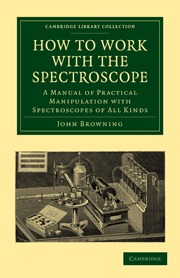
John Browning (1830–1925) was the leading British manufacturer of precision scientific instruments, including spectroscopes, telescopes, microscopes, and opthalmoscopes. In How to Work with the Spectroscope (1878), he provides a complete overview of the field in which he was the undisputed expert, describing in detail the care and use of instruments ranging from the universal spectroscope to the star spectroscope to the induction coil. This volume also includes Browning's A Plea for Reflectors (1867), in which he provides an introduction to the silvered-glass reflecting telescope. Numerous illustrations of the various instruments and a complete price list of Browning's lenses and other apparatuses provide important insight into his business practices and range of expertise. Designed for the lay enthusiast no less than the dedicated scientist, these volumes are also valuable witnesses to the growth of popular science in nineteenth- and early twentieth-century Britain.
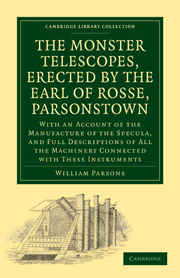
William Parsons (1800–67), third earl of Rosse, was responsible for building the largest telescope of his time, nicknamed the 'Leviathan'. It enabled the earl to describe the spiral structure of galaxies. This volume reissues two contemporary accounts of the telescope. The first, published anonymously in 1844 and later revealed to be by Thomas Woods, provides a comprehensive description of the workings of both the 'Leviathan' and the smaller telescope which preceded it, with detailed accounts of the construction of both telescopes. The second, by another anonymous author, first appeared in the Dublin Review in March 1845, and outlines the history and problems of telescope manufacture from Galileo onwards. Together with a short account from 1842 of the Armagh observatory by its director, these works situate the telescopes, and the difficulties the earl faced during the eighteen years he took to build the 'Leviathan', in their wider context.
One of the most dramatic consequences of low-scale (~1 TeV) quantum gravity in models with large or warped extra dimension(s) is possibly copious production of mini black holes at future colliders. Hawking radiation of these black holes is expected to be constrained mainly to our three-dimensional world and results in rich phenomenology. In this talk we discuss selected aspects of mini black hole phenomenology, such as production at colliders, black-hole decay properties, and Hawking radiation as a sensitive probe of the dimensionality of extra space.
Introduction
Particle physics and astrophysics have much in common. Both fields build beautiful instruments to unveil hidden mysteries of space. Not only do they utilize the cutting edge (and often similar) technology to achieve best possible performance, but they also look gorgeous—shiny metal shells protecting the most precise detectors human kind ever built. We both launch big things—the astrophysicists launch things up, in the outer space; particle physicists launch things down—into enormous underground caverns where the most powerful particle accelerators collide particles to converge energy into mass and perhaps recreate the early moments of the universe. Figure 1 shows two of these spectacular launches: that of the Hubble Space Telescope and the largest part of the Compact Muon Solenoid (CMS) detector at the Large Hadron Collider (LHC).
The more we learn about the puzzles of the world around us, the more we find an astonishing connection between phenomena happening at the largest distance scales and physics revealed at the tiniest distances we have been able to probe.
For about a quarter of a century, from 1948 to 1972, Fred Hoyle was one of the most famous astronomers in the world, renowned in the public eye not so much for his solid achievements in astrophysics as for his revolutionary ideas on the origin and nature of the universe. In Britain, Hoyle enjoyed two decades of being one of the best-known scientists in the country. His controversial ideas and the disputes they caused were often in the media. The series of events that would turn him into the world's most quoted cosmologist began during his war service.
When he decided to make a career in theoretical astronomy rather than nuclear physics, Hoyle originally gave cosmology a wide berth. He afterward claimed that, in the late 1930s, it seemed inconceivable to him that something as vast and complex as the universe could be understood on the basis of the sparse observations that had been made up to that time. By today's standards, astronomers then knew little about the universe. Edwin Hubble had shown that spiral galaxies contain stars and are very much like the Milky Way. He had discovered the relationship now known as Hubble's law: the more distant a galaxy is from the Milky Way, the faster it is moving away from us. Expansion of the universe offered a natural explanation for this link between the distances of galaxies and their speeds of recession.
By
J. E. McClintock, Harvard-Smithsonian Center for Astrophysics, USA,
R. Narayan, Harvard-Smithsonian Center for Astrophysics, USA,
R. Shafee, Harvard-Smithsonian Center for Astrophysics, USA
Edited by
Mario Livio, Space Telescope Science Institute, Baltimore,Anton M. Koekemoer, Space Telescope Science Institute, Baltimore
We describe a program that we have embarked on to estimate the spins of stellar-mass black holes in x-ray binaries. We fit the continuum x-ray spectrum of the radiation from the accretion disk using the standard thin disk model, and extract the dimensionless spin parameter a* = a/M of the black hole as a parameter of the fit. We have obtained results on three systems, 4U 1543–47 (a* = 0.7−0.85), GRO J1655−40 (0.65−0.8), and GRS 1915+105 (0.98−1), and have nearly completed the analysis of two additional systems. We anticipate expanding the sample of spin estimates to about a dozen over the next several years.
Introduction
The first black hole (BH), Cygnus X−1, was identified and its mass estimated in 1972. We now know of about 40 stellar-mass black holes in x-ray binaries in the Milky Way and neighboring galaxies. The masses of 21 of these, which range from ~5−15 M⊙, have been measured by observing the dynamics of their binary companion stars (Remillard & McClintock 2006; Orosz et al. 2007). In addition, it has become clear that virtually every galaxy has a supermassive black hole with M ~ 106−1010M⊙ in its nucleus. A few dozen of these supermassive BHs have reliable mass estimates, which have been obtained via dynamical observations of stars and gas in their vicinity (Begelman 2003).
With many mass measurements now in hand, the next logical step is to measure spin.
How did the mass of 108−1010M⊙ super-massive black holes at the center of massive galaxies in the local Universe build up? Did the bulk of the growth happen in an optically luminous AGN phase? Or did a substantial fraction of SMBH growth occur in a dusty, obscured phase, visible as a luminous infrared galaxy? Has there been substantial SMBH growth in a low luminosity or radiatively inefficient regime after the more luminous AGN phase? These are particularly important questions, given the tight relationship between the mass of galaxy bulges and their SMBHs, suggesting that the formation and evolution of galaxies and SMBHs are intimately linked. We use the multi-wavelength data in the NDWFS Boötes field to address this issue. We have performed an x-ray stacking analysis of ~20,000 red galaxies at z = 0.2−1 to show that the average nuclear accretion rates in these sources are low and decreasing with time. Given the long timescale, significant SMBH mass growth could occur in this regime. We also investigate the nature of an extreme, obscured population of AGN-dominated luminous infrared galaxies which are likely to host SMBHs undergoing a period of rapid and substantial growth.
Introduction
In the present day Universe, most (if not all) massive galaxies contain super-massive black holes (SMBHs). How did the mass of these SMBHs grow as a function of time? The correlation between the mass of SMBHs and the galaxy bulge in which they reside (Magorrian et al. 1998; Gebhardt et al. 2000; Ferrarese & Merritt 2000) suggests that the processes which govern the build up of galaxies and SMBHs are related.
In recent years deep x-ray and infrared surveys have provided an efficient way to find accreting supermassive black holes, otherwise known as active galactic nuclei (AGN), in the young universe. Such surveys can, unlike optical surveys, find AGN obscured by high column densities of gas and dust. In those cases, deep optical data show only the host galaxy, which can then be studied in greater detail than in unobscured AGN. Some years ago the hard spectrum of the x-ray “background” suggested that most AGN were obscured. Now GOODS, MUSYC, COSMOS, and other surveys have confirmed this picture and given important quantitative constraints on AGN demographics. Specifically, we show that most AGN are obscured at all redshifts and the amount of obscuration depends on both luminosity and redshift, at least out to redshift z ~ 2, the epoch of substantial black holes and galaxy growth. Larger-area deep infrared and hard x-ray surveys will be needed to reach higher redshifts and to fully probe the co-evolution of galaxies and black holes.
Cosmic growth of black holes and galaxies
Abundant evidence indicates that the growth of a supermassive black hole is closely tied to the formation and evolution of the surrounding galaxy. The energy released from accretion onto the black hole affects star formation in the galaxy, probably limiting growth at the high- and low-mass ends and, of course, the distribution and angular momentum of matter in the galaxy governs the amount of matter accumulated by the black hole (Silk & Rees 1998; King 2005; Rovilos et al. 2007).
Coalescing black-hole binaries are expected to be the strongest sources of gravitational waves for ground-based interferometers, as well as the space-based interferometer LISA. Recent progress in numerical relativity now makes it possible to calculate the waveforms from the strong-field dynamical merger, and is revolutionizing our understanding of these systems. We review these dramatic developments, emphasizing applications to issues in gravitational wave observations. These new capabilities also make possible accurate calculations of the recoil or kick imparted to the final remnant black hole when the merging components have unequal masses, or unequal or unaligned spins. We highlight recent work in this area, focusing on results of interest to astrophysics.
Introduction
Gravitational wave astronomy will open a new observational window on the universe. Since large masses concentrated in small volumes and moving at high velocities generate the strongest, and therefore most readily detectable waves, the final coalescence of blackhole binaries is expected to be one of the strongest sources. During the last century, the opening of the full electromagnetic spectrum to astronomical observation greatly expanded our understanding of the cosmos. In this new century, observations across the gravitational wave spectrum will provide a wealth of new knowledge, including accurate measurements of binary black-hole masses and spins.
The high frequency part of the gravitational wave spectrum, ~10 Hz ≲ f ≲ 103 Hz, is being opened today through the pioneering efforts of first-generation ground-based interferometers such as the Laser Interferometer Gravitational-Wave Observatory (LIGO), currently operating at design sensitivity.
On 19 august 1972, Fred Hoyle sat in his office at the Institute of Astronomy in Cambridge for the last time. His summer had been busy. A record number of academic visitors had come to the institute to benefit from summer conferences, collaborations, lectures and discussions. He had fretted to make sure the institute would be financed securely for the next five years. Just three weeks earlier, the Institute of Astronomy had been born through a merger of two astronomy departments, after the university had decided to join the historic Observatories established in 1823 with the pioneering Institute of Theoretical Astronomy founded by Hoyle in 1965. Hoyle had been the head of Theoretical Astronomy for seven years, but now he had a new boss, because the university had not chosen him as the director of the combined institute.
On a sultry afternoon with a threat of thunder in the air, staff members who were in the old Observatories, including myself, made the short walk along the path through the parklike grounds to the building that had been the Institute of Theoretical Astronomy – IoTA for short – to take their afternoon tea in the library. This wonderful Cambridge tradition gave the researchers and their students an opportunity to exchange ideas, and maybe wish a departing visitor a safe trip back to California or India. But this afternoon, Hoyle would not be joining his colleagues for tea.
During the nineteenth century, savants in England continuously improved the science of astronomy, bringing it to a high professional level by the end of Queen Victoria's reign.
In January 1820, fourteen gentlemen and scholars, one of them the future computer pioneer Charles Babbage, had founded the Royal Astronomical Society, which received its Royal Charter from King William IV in 1831. Sir William Herschel, the discoverer of Uranus, the builder of giant telescopes and the most accomplished sidereal observer of his age, became the society's first president. In 1834, the British government provided the society with suitable premises free of charge, an arrangement that continued uninterrupted until 2004. The universities of Oxford and Cambridge had important observatories from 1794 and 1823 respectively, together with endowed professorships. At Greenwich, the Royal Observatory, one of the world's oldest scientific institutions, flourished in the age of Queen Victoria, and was noted for its accurate observations of the positions of stars. In 1884, an international conference in Washington, DC, convoked by President Chester Arthur of the United States, selected Greenwich as the world's prime meridian.
By the early twentieth century, British astronomy could hold its head high: a small community of professionals at the Royal Observatories and in the ancient universities conducted world-class research. Furthermore, they encouraged the development of astronomy in the dominions of the British Empire, with the establishment of observatories in Australia, Canada and South Africa, where the practitioners still looked to Greenwich for guidance.