To save content items to your account,
please confirm that you agree to abide by our usage policies.
If this is the first time you use this feature, you will be asked to authorise Cambridge Core to connect with your account.
Find out more about saving content to .
To save content items to your Kindle, first ensure no-reply@cambridge.org
is added to your Approved Personal Document E-mail List under your Personal Document Settings
on the Manage Your Content and Devices page of your Amazon account. Then enter the ‘name’ part
of your Kindle email address below.
Find out more about saving to your Kindle.
Note you can select to save to either the @free.kindle.com or @kindle.com variations.
‘@free.kindle.com’ emails are free but can only be saved to your device when it is connected to wi-fi.
‘@kindle.com’ emails can be delivered even when you are not connected to wi-fi, but note that service fees apply.
Strictly speaking, an observatory is any place from which astronomical studies are carried out. It is even possible to claim that Stonehenge was an observatory, because there is little doubt that it is astronomically aligned. The oldest observatory building now standing seems to be that at Chomsong-dae in Kyingju, South Korea; it dates from AD 632. The name means ‘Star-gazing Tower’. Apparently, it was constructed under the reign of Queen Seondeok (632–647). It is 5.7 m wide at the base and 9.4 m high. Later, elaborate measuring instruments were built by the Arabs and the Indians; some of these still exist such as the great observatory at Delhi. In 1576, Tycho Brahe erected his elaborate observatory at Hven, in the Baltic, and used the equipment to draw up an amazingly accurate star catalogue. In the modern sense, observatories are of course associated with telescopes of some kind or another. A list of some great modern observatories is given in Table 30.4.
National observatories date back for centuries; the oldest seems to be that of Leiden in Holland (1632). The oldest truly national observatory was that at Copenhagen in Denmark, although unfortunately the original buildings were destroyed by fire.
The national British observatory, at Greenwich, was founded in 1675 by order of King Charles II, mainly so that a new star catalogue could be drawn up for the use of British seamen. The original buildings were designed by Wren and are now known as Flamsteed House (after the first Astronomer Royal).
The Earth is the largest and most massive of the inner group of planets. Data are given in Table 6.1. In the Solar System, only the Earth is suited for advanced life of our kind; it lies in the middle of the ‘ecosphere’, the region round the Sun where temperatures are neither too high nor too low. Venus lies at the extreme inner edge of the ecosphere, and Mars at the extreme outer edge.
The Earth–Moon system is often regarded as a double planet rather than as a planet and a satellite. The effect of tidal friction increases the Earth's axial rotation period by an average of 1.7 m s–1 per century.
STRUCTURE OF THE EARTH
The rigid outer crust and the upper mantle of the Earth's globe make up what is termed the lithosphere; below this comes the æsthenosphere, where rock is partially melted. Details of the Earth's structure are given in Table 6.2. The crust has an average depth of 10 km below the oceans, but down to around 50 km below the continents. The base of the crust is marked by the Mohorovičić discontinuity (the Moho) named after the Jugoslav scientist Andrija Mohorovičić, who discovered that the velocity of seismic waves changes abruptly at this depth, indicating a sudden change in density. Between 50 and 100 km below the surface the lithospheric rocks become hot and structurally weak.
The Solar System is made up of one star (the Sun), the eight planets with their satellites (Table 1.1) and various minor members such as asteroids, comets and meteoroids, plus a vast amount of thinly spread interplanetary matter. The Sun contains 99.86% of the total mass of the System, while Jupiter and Saturn account for 90% of what is left. Jupiter is the largest member of the planetary family, and is in fact more massive than all the other planets combined. Mainly because of Jupiter, the centre of gravity of the Solar System lies just outside the surface of the Sun.
The Solar System is divided into two parts. There are four comparatively small, rocky planets (Mercury, Venus, the Earth and Mars), beyond which comes the zone of the Main-Belt asteroids, of which only one (Ceres) is over 900 km in diameter. Next come the four giants (Jupiter, Saturn, Uranus and Neptune), plus a swarm of trans-Neptunian objects, of which the largest known are Eris and Pluto. For many years after its discovery, in 1930, Pluto was regarded as a true planet, but in August 2006 the International Astronomical Union, the controlling body of world astronomy, introduced a new scheme of classification, as follows:
A planet is any body in orbit round the Sun which is massive enough to assume a spherical shape, and has cleared its immediate neighbourhood of all smaller objects. All these criteria are met by the eight familiar planets, from Mercury to Neptune.
Venus, the second planet in order of distance from the Sun, is almost a twin of the Earth in size and mass; it is only very slightly smaller and less dense. However, in all other respects it is quite unlike the Earth. Only during the past 40 years have we been able to find out what Venus is really like; its surface is permanently hidden by its thick, cloudy atmosphere, and before the Space Age Venus was often referred to as ‘the planet of mystery’. Data are given in Table 5.1.
Venus is the brightest object in the sky apart from the Sun and the Moon. At its best it can even cast shadows – as was noted by the Greek astronomer Simplicius, in his Commentary on the Heavens of Aristotle, and by the Roman writer Pliny around 60 AD. Venus must have been known since prehistoric times. The most ancient observations which have come down to us are Babylonian, and are recorded on the Venus Tablet found by Sir Henry Layard at Konyunjik, now to be seen in the British Museum. Homer (Iliad, XXII, 318) refers to Venus as ‘the most beautiful star set in the sky’ and the name is, of course, that of the Goddess of Love and Beauty.
It may have been Pythagoras, in the sixth century BC, who first realised that the evening and morning apparitions of Venus relate to the same body – though like almost everyone else at that period, he believed Earth to be the centre of the universe.
Saturn is often regarded as the most beautiful object in the entire sky. Jupiter, Uranus and Neptune also have rings, but these systems are dark and obscure; Saturn's glorious, icy rings are unrivalled.
Saturn was the outermost planet known in pre-telescopic times, and is sixth in order of distance from the Sun. It is named in honour of the second ruler of Olympus, who succeeded his father Uranus and was himself succeeded by his son Jupiter (Zeus). It moves in the sky more slowly than the other bright planets, and has been associated with the passage of time. Data are given in Table 10.1.
MOVEMENTS
Saturn reaches opposition about 13 days later every year. Opposition dates for the period 2010–2020 are given in Table 10.2.
The opposition magnitude is affected both by Saturn's varying distance and by the angle of presentation of the rings. At its best, Saturn may outshine any star apart from Sirius and Canopus, but at the least favourable oppositions from this point of view – when the rings are edgewise-on, as in 2009 – the maximum magnitude may be little brighter than Aldebaran. A list of edgewise presentations is given in Table 10.3.
The intervals between successive edgewise presentations are 13 years 9 months and 15 years 9 months. During the shorter interval, the south pole is sunward; the southern ring-face is seen, and Saturn passes through perihelion. Perihelion fell in 1944 and 1974; the next will be in 2032. The aphelion dates are 1959, 1988 and 2018.
Meteors are cometary débris, too small and too friable to reach the surface of the Earth intact. Larger bodies, however, can survive the dash through the atmosphere, and land without being destroyed, though they may be fragmented. It may be helpful to give some definitions.
A meteoroid is defined by the IAU as ‘a solid object moving in interplanetary space, smaller than an asteroid and considerably larger than an atom’. This is all very well, but where exactly is the boundary between a meteoroid and an asteroid? The Royal Astronomical Society gives it as 10 m, but consider then the asteroid 2008 TN3, which impacted Earth on 7 October 2008. Its diameter was just about 10 metres, so that it could be classed either as a large meteoroid or a small asteroid; it was given an asteroid designation because it was followed telescopically well before it entered the atmosphere, exploded and broke into fragments. However, all the definitions could well be tightened up.
A meteorite is a body which has reached the Earth, or other planet, in recognisable form. If sufficiently large and dense, it may produce an impact crater. Note that the famous structure in Arizona is generally known as Meteor Crater; it really should be Meteorite Crater.
Meteorites and shooting-star meteors are very different. Most meteorites come from the asteroid belt, though some are believed to come from the Moon (see p. x) and others (the SNC meteorites) from Mars (see p. x).
Jupiter is much the largest and most massive planet in the Solar System; its mass is greater than those of all the other planets combined. It has been suggested that it may have been responsible for preventing approaching comets invading the inner Solar System, and thereby protecting the Earth from bombardment. Data are given in Table 9.1. Figure 9.1 is a surface map.
MOVEMENTS
Jupiter is well placed for observation for several months in every year. The opposition brightness has a range of about 0.5 magnitude. Generally speaking it ‘moves’ about one constellation per year; thus the opposition of 2003 was in Cancer, that of 2004 in Leo, 2005 in Virgo, and so on. Opposition dates for 2008–2020 are given in Table 9.2. Some years pass without an opposition; thus that of 3 December 2012 is followed by the next on 8 January 2014, missing out 2013.
Jupiter passes perihelion on 17 March 2011 (4.95 a.u.), and aphelion (5.46 a.u.) on 17 February 2017.
Generally, Jupiter is the brightest of the planets apart from Venus; its only other rival is Mars at perihelic opposition.
Look at the sky on a dark, clear night and it may seem that millions of stars are visible. This is not so. Only about 5780 stars are visible with the naked eye, and this means that it is seldom possible to see more than 2500 naked-eye stars at any one time, but much depends upon the visual acuity of the observer. People with average sight can see stars down to magnitude 6, but very keen-eyed observers can reach at least 6.5. On the magnitude scale, a star of magnitude 1 is exactly 100 times as bright as a star of magnitude 6.
The proper names of stars are usually Arabic, although a few (such as Sirius) are Greek. In general, proper names are used only for the stars conventionally classed as being of the first magnitude (down to Regulus in Leo, magnitude 1.36), plus a few special stars, such as Mizar in Ursa Major, Mira in Cetus, and Polaris in Ursa Minor. The system of using Greek letters was introduced by J. Bayer in 1603; also in wide use are the numbers given in Flamsteed's catalogue.
DISTANCES OF THE STARS
It had long been known that the stars are suns, and are very remote, but early efforts to measure their distances ended in failure. William Herschel tried the method of parallax; he reasoned – quite correctly – that if a relatively nearby star is observed at an interval of six months, it will seem to shift slightly against the background of more remote stars, because in the interim the Earth will have moved from one side of its orbit to the other.
The Sun is one of at least a hundred thousand million stars in our Galaxy, and many of these are of solar type. Therefore, most astronomers have always believed that it is unlikely to be unique in having a system of orbiting planets. If our Solar System had been formed by the near-collision between the Sun and a passing star, it would certainly have been a rarity, because close encounters seldom occur, but when this theory was abandoned there was no reason to believe that the Sun was a special case. Table 20.1 is a selected list of stars with known planets.
Proof was difficult to obtain. A planet will be very close to its parent star; it shines only by reflected light; it is much smaller than a normal star, and it will be drowned in its parent's glare, so that it will strain the power of even our largest telescopes. Only a few of these extra-solar planets (‘exoplanets’) have so far been actually seen, but fortunately there are other methods of detection. Of these, the most prolific are:
Astrometric. Proper motions of reasonably close stars are easy to detect with present-day equipment, and are measurable out to hundreds of light-years. If a star is attended by a planet of sufficient mass it will not move regularly, but will ‘weave’ its way along.
Mars, the fourth planet in order of distance from the Sun, must have been known since very ancient times, since when at its best it can outshine any other planet or star apart from Venus. Its strong red colour led to its being named in honour of the God of War, Ares (Mars): the study of the Martian surface is still officially known as ‘areography’.
Mars was recorded by the ancient Egyptian, Chinese and Assyrian star-gazers, and the Greek philosopher Aristotle (384–22 BC) observed an occultation of Mars by the Moon, although the exact date of the phenomenon is not known. According to Ptolemy, the first precise observation of the position of Mars dates back to 27 January 272 BC, when the planet was close to the star β Scorpii.
Data for Mars are given in Table 7.1. Oppositions occur at a mean interval of 779.9 days, so that, in general, they fall in alternate years (Table 7.2). The closest oppositions occur when Mars is at or near perihelion, as in 2003 when the minimum distance was only 56 000 000 km. The greatest distance between Earth and Mars, with Mars at superior conjunction, may amount to 400 000 000 km. The least favourable oppositions occur with Mars at aphelion, as in 1995 (minimum distance 101 000 000 km).
Mars shows appreciable phases, and at times only 85% of the day side is turned toward us. At opposition, the phase is of course virtually 100%.
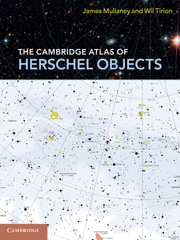
This superb, all-purpose star atlas is the first of its kind devoted to observing the Herschel objects with binoculars and telescopes. It displays over 2500 of the most visually-attractive star clusters, nebulae and galaxies that were discovered by Sir William, Caroline and Sir John Herschel, and is a must-have for stargazers who want to explore these fascinating objects. Covering the entire sky from the North to the South Celestial Pole, and showing all 88 constellations, it is also a general sky atlas showing variable, double and multiple stars, and the Milky Way. Written by experienced observer James Mullaney and illustrated by renowned celestial cartographer Wil Tirion, this is a magnificent 'celestial roadmap' to some of the finest deep-sky showpieces. Spiral bound and printed in red-light friendly colors for use at a telescope, with color-coded symbols for easy recognition and identification, this is an all-purpose observing reference for all amateur observers. Additional resources, including a target list ordered by Herschel designation, are available to download from www.cambridge.org/9780521138178.
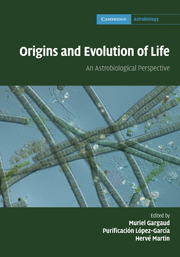
Devoted to exploring questions about the origin and evolution of life in our Universe, this highly interdisciplinary book brings together a broad array of scientists. Thirty chapters assembled in eight major sections convey the knowledge accumulated and the richness of the debates generated by this challenging theme. The text explores the latest research on the conditions and processes that led to the emergence of life on Earth and, by extension, perhaps on other planetary bodies. Diverse sources of knowledge are integrated, from astronomical and geophysical data, to the role of water, the origin of minimal life properties and the oldest traces of biological activity on our planet. This text will not only appeal to graduate students but to the large body of scientists interested in the challenges presented by the origin of life, its evolution, and its possible existence beyond Earth.
We are very pleased to present what is the first major star atlas devoted to the observation of the “Herschel objects” – some 5,000 star clusters, nebulae, and galaxies collectively discovered by Sir William Herschel, his sister Caroline, and son Sir John. With the widespread growing popularity of viewing these wonders of the heavens by amateur astronomers today, the need for such a work clearly exists. The one classic atlas that identified some of those objects found by William Herschel, using his designations (329 of them), was Norton's Star Atlas in all of its first 17 editions. Sadly, all later revised and redrawn versions – initially re-titled Norton's 2000.0 and currently back to the original Norton's Star Atlas – dropped these labels, to the dismay of observers. While this new atlas is primarily designed with observation of star clusters, nebulae, and galaxies in mind, it also serves as a general purpose guide for exploring all types of deep-sky objects, showing as it does many prominent double and multiple stars, variable stars, asterisms, and the majestic Milky Way itself. Additionally, it may be viewed as a companion volume to our previous work, The Cambridge Double Star Atlas, first published in 2009. Between these two publications, the long-standing lack of recognition accorded the discoveries of the Herschels, and those of the classic double star observers, by celestial cartographers has finally been rectified.
Who were the Herschels?
Sir William Herschel
William Herschel was without question the greatest visual observer who ever lived.