To save content items to your account,
please confirm that you agree to abide by our usage policies.
If this is the first time you use this feature, you will be asked to authorise Cambridge Core to connect with your account.
Find out more about saving content to .
To save content items to your Kindle, first ensure no-reply@cambridge.org
is added to your Approved Personal Document E-mail List under your Personal Document Settings
on the Manage Your Content and Devices page of your Amazon account. Then enter the ‘name’ part
of your Kindle email address below.
Find out more about saving to your Kindle.
Note you can select to save to either the @free.kindle.com or @kindle.com variations.
‘@free.kindle.com’ emails are free but can only be saved to your device when it is connected to wi-fi.
‘@kindle.com’ emails can be delivered even when you are not connected to wi-fi, but note that service fees apply.
We present recent results comparing the CO and HI dynamics of nearby galaxies that have been observed as part of the THINGS (HI) and the HERACLES (CO) surveys. We focus on 3 galaxies out of the 11 that have been analysed so far, and present velocity-fields and rotation curves of the CO, which we compare with that of the HI.
Luminous compact blue galaxies (LCBGs) are a diverse class of galaxies characterized by high luminosity, blue color, and high surface brightness that sit at the critical juncture of galaxies evolving from the blue to the red sequence. As part of our multi-wavelength survey of local LCBGs, we have been studying the HI content of these galaxies using both single-dish telescopes and interferometers. Our goals are to determine if single-dish HI observations represent a true measure of the dynamical mass of LCBGs and to look for signatures of recent interactions that may be triggering star formation in LCBGs. Our data show that while some LCBGs are undergoing interactions, many appear isolated. While all LCBGs contain HI and show signatures of rotation, the population does not lie on the Tully-Fisher relation nor can it evolve onto it. Furthermore, the HI maps of many LCBGs show signatures of dynamically hot components, suggesting that we are seeing the formation of a thick disk or spheroid in at least some LCBGs. There is good agreement between the HI and Hα kinematics for LCBGs, and both are similar in appearance to the Hα kinematics of high redshift star-forming galaxies. Our combined data suggest that star formation in LCBGs is primarily quenched by virial heating, consistent with model predictions.
Young and massive super star clusters (SSCs) are found whenever very active star formation is going on, such as that in interacting Luminous Infrared Galaxies (LIRGs). From a deep NIR adaptive optics imaging survey, we present thus far the first K-band SSC luminosity functions (LFs) in these types of galaxies, and also a relation between the brightest SSC and the global SFR of the galaxy. Based on the derived LFs, one can constrain the cluster initial mass function (CIMF) and study the formation and evolution of SSCs. Our preliminary results are in disagreement with theoretical expectations which suggest that the SSC LF should be well fitted by a single power-law with an index of −2. We find power-law indexes of ~−1.5, shallower than the expected ones. Taken at face value, our results appear to support the concept that the CIMF is mass-dependent, not universal, which will be studied in more detail by mass-modelling of the SSCs. The data-set will also allow us to estimate the fraction of total star formation originating in the SSCs over a range of galaxy types.
A 10-metre class telescope project on African soil is ending its commissioning period and is transitioning to science mode. We present the current status of the Southern African Large Telescope and its instruments. We will also briefly discuss the SALT capabilities for extragalactic astronomy in particular.
We have studied the star-forming and AGN activity of massive galaxies in the redshift range z = 0.4−2, which are detected in a deep survey field using the AKARI and Subaru telescopes toward the North Ecliptic Pole (NEP). The multi-wavelength survey allows us to select Mid-InfraRed (MIR) bright populations as Luminous InfraRed Galaxies (LIRGs) with L(IR) ≃ 1010–11 L⊙, which can be also sub-classified into Balmer Break Galaxies (BBGs) and Infra-Red (IR) Bump Galaxies (IRBGs). AKARI/IRC multiband photometry can distinguish their star-forming/AGN activity for LIRGs with/without the Polycyclic-Aromatic Hydrocarbon (PAH) emission bands at 6.2, 7.7 and 11.3 μm, and estimate the Star Formation Rate (SFR) from their total emitting InfraRed (IR) luminosities for star-formings and the emissions from dusty torus for AGNs. The results are summarised as below: 1) The rest-frame 7.7 μm luminosity is still a good tracer of the total IR (tIR) luminosity, as the PAH emission dominates for star-forming galaxies even up to z ≃ 2, 2) Rest-frame 5μm Luminosities may trace emissions from dusty torus of AGN in the LIRGs, 3) SFR of Starburst-AGN LIRGs (s/a-LIRGs) tends to quench at z < 0.8 more rapidly than that of Starburst dominated LIRGs (sb-LIRGs), 4) Intrinsic Stellar populations in the s/a-LIRGs show redder colours than those in the sb-LIRGs. These results suggest that Super Massive Black Holes (SMBH) could already have grown to ≃ 3 × 10⁸M⊙ in the agn-LIRGs, with ≃ 1011L⊙ at z > 1.2, and the growth of SMBH tends to follow the star-forming activities around z = 1–2.
As part of the Herschel Multi-tiered Extragalactic Survey we have investigated the rest-frame far-infrared (FIR) properties of a sample of more than 4800 Lyman Break Galaxies (LBGs) in the Great Observatories Origins Deep Survey North field. Most LBGs are not detected individually, but we do detect a sub-sample of 12 objects at 0.7 < z < 1.6 and one object at z = 2.0. The LBGs have been selected using color-color diagrams; the ones detected by Herschel SPIRE have redder colors than the others, while the undetected ones have colors consistent with average LBGs at z > 2.5. The spectral energy distributions of the objects detected in the rest-frame FIR are investigated using the code cigale to estimate physical parameters. We include far-UV (FUV) data from GALEX. We find that LBGs detected by SPIRE are high mass, luminous infrared galaxies. It appears that LBGs are located in a triangle-shaped region in the AFUV vs. LogLFUV = 0 diagram limited by AFUV = 0 at the bottom and by a diagonal following the temporal evolution of the most massive galaxies from the bottom-right to the top-left of the diagram. This upper envelop can be used as upper limits for the UV dust attenuation as a function of LFUV. The limits of this region are well explained using a closed-box model, where the chemical evolution of galaxies produces metals, which in turn lead to higher dust attenuation when the galaxies age.
Near-infrared images obtained with WIRCam are used to investigate the recent history of the starburst galaxy NGC 253. The distribution of stars in the disk is lopsided, with the projected density of young and intermediate age stars in the north east portion of the disk higher than on the opposite side of the galaxy. Bright AGB stars are also detected out to 15 kpc above the disk plane. Comparisons with models suggest that the extraplanar stars formed over a broad range of ages, suggesting that the disk of NGC 253 was disrupted by a tidal encounter.
Due to its proximity, size, complex structure and high inclination angle, M31 offers an excellent opportunity for studying galactic structures outside the Milky Way and for drawing implications for their cosmological origin. We have studied the stellar populations of M 31 using the Sloan Digital Sky Survey (SDSS) photometry and the Spitzer far-infrared (FIR) mappings of dust. Combining these data, we have constructed a 3-dimensional model of the galaxy, laying constraints on the intrinsic (dust-free) properties of the galaxy and its stellar populations: their apparent and intrinsic luminosities, luminosity distributions, colours, shapes and sizes. We have interpreted the derived spectral energy distributions with synthetic stellar populations created with the Starburst99 software, in order to constrain the ages and masses of the stellar components.
Integral-Field Units have been used to describe the morphology in numerous continuum and line wavebands of a sample of barred spirals galaxies (some of which known as starbursts and LINERs) and to characterize their gas and stellar populations. The central region of eight galaxies was studied with OASIS and an iterative technique developed to separate superposed stellar populations. Young populations, responsible for nebular emission lines, are found in nuclear structures. Older stellar components are mostly uniformly distributed. The mass distribution of the different populations indicates a long sequence of burst events over the whole galaxy history. An activity of the type composite/transition region is often seen over the whole central region. SpIOMM was also used to map the emission lines over the entire disk of one of these galaxies. Among other results, it confirms the peculiar line ratio.
Broadband spectral energy distribution (SED) fitting is used to study a deep sample of UV-selected sub-L* galaxies at z~2. They are found to be less dusty than L* galaxies, and to contribute more mass to the cosmic mass budget at this epoch than is inferred from shallower high-z surveys. Additionally, SFRs are found to be proportional to stellar masses over three orders of magnitude in mass; this phenomenon can be explained by assuming that new stars form out of gas that co-accretes along with dark matter onto the galaxies' dark matter halos, a scenario that naturally leads to SFRs that gradually increase with time.
We have studied the large scale distribution of matter in the Chandra Deep Field South on the basis of photometric redshifts and we have identified several over-densities between redshift 0.6 and 2.3. We analyse two of these structures using the deepest X-ray observations ever obtained: 4 Ms with the Chandra satellite and 2.5 Ms with XMM-Newton. We set a very faint upper limit on the X-ray luminosity of a structure at redshift 1.6, and we find an extended X-ray emission from a structure at redshift 0.96 of which we can estimate the gas temperature and make a comparison with the scaling relations between the X-ray luminosity and mass or temperature of high redshift galaxy clusters.
This contribution gives a short overview of the MeerKAT Karoo Array Telescope, the South African Square Kilometre Array Precursor. Some of the key specification and HI emission line science for MeerKAT are described.
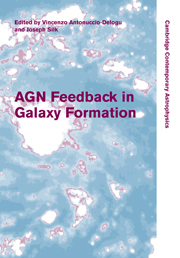
During the past decade, convincing evidence has been accumulated concerning the effect of active galactic nuclei (AGN) activity on the internal and external environment of their host galaxies. Featuring contributions from well-respected researchers in the field, and bringing together work by specialists in both galaxy formation and AGN, this volume addresses a number of key questions about AGN feedback in the context of galaxy formation. The topics covered include downsizing and star-formation time scales in massive elliptical galaxies, the connection between the epochs of supermassive black hole growth and galaxy formation and the question of whether AGN and star formation coexist. Authors also discuss key challenging computational problems, including jet-interstellar/intergalactic medium interactions, and both jet- and merging-induced star formation. Suitable for researchers and graduate students in astrophysics, this volume reflects the engaging and lively discussions taking place in this emerging field of research.
This autobiography was first published in 1883, and recounts the life of the Scottish scientist and inventor James Nasmyth (1808–1890), who was arguably the last of the early pioneers of the machine tool industry, most famously remembered for his invention of the steam hammer. He also produced and manufactured several other important machine tools, including a hydraulic press which used water pressure to force tight-fitting machine parts together. All of these machines became popular in manufacturing, and all are still in use today in modified forms. Nasmyth retired from business in 1856 at the age of just 48, and pursued his various hobbies including astronomy; he was co-author of The Moon: Considered as a Planet, a World, and a Satellite (1874) with James Carpenter. This autobiography follows a chronological order, and a list of Nasmyth's inventions is given at the end of the book.
Radio galaxies represent ideal laboratories to investigate the triggering, maintenance, and fading of AGN activity, as well as the link between these processes and the physical conditions of the environment, from sub- to super-galactic scales. In this context, key sources for the study of the very first phases of the evolution of radio galaxies are the gigahertz-peaked-spectrum (GPS) sources associated with galaxies. From sub-kpc scales, their jet-lobe structures propagate through the host-galaxy interstellar medium (ISM), evolving into sub-galactic (compact-steep-spectrum, CSS) sources, which then expand to super-galactic scales (see O'Dea 1998 for a review). However, this scenario still has several open issues, such as the absorption mechanism responsible for the characteristic turnover in the radio spectrum, the details of the dynamical evolution and interaction with the ISM, the parameters of the central engine, and the origin of the high-energy emission. We recently proposed a model that addresses some of these issues through the analysis of the broad-band emission of GPS galaxies (Stawarz et al. 2008). Here we show that our model satisfactorily reproduces a number of observed properties of X-ray emitting GPS galaxies.
The model: dynamical and spectral evolution
In the following, we recall the main features of our dynamical-radiative model; a more comprehensive discussion can be found in our original paper (Stawarz et al. 2008), and references therein.
In recent years, active galactic nuclei (AGN) have become more popular among a wider community. The possibility of using them to produce feedback effects that would help solve some of the questions connected to the hierarchical scenario of galaxy formation and evolution has made them particularly popular among theorists. Feedback effects associated with AGN-induced outflows are now routinely incorporated in models of galaxy evolution. Indeed, gas outflows may have a wide range of effects. For example, clearing up the circumnuclear regions and halting the growth of the supermassive black holes (see e.g. Silk & Rees 1998), as well as providing the mechanism that can cause the correlations found between the mass of the central super-massive black hole and the properties of the host galaxies. Outflows can also prevent the formation of too many massive galaxies in the early universe and can inject energy and metals into the interstellar and intergalactic medium. AGN-driven outflows could be a major source of feedback in the overall galaxy formation process. However, the characteristics of such feedback are poorly constrained and the exact relevance of gaseous outflows in galaxy evolution still needs to be evaluated.
AGN-driven outflows can have different origins. Here, I will concentrate on the role that the radio-loud phase of nuclear activity (and the presence of radio plasma jets) can play in the evolution of a galaxy. Radio-loud AGN are preferentially hosted by massive early-type galaxies.
In recent years, remarkably tight correlations have been observed between the properties of supermassive black holes (SMBHs) residing in galaxy cores and those of the host galaxies themselves (Magorrian et al. 1998; Gebhhardt et al. 2000; Häring and Rix 2004). A growing body of evidence seems to support the idea that feedback from active galactic nuclei (AGN) provides a natural link between these. While every galaxy can potentially host a SMBH, only a relatively small fraction of these are observed in an active state. AGN activity manifests itself through powerful outflows observable right across the electromagnetic spectrum.
The central black holes are powered by accretion of surrounding cold gas. The resultant outflows, in turn, affect the cold gas supply by heating and/or transporting this gas away from dense inner regions with short cooling times. It is for this reason that feedback from radio sources is particularly interesting. Despite only contributing around one per cent of the AGN bolometric luminosity, radio-loud AGNs can profoundly affect their surroundings through such mechanical feedback. One piece of observational evidence supporting this view comes from studies of X-ray clusters. In the absence of feedback, large amounts of cold gas are expected in dense cluster cores (due to short cooling times), however no such gas has been found. This well-known ‘cooling flow problem’ points to the need for a central, powerful heating source.
There are two families of luminous elliptical galaxies: cusp galaxies and core galaxies. Cusp galaxies have steep power-law surface-brightness profiles down to the centre (hence the name ‘power-law’ galaxies, often used as a synonym for cusp galaxies), corresponding to intrinsic stellar density profiles with inner logarithmic slope γ > 0.5; core galaxies have surface-brightness profiles with a flat central core, corresponding to γ < 0.3 (Faber et al. 1997; Lauer et al. 2007). Cusp galaxies are relatively faint in optical, rotate rapidly, have disky isophotes, host radio-quiet active galactic nuclei (AGN) and do not contain large amounts of X-ray-emitting gas; core galaxies are brighter in the optical, rotate slowly, have boxy isophotes, radio-loud AGN and diffuse X-ray emission (for a summary of these observational findings see Nipoti and Binney 2007; Kormendy et al. 2009, and references therein). The most popular explanation for the origin of such a dichotomy is that cusp galaxies are produced in dissipative, gas-rich (‘wet’) mergers, while core galaxies are produced in dissipationless, gas-poor (‘dry’) mergers (Faber et al. 1997), the cores being a consequence of core scouring by binary supermassive black holes (Begelman et al. 1980). The actual role of galaxy merging in the formation of elliptical galaxies is still a matter of debate (e.g. Naab and Ostriker 2009). What is reasonably beyond doubt is that cores must be produced by dissipationless processes, while cusps are a signature of dissipation (Faber et al. 1997; Kormendy et al. 2009, and references therein).