To save content items to your account,
please confirm that you agree to abide by our usage policies.
If this is the first time you use this feature, you will be asked to authorise Cambridge Core to connect with your account.
Find out more about saving content to .
To save content items to your Kindle, first ensure no-reply@cambridge.org
is added to your Approved Personal Document E-mail List under your Personal Document Settings
on the Manage Your Content and Devices page of your Amazon account. Then enter the ‘name’ part
of your Kindle email address below.
Find out more about saving to your Kindle.
Note you can select to save to either the @free.kindle.com or @kindle.com variations.
‘@free.kindle.com’ emails are free but can only be saved to your device when it is connected to wi-fi.
‘@kindle.com’ emails can be delivered even when you are not connected to wi-fi, but note that service fees apply.
At a public lecture at the Sorbonne in 1864, the renowned French scientist Louis Pasteur raised the fundamental philosophical question pertaining to the origin of life: can matter organize itself to form a living system? Pasteur answered this question with a decisive no. He was referring both to the emergence of life on the primordial Earth and to the possibility of “spontaneous generation” – the formation of living organisms out of matter here and now. Life, Pasteur believed, was originally created by God and organisms are subsequently born only from parents.
Toward the end of the eighteenth century, the German philosopher Immanuel Kant had also pondered the question of the nature of biological organization and its emergence from matter. Unlike other physical objects, Kant noted, an organism is an interactive system in which parts and whole are reciprocally dependent. This circular, self-reproducing nature defines a living system and the critical question is whether we can understand the production of such an organized, functional whole in causal, materialistic terms.
For Kant, the idea of physical principles of self-organization, working mechanistically without any guiding plan and yet capable of producing an organized whole, was inconceivable. Hence, the very possibility of the emergence of life from matter seemed to him absurd. Although not sharing Kant's and Pasteur's convictions, most scientists toward the end of the nineteenth century nevertheless preferred not to deal with the origin-of-life problem.
When the “origin-of-life” issue is debated nowadays, the question most often asked is: How did the first cell originate? What sequence of processes could have given rise to the extraordinary complexity of even the most rudimentary living cell? Once such a cell was in place, the assumption is that metabolism and descent with modification could begin and the Darwinian selection process could get under way, generating over the course of aeons the vast profusion of natural kinds, living and extinct, that we know. But what sort of selection principles, working on what sort of materials, could have sufficed in the first place to build up the kind of intricate structure that even the smallest functioning cell requires? In short, how did the living come from the non-living in the first place?
In earlier centuries, the transition from non-life to life would have seemed unproblematic, indeed entirely commonplace. It would have appeared obvious that living comes from non-living in the world of nature all the time: maggots develop in decaying flesh, tiny worms appear in rotting fruit, and so on. At the lowest levels of living complexity, matter (it seemed) could generate life unaided. Only with the advent of the microscope and finally the experiments of Pasteur was it shown that this kind of spontaneous generation was only apparent: no real transition from non-living to living actually occurred in it. So how did life begin?
The search for and discovery of extraterrestrial life, especially an independent origin of life, raise interesting philosophical issues (most or all of which can be connected to important practical issues), in at least three interrelated areas: (1) epistemology, (2) value theory (especially ethics), and (3) worldviews. This chapter samples a variety of views in these areas, touching slightly on some policy and theological connections, both of which are covered more extensively elsewhere in this volume.
The first section will explore epistemological areas such as (a) dealing with the limitation of knowing only one kind of biology, (b) challenges of discerning an independent origin of life, and (c) challenges for assessing the biological status of a region or entire planet. The ethical considerations of the second section will explore (a) the role of an independent origin of life vs. interplanetary transport, (b) ethical views ranging from anthropocentric to cosmological, and (c) potential policy implications. The third section will touch briefly on basic worldviews that revolve around (a) randomness and chance (an “accidental” universe), (b) purpose and meaning (a deliberate universe), and (c) a “bootstrapped” universe in which meaning and purpose emerge in the universe through valuing cultural beings (a “cultural cosmos”).
Epistemology
Extraterrestrial life poses unique challenges to the boundaries, application, and confidence in our knowledge. Some interrelated epistemological questions to consider are: (1) How can we deal with the limitations of knowing only one kind of biology?
Astrobiology has life at its core: Where does life come from? Where is it going? Are we alone? While it includes the search for extraterrestrial life – the very bit that has so captured the public's attention – it uses life on Earth as its reference point. Of course this probably has less to do with philosophy, and more to do with practicalities. After all, there is only one place that we know with certainty contains life, and most likely an indigenous biota at that. So, planet Earth remains the reference point. Thus, a search for life elsewhere, even in our own solar system, must include an understanding of the known range of life on Earth. And, even before that, an understanding of what we mean by “life.”
Understanding the range of current life on Earth, and mapping it to current environments in the solar system, is only a start as it lacks the element of time. Life on Earth may have been substantially different when it arose around about 4 billion years ago because the environmental range on Earth was dramatically different. Similarly, the climatic conditions forecast for a billion or so years into the future are bleak for much of life as we know it, including ourselves. Without intervention, the Sun as we know it will not even exist.
There has been a lively discussion recently about the science and ethics of “terraforming” Mars. The high level of interest is a result of spacecraft discoveries about Mars combined with the realization that humans are effectively warming the Earth and wondering if they can, and should, do the same on Mars. I suggest that terraforming is more appropriately called planetary ecosynthesis, and in this chapter I review the scientific studies of planetary ecosynthesis and the environmental ethics associated with instigating such global change on another planet.
Mars today is a cold, dry, frozen desert world on which not even the most hardy of Earth life could survive. Temperatures average −60°C and the pressure averages 0.6 kPa, over one hundred times less than atmospheric pressure at the surface of the Earth. As a result of the low pressure, and secondarily the low temperature, water is not liquid on the surface of Mars at any location or season. Strong solar ultraviolet radiation reaches the surface of Mars to complete the deadly mix of hostile environmental conditions.
But Mars has not always been this harsh. There is compelling evidence that early in its history Mars had stable liquid water on its surface. Presumably this phase of liquid water was associated with a higher pressure and somewhat warmer atmosphere.
The origin of life involved many, many emergences.
Harold Morowitz
The experimental investigation of life's origin commenced in earnest more than a half-century ago with the pioneering work of Miller, who synthesized many of life's molecular building blocks under plausible prebiotic conditions. Despite an initial euphoric sense that the origin mystery would soon be solved, scientists quickly realized that the transition from a geochemical to a biochemical world would not easily be deduced by the scientific method.
The great challenge of origins research lies in replicating in a laboratory setting the extraordinary increase in complexity that is required to evolve from isolated molecules to a living cell. The principal objective of this review is to describe some of the efforts by origin-of-life researchers to induce such increases in complexity. A unifying theme of these studies, and hence a useful organizing framework for this review, is the principle of emergence – the natural process by which complexity arises.
Emergence as a unifying concept in origins research
The origin of life may be modeled as a sequence of so-called “emergent” events, each of which added new structure and chemical complexity to the prebiotic Earth. Observations of numerous everyday phenomena reveal that new patterns commonly emerge when energy flows through a collection of many interacting particles.
The premise of my chapter is that history can be not only enlightening in itself but also significant in a variety of contemporary contexts. One clear example of this is in connection with the theological, ethical, and philosophical implications of the search for life, because these issues have been addressed again and again throughout history as the possibility of life beyond Earth has been raised. It is true that most of the historical debate has centered on extraterrestrial intelligence rather than microbial life. But at least part of the interest in the search for microbial life is that it is an indication of the prevalence of intelligence in the universe. This explains in part the uproar over the claims for nanofossils in the Mars rock in 1996 – much more was at stake than primitive life on Mars itself. This connection between microbes and intelligence is made especially in the popular mind, despite the fact that many evolutionists would argue that the gap between microbes and intelligence is greater than that between life and non-life. Thus, Peter Ward and Donald Brownlee have recently, and famously, argued that the universe may well be full of microbes, but not intelligence, making ours a “Rare Earth”. If this is true, the study of the implications of microbial life beyond Earth is all the more important.
The origin of life has always been a topic charged with religious import. This chapter aims to survey briefly some origin-of-life ideas over time; first, if we look in detail at how the debate over life's origin played out between Darwin and his supporters, we will see a clear example of this. Note that I said Darwin's supporters, rather than his opponents. We expect a story about the new evolutionary science to include much heated objection from religious groups, for whom so many aspects of Darwin's theory produced problems. But a look at how divisive the issue was among the Darwinians themselves is an even more complex and enlightening story, perhaps of more relevance to scientists in their own work.
By the 1850s, William Benjamin Carpenter, Professor of physiology at the Royal Institution of London, believed, as did Herbert Spencer, that the vital force of living things was completely interconvertible with forces from non-living nature such as heat, electricity, kinetic energy, etc. However, also like Spencer and a number of others in the Darwinian camp, Carpenter believed that the conversion of heat or chemical energy into vital energy could only be accomplished through the agency of already living matter; in other words, that non-living matter could never organize itself into living matter capable of generating vital force. This served as a convenient theoretical barrier separating modern physiology and its ally, the new evolution theory, from the bête noir of spontaneous generation.
Astronomy, like any experimental subject, needs statistical methods to interpret data reliably. This practical handbook presents the most relevant statistical and probabilistic machinery for use in observational astronomy. Classical parametric and non-parametric methods are covered, but there is a strong emphasis on Bayesian solutions and the importance of probability in experimental inference. Chapters cover basic probability, correlation analysis, hypothesis testing, Bayesian modelling, time series analysis, luminosity functions, and clustering. The book avoids the technical language of statistics in favour of demonstrating astronomical relevance and applicability. It contains many worked examples, and problems that make use of databases which are available on the Web. It is suitable for self-study at advanced undergraduate or graduate level, as a reference for professional astronomers, and as a textbook basis for courses in statistical methods in astronomy.
Astrobiology is one of the hottest areas of current research, reflecting not only impressive advances in the understanding of the origin of life but also the discovery of over 100 extrasolar planets in recent years. This volume is based on a meeting held in 2002 at the Space Telescope Science Institute, which aimed to lay the astrophysical groundwork for locating habitable places in the Universe. Written by leading scientists in the field, it covers a range of topics relevant to the search for life in the Universe, including: cosmology and its implications for the emergence of life, the habitable zone in the Milky Way Galaxy, the formation of stars and planets, the study of interstellar and interplanetary matter, searches for extrasolar planets, the synthesis of organic material in space, and spectroscopic signatures that could be used to detect life. This is an invaluable resource for both professional researchers and graduate students.
This book reviews the findings on the composition of the universe, its dynamics, and the implications of both for the evolution of large-scale structure and for fundamental theories of the universe. With each chapter written by a leading expert in the field, topics include massive compact halo objects, the oldest white dwarfs, hot gas in clusters of galaxies, primordial nucleosynthesis, modified Newtonian dynamics, the cosmic mass density, the growth of large-scale structure, and a discussion of dark energy. This book is an invaluable resource for both professional astronomers and graduate students.
In the last few years, digital SLR cameras have taken the astrophotography world by storm. It is now easier to photograph the stars than ever before! They are compact and portable, flexible to adapt with different lenses and for telescope use, and above all DSLR cameras are easy and enjoyable to use. In this concise guide, experienced astrophotography expert Michael Covington outlines the simple, enduring basics that will enable you to get started, and help you get the most from your equipment. He covers a wide selection of equipment, simple and advanced projects, technical considerations and image processing techniques. Unlike other astrophotography books, this one focuses specifically on DSLR cameras, not astronomical CCDs, non-DSLR digital cameras, or film. This guide is ideal for astrophotographers who wish to develop their skills using DSLR cameras and as a friendly introduction to amateur astronomers or photographers curious about photographing the night sky.
Essential Science in the Final Years of the Hubble Space Telescope: Proceedings of the Space Telescope Science Institute Symposium, Held in Baltimore, Maryland May 3–6, 2004
This book acknowledges the importance of identifying the most crucial science to be performed by the superb Hubble Telescope. With this goal in mind, the book presents a review of some of the most important open questions in astronomy. World experts examine topics ranging from extrasolar planets and star formation to supermassive black holes and the reionization of the universe. Special emphasis is placed on what astronomical observations should be carried out during the next few years to enable breakthroughs in our understanding of a complex and dynamic universe. In particular, the reviewers attempt to identify those topics to which the Hubble Space Telescope can uniquely contribute. The special emphasis on future research makes this book an essential resource for both professional researchers and graduate students in astronomy and astrophysics.
Why is the sky blue and why are sunsets red? When can I see a rainbow? Why is the moon sometimes visible in daylight? In Out of the Blue skywatcher John Naylor offers practical advice about where and when you can expect to see natural phenomena, what you will see and how to improve your chances of seeing it. He takes in both the night and the day sky, and deals only with what can be seen with the naked eye. Drawing on science, history, literature and mythology, and written in a popular style that assumes only basic scientific know-how, Out of the Blue is for everyone who enjoys being outdoors and who feels curious or puzzled about things optical and astronomical.
The Hubble Space Telescope has made some of the most dramatic discoveries in the history of astronomy. From its vantage point 600km above the Earth, Hubble is able to capture images and spectra that would be difficult or impossible to obtain from the ground. This volume represents some of the most important scientific achievements of the Hubble Space Telescope in its first decade of operation. Written by world experts, the book covers topics ranging from our own solar system to cosmology. Chapters describe cutting edge discoveries in the study of Mars and Jupiter, of stellar birth and death, of star clusters, of the interstellar medium, of our own Milky Way Galaxy and of other galaxies, of supermassive black holes, and of the determination of cosmological parameters, including the age and ultimate fate of our universe. This is an indispensable collection of review articles for researchers and graduate students.
Several major breakthroughs have helped contribute to the emerging field of astrobiology. Focusing on these developments, this fascinating book explores some of the most important problems in this field. It examines how planetary systems formed, and how water and the biomolecules necessary for life were produced. It then focuses on how life may have originated and evolved on Earth. Building on these two themes, the final section takes the reader on a search for life elsewhere in the Solar System. It presents the latest results of missions to Mars and Titan, and explores the possibilities of life in the ice-covered ocean of Europa. This interdisciplinary book is an enjoyable overview of this exciting field for students and researchers in astrophysics, planetary science, geosciences, biochemistry, and evolutionary biology. Colour versions of some of the figures are available at www.cambridge.org/9780521875486.
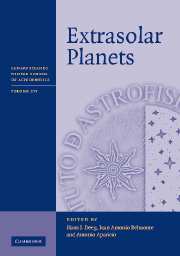
This 2007 volume presents the lectures from the sixteenth Winter School of the Instituto de Astrofísica de Canarias, which was dedicated to extrasolar planets. Research into extrasolar planets is one of the most exciting fields of astrophysics, and the past decade has seen a research leap from speculations on the existence of planets orbiting other stars to the discovery of around 200 planets to date. The book covers a wide range of issues, from the state-of-the-art observational techniques used to detect extrasolar planets, to the characterizations of these planets, and the techniques used in the remote detection of life. It also looks at the insights we can gain from our own Solar System, and how we can apply them. The contributors, all of high-standing in the field, provide a balanced and varied introduction to extrasolar planets for research astronomers and graduate students, bridging theoretical developments and observational advances.
I review the progress made in understanding the physics and modes of star cluster formation through the use of direct self-gravitating hydrodynamical simulations, including those that have recently been performed incorporating radiative transfer and magnetic fields.