Refine search
Actions for selected content:
28358 results in Astrophysics
Positions of the Fundamental and Harmonic Sources of a Type II Solar Burst
-
- Journal:
- Publications of the Astronomical Society of Australia / Volume 1 / Issue 7 / April 1970
- Published online by Cambridge University Press:
- 25 April 2016, pp. 308-310
-
- Article
- Export citation
Observations of Shell-Type Galactic Radio Sources
-
- Journal:
- Publications of the Astronomical Society of Australia / Volume 1 / Issue 1 / January 1967
- Published online by Cambridge University Press:
- 25 April 2016, p. 21
-
- Article
- Export citation
The Galactic Force Law
-
- Journal:
- Publications of the Astronomical Society of Australia / Volume 7 / Issue 1 / 1987
- Published online by Cambridge University Press:
- 25 April 2016, pp. 26-30
-
- Article
- Export citation
Polarization of Southern Pulsars
-
- Journal:
- Publications of the Astronomical Society of Australia / Volume 10 / Issue 4 / 1993
- Published online by Cambridge University Press:
- 25 April 2016, p. 365
-
- Article
-
- You have access
- Export citation
Carbon Abundances in Planetary Nebulae in the Galactic Bulge
-
- Journal:
- Publications of the Astronomical Society of Australia / Volume 5 / Issue 4 / 1984
- Published online by Cambridge University Press:
- 25 April 2016, pp. 535-537
-
- Article
- Export citation
Microwave Holographic Surface Measurement of the Tidbinbilla 64-m Antenna
-
- Journal:
- Publications of the Astronomical Society of Australia / Volume 5 / Issue 2 / 1983
- Published online by Cambridge University Press:
- 25 April 2016, pp. 270-272
-
- Article
- Export citation
The Australia Telescope — Current Status
-
- Journal:
- Publications of the Astronomical Society of Australia / Volume 6 / Issue 1 / 1985
- Published online by Cambridge University Press:
- 25 April 2016, pp. 101-104
-
- Article
- Export citation
Gravity, Particles, and Astrophysics Paul S. Wesson, D. Reidel 1980
-
- Journal:
- Publications of the Astronomical Society of Australia / Volume 4 / Issue 2 / 1981
- Published online by Cambridge University Press:
- 25 April 2016, p. 274
-
- Article
- Export citation
Notice to Authors
-
- Journal:
- Publications of the Astronomical Society of Australia / Volume 2 / Issue 2 / March 1972
- Published online by Cambridge University Press:
- 25 April 2016, p. 119
-
- Article
- Export citation
Solar: Fine Structure of the Flare of 1968 June 9
-
- Journal:
- Publications of the Astronomical Society of Australia / Volume 1 / Issue 5 / March 1969
- Published online by Cambridge University Press:
- 25 April 2016, pp. 184-185
-
- Article
- Export citation
Theory of the Solar 22-Year Cycle
-
- Journal:
- Publications of the Astronomical Society of Australia / Volume 2 / Issue 1 / July 1971
- Published online by Cambridge University Press:
- 25 April 2016, pp. 7-10
-
- Article
- Export citation
The Llanherne Low Frequency Radio Telescope
-
- Journal:
- Publications of the Astronomical Society of Australia / Volume 2 / Issue 3 / October 1972
- Published online by Cambridge University Press:
- 25 April 2016, pp. 135-137
-
- Article
- Export citation
The Galactic Magnetic Field from Pulsar Rotation Measures
-
- Journal:
- Publications of the Astronomical Society of Australia / Volume 9 / Issue 1 / 1991
- Published online by Cambridge University Press:
- 25 April 2016, p. 131
-
- Article
- Export citation
The Kinematics of Cyclotron Emission for Quantized Electrons
-
- Journal:
- Publications of the Astronomical Society of Australia / Volume 4 / Issue 4 / 1982
- Published online by Cambridge University Press:
- 25 April 2016, pp. 359-362
-
- Article
- Export citation
-
Since the work of Wu and Lee (1979) there has been renewed interest in the classical theory of electron cyclotron masers (Lee and Wu 1980, Lee et al. 1980, Wu et al. 1981, 1982, Hewitt et al. 1981, 1982, Melrose et al. 1982, Omidi and Gurnett 1982, Melrose and Dulk 1982). A useful idea in these recent developments of the classical theory concerns a geometric interpretation of the classical gyroresonance condition

where Ωe , is the nonrelativistic gyrofrequency, s = 0, ± 1, ± 2,… is the harmonic number,
 is the Lorentz factor and ║ and ┴ denote components parallel and perpendicular to the magnetic field. In v ┴ − v ║ space (1) represents an ellipse with centre v ║ = v c , v ┴ = 0, eccentricity e 0 and semi-major axis V parallel to the v ┴ axis, with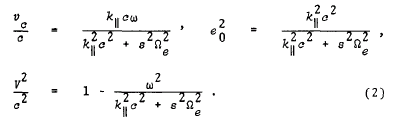
 is the Lorentz factor and ║ and ┴ denote components parallel and perpendicular to the magnetic field. In v
The Symbiotic Star H1-36
-
- Journal:
- Publications of the Astronomical Society of Australia / Volume 5 / Issue 2 / 1983
- Published online by Cambridge University Press:
- 25 April 2016, pp. 211-213
-
- Article
- Export citation
Notice to Authors
-
- Journal:
- Publications of the Astronomical Society of Australia / Volume 2 / Issue 4 / October 1973
- Published online by Cambridge University Press:
- 25 April 2016, p. 227
-
- Article
- Export citation
Recent Results on SN 1987A
-
- Journal:
- Publications of the Astronomical Society of Australia / Volume 7 / Issue 4 / 1988
- Published online by Cambridge University Press:
- 25 April 2016, pp. 355-370
-
- Article
- Export citation
Cosmic-Ray Anisotropies as a Function of Time and Direction
-
- Journal:
- Publications of the Astronomical Society of Australia / Volume 1 / Issue 3 / February 1968
- Published online by Cambridge University Press:
- 25 April 2016, pp. 114-115
-
- Article
- Export citation
The Generation of Radio Waves in Astrophysical Plasmas
-
- Journal:
- Publications of the Astronomical Society of Australia / Volume 1 / Issue 4 / December 1968
- Published online by Cambridge University Press:
- 25 April 2016, pp. 124-129
-
- Article
- Export citation
Galactic Cosmic Ray Anisotropies in the Energy Range 1011 – 1014eV.
-
- Journal:
- Publications of the Astronomical Society of Australia / Volume 6 / Issue 4 / 1986
- Published online by Cambridge University Press:
- 25 April 2016, pp. 425-436
-
- Article
- Export citation
