Refine search
Actions for selected content:
28356 results in Astrophysics
OH/IR stars and the Period-Luminosity Relation of Mira variables
-
- Journal:
- Proceedings of the International Astronomical Union / Volume 18 / Issue S376 / December 2022
- Published online by Cambridge University Press:
- 06 February 2024, pp. 328-333
- Print publication:
- December 2022
-
- Article
-
- You have access
- Open access
- Export citation
The last stand before Rubin: semi-automated inverse modelling of galaxy-galaxy strong lensing systems
-
- Journal:
- Proceedings of the International Astronomical Union / Volume 18 / Issue S381 / December 2022
- Published online by Cambridge University Press:
- 04 March 2024, pp. 31-34
- Print publication:
- December 2022
-
- Article
-
- You have access
- Export citation
-
Galaxy-galaxy strong lensing (SL) systems provide a unique opportunity to test modified gravity theories. Deviations from General Relativity are encoded in the post-Newtonian parameter (γ). As a preparation for the upcoming data from the Vera Rubin Observatory Legacy Survey of Space and Time (LSST), our research group collected imaging data of SL systems from ground-based telescopes and conducted spectroscopic observations of 21 systems on the Southern Astrophysical Research (SOAR) Telescope to measure the lens velocity dispersions, σv. We briefly describe the semi-automated SL modelling of the systems in this sample and combine the results with σv from SOAR to derive an estimate for γ. Our preliminary results yield a value of
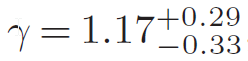 $$\gamma= 1.17_{ - 0.33}^{ + 0.29}$$, which is consistent with General Relativity. Although the error bars are limited by the sample size, this result represents the first constraint on modified gravity obtained purely from ground-based data, with a sample completely independent from previous studies, and which allows for a self consistent end-to-end analysis.
On the predictability horizon in Impact Monitoring of Near Earth Objects
-
- Journal:
- Proceedings of the International Astronomical Union / Volume 18 / Issue S382 / December 2022
- Published online by Cambridge University Press:
- 16 October 2024, pp. 185-190
- Print publication:
- December 2022
-
- Article
-
- You have access
- Open access
- Export citation
IAU volume 18 issue 382 Cover and Back matter
-
- Journal:
- Proceedings of the International Astronomical Union / Volume 18 / Issue S382 / December 2022
- Published online by Cambridge University Press:
- 16 October 2024, pp. b1-b2
- Print publication:
- December 2022
-
- Article
-
- You have access
- Export citation
Massive-Star Feedback at Low Metallicity
-
- Journal:
- Proceedings of the International Astronomical Union / Volume 18 / Issue S377 / December 2022
- Published online by Cambridge University Press:
- 13 February 2024, pp. 14-21
- Print publication:
- December 2022
-
- Article
-
- You have access
- Open access
- Export citation
The period-luminosity relations of red supergiants
-
- Journal:
- Proceedings of the International Astronomical Union / Volume 18 / Issue S376 / December 2022
- Published online by Cambridge University Press:
- 06 February 2024, pp. 292-305
- Print publication:
- December 2022
-
- Article
-
- You have access
- Open access
- Export citation
Dynamics of Circumstellar Planets in Binary Star Systems
-
- Journal:
- Proceedings of the International Astronomical Union / Volume 18 / Issue S382 / December 2022
- Published online by Cambridge University Press:
- 16 October 2024, pp. 12-19
- Print publication:
- December 2022
-
- Article
-
- You have access
- Open access
- Export citation
Maser Activity of Large Molecules toward Sgr B2 North
-
- Journal:
- Proceedings of the International Astronomical Union / Volume 18 / Issue S380 / December 2022
- Published online by Cambridge University Press:
- 07 February 2024, pp. 194-198
- Print publication:
- December 2022
-
- Article
-
- You have access
- Export citation
Interferometric Observations of the Water Fountain Candidates OH 16.3−3.0 and IRAS 19356+0754
-
- Journal:
- Proceedings of the International Astronomical Union / Volume 18 / Issue S380 / December 2022
- Published online by Cambridge University Press:
- 07 February 2024, pp. 362-364
- Print publication:
- December 2022
-
- Article
-
- You have access
- Export citation
The loss of OH maser emission in the early stage of Post-AGB evolution
-
- Journal:
- Proceedings of the International Astronomical Union / Volume 18 / Issue S380 / December 2022
- Published online by Cambridge University Press:
- 07 February 2024, pp. 371-373
- Print publication:
- December 2022
-
- Article
-
- You have access
- Open access
- Export citation
Where are the Eddington-limited starbursts? Gravitational lensing provides a way forward for sub-kiloparsec views of star formation
-
- Journal:
- Proceedings of the International Astronomical Union / Volume 18 / Issue S381 / December 2022
- Published online by Cambridge University Press:
- 04 March 2024, pp. 147-156
- Print publication:
- December 2022
-
- Article
-
- You have access
- Open access
- Export citation
-
In the past decade, submillimeter surveys have been employed to define samples of gravitationally-lensed dusty star-forming galaxies (DSFGs) at z ∼ 1 − 4. These extreme objects (
 ) appear to form stars prodigiously at rates of
  . Using all-sky Planck and WISE surveys, and wide-area Herschel surveys, we have identified the PASSAGES sample, with some of the rarest hyper-luminous IR galaxies ever discovered. We have found that their globally-averaged star formation surface densities are always sub-Eddington, typically by an order of magnitude. This may suggest that our understanding of how radiation pressure from massive stars disrupts the collapse of molecular clouds (thereby quenching star formation) is flawed—or simply that smaller physical resolutions are necessary. With the aid of lensing, we can now capture the source-plane distribution of star formation at ∼ 100pc scales, letting us identify isolated super-Eddington regions where quenching is occurring.
 ) appear to form stars prodigiously at rates of
  . Using all-sky Planck and WISE surveys, and wide-area Herschel surveys, we have identified the PASSAGES sample, with some of the rarest hyper-luminous IR galaxies ever discovered. We have found that their globally-averaged star formation surface densities are always sub-Eddington, typically by an order of magnitude. This may suggest that our understanding of how radiation pressure from massive stars disrupts the collapse of molecular clouds (thereby quenching star formation) is flawed—or simply that smaller physical resolutions are necessary. With the aid of lensing, we can now capture the source-plane distribution of star formation at ∼ 100pc scales, letting us identify isolated super-Eddington regions where quenching is occurring.
Catching unusual phenomena with extensive maser monitoring
-
- Journal:
- Proceedings of the International Astronomical Union / Volume 18 / Issue S380 / December 2022
- Published online by Cambridge University Press:
- 07 February 2024, pp. 210-212
- Print publication:
- December 2022
-
- Article
-
- You have access
- Export citation
Water Masers in the Galactic Center
-
- Journal:
- Proceedings of the International Astronomical Union / Volume 18 / Issue S380 / December 2022
- Published online by Cambridge University Press:
- 07 February 2024, pp. 125-127
- Print publication:
- December 2022
-
- Article
-
- You have access
- Export citation
Observations of Possibly New OH Excited Rotational State Masers
-
- Journal:
- Proceedings of the International Astronomical Union / Volume 18 / Issue S380 / December 2022
- Published online by Cambridge University Press:
- 07 February 2024, pp. 240-242
- Print publication:
- December 2022
-
- Article
-
- You have access
- Export citation
CHAPTER IV: CLOSING AND HANDOVER CEREMONY
-
- Journal:
- Proceedings of the International Astronomical Union / Volume 18 / Issue T30 / December 2022
- Published online by Cambridge University Press:
- 18 March 2024, pp. 27-34
- Print publication:
- December 2022
-
- Article
-
- You have access
- HTML
- Export citation
CHAPTER I: INAUGURAL CEREMONY
-
- Journal:
- Proceedings of the International Astronomical Union / Volume 18 / Issue T30 / December 2022
- Published online by Cambridge University Press:
- 18 March 2024, pp. 1-11
- Print publication:
- December 2022
-
- Article
-
- You have access
- HTML
- Export citation
Deconvolving the complex structure of the asteroid belt
-
- Journal:
- Proceedings of the International Astronomical Union / Volume 18 / Issue S382 / December 2022
- Published online by Cambridge University Press:
- 16 October 2024, pp. 86-97
- Print publication:
- December 2022
-
- Article
-
- You have access
- Open access
- Export citation
The Tip of the Red Giant Branch as a Cosmological Tool
-
- Journal:
- Proceedings of the International Astronomical Union / Volume 18 / Issue S376 / December 2022
- Published online by Cambridge University Press:
- 06 February 2024, pp. 30-47
- Print publication:
- December 2022
-
- Article
-
- You have access
- Open access
- Export citation
Megamaser Cosmology Project II : The prospects for measuring a 1% Ho and distances to high-z galaxies
-
- Journal:
- Proceedings of the International Astronomical Union / Volume 18 / Issue S380 / December 2022
- Published online by Cambridge University Press:
- 07 February 2024, pp. 3-11
- Print publication:
- December 2022
-
- Article
-
- You have access
- Open access
- Export citation
Migration of giant planets in low viscosity discs and consequences on the Nice model
-
- Journal:
- Proceedings of the International Astronomical Union / Volume 18 / Issue S382 / December 2022
- Published online by Cambridge University Press:
- 16 October 2024, pp. 110-115
- Print publication:
- December 2022
-
- Article
-
- You have access
- Export citation
