Refine search
Actions for selected content:
1122 results in Biological Physics and Soft Matter Physics
11 - Self-replicating systems
-
- Book:
- Structural DNA Nanotechnology
- Published online:
- 05 December 2015
- Print publication:
- 07 January 2016, pp 186-197
-
- Chapter
- Export citation
12 - Computing with DNA
-
- Book:
- Structural DNA Nanotechnology
- Published online:
- 05 December 2015
- Print publication:
- 07 January 2016, pp 198-212
-
- Chapter
- Export citation
9 - DNA origami and DNA bricks
-
- Book:
- Structural DNA Nanotechnology
- Published online:
- 05 December 2015
- Print publication:
- 07 January 2016, pp 150-171
-
- Chapter
- Export citation
Index
-
- Book:
- Structural DNA Nanotechnology
- Published online:
- 05 December 2015
- Print publication:
- 07 January 2016, pp 251-257
-
- Chapter
- Export citation
Contents
-
- Book:
- Structural DNA Nanotechnology
- Published online:
- 05 December 2015
- Print publication:
- 07 January 2016, pp vii-viii
-
- Chapter
- Export citation
Frontmatter
-
- Book:
- Structural DNA Nanotechnology
- Published online:
- 05 December 2015
- Print publication:
- 07 January 2016, pp i-vi
-
- Chapter
- Export citation
8 - DNA nanomechanical devices
-
- Book:
- Structural DNA Nanotechnology
- Published online:
- 05 December 2015
- Print publication:
- 07 January 2016, pp 130-149
-
- Chapter
- Export citation
4 - Single-stranded DNA topology and motif design
-
- Book:
- Structural DNA Nanotechnology
- Published online:
- 05 December 2015
- Print publication:
- 07 January 2016, pp 44-63
-
- Chapter
- Export citation

Brownian Ratchets
- From Statistical Physics to Bio and Nano-motors
-
- Published online:
- 05 January 2016
- Print publication:
- 11 January 2016
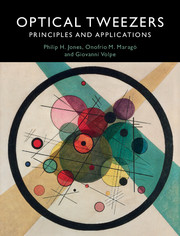
Optical Tweezers
- Principles and Applications
-
- Published online:
- 05 December 2015
- Print publication:
- 03 December 2015
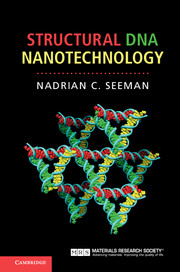
Structural DNA Nanotechnology
-
- Published online:
- 05 December 2015
- Print publication:
- 07 January 2016
Frontmatter
-
- Book:
- Optical Tweezers
- Published online:
- 05 December 2015
- Print publication:
- 03 December 2015, pp i-iv
-
- Chapter
- Export citation
25 - Towards the quantum regime at the mesoscale
- from Part III - Applications
-
- Book:
- Optical Tweezers
- Published online:
- 05 December 2015
- Print publication:
- 03 December 2015, pp 524-536
-
- Chapter
- Export citation
15 - Spectroscopy
- from Part III - Applications
-
- Book:
- Optical Tweezers
- Published online:
- 05 December 2015
- Print publication:
- 03 December 2015, pp 395-408
-
- Chapter
- Export citation
1 - Introduction
-
- Book:
- Optical Tweezers
- Published online:
- 05 December 2015
- Print publication:
- 03 December 2015, pp 1-16
-
- Chapter
-
- You have access
- Export citation
14 - Cell biology
- from Part III - Applications
-
- Book:
- Optical Tweezers
- Published online:
- 05 December 2015
- Print publication:
- 03 December 2015, pp 385-394
-
- Chapter
- Export citation
21 - Nanothermodynamics
- from Part III - Applications
-
- Book:
- Optical Tweezers
- Published online:
- 05 December 2015
- Print publication:
- 03 December 2015, pp 462-469
-
- Chapter
- Export citation
7 - Brownian motion
- from Part I - Theory
-
- Book:
- Optical Tweezers
- Published online:
- 05 December 2015
- Print publication:
- 03 December 2015, pp 188-218
-
- Chapter
- Export citation
17 - Colloid science
- from Part III - Applications
-
- Book:
- Optical Tweezers
- Published online:
- 05 December 2015
- Print publication:
- 03 December 2015, pp 422-432
-
- Chapter
- Export citation
Part I - Theory
-
- Book:
- Optical Tweezers
- Published online:
- 05 December 2015
- Print publication:
- 03 December 2015, pp 17-18
-
- Chapter
- Export citation
