To save content items to your account,
please confirm that you agree to abide by our usage policies.
If this is the first time you use this feature, you will be asked to authorise Cambridge Core to connect with your account.
Find out more about saving content to .
To save content items to your Kindle, first ensure no-reply@cambridge.org
is added to your Approved Personal Document E-mail List under your Personal Document Settings
on the Manage Your Content and Devices page of your Amazon account. Then enter the ‘name’ part
of your Kindle email address below.
Find out more about saving to your Kindle.
Note you can select to save to either the @free.kindle.com or @kindle.com variations.
‘@free.kindle.com’ emails are free but can only be saved to your device when it is connected to wi-fi.
‘@kindle.com’ emails can be delivered even when you are not connected to wi-fi, but note that service fees apply.
The idea that chances are facts about real possibilities is – to many – an outlandishly metaphysical claim. It makes chance seem more like a philosopher's fantasy than anything else. One way of avoiding the idea that chances are facts about possibilities is to attempt to identify some non-chancy facts in the actual world which constitute the basis of probabilities. What I call actualist approaches thus maintain that chances are mind-independent and real, but hold that they are reducible to ‘this-worldly’ phenomena.
Actualist interpretations of chance
The actualist approach is associated with David Hume's famous discussion of the concept of causation. Hume observed that the concept of causation appeared to involve a necessary connection between cause and effect: given the cause, the effect must happen. But upon close inspection, Hume found that there was no observable correlate of such necessary connections. Exactly what conclusion Hume drew from this is still disputed, but one very influential interpretation of his thought is that he believed therefore that causation was in reality nothing more than the constant conjunction of two types of event. Seeing two events of a particular type occur together in time and space, again and again, produces in us a belief that they are causally connected, and that belief has an associated feeling that the connection is necessary.
If there are real chances, then it seems as though there are ‘more’ of them, in some sense, in the future. To illustrate, take some events which are governed by stochastic laws. For instance, at the tip of my nose, there is an atom of carbon-14, the radioactive form of carbon. Being radioactive, there is some chance that the atom will undergo radioactive decay. The typical type of decay for carbon-14 is known as beta-minus decay. This is a process whereby an atom emits two particles: an electron and an electron anti-neutrino, and in addition one of the atom's neutrons is converted to a proton. The result, when this occurs in an atom of carbon-14, is that it becomes an atom of nitrogen-14.
Whether this particular atom of carbon-14 will decay in the next year is a matter of chance. The chance is very small, but greater than zero. In contrast, for the year that has just passed, it seems that there is nothing chancy about what happened to the atom. The atom of carbon-14 ‘got here’ in one particular way – though we may not know what that is – and there is no chance that it in fact developed in any different way.
In this chapter, I examine a number of ways in which one can take a less realist attitude towards chance than I have been adopting thus far. It turns out that there are at least three important varieties of anti-realism, and it pays to distinguish between them carefully.
Varieties of anti-realism
To this point, I have assumed some form of objectivism about chance. By this, I mean that the sorts of facts that make chance ascriptions true are – by and large – facts that obtain independently of our beliefs and attitudes.1 An alternative, subjectivist view is that the truth about chances depends in some way on subjective facts, such as what we believe, desire, or expect. That I like dark chocolate more than other varieties is a subjective fact. Prima facie, that the coin is fair, and thus has an even chance of landing heads or tails, is not a subjective fact, because this fact about the coin surely does not depend on anything to do with anyone's attitude to the coin. But perhaps that appearance is mistaken, and subjectivism might provide a better approach to understanding chance.
Both objectivism and subjectivism assume that chance claims represent facts. But this assumption too can be denied. Some meaningful sentences seem to have meaning without representing facts.
As we saw in the previous chapter, the Everett interpretation seems to dispense with probabilities in quantum mechanics. Instead of describing a world for which many things are possible, but only some of those possibilities are actualised, it suggests a world in which all possibilities actually happen. Moreover, this is something of which we can be absolutely certain.
Obviously, this does not straightforwardly fit our experience. We do not see multiple possibilities becoming actual. Whenever we measure a superposed particle, we observe only one property or another. Moreover, we have a very useful probabilistic rule to help us to predict what we will see. How can the success of this probabilistic rule be explained, if an Everett world does not involve any uncertainty?
There are two main moves that are employed in response to this challenge. The first – what I call Stage A – is to show that there is a relevant sort of uncertainty, even in a universe where we are certain that everything will happen. The second move – Stage B – is to try to vindicate the probability of the Born rule in particular. That is, to show that we should not merely be uncertain about the future, but that we have good reason to attach the particular probabilities dictated by the Born rule to the possible outcomes of a quantum experiment. We will consider these two stages in turn.
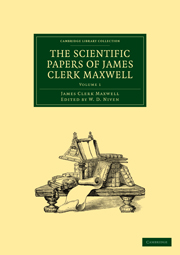
The publication in 1890 of the two-volume Scientific Papers of James Clerk Maxwell, edited by W. D. Niven, was one of the two objects of a committee formed 'for the purpose of securing a fitting memorial of him' (the other object being the commissioning of a marble bust for the Cavendish Laboratory). Before his death in 1879 at the age of 48, Clerk Maxwell had made major contributions to many areas of theoretical physics and mathematics, not least his discoveries in the fields of electromagnetism and of the kinetic theory of gases, which have been regarded as laying the foundations of all modern physics. He is generally considered the third most important physicist of all time, after Newton and Einstein. These collected shorter works, beginning with a paper written at the age of 15, show the wide range of Clerk Maxwell's interests across mathematics, physics and chemistry.
Chance, when strictly examined, is a mere negative word, and means not any real power which has anywhere a being in nature.
(Hume 1902 [1777])
Darwin's theory of evolution is an unsettling idea. It provides explanations for the existence of many features of the biological world. Not least, it provides explanations for the existence of human traits and behaviours which we typically take for granted. These sorts of explanations can threaten our ordinary self-understanding.
Normative concepts, like rationality, reason, right, and wrong do not play any essential role in the explanations offered to us by evolutionary theory. Moreover, it appears as though the very existence of our concepts of rationality, reason, right, and wrong might be susceptible to being explained – in large part – by evolutionary theory. The question then arises: are the explanations of these concepts that we can obtain from evolutionary theory capable of vindicating our ordinary practice in deploying those concepts? Having understood evolutionary theory, should we be content to employ normative concepts in much the same way that we did before? Or does an evolutionary account debunk the normative realm? Does it show that, implicit in our normative practices, there is something misguided, erroneous, or otherwise incorrect?
In trying to develop a theory of chance, I have so far drawn largely on a metaphysical picture inspired by classical physics, and have used statistical mechanics as my central example of chance arising in physical theories. It has proven difficult to develop an adequate theory of chance. But perhaps things will look different if we turn to quantum mechanics. The theory of quantum mechanics is extremely well confirmed. It is doubtful whether it is strictly true in its current form, due to the well-known conflict between quantum mechanics and the general theory of relativity, but it is an outstandingly good example of a successful physical theory, and it represents a stark break from earlier models of the physical world. Perhaps by tapping into these resources, we can develop an adequate metaphysics of chance.
The quantum mechanical world
It is widely believed that quantum mechanics is starkly opposed to classical physics, because quantum mechanics claims that the world is governed by fundamentally indeterministic laws. As it happens, this common belief oversimplifies somewhat. Quantum mechanics is a theory that is formulated in relatively mathematical terms, quite removed from concepts of directly observable physical entities. Consequently, there is a great deal of room for interpretation of the meaning of the mathematics. Indeed, there are at least three interpretations of quantum mechanics which are serious candidates for giving an adequate account of how the mathematics relates to reality.
When I began writing this book, I believed that I had identified a realist theory of chance which – though not entirely novel – had not been defended as well as it might have been. My book was to have been the definitive presentation and defence of a realist account.
Roughly six years later, I have come to appreciate much better the enormous difficulties facing not only that theory, but all realist accounts of chance, and I find myself in the mildly embarrassing position of writing the preface to a book in which I defend a modest form of anti-realism. In some sense, I now believe, Hume was correct to say that chance has no ‘real being’ in nature (Hume 1902 [1777]: §8, part I).
During this gradual conversion, becoming better acquainted with the literature, I frequently found the going rather difficult. Much of the literature is very technical, to the point of being inaccessible to many readers, including myself. This is unfortunate. Our best physical theories strongly suggest that chances are a fundamental part of reality. If we are to understand and evaluate these claims, we need to understand philosophical and scientific debates about chance. In consequence, I have written this book, not merely as a vehicle for my own ideas, but also to introduce the philosophy of chance to the broadest possible audience. While I don't pretend that the material is always easy, I expect it should at least be accessible to any tertiary-level reader.
Obviously, our knowledge of the world is quite unlike our hypothetical deity's. We don't know exactly how many particles there are. We don't know their exact properties. We don't know their exact positions.
One important way to distinguish our state of knowledge from the deity's is that for us, there are lots of ways the world might be. If we were shown the deity's memento, even if we had time to examine it, we still could not say with confidence that it is an accurate representation of the world.
This suggests a link between knowledge and possibility. Our state of knowledge is one that is compatible with a number of different ways the world might be. And this is a key difference between our state of knowledge and the state of a being who knows everything. Such a being is in a state that is compatible with only one way the world is. In this chapter, I will explore this link further, and consider how we can represent certain sorts of knowledge in terms of ways the world might be.
A multitude of lists
The deity's memento is a perfect record of the world at a particular time. It consists simply of a table that lists every particle and the physically important properties of each particle: mass, charge, position, velocity, and any others that might feature in the laws.
For a long time physicists regarded the world as conforming very closely to what I will call ‘the classical picture’. The classical picture is most importantly based upon Newtonian mechanics, a beautiful and very powerful theory which is still used to make very accurate predictions about a wide variety of phenomena. But the classical picture is not restricted solely to Newtonian theories: by this term I mean a whole family of theories which were developed in the period before Einstein, and which were in broad agreement with Newton about fundamental matters. For example, what is known as classical electrodynamics is a theory that goes well beyond Newtonian mechanics in the sort of phenomena it describes, but it is still recognisably part of the classical picture.
In the following sections, I will present a heavily simplified version of the classical picture. Many of the ideas will be familiar to many readers, and it might seem unnecessary to rehearse them. It is often unappreciated, however, that these features interact to generate an overall conception of the world. To make the classical picture vivid, I will ask you to imagine a fictitious being, much like a deity, attempting to record in perfect detail exactly how the world is at a particular time.
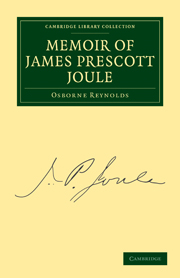
Sir James Prescott Joule (1818–1889) became one of the most significant physicists of the nineteenth century, although his original interest in science was as a hobby and for practical business purposes. The son of a brewer, he began studying heat while investigating how to increase the efficiency of electric motors. His discovery of the relationship between heat and energy contributed to the discovery of the conservation of energy and the first law of thermodynamics. Volume 1 of Joule's scientific papers was published in 1884. It is organised chronologically and reveals the range of Joule's interests and the development of his thought. The topics of the papers include the measurement of heat, voltaic batteries, electromagnets, specific heat, meteorology and thermodynamics. Joule's careful experiments in these areas were fundamental to the development of significant areas of twentieth-century physics, although he was slow to gain recognition from his contemporaries.
In this first biography of the physicist Sir James Prescott Joule (1818–1889), his friend and collaborator Osborne Reynolds (1842–1912), Professor of Engineering at Owens College, Manchester, is keen to show how Joule, the son of a prosperous Salford brewer, was an 'ordinary' boy, enjoying regular walking trips to Snowdon, the Peaks and the Lakes; at the same time, he was greatly influenced by two years of tuition by John Dalton. His later experiments, observations and published papers are discussed and quoted at length. Reynolds stresses the influence Joule's work on heat and thermodynamics had on his contemporaries, but also that this 'amateur' scientist was often so far ahead of his time that his work was misunderstood or dismissed. Since publication of this book in 1892, only one other biography of Joule has appeared, and so it remains a vital source of first-hand information on his life and work.
In the preceding chapters, we studied integrable systems and their perturbations. We noted that integrability is rare among dynamical systems, and that, while the perturbative approach is quite successful in any finite order, the perturbation series cannot be counted on to converge in the generic case. As we shall soon see, the perturbative convergence problem can be overcome if the perturbation is small enough and certain other hypotheses are satisfied, thanks to the famous theorem of Kolmogorov, Arnol'd, and Moser (KAM) [26, 27, 28]. There are several approaches (none of them easy!) to the statement and proof of this theorem. In this chapter we will rely mainly on that of [28]. A helpful discussion of the theorem, without detailed proofs, can be found in [29].
Perhaps the main message of the KAM theorem is that if we label the invariant n-tori of the unperturbed integrable model by the n oscillation frequencies ω1, …, ωn, and if the perturbation is weak enough, then a fraction, arbitrarily close to unity, of the tori will be preserved. This is the main result concerning “order” in Hamiltonian systems. No comparably strong statement exists concerning what replaces those tori which break up under the perturbation. Here we rely mainly on numerical investigations in a variety of models. These suggest certain universal features, principally island chains and deterministic chaos.
In the present chapter we will introduce the KAM theorem in the context of nonlinear stability of equilibrium states.