Refine search
Actions for selected content:
1738 results in Nonlinear Science and Fluid Dynamics
3 - Two-Dimensional Irrotational Flow
- from Part I - Inviscid Flow
-
- Book:
- Introductory Incompressible Fluid Mechanics
- Published online:
- 05 January 2022
- Print publication:
- 02 December 2021, pp 100-140
-
- Chapter
- Export citation
Part I - Inviscid Flow
-
- Book:
- Introductory Incompressible Fluid Mechanics
- Published online:
- 05 January 2022
- Print publication:
- 02 December 2021, pp 1-140
-
- Chapter
- Export citation
2 - Ideal Fluid Flow
- from Part I - Inviscid Flow
-
- Book:
- Introductory Incompressible Fluid Mechanics
- Published online:
- 05 January 2022
- Print publication:
- 02 December 2021, pp 27-99
-
- Chapter
- Export citation
Introduction
-
- Book:
- Introductory Incompressible Fluid Mechanics
- Published online:
- 05 January 2022
- Print publication:
- 02 December 2021, pp xiii-xviii
-
- Chapter
- Export citation
Part II - Viscous Flow
-
- Book:
- Introductory Incompressible Fluid Mechanics
- Published online:
- 05 January 2022
- Print publication:
- 02 December 2021, pp 141-296
-
- Chapter
- Export citation
Further Reading
-
- Book:
- Introductory Incompressible Fluid Mechanics
- Published online:
- 05 January 2022
- Print publication:
- 02 December 2021, pp 306-306
-
- Chapter
- Export citation
Dedication
-
- Book:
- Introductory Incompressible Fluid Mechanics
- Published online:
- 05 January 2022
- Print publication:
- 02 December 2021, pp v-vi
-
- Chapter
- Export citation
6 - Boundary-Layer Theory
- from Part II - Viscous Flow
-
- Book:
- Introductory Incompressible Fluid Mechanics
- Published online:
- 05 January 2022
- Print publication:
- 02 December 2021, pp 223-252
-
- Chapter
- Export citation
-
Summary
The Reynolds numbers associated with flows past aircraft or ships are typically large, indeed of the order of
of
References
-
- Book:
- Introductory Incompressible Fluid Mechanics
- Published online:
- 05 January 2022
- Print publication:
- 02 December 2021, pp 300-305
-
- Chapter
- Export citation
1 - Flow and Transport
- from Part I - Inviscid Flow
-
- Book:
- Introductory Incompressible Fluid Mechanics
- Published online:
- 05 January 2022
- Print publication:
- 02 December 2021, pp 3-26
-
- Chapter
- Export citation
Contents
-
- Book:
- Introductory Incompressible Fluid Mechanics
- Published online:
- 05 January 2022
- Print publication:
- 02 December 2021, pp vii-x
-
- Chapter
- Export citation
5 - Low Reynolds-Number Flow
- from Part II - Viscous Flow
-
- Book:
- Introductory Incompressible Fluid Mechanics
- Published online:
- 05 January 2022
- Print publication:
- 02 December 2021, pp 182-222
-
- Chapter
- Export citation
Index
-
- Book:
- Introductory Incompressible Fluid Mechanics
- Published online:
- 05 January 2022
- Print publication:
- 02 December 2021, pp 307-316
-
- Chapter
- Export citation
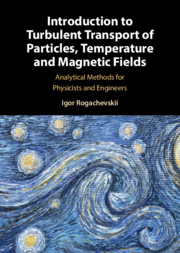
Introduction to Turbulent Transport of Particles, Temperature and Magnetic Fields
- Analytical Methods for Physicists and Engineers
-
- Published online:
- 10 September 2021
- Print publication:
- 05 August 2021
4 - Analysis Based on Budget Equations
-
- Book:
- Introduction to Turbulent Transport of Particles, Temperature and Magnetic Fields
- Published online:
- 10 September 2021
- Print publication:
- 05 August 2021, pp 155-176
-
- Chapter
- Export citation
Contents
-
- Book:
- Introduction to Turbulent Transport of Particles, Temperature and Magnetic Fields
- Published online:
- 10 September 2021
- Print publication:
- 05 August 2021, pp v-vi
-
- Chapter
- Export citation
Author Index
-
- Book:
- Introduction to Turbulent Transport of Particles, Temperature and Magnetic Fields
- Published online:
- 10 September 2021
- Print publication:
- 05 August 2021, pp 253-258
-
- Chapter
- Export citation
References
-
- Book:
- Introduction to Turbulent Transport of Particles, Temperature and Magnetic Fields
- Published online:
- 10 September 2021
- Print publication:
- 05 August 2021, pp 230-252
-
- Chapter
- Export citation
Subject Index
-
- Book:
- Introduction to Turbulent Transport of Particles, Temperature and Magnetic Fields
- Published online:
- 10 September 2021
- Print publication:
- 05 August 2021, pp 259-262
-
- Chapter
- Export citation
Frontmatter
-
- Book:
- Introduction to Turbulent Transport of Particles, Temperature and Magnetic Fields
- Published online:
- 10 September 2021
- Print publication:
- 05 August 2021, pp i-iv
-
- Chapter
- Export citation
