Refine search
Actions for selected content:
2193 results in Statistical Physics
Part IV - Applying Tangles
-
- Book:
- Tangles
- Published online:
- 16 May 2024
- Print publication:
- 23 May 2024, pp 185-186
-
- Chapter
- Export citation
Acknowledgments
-
- Book:
- The Physics of Flocking
- Published online:
- 16 May 2024
- Print publication:
- 23 May 2024, pp xv-xvi
-
- Chapter
- Export citation
13 - Applying tangles in the social sciences
- from Part IV - Applying Tangles
-
- Book:
- Tangles
- Published online:
- 16 May 2024
- Print publication:
- 23 May 2024, pp 203-214
-
- Chapter
- Export citation
Index
-
- Book:
- Tangles
- Published online:
- 16 May 2024
- Print publication:
- 23 May 2024, pp 277-282
-
- Chapter
- Export citation
Part III - The Mathematics of Tangles
-
- Book:
- Tangles
- Published online:
- 16 May 2024
- Print publication:
- 23 May 2024, pp 73-74
-
- Chapter
- Export citation
5 - The Dynamical Renormalization Group Applied to the Flocking Problem
-
- Book:
- The Physics of Flocking
- Published online:
- 16 May 2024
- Print publication:
- 23 May 2024, pp 117-120
-
- Chapter
- Export citation
1 - Introduction and Motivation: Are Birds Smarter Than Nerds?
-
- Book:
- The Physics of Flocking
- Published online:
- 16 May 2024
- Print publication:
- 23 May 2024, pp 1-8
-
- Chapter
-
- You have access
- Export citation
Contents
-
- Book:
- The Physics of Flocking
- Published online:
- 16 May 2024
- Print publication:
- 23 May 2024, pp vii-x
-
- Chapter
- Export citation
Bibliography
-
- Book:
- The Physics of Flocking
- Published online:
- 16 May 2024
- Print publication:
- 23 May 2024, pp 231-237
-
- Chapter
- Export citation
3 - The two main tangle theorems: an informal preview
- from Part I - Tangles
-
- Book:
- Tangles
- Published online:
- 16 May 2024
- Print publication:
- 23 May 2024, pp 27-30
-
- Chapter
- Export citation
12 - Applying tangles in the natural sciences
- from Part IV - Applying Tangles
-
- Book:
- Tangles
- Published online:
- 16 May 2024
- Print publication:
- 23 May 2024, pp 187-202
-
- Chapter
- Export citation
2 - The notion of a tangle
- from Part I - Tangles
-
- Book:
- Tangles
- Published online:
- 16 May 2024
- Print publication:
- 23 May 2024, pp 15-26
-
- Chapter
- Export citation
9 - “Malthusian” Flocks (Flocks with Birth and Death)
-
- Book:
- The Physics of Flocking
- Published online:
- 16 May 2024
- Print publication:
- 23 May 2024, pp 164-230
-
- Chapter
- Export citation
6 - Examples from data science
- from Part II - Tangles in Different Contexts
-
- Book:
- Tangles
- Published online:
- 16 May 2024
- Print publication:
- 23 May 2024, pp 53-72
-
- Chapter
- Export citation
1 - The idea behind tangles
- from Part I - Tangles
-
- Book:
- Tangles
- Published online:
- 16 May 2024
- Print publication:
- 23 May 2024, pp 3-14
-
- Chapter
-
- You have access
- Export citation
4 - Examples from the natural sciences
- from Part II - Tangles in Different Contexts
-
- Book:
- Tangles
- Published online:
- 16 May 2024
- Print publication:
- 23 May 2024, pp 33-40
-
- Chapter
- Export citation
10 - Choosing the feature system
- from Part III - The Mathematics of Tangles
-
- Book:
- Tangles
- Published online:
- 16 May 2024
- Print publication:
- 23 May 2024, pp 157-168
-
- Chapter
- Export citation

Tangles
- A Structural Approach to Artificial Intelligence in the Empirical Sciences
-
- Published online:
- 16 May 2024
- Print publication:
- 23 May 2024
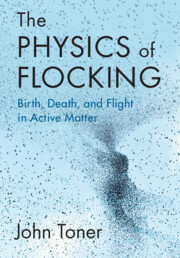
The Physics of Flocking
- Birth, Death, and Flight in Active Matter
-
- Published online:
- 16 May 2024
- Print publication:
- 23 May 2024
Boolean Networks as Predictive Models of Emergent Biological Behaviors
-
- Published online:
- 04 March 2024
- Print publication:
- 28 March 2024
-
- Element
- Export citation
