To save content items to your account,
please confirm that you agree to abide by our usage policies.
If this is the first time you use this feature, you will be asked to authorise Cambridge Core to connect with your account.
Find out more about saving content to .
To save content items to your Kindle, first ensure no-reply@cambridge.org
is added to your Approved Personal Document E-mail List under your Personal Document Settings
on the Manage Your Content and Devices page of your Amazon account. Then enter the ‘name’ part
of your Kindle email address below.
Find out more about saving to your Kindle.
Note you can select to save to either the @free.kindle.com or @kindle.com variations.
‘@free.kindle.com’ emails are free but can only be saved to your device when it is connected to wi-fi.
‘@kindle.com’ emails can be delivered even when you are not connected to wi-fi, but note that service fees apply.
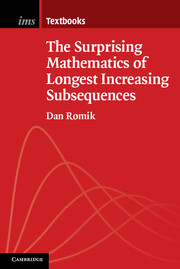
In a surprising sequence of developments, the longest increasing subsequence problem, originally mentioned as merely a curious example in a 1961 paper, has proven to have deep connections to many seemingly unrelated branches of mathematics, such as random permutations, random matrices, Young tableaux, and the corner growth model. The detailed and playful study of these connections makes this book suitable as a starting point for a wider exploration of elegant mathematical ideas that are of interest to every mathematician and to many computer scientists, physicists and statisticians. The specific topics covered are the Vershik-Kerov–Logan-Shepp limit shape theorem, the Baik–Deift–Johansson theorem, the Tracy–Widom distribution, and the corner growth process. This exciting body of work, encompassing important advances in probability and combinatorics over the last forty years, is made accessible to a general graduate-level audience for the first time in a highly polished presentation.
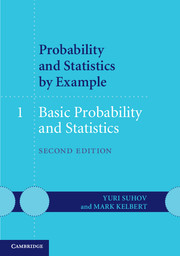
Probability and statistics are as much about intuition and problem solving as they are about theorem proving. Consequently, students can find it very difficult to make a successful transition from lectures to examinations to practice because the problems involved can vary so much in nature. Since the subject is critical in so many applications from insurance to telecommunications to bioinformatics, the authors have collected more than 200 worked examples and examination questions with complete solutions to help students develop a deep understanding of the subject rather than a superficial knowledge of sophisticated theories. With amusing stories and historical asides sprinkled throughout, this enjoyable book will leave students better equipped to solve problems in practice and under exam conditions.
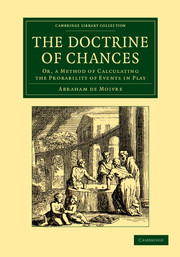
A Huguenot exile in England, the French mathematician Abraham de Moivre (1667–1754) formed friendships with such luminaries as Edmond Halley and Isaac Newton. Making his living from private tuition, he became a fellow of the Royal Society in 1697 and published papers on a range of topics. Probability theory had been pioneered by Pascal, Fermat and Huygens, with further development by the Bernoullis. Originally published in 1718, The Doctrine of Chances was the first English textbook on the new science and so influential that for a time the whole subject was known by the title of the work. Reissued here is the revised and expanded 1738 second edition which contains the remarkable discovery that when a coin is tossed many times, the binomial distribution may be approximated by the normal distribution. This version of the central limit theorem stands as one of de Moivre's most significant contributions to mathematics.
The original motivation for writing this book was rather personal. The first author, in the course of his teaching career in the Department of Pure Mathematics and Mathematical Statistics (DPMMS), University of Cambridge, and St John's College, Cambridge, had many painful experiences when good (or even brilliant) students, who were interested in the subject of mathematics and its applications and who performed well during their first academic year, stumbled or nearly failed in the exams. This led to great frustration, which was very hard to overcome in subsequent undergraduate years. A conscientious tutor is always sympathetic to such misfortunes, but even pointing out a student's obvious weaknesses (if any) does not always help. For the second author, such experiences were as a parent of a Cambridge University student rather than as a teacher.
We therefore felt that a monograph focusing on Cambridge University mathematics examination questions would be beneficial for a number of students. Given our own research and teaching backgrounds, it was natural for us to select probability and statistics as the overall topic. The obvious starting point was the first-year course in probability and the second-year course in statistics. In order to cover other courses, several further volumes will be needed; for better or worse, we have decided to embark on such a project.
In this chapter, we study the (d — 1)-volume and the covering numbers of the medial axis of a compact subset of ℝd. In general, this volume is infinite; however, the (d — 1)-volume and covering numbers of a filtered medial axis (the μ-medial axis) that is at distance greater than ε from the compact set can be explicitly bounded. The behavior of the bound we obtain with respect to μ, ε and the covering numbers of K is optimal.
From this result we deduce that the projection function on a compact subset K of ℝd depends continuously on the compact set K, in the L1 sense. This implies in particular that Federer's curvature measures of a compact subset of ℝd with positive reach can be reliably estimated from a Hausdorff approximation of this subset, regardless of any regularity assumption on the approximating subset.
Introduction
We are interested in the following question: given a compact subset K of ℝd with positive reach, and a Hausdorff approximation P of this set, is it possible to approximate Federer's curvature measures of K (see [9] or Section 12.2.2 for a definition) from P only? A positive answer to this question has been given in [8] using convex analysis. In this chapter, we show that such a result can also be deduced from a careful study of the “size” – that is, the covering numbers – of the medial axis.
The notion of medial axis, also known as ambiguous locus in Riemannian geometry, has many applications in computer science. In image analysis and shape recognition, the skeleton of a shape is often used as an idealized version of the shape, which is known to have the same homotopy type as the original shape [14].
Since the creation of Ricci flow by Hamilton in 1982, a rich theory has been developed in order to understand the behaviour of the flow, and to analyse the singularities that may occur, and these developments have had profound applications, most famously to the Poincaré conjecture. At the heart of the theory lie a large number of a priori estimates and geometric constructions, which include most notably the Harnack estimates of Hamilton, the L-length of Perelman (in the spirit of Li-Yau), the logarithmic Sobolev inequality arising from Perelman's W-entropy, and the reduced volume of Perelman, amongst others.
The objective of these lectures is to explain this theory from the point of view of optimal transportation. As I explain in Section 5.4, Ricci flow and optimal transportation combine rather well, and we will see fundamental but elementary aspects of this when we see in Theorem 5.2 how diffusions contract under reverse-time Ricci flow. However, the key to the whole theory is to realise to which object one should apply this result: not the original Ricci flow, but a new Ricci flow derived from the original one, on a base manifold of one higher dimension, that we call the canonical soliton. In this way, essentially the entire foundational theory of Ricci flow mentioned above drops out naturally.
Throughout the lectures I emphasise the intuition; the objective is to demonstrate how one can discover the theory rather than treat it as a black box that just happens to work.
We review here some recent results by the authors, and various coauthors, on (weak, super) Poincaré inequalities, transportation-information inequalities or logarithmic Sobolev inequality via a quite simple and efficient technique: Lyapunov conditions.
Introduction and main concepts
Lyapunov conditions appeared a long time ago. They were particularly well fitted to deal with the problem of convergence to equilibrium for Markov processes; see [23, 38–40] and references therein. They also appeared earlier in the study of large and moderate deviations for empirical functionals of Markov processes (for examples, see Donsker and Varadhan [21, 22], Kontoyaniis and Meyn [33, 34], Wu [47, 48], Guillin [28, 29]), for solving the Poisson equation [24].
Their use to obtain functional inequalities is however quite recent, even if one may afterwards find hint of such an approach in Deuschel and Stroock [19] or Kusuocka and Stroock [35]. The present authors and coauthors have developed a methodology that has been successful for various inequalities: Lyapunov–Poincaré inequalities [4], Poincaré inequalities [3], transportation inequalities for Kullback information [17] or Fisher information [32], super Poincaré inequalities [16], weighted and weak Poincaré inequalities [13], or [18] for super weighted Poincaré inequalities. We finally refer to the forthcoming book [15] for a complete review. For more references on the various inequalities introduced here we refer to [1, 2, 36, 46]. The goal of this short review is to explain the methodology used in these papers and to present various general sets of conditions for this panel of functional inequalities. The proofs will of course be only schemed and we will refer to the original papers for complete statements.