Note on the Text
Publishers, place of publication, and full titles are provided in the bibliography.
Hitchener’s letters are quoted from freshly edited texts of British Library Add MSS 37496, abbreviated as follows:
HL1 To Percy Bysshe Shelley, 8–10 June 1811 [ff. 5–6]
HL2 To PBS, 14 June 1811 [ff. 10–11]
HL3 To PBS c.10 July 1811 [ff. 19–20]
HL4 To PBS, 11 October 1811 [ff. 32–33]
HL5 To PBS, 23 October 1811 [ff. 39–40]
HL6 To PBS, 12 November 1811 [ff. 46–47]
HL7 To PBS, 15 November 1811 [ff. 50–51]
HL8 To Harriet Shelley, 17 December 1811 [f. 67]
HL9 To PBS, 19 December 1811 [ff. 68–69]
HL10 To HS, 20 December 1811 [f. 70]
HL11 To HS, 1 January 1812 [ff. 73–74]
HL12 To PBS, c. 3 May 1812 [ff. 112–113]
Shakespeare is quoted from The Oxford Shakespeare: The Complete Works, ed. John Jowett et al., 2nd edn. (Oxford, 2005).
Shelley’s poetry is quoted from The Poems of Shelley, ed. Geoffrey Matthews, Kelvin Everest et al. (London, 1989–2024).
Introduction
Elizabeth Hitchener (1783–1821), schoolmistress and poet, is an enigma who wrote enigmas. In the fourth of her posthumous Enigmas, Historical and Geographical (1834), she challenges readers to deduce a series of locations from people with whom they are associated:
Hitchener’s tone is knowing: each time she says ‘Where’, she avers that This is where… while asking Where is this? The answers which form the enigma’s ‘Solution’ – Medina, Edinburgh, Rotterdam, Calcutta, Ushant, Rheims, York, out of which Mercury appears acrostically – hold less significance for Hitchener than the act of inquiry (the ‘eager desire’ to extend ‘knowledge’) that she induces in ‘the minds of young persons’.Footnote 2 A whimsical consequence of this inquiry is the detention of ‘name[s] renown’d’, all of them distinguished men, in a cultural-historical waiting room – as though Darnley, Erasmus, and the rest are left nervously to ponder ‘where’, if anywhere (since the enigma may remain unsolved), their fame and legacy might be found.
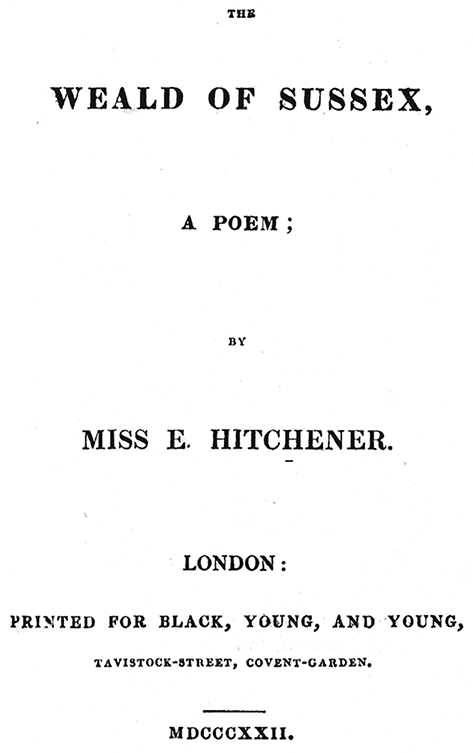
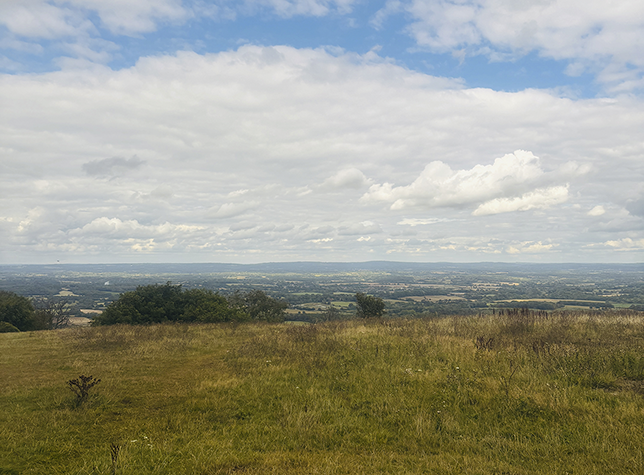
The effort to solve ‘Enigma IV’ resembles the challenge faced by anyone who inquires into the life and work of Elizabeth Hitchener. This ‘mystery woman’, as Walter E. Peck labelled her, enters the sphere of Percy Bysshe Shelley in June 1811, and spends a year as his closest correspondent before joining his household. By the end of 1812, she has been dismissed and discredited.Footnote 3 Hitchener appears temporarily in literary history, but then – to redeploy the phrase Paula R. Feldman uses to characterise the exclusion of women poets from the Romantic canonFootnote 4 – she is ‘not there’, consigned to what Hitchener herself would later call, in her poem on her native landscape The Weald of Sussex (1822), the ‘shadows of the past’.Footnote 5 Contemporary testimonies and later biographies of Shelley have offered clues about Hitchener’s character and appearance. But the clues tend to perpetuate rumours and observations (concerning her ‘humble’ background, ‘gauche’ personality, androgyny, facial hair, ‘dark’ complexion, ugliness, poor hygiene, ‘disordered imagination’, unpolished letters, fallacious republicanism, and ‘undistinguished’ poetry) which are inflected by prejudice and animosity. This Element puts these denunciations under scrutiny and looks beyond them. It shows the ways in which Hitchener transcends the denigrating, obfuscating, and demonising narratives that have been told about her as ‘the lasting butt of Shelley biographers’ for over two centuries.Footnote 6 ‘Where’, as the enigma asks, can we find Elizabeth Hitchener?
Recovery and Revision
In an essay on the ‘lost’ facts of history, Virginia Woolf described Eliza Draper as ‘an obscure woman […] whose thirty-five years would have been utterly forgotten were it not that for three months in one of them she was loved by Laurence Sterne’.Footnote 7 A similar assessment can be made of Hitchener, who would remain unknown were it not for the eighteenth months in which Shelley ordained her ‘the sister of my soul’. Like Draper, Hitchener occupies a paradoxical place in the literary history of the long eighteenth century as a woman both remembered and forgotten. Hitchener appears in almost every biography of Shelley; the story of their companionship, her joining his ménage, and her ostracism from the group, has acquired near-mythical status; and works of Romantic criticism abound in references to the letters Shelley wrote to her. Yet Hitchener has interested scholars only for as long as she remains close – as correspondent, co-dweller, and finally enemy – to the male canonical cynosure. As a published author, Hitchener is ‘utterly forgotten’ or otherwise spurned. In Finding Elizabeth Hitchener we bring Hitchener’s life and work into focus using an approach which, in Devoney Looser’s words, repudiates conceptions of history as a ‘male enclave devoid of female subjects’ by exploring ‘materials by and about women that had previously been neglected or ignored’.Footnote 8 The Hitchener that emerges existed before and after her association with Shelley: she is an exemplar of developments in eighteenth-century female education and thought, a celebrated teacher, an agile correspondent, an occasional travel writer, and a distinctive poet of history and of place.
The Element is not only concerned with those parts of Hitchener’s life and work that have been ‘neglected or ignored’. It is concerned, too, with the small part of Hitchener’s life, her life proximate to Shelley, that has been misrepresented to the detriment of her legacy. Any figure whose life is written as a byproduct of somebody else’s is at the mercy of what Sidney Lee calls ‘the biographer’s indulgence in the partial view’.Footnote 9 In Hitchener’s case, the ‘partial view’ has been unduly influenced by Shelley’s final characterisation of her as ‘an ugly, hermaphroditical beast of a woman’ and ‘The Brown Demon’.Footnote 10 How and why has this image of Hitchener come to reign over all others? Brenda Ayres talks of the need ‘to expose the distortions, gaps, inconsistencies, biases, contradictions, mistakes, misconceptions, and misappropriation of information’ in biographies of female writers of the eighteenth and nineteenth centuries.Footnote 11 Hitchener has received no dedicated biography, but distortions, inconsistencies, and biases plague her portrayal in accounts of Shelley’s life. By attending to Hitchener as a woman at times forgotten and at others remembered unjustly, the Element deploys a two-pronged critical method that comprises recovery and revision. Finding Elizabeth Hitchener contends that Shelley and his circle, and subsequently biographers, critics, and editors, have obscured the real Elizabeth Hitchener and her achievements by fabricating versions of her which neglect, misrepresent, or bury the truth. In this context, ‘finding’ serves at once as a metaphor for the act of recovery (we reveal a wealth of new biographical information, offer the most substantial explication to date of the Hitchener-Shelley correspondence, and provide the first critical account of her published verse), and for the difficulties faced in performing that act of recovery (the struggle to nullify obfuscating critical and editorial practices, and to see beyond the pervasive – often prejudiced – gaze of Shelley’s biographers).
Places and Names
Finding Hitchener involves negotiating with her own complex self-depictions. Hitchener published three volumes of verse: The Fireside Bagatelle (1818), The Weald of Sussex (1822), and the posthumous Enigmas, Historical and Geographical (1834).Footnote 12 In each, she speaks as a poet of place who yields readers and biographers none of the revelations of her self-dramatising male contemporaries. The ‘Dedicatory Ode’ offered ‘To Some Amiable Young Friends’ at the start of The Fireside Bagatelle justifies a mode the scale and temperament of which guards against discovery:
The allusion secreted in these lines – only the ‘Amiable Young Friends’, themselves unknown, know what it ‘hides’ – reserves personal space amid the poetry’s public voice. In what follows, we advance a method of reading responsive to a body of writing which is both stylistically (in Hitchener’s poems) and literally (in the drafts that survive of her letters) sheltered. In part a pleasure, remaining ‘hidden’ was also a pressure Hitchener faced in her life as poet and teacher. Female education, as Anna Laetitia Barbauld wrote, had to be pursued in ‘a quiet and unobserved manner’ in the period, ‘only connived at while carefully concealed, and if displayed, punished with disgrace’.Footnote 14 Hitchener’s Enigmas practise an art of concealment that negotiates this cultural expectation. Even the more public voice of The Weald submerges selfhood in the history and traditions of the Sussex landscape and resists what Anne K. Mellor calls ‘the introspective and personal meditations’ which have motivated the ‘recovery’ of Romantic ‘poetesses’ such as Felicia Hemans and Letitia Elizabeth Landon.Footnote 15 That Hitchener has gone largely ‘unobserved’ in literary history is an ironic reflection of her enigmatic talents.
Hitchener came of age in a region close to the border – and the threat – of revolutionary and then Napoleonic France. We trace the manifestations of the political vision to which that experience gave rise. Her education was informed by the ideas of Wollstonecraft and the intellectual foment of the French Revolution, and the early parts of this Element find a young female radical emerging from the 1790s as a champion of the Rights of Women and an exponent of Rational Dissent. Hitchener’s proto-feminism was mocked by Shelley’s early biographers, but she was more pragmatic than they make out. Although Shelley imagined her as the ‘votary’ of a ‘virtue’ entirely at one with his own radicalism, Hitchener was as much the antagonist to Shelley’s idealism as its cheerleader.Footnote 16 In a review of Shelley’s letters to Hitchener, Woolf observed that it ‘would be delightful if we could have Miss Hitchener’s letters also, for some allusions in Shelley’s answers show the way in which, on occasion, she would try to cap his speculations’.Footnote 17 Drafts of some of those letters (fully transcribed for the first time for this Element) survive, and they show Hitchener arguing for ‘practical political virtue in degenerate times’.Footnote 18 An emphasis on the real consequences of political power is central to her most ambitious poem, The Weald of Sussex, in which Hitchener surveys a local cultural inheritance that impedes revolutionary fervour. ‘Ere you of order’s law | One line destroy, think well you can restore?’ she asks, warning of the ‘common sea of ruin’ that awaits if ‘this fair cultured scene, this lovely Weald’ should be ‘Rudely defaced by wild and lawless hands’.Footnote 19 The lines, underpinned by a Whiggish sense of cumulative progress, typify a practicality which capped some of Shelley’s abstruse musings. It is a vision shaped by the local attachment that Hitchener saw as the fountain of ‘earthly bliss’ and spiritual reward: ‘In Paradise its source began | And followed, leads us there’.Footnote 20 The ‘native’ character of Hitchener’s poems earns her a distinctive place among women writers of the Romantic period who, in Mellor’s terms, ‘spoke to and for the nation’.Footnote 21
The Element reveals the connectedness of a seemingly rooted life. As well as being invitations to settle, Hitchener’s poems are inducements to explore. The Enigmas take readers as far as Persia, Rome, Switzerland, and the West Indies, while The Weald begins on Hitchener’s ‘native downs’ and ends in a celebration of the freedom to ‘walk […] ’mong nations of the Earth’.Footnote 22 We present Hitchener as a local author with a sense of humanity’s ‘universal’ ties.Footnote 23 In some prescient lines, she contemplates the resistance to migrants among ‘Sussex Yeomen’, whose ‘failing’ is
Hitchener valued travel as a vehicle of cultural and intellectual exchange. Her correspondence with Shelley connected her with Edinburgh, York, Keswick, Dublin, and Radnorshire; it eventually took her to London, Devon, and Wales. Underlying the lines just quoted might be the suspicions visited upon Hitchener after she had joined the Shelleys in Lynmouth and was subsequently ostracised from polite society. Hitchener committed at considerable cost to the networks circulating the ‘liberal sentiments and just ideas’, which she saw as a cure for the ‘clan-ship’ of Sussex society.Footnote 25 This Element is in part concerned with how the ‘jealous dread’ directed towards a woman who was in social and cultural terms a ‘new-comer’ motivated her rejection and neglect.
Hitchener aimed to ‘preserve’ the ‘name’ of those who had shaped her native culture.Footnote 26 In restoring Hitchener’s own name to literary history, we are driven by Woolf’s interrogation of the assumptions underlying ‘The Art of Biography’:
Is not anyone who has lived a life, and left a record of that life, worthy of biography – the failures as well as the successes, the humble as well as the illustrious? And what is greatness? And what smallness? We must revise our standards of merit and set up new heroes for our admiration.Footnote 27
The rapidity with which those questions are posed implies an assent that might be withheld by a reader who pauses to give them thought. Our aim is to present Hitchener as a human being, not a heroine. Nevertheless, the sense that ‘there is no person so insignificant’ that they do not mark the lives around them is the burden of one of the wisest moments in Hitchener’s letters,Footnote 28 and in such a vein this Element offers a model for a more inclusive mode of literary biography.
Hitchener’s fragile foothold in history is caught in the question of her own ‘name’. In the biographical record she appears variously as ‘Hichener’, ‘Tichener’, ‘Kitchener’, and ‘Hitchner’.Footnote 29 The Shelleys were uncertain how to address her. ‘Pray what are you to be called when you come to us’, Shelley wondered. ‘Elizabeth’ was too close to his sister-in-law, Eliza. ‘Miss Hitchener’, on the other hand, was ‘too long too broad and too deep’ (whatever that means).Footnote 30 Someone, either Shelley or Hitchener, suggested ‘Portia’, thereby gracing Hitchener with Shakespearean splendour.Footnote 31 Shelley’s wife Harriet, who was well-educated but self-conscious about her own non-aristocratic background, thought this a bit much. Did it imply Hitchener was akin to the woman whom Brutus, trampling social hierarchies, calls his ‘true and honourable wife’? Or the Portia in which Bassiano ‘finds the joys of heaven here on earth’?Footnote 32 Although Hitchener was never wealthy and members of her family were beset by financial difficulties, by the time the Shelleys knew her she could be considered a well-educated woman of middling status. The Shelleys, however, returned to the idea of her ‘poverty’ initially to acclaim her exceptionalism and later to discredit her virtues.Footnote 33 That Harriet protested against Portia is revealing: ‘I do not like the name you have taken but mind only the name. You are fully worthy of it but being a name so much out of the common way it excites so much curiosity in the mind of the hearer this is my only reas[on] for not liking it’. Hitchener was to take something ‘more common & more pleasing to the ear’: ‘Bessy’.Footnote 34 Shelley’s letters had transported Hitchener into an idealised realm. Harriet’s jittery reassertion of her ‘common’ status contains the seeds – in class animus, even sexual jealousy – of her eventual dismissal. But Hitchener was, in the best sense, ‘out of the common way’. This Element goes in search of her. It finds no ‘mortal breathing saint’,Footnote 35 but a woman whose attachments were to ‘the peopled Earth’.Footnote 36
Finding a Form
‘The biographer truly succeeds if a distinct literary form can be found for the particular life’, wrote Leon Edel.Footnote 37 Much of Hitchener’s life has been forgotten; other parts of it cannot be disentangled from her afterlives. Accordingly, the form we have chosen for this Element charts Hitchener’s achievements as a teacher and writer and, in its latter stages especially, reflects our engagement with those critics and biographers who have prevented her finding her place in history – it enacts a process of ‘recovery’ and ‘revision’, to return to the terms deployed earlier. We study Hitchener’s life chronologically, remaining responsive to the sporadically rich but often sparse records available. Our first section, ‘Woman’, offers a detailed account of Hitchener’s largely overlooked life before Shelley and places her accomplishments as a teacher within the context of eighteenth-century developments in female education. ‘Angel’ is concerned with a single year. It examines Hitchener’s correspondence with Shelley, which constituted one of the most significant intellectual exchanges of his life, and which precipitated their ménage along with Harriet Shelley and Eliza Westbrook during the summer of 1812. The fallout from this experiment in co-habitation, and the shadow it casts over Hitchener in the eyes of Shelley scholars, is examined in ‘Demon’, which considers the enduring characterisations of Hitchener from 1812 to the present day. ‘Poet’ and the ‘Coda’ address Hitchener’s life after Shelley as a published author and successful schoolmistress, before her death at the age of thirty-eight.
Finding Elizabeth Hitchener also offers a counter-biography that challenges existing stories of Hitchener’s life and tells newly discovered truths. The kaleidoscope of prejudice through which Hitchener has been seen – as demon, temptress, swindler, upstart, poetess – had its genesis in the biased testimonies of the Shelley circle (Percy and Harriet Shelley, and Eliza Westbrook) which were put into print by contemporary biographers (Shelley’s friend, Thomas Jefferson Hogg, and his cousin, Thomas Medwin) and taken up uncritically from the nineteenth century onwards. We begin the work of revision in ‘Woman’ by deploying seriously a label that has motivated the opprobrium directed towards her. The subsequent movement from ‘Angel’ to ‘Demon’ follows the teleology established by Hitchener’s detractors in order to question it: the section titles are borrowed from Irving Babbitt’s line that Shelley ‘begins by seeing in Elizabeth Hitchener an angel of light and then discovers that she is instead a “Brown Demon”’.Footnote 38 The final chapter takes its cue from a sneering observation that Hitchener ‘fancied herself a poetess’ to assert her accomplishment as a poet.Footnote 39 ‘Recovering’ and ‘revising’ Hitchener’s life and work in this way, the Element reveals both the mechanisms of Hitchener’s neglect and her status as a significant intellectual figure who, to apply Orianne Smith’s re-conception of the female writer of the period, ‘seldom conform[s] to the familiar outlines of what we have customarily regarded as the male Romantic poetic tradition in Britain’.Footnote 40 The aim is not simply to recover what we can of Hitchener’s life and work, but to find her place in literary history.
1 Woman
What can be reclaimed of Hitchener’s life before Shelley? It is common for scholars to speak of Hitchener as someone who ascended into his world from nowhere thanks to her freakish autodidacticism. She ‘educated herself in liberal ideas’, as Richard Holmes puts it, and ‘had risen far beyond her background’.Footnote 41 The notion can be traced back to a letter of August 1811 in which Shelley addresses Hitchener as someone ‘whom talents & virtues have lifted from the obscurity of poverty’,Footnote 42 and to the résumé with which he provided William Godwin in July 1812: ‘tho deriving her birth from a very humble source she contracted during youth a very deep & refined habit of thinking; her mind naturally inquisitive & penetrating overleaped the bounds of prejudice – she formed for herself an unbeaten path of life’.Footnote 43 Shelley imagines Hitchener as a prodigy who was inspired by genius and ‘severe virtue’Footnote 44 to transcend her ‘very humble’ background. Yet the idea that Hitchener ‘contracted’, as though from some mystical source, her ‘very deep & refined habit of thinking’, obscures the influence of the people, places, and institutions that shaped her. Providing fresh details recovered through archival research, this section reveals the role Hitchener’s family played in encouraging her intellectual ambitions, the values of female progress which underpinned her education at Adams’ Girls’ School in the 1790s, and the success she made of her own teaching career. In doing so, it considers Hitchener as part of a developing tradition of educated radical women in the period and as a beneficiary of an earlier Bluestocking advocation of female learning, friendship, and conversation.
By the Same Means as Men
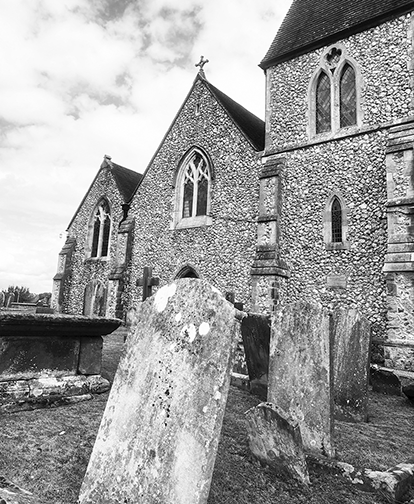
Elizabeth Hitchener was baptised in Keymer, a parish of Sussex, on 22 April 1783.Footnote 45 She was the second of five children born to Thomas Hitchener (b. 1749),Footnote 46 a former smuggler who appears to have changed his name from Yorke (or York)Footnote 47 to Hitchener before becoming landlord of the Fryar’s Oak Inn in Clayton, Sussex,Footnote 48 and Elizabeth Hitchener (née Greenwood), whose status was recorded as ‘Widow’ when she married Thomas at St. Andrew’s church in Holborn, London, on 16 November 1780.Footnote 49 The parish of Keymer encompassed a Saxon parish church, a manor house, and Oldland Windmill, and extended to its south in ‘a long, narrow strip up the side of the South Downs to a height of over 700 ft.’Footnote 50 Determining how Hitchener felt about her early life in Keymer is difficult because the record depends upon a couple of brief and nebulous accounts. In one of her letters to Shelley, Hitchener told him that she had ‘visionary’ sentiments from ‘very early’ on and lamented that ‘they’ – seemingly Keymer villagers – ‘pronounced me romantic, eccentric & conceited, & compelled me to live without sympathy’.Footnote 51 The ‘Apologetic Stanzas’ attached to The Weald of Sussex (1822) offer another reflection on the ‘disadvantages’ of her early years:
Since the ‘thee’ to which these lines are addressed is the personified volume of verse, not Hitchener herself, the account is only obliquely autobiographical, and the denial of social and intellectual influence (‘No kindred friendship’, ‘No brilliant converse’) is partly a strategy to downplay expectations. It is also possible that Hitchener is recasting the myth Shelley made for her of the visionary’s self-impelled flight from obscurity, for we know that Hitchener did find ‘kindred friendship’ in at least one of her siblings: she had a younger sister called Ann (baptised 19 September 1785),Footnote 53 with whom she eventually co-founded a school and to whom she remained close throughout her life. She also had two younger brothers, Thomas, who died ‘young’ and was buried in Keymer on 23 September 1784, four days after his baptism,Footnote 54 and James (baptised 13 July 1787),Footnote 55 as well as a notable elder brother, William Henry Hitchener (baptised 30 December 1781).Footnote 56 After impressing in the role of Hotspur in a production of Henry IV, Part I at Thornton’s, a boys’ boarding school for ‘young gentlemen’ in Horsham,Footnote 57 by 1811 William was, in the words of the Sussex Weekly Advertiser, a ‘deserving and improving’ actor with the Surrey Theatre.Footnote 58 He wrote two plays, Love in a Desert. A Musical Entertainment, in Two Acts (1802) and Ivor; or, The Sighs of Ulla. A Tragedy (Ivor was performed in Henley-on-Thames in 1808 with ‘Mr. Hitchener’ in the starring role).Footnote 59 He also published two novels, St Leonard’s Forest; or, the Child of Chance. A Novel (1813) and The Towers of Ravenswold; or, Days of Ironside. A Romance (1813), the latter of which features Adeliza, a woman with a ‘mind’ of ‘superior cast’ possibly based on his sister.Footnote 60 An ode about a barber shop was ridiculed in The British Critic in 1804: ‘We do not know this Mr. Hitchener, but conjecture he may be the shaver himself, though no cunning one certainly’.Footnote 61 Elizabeth would follow her brother in becoming a published author that the literary establishment did ‘not know’.
Scholars have claimed that Hitchener ‘owed little to father or mother’.Footnote 62 The observation feeds into the myth of the autonomous child prodigy while smuggling in a class-based animus. Of what use could unwealthy parents be to a future member of Shelley’s circle? Yet the fact that an eighteenth-century Sussex publican and his wife produced two published authors is enough to suggest that bookish interests and ‘brilliant converse’ were nurtured in their household. From some aggrieved comments Hitchener made in a letter to Shelley it has been concluded that her mother was a ‘rigid’ and ‘conventional’ woman.Footnote 63 But these comments need to be read in context. They show the twenty-eight-year-old Hitchener reflecting upon her mother’s disapproval of her dedication to the welfare of Hannah Adams, her former teacher and mentor, whom Hitchener regarded as ‘the Mother of my soul’:
my Mother condemns her because she did not treat me as she had done, & for allowing a girl to have an opinion, nor does she pardon the affection I must ever have for her, & to which my Mother claims a right, surely it does not lessen my love for one because I love the other more…Footnote 64
Just because Hitchener’s mother felt that Hannah Adams was too liberal in encouraging some of her daughter’s opinions, it does not follow that her own values were ‘rigid’. And just because ‘she did not treat’ Hitchener as Adams ‘had done’, it does not mean that she treated her badly. Hitchener in fact retreats from her claim that the love she holds for her mother is secondary: ‘nay I know not as to loving more’.Footnote 65 Shelley, who had never met Hitchener’s mother, responded by describing her as ‘one of those everyday characters by whom the stock of prejudice is augmented rather than decreased’.Footnote 66
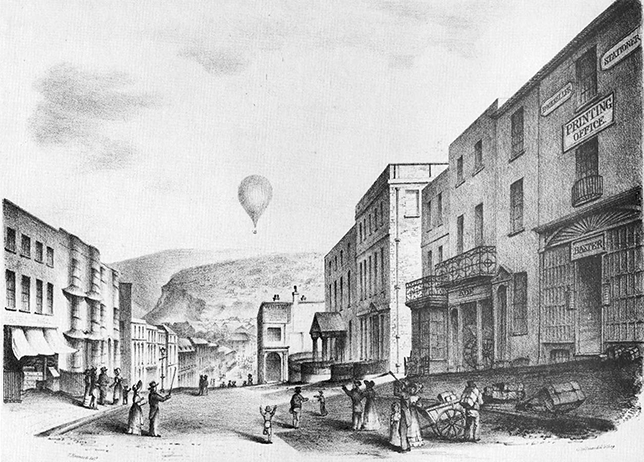
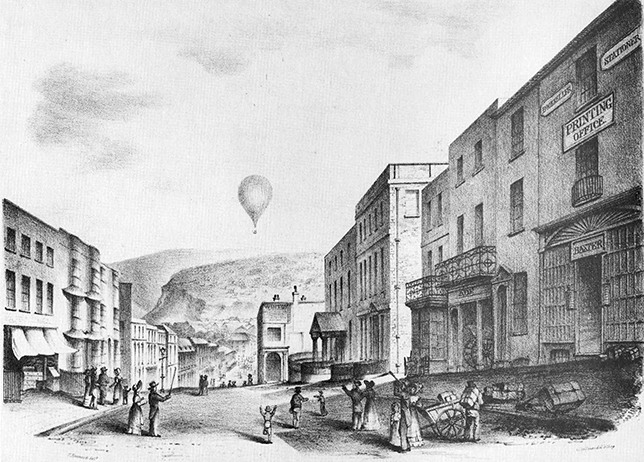
At the very least, Hitchener had her mother to thank for ‘the school she selected in which reason not accident directed her’.Footnote 67 In choosing Adams’ Girls’ Boarding School, co-founded by Hannah and her sister Mary Adams circa 1774,Footnote 68 Hitchener’s mother secured for her eldest daughter an education as ‘superior’Footnote 69 as the education she had secured for her eldest son – which was to risk incensing moralists of the period who considered sending a daughter to school an example of ‘bad mothering’ that encouraged corruption.Footnote 70 Hitchener started at Adams’ School, situated on School Hill in Lewes, when she was nine (see Figure 1).Footnote 71 Stretching down ‘a beautiful declivity of the South Downs’, as Hitchener described it,Footnote 72 Lewes is just over eight miles from Keymer. Its radical credentials, as Harvey J. Kaye has shown, were apparent from the ‘several Nonconformist churches, and a tradition of opposition to the monarchy and pro-republican sentiments going back to the revolutionary decades of the seventeenth century’, and it was here that Thomas Paine had begun his political activities while living above a tobacco shop between 1768 and 1774.Footnote 73 At a town meeting held in the year Hitchener started school, the grammar-school usher Paul Dunvan was characterised as ‘riotous’ (he went on to publish anonymously what John Caffyn calls the ‘aggressively radical’ Ancient and Modern History of Lewes and Brighthelmston in 1795, which Hitchener cites in notes to The Weald of Sussex).Footnote 74 Lewes was therefore a suitable setting for Hitchener’s introduction to ‘the dear woman’ who educated her in the principles of virtue and truth: ‘when first I heard her speak,’ Hitchener said of Adams, ‘I listen’d with a delight I never tasted before’.Footnote 75
Thomas Henwood, ‘A View from Baxter’s Library, High Street, School Hill, Lewes’ (1828),
Hannah Adams was in the vanguard of an ‘educational innovation’, the commercial girls’ school, that emerged ‘when there was widespread interest in female education’.Footnote 76 As Susan Skedd points out, these schools ‘gave girls the opportunity of an extensive school education as an alternative to a private education in the home’.Footnote 77 In one way the education Hitchener received was conventional: she was taught ‘plain’ and ‘fine’ (i.e. ornamental) needlework in preparation for an industrious life in the home.Footnote 78 In other ways Hitchener’s was a ‘proper education’ of the pioneering kind Wollstonecraft envisioned in A Vindication of the Rights of Woman (1792), which was published a few months before Hitchener began her schooling and came to exert a lasting influence on her.Footnote 79 The ‘enlightened’Footnote 80 Hannah Adams sought to fulfil the Wollstonecraftian aim of furnishing young women with ‘well-stored mind[s]’ by fostering their ‘dignified pursuit of virtue and knowledge’.Footnote 81 But she was not present for all of Hitchener’s time at the school. Towards the end of 1792, several months after Hitchener’s enrolment, Adams departed for revolutionary France.Footnote 82 Adams must have arrived in Paris a month or two prior to the execution of Louis XVI on 21 January 1793, and, once France had declared war on England in February 1793, she was left stranded by a law that prevented foreigners from leaving the country. It is possible that Adams came into contact with the circles of expatriates in which Wollstonecraft (who had travelled there around the same time) found solace in Paris, and even with Wollstonecraft herself.Footnote 83 Meanwhile, for over two years Hitchener’s education, as well as that of over twenty other girls,Footnote 84 likely fell under the remit of Mary Adams, who Lewes locals labelled a ‘reactionary’,Footnote 85 and to whom Hitchener assumedly referred when she later described ‘a Sister, who is the opposite of her’.Footnote 86
When Hannah Adams returned to the school in 1795, she grew ever closer to Hitchener, who she came to ‘love as her child’.Footnote 87 Hitchener adored Adams in return as mother-figure, teacher, and incarnation of her own emerging radicalism: ‘to love her & virtue was the same’.Footnote 88 In December 1795, Adams’ School published an advertisement, written in both English and French presumably to exhibit the school’s prestige, outlining an ambitious curriculum that included English, French, geography, and ancient and modern history.Footnote 89 Pupils were also encouraged to participate in philanthropy, as when in 1790 (two years prior to Hitchener’s enrolment) the ‘Young Ladies at Miss Adam’s Boarding School’ raised £2 2s for a public appeal to aid three orphaned children.Footnote 90 One area that could not be included in the published advertisement, to which Adams likely introduced Hitchener during her schoolyears, was religious questioning influenced by Rational Dissent, which saw increased female interest from the mid-eighteenth century. The belief in ‘the right to private judgement in matters of religious faith’, as Valerie Smith defines it,Footnote 91 may have informed some of the opinions to which Hitchener’s mother objected, and Hitchener later brought to bear her ‘private’ thoughts concerning Christian orthodoxy on her correspondence with Shelley.
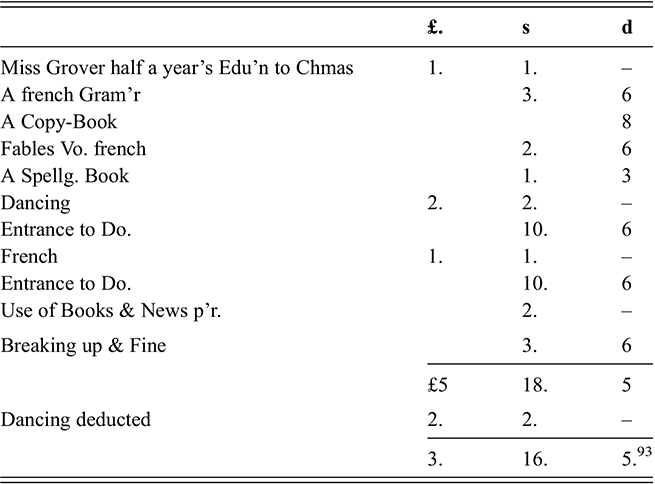
A surviving bill of 1804 for Adams’ School details costs in addition to the annual day fee of £2 2s (cheaper than a number of contemporaneous Sussex girls’ schools)Footnote 92 for a ‘Miss Grover’:
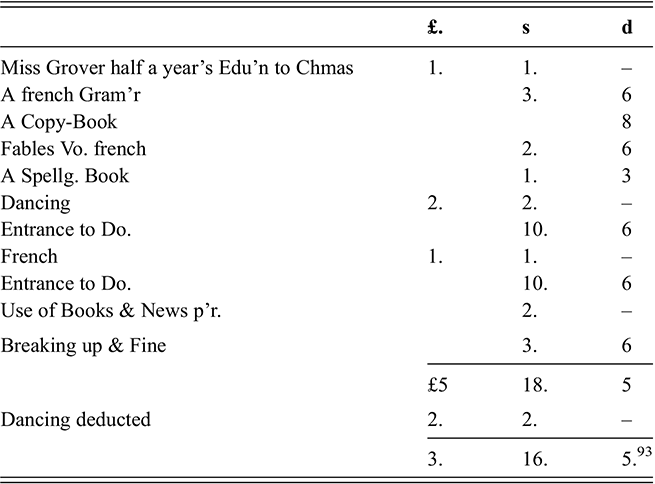
Table 1.01 Long description
The additional costs are listed in abbreviated prose according to the educational item received or the class taken. ‘Miss Grover half a year’s Edu’n to Chmas’ cost one pound and one shilling; ‘A french Gram’r’ cost three shillings and six pence; ‘A Copy-Book’ cost eight pence; ‘Fables Vo. french’ cost two shillings and six pence; ‘A Spellg. Book’ cost one shilling and three pence; ‘Dancing’ cost two pounds and two shillings; ‘Entrance to Do.’ cost ten shillings and six pence; ‘French’ cost one pound and one shilling; ‘Entrance to Do.’ cost ten shillings and six pence; ‘Use of Books & News p’r.’ cost two shillings; ‘Breaking up & Fine’ cost three shillings and six pence. The total is given as five pounds, eighteen shillings, and five pence, before ‘Dancing’ costs of two pounds and two shillings are ‘deducted’. The final total is given as three pounds, sixteen shillings, and five pence.
Hitchener had left the school by 1804, but the bill gives a sense of the expertise, equipment, books, and newspapers from which her education would have benefited. It marks, too, the coming to fruition of the call for women’s access to literature that had gained momentum during the eighteenth century. In 1748, the clergyman Thomas Seward had published ‘The Female Right to Literature’, a poem which inspired his daughter Anna’s literary ambitions: ‘But, say, Britannia,’ one of his apostrophes begins, ‘do thy sons who claim | A birth-right liberty, dispense the same | In equal scales? Why then does Custom bind | In chains of ignorance the female mind?’Footnote 94 Maria Edgeworth then echoed Seward’s call by publishing a second edition of Letters for Literary Ladies in 1798 with the aim of asserting ‘more distinctly the female right to literature’.Footnote 95 Hitchener’s own enigmas and The Weald of Sussex reflect the expansive curriculum she followed at Adams’ School and attest to her lasting interests in Roman, Greek, and early English history and etymology, among other things, in what the Sussex historian William Smith Ellis described in 1837 as ‘a most unfeminine and ostentatious display of learning’.Footnote 96 At one point in The Weald Hitchener pays tribute to ‘the Graces’ of ‘fair Lewes’, before reflecting on the ‘treasures’ of early education:
The allusion to the Greek Muses signals Hitchener’s abiding advocation of female inspiration; and, for any reader familiar with her biography, out of those proliferating hers the presence of Hannah Adams emerges like the solution to one of Hitchener’s enigmas.
The tendency of Shelley and his critics to obfuscate details of Hitchener’s childhood, even if partly inspired by her self-identification as a ‘visionary’, has served to efface the truth that her intellectual and political instincts were fostered by radical advancements in female education, typified by Hannah Adams and her school. These advancements challenged the ‘wild chimera’ of Rousseau’s Émile – that ‘All the ideas of women, which have not the immediate tendency to points of duty, should be directed to the study of men’Footnote 98 – a doctrine which Wollstonecraft rebuked in A Vindication:
But I still insist, that not only the virtue, but the knowledge of the two sexes should be the same in nature, if not in degree, and that women, considered not only as moral, but rational creatures, ought to endeavour to acquire human virtues (or perfections) by the same means as men, instead of being educated like a fanciful kind of half being…Footnote 99
Shelley’s friend Thomas Jefferson Hogg sarcastically remembered interrogating Hitchener ‘about the Rights of Women, respectfully requesting to be informed what they were’.Footnote 100 The lofty sobriquet to which he has recourse – ‘I represented my view of the matter to the scholastic Minerva’ – is hardly respectful.Footnote 101 For the truth is that any well-educated man of privilege who held even the slightest reservations regarding female progress had reason to feel unnerved by Hitchener. Even while her ‘very humble’ background defied Wollstonecraft’s bourgeois ‘natural state’,Footnote 102 Hitchener had acquired ‘human virtues’ by the ‘same means as men’. She was the incarnation of Wollstonecraft’s revolutionary ideals.
An Establishment for Young Ladies
Inspired by her experience at Adams’ School, Hitchener chose to dedicate her life to female education. ‘The most common and often the only qualification that a teacher could rely on’, Skedd points out, ‘was her own experience of a school education, which in itself was seen as an investment for future employment’.Footnote 103 Sometime around 1803, aged twenty, Hitchener founded her own girls’ boarding school (‘an Establishment for Young Ladies’) in Hurstpierpoint, about nine miles from Lewes, which appears to have occupied a building known as Patchwork Hall.Footnote 104 For a female teacher to get a school up and running in the period was an achievement: in 1783 Wollstonecraft had abandoned her own first attempt at founding a boarding school in Islington after struggling to enrol pupils.Footnote 105 Hitchener later explained to Shelley that her ‘principal motive for engaging in a School’ was to offer Hannah Adams a refuge from reactionary presences both local and familial:
[Adams] has kept a school seven & thirty years, but having too much virtues for the x age has ever been an object of persecution, she is still compelled to continue it, & I have long sigh’d to offer her an asylum […] she is so circumstanc’d with a Sister […] that she is not more at liberty as to me than I am to her…Footnote 106
As two educated and (ultimately) persecuted women, Hitchener and Adams formed an enduring bond belonging to a category of female friendship that ‘emerged through women’s agency’ in the long eighteenth century ‘as a powerful resource in the struggle for autonomy and authority’, according to Susan S. Lanser.Footnote 107 Hitchener and Adams take their place alongside Elizabeth Carter and Catherine Talbot, Charlotte Smith and Henrietta O’Neill, Anna Seward and Honora Sneyd, Lucy Aikin and Joanna Baillie, as women whose companionship facilitated spiritual and intellectual growth, and, for Hitchener and Adams at least, a vibrant exchange of political ideas: friendship is ‘That name’, wrote Ann Yearsley in her ‘Address to Friendship’ (1785), ‘which never yet cou’d dare exist | But in equality’.Footnote 108 Such a friendship could not reach its zenith through correspondence alone. Taking heed of Aristotle’s belief that ‘[t]hose who welcome each other but do not live together would seem to have goodwill rather than friendship’, Hitchener imagined an ‘asylum’ in which she and Adams would live together, read, teach, and engage in philanthropy, perhaps in part out of financial necessity.Footnote 109 As her later reflections attest, Hitchener was persistent in encouraging Adams to join her in Hurstpierpoint, while lamenting that, owing to the oppressive influence of her sister,
we could not have lived together; tho’ [Adams] may not be induced to accept independance, still the delight she will feel in the offer is such that I wish her to have what is due to her rather than to me […] I can when she is thus importun’d, perhaps persu^ade her to reside with me …Footnote 110
Hitchener’s vision of a shared home and school in which each woman’s ‘independance’ would be preserved aligns with Nicole Pohl’s description of the eighteenth-century model of the ‘sentimental household’ – composed of ‘attachments that allow for emotional fulfilment and self-possession in opposition to “the texture of female subordination” in contemporary family and household structures’.Footnote 111 The model found its most alluring expression in the utopian community of altruistic women at the centre of Sarah Scott’s Millenium Hall (1762): ‘In the bow’, observes the enthralled male traveller who enters the manor’s ‘Attic school’, ‘sat two ladies reading, with pen, ink, and paper on the table before them, at which was a young girl translating out of French. At the lower end of the room was a lady painting with quite exquisite art indeed, a beautiful Madona; near her another, drawing a landscape out of her own imagination; a third, carving a picture-frame in wood, in the finest manner; a fourth, engraving; and a young girl reading aloud to them’.Footnote 112 In the late eighteenth and early decades of the nineteenth century, traces of Scott’s eutopia can be found in the biographies of Hannah More, who established schools and engaged in acts of philanthropy while living with her sister Patty in Somerset, and Jane Austen, who enjoyed the company of her sister Cassandra at Chawton, where, as their niece recorded, ‘our Aunts occupied themselves in working for the poor & teaching here & there some boy or girl to read & write’.Footnote 113 When Hitchener later agreed, after much hesitation, to go and live with the Shelleys in 1812, she was responding in part to her own unsatisfied yearning for a ‘Millenium Hall’.
No evidence exists to indicate that Hannah Adams ever resided with Hitchener in Hurstpierpoint – she appears to have stayed at Adams’ School until she married a John Stanley in 1813, before moving to Cornwall in 1817Footnote 114 – but her mentorship and companionship were enabling factors in the foundation of Hitchener’s own school. Here Hitchener offered a radical curriculum inspired by Adams, both in terms of its range and richness and the Rational Dissenting spirit in which she ‘publickly instructed youth as a Deist, & a Republican’,Footnote 115 anchored by her own attunement to the realities of ‘practical’ learning: ‘experience of Mankind’, she later told Shelley, ‘is of all schools the severest, its ingenuous pupils purchase their knowledge with tears of blood, (here ignorance is indeed bliss), like every other knowledge you early obtain it’.Footnote 116 While parallels can be drawn between Hitchener and figures such as Wollstonecraft and Ann Murry (author of Mentoria; or, the Young Ladies Instructor (1778)) who made a living teaching in London in the1780s and 90s, she was also part of a lesser-known constellation of women outside of the capital – including Ellenor Fenn (1743–1813) in Norfolk and Catharine Cappe (1744–1821) in York – who combined teaching with writing and philanthropy. Fenn, for instance, assisted in the founding of a Sunday school, adopted an orphaned heiress, and from her home in Dereham wrote dozens of books aimed primarily at young girls under the pseudonym ‘Mrs Teachwell’. The transmission of her work through reprints in the United States and her public support for the National Society for the Education of the Poor testifies to the influence that the position of teacher-author opened to women in the period.Footnote 117
Although Hitchener’s own establishment and the school she attended were not charity schools, this did not preclude a concern for the education of the poor and pupils of modest means. The aspect of commercial girls’ schooling that ‘most exercised moralists and educationalists’ in the eighteenth century, as Michèle Cohen has shown, ‘was the “promiscuous” mixing of social classes’, condemned because girls could ‘acquire ideas above their station’.Footnote 118 At Adams’ School, which set lower fees, promoted philanthropic endeavours, and offered an advanced education, possibly enabled by donations, to girls like herself, Hitchener found inspiration in an environment that embraced this ‘mixing of social classes’. Within her own Hurstpierpoint establishment, Hitchener counted among her pupils the girls of an American family as well as Emma Pilfold, the daughter of Shelley’s uncle Captain John Pilfold, a naval officer, but she doubtless educated local girls who had suffered the ‘disadvantages of birth’.Footnote 119 The Report of the Select Committee on the Education of the Poor recorded two endowments in 1806 totalling nearly £14,000 for the education of one hundred poor children, including girls, who were sent to ‘different schools in the parish’ of Hurstpierpoint, Hitchener’s possibly among them.Footnote 120
Contemporary testimonies tell us that Hitchener was ‘well spoken of’ in Hurstpierpoint, was ‘said to be very clever’, and was ‘successful in the speculation’ of running a school.Footnote 121 She would never have come into contact with Shelley had she not earned the admiration of Captain Pilfold, who in the early summer of 1811 (when she was twenty-eight)Footnote 122 invited her to dine at the family home in Cuckfield. It was there that she first met Shelley, who was ten years her junior; he was struck by her intelligence and agility as a conversationalist. Judging by the letter he sent to her afterwards, the meeting facilitated a lively discussion about education and stimulating ‘arguments’ concerning religion that would play out in the pair’s correspondence (the subject of the next section, ‘Angel’) over the coming months.Footnote 123 But the Cuckfield encounter also marks the point at which Shelley’s biographers begin to denounce Hitchener’s character, gender, and politics, and one way in which they do this is by calling her blue.
A Bomb-Proof Blue
Hogg introduces Hitchener to us as ‘a tower-proof, fire-proof, bomb-proof blue; free from and above all prejudices; and a resolute champion of the Rights of Women’, and Medwin follows suit by calling ‘Miss Kitchener’ ‘an esprit fort, ceruleanly blue’ and a ‘great stickler for the rights of her sex’.Footnote 124 They are likely taking their cue from Byron’s stanzas in Don Juan IV (1820) about ‘learned ladies’:
In the latter part of the eighteenth and first half of the nineteenth century, ‘blue’, which originated from ‘Bluestocking’, could be used as a term of endearment for women ‘so wise, and so learned, so blue’, as Edgeworth put it in Patronage (1814);Footnote 126 but it was often delivered, as here, with a mocking edge that discredited female learnedness, sustaining the pejorative connotations of ‘Bluestocking’ that emerged as early as the 1780s.Footnote 127 When fifteen-year-old Fanny in the anonymously-authored Blue-Stocking Hall (1827) archly asks the older Mr Otway, ‘What is the meaning, dear Phil. of calling people Blue-stockings, whose stockings are really white?’, he pertinently replies: ‘Blue-stockings, my Fan, is a vulgar slang for learned ladies’.Footnote 128 Otway goes on:
Certainly, a learned lady is the terror of all ignorant men, and to cover their own idleness, or incapacity, they never fail to under-value what they do not possess, particularly if they find knowledge and ability in those, whom, as females, they consider their inferiorsFootnote 129
It is precisely the double-edged perception of Hitchener as knowledgeable and able and ‘inferior’ and female that induces the kind of ‘terror’ in Shelley’s biographers, disguised in the form of sniggering wit or unjustified wrath, that will be shown in its severest form in Section 3 of this Element.
Such slack deployment of ‘blue’ as ‘vulgar slang’ has also obscured a more profound truth: that Hitchener, as an educated woman of rural Sussex without property, embodied the class-dissolving evolution of the adjective (‘so wise, so learned, and so blue’) and the legacy of Bluestocking espousal of women’s education, writing, philanthropy, and patronage with which it was associated.Footnote 130 This advocation originated in the elite assemblies hosted by Elizabeth Vesey and Elizabeth Montagu (Sarah Scott’s sister)Footnote 131 in London in the 1750s and 1760s, and was preserved by the measured proto-feminism of second-generation Bluestockings. At the same time, it was transmitted along the political spectrum to the Radical and Rational dissenting female intellectuals of the 1780s and 1790s, including national figures like Helen Maria Williams and regional ones like Hannah Adams, who in turn catalysed Hitchener’s career as a teacher and writer in the 1800s and 1810s. The ‘practical political virtue’ for which she advocated was therefore shaped at once by Radical and Bluestocking values. In addition to her reading of Wollstonecraft, Hitchener admired the work of Hannah More,Footnote 132 a participant in Bluestocking gatherings from 1778, whose ‘The Bas Bleu: or, Conversation’ (1786) pays ardent tribute to Bluestocking conversation as ‘that noblest commerce of Mankind’:
The poem ‘encapsulates’, in Elizabeth Eger’s words, ‘a particular mission to improve, self-consciously advertising a belief in the possibilities offered by conversation as a means of asserting social and intellectual equality’.Footnote 134 This Bluestocking ‘belief’ echoes through Hitchener’s life and work: her poetry’s recognition that ‘brilliant converse’ can ‘elicit truth’; Harriet Shelley’s description of her talking ‘a great deal. If you like great talkers she will suit you. […] She laughs and talks and writes all day’;Footnote 135 her desire to live alongside the woman who kindled her intellectual awakening ‘when first I heard her speak’; the interactive structures of her enigmas; and the longing for unbridled conversation – ‘will you indulge my familiar style & ity & allow me to chat at all seasons’Footnote 136 – that inspired her correspondence with Shelley across 1811–12. By recovering elements of the pre-Shelleyan life that scholars have long denied Hitchener, and by finding her presence within the cultural and intellectual fabric of the long eighteenth century, this section has allowed such echoes to be heard.
2 Angel
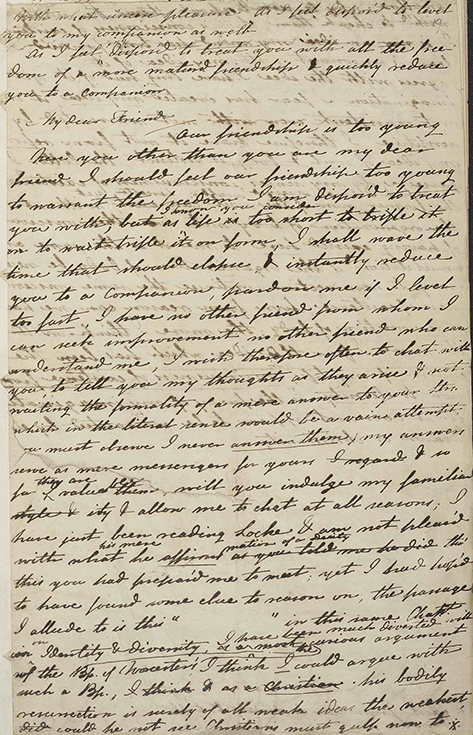
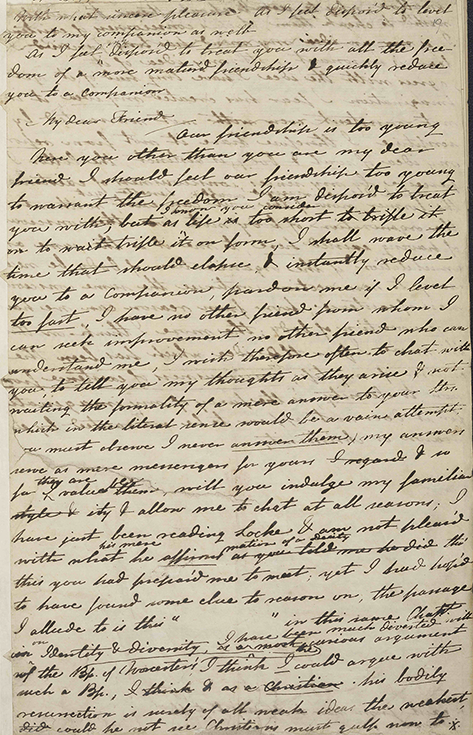
The letters Hitchener exchanged with Shelley between the summers of 1811 and 1812 are the richest record of her personality. They are also the root of the distortions that have plagued her biography ever since. Fifty-eight letters survive: forty-five from Shelley to Hitchener (seven with contributions by Shelley’s first wife Harriet, from whom there is also one letter to Hitchener) and twelve – in draft – from Hitchener in return.Footnote 137 The manuscripts are preserved in the British Library in a leather-bound volume donated by the Reverend Charles Hargrove in 1907.Footnote 138 None of Hitchener’s fair copies remain, and in our estimation over forty of Hitchener’s letters to the Shelleys are now lost entirely. The surviving drafts are scrappy and sometimes incomplete, and ‘estimates of [Hitchener’s] intelligence’, as Holmes observes, ‘have suffered unfairly’ as a result.Footnote 139 Some (see Figure 2) document in their revisions and crossings-out a nervous care; some break off in the middle of the page, unsigned; others are addressed in full, as if saved from the post at the last minute. They preserve a tantalisingly fragmented voice.
Hitchener to Shelley, c. 10 July 1811. HL3 f. 19r,
This section sustains the Element’s dual method of ‘revision’ and ‘recovery’ by demonstrating Hitchener’s importance to a correspondence usually taken only as evidence of Shelley’s ‘amazing’ intellectual energy.Footnote 140 Shelley exalted Hitchener as a source of personal salvation and the harbinger of a transformed world. ‘Your letters are like angels sent from heaven on missions of peace’, he wrote, ‘they point out the path which it is Paradise to tread’.Footnote 141 He found in her ‘the embryon of a mighty intellect which may one day enlighten thousands’.Footnote 142 One story rehearsed in this section is of Shelley’s entrancement by visions of his own making. Another, never told before, is of the compassion, intelligence, and level-headedness Hitchener extended in response to Shelley’s exaggerations. Clearing away Shelleyan hyperbole and the history of critical condescension, the section answers Hitchener’s invitation to ‘see me […] as I really am’.Footnote 143
When Hitchener first met Shelley, he was eighteen. He had been sent down from University College, Oxford, in March 1811 and in the fallout banished by his father and spurned by his sister (another Elizabeth): ‘she is not the singular angelic being whom you adored & I loved’, he wrote to Hogg, ‘I mourn her as no more’.Footnote 144 Hitchener would replace her. Shelley drifted between relatives in Wales, the house of his sympathetic uncle Captain Pilfold in Cuckfield (where he met Hitchener), and London, where he pursued a relationship with the sixteen-year-old Harriet Westbrook, with whom in August he would elope. Having married in Edinburgh, Harriet and Shelley spent September there with Hogg before moving to York, where they were joined by Harriet’s older sister Eliza. The household quickly fell apart on the back of a hazily-documented episode in which Hogg made advances on Harriet while Shelley was visiting his father. Shelley, Harriet, and Eliza fled to Keswick, befriending Robert Southey, before in January 1812 they sailed to Dublin. In March 1812, they returned to Wales. All the while, Hitchener was running her school in Hurstpierpoint, answering Shelley’s letters ‘home’. Hitchener was Shelley’s most frequent correspondent over this year. At the start, she was a friendly intellectual adversary. She became Shelley’s refuge from personal crises and the talisman of a radical crusade: ‘You are to my fancy as a thunder-riven pinnacle of rock amid the rushing tempest and the boiling surge’, he wrote.Footnote 145 When, in November 1811, Shelley told Hitchener that he loved her ‘more than any relation I posses’,Footnote 146 he had met her only three times.
Annotating the letters in preparation for his 1890 privately printed edition, Thomas Wise lamented that Shelley’s estimation of Hitchener displayed a ‘gross & even ludicrous incongruity with the simple sober facts of the case’.Footnote 147 As if to compensate, critics since have tended to invert the hyperbole. Boas sees Hitchener in the guise of a ‘perplexed’ pupil ‘in need of guidance’.Footnote 148 ‘Poor Elizabeth Hitchener’, says Bradley, ‘served as a sounding-board for her young mentor’s ideas’, which at least glances at how annoying the young Shelley could be.Footnote 149 Frederick L. Jones, the letters’ most significant twentieth-century editor, presents a selection of Hitchener’s drafts only to dismiss them as ‘uninteresting and often hardly literate’.Footnote 150 Hitchener downplayed her own significance: ‘my answers serve as mere messengers for yours’, she wrote early in the correspondence,Footnote 151 and later, ‘the reciprocity of my friends gives comprehension to my language’.Footnote 152 But if this formulation implies that Hitchener’s letters can only be understood alongside the letters to which they reply, then the reverse also holds. Finding her voice involves viewing her in the light of the thoughts she prompted as well as proffered. This section emphasises the value of reading literary correspondence as a collaborative genre, a conversation in which both participants seek, but do not always find, what More describes in ‘The Bas Bleu’ as ‘the pure delight | When kindling sympathies unite’.Footnote 153 We reinsert Hitchener’s drafts into the correspondence to show how they offer a grounded, often ironical counter-voice to Shelley’s idealism. Our account reveals an exchange conducted in the spirit of the ‘collision of mind with mind’ advocated in Godwin’s Enquiry Concerning Political Justice (1793), a volume which would become important to both writers.Footnote 154 As she questions and tempers Shelley’s ardency, Hitchener emerges as a sometimes ‘sober’, but far from ‘simple’, figure.
No Other Friend Who Can Understand Me
The early correspondence is marked by the contrast between Shelley’s fluent atheism and Hitchener’s tentative defences of her faith:
I feel it my duty to pursue my inquiry for the God I serve, I am sure prefers the homage of a rational commands me to use, the faculties he bestows, & I shall indeed be convinc’d that if the Christian Religion is^cannot stand the test of inquiry &c itnot safe only among the immoral & the frivolous it comes not from the Being I worshipFootnote 155
When transcribed faithfully, as they have been for the first time for this Element, Hitchener’s drafts initially present an unpromising platform for the recovery of a literary reputation. One defence of their significance is to contend, with Isobel Grundy, that in the recovery of women writers ‘the argument from literary quality needs reinforcement from the argument for the value of knowledge’.Footnote 156 The drafts are a valuable, if rough and attenuated, record of an unheard voice. Yet the very roughness of that voice is inscribed with the qualities that made Hitchener a stimulating correspondent. Hitchener’s corrections reveal her care to tailor her attitudes to Shelley – whether through a class- or gender-oriented subservience, an effort to manipulate his sympathies, or the pleasure of discovering her own beliefs in the act of writing. They show a mind in flux.
The ‘knowledge’ afforded by the drafts is often incomplete. ‘[O]nce I dreamt I had a friend’, Hitchener wrote in November 1811, ‘but the world stole her, I still admire that intellect the brilliancy of her mind, & often regret that I cannot love what I must admire her, in the warmth of youthful fancy my heart began to expand towards her, but she nipt the opening blossom, my heart bled then’.Footnote 157 Nothing remains to identify this friend, or the nature of Hitchener’s affection for her. Hitchener’s lost dream of a friendship based on the ‘brilliancy’ of female ‘intellect’, however, shapes her correspondence with Shelley. ‘I have no other friend from whom I can seek improvement, no other friend who can understand me’, she wrote: ‘I wish therefore often to chat with you, to tell you my thoughts as they arise’.Footnote 158 ‘It was a trope in the eighteenth century that familiar writing should resemble conversation’, observes Cynthia Aalders.Footnote 159 Hitchener’s conception of friendship and ‘chat’ as vehicles for ‘improvement’ suggests how productively she understood the correspondence within a framework of eighteenth-century values. She quotes recurrently from the second ‘Night’ of Edward Young’s Night-Thoughts (‘On Time, Death, and Friendship’), expressing herself ‘peculiarly happy in possessing a Friend who can “set my mind abroach”’, yet grateful, too, that conversation gives ‘due restraint’ to ‘rude thought’.Footnote 160 She turns as well to More, quoting from Sensibility to pay tribute to her mentor Hannah Adams in terms which also illuminate her sense of the moral value of her discussions with Shelley: ‘“if any love of virtue glow in me” I first caught that love from her’.Footnote 161 Although the material record of Hitchener’s correspondence is slight, the allusiveness of the surviving drafts indicates the seriousness with which she conceived of the exchange as an intellectual and literary endeavour.
In other respects, Hitchener’s letters complicate established ideals. Alexander Pope’s line that a letter presents ‘thoughts just warm from the brain, without any polishing or dress’ remained influential when Hitchener and Shelley were writing.Footnote 162 Hitchener’s drafts fulfil that ideal with disarming authenticity. Both their hesitations and their headlong energy expose the artifice of Popean spontaneity. Hitchener promised to write ‘with all the freedom of thought, that has not thought’,Footnote 163 her idiom honouring the extemporising openness that captures the drama of ‘thoughts as they arise’:
the narrow & prejudiced of Mankind, such as too often have stung me to the soul, & prompted me to steel my feelings with indifference against the arrows of disappointment, & to endeavor to sacrifice on the Altar of Virtue that sensibility which brought pain to myself, & no happiness to others, the world severely & very early taught me, that my soul was fraught with sentiments visionary to them, they pronounced me romantic, eccentric & conceited, & compelled me to live without sympathy for I seem’d created to awaken in them, only surprise, vacancy, & stupidity; yet is this sympathy the charm of life, a balance which outweighs its evils, a sacred gift which amply compensates the ills of life, the its sweetest solace, mysterious cement of the soul, soother of all the life, oh lovely sympathy I owe thee much & the few months I have drank of thy reanimating cup atones for the blank of years I have^had before endur’dFootnote 164
The passage has an immediacy unavailable to more ‘polished’ prose. Sorrow at a world hostile to Hitchener’s ‘eccentricity’ is rescued by a cheerfulness that awakens spontaneously from contemplation of the ‘sympathy’ for which the letter longs. The indeterminate syntax suggests a mind gaining only momentary purchase on a solace it fears to be nothing more than a ‘charm’, prone to evaporate as soon as experienced. ‘Fraught with sentiments’, to use Hitchener’s own astutely ambivalent phrase, the draft speaks with a deftness that refutes accusations of ‘illiteracy’.
The ‘understanding’ nurtured by the letters was intellectual as well as emotional. ‘Conversation’, in More’s terms, was an agent of ‘moral truth’ and ‘wisdom’ as well as ‘delight’.Footnote 165 One context within which the letters can be understood is the tradition of epistolary mentorship that had grown following the publication of Lord Chesterfield’s letters in 1774. Hitchener and Shelley share little of Chesterfield’s interest in ‘good-breeding and politeness’,Footnote 166 or the concern with conduct and manners that marks Hester Chapone’s Letters on the Improvement of the Mind (1773). Their concern with ‘virtue’ is more radically inflected.Footnote 167 But Shelley, blithely inverting the conventions of age and professional experience, appears at first to have had something similarly didactic in mind. Proposing a ‘polemical correspondence’Footnote 168 in June 1811, he anticipated a one-sided affair. To begin Hitchener’s ‘secondary education’,Footnote 169 he arranged for copies of Locke’s Essay Concerning Human Understanding (1689), Southey’s Curse of Kehama (1810), and George Ensor’s On National Education (1811) to be sent to her. Ensor’s book makes the case for poetry as ‘the most powerful means of instructing youth’Footnote 170 and underpinned Shelley’s puritanical view that ‘all poetical beauty ought to be subordinate to the inculcated moral’.Footnote 171 Yet the exchange proves the difficulty of ‘inculcating’ any single moral perspective. Although Hitchener looked forward to the development of her mind from a ‘chaos of disjointed ideas’ into ‘a seat of order and harmony’,Footnote 172 it is the ‘chaos’ of jostling arguments that animates the letters. In this respect, the model of epistolary mentorship at work is more Godwinian: ‘If we would […] improve the social institutions of men’, Godwin asserted in Political Justice, ‘we must write, we must argue, we must converse’.Footnote 173 As Clare Brant observes, although late eighteenth-century paradigms ‘presumed an exchange of views which tempered assertion, letters, like dialogues, enabled women to argue’.Footnote 174 ‘[T]ho I presume not to argue I love to discuss’,Footnote 175 Hitchener herself declared. Eventually, Shelley encouraged her: ‘Preserve your individuality, reason for yourself, compare and discuss with me’.Footnote 176
From the start, Hitchener teasingly indulged Shelley’s teacherly earnestness. ‘Self-love’, she wrote, confessing to a quality which Shelley proudly renounced, ‘prompts me eagerly to accept the opportunity you offer me of improving my mind by a correspondence with you’.Footnote 177 Conceding Locke’s arguments against innate ideas, a foundation of Shelley’s atheism and egalitarianism, she professed to ‘feel as if I had never thought before’.Footnote 178 The phrase typifies Hitchener’s way of sounding both naïve and knowing; her emphases short-circuit Shelley’s attempts to disavow ‘feeling’ in favour of reason. Hitchener continues by putting the Essay to different ends than Shelley had anticipated. ‘I am so truly happy to find Locke saying we posses faculties to discover God’, she remarks,Footnote 179 presumably noticing Locke’s description of ‘the knowledge of a GOD [as] the most natural discovery of humane reason’.Footnote 180 A surprised Shelley wondered whether ‘to expect an enemy or an ally in Locke?’ before impatiently stamping out Hitchener’s supposed misreading: ‘Locke proves that there are no innate ideas […] thus overturning all appeals of feeling in favor of Deity’.Footnote 181 By contrast, Hitchener’s encouragement of ‘discussion’ endows her letters with a wisdom in modesty:
I think the happiness of others may be injur’d if I tread not lightly and cautiously on what they consider sacred, I have found also many excellent passages in the sacred writings, I have understood them & found them adapted to improve my nature, what therefore has appear’d hard to understand & which my feeling has revolted at, I have imagin’d equally excellent with what I valued, only that my understanding was limited, that I saw only a part from not knowing its adaptation to the nature of othersFootnote 182
Hitchener’s letters show her ‘striving […] with Shelley’s help, to come to grips with religious and philosophical problems’, says Cameron.Footnote 183 It would be truer to say that Hitchener affords Shelley a lesson in the humility and flexibility necessary to productive argument.
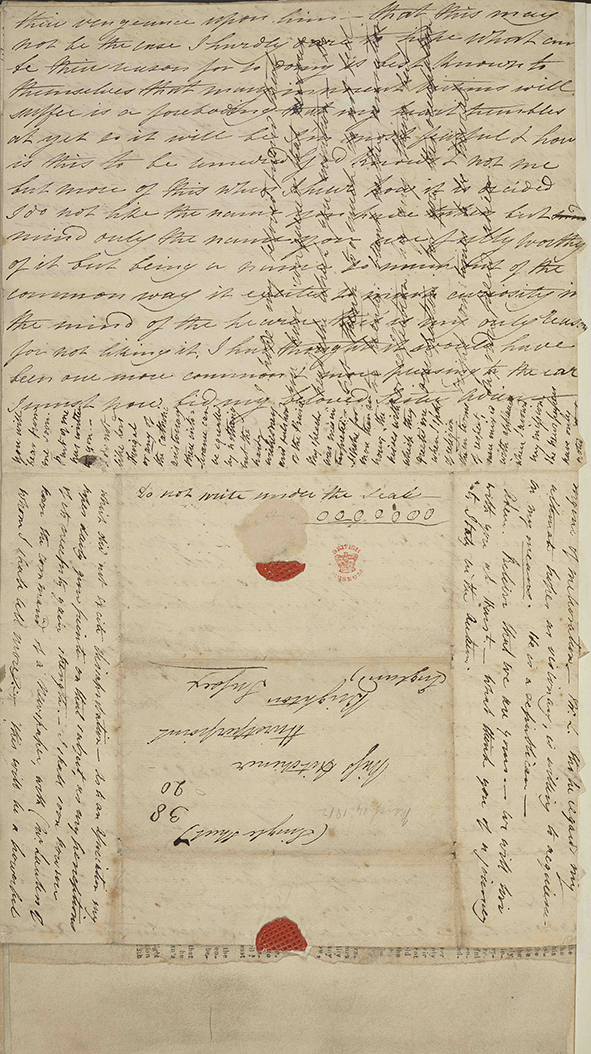
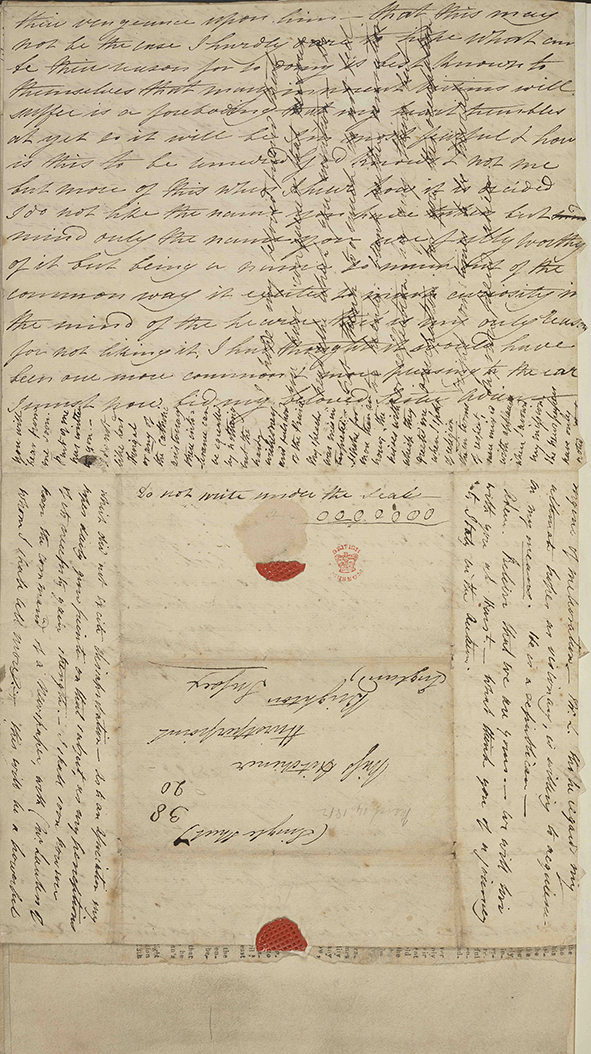
Hitchener’s appeal to ‘feeling’ as a mode of intuition aligns her with female Rational Dissenters such as Mary Hays, who sought to moderate the ‘sour, haughty, and contentious’ consequences of a ‘purely mental and contemplative’ faith by advocating the ‘affecting and elevated emotions’ involved in Christian belief.Footnote 184 In response to Shelley’s accusations of sentimentality, she conceded: ‘You reason almost too clearly for me on the subject of Deity; but the feeling has taken deep root, & I am sure you cannot be surpris’d when I say, if I reject on one side, I receive on the other’.Footnote 185 Hitchener’s letters treat Shelley’s devotion to ‘reason’ with reasonable scepticism. ‘You tell me since you have been a decided votary of reason you have never felt happiness, & you ask me to comment on it’, Hitchener wrote in the same letter, picking up on the austere pride with which Shelley had announced that ‘since I have devoted myself unreservedly to its [i.e. reason’s] influencing I have never felt Happiness’.Footnote 186 To this self-flagellation, Hitchener responds: ‘your own arguments furnish me with an answer, viz “that reason sanctions an aberration from reason, when that aberration is productive of higher morality”’. Hitchener exposes the contradiction in Shelley’s avowal of disinterestedness and turns his naïve sense of the ease of altruism back upon him with a cool wit: ‘must not […]the children of virtue seek to be happy themselves lest they give pain to those who in others happiness find their own?’Footnote 187 Shelley conceded the point: ‘“Reason sanctions an aberration from reason” – I admit it … ’Footnote 188 Boas argues that in ‘writing intimately to one he knew so little [Shelley] was, in a way, talking to himself’Footnote 189 (an impression reinforced by the claustrophobia of Shelley’s close-packed foolscap sheets (see Figure 3)). That did not stop Hitchener interjecting – and occasionally getting through. She argues with a dissenting spirit which, in Gina Luria Walker’s words, ‘integrates reason and feeling’.Footnote 190 Followed as a ‘discussion’, and not a monologue, the correspondence shows Hitchener as a mature and subtle antagonist.
Shelley to Hitchener, 14 March 1812. BL Add MSS 37496 f. 103v,
The Real Difference That Exists between Us
Hitchener emerged from the summer of 1811 as Shelley’s intellectual match. Through the autumn, she became his emotional support. When in October 1811, after a short gap in the correspondence, Shelley announced his marriage to Harriet, Hitchener yielded readily to his claim to have acted out of chivalry: ‘by doing as you have, you have defended her against an evil which she might not have known how to sustain alone’.Footnote 191 The comment intimates Hitchener’s own isolation. For those who speculate Hitchener held romantic designs on Shelley the marriage was ‘a blow to her pride, and possibly to her hopes’.Footnote 192 But Hitchener’s generosity also strengthened their attachment. Shelley and Hitchener met for the third time on Shelley’s visit to Pilfold’s between 18 and 22 October. As their letters over the winter make clear, the ‘lovely sympathy’ that drew the two together then grew deeper in separation.
Hitchener’s importance for Shelley increased in the aftermath of Hogg’s advances upon Harriet. She became Shelley’s sole confidant. Her letters extended a loyalty and compassion that proved her credentials as Shelley’s ‘dearest friend’. The news has ‘absorbed in horror every faculty I possess’, she wrote, ‘I seem’d almost depriv’d of breath & sight’.Footnote 193 Such outpourings are presumably what Shelley had in mind when he praised a ‘sincerity’ which ‘comes from the soul’ and ‘has the impassionateness of nature’.Footnote 194 Yet Hitchener’s letter is tonally nuanced and self-aware in a way that makes ‘sincerity’ seem a one-dimensional virtue. Hitchener writes with new confidence, sensing a shift in the dynamics of the friendship. Her condemnation of Hogg supplies an implicit criticism of Shelley’s optimism about human perfectibility. She had hoped that Hogg might prove a model of virtue, but she sees now that he ‘mistook the love of virtue for the practice of it, splitting on that self-deluding rock which thousands have before, esteeming themselves virtuous because they admire virtue’ (the implications reach to Shelley, too). It is her knowledge of the propensity of human beings to do wrong, Hitchener says, that drives her to have
clung to a religion which promises in the hour of temptation more than human strength, the crimes of my fellow-beings have induced me to seek communion with perhaps imaginary ones, yet oh the ecstatic idea of the society of “just men made perfect” & a Being more holy than the human-mind can conceive, affords the heart such real bliss, that my feeling knows not how to forego what my reason is not ready to adopt.Footnote 195
This is a fine illustration of the interplay between feeling and rationality complicating Hitchener’s faith. It is also a sympathetic correction of Shelley’s increasingly extreme adulation. Shelley overlooked it. His reply promised to treat Hitchener as his ‘best friend and sister’, although by this point affection had transformed into veneration: ‘I am convinced that the wildest bigot who ever carried fury & and fanaticism thro’ a country never could so firmly believe his Idol as I believe in you’.Footnote 196 So ‘sincere’ do Shelley’s letters appear at such moments that, as Olwen Ward Campbell observes, it becomes hard to separate ‘imbecilities’ from ‘deep feeling’.Footnote 197 Hitchener, expressing compassion and gratitude, not flattery, writes with more restraint: ‘when first I saw you […] little did I then foresee the gleam of sunshine^^xxxxxxxxxcheering path before me […] thus will new views open on your path’.Footnote 198 The revision, from ‘sunshine’ to ‘path’, meets ‘imbecilities’ with a grounded maturity. Those who criticise Hitchener for indulging Shelley’s fantasies should recognise her efforts to keep his ‘imbecilities’ in check.
The ‘sympathy’ Hitchener afforded Shelley in the autumn of 1811 cemented a bond impatient of conventions of social class and niceties of decorum. Through the months that followed, the letters played out a drama between Shelley’s pioneering if naïve efforts to encourage Hitchener into a household based on ‘the equality of friendship’Footnote 199 and Hitchener’s more grounded sense of social relations, consolidated, no doubt, through her experience of commercial schooling. In Shelley’s eyes, Hitchener was the ‘isolated and friendless’ inhabitant of a world in which ‘all the dreary intercourse of daily life is unmingled by consolation, save the infrequent post days’.Footnote 200 But Hitchener retained a qualified attachment to Hurstpierpoint. A blend of alienation and loyalty emerges in the letter to Harriet of 1 January 1812:
this Morn. my patience was tried more than common, by one of those poor creatures of our sex, who having no resources in themselves cannot exist one hour without the assistance of those unfortunate beings who live within their reach, this unlucky distance alas is mine, & I am at times pestered with these living dolls, I bear with them, with the remote hope of influencing them, & because I think people who live in the same neighbourhood should be sociable with allFootnote 201
The snobbery is redeemed by Hitchener’s realism and the closing vision of social usefulness. The letter ends by expressing a desire to ‘do away those distinctions which separate one human-being from another, there is no person so insignificant but has this influence to a certain degree, particularly in a village as small as the one I reside in’.Footnote 202 It is testimony to Hitchener’s ‘practical’ sense of responsibility to a community which Shelley encouraged her to leave.
The ‘distinctions which separate one human-being from another’ are a defining matter of the correspondence. Shelley’s ‘polemic’ advocated a vision of ‘Equality’ based on the inauspicious proposal that ‘were I a moral legislator I would propose to my followers that they should arrive at the perfection of morality’.Footnote 203 Hitchener moderated such fantasies. But ‘distinction’ was not just a topic of debate; it was a matter of the social boundaries which the correspondence itself transgressed. In her (now lost) reply to the above letter, Hitchener had insisted, to Shelley’s ‘disappointment’, upon ‘the real difference that exists between us’.Footnote 204 To the more ‘practical’ minded Hitchener, ‘Nature has decidedly distinguished degrees among a degenerate race’.Footnote 205 Concerned, with Harriet in mind, that by continuing to write she ‘risk’d disquieting^to another by indulging myself’,Footnote 206 she questioned whether it was proper for the exchange to continue. For Shelley there was no doubt. Although he conceded around the time of their second meeting (in August) ‘the impropriety of dining with you, even of calling upon you’, he refused to ‘give up the friendship & correspondence of one whom however superior to me my arrogance calls an equal’.Footnote 207
Even outside radical circles, platonic correspondences between men and women were not uncommon in the late eighteenth century. Charlotte Smith’s exchange with the Wicklow-based antiquarian Joseph Cooper Walker is an example local to Hitchener. Nor was it unusual for letters to cross boundaries of class. The correspondence between the rural Irish Quaker Mary Leadbetter and the Dublin author Melesina Trench bridged similar divisions.Footnote 208 ‘As to the “difference of personal circumstances” you allude to, it does not exist, for I am unencumbered by rank or precedence of any kind, and surely your friendship would throw a lustre on the highest’, Trench told Leadbetter, sounding not unlike Shelley.Footnote 209 Nonetheless, an exchange of letters between an aristocratic – and, for most of its duration, married – young man and an older, unmarried woman of a lower social class was unusual enough to raise consternation. Mary Favret observes that since ‘letters were imagined as fluid, spontaneous and unregulated’ they were feared to ‘encourage the writer to abandon all sense of propriety’.Footnote 210 Shelley cared little for such decorum: ‘Prejudice […] is an idol to whom we bow not’.Footnote 211 The attitude slighted the circumstances faced by Hitchener, for whom the reputational risks were greater, and whose material and financial security were hard won. She possessed a surer sense of the world in which ideals must play out.
Hitchener handled gracefully the attempts upon her independence made by Shelley’s domineering ‘we’. In October 1811, Shelley suggested that Hitchener share his inheritance. Hitchener answered with anchoring realism: ‘you deceive yourself, see me more such as I really am, could you see the time I trifle you would alter your opinion’.Footnote 212 Shelley stuck to his idealistic guns: ‘it is no generosity – it is justice, bare simple justice’ – and turned Hitchener’s injunction upon her: ‘I know you to be superior to that mock modesty of self-depre{ci}ation; this therefore has no weight. – See yourself then as you are – ’.Footnote 213 (There is an artless revelation of Shelley’s failure to see Hitchener as she ‘really was’ when he writes: ‘I could not believe you other than the being I have considered as enshrined in the identity of Elisabeth [sic.] Hitchener’.)Footnote 214 The financial offer was part of a campaign to persuade Hitchener to ‘give up school’Footnote 215 and join his household. Shelley pressed the invitation with wearying persistence: sometimes with sunlit idealism – ‘Dearest friend come to us all, – at midsummer never to part again – Lose in our little circle the tenets of the unthinking’Footnote 216 – at other times with plaintive hopefulness: ‘Perhaps the Capt[ain] will come, and my aunt in [and] the little things, perhaps you will bring the dear little Americans, and my mother Mrs. Adams; Perhaps Godwin will come’ (Shelley had struck up a correspondence with the philosopher and was already pestering him with invitations, too).Footnote 217 Hitchener resisted. As Woolf observed, ‘the prophetess kept one shrewd and sensible and, it must be added, honourable eye upon the earth’.Footnote 218 Hitchener’s self-possession was often met by Shelley with a petulant failure to appreciate the sacrifices he was demanding. He offered an apology of sorts for suggesting that Hitchener abandon teaching, satisfying himself that ‘the warmth of our [sic.] hearts ran away with the coolness of our heads’,Footnote 219 but two weeks later he was at it again: ‘resign your School, and live with us forever’.Footnote 220
Hitchener stood firm, but her letters reveal a longing for the consolations of home and family. The language of sisterhood that flowered in November 1811 as Hitchener welcomed news of Shelley’s marriage was scored with loneliness. ‘[A]re you not the Brother of my soul’, Hitchener ventured.Footnote 221 ‘[Y]ou are the sister of my soul’, Shelley answered, ‘its dearest sister, & I think the component parts of that soul must undergo complete dissolution before its sympathies can perish’.Footnote 222 Framing their relationship as one of sibling affection, Hitchener provided a bulwark against suspicions that her interests were romantic. Shelley’s attempts to assuage these suspicions were less sure-footed. In one letter he encouraged Hitchener to think of herself as Harriet’s teacher, or even mother: ‘If Harriet be not at sixteen all that you are at a more advanced age, assist me to mould a really noble soul into all that can make it[s] nobleness useful and lovely’.Footnote 223 The dynamic would have unnerved Harriet, whose education at Mrs Fenning’s Boarding School in Clapham – arranged by her aspirational father, who owned a coffee house on Grosvenor Square – had placed her in a more urban and elevated social strata than her proposed mentor. Hitchener refused to condescend anyway, or to play her professional role in private life. ‘I anticipate a Sister’s affection for her, I long to see, to know, & to love her’,Footnote 224 she answered. As Campbell remarks, ‘It is comforting’ amid the ‘unmitigated absurdity’ of Shelley’s worship of Hitchener, ‘to know that [Harriet] frequently added postscripts to her husband’s letters to his deity’.Footnote 225 When the two women started corresponding in January 1812 Harriet embraced Hitchener into a sisterhood that encompassed Eliza, too: ‘do not call her Miss Westbrook, she is your Sister and mine’.Footnote 226 Meanwhile, Shelley wavered between fumbling declarations of a ‘love’ unclouded by any relation to ‘the lump of organised matter which enshrines thy soul’, and proper recognitions of Hitchener’s intellectual mentorship: ‘not a thought shall arise which shall not seek its responsion in your bosom, not a motive of action shall be uncanvassed by your cooler reason – ’.Footnote 227 ‘I ought to count myself a favoured mortal with such a wife and friend (these human names and distinctions perhaps are necessary in the present state of society)’, Shelley later wrote,Footnote 228 urging that ‘in the great pursuit in which we are engaged’, he and Hitchener consider themselves ‘as little as possible in the light of individuals who have separate interest to gratify and separate ends to answer’.Footnote 229 That is a pioneering, if presumptuous, aspiration. Set against it, Hitchener’s ambition, expressed in her new year letter to Harriet, ‘to soften piques & asperities, & unite as much as possible all around you, to belong to no particular party, to blend all together’,Footnote 230 approaches social ‘distinctions’ with a more sympathetic and ‘practical’ understanding of the ‘individuals’ they held apart.
A Picture of Heaven
The sense that he and Hitchener were engaged on ‘a great pursuit’ had animated Shelley’s letters ever since the split with Hogg. Hitchener’s presence, he insisted in April 1812, was ‘all that is wanting to render’ existence ‘a perfect Heaven’.Footnote 231 ‘What exactly she was to do’ when she joined him, Campbell observes dryly, ‘was left undefined; she was to help Shelley bring nearer the Millenium’.Footnote 232 Announcing his conception of the poem that was to become Queen Mab in December 1811, Shelley had invoked Hitchener’s help in creating ‘a picture of the manners, simplicity, and delights of a perfect state of society’, and after that, ‘a picture of Heaven’.Footnote 233 Hitchener enjoyed puncturing Shelley’s designs for moral and social ‘perfection’ as ‘impossible’ and ‘unattainable’.Footnote 234 But in the early months of 1812 Shelley committed wholeheartedly to his ideals. At the start of February, Shelley, Harriet, and Eliza sailed to Dublin. They went to further the cause of Catholic emancipation, whose success, Shelley claimed in the Address to the Irish People he prepared for distribution in Dublin, would inspire ‘the peace, the harmony, and the happiness of Ireland, England, Europe, the World’.Footnote 235 Before the crossing, Shelley told Hitchener, ‘I fancy I hear you breathing to fill the sails of our packet and be like ministrant angels to us’.Footnote 236 Whatever Shelley fancied he had heard, the occasional gesture of reassurance in his replies (‘Do not fear what you say in your letters’)Footnote 237 suggests that Hitchener, whose drafts from this period do not survive, shared anxieties expressed by Godwin, who had warned ‘Shelley, you are preparing a scene of blood!’Footnote 238 Hitchener was right to be wary. Towards the end of his time in Ireland, Shelley posted her a box containing copies of his recent pamphlets: the demotic Address, the more theoretical Proposals for an Association of Philanthropists, and the Declaration of Rights, a sheet of radical principles which Harriet urged Hitchener to ‘Dispense’ in rural Sussex: ‘Percy says the farmers are very fond of having something posted on their walls’.Footnote 239 (Shelley noted optimistically that ‘it was by a similar expedient that Franklin propagated his commercial opinions among the Americans’.)Footnote 240 Shelley paid postage only as far as Holyhead, assuming aristocratically that Hitchener would cover the rest. The package was opened by the customs officers, who reported the discovery of ‘a Large deal box, directed to a “Miss Hitchener, Hurst per pier, Brighton, Sussex, England”’ which ‘contained, besides a great quantity of Pamphlets and printed papers, an open letter, of a tendency […] dangerous to Government’. The matter reached the Postmaster General, the Earl of Chichester, whose response identified a ‘Miss Hichener, of Hurstperpoint, [who] keeps a school there, and is well spoken of; her Father keeps a Publick House in the neighbourhood, he was originally a smugler, and changed his name from Yorke to Tichener, before he took the public House’. He promised to ‘have a watch upon the Daughter, and discover whether there is any connexion between her and Shelley’.Footnote 241
In the 1790s, laws had been passed permitting government intervention in personal correspondence. Private conversations ‘are to be pried into with such inquisitional jealousy, as to make it dangerous for [people] to commit their thoughts to paper’, Charles James Fox had warned.Footnote 242 Hitchener fell victim to these inspections. Soon after Shelley’s return to Wales, Hitchener informed him that salacious ‘reports’ were circulating in Cuckfield. Shelley was incredulous (‘I unfaithful to my Harriet! You a female Hogg!’) and judged them the invention of Captain Pilfold’s wife (‘she wants you in the country to educate her child’).Footnote 243 A few months earlier, Shelley had reassured Hitchener that Harriet was ‘above the littleness of jealousy of which you at first suspected her’.Footnote 244 But the rumours, if they reached Harriet, might have sown the seeds of insecurity that eventually caused her to turn on Hitchener. They certainly caused both Pilfold and Hitchener’s father to voice doubts about the scheme of cohabitation. Shelley’s first reaction was to suggest that Thomas Hitchener accompany his daughter to Wales and work their land: ‘He understands a farm, and its management would be an amusement to him’.Footnote 245 The class-based superiority that surfaces here carried over into two supercilious letters of protest. The first attempted to discredit the accusations in a polite, if pompous manner, perhaps playing on the former smuggler’s desire to uphold respectability (‘Sir, my moral character is unimpeached, & unimpeachable’).Footnote 246 The second scaled heights of self-righteousness: ‘I had some difficulty in stifling an indignant surprise on reading the sentence of your letter in which you refuse my invitation to your daughter. How are you entitled to do this? who made you her governor?’ For all he disavowed ‘distinctions’ when it suited him, Shelley retained a vein of entitlement which, without irony, he exerted here in a supposedly radical cause. ‘[W]hen I next hear from you’, he added, ‘I hope that time will have liberalized your sentiments’.Footnote 247 There is no record of any reply.
With a blithe lack of self-awareness, Shelley wondered whether Hitchener might ‘not be mistaken in attributing excellencies to your father which he does not posess? Both he & the Captain seem at least to share some of their qualities with the mule’.Footnote 248 Hitchener, characteristically, was more measured: ‘when I tell you how shamefully you have been represented to him you will pardon his opposition’.Footnote 249 At the same time, she extended affection towards Harriet, whom Shelley claimed to have suffered ‘a bilious attack which so overpowered her with languor that she could not hold a pen’.Footnote 250 ‘No one can read’ Hitchener’s letter of concern ‘without feeling that she was insincere, hypocritical, and, in a limited way, cunning’, writes Walter E. Peck, pressing his case that Hitchener was after Shelley’s money.Footnote 251 The letter is awash with sentimentality; but exclamations such as ‘live oh live dearest Sister of my mind & soul live for thy Husband, thy Sister, thy Friend, not one dearest Harriet can spare thee’Footnote 252 are a sympathetic extension of an idiom which Hitchener, on the whole, resisted. We might also detect a measure of desperation, driven by a determination not to be proven wrong. ‘I do know you, & far better than those who say I know you not’, Hitchener insisted:Footnote 253 her emphases suggest she knew she was protesting too much. By its culmination, the correspondence had transformed from an intellectual conversation into visionary courtship. Shelley’s final letter before their reunion rises to a crescendo in celebration of the ‘glorious cause’, in which the two heroes conspire against the bigotry of the world:
Affairs have now arrived at a crisis […] How little ought the commonplace cant of prejudice to affect you! – How little ought your mighty soul to be shaken by the whisper of a worldling! Let us shew that truth can conquer fals[e]hood’Footnote 254
In reality, Shelley had allowed ‘falsehood’ to vanquish truth. His idealisation of Hitchener – as ‘soul-sister’ and ‘ministering’ angel – obscured the humane and ‘practical’ sensibility which ‘whispers’ through her letters.
3 Demon
Hitchener finally yielded and agreed to join Percy’s ‘little circle’ after the Shelleys returned from Ireland in April 1812.Footnote 255 Despite the vigorousness of Shelley’s campaign to lure her away from Hurstpierpoint, and her own wariness about the prospect of abandoning her life and school, biographers have been quick to criticise Hitchener’s decision: the invitation was ‘rashly accepted’; she ‘made a fatal mistake’.Footnote 256 On her way to Lynmouth, Devon, where Shelley, Harriet, and Eliza were residing in July 1812, Hitchener stopped overnight in London with Godwin and his family for a visit arranged by Shelley. Godwin’s dairy entry for 14 July 1812 reads: ‘miss Hitchener sups and sleeps’.Footnote 257 Given that Godwin and his wife had set up the Juvenile Library in 1805,Footnote 258 educational literature was a likely topic of conversation, and Hitchener may have disclosed that she had recently read Political Justice (1793) on Shelley’s recommendation.Footnote 259 It is the final occasion upon which we find Hitchener in canonical literary history in isolation from the Shelleys. This section traces the oft-misrepresented events that culminated in Shelley’s angelic soul sister being cast out as the ‘Brown Demon’. First, we show that Hitchener’s cohabitation with the Shelleys was a less disastrous and more productive affair than biographers have suggested, and we recover Hitchener’s writing about North Wales inspired by her travels with the group. Second, we scrutinise the biographical and scholarly practices that have preserved the demonic image of Hitchener for more than two hundred years.
Distortion of Fact and the Practical Sublime
Hitchener’s arrival in Lynmouth has been related in a way which suggests she fell from heaven the instant she walked through the door: ‘Arriving in Lynmouth, Hitchener’s troubles began … ’; ‘The enchantment, alas! was of short duration!’; ‘What a fall from the ideal reformer of the world!’; ‘It was, as might have been predicted, a disaster’.Footnote 260 The tone implies that Hitchener was foolish for thinking she could live up to her status, orchestrated by Shelley, as ‘the Roman Portia of the correspondence’.Footnote 261 But the pair had met repeatedly in Cuckfield already, and the evidence indicates that Hitchener was a welcome arrival. Harriet’s letters enthuse over the intelligence, political inquisitiveness, eloquence, and humorousness that Hitchener’s letters had promised: ‘I knew our friend, whom we call Bessy,’ reflected Harriet, ‘just as well when we corresponded as I do now’.Footnote 262 On 4 August, around two weeks on from Hitchener’s arrival, Harriet wrote brightly to her friend Catherine Nugent:
Our friend, Miss Hitchener, is come to us. She is very busy writing for the good of mankind. […] She talks a great deal. If you like great talkers she will suit you. […] Miss Hitchener has read your letter and loves you in good earnest. Her own expression. I know you would love her did you know her. […] She laughs and talks and writes all day.Footnote 263
Harriet also provided a sketch of Hitchener’s appearance: ‘She is very dark in complexion, with a great quantity of long black hair […] She is taller than me or my sister, and as thin as it is possible to be. I hope you will see her some day. […] her age is 30. She looks like as if she was only 24 and her spirits are excellent’.Footnote 264 (As we will see, most Shelley biographers have chosen not to preserve this youthful image.) A week later, on 11 August, Harriet’s enthusiasm for ‘Bessy’ remained undiminished – which contradicts her later embittered claim that ‘no sooner’ had they invited Hitchener ‘to come and live with us’ ‘than we found out our mistake’.Footnote 265 Harriet delighted in informing Nugent, herself a Dubliner who had been active in the Irish rebellion of 1798,Footnote 266 of Hitchener’s reading in Irish history and her commitment to the republican cause:
Your friend & our friend Bessy has been reading (Pieces of Irish History) and is so much enraged with the characters there mentioned, that nothing will satisfy her desire of revenge but the printing & publishing of them, to exhibit to the world those characters which are (shameful to say) held up as beings possessing every amiable quality, whilst their hearts are as bad as it is possible to be.Footnote 267
Shelley was so inspired by Hitchener’s ‘desire of revenge’ that he sought (unsuccessfully)Footnote 268 to persuade the bookseller Thomas Hookham to republish William James MacNeven’s Pieces of Irish History (1807), which rallies against the ‘virulence of invective’, ‘violation of truth’, and ‘distortion of fact’ that ‘marked the conduct of the English faction towards the United Irishmen’.Footnote 269 It is common for biographers to refer to Hitchener as Shelley’s ‘eager pupil’ who ‘hung on his words with philosophic acquiescence’;Footnote 270 but Hitchener was the celebrated teacher, and she was exerting her own influence on Shelley’s radicalism in Lynmouth. On 29 July, Shelley wrote to Hookham requesting a copy of ‘“Rights of Woman” by Mary Wollstonecraft’, no doubt on the back of conversations Hitchener had initiated regarding the values, mechanisms, and possibilities of female progress.Footnote 271
Hitchener also agreed again to assist Shelley in his efforts to circulate the Declaration of Rights and The Devil’s Walk. Shelley had devised some fanciful mechanisms for their distribution: fire balloons, floating bottles, and ‘miniature boat[s]’, all of which were sent into, or above, the Bristol Channel.Footnote 272 Before Hitchener met Shelley her activism had consisted of sharing liberal ideas about politics and religion with her Hurstpierpoint pupils. The part she played in launching Shelley’s ‘Vessels of Heavenly medicine’Footnote 273 into sea and air took her own ‘practical political virtue’Footnote 274 in a new, more conspicuous and dangerous, albeit farcical, direction. When the Home Secretary, Lord Sidmouth, got wind of Shelley’s activities in Lynmouth, he sent the town clerk of Barnstaple, Henry Drake, on a mission to watch ‘Mr. Shelley’s proceedings’.Footnote 275 Drake arrived only once the Shelleys had departed, but reported that ‘Mr. Shelley has been often observed on the beach in company with a female servant (supposed a foreigner), and […] frequently, in her presence only, has been observed to push out to sea, from the rocks, some small boxes’.Footnote 276 Whether the appetite of the fishermen of Devon for this radical material was any greater than that of the farmers of Sussex is questionable. But it was fortunate for Hitchener that Drake did not determine that she was the ‘female servant’ in question, given the government already had ‘a watch upon’ her after the interception of the ‘Inflammatory’ Irish materials.Footnote 277 On 19 August, the Shelleys’ Irish servant Daniel Healey was arrested in Barnstable, having been caught dispensing a broadside around the town that was deemed ‘seditious in its tone and contents’:Footnote 278 Shelley’s Declaration began with the line ‘Government has no Rights’.Footnote 279 The news must have come as a disconcerting reality-check for Hitchener, who knew she could be found guilty of similar charges. Since Shelley, who was fending off debtors, could not afford to pay the fine of £200, Healey was sentenced to six months in prison,Footnote 280 causing Shelley to predict (accurately, as Drake’s visit proves) that the authorities would soon be on his trail. The group left Lynmouth in a hurry on 28 August.Footnote 281 They passed through Ilfracombe and Swansea, ‘travelled east, deeper and deeper into Wales’,Footnote 282 before settling further north in Tremadoc, a new village erected on land claimed back from the estuary of Afon Glaslyn. The Whig MP William Alexander Madocks was the mastermind behind an embankment that would eventually enclose thousands of acres of land (see Figure 4). The Traeth Mawr was celebrated as a wonder of Wales. While Hitchener and the Shelleys were staying at the Madocks Arms in the new market square, Shelley negotiated an extended rent-free stay at Madocks’s own villa, Tan-yr-allt, which stood on a hill nestled beneath the wide rising crag that loomed over the village.Footnote 283
Matthew Dubourg, ‘The Embankment. Traeth Mawer, Tre-Madoc, north Wales’ (1811),
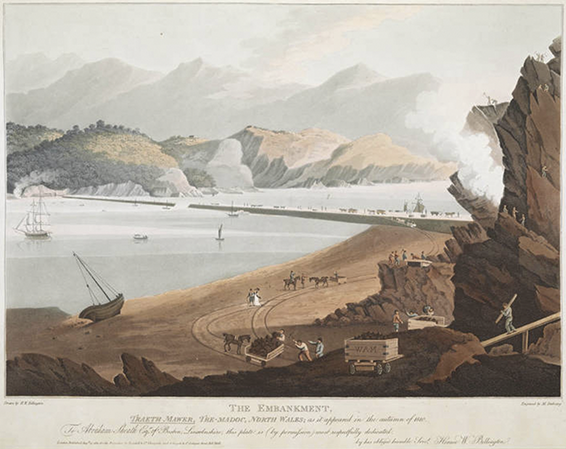
Even though the group remained in Wales for nearly three weeks, Hitchener’s presence in Tremadoc has been recorded at best in actual or implicit parentheses, with the effect of making her seem half absent: ‘Shelley and his considerable household (Elizabeth Hitchener stayed with them) moved back to Wales’.Footnote 284 Biographers have neglected the fact that Hitchener later attached to The Weald of Sussex a long note about Tremadoc, which begins by describing the route into the town via the Aber-Glasllyn gorge, ‘some of the most striking scenery in Wales’:
No appearance of vegetable or animal life is to be seen, save here and there a solitary goat, hanging on the rocky sides of the mountains. – The entrance to this extraordinary pass, is by a narrow road, on the edge of the river, from which it is separated, by a low narrow wall, of loose stones: this entrance soon becomes imperceptible to the eye, the road continuing on the side of Glasllyn, its circuitous windings render invisible the opposite opening, and the traveller appears suddenly immured in this astonishing chasm.Footnote 285
In the interplay of singularity and vastness (‘a solitary goat’, ‘this extraordinary pass’), in the way the prose draws the mind’s ‘eye’ to the limits of vision, in its clipped clauses that trace the gorge’s ‘circuitous windings’, and in its description of the lone ‘traveller’ engulfed by the ‘astonishing’ Burkean character of the Welsh sublime, we can see Hitchener in a new light – as an occasional but accomplished Romantic travel writer. It is a measure of the quality of the description that it inspired G. N. Wright’s account of the Aberglaslyn gorge (‘Here the traveller finds himself immured within a chasm of rifted rocks’) in Scenes in North Wales (1833).Footnote 286 The passage places Hitchener, too, within a tradition of late eighteenth- and early nineteenth-century women writers – such as Hester Lynch Thrale Piozzi (whose unpublished ‘Journal of a Tour in Wales’ dates to 1774), Mary Morgan (A Tour to Milford Haven, 1791), Mary Robinson (Memoirs, 1801), and Elizabeth Isabella Spence (Summer Excursions, 1809) – whose work bears witness to the landscapes and settlements of Wales.Footnote 287 Thrale’s account of looking up to Snowdon from Llyn Padarn foreshadows Hitchener’s response to the rocky scenery of North Wales:
[W]e saw Snowdon tower over the neighbouring hills with all the dignity of barren magnitude. […] we were entertained during our little voyage with blasts from the Copper Mills upon the mountain that made an echo of many reverberations. Goats frisking on the hills and a cataract playing at a small distance so finished the scene, that nothing, I think, could be wished for.Footnote 288
What we find in Hitchener’s and Thrale’s writing is not the ‘domesticated’ vision that, as Mellor argues, displaces the ‘epistemological’ foundation of the Romantic masculine sublime.Footnote 289 Rather, it is what we might call a ‘practical sublime’ that is also present in women’s writing of the period, in which an appreciation for what Thrale calls the ‘triumphs of Art’ – products of human ‘ingenuity’ of which the copper mills are a symbol – exists alongside an awed responsiveness to the wonders ‘of nature’.Footnote 290 As Harriet Guest has observed, in her Letters Written During a Short Residence (1796) Wollstonecraft ‘counterbalanced her appreciation of sublime wilderness with a more practical admiration for well-cultivated fields and was confident that towns were essential to the modern way of life’ – ‘I trace the progress of the world’s improvement’, Wollstonecraft writes in Letter XIX.Footnote 291 Hitchener’s travel writing shares Thrale’s and Wollstonecraft’s practical concern for what she calls in The Weald ‘Culture’s progressive power’, and she deploys the same terms as Thrale when celebrating Tremadoc as a town formed at the confluence of ‘Nature’ and ‘Art’:Footnote 292
The road which leads through such wonderful scenes of Nature, conducts to what is equally astonishing in Art; the embankment from the sea of six thousand acres of land, formerly an entire bed of sand, denominated the Traeth Mawr; but now presenting to the eye, land in a high state of cultivation, on a part of which stands the interesting little town of Tre-madoc. – This embankment also opens an advantageous communication, between Merioneth and Caernarvonshire: for this great and beneficent undertaking, the nation is indebted to William Alexander Madox, Esq. Tre-Madoc is seven miles west of Bedd-gelert.Footnote 293
The embankment served for Hitchener as an emblem of her own Godwinian vision of human perfectibility, advancement, and ingenuity. Madocks saved ‘many valuable lives’ by removing ‘the dangerous passage across the sands’ described by Richard Colt Hoare in 1810.Footnote 294 He generated new communities, de-monopolised property ownership, dissolved social boundaries, and enabled ‘advantageous communication’ between people, counties, and nations (since one of his aims was to create a new route between Wales and Ireland). In addition to her prose note, Hitchener offers a sixty-four-line blank-verse poem which attests to her aptitude for writing tragic verse that soothes itself with a final vision of hope. The poem paints an apocalyptic scene on the ‘treacherous sands’ of the Traeth-Mawr:
‘With a pitying eye’ Snowdon howls a ‘melancholy dirge’.Footnote 296 Nobody had discovered the means to prevent these tragedies, Hitchener goes on to lament, until Madocks,
The internal rhyming of ‘woe’ with ‘glowing’ enacts in miniature a quasi-divine intervention. Madocks’s project replenishes ‘the watery waste’ of the Traeth-Mawr with ‘Flowers, fruits, and herbage’ while turning the ‘dwellings of Mankind’ into a republican ‘second Eden’, ‘Where Man in social sympathy unites’.Footnote 298 Nothing of this makes Tremadoc sound like a place Hitchener visited fleetingly and unthinkingly, or where she spent a miserable few weeks in limbo while the Shelleys gave her the cold shoulder. On the contrary, she expresses an enduring admiration for a place that epitomises what is possible when the ‘Art’ of human ingenuity and the ‘voice’ of human sympathy unite with nature’s beauty. Recovering Hitchener’s writing enables us to find her in Wales for the first time.
(E. H. congé)
It was late September 1812 when Hitchener and the Shelleys left Tremadoc for London. ‘Shelley had many reasons for wishing to go to London’, claims Jones, ‘his desire to see Godwin and Hookham and to get rid of Miss Hitchener were […] powerful motives’.Footnote 299 But Shelley did not ‘rid’ himself of her quickly. Hitchener and the Shelleys occupied rooms at Lewis’s Hotel on St James’s Street for over a month.Footnote 300 On an unknown date in October, Harriet wrote to Catherne Nugent expressing her ‘pleasure’ at ‘seeing’ Godwin ‘daily’, before adding: ‘Percy, Bessey, and Eliza desire to be remembered most affectionately to you’ – which is a convincing show of togetherness.Footnote 301 Some of Hitchener’s and the Shelleys’ activities can be tracked via Godwin’s diary. On 4 October: ‘Shelleys arrive: Shelleys, E Hitchener & Hammond [a wealthy supporter of Godwin’s] dine’; 5 October: ‘Call on […] E Hitchener’; 11 October: ‘E Hitchener & E Westbrook dine’;14 October: ‘Shelleys & E Hitchener dine’; 23 October: ‘2 Shelleys dine; adv. E Hitchener’; 5 November: ‘2 Shelleys & E Hitchener dine’.Footnote 302 Two conclusions can be deduced from these entries: first, that Hitchener and the Shelleys remained on at least civil terms until early November; and second, that Godwin, who called on Hitchener independently and distinguished her from the ‘Shelleys’, likely considered her an autonomous woman with whom he felt intellectually compatible – not a third wheel who was ‘still hanging on’.Footnote 303 At some point in the lead up to 8 November, the relationship between Hitchener and the Shelleys deteriorated irreversibly. Hitchener had spent almost four months in the company of Shelley, Harriet, and Eliza, and Godwin confirmed her immanent expulsion by entering in his diary ‘Call on E Westbrook (E. H. congé)’.Footnote 304
How did Hitchener’s ostracism inspire the demonic characterisations from which her reputation has never recovered? Unluckily for Hitchener, Hogg, towards whom Shelley’s animosity had softened since the events of the previous autumn, arrived at Lewis’s Hotel on the day of her departure, giving him licence to write an account that sealed Hitchener’s biographical fate. In a highly stylised set piece that could pass for a scene in a comedy of manners, Hogg depicts Eliza and Hitchener squabbling in St James’s Park:
[T]he fair rivals, the dark rivals, quarrelled with one another across me, to whom, however, they were both exceedingly civil, – deferential, I may say. The lovely Eliza attacked the foe with haughty contempt; [Hitchener] defended herself and offended her enemy with meek contumacy […] For some time, there was a hit for hit delivered on both sides with calm, soft acrimony …Footnote 305
According to Hogg, Eliza then chastised him for talking to Hitchener at all: ‘How could you talk to that nasty creature so much? […] Why did you encourage her? Harriet will be seriously displeased with you’.Footnote 306 Hogg mocked the way that Hitchener was initially ‘hailed’ by Shelley ‘with a kind of angelic salutation’.Footnote 307 But now, perhaps anachronistically (since it would be weeks later when Shelley would first deploy the term ‘Brown Demon’ in a letter), or because the nickname had already taken root in the Shelley group, Hogg recasts Hitchener as the rebellious Devil in a mock-epic war in Heaven:
The indignation of good Harriet, if it really was excited, must have been too big for utterance: I never heard of it. She merely asked, ‘Were you not tired of the Brown Demon?’
Most infernally! might have been an appropriate answer; and to say the truth, which I did not dare to say, I was equally weary of Angel and Devil.Footnote 308
Later that day there was a last supper, after which Hogg ventured to ask Hitchener again about ‘the Rights of Women’, whereupon the ‘Goddess of Reason’ lectured to the group ‘with fluency and animation’.Footnote 309 Shelley, rising from his seat while ‘looking enthusiastic’, was glared down by Harriet and Eliza with ‘manifest displeasure, as a person holding treasonable communications with a public enemy’.Footnote 310 Then Hitchener departed: ‘At the appointed hour a coach was called, and the Defender of the Faith and of her sex took her leave’ – ‘the whole party believed that they were very happy’.Footnote 311 Hogg, for all the relish with which he documents the break-up, claims not to have participated ‘in their joy’ since Hitchener seemed to him ‘a fair average specimen of a schoolmistress’.Footnote 312 This is doubtless a hammed-up version of what really happened. But it is interesting that, on Hogg’s account, it was Eliza and Harriet more than Shelley who chased Hitchener out.
A damaging consequence for Hitchener of having her life written through somebody else’s is that her biographical identity is largely formed and put on trial in absentia. It is difficult to find the reality of someone who is no longer present in the life of the primary biographical subject. Once banished from Shelley’s circle around 11 November 1812, Hitchener is ushered offstage. But the Shelleys kept on talking about her, and their unsavoury comments took on an enduring life of their own, which has become the accepted biography of Elizabeth Hitchener. A letter from Harriet to Catherine Nugent of 14 November 1812 strips Hitchener of the virtues she possessed as Shelley’s soul sister. Harriet accuses Hitchener, amongst other things, of faking her republican values, a line that Virginia Woolf later amplified when declaring that Hitchener ‘was not, as Shelley was eager to assure her, a Deist and a Republican’Footnote 313 – and yet we know that Hannah Adams instilled those values in Hitchener years before she first encountered Shelley. Harriet’s letter is our first official introduction to the despised Hitchener:
The lady I have so often mentioned to you, of the name of Hitchener, has to our very great happiness left us. We were entirely deceived in her character as to her republicanism, and in short everything else which she pretended to be. […] She built all her hopes on being able to separate me from my dearly beloved Percy, and had the artfulness to say that Percy was really in love with her, and [it] was only his being married that could keep her within bounds now. Percy had seen her twice before the marriage. He thought her sensible but nothing more. She wrote continually, and at last I wrote to her, and was very much charmed with her letters. We thought it a thousand pities that such a mind as hers appeared to be should be left in a place like that she inhabited. […] It was a long time ere we could possibly get her away, till at last Percy said he would give her £100 per annum. And now, thank God, she has left us never more to return.Footnote 314
A handful of biographers have brought Harriet’s account under scrutiny. Hogg conjectures that Eliza slyly ‘worked upon’ Harriet’s lurking insecurities to turn her against her husband’s ‘former favourite’; and Cameron picks up Hogg’s hint when suggesting that Eliza fabricated the story about Hitchener’s desire to wrench Shelley away from Harriet.Footnote 315 Dowden only tentatively sides against Hitchener: ‘Probably Miss Hitchener, through indiscreet speeches, had a share in bringing her fate upon herself’.Footnote 316 Others have added fuel to Harriet’s fire by speculating that Hitchener was a woman of devilish sexuality who (says Todd) ‘proved insufficiently “intellectual” for [Shelley’s] taste, too much infatuated with himself, perhaps too sexually demanding’,Footnote 317 and that she ‘likely’ made Shelley a ‘frank physical offer’, as Holmes puts it.Footnote 318 If such a scenario did occur, why must Hitchener have been the instigator? Shelley, after all, had poured out admiration for her in his letters. He was happy to spend time alone with Hitchener on Lynmouth’s sands, and it was he who spoke of marriage as ‘an evil of immense and extensive magnitude’.Footnote 319
For Peck, Hitchener’s interest in Shelley was always about the money: ‘If I were asked to state what I believe chiefly drew Elizabeth Hitchener to Shelley, I should answer without hesitation: his prospects. […] she leaves the Shelleys […] only after a pension of £100 per annum has been guaranteed to her. Shelley was gullible, and the scheming schoolmistress knew it’.Footnote 320 But the negotiation of a pension offers little evidence of a long-standing masterplan to exploit Shelley financially. Hitchener made a point of turning down a portion of Shelley’s pending inheritance and paid a heavy price for signing up to his utopian schemes: she had forsaken ‘all everything’Footnote 321 – her school, income, and reputation, a life free from surveillance and the fear of arrest – with no prospect of family wealth bailing her out. Her anxiety would have been sharpened by the knowledge that her elder brother William Henry Hitchener had been declared bankrupt in 1805 and then again in 1810. (His occupation was recorded as ‘Warehouseman, Dealer and Chapman’ and then as ‘Linen-Draper’.)Footnote 322 In his own reflection on the matter, Shelley offers a hodgepodge of spitefulness, embarrassment, intransigence, guilt, sympathy, and wrath:
I pay it with a heavy heart and an unwilling hand; but it must be so. She was deprived by our misjudging haste of a situation, where she was going on smoothly: and now she says, that her reputation is gone, her health ruined, her peace of mind destroyed by my barbarity; a complete victim to all the woes mental and bodily that heroine ever suffered! This is not all fact …Footnote 323
Shelley went on to admit that ‘certainly she is embarrassed and poor, and we, being in some degree the cause, we ought to obviate it’Footnote 324 – though there is no proof that the annuity was ever paid. Some evidence exists that in March 1813 Hitchener wrote to John Williams, a mutual acquaintance of hers and Shelley’s, threatening to bring Shelley’s mistreatment of her to light. Williams tipped Shelley off, who responded indignantly: ‘she is a woman of desperate views & dreadful passion but of cool & undeviating revenge […] I laughed heartily at her day of retribution’.Footnote 325 Citing this evidence alone, Denis Florence MacCarthy, one of Shelley’s Victorian biographers, concocted a theory related to Shelley’s much-discussed claim that two assassination attempts were made on him during a stormy night at Tan-yr-allt on 26 February 1813,Footnote 326 over three months on from Hitchener’s departure. Shelley suspected the local quarry owner, Robert Leeson, who he had offended.Footnote 327 MacCarthy proposes that it was either Hitchener or her father, seeking the first unpaid instalment of the stipend, that employed the ‘agent’ who fired shots at Shelley.Footnote 328 It is true that Thomas Wise reported hearing from Claire Clairmont, the stepsister of Shelley’s second wife Mary, that Shelley supposedly believed Hitchener had ‘endeavoured to poison Harriet’.Footnote 329 But the possibility that Hitchener tried to murder him, too, appears never to have crossed Shelley’s mind, and the assassination attempt might well have happened partially or entirely in his own head. These speculations, whether originating with Shelley or his biographers, epitomise the culture of blame that has formed around Hitchener as the public enemy of Shelley scholarship. We keep finding her lost in a haze of extravagant guesswork.
The Brown Demon
Whatever happened between Hitchener and Shelley, by the end of 1812 ‘she was no longer his angel’, as Daniel J. MacDonald observes.Footnote 330 Shelley’s bitter mock-romantic mode (‘all the woes […] that heroine ever suffered!’) and Harriet’s wealthy-saviour trope (‘We thought it a thousand pities that such a mind as hers appeared to be should be left in a place like that …’) are signs that the smear campaign was underway. The campaign sank so low as to befoul Hitchener’s politics, her class, and her hygiene and appearance – with lasting consequences for her reputation, career, and legacy. In a letter of 26 January 1812, Shelley had remarked upon the ‘sleekness’ of Hitchener’s ‘skin’ and the ‘symmetry’ of her ‘form’.Footnote 331 Those qualities, as well as the youthfulness to which Harriet alluded, have mysteriously disappeared: her complexion is ‘pocked and ravaged’ says one modern biographer, without providing evidence, and Shelley is ‘acutely aware of her ugliness’, remarks another.Footnote 332 Hogg claimed that on the day of Hitchener’s departure Eliza whispered to him: ‘If you only knew how filthy dirty she is, you would not come near her!’Footnote 333 Then, in his oft-quoted letter to Hogg of 3 December 1812, Shelley unleashes his vicious tirade against ‘The Brown Demon’ – the ‘invidious name’, as William Michael Rossetti termed it, with which Hitchener would come forever to be associated in Shelley biographies:Footnote 334
The Brown Demon, as we call our late tormenter and school-mistress, must receive her stipend. […] She is an artful, superficial, ugly, hermaphroditical beast of a woman, and my astonishment at my fatuity, inconsistency, and bad taste was never so great, as after living four months with her as inmate. What would hell be, were such a woman in Heaven?Footnote 335
Shelley turns Hitchener from bomb-proof blue to brown, thereby transforming her into an image of political and racial otherness that endures in Jeaffreson’s unpleasant description of the ‘brown-skinned intruder’ and Dowden’s depiction of ‘her complexion dark as that of a foreigner of the south’.Footnote 336 Shelley reactivates his ‘primæval prejudice’Footnote 337 against her class by reducing her to a ‘beast’; he accuses the woman whose letters came to him like ‘angels sent from heaven’ of bearing an unfathomable Hellishness;Footnote 338 and he diagnoses her as ‘hermaphroditical’, an insult that both maligns her appearance and (tapping into a pejorative contemporary idiom) brings into disrepute the learnedness and political ardour that drew Shelley to Hitchener in the first place.Footnote 339
As Victoria F. Russell has recently demonstrated, the ‘hermaphroditic image of abandoned femininity was used increasingly to discredit female radicals’ from the 1790s onwards.Footnote 340 In a poem of 1798 entitled The Unsex’d Females, the Anglican writer Richard Polwhele took aim at a progressive ‘band’ of women, including Wollstonecraft, Barbauld, Hays, and Helen Maria Williams, who he accused of ‘despising Nature’s law’ and ‘modest Virtue’, causing him to ‘shudder at the new unpictur’d scene, | Where unsex’d woman vaunts the imperious mien’.Footnote 341 The image persisted well into the nineteenth century. An 1838 article in The Ladies’ Companion by the Rev. Henry F. Harrington warned the women of America about the dangers of female progress by dismissing Wollstonecraft, Frances Wright, and Harriet Martineau as ‘only semi-women, mental hermaphrodites’.Footnote 342 Shelley’s ‘hermaphroditical beast’ insult was therefore thrown from the right, so to speak, borrowed from a cache of conservative slurs against educated radical women, and it exerted influence on Hogg’s lasting account of Hitchener’s appearance:
The heroine was tall and thin, bony and masculine, of a dark complexion; and the symbol of male wisdom, a beard, was not entirely wanting. She was neither young nor old; not handsome – not absolutely ill-looking.Footnote 343
Having conceded that Hitchener was ‘stigmatised’ as ‘androgynous’ by Shelley,Footnote 344 Hogg fortifies the stigmatisation: he goes on to call Hitchener ‘the bearded preceptress’, and describes wisdom flowing ‘in a gentle, continuous stream from her bearded lips’.Footnote 345 This ‘typically Dickensian portrait’ in Hogg’s formative biography produces an unfortunate domino effect.Footnote 346 A few decades later Jeaffreson portrays Hitchener as ‘this tall, thin, rather bony, somewhat masculine, slightly bearded, perceptibly moustached, all too swarthy, far too loquacious young woman’;Footnote 347 and André Maurois’s bizarre fictionalised biography of Shelley has Hitchener as ‘a big, bony, masculine woman, dark-skinned, and with traces of a beard’.Footnote 348 Influential modern biographers have recast Hogg’s words to describe Hitchener as ‘a bony, masculine figure, with a shadow of facial hair above her lip’, ‘masculine with a hint of a mustache’, and ‘mannish’.Footnote 349 By prefixing these remarks with ‘Hogg […] says’ and ‘Hogg disliked Elizabeth Hitchener, portraying her … ’, they are careful not to endorse their own renditions. But the fact that the details have persisted shows how the Shelley circle’s vexed, prejudiced words have authored lasting facets of Hitchener’s biography. Whether she had facial hair does not matter. Yet just because it may not be possible to find the real image of Hitchener beyond the Shelleys’ and Hogg’s depictions of her, we should not resign ourselves to seeing her through their glowering eyes, and the gaze of Shelley’s biographers, only. At play in Hogg’s portrait of Hitchener, too, are cultural associations inherited from early modern England which align beardedness with diabolism and moral transgression. When Banquo addresses the witches in Macbeth with the words ‘You should be women, | And yet your beards forbid me to interpret | That you are so’, he expresses bewilderment at a physical indeterminacy that engenders in Macbeth himself a ‘fear’ of the witches’ demonic capability.Footnote 350 The ‘moral aberration’ which was, as Brett D. Hirsch has shown,Footnote 351 associated with the female beard could also be sexual, since hair growth on a woman’s face was thought to symbolise ‘the sexual deviance of the bawd’.Footnote 352 It is this web of associations, as well as the accompanying feelings of confusion and apprehension, that shapes the disparaging portrayals of the ‘hermaphroditic’ radicals of the 1790s and subsequently of Hitchener herself. Polwhele’s poem makes biting reference to Wollstonecraft’s ‘licentious love’ for Gilbert Imlay, and in the same spirit Joseph Gibbons Merle (as we will see in the next section) accused Hitchener of being ‘a disciple of infidelity’.Footnote 353 The radical ‘unsex’d female’ is paradoxically sexually transgressive. But since no written mention was ever made of Hitchener’s facial hair until Hogg published his Life of Percy Bysshe Shelley (1858) over four decades on from her acrimonious break-up with the Shelleys, this raises the question of which grew first: the suspicions regarding Hitchener’s deviant sexuality or her diabolical beard?
One of the most unreasonable ideas about Hitchener to have gained traction is that she never really existed in the first place – or, to be more precise, that the radical, learned Elizabeth Hitchener, the youthful, animated conversationalist with celebrated teacherly abilities, as opposed to the awkward, bearded, assassin-hiring, poison-wielding, filthy-dirty demonic Elizabeth Hitchener, was never anything but a fantasy-figure invented by Shelley’s mind, a total fiction – ‘his heroine of a daydream’, ‘another of Shelley’s self-made idols’, ‘the creation of his imagination’.Footnote 354 ‘Miss Hitchener had to pay the penalty of being – as she undoubtedly was – an illusion’, wrote Olwen Ward Campbell.Footnote 355 But to concede that Shelley idealised Hitchener in the correspondence is not to accept that no worthy version of her ever lived. Even modern biographers have persevered with the idea that Hitchener was in essence an impressive fantasy. Bieri suggests that when Shelley diagnoses the delusive ‘illusions’ that vitalized Hogg’s desire for his sister Elizabeth – ‘You loved a being, an idea in your mind which had no real existence’ – he is really talking ‘unwittingly’ about his own ‘love’ for Hitchener.Footnote 356 Wroe describes a ‘thin, spinsterish, gushing schoolmistress’ in whom Shelley confided everything until ‘the fit passed’, as though the brilliant Hitchener was the hallucinatory symptom of an extended seizure.Footnote 357 As recently as 2019, Worthen’s Life of Percy Bysshe Shelley recycled the familiar story: ‘Elizabeth Hitchener was transformed, in [Shelley’s] letters, from the rather gauche, disappointed, intellectually stumbling woman she seems to have been, into a considerable intellectual’.Footnote 358 Where are these uncharitable pictures of the untransformed Hitchener coming from? Not from Hitchener’s letters, which possess a nimble and self-questioning intelligence, nor from the grateful parents of her pupils, nor from the Shelley who met her in Cuckfield or the Harriet who welcomed her to Lynmouth. Rather, in toned-down ways, they are coming from the cruel and embarrassed post-fracas Shelley, a seething Harriet, an Eliza full of malice, the remorseless caricaturist Hogg, who as retrospective storyteller is relishing and embellishing the soap-opera drama of it all, and from a succession of scholars and biographers who, instead of taking the heat out of the situation, have wilfully or inadvertently kept it hot enough for the demon to live on.
4 Poet
Reliable accounts of Hitchener’s life in the wake of her ejection – marked by Godwin’s peremptory ‘congé’ on 8 November 1812 – are thin on the ground: she is simultaneously cast out of the Shelley circle and of literary history. Finding Hitchener is made more difficult by the fact that the two anecdotes about her life after Shelley that have been readily accepted and retold by modern scholars are likely fictitious.Footnote 359 The first comes from Joseph Gibbons Merle (1796–1855) in ‘A Newspaper Editor’s Reminiscences’, serialised in Fraser’s Magazine.Footnote 360 The June 1841 instalment is devoted to Merle’s ‘friendship’ with Shelley. The two men, says Merle, ‘wrote to each other frequently’.Footnote 361 It is true that Merle and Shelley were in brief contact in spring 1810, but his claims are questionable:Footnote 362 no letters between them survive, and Merle includes no quotations from their purported correspondence. The reminiscence concludes on the subject of Hitchener under the running title ‘Shelley’s Amour with a Sussex Lady’. Merle claims that he twice delivered letters from Shelley to Hitchener. He offers a brief history of her school, her transgressive beliefs (she was ‘a disciple of infidelity’ (709)), before relating Hitchener’s life after she was expelled from London:
when the lady returned [to Sussex], and endeavoured again to set up a school, she could not obtain a single pupil. I saw her after her return at the house of her father, sitting alone in a melancholy mood, with one of Shelley’s works before her. Her fine black eye lighted up, her well-formed Roman countenance was full of animation, when I spoke of Shelley. But she did not allude to her elopement; nor did I touch upon a theme which might have been painful, for I knew nothing of the circumstances under which they had separated. What become of this female I know not.
It is likely that village gossip concerning Hitchener’s cohabitation with the Shelleys prevented her from reopening her Hurstpierpoint establishment. The rest of Merle’s account is rich in fancy but lean on facts. Hitchener is ‘sitting alone in a melancholy mood, with one of Shelley’s works before her’, as a figure whose life is both tied to and destroyed by the great poet who beguiled her and then abandoned her. What was Hitchener reading? Ignoring the unlikelihood of Merle chancing upon Hitchener just as she has Shelley’s work ‘before her’, is it plausible she is poring over one of the Irish pamphlets? The only other work bearing Shelley’s name in print between 1813 and 1815, when the meeting is supposed to have taken place, was Queen Mab (1813), a volume privately distributed in seventy copies among close friends. Although Shelley had asked for Hitchener’s assistance with the poem, and its first mention occurs in a letter to her,Footnote 363 she was decidedly not a close friend by 1813. The physical description of Hitchener – the first by a biographer in print – is evocative, and Dowden later picked up on it in his mention of Hitchener’s ‘well-formed Roman features’.Footnote 364 It is also striking that we neither hear Hitchener speak nor learn what she spoke about: there is little sign of the vibrant conversationalist Shelley met in Cuckfield. With a mute young Juliana Bordereau before us, it seems only right that her character arc takes its expected course: Merle concludes that Hitchener was ‘evidently labouring under the effects of a disordered imagination’ and speculates that ‘her wanderings had ended in insanity’ (710).
A few decades later, a second anecdote emerged in which Hitchener is reported to have gone abroad. The story arose due to controversy over the ownership of manuscripts. Rossetti’s diary entry of 26 July 1869 provides a history of the originals of the Hitchener-Shelley correspondence: they were ‘left for many years undisturbed’ in the hands of the lawyer, ‘Mr Slack’, despite being owned first by a ‘Mrs Holst’ and then by a ‘Mrs Buxton’.Footnote 365 Slack later allowed Rossetti to make transcriptions, which were used by Dowden in his Life of Shelley (1886).Footnote 366 Slack’s widow left the letters to Charles Hargrove in March 1907, who gave them to the British Museum. They first appeared to the public in Bertram Dobell’s Letters from P. B. Shelley to Elizabeth Hitchener (1908), but had been printed earlier in a private edition by T. J. Wise in 1890. Both Dobell’s edition and Ingpen attribute to Wise the story of Hitchener’s travels:
Wise tells me that Mr. Henry James Slack gave him the following information concerning Miss Hitchener from his personal knowledge. He said that she subsequently became governess to the children of a gentleman who held some official position, probably in the diplomatic service, and she accompanied his family to the Continent. Before she left England, however, she deposited with Mr. Slack, Shelley’s letters to her, together with transcripts of some of hers to Shelley, and that these papers were never reclaimed. While abroad Miss Hitchener made the acquaintance, and afterwards married, an officer in the Austrian service, but she parted from him soon after, and, returning to England, assumed her maiden name.Footnote 367
The story appeared nowhere else. Again, the narrative has an air of fiction: both the governess and the foreign marriage are mainstays of the nineteenth-century novel.Footnote 368 Like Merle, Wise attempts to make a conventional story out of the blank space in Hitchener’s life after 1813. Was the tale fabricated to stop the truth from being found? In 1978 Donald Reiman smelt a rat, pointing out that, because Slack died in 1896, he could not conceivably have been someone whom Hitchener left letters with in 1813. He suggested that ‘the story about Miss Hitchener going abroad was a fabrication by Mr. Slack to explain how he came into possession of Shelley’s letters to Hitchener’.Footnote 369 It is possible, however, that the tale originated not with Slack but with Wise. Wise recounted it to Ingpen around 1916, when Wise was an esteemed bibliophile – before he was outed as a thief and forger by John Carter’s and Graham Pollard’s An Enquiry Into the Nature of Certain Nineteenth Century Pamphlets (1934). Had Ingpen known more of Wise’s character, he might have realised that the Hitchener anecdote was a fig leaf to hide questions of ownership that might be raised by Wise’s edition.
A Spirit of Inquiry
Critics and biographers have recapitulated these dubious narratives about Hitchener. They have given much less time to her published verse, all of which dates from after her friendship with Shelley. It is difficult to find much record of Hitchener’s poetry – The Fire-side Bagatelle (1818), The Weald of Sussex (1822), and the posthumous Enigmas, Historical and Geographical (1834) – in literary history. The few critics who have discussed Hitchener as a poet have tended to belittle her, an attitude inaugurated by Medwin:
This lady […] fancied herself a poetess. I only know one anecdote of her, which Shelley used to relate, laughing till the tears ran down his cheek. She perpetrated an ode, proving that she was a great stickler for the rights of her sex, the first line of which ran thus: –
Medwin does not let his ignorance of Hitchener, or her poetry, get in the way of his humiliating anecdote about Shelley mocking an upstart ‘poetess’. Despite the fact that serious doubts have been raised concerning Medwin’s reliabilityFootnote 371 – and the absence of any evidence that Hitchener ever wrote such a line – the anecdote has been repeated by numerous critics, Virginia Woolf among them, who never quote any of Hitchener’s published poetry.Footnote 372 Hitchener’s best-known line of verse is one she may never have written. The attitude of those who have gained some knowledge of her poetry has been only a bit more appreciative, and is summed up by the concluding sentences of Reiman’s introduction to a facsimile of Hitchener’s first two publications:
Hitchener would never occupy a place in literary history […] had she not been so closely connected with one of the great poets of the age. But since she is here, let her poetry stand as an example of the work of an intelligent, decently educated, and well-read female school teacher of the day.Footnote 373
Hitchener’s ‘work’ exists only in relation to Shelley, less as an achievement than an example. Finding what is valuable and distinctive in Hitchener’s verse means freeing her from comparisons with ‘one of the great poets of the age’, by contextualising her work within the traditions in which it places itself. Hitchener’s published work emerged some years after her connection with Shelley, and in it we find her ‘occupy[ing] a place in literary history’ predicated upon two types of poetry with an interest in place: the educational enigma and the panoramic blank verse poem.
Puzzles in verse for younger readers enjoyed a boom in the long eighteenth century. Donelle Ruwe has shown that such ‘utilitarian literature’ was the mainstay of children’s publishers’ catalogues, but, aside from brief mentions of Mr Woodhouse’s riddles in Austen’s Emma (pub. 1815, title page 1816), among modern critics ‘the overtly pedagogical poem is in the doghouse’.Footnote 374 The wider genre of children’s didactic poetry was still, to an extent, predicated on the moral teaching central to works such as Isaac Watts’ Divine Songs (1715), but its more progressive potential was marked by the Edgeworths’ Practical Education (1798), which was itself part of a burgeoning related field of educational theory written and co-written by women.Footnote 375 History was becoming a popular didactic poetic subject, as Elizabeth Rowse’s Outlines of English History (1808), with its ninety pages of tetrameter couplets taking younger readers from the Romans to George III, attests. Popular volumes of verse enigmas published before Hitchener’s The Fire-side Bagatelle (1818) tended to be historical in subject and included Anne Ritson’s Classical Enigmas (1811, five editions up to 1815) and Exercises for the Memory (1813), and Marianne Curties’s Classical Pastime (1813). (Christina Rossetti’s enigmas for the Marshall’s Ladies Daily Remembrancer: For 1850 indicate that the form remained popular with female poets and readers long into the century.) These works educate young readers by quizzing them on the major events and sites of Classical history through acrostic puzzles. Here is Curties’ enigma entitled ‘Ω’:
The stanzas are answered ‘Lucretia’, ‘Elysium’, and ‘Omphale’, the solution being the fifth sign of the zodiac ‘Leo’. Such puzzles follow an impulse in pedagogical poetry – identified by Heather Glen – ‘to conventionalize and rationalize more ambiguous modes of awareness, such as could be found in the traditional proverb, into straightforward, easily understandable lessons’.Footnote 377
Although Hitchener is part of this tradition of pedagogical poetry by educated women, her enigmas are more sophisticated and more cryptic:
This enigma invites us to add the first three letters of ‘Doric’ to ‘Chester’, to make Dorchester, where (some legends claim) the Saxon Queen Elfrida orchestrated the death of her son Edward in 978 CE. The form is replicated in all fifty-five of the enigmas, in which sestets rhyming ababcc display riddles based on the syllabic parts of county towns. The grandiloquence of the idiom is softened by the personal voice – ‘my first […] My next’ – that guides young readers towards the solution. Hitchener is very much a teacher-poet. Her tone reveals her enjoying her craft as might a crossword setter, while the content of this enigma illustrates in miniature the intellectual range of the Fire-side Bagatelle, moving as it does from Ancient Greece to Roman Britain to Saxon England to the solution that is a modern English town. Hitchener asks more of her young readers as they work through the book. Her mode is instructive – ‘To find my first, a letter you must change’ (17) – and playful – in that on occasions old lexical forms must be used to solve the enigma (‘My first, if we its derivation trace, | Had letter more’ (21)). Hitchener encourages readers to play with words and their constituent parts, and asks them to perform the kind of lateral thinking that (at least in theory) has become standard practice in the modern classroom.
While such works may seem frivolous – as Hitchener’s title suggests – how children learned factual information, and whether some children needed to learn factual information at all, were contested subjects in the period. Enigmas and educational literature more generally were genres dominated by women like Hitchener and Curties who had a background in teaching.Footnote 378 As we have seen, Hitchener’s education at Adams’ Girls’ School was wide-ranging. She had benefitted from an intellectual education achieved through classroom study and private reading – one which taught more than useful skills to both sexes regardless of class – as part of the developments in Rational Dissenting education propagated by schoolteacher-authors such as Barbauld, More, and Wollstonecraft. The tradition, with its roots in Elizabeth Montagu’s Bluestocking advocacy for female education,Footnote 379 argued for literacy as a means of personal and societal improvement, and challenged the infantilising naturalist pedagogies of Rousseau’s influential Émile ou de l’éducation (1762).Footnote 380 Both the methods Hitchener was taught and the puzzle books she later produced contradict Rousseau’s attempt to reform learning in the second book of Émile:
on lui apprend des noms de villes, de pays, de riviéres, qu’il ne conçoit pas exister ailleurs que sur le papier où on les lui montre […] Par une erreur encore plus ridicule on leur fait étudier l’histoire : on s’imagine que l’histoire est à leur portée, parce qu’elle n’est qu’un recueil de faits;Footnote 381
[we teach him the names of cities, countries, rivers; he has no idea that they exist anywhere but on the map we use in pointing them out to him […] A still more ridiculous method obliges children to study history, supposed to be within their comprehension because it is only a collection of facts]
Hitchener believed that children need facts, but the range and intimacy of her enigmas is in part an attempt to curb the monotony and ineffectiveness of rote learning. These efforts place Hitchener in an English tradition of factual literature for children developed by Wollstonecraft and carried into the nineteenth century by Godwin’s Juvenile Library (1805–1825). In works published by the Juvenile Library, especially those on classical myth and national history, an emphasis was placed on the idea that, as Pamela Clemit puts it, ‘individuals should learn to think and act independently so as to develop their capacity to govern themselves in all areas of life’.Footnote 382 Hitchener’s enigmas – in their ability to test both the problem-solving capabilities and the knowledge ancient and modern of young minds – are Godwinian in character, and she and Godwin may have discussed such modes of learning when they dined together in July, October, and November 1812.
The radical strand that distinguishes Hitchener’s approach from Ritson and Curties is apparent from the prefatory materials to her Enigmas. In the ‘Advertisement’ to her Exercises, Ritson presents her ambition to follow the Horatian concept of utile et dulce – ‘[that] the Enigmas may not only amuse, but at the same time convey some information to those who peruse them’Footnote 383 – but Hitchener’s ‘Preface’ is more pointed:
The Writer of this little work is induced to offer it to the Public, from the hope that it may be found useful: considering every thing, however insignificant in itself, yet acceptable, if in the slightest degree calculated to excite in young minds, a spirit of inquiry, and a taste for Literature.
In the Orthography, any departure from Johnson is only when in more strict conformity to Derivation. In the measure of the verse, agreeable to modern poetry, no elision is made in the dactyl.Footnote 384
Hitchener follows an eighteenth-century tradition by identifying her book as a ‘little work’. When the phrase is deployed by women writers – as it is in the preface to Anna Seward’s Louisa (1784), Elizabeth Keir’s Interesting Memoirs (1785), Fanny Burney’s Camilla (1796), Augusta Stuart’s Ludovico’s Tale (1808), and Julia Smith’s The Prison of Montauban (1810) – the semi-ironic affectation of modesty participates in a subtle critique of what Angela Keane has called the ‘symbolic order’.Footnote 385 As might be expected, Hitchener also alludes to Wollstonecraft, who can be heard in her wish to ‘excite […] a spirit of inquiry’: one of the best-known paragraphs of Letters Written During a Short Residence (1796) begins, ‘This spirit of inquiry is the characteristic of the present century…’.Footnote 386 The second part of the preface is less coy, since Hitchener admits to overruling Johnson, the etymological authority of the age, whenever she knows better. Hitchener then presents the reader with a ‘Dedicatory Ode affectionately addressed to some amiable young friends’. In a break with convention, these ‘amiable young friends’ are female (‘What tho’, dear Girls, my Muse is rude; | Yet oft it you delights’). Later in the ode, there is an equally unexpected appeal to sorority before fraternity (‘Perchance it may some hours amuse | Of sisters, brothers dear’).Footnote 387 Like the enigmas they preface, these introductory materials present an author assured enough to challenge the conventions she works within. When judged within their salient contexts – as puzzles in verse for children, as educational literature, and as Romantic-period women’s writing – Hitchener’s enigmas stand as contributions to Radical Dissenting and feminist pedagogical literature that wear and share their learning lightly.
In This Weald
Hitchener carried the assurance of the Bagatelle into her most ambitious published work: The Weald of Sussex (1822) (Figure 5). Despite not once quoting the poem, Dowden suggests that The Weald ‘proves’ that Hitchener is ‘not a poet’.Footnote 388 The argument that follows contests that claim. It demonstrates The Weald’s intelligent response to questions of place, history, and contemporary social ills. While the Bagatelle shows young readers the history and geography of England’s principal towns, The Weald returns to the locations of Hitchener’s own youth, to places she is ‘prompted to introduce […] from the attachment of the heart which unites us to the scenes of our childhood’.Footnote 389 Hitchener begins with a justification for the poem based on own her disconnectedness from expertise (‘the Author’s being unacquainted with those who are best informed of the topography of the County’ (ii)) and rejects literary preferment at the opening of the prefatory ‘Apologetic Stanzas’ (‘Yes, little volume, yes unshielded go, | Without the sanction of patrician name’ (v)). This independence is sustained in the poem proper, which refuses to bow to conventional thinking on faith, gender, and politics. In formal terms, The Weald conforms to readerly expectations of long discursive and topographical poems in the period: in its scrupulously regular blank verse, in its epigrams from male canonical authorities (including Byron, Milton and Shakespeare), and in its quantity of learned notes which rival Southey’s Roderick (1814) in meticulousness of detail.
Elizabeth Hitchener, The Weald of Sussex title page (1822).
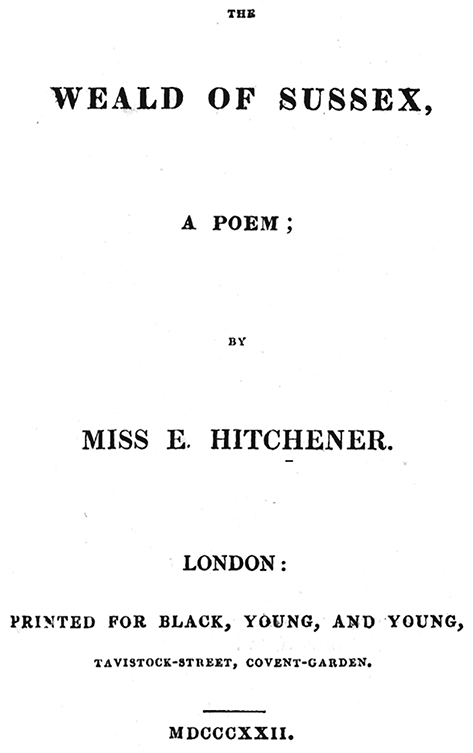
Hitchener’s notes come at the end and take up about a third of the volume. Written in an age when explanatory appendices to long poems became more expansive, the notes to The Weald range from half a page to five pages in length, and occasionally include rigorous, if sometimes exhausting, notes within notes. The notes alone display a wealth of understanding that defies Reiman’s faint praise of Hitchener as ‘an intelligent, decently educated, and well-read female school teacher’. Many receive ballast from weighty Roman (Suetonius, Seneca, Tacitus) and English (Camden, Blackstone, Gibbon) authorities, but Hitchener employs an esoteric range of additional sources. The style lies somewhere between the locally-sourced digressions on the history of place recognisable from Scott’s Lay of the Last Minstrel (1805), and the more cosmopolitan references found in Byron’s Childe Harold’s Pilgrimage (1812–18). For the former, Hitchener blends her own knowledge of what she calls, in the poem’s first phrase, ‘My native Downs’, with quotations from some quite obscure local accounts of history such as William Lambard’s The Perambulation of Kent (1576), William Somner’s The Antiquities of Canterbury (1640), and Paul Dunvan’s Ancient and Modern History of Lewes (1795). For the latter, Hitchener shows her knowledge of contemporary travel-writing, including Thomas Pennant’s Tour in Wales (1778–81) and J. B. Savigny and Alexander Correard’s Narrative of a Voyage to Senegal (1818), and of risqué French philosophical literature, with lengthy quotations from Jean de la Bruyère Les Caractères ou les Mœurs de ce siècle (1688) and Henri-Joseph Dulaurens’s Le Compère Mathieu (1766). The depth of reading in which Hitchener anchors The Weald signals the poem’s intellectual ambition. To understand a place, the notes imply, you need to know its cultural and political history. It is human activity that turns a ‘desert rude’ into a ‘scene most fair’ (22).
Finding Hitchener is partly a matter of locating her geographically, and above all else Hitchener is a poet of Sussex. The poem proper begins on Ditchling Beacon (Figure 6), the highest point in east Sussex, with a prospect from which Hitchener surveys time as well as space (‘Enchanted by the pleasing sight, wrapt thought | The effect of human labor contemplates, | Which, in this scene has wrought such wondrous change’ (2)). She expounds an eclectic range of subjects: Britain’s early settlement by Romans, Vikings, and Saxons, while hinting at the nation’s current imperial exploits (‘chiefly colonists from other climes, | Strangers to Albion’s every green recess’ (17)); the English adoption of the Interpretatio germanica for names of the week; and the etymological changes in the place’s name (from ‘Coid Andred’ to ‘Lucus Andates’ to ‘Andradswald’ to ‘Weald’). She offers a portrait of Thomas Otway (the Weald’s most famous literary product), rejects the Church and sectarianism and remembers the diversity of Jesus’s disciples (‘Since Christ then chose Men of such different shades, | With a variety so strongly marked, | This surely should a striking lesson teach’ (56)),Footnote 390 delivers a tirade against war, and finally looks out over the Weald and the future of England.
Will Bowers, ‘View over the Weald from Ditchling Beacon’ (2025).
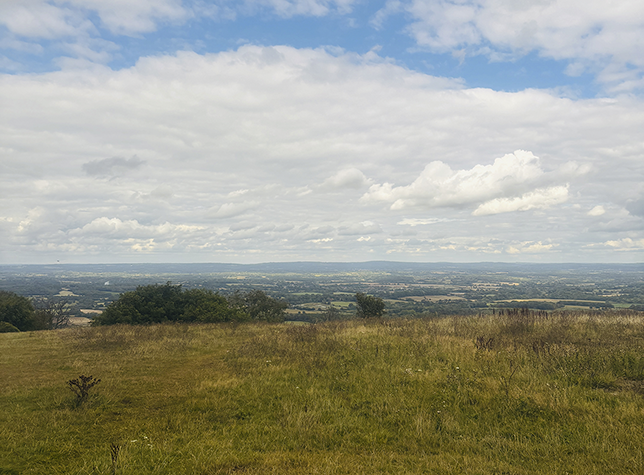
The idea that a panoramic prospect allows the narrator to peer into history had been part of the poetic tradition since Cooper’s Hill (1642), in which John Denham uses the view over Windsor ‘to recount those several Kings, to whom | It gave a Cradle, or to whom a Tombe’.Footnote 391 More recently, the power of a panorama to prompt historical and visionary thought had been exemplified by Charlotte Smith – who like Hitchener had benefitted from a formal education – in her blank verse Sussex poems The Emigrants (1793) and Beachy Head (1807). The former is written from ‘an Eminence on one of those Downs, which afford to the South a View of the Sea; to the North of the Weald of Sussex’,Footnote 392 and the latter from a prospect twenty miles south-east of Ditchling Beacon, where ‘Contemplation here, | High on her throne of rock, aloof may sit, | And bid recording Memory unfold | Her scroll voluminous’.Footnote 393 Given Hitchener was resident in Sussex when both poems were published, it is likely she knew these works and placed The Weald in dialogue with them. But reading these lines about Smith’s ‘native hills’ is quite different from reading Hitchener on the same ground:
Smith is a poet, in Jacqueline Labbe’s words, ‘defined by her sorrows, paralyzed by their evocation’.Footnote 394 Nature’s present delights cannot diminish personal trauma nor dispel ‘dark retrospect’ on the human condition. In contrast, Hitchener’s is a predominantly impersonal vision of a future progressive connection between man and nature among the same ‘native hills’. The Weald might take the vantage point of The Emigrants, but Hitchener does not share Smith’s wish to remove herself from the peopled land, her ‘sigh for some lone cottage, deep embowered’ (1. 42), nor her anxiety and pessimism about the political present. When Hitchener’s poem considers the present – human rights and social ills in the light of the Sussex scene before her – there is a discernible confidence, directness, and clarity in her verse. In a glance to ‘yonder vale’ the inhabitants of which ‘bear | Keen poverty and its attendant ills’ (43), Hitchener encourages charity to the hungry without preaching or moralising:
Hitchener neatly lays out her case across the first three lines by virtue of impersonal and logical statements, before turning to a more direct second-person address which makes its point through alliterative incipits (‘Bound […] Bear’) and anaphora. In this voice of reasonable appeal – with fewer inversions and a conversational yet urgent tone – and in the range of subjects about which she hopes to reform our thinking, Hitchener is closer to the easy immediacy of Cowper’s blank verse in The Task (1785) than the grander efforts of Smith. But the digressive mode of the Weald, Cowperian in tone and range, is resolutely radical in purpose. As Hitchener admits in mock-apologetic terms, ‘Forgive ye pious, that my mind inquires, | Appeals to reason, for what you would say, | Religion shows, and Holy writ contains’ (48).
In The Weald, Hitchener’s inquiring mind is willing to accuse the culprits for the poverty she sees (as the repeated ‘ye who’ in the lines above suggests). Attempts to expose power to truth run through the poem. This voice of appeal – which exercises Hitchener’s ‘practical political virtue in degenerate times’ – is at its most effective in the extended discussion of soldiery that concludes the section against war.Footnote 395 Hitchener criticises those in military service for their neglect of an ethical contract (one who ‘oft forgets the social tie | Forgets the powerful duties of the man’ (74)), before focusing on the individual:
The indefinite article introduces the soldier in the abstract, but his servitude is brought to life by successive taut vignettes of disfigurement. Although Hitchener observes these soldiers within the history of ‘European slaves’ – among Ancient Spartans and Medieval Lords – her imagery has a modern significance. The literature of the Atlantic trade had been transfixed by bodies of enslaved people since at least since James Grainger’s description of ‘their flesh’ in Book 4 of The Sugar Cane (1764), in lines that Cristobal Silva suggests are ‘so insistently corporeal in their vision that they abject the African body’.Footnote 396 Hitchener’s masterstroke is to transpose on to her soldier an abolitionist diction of constraint and degradation of the enslaved body in place of Grainger’s voyeurism. The rhetoric of The Weald is rooted in abolitionist disgust at a practice that allows man to ‘traffic, gage, and span, | And buy the muscles and the bones of man’.Footnote 397 The force and the originality of this section come from its ability to sustain an angry critique of soldiery and its violent purpose, while also eliciting some, but not total, concern for a soldier’s experience. Hitchener’s balanced sympathies are apparent when she moves from the body of an active soldier to the mind of one discharged, who
This is a description of what would now be called post-traumatic stress, and in its focus on the mind and conscience after war it makes universal the plight of Wordsworth’s discharged solider, who emits ‘murmuring sounds, as if of pain | Or some uneasy thought’.Footnote 398 What to do with the thousands of soldiers after the mass demobilisation of the army that followed the Napoleonic Wars was a common question in the public sphere, but Hitchener’s draws attention to those mental ‘scars that silent speak | Telling the tale that hastens to the grave’ (81).Footnote 399 The internal tortures are again conceived corporeally, as an ‘arm […] imbrued’ and a body scarred, to create a totalising portrait of conflict’s horrific aftermath from a poet who lived for most of her life in a nation at war. Philip Shaw, in his study of Romantic literary accounts of war, asks ‘why is it that images of the body in pain are so elusive in this period?’Footnote 400 Hitchener’s impassioned diatribe provides just such an image: it puts corporeal and mental suffering at the centre of a pacifist argument that not only shows the pain of ‘mangled limbs’ (81) but a traumatic mental aftermath in which ‘the reeking plain | Of slaughtered thousands, rise before’ the soldier’s ‘sight’ (78).
Given Hitchener’s own persecution at the hands of the Shelleys, it is unsurprising that the poem addresses the causes and symptoms of what Hitchener calls ‘civil discord fierce’. But The Weald is no jeremiad. Throughout the poem, Hitchener argues for ‘Culture’s progressive power’ (86) in her attempts to answer in the affirmative a question posed early in the poem: ‘Can man, weak man, the creature of a day, | Thus change, in twice nine centuries, Nature’s face?’ (22). While acknowledging the damage wrought by war and nascent global capitalism (‘which grateful Commerce wafts, from shores | Of either Ind’ (23)), Hitchener lays out a progressive vision:
Clarity arises from conviction. Hitchener guides her reader with imperatives to ‘Turn’ and ‘See’ the signs of social progress in a mode befitting of a practical visionary verse devoid of the conditional mays, mights, and coulds that characterise Shelley’s prophetic poetry. The Weald is at its most impressive when it shares the mind-enlarging purpose of Hitchener’s enigmas. As the poem moves from prospect to the prospective, it delivers a pedagogical vision of ‘improvement’ rooted in Hitchener’s experiences of being educated and teaching ‘in this Weald’. In these stately moments The Weald aspires to be a georgic, but this is a georgic which advocates for the kind of improvement Hitchener found in William Madock’s embankment scheme at Tremadoc, refusing to resign itself entirely to the ‘complaint’ against ‘social and economic ills’ that characterises both Smith’s blank verse and the wider Georgic genre in the Romantic period.Footnote 401 Hitchener offers another enthusiastic invocation of the people and geography of the Weald through time in the final lines of the poem, dedicated to ‘those residing now amid its shades’, who
Hitchener’s focus is again on the relation of humans to the earth they inhabit. Although the title leads us to expect a poem of place, The Weald conceives of ‘bequests’ quite differently from other Romantic landscape poems. Wordsworth wrote a letter to Charles James Fox discussing his poem ‘Michael’ in the context of ‘proprietors of small estates which have descended to them from their ancestors’ for whom ‘their little tract of land serves as a kind of permanent rallying point for their domestic feelings’.Footnote 402 But Hitchener’s Weald is a place where natural rights rather than ‘individual Acres’ or tracts of land are bequeathed ancestrally and received adoringly. The definition of this autochthonous bequest in the poem’s last two lines affords a microcosm of The Weald’s range and hybridity: radical rhetoric established by the ‘birth right of a man’, with its overtones of both Paine and the French National Assembly’s declaration of August 1789, rubs up against the defiance of Horace’s first epistle (te responsare superbae | liberum et erectum),Footnote 403 and the Biblical quotation in the last phrase, taken from a passage in Genesis promising future growth.Footnote 404 Hitchener’s way of blending these traditionally antagonistic intellectual systems provides an impressive conclusion to a new kind of panoramic poem that is nourished by a variety of genres – topographical poetry, meditative blank verse, and georgic – whilst refusing to settle into one. The dubious biographical record obscures Hitchener from us, but there is one way in which the struggle to find her reflects her own accomplishment, since her most significant poetic achievement resists easy definition.
Coda
‘What true delight it would bestow on numbers to be as certain that the Being they love & adore is not the phantom of their own imagination’, Hitchener wrote in her first letter to Shelley.Footnote 405 This Element has offered accounts of a ‘Being’ (woman, teacher, correspondent, and poet) more ‘certain’ than the phantoms born of love and vengeance that Shelley and his biographers have made of Hitchener. Yet phantoms continue to haunt accounts of Hitchener’s final years. The few scholars who have considered her later life have followed Merle in characterising her as a wistful spinster living in the afterglow of her association with the great poet. Often cited as a source for these depictions is a quatrain from the ‘Apologetic Stanzas’ attached to The Weald, probably composed in the year of Hitchener’s death:
Apparently this is ‘a reference to the ardent days of [Hitchener’s] early friendship with Shelley’ – proof that ‘she had not forgotten him’ and ‘held a candle for Shelley to the end’.Footnote 407 Are these nebulously autobiographical lines really about Shelley? Assuming the ‘vision’ is a person at all – not a metaphor for autonomous inspiration, or a reference to the ‘vision’ beheld from Ditchling Beacon with which The Weald begins and ends – it could just as plausibly be Hannah Adams, whose wisdom and ‘virtue’ Hitchener credited for her intellectual awakening. But even if we take the ‘vision’ to be Shelley, the lines can be read less as a candle-holding eulogy than an understated continuation of Hitchener’s wariness of idealisation. When ‘fancy whispered’ him ‘wise and great and fair’, was this an illusion? The quatrain contains, too, a cleverly self-contradictory piece of self-mythologising. The picture of an author inspired to temper her ‘wildest air[s]’ owes something to Milton’s description of Shakespeare (‘Fancies childe’ who ‘Warble[s] his native Wood-notes wilde’) and to More’s opening address to Elizabeth Vesey in ‘The Bas Bleu’ (‘Vesey! of Verse the judge and friend! | Awhile my idle strain attend’),Footnote 408 but the twofold allusion dispels the myth it creates of Hitchener, or her spirit as reflected in this ‘little volume’, as an untutored or ‘idle’ genius. The lines confound the straightforward image – of a woman who remained in thrall to Shelley until her dying day – that biographers have extracted from them.
The culture of mythmaking surrounding Hitchener has proven to be pervasive and generative. It has inspired scholars to find phantoms of her in unlikely places. Despite the fact that, as Nicholas Joukovsky has pointed out, Thomas Love Peacock never met Hitchener, did not encounter her name in letters from Shelley, and made no mention of her in his Shelley Memoirs (1858–62), in 1910 Aurélien Digeon argued that Hitchener (not Mary Wollstonecraft Shelley) was the inspiration behind Celinda Toobad in Nightmare Abbey (1818), a theory endorsed by Cameron in 1961.Footnote 409 As the love interest of Scythrop Glowry (a caricature of Shelley), the ‘strange’ Celinda, in her disguise as Stella, is described as
full of impassioned schemes of liberty, and impatience of masculine usurpation. She had a lively sense of all the oppressions that are done under the sun; and the vivid pictures which her imagination presented to her of the numberless scenes of injustice and misery which are being acted at every part of the inhabited world, gave an habitual seriousness to her physiognomy, that made it seem as if a smile had never once hovered on her lips.Footnote 410
These scholars claim to have found an image of Hitchener. In truth, they have projected back onto Peacock’s wry characterisation of Celinda a phantom with which he was unlikely to have been familiar, bequeathed to the twentieth century by Shelley (‘a complete victim to all the woes’), Medwin (‘a great stickler for the rights of her sex’), Hogg (‘above all prejudices’), and Merle (‘a melancholy mood’). Time and time again, scholars have been lured into perpetuating myths about Hitchener when they could have been citing recoverable facts. In the year of Nightmare Abbey’s publication, the real Hitchener was running a well-respected girls’ school in Edmonton, Middlesex, which she co-founded with her sister Ann. Like Hannah and Patty More, Elizabeth and Ann used their ‘kindred friendship’ to inspire their teaching and philanthropy. In Edmonton, Hitchener appears to have found the life for which she had always longed – one composed of female conversation, education, collaboration, and cohabitation. A former pupil of the school, Mrs Caffyn, paid poignant tribute:
The school-days I passed at Edmonton, under the kind and judicious teaching of Miss Hitchener, were some of the happiest in my life. Miss Hitchener was exceedingly fond of poetry, and used to recite Darwin’s ‘Eliza’ to us in such a way that it brought tears to our eyes. We knew that she was acquainted with Shelley, but never knew how she was associated with the family […] I consider her to have been a high-principled, clever woman, with a remarkable capacity for teaching. I think all her pupils loved her. Both she and her sister will be cherished in my memory as long as it lasts.Footnote 411
In 1884, the Saturday Review published an obituary of the poet Richard Hengist Horne, who had once fallen in love with a girl from Hitchener’s school, which painted a different picture: ‘At Tottenham […] he knew Miss Hitchener, the grim educational spinster, known in the history of Shelley as “the Brown Demon”’.Footnote 412 The real Elizabeth Hitchener (a ‘clever woman’, ‘cherished’ and ‘loved’ by her pupils) had already become irreparably conflated with the grim phantom of the ‘Brown Demon’.
In the final weeks of her life, it seems more likely that Hitchener experienced feelings of pride than wistfulness. The November 1821 issue of The Monthly Magazine carried an advertisement for the imminent publication of ‘The Weald of Sussex, a Poem, by E. Hitchener’ (‘This poem abounds in moral passages, as well as descriptions of local scenery; and is enriched with a variety of interesting historical notes’). Two months later the same magazine announced its author’s death.Footnote 413 Hitchener died intestate in Edmonton, aged thirty-eight, on 4 December 1821. Her last address was Union House, Upper Edmonton Parade, Middlesex, but she was buried in Keymer on 13 December 1821 (Figure 7).Footnote 414 The ‘goods, chattels, and credits of Elizabeth Hitchener’ were valued at £450.Footnote 415 On 6 August 1822, the solicitor serving as executor of Hitchener’s estate, H. Holste of 22 Bush Lane, London, wrote to Shelley’s father informing him of a failed attempt to contact his son (whose death had in fact occurred on 8 July 1822) regarding a debt of £100 ‘which Miss Hitchener lent him in June 1812’.Footnote 416 The sum may have been confused with the £100 Shelley agreed to pay Hitchener annually before her departure in November 1812; but considering the poor state of Shelley’s finances in June 1812 and the fact that Hitchener had yet to join his little circle, it is ‘possible’ – Ingpen concedes – ‘that Miss Hitchener may have sent him the £100’.Footnote 417
Will Bowers, ‘Churchyard of St Cosmas and St Damian, Keymer’ (2025).
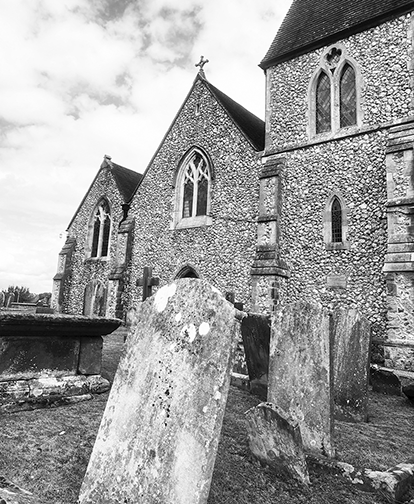
Hitchener was survived by her parents, to whom biographers claim questionably she owed little: ‘you have soothed your parent’s lonely hours, | (A source of pleasure sacred, fond, and dear;)’, she wrote in the ‘Apologetic Stanzas’.Footnote 418 Her father Thomas remained landlord of the Fryar’s Oak Inn for ‘upwards of forty years’ until his death aged eighty: he was buried in Keymer on 16 May 1829, ‘much respected and regretted by all who knew him’.Footnote 419 A probate record shows that he was survived by his wife Elizabeth and daughter Ann.Footnote 420 In the wake of her sister’s death, Ann Hitchener returned to Sussex: a notice posted on 11 July 1825 in the Sussex Weekly Advertiser announced that she would be reopening a school at Pyecombe Rectory ‘for the Board and Education of Young Ladies’.Footnote 421 In 1840 she was temporarily imprisoned as an insolvent debtor and was ‘brought up before a Commissioner’ at Horsham courthouse.Footnote 422 An 1847 report for the Governesses Benevolent Institution in London listed her as a candidate for annuity on the grounds of ‘ruinous’ expenses incurred while supporting and educating ‘two orphan nieces and a nephew’.Footnote 423 The children were William Henry Hitchener’s, whose death on 17 March 1820 at Epsom Wells, Surrey, was registered in Blackwood’s Magazine.Footnote 424 Ann Hitchener died in December 1864, aged seventy-nine, at the Asylum for Aged Governesses in Kentish Town.Footnote 425 Like her elder sister, she had dedicated her life to the education and welfare of children.
This Element began by calling Elizabeth Hitchener an enigma. Its sections have recovered details of her childhood, education, and career, found a place for her in proto-feminist traditions of the long eighteenth century, scrutinised the accounts of her character that have plagued her reputation, and celebrated her virtues as a letter-writer and poet. Yet the riddle of her life has been only partially solved. Questions remain about the cause of the falling-out with the Shelleys, her life between 1812 and the foundation of the Edmonton school, and how her posthumous Enigmas, Historical and Geographical (1834) found its way into print. We might also wonder why Hitchener’s body was moved over fifty miles from Edmonton to Keymer (presumably at some expense) for her burial. In Shelley’s eyes, Hitchener ‘lifted’ herself from ‘obscurity’; she herself complained of a community that forced her to live as a child ‘without sympathy’; and yet her ‘Dedicatory Ode’ speaks of ‘Home’ as a source of ‘Contentment, health, and ease’.Footnote 426 The fact that Hitchener’s body made the journey back to Keymer may be a sign that she sustained an attachment to her birthplace and parents deeper than the records do justice to. In a final bid to exorcise the phantoms from her life, the authors of this study went in search of Hitchener’s resting place in Keymer. No grave was found.
Abbreviations
- Bieri
James Bieri, Percy Bysshe Shelley (2008)
- Boas
Louise Schutz Boas, Harriet Shelley (1962)
- Bradley
J. L. Bradley, A Shelley Chronology (1993)
- Dowden
Edward Dowden, The Life of Percy Bysshe Shelley, 2 vols (1886)
- Caffyn
John Caffyn, Sussex Schools in the Eighteenth century (1998)
- Cameron
Kenneth Neill Cameron, The Young Shelley (1951)
- Clutton-Brock
A. Clutton-Brock. Shelley (1910)
- Dobell
Bertram Dobell (ed.). Letters from Percy Bysshe Shelley to Elizabeth Hitchener. (1908)
- EHG
Elizabeth Hitchener, Enigmas, Historical and Geographical (1834)
- FB
Elizabeth Hitchener, The Fireside-Bagatelle (1818)
- Hogg
Thomas Jefferson Hogg, The Life of Percy Bysshe Shelley, vol. ii (1858)
- Holmes
Richard Holmes, Shelley (2005)
- Jeaffreson
John Cordy Jeaffreson, The Real Shelley (1885)
- Julian
Complete Works of Percy Bysshe Shelley, ed. Roger Ingpen and Walter Edwin Peck, 10 vols (1927)
- LPBS
Letters of Percy Bysshe Shelley, ed. Frederick L. Jones, 2 vols (1964)
- Medwin
Thomas Medwin, The Life of Percy Bysshe Shelley, ed. H. Buxton Forman (1913)
- Merle
Anon. [Joseph Gibbons Merle], ‘A Newspaper Editor’s Reminiscences’, Fraser’s Magazine (1841)
- Peck
Walter Edwin Peck, Shelley, 2 vols (1927)
- PeckForeword
Walter Edwin Peck, ‘Foreword’, Letters of Elizabeth Hitchener to Percy Bysshe Shelley (1926)
- Rabbe
Félix Rabbe, Shelley (1887; 1888)
- Reiman
Elizabeth Hitchener, The Fire-side Bagatelle; The Weald of Sussex, ed. Donald Reiman (1978)
- SinE
Roger Ingpen, Shelley in England (1917)
- Todd
Janet Todd, Death and the Maidens (2007)
- White
Newman Ivey White, Shelley, 2 vols (1940)
- Worthen
John Worthen, The Life of Percy Bysshe Shelley (2019)
- Woolf
Virigina Woolf, ‘Shelley and Elizabeth Hitchener’, TLS (05/03/1908)
- WS
Elizabeth Hitchener, The Weald of Sussex (1822)
Acknowledgements
The authors are grateful to the British Academy for the Small Grant that supported their research on Hitchener. They also wish to thank the series editors and the anonymous readers for their feedback and support, and Joseph Turner for his response to an early version of the typescript. Figures 2 and 3 are reproduced from BL Add MSS 37496 by permission of the British Library.
Series Editors
Eve Tavor Bannet
University of Oklahoma
Eve Tavor Bannet is George Lynn Cross Professor Emeritus, University of Oklahoma and editor of Studies in Eighteenth-Century Culture. Her monographs include Empire of Letters: Letter Manuals and Transatlantic Correspondence 1688–1820 (Cambridge, 2005), Transatlantic Stories and the History of Reading, 1720–1820 (Cambridge, 2011), and Eighteenth-Century Manners of Reading: Print Culture and Popular Instruction in the Anglophone Atlantic World (Cambridge, 2017). She is editor of British and American Letter Manuals 1680–1810 (Pickering & Chatto, 2008), Emma Corbett (Broadview, 2011) and, with Susan Manning, Transatlantic Literary Studies (Cambridge, 2012).
Markman Ellis
Queen Mary University of London
Markman Ellis is Professor of Eighteenth-Century Studies at Queen Mary University of London. He is the author of The Politics of Sensibility: Race, Gender and Commerce in the Sentimental Novel (1996), The History of Gothic Fiction (2000), The Coffee-House: a Cultural History (2004), and Empire of Tea (co-authored, 2015). He edited Eighteenth-Century Coffee-House Culture (4 vols, 2006) and Tea and the Tea-Table in Eighteenth-Century England (4 vols 2010), and co-editor of Discourses of Slavery and Abolition (2004) and Prostitution and Eighteenth-Century Culture: Sex, Commerce and Morality (2012).
Advisory Board
Linda Bree, Independent
Claire Connolly, University College Cork
Gillian Dow, University of Southampton
James Harris, University of St Andrews
Thomas Keymer, University of Toronto
Jon Mee, University of York
Carla Mulford, Penn State University
Nicola Parsons, University of Sydney
Manushag Powell, Purdue University
Robbie Richardson, University of Kent
Shef Rogers, University of Otago
Eleanor Shevlin, West Chester University
David Taylor, Oxford University
Chloe Wigston Smith, University of York
Roxann Wheeler, Ohio State University
Eugenia Zuroski, MacMaster University
About the Series
Exploring connections between verbal and visual texts and the people, networks, cultures and places that engendered and enjoyed them during the long Eighteenth Century, this innovative series also examines the period’s uses of oral, written and visual media, and experiments with the digital platform to facilitate communication of original scholarship with both colleagues and students.