


1 Introduction
The number of international human rights institutions and countries participating in them has risen dramatically in recent decades. This growth in both institutions and state commitments to them has precipitated considerable interest and heated debates about why countries make such pledges and whether these commitments promote improvements in the human rights behavior of member states (Cole Reference Cole2005; Goodliffe and Hawkins Reference Goodliffe and Hawkins2006; Hafner-Burton Reference Hafner-Burton2012; Lupu Reference Lupu2015; Comstock Reference Comstock2021).Footnote 1 Until now, these debates have centered on a small number of human rights treaties and revolve around the domestic scope conditions necessary to generate state compliance with treaty obligations.
While there now exists a substantial literature predicting the diverse factors that trigger human rights treaty ratification (Hathaway Reference Hathaway2005; Wotpika and Tsutsui Reference Wotipka and Tsutsui2008; Simmons Reference Simmons2009), there is substantial debate and disagreement over whether these commitments ever produce compliance, defined as improved human rights outcomes. There are multiple schools of thought and contradictory evidence. An initial wave of scholarly research found little evidence that human rights treaties systematically, or directly, improve the behavior of signatories (Hathaway Reference Hathaway2002; Neumayer Reference Neumayer2005; Hafner-Burton and Tsutsui Reference Hafner-Burton and Tsutsui2005, Reference Hafner-Burton and Tsutsui2007; von Stein Reference von Stein2016). Much of that literature landed on the argument that these treaties are simply cheap talk, especially for highly repressive, autocratic regimes that can just ignore them. Membership in a few treaties (especially the United Nations [UN] Convention Against Torture) even seemed to be associated with deteriorating human rights conditions (Neumayer Reference Neumayer2005; Vreeland Reference Vreeland2008; Hill Reference Hill and Daniel2010; Hollyer and Rosendorff Reference Hollyer and Rosendorff2011a). Subsequent research, however, generated evidence that treaties can enhance human rights under certain circumstances, which depend largely on domestic politics, what neighboring states are doing, and the nature of the rights in question (Powell and Staton Reference Powell and Staton2009; Simmons Reference Simmons2009; Conrad and Ritter Reference Conrad and Ritter2013; Lupu Reference Lupu2013, Reference Lupu2015). The debate over compliance with human rights treaties is far from settled.
Treaties, however, are not the only international institutions that aspire to promote human rights. Many, arguably more powerful international organizations (IOs), also aim to promote, advance, or enforce human rights by linking the issue to their other missions. For example, the Organization for Security and Co-operation in Europe (OSCE) – which is the world’s largest regional security organization, with fifty-seven participating states – reports that respect for human rights and fundamental freedoms are key to its comprehensive security concept.Footnote 2 The OSCE’s Office for Democratic Institutions and Human Rights claims to be active in fostering human rights, tolerance, and nondiscrimination, and its field operations provide members with information about and assistance in promoting rights. The Organization for Economic Co-operation and Development (OECD) encourages policies that will improve the economic and social well-being of people around the world, integrating human rights into its development goals. The OECD has adopted formal guidelines with the stated intention to advance human rights-friendly corporate codes of conduct by multinational firms operating in or from forty-two countries.Footnote 3
It is not only IOs composed of Western democracies that articulate human rights goals. The Southern African Development Community (SADC) professes to advance economic well-being, improve standards of living and quality of life, further freedom and social justice, and foster peace and security for members. The organization has also established formal principles and guidelines for promoting free and fair elections in its fifteen member states based on “shared values and principles of democracy, the rule of law and respect for human rights.”Footnote 4 The Arab League states its intention to strengthen political, cultural, economic, and social programs among its members. It has a formal Permanent Committee on human rights (like the UN Human Rights Council), which is charged with establishing rules of cooperation on human rights issues among members, promoting implementation of human rights commitments, and monitoring implementation of the updated Arab Charter on Human Rights. We refer to this group of organizations that formally state the aim to foster the promotion of human rights as “human rights IOs.” We do not assess how they define human rights but focus simply on whether they claim to promote any form of internationally recognized human rights.
We show in Section 5 that the number of organizations which promote human rights has grown substantially in the post–World War II period. The proliferation of human rights IOs raises two critical questions. First, why do countries join IOs with formal human rights requirements, when membership arguably constrains their sovereignty and noncompliance with those requirements could lead to punishments? Second, once countries join these organizations, do they honor their commitments to protect human rights?
We argue that answers to both questions depend on the institutional design of the organization, specifically, on their “sovereignty costs.” These costs stem from the constraints that IOs impose on members, which vary substantially across organizations. Human rights IOs marked by extensive precision, obligation, and delegation impose higher sovereignty costs on participants (Abbott and Snidal Reference Abbott and Snidal2000; Abbott et al. Reference Abbott, Keohane, Moravcsik, Slaughter and Snidal2000). Other organizations generate fewer sovereignty costs because they have weaker enforcement mechanisms, a lack of institutional capacity, or the absence of formal reporting on human rights conditions in member states. As such, some organizational commitments to human rights, even if spelled out in a charter or agreement, may amount to cheap talk.
We hypothesize that emerging democracies are the most likely type of regime to enter high sovereignty cost human rights IOs. Their motives are multiple. Some democratizing states seek membership to lock in liberal policies and signal their intent to consolidate democracy. The more extensive constraints on government behavior imposed by higher sovereignty cost IOs serve this function. Others seek the added benefits associated with membership in an IO that covers multiple issue-areas, such as aid, trade, national security, or diplomacy. While these states may not seek to lock in human rights standards for their own sake, they are willing to pay the human rights sovereignty costs associated with membership to access those other benefits. Still other emerging democracies face pressure to join from external sources, such as aid donors, allies, trade or investment partners, or other IOs to which they belong. All these factors contribute to the tendency for democratizing states to join human rights IOs that impose greater constraints on state sovereignty.
In contrast, we suggest that nondemocratic states are less likely to join these organizations. They typically do not seek to lock in human rights standards and are more likely than emerging democracies to shy away from institutions that will shine a spotlight on their human rights records. And many are unwilling to labor under good governance clauses that constrain their domestic political choices. There is an emerging literature that does consider the conditions under which autocrats consent to international legal obligations, including in the areas of criminal law and good governance (Ginsburg Reference Ginsburg2020; Hashimoto Reference Hashimoto2020). That literature concludes that when autocrats and other repressive regimes adopt international legal obligations, they tend to accept the lowest common denominator. Alternatively, autocratic states use IO sovereignty costs strategically to project their own power outside of the organization (Hafner-Burton, Pevehouse, and Schneider Reference Hafner-Burton, Jon, Pevehouse and Christina2024).Footnote 5 Our argument about membership is not that autocrats never participate in human rights IOs but rather that they are less likely to seek out those that impose high sovereignty costs.
Of course, joining an IO that incorporates human rights standards into its mission is different from the effect of membership on government behavior toward its citizens. While there are many schools of thought about the drivers of compliance – some focused on norm diffusion and internalization (e.g., Risse and Ropp Reference Thomas, Ropp, Risse, Ropp and Sikkink1999; Goodman and Jinks Reference Goodman and Jinks2008), others focused on legal enforcement (e.g., Hillebrecht Reference Hillebrecht2012) – we argue that to be effective, human rights IOs must create costly commitments for member states. We unpack these commitments in Section 4. Otherwise, the human rights rhetoric amounts to cheap talk, as some argue is the case for many human rights institutions.
These commitments also explain why organizations marked by higher sovereignty costs tend to generate greater promotion, advancement, and enforcement of human rights than those characterized by fewer sovereignty costs. We argue that once states accept extensive sovereignty costs, whatever the motive for doing so, there is often a noticeable improvement in the domestic protection of human rights. On the flip side, there is little boost in the protection of human rights from entering an IO that imposes relatively few such costs. The latter institutions are little more than rhetoric, which may have some value but are unlikely to stimulate improvements in members’ human rights behavior.
Central to our contribution is the finding that the effects of human rights IOs on government behavior do not depend on whether a state is democratizing. In other words, the effects of higher sovereignty cost IOs on human rights behavior are not limited to those states that are particularly drawn to these organizations. This is not to say that regime type is unrelated to human rights behavior. On the contrary, past research provides ample reason to expect that this factor plays an important role in shaping such behavior (Davenport and Armstrong Reference Christian and David2004; Davenport Reference Davenport and Goodhart2009). The effect of regime type, however, does not operate via IOs. As we mentioned earlier and explain in Section 2, democratizing states have especially sizable incentives to enter high sovereignty cost human rights IOs because of the useful signals that are sent, as well as the material benefits that accrue to all members of international institutions. But when they join, all members – regardless of their regime type – are constrained to some degree by the extensive precision, obligation, and delegation that characterizes high sovereignty cost IOs. It is thus not only regime type that helps to explain why some countries are more likely to protect human rights but also the nature of the commitments that states are making to IOs that link these rights to their broader missions.
Using a new dataset on human rights IOs comprised of fifty-six IOs over the period from 1950 to 2018 and an original measure of their associated sovereignty costs, we generate some of the first cross-national evidence on how variation in institutional design influences member states’ likelihood of commitment to these organizations and their subsequent human rights behavior. The results provide strong support for our argument. Countries engaged in a democratic transition are more likely to join human rights organizations that levy extensive sovereignty costs on participants, compared to all other regime types. Our results suggest that democratizing countries seek membership in human rights institutions for different reasons than other countries. Our results also show that, whatever their regime type, states joining IOs that impose higher sovereignty costs on members are more likely to improve human rights upon accession, whereas those entering IOs that impose fewer costs are less likely to improve such rights.
The argument and evidence indicate that, although existing debates over human rights institutions have focused on a small number of treaties and emphasize the domestic scope conditions necessary to stimulate both commitment to and compliance with those treaties, a wider range of international institutions that cover human rights issues also influence governments’ treatment of their citizens. However, the ability of these international organizations to safeguard human rights depends heavily on how they are designed. These design features play a significant role in determining whether organizations taking on human rights as part of their mission espouse mere rhetoric (that is, cheap talk without consequences) or create the potential for the institution to incentivize and enforce human rights.
This finding contributes not only to debates on whether international human rights institutions make a difference but also to the question of what institutional factors correlate with compliance. In addition, this result has interesting implications in a world currently characterized by democratic backsliding and autocratization. The domestic politics of a state clearly shape membership decisions about whether to accept high sovereignty cost commitments; but once those commitments are made, high sovereignty costs improve human rights behavior across various regime types, while commitments to low sovereignty cost organizations yield little change in such behavior.
This Element is structured as follows. Part I develops the argument in three parts. Section 2 explains how sovereignty costs shape state incentives to become members of human rights IOs. Section 3 defines the nature of IO sovereignty costs and their underlying features, which produce variation in the strength of commitments states make when they join these organizations. Finally, Section 4 considers whether these commitments are likely to precipitate action and explains why membership in high sovereignty IOs is likely to nudge states toward better human rights practices, while low sovereignty cost commitments are largely rhetorical.
Part II of the Element turns to data and evidence. Section 5 describes our sample of human rights IOs and our protocol for measuring sovereignty costs. There, we also compare alternative forms of measurement and data. Section 6 applies our data to the study of membership in these organizations and provides evidence that democratizing states are in fact the most likely type of state to join high sovereignty cost IOs. Section 7 then analyzes the conditions under which the rhetoric of human rights becomes a reality, by determining whether the sovereignty costs a member state has committed to are reflected in that state’s future human rights behavior. Section 8 concludes.
Part I The Argument
2 Membership in International Human Rights Organizations
Existing debates over why countries make international legal commitments to promote human rights, and whether these commitments improve human rights behavior, have centered on a small number of global and regional human rights treaties (Hawkins Reference Hawkins2004; Cole Reference Cole2005, Reference Cole2009; Simmons Reference Simmons2009). The United Nations International Covenant on Civil and Political Rights (ICCPR) and the United Nations Convention Against Torture (CAT) have been the subjects of the most attention. Much of the extant literature has focused on factors that might motivate states to ratify these treaties, including pressure by civil society, democratic status, norm diffusion, economic dependence, and regional (or other foreign) diplomatic pressures (cf. Smith-Cannoy Reference Smith-Cannoy2012; Lupu and Riedl Reference Lupu and Riedel2013; Milewicz and Elsig Reference Milewicz and Elsig2014). Currently, almost every country has ratified at least one human rights treaty and most states have ratified most of them, yielding increasingly little cross-national variation in treaty commitments over time.
Scholars have proposed a long list of reasons why states join human rights treaties, including regional and global diffusion effects, the potential to gain economic benefits, signaling public acceptance of human rights norms, and to lock in behavioral commitments. But while treaties are important legal instruments for the promotion and protection of human rights, far less attention has been paid to the larger and arguably more powerful set of international organizations that also claim to promote, advance, and enforce human rights. Yet, we know little about why states accede to IOs that profess to champion human rights. This could be because of the attention given to human rights treaties, but it could also stem from the lack of systematic data on which IOs promote human rights. One of the key contributions of this study is to shed light on why states join IOs that impose human rights requirements when this membership could constrain their sovereignty, in some cases much more than treaties.
We argue that states experiencing a democratic transition have particularly strong reasons to pay the sovereignty costs generated by membership in human rights IOs, and that they are therefore drawn to those organizations that impose especially high costs. One reason democratizing states are more likely than other states to incur higher sovereignty costs is to signal they are not engaging in cheap talk about human rights as well as to lock in domestic political reforms.
For the government of a democratizing country that sincerely wants to consolidate democratic institutions, joining an international organization that insists its members safeguard the human rights of their citizens has various benefits. Respect for these rights is a keystone of democracy. Entering a human rights IO that extracts high costs enhances the credibility of the government’s commitment to democratic reform and sends a credible signal to both domestic and foreign audiences that it is serious about such change. By contrast, mature democracies and dictatorships have less reason to join high-cost institutions because membership infringes on their sovereignty, with few corresponding benefits.
In a foundational article, Moravcsik (Reference Moravcsik2000) argues that governments seek binding commitments to human rights institutions, such as the European Convention on Human Rights (a treaty), when the benefits of reducing uncertainty about future human rights policy exceed the sovereignty costs of membership. Emerging democracies gain most from an external mechanism to help guide domestic policy because they have the strongest interest in demonstrating that they intend to act democratically in the future – including an avowal to protect human rights. For the government of a democratizing country, the sovereignty costs associated with membership in a human rights IO locks in domestic reforms and reduces the likelihood that these reforms will be rolled back at some later date.
Moravcsik (Reference Moravcsik2000) further argues that both established democracies and dictatorships are more likely to oppose these binding commitments to human rights. Because most established democracies already demonstrate respect for such rights, they are generally more reluctant to bear the sovereignty costs stemming from entering human rights organizations. Pressure exerted by domestic interest groups sometimes prompts established democracies to join these organizations, but these governments have less incentive to do so than the governments of democratizing countries. And while autocratic governments could potentially generate benefits from participating in these organizations, unless they can be assured that the associated costs will be modest, they also tend to eschew membership. Many scholars have since picked up on this logic (Landman Reference Landman2005; Cole Reference Cole2009; Simmons Reference Simmons2009).
Although we draw on Moravcsik’s argument, we are mindful of the contention that European politics and institutions are different, and perhaps uniquely prone to stating human rights goals. We contend that his logic applies to a broader subset of institutions beyond treaties that requires members to surrender discretion over national policies – that is, to international organizations designed to impose high sovereignty costs. However, not all human rights IOs are designed in this manner. As we explain more fully in Section 3, if there is a large degree of uncertainty about enforcement, delegation to an international agent will not limit the ability of government officials to mistreat citizens. As such, we expect that democratizing states will be most attracted to human rights organizations that impose high sovereignty costs because they are most in need of the commitment and signaling benefits.
We depart from Moravcsik, however, in arguing that credible commitments are only one among several motivations for new democracies to join human rights organizations. For democratic consolidation to succeed, the public must believe that democratic reforms are genuine (Mainwaring Reference Mainwaring, Mainwaring, O’Donnell and Valenzuela1992). One way a new government can credibly signal its intention to carry through on reform is by joining international organizations (Pevehouse Reference Pevehouse2005; Schneider Reference Schneider2020). In an emerging democracy where citizens fear the possibility of human rights abuses, the government can reassure a nervous public by entering IOs that regulate and monitor the treatment of citizens.
As a system of governance, however, democracy is not only consistent with respect for human rights but it also provides opportunities for nongovernmental actors to pressure the government (Hathaway Reference Hathaway2003). In newly democratic states (as well as established ones), interest groups may well press the government to make external human rights commitments. Membership in these organizations can provide information to international and domestic audiences about a new democracy’s objectives, signaling other states, multinational firms, and transnational social movements that it is committed to protecting human rights (Hawkins Reference Hawkins1997; Vreeland Reference Vreeland2008; Milewicz and Elsig Reference Milewicz and Elsig2014).
However, the clarity of a signal to support human rights is weakened if states join organizations that impose few costs. Because such organizations lack strong enforcement mechanisms and contain imprecise or minimal obligations, participation sends a less credible signal about a government’s intentions to treat citizens humanely than membership in a higher cost IO. This is not to say that lower cost human rights organizations have no inherent value with regard to human rights. Joining one can be costly if a government does not intend to abide by the rules, but participation raises expectations that the government will respect human rights. This is especially true in the case of new democracies, for which being granted membership in an international organization is often a form of global recognition (Klebes Reference Klebes1999; Pevehouse Reference Pevehouse2005; Dai and Tokhi Reference Dai and Tohki2023). Moreover, the public in these countries is likely to be aware of membership since participation in more liberal international institutions is a clear break from past authoritarian practice (Pridham Reference Pridham, Pridham, Sanford and Herring1994). As Pridham (Reference Pridham1995, 191) notes in the case of Southern Europe, for example, “Undoubtedly, the citizens of [Southern Europe] felt gratification over being treated as equals by international partners … We may say that external policy practice has confirmed the credibility of the democratic decision-making structures.” By reneging on international commitments, regardless of whether they are punished by other treaty members, some leaders risk a domestic political backlash (Fearon Reference Fearon1994; Tomz Reference Tomz2007; Chaudoin Reference Chaudoin2014).
A stronger signal is sent, however, if the international organization has a greater capacity for enforcement. Although any international commitment has the potential to create groups within society that will monitor the government’s behavior and press it to adhere to the agreement, those commitments instantiated with organizations that extract sizable sovereignty costs are more likely to be preferred by emerging democracies. As Hathaway (Reference Hathaway2002, Reference Hathaway2005) argues in the context of treaty ratification, the “expressive” (i.e., signaling) benefits of joining an international institution become attenuated when the “instrumental” (i.e., legal enforcement) possibilities are low. While states gain some utility from signing low-cost human rights treaties, Hathaway shows that the difficulties associated with enforcing the treaties’ terms create a pooling equilibrium in which the act of signing such a treaty conveys no information about the intent of the signatories. The same can be said of human rights IOs.
Making commitments that have a greater likelihood of being enforced – such as those stemming from membership in international organizations that create precise obligations and mechanisms to enforce them – send a clearer and stronger signal. Whereas scholars often treat establishing credible commitments and signaling as distinct processes, they are intimately related in the human rights realm. Less credible commitments have low signaling value. If a country wants to create higher sovereignty costs to increase the quality of the signal about its future intentions, then it is more likely to do so by joining high-cost human rights organizations, where the possibility of enforcement is greater, rather than by joining low-cost IOs.
Of course, the decision to enter a human rights IO is not driven by prospective members alone. There is also a supply side to this process (Smith Reference Smith1994; Hafner-Burton, Pevehouse, and Schneider Reference Hafner-Burton, Jon, Pevehouse and Christina2024). Established democracies often provide inducements for emerging democracies to join such organizations, including financial assistance or the promise of future membership in more exclusive international organizations, such as the European Union (EU) or the North Atlantic Treaty Organization (NATO) (Hawkins Reference Hawkins2004; Kelley Reference Kelley2004; Hafner-Burton Reference Hafner-Burton2005; Neumayer Reference Neumayer2005). The EU, for example, all but requires countries to enter various human rights treaties and organizations before being granted membership.
Our expectations regarding emerging democracies are clear. Although we cannot directly observe hand-tying, signaling processes, or inducements, we can observe some implications of each of these factors. The underlying causal logic for each implies that states experiencing a democratic transition have reasons to join human rights organizations marked by high sovereignty costs stemming from membership. Such states have less reason to participate in IOs that impose lower sovereignty costs on participants.
In contrast to new democracies, we expect autocracies to avoid participation in high sovereignty cost IOs whenever possible. These states often use human rights violations to govern and redistribute resources. They have no direct incentive to protect human rights by delegating authority to an international organization that could punish them for violations. Still, some dictators may join these organization, feigning interest in human rights, if other linked benefits are large enough to offset the cost of membership (Hafner-Burton, Pevehouse, and Schneider Reference Hafner-Burton, Jon, Pevehouse and Christina2024). Yet if the cost of participating in these organization is too high, we expect that autocratic leaders will generally eschew membership. That said, lower sovereignty costs IOs might attract nondemocratic states.
In sum, we expect transitional democracies to display a more pronounced tendency to join human rights IOs designed to place high costs on them. Other types of regimes should enter high-cost organizations less frequently, preferring lower-cost organizations that create a facade of respect for human rights, but are ultimately cheap talk.
3 International Organizations and Sovereignty Costs
We now consider which human rights organizations are designed to impose higher sovereignty costs on member states. Although various observers agree that membership in human rights institutions imposes some costs on at least some states some of the time, certain institutions are better than others at generating sovereignty costs. While most of that research has focused on treaties (Koh Reference Koh1996; Cole Reference Cole2009; Simmons Reference Simmons2009), in this section we discuss the factors that determine the magnitude of these costs and how they vary across organizations.
There are many ways to conceptualize sovereignty costs and how the design of an organization might generate them (Rathbun Reference Rathbun2011; Tallberg et al. Reference Tallberg, Sommerer, Squatrito and Jonsson2014; Abbott et al. Reference Abbott, Genschel, Snidal and Zangl2016; Hooghe and Marks Reference Hooghe and Marks2015; Voeten Reference Voeten2019). As a starting point, we adopt the classic typology proposed by the Legalization School and argue that human rights IOs marked by extensive precision, obligation, and delegation impose higher sovereignty costs on participants (Abbott and Snidal Reference Abbott and Snidal2000; Abbott et al. Reference Abbott, Keohane, Moravcsik, Slaughter and Snidal2000). By increasing the level of formal institutional legalization, these three factors place higher sovereignty costs on members. Organizations marked by less legalization (and thus, precision, obligation, and delegation) generate fewer sovereignty costs because they have, for example, weaker enforcement mechanisms, a lack of institutional capacity, or the absence of formal reporting on human rights conditions in member states. As such, some institutional commitments to human rights, even if spelled out in a charter or agreement, may be cheap talk.
In the remainder of this section, we explain how these institutional variations in institutional design map on to an organization’s level of legalization, and thus its sovereignty costs on members.
Precision
IOs extract greater costs when they are more precise since precise rules generally are subject to less interpretation and reduce the room for political maneuvering by participants. Highly specific rules clearly proscribe certain behaviors, while more general guidelines leave open the possibility of behavior that is inconsistent with the spirit of the commitment (Abbott et al. Reference Abbott, Keohane, Moravcsik, Slaughter and Snidal2000, 415). Further, because vague guidelines can be creatively interpreted, it may not be clear whether rule violations have occurred and thus enforcement is needed.
In the case of human rights, institutions are more precise when they make specific reference to human rights laws and norms or when protecting human rights is their sole mission. For example, the Inter-America Commission on Human Rights within the Organization of American States makes specific references to the Inter-American Convention on Human Rights. Similarly, the Council of Europe draws on the European Convention on Human Rights for its legal authority. In contrast, other organizations make only vague references to the improvement of human rights with no direct reference to actual human rights law. The League of Arab States and the International Organization for Migration, for example, both insist that members uphold human rights, but offer few details on which rights and what law or treaties are relevant. Such organizations are imprecise and thus generate lower sovereignty costs on members.
Consider two additional examples. The Latin American Parliament is marked by a relatively high level of precision. It maintains a Commission on Human Rights, Justice, and Prison Policies to “protect and defend the fundamental rights of individuals and their development.” Alternatively, the Andean Parliament is characterized by a less precision. It pledges to “ensure respect for human rights,” but there is no formal part of the institution that addresses human rights issues. By our account, the former organization imposes greater sovereignty costs from precision around human rights commitments than the latter organization.
Also related to precision is the creation of internal institutions to address human rights. International organizations vary in how formally and explicitly this occurs. IOs levy costs when they explicitly create a formal apparatus to focus on human rights because these internal bodies house the bodies tasked with monitoring and enforcement. Note this is different than creating a process for monitoring or enforcement, which we will address in the subsection on enforcement. Rather, we argue that IOs that establish separate bodies for human rights-related activities, rather than leaving them to a general assembly or commission, generate higher sovereignty cost. This is because with an institutional “home” for human rights, there is more clarity on procedures and obligations.
One example of such an institution in our data is the Commonwealth Secretariat, which maintains a Human Rights Unit with the stated purpose to promote member states’ practices and standards. An example with no such design element is the European Centre for Global Interdependence and Solidarity, an emanation of the Council of Europe that promotes human rights in the European “neighborhood.”Footnote 6 It possesses no formal internal institution for dealing with human rights even though it claims to promote such rights as part of its mission.
Obligation
IOs also impose greater sovereignty costs when they create more obligations for members. Obligation can arise from many sources, including a sense of what is “right and wrong” and belief in the legitimacy of an organization’s mission (Finnemore Reference Finnemore1996; Finnemore and Toope Reference Finnemore and Toope2001). Those sources of obligation derive from subjective perceptions by individual states and actors, making them difficult to measure. Following the Legalization School, we adopt an approach to identifying obligation based on the objective design of organizations (i.e., how the rules are written and how the institutional procedures are designed). Obligations are voluntary legal commitments that indicate the “intent to be legally bound” (Abbott et al. Reference Abbott, Keohane, Moravcsik, Slaughter and Snidal2000, 410). Extensive obligation involves unconditional pledges to be bound by an organization’s rules, whereas little obligation is generated by mere recommendations or an intent to avoid being bound by an agreement. The clearer and more binding is the commitment, the more a state is obligated to act in a particular manner and the greater are sovereignty costs.
First, IOs create stronger obligations when they establish strict human rights or democracy requirements for membership (Pevehouse Reference Pevehouse2002, Reference Pevehouse2005; Hafner-Burton Reference Hafner-Burton2005; Schimmelfennig Reference Schimmelfennig2005). As a condition of membership, some organizations insist that countries meet an existing standard of democratic governance or respect for human rights. Most notable in this regard is the EU, whose acquis communitaire reviews applicants to ensure their suitability for membership along many dimensions, including democracy and human rights (Kelley Reference Kelley2004). In the same vein, the Southern African Development Community (SADC) stipulates that all members should “enshrine the principles of equal opportunities and full participation of the citizens.”Footnote 7 Most international organizations, however, do not have explicit human rights or democracy membership criteria and therefore create relatively few explicit obligations for participating countries.
Second, we conceptualize enforcement as a key component of obligation (Tallberg Reference Tallberg2002; Donno Reference Donno2010; von Borzyskowski and Vabulas Reference von Borzyskowski and Vabulas2019). Those human rights IOs which possess enforcement institutions or processes significantly raise the sovereignty cost of accession. Without this aspect of regime design, an international organization is less likely to act in cases of human rights violations. Even if there is a prospect that the enforcement institutions will not function properly in a particular instance, the ex ante belief that enforcement will occur is greater if such institutions exist than if they are absent.
For example, the Organization of American States (OAS) can refer cases to the Inter-American Court of Human Rights, thus providing a clear enforcement mechanism (Hillebrecht Reference Hillebrecht2012). Another example of explicit enforcement procedures is the International Labor Organization, which maintains a complaint procedure as part of its charter. In contrast, many organizations leave enforcement unspecified and unenumerated, thus forcing the organization and its members to address violations in an ad hoc manner.
We are cognizant that the literature on courts and other forms of dispute settlement often highlights their role as agents of delegation (among other factors) in providing this formal source of obligation (Alter et al. Reference Alter, Hafner-Burton and Helfer2019).Footnote 8 For our purposes, we contend that such institutions also play a key role in making the “intent to be legally bound” credible and in creating or expanding upon these obligations. For instance, over many decades, the European Court of Human Rights has produced a growing list of “positive obligations” under the European Convention (Mowbray Reference Mowbray2004; Dickson Reference Dickson2010). So has the Inter-American Court of Human Rights (Lavrysen Reference Lavrysen2014). Later in the Element, we take steps to untangle the special role of courts in our theoretical and empirical framework, as it is the delegation to these courts that can produce and help enforce legal obligations.
A final component of obligation is the presence of the potential for issue linkage (Hafner-Burton Reference Hafner-Burton2009). Human rights organizations that also have competencies in additional issue areas create the potential to link human rights to other benefits. Such benefits could be held hostage if the organization determines a country is violating its agreement to uphold human rights. In our data, many organizations maintain activities in multiple issue areas ranging from trade, to defense, to foreign aid, and education.
Delegation
IOs characterized by widespread delegation also extract extensive sovereignty costs.Footnote 9 Generally, delegation involves vesting third parties (in our case, human rights institutions or nongovernmental organizations [NGOs]) with the authority to carry out tasks that could otherwise be performed by states. Among these tasks are dispute settlement, enforcement, and monitoring the behavior of members (Abbott et al. Reference Abbott, Keohane, Moravcsik, Slaughter and Snidal2000, 416). In human rights IOs, delegation increases sovereignty costs through several channels, including increased internal monitoring of various types and assigning oversight to NGOs.
First, states shifting responsibility for monitoring of human rights obligations to an institution is one aspect of delegation. Some IOs issue regular reports dedicated to the discussion of human rights policies of member states. These reports usually involve monitoring on member state behavior. For example, the Agencie de la Francaphonie (ACCT) issues a human rights report on each member every two years. The Commissioner of the Council of the Baltic Sea States (CBSS) also issues regular reports about respect for human rights and civil liberties. Yet many other organizations that register their intent to further human rights do not issue accounts describing members’ treatment of people.
In addition, some organizations promote frequent interaction over, and discussion of, human rights issues. IOs that hold regular meetings or can call ad hoc meetings on human rights issues create higher sovereignty costs because they delegate control of this monitoring process to the international institution. For example, the Central European Initiative can call ad hoc meetings at the suggestion of its working groups. The League of Arab States can convene emergency meetings at the request of its members.
Finally, delegation is more extensive if NGOs are formally consulted when organizations take up human rights issues (Sikkink Reference Sikkink1993; Keck and Sikkink Reference Keck and Sikkink1998; Risse and Sikkink Reference Risse, Sikkink, Risse, Ropp and Sikkink1999). This increases the likelihood that states violating human rights standards will be publicly reproached by nongovernmental third parties over whom members have no control. As we will explain in Section 4, states are much more likely to comply with their international human rights commitments when NGOs have a strong presence and the capacity to mobilize popular support (Hafner-Burton and Tsutsui Reference Hafner-Burton and Tsutsui2005; Neumayer Reference Neumayer2005; Simmons Reference Simmons2009). Of course, human rights organizations vary widely as to how much access NGOs are given. For example, the African Commission on Human and People’s Rights grants observer status to NGOs and reserves the right to consult with NGOs at any point. Many other organizations, however, provide little to no role for NGOs.
With regard to the design of international and regional organizations, other theories and frameworks have been put forth to describe important variations. For example, Abbott et al. (Reference Abbott, Genschel, Snidal and Zangl2016) distinguish delegation by organizations versus pooling of authority. Zürn, Tokhi, and Binder (Reference Zürn, Tokhi and Binder2021) elucidate how organizations delegate and manage authority relations within the institution and with member states. Hooghe et al. (Reference Liesbet, Marks and Lenz2017) create a framework to measure the level of delegation and pooling of authority in the design of regional institutions. Theoretically, we rely on the Legalization School as it most closely aligns with the mechanisms in the human rights literature argued to be correlated with improved human rights behavior. And while we are not suggesting that other aspects of regime design are irrelevant to human rights, we believe the Legalization School is the most closely aligned with existing human rights theory. In Section 5, we discuss why the data for those projects are not ideal for our empirical purposes.
Thus, there is considerable variation in the design of international organizations that link human rights to their more general mandate. In the next section, we explain how this same variation could influence whether states will subsequently follow through on those commitments to improve human rights behavior.
4 Intergovernmental Organizations and Human Rights Behavior
Sections 2 and 3 have made the case that human rights IOs vary substantially in the sovereignty costs they impose on member states and that those costs influence decisions to commit to joining organizations, especially in newly democratic states. In this section, we explain how those sovereignty costs relate to the human rights behavior of member states.
We start with the debate over compliance.Footnote 10 In the extensive literature on treaties, least understood and most controversial are whether and how international human rights treaties influence the compliance behavior of those responsible for abuse. Some studies suggested that, by themselves, treaties have done little to improve human rights (Keith Reference Keith1999; Hathaway Reference Hathaway2002; von Stein Reference von Stein2016). Others argued that human rights regimes have some positive influence, even if limited, though there is no agreement as to why (Landman Reference Landman2005; Gilligan Reference Gilligan2006; Simmons and Danner Reference Beth and Danner2010). Some focus on enforcement or the lack thereof, while others point to the managerial problems that can hamper compliance, norm diffusion and internalization, or domestic political pressures. Different statistical models and data may help to explain the conflicting views about whether or how these treaties influence human rights behavior. And, until recently, there has been little debate about whether these legal institutions influence autocracies.Footnote 11 Studies show that treaties either have little independent effect on human rights behavior in autocratic regimes (especially if courts are corrupt or weak) or are correlated with worse abuses (Hafner-Burton and Tsutsui Reference Hafner-Burton and Tsutsui2007; Smith-Cannoy Reference Smith-Cannoy2012). Most of the research on influence has now converged on the view that compliance is not an all-or-nothing affair and that the effects of human rights treaties, when and where they exist, are conditional on other institutions and actors.
We contribute to this debate with a focus on human rights IOs. State leaders weigh the costs and benefits of repression. We argue a key part of that calculation is their perception of the likelihood that repression will be exposed by international sources, which could subsequently lead to punishments. The three aspects of sovereignty costs that we highlighted in Section 3 – delegation, precision, and obligation – influence leaders’ assessment of whether repression will be detected and sanctioned.
We have argued that IOs marked by extensive precision, obligation, and delegation impose higher sovereignty costs on member states (Abbott and Snidal Reference Abbott and Snidal2000; Abbott et al. Reference Abbott, Keohane, Moravcsik, Slaughter and Snidal2000). Here, we argue that these costs, in turn, raise the likelihood that members will adhere in some way to an organization’s mandate for human rights promotion. They provide the means for governments to make credible commitments to protect human rights, they generate standards and rules around which interest groups and government agencies can mobilize and converge, and they create pressure for states to conform by raising the specter of compliance and enforcement.
By contrast, other organizations generate lower sovereignty costs because they have weaker enforcement mechanisms, a lack of institutional capacity or precision, or the absence of formal reporting on human rights conditions in member states. Joining these IOs is less likely to spur new members to improve human rights.
Precision
IOs, we have argued, impose greater sovereignty costs on members when their rules are more precise since greater precision reduces the specter of interpretation or political maneuvering. Precise rules clearly proscribe certain behaviors. Calls for the promotion of human rights without specifying which rights will be promoted or the legal basis on which those rights are founded lead to flexible interpretation. Indeed, higher precision is in some ways the antithesis of flexible institutional design. In contrast to other issue-areas where a slight or unintended abrogation of commitments can be addressed through flexible design (cf. Rosendorff and Milner Reference Rosendorff and Milner2001), human rights is an area where precision and rigidity about those rules is valued. As noted by Wendt (Reference Wendt2001, 1026), “there is no exception for murder in the human rights regime.”
Because vague guidelines can be creatively interpreted, it may not be clear whether enforcement is ever called for, even if procedures for enforcement exist. Moreover, imprecision may lead countries to unintentional defection from the rules rather than calculated noncompliance, when ambiguity generates confusion over the rules and competing interpretations, as predicted by the management school on compliance (Chayes and Chayes Reference Chayes and Chayes1993). While institutional precision comes with a variety of costs, in the context of human rights promotion, it sets a clear baseline for compliance with the rules and subsequent enforcement.
The precision mechanisms that influence sovereignty costs reduce the discretion of governments to determine the nature and extent of human rights violations and whether such violations contravene an IO’s rules. Thus, in IOs characterized by greater precision, member states’ leaders realize that it will be more difficult to either cast repression as consistent with their international commitments or cast the rules themselves as nonapplicable to their behavior.
As we explained in Section 3, precision requires specific reference to human rights treaties or existing norms, linking those references to any of the organization’s other missions or specifying protection of human rights as their sole or central mission. For example, the African Commission on Human and Peoples’ Rights (ACHPR) grows out of and promotes the African Charter, a treaty which is composed of twenty-nine very specific human rights rules and restrictions (Welch Reference Welch1992). In contrast, the North Atlantic Treaty Organization (NATO) creates obligations to protect and promote human rights, but with no specificity about which treaties or compacts are relevant. Moreover, the organization does not contain a separate institutional basis to support member states in advancing human rights, despite obligating members to do so. Such imprecision furnishes members substantial discretion in interpreting their obligations and provides few incentives for new members (and their leaders) to improve human rights.
Also, as previously noted, the presence of a formal apparatus dedicated to furthering human rights raises sovereignty costs because it limits the ability of member states to evade obligations. When a body within an institution is formalized and focusing on human rights, member states can be assured that there will be an authoritative voice to challenge any reinterpretation of rules. IOs impose fewer costs when they simply convey voluntary guidelines or best practices that are not explicitly associated with a formal bureaucratic process. With a more informal instantiation of human rights promotion (i.e., less precise), members must rely on each other to interpret behaviors. All else equal, formality should raise the cost of country leaders violating human rights. Many institutions in our sample have formal human rights institutions, including the Council on Baltic Sea States, the International Organization for Migration, and the Organization for Economic Cooperation and Development.
Our expectation is that organizations characterized by higher precision will encourage improved human rights behavior.
Obligation
The obligation mechanism also influences the cost–benefit calculation of leaders. We argue that IOs extract greater sovereignty costs when they create more formalized obligations for members to protect human rights, reflecting the “intent to be legally bound”. Extensive obligation involves legal commitments and potential enforcement of them, whereas the lack of obligation is often marked by largely rhetorical pledges. Thus, the more binding is the commitment, the more a state is obligated to act in a compliant manner, as predicted by the enforcement school on compliance (Goldsmith and Posner Reference Goldsmith and Posner2006). These higher costs of obligation can influence how actively leaders promote human rights within their borders.
The effects of obligation on human rights behavior operate through multiple channels. First, issue linkage creates leverage with which organizations can incentivize member states to comply with their obligations, even when human rights are not a high priority for a government (Haas Reference Haas1980). Most human rights IOs are not solely or centrally focused on these rights. Most append rights obligations onto the organization’s other purposes, which may proffer large benefits for member states. By maintaining levers in other issue-areas, such as trade, investment, security, foreign aid, or diplomacy, human rights organizations can encourage member behavior that is more consistent with human rights commitments, because the aggregate domestic costs of foregoing the benefits furnished by the organization outweigh the government’s costs of making human rights reforms (Hafner-Burton Reference Hafner-Burton2005, Reference Hafner-Burton2009).
Second, the presence of conditionality also represents an explicit threat to punish or even expel states who violate an IO’s human rights or democracy standards, thus jeopardizing the benefits of membership. Human rights IOs that create stronger obligations through conditionality (whether on democracy or human rights) directly influence the cost–benefit calculus of leaders (Pevehouse Reference Pevehouse2005). Some organizations require that countries meet an existing standard of democratic governance or respect for human rights (Schimmelfennig Reference Schimmelfennig2005; Whitehead Reference Whitehead2021). While such obligations may at times create incentives for governments to make initial, anticipatory improvements to join an organization, they also create incentives for governments to more deeply institutionalize and expand upon those improvements over time, once the benefits of membership start to accrue. This process should increase the chances of improved human rights practices.
These conditionality provisions also provide a legal mechanism for IOs to expel states who clearly violate these rules and existing studies suggest that these punishments do occur (von Borzyskowski and Vabulas Reference von Borzyskowski and Vabulas2025). Many IOs that espouse human rights rhetoric, however, do not have explicit human rights membership criteria and therefore create relatively few explicit obligations for participating countries to improve rights. It is unlikely that these organizations will directly affect decisions about human rights abuses.
Finally, the specification of an enforcement mechanism also raises costs for leaders who violate human rights. By creating institutional pathways to enforce human rights standards in the case of violations, human rights IOs establish a costly obligation for leaders. In cases where such pathways exist, we contend leaders will be more likely to abide by their obligations than in cases where no such enforcement provisions exist. And as we argued in Section 1, while there is mixed evidence about whether and how human rights treaties have influenced respect for human rights, we contend that human rights IOs are more likely to enforce obligations. Absent the enforcement procedures being specified, the chances of enforcement are lessened, at least from the top down.
For instance, the African, Caribbean, and Pacific Group of States maintains that respect for human rights is an “essential element” of development cooperation and reserves the right to suspend the membership of those countries violating their commitment to human rights. Council of Europe members have also delegated significant enforcement power to that organization in the realm of human rights since the European Court of Human Rights can overturn domestic laws that it finds objectionable.
Delegation
Equally, the delegation mechanism affects leader calculations by, among other factors, limiting their ability to conceal violations. As we explained in Section 3, international organizations characterized by extensive delegation to third parties, such as NGOs or arbitrators, usually impose high sovereignty costs on members. One way that delegation increases sovereignty costs is through the creation of internal or independent monitoring instruments that have some jurisdiction over members authority in human rights.
Above and beyond enforcement, repeated interaction is another mechanism that can promote complaint behavior. A substantial literature documents how IOs act like social clubs that teach (or inform) members to accept and abide by the norms of the organization (Hooghe and Marks Reference Hooghe and Marks2001; Checkel Reference Checkel2005; Goodman and Jinks Reference Goodman and Jinks2013). Repeated interactions between leaders create close personal connections (Lewis Reference Lewis2005). Some IOs provide venues for those interactions through frequent meetings and prolonged contact, communication, and negotiation that can shape preferences and interests (Finnemore Reference Finnemore1996). This sense of community and identity may develop consciously or unconsciously, as actors adopt the culture and policies that are like their peers (Meyer et al. Reference Meyer, Boli, Thomas and Ramirez1997). In this way, human rights IOs can act as a conduit for the creation and diffusion of norms and practices that political elites may eventually internalize (Johnston Reference Johnston2001).
Several human rights IOs in our sample maintain regular human rights reporting. The Commonwealth Secretariat regularly reports to member states and holds ad hoc meetings regarding human rights situations including reversals of democratic practice. The same is true of organizations ranging from the Council of Europe to the International Bureau of Education to the Organization of American States, all of which issue regular assessments of human rights.
Finally, NGOs linked to an IO are frequently key sources of information about conditions within member states. Various studies of human rights have argued that delegation to NGOs increases the likelihood that state leaders violating human rights standards will be confronted over their noncompliant behavior, revealed and publicized by nongovernmental third parties that spread information as a tactic to pressure for change (Keck and Sikkink Reference Keck and Sikkink1998; Risse and Sikkink Reference Risse, Sikkink, Risse, Ropp and Sikkink1999). Further studies suggest that NGOs’ capacity to mobilize popular support and social movements increases the probability that a state will abide by its human rights commitments (Hafner-Burton and Tsutsui Reference Hafner-Burton and Tsutsui2005; Neumayer Reference Neumayer2005; Simmons Reference Simmons2009). States are much more likely to comply with their international human rights commitments when NGOs have a strong presence and the capacity to mobilize popular support.
Some human rights IOs allow extensive access by NGOs, which can vest NGOs with significant influence in the organization (Sommerer and Tallberg Reference Sommerer and Tallberg2017). One example in our data is the United Nations Education, Scientific, and Cultural Organization (UNESCO), which integrates human rights goals in much of its programming. UNESCO allows hundreds of NGOs access to the organization including on human rights issues. The International Organization for Migration allows NGO observers at meetings and decision-making fora, based on Article 1(2) of its charter, which calls for cooperation with the NGO community.
In sum, there is extensive variation in both the design of human rights IOs and, by extension, the extent to which organizational calls to promote human rights produce any real incentives by way of sovereignty costs for acceding members to act. While there are several schools of thought about the drivers of (non)compliance, in our interpretation, these schools are not necessarily mutually exclusive and our conceptualization of sovereignty costs includes insights from management, enforcement and norm diffusion schools. Taken together, the arguments advanced in Part 1 of this book suggest that democratizing states are more likely to seek out or accept membership in high sovereignty cost human rights IOs but that states joining higher sovereignty cost human rights IOs – no matter their regime type – are more likely to exhibit improvements in human rights. In Part II of the Element, we turn to testing these arguments.
Part II The Evidence
5 Data on Human Rights Sovereignty Costs
Before we turn to testing our argument, Section 5 provides an overview of our original data collection process to catalogue variation in human rights IO sovereignty costs. We first explain how we derived our sample of organizations and then turn to an explanation for the measurement of sovereignty costs.
Sample of International Human Rights Organizations
The most extensive dataset on international organizations is compiled by the Correlates of War (COW) Project (Pevehouse et al. Reference Pevehouse, Nordstrom, McManus and Jamison2018), but it does not include many organizations that are relevant to the study of human rights. For example, many human rights IOs are emanations, which are organizations created by other organizations. The COW data, however, excludes all emanations, limiting its usefulness in creating a measure of commitment to human rights-related IOs as apart from other kinds of institutions.Footnote 12
To fill this gap, we identified and coded state membership in organizations that announced an intention to promote, advance, or enforce human rights during the period from 1950 to 2018. We first identified these organizations by searching the 2000 Yearbook of the Union of International Associations (UIA) and examining every IO’s stated “Goals and Aims” (Hafner-Burton, Mansfield, and Pevehouse Reference Hooghe and Marks2015). We also reviewed previous electronic versions (on CD-ROMs) of the Yearbook, searching for current and past (dead) organizations that fulfilled our criteria. To ensure that our choice of year did not influence our sample, we examined the institutions that the COW IGO project classified as ceasing operation between 1950 and 2000. Our search yielded no IGOs that could have been a member of our sample. If the goals included a human rights program of any type, the organization was added to the sample. We expanded this sample through 2018 by performing a search using identical criteria to identify human rights organizations formed from 2001 to 2018. We found no such organization that was established during that period.
We removed two types of organizations. First, we excluded organizations that were largely nongovernmental rather than intergovernmental. The UIA included some organizations that consist almost entirely of individual citizens or experts who do not speak for or represent a government. Second, we excluded IOs that have rotating memberships. Some emanations from the UN, such as the Commission on the Status of Women, maintain a limited number of seats that rotate among states. While certain states may decide not to serve, it is more likely that membership in these cases is determined by other factors, such as the institutional rules of the parent body. We are interested only in human rights organizations that states actively decide to join.
The resulting sample of fifty-six IOs is heterogeneous with respect to size, region, and scope of the organization’s overall mission (Appendix 11 contains a list of our organizations). For example, the sample includes the Organization for Security and Co-operation in Europe, which is the world’s largest regional security organization, with fifty-seven participating states. Its Office for Democratic Institutions and Human Rights (ODIHR) is active in election observation, democratic development, human rights, tolerance and nondiscrimination, and rule of law. Also included is the Organization for Economic Co-operation and Development (OECD), which aims to integrate human rights and development. The SADC works to ensure economic well-being, improve standards of living and quality of life, promote freedom and social justice, and foster peace and security for members. The League of Arab States (LAS) attempts to strengthen political, cultural, economic, and social programs among its twenty-two members. It also monitors implementation of the updated Arab Charter on Human Rights.
An important coding issue concerns international courts because some organizations create treaties and courts to enforce the treaties. For example, the OAS established the American Convention on Human Rights and two organizations to enforce the treaty. The Inter-American Commission on Human Rights investigates violations of individuals’ human rights, monitors members’ behavior, educates publics and governments on human rights matters, recommends policies to protect human rights, and submits cases of violations for consideration in the Inter-American Court of Human Rights. In principle, this could be problematic for our analysis, since the treaties create organizations that could better generate credible commitments and clearly signal intentions.
To guard against this possibility, we examine these organizations and subject them to the criteria used to assess their status as a formal international organization (Pevehouse et al. Reference Pevehouse, Nordstrom, McManus and Jamison2018). First, some of these organizations include both state-sponsored representatives and private citizens. Second, some of the organizations do not convene in regular intervals or meet only after long recesses. Organizations with either characteristic are excluded.
Finally, in a few cases only some treaty or organization members recognize the competence or jurisdiction of the monitoring body to consider complaints about treaty violations. Not all members of the treaty recognize the IO’s jurisdiction, and the Court applies and interprets the treaty only in countries that accept its jurisdiction. Thus, for the purposes of our data, only states accepting jurisdiction are considered members.Footnote 13 Figure 1 shows a time series of the human rights organizations that comprise our sample.
Number of human rights organizations, 1950–2018.
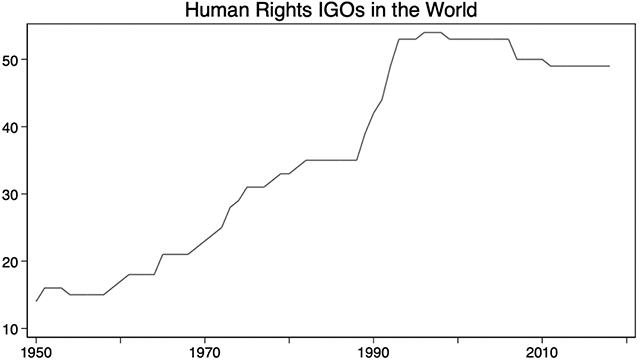
The sample is sizable and quite diverse, which allow us to make broader generalizations about our findings. That the sample is heterogeneous regarding types of international organizations also contributes to significant variation in the sovereignty costs generated by the organizations. At first blush, our sample of IOs may seem overly broad. However, this is by design, as a key part of our argument is that even organizations that do not have human rights as a central focus can impose significant sovereignty costs by linking the issue to their broader missions. At the end of this section, we discuss alternative sources of data and samples. Next, we turn to our measurement of those costs, which are determined by the extent of obligation, precision, and delegation.
Sovereignty Costs
There is no scholarly consensus on how to measure the sovereignty costs that a human rights organization imposes on member states. A notable first attempt was made by Cole (Reference Cole2009), who gauges the extent of a state’s obligation to three UN human rights treaties by a state’s level of membership (signing a treaty incurs weaker obligation than ratifying) and a treaty’s degree of surveillance for monitoring compliance. While Cole’s effort is valuable, it does not address the role that international organizations play in furthering the cause of human rights.
Coding such costs is one of our unique contributions. We code our sample of human rights IOs based on ten factors that are linked to the concepts of precision, delegation, and obligation. Each of these factors is coded as an indicator variable; these variables are then aggregated into an overall sovereignty cost score.
Precision depends on two factors: whether (1) there is a formal institution within the organization that focuses on human rights and (2) there are commitments grounded in specific and precise international laws, rather than general and aspirational language. These two variables are coded based on whether a given IO has a human rights-specific institution mandated by the organization and whether specific references to international human rights treaties or conventions exist in the international organization’s charter. For example, the Arab League has created the Permanent Arab Committee for Human Rights, a standing body of the League to consider human rights issues. This would add a point to the League’s sovereignty cost score.
Figure 2 shows the distribution of Precision scores across the human rights IOs in our sample (left panel) as well as the average across all IOs in the sample over time (right panel). The sample distribution is roughly uniform across the three possible values. The over-time comparison shows a decline in the presence of the Precision mechanisms from a little over 1.3 at its maximum to 1 in more recent years. The drop in Precision scores is due to the formation of new IOs since 1960 in which there has been slightly less precision, although its presence has stabilized since the early 1990s.
Sovereignty costs: Precision.
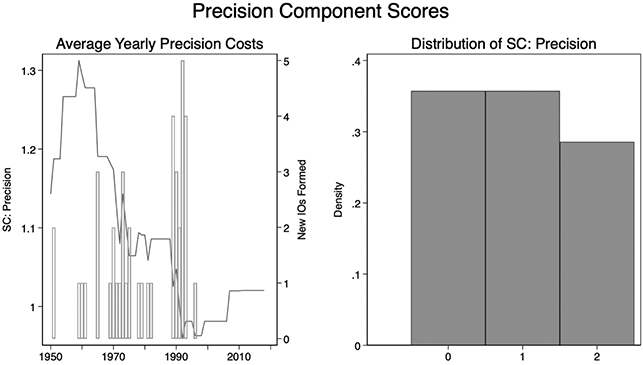
Figure 2 Long description
The right panel is a histogram plot with equal numbers of precision scores in 0 and 1 categories and slightly lower scores for category 2. The left panel shows the mean precision score in a time series graph that peaks in 1960 and falls until 2005, when it rises until the end of the series. The left panel has a bar graph underlay showing the number of human rights organizations founded each year. Most were founded between 1970 to 1995.
Four items tap Obligation. They address whether: (1) the IO has a built-in enforcement mechanism, (2) multiple issues are covered by the institution (facilitating issue linkage),Footnote 14 and membership is conditional on a state being (3) democratic or (4) committed to promoting human rights. For example, the Council of Europe scores highly on each of these four indicators. Its requirements about democracy and existing human rights practice, its multi-issue coverage, and its formal ties to the European Court of Human Rights contribute four points to the aggregate sovereignty cost index.
Figure 3 shows the distribution for the Obligation scores across the sample and over time. Compared to Precision and Delegation, less of the sample is marked by high levels of obligation. There is also less over-time variation in Obligation. In Sections 6 and 7, we examine whether any of these three indices perform differently in our models to assess whether these differences matter for choices to join these IOs or for their influence on human rights behavior.
Sovereignty costs: Obligation.
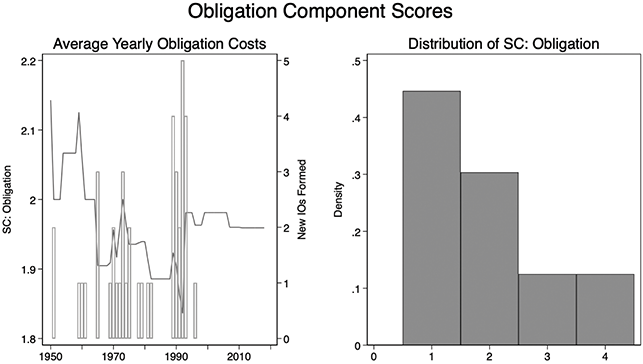
Figure 3 Long description
The right panel is a histogram plot of obligation scores. 1 is the most common score, followed by 2, then equal numbers of 3 and 4, both of which are the least common scores. The left panel shows the mean precision score in a time series graph, which peaks in 1950 and declines until 1965, then falls again in 1992 before rising back to a steady level in 1995. The left panel features a bar graph overlay showing the number of human rights organizations founded each year. Most were founded between 1970 to 1995.
Finally, four items capture Delegation. They measure whether the IO: (1) engages in formal reporting on human rights, (2) holds regular meetings concerning human rights, (3) can call ad hoc meetings on human rights, or (4) vests NGOs with authority in the human rights arena. Each of these indicators are assessed according to the language of an organization’s charter or governing document. For example, the Organization for Security Cooperation in Europe policies allow for all of these categories, including NGO activities regarding human rights; thus it receives a score of 4 in our coding.
Some scholars have argued that enforcement is the highest form of Delegation, not Obligation (e.g., Alter Reference Alter2008). On the one hand, because we use an additive index for our main analysis, the classification of each concept is not relevant to most of our findings. That said, we do assess the independent influences of each of our three categories of Sovereignty Costs in Sections 6 and 7. In those cases, the classification could be relevant. As we show in Appendix 4, however, whether enforcement is considered a part of Obligation or Delegation makes no difference in those findings.
Figure 4 shows the distribution of Delegation across our sample as well as the average global delegation score over time. The IO sample is distributed normally with a median around 2. Over time, there is a decline in the average across all IOs in the sample. As with Precision, this is not a large change (note the scale of the y-axis on the graph), but it reflects a tendency for IOs established from about 1965 to the early 1970s to exhibit a modest reduction in delegation.
Sovereignty costs: Delegation.
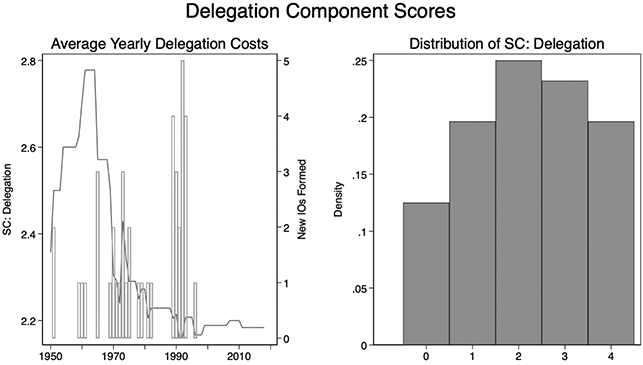
Figure 4 Long description
The right panel is a histogram plot with delegation scores. The distribution in the plot is normally distributed around the score of 2, but it is right-skewed with a slightly higher distribution of 3 and 4 scores versus 0 and 1. The left panel shows the mean precision score in a time series graph that peaks in 1965 and falls consistently until 2000, where it remains flat until 2018. The left panel has a bar graph underlay showing the number of human rights organizations founded each year. Most were founded between 1970 to 1995.
Clearly, the ten factors on which we focus not constitute an exhaustive list of the institutional design characteristics that affect sovereignty costs, but these features nonetheless play a crucial role in shaping such costs in the area of human rights. As we noted earlier, each of the ten items is assigned a score of 0 or 1 and each IO’s sovereignty costs are calculated (in the main analyses) as the sum of the scores across these ten items. We have no theoretical reason to disproportionately weight any of these factors and doing so would require us to become enmeshed in conceptual debates over the institutional design of human rights institutions that are beyond the scope of this study (Hafner-Burton, Mansfield, and Pevehouse Reference Hafner-Burton, Edward, Mansfield and Jon2015, 10–12). We thus use a simple additive index to measure Sovereignty Costs.
In Appendix 11, we provide a complete list of the IOs and their corresponding sovereignty cost scores. Figure 5 shows the distribution of the costs on our 0–10 scale for our entire sample of fifty-six IOs, as well as the average level of sovereignty costs in all IOs in the world over time. The modal IO is at the mid-point of the distribution of Sovereignty Costs. The global average of Sovereignty Costs appears to decline from about 1965 before stabilizing around 1980, although the drop is less than one point. Based on the previous graphs, it is clear this decline is driven by lower values of Precision and Delegation scores. Each of the time-series graphs of Sovereignty Costs and its components also includes a count of the founding of new organizations that claim to promote human rights. These bar graphs demonstrate that some of the larger movements of these scores occur when new organizations are formed. The implication is that many of these new organizations have lower Sovereignty Costs than the existing pool.
Note that we only code sovereignty costs in the year that a state accedes to a human rights IO. In all other years, sovereignty costs are assigned a value of 0. Note also that, while it is possible for an IO to receive a score of 0, none in our sample do so. The lowest observed value of Sovereignty Costs is 1. Consequently, there is no danger of confusing an IO marked by the complete absence of sovereignty costs (a score of 0) with the absence of entering a human rights IO (also a score of 0). For each organization, a higher score reflects greater precision, delegation, and/or obligation, and therefore higher sovereignty costs.
In the next two sections, we use these data to evaluate both the types of regimes that join high sovereignty costs organizations (Section 5), as well as the human rights behavior of those states that have elected to do so (Section 6).
Distribution of sovereignty costs across IOs and over time.
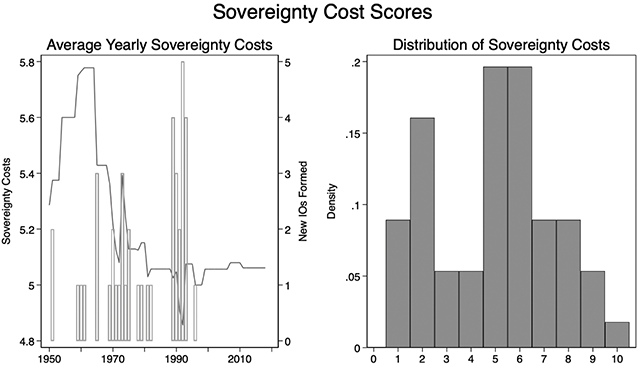
Figure 5 Long description
The left panel is a histogram plot with scores from 0 to 10. The most common scores are 5 and 6, followed by a score of 2. Scores 1, 7, and 8 are next with equal densities, followed by 3, 4, and 9. Score 10 is the least common. The right panel is a time series of aggregate scores reaching a peak in 1965, falling consistently until 1992, then rising back slightly in 1995, where it remains largely constant until 2018.
Alternative Concepts and Measures
There are multiple ways to measure the design features of an IO that could generate costs to members, and there are other datasets that seek to do so. Hooghe, Marks, Lenz, Bezuijen, Ceka, and Derderyan (Reference Liesbet, Marks and Lenz2017) developed the Measure of International Authority (MIA). This dataset, while innovative, does not tap sovereignty costs in the domain of human rights. Rather, it measures two concepts: delegation and pooling. While we also are interested in delegation, the MIA data does not code this for human rights in all cases where the IO expresses competencies in that issue area. MIA’s coding of pooling focuses on authority relations pertinent to an IO’s internal governance and decision making. In short, while the MIA data is valuable for many questions relating to international organizations, it is not fit for our study.
Another recent dataset, the International Authority Database (IAD), is closer to a measure of sovereignty costs (Zürn et al. Reference Zürn, Tokhi and Binder2021). The IAD focuses on “the functions that capture the external dimension of IO authority because IOs target and regulate state behavior by designing, setting, monitoring, enforcing, adjudicating, and reviewing substantive policies” (Zürn et al. Reference Zürn, Tokhi and Binder2021, 439). The IAD contains information on what the authors describe as a representative sample of 34 IOs, 16 of which cover human rights. However, this novel dataset covers only a fraction of our sample of human rights IOs. We believe by capturing a larger sample of organizations that purport to promote human rights, we can provide a more comprehensive test of our theory.
Another alternative data source on international organizations is the Regional Organizations Competencies (ROCO) data (Panke, Stapel, and Starkmann Reference Panke, Stapel and Starkmann2020). This dataset codes for what issues any organization includes in its mandate. The ROCO sample of organizations overlaps heavily with ours and includes a handful of additional organizations – most of which added human rights mandates well after their creation (e.g., the African Union, the Economic Organization of West African States, etc.). We thus take the additional organizations with human rights mandates from ROCO and code their attendant sovereignty costs, including this expanded sample below as a robustness check.
For these reasons, we focus our analyses in Sections 6 and 7 on the data sampling strategy we outlined in Section 5, and we take precautions to incorporate insights from these other sources where possible.
6 Predicting Membership in International Human Rights Organizations
In this section, we present a statistical analysis of state decisions to join human rights IOs with higher or lower sovereignty costs. This modeling is complicated by the need to separate a state’s decision to join any international organization with its decision about what type of IO to join. This requires a research design involving a multi-stage model.
A Statistical Model of Human Rights Institutions
To test our hypothesis about the influence of democratization on human rights institutions, we estimate the following model:
Joining HR Institutiont+1 = γ1Democratization + γ2Electoral Democracy +
γ3#Human Rights Institutions + γ4Years Independent + γ5#Military Conflicts +γ6ΔRegional Human Rights Institutions + γ7Time Since Last Joining + ε1 [1]
Sovereignty Costst+1 = β0 + β1Democratization + β2Electoral Democracy +
β3#Human Rights Institutions + β4Years Independent + β5#Military Conflicts +
β6 Y-hat: p of Joining HR Institution + ε2 [2]
In all our analyses, the unit of analysis is the country-year. To begin, we jointly address each state’s decision about whether to enter human rights institutions (equation 1) and the sovereignty costs associated with those institutions (equation 2). This is essential because past research has shown that democratizing states are more likely to join international institutions writ large (Mansfield and Pevehouse Reference Mansfield and Pevehouse2006). Thus, we want to separate the decision to join an institution in a general sense from the decision to join an institution with particular design features.
The dependent variable in the first stage (Joining HR Institution) is the log of the odds that country i joins a human rights institution in year t +1. We observe a 1 when a state joins a human rights institution. Otherwise, this variable is coded as 0.Footnote 15
The second stage dependent variable (Sovereignty Costs) is the sovereignty costs associated with any human rights institution that state i accedes to in year t + 1. If state i joins multiple human rights institutions in a given year, the sovereignty cost scores are summed across these institutions. If a state does not join a human rights institution in year t + 1, its sovereignty cost score for that year is 0. We measure both dependent variables in year t + 1 to avoid the possibility of direct reverse-causality (we further address identification concerns later in this section).
To measure each state’s regime type, we define Electoral Democracy as state i’s regime score in year t, based on the Variety of Democracies (V-DEM) project. This measure (also referred to as the polyarchy index) captures the extent to which “the ideal of electoral democracy” is achieved (Coppedge et al. Reference Coppedge, Gerring, Lindberg and Skaaning2017, 42). The measure is a continuous index ranging from 0 to 1, with 1 being an ideal-type democracy.
In both equations, Democratization equals 1 if, between year t-5 and year t, a state experiences a regime change leading it to become a democracy, which we define as moving from a regime score of less than 0.42 to a score equal to or greater than that value. Previous research using the V-DEM data identified this threshold as the preferred cutoff for measuring democracy (Kasuya and Mori Reference Kasuya and Mori2019).Footnote 16
As the most direct test of our theory, we expect the coefficient of Democratization to be positive in equation 2, since our argument is that states experiencing a democratic transition are especially likely to enter human rights institutions that impose higher sovereignty costs on members. Our expectations about Democratization in equation 1 are less clear: While our theory does not directly predict that democratic transitions will increase the probability of joining human rights institutions, past research has suggested this is the case (Mansfield and Pevehouse Reference Mansfield and Pevehouse2008).
We now turn to other variables that could confound the relationship between democratization and sovereignty costs. The decision to join a human rights institution is likely to be related to the existing set of such institutions to which a state already belongs (in year t). We therefore control for possible “ceiling” or “floor” effects in such membership. As a state participates in a growing number of human rights institutions, the marginal benefit of joining another one may decline. Further, the number of human rights institutions that a state does not belong to declines as it joins more organizations, thereby reducing the number of institutions that it could enter. As such, #Human Rights Institutions may be inversely related to the change in institutional memberships and sovereignty costs. Alternatively, this relationship may be direct. States that participate in a larger number of human rights institutions may be “joiners,” predisposed to enter as many of these institutions as possible (Mansfield and Pevehouse Reference Mansfield and Pevehouse2008). Conversely, states that belong to few human rights institutions may have an aversion to joining more.
Next, the presence of military conflicts may influence the democratization process while also influencing decisions about which (if any) human rights institution to join. To address this possibility, we include #Military Conflicts, which is the number of interstate or intrastate conflicts involving state i in year t. The data is drawn from the Uppsala Conflict Data Program.Footnote 17 Participants in a human rights institution may be reluctant to grant membership to a state involved in military disputes, since its belligerence could adversely affect the institution. Moreover, if there is a perceived tradeoff between national security and respect for individual liberties during times of conflict, it is unlikely that states would give priority to gaining membership in an institution that demands respect for human rights. This is especially likely to be true if the institution in question is intrusive (that is, generates higher sovereignty costs). Finally, if democratization is related to disputes, then it is important to account for military conflict as a possible confounder (Mansfield and Snyder Reference Mansfield and Snyder2002, Reference Mansfield and Snyder2005).
Next, Years Independent is the number of years state i has been an independent nation-state, as of year t, based on the date of independence furnished by the Correlates of War (COW) Project (Gleditsch and Ward Reference Gleditsch and Ward1999). Many newly independent states attempt to join international institutions early in their existence. There is also evidence that the time that has elapsed since independence is associated with transitions to democracy, suggesting that the variable should be included in our model to avoid conflating the influence of political independence and democratization (Pevehouse Reference Pevehouse2005).
Third, in equation 1, we add a count of the years since state i last joined a human rights institution, as of year t, to help account for temporal dependence in accession decisions (Beck, Katz, and Tucker Reference Nathaniel, Katz and Tucker1998). This variable also has important substantive interpretations as well. A negative coefficient of this variable (i.e., more time since the previous accession reduces the probability of joining a new institution) suggests states do not join human rights IOs in rapid succession, possibly due to a lack of state capacity. A positive coefficient (i.e., more time since joining raises the propensity to join) would suggest that states join institutions more quickly on the heels of previous accessions. Because this dynamic may be correlated with democratization, it is important to include this variable for both methodologically and substantively reasons.
Also in equation 1, we add ΔRegional Human Rights Institutions, which is the total number of changes in human rights IO memberships in the past year for the other states in the geographic region of state i (but excluding state i’s changes).Footnote 18 We include this variable as an instrument to help identify our two-stage model. We hypothesize that decisions to join human rights IOs are marked by geographic diffusion: As states surrounding state i join such institutions, state i becomes more likely to follow suit. Yet, we have no reason to believe this diffusion effect will influence state decisions about which institutions to join, including the extent of the sovereignty costs imposed by an IO. As such, we expect this instrument to satisfy the exclusion restriction.
In equation 2, the final variable we include is Y-hat: p of Joining HR Institution, which is the predicted probability that state i joins a human rights institution in year t, based on equation 1. This variable helps to address the possibility of endogeneity by controlling for the propensity to join a human rights institution. This allows us to more confidently control for the factors that drive a state to human rights IO accession apart from the factors that influence the sovereignty costs of the institution selected by the country. In short, we want to attend to the possibility that the same factors that drive a country to join a human rights institution are correlated with the decision to enter a high (or low) sovereignty cost institution.Footnote 19 Finally, each model contains a stochastic error term.
Descriptive statistics for the variables analyzed here are presented in Table 1. To estimate the first stage of the model, we use a logit specification with both country and year fixed effects. The second stage of the model is estimated using ordinary least-squares (OLS); it also includes country and year fixed effects. The fixed effects account for time invariant country-level factors and temporal shocks experienced by all states that could serve as confounders in our statistical models. Moreover, the year fixed effects allow us to control for factors like the yearly rises and declines in our Sovereignty Cost scores and their components. Our estimation sample contains observations beginning in 1950 and ending in 2018, the last year in which we have data for dependent variable in the following section.
| Variable | Mean | St Dev | Min | Max | N |
|---|---|---|---|---|---|
| Joining HR Institution | 0.157 | 0.364 | 0 | 1 | 9,368 |
| Time Since Last Joining | 4.939 | 5.605 | 0 | 57 | 9,368 |
| Democratization | 0.053 | 0.224 | 0 | 1 | 9,368 |
| Electoral Democracy | 0.425 | 0.289 | 0.009 | 0.922 | 9,368 |
| # Human Rights Institutions | 10.85 | 6.274 | 0 | 32 | 9,368 |
| Years Independent | 58.11 | 48.04 | 4 | 202 | 9,368 |
| # Military Conflicts | 0.237 | 0.666 | 0 | 7 | 9,368 |
| Sovereignty Costs | 1.045 | 3.620 | 0 | 58 | 9,368 |
| Δ Regional Human Rights Institutions | 6.277 | 13.199 | −54 | 90 | 9,368 |
| GDP per capita | 8.739 | 1.191 | 5.500 | 12.447 | 8,291 |
| Population | 2.080 | 1.680 | −2.699 | 7.264 | 8,291 |
| Human Rights Behavior | 0.246 | 1.470 | −3.391 | 5.336 | 8,291 |
Results
Table 2 presents the initial estimates of our models. The coefficient estimates in the first column refer to accession (the first stage model), while the coefficient estimates in the second column refer to sovereignty costs (the second stage model). In our first model, positive coefficients represent an increased probability of acceding to a human rights institution. The coefficient estimate of Democratization in the table’s first column is positive but not statistically significant at traditional levels (p < 0.05, although it is significant at the p < 0.10 level). Our theory does not predict the propensity of democratizing states to join all human rights organizations regardless of the sovereignty costs imposed. Indeed, if our theory is correct and newly democratic states are more selective about the institutions they join for signaling and credibility purposes, it is not clear we should expect them to enter all human rights organizations at a higher rate than other regime types.
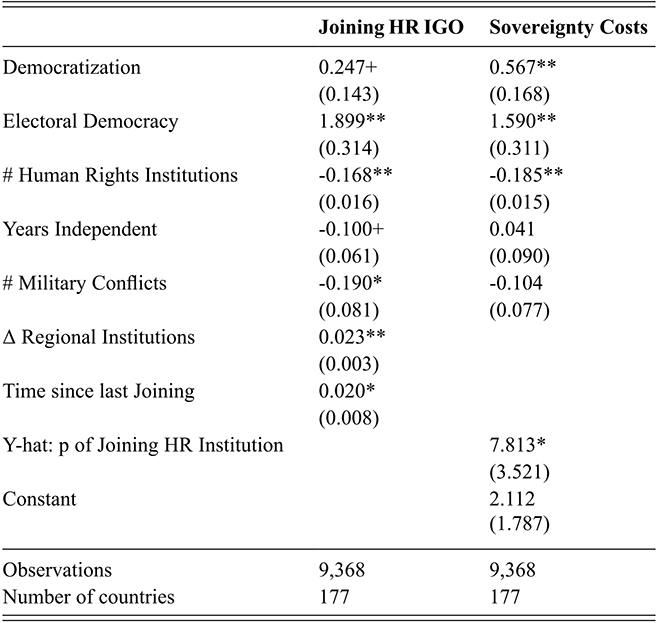
Table 2 Long description
The dependent variables are joining a human rights intergovernmental organization, sovereignty costs, and human rights behavior. Coefficients are reported with standard errors in parentheses. Statistical significance is indicated by plus signs for p less than 0.10, one asterisk for p less than 0.05, and two asterisks for p less than 0.01.
In the model predicting joining a human rights institution at t+1, democratization has a positive and statistically significant coefficient of 0.433 with a standard error of 0.166, significant at the 0.01 level. Electoral democracy has a positive and statistically significant coefficient of 1.774 with a standard error of 0.364, significant at the 0.01 level. The number of human rights institutions has a negative and statistically significant coefficient of negative 0.473 with a standard error of 0.042, significant at the 0.01 level. Years independent has a positive and statistically significant coefficient of 0.186 with a standard error of 0.016, significant at the 0.01 level. The number of military conflicts has a negative coefficient of negative 0.222 with a standard error of 0.099, significant at the 0.05 level. Change in regional memberships has a positive and statistically significant coefficient of 0.028 with a standard error of 0.004, significant at the 0.01 level. Time since last joining has a positive coefficient of 0.014 with a standard error of 0.008 and is significant at the 0.10 level.
In the model predicting sovereignty costs at t+1, democratization has a positive and statistically significant coefficient of 0.184 with a standard error of 0.086, significant at the 0.05 level. Electoral democracy has a positive and statistically significant coefficient of 0.901 with a standard error of 0.157, significant at the 0.01 level. The number of human rights institutions has a negative and statistically significant coefficient of negative 0.235 with a standard error of 0.016, significant at the 0.01 level. Years independent and the number of military conflicts are not statistically significant. The constant term is 2.252 with a standard error of 0.914 and is significant at the 0.05 level.
In the model predicting human rights behavior at t+1, human rights behavior at time t has a strong positive and statistically significant association, with a coefficient of 0.937 and a standard error of 0.004, significant at the 0.01 level. Predicted sovereignty costs have a positive and statistically significant coefficient of 0.086 with a standard error of 0.043, significant at the 0.05 level. The predicted probability of joining a human rights institution is not statistically significant. Logged population has a negative and statistically significant coefficient of negative 0.092 with a standard error of 0.015, significant at the 0.01 level. Logged GDP per capita has a small and statistically insignificant coefficient. The constant term is negative 0.046 with a standard error of 0.147 and is not statistically significant.
The joining and sovereignty cost models include 9,368 observations and 177 countries. The human rights behavior model includes 8,291 observations and 160 countries. Membership in human rights intergovernmental organizations classified as emanations is excluded from the sample.
Standard errors in parentheses; standard errors for the Y-hat p of Joining HR Institution variable are bootstrapped; ** p < 0.01, * p < 0.05, + p < 0.10
The estimates of other variables accord with prior findings. More democratic states are more likely to join human rights organizations, a higher number of existing memberships lowers the probability of joining further organizations (evidence of a ceiling effect), increasing memberships to these organizations in a state’s region leads to an increase probability of joining (evidence of a diffusion effect), while the presence of military conflicts decreases the probability of accession. Longer time as an independent state appears to have little bearing on accession.
The core purpose of this model, however, is to generate an instrument for the probability of a country joining a human rights organization. Doing so helps to control for factors that may also be correlated with the sovereignty costs in human rights organizations that a state is willing to bear. We thus use the predicted value of the propensity to join a human rights organization taken from this model and labeled Y-hat: p of Joining HR Institution and introduce it into the second stage of the model.
The estimates in the second column represent the correlates of the sovereignty costs accepted by states as they join human rights organizations. Our central hypothesis is that democratizing states will be more likely to incur higher sovereignty costs than other countries. The estimated coefficient of Democratization is positive and statistically significant, which strongly supports this claim. Not only do states that have recently undergone a democratic transition display a greater tendency to enter higher sovereignty cost human rights institutions than any other type of country but these effects are also substantively large as well. Based on our estimates, for example, a state transitioning to democracy selects institutions that impose about fifty percent higher sovereignty costs than IOs selected by countries that are not democratizing.Footnote 20
We also find that the estimate of Y-hat p of Joining HR Institution is positive and statistically significant, indicating that a higher propensity to join a human rights institution is positively correlated with the level of sovereignty costs. Again, including this variable helps to address the possibility that the effects of democratization are exerted via the likelihood of joining a human rights IO, rather than directly influencing the level of sovereignty costs that a country accepts.
Turning to the control variables in the second stage of the model, we find a similar ceiling effect based on the estimate of #Human Rights Institutions. A higher number of existing memberships is associated with lower sovereignty costs, perhaps due to a reduced need to demonstrate a commitment to human rights. Higher levels of democracy (Electoral Democracy) are correlated with joining higher sovereignty cost institutions, a result that reflects the priority that most democracies place on human rights.
Military disputes appear to have little bearing on the sovereignty costs accepted by those states who join human rights institutions. The estimate of Military Conflicts is negative but not statistically significant in the second stage of the model. Finally, Years Independent also has no bearing on the level of sovereignty costs accepted by states.
Robustness Checks and Further Explorations
Our initial results indicate that democratizing states are drawn to human rights IOs that impose high sovereignty costs on members. However, it is important to ensure that our findings are not an artifact of how we measured regime type. To that end, we conduct an additional analysis using an alternative measure of regime type. We use the Episodes of Regime Transition (ERT) coding to identify episodes of democratization occurring from year t-5 to year t (Edgell et al. Reference Edgell, Maerz and Maxwell2020). In Appendix 10, we show that our model is robust to the use of this different measure of regime change, bolstering confidence that our findings are not an artifact of the V-DEM measurement strategy.
Next, we want to ensure that any tendency to join human rights organizations, especially those with high sovereignty costs, does not stem from existing human rights practices in a state. This is essential since regime type and changes in regime type are also correlated with human rights practices. Moreover, as highlighted by Hathaway (Reference Hathaway2007), a state’s existing record of human rights protection might affect its entrance into human rights institutions. For instance, states with relatively poor human rights records may eschew human rights institutions, especially ones that impose high sovereignty costs. We thus introduce Human Rights Behavior, which is generated by using Fariss’s (Reference Fariss2014) latent variable model of human rights behavior to create scores for states until 2019.Footnote 21
As shown in Appendix 3, including this new variable has no influence on our previous estimates, although the variable itself is statistically significant in the second (Sovereignty Cost) stage of our model. These results indicate that a state’s extent of repression does not influence membership changes in its overall portfolio of human rights institutions. As such, human rights practices do not seem to influence membership patterns in human rights institutions, contrary to what some studies suggest (Hathaway Reference Hathaway2003). And although human rights practices do predict higher levels of Sovereignty Cost acceptance, accounting for this does not change the influence of Democratization on the acceptance of those costs. We also examined the interaction between Democratization and Human Rights Behavior and found no evidence that this interaction helps to explain either the decision to join human rights institutions or the level of Sovereignty Costs accepted by new member states. As shown in Appendix 3, the interaction term is not statistically significantly different from zero and has no discernable influence in either stage of the model.
Next, to ensure our findings are not an artifact of including IO emanations, we remove them from our sample of institutions. Membership in certain emanations is automatic when a state enters the parent organization. Including these emanations in our sample is entirely appropriate since governments understand that the decision to join the parent IO is also a decision to join the emanation and these emanations involve the promotion or protection of human rights. Nonetheless, to make sure their inclusion does not influence our results, we re-estimate our model after excluding membership in these institutions.
As shown in the first two columns of Appendix 2, the estimated coefficient of Democratization is positive and statistically significant in the first two stages of our model. The coefficient estimate of Democratization is smaller in the sovereignty cost stage of the model than in our previous analysis, but this is to be expected. In some ways, emanations can be viewed as another measure of sovereignty costs. States joining the OSCE, for example, recognize that they are also becoming members of the Office for Democratic Institutions and Human Rights. Both institutions may serve to lock in the democratization process. Having different institutions embedded within an organization can serve to increase the likelihood that it will enforce conditionality, investigate backsliding, or otherwise increase sovereignty costs associated with membership.
We also address the possibility that our findings about institutions are driven by the EU, which has a long-standing commitment to human rights and several emanations that promote norms of justice. As we show in Appendix 1, after removing all EU (or previously EC) members from the sample, the estimates of Democratization in both stages of the model are roughly the same size as our initial estimates. Thus, our results are not being driven by the EU.
Next, out of a concern for omitted variable bias, we re-estimate our model after including Former Communist, which indicates whether countries were formerly communist bloc states during the Cold War. We do so because many of the countries that both democratize and join human rights institutions in the later portion of our dataset are former communist states. While these cases are certainly consistent with our theoretical argument, we want to ensure our results are not unduly influenced by them. As we show in Appendix 5, however, this is not the case. The estimates of Former Communist are positive and statistically significant in both stages of the model, but the estimates of Democratization remain positive and statistically significant in the Sovereignty Cost stage as well. Thus, while a country’s status as a former communist state does seem to be correlated with joining more human rights organizations and accepting higher sovereignty costs, that relationship is not the source of the observed effects of democratization.
We then examine whether our findings are robust to the inclusion of additional institutions that deal with human rights. As discussed in Section 5, we supplement our sample of human rights organizations with those from the ROCO data (Panke, Stapel, and Starkmann Reference Panke, Stapel and Starkmann2020). We code their additional organizations (listed in Appendix 11) on the ten dimensions of our Sovereignty Costs measure. As we show in Appendix 7, the addition of these organizations makes no discernable difference to our previous results, indicating that our findings are not an artifact of our sample. Democratization remains positive and statistically significant in the Sovereignty Cost stage.
Finally, we further examine our measure of sovereignty costs. Recall that our measure is an index composed of three factors that compose sovereignty costs: Precision, Obligation, and Delegation. While our main results focus on the summary index, we investigate whether any of these three dimensions drives the influence of democratization on sovereignty costs in the second stage of our model. We thus re-estimate the second stage of our model using only the portion of the Sovereignty Cost score due to Precision, Obligation, and Delegation, respectively. The results, shown in the first, fifth, and eighth columns in Appendix 4, show that Democratization is strongly correlated with all three aspects of sovereignty costs.Footnote 22 In each case, the estimated coefficient of Democratization is positive and statistically significant, and there are few changes to the estimates of the control variables. Thus, there is no specific aspect of our index that accounts for our results.
Related to this test, we re-estimate our Obligation and Delegation models after moving our measure of enforcement from the former to the latter category. The results, found in columns three and ten of Appendix 4, show consistency with our previous estimates of these two categories of Sovereignty Costs.
Recall that in cases where a state joins multiple human rights IOs in a given year, Sovereignty Costs is computed as the sum of the sovereignty costs across those organizations. As a final robustness check, we recompute Sovereignty Costs at the maximum value for any individual IO of these costs. The results, found in Appendix 6, show that while these new computations attenuate the coefficient of Democratization in the second stage of the model, its estimate remains positive and statistically significant.
Next, there could be a concern that our results are due to dynamics that are specific to a particular time period. For example, the post–Cold War system saw an increase in international organizations and democracies. To ensure our findings are not influenced by this period, we re-estimate our model excluding the years 1990–2010. The resulting estimates, shown in the first and second columns of Appendix 9, do not differ from our previous findings regarding the relationship between Democratization and Sovereignty Costs.Footnote 23
Finally, we return to the question of courts – a delegation mechanism often held to significantly increase sovereignty costs in organizations. It is possible that these powerful institutions influence our results since our sample includes the most significant human rights courts. To ensure this is not the case, we re-estimate our model excluding the courts in our sample from Sovereignty Costs. As shown in Appendix 8, excluding these courts has little bearing on our estimates. To further probe this idea, we also introduce a separate control for membership in international courts. Those estimates, also found in Appendix 8, shows that this new variable (labeled Courts) has no bearing on our existing findings.
Taken together, our results show that democratizing states accept higher sovereignty costs than other states. This holds while controlling for the choice to enter a human rights institution in the first place. Our findings are also robust to several changes in measurement of Democratization and Sovereignty Costs, as well as changes to our sample and the addition of potential omitted variables. We are thus confident that democratizing states purposefully enter human rights-oriented institutions that extract higher potential sovereignty costs.
The next issue that we address is whether membership in these high sovereignty cost organizations actually improves human rights practices in the countries that join them.
7 The Effect of High Sovereignty Costs on Behavior
Our theory suggests that higher sovereignty cost organizations promote better human rights practices in member states. This section examines the empirical support for this hypothesis using the same dataset we previously analyzed.
A Statistical Model of Human Rights Behavior
To test our hypothesis about the influence of institutional sovereignty costs on human rights outcomes, we estimate the following statistical model, which builds on our previous models of membership in human rights organizations and their attendant sovereignty costs.
Human Rights Behaviort+1 = γ0 + γ1Human Rights Behaviort +
γ2Y-hat: Sovereignty Costs + + γ3Democratization + γ4Electoral Democracy +
γ5Population (ln) + γ6GDP per capita (ln) + γ7#Human Rights Institutions + ε [3]
As with our earlier models, the unit of analysis is the country-year. To construct our dependent variable, we use Fariss’s (Reference Fariss2014) latent variable model of human rights behavior to generate scores for a large cross-section of states between 1946 and 2019. Fariss points out that this variable, which we label Human Rights Behavior, accounts for changes in a country’s human rights behavior, but also adjusts for changing standards of accountability over time. Consequently, ratings of countries may change because of shifts in state behavior, but also because of shifting human rights standards adopted by the international community or others who evaluate this behavior (e.g., the United States Department of State).Footnote 24
We continue to include both year and country fixed effects in this model. Doing so accounts for unobserved heterogeneity across counties that might influence changes in their human rights behavior. It also accounts for factors that occur at the global level and that could influence the behavior of various countries at a given point in time. Moreover, to lessen concerns about reverse causality, we analyze our outcome in year t+1, while all covariates are analyzed in year t.
Our key independent variable – Y-hat: Sovereignty Costs – is the predicted sovereignty costs associated with any human rights IO that state i accedes to in year t+1.Footnote 25 To compute this variable, we take the predicted value of Sovereignty Costs from stage 2 of the model analyzed in Section 6. In other words, rather than take the actual level of sovereignty costs accrued by joining an institution, we compute the predicted value based on our previous model. We do so out of concern that the value of Sovereignty Costs is not generated at random and thus could be endogenous. By using this instrumental variable strategy, we can be more confident in the estimated effects of sovereignty costs on human rights behavior because the main sources of selection into high sovereignty cost organizations are controlled for.Footnote 26
Model 3 also includes some control variables that were not analyzed previously. Although there are several different specifications in the literature for models of state repressive behavior, we follow Fariss’s (Reference Fariss2014, fn. 21) model. We subject this model to alternative specifications later in this section and in the appendix to assess the robustness of our results. Our principal concern driving model specification is the inclusion of confounders which would correlate with both state repression and accession to human rights international organizations.
To control for regime type, we include Democratization and Electoral Democracy, as previously defined in Section 5 and measured in year t. Past research has shown that regime type and democratization are key determinants of human rights behavior, as well as membership in both international institutions covering human rights and high sovereignty cost institutions.Footnote 27
Next, the natural logarithm of both Population and GDP per capita are introduced since they typically appear in models of human rights compliance (Fariss Reference Fariss2014).Footnote 28 These two variables serve as proxies for the ease of repression and state capacity, respectively.
Fourth, we include a lagged endogenous variable to control for previous levels of Human Rights Behavior. Although our model contains both country and year fixed effects, we include this variable since for most countries in Fariss’s data, human rights behavior scores are relatively sticky, changing only gradually over time. The fact that the estimates of this variable are consistently large and statistically significant indicates that fixed effects alone are not able to fully account for the autoregressive nature of Human Rights Behavior.
Finally, because entry into a given human rights IO is undoubtedly related to the number of organizations to which state i is already a member, we include #Human Rights Institutions. As a state participates in a growing number of human rights IOs, the marginal benefit of joining another one may decline. Further, as the number of human rights IOs that it does not belong to falls, so does the number that it could enter. Alternatively, states that participate in numerous human rights organizations may be “joiners,” predisposed to accede to as many of these institutions as possible. Those that belong to few human rights organizations may have an aversion to joining more.
Results
All models are estimated using ordinary least squares. Table 3 presents some initial results.Footnote 29 In each case, the estimated coefficient of Y-hat: Sovereignty Costs is positive and statistically significant, indicating that joining higher sovereignty cost IOs leads to greater improvements in the human rights outcomes of new members than joining lower cost IOs.
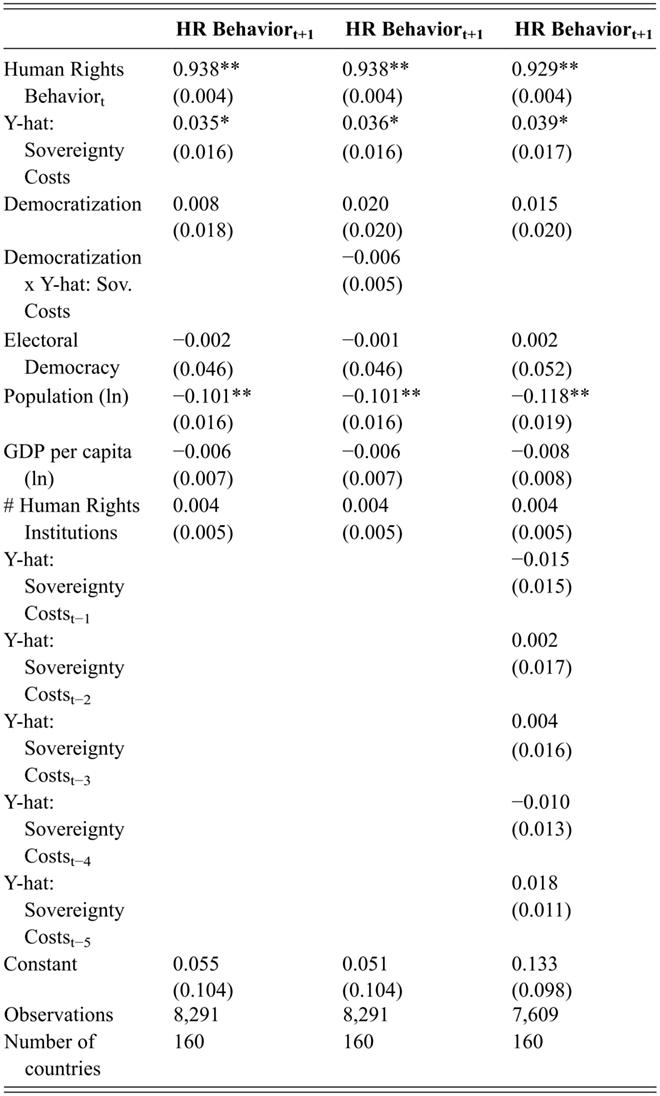
Table 3 Long description
Appendix 3, columns 1 through 3, presents regression results examining the effects of democratization, electoral democracy, human rights institutions, and other controls on joining human rights intergovernmental organizations (HR IGOs), sovereignty costs, and subsequent human rights behavior. It adds prior human rights behavior to all three stages. Standard errors are reported in parentheses, and significance is indicated as ** p<0.01, * p<0.05, and + p<0.1. Observations range from 8,291 to 9,326, covering 160 to 176 countries.
For joining HR IGOs at t+1 (n = 9,326; 176 countries): democratization has a coefficient of 0.257 with a standard error of 0.144, marginally significant at p<0.1. Electoral democracy has a coefficient of 1.797 with a standard error of 0.321, significant at p<0.01. The number of human rights institutions has a coefficient of -0.178 with a standard error of 0.017, significant at p<0.01. Years independent has a coefficient of -0.100 with a standard error of 0.060, marginally significant at p<0.1. The number of military conflicts has a coefficient of -0.142 with a standard error of 0.084, marginally significant at p<0.1. The change in regional memberships has a coefficient of 0.022 with a standard error of 0.003, significant at p<0.01. Time since last joining a HR IGO has a coefficient of 0.018 with a standard error of 0.008, significant at p<0.05. Prior human rights behavior has a coefficient of 0.112 with a standard error of 0.058, marginally significant at p<0.1. The constant term is 2.391 with a standard error of 1.794, not significant.
For sovereignty costs at t+1 (n = 9,326; 176 countries): democratization has a coefficient of 0.604 with a standard error of 0.168, significant at p<0.01. Electoral democracy has a coefficient of 1.406 with a standard error of 0.319, significant at p<0.01. The number of human rights institutions has a coefficient of -0.196 with a standard error of 0.016, significant at p<0.01. Years independent has a coefficient of 0.034 with a standard error of 0.090, not significant. The number of military conflicts has a coefficient of -0.032 with a standard error of 0.081, not significant. The predicted probability of joining a HR institution has a coefficient of 8.134 with a standard error of 3.904, significant at p<0.05. Prior human rights behavior has a coefficient of 0.167 with a standard error of 0.056, significant at p<0.01. The constant term is 0.071 with a standard error of 0.112, not significant.
For human rights behavior at t+1 (n = 8,291; 160 countries): democratization has a coefficient of 0.011 with a standard error of 0.020, not significant. Electoral democracy has a coefficient of 0.015 with a standard error of 0.045, not significant. The number of human rights institutions has a coefficient of 0.003 with a standard error of 0.006, not significant. Prior human rights behavior strongly predicts subsequent behavior, with a coefficient of 0.933 and a standard error of 0.006, significant at p<0.01. The predicted sovereignty cost has a coefficient of 0.028 with a standard error of 0.013, significant at p<0.05. Population, logged, has a coefficient of −0.101 with a standard error of 0.016, significant at p<0.01. GDP per capita, logged, has a coefficient of −0.006 with a standard error of 0.007, not significant. The constant term is 0.071 with a standard error of 0.112, not significant.
Appendix 3, columns 4 through 6, presents regression results examining the effects of democratization, electoral democracy, human rights institutions, prior human rights behavior, and the interaction between democratization and prior human rights behavior on joining human rights intergovernmental organizations (HR IGOs), sovereignty costs, and subsequent human rights behavior. Standard errors are reported in parentheses, and significance is indicated as ** p<0.01, * p<0.05, and + p<0.1. Observations range from 8,291 to 9,326, covering 160 to 176 countries.
For joining HR IGOs at t+1 (n = 9,326; 176 countries): democratization has a coefficient of 0.256 with a standard error of 0.144, marginally significant at p<0.1. Electoral democracy has a coefficient of 1.797 with a standard error of 0.321, significant at p<0.01. The number of human rights institutions has a coefficient of -0.178 with a standard error of 0.017, significant at p<0.01. Years independent has a coefficient of −0.099 with a standard error of 0.060, not significant. The number of military conflicts has a coefficient of -0.142 with a standard error of 0.084, marginally significant at p<0.1. The change in regional memberships has a coefficient of 0.022 with a standard error of 0.003, significant at p<0.01. Time since last joining a HR IGO has a coefficient of 0.018 with a standard error of 0.008, significant at p<0.05. Prior human rights behavior has a coefficient of 0.107 with a standard error of 0.058, marginally significant at p<0.1. The interaction between democratization and prior human rights behavior has a coefficient of 0.086 with a standard error of 0.134, not significant. The constant term is 2.402 with a standard error of 1.795, not significant.
For sovereignty costs at t+1 (n = 9,326; 176 countries): democratization has a coefficient of 0.601 with a standard error of 0.169, significant at p<0.01. Electoral democracy has a coefficient of 1.404 with a standard error of 0.319, significant at p<0.01. The number of human rights institutions has a coefficient of −0.196 with a standard error of 0.016, significant at p<0.01. Years independent has a coefficient of 0.034 with a standard error of 0.090, not significant. The number of military conflicts has a coefficient of −0.032 with a standard error of 0.081, not significant. The predicted probability of joining a HR IGO has a coefficient of 8.158 with a standard error of 3.911, significant at p<0.05. Prior human rights behavior has a coefficient of 0.170 with a standard error of 0.057, significant at p<0.01. The interaction between democratization and prior human rights behavior has a coefficient of −0.074 with a standard error of 0.155, not significant. The constant term is 0.061 with a standard error of 0.111, not significant.
For human rights behavior at t+1 (n = 8,291; 160 countries): democratization has a coefficient of 0.009 with a standard error of 0.020, not significant. Electoral democracy has a coefficient of 0.010 with a standard error of 0.044, not significant. The number of human rights institutions has a coefficient of 0.004 with a standard error of 0.006, not significant. Prior human rights behavior strongly predicts subsequent behavior, with a coefficient of 0.933 and a standard error of 0.006, significant at p<0.01. The predicted sovereignty cost has a coefficient of 0.032 with a standard error of 0.016, significant at p<0.05. Population, logged, has a coefficient of −0.101 with a standard error of 0.016, significant at p<0.01. GDP per capita, logged, has a coefficient of −0.006 with a standard error of 0.007, not significant. The constant term is 0.061 with a standard error of 0.111, not significant.
Standard errors in parentheses; for all Y-hat variables, standard errors are bootstrapped; **p < 0.01, * p < 0.05, + p < 0.1
The influence of Y-hat: Sovereignty Costs is substantively significant as well. Based on the results in column 1 of Table 3, predicted human rights behavior improves by about 0.5 in the year after joining an IO with a sovereignty cost score of 6. While this might seem to be a modest rise, it is substantively meaningful since Human Rights Behavior ranges from −3.3 to 5.3, with a mean of 0.26. Further, a change from not joining a human rights IO to joining one marked by the maximum sovereignty cost score nearly doubles the value of its human rights behavior score.
It is notable that few of the control variables influence changes in human rights behavior. Larger values of Population are correlated with lower human rights scores, but no other variable’s estimated coefficient is statistically significant. This could be due to the conservative nature of our model: With a lagged dependent variable and both year and country fixed effects, there is little variation unaccounted for (R2 for the model is 0.97). Still, even given this specification, Y-hat: Sovereignty Costs achieves statistical significance.
While these findings strongly suggest that joining high sovereignty cost IOs improves human rights, we further probe the results with some additional tests. Initially, we address a key question related to our theory: If higher sovereignty cost IOs improve human rights behavior, do they do so for the democratizing states that we previously showed are more likely to join these organizations? To analyze this issue, we include the interaction between Democratization and Y-hat: Sovereignty Cost. If new democracies benefit disproportionately from higher sovereignty costs, we should see a statistically significant association between this interaction term and human rights behavior.
The results of this test are shown in the second column of Table 3. Interestingly, while the estimated coefficient of Y-hat: Sovereignty Cost remains positive and statistically significant, the interaction term is not statistically significant; nor does computing the predicted marginal effects of the interaction term yield any evidence of a conditional relationship. Thus, the relationship between sovereignty costs and improvement in human rights behavior is not conditioned by whether the country is democratizing.
This result is good news for those interested in promoting human rights. The effects of joining high sovereignty cost IOs on improvements in human rights behavior are not restricted to states that are democratizing. Instead, all states that join high sovereignty cost institutions appear to improve their human rights behavior.Footnote 30
Additional Tests and Considerations
As with any study attempting to assess the effects of institutions, it is important to address whether our results are threatened by endogeneity. Various observers have pointed out that international institutions should be treated as endogenous if the very behavior they regulate is a key factor shaping which states joining them (Downes, Rocke, and Barsoom Reference Downs, Rocke and Barsoom1996; von Stein Reference von Stein2005). In our case, it is possible that states with better (worse) human rights records select themselves into higher (lower) sovereignty cost organizations. We have taken several steps to avoid this possibility in order to make our analysis as clean as possible, but we also recognize that achieving strong causal identification in this case is extremely difficult.
As we noted earlier, we addressed this issue by instrumenting for the decision to join IOs. Thus, we have attempted to account for the nonrandom selection into high sovereignty cost IOs by modeling it directly and controlling for the propensity to join such organizations. Recall that rather than measure Sovereignty Costs directly for each state, we use the predicted value of Sovereignty Costs based on the model presented in Section 6.
We also contend, however, that the theoretical concern about endogeneity may be overstated. The classic argument about nonrandom selection into IOs suggests that only well-behaved states and states confident they can improve human rights would join demanding institutions (Downes, Rocke, and Barsoom Reference Downs, Rocke and Barsoom1996). Yet, in the human rights arena, various studies have found that well-behaved states often do not join international regimes and that poorly behaved states frequently do enter them (Moravscik Reference Moravcsik2000; Hathaway Reference Hathaway2002). Moreover, some observers argue that states that strongly resist human rights improvements are particularly likely to join human rights institutions (Hollyer and Rosendorff Reference Hollyer and Rosendorff2011a).Footnote 31 Thus, if selection creates a bias, its direction is theoretically indeterminate.
Moreover, recall that as a robustness check in Section 6 (found in Appendix 3), we added a measure of human rights behavior in the first two stages of our model (the choice to join an IO and the choice of level of sovereignty costs). Even when controlling for any influence of existing behavior on Sovereignty Costs, the predicted value of those Sovereignty Costs is still a statistically significant influence on improvements in human rights behavior. This result can be found in the final column of Appendix 3.
As an additional precaution, we estimate a model controlling for the act of joining a human rights IO, regardless of its level of sovereignty costs. To ensure that the observed effects of sovereignty costs do not simply reflect the influence of joining a human rights IO, we re-estimate the model after adding an indicator variable coded as 1 if a state joins a human rights IO in year t and 0 otherwise. This variable does not achieve statistical significance; nor does it affect the statistical significance or sign of the coefficient of Y-hat: Sovereignty Costs. Hence, changes in human rights behavior are being driven by sovereignty costs and not by a state joining any human rights IO.
Finally, in terms of robustness, we replicated all our measurement and omitted variable bias checks in Section 6 (Appendices 1–10). Our results reveal that the correlation between Y-hat: Sovereignty Costs and human rights behavior is robust to the exclusion of the EU from our sample, excluding emanations, including an indicator for former communist states, changing our measure of regime change, and controlling for existing human rights behavior.
Disaggregated and Intertemporal Effects
Recall that in Section 6 we investigated whether any single component of our Sovereignty Cost measure (Precision, Obligation, or Delegation) was responsible for the observed effects of Democratization on Sovereignty Costs. We showed (Appendix 4) that all three components were highly correlated with Democratization. In that same Appendix, we also use the predicted values of those three models (one for each component) to assess whether any of the three components had an independent effect on human rights behavior.
More specifically, we re-estimate our model of human rights behavior after replacing the aggregate measure of Y-hat: Sovereignty Costs with the respective predicted scores for Precision, Obligation, and Delegation. The estimated coefficient of each of these three variables, when introduced individually, is positive and statistically significant, indicating that all three features of sovereignty costs influence a state’s human rights behavior.Footnote 32 This finding holds regardless of whether we classify enforcement in the category of Obligation or Delegation.
Our statistical models have estimated the short-run effects of human rights institutions in the year after accession. But joining high sovereignty cost human rights organizations may have longer-term effects as well. Either through increasing reputational effects over time, a lag in some aspects of implementation through domestic legislation, or a slow shift in domestic norms or policies relating to compliance, there are reasons to expect that the total influence of an institution may not be realized in the immediate aftermath of accession. Although this point has been made repeatedly in the theoretical literature on human rights institutions, it is rarely assessed empirically.Footnote 33 We therefore re-estimate our model after adding five additional one-year lags (in t-1, t -2, t -3, t -4, and t -5) of sovereignty costs to capture any over-time effects in changing human rights behavior.Footnote 34
The estimates presented in column 3 of Table 3 indicate that the estimated coefficient of our original measure of Sovereignty Costs (at time t since our measure of human rights behavior is led by one year) remains nearly identical to that of our earlier results. None of the extended temporal lags (t-1 to t-5) achieve statistical significance. It thus appears that the effect of Y-hat: Sovereignty Costs on human rights behavior is relatively short-lived. This is surprising since existing arguments suggest that the most effective international instruments to promote human rights are ones that are integrated into a country’s domestic institutions and practices (Schimmelfennig Reference Schimmelfennig2005; Simmons Reference Simmons2009). One possibility is that previous analyses have largely focused on the treaty regime, which often lacks firm enforcement mechanisms, and our analysis examines IOs. One of our central arguments is that high sovereignty cost IOs possess the ability to better monitor and enforce human right standards. Should this happen, it appears it is a short-term effect that is not present in the longer run (at least when controlling for previous effects).
8 Conclusion
The rise of international human rights institutions has spawned a vigorous debate in the fields of international relations and international law. Many observers contend that these institutions create strong legal and normative structures that heavily shape state behavior, and thus that they tend to attract members that seek better (or already protect) human rights. Others hold that these institutions are often inconsequential and thus widely attract members that intend to violate human rights. This study engages the debate by exploring what types of states join what types of institutions. By developing a new dataset of human rights organizations and mapping variation in the sovereignty costs associated with participation in those organizations, we tested several propositions concerning what provides the impetus for state membership in human rights institutions. We found not only that democratization prompts countries to join IOs with higher sovereignty costs but also that these more stringent institutions are more likely to improve the human rights behavior of member states than those with lower sovereignty costs, no matter what the regime type of the member.
In exploring the question of who joins human rights organizations, in Section 2, drew on the logics of credible commitments, signaling, and inducements, all of which led us to expect that transitions to democracy spur states to join human rights institutions that impose substantial sovereignty costs on members. We generated an index of sovereignty costs associated with membership in human rights institutions, which we discussed conceptually in Section 3 and explored descriptively in Section 5. Consistent with the literature on legalization in international institutions, our notion of sovereignty costs includes variation in the precision, obligation, and delegation required by the organizations.
Our statistical analysis of who joins human rights organizations (Section 6) yielded substantial support for our argument that democratizing states are more likely to join higher sovereignty cost institutions, even when controlling for their underlying propensity to join any human rights institution. This correlation holds across a variety of model specifications, measurements of democratization, and after distinguishing the three different aspects of sovereignty costs.
We also tackled the much thornier question of whether human rights institutions improve state respect for human rights. We theorized in Section 4 that variation in obligation, precision, and delegation will influence the human rights performance of member states, regardless of their domestic regime type. A large and growing number of IOs claim to incorporate the promotion of human rights into their formalized goals. These organizations often have substantial power over member states.
Using our data on sovereignty costs, in Section 7, we examined whether and how these IOs can improve human rights on the ground. We found significant support for the argument that membership in IOs marked by higher sovereignty costs tends to stimulate improvements in human rights. By contrast, joining IOs that impose few sovereignty costs does little to incentivize the membership to comply with the rhetoric. This finding is robust to the inclusion of a series of control variables and alternative statistical models. We also showed that the correlation holds when attempting to instrument for joining higher sovereignty cost institutions. Equally, we found no evidence that state selection into low or high sovereignty cost organizations account for our findings.
Further, it is not only democratizing states that join higher sovereignty cost institutions that improve their human rights behavior. This is good news. Regardless of regime type, states joining a higher sovereignty cost institution can experience improvements in human rights practices. Given the rising resistance to the liberal international order, including the possibility that liberal institutions themselves are creating some of the resistance (Börzel and Zürn Reference Börzel and Zürn2021), our findings suggest what could be lost by allowing these institutions to be eliminated or redesigned to reduce their sovereignty costs.
Our findings bear on debates about whether human rights instruments are effective, as well as debates about the optimal design of those regimes. Furthermore, they speak directly to the wisdom of linking human rights to other, often more powerful, institutions outside the body of international treaties designed to promote the issue. Unless IOs impose significant sovereignty costs, discussions of human rights remain largely empty rhetoric.
Our research has a variety of important implications. First, the design of human rights IOs tends to screen in or screen out certain types of states. Of the many drivers that could lead a state to join or reject an organization, the costs and benefits associated with the formally stated rules and procedures are crucial and a state’s regime type plays a significant role in shaping the incentives to join IOs with stated human rights goals. While we cannot fully disentangle the motives for taking on these high costs, there appear to be at least three: a desire to solve domestic time inconsistency problems and lock in commitments at home to signal to a domestic audience; a desire to placate or signal to other, more powerful international actors that both promote human rights norms and hold purse strings they are not afraid to use; and, related, to signal that a state is part of the liberal international order. Our findings are noteworthy because so much of the literature has focused on treaties and other factors without taking into consideration the oftentimes much more powerful (yet variable) role IOs can play in terms of leveling sovereignty costs.
Second, this research contributes to ongoing debates not only over whether international human rights norms and rules affect the protection of people but also over the question which of the various drivers of compliance carry the day. There are multiple “schools” of compliance that are often pitted against each other: norm diffusion, capacity, enforcement, and so on. Critically, we see little difference between regime types when it comes to compliance through membership. Democracies, autocracies, and regimes in transition all experience a boost in the likelihood of human rights improvements from joining these organizations. They do not join at the same rates, for reasons we have explained. But irrespective of what is motivating them, states that join human rights IOs are more likely across the board to see improvements, and that includes nondemocratic states. This finding helps to sharpen the debate over the role of international commitments to foster better governance, even where human rights norms by themselves may not be wanted or respected as part of national governance. The domestic politics of a state clearly shape membership decisions about whether to accept high sovereignty cost commitments. But once those commitments are made, high sovereignty costs matter across the board for human rights behavior, while commitments to low sovereignty cost organizations appear to be cheap talk. Both sides of the compliance debate are correct in certain circumstances, and those circumstances depend in great measure on the design of the institution and not, as conventional wisdom on treaties would have it, on domestic regime type.
Third, and taken together, these findings have important implications in a world that has experienced increasing resistance to the liberal international order, more democratic backsliding, and autocratization in the 2010s and 2020s. On one hand, the growing amount of democratic backsliding (Waldner and Lust Reference Waldner and Lust2018) could be seen as a falsification of our argument. Even in a world of high sovereignty cost organizations, human rights and democracy are under threat.
Yet, we argue that it is difficult to know the counterfactual. In a world without high sovereignty cost organizations (or fewer of them), would backsliding and autocratization be worse or better? Moreover, the attempts to undermine international and regional institutions by aspiring autocrats, whether in Europe, Africa, South America, or North America, suggests that these would-be dictators worry about the sovereignty constraints imposed by these organizations. We do not argue that any international or regional institution can eliminate the existence of those who would degrade human rights and democracy, but the hope is that high sovereignty cost institutions can create constraints to rein in their behavior.
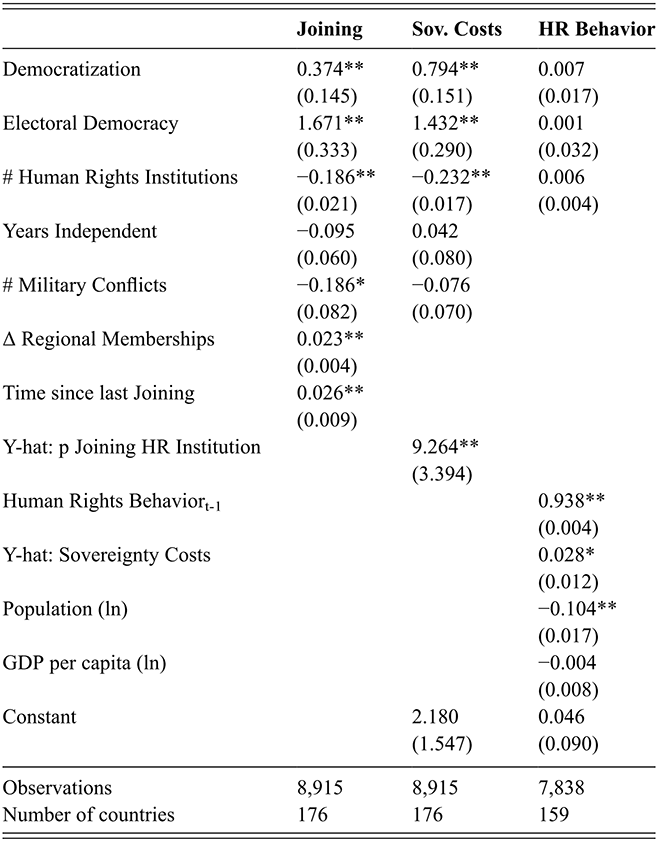
Appendix 1 Long description
The dependent variables are joining a human rights intergovernmental organization, sovereignty costs, and human rights behavior. Coefficients are reported with standard errors in parentheses. Statistical significance is indicated by plus signs for p less than 0.10, one asterisk for p less than 0.05, and two asterisks for p less than 0.01.
In the model predicting joining a human rights institution, democratization has a positive and statistically significant coefficient of 0.374 with a standard error of 0.145, significant at the 0.01 level. Electoral democracy has a positive and statistically significant coefficient of 1.671 with a standard error of 0.333, significant at the 0.01 level. The number of human rights institutions has a negative and statistically significant coefficient of negative 0.186 with a standard error of 0.021, significant at the 0.01 level. Years independent has a negative coefficient of negative 0.095 with a standard error of 0.060 and is not statistically significant. The number of military conflicts has a negative coefficient of negative 0.186 with a standard error of 0.082, significant at the 0.05 level. Change in regional memberships has a positive and statistically significant coefficient of 0.023 with a standard error of 0.004, significant at the 0.01 level. Time since last joining has a positive and statistically significant coefficient of 0.026 with a standard error of 0.009, significant at the 0.01 level.
In the model predicting sovereignty costs, democratization has a positive and statistically significant coefficient of 0.794 with a standard error of 0.151, significant at the 0.01 level. Electoral democracy has a positive and statistically significant coefficient of 1.432 with a standard error of 0.290, significant at the 0.01 level. The number of human rights institutions has a negative and statistically significant coefficient of negative 0.232 with a standard error of 0.017, significant at the 0.01 level. Years independent and the number of military conflicts are not statistically significant. The constant term is 2.180 with a standard error of 1.547 and is not statistically significant.
In the model predicting human rights behavior, lagged human rights behavior has a strong positive and statistically significant association, with a coefficient of 0.938 and a standard error of 0.004, significant at the 0.01 level. The predicted probability of joining a human rights institution has a positive and statistically significant coefficient of 9.264 with a standard error of 3.394, significant at the 0.01 level. Predicted sovereignty costs have a positive and statistically significant coefficient of 0.028 with a standard error of 0.012, significant at the 0.05 level. Logged population has a negative and statistically significant coefficient of negative 0.104 with a standard error of 0.017, significant at the 0.01 level. Logged GDP per capita has a small and statistically insignificant coefficient. The constant term is 0.046 with a standard error of 0.090 and is not statistically significant.
The joining and sovereignty cost models include 8,915 observations and 176 countries. The human rights behavior model includes 7,838 observations and 159 countries. Observations for European Union member states are excluded from all models.
Note: Estimates do not include observations for members of the European Union. Standard errors in parentheses; ** p < 0.01, * p < 0.05, + p < 0.1
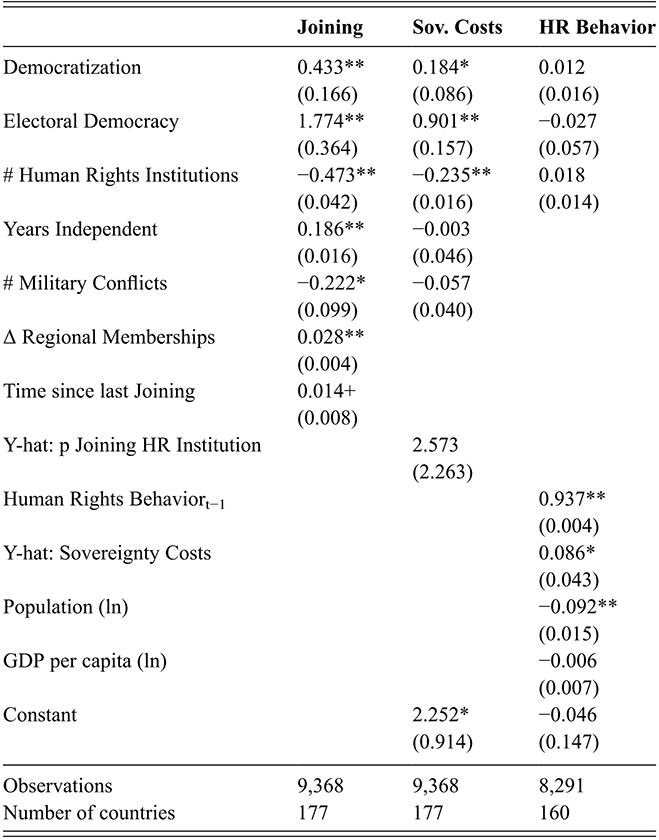
Appendix 2 Long description
The dependent variables are joining a human rights intergovernmental organization, sovereignty costs, and human rights behavior. Coefficients are reported with standard errors in parentheses. Statistical significance is indicated by plus signs for p less than 0.10, one asterisk for p less than 0.05, and two asterisks for p less than 0.01.
In the model predicting joining a human rights institution at t+1, democratization has a positive and statistically significant coefficient of 0.433 with a standard error of 0.166, significant at the 0.01 level. Electoral democracy has a positive and statistically significant coefficient of 1.774 with a standard error of 0.364, significant at the 0.01 level. The number of human rights institutions has a negative and statistically significant coefficient of negative 0.473 with a standard error of 0.042, significant at the 0.01 level. Years independent has a positive and statistically significant coefficient of 0.186 with a standard error of 0.016, significant at the 0.01 level. The number of military conflicts has a negative coefficient of negative 0.222 with a standard error of 0.099, significant at the 0.05 level. Change in regional memberships has a positive and statistically significant coefficient of 0.028 with a standard error of 0.004, significant at the 0.01 level. Time since last joining has a positive coefficient of 0.014 with a standard error of 0.008 and is significant at the 0.10 level.
In the model predicting sovereignty costs at t+1, democratization has a positive and statistically significant coefficient of 0.184 with a standard error of 0.086, significant at the 0.05 level. Electoral democracy has a positive and statistically significant coefficient of 0.901 with a standard error of 0.157, significant at the 0.01 level. The number of human rights institutions has a negative and statistically significant coefficient of negative 0.235 with a standard error of 0.016, significant at the 0.01 level. Years independent and the number of military conflicts are not statistically significant. The constant term is 2.252 with a standard error of 0.914 and is significant at the 0.05 level.
In the model predicting human rights behavior at t+1, human rights behavior at time t has a strong positive and statistically significant association, with a coefficient of 0.937 and a standard error of 0.004, significant at the 0.01 level. Predicted sovereignty costs have a positive and statistically significant coefficient of 0.086 with a standard error of 0.043, significant at the 0.05 level. The predicted probability of joining a human rights institution is not statistically significant. Logged population has a negative and statistically significant coefficient of negative 0.092 with a standard error of 0.015, significant at the 0.01 level. Logged GDP per capita has a small and statistically insignificant coefficient. The constant term is negative 0.046 with a standard error of 0.147 and is not statistically significant.
The joining and sovereignty cost models include 9,368 observations and 177 countries. The human rights behavior model includes 8,291 observations and 160 countries. Membership in human rights intergovernmental organizations classified as emanations is excluded from the sample.
Note: Estimates exclude membership in human rights IOs that are considered emanations. Standard errors in parentheses; ** p < 0.01, * p < 0.05, + p < 0.1
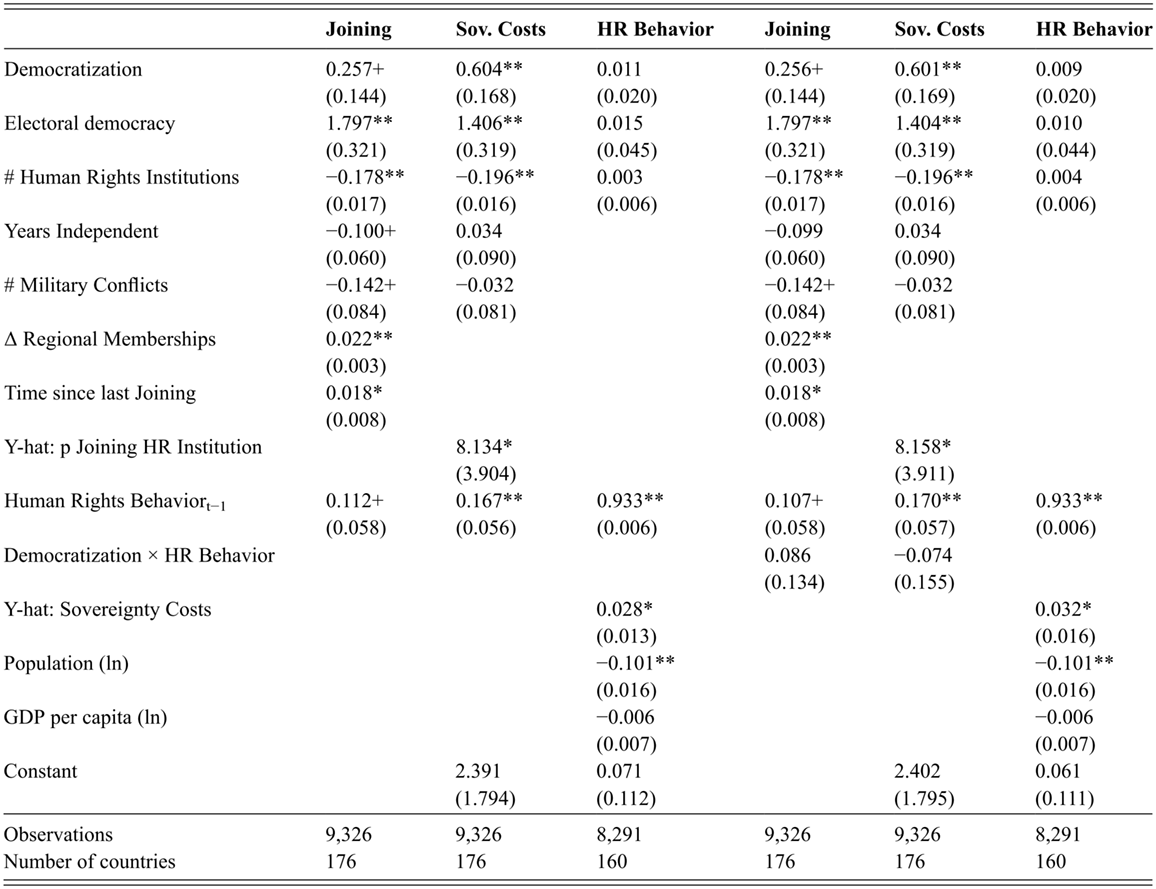
Appendix 3 Long description
Appendix 3, columns 1 through 3, presents regression results examining the effects of democratization, electoral democracy, human rights institutions, and other controls on joining human rights intergovernmental organizations (HR IGOs), sovereignty costs, and subsequent human rights behavior. It adds prior human rights behavior to all three stages. Standard errors are reported in parentheses, and significance is indicated as ** p<0.01, * p<0.05, and + p<0.1. Observations range from 8,291 to 9,326, covering 160 to 176 countries.
For joining HR IGOs at t+1 (n = 9,326; 176 countries): democratization has a coefficient of 0.257 with a standard error of 0.144, marginally significant at p<0.1. Electoral democracy has a coefficient of 1.797 with a standard error of 0.321, significant at p<0.01. The number of human rights institutions has a coefficient of -0.178 with a standard error of 0.017, significant at p<0.01. Years independent has a coefficient of −0.100 with a standard error of 0.060, marginally significant at p<0.1. The number of military conflicts has a coefficient of −0.142 with a standard error of 0.084, marginally significant at p<0.1. The change in regional memberships has a coefficient of 0.022 with a standard error of 0.003, significant at p<0.01. Time since last joining a HR IGO has a coefficient of 0.018 with a standard error of 0.008, significant at p<0.05. Prior human rights behavior has a coefficient of 0.112 with a standard error of 0.058, marginally significant at p<0.1. The constant term is 2.391 with a standard error of 1.794, not significant.
For sovereignty costs at t+1 (n = 9,326; 176 countries): democratization has a coefficient of 0.604 with a standard error of 0.168, significant at p<0.01. Electoral democracy has a coefficient of 1.406 with a standard error of 0.319, significant at p<0.01. The number of human rights institutions has a coefficient of −0.196 with a standard error of 0.016, significant at p<0.01. Years independent has a coefficient of 0.034 with a standard error of 0.090, not significant. The number of military conflicts has a coefficient of −0.032 with a standard error of 0.081, not significant. The predicted probability of joining a HR institution has a coefficient of 8.134 with a standard error of 3.904, significant at p<0.05. Prior human rights behavior has a coefficient of 0.167 with a standard error of 0.056, significant at p<0.01. The constant term is 0.071 with a standard error of 0.112, not significant.
For human rights behavior at t+1 (n = 8,291; 160 countries): democratization has a coefficient of 0.011 with a standard error of 0.020, not significant. Electoral democracy has a coefficient of 0.015 with a standard error of 0.045, not significant. The number of human rights institutions has a coefficient of 0.003 with a standard error of 0.006, not significant. Prior human rights behavior strongly predicts subsequent behavior, with a coefficient of 0.933 and a standard error of 0.006, significant at p<0.01. The predicted sovereignty cost has a coefficient of 0.028 with a standard error of 0.013, significant at p<0.05. Population, logged, has a coefficient of −0.101 with a standard error of 0.016, significant at p<0.01. GDP per capita, logged, has a coefficient of −0.006 with a standard error of 0.007, not significant. The constant term is 0.071 with a standard error of 0.112, not significant.
Appendix 3, columns 4 through 6, presents regression results examining the effects of democratization, electoral democracy, human rights institutions, prior human rights behavior, and the interaction between democratization and prior human rights behavior on joining human rights intergovernmental organizations (HR IGOs), sovereignty costs, and subsequent human rights behavior. Standard errors are reported in parentheses, and significance is indicated as ** p<0.01, * p<0.05, and + p<0.1. Observations range from 8,291 to 9,326, covering 160 to 176 countries.
For joining HR IGOs at t+1 (n = 9,326; 176 countries): democratization has a coefficient of 0.256 with a standard error of 0.144, marginally significant at p<0.1. Electoral democracy has a coefficient of 1.797 with a standard error of 0.321, significant at p<0.01. The number of human rights institutions has a coefficient of −0.178 with a standard error of 0.017, significant at p<0.01. Years independent has a coefficient of −0.099 with a standard error of 0.060, not significant. The number of military conflicts has a coefficient of −0.142 with a standard error of 0.084, marginally significant at p<0.1. The change in regional memberships has a coefficient of 0.022 with a standard error of 0.003, significant at p<0.01. Time since last joining a HR IGO has a coefficient of 0.018 with a standard error of 0.008, significant at p<0.05. Prior human rights behavior has a coefficient of 0.107 with a standard error of 0.058, marginally significant at p<0.1. The interaction between democratization and prior human rights behavior has a coefficient of 0.086 with a standard error of 0.134, not significant. The constant term is 2.402 with a standard error of 1.795, not significant.
For sovereignty costs at t+1 (n = 9,326; 176 countries): democratization has a coefficient of 0.601 with a standard error of 0.169, significant at p<0.01. Electoral democracy has a coefficient of 1.404 with a standard error of 0.319, significant at p<0.01. The number of human rights institutions has a coefficient of −0.196 with a standard error of 0.016, significant at p<0.01. Years independent has a coefficient of 0.034 with a standard error of 0.090, not significant. The number of military conflicts has a coefficient of −0.032 with a standard error of 0.081, not significant. The predicted probability of joining a HR IGO has a coefficient of 8.158 with a standard error of 3.911, significant at p<0.05. Prior human rights behavior has a coefficient of 0.170 with a standard error of 0.057, significant at p<0.01. The interaction between democratization and prior human rights behavior has a coefficient of −0.074 with a standard error of 0.155, not significant. The constant term is 0.061 with a standard error of 0.111, not significant.
For human rights behavior at t+1 (n = 8,291; 160 countries): democratization has a coefficient of 0.009 with a standard error of 0.020, not significant. Electoral democracy has a coefficient of 0.010 with a standard error of 0.044, not significant. The number of human rights institutions has a coefficient of 0.004 with a standard error of 0.006, not significant. Prior human rights behavior strongly predicts subsequent behavior, with a coefficient of 0.933 and a standard error of 0.006, significant at p<0.01. The predicted sovereignty cost has a coefficient of 0.032 with a standard error of 0.016, significant at p<0.05. Population, logged, has a coefficient of -0.101 with a standard error of 0.016, significant at p<0.01. GDP per capita, logged, has a coefficient of −0.006 with a standard error of 0.007, not significant. The constant term is 0.061 with a standard error of 0.111, not significant.
Note: Models include Human Rights Behavior and its interaction with Democratization in first two stages (unlagged). Standard errors in parentheses; ** p < 0.01, * p < 0.05, + p < 0.1
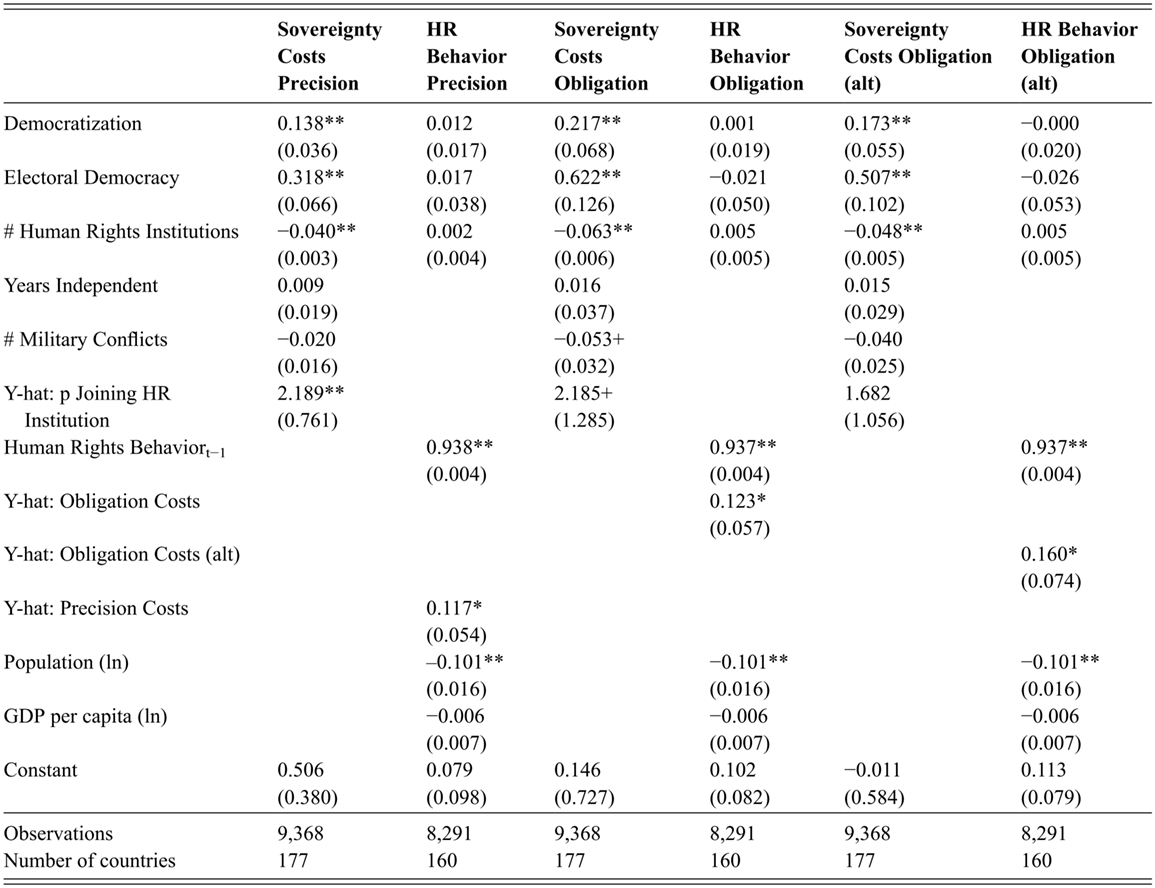
Appendix 4a Long description
Appendix Table 4, columns 1 and 2, presents regression results examining the precision component of the second and third stage of the model, sovereignty costs and human rights behavior, respectively. Observations range from 8,291 to 9,368, covering 160 to 177 countries.
For sovereignty costs at t+1 (n = 9,368; 177 countries): democratization has a coefficient of 0.138 with a standard error of 0.036, significant at p<0.01. Electoral democracy has a coefficient of 0.318 with a standard error of 0.066, significant at p<0.01. The number of human rights institutions has a coefficient of −0.040 with a standard error of 0.003, significant at p<0.01. Years independent has a coefficient of 0.009 with a standard error of 0.019, not significant. The number of military conflicts has a coefficient of −0.020 with a standard error of 0.016, not significant. The predicted probability of joining a human rights institution has a coefficient of 2.189 with a standard error of 0.761, significant at p<0.01. The constant term is 0.506 with a standard error of 0.380, not significant.
For human rights behavior at t+1 (n = 8,291; 160 countries): democratization has a coefficient of 0.012 with a standard error of 0.017, not significant. Electoral democracy has a coefficient of 0.017 with a standard error of 0.038, not significant. The number of human rights institutions has a coefficient of 0.002 with a standard error of 0.004, not significant. Prior human rights behavior strongly predicts subsequent behavior, with a coefficient of 0.938 and a standard error of 0.004, significant at p<0.01. The predicted precision costs have a coefficient of 0.117 with a standard error of 0.054, significant at p<0.05. Population, logged, has a coefficient of -0.101 with a standard error of 0.016, significant at p<0.01. GDP per capita, logged, has a coefficient of −0.006 with a standard error of 0.007, not significant. The constant term is 0.079 with a standard error of 0.098, not significant.
Appendix Table 4, columns 3 and 4, presents regression results examining the obligation component of sovereignty costs on accepted sovereignty costs and human rights behavior, respectively. Observations range from 8,291 to 9,368, covering 160 to 177 countries.
For sovereignty costs model at t+1 (n = 9,368; 177 countries): democratization has a coefficient of 0.217 with a standard error of 0.068, significant at p<0.01. Electoral democracy has a coefficient of 0.622 with a standard error of 0.126, significant at p<0.01. The number of human rights institutions has a coefficient of −0.063 with a standard error of 0.006, significant at p<0.01. Years independent has a coefficient of 0.016 with a standard error of 0.037, not significant. The number of military conflicts has a coefficient of −0.053 with a standard error of 0.032, marginally significant at p<0.1. The predicted probability of joining a human rights institution has a coefficient of 2.185 with a standard error of 1.285, marginally significant at p<0.1. The constant term is 0.146 with a standard error of 0.727, not significant.
For human rights behavior model at t+1 (n = 8,291; 160 countries): democratization has a coefficient of 0.001 with a standard error of 0.019, not significant. Electoral democracy has a coefficient of −0.021 with a standard error of 0.050, not significant. The number of human rights institutions has a coefficient of 0.005 with a standard error of 0.005, not significant. Prior human rights behavior strongly predicts subsequent behavior, with a coefficient of 0.937 and a standard error of 0.004, significant at p<0.01. The predicted obligation cost has a coefficient of 0.123 with a standard error of 0.057, significant at p<0.05. Population, logged, has a coefficient of −0.101 with a standard error of 0.016, significant at p<0.01. GDP per capita, logged, has a coefficient of -0.006 with a standard error of 0.007, not significant. The constant term is 0.102 with a standard error of 0.082, not significant.
Appendix Table 4, columns 5 and 6, reports regression results examining the alternative obligation component of sovereignty costs and its relationship to accepted sovereignty costs and human rights behavior, respectively.
In the sovereignty costs model at t+1, democratization has a positive and statistically significant association with obligation costs, with a coefficient of 0.173 and a standard error of 0.055, significant at the 0.01 level. Electoral democracy is also positively and significantly related to obligation costs, with a coefficient of 0.507 and a standard error of 0.102, significant at the 0.01 level. The number of human rights institutions is negatively and significantly associated with obligation costs, with a coefficient of −0.048 and a standard error of 0.005, significant at the 0.01 level. Years independent has a positive but statistically insignificant coefficient of 0.015 with a standard error of 0.029. Military conflicts have a negative but statistically insignificant coefficient of −0.040 with a standard error of 0.025. The predicted probability of joining a human rights institution has a positive but statistically insignificant coefficient of 1.682 with a standard error of 1.056. The constant term in the obligation model is −0.011 with a standard error of 0.584. This model includes 9,368 observations from 177 countries.
In the human rights behavior model at t+1, democratization has a coefficient of −0.000 with a standard error of 0.020 and is not statistically significant. Electoral democracy has a negative but statistically insignificant coefficient of −0.026 with a standard error of 0.053. The number of human rights institutions has a positive but statistically insignificant coefficient of 0.005 with a standard error of 0.005. Lagged human rights behavior has a positive and highly significant association with current human rights behavior, with a coefficient of 0.937 and a standard error of 0.004, significant at the 0.01 level. The predicted value of alternative obligation costs is positively and significantly associated with human rights behavior, with a coefficient of 0.160 and a standard error of 0.074, significant at the 0.05 level. Logged population has a negative and statistically significant coefficient of −0.101 with a standard error of 0.016, significant at the 0.01 level. Logged GDP per capita has a negative but statistically insignificant coefficient of −0.006 with a standard error of 0.007. The constant term is 0.113 with a standard error of 0.079. This model includes 8,291 observations from 160 countries.
Standard errors in parentheses; ** p < 0.01, * p < 0.05, + p < 0.1
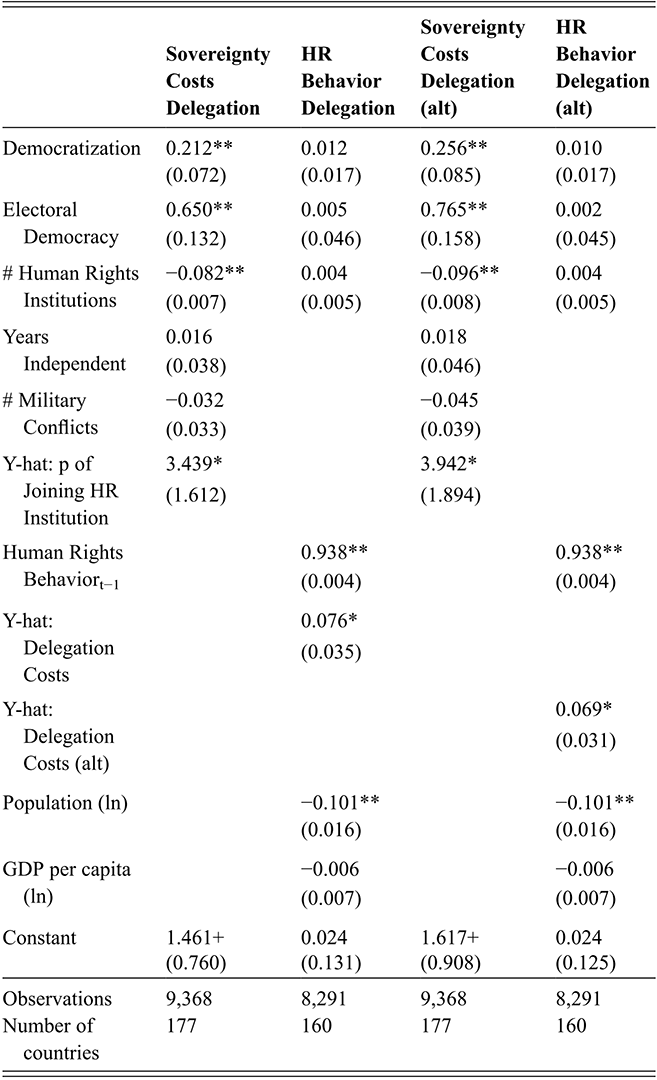
Appendix 4b Long description
The continuation of Appendix Table 4 presents regression results examining the delegation component of sovereignty costs and its relationship to accepted sovereignty costs and human rights behavior, respectively.
In the sovereignty costs model at t+1, Democratization has a positive and statistically significant coefficient of 0.212, with a standard error of 0.072, significant at the 0.01 level. In the Human Rights Behavior model, Democratization has a coefficient of 0.012 with a standard error of 0.017, which is not statistically significant.
Electoral Democracy is positively and significantly associated with sovereignty costs, with a coefficient of 0.650 and a standard error of 0.132, significant at the 0.01 level. In the Human Rights Behavior model, the coefficient on Electoral Democracy is 0.005 with a standard error of 0.046, and is not statistically significant.
The number of Human Rights Institutions entered into has a negative and statistically significant association with sovereignty costs. The coefficient is minus 0.082 with a standard error of 0.007, significant at the 0.01 level. In the Human Rights Behavior model, the coefficient on Human Rights Institutions is 0.004 with a standard error of 0.005, which is not statistically significant.
Years Independent has a coefficient of 0.016 in the sovereignty costs model, with a standard error of 0.038, and is not statistically significant. This variable is not included in the Human Rights Behavior model.
The number of Military Conflicts has a coefficient of minus 0.032 in the sovereignty costs model, with a standard error of 0.033, and is not statistically significant. This variable does not appear in the Human Rights Behavior model.
The predicted probability of Joining a Human Rights Institution (Y-hat) is positively associated with sovereignty costs. The coefficient is 3.439 with a standard error of 1.612, significant at the 0.05 level. This predicted joining variable does not enter the Human Rights Behavior model directly.
In the Human Rights Behavior model at t+1, Human Rights Behavior at time t has a large and highly significant coefficient of 0.938, with a standard error of 0.004, significant at the 0.01 level.
The predicted value of Delegation Costs (Y-hat) is positively and significantly associated with Human Rights Behavior, with a coefficient of 0.076 and a standard error of 0.035, significant at the 0.05 level. An alternative measure of delegation costs is listed but not estimated in this specification.
Population (logged) has a negative and statistically significant coefficient in the Human Rights Behavior model, equal to minus 0.101 with a standard error of 0.016, significant at the 0.01 level. GDP per capita (logged) has a coefficient of minus 0.006 with a standard error of 0.007, which is not statistically significant.
The constant term in the sovereignty costs model is 1.461 with a standard error of 0.760, significant at the 0.1 level. In the Human Rights Behavior model, the constant is 0.024 with a standard error of 0.131 and is not statistically significant.
The sovereignty costs model includes 9,368 observations from 177 countries. The Human Rights Behavior model includes 8,291 observations from 160 countries.
The final two columns of the remainder of Appendix Table 4 reports two regression models estimating the influence of delegation component of sovereignty costs using an alternative measurement strategy for the delegation variable. The first column presents a model with accepted sovereignty costs as the dependent variable. The second column presents a model with human rights behavior as the dependent variable.
In the accepted sovereignty costs model at t+1, democratization has a positive and statistically significant coefficient of 0.256, with a standard error of 0.085, significant at the one percent level. Electoral democracy is also positive and statistically significant, with a coefficient of 0.765 and a standard error of 0.158, significant at the one percent level. The number of human rights institutions is negatively associated with delegation sovereignty costs, with a coefficient of negative 0.096 and a standard error of 0.008, significant at the one percent level. Years since independence has a small positive coefficient of 0.018 with a standard error of 0.046 and is not statistically significant. The number of military conflicts has a negative coefficient of negative 0.045 with a standard error of 0.039 and is not statistically significant. The predicted probability of joining a human rights institution has a positive coefficient of 3.942 with a standard error of 1.894, significant at the five percent level. The constant term in this model is positive at 1.617 with a standard error of 0.908, significant at the ten percent level.
In the human rights behavior model at t+1, democratization has a coefficient of 0.010 with a standard error of 0.017 and is not statistically significant. Electoral democracy has a coefficient of 0.002 with a standard error of 0.045 and is not statistically significant. The number of human rights institutions has a small positive coefficient of 0.004 with a standard error of 0.005 and is not statistically significant. Lagged human rights behavior is strongly positive and statistically significant, with a coefficient of 0.938 and a standard error of 0.004, significant at the one percent level. The alternative predicted delegation costs variable has a positive coefficient of 0.069 with a standard error of 0.031, significant at the five percent level. Population size, measured as the natural logarithm, has a negative and statistically significant coefficient of negative 0.101 with a standard error of 0.016, significant at the one percent level. GDP per capita, measured as the natural logarithm, has a coefficient of negative 0.006 with a standard error of 0.007 and is not statistically significant. The constant term in the human rights behavior model is 0.024 with a standard error of 0.125 and is not statistically significant.
The sovereignty costs model includes 9,368 observations from 177 countries. The human rights behavior model includes 8,291 observations from 160 countries. Standard errors are reported in parentheses.
For all models in appendix 4, statistical significance is indicated by double asterisks for p-values less than 0.01, a single asterisk for p-values less than 0.05, and a plus sign for p-values less than 0.10.
Standard errors in parentheses; ** p < 0.01, * p < 0.05, + p < 0.1
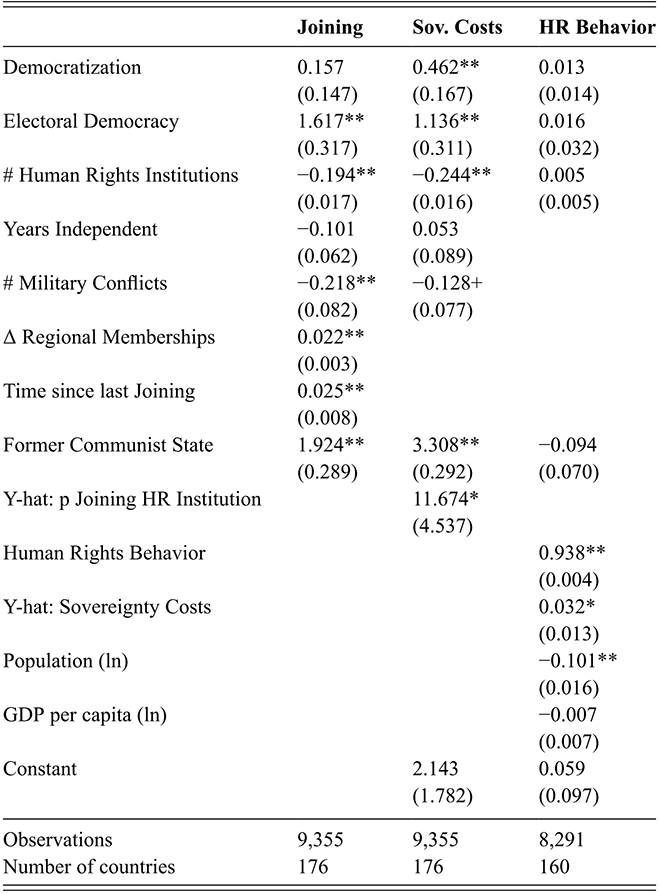
Appendix 5 Long description
The table contains three columns corresponding to the stages of the model: Joining a human rights institution, Sovereignty Costs, and Human Rights Behavior. Coefficients are reported with standard errors in parentheses below each estimate.
In the first-stage Joining model at t+1, Democratization has a coefficient of 0.157 with a standard error of 0.147. Electoral Democracy has a positive and statistically significant coefficient of 1.617 with a standard error of 0.317. Human Rights Institutions has a negative and statistically significant coefficient of −0.194 with a standard error of 0.017. Years Independent has a coefficient of −0.101 with a standard error of 0.062. Military Conflicts has a negative and statistically significant coefficient of −0.218 with a standard error of 0.082. Change in Regional Memberships has a positive and statistically significant coefficient of 0.022 with a standard error of 0.003. Time since Last Joining has a positive and statistically significant coefficient of 0.025 with a standard error of 0.008. Former Communist State has a positive and statistically significant coefficient of 1.924 with a standard error of 0.289.
In the second-stage Sovereignty Costs at t+1 model, Democratization has a positive and statistically significant coefficient of 0.462 with a standard error of 0.167. Electoral Democracy has a positive and statistically significant coefficient of 1.136 with a standard error of 0.311. Human Rights Institutions has a negative and statistically significant coefficient of −0.244 with a standard error of 0.016. Years Independent has a coefficient of 0.053 with a standard error of 0.089. Military Conflicts has a negative, marginally significant coefficient of −0.128 with a standard error of 0.077. Former Communist State has a positive and statistically significant coefficient of 3.308 with a standard error of 0.292. The predicted probability of joining a human rights institution from the first stage (Y-hat: p Joining HR Institution) enters positively and significantly, with a coefficient of 11.674 and a standard error of 4.537. The constant term has a coefficient of 2.143 with a standard error of 1.782.
In the third-stage Human Rights Behavior at t+1 model, Democratization has a coefficient of 0.013 with a standard error of 0.014. Electoral Democracy has a coefficient of 0.016 with a standard error of 0.032. Human Rights Institutions has a coefficient of 0.005 with a standard error of 0.005. Former Communist State has a coefficient of −0.094 with a standard error of 0.070. Lagged Human Rights Behavior has a positive and statistically significant coefficient of 0.938 with a standard error of 0.004. Predicted sovereignty costs (Y-hat: Sovereignty Costs) enter positively and significantly, with a coefficient of 0.032 and a standard error of 0.013. Population (log) has a negative and statistically significant coefficient of −0.101 with a standard error of 0.016, while GDP per capita (log) has a coefficient of −0.007 with a standard error of 0.007. The constant term has a coefficient of 0.059 with a standard error of 0.097.
The number of observations is 9,355 for the Joining and Sovereignty Costs models and 8,291 for the Human Rights Behavior model. The number of countries included is 176 in the first two stages and 160 in the third stage. Standard errors are reported in parentheses. Statistical significance is denoted by double asterisks for p < 0.01, single asterisks for p < 0.05, and plus signs for p < 0.1.
Standard errors in parentheses; ** p < 0.01, * p < 0.05, + p < 0.1
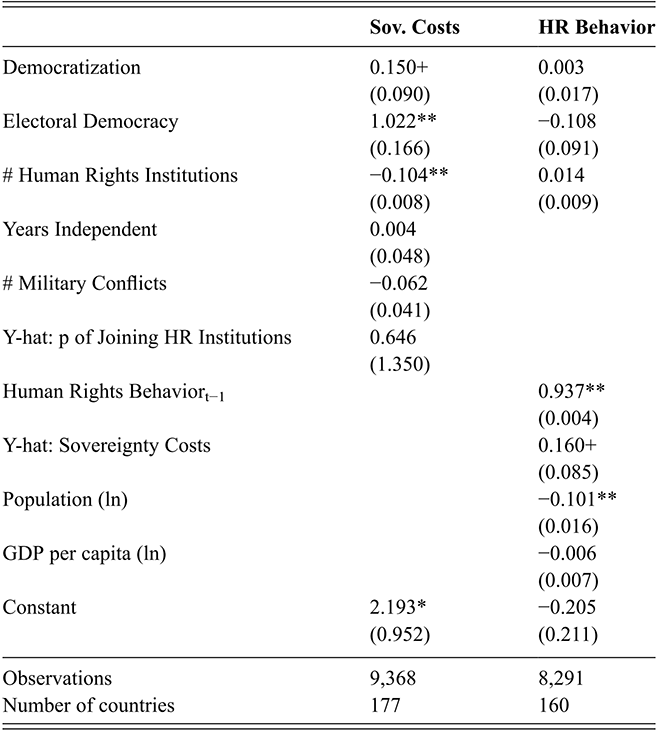
Appendix 6 Long description
The table contains two columns corresponding to the stages of the model: Sovereignty Costs and Human Rights Behavior. Coefficients are reported with standard errors in parentheses below each estimate.
In the model predicting Sovereignty Costs at t+1, Democratization has a positive and marginally significant coefficient of 0.150 with a standard error of 0.090. Electoral Democracy has a positive and statistically significant coefficient of 1.022 with a standard error of 0.166. Human Rights Institutions has a negative and statistically significant coefficient of −0.104 with a standard error of 0.008. Years Independent has a coefficient of 0.004 with a standard error of 0.048. Military Conflicts has a coefficient of −0.062 with a standard error of 0.041. The predicted probability of joining a human rights institution (Y-hat: p of Joining HR Institutions) has a coefficient of 0.646 with a standard error of 1.350. The constant term has a positive and statistically significant coefficient of 2.193 with a standard error of 0.952.
In the model predicting Human Rights Behavior at t+1, Democratization has a coefficient of 0.003 with a standard error of 0.017. Electoral Democracy has a coefficient of −0.108 with a standard error of 0.091. Human Rights Institutions has a coefficient of 0.014 with a standard error of 0.009. Lagged Human Rights Behavior (t−1) has a positive and statistically significant coefficient of 0.937 with a standard error of 0.004. Predicted Sovereignty Costs (Y-hat) enter positively and marginally significantly, with a coefficient of 0.160 and a standard error of 0.085. Population (log) has a negative and statistically significant coefficient of −0.101 with a standard error of 0.016, while GDP per capita (log) has a coefficient of −0.006 with a standard error of 0.007. The constant term has a coefficient of −0.205 with a standard error of 0.211.
The number of observations is 9,368 in the Sovereignty Costs model and 8,291 in the Human Rights Behavior model. The number of countries included is 177 in the Sovereignty Costs model and 160 in the Human Rights Behavior model. Standard errors are reported in parentheses. Statistical significance is denoted by double asterisks for p < 0.01, single asterisks for p < 0.05, and plus signs for p < 0.1.
Standard errors in parentheses; ** p < 0.01, * p < 0.05, + p < 0.1
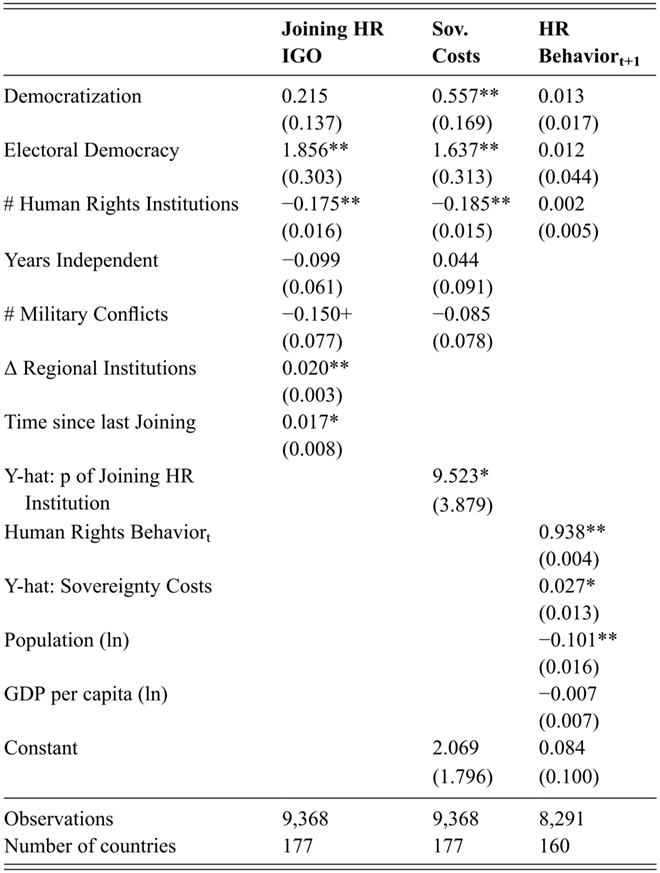
Appendix 7 Long description
Appendix 7 presents regression results for a three-stage model on variables: joining human rights intergovernmental organizations (HR IGOs), sovereignty costs, and human rights behavior all at t+1, including ROCO-coded human rights organizations. All coefficients are reported with their standard errors, and significance is indicated as ** p<0.01, * p<0.05, and + p<0.1.
For joining HR IGOs at t+1 (n = 9,368 observations; 177 countries): democratization has a coefficient of 0.215 with a standard error of 0.137, not statistically significant. Electoral democracy has a coefficient of 1.856 with a standard error of 0.303, significant at p<0.01. The number of human rights institutions has a coefficient of -0.175 with a standard error of 0.016, significant at p<0.01. Years independent has a coefficient of −0.099 with a standard error of 0.061, not significant. The number of military conflicts has a coefficient of −0.150 with a standard error of 0.077, marginally significant at p<0.1. The change in regional institutions has a coefficient of 0.020 with a standard error of 0.003, significant at p<0.01. Time since last joining a HR IGO has a coefficient of 0.017 with a standard error of 0.008, significant at p<0.05.
For sovereignty costs at t+1 (n = 9,368; 177 countries): democratization has a coefficient of 0.557 with a standard error of 0.169, significant at p<0.01. Electoral democracy has a coefficient of 1.637 with a standard error of 0.313, significant at p<0.01. The number of human rights institutions has a coefficient of −0.185 with a standard error of 0.015, significant at p<0.01. Years independent has a coefficient of 0.044 with a standard error of 0.091, not significant. The number of military conflicts has a coefficient of −0.085 with a standard error of 0.078, not significant. The predicted probability of joining a HR IGO has a coefficient of 9.523 with a standard error of 3.879, significant at p<0.05. The constant term is 2.069 with a standard error of 1.796, not significant.
For human rights behavior at t+1 (n = 8,291; 160 countries): prior human rights behavior has a coefficient of 0.938 with a standard error of 0.004, significant at p<0.01. Sovereignty costs has a coefficient of 0.027 with a standard error of 0.013, significant at p<0.05. Population (logged) has a coefficient of −0.101 with a standard error of 0.016, significant at p<0.01. GDP per capita (logged) has a coefficient of −0.007 with a standard error of 0.007, not significant. Democratization has a coefficient of 0.013 with a standard error of 0.017, not significant. Electoral democracy has a coefficient of 0.012 with a standard error of 0.044, not significant. The number of human rights institutions has a coefficient of 0.002 with a standard error of 0.005, not significant. The constant term is 0.084 with a standard error of 0.100, not significant.
These results indicate that stronger electoral democracy increases the likelihood of joining HR IGOs, human rights institutions reduce sovereignty costs, and prior human rights behavior is the strongest predictor of future human rights performance. Population size is negatively associated with future human rights behavior.
Note: Standard errors in parentheses; ** p < 0.01, * p < 0.05, + p < 0.1
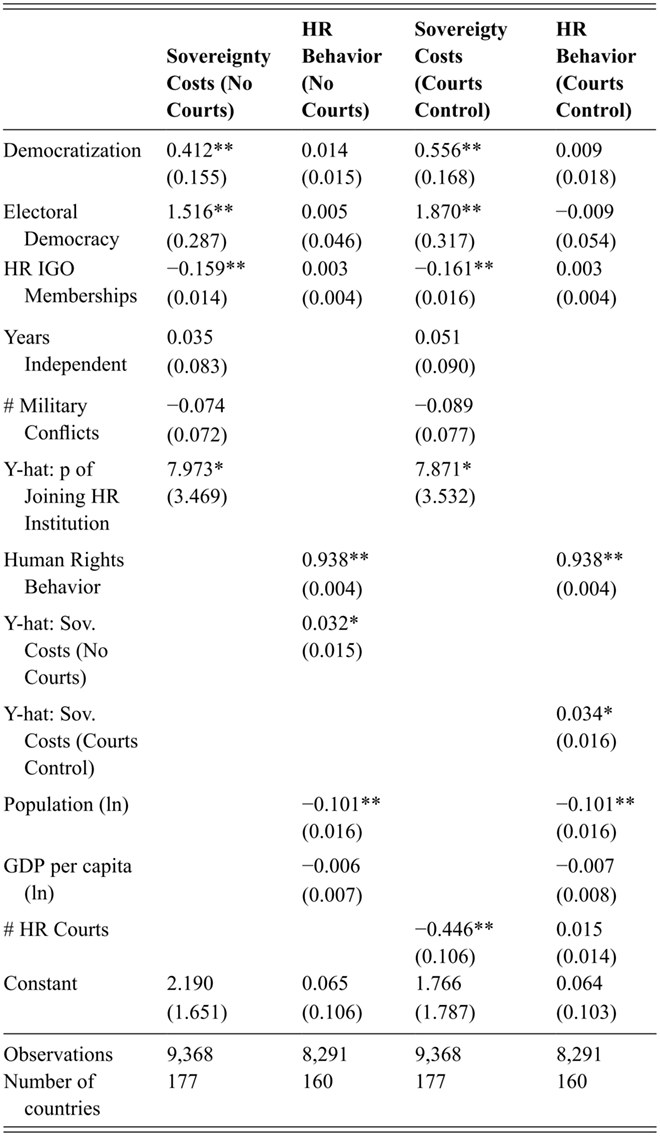
Appendix 8 Long description
Appendix 8 presents regression results examining the effects of democratization, electoral democracy, human rights IGO memberships, and other controls on the second stage of sovereignty costs and the third stage of human rights behavior, both without courts included and with a control for human rights courts. Four models are presented: sovereignty costs with no courts, human rights behavior with no courts, sovereignty costs controlling for courts, and human rights behavior controlling for courts. Standard errors are in parentheses, and significance is indicated as ** p<0.01, * p<0.05, and + p<0.1. Observations range from 8,291 to 9,368, covering 160 to 177 countries.
For sovereignty costs at t+1 without courts included (n = 9,368; 177 countries): democratization has a coefficient of 0.412 with a standard error of 0.155, significant at p<0.01. Electoral democracy has a coefficient of 1.516 with a standard error of 0.287, significant at p<0.01. Human rights IGO memberships have a coefficient of −0.159 with a standard error of 0.014, significant at p<0.01. Years independent has a coefficient of 0.035 with a standard error of 0.083, not significant. The number of military conflicts has a coefficient of −0.074 with a standard error of 0.072, not significant. The predicted probability of joining a human rights institution has a coefficient of 7.973 with a standard error of 3.469, significant at p<0.05. The constant term is 2.190 with a standard error of 1.651, not significant.
For human rights behavior at t+1 without courts included (n = 8,291; 160 countries): democratization has a coefficient of 0.014 with a standard error of 0.015, not significant. Electoral democracy has a coefficient of 0.005 with a standard error of 0.046, not significant. Human rights IGO memberships have a coefficient of 0.003 with a standard error of 0.004, not significant. Human rights behavior at the previous time point has a coefficient of 0.938 with a standard error of 0.004, significant at p<0.01. The predicted sovereignty cost without courts has a coefficient of 0.032 with a standard error of 0.015, significant at p<0.05. Population, logged, has a coefficient of −0.101 with a standard error of 0.016, significant at p<0.01. GDP per capita, logged, has a coefficient of −0.006 with a standard error of 0.007, not significant. The constant term is 0.065 with a standard error of 0.106, not significant.
For sovereignty costs at t+1 controlling for courts (n = 9,368; 177 countries): democratization has a coefficient of 0.556 with a standard error of 0.168, significant at p<0.01. Electoral democracy has a coefficient of 1.870 with a standard error of 0.317, significant at p<0.01. Human rights IGO memberships have a coefficient of −0.161 with a standard error of 0.016, significant at p<0.01. Years independent has a coefficient of 0.051 with a standard error of 0.090, not significant. The number of military conflicts has a coefficient of -0.089 with a standard error of 0.077, not significant. The predicted probability of joining a human rights institution has a coefficient of 7.871 with a standard error of 3.532, significant at p<0.05. The number of human rights courts has a coefficient of -0.446 with a standard error of 0.106, significant at p<0.01. The constant term is 1.766 with a standard error of 1.787, not significant.
For human rights behavior at t+1 controlling for courts (n = 8,291; 160 countries): democratization has a coefficient of 0.009 with a standard error of 0.018, not significant. Electoral democracy has a coefficient of −0.009 with a standard error of 0.054, not significant. Human rights IGO memberships have a coefficient of 0.003 with a standard error of 0.004, not significant. Human rights behavior at the previous time point has a coefficient of 0.938 with a standard error of 0.004, significant at p<0.01. The predicted sovereignty cost controlling for courts has a coefficient of 0.034 with a standard error of 0.016, significant at p<0.05. Population, logged, has a coefficient of −0.101 with a standard error of 0.016, significant at p<0.01. GDP per capita, logged, has a coefficient of −0.007 with a standard error of 0.008, not significant. The number of human rights courts has a coefficient of 0.015 with a standard error of 0.014, not significant. The constant term is 0.064 with a standard error of 0.103, not significant.
Standard errors in parentheses; ** p < 0.01, * p < 0.05, + p < 0.1
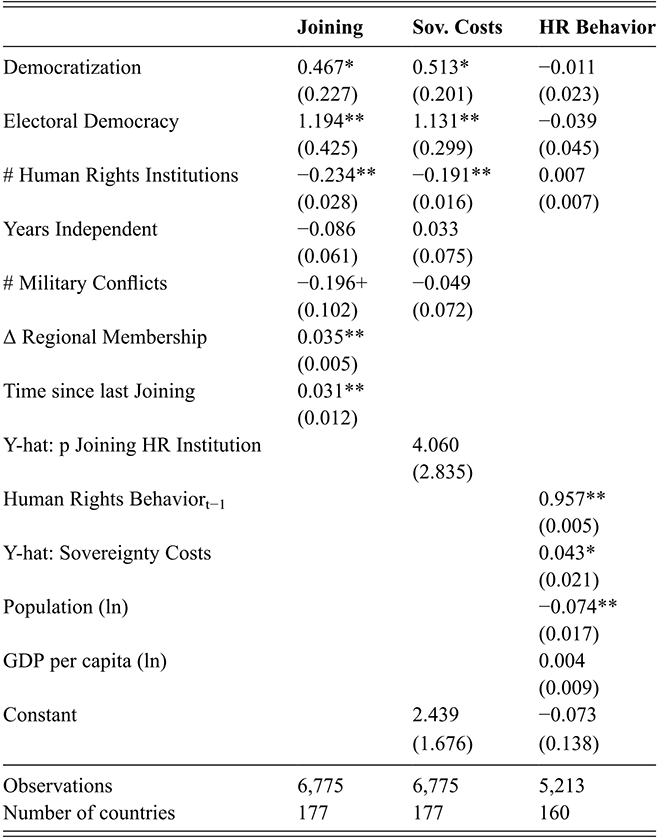
Appendix 9 Long description
Appendix 9 presents regression results examining the effects of democratization, electoral democracy, human rights institutions, and other factors on joining human rights intergovernmental organizations (HR IGOs), sovereignty costs, and subsequent human rights behavior, using a sample that excludes the post-Cold War window (years 1990–2011). Standard errors are reported in parentheses, and significance is indicated as ** p<0.01, * p<0.05, and + p<0.1. Observations range from 5,213 to 6,775, covering 160 to 177 countries.
For joining HR IGOs at t+1 (n = 6,775; 177 countries): democratization has a coefficient of 0.467 with a standard error of 0.227, significant at p<0.05. Electoral democracy has a coefficient of 1.194 with a standard error of 0.425, significant at p<0.01. The number of human rights institutions has a coefficient of -0.234 with a standard error of 0.028, significant at p<0.01. Years independent has a coefficient of -0.086 with a standard error of 0.061, not significant. The number of military conflicts has a coefficient of -0.196 with a standard error of 0.102, marginally significant at p<0.1. The change in regional membership has a coefficient of 0.035 with a standard error of 0.005, significant at p<0.01. Time since last joining a HR IGO has a coefficient of 0.031 with a standard error of 0.012, significant at p<0.01. The constant term is 2.439 with a standard error of 1.676, not significant.
For sovereignty costs at t+1 (n = 6,775; 177 countries): democratization has a coefficient of 0.513 with a standard error of 0.201, significant at p<0.05. Electoral democracy has a coefficient of 1.131 with a standard error of 0.299, significant at p<0.01. The number of human rights institutions has a coefficient of −0.191 with a standard error of 0.016, significant at p<0.01. Years independent has a coefficient of 0.033 with a standard error of 0.075, not significant. The number of military conflicts has a coefficient of −0.049 with a standard error of 0.072, not significant. The predicted probability of joining a HR institution has a coefficient of 4.060 with a standard error of 2.835, not significant. The constant term is 2.439 with a standard error of 1.676, not significant.
For human rights behavior at t+1 (n = 5,213; 160 countries): democratization has a coefficient of −0.011 with a standard error of 0.023, not significant. Electoral democracy has a coefficient of −0.039 with a standard error of 0.045, not significant. The number of human rights institutions has a coefficient of 0.007 with a standard error of 0.007, not significant. Prior human rights behavior strongly predicts subsequent behavior, with a coefficient of 0.957 and a standard error of 0.005, significant at p<0.01. The predicted sovereignty cost has a coefficient of 0.043 with a standard error of 0.021, significant at p<0.05. Population, logged, has a coefficient of −0.074 with a standard error of 0.017, significant at p<0.01. GDP per capita, logged, has a coefficient of 0.004 with a standard error of 0.009, not significant. The constant term is −0.073 with a standard error of 0.138, not significant.
Note: Estimation sample excludes years 1990–2011. Standard errors in parentheses; ** p < 0.01, * p < 0.05, + p < 0.1
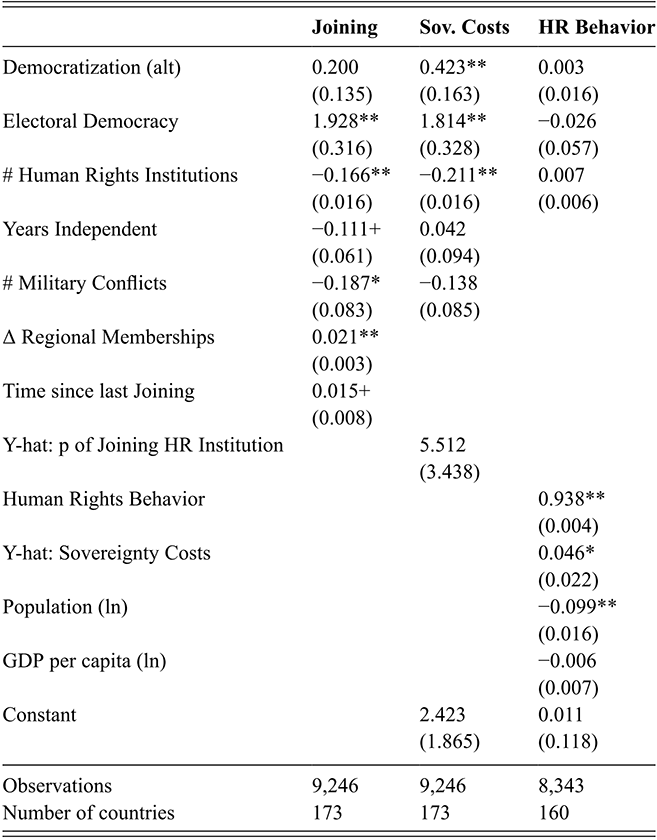
Appendix 10 Long description
Appendix 10 presents regression results examining the effects of an alternative measure of democratization, electoral democracy, human rights institutions, and other controls on the three stages of joining human rights intergovernmental organizations (HR IGOs), sovereignty costs, and subsequent human rights behavior. Standard errors are reported in parentheses, and significance is indicated as ** p<0.01, * p<0.05, and + p<0.1. Observations range from 8,343 to 9,246, covering 160 to 173 countries.
For joining HR IGOs at t+1 (n = 9,246; 173 countries): the alternative democratization measure has a coefficient of 0.200 with a standard error of 0.135, not statistically significant. Electoral democracy has a coefficient of 1.928 with a standard error of 0.316, significant at p<0.01. The number of human rights institutions has a coefficient of -0.166 with a standard error of 0.016, significant at p<0.01. Years independent has a coefficient of −0.111 with a standard error of 0.061, marginally significant at p<0.1. The number of military conflicts has a coefficient of −0.187 with a standard error of 0.083, significant at p<0.05. The change in regional memberships has a coefficient of 0.021 with a standard error of 0.003, significant at p<0.01. Time since last joining a HR IGO has a coefficient of 0.015 with a standard error of 0.008, marginally significant at p<0.1. The constant term is 2.423 with a standard error of 1.865, not significant.
For sovereignty costs at t+1 (n = 9,246; 173 countries): the alternative democratization measure has a coefficient of 0.423 with a standard error of 0.163, significant at p<0.01. Electoral democracy has a coefficient of 1.814 with a standard error of 0.328, significant at p<0.01. The number of human rights institutions has a coefficient of −0.211 with a standard error of 0.016, significant at p<0.01. Years independent has a coefficient of 0.042 with a standard error of 0.094, not significant. The number of military conflicts has a coefficient of −0.138 with a standard error of 0.085, not significant. The predicted probability of joining a HR IGO has a coefficient of 5.512 with a standard error of 3.438, not significant. The constant term is 0.011 with a standard error of 0.118, not significant.
For human rights behavior at t+1 (n = 8,343; 160 countries): the alternative democratization measure has a coefficient of 0.003 with a standard error of 0.016, not significant. Electoral democracy has a coefficient of -0.026 with a standard error of 0.057, not significant. The number of human rights institutions has a coefficient of 0.007 with a standard error of 0.006, not significant. Prior human rights behavior strongly predicts future behavior, with a coefficient of 0.938 and a standard error of 0.004, significant at p<0.01. The predicted sovereignty cost has a coefficient of 0.046 with a standard error of 0.022, significant at p<0.05. Population, logged, has a coefficient of −0.099 with a standard error of 0.016, significant at p<0.01. GDP per capita, logged, has a coefficient of −0.006 with a standard error of 0.007, not significant. The constant term is 0.011 with a standard error of 0.118, not significant.
Overall, the results indicate that using an alternative measure of democratization produces similar patterns to previous models: electoral democracy promotes joining HR IGOs and increases sovereignty costs; human rights institutions reduce sovereignty costs; prior human rights behavior is the strongest predictor of future behavior; and larger population size is negatively associated with human rights outcomes.
Note: Standard errors in parentheses; ** p < 0.01, * p < 0.05, + p < 0.1
List of IOs and Sovereignty Cost scores
African Commission on Human and Peoples’ Rights (ACHPR) [6]
African, Caribbean and Pacific Group of States (ACP Group) [6]
Agence de La Francophonie (ACCT) [5]
Andean Parliament [2]
Arab Labour Organization (ALO) [1]
CBSS Commissioner on Democratic Institutions and Human Rights [5]
Central American Integration System [2]
Central European Initiative [2]
Committee of Ministers of the Council of Europe [9]
Commonwealth Secretariat (ComSec) [5]
Community of Portuguese-Speaking Countries [1]
Council of Europe (CE) [8]
Council of the Baltic Sea States (CBSS) [6]
European Centre for Global Interdependence and Solidarity (North-South Centre) [5]
European Centre for Social Welfare Policy and Research (ECSWPR) [1]
European Commission [7]
European Commission for Democracy through Law (Venice Commission) [6]
European Community Humanitarian Office (ECHO) [5]
European Court of Human Rights [8]
European Parliament (EP) [9]
European Union (EU) [10]
European Youth Foundation (EYF) [4]
Inter-American Children’s Institute (IACI) [6]
Inter-American Court of Human Rights (IACHR) [5]
Inter-American Indian Institute (IAII) [2]
Intergovernmental TV and Radio Corporation (MIR) [2]
International Bureau of Education (IBE) [5]
International Court of Justice (ICJ) [6]
International Labour Organization (ILO) [7]
International Organization for Migration (IOM) [5]
International Training Centre of the ILO [2]
Latin American Faculty of Social Sciences [1]
Latin American Parliament [5]
League of Arab States (LAS) [3]
Nordic Council of Ministers [3]
North Atlantic Treaty Organization (NATO) [3]
Organization for Economic Cooperation and Development (OECD) [6]
Organization for Security and Cooperation in Europe (OSCE) [9]
Organization of American States (OAS) [5]
Organization of the Islamic Conference (OIC) [4]
OSCE – Office for Democratic Institutions and Human Rights (ODIHR) [8]
Parliamentary Assembly of the Council of Europe [8]
Parliamentary Assembly of the Organization for Security and Cooperation in Europe [7]
Parliamentary Committee of the Central European Initiative [6]
Phare Programme [6]
Programme for Central and Eastern European Development (PROCEED) [2]
Southern African Development Community (SADC) [7]
Steering Committee for Equality between Women and Men [6]
Tacis Programme [2]
United Nations [8]
United Nations Committee on the Exercise of the Inalienable Rights of the Palestinian People [5]
United Nations Economic Commission for Latin America and the Caribbean (ECLAC) [6]
United Nations Educational, Scientific and Cultural Organization (UNESCO) [7]
United Nations High Commissioner for Refugees Executive Committee (UNHCREXC) [7]
United Nations (SPECIAL COMMITTEE ON) Peacekeeping Operations [4]
World Tourism Organization (WTO) [1]
Additional Organizations from ROCO Sample
Bolivarian Alliance for the Peoples of Our Americas [0]
Economic Community of Central African States [4]
Community of Sahel-Saharan States [1]
Common Market for Eastern and Southern Africa [1]
East African Community [5]
Eurasian Economic Union [0]
Economic Community of West African States [7]
Intergovernmental Authority on Development [0]
MERCOSUR [5]
Organization of Eastern Caribbean States [0]
Shanghai Cooperation Organization [0]
Series Editors
Tanja A. Börzel
Freie Universität Berlin
Tanja A. Börzel is professor of political science and holds the Chair for European Integration at the Otto-Suhr-Institute for Political Science, Freie Universität Berlin. She is the director of the Cluster of Excellence “Contestations of the Liberal Script”. Her research focus and teaching experience lie in the field of European Integration, Governance, and Diffusion. She investigates the contestation of liberal norms, such as academic freedom, within democratic societies. Her most recent research focuses on democratic resilience and its sources. Her most important publications include “Effective Governance Under Anarchy. Institutions, Legitimacy, and Social Trust in Areas of Limited Statehood,” with Thomas Risse (Cambridge University Press 2021), “Why Noncompliance. The Politics of Law in the European Union” (Cornell University Press 2021), “The Liberal Script at the Beginning of the 21st Century. Conceptions, Components, and Tensions”, co-edited with Johannes Gerschewski, and Michael Zürn (Oxford University Press), and “Polarization and Deep Contestations: The Liberal Script in the United States”, co-edited with Thomas Risse, Stephanie Anderson, and Jean Garrison (Oxford University Press).
Jeffrey T. Checkel
European University Institute
Jeffrey T. Checkel is Professor and Chair in International Politics, European University Institute. Checkel’s research interests include international relations theory (domestic-international linkages, international institutions, governance); philosophies of social science; conflict studies (civil war); identity politics; and qualitative methods (theory-practice-ethics of processual methods; bridging positivist-interpretive techniques). He is the author of four books from Cambridge, including European Identity (co-edited with Peter J. Katzenstein, 2009); Transnational Dynamics of Civil War (edited, 2013); and Process Tracing: From Metaphor to Analytic Tool (co-edited with Andrew Bennett, 2015).
Edward D. Mansfield
University of Pennsylvania
Edward D. Mansfield is the Hum Rosen Professor of Political Science and Director of the Christopher H. Browne Center for International Politics at the University of Pennsylvania. His research focuses on international political economy, international institutions, and international security. He is the author of Power, Trade, and War (Princeton University Press, 1994), Electing to Fight: Why Emerging Democracies Go to War (with Jack Snyder) (MIT Press, 2005), Votes, Vetoes, and the Political Economy of International Trade Agreements (with Helen V. Milner) (Princeton University Press, 2012), and The Political Economy of International Trade (World Scientific, 2015). He is also the editor of sixteen books and journal special issues, and has published articles in the American Political Science Review, British Journal of Political Science, Comparative Political Studies, International Organization, International Security, International Studies Quarterly, Journal of Conflict Resolution, Journal of Politics, Proceedings of the National Academy of Sciences, and World Politics. Mansfield is an elected member of the American Academy of Arts and Science and received the 2000 Karl W. Deutsch Award in International Relations and Peace Research.
Stefanie Walter
University of Zurich
Stefanie Walter is Full Professor for International Relations and Political Economy at the Department of Political Science at the University of Zurich. She received her PhD in Political Science from ETH Zurich for a dissertation on the political economy of currency crises. Before joining the University of Zurich, she was a Fritz-Thyssen-Fellow at the Weatherhead Center for International Affairs at Harvard University and Junior Professor for International and Comparative Political Economy at the University of Heidelberg. Her research examines distributional conflicts, political preferences and policymaking related to globalization, European integration, financial crises, and international cooperation. Current projects examine the backlash against globalization, perceptions of the Global South, and the politics of international non-cooperation. Her work has been published in journals such as the Annual Review of Political Science, American Journal of Political Science, Comparative Political Studies, International Studies Quarterly and International Organization. She is the author of “Financial Crises and the Politics of Macroeconomic Adjustments” (2013, Cambridge University Press) and co-author of “The Politics of Bad Options” (2020, Oxford University Press).
Editorial Team
International Relations Theory
Jeffrey T. Checkel, European
University Institute, Florence
International Organisations
Tanja A. Börzel, Freie Universität Berlin
International Political Economy
Edward D. Mansfield, University of Pennsylvania
Stefanie Walter, University of Zurich
About the Series
The Cambridge Elements Series in International Relations publishes original research on key topics in the field. It focuses on international politics broadly defined, including international security and civil conflicts, international political economy, international organizations, Global IR, and international relations theory. Our objective is to publish cutting edge research that engages crucial topics in each of these areas; the series is open to any theoretical or methodological approach.
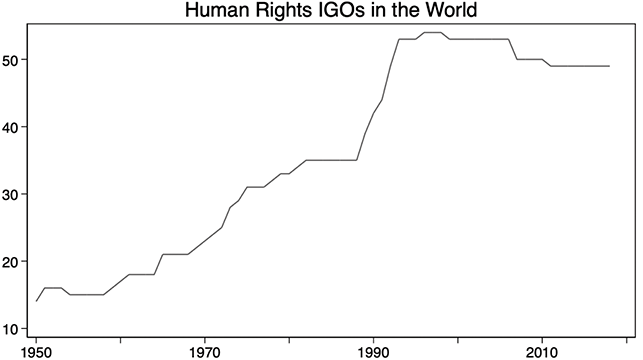
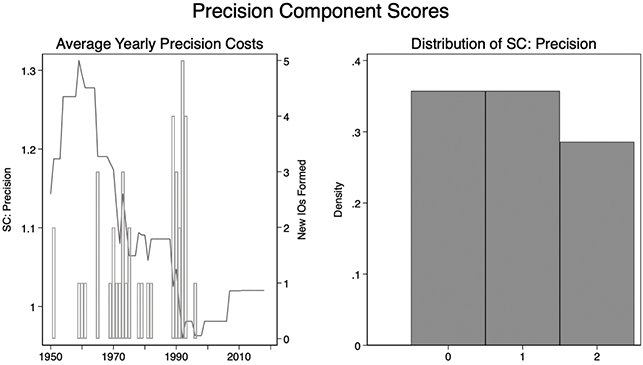
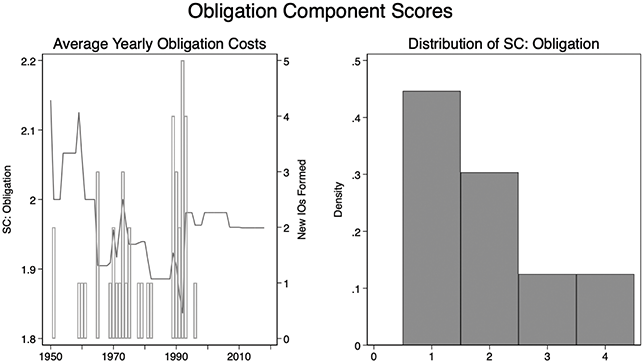
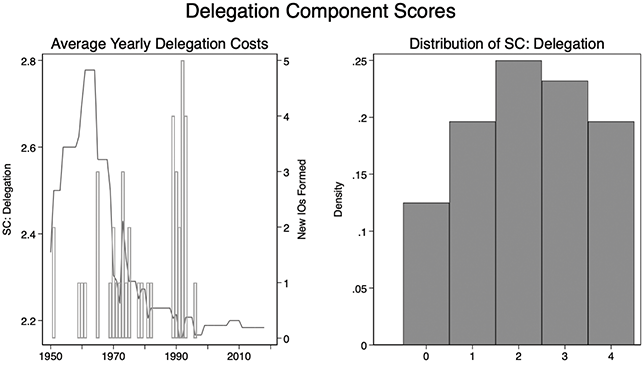
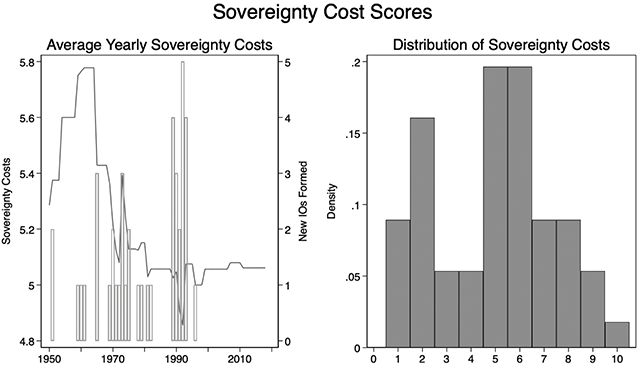
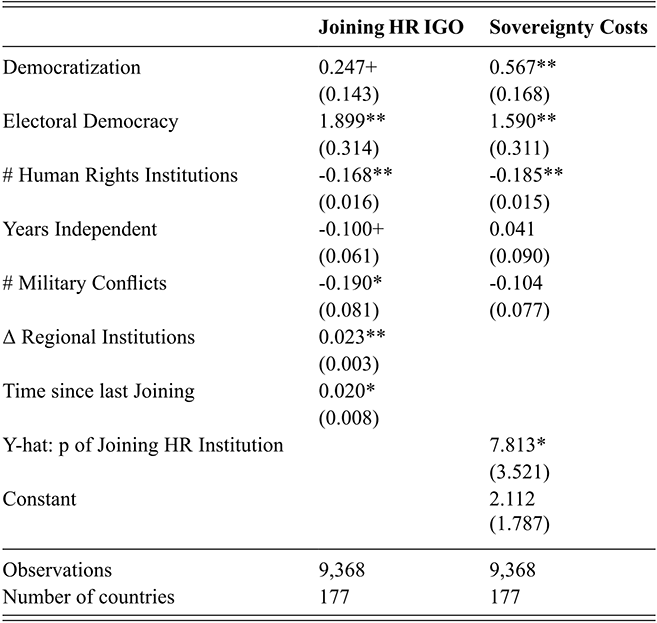
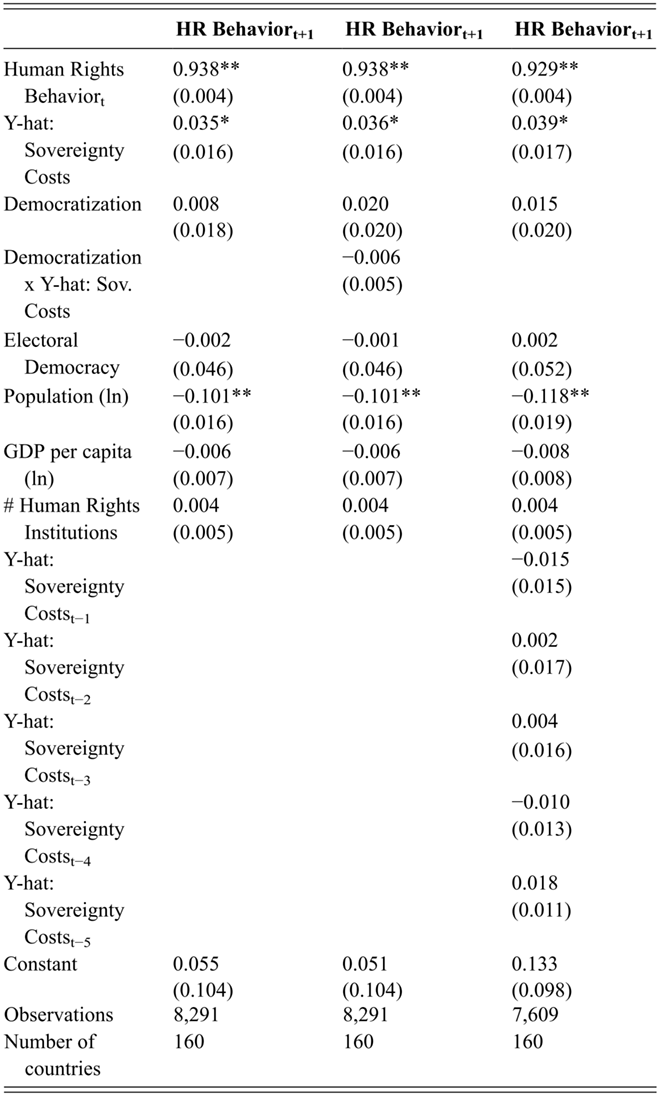

 Open access