



The role of parties has dominated scholarship on political institutions. One of the most important and outstanding questions in legislative politics is whether majority party control affects legislator behavior and agenda control. Since at least the 1970s, political parties successfully set the agenda on the US House floor (Cox and McCubbins Reference Cox and McCubbins2005; Rohde and Aldrich Reference Rohde, Aldrich and Stonecash2010) and in multiparty democracies (Fortunato Reference Fortunato2019; McElroy and Benoit Reference McElroy and Benoit2012; Yoshinaka, McElroy, and Bowler Reference Yoshinaka, McElroy and Bowler2010); though see Krehbiel (Reference Krehbiel1998) for an alternative view.Footnote 1
The majority party’s agenda setting in the US Senate, however, with its emphasis on individual power (Oppenheimer, Box-Steffensmeier, and Canon Reference Oppenheimer, Box-Steffensmeier and Canon2002; Reynolds Reference Reynolds2017; Schiller Reference Schiller1995), is alleged to be much weaker (Curry and Lee Reference Curry and Lee2019; Den Hartog and Monroe Reference Den Hartog and Monroe2019). Instead, scholars argue that legislators’ preferences—or a hybrid of senator preferences and filibuster pivot gatekeeping—are more influential than the majority party (Clinton and Richardson Reference Clinton and Richardson2019; Krehbiel Reference Krehbiel1998; Peress Reference Peress2013; Richman Reference Richman2011). Still others argue that parties play a role in the US Senate, even if their influence is more constrained than in the House. When majority-party effects are found, they are limited to the polarized contemporary Senate (Campbell, Cox, and McCubbins Reference Campbell, Cox, McCubbins, Brady and McCubbins2002; Den Hartog and Monroe Reference Den Hartog and Monroe2011; Reference Den Hartog and Monroe2019; Monroe, Roberts, and Rohde Reference Monroe, Roberts and Rohde2009; Reynolds Reference Reynolds2017; Smith Reference Smith2007; though see Gailmard and Jenkins Reference Gailmard and Jenkins2007; Ragusa and Birkhead Reference Ragusa and Birkhead2015). Especially during the mid-twentieth century, the US Senate has been characterized as having weak parties (Carson, Madonna, and Owens Reference Carson, Madonna and Owens2016; Roberts and Smith Reference Roberts, Smith, Brady and McCubbins2007). Even those accounts positing party effects anticipate they hold only under conditions observed since the 1980s (Rohde Reference Rohde and Davidson1992). Classic work suggests the majority party has limited power to influence senators (Huitt Reference Huitt1957; Matthews Reference Matthews1960).
In contrast, we argue that majority party control affects legislator behavior and agenda control in the US Senate. Leveraging a natural experiment where nearly one tenth of the chamber’s senators died within the same legislative session, we identify the exogenous effect of party control on agenda control and legislator behavior. In that session, party control changed due to deaths while little else varied. Scholars have asserted that “deaths in office” create exogenous “opportunities for policy change” (Clarke, Gray, and Lowande Reference Clarke, Gray and Lowande2018, 1085), yet no work has harnessed the power of exogenous changes to party majorities in political institutions due to unexpected deaths. In fact, almost all research on parties in legislatures analyzes correlational or endogenously generated evidence and there is a paucity of experiments on institutions generally (though see Broockman and Butler Reference Broockman and Butler2015; Clinton Reference Clinton2005; Darmofal, Finocchiaro, and Indridason Reference Darmofal, Finocchiaro and Indridason2019; Jenkins Reference Jenkins1999; Rogowski and Sinclair Reference Rogowski and Sinclair2012; Williams and Indridason Reference Williams and Indridason2018; Zelizer Reference Zelizer2019).
We argue and find that partisan numerical majorities matter, even in the individualistic Senate. Exogenous changes in majority party control cause changes both to the agenda and to legislators’ revealed preferences. We identify the numerical party majority on the floor as a mechanism for party effects because we are able to keep pre-floor agenda-setting mechanisms such as committee composition constant. This letter comes closer to meeting the conditions for causal inference than any other work on parties in legislatures. This research shows that majority party control affects legislative behavior and agenda setting, and the magnitude of the effect is larger than has been uncovered in past correlational studies.
Does Majority Party Control Matter in the US Senate? Scholars are Divided
Scholars have frequently shown statistical relationships between party membership and roll-call voting in the US House, yet fewer scholars study parties in the US Senate. What evidence there is concerning party control and roll-call voting in the US Senate is mixed, with scholars occasionally finding correlations between majority party control and roll-call voting (Monroe, Roberts, and Rohde Reference Monroe, Roberts and Rohde2009) but other times not (Curry and Lee Reference Curry and Lee2019; Krehbiel Reference Krehbiel1998).
A fundamental problem in identifying the effect of majority party control is separating its effect from that of changes that occur due to election cycles. When party control shifts, so do pivotal floor preferences, as many new legislators are elected at once. Significant shifts in partisan balance are shaped by elections, and returning incumbents interpret electorally induced changes in membership as mandates for policy change. Further, strategic retirement hastens membership turnover and influences interpretations of electoral mandates; committee composition changes after elections (Anzia and Jackman Reference Anzia and Jackman2013; Fortunato Reference Fortunato2013; Minta Reference Minta2011); and elections induce changes in ideological diversity on the floor, within the majority caucus or in committees (Rohde and Aldrich Reference Rohde, Aldrich and Stonecash2010; Theriault Reference Theriault2013).
Nearly all research on majority party effects examines changes in majority party control due to endogenous electoral changes, failing to isolate and identify the effect of majority party floor control. Theoretically rich prior work is often of two types. The first type compares Congresses over time, with each Congress as the unit of analysis (Cox and Poole Reference Cox and Poole2002; Gailmard and Jenkins Reference Gailmard and Jenkins2007; Smith Reference Smith2007). The key independent variable is majority party control and the dependent variable measures roll-call voting. The second type examines individual legislators as the unit of analysis with correlations between majority party status and legislator-level outcomes like roll-call votes (Crespin et al. Reference Crespin, Madonna, Sievert and Ament-Stone2015; Curry and Lee Reference Curry and Lee2019; Fortunato Reference Fortunato2019). Both types carefully connect theory to empirics, but any findings have been correlative despite the causal claims implied by the theories tested.
Work by Den Hartog and Monroe (Reference Den Hartog and Monroe2019) has been the only and best attempt to causally identify party control effects. They examine change in majority party control when Senator James Jeffords left the Republicans to caucus with Democrats in 2001. Den Hartog and Monroe cleverly exploited a unique empirical situation. However, Jeffords’s decision to switch was neither random nor exogenous because attempts by party leaders to woo Jeffords to the Democratic caucus or keep him in the Republican caucus were strategic and likely correlated with both Jeffords’s decision to switch and agenda control and legislator behavior after the switch (Grose and Yoshinaka Reference Grose and Yoshinaka2003). Further, the party switch changed pre-floor committee composition as well as majority party floor control.
The scholarly conventional wisdom is that party leaders create party majorities on standing committees, and these standing committees exert negative agenda control by blocking legislation that is not preferred by a majority of the majority party (e.g., Cox and McCubbins Reference Cox and McCubbins2005). We argue that numerical party majorities in the Senate also allow parties to use floor procedures to affect outcomes, as some floor procedural motions allow a simple majority of senators to block a bill from progressing on the floor. We argue that a party leader who commands a numerical floor majority can thus exert negative agenda control at the floor stage. Previous work classified floor agenda setting in the Senate as a matter of simple legislator preferences or tended to emphasize pre-floor party agenda setting (Campbell, Cox, and McCubbins Reference Campbell, Cox, McCubbins, Brady and McCubbins2002).
We empirically isolate the effect of numerical party majorities on the floor on legislator behavior and agenda control using exogenously generated variation in numerical party majorities. We establish such exogeneity by identifying as-if random variation in changes to the partisan composition of the US Senate due to senator deaths. Importantly, the deaths did not change party composition on committees or meaningfully shift the preferences of pivotal actors, thus overcoming fundamental problems in identifying the effect of majority party floor control. Unlike past research, we are able to isolate the mechanism of the numerical floor majorities on legislator behavior and the agenda.
Empirical Setting: Nine Deaths in a Legislature
“Membership in the most famous parliamentary body in the world does not guarantee a lengthy membership.”—Bill Henry, columnist, commenting on deaths in the 83rd CongressFootnote 2
In 1952, the voters of Nebraska reelected US Senator Hugh Butler to a six-year term while also voting for Dwight Griswold to fill a special election for the state’s other seat. In less than two years, both senators were dead. Griswold suffered a heart attack and Butler suffered a stroke.
In the 83rd Congress (1953–54), they were not alone. During this one congressional session, nine of 96 US senators died, creating vacancies and replacements. Due to these unexpected deaths, party control of the US Senate ranged from +3 Republican to +1 Democratic.Footnote 3 These changes in party control were exogenous to our outcomes of interest, as-if randomly assigned, and did not affect other potential independent variables, thus facilitating causal inference.Footnote 4 Yet other than a short section in a descriptive article classifying these deaths as “unexpected interruptions,” political scientists have never studied these deaths (Clem Reference Clem1966, 70). Further, there were few major exogenous events in US society or Congress during these two years that may confound our study of these deaths.
Data and Empirical Tests
We collected all roll-call votes from the 83rd Senate and separated them into regimes (see Appendix A for details on each regime, defined as each unchanging composition of senators). Each regime comprises the set of roll-call votes that took place during unchanging compositions of senators during this one congressional session from 1953–1954. When a senator left office due to death, we created a new regime. When the dead senator’s replacement was named and seated, we also created a new regime. We then estimated ideal points for each senator-regime and bridged across regimes by holding four ideologically extreme senators fixed across time.Footnote 5
Following Clinton, Jackman, and Rivers (Reference Clinton, Jackman and Rivers2004), we estimated ideal points by assuming $ \Pr \left({\mathrm{Vote}}_{ij}=\mathrm{Yea}\right)=\Phi \left({\beta}_j{x}_i-{\alpha}_j\right) $
, where
$ \Pr \left({\mathrm{Vote}}_{ij}=\mathrm{Yea}\right)=\Phi \left({\beta}_j{x}_i-{\alpha}_j\right) $
, where $ \Phi $
is the standard normal cumulative density function, βj
represents vote j’s discrimination parameter, αj
represents vote j’s difficulty parameter, and xi
represents legislator i’s ideal point. We used Bayesian Markov chain Monte Carlo procedures to estimate ideal points (Clinton, Jackman, and Rivers Reference Clinton, Jackman and Rivers2004; Marshall and Peress Reference Marshall and Peress2018). We estimated ideal points in two dimensions because this era had both economic and racial dimensions (Hare and Poole Reference Hare, Poole, Heckelman and Miller2015; Poole and Rosenthal Reference Poole and Rosenthal2000). Second-dimension results are presented in Appendix C.Footnote
6
$ \Phi $
is the standard normal cumulative density function, βj
represents vote j’s discrimination parameter, αj
represents vote j’s difficulty parameter, and xi
represents legislator i’s ideal point. We used Bayesian Markov chain Monte Carlo procedures to estimate ideal points (Clinton, Jackman, and Rivers Reference Clinton, Jackman and Rivers2004; Marshall and Peress Reference Marshall and Peress2018). We estimated ideal points in two dimensions because this era had both economic and racial dimensions (Hare and Poole Reference Hare, Poole, Heckelman and Miller2015; Poole and Rosenthal Reference Poole and Rosenthal2000). Second-dimension results are presented in Appendix C.Footnote
6
Cutpoints: Estimating the Effect of the Majority Party on Proposal Locations
Cutpoints are the midpoints between the status quo policies and new policy proposal locations, which are generated for each individual bill in the estimation process (Krehbiel, Meirowitz, and Woon Reference Krehbiel, Meirowitz, Woon, Austen-Smith and Duggan2005). To intuit a cutpoint, imagine a bill facing the US Senate. In simple spatial voting, if the status quo policy was on the left of the spectrum, say at –0.5, and the policy proposal was on the right of the spectrum, say at 0.5, it would divide senators by ideology down the middle of the first dimension at 0, the bill’s cutpoint. A senator with ideal point 0 would be indifferent between the status quo and the new proposal. We would then observe senators voting nay who were to the left of the cutpoint, with negative ideal points, thus preferring the status quo, but senators on the right of the cutpoint, with positive ideal points, voting for the bill.
The Clinton, Jackman, and Rivers (Reference Clinton, Jackman and Rivers2004) model estimates these cutpoints. For each vote j, the cutpoint is the location at which a legislator is indifferent between voting yea or nay, implying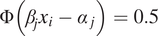 $ \Phi \left({\beta}_j{x}_i-{\alpha}_j\right)=0.5 $
or
$ \Phi \left({\beta}_j{x}_i-{\alpha}_j\right)=0.5 $
or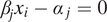 $ {\beta}_j{x}_i-{\alpha}_j=0 $
, meaning the cutpoint for vote j is
$ {\beta}_j{x}_i-{\alpha}_j=0 $
, meaning the cutpoint for vote j is $ {c}_j=\frac{\alpha_j}{\beta_j} $
. In theory, all legislators for whom xi
< cj
vote nay (favoring status quo) and for whom xi
> cj
vote yea (for the policy proposal).
$ {c}_j=\frac{\alpha_j}{\beta_j} $
. In theory, all legislators for whom xi
< cj
vote nay (favoring status quo) and for whom xi
> cj
vote yea (for the policy proposal).
If the majority party exerts agenda control on the floor, we would expect the range of status quo policies considered for revision to change when majority party control changes. The majority party would not allow the revision of status quo policies that would split its members and result in the creation of a new policy that a majority of the majority party disfavors. Because status quo policies can be mapped into cutpoints, cutpoints should also vary when majority party control changes.Footnote 7
If party control matters, we not only expect to see cutpoint location change but also anticipate the direction of the cutpoint change. Higher (positive) values of cutpoints imply a liberal agenda, whereas lower (negative) cutpoints imply a conservative agenda. In the 83rd Senate, Republicans controlled the Senate for most regimes. According to the party-agenda-control model, then, cutpoints should cluster around moderate to low values (liberal policies), as these are the status quo policies the majority party would like to revise that could garner a sufficient majority to move policy toward the party median. When the majority in the Senate switches to Democratic control, however, the range of status quo policies the Democrats would prefer to revise implies observing cutpoints that are moderate to high (conservative policies). Therefore, we expect to see larger, more positive, cutpoints during periods of Democratic control than Republican control.
Because we examine roll calls within the same Senate, the various pivots do not meaningfully change. In Senates changing due to electoral churn, we would observe meaningful shifts as multiple members exit. Because the pivotal senators do not significantly change from one regime to the next within the same senate, as only one senator at a time is being displaced due to death, the pivotal politics model predicts no change in equilibrium outcomes from moving from one regime to another. In addition, we confirmed with the Senate historian that committees, committee leadership, and other rules did not change within this 83rd Senate due to the deaths of any individual senators. Even committee chairs retained their positions during the regimes in which party control changed, as there was anticipation of eventual replacement for each dead senator sharing the party of each former senator. This implies that any changes we uncover due to majority party control are not due to pre-floor agenda setting but rather to changes in agenda setting through the use of floor procedures favoring the numerical floor majority.
Figure 1 displays mean cutpoints for each regime. During seven of eight periods of Republican control (in red), cutpoints were lower than during Democratic control (in blue). Perhaps most importantly, the periods of Republican control immediately preceding (Regime 5) and following (Regime 7) the period of Democratic majority party control (Regime 6) produced lower cutpoints than the period of Democratic control. The mean cutpoints with 95% CIs for regimes 5 and 7 are –0.1 [–0.4, 0.2] and –0.2 [–0.6, 0.2], respectively, and for Regime 6 is 1.1 [0.5, 1.6]. Numerical majority control on the floor mattered. The fact we find statistically distinct effects even though the Democratic regime was of shorter duration with fewer votes than other regimes is noteworthy (see Appendix A for more details on regimes).
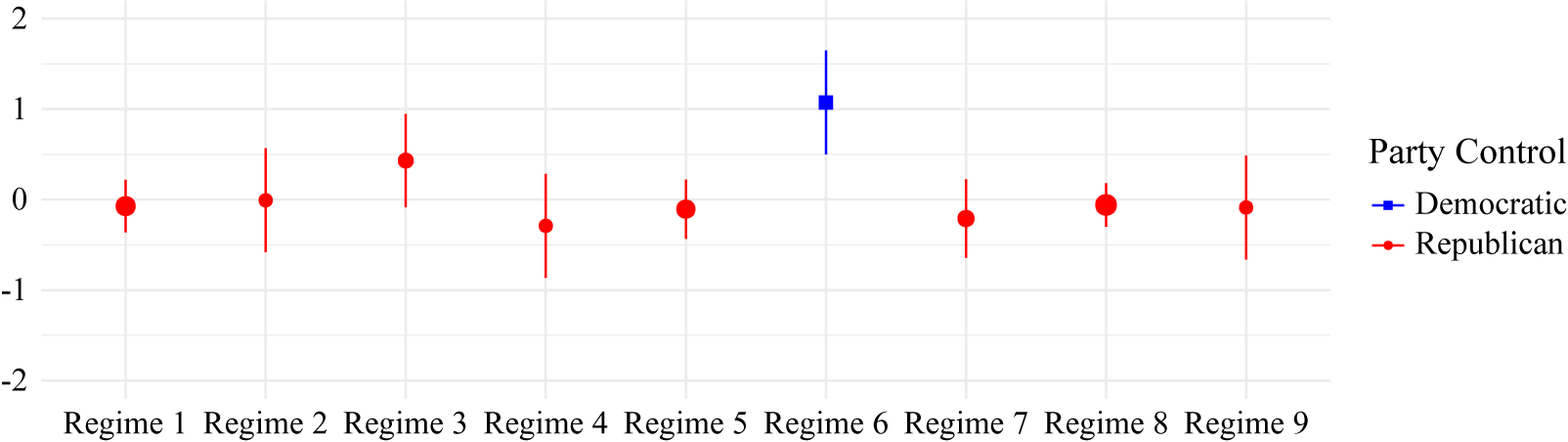
Figure 1. Cutpoints
Note: Each point represents the mean cutpoint for each regime, and bars represent 95% CIs. Cutpoint estimates are standardized to mean zero and standard deviation one. Point size is proportional to the number of roll calls voted on in each regime.
Table 1 displays differences in mean cutpoints by party control, estimated via OLS. The unit of analysis is the bill/roll call. Model 1 displays the effect of Democratic majority status relative to all periods of Republican control in the 83rd Senate; model 2 displays the effect for the period of Democratic control relative to the two periods of Republican control immediately before and after Democratic control; and model 3 displays the effect relative only to other regimes in the second year of the 83rd Senate (1954), the year where both Democratic and Republican numerical floor majorities occurred.
Table 1. Effect of Party Control on Cutpoints
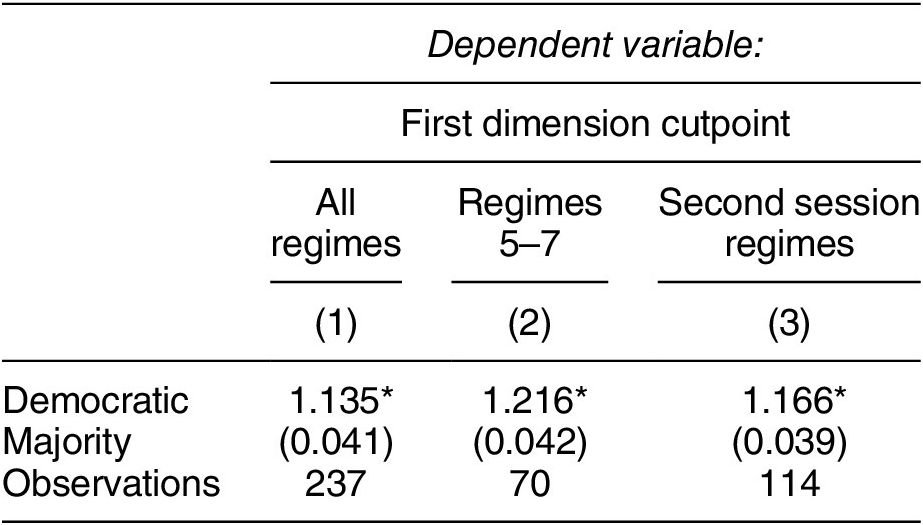
Note: Estimated via OLS. Unit of analysis is the bill/roll call. Baseline condition is Republican majority. Coefficients are reported, and heteroskedasticity-corrected standard errors clustered by regime are reported in parentheses. P-values use two-tailed tests. Dependent variable was rescaled to have mean zero and standard deviation one. *p < 0.01.
During Democratic control, cutpoint locations were significantly more to the right than during Republican control, indicating that Democrats were able to get bills revising conservative status quos on the floor. The change from Republican to Democratic control caused a full standard deviation increase in the mean cutpoint location, a sizeable effect. Because changes in party control were caused by as-if random deaths, the cutpoint changes are only affected by these as-if random deaths. Because there is little else that changed within this Senate, there is no need to estimate a multivariate model. We instead simply compare cutpoints across regimes in Table 1. Additionally, these causally identified effect sizes are of larger magnitude than those that have been found in correlational studies.
We also analyze correlations between cutpoints and party control from the 80th–116th Congresses and find similar results, demonstrating external validity. Analyzing cutpoints of all 23,909 roll calls during this 74-year period, we find an average change in cutpoints of 0.11 standard deviations for a change in the majority party. As shown in Figure 2, Democratic periods of Senate control yield higher cutpoints across this longer period. See Appendix E for details on this estimation.
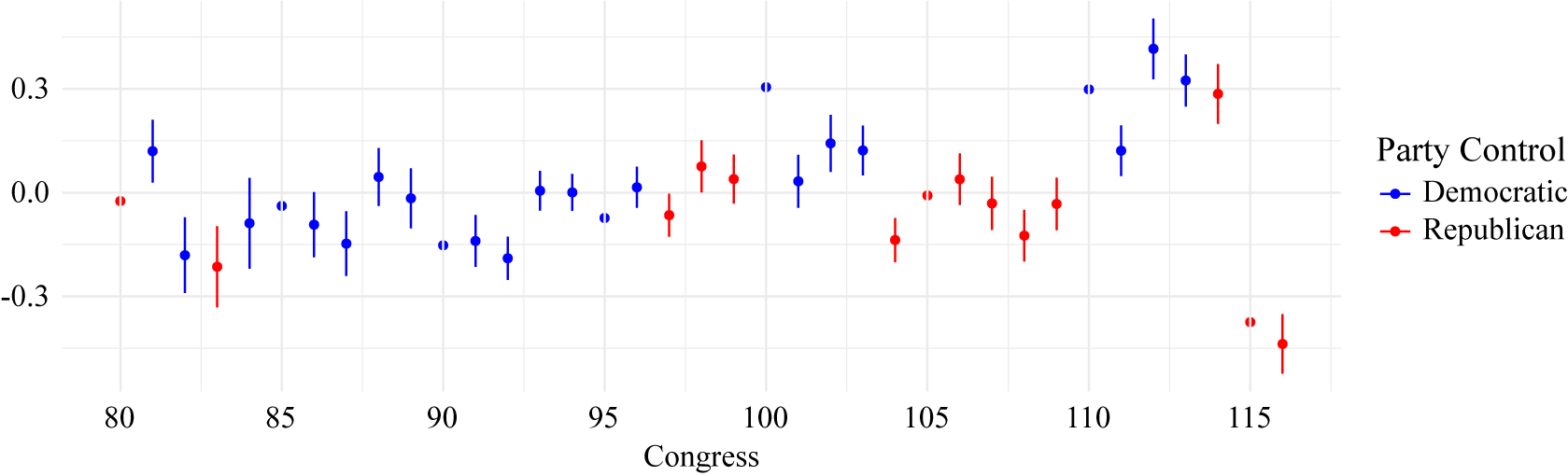
Figure 2. Average Cutpoints, 80th–116th Congresses
Note: Each point represents the mean cutpoint for each Congress, and error bars represent 95% CIs. Cutpoints estimated with the NOMINATE algorithm and retrieved from voteview.com.
Ideal Points: Estimating the Effect of the Majority Party on Legislator Behavior
We also leverage the exogenous nature of the switch to Democratic control to analyze how party control affected individual senator behavior on the floor. Figure 3 displays the density of the estimated ideal points by senator party and majority party control. The ideal point estimates are facially valid, as Democrats are to the left of Republicans.Footnote 8 Figure 3 also shows Republican senators’ revealed preferences were split during the period of the Democratic floor majority, and they were not as divided during periods of Republican control.
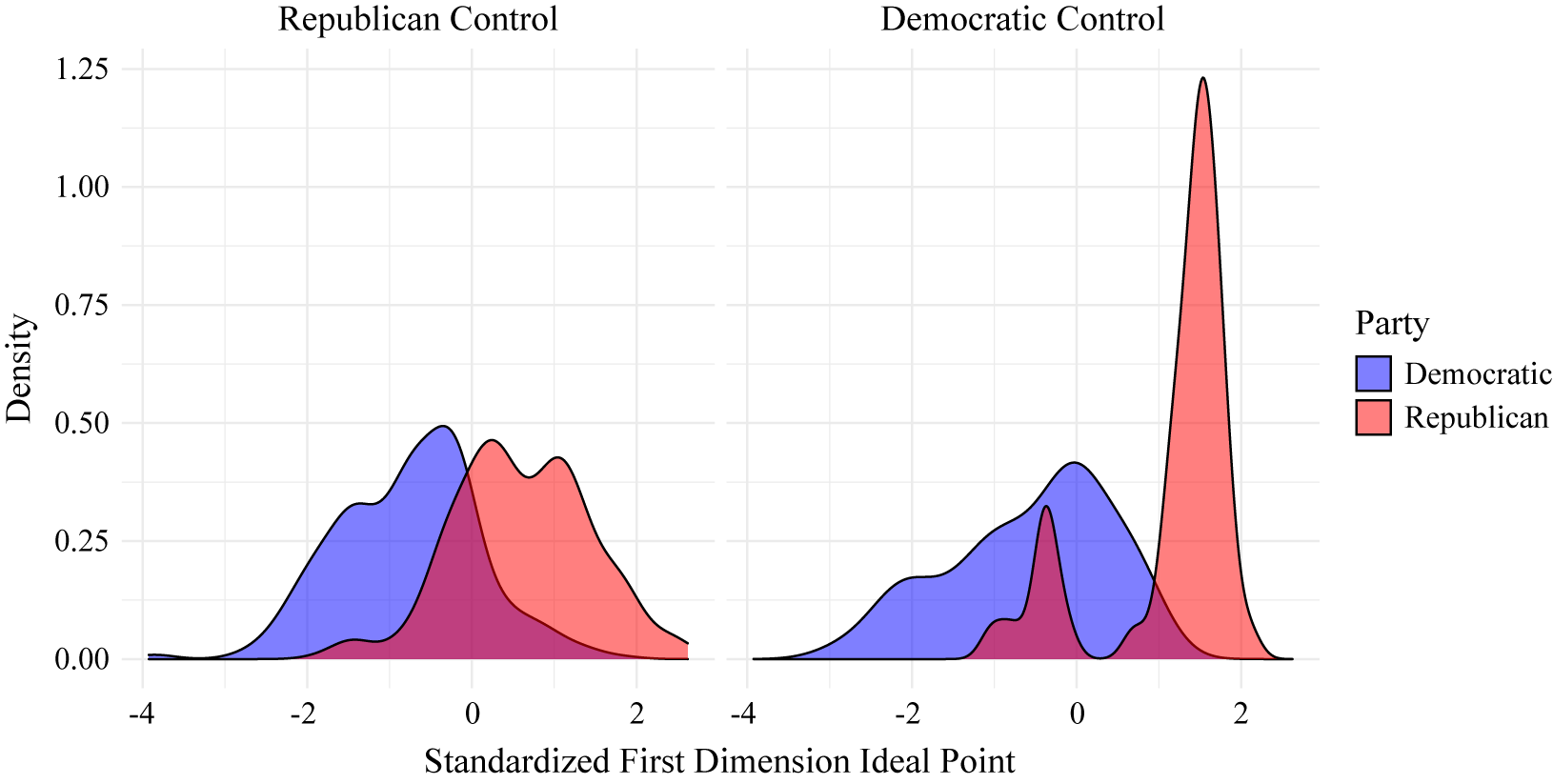
Figure 3. Ideal Points by Majority Party Control
Note: Ideal points are standardized to mean zero and standard deviation one for this plot to ease interpretation.
Table 2 displays OLS estimates where the unit of analysis is the senator. The dependent variable in Table 2 is the senator’s ideal point estimate, as described above, scaled to be mean zero and standard deviation of one. The independent variable is one indicating Democratic party control (during Regime 6) and zero in other GOP-controlled regimes. Each model includes senator fixed effects, controlling for all confounds that were static throughout the 83rd Senate for each legislator including state characteristics, seniority, electoral margin, committees, and other factors. Therefore, the coefficient on Democratic majority identifies the within-senator causal effect of the exogenous switch to Democratic majority, analogous to a within-subject experimental design.Footnote 9 We separately estimate models for Democrats and Republicans, as floor party majority control should move the legislators in different ideological directions.
Table 2. Effect of Party Control on Ideal Points
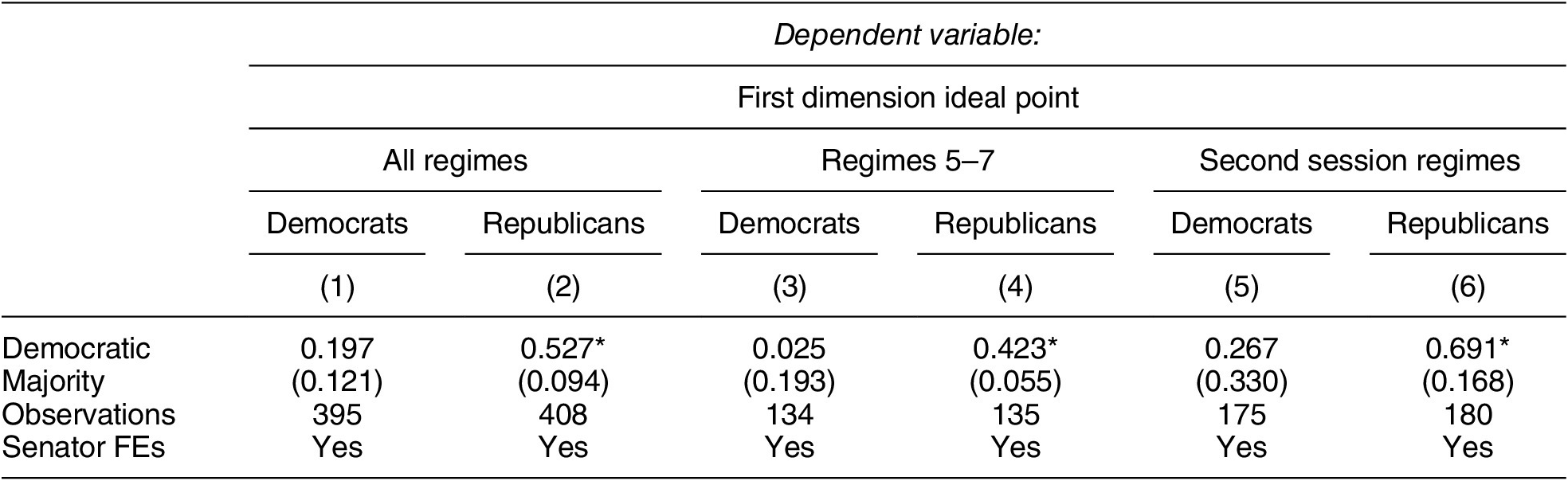
Note: Estimated via OLS. Unit of analysis is the senator-regime. Baseline condition is Republican majority. Coefficients are reported, and heteroskedasticity-corrected errors clustered by regime are reported in parentheses. P-values use two-tailed tests. Dependent variable was scaled to mean zero and standard deviation one. *p < 0.01.
Models 1 and 2 display the effect of Democratic majority status relative to all periods of Republican floor majorities, models 3 and 4 display the effect relative only to the periods of Republican control immediately before and after the period of Democratic control, and models 5 and 6 display the effect relative only to other regimes in the second year of the 83rd Senate.
Table 2 shows that, during the period of Democratic control, Republican ideal points moved rightward. The change from Republican to Democratic control caused more than half a standard deviation increase in the mean Republican ideal point (p < 0.01)—a sizeable effect—in all three Republican legislator models. Because changes in party control were due to as-if random senator deaths, we are confident that party control caused changes in legislators’ revealed preferences.
With Democrats, we find no evidence of ideal point change due to party control. These attenuated effects of a Democratic majority on Democratic legislators are due to differences between southerners and nonsoutherners. In Appendix G, we show that Democratic control did affect nonsouthern Democratic legislators’ revealed preferences but not those of southern Democratic legislators.Footnote 10
Because we showed in the cutpoint analysis that the agenda moved toward the left during periods of Democratic control, the ideal point analysis suggests that Republicans’ revealed preferences moved right when Democrats controlled the agenda. Along with the separation of Republican ideal points in Figure 2, this provides further evidence that the agenda shifted left, as this would induce more Republicans to vote against bills and therefore move their revealed preferences to the right.Footnote 11
Conclusion
As Senator Ron Johnson (R-WI) said in 2020, “death is an unavoidable part of life.” Deaths in the US Senate allowed us to assess the role of the majority party on legislator and policy outcomes. We argued for and have uncovered evidence that changes in numerical party control cause changes in the agenda and legislator behavior. The 83rd Senate is a particularly hard case for party effects given both the relatively weak parties and ideological heterogeneity within parties in the mid-twentieth century (e.g., Huitt Reference Huitt1957). It is an excellent case for examining exogenous changes in party control because we are able to isolate how one key mechanism—numerical majority control of the chamber on the floor—affects decisions in legislatures. The party leader with the most seats is able to agenda-set using floor procedures, including motions requiring only a simple majority vote. Nevertheless, the case also faces limitations that trouble our ability to generalize. However, we presented broader quantitative evidence from the period 1947–2018 supporting the results we found in the 83rd Senate, thus demonstrating external validity. This article is among the first in the study of political institutions to examine the causal effect of parties on the agenda and legislators’ revealed preferences, overcoming the fundamental problem in identifying the effect of party control due to its endogenous nature.
Supplementary Materials
To view supplementary material for this article, please visit http://doi.org/10.1017/S0003055421000721.
Data Availability Statement
Research documentation and/or data that support the findings of this study are openly available at the American Political Science Review Dataverse: https://doi.org/10.7910/DVN/7WUTWA.
Acknowledgments
We thank the Senate Historian’s office for providing details and qualitative context on the 83rd Senate and the archivists and staff of the Bancroft Library at the University of California, Berkeley for their help with the Senator William Knowland papers. We also thank three anonymous reviewers, the editors of the American Political Science Review, and many others for their excellent feedback and suggestions on earlier versions of this article.
CONFLICT OF INTEREST
The authors declare no ethical issues or conflicts of interest in this research.
Ethical Standards
The authors affirm this research did not involve human subjects.


 Open access


Comments
No Comments have been published for this article.