



THE PUZZLE OF GLOBAL PRISON ORDER
Governance institutions define and enforce property rights, promote trade, and assist in the production of collective and public goods (Dixit Reference Dixit2009). Governance can come from both centralized governments and competing, overlapping organizations in a polycentric system (Aligica and Tarko Reference Aligica and Tarko2013; Hooghe and Marks Reference Hooghe and Marks2003). While the conventional wisdom identifies the government as a key provider of governance, theoretical research identifies a range of nonstate mechanisms that can make self-enforcing exchange viable (Axelrod and Hamilton Reference Axelrod and Hamilton1981; Dixit Reference Dixit2007; Kreps Reference Kreps, Alt and Shepsle1990). An important empirical literature shows how extralegal governance works in practice in both historical and contemporary settings (Benson Reference Benson1989; Bernstein Reference Bernstein1992; Ellickson Reference Ellickson1991; Greif Reference Greif1993, Reference Greif2006b; Leeson Reference Leeson2007a, Reference Leeson2007c, Reference Leeson2008, Reference Leeson2009; Milgrom et al. Reference Milgrom, North and Weingast1990; Schaeffer Reference Schaeffer2008; Stringham Reference Stringham2015). Laboratory experiments and simulations also identify when self-governance is possible (Axelrod Reference Axelrod1981, Reference Axelrod1986; Ostrom et al. Reference Ostrom, Walker and Gardner1992). While this work provides important insights about the mechanisms of self-enforcing exchange, I argue that studying prisons—a microcosm of politics in society—presents a useful way to understand comparative extralegal governance institutions.
The quality of governance institutions is crucial in explaining why some economies develop and others do not (Acemoglu et al. Reference Acemoglu, Johnson, Robinson, Aghion and Durlauf2005). While the primary focus of existing research is on the quality of government-produced governance institutions, much of the governance that people rely on in both developed and less developed countries is actually produced through private mechanisms (Ostrom Reference Ostrom1990; Reference Ostrom2005). Moreover, there is a vast amount of economic activity taking place in countries whose governments are weak and unstable (Leeson and Williamson Reference Leeson and Williamson2009). This suggests that extralegal governance institutions play an important role in producing aggregate outcomes. However, precisely because these institutions are informal, we know less about how they function. To get around this problem, I examine the extent and form of informal institutions in prisons around the world. This affords a useful opportunity to study the extralegal governance institutions in cases that are comparable in key respects—because of the nature of a prison—while varying in important other ways, such as in the inmate demographics and the quality of governance provided by officials.
Studying prison social order provides several analytical advantages. The definitive characteristics of prisons are constant across cultures, legal systems, and political regimes (Giallombardo Reference Giallombardo1966, 2). For example, most inmates do not opt in to prison life, and inmates cannot rely on the exit option as a way to achieve better outcomes (Hirschman Reference Hirschman1970). Within a prison, inmates often must intermingle. When people can choose with whom to interact, cooperative people find each other and do well, while uncooperative people do worse (Tullock Reference Tullock1999). The ability to self-segregate through selective coalitions, which has proven effective in other settings (Bernstein Reference Bernstein1992; Greif Reference Greif1993), is unavailable in prisons. Offenders also have less self-control and higher discount rates on average than the general population (Gottfredson and Hirschi Reference Gottfredson and Hirschi1990; Pratt and Cullen Reference Pratt and Cullen2000), which make cooperation less likely (Fudenberg and Maskin Reference Fudenberg and Maskin1986). Each of these is a reason to expect that prisoners will not develop cooperative self-governance institutions. The first goal of this article is to identify how inmates create extralegal governance institutions in the face of these limitations.
The primary contribution of this article is then to explain the puzzle of why inmates create drastically different extralegal governance institutions. In Latin America, inmate groups of diverse variety wield authority, and they are sometimes the main or only source of governance. In Scandinavian countries, by contrast, informal institutions are relatively unimportant. Informal institutions also vary within developed western countries. Organized, ethnically segregated gangs govern Californian men's prisons, but similar groups do not operate in England. This article answers two related questions. What explains the amount of control wielded by inmates? Within that sphere of autonomy, what explains the varying degree of centralization?
Drawing on the new institutional framework (Greif Reference Greif2006a; North Reference North1990; Ostrom Reference Ostrom2005), this article provides evidence on how official governance institutions and inmate demographics jointly determine the importance and form of extralegal governance institutions. I argue that inmates develop these institutions when the quality of official governance is insufficient to meet inmates’ needs. Decentralized mechanisms—such as ostracism—are low cost, but they are only effective in small communities where reputations are well known. When populations increase in size, and sometimes diversity, centralized bodies that specialize in information transmission and enforcement provide extralegal governance more efficiently.
I examine a series of cases, which are selected purposively to sample the range of explanatory variables (King et al. Reference King, Keohane and Verba1994, 115–49; Small Reference Small2009, 13).Footnote 1 Since the quality of official governance is crucial to explaining the existence and need for extralegal governance, I study prisons in Brazil and Bolivia that have low-quality official governance. When prison officials do not govern effectively, inmates do. By contrast, Scandinavian prisons provide high-quality governance, and inmates invest little in informal mechanisms of social control.
To identify the effect of inmate demographics on the form of extralegal governance, I use a most similar systems design to study three examples of prison social order within and between prisons in California and England. First, I compare extralegal governance regimes in Californian men's prisons diachronically. As prison populations increased and became more diverse over time, the governance mechanisms transitioned from a decentralized form based on reputations to a centralized form based on gangs. Second, I use a synchronic analysis to compare the current governance regimes in Californian men's prisons and English men's prisons. The latter hold small populations and inmates rely on decentralized governance rather than gangs. Third, I compare men's and women's governance regimes. Women's prisons have small populations, and female inmates rely on decentralized governance mechanisms that are similar to what men used in the era prior to gangs.
While analysis of comparative cases does not have the identification power found in experimental and quasi-experimental research, the historical and cross-sectional variation allows me to provide empirical support for several theoretical predictions. Moreover, the detailed nature of these cases provides the opportunity to identify the mechanisms that sustain institutional outcomes (Bennett and Elman Reference Bennett and Elman2006, 255; Poteete et al. Reference Poteete, Janssen and Ostrom2010, 35). In particular, they allow for the identification of information transmission mechanisms, enforcement procedures, and the underlying factors that maintain the governance regime.
The evidence for these cases comes from the extensive literature in global prisons research. The types of sources vary, including ethnography, interviews, surveys, archival evidence, and reports from governmental and nongovernmental organizations.Footnote 2 The resources and experience needed to adequately understand a specific prison system has led scholars in this field to specialize quite narrowly. Most research therefore focuses on an individual prison or prison system. This article takes up the challenge outlined by Lacey (Reference Lacey and Crawford2011), which advocates drawing on thick descriptions of particular prison systems to conduct a broader, comparative analysis. I do this mainly by drawing on the rich academic literature on global prisons, in addition to published reports by government and nongovernmental organizations and on accounts by prisoners and prison staff members (the Appendix provides details of their research methods). This article thus offers a single theoretical framework to explain wide-ranging findings on extralegal governance in global prisons.Footnote 3
GOVERNANCE THEORY OF PRISON SOCIAL ORDER
The two main frameworks that scholars use to understand prison life have limitations that prevent them from addressing comparative questions. The “importation theory” focuses on the values and beliefs that inmates held prior to incarceration (Irwin and Cressey Reference Irwin and Cressey1962). Prison order is explained by studying offenders’ neighborhoods, beliefs, and broader social conditions. Much of the evidence, however, does not support this approach. There are sometimes rapid changes in prison order, with little apparent causal change from outside of prison (Dias and Salla Reference Dias and Salla2013). Likewise, research finds different social orders at prisons where its residents come from the same or similar communities (DiIulio Reference DiIulio1987). These results suggest that the importation theory is underdetermined and not suitable for comparative analysis.
The second framework focuses on the “pains of imprisonment” felt by inmates from losing access to security, autonomy, heterosexual relationships, family, and resources (Sykes Reference Sykes1958). The key to understanding prison life then is to understand the prison environment. The most extreme position in this tradition is the pure functionalist approach, which argues that the nature of a total institution means that any perceived differences are relatively unimportant in the homogenizing face of institutionalization (Drake et al. Reference Drake, Darke and Earle2014, 4). If this is true, then there is no variation in the extent of deprivation, so it cannot explain the variation in prison order (King et al. Reference King, Keohane and Verba1994, 146–7). Likewise, if there is a “universal prisoner identity” then this cannot explain different prison experiences. Scholars have thus typically treated the pains of imprisonment as exogenous, and sometimes invariant, factors.
To make this framework more analytically powerful, I combine insights from the new institutional theory and the rational choice approach to endogenize the pains of imprisonment. In particular, the quality of official governance institutions and inmate demographics determine the importance and form of extralegal governance institutions. Taken together, these explain prison outcomes.
Inmates in all prisons demand governance. Staff members and official procedures are one common source (DiIulio Reference DiIulio1987).Footnote 4 However, even when official governance is available inmates often provide key governance institutions themselves. They do so for several reasons. First, on the margin, inmates wish to be safer. Prison populations are comprised of people who are most willing to act opportunistically, and inmates invest resources to avoid victimization (Bowker Reference Bowker1980; Toch Reference Toch1992). Second, the communal nature of prisons gives rise to externality problems and the need to allocate common resources (Kaminski Reference Kaminski2004). Externalities arise when inmates make excessive noise or when hygiene and bodily functions affect other inmates. Conflicts occur over insufficient access to common resources, such as telephones, televisions, and use of recreation facilities.
Third, inmates require extralegal governance because officials do not facilitate economic activity. Many inmates desire prohibited goods, such as alcohol and drugs (Kalinich and Stojkovic Reference Kalinich and Stojkovic1985). Inmates cannot rely on prison officials to protect the contraband involved or to secure transactions. As one Brazilian inmate explains, “if I sell a rock of crack and the guy doesn't cough up, I got no judge to complain to or promissory note to claim” (Varella Reference Varella1999, 141). Inmates’ need for additional governance suggests the first hypothesis (H1):
Hypothesis 1 : Inmates provide extralegal governance when the governance supplied through official mechanisms does not meet inmates’ demand for governance.
Hypothesis 1 predicts that extralegal governance will be more important when officials provide low-quality governance, administer the facility ineffectively, and provide few resources. By contrast, well-governed prisons will have few extralegal governance institutions.Footnote 5
The existence of a governance vacuum often leads scholars to believe that centralized organizations, like nation states, are needed to provide governance (North Reference North1990). Related, in fact, is important work by Diego Gambetta (Reference Gambetta1993) and Federico Varese (Reference Varese2001; Reference Varese2011) that demonstrates that mafia groups operate in places where state-produced governance is unavailable or ineffectual. Mafias are often found to enforce property rights and facilitate trade when the state does not (Skaperdas Reference Skaperdas2001; Varese Reference Varese and Varese2010; Shortland and Varese Reference Shortland and Varese2014).
However, a governance vacuum is only necessary, but not sufficient, for the emergence of a centralized extralegal governance institution. If official governance is absent but the community can rely on less costly decentralized mechanisms, then centralized mechanisms will not emerge (Leeson and Rogers Reference Leeson and Rogers2012; Koivu Reference Koivu2015). According to Demsetz (Reference Demsetz1967), people will only invest in creating more rules and centralization when the marginal benefits outweigh the marginal costs. Building on this, Reference LeesonLeeson (2007b) provides a useful way to understand these tradeoffs. He identifies several costs associated with centralized governance: decision-making costs and external costs (à la Buchanan and Tullock Reference Buchanan and Tullock1962), the cost of enforcing rules, and the cost of producing public goods.
In the context of traditional governments, Leeson argues that these costs imply that “anarchy” is efficient in two scenarios. First, if the cost of government is substantial, then even one that creates considerable benefit might be inefficient. For example, a global government might do much to increase trade and reduce conflict, but the cost of organizing and operating a global government would be significant as well. If the costs exceed the benefits, then “international anarchy” is efficient (Leeson Reference Leeson2007b, 49–51).Footnote 6
Second, when there is little scope for market activity, there are fewer benefits from having a centralized government. In particular, government can do little to promote trade in communities characterized by small populations of people, with similar productive abilities, preferences, endowments, and who can rely easily on decentralized governance. A government would provide few improvements to market opportunities for primitive societies, such as the Nuer people from the southern Sudan in the 1930s (Leeson Reference Leeson2007b, 46–8). These communities were highly egalitarian, reflecting the presence of similar endowments. They were overwhelmingly engaged in cattle-herding, meaning that people had similar productive capabilities. Finally, these communities were small, tight-knit, and could easily rely on community elders as a source of dispute adjudication. For these reasons, the marginal benefit of creating a government was small, and local anarchy was efficient.
In the prison context, inmates also face the choice of how much centralization to create within the realm of extralegal governance. Their choice to centralize these institutions will depend, in part, on the effectiveness of decentralized ones.
History provides many examples of successful decentralized governance regimes that rely on reputation and the threat of ostracism (Bernstein Reference Bernstein1992; Greif Reference Greif1993; Ellickson Reference Ellickson1991). In these cases, bilateral and multilateral punishment regimes deter opportunism at low cost. However, for such systems to work, populations have to be sufficiently small for people to identify others’ reputations. Bilateral boycott is less effective when there are many alternative trading partners available. Multilateral boycott fails when information costs make it infeasible to certify a person's reputation. Larger communities are also less tightly knit, making ostracism less costly. Finally, larger populations make it easier for a person to free ride on contributing to decentralized enforcement.Footnote 7 Each of these mechanisms suggests the second hypothesis (H2):
Hypothesis 2 : Extralegal governance will be decentralized if the inmate population is sufficiently small to allow information transmission and enforcement at relatively low cost.
In addition to population size, ethnic heterogeneity might undermine decentralized governance institutions. Homogenous communities—where people share the same beliefs, language, culture, and religion—can more easily rely on decentralized governance (Landa Reference Landa1994). These groups share greater agreement on what constitutes acceptable behavior. Members of homogenous communities are more likely to share other-regarding preferences and to have similar preferences for public goods (Alesina and Spolaore Reference Alesina and Spolaore2003, 18–23). Finally, diverse communities tend to have greater difficulty in discouraging free riding in the production of public goods (Alesina et al. Reference Alesina, Baqir and Easterly1999).
On the other hand, each of these mechanisms relies on the assumption that individuals face sufficiently high transaction costs that they cannot overcome coordination and collective action problems. The empirical research has focused on large metropolitan areas and states, where this is likely true (Alesina et al. Reference Alesina, Baqir and Easterly1999; Easterly and Levine Reference Easterly and Levine1997). But smaller communities are more capable of solving these problems and accommodating disagreement over values. Likewise, small communities can more easily monitor free riding, even if people lack other-regarding preferences. Finally, people in diverse communities also recognize the problem and actively respond to it by investing more resource to mitigate its harms (Rugh and Trounstine Reference Rugh and Trounstine2011). This suggests the third hypothesis (H3):
Hypothesis 3 : Ethnic heterogeneity will not undermine decentralized extralegal governance in small populations, but it will become more problematic in large ones.
When decentralized governance fails, inmates turn to more centralized institutions (Leeson Reference Leeson2007b, 45). However, even when inmates have a demand for centralized governance, someone must have the information and incentive to produce it. Because governance has public goods attributes, it is more likely to be undersupplied privately (Landes and Posner Reference Landes and Posner1975). Moreover, key actors may prefer to shape institutions in a way that benefit themselves disproportionately rather than to maximize social welfare (Knight Reference Knight1992). For these reasons, we cannot simply assume that centralized institutions will emerge. When they do, there must be incentives for inmates to produce them. This suggests the fourth hypothesis (H4):
Hypothesis 4: For inmates to create centralized extralegal governance institutions, inmates must have the information and incentives needed to supply them.
In the empirical sections, I identify two ways in which inmates in large populations bundle public good provision with private benefits. First, inmates have an incentive to create centralized governance institutions when they are residual claimants to assets that appreciate when governance improves. Ownership of durable goods provides a strong incentive because it increases the relevant time horizon. However, an inmate must own the asset before providing the governance to benefit from the price increase. If not, then the price of governance will have already been capitalized into the price of the asset. This “residual claimant mechanism” creates incentives to produce public goods, but it is limited because it does not incentivize an inmate with no assets.
A second mechanism that leads inmates to govern social activity is when it creates a cross subsidy that increases the private benefits of economic activity.Footnote 8 If producing governance in one set of interactions makes market activity possible, then inmates who wish to trade will have an incentive to provide it. The benefits of market activity, rather than the price of a particular asset, incentivize public good provision under this “cross-subsidy mechanism.” As a result, even inmates with no desire to participate in the underground economy can still receive governance in social affairs.
A common type of centralized institution used in the absence of strong, effective government is a community responsibility system (Fearon and Laitin Reference Fearon and Laitin1996; Greif Reference Greif2006a; Weiner Reference Weiner2013). In such a system, all members of a clan, ethnic community, or group are responsible for other members’ actions. This creates an incentive to self-police the group to maintain the group's standing and to facilitate intergroup relationships. To be effective, a group must clearly delineate membership, monitor members’ behavior, and make it possible for outsiders to know which group a stranger belongs to.
In prison, we will only observe such a community responsibility system in large populations that cannot rely on decentralized mechanisms. In practice, several techniques make these systems work more effectively. First, to limit internal opportunistic behavior, groups exclude membership to people who will be costly to be held accountable for. This includes those inmates who are considered to be in the lowest social standing, such as sex offenders (Trammell and Chenault Reference Trammell and Chenault2009). Second, membership is permanent and mutually exclusive to reduce uncertainty about which group is responsible for any particular individual. Fleeting and overlapping membership would cause confusion about which group was responsible for a particular inmate. Finally, in a society of strangers, groups align in ways that make it easier to identify group affiliation. One method of doing so is ethnic and racial segregation. These factors suggest the fifth hypothesis (H5):
Hypothesis 5 : Prison groups functioning in a community responsibility system will only operate in communities that cannot rely on decentralized governance. They will develop ways to delineate membership, monitor members, and identify group affiliation.
This hypothesis predicts that collective responsibility will be important when the community is too large to rely on decentralized mechanisms. By contrast, small populations will lack groups with permanent, mutually exclusive membership, and racial and ethnic segregation will not be a defining characteristic of inmate life.
Before turning to the case studies to test these hypotheses, it will be useful to briefly review some descriptive statistics for the countries examined (see Table 1). The total number of people in prison ranges from less than 3,500 in Denmark to more than 2.2 million in the United States. The prison use rate (per 100,000 population) ranges from a low of 55 in Sweden to a high of 698 in the United States, with a median of 122 in the sample. Prison occupancy rates vary from 93% of designed capacity in Denmark to a high of 269% in Bolivia. The number of prison staff varies as well. In Brazil, there are more than five inmates for every member of prison staff, whereas in Denmark and Sweden there are actually more prison staff members than inmates.
Table 1. Descriptive Statistics on Prisons and Crime

aWorld Prison Brief. The data is for 2015 for Bolivia, Denmark, England & Wales, Norway, and Sweden, for 2014 for Brazil, and for 2013 for the United States. Source: http://www.prisonstudies.org/world-prison-brief.
bUnited Nations Office on Drug and Crime. All data is for 2013, except for the Bolivian data, which is from 2012. Source: https://data.unodc.org/.
cThis data point refers to the homicide rate in all of the United Kingdom.
Cross-sectional national comparisons of crime are often unreliable, but national data do give a general indication of criminal activity and help to explain incarceration patterns within a country (Shaw et al. Reference Shaw, Van Dijk and Rhomberg2003). Table 1 provides data from the United Nations Office on Drugs and Crime on the rates of homicide, robbery, and assault. Homicide rates, which are typically considered to be the most reliable cross-national measure of crime, are lowest in Denmark, Norway, and Sweden, at 0.7, 0.9, and 0.9 per 100,000 population, and highest in Bolivia (12.1) and Brazil (26.5). Likewise, for robbery rates, the Scandinavian countries do best, followed by England and Wales, the United States, Bolivia, and Brazil. For assault rates, there is more variation across regions: Norway and Bolivia perform best, followed by Denmark, the United States, Brazil, England and Wales, and Sweden.
INMATES RESPOND TO GAPS IN OFFICIAL GOVERNANCE (H1)
Hypothesis 1 predicts that when official governance fails, extralegal governance will become more important, and that when official governance is effective, inmate organization will be minimal. This section provides evidence on Hypothesis 1 by studying two extreme cases, prisons with little to no official governance in Brazil and Bolivia and those with high-quality official governance in Scandinavian facilities.
Inmates Govern When Official Governance Fails
In Brazil, the amount and quality of resources provided through official means is extremely limited. Inmates often have little access to health care, food, and shelter (Inter-American Commission on Human Rights 2011). Severe overcrowding is widespread. Inmates lack clean water, soap, and showers. A recent report found that a quarter of facilities did not have mattresses for all inmates and about two-thirds of prisons did not have hot water or towels and toiletries (Conselho Nacional do Ministério Público 2013, 65). Prisons are poorly built and in decay.
Brazilian prisons are chronically understaffed. Even with official data indicating there are 5.6 inmates per staff member, many employees who officially work in custodial roles actually perform administrative tasks, and there is a high level of absenteeism (Mariner Reference Mariner1998, 100). There are often far fewer staff members overseeing inmates. For example, in Rio Grande do Norte prison, three guards oversaw 646 prisoners (Mariner Reference Mariner1998, 102). At a jail in Rio de Janeiro, there were only six officials responsible for 1,405 inmates (Darke Reference Darke2013a, 275). At another Brazilian prison, five officers administered a population of 4,200 prisoners (Darke Reference Darke2013a, 275). The poverty and limited presence of officers indicates that official governance is lacking.
In surveying the literature on Latin American prisons, Darke and Karam (Reference Darke, Karam, Jewkes, Crewe and Bennett2014, 10) identify numerous forms of inmate-created extralegal governance. These include directivas (directors) in Bolivia; the cabos/delegados de pabellón (heads/dormitory delegates), jefes de patio o pasillo (heads of patio or corridor)/gremio (management), and polipresos (inmate police) in Venezuela; the nueva mafia (new mafia) in Honduras; delegados (delegates) in Peru; the comités de orden y disciplina (committees of order and discipline) of Guatemala; the “cellblock bosses” of Mexico; the “internal chiefs” of Colombia; the capataces (foremen) of Paraguay, and the limpiezas (cleaners) of Argentina. These findings offer aggregate-level support for Hypothesis 1—low-quality official governance correlates with extralegal governance.
A former Brazilian prison doctor explains the importance of the inmate-governance produced by the faxinas (cleaners). He explains, “[they] were the backbone of the prison. Without understanding their organization, it is impossible to comprehend the day-to-day events, from the ordinary moments to the most exceptional ones” (Varella Reference Varella1999, 109). They played a prominent role in regulating trade. The doctor reports, “the cleaners were absolutely fundamental in keeping internal violence in check. If an inmate didn't honour a debt, his creditor couldn't knife him without first consulting the pavilion leader, who would listen to both parties and set a deadline for the resolution of the situation. Before this time was up, woe was the creditor who dared attack a debtor” (Varella Reference Varella1999, 112). Even the notorious Primeiro Comando do Capital (“First Command of the Capital”) prison gang has created inmates courts to adjudicate disputes, and their use has coincided with a dramatic fall in violence (Denyer Willis Reference Denyer Willis2015, 60–3; Dias and Salla Reference Dias and Salla2013).
Criminologist Sache Darke has visited and studied 20 Brazilian prisons and jails in six states. His field study of a Brazilian lockup is especially relevant here because it documents the daily importance of inmate governance (Darke Reference Darke2013a, Reference Darke2013b, Reference Darke2014). Inmates, whose authority staff and other inmates acknowledge, sometimes administer Brazilian jails quite capably. They can play a key role in maintaining the physical structure of the facility, and they gain the compliance of other inmates through voluntary assent.
In the jail studied, prisoners outnumbered the staff by 10 to 1 (Darke Reference Darke2013b, 18). They lived in cells comprising two wings, a general wing and a segregation wing (for inmates who would be unsafe in the general population). Each cell had an inmate leader, called the representante de cela (cell representative) and each of the two jail wings had a representante geral (general representative) (Darke Reference Darke2014, 58). Officials did not select representatives—the inmates did. For a representative to keep his position, he had to satisfy his responsibilities, and inmates held them accountable. According to Darke (Reference Darke2013a, 277), the representatives “owe their position to the confidence of the colectivo [the collective] as much as to other prisoner representatives” (Darke Reference Darke2013a, 277).
Representatives oversaw the work of about 45 inmate trustees. They were in charge of cleaning the jail, cooking and distributing meals, making repairs, serving as porters, and provided medicine, cooking utensils, toiletries, and bedding and clothing. Inmates also built furniture, fixed fans, and repaired police cars (Darke Reference Darke2014, 60).
Inmates organized mutual-aid efforts. They welcomed new inmates, helped them find a place to sleep, and provided essentials like food, toiletries, medicine, and the prison uniform. Cell representatives also collected items left by departing prisoners, which they gave to needy inmates (Darke Reference Darke2013a, 277; Darke Reference Darke2014, 64).
Trustees were also in charge of important security responsibilities. They handcuffed and escorted inmates through the prison. Trustees searched the facility for contraband. They ensured that everyone was in their cell when required and that they were not excessively loud (Darke Reference Darke2013b, 18–9). Inmates conducted end-of-visit strip searches and the evening inmate count. In addition, officials rarely entered the cellblocks and mainly communicated with inmates through the representatives. In North American prisons, by contrast, it is rare for inmates to play such an active role in administrative and custodial activities (Birkbeck Reference Birkbeck2011, 315).
When the prison director was not on site, the representatives were in charge of security, including carrying keys to the cellblock (Darke Reference Darke2013b, 19). A representative explains, “We try to do everything to avoid confusion. . . to maintain calm for everyone” (Darke Reference Darke2013a, 280). Prison officials’ main concern was that the prison was quiet and orderly. According to Darke (Reference Darke2013b, 19), the “director explained that so long as the wing remained quiet and no one was seriously hurt, what happened on the wings was ‘their business.’” Officials formally recognize the role of trustees, but their use is often criticized and quite controversial. Nonetheless, consistent with Hypothesis 1, when officials did not administer or govern the prison fully, inmates governed more.
We can further test Hypothesis 1 by looking at the San Pedro Prison in Bolivia, where an even more extreme example of inmate self-governance exists (Skarbek Reference Skarbek2010b). Guards restrict access to the facility and prevent escape, but do almost nothing else. Officials provide no rehabilitation services and only a minimal amount of low-quality food (Baltimore et al. Reference Baltimore, Bastien van der Meer, Brennan, Burton, Castillo, Cavise, Davis, Friedman-Rudovsky, Mendoza, Oliveira, Somberg, Spinazola, Staskawicz, Stern and Tockman2007, 24; Organization of American States 2007, 54). The prison—designed to hold 400 inmates—now holds about 1,500, a large portion of whom are there for drug offenses (Inter-American Commission on Human Rights 2011, 157). According to the National Lawyers Guild, inmates “have complete freedom of movement within the prison,” and they conclude that San Pedro Prison is “essentially self-governed” (Baltimore et al. Reference Baltimore, Bastien van der Meer, Brennan, Burton, Castillo, Cavise, Davis, Friedman-Rudovsky, Mendoza, Oliveira, Somberg, Spinazola, Staskawicz, Stern and Tockman2007, 23).
The primary source of extralegal governance is elected representatives of eight different housing sections (Estefania Reference Estefania2009; Young and McFadden Reference Young and McFadden2003, 80). Each section has committees responsible for resolving disputes and disciplining residents. Sections sometimes have multiple leadership positions, including treasurer, disciplinary secretary, culture and education secretary, sports secretary, and health secretary. To run for election, an individual must have resided in the prison for at least six months, have an unmortgaged cell, and no debt (Young and McFadden Reference Young and McFadden2003, 279).
When a new inmate arrives, he must purchase or rent his own cell (Baltimore et al. Reference Baltimore, Bastien van der Meer, Brennan, Burton, Castillo, Cavise, Davis, Friedman-Rudovsky, Mendoza, Oliveira, Somberg, Spinazola, Staskawicz, Stern and Tockman2007; Organization of American States 2007, 52). Housing quality varies, and prices range from several hundred to several thousand dollars (Baltimore et al. Reference Baltimore, Bastien van der Meer, Brennan, Burton, Castillo, Cavise, Davis, Friedman-Rudovsky, Mendoza, Oliveira, Somberg, Spinazola, Staskawicz, Stern and Tockman2007, 23; U.S. Department of State 2001). The most inexpensive housing consists of bare six-by-nine-foot rooms with few amenities. Ownership of a cell exists for the duration of a prisoner's sentence. Purchasing a unit requires payment of a nonrefundable fee, typically 20% to 25% of the purchase price, to the housing section (Young and McFadden Reference Young and McFadden2003, 82). The fee is supposed to “cover section expenses such as maintenance, administration, cleaning, renovations and the occasional social event such as the Prisoners’ Day party every September, when the section delegates cooked a barbecue and hired a band for the inmates” (Young and McFadden Reference Young and McFadden2003, 81).
A record keeping forum certifies the legitimacy of ownership claims. Each owner has a property title that describes the cell, its location, the previous owner, and the purchase price (Young and McFadden Reference Young and McFadden2003, 82). The owner retains the original title, but many people also give a copy to the housing section register. To transfer a title, inmates sign a purchase contract in the presence of the housing section delegate, who verifies the transaction, stamps the contract with the section's official seal, and collects the fee.
The National Lawyers Guild reports that, “[e]ach section has the feel of a neighborhood or even a small village with its own courtyard plaza and shops. The committee in charge of each section manages the section, repairing the sidewalks or painting the walls. Each ‘directiva’ sets an assessment charge for prisoners in the section and each committee is responsible for its own budget. Inmates pay for all services” (Baltimore et al. Reference Baltimore, Bastien van der Meer, Brennan, Burton, Castillo, Cavise, Davis, Friedman-Rudovsky, Mendoza, Oliveira, Somberg, Spinazola, Staskawicz, Stern and Tockman2007, 23). Purchasing a cell provides access to that section's amenities, which sometimes includes billiard tables and sponsored intersectional soccer tournaments (Baltimore et al. Reference Baltimore, Bastien van der Meer, Brennan, Burton, Castillo, Cavise, Davis, Friedman-Rudovsky, Mendoza, Oliveira, Somberg, Spinazola, Staskawicz, Stern and Tockman2007, 24; Estefania Reference Estefania2009).
There is a laissez-faire economy within the prison. According to a former resident, inmates cannot rely on prison officials “for anything, not even to maintain the buildings, so everything that needed to be done or bought was done or bought by the prisoners themselves” (Young and McFadden Reference Young and McFadden2003, 133–4). One inmate explains, “not everyone likes the food in the canteen, so we sell snacks and sandwiches here for inmates and for their families when they come to visit. . . . With the money I make, I pay my rent and keep a few bolivianos for cigarettes” (Estefania Reference Estefania2009).
Inmates own and operate grocery stores, restaurants, food stalls, barbershops, butcher shops, carpentry services, and a copying center (Baltimore et al. Reference Baltimore, Bastien van der Meer, Brennan, Burton, Castillo, Cavise, Davis, Friedman-Rudovsky, Mendoza, Oliveira, Somberg, Spinazola, Staskawicz, Stern and Tockman2007, 23; Estefania Reference Estefania2009). The economy includes “cooks, painters, restaurateurs, carpenters, electricians, cleaners, accountants and doctors. There were artesanos who sold their artwork and tiny handicrafts—such as paintings and figurines—to visitors. . . . Basically, anything you wanted done or anything you wanted to buy, you could, and if they didn't have it, someone could get it in for you for a small commission” (Young and McFadden Reference Young and McFadden2003, 134).
It appears that the most salient issue of conflict in the prison is the production and exportation of drugs. As a former prisoner explains, “. . .the main business was definitely drugs; that was what most of us had been convicted for and that was the most profitable product to sell” (Young and McFadden Reference Young and McFadden2003, 135). Conflicts associated with the drug trade tend to arise for three reasons. First, inmates who are under the influence are disruptive and sometimes fight. Second, some inmates sought to steal drugs during their production in the prison, or business partners outside of the prison would avoid paying after receiving the drugs (Young and McFadden Reference Young and McFadden2003, 136). Finally, inmates who fail to repay a drug debt are often assaulted, and sometimes killed. In some prisons, inmates rely on informal courts to adjudicate such problems, but that's not always the case (Dias and Salla Reference Dias and Salla2013, 403; Varella Reference Varella1999, 112). A nurse at a Brazilian prison reports that violence is most common on Mondays because “it's collection day. After the visits on Sundays, people who are owed money come to collect. When the guys who owe don't have the money, fights start” (Mariner Reference Mariner1998, 109).
While the prison is not free of violence, some inmates prefer that their families live with them in the prison. Bolivian law allows children under the age of six to do so, but officials have not evicted families with older children (Organization of American States 2007, 55). In 2009, there were about 200 children living in the prison (McFarren and Poslu Reference McFarren and Poslu2009), and in 2013, Bolivia's National Institute of Statistics estimates there were 1,319 children living in the country's adult prisons.
Inmates at San Pedro operate a parent's association. The association president explains, “If anything happens, we call a meeting, and [the prisoner responsible is] immediately punished. . . . It is more secure in here than out there” (Llana Reference Llana2007). One mother explains, “everything depends on the parents, how we organise to protect and take care of the children” (Shahriari Reference Shahriari2014). If inmates are fighting and a child enters the area, the inmates must stop immediately (Young and McFadden Reference Young and McFadden2003, 90–1).
Consistent with Hypothesis 1, San Pedro Prison shows that when officials provide few resources, no administration, and no governance, that inmate governance becomes much more important. Inmates participate in market activity and establish governance mechanisms based on housing areas. Furthermore, San Pedro confirms the intuition of Hypothesis 4 that inmates must have the information and incentive to produce centralized governance. In this case, because inmates are the residual claimants to their homes, they have an incentive to improve them, including the rules that govern the housing section. The better the governance institutions, the more the home is worth on the market. The presence of different housing sections also introduces a degree of competition and exit that can create incentives for inmates to discover more optimal local public good provision (Stringham Reference Stringham2015; Tiebout Reference Tiebout1956).
The autonomy of the inmates also provides two additional benefits. First, the ability for an inmate to alter and secure his environment (such as installing a lock on a door) strengthens property rights. This in turn increases the return to engaging in productive activity. Second, the ability to participate in productive economic activity raises the opportunity cost of engaging in predatory behavior.
Even to the extent that these institutions are successful, Latin American prisoners still experience violence. However, in some cases, prison violence seems to decline when a single inmate group can monopolize control within a prison. In São Paulo, for example, the Primeiro Comando da Capital prison gang consolidated its power in 2006, and since that time, prison homicides and violence have fallen substantially (Dias Reference Dias2011; Dias and Salla Reference Dias and Salla2013). Power struggles are rife with violence, so its use declines when a single group emerges. As predicted in theories of state formation (Buchanan Reference Buchanan1975, 76–7), statelike groups also have an incentive to enforce disarmament of inmates, and Primeiro Comando da Capital now prevents inmates from carrying knives. The gang also uses a graduated punishment scheme to enforce their rules (departing from their earlier use of gruesome killings as punishment). Life in these prisons is far from ideal, but the institutions that emerge are a rational response to vulnerability and the lack of official governance.
Inmates Govern Less When Officials Govern Well
Hypothesis 1 also predicts that when official governance is effective, inmate governance will be much less important. Scandinavian prisons provide a useful comparison case because they differ in several key ways from those in Brazil and Bolivia.Footnote 9 First, their prison systems have a larger number of smaller prisons, with each facility usually holding fewer than 100 inmates (Pratt Reference Pratt2008, 120). Norway's largest prison holds only several hundred inmates, and the facility is separated into housing areas of roughly fifty prisoners (Mjåland Reference Mjåland2014, 339). By comparison, the prisons in Latin America and California (discussed below) regularly hold thousands of inmates. The average number of people in a prison in Norway, Denmark, and Sweden is 88, 70, and 68. Small prisons are easier for officials to monitor and control.
These prisons also have a larger proportion of staff members relative to inmates. As noted in Table 1, Denmark, Norway, and Sweden have inmate-to-staff ratios close to 1:1. These jobs attract high-quality employees. Working in a prison is seen by the community as honorable work. Staff members are trained well. In Norway, for example, officers get two years of training at full salary (Pratt Reference Pratt2008, 120). It is also common that prisoners have a voice in official decision-making.
Scandinavian prisons also offer better material conditions. Their prisons are clean and quiet. Inmates rarely have a cellmate, and most cells have a television. Many housing units include a shared kitchen where inmates prepare their own meals. Inmates work full-time jobs or receive an education at zero expense (Pratt Reference Pratt2008, 121). In a low-security prison in Sweden, some inmates work outside the prison and return at night. If inmates are running late on their return, “they can telephone ahead and a meal will be left out for them” (Pratt Reference Pratt2008, 122–3). Inmates at Norway's largest prison have a gym and can take spinning classes (Ugelvik Reference Ugelvik2014, 124). Many Scandinavian prisons have solarium facilities so that inmates with little access to sunlight do not suffer vitamin D deficiencies (Pratt Reference Pratt2008, 122).
Even in closed prisons (those holding the most serious offenders), many facilities have communal entertainment areas and kitchens. Low security inmates in open prisons can leave the prison to purchase food at near-by stores. Based on 16 visits to Scandinavian prisons, Pratt (Reference Pratt2008, 122) reports that the prison food “seemed nutritious and generous, with ample servings provided. There was no attempt to ration, for example, how much bread, sugar and sauce each prisoner was allowed to have, as happens in some of the Anglo-American jurisdictions.” Plenty of inmates are still dissatisfied with the quality of the food (Ugelvik Reference Ugelvik2014, 134–7), but compared with the poverty of Latin American prisons, they fare better.
Each of these features reflects the fact that officials administer and govern these prisons effectively. Consistent with Hypothesis 1, there is little need for inmate-produced governance. Inmates thus do not create and rely on extensive markets or elaborate inmate-governance institutions like those found in Brazil and Bolivia.
When inmates do have conflicts in Scandinavian prisons, they are resolved in decentralized ways. Based on a yearlong ethnographic study at a maximum-security prison in Norway, Ugelvik (Reference Ugelvik2014, 107) identifies ostracism as the key mechanism. Norwegian inmates ostracize each other for two reasons. First, some inmates are considered genuinely evil or dangerous (like mass murderer Anders Breivik). Second, inmates shun those who do not adapt well to prison. This includes inmates who are overly nervous, whine excessively, or act pitifully (Ugelvik Reference Ugelvik2014, 213–8). Inmates apply social sanctions in a decentralized manner and at their own discretion. There are no centralized extralegal institutions to create and enforce inmate rules.
When inmates desire contraband, they do not always rely on markets. Mjåland's (Reference Mjåland2014) observational and interview-based study (n = 23 inmates; n = 12 staff members) of illicit drug use at Norway's Kollen prison reveals that inmates get drugs through reciprocal sharing arrangements. One resident summarizes the relationship: “you have to give in order to get” (Mjåland Reference Mjåland2014, 343). Another resident explains, “it's also a kind of duty. . . . That people expect you to do it because they would have” (Mjåland Reference Mjåland2014, 345). As Mjåland (Reference Mjåland2014, 344) explains, “the most striking feature of the ‘culture of sharing’ is its inclusiveness. As long as prisoners contribute by reciprocating for the drugs they receive, they are part of the sharing culture.”
Inmates only use markets when the benefits of doing so exceed the costs (Coase Reference Coase1937). Markets increase efficiency because they overcome the knowledge problem about how society should use resources, provide incentives for people to act, and because money frees us from the inefficiency of barter (DeCanio Reference DeCanio2014; Meadowcroft Reference Meadowcroft2005). However, if these problems are not present, then nonmarket alternatives may be a more efficient way to accomplish social coordination over the use of resources. This is especially true when decentralized enforcement is effective.
Several factors make markets undesirable here. First, staff members are actually the major source of drugs. The facility provides two types of opioid (buprenorphine and benzodiazepines) to residents as part of a treatment regime. Staff members break the tablets into smaller pieces and place them under the prisoner's tongue to dissolve, and they monitor the process. Despite these precautions, prisoners are often still able to smuggle undissolved pieces of the drug back to their housing area.
Residents are partly willing to give up some of their smuggled drugs because the dosage is excessive. Even though one 8-mg tablet of buprenorphine can allegedly affect up to 30 prisoners, the average daily dose given to residents is actually 18 mg (Mjåland Reference Mjåland2014, 341). Many of the prisoners “claimed that their doses were far too high, and that they easily could take less buprenorphine without suffering withdrawal symptoms, especially if they also snorted some of the buprenorphine they hid away, or if they took a full dose every other day” (Mjåland Reference Mjåland2014, 341–2). Inmates did not typically store surplus dosage because they feared that staff would discover it (Mjåland Reference Mjåland2014, 346–7). Since officials provide the supply—which was reported to be dispensed daily and in steady quantities—higher prices are not needed to increase the quantity supplied (Mjåland Reference Mjåland2014, 345).
Delinquent debts, a common source of conflict, are also avoided by relying on sharing. One inmate explains that debt problems do not arise, “you can't get into debt here, it's impossible, that would never happen. If anybody says so, it's nonsense, I have never heard of it” (Mjåland Reference Mjåland2014, 342–3). This sharing system eliminates the need for mechanisms to make debt available and to resolve problems that arise as a result.
As Leeson (Reference Leeson2007b) argues, centralization is less desirable if people can rely easily on informal mechanisms, and the demographic characteristics of the housing unit are well suited to facilitate cooperation. These areas have small populations, typically with two housing units that hold 20 to 30 inmates and whose residents (all male) are between the ages of 25 and 45 (Mjåland Reference Mjåland2014, 339–40). All of the prisoners were ethnic Norwegians who lived in a nearby city, and many of the “prisoners knew each other from previous sentences or from the local drug scene” (Mjåland Reference Mjåland2014, 340).
The small population makes it is easy for residents to keep track of who shares and who does not. The confined living environment makes it low cost to monitor who goes for treatment at what times. The fact that they all receive the same drug makes reciprocity easier because quantities are comparable. Because residents are highly homogenous, know each other, and have ties outside of prison, the threat of ostracism is effective. The cost of using markets exceeds the benefits, so inmates rely on reciprocity and sharing.
LARGE POPULATIONS LEAD TO CENTRALIZATION (H2, H4, AND H5)
The cases from Latin America and Scandinavia provide evidence consistent with predictions of Hypothesis 1. However, even within a given arena of extralegal governance, the extent of centralization varies. Using a most similar systems design (Przeworski and Teune Reference Przeworski and Teune1970, 31–46), this section tests Hypothesis 2 by examining the United States and England. Both are developed Western countries with common law legal traditions, democratic institutions, the rule of law, and the latter has imported many of the penal practices and criminal justice policies implemented in the former (Newburn Reference Newburn2002). Despite these similarities, variation exists in how inmates govern themselves in California and England, in both men's and women's prisons.
This section compares (1) Californian men's prisons in recent and historical periods, (2) Californian men's and women's prison in the present, (3) and men's prisons in California and England in the present. The historical and cross sectional evidence suggests that extralegal governance becomes centralized only when populations are sufficiently large that reputation-based governance is ineffective. These cases also provide evidence consistent with Hypotheses 4 and 5.
Californian Men's Prisons over Time
The history of the California prison system provides a useful case to test the claim that decentralized extralegal governance will be effective in small populations. There has been a dramatic increase in the size of the prison population, and as predicted by Hypothesis 2, during this time, the extralegal governance institutions in men's prisons became much more centralized (Skarbek Reference Skarbek2014).Footnote 10 Inmate life is now regulated by ethnically segregated prison gangs in a community responsibility system.
Prior to the 1960s, inmates relied on a system of norms known as the “convict code” (Irwin Reference Irwin1980, 11–4; Irwin and Cressey Reference Irwin and Cressey1962). The code prohibited disruptive behavior, such as lying, stealing, and defaulting on a debt. To the extent that an inmate adhered to these unwritten norms, he would have the mutual support of his peers and would be less likely to be victimized. Deviations from the norm were punished in a decentralized manner through gossip, ostracism, withholding of peer support, and violence in varying degree (Clemmer Reference Clemmer1940, 129, 141–3; Clemmer Reference Clemmer, Johnston, Savitz and Wolfgang1962, 112–3; Irwin Reference Irwin1980, 58–60). The convict code was not explicit or intentionally created, and its enforcement was not organized or monitored by a centralized body. Inmates formed only loose groups, which had neither mutually exclusive nor permanent membership. Unlike gangs in later periods, the individual's reputation was the key focus of the informal system.
As predicted by Hypothesis 2, archival and historical evidence shows that this governance regime began to fail as the demographics of the inmate social system shifted dramatically (Skarbek Reference Skarbek2012; Reference Skarbek2014, 32–42). The prison population grew from a few thousand inmates in the 1940s to more than 170,000 in 2006. At that time, prisons held an average of 5,200 inmates. Likewise, from 1945 to 2015, the prison system grew from 4 to 35 correctional facilities. Because an inmate often serves his sentence in several prisons, the actual population that he interacts with has grown in this way too. Moreover, communication between prisons is more costly than within a prison, so knowledge of a person's standing is more costly to obtain when inmates serve time in multiple, distant prisons.
With the rapid increase in the population came an increase in the frequency of inmate violence (Irwin Reference Irwin1980, 181–212). As a response to this violence, inmates created gangs for protection. Officials now publicly acknowledge the prominent role played by gangs. In a television interview, then-warden of San Quentin prison admits, “the Department of Corrections has pretty much given over control of the general populations to gangs” (MSNBC 2007).
Hypothesis 5 predicts that a community responsibility system will only exist in communities that cannot rely on decentralized governance. Consistent with this, in the face of changing demographics, prison gangs now operate in a community responsibility system that provides extralegal governance (Skarbek Reference Skarbek2014, 75–103). Everyone in prison must affiliate with a group. Prison gangs, and broader ethnic and racial cliques, are the most important such groups. All members of a group are responsible for each member's actions and obligations. For example, if one group member cannot repay a debt, the group itself is held responsible (Skarbek Reference Skarbek2014, 75–87; Trammell Reference Trammell2012, 92). The gang might pay the debt for their member, or force the indebted member to work it off for the other gang, perhaps by attacking another inmate. Often, the gang will assault their member to the extent that it satisfies the gang that is owed. The reputation of the group determines a person's social status.
Gang leaders exert tremendous pressure within the group—where they know each member personally and have low costs of monitoring behavior—to ease relations with other groups. In large populations, impersonal exchange and social interactions are made easier because an inmate needs only to know the reputation of the group rather than each person's reputation. Gangs issue written rules, maintain records on disruptive inmates, and administer questionnaires to new inmates (Skarbek Reference Skarbek2014, 75–95). Gang leaders communicate with gang members in other prisons to identify which inmates are in good standing. Inmates in bad standing are punished. Information transmission is more centralized than in the convict code era.
Criminologist Rebecca Trammell has done extensive research on the California prison system, including recent work interviewing male former offenders (n = 80) about prison dynamics (Trammell Reference Trammell2009, Reference Trammell2012). A former inmate explained how gang leaders adjudicate conflict, “so here's the deal, you got old guys like me who have been in prison forever and have shot-callers do their job, keep peace and run the action. That's why we have shot-callers so when a couple of idiots get into it in the yard, instead of letting them kill themselves, the shot-caller goes out and works it out” (Trammell Reference Trammell2012, 47). Another inmate explains, “when I first got to prison, I said some shit to this white guy and the next thing I know, I'm told to make it right with him. . . . At first I thought, you gotta be kidding me. No way am I going to tell this guy that I'm sorry. Then they told me that I have no choice. That's the rule, you do what you're told. . . . Okay, so I made things right” (Trammell Reference Trammell2009, 766).
Hypothesis 4 claims that inmates must have an incentive to create centralized extralegal institutions. One subject explains why gangs do so. He says, “we don't fight in a riot and stuff unless we have to, it's too dangerous. We'll go into lockdown. . . . If I'm locked down, then I'm not working. You can make some serious bank in prison and shot-callers hate it when you're in lockdown” (Trammell Reference Trammell2009, 762). Another subject explains the process of self-policing. He says, “If one of my guys is messing up then we either offer him up to the other guys or we take him down ourselves. Like I had a guy that ran up a big drug . . .and I had to turn him over to them. They took him to a cell and really beat the shit out of him. We had to do it. If not, then everyone fights which is bad for business and bad for us” (Trammell Reference Trammell2009, 763–4). Officials respond to fights and riots by locking down entire cell blocks and all members of the racial groups involved. Because this reduces their ability to do business, the “cross-subsidy mechanism” gives gang leaders an incentive to provide the public good of governance.
Hypothesis 5 predicts that a community responsibility system works best when people can easily delineate membership, monitor members, and help strangers identify a person's group affiliation. Gangs’ organization reflects this in practice. Gangs require permanent and mutually exclusive affiliations because fleeting and overlapping membership would obscure group responsibility. Racial segregation provides a low cost way for strangers to identify an inmate's affiliation. The switch to a community responsibility system helps explain why racial segregation is actually more serious today than it was in California prisons in the 1940s and 1950s (Bunker Reference Bunker2000, 128–45, 264–94; Irwin Reference Irwin1970, 56). Identifying group affiliation among strangers was not needed in the convict code era where an individual's reputation mattered most.
While both of these practices improve the operation of the system, neither mechanism would provide the same benefits in a small population. In large prison populations, the collective reputation of the gang substitutes for the individual's reputation. This helps explain why large prison systems, like those in California and Texas, have more serious prison gang problems than do smaller prison systems, like Wyoming or Vermont.Footnote 11
English Men's Prisons
Men have not always formed gangs in California prisons, but since factors other than the size of the prison population have changed over time, the transition from decentralized to centralized governance might be attributed to alternative causes. One way to control for confounding variables is to look at prison social order in a comparable country that still has a relatively small prison population, such as England.
In November 2015, England and Wales listed the facility populations for 120 prisons. They held an average of 710 inmates (Figure 1). Fifty-two prisons held 600 or fewer people, and the largest prison held only 1,677 inmates (HM Prison Service 2015). By comparison, the average prison population in Californian men's prisons is nearly five times larger than the average prison in England and Wales. Moreover, the California prison with the smallest population (2,160 inmates) is still larger than the largest prison in England and Wales (1,671 inmates). The average Scandinavian prison holds far fewer.
Consistent with Hypothesis 2, inmates in English prisons rely on decentralized governance institutions, and prison gangs are unimportant—and in many facilities, do not even exist.Footnote 12 As predicted by Hypothesis 5, inmates do not rely on a community responsibility system, they lack permanent and mutually-exclusive group membership, and racial segregation is not important like in California.

Figure 1. Average Prison Population
Sociologist Coretta Phillips conducted ethnographic research on inmate life at the Rochester Young Offenders’ Institution and the Maidstone prison in Southeast England (n = 110 inmate interviews during 1,079 hours observing prison life) (Phillips Reference Phillips2012a; Reference Phillips2012b). Both facilities hold about 600 inmates. The Maidstone prison is a closed prison for medium security inmates, and it is divided into four residential and one segregation housing unit. The Rochester prison holds males aged 18 to 21 who are serving sentences of up to seven years, and adult males in a range of security classifications and sentence types.
Over the span of three years, Phillips found no evidence for anything like the gangs that operate in California. She explains, “there appears to be no recognizable equivalent of the organized US gang in either Rochester or Maidstone prisons. Prisoners were unequivocal in denying the presence of organized gangs” (Phillips Reference Phillips2012a, 56). Her informants explain (Phillips Reference Phillips2012a, 56), “there's definitely not a gang scene going on.” Another reiterates that, “it's not really like there's a gang that runs the prison or some bullshit like that,” and one asks, “where you heard of this gang thing?, I don't know nothing about that.”
Instead, inmates govern themselves through decentralized mechanisms. Like the convict code era in California, an inmate's individual standing is crucial. An inmate's status depends on his crime, sentence, physical prowess, and success in the underground economy (Phillips Reference Phillips2012a, 56). These are the same factors that determined a person's status in California during the convict code era (Irwin Reference Irwin1980, 58–60). Also, like California prisons prior to gangs, the underground economy in these prisons is populated only by sole proprietors (Phillips Reference Phillips2012a, 56). For these mechanisms to work, prison populations have to be sufficiently small for other inmates to know other people's reputations.
When conflict occurs, there are no gang leaders to adjudicate the dispute. Consistent with predictions from Hypothesis 5, there is no community responsibility system in place. Instead, inmates view these issues as individual-level conflicts. One subject explains that if “two people had a fight, it's just a fight, that's all it is and it's done with. . .It really isn't a gang thing” (Phillips Reference Phillips2012a, 56). In California, by contrast, a fight between individuals affiliated with different groups would automatically make it a group-level conflict between all members (Trammell Reference Trammell2012, 49).
Like both men's prisons in California before gangs and women's prisons today (see below), English inmates associate loosely with others, including acquaintances who they knew before incarceration (Crewe Reference Crewe2009; Phillips Reference Phillips2012a, 57; in California, Irwin Reference Irwin1980, 58–60). These loose affiliations lack the hallmark characteristics of prison gangs. Consistent with Hypothesis 5, they do not require mutually exclusive, restrictive, and permanent membership. They do not exist into perpetuity or have a corporate entity. They are not centralized, top-down authority structures. Phillips describes these dynamics as “loose collectives” with no internal organization (Phillips Reference Phillips2012a, 51). Each of these organizational characteristics is advantageous only in settings where information about an individual's reputation is difficult to ascertain and where communities are responsible for its members. In these English prisons, which are small and house inmates who share social ties in the community, the centralized extralegal governance created by gangs is not worth the cost.
California Women's Prisons
Social order in Californian women's prisons still resembles the decentralized system that existed during the convict code era.Footnote 13 Women's prison populations are still small. At the start of the prison boom in 1981, there were only about 1,400 female inmates in the state, compared to nearly 27,000 male inmates. By 2015, there were about 5,400 female inmates, compared to more than 127,000 male inmates. Like men's prisons prior to the 1950s, the demographics of these communities make it easier to know an individual's reputation.
Instead of forming gangs, many female inmates create prison “families” (Owen Reference Owen1998, 134–48; Trammell Reference Trammell2012, 32–8; Trammell et al. Reference Trammell, Wulf-Ludden and Mowder2015). Each woman typically takes on a traditional role, such as the mother or father. Families are comprised of only a few women. They mentor and support new and young inmates. They “promoted the norm of civility. They believed that young girls who entered prison were in dire need of mentoring and mothering. . . . Of course, making families also meant that they must discipline these girls to ‘set them straight’” (Trammell Reference Trammell2012, 36). Families “taught new inmates the norms of prison. . . . At the end of the day, no one wanted chaos” (Trammell Reference Trammell2012, 37).
These families resemble key aspects of the social order in men's prisons prior to gangs. Consistent with the predictions of Hypothesis 5, membership in a prison family is not permanent and is not mutually exclusive. Instead, women sometimes form ties with other families via fictive kinship roles, like cousins, and through intermarriage. Families are small, loose, and overlapping. Unlike prison gangs, prison families do not rely on extensive written constitutions or have formal procedures for regulating the community (Skarbek Reference Skarbek2010a; Reference Skarbek2011). Likewise, women do not segregate themselves by race (Kruttschnitt and Gartner Reference Kruttschnitt and Gartner2005, 107–8; Owen Reference Owen1998, 152–9; Trammell Reference Trammell2012, 53; Trammell et al. Reference Trammell, Wulf-Ludden and Mowder2015, 8).
One woman tells Trammell, “Women don't form gangs. . .it's not like the guys” (Trammell Reference Trammell2012, 54–5). One woman explains, “If anything happens, if there's any conflict, then you get with your homegirls from your areas. . .there's more of a formal system with the men; they assume their roles and they know their positions. With women, it's not like that” (Trammell Reference Trammell2012, 56). The community responsibility system in men's prisons place a high degree of importance on the authority of shot callers who adjudicate disputes. By contrast, no such leaders emerge among women (Trammell Reference Trammell2012, 57).
Hypothesis 5 also helps explain another difference: female inmates do not systematically shun other inmates, while men assault inmates who they deem to be untouchable, such as informants, sex offenders, and former law enforcement officers (Trammell and Chenault Reference Trammell and Chenault2009). Female inmates also do not reveal or demand to know a new inmate's crime, whereas men often require inspection of an inmate's official paperwork to determine his criminal history. A person's history and standing are more important when a group must be held responsible for him. By contrast, in an individual-focused system a person's history has less relevance to other inmates.
Gender is an obvious confounding variable in comparing men's and women's prisons. It might be that women are simply less likely than men are to resort to violence, due to a combination of genetic and social differences. However, the available evidence on prison violence actually finds that women are “at least as violent and often more prone to violence than men are” (Gambetta Reference Gambetta2009, 93). For example, a large study of Texas prisons found that for assaults with a weapon, men and women are involved at similar rates; for altercations not involving a weapon, women are involved at higher rates than men are (Tischler and Marquart Reference Tischler and Marquart1989, 511). Using comprehensive data from England and Wales, Gambetta (Reference Gambetta2009, 93) calculates that women assault each other twice as often as men do, and they fight one and a half times more often. This is especially striking given that outside of prison men commit violent crime at far higher rates than do women. Gambetta attributes the use of prison violence to the greater uncertainty among female inmates about their relative capacity to use violence. Men are more likely to know their own ability because of past altercations and to have scars that signal their toughness. Even if genetic and social differences exist, the social dynamics of prison life can still have a significant effect on women's behavior in prison.
HOW DOES ETHNIC HETEROGENEITY MATTER? (H3)
Hypothesis 3 predicts that in large communities, ethnic heterogeneity will undermine the cooperation needed to produce decentralized governance, but it will be less problematic in small communities. Below, I address how the cases above support this prediction.
First, consider men's prisons in California. In 1951, there were two white inmates for each minority inmate. By 2011, prisons held three minority inmates for each white inmate. This represents a radical shift in the ethnic composition of the community. Ethnic fractionalization, which estimates the approximate probability that two randomly selected people from a population belong to a different ethnic group, increased 23% over this period, to 0.69. For context, this rate would fall in the 76th percentile of a national ethnic fractionalization ranking. This data is also consistent with qualitative, historical accounts that describe the process of increasing ethnic diversity and conflict that was unfolding (Bunker Reference Bunker2000, 128–45, 264–94; Davidson Reference Davidson1974; Irwin Reference Irwin1980, chap. 7). Consistent with Hypothesis 3, an increasing level of ethnic heterogeneity, combined with significant increases in the size of the population, undermined decentralized governance.
However, ethnic fractionalization by itself does not undermine decentralization. In 2011, ethnic fractionalization among male (0.69) and female (0.70) prisoners was basically the same (California Department of Corrections and Rehabilitation 2012, 7). Yet, women did not form gangs. Centralization arises in men's large, diverse communities, but not women's small, diverse communities. This supports the claim that small communities can more easily solve the coordination and collective action problems associated with heterogeneity.
In England and Wales, prisons are less ethnically diverse than in California. Based on data from the Ministry of Justice (2014, Table A1.7), the ethnic fractionalization of prisoners is only 0.43. This is less than Californian men's prisons in both 2011 and 1951 (Department of Corrections 1951, 7). Moreover, the Norwegian prison discussed by Mjåland (Reference Mjåland2014, 340) was comprised entirely of ethnic Norwegians. In both cases, relatively high levels of ethnic homogeneity correspond with decentralized governance regimes.
Finally, levels of ethnic homogeneity similar to England and Wales are not sufficient to prevent centralization. In 2012, racial fractionalization of Brazilian inmates was 0.49. Nevertheless, the rise to power of Brazil's Primeiro Comando do Capital shows that gangs can be tremendously important even in relatively homogenous communities, if these are also large populations governed poorly by officials.
CONCLUSION
The political consequences of incarceration are substantial. Imprisonment represents the state's most extreme restriction on a person's liberty. In addition to excessive prison use, in many countries, minorities are represented disproportionately in prison. For example, the state and federal male imprisonment rate in the United States is 904 per 100,000 residents, but for Hispanic and black males the rate rises to 1,134 and 2,805 per 100,000 residents (Carson Reference Carson2014, 9). When inmates return to the community, prison influences come with them. Some inmates build criminal networks and social capital that increases post-release criminality (Bayer et al. Reference Bayer, Hjalmarsson and Pozen2009). Gangs that rise to power behind bars wield tremendous influence on the outside (Denyer Willis Reference Denyer Willis2015; Lessing Reference Lessing2015; Skarbek Reference Skarbek2011). Incarceration weakens the foundations of democracy by undermining trust in the government and reducing civic engagement (Lerman and Weaver Reference Lerman and Weaver2014; Weaver and Lerman Reference Weaver and Lerman2010). For these reasons, it is crucial that we understand the causes of extralegal governance in prison. Their effects are felt far beyond prison walls.
In this article, I develop a governance theory of prison social order to explain the variation in informal institutions. Through analysis of prisons in Brazil, Bolivia, England, Scandinavia, and men's and women's prisons in California, I provide evidence consistent with five hypotheses. First, the importance of extralegal governance depends on the quality of official governance provided; when officials do not govern, inmates will (Hypothesis 1). Second, given a need for extralegal governance, the form that the regime takes depends on the size, and sometimes the ethnic diversity, of the prison population (Hypotheses 2 and 3). In small homogenous prison populations, inmates produce extralegal governance through decentralized mechanisms. In large prison populations, inmates create centralized institutions to govern the community. Community responsibility systems, in particular, only operate when decentralized mechanisms fail (Hypothesis 5), and inmates must have the information and incentives to create them (Hypothesis 4). These centralized bodies facilitate economic and social interactions.
The governance theory also sheds light on out-of-sample cases. For instance, the Soviet Gulags sometimes had large prison populations, but no prison gangs. This apparent contradiction to the theory is resolved by looking at the way official governance operated. Officials were oppressive rather than negligent, so inmates had no significant autonomy and thus no demand for extralegal institutions. There was severe poverty, but unlike Brazil, the overwhelming force of the state prevented inmates from developing extensive markets and extralegal governance to cope.
Similarly, this theory helps explain the Los Angeles County jail's dorm for gay and transgender inmates. The general population area of the jail is the largest jail facility in the country, and gangs wield substantial power there. Yet, that is not the case in the gay and transgender dorms within the jail, where there are no gangs (Dolovich Reference Dolovich2012). Because of the politically sensitive nature of these dorms, officials provide high-quality governance. These dorms are also comprised of small, homogenous populations (about 100 inmates per dorm). These inmates have higher levels of recidivism, so inmates who arrive at the dorm are often met by “familiar and even friendly faces” (Dolovich Reference Dolovich2012, 1046). Inmates can more easily know each other, so they rely on decentralized governance mechanisms instead of gangs. These two examples suggest that the institutional approach is sufficiently analytical to explain novel cases.
This analysis also suggests two public policy implications. The first is that to reduce the power of inmate groups, prison officials need to meet the demands for which inmates turn to them. If inmates turn to gangs for safety, make prisons safer. If inmates turn to gangs to regulate illicit markets, then make more goods available through official outlets. Inmate groups do not exist because inmates are inherently violent, irrational, or pathological. They are a rational response to demands that inmates have for governance, so to reduce the power of extralegal institutions, officials must satisfy inmates’ unmet demand.
Second, the conventional wisdom is that larger prisons enjoy economies of scale in operation. However, if decision-makers are not accounting for the costs created by prison gangs, then current estimates of the optimal prison size are too large. Prison gangs undermine the official operation of a facility, increase recidivism, and have substantial influence on the streets. Gangs lack robust systems of accountability, equality, the rule of law, and conformance to generally held ideas of morality. Incorporating these costs into calculations about the optimal prison size would lead to smaller, more efficient, prisons.
In a classic article, Ostrom et al (Reference Ostrom, Walker and Gardner1992) demonstrated that self-governance is possible. We know less, however, about its robustness. This article contributes new evidence to the debate about the comparative robustness of governance regimes (Munger Reference Munger2000; Pennington Reference Pennington2011). Past work on private governance focuses on communities with strong religious and cultural ties, ethnic homogeneity, and comprised of the wealthy and elite. These are not representative cases. These examples are “best case” scenarios for extralegal governance, so focusing on them biases our estimate of its effectiveness more generally. In contrast, prison presents something closer to a “worst case” scenario. Prison populations are comprised of a biased agent type, forced to interact with each other, with no exit options, and sometimes living in desperate poverty. Nevertheless, this article shows that inmates can develop effective (albeit far from ideal) solutions to the problem of order, and these solutions take diverse forms depending on official's choices and the demographics of the community. Extralegal governance is not only possible, but is often robust to significant difficulties.
APPENDIX. LIST OF MAIN SECONDARY SOURCES USED
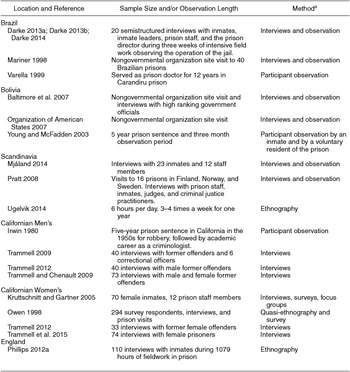
a When possible, the description of the method is the term given by the author(s).




Comments
No Comments have been published for this article.