





Introduction
Numerous examples of the post-mortem manipulation of human bodies and body parts are known in the European archaeological record, spanning from the Palaeolithic to the Roman period and beyond (e.g. Rebay-Salisbury et al. Reference Rebay-Salisbury, Stig Sørensen and Hughes2010; Triantaphyllou Reference Triantaphyllou2016; Holst et al. Reference Holst2018). These practices include secondary burial, the rearrangement of skeletons and the selection of bones for a variety of social uses. Two striking examples of such manipulation come from the Bronze Age sites of Cladh Hallan (Parker Pearson et al. Reference Parker Pearson2005; Hanna et al. Reference Hanna, Bouwman, Brown, Parker Pearson and Brown2012) and of Cnip Headland (Lelong Reference Lelong2018), in Scotland, where skeletons were assembled using body parts from several different individuals. In this article, we present another example of a burial that gives the impression of being a single individual but which is in fact assembled from multiple individuals who lived millennia apart. Grave 26 at Pommerœul, in Belgium, was originally excavated in the 1970s. Here, we use bioarchaeological analyses to show that the Gallo-Roman burial includes skeletal elements of Neolithic date and we explore the implications in relation to the role of ancestors.
The town of Pommerœul is located close to the French border (Figure 1). Excavations in the 1970s revealed 76 cremation burials and one inhumation (grave 26) associated with a large Gallo-Roman town located on a navigable river. Based on the characteristics of the associated settlement, the cremation burials were dated to the Roman period (second–third centuries AD; Cattelain Reference Cattelain2023). The lone inhumation was recovered from a deeper stratigraphic layer than the cremation deposits. Although the arrangement of the body is atypical for the Roman period—positioned in a flexed position on the right side—the presence of a Roman bone pin near the cranium led to the interpretation of the inhumation as Gallo-Roman. A recent radiocarbon dating programme confirms that the cremation deposits are of Roman date; unexpectedly, the inhumation yielded dates consistent with the Late Neolithic (Table 1; Dalle et al. Reference Dalle2019).

Figure 1. Location of Pommerœul (star), the Gallo-Roman site of Tongeren and the Neolithic sites mentioned in the text (figure by authors).
Table 1. Overview of DNA, radiocarbon dating and isotope data for each skeletal element.

F = female; M = male; U = unobservable; I = individual.

Figure 2. Inhumation grave 26, shown in the original field photograph (left), with bones in anatomical articulation lying on their right side with flexed legs, and with colour added to the bones that were sampled for aDNA analysis (right) (photograph courtesy of Paumen, Wargnies and Demory; Fédération Wallonie-Bruxelles; figure by authors).
The principal archaeologically observable funerary practice in northern Gaul during the second century AD was cremation (Capuzzo et al. Reference Capuzzo2020). Inhumation was also practised during this time and gradually supplanted cremation by the end of the third century. Buried individuals were typically, though not always, laid supine with the lower limbs extended (Blaizot et al. Reference Blaizot2009; Mauduit et al. Reference Mauduit, Chenal, Pélissier, Barrand-Emam, Blanchard, Chimier, Gaultier and Verjux2022). In contrast, the flexed position of the Pommerœul inhumation is consistent with burial practices from the Late Neolithic and Early Bronze Age of the wider region (e.g. Bourgeois & Kroon Reference Bourgeois and Kroon2017; Drenth et al. Reference Drenth, Meurkens, Van Gijn, Lohof, Hamburg and Flamman2011; Rathmann et al. Reference Rathmann, Stoyanov and Posamentir2022). The Late Neolithic is notable for its megalithic gallery graves (Toussaint Reference Toussaint2003) and karst burials in limestone cliffs along the river Meuse and its tributaries (Cauwe Reference Cauwe, Cauwe, Hauzeur, Jadin, Polet and Vanmontfort2011). A few of these caves were already used as burial places during the Mesolithic, but most excavated burials contain artefacts that bear similarities to the material culture of the Late Neolithic Seine-Oise-Marne group, found in the Paris Basin. Most of these caves display a variety of funerary practices, including primary and secondary deposits of one or more individuals, often laid directly on the ground surface (e.g. Abri des Autours, Trou des Blaireaux, Spiennes; Cauwe Reference Cauwe1997; Toussaint Reference Toussaint2013) (see Figure 1).
In this article, we deploy multiple bioarchaeological techniques to shed further light on Pommerœul grave 26. By combining information on burial location and body position with osteological analysis of the skeletal elements, and by integrating radiocarbon dating, stable isotope and ancient DNA (aDNA) analyses of different skeletal elements, we disentangle the composite nature of this burial.
Methods
We re-examined the skeletal elements from grave 26. Osteological sex determination and age-at-death estimation were undertaken in line with standard practice (e.g. Ferembach et al. Reference Ferembach1980; Phenice Reference Phenice1969; Buckberry & Chamberlain Reference Buckberry and Chamberlain2002; for detailed protocols see online supplementary material (OSM) 1). The bones were assessed macroscopically for traces of human modification, using the classification described by Bello and colleagues (Reference Bello, Wallduck, Dimitrijević, Živaljević and Stringer2016).
Samples for radiocarbon dating were taken from each of the bones highlighted in Figure 2, and from five adult metatarsals. The long bones and cranium were also sampled for DNA analysis, and additional samples were taken from a second left radius, left and right tibia and a right fibula. Following DNA extraction, we produced double- or single-stranded libraries. Samples were enriched in-solution for both mitochondrial DNA and a set of pre-defined 1.24 million single nucleotide polymorphism (SNP) targets. The enriched libraries were sequenced and processed on Illumina instruments and aligned to the human genome as described in previous studies (Mathieson et al. Reference Mathieson2015). In areas of high coverage, a single representative sequence was then randomly selected for each targeted position in the genome. Results from 16 libraries generated on 16 distinct samples are presented in Table S1. Of these, six samples from Pommerœul produced data on at least 3000 autosomal SNPs (with an average of 31 000, and a range of 3000–820 000). In this article, we report data from these eight samples.
Results
Macroscopic assessment of the full skeletal assemblage from grave 26 at Pommerœul indicates the presence of the bones from multiple individuals. This result is based on differences in the shape, robusticity (Figure 3) and developmental stage (fused/unfused epiphyses) of the bones, and on poor anatomical articulation of some elements (e.g. poorly fitting vertebrae). The presence of five adult first right metatarsals and of two non-adult first proximal foot phalanges in different stages of development (see Figure 4) suggest that bones from at least seven individuals were included in the burial (OSM2 presents an overview of all the bones present in and around grave 26).

Figure 3. A) left and right scapulae (posterior aspects); B) left and right os coxae (antero-medial aspects) (figure by authors).

Figure 4. Five adult right first metatarsals and two first proximal foot phalanges from two different non-adults, all found in grave 26 (figure by authors).
It was not possible, macroscopically, to determine whether these seven individuals contributed body parts to the composite flexed skeleton as the metatarsals and phalanges were not found in anatomical position. DNA analysis does, however, indicate that the long bones and the cranium come from at least five different individuals (see Table 2). It was also impossible to identify macroscopically definitive evidence of post-mortem modification due to the post-excavation treatment of bones with resin.
Table 2. Relatedness matrix.

The number of SNPs covered at least once is shown, 95% confidence intervals of the relatedness coefficient are highlighted in orange (cases where identical genetics corresponding to a value of 1 can be excluded) or red (cases that cannot be excluded as the pair being from the same individual). Limited data mean that it is not possible to determine whether the lower coverage sample (I21565) represents a different individual from the second or third-lowest coverage samples (full relatedness cannot be excluded in these cases).
Radiocarbon dates for 11 human bones from grave 26 are shown in Figure 5. Although all date broadly to the Late Neolithic, the time intervals for some elements do not overlap. The high variability present suggests that the individuals lived and died during at least three different periods. A chi-squared test further underlines the temporal disparity between the left and right femora, suggesting that they are not from the same individual (χ2-test: T = 8.3; p = 0.0040).

Figure 5. OxCal plot showing the calibrated radiocarbon dates on human bones from grave 26 (figure by authors).
Alongside the human elements, three badger (Meles meles) bones were also recovered: a skull fragment, a fused phalanx and an unfused humerus (see OSM1). Bioarchaeological analyses suggest that these badger bones also represent different individual animals, with the cranium dating to the Late Mesolithic and the humerus to the Late Neolithic (see Table 1). The bone pin located next to the cranium yields a Roman date (AD 69–210 at 94.5% probability) and is therefore contemporaneous with the cremation deposits at Pommerœul.
Table 2 shows the probability of genetic relatedness between the sampled bones. For sample I21565 (the robust left radius), insufficient genetic data were present to reject the possibility that it is from the same individual as the samples with the lowest amounts of data (the right ulna and the left humerus). For one of these low coverage sample pairings (I21565/I18067), the 95 per cent confidence interval for the relatedness coefficient is 0.49–1. This pairing could therefore represent bones from the same individual (with an expected relatedness coefficient of 1) or bones from first-degree relatives (with an expected relatedness coefficient of 0.5).
We used a principal component analysis (PCA) to merge our new genetic data with previously published ancient data (Table S3) and to project the resulting dataset onto the variation observed in modern individuals, assessed at approximately 600 000 SNPs (Table S2). Two of the high-coverage individuals, I18068 (left femur) and I21570 (right tibia), plot onto the PCA in a location midway between the French Neolithic and western hunter-gatherers. Such a location would be expected for a population of early European farmers with high hunter-gatherer-related admixture, and is consistent with the genetic profile of an individual from the Wartberg Late Neolithic culture (3500–2800 BC) located in the lower Rhine region (Immel et al. Reference Immel2021). The three lower coverage samples, I21565, I18067 and I21568, also plot in this area of the PCA but their variation probably reflects their limited data (Figure 6).

Figure 6. Projection of genetic data from the six Pommerœul samples and two Tongeren samples onto a PCA of genetic variation in 999 modern West Eurasian individuals. For comparison, projected data from relevant ancient groups is shown bounded by polygons. WHG: western hunter-gatherers; LBK: Linearbandkeramik (figure by authors).
The sample with the highest coverage (I18605, the cranium) plots in a different location, close to individuals living in the area of the Low Countries between the Late Neolithic (e.g. Netherlands Bell Beaker) and the present day. This position suggests large proportions of Steppe pastoralist ancestry that were absent in central and western Europe prior to c. 2500 BC (Olalde et al. Reference Olalde2018). Three attempts to produce a radiocarbon date from the petrous portion of the cranium after it had been sampled for aDNA failed due to poor collagen preservation but genetic analysis was able to suggest a date.
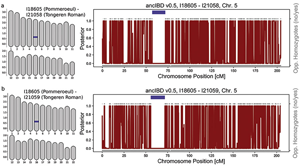
To further explore the genetic origins of the individuals assembled in grave 26, we used the ancIBD software to compare our six samples to a published dataset (Ringbauer et al. Reference Ringbauer2023) of more than 10 000 ancient West Eurasian individuals with high-quality genome-scale data (more than 600 000 autosomal SNPs covered by at least one sequence). The software searches for large segments of the genome that are genetically indistinguishable between randomly paired individuals. These segments are identical by descent (IBD), in other words, they have been inherited from a common ancestor and their presence indicates that the individuals are related within a few dozen degrees of genetic separation. This analysis reveals that both individuals from the south-western cemeteries of the Roman city (second–third centuries AD) of Tongeren, approximately 150km east of Pommerœul (I21509 and I21058, whose data is published for the first time here) were ‘genetic cousins’ of the grave 26 cranium (I18605). I18605 shares an estimated 16 centimorgan (cM) segment of their genome IBD with I21059, and a similar 15cM segment with I21058 (Figure 7). Assessment of genetic relatedness further suggests that the two individuals from Tongeren are genetic siblings, suggesting the shared stretch of their genomes was likely inherited from the same parent. Individual I21058 was a 4–5-year-old female and I21059 a 2–4-year-old male, both buried together with an adult male who was not, based on uniparental marker genetic analyses, their father (Van der Velde et al. Reference Van der Velde, Altena, d'Hollosy, Kootker, Pijpelink, Geerts and Veldman2022). Strontium and oxygen isotope analyses of the siblings shows they were both born and remained in the region in which they were buried (Van der Velde et al. Reference Van der Velde, Altena, d'Hollosy, Kootker, Pijpelink, Geerts and Veldman2022). The radiocarbon date of I21058, cal AD 211–335 (1796 ± 24 BP; GRM15605), is consistent with other dates from the south-western Tongeren cemetery and from the Pommerœul cremation cemetery, including the bone pin (Table 1).

Figure 7. Inferred IBD segments shared by Pommerœul individual I18605 (cranium) and a pair of siblings from Tongeren (I21058 & I21059). The long shared IBD segment between I18605 and I21058 is visualised in panel a; and for I18605 and the other sibling I21059 in panel b. Both inferred IBD segments are on largely overlapping positions on Chromosome 5. Right: Posterior of ancIBD to be in a non-IBD state along Chromosome 5. We additionally visualise opposing homozygotes (configurations where two individuals have identical genotypes for different alleles) on imputed diploid genotypes. Only markers where both genomes have imputed genotype probabilities higher than 0.99 are depicted. The opposing homozygote signal confirms the presence of the two long IBD segments (they are signalled by the absence of opposing homozygotes because at least one allele has to be shared) (figure by authors).
The scale of the IBD segments in the genomes of the two Tongeren Gallo-Roman siblings and individual I18605 is approximately what would be expected from 0–28 generations of time separation, or 0–784 years (the ranges correspond to 95% confidence intervals computed as described in OSM1, and the translation to years is based on an assumption of 28 years per generation (Fenner Reference Fenner2005; Ringbauer et al. Reference Ringbauer2023)). Given that the Tongeren individuals are from the Gallo-Roman period, even the most extreme estimate of 784 years of time separation leaves the cranium from grave 26 post-dating the associated Neolithic post-cranial bones by at least 2500 years. Although an accidental mix-up of the cranium after excavation or of sample numbers during aDNA analysis could account for the anomalous genetic profile and date of I18605, neither are likely scenarios. Of the more than 10 000 samples screened by ancIBD, less than one per cent of which are from Belgium, the only large segments of shared IBD hits are with individuals from another Roman site in Belgium. Grave 26 was the only inhumation excavated at Pommerœul and no other unburnt skeletal remains were retrieved from the site. The storage boxes are all clearly marked, and the cranium sampled (depicted in Figure 8 without the left os temporalis, which was removed for DNA and radiocarbon analyses) is markedly similar to the cranium observable in original excavation photographs (see Figure 2).

Figure 8. The cranium from grave 26 (figure by authors).
Discussion
Late Neolithic inhumations, and particularly those containing articulated skeletons, are relatively rare in north-western Europe (Cauwe Reference Cauwe, Cauwe, Hauzeur, Jadin, Polet and Vanmontfort2011; Watermann & Thomas Reference Watermann and Thomas2011). Within this context, Pommerœul grave 26 is remarkable considering that the interred ‘individual’ was clearly assembled from the body parts of multiple individuals. The only other known examples of such composite burials are from the Middle Bronze Age site of Cladh Hallan (Parker Pearson et al. Reference Parker Pearson2005; Hanna et al. Reference Hanna, Bouwman, Brown, Parker Pearson and Brown2012) and the Early Bronze Age site of Cnip Headland (Lelong Reference Lelong2018) in Scotland. At Cladh Hallan, bioarchaeological analyses indicate that male 2638 was constructed with body parts from at least three different male individuals (Parker Pearson et al. Reference Parker Pearson2005), and subsequent DNA analysis confirms that at least three individuals were also represented within female 2613 (Hanna et al. Reference Hanna, Bouwman, Brown, Parker Pearson and Brown2012). In both instances, the arrangement of the burial suggested a single individual (Parker Pearson et al. Reference Parker Pearson2005). In area C at Cnip Headland, body parts from two adults and two non-adults were discovered together, some in approximate anatomical position (Lelong Reference Lelong2018). Beyond Europe, at least one composite mummy has been identified in the Roman cemetery of Ismant el-Kharab in Egypt, where body parts from two adult females and two non-adults were used to construct a ‘single’ individual (Aufderheide et al. Reference Aufderheide, Zlonis, Cartmell, Zimmerman, Sheldrick, Cook and Molto1999).
Several questions arise concerning the construction of the composite burial of Pommerœul grave 26.
Who was responsible for assembling the new ‘individual’?
The field photographs captured during the original excavation of grave 26 show the positioning of the ‘individual’ as recovery progressed (see Figure 2). The arrangement of the bones gives the impression of a single right-side flexed inhumation but our bioarchaeological analyses reveal a different story. While we will never be able to establish the full details of the excavation context, we are grateful for personal communication with the excavators, M. Paumen, J. Wargnies and A. Demory, that permits consideration of two possible scenarios for the creation of this assemblage.
One possibility is that the composite inhumation was disturbed during the interment of cremations during the Gallo-Roman period. Either there was originally no cranium and the Roman community that discovered the burial added one to complete the ‘individual’, or they replaced the existing Neolithic-date cranium with a Roman-period one. In either case, the pin seems to have been added, perhaps as a grave good, at this time. There are documented cases of activity in the Roman period disturbing tombs from earlier times (Grange et al. Reference Grange, Charbouillot, Silvino, Noterman and Cervel2020) but the recutting of graves is not attested elsewhere. A second possibility is that the entire ‘individual’ was assembled during the Gallo-Roman period, combining locally sourced Neolithic bones with a Roman-period cranium. If so, to our knowledge, this would be the first Roman grave in which a new ‘individual’ was assembled from prehistoric and Roman bones.
The positioning of the ‘individual’ within the burial lends more weight to the first scenario (e.g. Drenth et al. Reference Drenth, Meurkens, Van Gijn, Lohof, Hamburg and Flamman2011; Bourgeois & Kroon Reference Bourgeois and Kroon2017; Rathmann et al. Reference Rathmann, Stoyanov and Posamentir2022). A flexed position is rare though not unusual in the Middle and Late Neolithic, in Belgium—it is documented, for example, at Avennes (Destexhe-Jamotte Reference Destexhe-Jamotte1947; Figure 1)—but such bodily arrangement is not attested in the regional Gallo-Roman period (Blaizot et al. Reference Blaizot2009; Mauduit et al. Reference Mauduit, Chenal, Pélissier, Barrand-Emam, Blanchard, Chimier, Gaultier and Verjux2022). It is unlikely, therefore, that a composite burial constructed in the Gallo-Roman period would be posed in this manner. More likely is the scenario that the composite burial was first assembled by a local Neolithic group and that, some 2500 years later, the Gallo-Roman inhabitants of the area disturbed and ‘restored’ the burial. The possibility of a Gallo-Roman assemblage created from scattered Neolithic bones cannot be entirely ruled out, however, given historical references to the handling of human remains and the Roman reverence for the dead (Grange et al. Reference Grange, Charbouillot, Silvino, Noterman and Cervel2020).
The badger remains were perhaps deposited as grave goods, although only the immature humerus is contemporaneous with some of the human bones (Table 1). The cranial fragment is much older and must either have been retained for several generations before being deposited or else was not intentionally included in the burial at all. The badger is a burrowing species, and it is possible that these elements represent parts of animals that died at the location. More enigmatic is the presence of the burnt badger phalanx, which provides another potential link between the badger remains and human activity.
Where are the remaining parts of the skeletons?
The nearest sites to Pommerœul that have yielded Neolithic human bones are the flint mines at Spiennes, Belgium (Toussaint et al. Reference Toussaint2019), and Valenciennes, France (Deckers & Delassus Reference Deckers and Delassus2009; Figure 1). If the remains were transported from places such as these, this relocation likely happened well after the time of death, as no cut or chop marks can be observed on the bones (Robb et al. Reference Robb, Elster, Isetti, Knüsel, Tafuri and Traverso2015; Bello et al. Reference Bello, Wallduck, Dimitrijević, Živaljević and Stringer2016). Decomposition must have been sufficiently advanced that either the bones were already naturally defleshed and cutting them loose was unnecessary, or disarticulation could be achieved without leaving any marks (e.g. Domínguez-Rodrigo Reference Domínguez-Rodrigo2003).
It is also possible that the Neolithic bones came from local burials at Pommerœul and that the rest of the skeletons may still be in the vicinity; the excavation around grave 26 was relatively narrow leaving scope for future discoveries. The few flint finds from the cemetery of Pommerœul and the surrounding areas of Montrœul-sur-Haine and Hautrage are consistent with a Neolithic human presence in the area (Dufrasnes Reference Dufrasnes1999, Reference Dufrasnes2001; Dufrasnes et al. Reference Dufrasnes, Leblois and Picavet2021). No teeth were preserved in the burial to provide insight into mobility patterns using isotope analyses.
The whereabouts of the postcranial remains from the Gallo-Roman female I18605 are also unknown. Although a combination of cremation and inhumation was common in the Roman period (Hollevoet Reference Hollevoet1993; Van der Velde et al. Reference Van der Velde, Altena, d'Hollosy, Kootker, Pijpelink, Geerts and Veldman2022), at Pommerœul all but grave 26 were cremation deposits. A plausible scenario is that the rest of the skeleton was cremated and interred as a cremation deposit in the cemetery. All the cremation deposits recovered during excavations contain cranial fragments, apart from T25, T51, T60 and T87 (Veselka et al. Reference Veselka and Cattelain2023). T25 is a particularly good candidate for the remaining skeleton, as it lies immediately adjacent to grave 26 and contained Neolithic flint artefacts. The total weight of the cremation deposit from T25 is also low (23.9g), implying either that only some of the body was cremated and buried or that only some of the burnt remains were buried in T25, the rest potentially being scattered or distributed among the other deposits. Two or more individuals are apparent in 11 of the cremation deposits at Pommerœul (Veselka et al. Reference Veselka and Cattelain2023) and, although the total mass of none of the cremations supersedes 1700g, it is possible that the missing post crania, if cremated, were divided among the other cremation burials, paralleling the composite nature of the inhumation burial. Alternatively, consistent with other funerary practices in the Roman period (Grange et al. Reference Grange, Charbouillot, Silvino, Noterman and Cervel2020), the rest of the skeleton could have been buried in the vicinity.
Why was this ‘individual’ assembled?
A flexed position is documented in Late Neolithic and Bronze Age burials all over Europe (e.g. Drenth et al. Reference Drenth, Meurkens, Van Gijn, Lohof, Hamburg and Flamman2011; Bourgeois & Kroon Reference Bourgeois and Kroon2017; Rathmann et al. Reference Rathmann, Stoyanov and Posamentir2022) and the 14C dates of the post-cranial bones are Neolithic. If indeed a Neolithic population assembled the ‘individual’, it is notable that most of the skeletal samples used were from not closely related individuals, implying that the ‘individual’ may have fulfilled a need of a group of people that considered themselves kin despite their genetic differences, as suggested for the Cladh Hallan remains (Parker Pearson et al. Reference Parker Pearson2005). It is tempting to hypothesise that the ‘individual’ was intended posthumously to represent, defend or connect the deceased either to other living individuals, such as neighbouring families or tribes, or to deceased individuals or ancestors, as postulated for the burial at Cnip Headland (Lelong Reference Lelong2018). A connection to the afterlife can also be hypothesised for the Gallo-Roman intervention. The ancient Roman attitude towards death saw the deceased as an enduring member of the community (e.g. Erasmo Reference Erasmo2001; Parker Pearson Reference Parker Pearson2008), and the handling of human remains was part of the ritual surrounding death (Graham Reference Graham2009). Disturbance of the burial may have necessitated reparations through the completion or construction of an individual with agency in the afterlife.
Conclusion
Grave 26 at Pommerœul adds to our growing understanding of the variability of human burial practices and provides a unique point of connection between the Late Neolithic and Roman worlds. Whether the Neolithic bones were obtained from burials at Pommerœul or from more distant mortuary contexts, and whether the assembly of the bones occurred in the Late Neolithic or in the Roman period, the presence of the ‘individual’ was clearly intentional. The bones were selected, a fitting location chosen and the elements arranged carefully to mimic the correct anatomical order. The resulting burial implies great care and planning, as well as a good knowledge of human anatomy. The Gallo-Roman contribution of a cranium to the composite individual is certain but the motivation remains obscure; perhaps this community was inspired by superstition or felt the need to connect with an individual who had occupied the area before themselves. Regardless, the bioarchaeological analyses of grave 26 described here contribute to a growing awareness of the unexplored breadth of both Neolithic and Gallo-Roman burial rites and of the need for careful re-evaluation of historical collections of human remains.
Acknowledgements
We would like to acknowledge support from VUB Strategic Research. We are grateful to the excavators M. Paumen, J. Wargnies and A. Demory.
Funding statement
The osteological and radiocarbon analyses were supported by the Fonds Wetenschappelijk Onderzoek (Scientific Research Fund) and the F.R.S.-FNRS (Fund for Scientific Research) under Excellence of Science 30999782 project-CRUMBEL. The ancient DNA data work was supported by a National Institutes of General Medical Sciences grant (HG012287), the John Templeton Foundation (grant 61220), by a private gift from Jean-François Clin, by the Howard Hughes Medical Institute (DR) and by the Allen Discovery Center program, a Paul G. Allen Frontiers Group advised program of the Paul G. Allen Family Foundation.
Online supplementary material (OSM)
To view supplementary material for this article, please visit https://doi.org/10.15184/aqy.2024.158 and select the supplementary materials tab.


 Open access

