


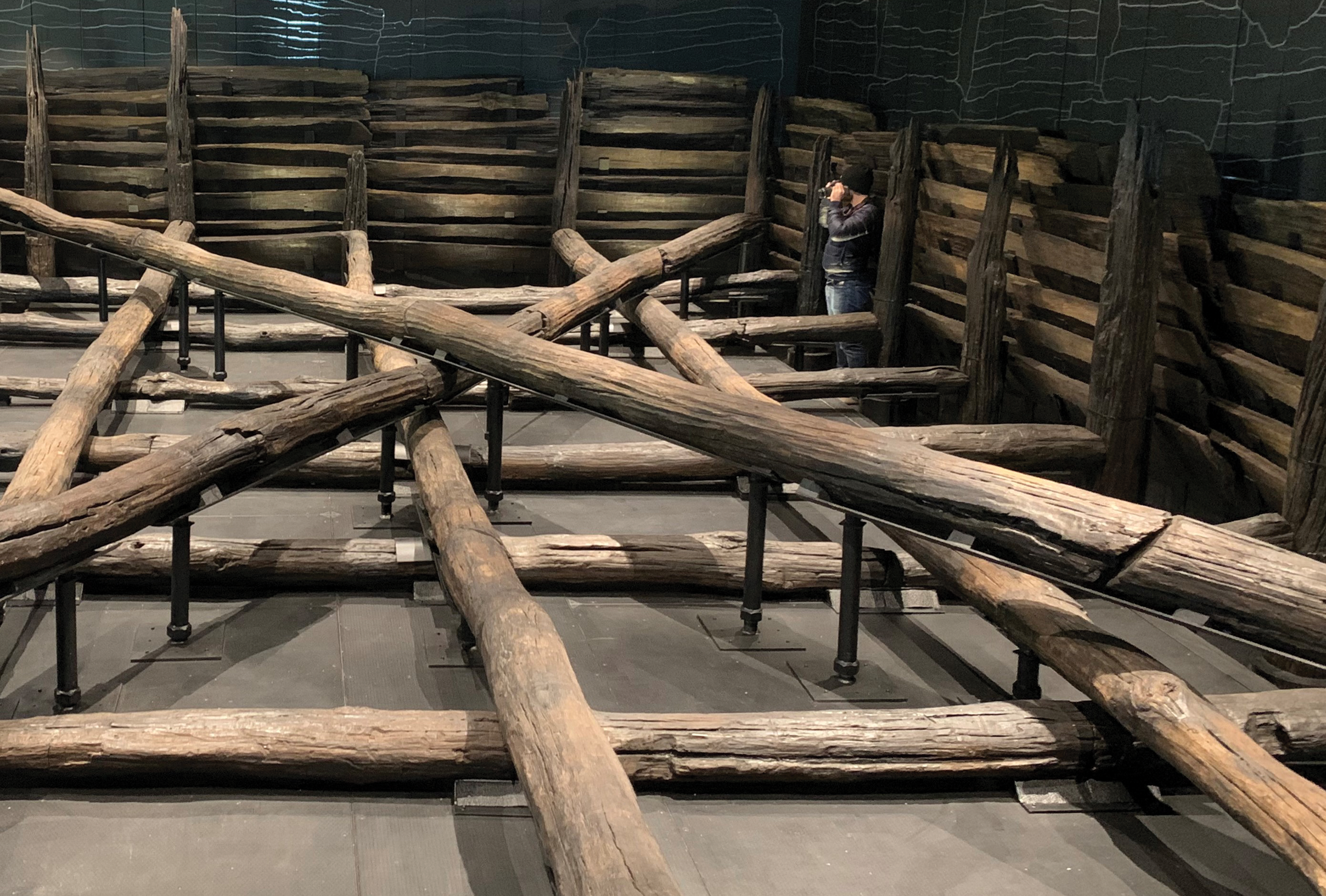
The Noceto ‘Vasca Votiva', or votive tank, is a wooden structure of Bronze Age date discovered on the southern edge of the Po Plain, Italy. The plank-lined, rectangular tank, 12 × 7m, was set into the ground on the edge of a Terramare village (c. 1600–1150 BC). The structure is unique. The excellent preservation provides unparalleled insight into Bronze Age construction skills. Finds include wooden tools and a large assemblage of intentionally deposited pottery that points to a ritual function for the tank. First discovered in 2005, the wooden structure has undergone more than a decade of conservation work. A new museum in Noceto dedicated to the tank will be inaugurated in spring 2020. Photograph: Andrea Zerboni, Università degli Studi di Milano; © MiBACT.
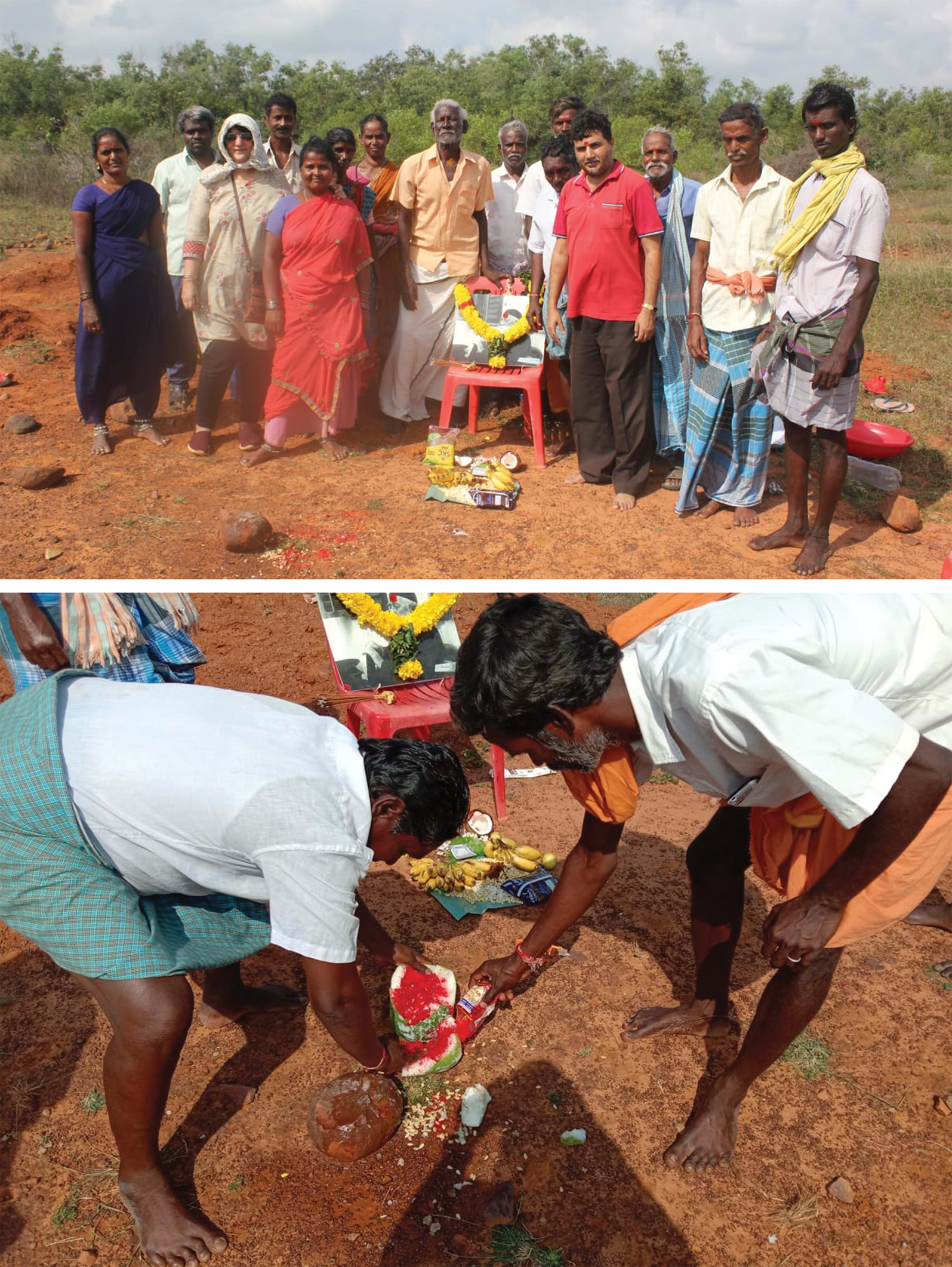
A blend of religion, tradition, Stone Age tools, memories of the dead and modern science at Sendrayanpalayam, Tamil Nadu. Before the trowel begins work, ancient rituals (puja) for the earth goddess are performed. The villagers also revere Robert Bruce Foote, who discovered the first Palaeolithic artefact in south India, in 1863. Decades of collaboration between archaeologists and local people working at the site of Attirampakkam, where Foote discovered stone tools, has left a deep impression of his contribution to their prehistoric heritage. Now, as new work begins at nearby Sendrayanpalayam, we look to him to bring us luck—perhaps a hominin fossil? Lithic analysis, palaeoenvironmental and geochronological studies will follow. Photographs © Sharma Centre for Heritage Education.
The road to ruins
 For as long as people have lived in cities, they have sought to explain the origins of these urban settlements: the results of the actions of eponymous gods or powerful rulers, or the uncommon gift of a navigable river or a source of natural wealth. After the destruction or abandonment of a city, however, attention shifts from birth to death, from origins to epilogue. How could a thriving centre of community, culture and commerce cease to exist? And why? Any number of factors beyond the control of a city's inhabitants might bring about the slow demise and eventual abandonment of a settlement: a silting port, a falling water table, encroaching desert sands, the re-routing of a highway, a change of political regime. Other causes might be more violent and abrupt: an earthquake, a flood, a fire or a siege. All of these factors offer rational and objective explanation for abandonment, but the death of a city seems also to demand moral contemplation and judgement. Surely there must be some greater meaning, some lesson to be learned?
Today, a lot of effort or, at least, policy-making, goes into ensuring contemporary cities are ‘resilient’ and ‘sustainable’, even as the challenges to their survival seem to multiply: clogged streets, unbreathable air and vulnerability to increasingly frequent and extreme events linked to climate change such as tidal surges, cyclones, droughts and—as most recently exemplified in Australia—bushfires. In the context of these environmental and existential anxieties, it is perhaps more than a coincidence that exhibitions in London and Rome set out to tell the stories of four ancient cities: Troy, Carthage, Pompeii and Akrotiri on Thera (Santorini). Each of these ancient places once bustled with life and culture; each was destroyed, sacked by vengeful armies or consumed by volcanic catastrophe; and each offers a powerful story of destruction, absorbed into popular culture and imbued with moral significance.
The British Museum tackles the most infamous example, at least in the Western imagination, of a city destined to fall, with ‘Troy: Myth and Reality’ (21 November 2019–8 March 2020). The exhibition is arranged in three sections. The first deals with the narrative of the Trojan War and subsequent events as told through artefacts depicting Homer's epic, including Pompeian wall paintings and the late eighth-century BC Pithecusae Cup, incised with lines of Homeric verse. The second section turns to the excavations initiated by Heinrich Schliemann in 1870 at the tell site of Hisarlık; exhibits include objects not only from the late second-millennium BC timeframe of the Trojan War, but also spanning the entire occupational history of the site. The final section turns to the enduring story of Troy, and the reception and retelling of its destruction in medieval and modern texts and artworks (for a review of the exhibition, see Mac Sweeney in this issue). Judging by the crowded gallery when I visited, the tragic story of Troy has lost none of its allure.
Meanwhile, in Rome, the latest blockbuster exhibition to grace the galleries of the Colosseum is ‘Carthago: Il mito immortale [Carthage: the Immortal Myth]’, running from 27 September 2019–29 March 2020. Rome and Carthage were, of course, mortal enemies, and their long-running conflict would end with the complete destruction of the latter in 146 BC at the hands of Scipio Aemilianus Africanus and his armies. Even though the supposed salting of the site to prevent its resettlement is a later misreading of the ancient texts, the destruction of the city was no spontaneous act of military indiscipline; the statesman Cato had argued for years in the senate in favour of the African city's destruction—‘Carthago delenda est’. Ever since, the reputation of the Carthaginians has suffered due to the dominance of the hostile perspective of the Graeco-Roman texts, a powerful and paradoxical stereotype that the Carthago exhibition acknowledges is difficult to escape. The organisers nonetheless set out to establish the city as a cultural and political equal to Rome, worthy of attention in its own right. Highlights include some of the finds from the wreck of a Carthaginian ship and elephant tusks inscribed with Phoenician script, as well as three of the recently discovered bronze rostra (prows) from ships sunk during the naval battle between Roman and Carthaginian forces off the Egadi Islands in 241 BC.
Finally, a short walk from the Colosseum across the imperial fora brings us to the Scuderie del Quirinale, where the exhibition ‘Pompei e Santorini: l'eternità in un giorno [Pompeii and Santorini: Eternity in a Day]’, was on show from 11 October 2019–6 January 2020. If Troy and Carthage were destroyed by human hands, the fates of Pompeii and Akrotiri lay with volcanic forces. The exhibition brought together an impressive collection of material, from the painted interiors of entire rooms through to carbonised archaeobotanical finds, in addition to a huge range of ceramics. All three exhibitions address the reception of these cities in later artworks, but ‘Pompei e Santorini’ mixes the ancient and modern most freely: Andy Warhol's Vesuvius sits alongside some of the iconic frescoes on loan from the Museum of Prehistoric Thira, and resin copies of Fiorelli's plaster-cast Pompeian victims are juxtaposed with works by artists such as Antony Gormley. Running throughout is the story of human loss and the search by survivors and subsequent generations for meaning in these sudden and unexpected events.
Staying put
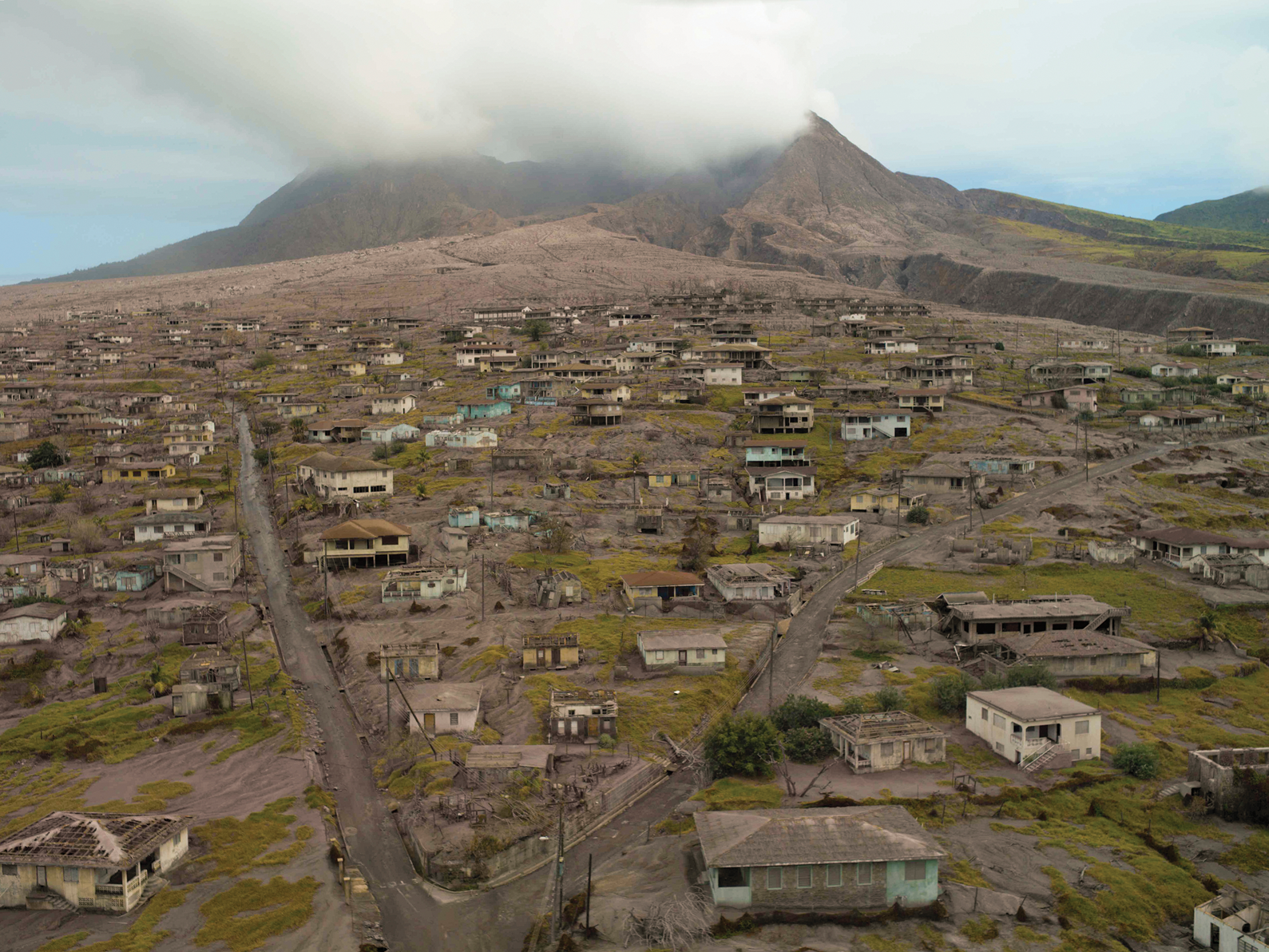
 One of the most evocative contemporary images of the fragility of civilisation is Charlton Heston stumbling across the ruined Statue of Liberty at the end of Planet of the Apes. But there are many actual examples of modern cities reduced to rubble or abandoned due to earthquakes, volcanic eruptions, hurricanes, bombs, radioactivity or the exhaustion of the natural resources that first allowed them to prosper (Figure 1). These depopulated places are the Pompeiis of future archaeologists, and many, from Chernobyl to the coal-mining island-city of Hashima, have already become the focus of ‘dark tourism’, an opportunity to reflect not only on humankind's inability to control nature, but also inability to control its own greed and ingenuity. Yet many, if not most, of the modern cities struck by disaster have been rebuilt and repopulated: Bam, Darwin, Hiroshima, Messina, San Francisco, Stalingrad/Volgograd and countless others. For a species that rose to global dominance precisely because of its propensity to explore and colonise new habitats, Homo sapiens demonstrates a remarkable fascination with places as accumulations of material, memory and meaning. Following the sack of Rome by the Gauls in 390 BC, the Romans debated—and firmly rejected—the idea of rebuilding their city on the site of their vanquished Etruscan neighbour, Veii. Indeed, the fascination with place may be shared with some of our nearest relations; the repeated visits of Neanderthals to La Cotte de St Brelade, Jersey, for example, has been characterised as the creation of a ‘persistent place’, a means of creating familiarity with, and enculturing the landscape of, the Middle Pleistocene.Footnote 1
View of the abandoned town of Plymouth, Monserrat, following the eruption of Soufrière Hills volcano in 1995. Photograph: Andrew Shiva/Wikipedia/CC BY-SA 4.0.
Such ‘topophilia’ might explain our reluctance to give up on a place, even when a rational assessment might suggest relocation is the more prudent option. It takes exceptional energy, or entropy, to dislocate humans from ancient site A and resettle them at new site B. Of course, new cities have always been founded, from Akhetaten to Baghdad and Brasilia to Madinat al-Zahra—some become persistent places, others do not—and today there are ambitious plans to move, or at least partially relocate, several major global cities. The streets of Jakarta, the world's fastest-sinking city, were again underwater over the New Year; fortunate then that the government of Indonesia has drawn up plans to relocate the capital city more than 1000km to the east; and in the desert outside Cairo, construction work on a new Egyptian capital city is well advanced. Yet more often than not, we are committed to existing places and to finding ever more ingenious ways to allow us to stay put when circumstances might recommend otherwise: building barriers to hold back the rising tides that submerge Venice with growing frequency, and tunnelling through increasingly complex subterranean infrastructure to relieve congestion on the surface. But even once forced out, people are still drawn back, rebuilding cities on dangerous tectonic fault-lines or on land exposed to sea-level rise. The Romans, for example, soon forgave Vesuvius and quickly set about resettling the fertile land around the volcano, a cycle that has continued through to the present. Today, the wider Naples region is home to 3 000 000 inhabitants, with hundreds of thousands settled in areas at high risk in the event of the next (overdue) eruption. In this issue of Antiquity, Rachelle Martyn et al. present new research on the victims of the AD 79 eruption recovered during excavations at the Roman seaside town of Herculaneum. By examining bone diagenesis and collagen degradation in samples from over 150 individuals, the authors are able to re-assess the intensity of the thermal pyroclastic flow that struck the city and claimed the lives of its inhabitants as they sought shelter on the seafront. Ultimately, the true death of a city is the death of its population.
#IranianCulturalSites
 It is precisely because meaningful places are integral to the identities of peoples and cultures that attacks on them are symbolically potent. Since 1954, the Hague Convention for the Protection of Cultural Property in the Event of Armed Conflict has sought to safeguard the world's cultural heritage by encouraging respect and responsibility for archaeological sites, historic monuments and portable objects regardless of national boundaries. In recent years, it has been made very clear what can happen when the principles of the convention are flouted or ignored. The atrocious civil war in Syria and actions of the so-called Islamic State have claimed not only many thousands of lives, but also resulted in unquantified damage to museum collections and archaeological sites of all periods. The blowing up of the Temple of Baalshamin at Palmyra in 2015 was just one of countless acts perpetrated by ISIS with the intention of creating a powerful image of ‘topocide’ for global media consumption.Footnote 2 With such a recent precedent still fresh in the mind, it was all the more shocking for the U.S. President to tweet about the military targeting of sites important to ‘Iranian culture’ in the event of any retaliation for the killing of Qasem Soleimani in early January. Even as Secretary of State Mike Pompeo sought to clarify that any U.S. action would be lawful, and therefore consistent with the Hague Convention, the President initially confirmed that his original tweet meant exactly what it appeared to suggest: the identification of cultural heritage sites in Iran as legitimate targets for military action. Unsurprisingly, condemnation was swift and universal, from lawyers and politicians to strategic analysts and historians. Perhaps the most elegant responses, however, were the many photographs of sites and monuments circulated on Twitter under the hashtag #IranianCulturalSites. As well as images of some of the country's two dozen UNESCO World Heritage Sites, from Persepolis to Susa and Isfahan, there were also photographs of many other monuments and sites attesting to Iran's long and rich history, part of humanity's shared cultural heritage. Threatening to destroy such places, resorting to words and images with deep, dark historical roots, will do little to reverse the latest deterioration in relations between the USA and Iran.
The dustbin of history
 If driftwood provides inspiration for poets and children alike, ‘driftplastic’ is the stuff of nightmares. Over the past few years, awareness of the scale and effects of marine plastic pollution has grown rapidly, pushing the problem up the popular and political agendas. In particular, natural history programming has brought into our living rooms images of wildlife entangled in plastic waste, and the corpses of seabirds and mammals stuffed with disposable drinking straws and cigarette lighters. The quantities of plastic in the seas are unfathomable; swirling around the ocean between East Asia and North America is the ‘Great Pacific garbage patch’, a huge gyre of plastic and other anthropogenic rubbish that has a claim to be one of the largest assemblages of material culture created to date. But like an iceberg, what is visible on the surface is only a small part of what lies beneath. Research has identified huge concentrations of marine plastic pollution at depths of between 200 and 600m off the coast of California.Footnote 3 Much of it consists of small fragments or microplastics and, even more toxic, nanoplastics—pieces so small that they can pass through cell membranes into body tissues. Presumably, these plastics will eventually make their way to the bottom of the world's oceans in the corpses of dead animals to create new geological deposits and to act as another marker of the Anthropocene alongside rising levels of CO2.
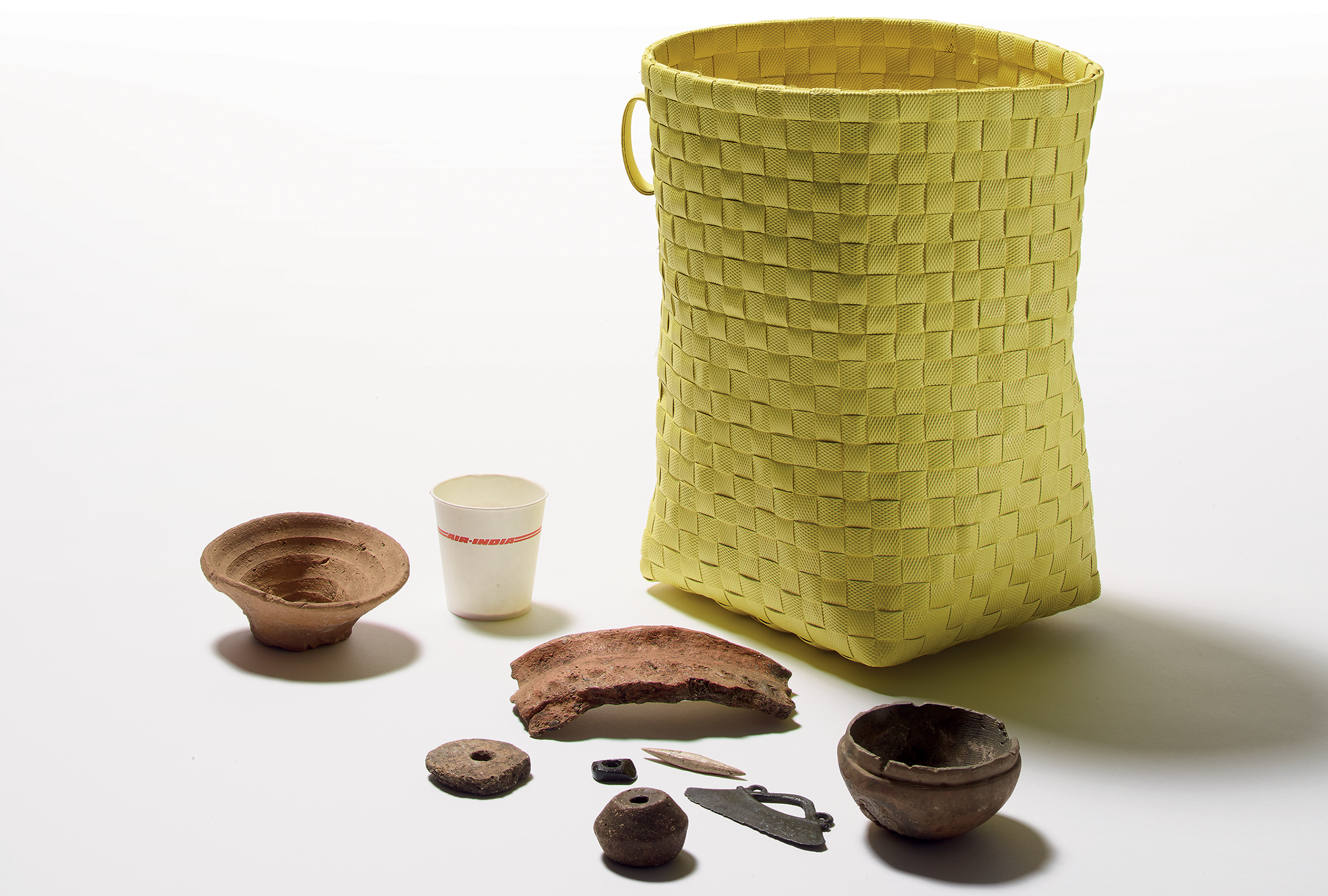
Taking a broad view of the problem, a new British Museum exhibition aims to raise awareness about the stuff that we mindlessly chuck away. The Asahi Shimbun Displays ‘Disposable? Rubbish and Us’ (19 December 2019–23 February 2020) highlights objects once discarded as ‘rubbish’ but now part of the museum's collection. In particular, the exhibition seeks to draw attention to the mundane single-use objects that all too briefly share our lives before becoming waste, such as a 1990s paper coffee cup made for Air India. Such disposable cups have become part of the ubiquitous material culture of everyday life—it would be impossible to walk far in any town or city without encountering a passer-by equipped with a coffee cup in one hand and a mobile phone in the other. Isolated as a museum display, the exhibition forces a new attentiveness to this most familiar of objects. On display alongside the Air India cup is a Minoan conical cup from Crete dated to c. 1700–1600 BC (Figure 2). The organisers suggest that the latter is also a kind of single-use material culture, a plain and cheaply produced drinking vessel, designed for a one-off task. While the comparison is well intended, the equivalence is strained in terms of the very different social and economic contexts in which these Minoan cups were used and, of course, in relation to the scale of consumption. But, if we accept that the past is only meaningful in so far as it is useful today, the ability of a Minoan cup to help us become aware of our own consumption practices, rather than those of ancient Crete, might be taken as a measure of success.
Objects, including a basket made from plastic washed up in the Pacific, on display at the ‘Disposable? Rubbish and Us’ exhibition at the British Museum. Photograph: ©Trustees of the British Museum.
Archaeologists are well equipped to think about rubbish. From lithic reduction debris to broken pottery, and butchered animal bone to slag heaps, archaeology has specialised in dealing with the material culture that people have discarded. But waste is far more complex than stuff at the end of its original use life, or a by-product of something more desirable. One person's waste is another's raw materials: a pot sherd refashioned as a spindle whorl, or cullet collected to produce new glass vessels. Or perhaps two waste streams in one: a Roman wine amphora repurposed as a urinal to gather human waste for the fulling trade—where there's muck there's brass. Waste can also be culturally meaningful as well as economically valuable: the burial of the dead in a shell midden, or a mound of discarded olive oil amphorae so large that it gives its name to a neighbourhood of Rome. The latter—Monte Testaccio—is composed of some of the millions of smashed and carefully stacked ceramic vessels used to import oil to feed, fuel, cleanse and medicate the population of the ancient metropolis. But even these industrial quantities of waste pale in comparison to the mind-boggling amounts produced by contemporary Western society.
In this issue
 Another object featured in the ‘Disposable? Rubbish and Us’ exhibition is a yellow fishing basket made from plastic waste washed up on a Pacific Ocean beach. As well as another example of one person's waste being another's raw materials, this object also brings us back to plastics in the seas and the question of how we begin to tidy up the epic mess that we have created. In this issue of Antiquity, John Schofield and colleagues present results from a project that aims to bring an archaeological perspective to the problem of marine plastic pollution and how we document it and encourage reflection on how we must change our behaviours. Taking an assemblage of plastic from an inaccessible beach in Galápagos, the authors seek to trace where the individual objects came from and, through workshops with people who live and work in the islands, to develop narratives about why these objects washed up where they did. As with so many other pressing global challenges, archaeologists alone will not solve the problem of marine plastic pollution, but we can hopefully bring a distinctive and complementary disciplinary perspective to the table based on an understanding of how humans have created and lived with waste for thousands of years.
Elsewhere in this issue, we feature an update on the new excavations at the Shanidar Cave in Iraqi Kurdistan, continuing those started by the late Ralph Solecki, who first identified Neanderthal remains at the site, including the ‘Flower Burial’. Other articles take us to sites and landscapes in Argentina, Bali, the Basque Country, Scandinavia, South Africa, Sudan and Transylvania. We also feature the discovery of a carved figure of an early medieval warrior on a monolith from central Scotland, the excavation of a fourteenth-century AD plague pit at a monastery in Lincolnshire, and consider the neglected role of fords and their influence on mobility around the landscape of Hadrian's Wall. Finally, Paul Everill and colleagues present a study of veteran-led excavation projects, exploring the growing area of ‘rehabilitation archaeology’ as a form of therapy for former and current military personnel. The authors set out the historical background for the development of these projects, and present the first attempt to advance beyond the intuitive but anecdotal claims for the benefits of using archaeology to improve the wellbeing of soldiers and veterans.
In this first issue of 2020, readers will no doubt be quick to observe the introduction of a new page layout. The last major redesign was in 2003, with the addition in 2010 of our now trademark location map alongside each research article abstract. Over the years since, publishing best practice has required the addition of various new metadata, such as DOI numbers, while other elements have been rendered all but redundant, such as the full postal addresses of all the authors, especially when the average number of authors per paper has also increased significantly. The new page design is therefore intended to remove unnecessary detail and ensure essential article information is clearly laid out. One element of the previous layout that we deemed essential to retain was the location map. This ‘cartographic keyword’ is an important way of helping the reader to geolocate content related to sites dispersed around the globe. With our new-look maps, designed by Connor Sweetwood, we have deliberately chosen to eschew the modern political boundaries that were the dominant feature of the old maps. The new design instead offers a better sense of the physical landscape—topography, rivers and coastlines—to provide the reader with more relevant contextual information with which to appreciate the location of sites in the Chinese Central Plain, the Ethiopian Highlands or the Nile Delta. As ever, you can head to our website to find details of how to contact us and let us know what you think—by email, by Twitter or even by old-fashioned snail mail!



