


SEAA8 in Nanjing
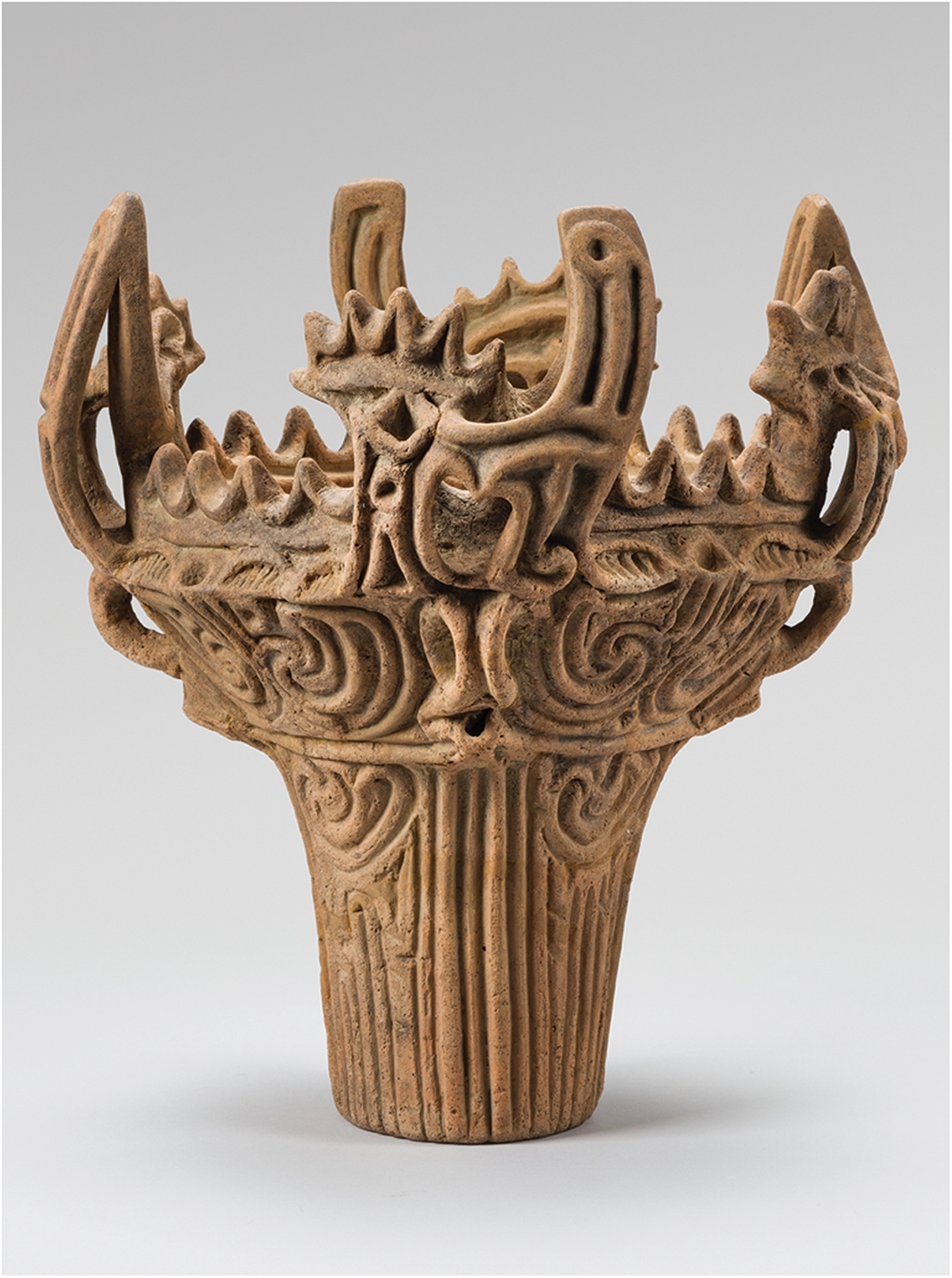
Flame-style (kaen-gata) pottery vessel from the site of Sasayama, Niigata prefecture, Japan, c. 3000 BC (height: 0.34m). Around 900 Flame-style pots were recovered during excavations at Sasayama during the early 1980s, even though less than 10 per cent of the settlement was investigated. Considered the best examples of the long Jomon tradition of the Japanese archipelago, the vessels were designated as National Treasures in 1999. Food residues indicate that, despite their elaborate decoration, they were cooking pots. Several Flame-style pots are on display at the newly refurbished Mitsubishi Corporation Japanese Galleries at the British Museum, and are also under consideration as models for the Olympic Cauldron for the Tokyo 2020 Olympics and Paralympics. Photograph: Tokamachi City Museum.
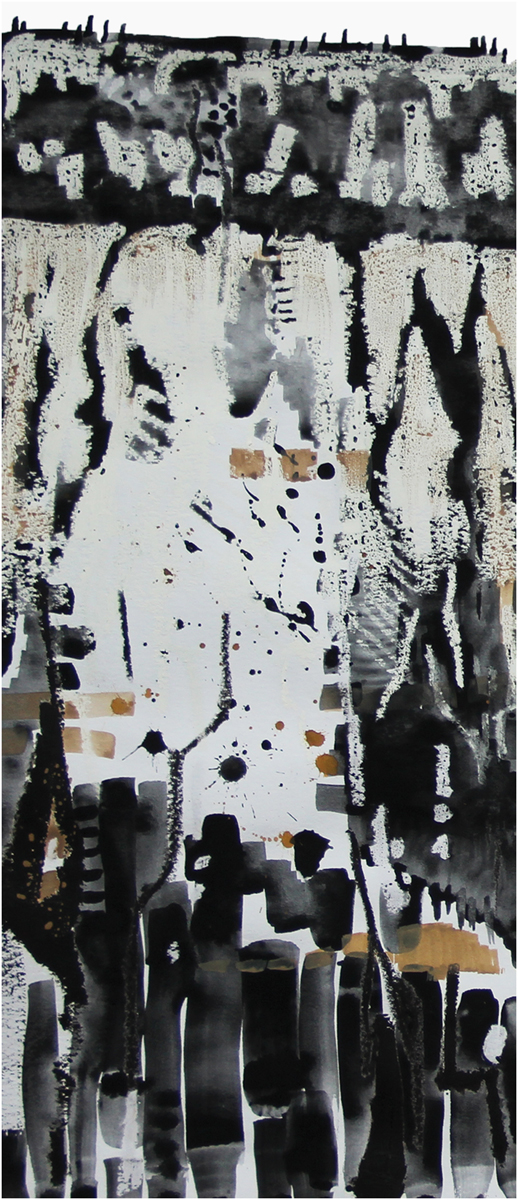
Stratigraphy, 2018. Wax crayon, oil pastel and watercolour. This painting, by archaeologist and artist Rose Ferraby, is a preparatory piece for two artworks commissioned by the Museum of Archaeology and Anthropology in Cambridge for their current exhibition: 'A Survival Story—Prehistoric Life at Star Carr'. The resistance of the wax and oil to the watercolour echoes the way in which the delicate fronds of past activity emerge from the peaty ground at the famous Mesolithic site in North Yorkshire, UK. The exhibition features the work of three artists, offering a dynamic approach to the use of art in archaeological communication (http://maa.cam.ac.uk/a-survival-story-prehistoric-life-at-star-carr/).
 The rapidly rising urban skylines of China attest to a nation that is building for the future. It is also investing heavily in its past. Thus, among the delegates at the Eighth Society for East Asian Archaeology conference (SEAA8), hosted by Nanjing University 8–11 June 2018, there was as much talk about modernity as there was of antiquity. The scale and pace of China’s recent economic development has opened up opportunities for archaeological investigations in advance of construction projects across this vast country: road and high-speed rail links, tunnels, bridges, ports, airports and whole new cities. It has also brought funding for archaeology, and, in particular, for new museums. SEAA8 was therefore an opportune moment for delegates to catch up on fast-moving advances in Chinese archaeology, and to visit some of the relevant sites and museums. But, as its name suggests, the remit of the SEAA extends far beyond China, and the meeting’s 250 or so papers also surveyed the latest archaeological research from Japan, Korea, Mongolia and the Russian Far East.
The 36 academic sessions covered a wealth of subjects: specific archaeological materials such as jade and glass; individual sites, regions and projects; and themes such as frontiers and landscape archaeology. Many of the sessions were explicitly interdisciplinary, integrating archaeological, linguistic and genetic evidence, or the results of palaeopathological and isotope studies. For example, a series of sessions on the rice-based societies of the Chinese Neolithic deployed a battery of techniques to address all aspects of the cultivation, preparation and consumption of rice: the DNA of domestication, the landscape archaeology of paddy fields, ethnoarchaeologies of cultivation and cooking techniques, bioarchaeological studies of health, and the isotopic signatures of changing diets.
Another theme running through multiple sessions concerned regional interaction and the spread of ideas and the exchange of commodities between, for example, the Korean peninsula and the Japanese archipelago, or between China and the Mongolian steppe. A number of sessions and papers addressed the routes heading west into Gansu and Xinjiang in western China and on into Central Asia. Some of these papers made reference to the Silk Road(s) in this context. But whereas Silk Road studies have been more often concerned with the Han and Roman Empires, attention at SEAA8 was firmly concentrated on the rich and complex archaeology to be found in the continental interior. Many of the papers also took a long-term perspective on these connections into Central Asia, tracing back into prehistory the exchange of not only silk, but also agricultural and metallurgical know-how and the genes of humans, animals and plants. For this East Asian archaeology neophyte, SEAA8 was a well-organised, welcoming and stimulating conference, showcasing deep international collaborations and cutting-edge research from across this vast and varied region.
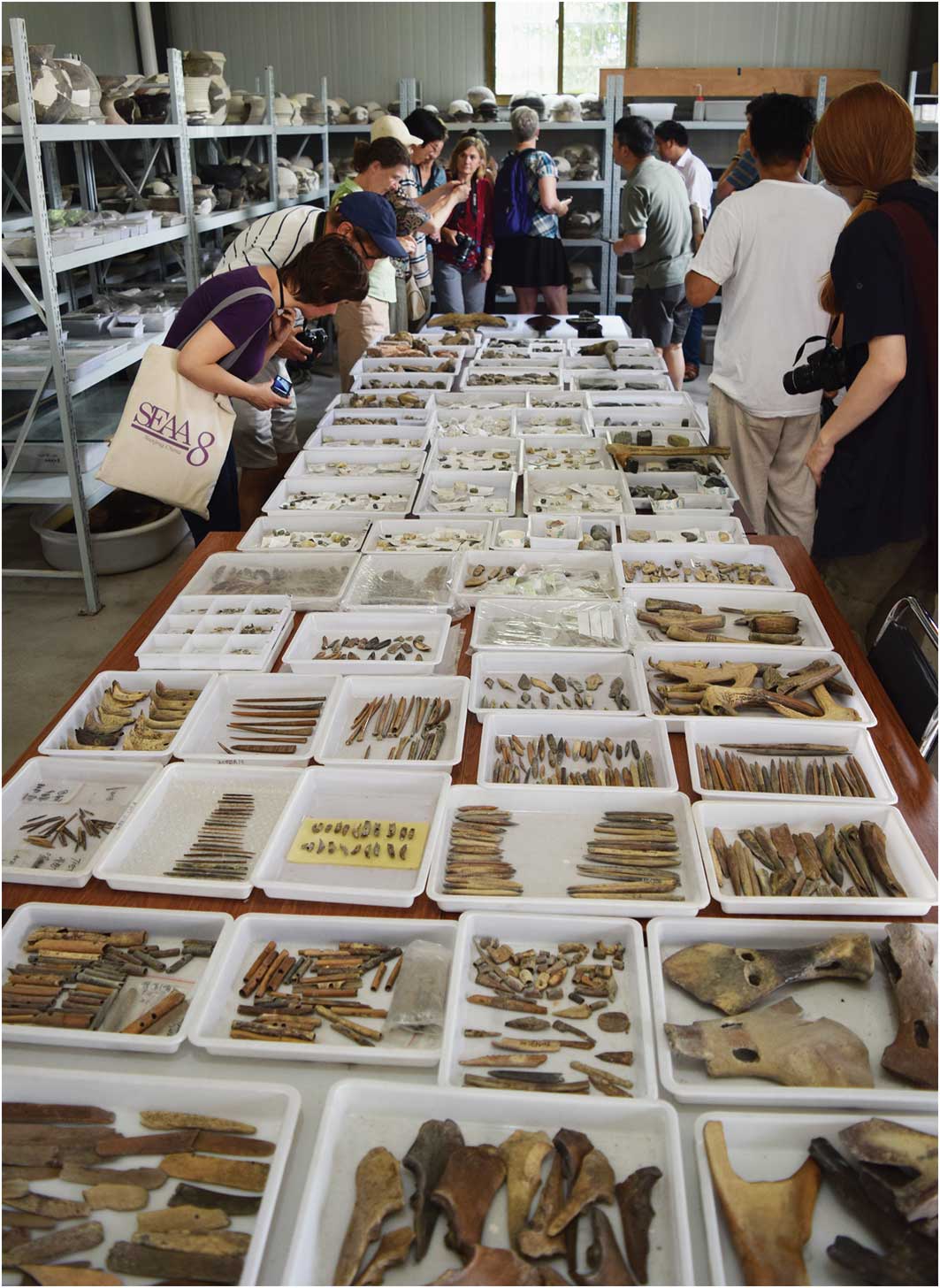
Post-conference, some of the delegates took the opportunity to visit sites and museums in the provinces of Hubei or Zhejiang. Just one of the many places visited was Tianluoshan, a recently excavated Neolithic village of stilt houses associated with the rice-growing Hemudu culture. Preservation conditions at this wet, once-coastal site are excellent, and the organic finds are of extraordinary quality and quantity. The site’s chief excavator, Sun Guoping, guided delegates around the in situ building timbers, now protected beneath a stadium-sized building. In the store rooms, we were also able to examine at first hand some of the many astonishing finds, from bone flutes to carved wooden plaques and carbonised rice, through to industrial quantities of pottery (Figure 1).
SEAA delegates inspect some of the extraordinary finds from the Neolithic site of Tianluoshan.
Chinese archaeology in this issue
In the traditional historical narrative, the cradle of Chinese civilisation is located in the Central Plains. Based largely on the testimony of classical texts, archaeologists long gave primacy to this region of the Yellow River Valley as the home of the earliest Chinese state and the source of China’s technological and cultural innovation. Two of the papers that feature in this issue of Antiquity, however, concern sites that lie beyond the Central Plains, but which, the authors argue, made significant contributions to early Chinese historical development.
In the first paper, Colin Renfrew and Bin Liu present the site of Liangzhu, in the Lower Yangtze River Valley. Dating to 3300–2300 BC, Liangzhu extends to 300ha, and is centred on a series of huge rammed-earth platforms, including a ‘palace’ complex rising up to 15m in height, with the entirety enclosed within an earthen wall 6km in length. Here, Renfrew and Liu make the case that Liangzhu was a state society—an interpretation that would make it not only the earliest in China, but also a site of importance for comparative studies of the emergence of social complexity worldwide. Integral to the argument, alongside evidence for ritual jades and elite burials, is the recent identification of an extraordinary system of huge earthen dams intended to control floodwaters as well as to irrigate rice paddy fields. It is not simply the technical ingenuity of the dams’ construction or the scale of labour mobilisation required that makes them so impressive—it is the sheer ambition with which this landscape-scale engineering scheme was conceptualised 5000 years ago.
The second of the two China papers in this issue follows on chronologically and thematically from the first. By the late third millennium BC, Liangzhu was in decline, possibly as a result of environmental change. But 1500km to the north-west, a new site emerged at this time: Shimao. The site shares characteristics with Liangzhu: a wall circuit, a central palace and primacy within a regional settlement hierarchy. Yet, Shimao was larger, surrounded by a massive stone, rather than earthen, wall, and its central palace complex rose much higher; there is also evidence for human sacrifice. The environmental and geographic locations of the two sites are equally very different: Liangzhu in a wet, low-lying position in the Lower Yangtze River Valley, and Shimao in the loess hills of northern China, close to the steppe edge. Significantly, however, both sites are located outside the Central Plains. In their paper, Li Jaang and colleagues argue that the traditional text-based narrative has cast sites such as Shimao (and Liangzhu) as peripheral, systematically diminishing their importance for understanding the political, economic and cultural development of early China. They argue that Shimao was, in fact, the centre of a supra-regional polity, preceding by several centuries the Erlitou polity (1900–1550 BC) of the Central Plains, the latter often cited as the first Chinese state. Reading these papers side by side, we can see how the potential significance of such sites was overlooked by earlier generations of archaeologists who consciously or otherwise deferred to the text-based narrative—Shimao was mistaken for part of the later Great Wall, and the jades of Liangzhu were thought to be artefacts of the subsequent Zhou or Han periods.
Chinese museums
Chinese museums are experiencing something of a Golden Age. Vast new buildings housing huge collections of jades, bronzes, ceramics and much more besides are opening across China. Complementing the established national and regional collections, many of the newer museums focus on specific cultures, periods or themes. For example, the Oriental Metropolitan Museum in Nanjing is dedicated to the Six Dynasties period (c. AD 220–589), and the National Silk Museum in Hangzhou documents the history of Chinese silk textiles and technology, including a full-sized working replica of a model loom found in a Han-period tomb near Chengdu (Zhao et al. 2017).Footnote
1
In contrast with the emphasis at SEAA8 on the terrestrial routes into Central Asia and on to the west, the museums of the coastal Zhejiang region concentrate on maritime connections across the South China Sea and Indian Ocean. One of the displays at the excellent Yue Kilns Museum, for example, documents how some of the site’s huge ceramic production was destined for foreign shores; some tens of thousands of celadon vessels at the site have been recovered from a tenth-century AD shipwreck at Cirebon in Indonesia. And just outside Ningbo—today one of the world’s busiest container ports—is the China Port Museum, a gargantuan metallic temple dedicated to China’s history as a seafaring and trading nation. All of these museums explicitly frame these trade connections in terms of the Maritime Silk Road. This is a message well aligned with China’s official ‘Belt and Road Initiative’. But it also reflects a degree of local pride in the long history of maritime connectivity in a region of modern China that has grown wealthy on overseas business and trade. Indeed, there are hints that these achievements grew not from universal Chinese characteristics, but from distinct regional traits. For example, one of the information panels introducing the beautifully displayed archaeology galleries at the Wulin Branch of the Zhejiang Provincial Museum explains that
Though the ancient Yue kingdom no longer exists in the course of continuous national integration, their spirit of self-reliance and unremitting strive as well as their legacy of open-minded, enterprising, practical and innovative cultural traditions remain to this day, and serve as an everlasting epic that continues to encourage their successors on the land of Zhejiang to work steadfastly towards brilliant achievements in civilization.
As Gideon Shelach-Lavi has recently observed in his analysis of politics and identity construction in Chinese museums, framing the archaeological past in this way skilfully conforms to the dominant narrative of Chinese historical continuity and national integration, while also expressing a degree of local distinctiveness.Footnote 2 In this case, the industrious and creative spirit of Zhejiang’s past inhabitants—whether domesticating rice, crafting some of China’s earliest jades, reclaiming coastal lands or doing business overseas—is seamlessly incorporated into the national narrative of 5000 years of Chinese civilisation.
New World Heritage sites
The most recent (forty-second) session of the World Heritage Committee met in Bahrain, 24 June–4 July 2018. The 13 new cultural properties added to the World Heritage site list range from the Arctic (‘Aasivissuit—Nipisat: Inuit hunting ground between ice and sea’, on the Greenland coast) to the Equator (‘Thimlich Ohinga archaeological site’ in Kenya). Many of the sites document the movement of people, goods and ideas—the spread of religions: ‘Sansa, Buddhist mountain monasteries’ (South Korea) and ‘Hidden Christian sites in the Nagasaki region’ (Japan); the expansion of empires: the ‘Caliphate city of Medina Azahara’ (Spain) and the ‘Victorian Gothic and Art Deco ensembles of Mumbai’ (India); or the exchange of commodities: the ‘Ancient city of Qalhat’ (Oman). Conversely, the ‘Archaeological border complex of Hedeby and the Danevirke’ (Germany) perhaps speaks to the attempts of historical states to define borders and control resources. The newly inscribed sites also span the entire Holocene from Göbekli Tepe in Turkey to ‘Ivrea, industrial city of the twentieth century’ in northern Italy. In addition, a further three mixed (both culturally and naturally significant) sites were inscribed on the list, including Mexico’s ‘Tehuacán-Cuicatlán Valley: originary habitat of Mesoamerica’, for its evidence of water management and plant domestication, and Colombia’s ‘Chiribiquete National Park—The Maloca of the Jaguar’, for the thousands of paintings in the rockshelters of the tepui in the western Amazon rainforest. The latest additions to the roll-call—cultural, natural and mixed—bring the running total to 1092 sites in 167 countries.
Coincidentally or otherwise, the two nations with the most World Heritage sites lie at either end of the Silk Road: Italy and China. Italy’s embarrassment of cultural riches has long been integral to the list, as has European heritage generally. But having embraced the many opportunities, challenges and contradictions of World Heritage, China has rapidly caught up. In a new book, World Heritage craze in China: universal discourse, national culture, and local memory, Haiming Yan explores how China has invested politically, culturally and economically in World Heritage, navigating between the ideals and realities of ‘outstanding universal value’, national politics and regional and local identities, in some ways replicating the same issues identified by Shelach-Lavi in Chinese museum displays.Footnote 3
In 2019, the forty-third session of the World Heritage Committee meets in Baku, Azerbaijan. One of the candidate sites that will come up for consideration for inscription on the World Heritage list is none other than Liangzhu. As I witnessed during my recent visit, preparations are well advanced: new roads, paths, interpretation boards and visitor facilities, new storage and laboratory spaces and the refurbishment of the existing nearby museum. The proposed World Heritage property also incorporates several associated sites, including the ritual altar and cemetery at Yaoshan and the system of dams to the north and west of Liangzhu. The nomination documents emphasise not only the site’s unique testimony to China’s 5000-year-old civilisation, particularly in relation to rice agriculture and ritual jade forms, but also its contribution to the understanding of settlement and civilisation across East Asia and beyond.
Chaco Canyon special section
The distinctive monumental and ceremonial buildings around Chaco Canyon in New Mexico were added to the World Heritage list in 1987 as examples of the regional development of ancestral Pueblo culture. This issue of Antiquity features a special section on recent research on the Chaco World. We start with an introduction by guest editor Barbara Mills, who summarises the diversity of research undertaken over the past decade. The following four papers then introduce new research on varied themes. Vernon Scarborough and his colleagues use geomorphological work and isotope analyses to document the scale and operation of the extensive hydraulic systems that facilitated agricultural production in Chaco’s arid environment, with implications for social and ritual organisation. The paper by Patricia Crown and her collaborators focuses on Pueblo Bonito, the largest and best-known of the so-called ‘great houses’. The authors argue that one reason that this complex site has proven so difficult to date and interpret is that the house was in a permanent state of construction and modification, which renders it resistant to traditional archaeological phasing—a lesson with resonance for sites elsewhere. Meanwhile, Katherine Dungan and her colleagues focus on the question of the visibility of architecture in the landscape. They deploy a new method to implement GIS viewshed analysis in order to assess the intended audiences of these architectural landmarks. Finally, a team led by Mills deploys social network analysis to interrogate a database of nearly two million ceramic sherds so as to assess a series of different migration hypotheses; their results reveal shifting patterns of human mobility that challenge established ideas about the movement of people and pottery across this region. The section as a whole highlights the intensity and innovation of recent work at Chaco, overcoming the challenges created by poorly documented early ‘archaeological’ interventions, and demonstrating the value to be extracted from large, collaboratively developed regional databases.
From Early Holocene hunter-gatherers in Vietnam to ceramic dinner services in nineteenth-century Cambridge, and from the Neolithic transition in Northern Europe to tweeting about heritage destruction in the Middle East, we hope that you enjoy exploring the world of archaeology in this issue.
1 August 2018



