


Dariali Fort (Georgia) features prominently in Pliny the Elder's Natural History written in the first century AD, and was still considered world-famous by the Arab author Mas'udi in the tenth century. The current fort (positioned on a strategic rock), with a stairway leading down to the river, dates to the late fourth/early fifth century AD. The site has been the subject of exploration by the ERC ‘Persia and its Neighbours’ project since 2013; this view was captured by a drone, or UAV, in January 2017. The stronghold dominates Dariali Gorge—known in antiquity as the Caspian or Alan Gates—the main land route from modern Georgia and Armenia to Russia. (See E.W. Sauer et al. 2015 ‘Northern outpost of the Caliphate’, Antiquity 89: 885–904. https://doi.org/10.15184/aqy.2015.80.) Photograph: Davit Naskidashvili.

A Roman tomb, probably dating to the first century AD at Hierapolis in Turkey. The form of the tomb mimics a house; today, little more than the pitched roof is visible. The Roman city sits on the slopes overlooking the Lycos Valley and has been renowned since antiquity for the healing properties of its hot springs. The mineral-rich waters continually precipitate calcium carbonate to produce gleaming white travertine deposits that cascade down the hillside. The city's eastern necropolis is slowly being buried by these deposits, leaving the occupant of this tomb buried in stone not once but twice. Photograph: Sophie Hay.

Both Antiquity and archaeology have changed immeasurably since O.G.S. Crawford penned this journal's first editorial in 1927.Footnote 1 The discipline has grown in size and sophistication, and has achieved professional status and public recognition. What was novel at that time, such as aerial photography and the use of ethnographic parallels, both flagged in that first editorial, have now long been integral to archaeological theory and practice. Antiquity has documented—and often driven—these developments, itself evolving along the way. Nine decades after its foundation, Antiquity publishes more content, on more varied periods and places, and authored by an ever-more international cast of contributors. It has also changed in terms of its audience. Part of Crawford's original vision was to communicate archaeology more effectively to the general public, not least with the intention of debunking the misleading, sensationalist and downright incorrect fare peddled in the bestsellers and newspapers of the day. The content of Antiquity today is aimed at a more professional readership, what one previous editor, Martin Carver, called “the extended archaeological family” of academics and field archaeologists, and the many associated specialists in cognate disciplines with whom we work.Footnote 2 All these developments notwithstanding, it is striking that many of Crawford's concerns and interests still continue to resonate. The disciplinary imperative to communicate with the public is stronger than ever, finding new opportunities in social media, blogs and TV programmes, and under pressure from funding bodies to demonstrate public benefit or ‘impact’. The analytical, and aesthetic, importance of aerial photography that Crawford worked hard to promote has too taken on a new lease of life through satellite imagery, LiDAR and, most recently, photography using drones or unmanned aerial vehicles (see Frontispiece 1).
With this issue of Antiquity, a new editorial team takes over the reins (more on that below), but our mission remains unchanged: to support and disseminate the very best archaeological research from around the world. Antiquity is a resolutely generalist journal of archaeology—it publishes on all periods and regions, combining original research and method articles, debate features and a substantial reviews section. Yet, as editor Chris Chippindale observed over 30 years ago, the growing specialisation of archaeology and the appearance of increasingly specialist journals meant that few, if any, archaeologists would have the time to read Antiquity from cover to cover.Footnote 3 Three decades later, the discipline and its practitioners have become even more diverse and technical, and are served by an even larger number of journals dedicated to specific methods and areas of interest. What then is the value of a generalist archaeology journal such as Antiquity in the twenty-first century? Arguably, growing specialisation itself provides the most powerful case in support of a venue dedicated to the communication of research to the widest archaeological audience. This is particularly significant in relation to the complex scientific techniques that innovative research increasingly requires; the non-specialist archaeologist needs articles that translate and communicate these important technical developments in an accessible format.
Alongside specialisation, however, interest in crossing disciplinary boundaries continues to grow, and the proliferation of specialist journals is mirrored by the rise of multidisciplinary journals, encompassing archaeological research within their broad-ranging remits. Such outlets reflect and drive interest in archaeological datasets by specialists in other disciplines such as palaeoclimatology, economic history, health and environment.
Antiquity therefore sits in a unique position—a venue for the archaeological community to bridge the discipline's many specialisms, and a means for reaching out to the wider world and showcasing what archaeology has to offer to other fields. Central to this mission is Antiquity’s long-standing commitment to the publication of short, clearly written papers, subject to rigorous peer review, and edited and produced to a high standard. In addition, over the past five years, there have been developments to improve the experience of both contributors and readers still further: a new online submission system; the re-digitisation of our complete 90-year archive; and the allocation of DOI numbers to aid discoverability and long-term access. Such changes have helped to keep Antiquity in line with best practice in academic journals publishing. That landscape, however, is changing rapidly, and over the coming years we will be introducing additional innovations to help both our authors and audiences to get more from the journal.
From the outset, Antiquity has been a journal of world archaeology, and during the past 90 years, research on more than 100 countries has appeared in its pages. Some regions, however, such as Africa and Southeast Asia, have received less coverage than others. To bring our readers the best archaeological research, we need to showcase an even broader and more representative range of the work going on around the world. To facilitate this, we are launching a new initiative to encourage and support article submissions from archaeologists based in, and working on, regions that are less well represented within the covers of Antiquity. This will involve the appointment of ‘ambassadors’ who will promote Antiquity as a place to publish, identify potential authors (whether individual scholars or teams) and work with them to support and develop their research for submission to and publication in Antiquity. As each region is different, we will be working with our ambassadors to develop local strategies, such as running ‘master classes’ at regional conferences, fostering links between scholars and research groups, commenting on draft texts and providing support through the peer-review process. One of our priority areas is Sub-Saharan Africa, and we are delighted that Innocent Pikirayi, professor of archaeology at the University of Pretoria, has agreed to become our first Antiquity ambassador. Regular readers will be familiar with Innocent's work on Great Zimbabwe and with his recent paper on the ‘The future of archaeology in Africa’.Footnote 4 We look forward to working with Innocent to support more African scholars to publish their research in Antiquity and, in the process, to bring to our readers a more representative sample of world archaeology and a greater range of voices.
In parallel to our ambassadors scheme, we are also collaborating with our publisher, Cambridge University Press, to ensure that Antiquity is accessible to readers based in those parts of the world where a traditional subscription may not be affordable. We are delighted to be part of a number of initiatives that bring free or discounted access to our content for developing countries (for more details, see www.cambridge.org/developingworldaccess).
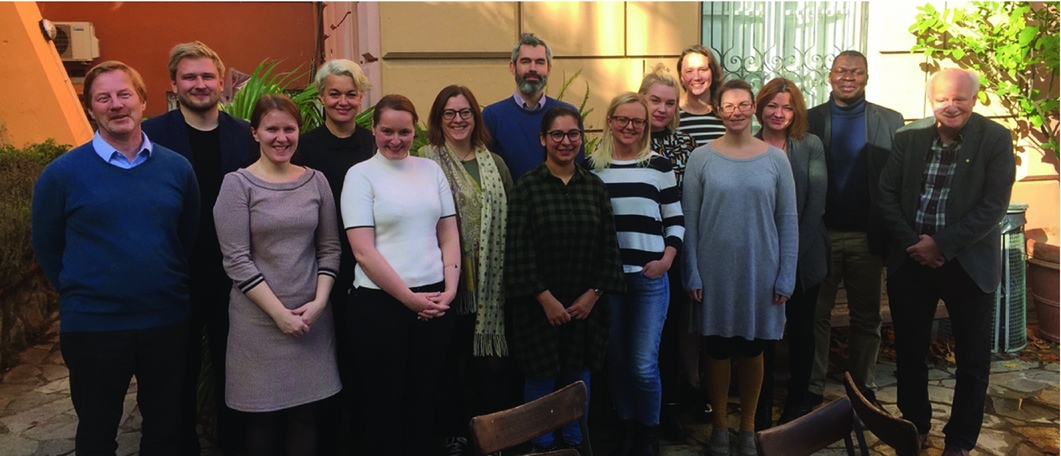
As well as diversifying the geographic range of our contributors and readers, it is also important for Antiquity to nurture the next generation—the younger scholars who will be reviewing, writing, reading and citing Antiquity papers in the years to come. To this end, last November I was delighted to participate in the ‘Writing a Successful Article’ workshop organised by the Nordic Graduate School in Archaeology (‘Dialogues with the Past’). Along with the editors of other journals, I spent three days with a group of PhD students, discussing how they might develop their research for publication in international journals. With students from Denmark, Estonia, Finland, Norway, Russia and Sweden, and hosted in the convivial surroundings of the Norwegian Institute in Rome, the meeting was a model of European cooperation.
Editor Robert Witcher, with Kristian Kristiansen, Liv Nilsson Stutz, Robin Skeates and research postgraduate students at the Nordic Graduate School in Archaeology (‘Dialogues with the Past’) workshop on ‘How to write a successful article’, held at the Norwegian Institute in Rome, November 2017. Photograph by Hulda Kjeang Mørk.
In this first issue of 2018, we feature research from around the globe, from the Near East via Europe, and Central and South America to Remote Oceania. We also travel far through time from the Late Pleistocene to the threshold of the modern world and the Spanish conquest of Hispaniola. The periods and regions are diverse, but any number of common threads run through the articles. For example, we track evidence for the changing forms of artistic expression, from images of animals at the Cala dei Genovesi Cave off the coast of Sicily, to a geometrical design incised on an animal bone at the end of the last Ice Age. Much more recent artistic expressions include the depiction of marine creatures on rock surfaces in the Atacama Desert and carvings of dromedaries of possible Nabataean date in northern Arabia. We can also witness the diverse treatment of the dead across time and space, from the funerary rituals bestowed on the Mid Upper Palaeolithic individuals at Sunghir in western Russia, to the violence attested by the human skulls displayed on poles in Mesolithic Sweden, the burial of humans with domesticated animals in Late Neolithic Finland and the Viking charnel deposits and associated burials at Repton, UK. A particular theme, linking all of these mortuary studies (and other papers), is the application of new techniques to previously investigated sites.
This is just a sample of the research appearing in this issue, but although such richness and diversity is dazzling, we should not lose sight of the bigger questions—what it means to be human, to live in an interconnected world, to protect the environment, to promote a sustainable way of life, to value life itself, to feed curiosity. As archaeologists we are well placed, sometimes uniquely so, to attend to the deep history of such matters. Some of the books featured in this issue's reviews section illustrate the point, including broad-ranging accounts of social complexity and the role of material culture in human society.
Finally, an update on the editorial team. First and foremost, with the change of editor, I must express deep gratitude, on behalf of Antiquity’s readers and contributors, to Chris Scarre. Under his stewardship, Antiquity has prospered, moving from four to six issues a year, a new publishing partnership with Cambridge University Press and new features such as ‘Archaeological Futures’. I have had the privilege to work closely with Chris over the past five years, and I owe him a particular debt of thanks. As he steps down, we are also delighted to congratulate Chris for the Distinguished Service Award for his editorship of Antiquity, awarded at the Third Shanghai Archaeology Forum. The meeting was held in December, and we will report further in the April editorial.
The new editorial team embodies the continuity and change that we aim to pursue over the next five years. The Antiquity Office will remain in the Department of Archaeology at Durham University. The new Reviews Editor is Dan Lawrence, a Near Eastern landscape archaeologist; he will be continuing the established format of the reviews section: review articles, individual book reviews and the New Book Chronicle. In addition to a Reviews Editor, for the first time, Antiquity will have an Associate Editor—Rebecca Gowland, a bioarchaeologist also based at Durham. One of her roles will be to attract more contributions from archaeological scientists to ensure that we are disseminating more cutting-edge, and accessible, research in this fast-moving area. In the Antiquity Office, we welcome a new Editorial Manager, Liz Ryan, and extend our thanks to her predecessor, Jo Dean. Thomas Swindells, James Walker and Ross Kendall will continue their invaluable editorial work, and Public Engagement & Press Officer, Tom Horne, will be developing our press and social media activities. Further information is available at www.antiquity.ac.uk, where you can also find details of the different ways of contacting us. If you have any ideas, suggestions or comments for how we might develop the journal over the next five years, do please get in touch. Together we can make Antiquity an even more central resource for the global archaeological community and a voice for our discipline in the wider world.



