





Impact statement
Scaling bio-based materials requires coordinated reasoning across material performance, production stability and economic feasibility. This work introduces an agent-based decision-support framework that integrates these domains into a structured computational interface. By embedding techno-economic reasoning directly into material development, the system enables more economically grounded and decision-aware pathways toward production at scale.
Plain language summary
Bio-based materials often work well in the lab but fail when teams try to produce them at larger scales. One reason is that designers, biologists and business teams often make decisions separately, even though their choices affect one another.
Agents.design.bio is a platform that helps users explore these connections. Users can talk to specialized AI agents focused on material performance, cultivation processes and production economics. The system analyzes structured datasets such as growth logs, contamination rates, material measurements and cost assumptions.
Instead of generating speculative ideas, the platform helps users evaluate trade-offs. For example, users can test how improving material quality might increase production cost or how contamination affects profitability.
The goal is to help students, researchers and founders think about scaling earlier in the design process and make more grounded decisions about whether and how a biomaterial should scale.
The problem: fragmented biodesign decision-making
In biodesign education and early-stage ventures, promising biomaterials frequently fail to leave the lab or studio. Students and founders may learn to work with bacterial cellulose (BC), mycelium composites or algae-derived materials yet struggle to answer fundamental questions:
-
• Which cultivation variable most affects yield?
-
• Is improving tensile strength worth the added cost?
-
• What contamination rate makes scale-up economically unviable?
-
• When does a pilot facility become financially justified?
These decisions span design, biology, engineering and finance. However, the tools and expertise supporting these domains remain siloed:
-
• Material evaluation is qualitative or lab-bound.
-
• Production logs remain under-analyzed.
-
• Techno-economic models exist as isolated spreadsheets.
-
• AI tools focus on generative ideation rather than operational reasoning.
The result is a cognitive bottleneck at the transition from prototype to production. Founders may misallocate capital before validating process stability or economic viability.
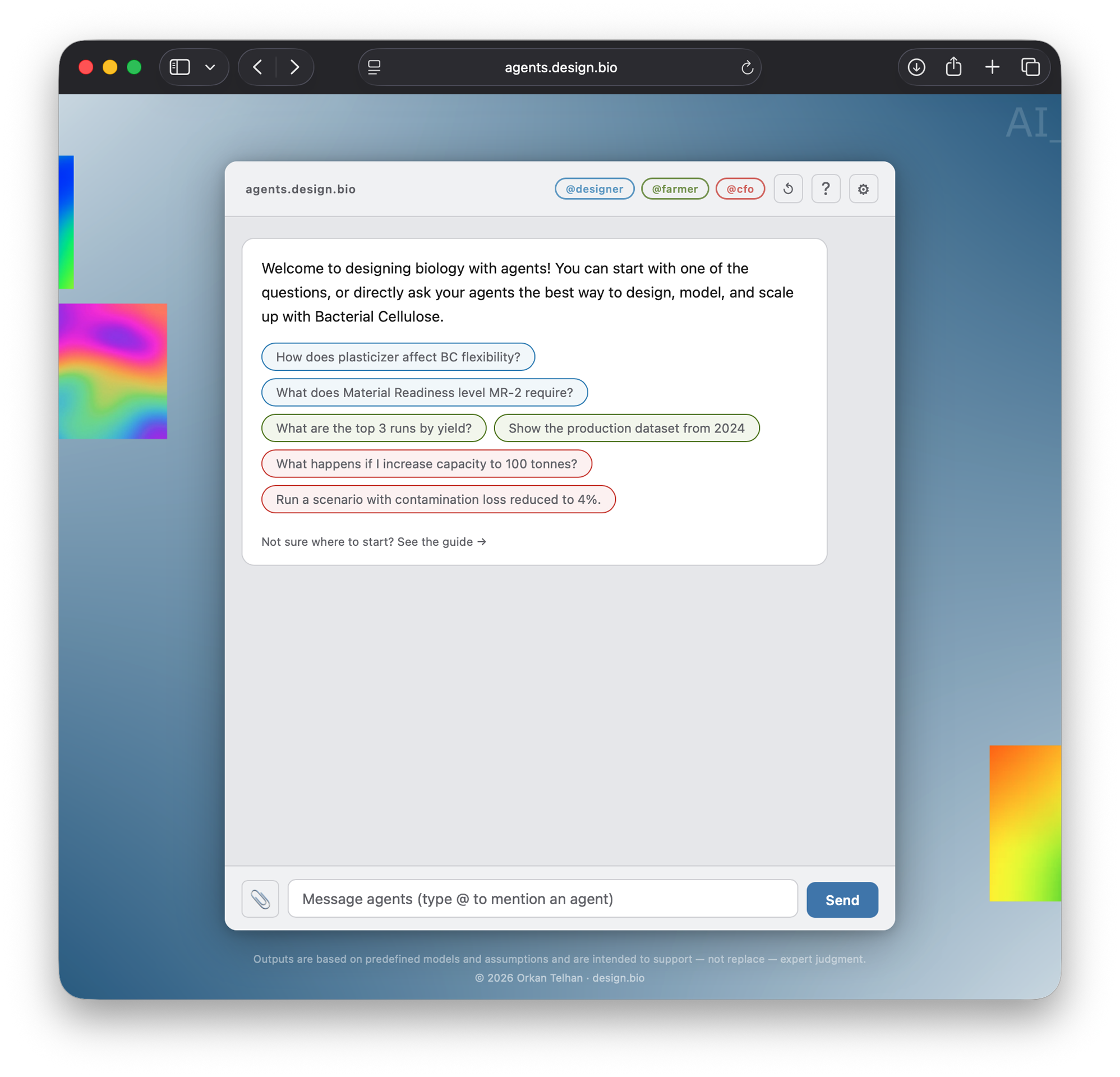
Agents.design.bio addresses these bottlenecks by externalizing cross-domain reasoning into a customizable, agent-based decision framework. Through the chat interface, users test scenarios and receive structured feedback on assumptions (Figure 1). By making alternatives and trade-offs explicit, the system aligns with structured decision-analysis approaches that emphasize systematic comparison over intuition-driven choice (Bardach Reference Bardach2012).
System entry point and interface overview for agents.design.bio, where users interact with role-based agents over shared datasets and models.

System overview
Agents.design.bio is a web-based application operating on structured documents and markup files that form the agents’ knowledge base:
-
• Design guidance and qualitative and quantitative assessment documents
-
• Production spreadsheets (yield, contamination rate, recipe inputs)
-
• Material performance data (tensile strength, thickness, translucency)
-
• Techno-economic assumptions (price/kg, drying cost, labor, facility capacity)
The system is modular and deployable with different knowledge bases. Labs, classrooms or startups can encode their own cultivation protocols, economic assumptions and evaluation criteria. Although the demonstration scenario centers on bacterial cellulose, the framework is organism-agnostic. The same architecture can operate on structured datasets for mycelium composites, algae-derived materials, precision fermentation systems, biomineralization workflows or other cultivation-based material platforms, provided that relevant process, performance and techno-economic parameters are encoded into the shared knowledge base.
Role-based multi-agent architecture
The platform is structured around three specialized agents, each representing a distinct reasoning mode within biofabrication practice. Rather than offering a single generalized model, the system separates material, process and economic cognition into domain-specific interfaces. Conversational interfaces for manufacturing systems have recently been explored in other industrial contexts, where large language models mediate interaction with production infrastructures (Yuan et al. Reference Yuan, Li, Liu, Han, Huang and Dai2025). Unlike such systems, which focus on operational control, agents.design.bio emphasizes cross-domain reasoning and techno-economic trade-off analysis during early experimentation. Our design draws from established principles in agent-based modelling, where distributed agents represent distinct rule sets and decision logics within complex systems (Abar et al. Reference Abar, Theodoropoulos, Lemarinier and O’Hare2017).
By structurally separating reasoning modes, the system prevents economic assumptions from implicitly biasing material exploration and vice versa. The architecture also functions pedagogically by helping students externalize and compare reasoning processes that are otherwise distributed across specialized disciplines.
The interface is available at https://agents.design.bio.
@designer: material and performance reasoning
The @designer agent supports material-focused evaluation using:
-
• Uploaded images (pellicle quality, thickness distribution)
-
• Measured physical properties (tensile strength, density, translucency)
-
• Application-specific benchmarks
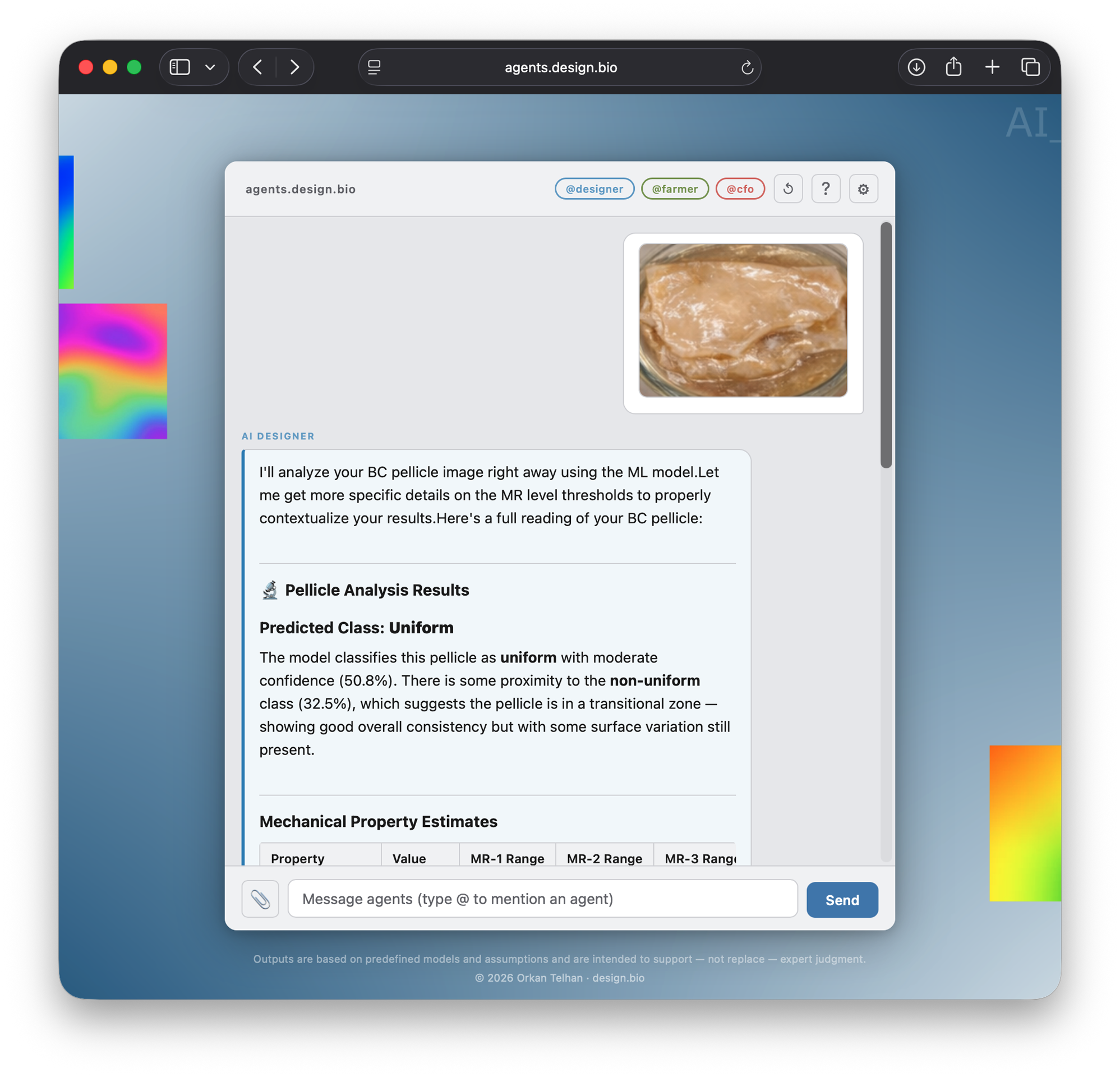
When users submit test results, it detects contamination indicators, identifies performance bottlenecks and proposes structured experimental adjustments (Figure 2). Research on aesthetic and sensorial perception of grown BC reinforces the importance of structured material evaluation beyond mechanical metrics (Gilmour et al. Reference Gilmour, Aljannat, Markwell, James, Scott, Jiang, Torun, Dade-Robertson and Zhang2023; Groutars et al. Reference Groutars, Martins and Karana2025; Papile et al. Reference Papile, Bolzan, Parisi and Pollini2021).
Example @designer interaction: image-based material assessment and structured recommendations linked to measurable quality criteria.
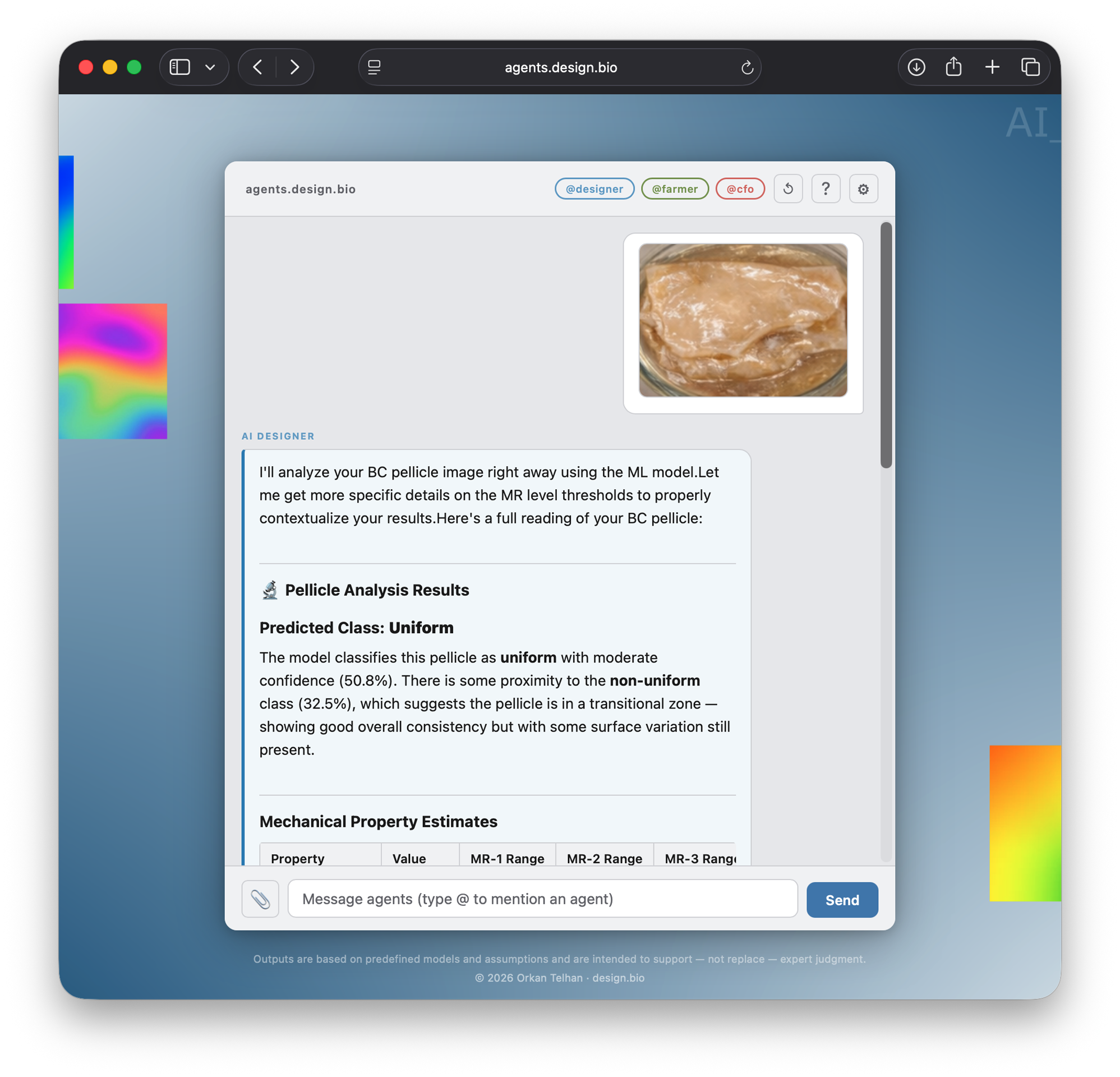
The @designer does not generate speculative recipes. Instead, it constrains suggestions to variables represented within the structured dataset.
@farmer: process and production analytics
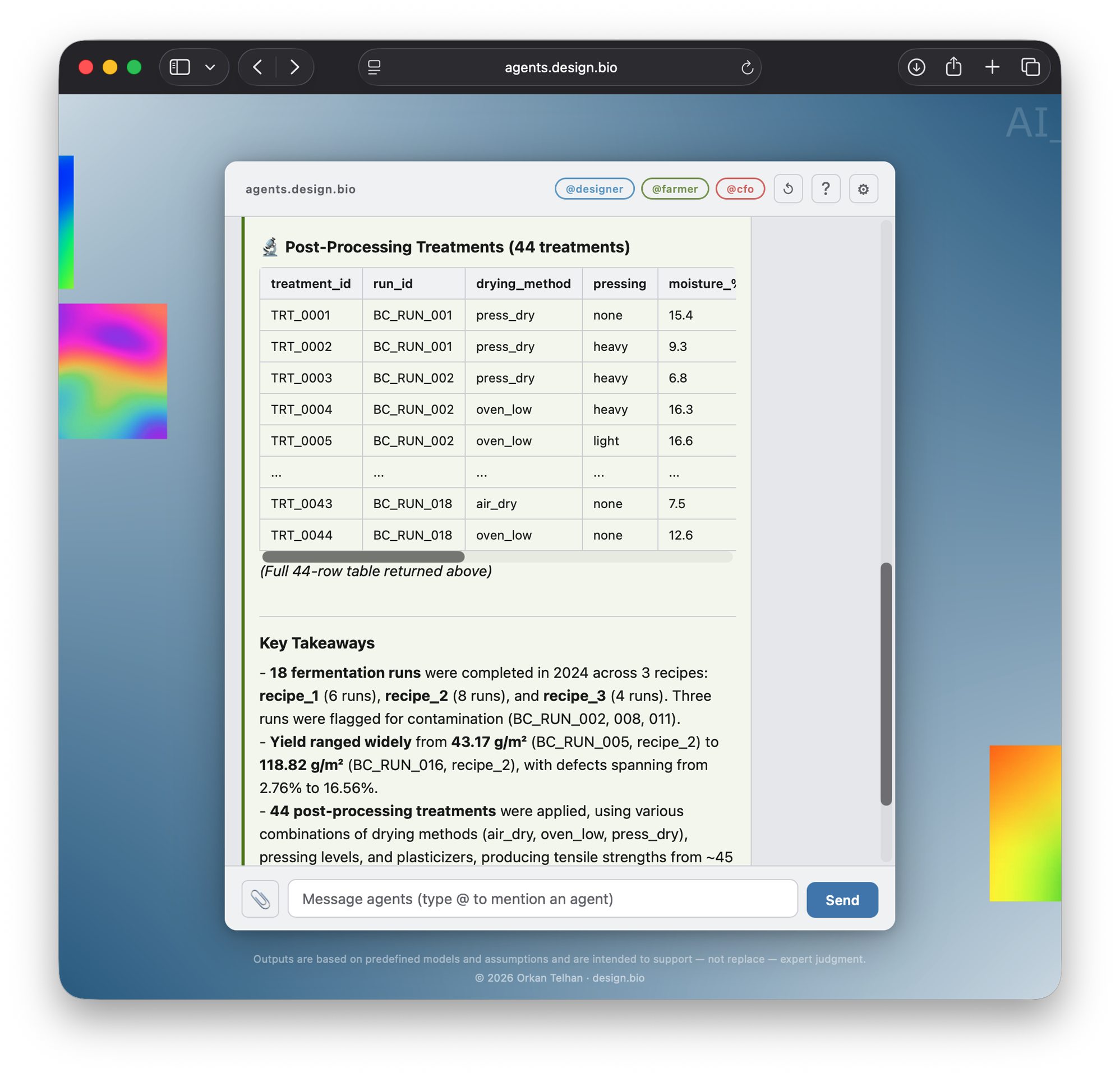
The @farmer agent analyzes structured cultivation records including fermentation duration, nutrient concentrations, temperature, pH, tray area and contamination events (Figure 3). These parameters align with established BC cultivation research (Behera et al. Reference Behera, Laavanya and Balasubramanian2022).
Example @farmer interaction: process analytics over batch logs to surface yield drivers, volatility and recurring contamination patterns.

The agent surfaces correlations, quantifies batch volatility and identifies instability risks. Process stability and contamination control are repeatedly identified as central constraints in industrial BC scale-up (Mukherjee et al. Reference Mukherjee, Kamble, Krishnan, Sivaprakasam and Sekharan2025). Rather than optimizing for yield alone, the @farmer emphasizes reproducibility and robustness.
@cfo: techno-economic modeling
The @cfo agent translates biological performance into economic consequences using explicit techno-economic models:
-
• Cost of goods sold (COGS)
-
• Labor and facility costs
-
• Yield and contamination assumptions
-
• Capacity utilization parameters
-
• Market price scenarios
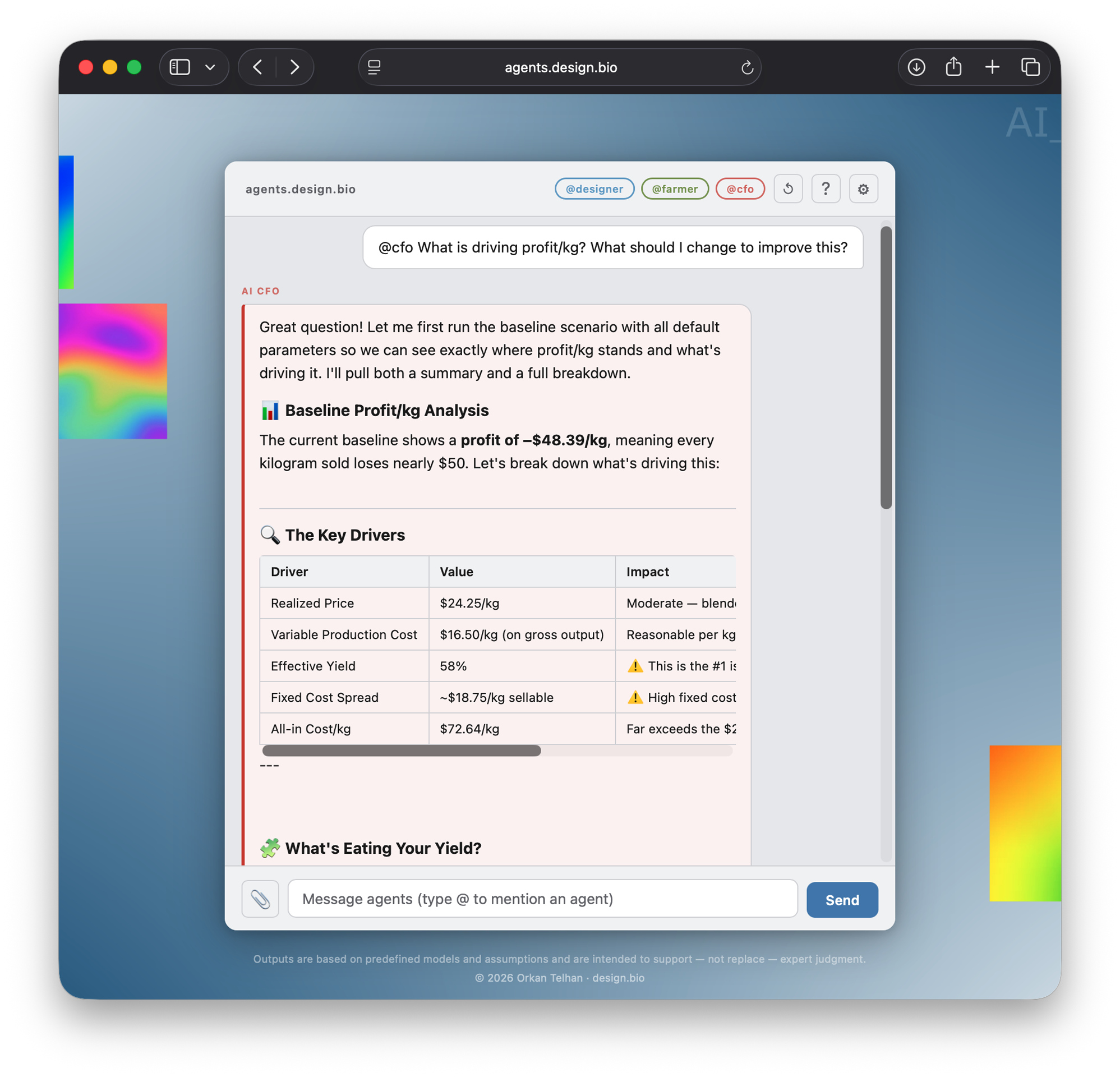
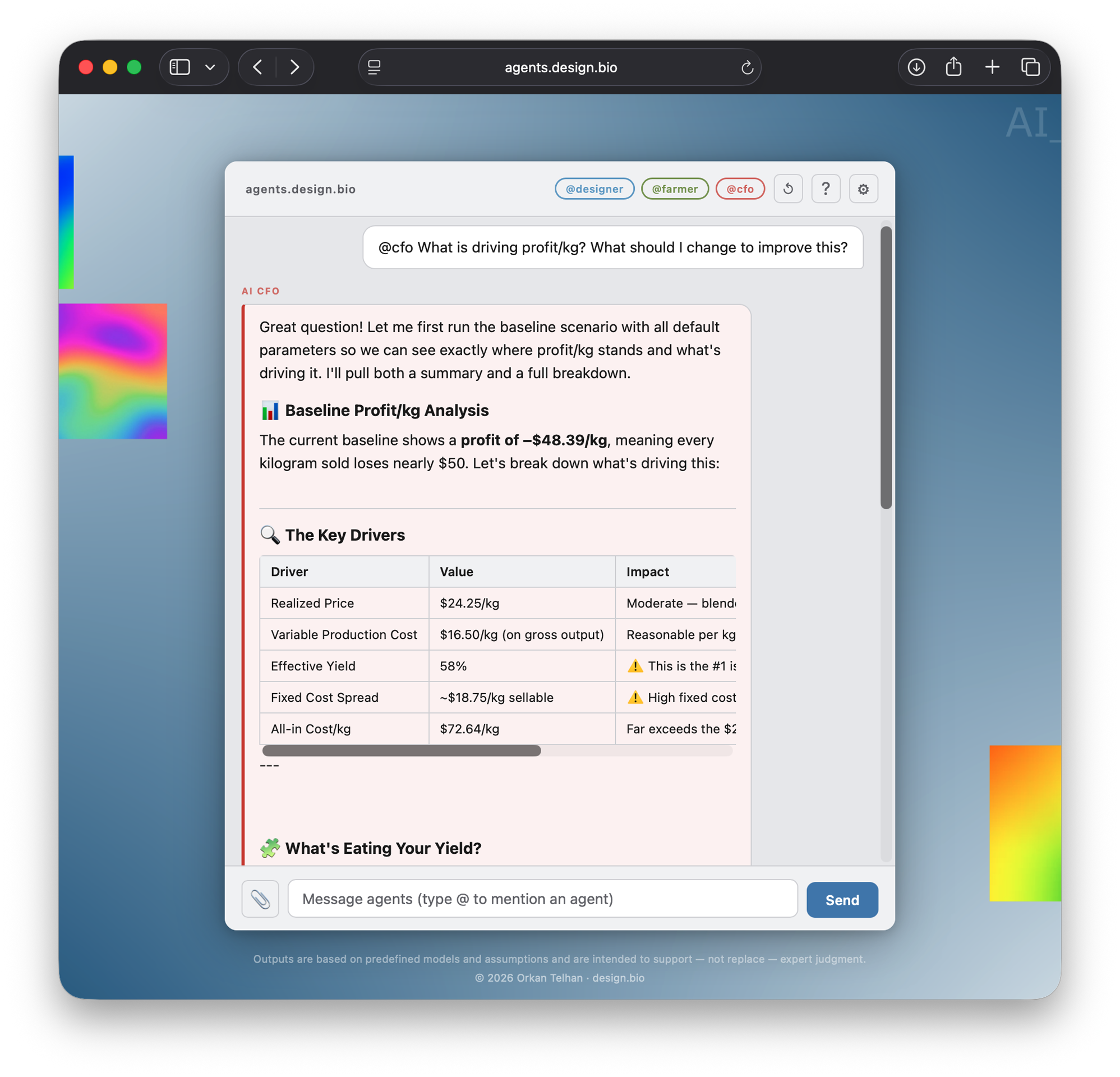
The techno-economic structure follows modeling practices in bioprocess engineering and feasibility analysis (Burk Reference Burk2025; Behera et al. Reference Behera, Laavanya and Balasubramanian2022). Sensitivity analysis identifies economically influential variables. By embedding these models into the conversational interface, economic reasoning becomes responsive to biological performance rather than detached from it (Figure 4).
Example @cfo interaction: scenario-based techno-economic modeling connecting yield, contamination and capacity assumptions to margin and break-even outcomes.
Demonstration scenario
The system supports four modes of interaction that reflect different stages of scale-up reasoning:
-
• Phase 1: Material Evaluation. Users upload a BC pellicle image and query material quality. The @designer proposes targeted interventions based on structured performance criteria.
-
• Phase 2: Process Optimization. Users query historical batch data. The @farmer surfaces yield correlations, volatility patterns and contamination trends.
-
• Phase 3: Scale-Up Stress Test. Users simulate increased capacity, contamination reduction or drying changes. The @cfo computes resulting economic consequences.
-
• Phase 4: Trade-Off Analysis. Users test constrained decisions, such as whether a 15% gain in tensile strength justifies a 20% increase in cost and calculate threshold conditions including minimum break-even yield.
The demonstration datasets combine experimental BC cultivation records, manually curated techno-economic assumptions derived from literature and synthetic stress-test scenarios generated to simulate scale-up conditions. The current prototype prioritizes transparency and interpretability over predictive accuracy. Twenty pilot users – including students, educators, founders and researchers – participated in iterative interface evaluations focused on usability and reasoning clarity.
Scaling biodesign as a learning process
As biodesign projects move from experimental prototypes toward potential production systems, the nature of decision-making changes. Variables that once appeared local – such as culture conditions or material properties – begin to influence cost structures, capacity constraints and risk exposure. Navigating this shift requires reproducibility, stability and clearly defined decision thresholds.
Importantly, not every biodesign project must or should scale. Designers and founders must make grounded decisions about whether scaling is desirable, feasible or aligned with their intended impact. Scaling is, therefore, not an automatic progression but a deliberate choice shaped by technical performance, economic constraints and broader project goals.
When scale is pursued, teams must learn how variables propagate across domains – from biological inputs to financial outcomes. This propagation makes scaling as much a learning process as a technical one.
Scaling decisions are often deferred until after material performance stabilizes. In practice, however, economic assumptions influence experimentation from the beginning – implicitly shaping which variables are explored and which are ignored. By embedding techno-economic modeling directly into the design workflow, the platform makes these assumptions explicit rather than latent.
Questions about break-even yield, contamination tolerance and acceptable volatility become part of early iteration rather than late-stage validation. The system does not automate judgment; instead, it formalizes the structure within which judgment operates. Scaling becomes disciplined experimentation under constraint rather than optimistic projection.
Conclusion
Agents.design.bio demonstrates how agent-based decision support can formalize scaling decisions within biodesign practice. By integrating material evaluation, process analytics and techno-economic modeling into a shared reasoning framework, the platform makes cross-domain trade-offs explicit during early experimentation. Rather than treating scale as an inevitable endpoint, it supports grounded decisions about when, why and how to scale biomaterial systems – transforming scale from a late-stage challenge into a structured learning process.
Data availability statement
The code and data used in the demonstration are held in a private GitHub repository but can be shared upon request.
Acknowledgements
We thank the twenty user testers – spanning students, educators, principal investigators and startup founders – who participated in iterative evaluations of the platform and shared feedback on the user experience.
Author contributions
Conceptualization and implementation: O.T; Writing original draft: O.T.
Financial support
The research was funded by Design.bio, NY, USA.
Competing interests
None.
Ethical standards
The research meets all ethical guidelines, including adherence to the legal requirements of the study country.

 Open access

