




When an architect in Germany designs a building, chances are that she will reach for ‘the Neufert’ at some point.Footnote 1 Now in its forty-second German edition with eighteen international editions, Ernst Neufert's (1900–86) eponymous Bau-Entwurfslehre (BEL), first published in 1936, comprises an encyclopedic assortment of floor-plan elements that still serves as a reference for the organization of competition briefs and the execution of commissioned buildings. With its collection of ‘solutions’ for architectural programmes – for everything from dog kennels and Zeppelins to office buildings and school layouts – the volume has arguably educated more of Germany's architects and shaped more of its architectural production than any architectural school or famous master.Footnote 2
Educated by the first Bauhaus director Walter Gropius (1883–1969), the BEL soon established Neufert as the German expert for technical norms in architecture, as it compiled standardized building regulations and pre-planned elements of all scales for ready-at-hand usage. The BEL had comprehensive aspirations: it provided schemes for different scales of building, and offered overviews of diverse typologies – all measured, rasterized and broken down from street width to office floor plans to the typewriter on the desk. But it also instructed architects how to draw or hold a pencil, and prescribed the spatial dimensions for all activities in the household. In short, through this manual, Neufert tried to define all elements of architectural production – including ‘man's measures and spatial needs’. Hired in 1938 by Reichsminister Albert Speer (1905–81) as standardization expert,Footnote 3 Neufert set out to conceptualize a total system of measurements for the entire German building industry, motivated by his ‘daily experience of lacking a super-ordinated relation of measure of parts to each other, which would have made their understanding and assembly easier’.Footnote 4 In 1943, this system was published in Neufert's Bauordnungslehre ('Building Order Treatise', BOL, a compendium of norms for the building industry): his second manual.Footnote 5 This work on behalf of the National Socialist regime (with a foreword by Albert Speer citing Adolf Hitler) was the architects’ tool Neufert had deemed missing not only for the construction of a state-controlled built environment, but for architecture at large – especially in light of the ever-growing number of building standards issued by a private association of engineers, architects and industry representatives, the German Institute for Norms (DIN, founded in 1917).Footnote 6
While conventionally translated in histories of technology and architecture as ‘standard’, it is important to this history to note that the German term Norm is suspended between technical regulation and social mode of conduct. The norm, and ‘to norm’, in twentieth-century Germany, were acts of deliberate form-giving with far-reaching intentions to reshape society. The German Institute for Norms (DIN), founded in 1917 under the name Normenausschuß der deutschen Industrie as an initiative of the military Fabrikationsbüro (Office for Production, FABO) to streamline the production of weapons and munitions, broadened its ambitions soon after the First World War beyond military production. By 1926, the committee changed its name accordingly and dropped the Industrie from its name, announcing its total scope as Deutscher Normenausschuß (German Norm Committee): thousands of DIN norms now regulated German building production and household items from doorknobs to postcards.Footnote 7 Scaled up (and down), the military origins of efficiency and control were taken up by engineers to construct a safe post-First World War German state. Modern architects such as Gropius took the total ambition of the DIN to heart and saw in the norm's principle the opportunity for the design of a new social order. Neufert, his student, would soon take modern architecture's will to order beyond architecture – to the subject.
Neufert's published manuals are garnering increasing scholarly attention, both for their widespread impact on architectural production (hitherto mostly analysed through the influences of the so-called avant-gardes), and, more recently, for their charged political implications which have surfaced after long-standing assumptions of standardization as technology supposedly free of ideology.Footnote 8 Exploiting this assumed neutrality, standardization efforts for the building industry proved a resilient platform for changing political ideologies in three different political systems in twentieth-century Germany, since, as architecture historian Nader Vossoughian has shown, ‘technical standards also serve a normalizing function’ in society.Footnote 9 Claiming repeatedly that ‘technology has nothing to do with politics’,Footnote 10 Neufert profited directly from such perceived lack of political or aesthetic intention behind norm making and standardization, as his continuous career as teacher, architect and author through different political regimes demonstrates: he was the first full professor reinstated at a German university after the end of the Second World War, despite having worked directly under Speer, Hitler's architect and master strategist. For Neufert, his books were the necessary tool to prepare architects for the materialized totality of norms that the DIN had envisioned: an ordered life, furnished with normed objects, lived within standardized houses. Neufert's ambition, indebted both to the total aspirations of modern architecture and to his technocratic, indiscriminate methodology, made his work all the more suitable for the total instrumentalization of aesthetics for politics by the National Socialist regime.
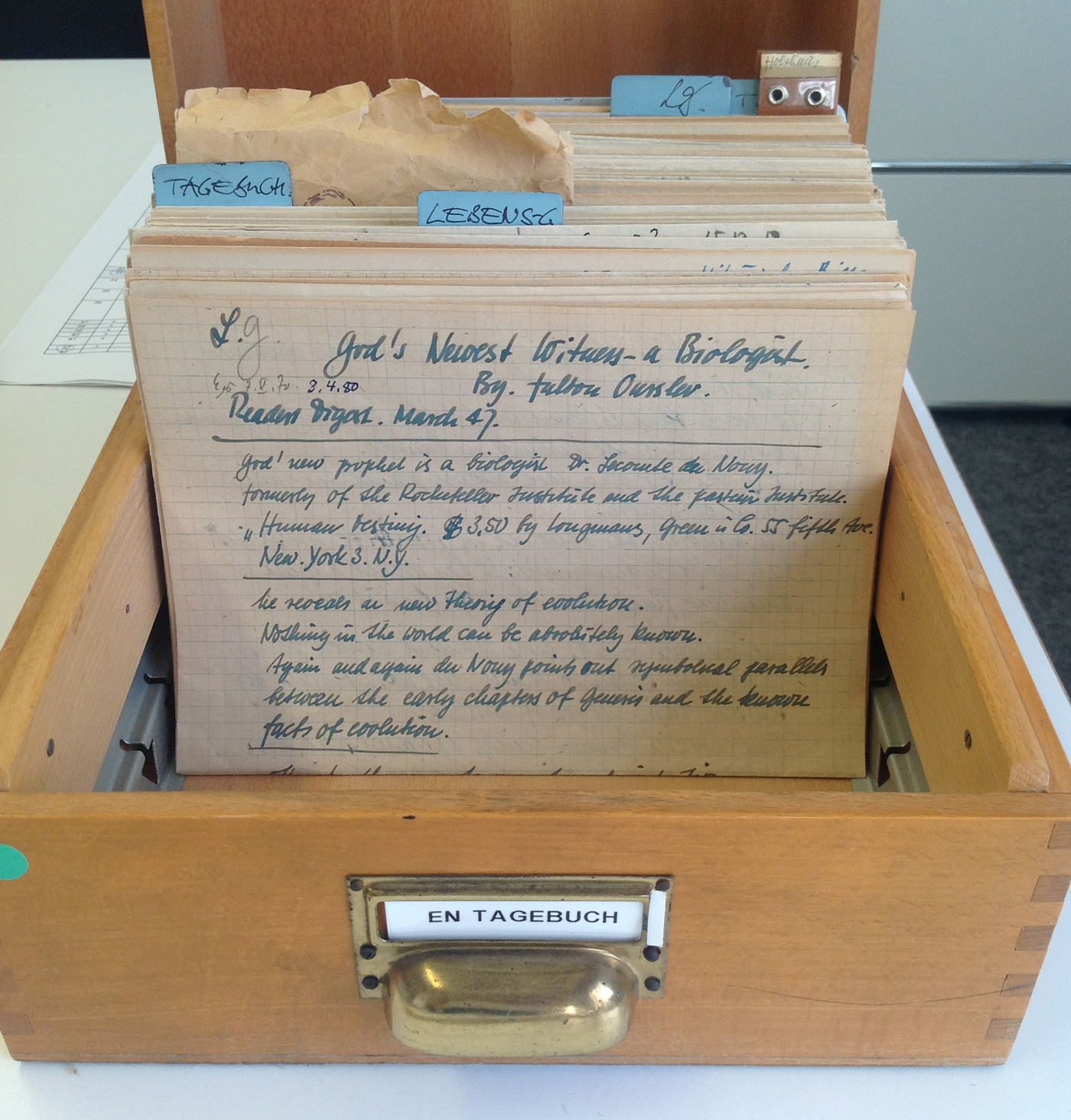
It is therefore imperative to expand the scope of analysis of Neufert's architecture manuals, in which he ostensibly aimed to order not just the built environment, but also the people living in it. To break open readings of Neufert's books as pragmatic instructions for architects, this article focuses on Neufert's third, unpublished, treatise: his ‘Lebensgestaltungslehre’, or ‘Life design manual’. While both BEL and BOL were published as bound volumes, the unknown treatise ‘Lebensgestaltungslehre’ is not a book – not even a manuscript. Rather, it consists of a series of diary entries on folded paper sheets, an order mechanism, and a plan for future publication (Figure 1).Footnote 11 And yet for Neufert himself it was a central piece of his oeuvre, the missing piece to bridge the scale from building to life, by organizing and ordering his mind with the same technique and rigour as his architecture. Despite the deceiving appearance (after all, it never became a book), this planned manual, too, bears the label Lehre, and this manual, too, followed Neufert's work process developed in his years of teaching and writing.
Ernst Neufert's diary in its original state as card index. Archiv der Moderne, Bauhaus-Universität Weimar. Photograph by the author.
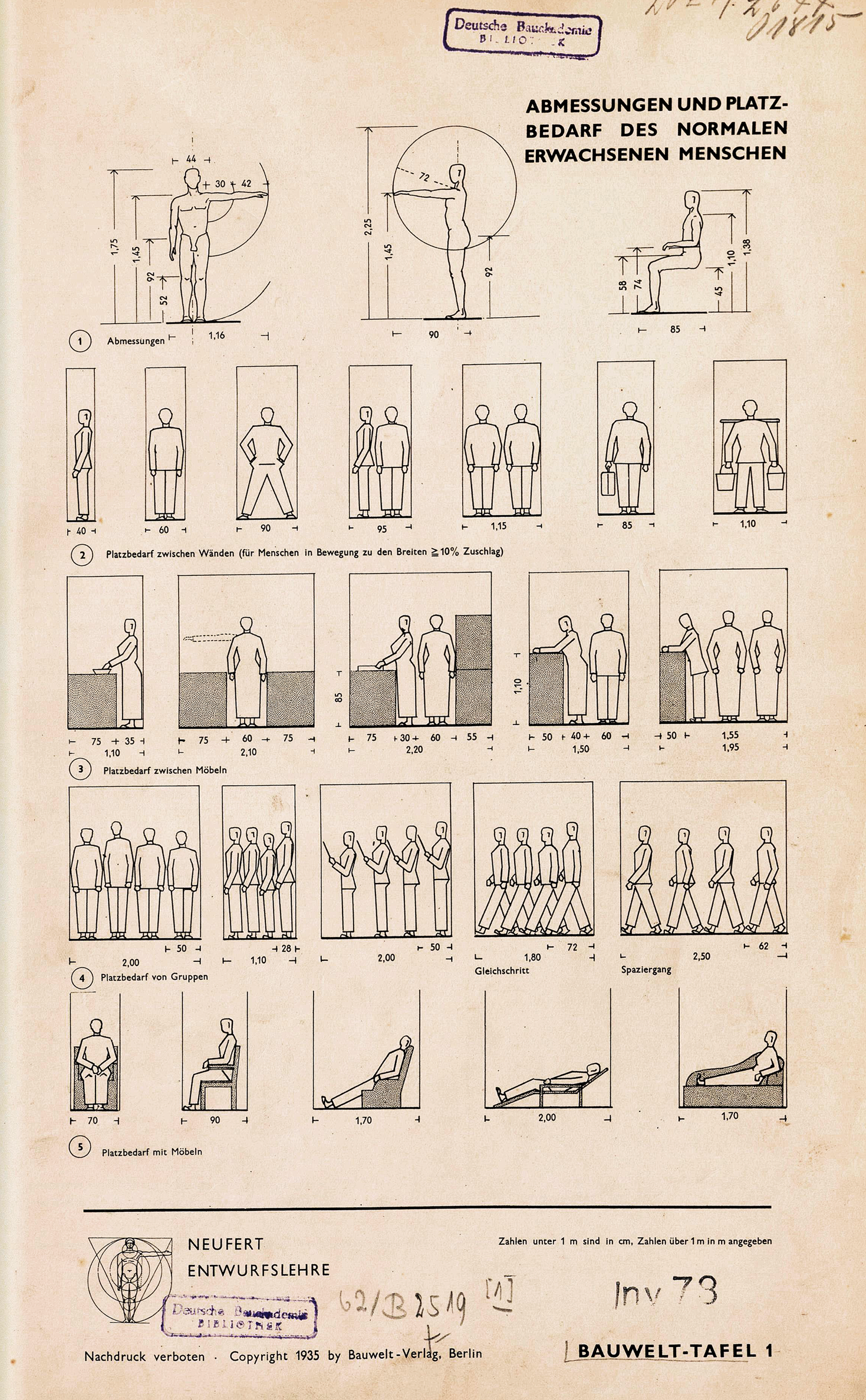
The BEL – the famous, published manual – had not emerged as conventional manuscript, but started out as a set of single-sheet publications in the architecture periodical Bauwelt, sorted according to categories not unlike the diary. These single sheets, called ‘Bauwelt-Tafeln’, were announced in 1935 as ‘something totally different’ from a book, presented in ‘mostly serialized depictions’ as a ‘time lapse’ (Zeitraffer) mechanism (Figure 2). These depictions were based in turn on Neufert's teaching methods that he had developed at the Bauhochschule Weimar under Otto Bartning's directorship,Footnote 12 where he taught, starting in 1926 (at a mere twenty-six years old), a course called Rapid Design (Schnellentwerfen).Footnote 13 Presented with concise, programmatically specific briefs, the students were tasked to come up with a functional design solution within mere hours, submitted on DIN A paper sheets.Footnote 14 Neufert, in turn, would file the student's drawings sorted according to programme, creating a ‘standard index’ (Standardkartei) of architectural proposals for each brief – the index that would form the foundation for the content of the BEL.
Ernst Neufert's ‘Bauwelt-Tafel 1’ configured human bodies into ‘measures and spatial needs of the normal adult human’ based on DIN A paper formats. Insert in Bauwelt, Bauwelt-Verlag, 1935.
Including Neufert's unpublished ‘Lebensgestaltungslehre’ in this issue on handbooks might help to frame handbooks as part of larger processes and projects. If a manual is not a stand-alone work, but part of a larger body of work (not bound to books), our understanding of a manual's intentions and effects necessarily shifts scales. The declared message (or audience) of such a handbook changes if one zooms out to include related works, transcending the distinctions of medium, edition or format altogether. Seemingly clear-cut handbooks might suddenly seem closer to a different genre; conversely, notes jotted down in a diary can become a manual in their own right. After all, what is the material and methodological condition that actually makes a manual if what constitutes Neufert's Lehren were not the distributed books? Rather than an embossed title on the spine of a finished volume, they share a methodological and material procedure: they all consist of a series of DIN A formatted sheets collected in books, bureaucratic brochures or indexed diary entries, all subject to Neufert's formatting and sorting process.
Containing structures of different sizes each on a single sheet, Neufert subjected household tasks, buildings, diary entries or small objects to the same process. Overcoming the boundaries of scale, these equalized depictions within their normed frames could now be grasped across their former categorical differences – sorted into the system of Neufert's Lehre. All three of the Lehren are attempts to order the world, be it built, designed or imagined. Through first dividing this world into parts, formatting them and categorizing them, Neufert's Lehren were meant to enable the reader to then construct a new, norm-conforming world from these parts.
Hence, this is not a story of a handbook. Rather, by tracing the scattered remains of the ‘Lebensgestaltungslehre’ across their medial states I hope to unveil the power of a projective title (after all, calling it Lehre might already make it so), the scalar diversity of a decades-long formatting process, and their usefulness to the politics of their time. In fact, this essay posits that what produced Neufert's Lehren (both published and not) was the very act of formatting itself: of paper, of architecture and of subjects.
One Lehre to teach them all
When Neufert published the BEL, both teaching guides and reference works had a long-standing tradition in the discipline of modern Western architecture; in fact, the organized curriculum and guidebooks were part of the discipline's professional foundation. The thirty-three-volume Handbuch der Architektur, the BEL's most prominent (and extensive) predecessor, was launched in 1880, nine years after the founding of the new German empire.Footnote 15 In the wake of industrialization, higher architectural education evolved in the nineteenth century from a ‘school of style’ to a ‘school of method’.Footnote 16 Additionally, as architecture historian Susanne Jany notes, modernization of German industries had produced new programmes, and the ‘novel types of buildings, such as railway stations, department stores, and disinfection plants, presented architects with the pressing question of how to design them appropriately to their purposes’.Footnote 17 Rapidly evolving (and changing) industrial standards and production processes additionally required up-to-date knowledge and information. And in true modern spirit, this prompted the attempt at a comprehensive system of rules and values – concisely printed on paper.
Books such as the Handbuch der Architektur were written not only to instruct students, but as a guidebook for the building of a new nation. In the late 1930s and early 1940s when Neufert published his BEL and BOL (in 1936 and 1943 respectively), architecture had become not just a series of monuments for the Third Reich, but a methodological strategy across scales. At the same time, industrialized production surged during wartime, and several attempts to fuse the diverse manufacturers’ catalogues into a compendium for practising architects, as theorist and historian Gernot Weckherlin describes, were published during these two decades.Footnote 18 Historian Anson Rabinbach has studied the aesthetic measures and manipulations of the National Socialist regime in their political context, detecting a marked shift in the perception and practice of design in the 1930s from the völkisch rhetoric and aesthetic toward an embracing of technology as aesthetics.Footnote 19 But this was not a clean-cut succession of styles. As Paul Betts has astutely analysed in his book The Authority of Everyday Objects, there was ‘no clear divide between 1932 and 1933 in German industrial aesthetics. Nazism provided little design innovation, nor did it ever really break from Weimar modernism’.Footnote 20 Historian Winfried Nerdinger links the ‘eclectic’ aesthetic concept of the 1930s and 1940s to the closing of the Bauhaus in 1933 and the dissolution of the Werkbund in 1938, with the modernist aesthetic being absorbed into the larger National Socialist toolkit.Footnote 21 So what was it that Neufert aimed to teach through his manuals? Rather than contribute to a (mostly fictional) National Socialist aesthetic of the ‘sacred or the aesthetic sublime’,Footnote 22 Neufert worked toward a normalization of political ideology by concretely shaping the design process – and ultimately the designer himself. Neufert's expertise as modernist, norm specialist and bureaucrat uniquely qualified him to shape Germany's new national landscape: a design task beyond the built.
In order to model National Socialist Germany into an economic super-force fuelling a nationalist–racist agenda demonstrating aesthetic, military and technological superiority, merchants under the stewardship of the government soon took to shaping and redesigning the means of the nation's production and people's everyday surroundings. The strategy was conceived by and carried out under the auspices of the architect and technocrat Speer. While the architect–bureaucrat had a long-standing history in German administration, rarely had an architect risen to such political prominence as Speer during his tenure under Hitler.Footnote 23 He conceived of the National Socialist organization on several scales: he was instrumental to Germany's Gestaltung as Third Reich. In his function as ‘inspector general of buildings’ (Generalbauinspektor, GBI), Speer gave shape to the regime's fantasies of dominance with his plans for the reconstruction of Berlin as ‘Germania’, the Reich's capital, or the oversight of the designs for the 1936 Olympic Games in Berlin by architect Werner March. As director of Organisation Todt (OT), a paramilitary building organization active mostly in the occupied territories, he oversaw the building of bunkers and defense structures from 1940. Despite being ‘neither a technician nor a specialist’,Footnote 24 the architect Speer became minister of armaments in 1942, and from there on organized not just the military's weaponry, but the very state apparatus of the National Socialist regime itself. It was under Speer's superintendence that Neufert was called in to become the regime's norm expert in 1938. This involvement went beyond the transmission of aesthetic skills or technological know-how: in their official capacities, the bureaucrat–architects created systems and organizational principles for the ordering of space, territory, industry and the military – they designed a new state altogether.
In late 1943, Speer founded a new ‘Arbeitsstab for the reconstruction of cities destroyed by bombing’, planning the reconstruction of war damage even before the war had ended. Neufert was part of this Arbeitsstab, responsible for questions of ‘systematic standardization’. At a meeting in April 1944, the members of the committee argued about the best way to produce mass housing after the war, stressing the importance of standardization and ‘the right measure’ for this process.Footnote 25 At the next meeting in October, after Neufert presented his work on typologies and norms, Walter Groß (head of the Office of Racial Policy) declared questions of housing typologies as tools for ‘racial selection’.Footnote 26
Despite such direct involvement in terms of his employment, as well as discussed content, in his diary Neufert almost completely avoids commentary on political events. In October 1945, shortly after the end of the war, he writes, ‘The work is going forward, but without great inspiration [Gedankenflug], and, additionally, joyful, unencumbered atmosphere is lacking, which, given the political events, does not even emerge here in the US occupied zone.’Footnote 27
One must wonder about Neufert's perceived lack of unencumbered atmosphere after Germany's liberation; but rather than explain, Neufert quickly continues with a retreat behind his facade of neutrality:
I keep my distance from these events as much as I can, but even with the smallest of connections with which one is connected to the economic life [Wirtschaftsleben] one feels the burden, which strains me above all measure given my especially sensitive, almost anxious constitution.Footnote 28
Neufert had kept this ‘distance from these events’ (meaning the end of the Second World War) mostly rhetorically throughout his career; maintaining this sentiment afforded him liberation from many burdens (though not, first and foremost, the one mentioned here). By working directly for the National Socialist regime, this ‘distance’ most of all alleviated any burden of political accountability in the de-Nazification processes, allowing Neufert to seamlessly continue his career from the Arbeitsstab during the war to TU Darmstadt, where he was hired in 1946 as chair for ‘design and standardization [Normung] in the building industry and urban planning’.Footnote 29 Keeping distance was Neufert's strategy to keep working on his Gestaltungslehre, which he turns to in the same diary entry only a few sentences later, asking, ‘What is this work, this Gestaltungslehre? A search for the eternal laws, the rules of architecture’.Footnote 30
‘Lebensgestaltungslehre’: formatting total aesthetics
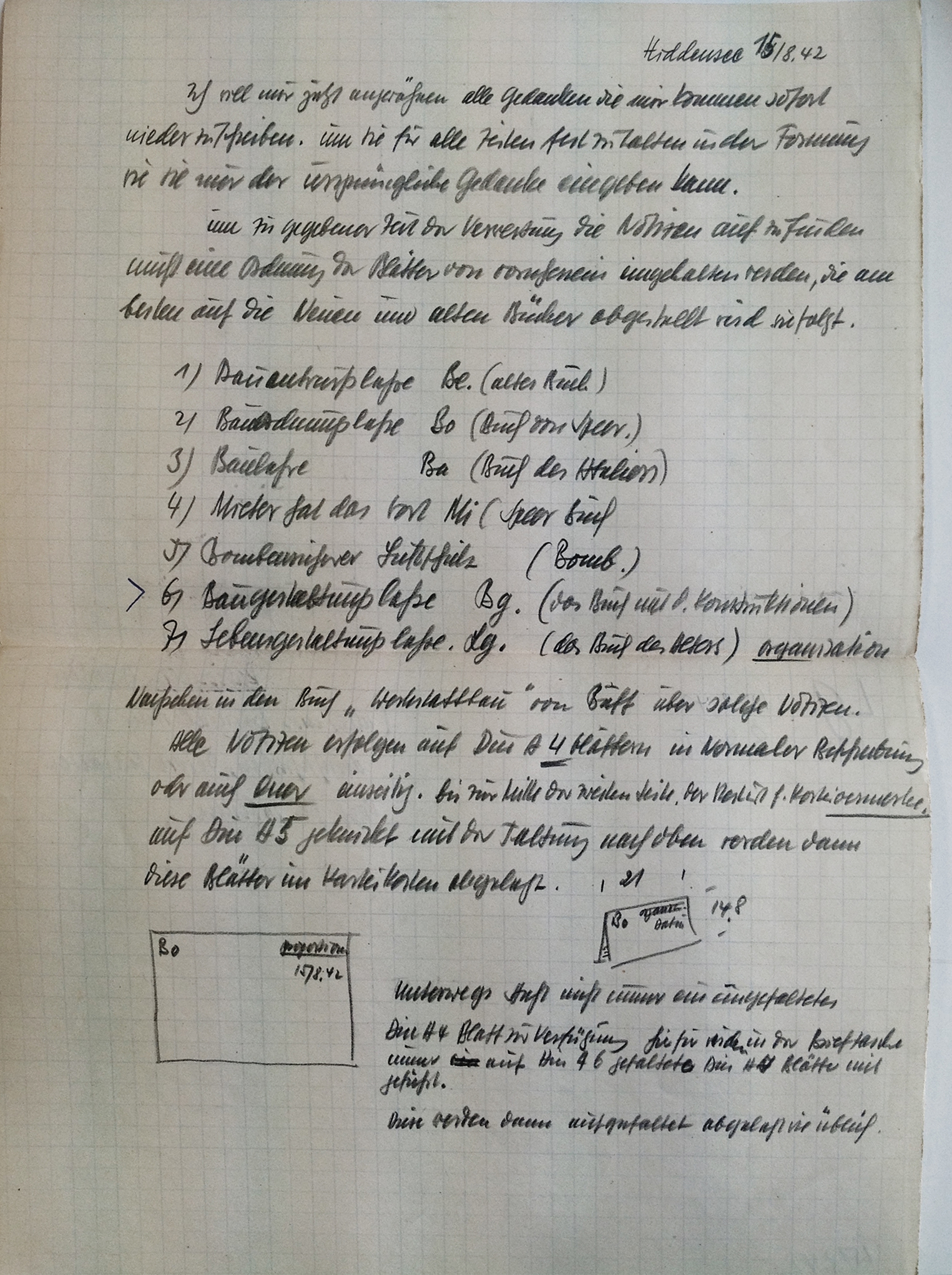
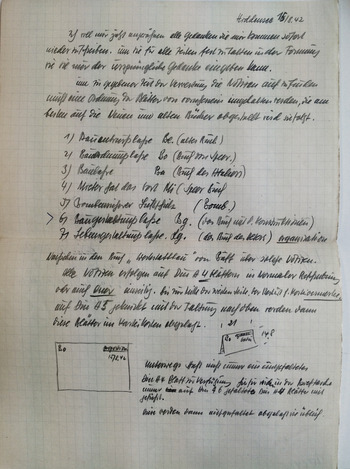
In November 1936, Neufert mapped out in his diary a larger scheme for his books: a tripartite oeuvre as strategy toward a system of total organization.Footnote 31 His BEL, published the same year, would provide pre-formatted elements for architectural design, and the ‘Baugestaltungslehre’ (a construction manual, which was also never published) would be the third step. Lodged between the two, Neufert proposed the ‘Lebensgestaltungslehre’ to provide the ‘human foundations’ (‘menschliche Grundlagen’) for the ‘organization of life’. In another list of manuals a few years later in 1942, the BEL was followed by the BOL, with the ‘Lebensgestaltungslehre’ (abbreviated LG) as the last, final project on the list (Figure 3).Footnote 32
Neufert's planned book projects including the ‘Lebensgestaltungslehre’ and folding technique of DIN A sheets for future diary entries. Diary entry, 15 August 1942, Archiv der Moderne, Bauhaus-Universität Weimar.
Where the National Socialists ‘untiringly glorified German labourers and labour’ by using terms like Gestaltung, Neufert departed from the term's previous understanding as ‘form-generating activity’ and organic process toward Gestaltung as highly strategized acts of formatting and fitting.Footnote 33 In Neufert's diary, the ‘Lebensgestaltungslehre’ was defined as ‘explication of a successful technique for living’,Footnote 34 and contained filings ranging from musings on Nietzsche and Schopenhauer to the recurring Selbsteinreden. With those ‘self-suggestions’ (or rather, instructions), Neufert tried repeatedly to structure his day to save time and enhance his productivity. In an entry in 1936 he tells himself, ‘Every morning from 5 to 8 except Tuesday and Thursday clean up; every evening from 6 to 9 in the public library except Wednesday and Saturday’. In August 1942, he reminds himself under bullet point 2 of a long list to ‘practise his imagination’ and under the next point to ‘speak as little as possible’ and ‘never from excitement or anger’. Rising early was an obsession; so was sleep, as ‘most often, yes, indeed generally such days were preceded by a bad night, or by an evening with alcohol and smoking, which brought the nerves in disarray’.Footnote 35 For Neufert, the ‘Lebensgestaltungslehre’ was part of a ‘vertical enterprise of the spiritual leadership in the building industry’;Footnote 36 as ‘every day has its scaffolding’, so, too, every architect needed to ‘think things through’ and adopt a standardized daily rhythm.Footnote 37 To shape life into order, sleep needed to be regulated just like working hours or floor plans.
The term Lebensgestaltung was not Neufert's invention. According to Peter Galison's analysis, philosophers such as Ludwig Wittgenstein and Otto Neurath were looking for a logical design for modern life that they called Lebensgestaltung as well, for which they deemed the modern architect to be the ideally fitted person, and the architects of the Bauhaus took their philosophical cues to understand the physical world as one built from elemental parts.Footnote 38 But where Galison's analysis stresses the logic of modernism as one of constructivist assembly, Neufert's approach was one of divisibility as technique across scales.Footnote 39 For Galison, Teilbarkeit then became the precursor to a systematic reconstruction of modernity, with both enterprises (logical positivism in philosophy and the Bauhaus in architecture) trying to ‘instantiate a … manifest building up from simple elements to all higher forms that would, by virtue of the systematic constructional program itself, guarantee the exclusion of the decorative, mystical, or metaphysical’.Footnote 40 While Galison identifies this mode of what he calls ‘transparent construction’ as the exclusion of the metaphysical both in modern architecture and in modern philosophy, Neufert's quest (and, earlier, that of the DIN) was one of legibility through delimitation, of ordering things through division, rather than aggregating them toward construction. In that sense, Neufert surpassed the project of the Viennese circle of the logical positivists: where they had aimed to construct complexity from parts, the DIN assumed the world to be already made of parts.
For Neufert, divisibility became the core technique to order and design, as well as the method to produce his books. However, the striving for an encyclopedic entirety in bound form accompanies his thinking. He criticizes the building norms of the DIN due to their lack of being thought of as a divisible system, and rather being thought of as parts:
Given that the building norm sheets are not available in bound form, but only as single sheets, often even in a very thorough compilation the newest, valid norm sheet is missing. The planner is then often annoyed and relinquishes the use of norms at large. This defeats the purpose of norm making.Footnote 41
Neufert deemed necessary a superordinated system in which everything else had to fit; norming the joints and spaces between parts was no longer sufficient. This desire for a formatted life and an order of thought was for Neufert directly linked to the praxis of making; as practitioner, Neufert was looking for a technique for ordering, or rather for making order possible in the first place. To arrive at this order, he divided things, even thoughts, and reconnected them through a larger system: the diary index, or the octametric measure system.
Rather than an additive system, as his colleague and competitor Martin Mittag had proposed,Footnote 42 Neufert advanced a series of measures derived from a division of ten metres (for example, 5, 2.5, 1.25, and 0.625 metres) as the best foundation for a comprehensive system to norm all parts of the building process.Footnote 43 In a drawing for the second edition of the BOL, Neufert illustrated several division methods for circles, trying to demonstrate the superiority of the two principles: if one assumed a metric system and divided a circle with a thousand units in half, and again, and again, one would arrive at Neufert's measure for the octametric system. Even more so, Neufert added, ‘625 mm is in relation to the meter like the “golden section” 5:8; and 2 × 625 mm = 1.25 m is the decisive measure of the series of halving of 10 m’.Footnote 44
Neufert had found his perfect system: one that merged the metric with the halving principle, and simultaneously offered the ultimate trope of aesthetic order – the golden section.Footnote 45 The embedded principle of Teilbarkeit – divisibility through cutting in half – was the main organizing principle throughout Neufert's three Lehren: the seminal Bau-Entwurfslehre, the Bauordnungslehre, and his unpublished ‘Lebensgestaltungslehre’. Furnished with this tool, Neufert could now proceed to seamlessly link from brick to man, house to furniture, and work processes to paper sizes.Footnote 46 In 1942, Neufert's work on this topic was issued in a special print titled ‘Building norms as totality’ (‘Baunormung als Ganzheit’) based on his octametric system from three years earlier.Footnote 47 Linking measures in the building process together with this modular system, the new ‘totality’ promised, according to Neufert, improvement not only in production, but in Gestaltung: furniture would fit into buildings, and buildings would fit into grids if built according to the octametric system, promising progress on all fronts. Simultaneously, his ‘Lebensgestaltungslehre’, a book-to-be dispersed onto the folded DIN A4 sheets in the diary, took on material shape beyond social norms.
Neufert's diary: a card index sorting life
Though never realized as a book, the Lebensgestaltung is central to a larger understanding of Neufert's norm efforts. Beyond the creation of an encyclopedic kit of parts for architectural production (as in BEL), or a complete norm measure system for architecture (as in BOL), it was in his diary that Neufert developed instructions and formats as tools to design the very subject of life and how to live it. This diary, however, was neither a conventional journal nor a loose collection of thoughts, but a collection of index cards organized with abbreviations into different categories. The resulting card catalogue embodied the nineteenth-century technique seemingly promising the documentation and production of universal knowledge.Footnote 48 Filed according to a sophisticated system of abbreviated categories, Neufert catalogued all entries just like he catalogued student work – and how he would finally catalogue architectural parts in the BEL. The abbreviations corresponded with architectural typologies and categories in his books, turning the diary into a materialization of its own logic: an index that would produce manuals not just for architecture, but for Lebensgestaltung.
Neufert had organized his index so that he could record his thoughts ‘immediately’ to preserve them in the formulation, which ‘only the original thought’ provided.Footnote 49 By filing them, he imposed order, turning them into documents to ‘hold on to them for all times’.Footnote 50 What constituted such thought was as diverse as his architectural scales, ranging from brick to city: they could be excerpts from Reader's Digest editions or a quote by Nietzsche followed by a series of time slots for lunch, coffee and nap on a workday. They did not need to be original, as long as they were formatted correctly in the diary sheet system. Thus transformed into carriers of recorded information, the diary sheets became part of a catalogue system, and were maintained, updated and corrected accordingly.Footnote 51 Most of the sorted entries are from the late 1930s and the early 1940s, with annotations into the 1980s. Also labelled ‘diaries’ (dated with the years 1944 to 1947), Neufert later used a stack of pre-printed calendar forms, with a week on each page in A6 format; whether those were sorted into the index remains unclear, but they contain scheduling entries such as meetings with collaborators or professional travel, and are less a record of the ‘original thought’ as he instructed himself with regard to the index entries. As sheets in an index they became sortable, storable and interconnected, a tool to order existing ideas and generate new ones. Hence it was Neufert's index diary that remained an active format for decades, as commentaries and additions reaching into the 1980s demonstrate.
Neufert's reliance on formatting was a question both of index and of the format of the indexed files; the most successful DIN norm to date in terms of breadth of application and international export, the DIN A series, had a profound impact on Neufert's work. It was authored by Walter Porstmann (a former assistant to Wilhelm Ostwald, who had been the creator of the ‘world format’), and Neufert conversed with him about norms and their respective publications well into the 1940s.Footnote 52 Porstmann, a mathematician, had defined the format through theorems and a process of division. The so-called ‘halving theorem’ (Halbierungssatz), together with the ‘similarity theorem’ (Ähnlichkeitssatz) derived each smaller format in the series by dividing the next-larger one in half, ensuring their geometrical similarity. This division was rooted in a material manipulation rather than abstract measuring: divisibility in Porstmann's scheme was ‘not a random half … but that half which emerges through simply folding’ the paper.Footnote 53 The normed ‘card index’ with DIN 6-sized sheets was the model for Neufert's diary.Footnote 54 Neufert not only used Porstmann's standard-sized paper sheets (A4) for his entries, but, rather than using ready-made DIN A6 index cards used in standardized library indices, he turned them into his card index by folding them – applying Porstmann's theorem to the sheets manually. For the DIN, the card index had become tool and material for its own norm production. In an advertisement printed on the jacket of Dinbuch 8 on drawing norms, the DIN promotes its own ‘Porstmann system’: ‘The DIN subscription card index is the connection between the producer and consumer of DIN norms.’Footnote 55
In Neufert's case, the card index materially connected author and his readership of one. The paper's size and categorization were the most consistent qualities of the papers in the diary: the sheets varied in colour (from white to brown to pink), sometimes were lined, sometimes consisted of ripped-out graph paper from a journal, but most often were blank. Yet unaffected by the printed structure or its time of origin, Neufert's handwriting remained uniform across the pages. Writing in fountain pen with varying colours of ink, he sometimes switched to pencil, and made accompanying sketches (of a building he saw in a dream, furniture details or his paper-folding technique) with the same tool. Reworking the entries time and again, he layered inks, lead and insights onto the normed sheets, becoming author and editor, commentator and subject.
Neufert also used A4 as a format for his books. While the BEL was in DIN A4 format, the first edition of the BOL ‘sadly could not be a DIN format as it needs to comply with the format of the publications by Speer's ministry’.Footnote 56 Part of the work for the second edition (1961) consisted of the reformatting of the content onto the normed paper format. Furthermore, the paper became the medium to bridge scales, to connect architect and architecture – materially and literally. Where the paper format was ‘normed’, a norm-sized binder followed. As both a normed object and a carrier of further norms, the two-dimensional sheet of paper was represented graphically as surrounded by an ever-expanding entourage (Gefolge) capable of formatting space. Soon after came the norm for the filing cabinet, and lastly the building that housed this normed furniture. That building, in turn, was built from normed parts: the window, the door, the brick all were defined by DIN norms. Neufert accordingly planned office buildings around paper-stack dimensions, promoted furniture suitable to roll out DIN A0 plans,Footnote 57 and repeatedly based his measure system on the paper format series.
By taking both the nineteenth-century idea of the card index as producer of universal knowledge and the DIN's understanding of paper format as materialized system in and of itself, Neufert used formatted paper to slice and slot life design onto its sheets. The filing system and the size of the folded sheets provided a superordinated system to unify diverse thoughts and scales – an apparatus for Lebensgestaltung.
The technique of Teilbarkeit
In the late 1930s, in the wake of the BEL's success and while writing the BOL, Neufert used terms such as ‘naturally’ (naturgemäß) and ‘nature’ (Natur) to introduce and justify his instructions, already found in the BEL, even more frequently.Footnote 58 For Neufert, invoking ‘nature’ served a double purpose: on the one hand he used it to naturalize ‘found’ norm measures for his octametric system and building materials and objects ‘naturally’ matching up with it, justifying the location of windows between columns or the measures of swimming pools; on the other, nature itself became part of ordered and normed life.
Neufert's idea of ‘organic life’ was based on rigorous discipline toward the body and toward the mind. His constant and repeated entries titled ‘life plan’ (Lebensplan) or ‘self-suggestion’ (Selbsteinrede) map out a life devoted to work. Annemarie Jaeggi called Neufert's obsessions toward disciplining spaces and bodies into his norm measures a ‘compulsive act’, and the diary entries seem to confirm such an assessment.Footnote 59 And yet a certain yearning for a discipline that would come naturally, that might not require the constant Selbsteinrede and guilt that would come with it, seems to seep through the rationalized visions of farm living in his diary. In Neufert's ‘Lebensgestaltungslehre’, time, behaviour and work projects were all sorted and divided into functional snippets toward higher productivity. The saving of energy that official bodies demanded of the population, Neufert expected of the designer. As equal project next to the building norms and the building manual toward the making of efficient, economic objects, he aimed to construct a designing subject with the same qualities.
In multiple diary entries in the 1940s, Neufert painted a structured life in peacetime: a whole village planned according to the octametric system, following his instructions on orderly conduct. In 1947, he envisioned people living on a farm together, with a clubhouse to host friends, a library and a bookshop organized according to the latest developments in card-index logistics, Sunday trips in the car and a communal kitchen during the week. But this was not an escapist idyll to get away from all things after the war; neither does he picture the group as a social community or family. What he portrays is an Arbeitsstab, using the terminology of Speer's organization in the ministries.Footnote 60 On Neufert's farm, men would order nature, not revel in it. Testing (and living out) his ideas for agrarian buildings and systems, Neufert's ambitions went beyond the mere cataloguing of dog kennels or feeding trays for cows. He paints a scene of modernized nature, where ‘everything [was to be done] with clear, precise attitude. Naturally organic and yet modern’.Footnote 61 Nature, as Neufert defines it in his diary, ‘must be created in its precision, both in the part as in the whole’; in fact, he declaims, ‘reason, creator of nature!’Footnote 62 Just like the human subject, nature for Neufert was the result of Gestaltung. Despite the justification rhetoric, it was not nature that gave order to the form. Rather, reason needed to order nature, subsuming it under the total system, or rather parcel it out and slot it into the grid – both literally and figuratively.
For Neufert, books and diary were not just part of such order, but both were created and organized through the mechanics of the card index. In his BOL, Neufert argues for the principle of halvability by showing a plan of a Palladio villa, pointing out the sequence of spaces sequentially halved in proportion and surface area, producing the perfect system for ‘good architecture’.Footnote 63 He also applauds Palladio's ‘rigour’ in the implementation of this principle. The halving of spaces together with their rearrangement produces, according to Neufert, exemplary architecture. A page earlier in the BOL, Neufert calls this cutting in half a ‘natural instinct’ (with his usual strategy of naturalizing the origins of his norms by long histories as Urtriebe):
The continued cutting in half is the most primitive, most obvious and simplest form to divide things. Even the little child starts while playing with paper to halve the sheet, then further halves the half and so forth. Every adult halves their letter sheets in continued sequence out of a natural play instinct.Footnote 64
This halving of sheets that Neufert explains as instinct here was at the same time the technique he lays out in his diary – for the diary itself. In one of his entries, Neufert specified (to himself), ‘all notes will be made on DIN A4 sheets … but only halfway up on the reverse page. The rest [of the page] is for Karteinotizen, folded to DIN A5 with the fold oriented upwards’. This instruction was followed even when travelling, where Neufert planned to always carry a stack of folded sheets (hence formatted from A4 to A5). Those were then ‘be filed as usual’ in the index card box that formed his diary: ‘In order to allow for their future use, the sheets must be kept in a specific order from the very beginning; this order will be best based on the new and old books as follows’.Footnote 65
The principle of division, or rather halving, was not limited to measures or floor plans, or to the diary itself. In 1942, one year before the Bauordnungslehre was published, Ernst Neufert wrote one of his so-called ‘self-suggestions’ (Selbsteinreden). The list of resolutions, which Neufert regularly composed to instruct himself toward a better, more ordered life, was headed by the following instruction: ‘1) to consider everything in a mode of accurate dissection [genau zergliedernd betrachten], and if necessary, to imprint it on the memory in such a way that it remains’.Footnote 66
He then moved on to a more general reminder – ‘5) to divide, order everything’ – and then went on to continue plans of how to format this life (i.e. to speak as little as possible in order not to waste energy, to formulate precisely, etc.).Footnote 67 One way to reach this goal was to ‘10) write not a diary but a daily index, in which all thoughts of the day are collected in order’.Footnote 68
This desire for a formatted life and an order of thought was for Neufert directly linked to the praxis of making. And as practitioner in this sense, Neufert sought a technique for ordering – or rather, a technique that would make order possible in the first place.
Man measured like all things
In a world of Neufert's Lehren, the production of a manual followed the same method as the design of a house or taking notes of thoughts. The diary was not only the site to construct the ‘Lebensgestaltungslehre’ by compiling folded papers, but simultaneously where Neufert planned the dissection of the day into working slots for their production. Analogous to his calculations for standardized brickwork according to his measure system, where he would calculate wall lengths to then divide them by brick size to find out the required amount of material, Neufert planned a new book by taking the page count of his already written books, and the time spent by him or his co-workers on the book, producing a quotient for calculating the book yet to be writtenFootnote 69. Not surprisingly, decades later Neufert noted on the diary sheet that the calculation had not produced the predicted result – the book remained unwritten.
And yet all of Neufert's Lehren continue to influence architectural practice. Students, practitioners and administrators used (and still use) the BEL, absorbing architectural standard solutions as unsuspecting neutral building blocks and grid systems into their designs. The BOL, shorter-lived and less widely distributed, was strategically important in the construction of a coherent norm system across architectural production (including bunkers). The ‘Lebensgestaltungslehre’ never had a shot at becoming a successful folio: it remained a loose series of paper sheets with a readership of one. And yet it was made following the same logic: a catalogued categorization of elements, made relatable through the application of the same system of division, categorization and systematization. The normed paper as common carrier (ideally in DIN A4) reinforced the material logic across all three works. In fact, one might argue that only some of his works ultimately took the form of a bound volume, while all of them existed in different loose-leaf states at one point. The medium of the diary itself – normed paper sheets sorted in an index – materialized as treatise for architectural order.
The unpublished ‘Lebensgestaltungslehre’ project resituates Neufert's published treatises, rendering their conventional reception as mere pragmatic tools untenable. So far absent from Neufert's historiographical treatment, this third Lehre foregrounds the scale of his aspirations – not in size, but in reach. Neufert expanded the notion of Lebensgestaltung from how it was understood around the turn of the century (for example among the logical positivists). By working on systems rather than on the shape and form of the finalized building or object, Neufert thought it possible to make every part conform – including the subjects inhabiting the building. For Neufert, his Lehre was not limited to objects or even architecture – all was subject to Gestaltung, most of all the human subject. Hence Neufert's books did not prescribe one distinct form for things, but presented a strategy for fitting designed parts into the larger (political and aesthetic) system. Beyond enabling the creation of an encyclopedic kit of parts for architectural production (as in BEL), or a complete system of norm measurements for architecture (as in BOL), dissecting the world into parts again and again ultimately became a tool for Neufert to format the very subject of life. Only when divided, ordered, sorted and compiled could floor plans be printed next to ironing boards, could notes about how to write be found next to musings on Kant or a sketch of the Leibnizhaus in Hanover. The index structure behind the Lehren allowed for ideological shuffling across categories.
And not just shuffling – Neufert's Lehren were concrete acts of shaping both built and social environments. The Third Reich's aesthetic representation followed a similar strategy as the regime's construction of an ideological apparatus which was in ‘constant need of refinement and reinterpretation’, as Anson Rabinbach pointed out.Footnote 70 Where this ideological construct depended on the ‘willingness to adhere to the precepts of the [Nazi] worldview which was vague and indistinct enough to embrace a variety of related perspectives’,Footnote 71 the regime's shaping of people's everyday lives was continually, concretely materialized in regime-selected aesthetic forms and shaping of mass-produced objects.Footnote 72 And while, in fact, the regime never had (despite later representations in the media) a uniform aesthetics, Neufert's trans-scalar measures, grids and design norms, following Speer's initiative, were attempts to normalize a new German nation. The actual ‘large scale’ of the National Socialist Gleichschaltung of German society became the making-same of the German subject itself.
For Neufert, man was never the measure of all things (although his use of the term, together with a Vitruvian vignette on book covers, publications and letterheads, abounds); rather, man needed to fit his system.Footnote 73 In fact, man needed to be told how to fit the system: through Selbsteinreden, repeated rules for daily conduct or work ethic – and the octametric system. Analysing his Lehren not as stand-alone volumes but as part of an approach to regulate life at large, Neufert's ‘Lebensgestaltungslehre’ undermines the technophile rhetoric of modern ‘objectivity’ and political and aesthetic ‘neutrality’ found in Neufert's own writing as well as his reception. The fragile materiality of his index diary betrays his seemingly robust technique of dividing objects, measures and thoughts alike to reformat them into one total system. Governed by his octametric system, there was no need for a relativized scale – there was no category that could not be filed in the index. Life became but one more area to be designed according to the octametric system – sorted under ‘LG’ for ‘Lebensgestaltungslehre’. By dividing material, thought and objects into their parts, Neufert could think not only about a housebuilding machine or a brick, but about a systematically formatted subject. When Neufert crossed out the ‘scale of the human’ (Maßstab Mensch) for the second edition of the BOL to replace it with ‘human building measures’ (Menschliche Baumaße), he literally subordinated man to his total system of order.Footnote 74
Neufert claimed throughout his career political neutrality for both himself and his work, precisely by defining his work on Norm as technical standards rather than societal conduct. And yet Neufert's Lehren were political tools, especially in an era in German history where representational strategies became a key political method across scales. Treating the ‘Lebensgestaltungslehre’ as third manual demonstrates Neufert's ease in applying material and abstract order to realms beyond conventional disciplinary and categoric bounds. By equally formatting his subject – human as well as architectural – Neufert instructed both himself and future architects in how to break down the world until it fit into his grid. In Neufert's book, norming objects and formatting life were part of the same act.
Supplementary material
The supplementary material for this article, which is a file showing a further three pictures, can be found at https://doi.org/10.1017/bjt.2020.13.
Acknowledgements
I want to thank the reviewers for their comments and the editors of this issue for creating a wonderful group of people to think with; the Max Planck Institute for the History of Science, Berlin, for providing community as well as the funds necessary to live and work; the Ernst-Neufert-Stiftung and the Archiv der Moderne at the Bauhaus-Universität Weimar for for granting image permissions; and the latter for letting me investigate Ernst Neufert's diary in its original index-card state. All translations from German are mine, unless otherwise noted.




 Open access

