

Damnatio memoriae is one of those ideas that has managed to insinuate itself so effectively into historical discourse that, despite the fact that everyone who studies the topic agrees that the term does more harm than good, we have now reached a point where we cannot reasonably jettison it. The term is regularly employed in reference to the Roman world to indicate processes directed at the suppression or manipulation of the memory of an enemy of the state. It is obligatory to make, in any study of the practice, two important qualifications: firstly, that damnatio memoriae, for all its Latinity, is not an ancient but a modern term, and, secondly, that damnatio memoriae is not actually a single process but an umbrella term that describes a number of overlapping but discrete activities. Despite the fact that these warnings are routinely communicated in the secondary literature, we still find that many historians of the Roman period are far too quick to talk unproblematically about ‘a damnatio memoriae being imposed’ or such and such ‘suffering damnatio memoriae’, thereby giving the impression that the emperor (or, in the Republican period, the senate) simply announced damnatio memoriae against someone and then a formalised and standardised process was rolled into action by his subordinates.Footnote 1 This, we know, was not the case.
This article is not an attempt to provide a new and conclusive definition of damnatio memoriae. I eschew this task both because of the limits of space and because it is something I hope to do more fully at a later date.Footnote 2 Some basic remarks on the topic will be offered below, but only in so far as it is necessary to set up the main argument. Instead, this article will seek to engage with damnatio memoriae in a very specific way through a single case study in order to show just how varied the processes in question might actually be and, most specifically, in order to highlight the fact that these processes, far from involving the destruction of historical source material, might in fact be generative of literature, art and monumental construction. The specific example we will examine is the emperor Magnus Maximus, who usurped imperial power in Britain in the summer of 383 and who ruled as emperor in the West from that time until his death in 388. We begin, however, with a consideration of damnatio memoriae in modern research and a justification of the fact that this article will follow the work of Harriet Flower and eschew the term damnatio entirely in favour of the more neutral ‘memory sanctions’.Footnote 3
1. Damning memory
Damnatio memoriae is a modern term. It appears to have been first coined in 1689 as the title of a short dissertation published in Leipzig.Footnote 4 It is used today to refer, in a collective and undifferentiated way, to a bundle of ancient Roman practices that were directed at convicted traitors, usually after their death. The term is a construct of the modern world and was never used in antiquity, the closest equivalents being the memoria damnata or memoria accussare of the jurists.Footnote 5 This is not to say, however, that the idea of sanctions against memory had no relevance in the Roman world. Romans were aware that fallen enemies might be subject to ritualised assaults on their memory. Jerome, in his Commentary on Habbakuk, describes violence against statues that must have been familiar to his audience: ‘When a tyrant is destroyed, his portraits and statues are also deposed. The face is exchanged or the head removed, and the likeness of he who has conquered is superimposed. Only the body remains and another head is exchanged for those that have been severed.’Footnote 6 Public rituals of enormous brutality were directed not only at monuments but at human bodies, and the stripping of honour and titles was also a frequent and publicly articulated practice.Footnote 7 In modern scholarship, however, the term damnatio memoriae effects considerable confusion both because the individual activities it constituted are, in general, poorly understood and because its very Latinity implies that we are employing it because it is a faithful reproduction of an idea that is clearly articulated in Latin but not in English (as, for example, when we describe the Roman virtue of felicitas rather than risk mangling its meaning with such broadly equivalent but ultimately unsuitable words as ‘luck’ or ‘happiness’). When we use damnatio memoriae, we are in fact doing exactly the opposite: creating a modern term where an ancient one is lacking.
This problem is compounded by the fact that modern research on the topic has tended to focus almost exclusively on both its destructive and its physical aspects, with the modern bibliography swelling with studies that focus upon memory sanctions as manifested through the mutilation and destruction of physical monuments, most notably statues, coins and inscriptions.Footnote 8 These studies have helped to shape the way we understand memory sanctions so concretely that damnatio memoriae has come, in many cases, to mean nothing more than the destruction of statues and inscriptions.Footnote 9 Thus, when scholars think of memory sanctions, it is to images like that shown in Figure 1 that their minds instantly turn. The image depicts the so-called Severan Tondo, a circular wooden panel 30.5 cm wide and painted during the reign of Septimius Severus, prior to the year 205. The image, which would probably have been displayed in the offices of a senior imperial official, is believed to be of Egyptian origin, though is of unknown provenance. When it was first painted, the image depicted Septimius Severus, his wife, Julia Domna, and their two children, the future emperors Geta and Caracalla. The face of Geta, however, has been purposefully and comprehensively scrubbed away from the painting, leaving a circle of bare wood. There is even evidence that the painting was smeared with excrement.Footnote 10 The explanation for this lies in Geta's fall from power. After Septimius Severus died, his two sons were made co-Augusti. The two young men quarrelled violently with one another and, on 19 December 211, less than a year after their father's death, Caracalla had Geta murdered in their mother's arms. An exceptionally violent purge of Geta's adherents then followed, and Geta himself was posthumously accused of having plotted to overthrow the state. His images were defaced or destroyed, which explains the condition of the Severan Tondo, from which Geta's face (and only his face) has been consciously and carefully erased.Footnote 11

Figure 1. The Severan Tondo, a picture of the imperial family from c. 200 ad.
This image is the example of damnatio memoriae par excellence. But if we use this and others like it incautiously, it can cause us to garner a lopsided impression of memory sanctions as a purely destructive force whose aim was to conceal the past in shadows and forgetfulness. This danger is made all the more real by the fact that we inherit a lexicon of destruction and oblivion from our sources. Of the numerous examples that might be selected, perhaps the most striking, at least in terms of its rhetorical ambition, comes from a law of the emperors Arcadius and Honorius, issued on 21 April 395. The law, addressed to Andromachus, the prefect of Rome, declared that while legal decisions made ‘during the time of the tyrant [Flavius Eugenius, d. 394]’ might be upheld, nevertheless the names of the consuls nominated by Eugenius must be abolished; it closed with the presumptuous injunction, ‘Let that time be considered as if it never was.’Footnote 12
Powerful as this rhetoric is, it is largely without substance. The impossibility of truly removing a time period from existence – indeed of removing anything from memory by conscious effort – ought to be self-evident. Cicero, in his de Finibus bonorum et malorum, has Themistocles lament the impossibility of ‘the art of forgetting’ (ars oblivionis), so much more difficult a task than the ‘art of remembering’ (ars memoriae).Footnote 13 Thinking more of the practicalities of political life, the historian Aurelius Victor, writing thirty four years before Arcadius and Honorius’ law, had described the imposition of memory sanctions in 193 against the short-lived emperor Salvius Didius Julianus: ‘[Septimius Severus] ordered the name and writings and deeds of Salvius to be destroyed (aboleri); but this he could not achieve.’Footnote 14 Roman emperors were no more capable of erasing every trace of their fallen enemies than are human minds of consciously forgetting. Nor, despite their grandiose claims, did Roman emperors attempt or even desire so to do. In fact, they derived considerable political capital from their fallen enemies.Footnote 15 Despite their grandiose rhetoric, Arcadius and Honorius both received panegyrics from their subjects that made sure to mention the achievement of their father in defeating Eugenius.Footnote 16
Modern historians have, of course, been keen to assert that memory sanctions are more complicated than simple and misguided attempts at oblivion. We may make a number of points about the Severan Tondo itself. Firstly, its survival into the modern world (it is in fact the only known painted image of a Roman emperor) suggests that it continued to be displayed and venerated as an imperial icon even after it was defaced. Secondly, though the destruction of Geta's face was total, no effort has been made to hide the fact that he was originally in the picture, his neck, shoulders and chest having been left visible and the context of the picture making it immediately apparent to any contemporary that the deleted face was Geta's. This is what Charles Hedrick refers to as ‘significant silences and erasures’, destructions that are meant to be seen in order to remind viewers of the punishment of oblivion that has been meted out.Footnote 17 The examples that may be adduced of such behaviour are legion. Hedrick himself chooses to draw our attention to an equestrian statue of Stilicho in the forum. After the general's downfall, the statue was torn from its base and the general's name and honours were cut away from the stone. Yet when the inscription was discovered in the modern period, the statue base was still in situ; the inscription had thus been intentionally left to stand, disfigured, in the prominent position within the city in which it had been erected. The men who defaced the statue, whether on Honorius’ direct orders or on their own initiative, wanted the wounded pedestal to remain there as a testimony to the fall of the disgraced general, whose name would be as conspicuously forgotten as it was assiduously remembered.Footnote 18
‘Significant silences and erasures’, however, are still ultimately destructive: they merely make a show of their destruction. Despite his emphasis on the exhibitive aspect of memory sanctions, all the different ways in which Hedrick shows that memory sanctions might be carried out are destructive or interdictory, focussing upon things to be erased or forbidden.Footnote 19 In this article, however, I would like to consider the ways in which memory sanctions could be truly creative processes, processes which I (somewhat flippantly) dub creatio memoriae. By creative, I do not mean simply that these processes were inventive (though they certainly were), but that the imposition of memory sanctions against an individual could and did entail the generation of historically commemorative material: of literature, ceremony, art, inscription and monumental construction. To demonstrate this, we will consider another Western usurper brought down by the armies of Theodosius: Magnus Maximus.
2. How to commemorate the damned
Magnus Maximus, a Spaniard by birth, had been a one-time companion in arms of Theodosius the Elder and had served with him in Britain in 369 and in Africa in 373–5 during the war against Firmus.Footnote 20 Under Gratian he was given a senior command in Britain, possibly that of comes Britanniarum. In the summer of 383, in response to perceived misgovernment by Gratian, the armies of Britain rebelled and declared Maximus emperor. He crossed into Gaul, where he and Gratian's forces met without joining battle. For five days a stand-off ensued – we may presume with much negotiation, both official and unofficial, between the two camps – until desertions from Gratian to Maximus began. Panicked, Gratian attempted to flee southwards but was apprehended by Maximus’ adherents and was executed.Footnote 21 Theodosius, ruling the Eastern Empire, apparently considered an invasion of the West, but this appears never to have taken place.Footnote 22 Instead an uneasy peace was reached between Maximus, Theodosius and Gratian's younger half-brother, Valentinian II, then ruling in Italy. Maximus was recognised by the other emperors, however mutedly, as emperor in Gaul.Footnote 23 Yet his ambitions clearly extended further than this and he carried his antipathy towards the child-emperor Valentinian as openly as an unsheathed sword.Footnote 24 In 387 he crossed the Alps and entered Italy under arms. Valentinian fled to the East, appealing to Theodosius for aid. The older emperor marched west with an army bolstered by Gothic auxiliaries newly recruited from the Balkans. He defeated Maximus in two battles in Illyricum. Maximus fell back to Aquileia in Italy but was captured there. He was brought captive to Theodosius and then executed.Footnote 25
Following Maximus’ execution, a typical package of ‘significant silences and erasures’ appears to have been deployed against his memory. His severed head was sent to Carthage, where it could still be seen on the walls of the city twenty-five years later.Footnote 26 His infant son, Flavius Victor, who had the misfortune of having been named Augustus by his father, was also executed by Theodosius.Footnote 27 Maximus’ name was chiselled from inscriptions across the Empire and Theodosius issued several laws, between September 388 and January 389, that annulled all appointments and legal judgements that had been made under Maximus. Maximus’ most senior officials were executed or demoted and men who had supported him found themselves fallen out of favour.Footnote 28 These activities, all perfectly recognisable as sanctions against memory, served Theodosius by establishing Maximus’ reputation as a tyrannus, a pretender who had sought to destroy the state.
Yet at the same time as these steps were being taken, at least notionally, to obliterate the memory of Maximus, vast resources were being poured into memorialising Maximus’ downfall. Having spent a year from the summer of 388 in northern Italy, Theodosius went south, to Rome, the first firmly attested imperial visit to the ancient capital since Constantius in 357.Footnote 29 Theodosius entered the city in an enormous triumphal procession and, in due reverence to ancient tradition, he met with the senate.Footnote 30 Already before he had arrived, the prefect of the city, Sextus Aurelius Victor, had raised a statue to him in the Forum of Trajan.Footnote 31 Victor's successor, Ceionius Rufius Albinus, who was in office at the time of Theodosius’ visit, went one better and set up a group of statues directly in front of the curia, one to Theodosius, one to his son Arcadius, and one to the nominal Western emperor Valentinian II. These statues openly declared themselves memorials to the downfall of Maximus; each stood on an inscribed base, the three inscriptions identical but for the name of the emperor to whom they were dedicated: ‘To the destroyer of tyrantsFootnote 32 and the author of public security, our lord Theodosius [vel Arcadius vel Valentinian], constant and fortunate eternal Augustus …’Footnote 33 The three emperors were raised together in a single monument almost on the steps of the senate house. With them and as part of the same monument, Ceionius Rufius Albinus also erected a fourth statue, dedicated to Thermantia, the mother of Theodosius, the inscription of which lionised the dynasty of Theodosius and thereby immortalised in stone the link between the fall of Maximus and the rise of the dynasty of the Eastern emperor.Footnote 34 This was a theme which would recur.
While in the city, Theodosius received panegyrics that proclaimed his victory over the fallen Maximus. An example of these speeches survives in the form of a panegyric by the Gallic orator Pacatus, a gargantuan text of nearly 1,300 lines that celebrated Theodosius and his great victory over ‘the tyrant’, ‘the purpled butcher’, ‘the man of death’, and ‘that man, formerly the most worthless little slave of your house and an attendant stationed at the tables of slaves’.Footnote 35 In this language, Pacatus exemplified a long tradition of panegyrical praise, going back to Pliny, which delighted in recounting the details and horrors of a fallen and supposedly unspeakable tyrant in order to glorify his destroyer.Footnote 36
The celebrations in Rome were the culmination of Theodosius’ war and ensured its legacy as a war of liberation for the West. Embassies were sent to Rome from cities around the Empire, bearing gold and official salutations on behalf of the communities that sent them.Footnote 37 Nor was the celebration in Rome unique. We know from Pacatus that Theodosius had been received in triumph at Emona when he entered the city while the campaign against Maximus was on-going. Though Maximus was still alive at this time, Pacatus tells us that the inhabitants of Emona paraded an effigy of his body and sang funeral laments for him.Footnote 38 In order to explain to his new Western subjects why he had entered Italy under arms, it was necessary for Theodosius to raise before them the shade of Maximus and the grim vision of his rotting head. His efforts were a resounding success: the anniversary of Maximus’ death was still being celebrated as a public holiday in Rome in the sixth century.Footnote 39
The celebrations in the West, therefore, were a generative act that has created for us a great deal of historical source material from which to reconstruct not only the celebrations themselves, but the life and reign of the man they notionally existed to efface. In some ways, however, these celebrations were a perfectly natural part of the normalising of Theodosius’ presence in the West. Political reality meant that Theodosius, even if he had been capable of it, could not afford to efface utterly the memory of Maximus because that memory was an important legitimating tool for generating support and framing his regime in territory only recently brought under his direct rule. More interesting, in as far as memory sanctions are concerned, is the way in which this victory was inscribed upon the monumental landscape of the city of Constantinople. Theodosius’ capital, untouched by the war, had no need to remember Maximus. If the rhetoric of destruction and oblivion has substance to it, therefore, we would expect that genuine silence would be the response of the city to the war with Maximus. Yet, as the rest of this article will show, quite the opposite was true and the commemoration of Maximus’ downfall was made an important theme within the enormous programme of building works that were being undertaken by Theodosius in Constantinople.Footnote 40 The tyrannus was commemorated in three enormous monuments within the city that stamped his defeat permanently upon Constantinople's topography.
2.1 The Theodosian Obelisk
The Theodosian Obelisk, which still stands today in Istanbul's Sultanahmet Park (see Figure 2), was raised in the hippodrome of Constantinople in 390 under the direction of the then city prefect, Proculus.Footnote 41 The obelisk, a single, imposing block of granite, had originally stood in the Temple of Karnak in Luxor, Upper Egypt, one of a pair taken by Constantine to furnish his own building projects but which during that emperor's lifetime appears only to have got as far as Alexandria.Footnote 42 At some point, probably after the reign of Julian, it would seem that the Theodosian Obelisk was brought to Constantinople but that attempts to raise its colossal mass proved a failure and so it languished, according to the Greek inscription upon its base, ‘forever lying heavily on the ground’.Footnote 43 In 390, however, renewed efforts were thrown into this endeavour and the obelisk was at last raised upon the spina of the hippodrome on a base adorned on four sides with relief carvings of Theodosius and his courtiers and on two sides (the south-east and north-west, those facing the stands of the circus) with inscriptions, one in Latin and one in Greek.Footnote 44 The Latin inscription is the most immediately relevant since it makes explicit the context of the obelisk's erection:
I was formerly reluctant to obey the serene masters, even when ordered to proclaim the victory over the extinct tyrants, [but since] all things yield to Theodosius and his everlasting offspring, I was conquered and subdued in three times ten days and raised to high heaven on the advice of Proclus [sic].Footnote 45
Addressing its viewer in the first person, the obelisk itself thus proudly proclaimed that it stood to commemorate Theodosius’ victory over ‘the extinct tyrants’, Maximus and his son Victor. The citizens of Constantinople could hardly have been ignorant of this context. Even if one ignores the fact that the victories in the West would, in 390, have been important current news, Linda Safran has demonstrated that both the Latin and Greek inscriptions are sufficiently large to have been legible to those sitting in seats either side of the obelisk.Footnote 46 The Latin inscription, which explicitly linked the obelisk to the tyranni, faced the kathisma, the imperial box from which the emperor and his family would preside over the games in the hippodrome and around which would be sat the city's most important dignitaries.Footnote 47 Furthermore, the erection of the obelisk was a gargantuan undertaking (as Ammianus’ description of the raising of a similar monument in Rome in 358 makes clear) and would certainly have commanded the attention of Constantinople's citizens, particularly as it would have been accompanied by dedicatory ceremonies and celebrations in which speeches that praised Theodosius’ war of Western liberation were delivered.Footnote 48

Figure 2. The Theodosian and Built Obelisks, 1901.
The language of Proculus’ inscription is very significant. The inscription explicitly declared that the obelisk had been ‘ordered to proclaim the victory over the extinct tyrants’ (iussus et exstinctis palmam portare tyrannis). The use of the plural, tyranni, here, which we also saw with the monuments erected in Rome, is likewise important. It might initially be assumed that the plural must here indicate that the monument was raised to commemorate Theodosius’ defeat of both Maximus and the later usurper Eugenius (r. 392–4). As the inscription makes clear, however, the monument was raised during the prefecture of Proculus, which ended in 392, and textual evidence tells us that the obelisk was raised in 390.Footnote 49 The second tyrannus referred to in the inscription can therefore only be Maximus’ infant son, Victor. In terms of understanding memory sanctions not simply as a process of oblivion but one of image formation, this realisation has very significant consequences. The term tyrannus had a long and highly charged political history by the end of the fourth century. It was used regularly in Roman political discourse throughout both the Republican and Imperial periods, and the imagined tyrant was regularly held up for comparison with the good emperor.Footnote 50 During the reign of Constantine, tyrannus appears to have established itself as the standard appellation for an enemy emperor defeated in civil war. Maxentius (306–12) was denounced as a tyrannus by Constantine's panegyrists and was so named in the dedicatory inscription on the Arch of Constantine.Footnote 51 Licinius was likewise denounced by Constantine himself in legislation after 324.Footnote 52 The word's Greek original, τύραννος, was used by both Libanius and Julian to describe emperors defeated under Constantine and under Constantius II, and Pacatus, as we have seen, used this word many times to describe Maximus in the panegyric he delivered to Theodosius in Rome.Footnote 53 The word retained, moreover, the moral force with which it had always been imbued in antiquity: the tyrant was the enemy of rational political order, a slave to depravity and vice, whose friendship quickly turned to enmity and who committed acts of violence for the sheer love of destruction.Footnote 54
The anonymisation of Maximus through this appellation stands at the heart of the creatio memoriae. Denied the honour of his name, and thereby the details that might identify him as a historical individual, the Theodosian Obelisk turned Maximus into a generic tyrant, much as had the monuments and speeches in Rome. In this way, the historical Maximus was remade in service of Theodosius as the dark and blood-thirsty tyrant brought down by the great and shining emperor. Unquestionably, such a dichotomy seriously misrepresents the character both of Maximus and his rule.Footnote 55 But such was the victor's prerogative. Maximus was made a tyrant in death because that was what he had to be: the darker his tyranny, the more glorious its defeat.
This act of historical back-writing comes into even sharper relief when we consider the appellation tyrannus in respect to Maximus’ son, Victor. Though we do not know his exact age at the time of his execution, it is clear that Victor was still only a child when he was killed. His death, by virtue of his imperial title, was a foregone conclusion and Victor was not the only purple infant to be executed in the late Roman world.Footnote 56 Yet the tyrannus was a monstrous figure and Victor only a little boy. To describe him in terms identical to those of his father (indeed, to commemorate his execution at all) was to take his memory and to claim it as Theodosius’. The very power of the word tyrannus lies in its ahistoricity. To eschew the names of Maximus and Victor and to put this anonymising moniker up in their stead was to decontextualise and to dehistoricise them, to make theirs the universal fate of tyrants before the universal victory of true emperors. In death Victor became, like his father, a pantomime figure, a caricatured opponent of the divine order as embodied by Theodosius. This was not remembering to forget, but creating a politically utile memory under the guise of interdiction.
The inscription itself is but one part of the monumentally decorative programme that the obelisk established in the hippodrome, and to understand Maximus’ place in the narrative created by the monument we need to view the inscription in its wider context. In the first place, the Latin inscription was merely one part, albeit an important one, of the obelisk's decorative programme. The upper part of the base was carved on all four sides with figural reliefs representing imperial interactions in the hippodrome: four imperial figures (the Augusti Theodosius, Valentinian II and Arcadius, and the Caesar Honorius) and their attendant entourage seated in the kathisma watching the chariot races (south-west side), these same emperors receiving the submission of barbarian peoples (north-west side), a single imperial figure (either Theodosius or Arcadius) seated in the kathisma overlooking the erection of the obelisk (north-east side), and a single imperial figure standing in the stama holding the wreath of victory (south-east side, above the Latin inscription).Footnote 57 The lower part contains the two inscribed texts (north-west and south-east sides) and relief scenes of the erection of the obelisk (north-west) and of chariot races in the hippodrome (south-west).Footnote 58 These images are all clearly united by their association with the hippodrome itself and they conjure the scenes of celebrations attendant on the erection of the obelisk and the downfall of the tyranni. Above the inscription that declares the fall of the nameless tyrants, the emperor (whether Theodosius or Arcadius) stands with the wreath of victory, at once presiding over the victories of the circus and his victories over tyranny.Footnote 59
Like Ceionius Rufius Albinus’ monument outside the Roman curia, the decorative scheme on the obelisk served not only to advertise the destruction of Maximus but to advance the dynastic programme of Theodosius by advertising the imperial status of his children.Footnote 60 Both the reliefs and the Latin inscription displayed the imperial children in a central position with reference to the victory of their father, reflecting conscious efforts on the part of Theodosius himself, who had also brought the young Honorius, future emperor of the West, with him to Rome for the triumph in 389 (Valentinian, notably, he had not).Footnote 61 The two themes, in fact, had become one, and through the victory over the Western tyrants Theodosius tacitly proclaimed the conquest of the West's legitimate ruler also. Indeed it might be pointed out that when the inscription upon the obelisk base declares that ‘all things yield to Theodosius and his everlasting offspring’, one of the most obvious candidates for having yielded is Valentinian himself, who after the defeat of Maximus was utterly side-lined, leading to his eventual suicide in 392.Footnote 62
Nor was the spina a blank canvas on which this victory was painted: since the time of Constantine it had grown crowded with monuments cannibalised from cities across the ancient world, monuments designed to lend grandeur and antiquity to this newest of imperial cities.Footnote 63 Together, these invoked the cultural and political history of the Greco-Roman world and included monuments to some of the most famous and important victories in its collective history, not least the Serpent Column, the bronze tripod base raised in thanksgiving to Apollo by the cities that had united against the Persian invasion of Greece under Xerxes in 479 BC, and the so-called Ass and Keeper, the curious bronze statue created by Augustus to adorn a shrine at Nicopolis, both statue and city standing as a testimony to the victory at Actium that had granted him domination of the Republic.Footnote 64 Both monuments, already ancient by 390, were created as emblems of the victory of order over tyranny, whether the tyranny of Darius or of Mark Anthony.Footnote 65 The Theodosian Obelisk's proclamation of victory over Maximus was made, therefore, not in a vacuum, but rather on the Eastern Empire's most public stage through a monument that dwarfed even the victories at Actium and Plataea.Footnote 66
Above all, of course, the obelisk would awe and impress with its sheer size. At 25.6 m (with its base), it towered over the spina of the hippodrome and all other monuments upon it, barring the Walled or Built Obelisk, itself 32 m tall and set up sometime between the foundation of Constantinople and 390 (see Figure 3).Footnote 67 The Theodosian Obelisk was situated directly in front of the imperial box, from which Theodosius would have presided over games within the hippodrome, not least those that crowned his triumphal return to the city in 391.Footnote 68 The hippodrome held 100,000 people and its role (whether in Constantinople or in other of the Empire's cities) was not simply as a social and athletic space, but also as a political arena in which the emperor (or, in the provinces, imperial officials) met with the people, heard them, and was heard by them. Circuses had long been an important ritual meeting place for ruler and ruled and by the end of the fourth century this importance was on the rise.Footnote 69 Here, on this most politically charged of the Empire's platforms, Theodosius had raised the monument that commemorated those events that were supposedly being condemned to oblivion.

Figure 3. Reconstruction of the hippodrome in Constantinople, showing the prominence of the Built (lower) and Theodosian (upper) Obelisks. © Byzantium1200.
That the erection of this monument also gave the hippodrome not its first but its second obelisk is also highly significant, since the only other hippodrome in the Roman world to possess two obelisks was the Circus Maximus at Rome.Footnote 70 To raise a second obelisk in Constantinople was therefore to challenge the primacy of Rome, a powerful statement of the ambition that Theodosius had for the city. Nor is it possible that this correspondence was unintended, as Figure 4 shows: the obelisks in the Constantinopolitan hippodrome were placed exactly so as to mirror those at Rome.Footnote 71 The language of the inscription on the Theodosian Obelisk even seems to draw directly on that inscribed upon the base of Constantius’ obelisk in Rome, likewise erected to celebrate the defeat of a tyrant.Footnote 72 In adorning the hippodrome with this great monument, therefore, Theodosius proclaimed his ambition to be, like Constantine, the founder of Nova Roma, a gesture made all the sharper by the fact that Constantine himself had hoped to bring this very monument to Constantinople but had been frustrated in his attempt.
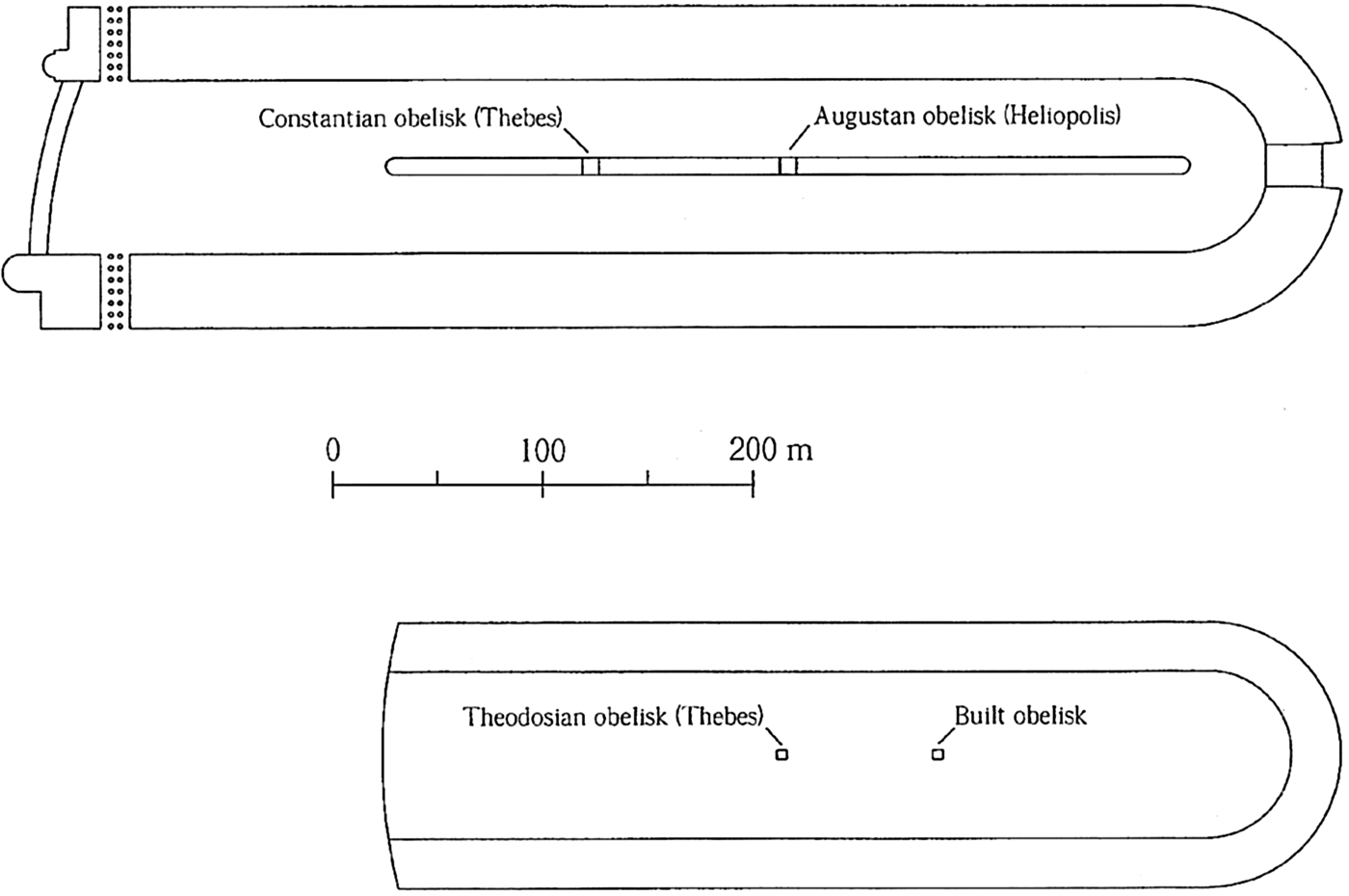
Figure 4. Comparative plan of the Circus Maximus and the hippodrome of Constantinople, showing the positions of the obelisks within each. Source: Bassett (Reference Bassett2004) 25. Image by Brian Madigan.
The triumph over Maximus was not merely being declared then, but declared on the Eastern Empire's most public stage through a monumental and decorative scheme intended to cast Constantinople, Nova Roma, as the rival of the ancient Roman capital. The defeat of Maximus was therefore the impetus to a programme of decoration that proclaimed Theodosius as an imperial founder and which firmly intertwined his dynasty with the fate of both city and Empire. Maximus was not forgotten, but rather – as tyrannus – made an intimate part of this story.
2.2 The Column of Theodosius
The commemorative programme of dynasty, victory and the defeat of tyranny created in the adornment of the hippodrome was reflected in an even grander style in the adornment of the Forum of Theodosius. The Forum of Theodosius (also known as the Forum Tauri) was Theodosius’ greatest contribution to the topography of Constantinople. Probably begun shortly after his first arrival in the city in 380, the Forum of Theodosius was a space approximately 55 by 55 metres constructed on the Mese roughly a kilometre west of the Forum of Constantine.Footnote 73 It was ringed with marble porticoes, an exedra to the north, and a large basilica whose long wall appears to have formed the boundary of the square to the south.Footnote 74 At both its western and eastern entrances, where the Mese pierced the span of the forum's porticoes, stood a triple spanned triumphal arch built of Proconnesian marble. Each was topped with an imperial statue, the arch on the eastern side bearing a statue of Arcadius, that on the west a statue of Honorius.Footnote 75 Within the forum itself, a statue of Hadrian and an equestrian statue of Theodosius were erected.Footnote 76 Finally, in the centre of the forum's wide expanse, an enormous historiated column, which mirrored those of Trajan and Marcus Aurelius at Rome, was erected; it was surmounted with a statue of Theodosius and had depicted upon it his military victories, including the conquest of the West and the downfall of Maximus.Footnote 77
From this summary alone, it should be obvious that the architectural programme advanced by the Forum of Theodosius was substantively similar to that of the hippodrome. Its themes were dynasty, victory and a rivalry of the grandeur of Rome. As with the hippodrome, the forum placed Theodosius’ children in a central position. The positioning of their statues atop the enormous triumphal arches was a clear statement of their future glory (somewhat unrealistically, as the case proved).Footnote 78 The placement of these statues at the east and west of the forum was also, undoubtedly, intended to represent their future lordship of East and West. The historiated column rising at the forum's heart was modelled on Trajan's and was decorated with a single frieze that spiralled upwards around the column and represented the victories of Theodosius. The column also served to make more vocal the parallels between Theodosius’ forum and the Forum of Trajan, in Rome, on which it was modelled. This connection also advanced Theodosius’ dynastic programme, since Theodosius (who was, like the second-century emperor, a Spaniard) claimed descent from this emperor, thereby giving his house the honour of an ancient imperial lineage.Footnote 79 Importantly, the inclusion of a historiated column was, as had been the raising of the second obelisk in the hippodrome, a powerful statement of Theodosius’ desire to see the New Rome made the rival of the Old; no other city in the Empire could boast a historiated column.Footnote 80
The column, which may already have been standing in 386, does not appear to have been finally completed until 393, shortly after which it was surmounted with the statue of Theodosius and the forum was dedicated.Footnote 81 Theodosius, crowning the story of his victories, thus looked down on his two imperial children and upon his great imperial ancestor. The column was dismantled around 1500 and only fragments of the relief have ever been found, so that it has been impossible to build anything like a comprehensive picture of their narrative. Nevertheless, it is clear that the column presented Theodosius’ martial victories: Roman soldiers can be seen on various fragments preparing their equipment, marching, fighting and travelling in ships.Footnote 82
Traditionally, it has been assumed that the column displayed the victories won over the Goths in the 380s.Footnote 83 This assumption was, however, overturned in 1958, when a fragment of the relief, which had been used as part of the foundation of a bathhouse of Sultan Bayezid II, was discovered.Footnote 84 The stone, on which the rising curve typical of a column relief is clearly visible framing the bottom of the image, depicts a group of soldiers in Roman military dress (see Figure 5). The soldiers are on bended knees and hold their hands out before themselves, palms upwards and devoid of weapons, in a gesture instantly recognisable as one of surrender.Footnote 85 Unlike every other Roman soldier on the surviving fragments, these men face not right (the direction in which Theodosius’ armies are marching) but rather left (the direction of his enemies). What is more, the Chi Rho design upon the shield of the central figure would appear to identify these men not only as Roman soldiers, but as members of an imperial bodyguard. As mentioned, the Forum of Theodosius was officially dedicated in 393, and so it must have been finally completed by this point.Footnote 86 The only candidate that we have for a scene representing a surrendering imperial bodyguard before this date would be the surrender of Maximus’ bodyguard to Theodosius, described in such gleeful detail in Pacatus’ panegyric.Footnote 87 What this means is that the column erected in the centre of the Forum of Theodosius must have depicted not only the wars with the Goths in the Balkans, but also the conquest of Maximus and the West.Footnote 88

Figure 5. Fragment from the relief of the Column of Theodosius, showing a group of supplicant figures whose attire, in particular the Chi Rho shield, show them to be the members of an imperial bodyguard. Photo by W. Schiele (Deutsches Archäologisches Institut negative no. D-DAI-IST-R1186).
The importance of these reliefs in the context of Roman artistic conventions is hard to overestimate. Despite a progressive normalisation of the idea that emperors might, to use Ammianus’ disapproving phrase, stage ‘a triumph over Roman blood’, the depiction of a battle between two Roman armies was virtually unheard of in the annals of Roman art.Footnote 89 Perhaps the only other known example of the representation of Romans fighting Romans is to be found on the Arch of Constantine, itself a monument dedicated to an emperor after his victory in a civil war (here over Maxentius in 312). The arch, erected in 315 by the Roman senate and decorated largely with spolia from nearby buildings, possesses six narrow bands of fourth-century relief sculpture. Two of these bands depict scenes from the civil war: the siege of a city (probably Verona) and the rout of Maxentius’ forces at the Milvian bridge. Figures, whose dress identifies them as Roman soldiers, can be seen on both sides in these battles. In the first image, Roman soldiers advance upon the walls with their shields raised in defence, while Roman defenders shower missiles down upon them; in the second one, armed Roman soldiers can be seen driving other Romans headlong into the churning river (see Figure 6). The Column of Theodosius may therefore be seen as a fusion of decorative schemes drawn from both the Arch of Constantine and the Column of Trajan, a new monument created in conscious emulation of both and in riotous disavowal of the principles of silence and erasure as regards the fallen Maximus.

Figure 6. The Battle of the Milvian Bridge, as depicted on the south face of the Arch of Constantine. Supplicant soldiers, as on the Column of Theodosius, can be seen in the bottom right. © Steve Kershaw.
Indeed, given the images from the column, it would not be unreasonable to say that the forum itself was meant to be understood not merely in the context of Theodosius’ victories over the Goths but also in terms of his conquests in the West. Nor is this simply modern speculation, for it is precisely what Constantine of Rhodes in the tenth century declared in his poem on the marvels of the city.Footnote 90 The enormous triumphal arches erected at the entrances of the forum thus expressed not only Theodosius’ restoration of peace in the Balkans (however illusory that peace was in actuality) but his pacification of the tyrant in the West. Like the obelisk, the column in the forum advertised the downfall and death of a man whom, the conventional wisdom would tell us, every effort was being made to forget.
2.3 The Golden Gate
The hippodrome and the Forum of Theodosius both represented monumental public spaces in the heart of the city, public canvases on which the story of tyranny defeated could be told. The final monument for which Maximus’ memory was co-opted, however, lay not within the city but upon its boundary (though, as we will see, in a location of enormous ceremonial and propagandistic importance). The Golden Gate appears, at first sight, to be part of the massive fortifications that comprise the Theodosian Wall.Footnote 91 Positioned at the southern extremity of the impregnable 6.5 km wall, spanning the Via Egnatia, it is constructed on a scale and to a design that clearly sets it apart from the other gates. As the Austrian scholar Josef Strzygowski demonstrated in 1893, this is because the Golden Gate predates the Theodosian Wall, and was not originally constructed as a fortification at all but rather as a triumphal arch on a monumental scale that dwarfed all previous endeavours in that medium.Footnote 92
The Golden Gate is a formidable edifice made of white marble, not of the alternating bands of brick and limestone from which the rest of the wall is constructed. Its façade is pierced by three enormous archways, which are flanked by two colossal towers built of the same stone as the arch, each having a footprint of some 310 m2 (see Figure 7).Footnote 93 The fact that the gate is pierced by three doorways is itself a strong suggestion that it was not built to be a fortification (the archways were eventually bricked up for precisely this reason).Footnote 94 The difference in the stone and the fact that the gate is neither bonded to the Theodosian Wall nor is it properly aligned to the course of the wall tell a similar story. These details, combined with the lack of evidence – physical or literary – to suggest that the surrounding wall was demolished in order to allow the gate to be inserted at a later date, demonstrate with reasonable certainty that the gate predates the Theodosian Wall, which was built between 405 and 413.Footnote 95

Figure 7. Reconstruction of the Golden Gate, with the figures at the bottom giving some sense of its enormous scale. The doors that obstruct the three arches were later additions (Bardill (Reference Bardill1999) 681–3). Atop the gate is the chariot drawn by elephants (here a biga is depicted, although some sources suggest a quadriga). Positioned on the flanking towers are Victory and the Tyche of Constantinople. © Byzantium1200.
If the gate is not a part of the Theodosian Wall, then what is it? A strong case can be made that it was originally built as a triumphal arch for Theodosius I in order to celebrate the victory over Maximus. A number of textual sources link the construction of the gate to Theodosius, namely Theophanes, the Great Chronographer and Kedrenos.Footnote 96 Its triple gateway also makes it a perfectly plausible candidate for a triumphal arch, the triple span being a very common form for imperial triumphal arches.Footnote 97 The gate was also topped with a statue of a figure riding in a chariot drawn by elephants (either two or four in number) and possibly flanked by personifications of the Tyche of Constantinople and of Nike, thus repeating the oft-articulated theme that united Theodosius’ victories with the glory of Constantinople.Footnote 98 More importantly, over the central span of the arch, dowel holes have been discovered that must once have held an inscription cast in metal letters (see Figure 8). Strzygowski was able to match these holes to an inscription on a triumphal arch previously known only from literary evidence and to demonstrate that the Golden Gate was once adorned with the following inscriptions: HAEC LOCA THEVDOSIVS DECORAT POST FATA TYRANNI (‘Theodosius decorates this place after the death of a tyrant’) and AVREA SAECLA GERIT QVI PORTAM CONSTRVIT AVRO (‘He who builds the gate with gold rules the golden age’).Footnote 99 The inscription declaring the downfall of the tyrant faced east, towards the city. The one declaring that the gate was adorned with gold faced west, towards Europe. At the time of its construction, therefore, the Golden Gate was not a fortification at all, but a triumphal arch in the Roman tradition. That a triumphal arch would be built to celebrate a victory in civil war was striking, again an action whose only known precedent was the Arch of Constantine. Once more, Theodosius consciously emulated Constantine and, likewise, sought to bring the glory and the splendour of Rome to Constantinople.

Figure 8. The dowel hoes in the voussoirs above the main arch of the Golden Gate on the (a) eastern and (b) western sides, and (c) the arrangement of holes for letters requiring three or four points. Source: J. Strzygowski (Reference Strzygowski1893) ‘Das Goldene Thor in Konstantinopel’, in Jahrbuch des Kaiserlich Deutschen Archäologischen Instituts 8, 8 Fig. 5.
The position of the gate so far outside the city may initially seem strange, but it was along this route that an army returning to Constantinople from the West would have travelled. The gate spanned the road from the Hebdomon, a region seven miles to the east of Constantinople that served as the city's equivalent of Rome's Campus Martius, a parade ground for mustering soldiers outside the city called the Campus Tribunalis (Greek: Κάμπος τοῦ τριβουναλίου). The region contained an imperial palace constructed by Valens and would have been where Theodosius and his soldiers assembled before entering the city on 10 November 391.Footnote 100 Though we have no specific evidence for Theodosius’ return to the city on this date, the triumph/adventus formula for the city was already well established by this point, and so it can be hypothetically reconstructed (see Figure 9).Footnote 101 Theodosius will have been met by a party of senators and senior clergy at the Hebdomon, and perhaps received panegyrics there. Together, emperor, dignitaries and army would then have processed beneath the new triumphal arch and on through Constantine's Golden Gate into the city, its streets lined by cheering crowds.Footnote 102 Passing through the Forum of Theodosius and beneath the great column, perhaps already chiselled with scenes of the downfall of the tyrant and the surrender of his armies, they would have proceeded along the Mese and thence to the Hippodrome where games would be given beneath the long shadow of the obelisk. As 100,000 people celebrated the return of the conqueror of tyrants, Theodosius would have laughed at talk of silence and forgetting.
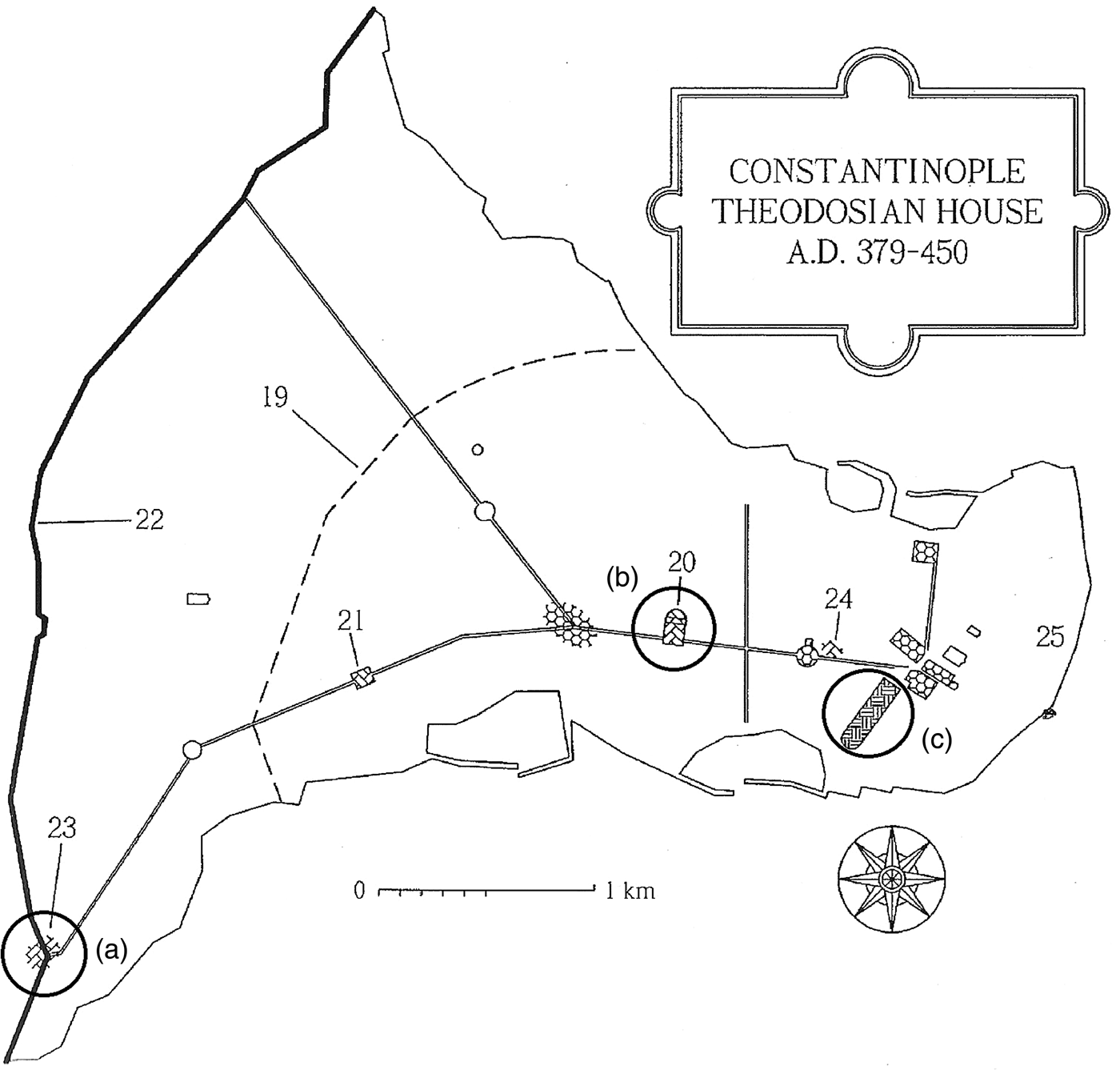
Figure 9. A typical route for an imperial entry into Constantinople from (a) the Golden Gate along the southern branch of the Mese to (b) the Forum of Theodosius and thence to (c) the hippodrome. Although imperial processions did not follow a set path through the city, this route was very common. Source: Bassett (Reference Bassett2004) 81, with additions by author. Image by Brian Madigan.
2.4 Creatio memoriae
The imposition of sanctions against the memory of Maximus and of his infant son cannot be said to have aimed either at silence or at erasure, or at least not solely so. In commemorating the defeat of the fallen tyranni, Theodosius raised a monument in the centre of the hippodrome that explicitly linked its erection to the fall of these tyranni, he raised a monument in the centre of his new forum that was decorated with images of the civil war, and he raised a vast triumphal arch across the Via Egnatia likewise inscribed in commemoration of the fata tyranni. These were not attempts simply to bury or to mutilate the memory of Maximus, but active and creative exercises that generated monumental construction and incorporated the memory of the fallen Maximus into a wider programme of building that advanced the primacy of the Theodosian dynasty and declared its perpetual victory. Three monuments survive that explicitly evoked the dead emperor, two of which named him a tyrannus and a third, astoundingly, depicted his downfall in stone.
It is important to see that, in this programme, Theodosius was not breaking with previous practice. The senate in Rome had raised to Constantine an enormous triumphal arch that commemorated his defeat of Maxentius, and Constantius had raised an obelisk in the Circus Maximus to commemorate his defeat of Magnentius. Both denounced their fallen enemies as tyranni. Likewise, both emperors had indulged in public triumphs that exalted the victories won in civil war; Constantine's triumph, we know, had even been adorned by the grim spectacle of Maximus’ severed head.Footnote 103 Indeed the parallels with Constantine run far deeper than the exploitation of the memory of fallen enemies, and Theodosius’ building programme within Constantinople can be seen as an attempt to compete with or even outdo that emperor in efforts to make the city a true rival to Rome.
The memory of Maximus was, unquestionably, a victim of this programme. In the propaganda that surrounded his downfall, Maximus’ name was stripped from him and he was commemorated only as a tyrannus. In the ignominious anonymity of this word, Maximus’ memory became a tool for Theodosius’ own ends: he became a generic tyrant thrown down by the virtue of Theodosius (and his infant son likewise). The creatio memoriae was thus sharply two-edged, for while memory sanctions could generate monumentality, literature and ceremony, their aim was to pollute and to reshape the memories they preserved. Within a generation or two we can imagine that only a very few people would have known who the wicked tyrannus commemorated in the hippodrome, or in the forum, or on the Golden Gate actually was. Yet some would, as the example of Constantine of Rhodes makes clear.
Thus, far from condemning Maximus to oblivion, Theodosius was co-opting his memory for his own purposes; anonymised and demonised, Maximus the tyrannus became a tile in the mosaic of Theodosius’ great dynastic programme within the city of Constantinople. Strikingly, the grandeur and the monumentality occasioned in Rome by Maximus’ fall was in fact far outstripped by that which occurred in Constantinople. These were enormous monumental additions to a capital city far removed from the civil war, and constituted a conscious and explicit effort to commemorate it for all time. The sentence passed against the memory of Maximus, therefore, was not a sentence of execution; it was, instead, a condemnation to mutilation and hard labour.



