















1. Introduction
Write $K=K(s_1, \ldots , s_r)$
for the complete
$K=K(s_1, \ldots , s_r)$
for the complete $r$
-partite
$r$
-partite $r$
-uniform hypergraph (henceforth
$r$
-uniform hypergraph (henceforth $r$
-graph) with parts of size
$r$
-graph) with parts of size $s_1\le s_2\le \cdots \le s_r$
. More precisely, the vertex set of
$s_1\le s_2\le \cdots \le s_r$
. More precisely, the vertex set of $K$
comprises disjoint sets
$K$
comprises disjoint sets $S_1, \ldots , S_r$
, where
$S_1, \ldots , S_r$
, where $|S_i|=s_i$
for
$|S_i|=s_i$
for $1\le i \le r$
, and the edge set of
$1\le i \le r$
, and the edge set of $K$
is
$K$
is
 \begin{equation*}\{ \{x_i, \ldots , x_r\}\,:\, (x_1, \ldots , x_r) \in S_1 \times \cdots \times S_r\}.\end{equation*}
Given $K$
as above, write
$K$
as above, write $\textrm {ex}(n, K)$
for the maximum number of edges in an
$\textrm {ex}(n, K)$
for the maximum number of edges in an $n$
-vertex
$n$
-vertex $r$
-graph that contains no copy of
$r$
-graph that contains no copy of $K$
as a subhypergraph. Similarly, write
$K$
as a subhypergraph. Similarly, write $z(n, K)$
for the maximum number of edges in an
$z(n, K)$
for the maximum number of edges in an $r$
-partite
$r$
-partite $r$
-graph
$r$
-graph $H$
with parts
$H$
with parts $X_1, \ldots , X_r$
, each of size
$X_1, \ldots , X_r$
, each of size $n$
, such that there is no copy of
$n$
, such that there is no copy of $K(s_1, \ldots , s_r)$
in
$K(s_1, \ldots , s_r)$
in $H$
with
$H$
with $S_i \subset X_i$
for all
$S_i \subset X_i$
for all $1\le i \le r$
(there could be copies of
$1\le i \le r$
(there could be copies of $K$
in
$K$
in $H$
, where for some
$H$
, where for some $i$
,
$i$
, $S_i \not \subset X_i$
). Determining
$S_i \not \subset X_i$
). Determining $\textrm {ex}(n, K)=\textrm {ex}_r(n, K)$
is usually called the Turán problem, while determining
$\textrm {ex}(n, K)=\textrm {ex}_r(n, K)$
is usually called the Turán problem, while determining $z(n, K)=z_r(n, K)$
is called the Zarankiewicz problem (we will omit the subscript
$z(n, K)=z_r(n, K)$
is called the Zarankiewicz problem (we will omit the subscript $r$
if it is obvious from context). These are fundamental questions in combinatorics with applications in analysis [Reference Astashkin and Lykov1, Reference Carbery, Christ and Wright7], number theory [Reference Oppenheim and Shusterman16], group theory [Reference Lucchini13], geometry [Reference Fox, Jacob and Suk10], and computer science [Reference Babai, Gál, Kollár, Rónyai, Szabó and Wigderson3].
$r$
if it is obvious from context). These are fundamental questions in combinatorics with applications in analysis [Reference Astashkin and Lykov1, Reference Carbery, Christ and Wright7], number theory [Reference Oppenheim and Shusterman16], group theory [Reference Lucchini13], geometry [Reference Fox, Jacob and Suk10], and computer science [Reference Babai, Gál, Kollár, Rónyai, Szabó and Wigderson3].
A basic result in extremal hypergraph theory, due to Erdős [Reference Erdős9], is the upper bound
 \begin{equation} \textrm {ex}(n, K(s_1, \ldots , s_r)) = O(n^{r-1/s}), \end{equation}
where $s=s_1s_2\cdots s_{r-1}$
(and, as before
$s=s_1s_2\cdots s_{r-1}$
(and, as before $s_1\le s_2\le \cdots \le s_{r-1}\le s_r$
). Here
$s_1\le s_2\le \cdots \le s_{r-1}\le s_r$
). Here $s_1, \ldots , s_r$
are fixed and the asymptotic notation is taken as
$s_1, \ldots , s_r$
are fixed and the asymptotic notation is taken as $n \to \infty$
. As
$n \to \infty$
. As $r$
is fixed, and
$r$
is fixed, and $z(n,K(s_1, \ldots , s_r))\le \textrm {ex}(rn, K(s_1, \ldots , s_r))$
, the same upper bound as (1) holds for
$z(n,K(s_1, \ldots , s_r))\le \textrm {ex}(rn, K(s_1, \ldots , s_r))$
, the same upper bound as (1) holds for $z(n,K(s_1, \ldots , s_r))$
.
$z(n,K(s_1, \ldots , s_r))$
.
A major problem in extremal (hyper)graph theory is to obtain corresponding lower bounds to (1) (or prove that no such lower bounds exist). In fact, it was conjectured in [Reference Mubayi15] that the exponent $r-1/s$
in (1) is optimal. This question has been studied for graphs since the 1930s, and results of Erdős-Rényi and Brown [Reference Brown5] gave optimal (in the exponent) lower bounds for
$r-1/s$
in (1) is optimal. This question has been studied for graphs since the 1930s, and results of Erdős-Rényi and Brown [Reference Brown5] gave optimal (in the exponent) lower bounds for $K(2,t)$
and
$K(2,t)$
and $K(3,t)$
. The first breakthrough for arbitrary
$K(3,t)$
. The first breakthrough for arbitrary $s_1$
occurred in the mid 1990’s by Kollar-Ronyai-Szabo [Reference Kollár, Rónyai and Szabó11] and then Alon-Ronyai-Szabo [Reference Alon, Rónyai and Szabó2], who proved that
$s_1$
occurred in the mid 1990’s by Kollar-Ronyai-Szabo [Reference Kollár, Rónyai and Szabó11] and then Alon-Ronyai-Szabo [Reference Alon, Rónyai and Szabó2], who proved that $\textrm {ex}(n, K(s_1,s_2)) = \Omega (n^{2-1/s_1})$
as long as
$\textrm {ex}(n, K(s_1,s_2)) = \Omega (n^{2-1/s_1})$
as long as $s_2\gt (s_1-1)!$
. More recently, in another significant advance, Bukh [Reference Bukh6] has proved the same lower bound as long as
$s_2\gt (s_1-1)!$
. More recently, in another significant advance, Bukh [Reference Bukh6] has proved the same lower bound as long as $s_2 \gt 9^{s_1+o(s_1)}$
.
$s_2 \gt 9^{s_1+o(s_1)}$
.
For $r\ge 3$
, the first nontrivial constructions that were superior to the bound given by the probabilistic deletion method were provided in the cases
$r\ge 3$
, the first nontrivial constructions that were superior to the bound given by the probabilistic deletion method were provided in the cases $s_1=\cdots =s_{r-2}=1$
and
$s_1=\cdots =s_{r-2}=1$
and $K(2,2,3)$
by the current author [Reference Mubayi15] and, soon after for
$K(2,2,3)$
by the current author [Reference Mubayi15] and, soon after for $K(2,2,2)$
by Katz-Krop-Maggioni [Reference Katz, Krop and Maggioni12] (see also [Reference Conlon, Pohoata and Zakharov8] for recent results on the
$K(2,2,2)$
by Katz-Krop-Maggioni [Reference Katz, Krop and Maggioni12] (see also [Reference Conlon, Pohoata and Zakharov8] for recent results on the $r$
-uniform case
$r$
-uniform case $K(2,\ldots , 2)$
that are superior to the probabilistic deletion bound but not optimal in the exponent). Later, optimal bounds for both
$K(2,\ldots , 2)$
that are superior to the probabilistic deletion bound but not optimal in the exponent). Later, optimal bounds for both $\textrm {ex}(n, K)$
and
$\textrm {ex}(n, K)$
and $z(n, K)$
were provided by Ma, Yuan, Zhang [Reference Ma, Yuan and Zhang14] (and independently by Verstraëte) by extending the method of Bukh, however, the threshold for
$z(n, K)$
were provided by Ma, Yuan, Zhang [Reference Ma, Yuan and Zhang14] (and independently by Verstraëte) by extending the method of Bukh, however, the threshold for $s_r$
for which the bound holds was not even explicitly calculated. More recently, lower bounds matching the exponent
$s_r$
for which the bound holds was not even explicitly calculated. More recently, lower bounds matching the exponent $r-1/s$
from (1) have been proved for
$r-1/s$
from (1) have been proved for $s_r \gt ((r-1)(s-1))!$
by Pohoata and Zakharov [Reference Pohoata and Zakharov17]. Here we improve this lower bound on
$s_r \gt ((r-1)(s-1))!$
by Pohoata and Zakharov [Reference Pohoata and Zakharov17]. Here we improve this lower bound on $s_r$
substantially in the Zarankiewicz case, from factorial to exponential at the expense of a small
$s_r$
substantially in the Zarankiewicz case, from factorial to exponential at the expense of a small $o(1)$
error parameter in the exponent. The following is our main result.
$o(1)$
error parameter in the exponent. The following is our main result.
Theorem 1.
Fix $r \ge 3$
, and positive integers
$r \ge 3$
, and positive integers $s_1, \ldots , s_{r-1}, t$
. Then as
$s_1, \ldots , s_{r-1}, t$
. Then as $n \to \infty$
,
$n \to \infty$
,
 \begin{equation*}z_r(n, K(s_1, \ldots , s_{r-1}, t)) \gt n^{1-o(1)} \cdot z_{r-1}(n, K(s_1, \ldots , s_{r-3}, s_{r-2}s_{r-1}, t)).\end{equation*}
Applying Theorem1 repeatedly (or doing induction on $r$
) yields
$r$
) yields
 \begin{equation*}z_r(n, K(s_1, \ldots , s_{r-1}, t)) \gt n^{r-2-o(1)} \cdot z_{2}(n, K(s, t))\end{equation*}
where $s=s_1\cdots s_{r-1}$
. Bukh [Reference Bukh6] proved that
$s=s_1\cdots s_{r-1}$
. Bukh [Reference Bukh6] proved that $z(n, K(s, t)) = \Omega (n^{2-1/s})$
provided
$z(n, K(s, t)) = \Omega (n^{2-1/s})$
provided $t \gt 3^{s+o(s)}$
and this yields the following corollary.
$t \gt 3^{s+o(s)}$
and this yields the following corollary.
Corollary 2.
Fix $r \ge 2$
, and integers
$r \ge 2$
, and integers $1\le s_1 \le \cdots \le s_{r-1}\lt t$
where
$1\le s_1 \le \cdots \le s_{r-1}\lt t$
where $t\gt 3^{s+o(s)}$
and
$t\gt 3^{s+o(s)}$
and $s=s_1\cdots s_{r-1}$
. Then as
$s=s_1\cdots s_{r-1}$
. Then as $n \to \infty$
,
$n \to \infty$
,
 \begin{equation*}z_r(n, K(s_1, \ldots , s_{r-1}, t)) = n^{r-1/s-o(1)}.\end{equation*}
We remark that Theorem1 can also be applied for small values of $s_i$
. For example, using the result of Alon-Rónyai-Szabó [Reference Alon, Rónyai and Szabó2] that
$s_i$
. For example, using the result of Alon-Rónyai-Szabó [Reference Alon, Rónyai and Szabó2] that $z(n, K(4,7)) =\Omega (n^{7/4})$
, it gives
$z(n, K(4,7)) =\Omega (n^{7/4})$
, it gives
 \begin{equation*}z(n, K(2,2,7)) \gt n^{1-o(1)} \,z(n, K(4, 7)) \gt n^{1-o(1)} \, n^{7/4} = n^{11/4-o(1)},\end{equation*}
where the exponent $11/4$
is tight. For contrast, the previous best result due to Pohoata and Zakharov [Reference Pohoata and Zakharov17] yields only
$11/4$
is tight. For contrast, the previous best result due to Pohoata and Zakharov [Reference Pohoata and Zakharov17] yields only $z(n, K(2,2,721)) \gt \Omega (n^{11/4})$
. If, as is widely believed,
$z(n, K(2,2,721)) \gt \Omega (n^{11/4})$
. If, as is widely believed, $z(n, K(4,4))=\Omega (n^{7/4})$
, then this would imply via Theorem1, that
$z(n, K(4,4))=\Omega (n^{7/4})$
, then this would imply via Theorem1, that $z(n,K(2,2,4))=n^{11/4-o(1)}$
.
$z(n,K(2,2,4))=n^{11/4-o(1)}$
.
2. Proof
Write $e(H)=|E(H)|$
for a hypergraph
$e(H)=|E(H)|$
for a hypergraph $H$
. To prove Theorem1, we need the following well-known consequence of Behrend’s construction [Reference Behrend4] of a subset of
$H$
. To prove Theorem1, we need the following well-known consequence of Behrend’s construction [Reference Behrend4] of a subset of $[n]$
with no 3-term arithmetic progression (see, e.g., [Reference Ruzsa and Szemerédi18]). There exists a bipartite graph
$[n]$
with no 3-term arithmetic progression (see, e.g., [Reference Ruzsa and Szemerédi18]). There exists a bipartite graph $G$
with parts of size
$G$
with parts of size $n$
and
$n$
and $n^{2-o(1)}$
edges whose edge set is a union of
$n^{2-o(1)}$
edges whose edge set is a union of $n$
induced matchings. More precisely, there are pairwise disjoint matchings
$n$
induced matchings. More precisely, there are pairwise disjoint matchings $M_1, \ldots , M_n$
such that
$M_1, \ldots , M_n$
such that $E(G)=\cup _{i=1}^n M_i$
and for all
$E(G)=\cup _{i=1}^n M_i$
and for all $i,j$
the edge set
$i,j$
the edge set $M_i \cup M_j$
contains no path with three edges. Additionally,
$M_i \cup M_j$
contains no path with three edges. Additionally, $e(G) =\sum _i|M_i|= n^{2-o(1)}$
.
$e(G) =\sum _i|M_i|= n^{2-o(1)}$
.
Proof of Theorem 1. Let $H'$
be an
$H'$
be an $(r-1)$
-partite
$(r-1)$
-partite $(r-1)$
-graph with parts
$(r-1)$
-graph with parts $X_1, \ldots , X_{r-3}, [n]$
and
$X_1, \ldots , X_{r-3}, [n]$
and $Y$
each of size
$Y$
each of size $n$
with
$n$
with $e(H')=z_{r-1}(n, K')$
that contains no copy of the complete
$e(H')=z_{r-1}(n, K')$
that contains no copy of the complete $(r-1)$
-partite
$(r-1)$
-partite $(r-1)$
-graph
$(r-1)$
-graph $K'= K(s_1, \ldots , s_{r-3}, s_{r-2}s_{r-1}, t)$
. Here we only assume that there are no copies of
$K'= K(s_1, \ldots , s_{r-3}, s_{r-2}s_{r-1}, t)$
. Here we only assume that there are no copies of $K'$
where the
$K'$
where the $i$
th part of size
$i$
th part of size $s_i$
is a subset of
$s_i$
is a subset of $X_i$
for
$X_i$
for $1\le i\le r-3$
, the
$1\le i\le r-3$
, the $r-2$
part of size
$r-2$
part of size $s_{r-2}s_{r-1}$
is a subset of
$s_{r-2}s_{r-1}$
is a subset of $[n]$
, and the
$[n]$
, and the $r$
th part of size
$r$
th part of size $t$
is a subset of
$t$
is a subset of $Y$
. Write
$Y$
. Write $d(j)$
for the degree in
$d(j)$
for the degree in $H'$
of vertex
$H'$
of vertex $j \in [n]$
, so
$j \in [n]$
, so $e(H') = \sum _j d(j)$
. By relabeling we may assume that
$e(H') = \sum _j d(j)$
. By relabeling we may assume that $d(1) \ge d(2) \ge \cdots \ge d(n)$
.
$d(1) \ge d(2) \ge \cdots \ge d(n)$
.
Let $G$
be a bipartite graph with parts
$G$
be a bipartite graph with parts $A$
and
$A$
and $B$
, each of size
$B$
, each of size $n$
comprising
$n$
comprising $n$
induced matchings
$n$
induced matchings $M_1, \ldots , M_n$
, with
$M_1, \ldots , M_n$
, with $e(G)=\sum _i|M_i| =n^{2-o(1)}$
. Moreover, we may assume that
$e(G)=\sum _i|M_i| =n^{2-o(1)}$
. Moreover, we may assume that $|M_1| \ge |M_2| \ge \cdots \ge |M_n|$
.
$|M_1| \ge |M_2| \ge \cdots \ge |M_n|$
.
Now define the $r$
-partite
$r$
-partite $r$
-graph
$r$
-graph $H$
as follows: the parts of
$H$
as follows: the parts of $H$
are
$H$
are $X_1, \ldots , X_{r-3}, A, B, Y$
, each of size
$X_1, \ldots , X_{r-3}, A, B, Y$
, each of size $n$
. For each
$n$
. For each $j \in [n]$
, let
$j \in [n]$
, let
 \begin{equation*}E_j = \{\{x_1,\ldots , x_{r-3}, a, b, y\}\,:\, \{x_1,\ldots , x_{r-3}, j, y\} \in E(H'), (a,b) \in A \times B, \{a,b\} \in M_j\}\end{equation*}
and let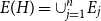 $E(H) = \cup _{j=1}^n E_j$
. Observe that
$E(H) = \cup _{j=1}^n E_j$
. Observe that $e(H) = \sum _j d(j)|M_j|$
. In words, we have replaced vertex
$e(H) = \sum _j d(j)|M_j|$
. In words, we have replaced vertex $j$
that lies in edge
$j$
that lies in edge $\{x_1,\ldots , x_{r-3}, j, y\}$
of
$\{x_1,\ldots , x_{r-3}, j, y\}$
of $H'$
by all possible pairs
$H'$
by all possible pairs $ab$
of
$ab$
of $M_j$
to create
$M_j$
to create $|M_j|$
edges of
$|M_j|$
edges of $H$
. Now Chebyshev’s sum inequality and
$H$
. Now Chebyshev’s sum inequality and $e(G)=n^{2-o(1)}$
yield
$e(G)=n^{2-o(1)}$
yield
 \begin{equation*}\frac {1}{n} \sum _{j=1}^n d(j)|M_j| \ge \frac {1}{n^2} \sum _{j=1}^n d(j) \sum _{j=1}^n |M_j| = \frac {1}{n^2} e(H') e(G)=e(H') n^{-o(1)}.\end{equation*}
Hence $e(H) =\sum _j d(j)|M_j| = n^{1-o(1)}e(H')$
as required.
$e(H) =\sum _j d(j)|M_j| = n^{1-o(1)}e(H')$
as required.
Now suppose there is a copy $L$
of
$L$
of $K=K(s_1, \ldots , s_{r-1}, t)$
in
$K=K(s_1, \ldots , s_{r-1}, t)$
in $H$
where the part of size
$H$
where the part of size $s_i$
lies in
$s_i$
lies in $X_i$
for
$X_i$
for $1\le i \le r-3$
, the part
$1\le i \le r-3$
, the part $A'$
of size
$A'$
of size $s_{r-2}$
lies in
$s_{r-2}$
lies in $A$
, the
$A$
, the $B'$
part of size
$B'$
part of size $s_{r-1}$
lies in
$s_{r-1}$
lies in $B$
, and the part of size
$B$
, and the part of size $t$
lies in
$t$
lies in $Y$
. Then all
$Y$
. Then all $s_{r-2}s_{r-1}$
pairs in
$s_{r-2}s_{r-1}$
pairs in $\binom {V(L)}{2}$
within
$\binom {V(L)}{2}$
within $A' \times B'$
must come from different matchings
$A' \times B'$
must come from different matchings $M_i$
as the matchings are induced. Indeed, if there is an
$M_i$
as the matchings are induced. Indeed, if there is an $i$
such that
$i$
such that $ab$
and
$ab$
and $a'b'$
are distinct edges of
$a'b'$
are distinct edges of $M_i$
, where
$M_i$
, where $a,a' \in A'$
and
$a,a' \in A'$
and $b, b' \in B'$
, then
$b, b' \in B'$
, then $ab'$
cannot lie in any edge of
$ab'$
cannot lie in any edge of $H$
, as
$H$
, as $M'$
is an induced matching, but
$M'$
is an induced matching, but $ab'$
must lie in many edges of
$ab'$
must lie in many edges of $L$
, contradiction. The number of these matchings
$L$
, contradiction. The number of these matchings $M_i$
is therefore
$M_i$
is therefore $|A'||B'|=s_{r-2}s_{r-1}$
and each such matching
$|A'||B'|=s_{r-2}s_{r-1}$
and each such matching $M_j$
corresponds to a vertex
$M_j$
corresponds to a vertex $j$
of
$j$
of $[n]$
. This means that we have a forbidden copy of
$[n]$
. This means that we have a forbidden copy of $K'$
in
$K'$
in $H'$
, contradiction.
$H'$
, contradiction.
Remarks.
-
• One shortcoming of our approach is that it applies only to the Zarankiewicz problem and not the Turán problem. It would be interesting to rectify this.
-
• For some $r$
-partite
$r$
-graphs
$H$
one can define an appropriate
$(r-1)$
-partite
$(r-1)$
-graph
$H'$
such that
$z_r(n, H)\gt n^{1-o(1)} z_{r-1}(n, H')$
. This may give some further new results for hypergraphs.
$r$
-partite
$r$
-graphs
$H$
one can define an appropriate
$(r-1)$
-partite
$(r-1)$
-graph
$H'$
such that
$z_r(n, H)\gt n^{1-o(1)} z_{r-1}(n, H')$
. This may give some further new results for hypergraphs. -
• For the proof, we do not need that the matchings
$M_i$
are induced, we only needed that for any two edges
$ab$
and
$a'b'$
of
$M_i$
, either
$ab'$
or
$a'b$
is not in any other matching. But this relaxed property doesn’t seem to help improve the
$n^{o(1)}$
error term.





Acknowledgment
The authors is grateful to a referee for their careful reading of the paper.

 Open access

