



No CrossRef data available.
Article contents
Multicolour Sunflowers
Part of:
Extremal combinatorics
Published online by Cambridge University Press: 22 April 2018
Abstract
A sunflower is a collection of distinct sets such that the intersection of any two of them is the same as the common intersection C of all of them, and |C| is smaller than each of the sets. A longstanding conjecture due to Erdős and Szemerédi (solved recently in [7, 9]; see also [22]) was that the maximum size of a family of subsets of [n] that contains no sunflower of fixed size k > 2 is exponentially smaller than 2n as n → ∞. We consider the problems of determining the maximum sum and product of k families of subsets of [n] that contain no sunflower of size k with one set from each family. For the sum, we prove that the maximum isfor all n ⩾ k ⩾ 3, and for the k = 3 case of the product, we prove that the maximum is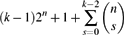 $$(k-1)2^n+1+\sum_{s=0}^{k-2}\binom{n}{s}$$We conjecture that for all fixed k ⩾ 3, the maximum product is (1/8+o(1))2kn.
 $$\biggl(\ffrac{1}{8}+o(1)\biggr)2^{3n}.$$
Information
- Type
- Paper
- Information
- Copyright
- Copyright © Cambridge University Press 2018
Footnotes
†
Research partially supported by NSF grants DMS-0969092 and DMS-1300138.
References
[1] Alon, N., Shpilka, A. and Umans, C. (2013) On sunflowers and matrix multiplication. Comput. Complexity 22 219–243.Google Scholar
[3] Bollobás, B., Keevash, P. and Sudakov, B. (2004) Multicolored extremal problems. J. Combin. Theory Ser. A 107 295–312.Google Scholar
[4] Borg, P. (2008) Intersecting and cross-intersecting families of labeled sets. Electron. J. Combin. 15 #N9.Google Scholar
[5] Borg, P. (2014) The maximum sum and the maximum product of sizes of cross-intersecting families. Europ. J. Combin. 35 117–130.Google Scholar
[6] Boyd, S. and Vandenberghe, L. (2004) Convex Optimization, Cambridge University Press.Google Scholar
[7] Croot, E., Lev, V. and Pach, P. (2017) Progression-free sets in ℤ4n are exponentially small. Ann. Math. 185 331–337.Google Scholar
[8] Deza, M. (1973) Une propriété extrémale des plans projectifs finis dans une classe de codes équidistants. Discrete Math. 6 343–352.Google Scholar
[9] Ellenberg, J. and Gijswijt, D. (2017) On large subsets of 𝔽qn with no three-term arithmetic progression. Ann. Math. 185 339–343.Google Scholar
[10] Erdős, P., Ko, C. and Rado, R. (1961) Intersection theorems for systems of finite sets. Quart. J. Math. 12 313–320.Google Scholar
[11] Erdős, P. and Rado, R. (1960) Intersection theorems for systems of sets. J. London Math. Soc. 35 85–90.Google Scholar
[12] Erdős, P. and Szemerédi, E. (1978) Combinatorial properties of systems of sets. J. Combin. Theory Ser. A 24 308–313.Google Scholar
[13] Frankl, P. and Rödl, V. (1987) Forbidden intersections. Trans. Amer. Math. Soc. 300 259–286.Google Scholar
[14] Frankl, P. and Tokushige, N. (2011) On r-cross intersecting families of sets. Combin. Probab. Comput. 20 749–752.Google Scholar
[15] Frankl, P., Lee, S. J., Siggers, M. and Tokushige, N. (2014) An Erdős–Ko–Rado theorem for cross t-intersecting families. J. Combin. Theory Ser. A 128 207–249.Google Scholar
[16] Hilton, A. J. W. (1977) An intersection theorem for a collection of families of subsets of a finite set. J. London Math. Soc. 2 369–384.Google Scholar
[17] Keevash, P., Saks, M., Sudakov, B. and Verstraëte, J. (2004) Multicolor Turán problems. Adv. Appl. Math. 33 238–262.Google Scholar
[18] Keevash, P. and Sudakov, B. (2005) Set systems with restricted cross-intersections and the minimum rank of inclusion matrices. SIAM J. Discrete Math. 18 713–727.Google Scholar
[20] Matsumoto, M. and Tokushige, N. (1989) The exact bound in the Erdős–Rado–Ko theorem for cross-intersecting families. J. Combin. Theory Ser. A 52 90–97.Google Scholar
[21] Mubayi, D. and Rödl, V. (2014) Specified intersections. Trans. Amer. Math. Soc. 366 491–504.Google Scholar
[22] Naslund, E. and Sawin, W. F. (2017) Upper bounds for sunflower-free sets. Forum Math., Sigma 5 E15. doi:10.1017/fms.2017.12Google Scholar
[23] Pyber, L. (1986) A new generalization of the Erdős–Ko–Rado theorem. J. Combin. Theory Ser. A 43 85–90.Google Scholar