




No CrossRef data available.
Article contents
The string of diamonds is nearly tight for rumour spreading
Published online by Cambridge University Press: 04 November 2019
Abstarct
For a rumour spreading protocol, the spread time is defined as the first time everyone learns the rumour. We compare the synchronous push&pull rumour spreading protocol with its asynchronous variant, and show that for any n-vertex graph and any starting vertex, the ratio between their expected spread times is bounded by 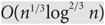 $O({n^{1/3}}{\log ^{2/3}}n)$. This improves the $O(\sqrt n)$ upper bound of Giakkoupis, Nazari and Woelfel (2016). Our bound is tight up to a factor of O(log n), as illustrated by the string of diamonds graph. We also show that if, for a pair α, β of real numbers, there exist infinitely many graphs for which the two spread times are nα and nβ in expectation, then $0 \le \alpha \le 1$ and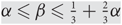 $\alpha \le \beta \le {1 \over 3} + {2 \over 3} \alpha $; and we show each such pair α, β is achievable.
Information
- Type
- Paper
- Information
- Copyright
- © Cambridge University Press 2019
Footnotes
†
A preliminary version of this paper appeared in Proceedings of the 21st International Workshop on Randomization and Computation (RANDOM’2017). This full version includes a new result, namely Theorem 2.5.
§
Supported by NSERC.
¶
Supported by an NSERC Postdoctoral Fellowship and a Simons–Berkeley Research Fellowship. Part of this work was done while this author was at the Simons Institute for the Theory of Computing at UC Berkeley. Currently at McGill University.
References
Acan, H., Collevecchio, A., Mehrabian, A. and Wormald, N. (2017) On the push&pull protocol for rumor spreading. SIAM J. Discrete Math. 31 647–668.CrossRefGoogle Scholar
Auffinger, A., Damron, M. and Hanson, J. (2017) 50 Years of First-Passage Percolation, Vol. 68 of University LectureSeries, American Mathematical Society.Google Scholar
Boyd, S., Ghosh, A., Prabhakar, B. and Shah, D. (2006) Randomized gossip algorithms. IEEE Trans. Inform. Theory 52 2508–2530.CrossRefGoogle Scholar
Demers, A., Greene, D., Hauser, C., Irish, W., Larson, J., Shenker, S., Sturgis, H., Swinehart, D. and Terry, D. (1987) Epidemic algorithms for replicated database maintenance. In Proceedings of the Sixth Annual ACM Symposium on Principles of Distributed Computing (PODC ’87), ACM, pp. 1–12.CrossRefGoogle Scholar
Doerr, B., Fouz, M. and Friedrich, T. (2012) Experimental analysis of rumor spreading in social networks. In Design and Analysis of Algorithms, Vol. 7659 of Lecture Notes in Computer Science, Springer, pp. 159–173.CrossRefGoogle Scholar
Durrett, R. (1989) Stochastic growth models: Recent results and open problems. In Mathematical Approaches to Problems in Resource Management and Epidemiology (Ithaca, NY, 1987), Vol. 81 of Lecture Notes in Biomathematics, Springer, pp. 308–312.CrossRefGoogle Scholar
Feige, U., Peleg, D., Raghavan, P. and Upfal, E. (1990) Randomized broadcast in networks. Random Struct. Alg. 1 447–460.CrossRefGoogle Scholar
Giakkoupis, G., Nazari, Y. and Woelfel, P. (2016) How asynchrony affects rumor spreading time. In Proceedings of the 2016 ACM Symposium on Principles of Distributed Computing (PODC ’16), ACM, pp. 185–194.CrossRefGoogle Scholar
Hammersley, J. M. and Welsh, D. J. A. (1965) First-Passage Percolation, Subadditive Processes, Stochastic Networks, and Generalized Renewal Theory, Springer, pp. 61–110.Google Scholar
Karp, R., Schindelhauer, C., Shenker, S. and Vöcking, B. (2000) Randomized rumor spreading. In Proceedings 41st Annual Symposium on Foundations of Computer Science, IEEE, pp. 565–574.CrossRefGoogle Scholar
Richardson, D. (1973) Random growth in a tessellation. Proc. Cambridge Philos. Soc. 74 515–528.CrossRefGoogle Scholar