







1. Introduction
In discrepancy theory, the basic question is whether a structure can be partitioned in a balanced way, or if there is always some ‘discrepancy’ no matter how the partition is made. Formally, let $\mathcal{H}$
be a hypergraph and let
$\mathcal{H}$
be a hypergraph and let $f\,{:}\, V(\mathcal{H}) \rightarrow \{\text{red, blue}\}$
be a 2-colouring of its vertices. For an edge
$f\,{:}\, V(\mathcal{H}) \rightarrow \{\text{red, blue}\}$
be a 2-colouring of its vertices. For an edge $e \in E(\mathcal{H})$
and a colour
$e \in E(\mathcal{H})$
and a colour $c$
, let
$c$
, let $c(e) \,:\!=\, \{x \in e \,:\, f(x) = c\}$
. The discrepancy of
$c(e) \,:\!=\, \{x \in e \,:\, f(x) = c\}$
. The discrepancy of $e$
is defined as
$e$
is defined as $D_f(e) \,:\!=\, \big ||\text{red}(e)| - |\text{blue}(e)|\big | = 2 \cdot \max _{c \in \{\text{red, blue}\}} \left ( |c(e)| - \frac {|e|}{2} \right )$
; the larger
$D_f(e) \,:\!=\, \big ||\text{red}(e)| - |\text{blue}(e)|\big | = 2 \cdot \max _{c \in \{\text{red, blue}\}} \left ( |c(e)| - \frac {|e|}{2} \right )$
; the larger $D_f(e)$
is, the less balanced is the colouring of
$D_f(e)$
is, the less balanced is the colouring of $e$
. The discrepancy of
$e$
. The discrepancy of $\mathcal{H}$
is then defined as
$\mathcal{H}$
is then defined as $\min _f \max _e D_f(e)$
. In other words, the discrepancy measures the maximum imbalance that is guaranteed to occur in every
$\min _f \max _e D_f(e)$
. In other words, the discrepancy measures the maximum imbalance that is guaranteed to occur in every $2$
-colouring of
$2$
-colouring of $V(\mathcal{H})$
. Discrepancy of hypergraphs is a classical topic in combinatorics; we refer the reader to [Reference Alon and Spencer2, Chapter 13] for an introduction. The notion of discrepancy naturally generalises to more than
$V(\mathcal{H})$
. Discrepancy of hypergraphs is a classical topic in combinatorics; we refer the reader to [Reference Alon and Spencer2, Chapter 13] for an introduction. The notion of discrepancy naturally generalises to more than $2$
colours: For a hypergraph
$2$
colours: For a hypergraph $\mathcal{H}$
, an
$\mathcal{H}$
, an $r$
-colouring
$r$
-colouring $f\,{:}\,V(\mathcal{H}) \rightarrow [r]$
and an edge
$f\,{:}\,V(\mathcal{H}) \rightarrow [r]$
and an edge $e \in E(\mathcal{H})$
, define the discrepancy of
$e \in E(\mathcal{H})$
, define the discrepancy of $e$
as
$e$
as $D_f(e) \,:\!=\, r \cdot \max _{c \in [r]} \left ( |c(e)| - \frac {|e|}{r} \right )$
. This coincides with the above definition of
$D_f(e) \,:\!=\, r \cdot \max _{c \in [r]} \left ( |c(e)| - \frac {|e|}{r} \right )$
. This coincides with the above definition of $D_f(e)$
for the case
$D_f(e)$
for the case $r=2$
. The
$r=2$
. The $r$
-colour discrepancy of
$r$
-colour discrepancy of $\mathcal{H}$
is then defined as
$\mathcal{H}$
is then defined as $\min _f \max _e D_f(e)$
.
$\min _f \max _e D_f(e)$
.
There are many works studying discrepancy problems for hypergraphs arising from graphs, namely, when $V(\mathcal{H})$
is the edge set of a graph
$V(\mathcal{H})$
is the edge set of a graph $G$
and
$G$
and $E(\mathcal{H})$
is a family of subgraphs of
$E(\mathcal{H})$
is a family of subgraphs of $G$
. Two early results of this type are the theorem of Erdős and Spencer [Reference Erdős and Spencer12] on the discrepancy of cliques in the complete graph, and the work of Erdős, Füredi, Loebl and Sós [Reference Erdős, Füredi, Loebl and Sós11] on the discrepancy of copies of a given spanning tree in the complete graph. In recent years there has been a lot of interest in discrepancy problems in general graphs, and there are by now many works studying conditions that guarantee the existence of high-discrepancy subgraphs of various types, such as perfect matchings and Hamilton cycles [Reference Balogh, Csaba, Jing and Pluhár3, Reference Freschi, Hyde, Lada and Treglown14, Reference Gishboliner, Krivelevich and Michaeli16, Reference Gishboliner, Krivelevich and Michaeli17], spanning trees [Reference Gishboliner, Krivelevich and Michaeli17],
$G$
. Two early results of this type are the theorem of Erdős and Spencer [Reference Erdős and Spencer12] on the discrepancy of cliques in the complete graph, and the work of Erdős, Füredi, Loebl and Sós [Reference Erdős, Füredi, Loebl and Sós11] on the discrepancy of copies of a given spanning tree in the complete graph. In recent years there has been a lot of interest in discrepancy problems in general graphs, and there are by now many works studying conditions that guarantee the existence of high-discrepancy subgraphs of various types, such as perfect matchings and Hamilton cycles [Reference Balogh, Csaba, Jing and Pluhár3, Reference Freschi, Hyde, Lada and Treglown14, Reference Gishboliner, Krivelevich and Michaeli16, Reference Gishboliner, Krivelevich and Michaeli17], spanning trees [Reference Gishboliner, Krivelevich and Michaeli17], $H$
-factors [Reference Balogh, Csaba, Pluhár and Treglown4, Reference Bradač, Christoph and Gishboliner7] and powers of Hamilton cycles [Reference Bradač6]. See also [Reference Freschi and Lo15, Reference Gishboliner, Krivelevich and Michaeli18] for an oriented analogue. Many of the results study minimum degree thresholds for linear discrepancy, namely, they determine how large the minimum degree of
$H$
-factors [Reference Balogh, Csaba, Pluhár and Treglown4, Reference Bradač, Christoph and Gishboliner7] and powers of Hamilton cycles [Reference Bradač6]. See also [Reference Freschi and Lo15, Reference Gishboliner, Krivelevich and Michaeli18] for an oriented analogue. Many of the results study minimum degree thresholds for linear discrepancy, namely, they determine how large the minimum degree of $G$
should (asymptotically) be so that
$G$
should (asymptotically) be so that $G$
is guaranteed to contain a subgraph of a certain type with discrepancy
$G$
is guaranteed to contain a subgraph of a certain type with discrepancy $\Omega (n)$
. For example, in [Reference Balogh, Csaba, Jing and Pluhár3, Reference Freschi, Hyde, Lada and Treglown14, Reference Gishboliner, Krivelevich and Michaeli17], it is shown that for every
$\Omega (n)$
. For example, in [Reference Balogh, Csaba, Jing and Pluhár3, Reference Freschi, Hyde, Lada and Treglown14, Reference Gishboliner, Krivelevich and Michaeli17], it is shown that for every $\varepsilon \gt 0$
, every
$\varepsilon \gt 0$
, every $r$
-edge-colouring of an
$r$
-edge-colouring of an $n$
-vertex graph with minimum degree
$n$
-vertex graph with minimum degree $(\frac {r+1}{2r} + \varepsilon )n$
has a Hamilton cycle and a perfect matching with linear discrepancy, and the constant
$(\frac {r+1}{2r} + \varepsilon )n$
has a Hamilton cycle and a perfect matching with linear discrepancy, and the constant $\frac {r+1}{2r}$
is best possible. We will often say high discrepancy to mean linear discrepancy, i.e., discrepancy
$\frac {r+1}{2r}$
is best possible. We will often say high discrepancy to mean linear discrepancy, i.e., discrepancy $\Omega (n)$
.
$\Omega (n)$
.
In this work, we study discrepancy problems in $k$
-uniform hypergraphs (short:
$k$
-uniform hypergraphs (short: $k$
-graphs), in analogy to the aforementioned works for graphs. In this context, it is worth mentioning the seminal result of Alon, Frankl, and Lovász [Reference Alon, Frankl and Lovász1] in which they proved, using topological methods, the following conjecture of Erdős: If the edges of the complete
$k$
-graphs), in analogy to the aforementioned works for graphs. In this context, it is worth mentioning the seminal result of Alon, Frankl, and Lovász [Reference Alon, Frankl and Lovász1] in which they proved, using topological methods, the following conjecture of Erdős: If the edges of the complete $n$
-vertex
$n$
-vertex $k$
-graph
$k$
-graph $K^{(k)}_n$
are coloured with
$K^{(k)}_n$
are coloured with $r$
colours, and
$r$
colours, and $n\ge (r-1)(s-1)+sk$
, then there exists a monochromatic matching of size
$n\ge (r-1)(s-1)+sk$
, then there exists a monochromatic matching of size $s$
. This generalises Kneser’s conjecture which corresponds to the case
$s$
. This generalises Kneser’s conjecture which corresponds to the case $k=2$
and was resolved by Lovász [Reference Lovász25]. The Alon–Frankl–Lovász result implies in particular that any
$k=2$
and was resolved by Lovász [Reference Lovász25]. The Alon–Frankl–Lovász result implies in particular that any $2$
-edge-colouring of
$2$
-edge-colouring of $K^{(k)}_n$
contains a monochromatic matching of size at least
$K^{(k)}_n$
contains a monochromatic matching of size at least $\lfloor \frac {n}{k+1} \rfloor$
and, by arbitrarily adding edges, this can be extended to a perfect matching with high discrepancy (assuming
$\lfloor \frac {n}{k+1} \rfloor$
and, by arbitrarily adding edges, this can be extended to a perfect matching with high discrepancy (assuming $k\mid n$
of course).
$k\mid n$
of course).
Our main result is the determination of the minimum $(k-1)$
-degree threshold for the discrepancy of perfect matchings and tight Hamilton cycles in
$(k-1)$
-degree threshold for the discrepancy of perfect matchings and tight Hamilton cycles in $k$
-graphs, thereby establishing a discrepancy version of the celebrated theorem of Rödl, Ruciński and Szemerédi [Reference Rödl, Ruciński and Szemerédi29]. Recall that a tight Hamilton cycle of a
$k$
-graphs, thereby establishing a discrepancy version of the celebrated theorem of Rödl, Ruciński and Szemerédi [Reference Rödl, Ruciński and Szemerédi29]. Recall that a tight Hamilton cycle of a $k$
-graph
$k$
-graph $G$
is a cyclic ordering
$G$
is a cyclic ordering $v_1,\ldots, v_n$
of the vertices of
$v_1,\ldots, v_n$
of the vertices of $G$
such that
$G$
such that $v_iv_{i+1}\ldots v_{i+k-1}$
is an edge for every
$v_iv_{i+1}\ldots v_{i+k-1}$
is an edge for every $1 \leq i \leq n$
, with indices taken modulo
$1 \leq i \leq n$
, with indices taken modulo $n$
. Before stating our main result, let us give some background on perfect matchings and Hamilton cycles in hypergraphs of large minimum degree. For a
$n$
. Before stating our main result, let us give some background on perfect matchings and Hamilton cycles in hypergraphs of large minimum degree. For a $k$
-graph
$k$
-graph $G$
and a set
$G$
and a set $S \subseteq V(G)$
, we say that the degree of
$S \subseteq V(G)$
, we say that the degree of $S$
in
$S$
in $G$
, denoted by
$G$
, denoted by $d_G(S)$
, is the number of edges containing
$d_G(S)$
, is the number of edges containing $S$
. We use
$S$
. We use $\delta (G)$
to denote the minimum
$\delta (G)$
to denote the minimum $(k-1)$
-degree, which is the minimum of
$(k-1)$
-degree, which is the minimum of $d_G(S)$
over all
$d_G(S)$
over all $(k-1)$
-sets
$(k-1)$
-sets $S \subseteq V(G)$
. In their seminal paper which introduced the absorbing method systematically, Rödl, Ruciński, and Szemerédi [Reference Rödl, Ruciński and Szemerédi29] showed that for every
$S \subseteq V(G)$
. In their seminal paper which introduced the absorbing method systematically, Rödl, Ruciński, and Szemerédi [Reference Rödl, Ruciński and Szemerédi29] showed that for every $\varepsilon \gt 0$
, any
$\varepsilon \gt 0$
, any $n$
-vertex
$n$
-vertex $k$
-graph
$k$
-graph $G$
with
$G$
with $\delta (G)\ge (1/2+\varepsilon )n$
contains a tight Hamilton cycle. Moreover, this is best possible, as there are
$\delta (G)\ge (1/2+\varepsilon )n$
contains a tight Hamilton cycle. Moreover, this is best possible, as there are $k$
-graphs
$k$
-graphs $G$
with
$G$
with $\delta (G) = n/2 - O(1)$
and no tight Hamilton cycle (see [Reference Katona and Kierstead21, Theorem
$\delta (G) = n/2 - O(1)$
and no tight Hamilton cycle (see [Reference Katona and Kierstead21, Theorem $3$
]).
$3$
]).
Let us now consider discrepancy of tight Hamilton cycles. Mansilla Brito [Reference Brito27] showed that if a $3$
-graph
$3$
-graph $G$
satisfies
$G$
satisfies $\delta (G) \ge (5/6+{\varepsilon })n$
, then it contains a tight Hamilton cycle with high discrepancy. We improve this to
$\delta (G) \ge (5/6+{\varepsilon })n$
, then it contains a tight Hamilton cycle with high discrepancy. We improve this to $\delta (G) \geq (1/2+{\varepsilon })n$
and show that this holds for any uniformity
$\delta (G) \geq (1/2+{\varepsilon })n$
and show that this holds for any uniformity $k \geq 3$
and any (fixed) number of colours
$k \geq 3$
and any (fixed) number of colours $r \geq 2$
. This result is best possible since
$r \geq 2$
. This result is best possible since $\delta (G) \geq \frac {n}{2} - O(1)$
is needed even to guarantee the existence of a tight Hamilton cycle. Thus, for
$\delta (G) \geq \frac {n}{2} - O(1)$
is needed even to guarantee the existence of a tight Hamilton cycle. Thus, for $k \geq 3$
, the threshold for the discrepancy of Hamilton cycles is the same as the existence threshold, and does not depend on the number of colours
$k \geq 3$
, the threshold for the discrepancy of Hamilton cycles is the same as the existence threshold, and does not depend on the number of colours $r$
. This is in contrast to the graph case, where the discrepancy threshold is strictly larger than the existence threshold and decreases as
$r$
. This is in contrast to the graph case, where the discrepancy threshold is strictly larger than the existence threshold and decreases as $r$
increases (see [Reference Balogh, Csaba, Jing and Pluhár3, Reference Freschi, Hyde, Lada and Treglown14, Reference Gishboliner, Krivelevich and Michaeli17]).
$r$
increases (see [Reference Balogh, Csaba, Jing and Pluhár3, Reference Freschi, Hyde, Lada and Treglown14, Reference Gishboliner, Krivelevich and Michaeli17]).
Theorem 1.1.
For all $k,r\in \mathbb{N}$
with
$k,r\in \mathbb{N}$
with $k\ge 3$
and
$k\ge 3$
and $r\ge 2$
, and all
$r\ge 2$
, and all ${\varepsilon }\gt 0$
, there exists
${\varepsilon }\gt 0$
, there exists $\mu \gt 0$
such that the following holds for all sufficiently large
$\mu \gt 0$
such that the following holds for all sufficiently large $n$
. Let
$n$
. Let $G$
be an
$G$
be an $n$
-vertex
$n$
-vertex $k$
-graph with
$k$
-graph with $\delta (G)\ge (1/2+{\varepsilon })n$
whose edges are
$\delta (G)\ge (1/2+{\varepsilon })n$
whose edges are $r$
-coloured. Then there exists a tight Hamilton cycle in
$r$
-coloured. Then there exists a tight Hamilton cycle in $G$
which contains at least
$G$
which contains at least $(1+\mu )\frac {n}{r}$
edges of the same colour.
$(1+\mu )\frac {n}{r}$
edges of the same colour.
Note that if $n$
is divisible by
$n$
is divisible by $k$
, then a tight Hamilton cycle decomposes into
$k$
, then a tight Hamilton cycle decomposes into $k$
perfect matchings. So by using Theorem1.1 and averaging, we obtain the following corollary, which was proved independently by Balogh, Treglown and Zárate-Guerén [Reference Balogh, Treglown and Zárate-Guerén5].
$k$
perfect matchings. So by using Theorem1.1 and averaging, we obtain the following corollary, which was proved independently by Balogh, Treglown and Zárate-Guerén [Reference Balogh, Treglown and Zárate-Guerén5].
Corollary 1.2.
For all $k,r\in \mathbb{N}$
with
$k,r\in \mathbb{N}$
with $k\ge 3$
and
$k\ge 3$
and $r\ge 2$
, and all
$r\ge 2$
, and all ${\varepsilon }\gt 0$
, there exists
${\varepsilon }\gt 0$
, there exists $\mu \gt 0$
such that the following holds for all sufficiently large
$\mu \gt 0$
such that the following holds for all sufficiently large $n$
divisible by
$n$
divisible by $k$
. Let
$k$
. Let $G$
be an
$G$
be an $n$
-vertex
$n$
-vertex $k$
-graph with
$k$
-graph with $\delta (G)\ge (1/2+{\varepsilon })n$
whose edges are
$\delta (G)\ge (1/2+{\varepsilon })n$
whose edges are $r$
-coloured. Then there exists a perfect matching in
$r$
-coloured. Then there exists a perfect matching in $G$
which contains at least
$G$
which contains at least $(1+\mu )\frac {n}{rk}$
edges of the same colour.
$(1+\mu )\frac {n}{rk}$
edges of the same colour.
The constant $1/2$
in Corollary 1.2 is tight, as there exist
$1/2$
in Corollary 1.2 is tight, as there exist $n$
-vertex
$n$
-vertex $k$
-graphs with
$k$
-graphs with $\delta (G)=n/2-O(1)$
and no perfect matching (see [Reference Kühn and Osthus24, Reference Rödl, Ruciński and Szemerédi30]).
$\delta (G)=n/2-O(1)$
and no perfect matching (see [Reference Kühn and Osthus24, Reference Rödl, Ruciński and Szemerédi30]).
Similarly, Theorem1.1 also implies an upper bound of $1/2$
for the discrepancy threshold of Hamilton
$1/2$
for the discrepancy threshold of Hamilton $\ell$
-cycles, where, for
$\ell$
-cycles, where, for $1 \le \ell \le k-1$
and for
$1 \le \ell \le k-1$
and for $n$
divisible by
$n$
divisible by $k-\ell$
, a Hamilton
$k-\ell$
, a Hamilton $\ell$
-cycle on
$\ell$
-cycle on $n$
vertices is a cyclic order
$n$
vertices is a cyclic order $v_1,\ldots, v_n$
of the vertices such that
$v_1,\ldots, v_n$
of the vertices such that $v_iv_{i+1}\ldots v_{i+k-1}$
is an edge for every
$v_iv_{i+1}\ldots v_{i+k-1}$
is an edge for every $i$
divisible by
$i$
divisible by $k-\ell$
(so any two such consecutive edges intersect in exactly
$k-\ell$
(so any two such consecutive edges intersect in exactly $\ell$
vertices). Note that the case
$\ell$
vertices). Note that the case $\ell =k-1$
corresponds to a tight Hamilton cycle. Observe indeed that if
$\ell =k-1$
corresponds to a tight Hamilton cycle. Observe indeed that if $n$
is divisible by
$n$
is divisible by $k-\ell$
, then a tight Hamilton cycle on
$k-\ell$
, then a tight Hamilton cycle on $n$
vertices decomposes into
$n$
vertices decomposes into $k-\ell$
Hamilton
$k-\ell$
Hamilton $\ell$
-cycles. Thus, by using Theorem1.1 and averaging, we get that in every
$\ell$
-cycles. Thus, by using Theorem1.1 and averaging, we get that in every $r$
-edge-colouring of a
$r$
-edge-colouring of a $k$
-graph
$k$
-graph $G$
on
$G$
on $n$
vertices, with
$n$
vertices, with $n$
divisible by
$n$
divisible by $k-\ell$
and
$k-\ell$
and $\delta (G) \geq (1/2+\varepsilon )n$
, there is a Hamilton
$\delta (G) \geq (1/2+\varepsilon )n$
, there is a Hamilton $\ell$
-cycle with at least
$\ell$
-cycle with at least $(1+\mu )\frac {n}{r(k-\ell )}$
edges of the same colour. Unlike Theorem1.1 and Corollary 1.2, here we do not know whether the constant
$(1+\mu )\frac {n}{r(k-\ell )}$
edges of the same colour. Unlike Theorem1.1 and Corollary 1.2, here we do not know whether the constant $\frac {1}{2}$
is tight, i.e., whether minimum degree
$\frac {1}{2}$
is tight, i.e., whether minimum degree $\frac {n}{2}$
is necessary. See the concluding remarks for more on this.
$\frac {n}{2}$
is necessary. See the concluding remarks for more on this.
1.1 Organisation of the paper
In Section 2, we provide an overview of the key steps of our proof. In Section 3, we summerise some known tools. Section 4 contains our key structural lemma which is already sufficient to prove the case of perfect matchings, i.e., Corollary 1.2. In Sections 5–7, we use additional methods to deal with Hamilton cycles. In the final section, we collect various other problems concerning discrepancy of spanning structures in hypergraphs which seem very interesting for further research.
1.2 Notation
For a set $V$
and a natural number
$V$
and a natural number $m$
, we write
$m$
, we write $\binom {V}{m}$
to denote the set of all
$\binom {V}{m}$
to denote the set of all $m$
-subsets of
$m$
-subsets of $V$
. We write
$V$
. We write $(V)_m$
to denote the set of all ordered
$(V)_m$
to denote the set of all ordered $m$
-tuples of distinct elements of
$m$
-tuples of distinct elements of $V$
. We use capital letters with arrows above to denote ordered tuples
$V$
. We use capital letters with arrows above to denote ordered tuples $\overrightarrow {S} \in (V)_m$
. We shall subsequently drop the arrow to denote the unordered version of this
$\overrightarrow {S} \in (V)_m$
. We shall subsequently drop the arrow to denote the unordered version of this $m$
-tuple, so that if
$m$
-tuple, so that if $\overrightarrow {S}\,:\!=\,(v_1,v_2,\ldots, v_m)$
, then
$\overrightarrow {S}\,:\!=\,(v_1,v_2,\ldots, v_m)$
, then $S$
denotes the set
$S$
denotes the set $\{v_1,\ldots, v_m\}$
. Moreover, we write
$\{v_1,\ldots, v_m\}$
. Moreover, we write $\overleftarrow {S}$
to denote the ordered
$\overleftarrow {S}$
to denote the ordered $m$
-tuple obtained by reversing the ordering of
$m$
-tuple obtained by reversing the ordering of $\overrightarrow {S}$
, so that
$\overrightarrow {S}$
, so that $\overleftarrow {S}\,:\!=\,(v_m,v_{m-1},\ldots, v_1)$
.
$\overleftarrow {S}\,:\!=\,(v_m,v_{m-1},\ldots, v_1)$
.
Let $G$
be a
$G$
be a $k$
-graph. For
$k$
-graph. For $v \in V(G)$
and a
$v \in V(G)$
and a $(k-1)$
-set
$(k-1)$
-set $S \subseteq V(G)$
, we say that
$S \subseteq V(G)$
, we say that $v$
is a neighbour of
$v$
is a neighbour of $S$
in
$S$
in $G$
if
$G$
if $S \cup \{ v\}$
is an edge in
$S \cup \{ v\}$
is an edge in $G$
, and we denote the set of neighbours of
$G$
, and we denote the set of neighbours of $S$
in
$S$
in $G$
by
$G$
by $N_G(S)$
. The shadow of
$N_G(S)$
. The shadow of $G$
is the
$G$
is the $(k-1)$
-graph on
$(k-1)$
-graph on $V(G)$
whose edges are the
$V(G)$
whose edges are the $(k-1)$
-sets which are contained in at least one edge of
$(k-1)$
-sets which are contained in at least one edge of $G$
.
$G$
.
Given a tight path $P = v_1 v_2 \ldots v_\ell$
on
$P = v_1 v_2 \ldots v_\ell$
on $\ell \ge k-1$
vertices in a
$\ell \ge k-1$
vertices in a $k$
-graph, we say that
$k$
-graph, we say that $P$
connects the ordered
$P$
connects the ordered $(k-1)$
-sets
$(k-1)$
-sets $(v_1, v_2, \ldots, v_{k-1})$
and
$(v_1, v_2, \ldots, v_{k-1})$
and $(v_\ell, v_{\ell -1}, \ldots, v_{\ell -k+2})$
, which we call the ends of
$(v_\ell, v_{\ell -1}, \ldots, v_{\ell -k+2})$
, which we call the ends of $P$
. The choice of taking
$P$
. The choice of taking $(v_\ell, v_{\ell -1}, \ldots, v_{\ell -k+2})$
rather than
$(v_\ell, v_{\ell -1}, \ldots, v_{\ell -k+2})$
rather than $(v_{\ell -k+2}, v_{\ell -k+3}, \ldots, v_{\ell })$
as an end of
$(v_{\ell -k+2}, v_{\ell -k+3}, \ldots, v_{\ell })$
as an end of $P$
is intentional and due to the fact that
$P$
is intentional and due to the fact that $P$
is an undirected path. We call
$P$
is an undirected path. We call $\ell$
the order of
$\ell$
the order of $P$
.
$P$
.
Given a $2$
-edge-colouring of
$2$
-edge-colouring of $G$
where we allow edges to receive multiple colours, we call the edges receiving both colours double-coloured.
$G$
where we allow edges to receive multiple colours, we call the edges receiving both colours double-coloured.
For $a$
,
$a$
, $b$
,
$b$
, $c \in (0, 1]$
, we write
$c \in (0, 1]$
, we write $a \ll b \ll c$
in our statements to mean that there are increasing functions
$a \ll b \ll c$
in our statements to mean that there are increasing functions $f, g \,{:}\, (0, 1] \to (0, 1]$
such that whenever
$f, g \,{:}\, (0, 1] \to (0, 1]$
such that whenever $a \le f (b)$
and
$a \le f (b)$
and $b \le g(c)$
, then the subsequent result holds. Moreover, when using the Landau symbols
$b \le g(c)$
, then the subsequent result holds. Moreover, when using the Landau symbols $O(\cdot ), \Omega (\cdot )$
, subscripts denote variables that the implicit constant may depend on.
$O(\cdot ), \Omega (\cdot )$
, subscripts denote variables that the implicit constant may depend on.
We say that an event holds with high probability (w.h.p.) if the probability that it holds tends to $1$
as the number of vertices
$1$
as the number of vertices $n$
tends to infinity.
$n$
tends to infinity.
2. Proof overview
Throughout this section, we let $G$
be an
$G$
be an $r$
-edge-coloured
$r$
-edge-coloured $n$
-vertex
$n$
-vertex $k$
-graph with
$k$
-graph with $\delta (G) \ge (1/2+ {\varepsilon })n$
. We will first sketch a proof that
$\delta (G) \ge (1/2+ {\varepsilon })n$
. We will first sketch a proof that $G$
contains a perfect matching with high discrepancy. Subsequently we will discuss what more needs to be done in order to find a tight Hamilton cycle with high discrepancy.
$G$
contains a perfect matching with high discrepancy. Subsequently we will discuss what more needs to be done in order to find a tight Hamilton cycle with high discrepancy.
2.1 Perfect matchings
We start by assuming that $r=2$
; we will handle the case of an arbitrary number of colours later on.
$r=2$
; we will handle the case of an arbitrary number of colours later on.
We aim to find an (edge-coloured) ‘gadget’ in $G$
with the property that it contains a perfect matching where the majority colour is red and a perfect matching where the majority colour is blue. Such a gadget can then be used to ‘push’ the majority colour. A natural candidate is the alternating
$G$
with the property that it contains a perfect matching where the majority colour is red and a perfect matching where the majority colour is blue. Such a gadget can then be used to ‘push’ the majority colour. A natural candidate is the alternating $k$
-grid, which is defined as follows. A
$k$
-grid, which is defined as follows. A $k$
-grid is the
$k$
-grid is the $k$
-graph on vertices
$k$
-graph on vertices $\{x_{ij}\,{:}\, 1 \le i,j \le k\}$
and with edges
$\{x_{ij}\,{:}\, 1 \le i,j \le k\}$
and with edges $x_{i1} \cdots x_{ik}$
for each
$x_{i1} \cdots x_{ik}$
for each $i \in [k]$
(which we will call horizontal edges) and
$i \in [k]$
(which we will call horizontal edges) and $x_{1j} \cdots x_{kj}$
for each
$x_{1j} \cdots x_{kj}$
for each $j \in [k]$
(which we will call vertical edges). An alternating
$j \in [k]$
(which we will call vertical edges). An alternating $k$
-grid is a
$k$
-grid is a $2$
-edge-coloured
$2$
-edge-coloured $k$
-grid with all horizontal edges red and all vertical edges blue (cf. Figure 1). Observe that the horizontal edges form a red perfect matching and the vertical edges form a blue perfect matching. If we can find linearly many such vertex-disjoint gadgets, say
$k$
-grid with all horizontal edges red and all vertical edges blue (cf. Figure 1). Observe that the horizontal edges form a red perfect matching and the vertical edges form a blue perfect matching. If we can find linearly many such vertex-disjoint gadgets, say ${\varepsilon } n/2k^2$
many, then, after removing them, the resulting
${\varepsilon } n/2k^2$
many, then, after removing them, the resulting $k$
-graph
$k$
-graph $G'$
still has
$G'$
still has $\delta (G')\ge (1/2+{\varepsilon }/2)|V(G')|$
and hence has a perfect matching
$\delta (G')\ge (1/2+{\varepsilon }/2)|V(G')|$
and hence has a perfect matching $M'$
(cf. [Reference Kühn and Osthus24, Reference Rödl, Ruciński and Szemerédi30]). Without loss of generality, assume that at least half of the edges of
$M'$
(cf. [Reference Kühn and Osthus24, Reference Rödl, Ruciński and Szemerédi30]). Without loss of generality, assume that at least half of the edges of $M'$
are red. Then, for each of the gadgets, take the red perfect matching. The union of all such matchings gives a perfect matching of
$M'$
are red. Then, for each of the gadgets, take the red perfect matching. The union of all such matchings gives a perfect matching of $G$
with at least
$G$
with at least $(1-\frac {{\varepsilon }}{2})\frac {n}{2k}+\frac {{\varepsilon }}{2k}n=(1+\frac {{\varepsilon }}{2})\frac {n}{2k}$
red edges, thus providing a perfect matching with high discrepancy.
$(1-\frac {{\varepsilon }}{2})\frac {n}{2k}+\frac {{\varepsilon }}{2k}n=(1+\frac {{\varepsilon }}{2})\frac {n}{2k}$
red edges, thus providing a perfect matching with high discrepancy.
An alternating $2$
-grid on vertices
$2$
-grid on vertices $\{x_{11},x_{12},x_{21},x_{22}\}$
and a near-alternating
$\{x_{11},x_{12},x_{21},x_{22}\}$
and a near-alternating $3$
-grid on vertices
$3$
-grid on vertices $\{x_{11},x_{12},x_{13},x_{21},x_{22},x_{23},x_{31},x_{32},x_{33}\}$
. The grey edges stand for edges whose colour is arbitrary.
$\{x_{11},x_{12},x_{13},x_{21},x_{22},x_{23},x_{31},x_{32},x_{33}\}$
. The grey edges stand for edges whose colour is arbitrary.
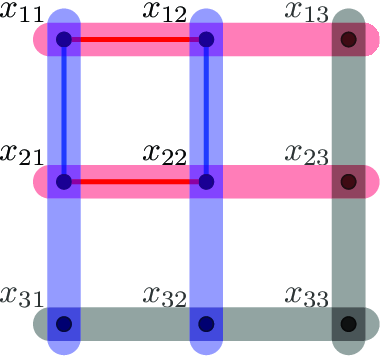
Unfortunately, an alternating $k$
-grid does not necessarily exist in
$k$
-grid does not necessarily exist in $G$
, not even if
$G$
, not even if $G$
is complete and has many edges of both colours. (For instance, if we choose a subset
$G$
is complete and has many edges of both colours. (For instance, if we choose a subset $A\,{\subseteq}\, V(G)$
and colour all edges which intersect
$A\,{\subseteq}\, V(G)$
and colour all edges which intersect $A$
blue and all edges which do not intersect
$A$
blue and all edges which do not intersect $A$
red, then it is easily verified that there is no alternating
$A$
red, then it is easily verified that there is no alternating $k$
-grid.) However, our key lemma says that, unless the colouring is almost monochromatic, we can guarantee a near-alternating
$k$
-grid.) However, our key lemma says that, unless the colouring is almost monochromatic, we can guarantee a near-alternating $k$
-grid, namely, a
$k$
-grid, namely, a $2$
-edge-coloured
$2$
-edge-coloured $k$
-grid such that all horizontal edges but at most one are red, and all vertical edges but at most one are blue (cf. Figure 1).
$k$
-grid such that all horizontal edges but at most one are red, and all vertical edges but at most one are blue (cf. Figure 1).
-
(L1) If $\delta (G)\ge (1/2+\varepsilon )n$
, then either
$G$
contains a near-alternating
$k$
-grid, or
$G$
is almost monochromatic.
$\delta (G)\ge (1/2+\varepsilon )n$
, then either
$G$
contains a near-alternating
$k$
-grid, or
$G$
is almost monochromatic.


The formal statement of (L1) is offered by Lemma 4.1. We defer a proof sketch of this result to Section 4. Applying (L1) repeatedly gives that either $G$
contains linearly many vertex-disjoint near-alternating
$G$
contains linearly many vertex-disjoint near-alternating $k$
-grids, or its colouring is almost monochromatic. In the first case, one can apply the same argument as above, with alternating
$k$
-grids, or its colouring is almost monochromatic. In the first case, one can apply the same argument as above, with alternating $k$
-grids replaced by near-alternating
$k$
-grids replaced by near-alternating $k$
-grids: this still works since, for each gadget, we can decide to cover its
$k$
-grids: this still works since, for each gadget, we can decide to cover its $k^2$
vertices with a perfect matching containing more red edges or more blue edges (as
$k^2$
vertices with a perfect matching containing more red edges or more blue edges (as $k \geq 3$
). In the second case, when almost all edges of
$k \geq 3$
). In the second case, when almost all edges of $G$
have the same colour, one can use standard methods to show that
$G$
have the same colour, one can use standard methods to show that $G$
contains an almost-monochromatic perfect matching. We remark this here for the benefit of the reader, but will actually not implement these steps since the result for perfect matchings will follow from the more general theorem about tight Hamilton cycles.
$G$
contains an almost-monochromatic perfect matching. We remark this here for the benefit of the reader, but will actually not implement these steps since the result for perfect matchings will follow from the more general theorem about tight Hamilton cycles.
The case of an arbitrary number $r$
of colours can be handled by identifying the first
$r$
of colours can be handled by identifying the first $r-1$
colours into one colour (say ‘blue’) and applying the 2-colour argument outlined above. The key point is that it suffices to find a perfect matching of
$r-1$
colours into one colour (say ‘blue’) and applying the 2-colour argument outlined above. The key point is that it suffices to find a perfect matching of $G$
that either has at least
$G$
that either has at least $\frac {n}{rk}+\Omega (n)$
edges in the
$\frac {n}{rk}+\Omega (n)$
edges in the $r$
th colour or at least
$r$
th colour or at least $\frac {(r-1)n}{rk}+\Omega (n)$
edges in blue, because in the latter case, averaging gives that one of the first
$\frac {(r-1)n}{rk}+\Omega (n)$
edges in blue, because in the latter case, averaging gives that one of the first $r-1$
colours appears at least
$r-1$
colours appears at least $\frac {n}{rk}+\Omega (n)$
times. Such a perfect matching can be found using the same strategy as above, consisting of first removing near-alternating grids and then covering the rest with a perfect matching
$\frac {n}{rk}+\Omega (n)$
times. Such a perfect matching can be found using the same strategy as above, consisting of first removing near-alternating grids and then covering the rest with a perfect matching $M'$
, and by applying a ‘biased’ case distinction for
$M'$
, and by applying a ‘biased’ case distinction for $M'$
. Namely, in
$M'$
. Namely, in $M'$
, either a
$M'$
, either a $(1-\frac {1}{r})$
-fraction of edges is blue or a
$(1-\frac {1}{r})$
-fraction of edges is blue or a $\frac {1}{r}$
-fraction has the
$\frac {1}{r}$
-fraction has the $r$
th colour, and whichever case holds, we can use the gadgets to ‘push’ the relevant colour(s).
$r$
th colour, and whichever case holds, we can use the gadgets to ‘push’ the relevant colour(s).
2.2 Tight Hamilton cycles
We now discuss how to find a tight Hamilton cycle with high discrepancy. For hypergraphs with minimum degree above $1/2$
(to which we refer informally as Dirac hypergraphs), there are well-known tools which allow one to connect a given set of disjoint tight paths into a tight Hamilton cycle (see Section 3.1). Therefore, if these paths are of high discrepancy and only ‘miss’ a small number of edges to close a Hamilton cycle, then we are done as, no matter which colours are used in the completion, the discrepancy cannot be ruined anymore. A crucial step of our argument is to find such paths (the formal statement is offered by Lemma 6.1).
$1/2$
(to which we refer informally as Dirac hypergraphs), there are well-known tools which allow one to connect a given set of disjoint tight paths into a tight Hamilton cycle (see Section 3.1). Therefore, if these paths are of high discrepancy and only ‘miss’ a small number of edges to close a Hamilton cycle, then we are done as, no matter which colours are used in the completion, the discrepancy cannot be ruined anymore. A crucial step of our argument is to find such paths (the formal statement is offered by Lemma 6.1).
-
(L2) If
$\delta (G) \ge (1/2+\varepsilon )n$
, then
$G$
contains a collection of vertex-disjoint tight paths, whose union contains
$(1-o(1))n$
edges and has high discrepancy.


In order to show the above, we proceed as follows. We use our key lemma to find a perfect fractional matching $\mathbf{x}$
such that
$\mathbf{x}$
such that $\mathbf{x}$
is ‘normal’, i.e. each edge has weight
$\mathbf{x}$
is ‘normal’, i.e. each edge has weight $\Theta (n^{-k+1})$
, and such that
$\Theta (n^{-k+1})$
, and such that $\mathbf{x}$
has high discrepancy, in the sense that the total weight received by some colour class (say ‘red’) is significantly above the average, i.e. larger than
$\mathbf{x}$
has high discrepancy, in the sense that the total weight received by some colour class (say ‘red’) is significantly above the average, i.e. larger than $n/(rk) + \Omega (n)$
(see Lemma 5.2, and see Section 3.1 for the definition of a perfect fractional matching). We then use
$n/(rk) + \Omega (n)$
(see Lemma 5.2, and see Section 3.1 for the definition of a perfect fractional matching). We then use $\mathbf{x}$
to define a random walk
$\mathbf{x}$
to define a random walk $\mathcal{Y}$
on
$\mathcal{Y}$
on $V(G)$
, such that a path of order
$V(G)$
, such that a path of order $t$
sampled according to the first
$t$
sampled according to the first $t$
vertices of
$t$
vertices of $\mathcal{Y}$
(conditioning on being self avoiding) has the following properties: Every vertex is approximately equally likely to be contained in the path and the probability of an edge
$\mathcal{Y}$
(conditioning on being self avoiding) has the following properties: Every vertex is approximately equally likely to be contained in the path and the probability of an edge $e$
appearing in the path is roughly proportional to
$e$
appearing in the path is roughly proportional to $\mathbf{x}(e)$
(see Lemma 5.3).
$\mathbf{x}(e)$
(see Lemma 5.3).
We sample $N$
paths of order
$N$
paths of order $t$
independently, where
$t$
independently, where $t$
is a sufficiently large constant and
$t$
is a sufficiently large constant and $N\,:\!=\,n^{t-1/2}$
. Finally, we define an auxiliary
$N\,:\!=\,n^{t-1/2}$
. Finally, we define an auxiliary $t$
-uniform hypergraph
$t$
-uniform hypergraph $\mathcal{H}$
with vertex set
$\mathcal{H}$
with vertex set $V(G)$
and edges corresponding to the vertex sets of the sampled paths. (The choice of
$V(G)$
and edges corresponding to the vertex sets of the sampled paths. (The choice of $N$
ensures that this hypergraph is rather dense, but still we do not expect too many parallel edges.) Owing to the first property of
$N$
ensures that this hypergraph is rather dense, but still we do not expect too many parallel edges.) Owing to the first property of $\mathcal{Y}$
mentioned above, the
$\mathcal{Y}$
mentioned above, the $t$
-graph
$t$
-graph $\mathcal{H}$
is almost-regular and, obviously, its maximum
$\mathcal{H}$
is almost-regular and, obviously, its maximum $2$
-degree is at most
$2$
-degree is at most $n^{t-2}$
. By a fundamental theorem of Frankl, Rödl [Reference Frankl and Rödl13], and Pippenger (see [Reference Pippenger and Spencer28]), we can then establish that
$n^{t-2}$
. By a fundamental theorem of Frankl, Rödl [Reference Frankl and Rödl13], and Pippenger (see [Reference Pippenger and Spencer28]), we can then establish that $\mathcal{H}$
contains an almost-perfect matching, which corresponds to a collection of vertex-disjoint tight paths of order
$\mathcal{H}$
contains an almost-perfect matching, which corresponds to a collection of vertex-disjoint tight paths of order $t$
covering almost all the vertices. However, our goal is to find such a collection with high discrepancy. Owing to the second property of
$t$
covering almost all the vertices. However, our goal is to find such a collection with high discrepancy. Owing to the second property of $\mathcal{Y}$
mentioned above and the fact that the weight of red edges is significantly above the average, the paths in
$\mathcal{Y}$
mentioned above and the fact that the weight of red edges is significantly above the average, the paths in $G$
which correspond to the edges in
$G$
which correspond to the edges in $\mathcal{H}$
are likely to contain many red edges. A result concerning finding hypergraph matchings with pseudorandom properties due to Ehard, Glock, and Joos [Reference Ehard, Glock and Joos9] (see Theorem3.5) then allows us to find an almost-perfect matching in
$\mathcal{H}$
are likely to contain many red edges. A result concerning finding hypergraph matchings with pseudorandom properties due to Ehard, Glock, and Joos [Reference Ehard, Glock and Joos9] (see Theorem3.5) then allows us to find an almost-perfect matching in $\mathcal{H}$
such that the corresponding collection of vertex-disjoint paths indeed has high discrepancy. This proves (L2) and establishes Theorem1.1.
$\mathcal{H}$
such that the corresponding collection of vertex-disjoint paths indeed has high discrepancy. This proves (L2) and establishes Theorem1.1.
3. Preliminaries
In this section, we collect some preliminary results.
3.1 Dirac hypergraphs
In this subsection we state three results concerning hypergraphs with minimum $(k-1)$
-degree above
$(k-1)$
-degree above $n/2$
. The first is the so-called ‘Connecting Lemma’ which allows to connect any two disjoint ordered
$n/2$
. The first is the so-called ‘Connecting Lemma’ which allows to connect any two disjoint ordered $(k-1)$
-tuples of vertices by a tight path of bounded length.
$(k-1)$
-tuples of vertices by a tight path of bounded length.
Lemma 3.1 (Lemma 2.4 in [Reference Rödl, Ruciński and Szemerédi29]). Let $1/n \ll {\varepsilon } \ll 1/k$
with
$1/n \ll {\varepsilon } \ll 1/k$
with $k \in \mathbb{N}$
and
$k \in \mathbb{N}$
and $k \ge 3$
. Let
$k \ge 3$
. Let $G$
be a
$G$
be a $k$
-graph on
$k$
-graph on $n$
vertices with
$n$
vertices with $\delta (G)\ge (1/2+{\varepsilon })n$
. Then for every two disjoint ordered
$\delta (G)\ge (1/2+{\varepsilon })n$
. Then for every two disjoint ordered $(k-1)$
-subsets of vertices of
$(k-1)$
-subsets of vertices of $G$
, there is a tight path in
$G$
, there is a tight path in $G$
of order at most
$G$
of order at most $2k/{\varepsilon }^2$
which connects them.
$2k/{\varepsilon }^2$
which connects them.
The second result is the so-called ‘Absorbing Lemma’ and shows the existence of an absorber for tight paths in Dirac hypergraphs.
Lemma 3.2 (Lemma 2.1 in [Reference Rödl, Ruciński and Szemerédi29]). Let $1/n \ll \beta \ll \mu \ll {\varepsilon }, 1/k$
, with
$1/n \ll \beta \ll \mu \ll {\varepsilon }, 1/k$
, with $k \in \mathbb{N}$
and
$k \in \mathbb{N}$
and $k \ge 3$
. Let
$k \ge 3$
. Let $G$
be a
$G$
be a $k$
-graph on
$k$
-graph on $n$
vertices with
$n$
vertices with $\delta (G) \ge (1/2+{\varepsilon })n$
. Then there exists a tight path
$\delta (G) \ge (1/2+{\varepsilon })n$
. Then there exists a tight path $P$
with
$P$
with $|V(P)| \le \mu n$
such that for every subset
$|V(P)| \le \mu n$
such that for every subset $W \subseteq V(G) \setminus V(P)$
of size
$W \subseteq V(G) \setminus V(P)$
of size $|W| \le \beta n$
, there is a tight path
$|W| \le \beta n$
, there is a tight path $\tilde {P}$
in
$\tilde {P}$
in $G$
with
$G$
with $V(\tilde {P})=V(P) \cup W$
and such that
$V(\tilde {P})=V(P) \cup W$
and such that $\tilde {P}$
has the same ends as
$\tilde {P}$
has the same ends as $P$
.
$P$
.
The third result concerns the existence of ‘balanced’ perfect fractional matchings. Let us introduce the relevant definitions. Let $G$
be an
$G$
be an $n$
-vertex
$n$
-vertex $k$
-graph. A perfect fractional matching of
$k$
-graph. A perfect fractional matching of $G$
is a function
$G$
is a function $\mathbf{x} \colon E(G)\to [0,1]$
such that, for every vertex
$\mathbf{x} \colon E(G)\to [0,1]$
such that, for every vertex $v\in V(G)$
, we have
$v\in V(G)$
, we have $\sum _{e\ni v}\mathbf{x}(e)=1$
. Observe that this implies that
$\sum _{e\ni v}\mathbf{x}(e)=1$
. Observe that this implies that $\sum _{e \in E(G)} \mathbf{x}(e)=n/k$
, which we will use throughout without mention. For
$\sum _{e \in E(G)} \mathbf{x}(e)=n/k$
, which we will use throughout without mention. For $\mu \in (0,1]$
, a perfect fractional matching
$\mu \in (0,1]$
, a perfect fractional matching $\mathbf{x}$
is said to be
$\mathbf{x}$
is said to be $\mu$
-normal if
$\mu$
-normal if $\mu n^{-k+1} \le \mathbf{x}(e) \le \mu ^{-1}n^{-k+1}$
for all
$\mu n^{-k+1} \le \mathbf{x}(e) \le \mu ^{-1}n^{-k+1}$
for all $e\in E(G)$
. The following result states that Dirac hypergraphs have normal perfect fractional matchings.
$e\in E(G)$
. The following result states that Dirac hypergraphs have normal perfect fractional matchings.
Lemma 3.3 (Lemma 4.2 in [Reference Glock, Gould, Joos, Kühn and Osthus19]). Let $1/n \ll \mu \ll {\varepsilon }, 1/k$
with
$1/n \ll \mu \ll {\varepsilon }, 1/k$
with $k\in \mathbb{N}$
and
$k\in \mathbb{N}$
and $k\ge 2$
. Let
$k\ge 2$
. Let $G$
be an
$G$
be an $n$
-vertex
$n$
-vertex $k$
-graph with
$k$
-graph with $\delta (G)\ge (1/2+{\varepsilon })n$
. Then
$\delta (G)\ge (1/2+{\varepsilon })n$
. Then $G$
has a
$G$
has a $\mu$
-normal perfect fractional matching.
$\mu$
-normal perfect fractional matching.
3.2 Probabilistic tools
We will often apply the following standard Chernoff-type concentration inequality (see [Reference Dubhashi and Panconesi8, Theorem1.1]).
Lemma 3.4 (Chernoff’s inequality). Let $X_1,\ldots, X_N$
be independent random variables taking values in
$X_1,\ldots, X_N$
be independent random variables taking values in $[0,1]$
, and let
$[0,1]$
, and let $X = \sum _{i=1}^N X_i$
. Then for every
$X = \sum _{i=1}^N X_i$
. Then for every $0 \lt \beta \lt 1$
,
$0 \lt \beta \lt 1$
,
 \begin{equation*} {\mathbb{P}}\Big [|X - \mathbb{E}[X]| \ge \beta \mathbb{E}[X]\Big ] \le 2\exp \left (-\frac {\beta ^2}{3} \mathbb{E}[X]\right )\, . \end{equation*}
As explained at the end of Section 2, our proof will use a hypergraph matching argument and will need the matching to look random-like with respect to some properties. In order to achieve that, we use a nibble-type result due to Ehard, Glock, and Joos [Reference Ehard, Glock and Joos9]. For a hypergraph $\mathcal{H}$
, define
$\mathcal{H}$
, define $\Delta (\mathcal{H}) \,:\!=\, \max _{v \in V(\mathcal{H})} d_{\mathcal{H}}(\{v\})$
and
$\Delta (\mathcal{H}) \,:\!=\, \max _{v \in V(\mathcal{H})} d_{\mathcal{H}}(\{v\})$
and $\Delta ^c(\mathcal{H}) \,:\!=\, \max _{\{u,v\} \subseteq V(\mathcal{H})} d_{\mathcal{H}}(\{u,v\})$
. We will consider edge weight functions
$\Delta ^c(\mathcal{H}) \,:\!=\, \max _{\{u,v\} \subseteq V(\mathcal{H})} d_{\mathcal{H}}(\{u,v\})$
. We will consider edge weight functions $w\colon E(\mathcal{H}) \rightarrow \mathbb{R}_{\geq 0}$
and, for a set
$w\colon E(\mathcal{H}) \rightarrow \mathbb{R}_{\geq 0}$
and, for a set $A \subseteq E(\mathcal{H})$
, we use the notation
$A \subseteq E(\mathcal{H})$
, we use the notation $w(A) \,:\!=\, \sum _{e \in A}w(e)$
.
$w(A) \,:\!=\, \sum _{e \in A}w(e)$
.
Theorem 3.5 (Theorem 1.2 in [Reference Ehard, Glock and Joos9]). Suppose $\delta \in (0,1)$
and
$\delta \in (0,1)$
and $t\in \mathbb{N}$
with
$t\in \mathbb{N}$
with $t\ge 2$
, and set
$t\ge 2$
, and set $\gamma \,:\!=\,\delta /50t^2$
. Then there exists
$\gamma \,:\!=\,\delta /50t^2$
. Then there exists $\Delta _0$
such that for all
$\Delta _0$
such that for all $\Delta \ge \Delta _0$
, the following holds. Let
$\Delta \ge \Delta _0$
, the following holds. Let $\mathcal{H}$
be a
$\mathcal{H}$
be a $t$
-uniform hypergraph satisfying
$t$
-uniform hypergraph satisfying $\Delta (\mathcal{H})\leq \Delta$
,
$\Delta (\mathcal{H})\leq \Delta$
, $\Delta ^c(\mathcal{H})\le \Delta ^{1-\delta }$
and
$\Delta ^c(\mathcal{H})\le \Delta ^{1-\delta }$
and $e(\mathcal{H})\leq \exp (\Delta ^{\gamma ^2})$
. Let
$e(\mathcal{H})\leq \exp (\Delta ^{\gamma ^2})$
. Let $\mathcal{W}$
be a set of at most
$\mathcal{W}$
be a set of at most $\exp (\Delta ^{\gamma ^2})$
weight functions on
$\exp (\Delta ^{\gamma ^2})$
weight functions on $E(\mathcal{H})$
such that
$E(\mathcal{H})$
such that $w(E(\mathcal{H}))\ge \max _{e\in E(\mathcal{H})}w(e)\Delta ^{1+\delta }$
for every
$w(E(\mathcal{H}))\ge \max _{e\in E(\mathcal{H})}w(e)\Delta ^{1+\delta }$
for every $w \in \mathcal{W}$
. Then there exists a matching
$w \in \mathcal{W}$
. Then there exists a matching $\mathcal{M}$
in
$\mathcal{M}$
in $\mathcal{H}$
such that
$\mathcal{H}$
such that $w(\mathcal{M})=(1\pm \Delta ^{-\gamma }) w(E(\mathcal{H}))/\Delta$
for every
$w(\mathcal{M})=(1\pm \Delta ^{-\gamma }) w(E(\mathcal{H}))/\Delta$
for every $w \in \mathcal{W}$
.
$w \in \mathcal{W}$
.
4. Key lemma
In this section, we state and prove our key structural lemma. Recall from Section 2 that a $k$
-grid is the
$k$
-grid is the $k$
-graph on vertices
$k$
-graph on vertices $\{x_{ij}\,{:}\, 1 \le i,j \le k\}$
and with edges
$\{x_{ij}\,{:}\, 1 \le i,j \le k\}$
and with edges $x_{i1} \cdots x_{ik}$
for each
$x_{i1} \cdots x_{ik}$
for each $i \in [k]$
(which we will call horizontal edges) and
$i \in [k]$
(which we will call horizontal edges) and $x_{1j} \cdots x_{kj}$
for each
$x_{1j} \cdots x_{kj}$
for each $j \in [k]$
(which we will call vertical edges). An alternating
$j \in [k]$
(which we will call vertical edges). An alternating $k$
-grid is a
$k$
-grid is a $2$
-edge-coloured
$2$
-edge-coloured $k$
-grid with all the horizontal edges red and all vertical edges blue. A near-alternating
$k$
-grid with all the horizontal edges red and all vertical edges blue. A near-alternating $k$
-grid is a
$k$
-grid is a $2$
-edge-coloured
$2$
-edge-coloured $k$
-grid such that all horizontal edges but (at most) one are red, and all vertical edges but (at most) one are blue. Thus, the difference between a near-alternating
$k$
-grid such that all horizontal edges but (at most) one are red, and all vertical edges but (at most) one are blue. Thus, the difference between a near-alternating $k$
-grid and an alternating
$k$
-grid and an alternating $k$
-grid lies in not prescribing the colour of one horizontal and one vertical edge (cf. Figure 1).
$k$
-grid lies in not prescribing the colour of one horizontal and one vertical edge (cf. Figure 1).
Our key lemma exploits the specific structure of the given colouring and shows that either it contains a near-alternating $k$
-grid or the colouring is almost monochromatic. While our main result applies to hypergraphs coloured with any number of colours, it suffices to handle here the case of only two colours.
$k$
-grid or the colouring is almost monochromatic. While our main result applies to hypergraphs coloured with any number of colours, it suffices to handle here the case of only two colours.
Lemma 4.1 (Key lemma). Let $1/n \ll \zeta \ll {\varepsilon }, \rho, 1/k$
with
$1/n \ll \zeta \ll {\varepsilon }, \rho, 1/k$
with $k\in \mathbb{N}$
and
$k\in \mathbb{N}$
and $k\ge 3$
. Let
$k\ge 3$
. Let $G$
be an
$G$
be an $n$
-vertex
$n$
-vertex $k$
-graph whose edges are
$k$
-graph whose edges are $2$
-coloured. Assume that all but at most
$2$
-coloured. Assume that all but at most $\zeta n^{k-1}$ $(k-1)$
-subsets
$(k-1)$
-subsets $S$
of
$S$
of $V(G)$
satisfy
$V(G)$
satisfy $d_G(S) \ge (1/2+{\varepsilon })n$
. Then either there exists a near-alternating
$d_G(S) \ge (1/2+{\varepsilon })n$
. Then either there exists a near-alternating $k$
-grid, or one of the colour classes has size at most
$k$
-grid, or one of the colour classes has size at most $\rho n^k$
.
$\rho n^k$
.
As explained in Section 2, Lemma 4.1 is enough to derive Corollary 1.2. Moreover, it is easy to see that the lemma also holds for $k=2$
, but then a near-alternating grid is not a suitable gadget, because such a grid (which is a 4-cycle) might only have perfect matchings with one red edge and one blue edge, so that no colour appears more often. Hence we ignore this case here.
$k=2$
, but then a near-alternating grid is not a suitable gadget, because such a grid (which is a 4-cycle) might only have perfect matchings with one red edge and one blue edge, so that no colour appears more often. Hence we ignore this case here.
We now sketch the proof of Lemma 4.1. It is helpful to first guarantee that if a $(k-1)$
-set of vertices is contained in an edge of a certain colour, then it is actually contained in many edges of this colour. While this is not true for an arbitrary edge-colouring, we can make sure this is the case after deleting only few edges. The required cleaning procedure is given by the following standard tool. We provide the short proof for the convenience of the reader.
$(k-1)$
-set of vertices is contained in an edge of a certain colour, then it is actually contained in many edges of this colour. While this is not true for an arbitrary edge-colouring, we can make sure this is the case after deleting only few edges. The required cleaning procedure is given by the following standard tool. We provide the short proof for the convenience of the reader.
Proposition 4.2.
Let $G$
be a
$G$
be a $k$
-graph on
$k$
-graph on $n$
vertices. Then by removing at most
$n$
vertices. Then by removing at most $t\binom {n}{k-1}$
edges, one can ensure that in the resulting subhypergraph, every
$t\binom {n}{k-1}$
edges, one can ensure that in the resulting subhypergraph, every $(k-1)$
-set has degree either
$(k-1)$
-set has degree either $0$
or at least
$0$
or at least $t$
.
$t$
.
Proof.
As long as there is a $(k-1)$
-set
$(k-1)$
-set $S$
with degree between
$S$
with degree between $1$
and
$1$
and $t$
, delete all edges containing
$t$
, delete all edges containing $S$
. Obviously, every
$S$
. Obviously, every $(k-1)$
-set is considered at most once during this process, and when it is considered, we delete at most
$(k-1)$
-set is considered at most once during this process, and when it is considered, we delete at most $t$
edges.
$t$
edges.
Once $G$
has been cleaned (with respect to both colours and to a suitable choice of
$G$
has been cleaned (with respect to both colours and to a suitable choice of $t$
), we obtain a subhypergraph
$t$
), we obtain a subhypergraph $G'$
with the desired property for both colours. Observe that, since we removed only few edges, for most of the
$G'$
with the desired property for both colours. Observe that, since we removed only few edges, for most of the $(k-1)$
-subsets of
$(k-1)$
-subsets of $V(G)$
, their degree in
$V(G)$
, their degree in $G'$
will still be linearly above
$G'$
will still be linearly above $n/2$
.
$n/2$
.
Let $H$
be the
$H$
be the $(k-1)$
-shadow of
$(k-1)$
-shadow of $G'$
, and equip
$G'$
, and equip $H$
with the following 2-colouring of its edges: Colour an edge of
$H$
with the following 2-colouring of its edges: Colour an edge of $H$
with colour
$H$
with colour $c$
if it is contained in at least one edge of
$c$
if it is contained in at least one edge of $G'$
of colour
$G'$
of colour $c$
(and hence at least
$c$
(and hence at least $t$
such edges). We note that an edge of
$t$
such edges). We note that an edge of $H$
can receive both colours (if it is contained in an edge of
$H$
can receive both colours (if it is contained in an edge of $G'$
of each of the colours). As we will show, by choosing
$G'$
of each of the colours). As we will show, by choosing $t$
appropriately, it suffices to find an alternating
$t$
appropriately, it suffices to find an alternating $(k-1)$
-grid in
$(k-1)$
-grid in $H$
in order to obtain a near-alternating
$H$
in order to obtain a near-alternating $k$
-grid in
$k$
-grid in $G$
(see Claim1).
$G$
(see Claim1).
If $H$
contains many double-coloured edges, then we can easily find an alternating
$H$
contains many double-coloured edges, then we can easily find an alternating $(k-1)$
-grid. In fact, we can use the following classical result of Erdős [Reference Erdős10], which states that the Turán density of
$(k-1)$
-grid. In fact, we can use the following classical result of Erdős [Reference Erdős10], which states that the Turán density of $k$
-partite
$k$
-partite $k$
-graphs is
$k$
-graphs is $0$
.
$0$
.
Theorem 4.3 ([Reference Erdős10]). Let $1/n \ll \eta, 1/\ell$
with
$1/n \ll \eta, 1/\ell$
with $\ell \in \mathbb{N}$
. Let
$\ell \in \mathbb{N}$
. Let $L$
be any
$L$
be any $k$
-partite
$k$
-partite $k$
-graph with
$k$
-graph with $\ell$
vertices. Then any
$\ell$
vertices. Then any $k$
-graph with
$k$
-graph with $n$
vertices and at least
$n$
vertices and at least $\eta n^k$
edges contains
$\eta n^k$
edges contains $L$
as a subgraph.
$L$
as a subgraph.
Call an edge of $H$
bad if it is double-coloured or has small degree in
$H$
bad if it is double-coloured or has small degree in $G'$
. Then by Theorem4.3 and what we observed above, we can assume that only few edges of
$G'$
. Then by Theorem4.3 and what we observed above, we can assume that only few edges of $H$
are bad. We would like to argue that all the edges of
$H$
are bad. We would like to argue that all the edges of $H$
which are not bad are then coloured with the same unique colour, which in turn will imply that
$H$
which are not bad are then coloured with the same unique colour, which in turn will imply that $G$
itself is almost-monochromatic.
$G$
itself is almost-monochromatic.
We proceed as follows: Let $\overrightarrow {T_1}$
and
$\overrightarrow {T_1}$
and $\overrightarrow {T_2}$
be arbitrary orderings of any two edges
$\overrightarrow {T_2}$
be arbitrary orderings of any two edges $T_1, T_2 \in E(H)$
which are not bad. The key observation we use is the following: Suppose there is a tight walk in
$T_1, T_2 \in E(H)$
which are not bad. The key observation we use is the following: Suppose there is a tight walk in $G'$
connecting
$G'$
connecting $\overrightarrow {T_1}$
and
$\overrightarrow {T_1}$
and $\overrightarrow {T_2}$
such that any
$\overrightarrow {T_2}$
such that any $(k-1)$
consecutive vertices of the walk give an edge of
$(k-1)$
consecutive vertices of the walk give an edge of $H$
which is not bad. The power of the cleaning procedure then comes in handy, as we can claim that each
$H$
which is not bad. The power of the cleaning procedure then comes in handy, as we can claim that each $(k-1)$
-set along the walk is contained in edges of
$(k-1)$
-set along the walk is contained in edges of $G'$
of the same unique colour. Therefore the colour information propagates from
$G'$
of the same unique colour. Therefore the colour information propagates from $T_1$
to
$T_1$
to $T_2$
and the tight walk must be monochromatic, implying that
$T_2$
and the tight walk must be monochromatic, implying that $T_1$
and
$T_1$
and $T_2$
must have the same colour.
$T_2$
must have the same colour.
To utilise the above observation, we want to be able to connect every (or almost every) pair of ordered edges $\overrightarrow {T_1},\overrightarrow {T_2}$
, as above. The standard tool to obtain this connection is Lemma 3.1. However, we cannot apply this lemma directly, as the required minimum degree does not hold in
$\overrightarrow {T_1},\overrightarrow {T_2}$
, as above. The standard tool to obtain this connection is Lemma 3.1. However, we cannot apply this lemma directly, as the required minimum degree does not hold in $G'$
. Nevertheless, by randomly sampling a small set of vertices, we can avoid all the bad
$G'$
. Nevertheless, by randomly sampling a small set of vertices, we can avoid all the bad $(k-1)$
-sets (as these are few) and thus apply Lemma 3.1 within the sample. To make this work, we perform another cleaning step which removes
$(k-1)$
-sets (as these are few) and thus apply Lemma 3.1 within the sample. To make this work, we perform another cleaning step which removes $(k-1)$
-sets that intersect with too many bad sets.
$(k-1)$
-sets that intersect with too many bad sets.
We are now ready to prove the key lemma.
Proof of Lemma 4.1. Let $k \in \mathbb{N}$
with
$k \in \mathbb{N}$
with $k \ge 3$
and
$k \ge 3$
and ${\varepsilon },\rho \gt 0$
be given, and observe that we can assume
${\varepsilon },\rho \gt 0$
be given, and observe that we can assume $\varepsilon$
to be small enough for Lemma 3.1 to hold. Let
$\varepsilon$
to be small enough for Lemma 3.1 to hold. Let
 \begin{equation*}1/n \ll \zeta \ll \eta \ll {\varepsilon }, \rho, 1/k\, .\end{equation*}
Let $G$
be a
$G$
be a $2$
-edge-coloured (with red and blue)
$2$
-edge-coloured (with red and blue) $n$
-vertex
$n$
-vertex $k$
-graph on
$k$
-graph on $V$
such that all but at most
$V$
such that all but at most $\zeta n^{k-1}$
of the
$\zeta n^{k-1}$
of the $(k-1)$
-subsets of
$(k-1)$
-subsets of $V$
satisfy
$V$
satisfy $d_G(S) \ge (1/2+{\varepsilon })n$
. We apply Proposition 4.2 with parameter
$d_G(S) \ge (1/2+{\varepsilon })n$
. We apply Proposition 4.2 with parameter $t\,:\!=\,\eta {\varepsilon } n$
twice, once to the subhypergraph induced by the red edges and once to the subhypergraph induced by the blue edges. This gives a subhypergraph
$t\,:\!=\,\eta {\varepsilon } n$
twice, once to the subhypergraph induced by the red edges and once to the subhypergraph induced by the blue edges. This gives a subhypergraph $G'$
of
$G'$
of $G$
with
$G$
with $e(G') \geq e(G) - 2\eta {\varepsilon } n^k$
such that each
$e(G') \geq e(G) - 2\eta {\varepsilon } n^k$
such that each $(k-1)$
-set
$(k-1)$
-set $S$
satisfies the following condition for each of the colours: either
$S$
satisfies the following condition for each of the colours: either $S$
is not contained in any edge of
$S$
is not contained in any edge of $G'$
of this colour, or it is contained in at least
$G'$
of this colour, or it is contained in at least $\eta {\varepsilon } n$
edges of
$\eta {\varepsilon } n$
edges of $G'$
of this colour.
$G'$
of this colour.
Let $H$
be the
$H$
be the $(k-1)$
-uniform shadow of
$(k-1)$
-uniform shadow of $G'$
, equipped with the following
$G'$
, equipped with the following $2$
-colouring of its edges: Colour an edge of
$2$
-colouring of its edges: Colour an edge of $H$
red (resp. blue) if it is contained in at least one red (resp. blue) edge of
$H$
red (resp. blue) if it is contained in at least one red (resp. blue) edge of $G'$
(and hence at least
$G'$
(and hence at least $\eta {\varepsilon } n$
such edges), noting that we allow edges of
$\eta {\varepsilon } n$
such edges), noting that we allow edges of $H$
to receive both colours. For the purpose of finding coloured structures in
$H$
to receive both colours. For the purpose of finding coloured structures in $H$
, an edge that has both colours can be used either way.
$H$
, an edge that has both colours can be used either way.
Claim 1.
If $H$
contains an alternating
$H$
contains an alternating $(k-1)$
-grid, then
$(k-1)$
-grid, then $G$
contains a near-alternating
$G$
contains a near-alternating $k$
-grid.
$k$
-grid.
Proof of Claim 1. Suppose $H$
contains an alternating
$H$
contains an alternating $(k-1)$
-grid. Then there exists
$(k-1)$
-grid. Then there exists $W\,:\!=\,\{x_{ij}\,{:}\,1 \le i,j \le k-1\} \subseteq V$
such that
$W\,:\!=\,\{x_{ij}\,{:}\,1 \le i,j \le k-1\} \subseteq V$
such that $x_{i1} \cdots x_{i(k-1)}$
is a red edge of
$x_{i1} \cdots x_{i(k-1)}$
is a red edge of $H$
for each
$H$
for each $i \in [k-1]$
and
$i \in [k-1]$
and $x_{1j} \cdots x_{(k-1)j}$
is a blue edge of
$x_{1j} \cdots x_{(k-1)j}$
is a blue edge of $H$
for each
$H$
for each $j \in [k-1]$
. Let
$j \in [k-1]$
. Let $\mathcal{R}$
be the set of ordered tuples
$\mathcal{R}$
be the set of ordered tuples $(x_{1k},x_{2k},\ldots, x_{(k-1)k})$
such that
$(x_{1k},x_{2k},\ldots, x_{(k-1)k})$
such that $x_{1k},x_{2k},\ldots, x_{(k-1)k} \in V \setminus W$
are pairwise distinct,
$x_{1k},x_{2k},\ldots, x_{(k-1)k} \in V \setminus W$
are pairwise distinct, $\{x_{i1} \cdots x_{ik}\}$
is a red edge of
$\{x_{i1} \cdots x_{ik}\}$
is a red edge of $G$
for each
$G$
for each $i \in [k-1]$
, and
$i \in [k-1]$
, and $d_G(\{x_{1k},x_{2k},\ldots, x_{(k-1)k}\}) \ge (1/2+{\varepsilon })n$
. Owing to the fact that a red edge of
$d_G(\{x_{1k},x_{2k},\ldots, x_{(k-1)k}\}) \ge (1/2+{\varepsilon })n$
. Owing to the fact that a red edge of $H$
can be extended to a red edge of
$H$
can be extended to a red edge of $G'$
(and hence
$G'$
(and hence $G$
) in at least
$G$
) in at least $\eta {\varepsilon } n$
ways and that for all but
$\eta {\varepsilon } n$
ways and that for all but $\zeta n^{k-1}$
of the
$\zeta n^{k-1}$
of the $(k-1)$
-subsets
$(k-1)$
-subsets $S$
of
$S$
of $V$
it holds that
$V$
it holds that $d_G(S) \ge (1/2+{\varepsilon })n$
, we have
$d_G(S) \ge (1/2+{\varepsilon })n$
, we have $|{\mathcal{R}}| \ge (\eta {\varepsilon } n)^{k-1} - n^{k-2} - (k-1)! \cdot \zeta n^{k-1} \ge (\eta {\varepsilon } n)^{k-1}/2$
, where we used
$|{\mathcal{R}}| \ge (\eta {\varepsilon } n)^{k-1} - n^{k-2} - (k-1)! \cdot \zeta n^{k-1} \ge (\eta {\varepsilon } n)^{k-1}/2$
, where we used $\zeta \ll \eta, {\varepsilon },1/k$
(and the
$\zeta \ll \eta, {\varepsilon },1/k$
(and the $n^{k-2}$
term accounts for the choices of
$n^{k-2}$
term accounts for the choices of $x_{1k},\ldots, x_{(k-1)k}$
which are not pairwise distinct). Similarly, let
$x_{1k},\ldots, x_{(k-1)k}$
which are not pairwise distinct). Similarly, let $\mathcal{B}$
be the set of ordered tuples
$\mathcal{B}$
be the set of ordered tuples $(x_{k1},x_{k2},\ldots, x_{k(k-1)})$
such that
$(x_{k1},x_{k2},\ldots, x_{k(k-1)})$
such that $x_{k1},x_{k2},\ldots, x_{k(k-1)} \in V \setminus W$
are pairwise distinct,
$x_{k1},x_{k2},\ldots, x_{k(k-1)} \in V \setminus W$
are pairwise distinct, $\{x_{1j} \cdots x_{kj}\}$
is a blue edge of
$\{x_{1j} \cdots x_{kj}\}$
is a blue edge of $G$
for each
$G$
for each $j \in [k-1]$
, and
$j \in [k-1]$
, and $d_G(\{x_{k1},x_{k2},\ldots, x_{k(k-1)}\}) \ge (1/2+{\varepsilon })n$
. As above for
$d_G(\{x_{k1},x_{k2},\ldots, x_{k(k-1)}\}) \ge (1/2+{\varepsilon })n$
. As above for $\mathcal{R}$
, we have
$\mathcal{R}$
, we have $|{\mathcal{B}}| \ge (\eta {\varepsilon } n)^{k-1}/2$
. Therefore, there exist vertex-disjoint
$|{\mathcal{B}}| \ge (\eta {\varepsilon } n)^{k-1}/2$
. Therefore, there exist vertex-disjoint $R \in {\mathcal{R}}$
and
$R \in {\mathcal{R}}$
and $B \in {\mathcal{B}}$
. As
$B \in {\mathcal{B}}$
. As $d_G(R),d_G(B) \ge (1/2+{\varepsilon })n$
, we have
$d_G(R),d_G(B) \ge (1/2+{\varepsilon })n$
, we have $|N_G(R) \cap N_G(B)|\ge 2(1/2+{\varepsilon })n - n = 2{\varepsilon } n$
. Hence, there exists
$|N_G(R) \cap N_G(B)|\ge 2(1/2+{\varepsilon })n - n = 2{\varepsilon } n$
. Hence, there exists $x_{kk} \in (N_G(R) \cap N_G(B)) \setminus W$
, i.e. a vertex
$x_{kk} \in (N_G(R) \cap N_G(B)) \setminus W$
, i.e. a vertex $x_{kk}$
which forms an edge of
$x_{kk}$
which forms an edge of $G$
with both
$G$
with both $R$
and
$R$
and $B$
(although we have no control of the colours of these edges). This gives a near-alternating
$B$
(although we have no control of the colours of these edges). This gives a near-alternating $k$
-grid in
$k$
-grid in $G$
, as desired.
$G$
, as desired.
Owing to Claim1, from now on we can assume that $H$
does not contain an alternating
$H$
does not contain an alternating $(k-1)$
-grid. We show that then
$(k-1)$
-grid. We show that then $H$
(and thus
$H$
(and thus $G$
) must be almost monochromatic. A
$G$
) must be almost monochromatic. A $(k-1)$
-subset
$(k-1)$
-subset $S$
of
$S$
of $V$
is called bad if
$V$
is called bad if $d_{G'}(S) \lt (1/2+{\varepsilon }/2)n$
or if, seen as an edge of
$d_{G'}(S) \lt (1/2+{\varepsilon }/2)n$
or if, seen as an edge of $H$
,
$H$
, $S$
is coloured with both colours. We bound the number of bad sets as follows.
$S$
is coloured with both colours. We bound the number of bad sets as follows.
Claim 2.
There are at most $5k\eta n^{k-1}$
bad sets.
$5k\eta n^{k-1}$
bad sets.
Proof of Claim 2. We begin by bounding the number of $(k-1)$
-sets
$(k-1)$
-sets $S$
with
$S$
with $d_{G'}(S) \lt (1/2+{\varepsilon }/2)n$
. Observe that if
$d_{G'}(S) \lt (1/2+{\varepsilon }/2)n$
. Observe that if $d_{G'}(S) \lt (1/2+{\varepsilon }/2)n$
, then either
$d_{G'}(S) \lt (1/2+{\varepsilon }/2)n$
, then either $d_G(S) \lt (1/2+{\varepsilon })n$
(i.e.
$d_G(S) \lt (1/2+{\varepsilon })n$
(i.e. $S$
has small degree already in
$S$
has small degree already in $G$
), or we removed at least
$G$
), or we removed at least ${\varepsilon } n/2$
edges of
${\varepsilon } n/2$
edges of $G$
containing
$G$
containing $S$
during the cleaning process (i.e. when obtaining
$S$
during the cleaning process (i.e. when obtaining $G'$
from
$G'$
from $G$
). The former case holds for at most
$G$
). The former case holds for at most $\zeta n^{k-1}$
sets
$\zeta n^{k-1}$
sets $S$
, by assumption. Let us now bound the number of
$S$
, by assumption. Let us now bound the number of $S$
in the latter case. Since removing an edge of
$S$
in the latter case. Since removing an edge of $G$
decreases (by one) the degree of precisely
$G$
decreases (by one) the degree of precisely $k$
$k$ $(k-1)$
-sets, and as the total number of removed edges is at most
$(k-1)$
-sets, and as the total number of removed edges is at most $2\eta {\varepsilon } n^k$
, the number of such sets
$2\eta {\varepsilon } n^k$
, the number of such sets $S$
is at most
$S$
is at most $\frac {k \cdot 2 \eta {\varepsilon } n^k}{{\varepsilon } n/2} = 4 k \eta n^{k-1}$
.
$\frac {k \cdot 2 \eta {\varepsilon } n^k}{{\varepsilon } n/2} = 4 k \eta n^{k-1}$
.
Next, we bound the number of double-coloured edges of $H$
. Let
$H$
. Let $\tilde {H}$
be the subhypergraph of
$\tilde {H}$
be the subhypergraph of $H$
on
$H$
on $V$
induced by the double-coloured edges. Then
$V$
induced by the double-coloured edges. Then $e(\tilde {H}) \le \eta n^{k-1}$
. Indeed, otherwise
$e(\tilde {H}) \le \eta n^{k-1}$
. Indeed, otherwise $\tilde {H}$
contains a copy of the
$\tilde {H}$
contains a copy of the $(k-1)$
-grid by Theorem4.3, since the
$(k-1)$
-grid by Theorem4.3, since the $(k-1)$
-grid is a
$(k-1)$
-grid is a $(k-1)$
-partite
$(k-1)$
-partite $(k-1)$
-graph (with each vertex class of size
$(k-1)$
-graph (with each vertex class of size $k-1$
). However, as each edge of
$k-1$
). However, as each edge of $\tilde {H}$
receives both colours, this gives an alternating
$\tilde {H}$
receives both colours, this gives an alternating $(k-1)$
-grid, which is a contradiction.
$(k-1)$
-grid, which is a contradiction.
Summarising, the number of bad sets is at most $(\zeta + 4 k \eta +\eta )n^{k-1} \le 5k\eta n^{k-1}$
, where we used
$(\zeta + 4 k \eta +\eta )n^{k-1} \le 5k\eta n^{k-1}$
, where we used $\zeta \ll \eta$
.
$\zeta \ll \eta$
.
Given a $(k-1)$
-subset
$(k-1)$
-subset $S$
of
$S$
of $V$
, we say that
$V$
, we say that $S$
is clean if, for every
$S$
is clean if, for every $0\le j\le k-1$
, the number of bad sets
$0\le j\le k-1$
, the number of bad sets $T$
with
$T$
with $|S\cap T|=j$
is at most
$|S\cap T|=j$
is at most $\eta ^{1/2} n^{k-1-j}$
. We remark that for
$\eta ^{1/2} n^{k-1-j}$
. We remark that for $j=k-1$
the condition means that
$j=k-1$
the condition means that $S$
itself is not bad.
$S$
itself is not bad.
Claim 3.
All but at most $\eta ^{1/3} n^{k-1}$
of the
$\eta ^{1/3} n^{k-1}$
of the $(k-1)$
-subsets of
$(k-1)$
-subsets of $V$
are clean.
$V$
are clean.
Proof of Claim 3. For each $0 \le j \le k-1$
, we bound the number of
$0 \le j \le k-1$
, we bound the number of $(k-1)$
-sets
$(k-1)$
-sets $S$
for which the number of bad sets
$S$
for which the number of bad sets $T$
with
$T$
with $|S \cap T| = j$
is more than
$|S \cap T| = j$
is more than $\eta ^{1/2} n^{k-1-j}$
. If
$\eta ^{1/2} n^{k-1-j}$
. If $j=0$
, this cannot happen by Claim2, so we can assume
$j=0$
, this cannot happen by Claim2, so we can assume $0 \lt j \le k-1$
. Given a bad set
$0 \lt j \le k-1$
. Given a bad set $T$
, the number of
$T$
, the number of $(k-1)$
-sets
$(k-1)$
-sets $S$
intersecting
$S$
intersecting $T$
in
$T$
in $j$
vertices is at most
$j$
vertices is at most $\binom {k-1}{j}n^{k-1-j}$
. Therefore, using the bound in Claim2, the number of
$\binom {k-1}{j}n^{k-1-j}$
. Therefore, using the bound in Claim2, the number of $(k-1)$
-subsets of
$(k-1)$
-subsets of $V$
which are not clean is at most
$V$
which are not clean is at most
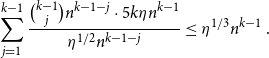 \begin{equation*} \sum _{j=1}^{k-1} \frac {\binom {k-1}{j} n^{k-1-j} \cdot 5 k \eta n^{k-1}}{\eta ^{1/2} n^{k-1-j}} \le \eta ^{1/3} n^{k-1}\, . \end{equation*}
Let $H'$
be the
$H'$
be the $(k-1)$
-subhypergraph of
$(k-1)$
-subhypergraph of $H$
consisting of the edges which are clean
$H$
consisting of the edges which are clean $(k-1)$
-sets. Observe in particular that each edge of
$(k-1)$
-sets. Observe in particular that each edge of $H'$
has a unique colour (because double-coloured edges are bad).
$H'$
has a unique colour (because double-coloured edges are bad).
Claim 4.
All edges of $H'$
have the same colour.
$H'$
have the same colour.
Using Claim4, we can easily complete the proof of the lemma. Indeed, suppose without loss of generality that the edges of $H'$
are red. Then for an edge of
$H'$
are red. Then for an edge of $G$
to be blue, it has to be either an edge of
$G$
to be blue, it has to be either an edge of $G \setminus G'$
, or an edge of
$G \setminus G'$
, or an edge of $G'$
none of whose
$G'$
none of whose $(k-1)$
-subsets belongs to
$(k-1)$
-subsets belongs to $H'$
. Using that
$H'$
. Using that $e(G) - e(G') \leq 2 \eta {\varepsilon } n^k$
and
$e(G) - e(G') \leq 2 \eta {\varepsilon } n^k$
and $e(H) - e(H') \leq \eta ^{1/3} n^{k-1}$
(by Claim3), we get that the number of blue edges of
$e(H) - e(H') \leq \eta ^{1/3} n^{k-1}$
(by Claim3), we get that the number of blue edges of $G$
is at most
$G$
is at most $2 \eta {\varepsilon } n^k + n \cdot \eta ^{1/3} n^{k-1} \le \rho n^k$
, as wanted. We are left to prove Claim4.
$2 \eta {\varepsilon } n^k + n \cdot \eta ^{1/3} n^{k-1} \le \rho n^k$
, as wanted. We are left to prove Claim4.
Proof of Claim 4. Consider two arbitrary edges $T_1, T_2 \in E(H')$
. We will show that they have the same colour. Fix
$T_1, T_2 \in E(H')$
. We will show that they have the same colour. Fix $C,\beta$
with
$C,\beta$
with $\eta \ll 1/C \ll \beta \ll {\varepsilon }, \rho, 1/k$
. We claim that there exists a set
$\eta \ll 1/C \ll \beta \ll {\varepsilon }, \rho, 1/k$
. We claim that there exists a set $R\,{\subseteq}\, V$
such that
$R\,{\subseteq}\, V$
such that
-
(i)
$|R| \ge C/2$
; -
(ii) for
$i=1,2$
, for every
$(k-1)$
-set
$S$
which is contained in
$R \cup T_i$
and is not bad, it holds that
$|N_{G'}(S) \cap R|\ge (1/2+{\varepsilon }/8)|R \cup T_i|$
; -
(iii) no
$(k-1)$
-subset contained in
$R \cup T_1$
or
$R \cup T_2$
is bad.


Let $R \subseteq V$
be obtained by independently including each vertex of
$R \subseteq V$
be obtained by independently including each vertex of $V$
with probability
$V$
with probability $C/n$
. We show that such
$C/n$
. We show that such $R$
satisfies (i), (ii) and (iii) with positive probability.
$R$
satisfies (i), (ii) and (iii) with positive probability.
Since $\mathbb{E}[|R|]=C$
and
$\mathbb{E}[|R|]=C$
and $1/C \ll \beta$
, an easy application of Chernoff’s inequality (Lemma 3.4) shows that
$1/C \ll \beta$
, an easy application of Chernoff’s inequality (Lemma 3.4) shows that $(1-\beta ) C \le |R| \le (1+\beta ) C$
with probability at least
$(1-\beta ) C \le |R| \le (1+\beta ) C$
with probability at least $0.9$
.
$0.9$
.
Fix $i \in \{1,2\}$
, let
$i \in \{1,2\}$
, let $S \subseteq V$
be a
$S \subseteq V$
be a $(k-1)$
-set which is not bad, and define the events
$(k-1)$
-set which is not bad, and define the events $A_S\,:\!=\, \{S \subseteq R \cup T_i\}$
and
$A_S\,:\!=\, \{S \subseteq R \cup T_i\}$
and $B_S\,:\!=\,\{X_S \lt (1/2+{\varepsilon }/4)C\}$
, where
$B_S\,:\!=\,\{X_S \lt (1/2+{\varepsilon }/4)C\}$
, where $X_S \,:\!=\, |N_{G'}(S) \cap R|$
. Furthermore, let
$X_S \,:\!=\, |N_{G'}(S) \cap R|$
. Furthermore, let $j=j_S\,:\!=\,|S \cap T_i|$
, so
$j=j_S\,:\!=\,|S \cap T_i|$
, so $0 \le j \le k-1$
. We are going to show that with probability at least
$0 \le j \le k-1$
. We are going to show that with probability at least $0.9$
, the event
$0.9$
, the event $A_S \cap B_S$
does not hold for any such
$A_S \cap B_S$
does not hold for any such $S$
. Note that
$S$
. Note that $A_S$
and
$A_S$
and $B_S$
are independent, and
$B_S$
are independent, and ${\mathbb{P}}[A_S]=\left (\frac {C}{n}\right )^{k-1-j}$
.
${\mathbb{P}}[A_S]=\left (\frac {C}{n}\right )^{k-1-j}$
.
Since $S$
is not bad, we have
$S$
is not bad, we have $\mathbb{E}[X_S] = |N_{G'}(S)| \cdot \frac {C}{n} \ge (1/2 + {\varepsilon }/2) C$
and, using Chernoff’s inequality (Lemma 3.4), we conclude that
$\mathbb{E}[X_S] = |N_{G'}(S)| \cdot \frac {C}{n} \ge (1/2 + {\varepsilon }/2) C$
and, using Chernoff’s inequality (Lemma 3.4), we conclude that ${\mathbb{P}}[B_S] \le 2 \exp \left (-\frac {(\varepsilon /4)^2}{3} \mathbb{E}[X_S]\right )=\exp (-\Omega _{{\varepsilon }}(C))$
. Therefore,
${\mathbb{P}}[B_S] \le 2 \exp \left (-\frac {(\varepsilon /4)^2}{3} \mathbb{E}[X_S]\right )=\exp (-\Omega _{{\varepsilon }}(C))$
. Therefore, ${\mathbb{P}}[A_S \cap B_S] \le \left (\frac {C}{n}\right )^{k-1-j} \cdot \exp (-\Omega _{{\varepsilon }}(C))$
. By taking the union bound over the at most
${\mathbb{P}}[A_S \cap B_S] \le \left (\frac {C}{n}\right )^{k-1-j} \cdot \exp (-\Omega _{{\varepsilon }}(C))$
. By taking the union bound over the at most $2^{k-1}n^{k-1-j}$ $(k-1)$
-sets
$(k-1)$
-sets $S \subseteq V$
with
$S \subseteq V$
with $j_S=j$
, we see that the probability that
$j_S=j$
, we see that the probability that $A_S \cap B_S$
holds for some such
$A_S \cap B_S$
holds for some such $S$
is at most
$S$
is at most $\left (\frac {C}{n}\right )^{k-1-j} \cdot \exp (-\Omega _{{\varepsilon }}(C)) \cdot 2^{k-1}n^{k-1-j} \le 0.1 k^{-1}$
, where we used that
$\left (\frac {C}{n}\right )^{k-1-j} \cdot \exp (-\Omega _{{\varepsilon }}(C)) \cdot 2^{k-1}n^{k-1-j} \le 0.1 k^{-1}$
, where we used that $1/C \ll {\varepsilon }, 1/k$
. The conclusion now follows by taking another union bound over the
$1/C \ll {\varepsilon }, 1/k$
. The conclusion now follows by taking another union bound over the $k$
choices for
$k$
choices for $j$
.
$j$
.
Next, let $Y$
be the random variable counting the number of bad sets contained in
$Y$
be the random variable counting the number of bad sets contained in $R \cup T_i$
, and observe that
$R \cup T_i$
, and observe that $Y= \sum _{j=0}^{k-1} Y_j$
, where
$Y= \sum _{j=0}^{k-1} Y_j$
, where $Y_j$
counts the number of bad sets
$Y_j$
counts the number of bad sets $T \subseteq R \cup T_i$
with
$T \subseteq R \cup T_i$
with $|T \cap T_i|=j$
. Since
$|T \cap T_i|=j$
. Since $T_i$
is a clean set, the number of bad sets
$T_i$
is a clean set, the number of bad sets $T$
with
$T$
with $|T \cap T_i|=j$
is at most
$|T \cap T_i|=j$
is at most $\eta ^{1/2} n^{k-1-j}$
. Therefore,
$\eta ^{1/2} n^{k-1-j}$
. Therefore, $\mathbb{E}[Y_j] \le \eta ^{1/2} n^{k-1-j} \cdot \left ( \frac {C}{n} \right )^{k-1-j} \leq \eta ^{1/2}C^{k-1}$
and hence
$\mathbb{E}[Y_j] \le \eta ^{1/2} n^{k-1-j} \cdot \left ( \frac {C}{n} \right )^{k-1-j} \leq \eta ^{1/2}C^{k-1}$
and hence $\mathbb{E}[Y] \le k \eta ^{1/2} C^{k-1}\le 0.1$
, using
$\mathbb{E}[Y] \le k \eta ^{1/2} C^{k-1}\le 0.1$
, using $\eta \ll 1/C$
. By Markov’s inequality, we have that
$\eta \ll 1/C$
. By Markov’s inequality, we have that $Y=0$
with probability at least
$Y=0$
with probability at least $0.9$
.
$0.9$
.
Therefore, with positive probability we have that $(1-\beta )C \le |R| \le (1+\beta )C$
, the event
$(1-\beta )C \le |R| \le (1+\beta )C$
, the event $A_S \cap B_S$
does not hold for any
$A_S \cap B_S$
does not hold for any $(k-1)$
-set which is not bad (for both
$(k-1)$
-set which is not bad (for both $i=1,2$
), and no
$i=1,2$
), and no $(k-1)$
-subset contained in
$(k-1)$
-subset contained in $R \cup T_1$
or
$R \cup T_1$
or $R \cup T_2$
is bad. These in turn imply properties (i)-(iii). Indeed, (i) and (iii) follow directly from the above, and for (ii) it is enough to observe that if
$R \cup T_2$
is bad. These in turn imply properties (i)-(iii). Indeed, (i) and (iii) follow directly from the above, and for (ii) it is enough to observe that if $S$
is not bad and is contained in
$S$
is not bad and is contained in $R \cup T_i$
(i.e.
$R \cup T_i$
(i.e. $A_S$
holds), then
$A_S$
holds), then $B_S$
cannot hold and thus
$B_S$
cannot hold and thus $X_S \ge (1/2+{\varepsilon }/4)C \ge (1/2+{\varepsilon }/8)|R \cup T_i|$
, where the first inequality follows from the definition of
$X_S \ge (1/2+{\varepsilon }/4)C \ge (1/2+{\varepsilon }/8)|R \cup T_i|$
, where the first inequality follows from the definition of $B_S$
, and the second inequality uses
$B_S$
, and the second inequality uses $|R| \le (1+\beta )C$
,
$|R| \le (1+\beta )C$
, $|T_i| = k-1$
, and
$|T_i| = k-1$
, and $1/C, \beta \ll {\varepsilon },1/k$
.
$1/C, \beta \ll {\varepsilon },1/k$
.
We conclude that a set $R$
satisfying (i), (ii) and (iii) does indeed exist. Note that (ii)–(iii) imply that
$R$
satisfying (i), (ii) and (iii) does indeed exist. Note that (ii)–(iii) imply that $\delta (G'[R \cup T_i]) \geq (1/2 + \varepsilon /8)|R \cup T_i|$
. Moreover, by (i),
$\delta (G'[R \cup T_i]) \geq (1/2 + \varepsilon /8)|R \cup T_i|$
. Moreover, by (i), $|R|$
is large enough to apply Lemma 3.1 to
$|R|$
is large enough to apply Lemma 3.1 to $G'[R \cup T_1]$
and
$G'[R \cup T_1]$
and $G'[R \cup T_2]$
. Now, fix two arbitrary orderings
$G'[R \cup T_2]$
. Now, fix two arbitrary orderings $\overrightarrow {T_1}$
and
$\overrightarrow {T_1}$
and $\overrightarrow {T_2}$
of
$\overrightarrow {T_2}$
of $T_1, T_2$
, respectively, and let
$T_1, T_2$
, respectively, and let $\overrightarrow {T}$
be an arbitrary ordering of a
$\overrightarrow {T}$
be an arbitrary ordering of a $(k-1)$
-set
$(k-1)$
-set $T \subseteq R \setminus (T_1 \cup T_2)$
. Using Lemma 3.1 twice, we find a tight path
$T \subseteq R \setminus (T_1 \cup T_2)$
. Using Lemma 3.1 twice, we find a tight path $P_1$
connecting
$P_1$
connecting $\overrightarrow {T_1}$
and
$\overrightarrow {T_1}$
and $\overrightarrow {T}$
in
$\overrightarrow {T}$
in $G'[R \cup T_1]$
and a tight path
$G'[R \cup T_1]$
and a tight path $P_2$
connecting
$P_2$
connecting $\overrightarrow {T_2}$
and
$\overrightarrow {T_2}$
and $\overrightarrow {T}$
in
$\overrightarrow {T}$
in $G'[R \cup T_2]$
. Owing to (iii), we know that every
$G'[R \cup T_2]$
. Owing to (iii), we know that every $k-1$
consecutive vertices in
$k-1$
consecutive vertices in $P_1$
form a set which is not bad, which means that all edges of
$P_1$
form a set which is not bad, which means that all edges of $G'$
containing this set have the same colour. By the definition of the colouring of
$G'$
containing this set have the same colour. By the definition of the colouring of $H$
, every such
$H$
, every such $(k-1)$
-set has the same colour and, in particular, this holds for
$(k-1)$
-set has the same colour and, in particular, this holds for $T_1$
and
$T_1$
and $T$
. By repeating the same argument for
$T$
. By repeating the same argument for $P_2$
, this holds for
$P_2$
, this holds for $T_2$
and
$T_2$
and $T$
. We conclude that
$T$
. We conclude that $T_1$
and
$T_1$
and $T_2$
have the same colour, as desired.
$T_2$
have the same colour, as desired.
This concludes the proof of Lemma 4.1.
5. Perfect fractional matchings with high discrepancy
In this section we focus on the random walk which we will use to sample a collection of paths of high discrepancy. But first, recalling the definition of perfect fractional matchings from Section 3.1, we introduce the following notation: For a perfect fractional matching $\mathbf{x} \colon E(G)\to [0,1]$
of a
$\mathbf{x} \colon E(G)\to [0,1]$
of a $k$
-graph
$k$
-graph $G$
, and for a set
$G$
, and for a set $S\subseteq V(G)$
with
$S\subseteq V(G)$
with $|S|\le k$
, define
$|S|\le k$
, define $\mathbf{x}(S)\,:\!=\,\sum _{e \in E(G)\colon S \subseteq e}\mathbf{x}(e)$
. Note that
$\mathbf{x}(S)\,:\!=\,\sum _{e \in E(G)\colon S \subseteq e}\mathbf{x}(e)$
. Note that $\mathbf{x}(\{v\})=1$
for all
$\mathbf{x}(\{v\})=1$
for all $v\in V(G)$
and
$v\in V(G)$
and $\mathbf{x}(S)=0$
for all
$\mathbf{x}(S)=0$
for all $S \subseteq V(G)$
with
$S \subseteq V(G)$
with $|S|=k$
and
$|S|=k$
and $S \not \in E(G)$
.
$S \not \in E(G)$
.
We define the following random walk $\mathcal{Y}=(Y_1, Y_2, \ldots )$
on
$\mathcal{Y}=(Y_1, Y_2, \ldots )$
on $V\,:\!=\,V(G)$
. It begins with an ordered
$V\,:\!=\,V(G)$
. It begins with an ordered $(k-1)$
-tuple
$(k-1)$
-tuple $(Y_1,\ldots, Y_{k-1}) \in (V)_{k-1}$
chosen according to the following initial distribution
$(Y_1,\ldots, Y_{k-1}) \in (V)_{k-1}$
chosen according to the following initial distribution $\pi \colon (V)_{k-1} \rightarrow [0,1]$
. Pick an ordered
$\pi \colon (V)_{k-1} \rightarrow [0,1]$
. Pick an ordered $(k-1)$
-set
$(k-1)$
-set $(Y_1,\ldots, Y_{k-1}) \in (V)_{k-1}$
at random with probability proportional to
$(Y_1,\ldots, Y_{k-1}) \in (V)_{k-1}$
at random with probability proportional to $\mathbf{x}(\cdot )$
, that is, for any
$\mathbf{x}(\cdot )$
, that is, for any $\overrightarrow {S} \in (V)_{k-1}$
,
$\overrightarrow {S} \in (V)_{k-1}$
,
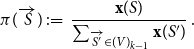 \begin{equation} \pi (\overrightarrow {S})\,:\!=\, \frac {\mathbf{x}(S)}{\sum _{\overrightarrow {S'} \in (V)_{k-1}} \mathbf{x}(S')}\, . \end{equation}
Observe that the denominator of (5.1) can be rewritten as
 \begin{equation} \sum _{\overrightarrow {S'} \in (V)_{k-1}} \mathbf{x}(S') = k! \cdot \sum _{e \in E(G)} \mathbf{x}(e) = (k-1)! \cdot n\,, \end{equation}
where we used that every edge contains $k!$
ordered
$k!$
ordered $(k-1)$
-sets. The transition probability will also be defined according to
$(k-1)$
-sets. The transition probability will also be defined according to $\mathbf{x}$
. For all
$\mathbf{x}$
. For all $i \ge k-1$
, conditional on the outcome of
$i \ge k-1$
, conditional on the outcome of $Y_{i-(k-2)},\ldots, Y_i$
, we choose the next vertex
$Y_{i-(k-2)},\ldots, Y_i$
, we choose the next vertex $Y_{i+1}$
as follows: Let
$Y_{i+1}$
as follows: Let $\overrightarrow {Z_i}\,:\!=\,(Y_{i-(k-2)},\ldots, Y_i)$
be the ordered set of the last
$\overrightarrow {Z_i}\,:\!=\,(Y_{i-(k-2)},\ldots, Y_i)$
be the ordered set of the last $k-1$
vertices in the sequence and choose
$k-1$
vertices in the sequence and choose $Y_{i+1}$
with probability proportional to
$Y_{i+1}$
with probability proportional to $\mathbf{x}(Z_i \cup \{\cdot \})$
, that is, for any
$\mathbf{x}(Z_i \cup \{\cdot \})$
, that is, for any $v \in V \setminus Z_i$
,
$v \in V \setminus Z_i$
,
 \begin{equation} {\mathbf{Pr}}[Y_{i+1}=v|Y_{i-(k-2)},\ldots, Y_{i}] = \frac {\mathbf{x}(Z_{i}\cup \{v\})}{\sum _{v' \in V \setminus Z_i}\mathbf{x}(Z_i \cup \{v'\})} = \frac {\mathbf{x}(Z_{i}\cup \{v\})}{\mathbf{x}(Z_i)} \,, \end{equation}
and for any $v \in Z_i$
the transition probability is
$v \in Z_i$
the transition probability is $0$
. Observe that
$0$
. Observe that $\mathcal{Y}$
is equivalent to the random walk
$\mathcal{Y}$
is equivalent to the random walk $\mathcal{Z}\,:\!=\,(\overrightarrow {Z_{k-1}},\overrightarrow {Z_k},\ldots )$
, and we can refer to both. In fact, with
$\mathcal{Z}\,:\!=\,(\overrightarrow {Z_{k-1}},\overrightarrow {Z_k},\ldots )$
, and we can refer to both. In fact, with $(V)_{k-1}$
viewed as the state space,
$(V)_{k-1}$
viewed as the state space, $\mathcal{Z}$
is a Markov chain and it is then easy to check that the distribution
$\mathcal{Z}$
is a Markov chain and it is then easy to check that the distribution $\pi$
defined in (5.1) is stationary (cf. [Reference Glock, Gould, Joos, Kühn and Osthus19, Proposition 5.5]). The important fact of defining the transition probabilities in terms of the perfect fractional matching
$\pi$
defined in (5.1) is stationary (cf. [Reference Glock, Gould, Joos, Kühn and Osthus19, Proposition 5.5]). The important fact of defining the transition probabilities in terms of the perfect fractional matching $\mathbf{x}$
is that then the random walk behaves uniformly with respect to the visited vertices, in the sense that the distribution of the vertices for
$\mathbf{x}$
is that then the random walk behaves uniformly with respect to the visited vertices, in the sense that the distribution of the vertices for $\mathcal{Y}$
to visit at any step is uniform over
$\mathcal{Y}$
to visit at any step is uniform over $V(G)$
as proved below.
$V(G)$
as proved below.
Fact 5.1.
For each integer $i \ge 1$
and
$i \ge 1$
and $v \in V(G)$
, we have that
$v \in V(G)$
, we have that ${\mathbf{Pr}}[Y_i=v]=1/n$
. Moreover, for each
${\mathbf{Pr}}[Y_i=v]=1/n$
. Moreover, for each $k \le i \le t$
, with
$k \le i \le t$
, with $e_i\,:\!=\,\{Y_{i-k+1},\ldots, Y_i\}$
denoting the
$e_i\,:\!=\,\{Y_{i-k+1},\ldots, Y_i\}$
denoting the $(i-k+1)$
-st edge of
$(i-k+1)$
-st edge of $\mathcal{Y}$
, the following holds: For each
$\mathcal{Y}$
, the following holds: For each $e\in E(G)$
, we have that
$e\in E(G)$
, we have that ${\mathbf{Pr}}[e_i=e]=\frac {k}{n}\mathbf{x}(e)$
.
${\mathbf{Pr}}[e_i=e]=\frac {k}{n}\mathbf{x}(e)$
.
Proof.
Let $v\in V$
. For
$v\in V$
. For $1 \le i \le k-1$
, observe the following identity where the first sum runs over all
$1 \le i \le k-1$
, observe the following identity where the first sum runs over all $\overrightarrow {S} \in (V)_{k-1}$
such that
$\overrightarrow {S} \in (V)_{k-1}$
such that $v$
is the
$v$
is the $i$
-th element of
$i$
-th element of $\overrightarrow {S}$
, and the second sum runs over all
$\overrightarrow {S}$
, and the second sum runs over all $S \in \binom {V}{k-1}$
with
$S \in \binom {V}{k-1}$
with $v \in S$
:
$v \in S$
:
 \begin{equation*} \sum _{\substack {\overrightarrow {S} = (v_1,\ldots, v_{k-1}) \\ v_i = v}} \mathbf{x}(S) = (k-2)! \cdot \sum _{S \in \binom {V}{k-1} \,{:}\, v \in S} \mathbf{x}(S) = (k-1)! \cdot \sum _{e\,:\,e \ni v} \mathbf{x}(e) = (k-1)! \,. \end{equation*}
Together with (5.2), we get ${\mathbf{Pr}}[Y_i=v] = 1/n$
.
${\mathbf{Pr}}[Y_i=v] = 1/n$
.
Since $\pi$
as defined in (5.1) is the stationary distribution of
$\pi$
as defined in (5.1) is the stationary distribution of $\mathcal{Z}$
, it holds that
$\mathcal{Z}$
, it holds that ${\mathbf{Pr}}[\overrightarrow {Z_i}=\overrightarrow {S}] = \pi (\overrightarrow {S})$
for each
${\mathbf{Pr}}[\overrightarrow {Z_i}=\overrightarrow {S}] = \pi (\overrightarrow {S})$
for each $i \ge k-1$
. Let
$i \ge k-1$
. Let $i \ge k$
. Then by the law of total probability we have
$i \ge k$
. Then by the law of total probability we have
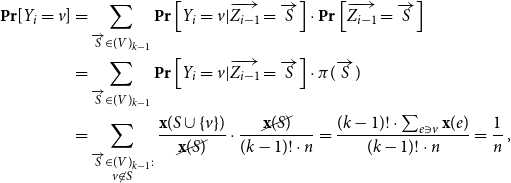
where we used (5.2), that for an edge $e$
with
$e$
with $e \ni v$
there are
$e \ni v$
there are $(k-1)!$
choices for
$(k-1)!$
choices for $\overrightarrow {S} \in (V)_{k-1}$
such that
$\overrightarrow {S} \in (V)_{k-1}$
such that $S \cup \{v\}=e$
, and that
$S \cup \{v\}=e$
, and that $\mathbf{x}$
is a perfect fractional matching.
$\mathbf{x}$
is a perfect fractional matching.
For the ‘moreover’-part of Fact 5.1, let $k \le i \le t$
and
$k \le i \le t$
and $e \in E(G)$
. Then
$e \in E(G)$
. Then
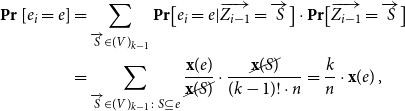
where we used (5.2) and that there are $k!$
ways to choose
$k!$
ways to choose $\overrightarrow {S} \in (V)_{k-1}$
such that
$\overrightarrow {S} \in (V)_{k-1}$
such that $S{\subseteq } e$
.
$S{\subseteq } e$
.
Despite Fact 5.1, for an arbitrary perfect fractional matching $\mathbf{x}$
, the behaviour of the random walk
$\mathbf{x}$
, the behaviour of the random walk $\mathcal{Y}$
can still be quite trivial. For instance, suppose that
$\mathcal{Y}$
can still be quite trivial. For instance, suppose that $\mathbf{x}$
is indeed a perfect matching
$\mathbf{x}$
is indeed a perfect matching $M$
, that is
$M$
, that is $\mathbf{x}(e)= \unicode {x1D7D9}(e\in M)$
. Then, once the first ordered
$\mathbf{x}(e)= \unicode {x1D7D9}(e\in M)$
. Then, once the first ordered $(k-1)$
-set
$(k-1)$
-set $\overrightarrow {Z_{k-1}}$
is chosen, the walk is completely deterministic (and uses the same edge in each step). In order to avoid this in a robust way, we will assume that
$\overrightarrow {Z_{k-1}}$
is chosen, the walk is completely deterministic (and uses the same edge in each step). In order to avoid this in a robust way, we will assume that $\mathbf{x}$
is
$\mathbf{x}$
is $\mu$
-normal for some (small) constant
$\mu$
-normal for some (small) constant $\mu \gt 0$
(see Section 3.1 for the definition).
$\mu \gt 0$
(see Section 3.1 for the definition).
Ultimately, we would like to use the random walk $\mathcal{Y}$
to sample a collection of tight paths which cover almost all the vertices of
$\mathcal{Y}$
to sample a collection of tight paths which cover almost all the vertices of $G$
and have high discrepancy. As proved in Fact 5.1, the probability that
$G$
and have high discrepancy. As proved in Fact 5.1, the probability that $\mathcal{Y}$
sees a certain edge
$\mathcal{Y}$
sees a certain edge $e$
is proportional to
$e$
is proportional to $\mathbf{x}(e)$
. Therefore, in order to guarantee that
$\mathbf{x}(e)$
. Therefore, in order to guarantee that $\mathcal{Y}$
sees a substantial number of edges of the same colour, it will be enough that
$\mathcal{Y}$
sees a substantial number of edges of the same colour, it will be enough that $\mathbf{x}$
is a normal perfect fractional matching with high discrepancy. Recall that the total weight assigned by any perfect fractional matching is
$\mathbf{x}$
is a normal perfect fractional matching with high discrepancy. Recall that the total weight assigned by any perfect fractional matching is $n/k$
, so, just by averaging, some colour will receive a total weight of at least
$n/k$
, so, just by averaging, some colour will receive a total weight of at least $n/(rk)$
. By combining Lemma 3.3 with our key lemma (Lemma 4.1), we are able to boost the discrepancy. Starting with a perfect fractional matching given by Lemma 3.3, if we can find a near-alternating
$n/(rk)$
. By combining Lemma 3.3 with our key lemma (Lemma 4.1), we are able to boost the discrepancy. Starting with a perfect fractional matching given by Lemma 3.3, if we can find a near-alternating $k$
-grid (which we refer to as a gadget from now on), then by increasing the weight of the red matching, say, and decreasing the weight of the blue matching by the same amount, the total weight of each vertex remains unchanged, but the total weight of the red edges has increased. Obviously, one gadget will only allow us to perform an insignificant perturbation, but by applying the key lemma iteratively, we can find many edge-disjoint gadgets and together they allow us to perturb the initial perfect fractional matching by a significant amount.
$k$
-grid (which we refer to as a gadget from now on), then by increasing the weight of the red matching, say, and decreasing the weight of the blue matching by the same amount, the total weight of each vertex remains unchanged, but the total weight of the red edges has increased. Obviously, one gadget will only allow us to perform an insignificant perturbation, but by applying the key lemma iteratively, we can find many edge-disjoint gadgets and together they allow us to perturb the initial perfect fractional matching by a significant amount.
Lemma 5.2.
Let $1/n \ll \mu \ll {\varepsilon }, 1/r, 1/k$
with
$1/n \ll \mu \ll {\varepsilon }, 1/r, 1/k$
with $k,r\in \mathbb{N}$
,
$k,r\in \mathbb{N}$
, $k\ge 3$
and
$k\ge 3$
and $r\ge 2$
. Let
$r\ge 2$
. Let $G$
be an
$G$
be an $n$
-vertex
$n$
-vertex $k$
-graph with
$k$
-graph with $\delta (G)\ge (1/2+{\varepsilon })n$
whose edges are
$\delta (G)\ge (1/2+{\varepsilon })n$
whose edges are $r$
-coloured. Then
$r$
-coloured. Then $G$
has a
$G$
has a $\mu$
-normal perfect fractional matching such that the total weight received by some colour class is at least
$\mu$
-normal perfect fractional matching such that the total weight received by some colour class is at least $(1+ \mu )\frac {n}{rk}$
.
$(1+ \mu )\frac {n}{rk}$
.
Proof. Let
 \begin{equation*}1/n \ll \mu \ll \eta \ll \zeta \ll \rho \ll \mu _0 \ll {\varepsilon }, 1/r, 1/k\,, \end{equation*}
where $\mu _0$
is small enough for Lemma 3.3 to hold on input
$\mu _0$
is small enough for Lemma 3.3 to hold on input $k$
and
$k$
and $\varepsilon$
, and
$\varepsilon$
, and $\zeta$
is small enough for Lemma 4.1 to hold on input
$\zeta$
is small enough for Lemma 4.1 to hold on input $k,{\varepsilon }/2$
and
$k,{\varepsilon }/2$
and $\rho /2$
. Let
$\rho /2$
. Let $\mathbf{x}_0$
be a
$\mathbf{x}_0$
be a $\mu _0$
-normal perfect fractional matching as given by Lemma 3.3.
$\mu _0$
-normal perfect fractional matching as given by Lemma 3.3.
Let $c_1, \ldots, c_r$
be the
$c_1, \ldots, c_r$
be the $r$
colours used in the edge-colouring of
$r$
colours used in the edge-colouring of $G$
. Since Lemma 4.1 is only stated for
$G$
. Since Lemma 4.1 is only stated for $2$
-edge-coloured graphs, we will now consider the following
$2$
-edge-coloured graphs, we will now consider the following $2$
-edge-colouring of
$2$
-edge-colouring of $G$
, obtained by identifying
$G$
, obtained by identifying $r-1$
of the colours to a unique colour: Colour by ‘red’ any edge coloured by
$r-1$
of the colours to a unique colour: Colour by ‘red’ any edge coloured by $c_1$
, and by ‘blue’ every other edge.
$c_1$
, and by ‘blue’ every other edge.
We claim that either $G$
contains
$G$
contains $\eta n^k$
edge-disjoint gadgets or one of the colour classes of
$\eta n^k$
edge-disjoint gadgets or one of the colour classes of $G$
has size at most
$G$
has size at most $\rho n^k$
. This follows by applying Lemma 4.1 iteratively. Suppose indeed that a maximal collection of edge-disjoint gadgets has size
$\rho n^k$
. This follows by applying Lemma 4.1 iteratively. Suppose indeed that a maximal collection of edge-disjoint gadgets has size $\ell \lt \eta n^k$
, and let
$\ell \lt \eta n^k$
, and let $G'$
be the subhypergraph of
$G'$
be the subhypergraph of $G$
obtained by removing all the edges of such gadgets. Let
$G$
obtained by removing all the edges of such gadgets. Let $\mathcal{S}$
be the collection of the
$\mathcal{S}$
be the collection of the $(k-1)$
-subsets
$(k-1)$
-subsets $S$
of
$S$
of $V$
with
$V$
with $d_{G'}(S) \lt (1/2+{\varepsilon }/2)n$
. We now bound the size of
$d_{G'}(S) \lt (1/2+{\varepsilon }/2)n$
. We now bound the size of $\mathcal{S}$
. The total number of removed edges is
$\mathcal{S}$
. The total number of removed edges is $2k \ell \lt 2k\eta n^k$
. In order to have
$2k \ell \lt 2k\eta n^k$
. In order to have $S \in {\mathcal{S}}$
, we must have removed at least
$S \in {\mathcal{S}}$
, we must have removed at least ${\varepsilon } n/2$
edges containing
${\varepsilon } n/2$
edges containing $S$
, and each removed edge decreases the degree of
$S$
, and each removed edge decreases the degree of $k$
$k$ $(k-1)$
-sets by one. Therefore
$(k-1)$
-sets by one. Therefore $|{\mathcal{S}}| \le \frac {2k^2 \eta n^k}{{\varepsilon } n/2} \le \zeta n^{k-1}$
, where we used
$|{\mathcal{S}}| \le \frac {2k^2 \eta n^k}{{\varepsilon } n/2} \le \zeta n^{k-1}$
, where we used $\eta \ll \zeta, {\varepsilon }$
for the last inequality. Since the collection was maximal, invoking Lemma 4.1, we get that one of the colour classes of
$\eta \ll \zeta, {\varepsilon }$
for the last inequality. Since the collection was maximal, invoking Lemma 4.1, we get that one of the colour classes of $G'$
has size at most
$G'$
has size at most $\rho n^k/2$
. Therefore one of the colour classes of
$\rho n^k/2$
. Therefore one of the colour classes of $G$
has size at most
$G$
has size at most $\rho n^k/2 + 2k \cdot \ell \lt \rho n^k$
, where we used
$\rho n^k/2 + 2k \cdot \ell \lt \rho n^k$
, where we used $\ell \lt \eta n^k$
and
$\ell \lt \eta n^k$
and $\eta \ll \rho$
.
$\eta \ll \rho$
.
If one of the colour classes of $G$
, say
$G$
, say $\mathcal{C}$
, has size at most
$\mathcal{C}$
, has size at most $\rho n^k$
, then, since
$\rho n^k$
, then, since $\mathbf{x}_0$
is
$\mathbf{x}_0$
is $\mu _0$
-normal, this colour class gets a total weight of at most
$\mu _0$
-normal, this colour class gets a total weight of at most $\sum _{e \in {\mathcal{C}}} \mathbf{x}_0(e) \le |{\mathcal{C}}| \mu _0^{-1} n^{-k+1} \le \mu _0^{-1} \rho n$
. Then the other colour class gets a total weight of at least
$\sum _{e \in {\mathcal{C}}} \mathbf{x}_0(e) \le |{\mathcal{C}}| \mu _0^{-1} n^{-k+1} \le \mu _0^{-1} \rho n$
. Then the other colour class gets a total weight of at least $(1/k- \mu _0^{-1} \rho )n$
. By averaging,
$(1/k- \mu _0^{-1} \rho )n$
. By averaging, $\mathbf{x}_0$
assigns to one of the colour classes of the original
$\mathbf{x}_0$
assigns to one of the colour classes of the original $r$
-edge-colouring of
$r$
-edge-colouring of $G$
a total weight of at least
$G$
a total weight of at least $\frac {(1/k-\mu _0^{-1}\rho )n}{r-1} \ge (1+\mu ) \frac {n}{rk}$
, where we used
$\frac {(1/k-\mu _0^{-1}\rho )n}{r-1} \ge (1+\mu ) \frac {n}{rk}$
, where we used $\rho \ll \mu _0, 1/r, 1/k$
. In particular,
$\rho \ll \mu _0, 1/r, 1/k$
. In particular, $\mathbf{x}_0$
is already a desired
$\mathbf{x}_0$
is already a desired $\mu$
-normal perfect fractional matching with high discrepancy.
$\mu$
-normal perfect fractional matching with high discrepancy.
We are left with the case where there exists a collection $\mathcal{L}\,:\!=\,\{L_i\,{:}\,i \in [\eta n^k]\}$
of
$\mathcal{L}\,:\!=\,\{L_i\,{:}\,i \in [\eta n^k]\}$
of $\eta n^k$
edge-disjoint gadgets. Now, either the total weight assigned by
$\eta n^k$
edge-disjoint gadgets. Now, either the total weight assigned by $\mathbf{x}_0$
to the red edges is at least
$\mathbf{x}_0$
to the red edges is at least $\frac {n}{rk}$
, or the total weight assigned by
$\frac {n}{rk}$
, or the total weight assigned by $\mathbf{x}_0$
to the blue edges is at least
$\mathbf{x}_0$
to the blue edges is at least $\frac {(r-1)n}{rk}$
.
$\frac {(r-1)n}{rk}$
.
Suppose we are in the first case. We will modify $\mathbf{x}_0$
on the edges of each gadget in
$\mathbf{x}_0$
on the edges of each gadget in $\mathcal{L}$
to obtain a
$\mathcal{L}$
to obtain a $\mu$
-normal perfect fractional matching
$\mu$
-normal perfect fractional matching $\mathbf{x}$
with high discrepancy in colour
$\mathbf{x}$
with high discrepancy in colour $c_1$
. For
$c_1$
. For $L \in \mathcal{L}$
, let
$L \in \mathcal{L}$
, let $e_1^L,\ldots, e_k^L$
(resp.
$e_1^L,\ldots, e_k^L$
(resp. $f_1^L,\ldots, f_k^L)$
be the horizontal (resp. vertical) edges of
$f_1^L,\ldots, f_k^L)$
be the horizontal (resp. vertical) edges of $L$
, and recall these are pairwise distinct. By the definition of a near-alternating
$L$
, and recall these are pairwise distinct. By the definition of a near-alternating $k$
-grid, all edges
$k$
-grid, all edges $e_1^L,\ldots, e_k^L$
but at most one are red, and all edges
$e_1^L,\ldots, e_k^L$
but at most one are red, and all edges $f_1^L,\ldots, f_k^L$
but at most one are blue. Define
$f_1^L,\ldots, f_k^L$
but at most one are blue. Define $\mathbf{x} \colon E(G) \to [0,1]$
as follows:
$\mathbf{x} \colon E(G) \to [0,1]$
as follows: $\mathbf{x}(e_i^L)=\mathbf{x}_0(e_i^L)+ \mu _0 n^{-k+1}/2$
and
$\mathbf{x}(e_i^L)=\mathbf{x}_0(e_i^L)+ \mu _0 n^{-k+1}/2$
and $\mathbf{x}(f_i^L)=\mathbf{x}_0(f_i^L)- \mu _0 n^{-k+1}/2$
for each
$\mathbf{x}(f_i^L)=\mathbf{x}_0(f_i^L)- \mu _0 n^{-k+1}/2$
for each $i \in [k]$
and
$i \in [k]$
and $L \in \mathcal{L}$
. Moreover, set
$L \in \mathcal{L}$
. Moreover, set $\mathbf{x}(e)=\mathbf{x}_0(e)$
for any other edge
$\mathbf{x}(e)=\mathbf{x}_0(e)$
for any other edge $e \in E(G)$
. In other words,
$e \in E(G)$
. In other words, $\mathbf{x}$
is obtained from
$\mathbf{x}$
is obtained from $\mathbf{x}_0$
by decreasing the weight of each vertical edge by
$\mathbf{x}_0$
by decreasing the weight of each vertical edge by $\mu _0 n^{-k+1}/2$
and increasing the weight of each horizontal edge by the same quantity, in each of the gadgets in
$\mu _0 n^{-k+1}/2$
and increasing the weight of each horizontal edge by the same quantity, in each of the gadgets in $\mathcal{L}$
. Observe that if a vertex is contained in a gadget, then it belongs to precisely one horizontal edge and one vertical edge of this gadget. Therefore for every vertex
$\mathcal{L}$
. Observe that if a vertex is contained in a gadget, then it belongs to precisely one horizontal edge and one vertical edge of this gadget. Therefore for every vertex $v \in V(G)$
we have that
$v \in V(G)$
we have that $\sum _{e \ni v} \mathbf{x}(e) = \sum _{e \ni v} \mathbf{x}_0(e) = 1$
. Also, for every
$\sum _{e \ni v} \mathbf{x}(e) = \sum _{e \ni v} \mathbf{x}_0(e) = 1$
. Also, for every $e \in E(G)$
we have
$e \in E(G)$
we have $\mu n^{-k+1} \le \mathbf{x}_0(e)-\mu _0 n^{-k+1}/2 \le \mathbf{x}(e) \le \mathbf{x}_0(e)+\mu _0 n^{-k+1}/2 \le \mu ^{-1} n^{-k+1}$
, where we used that
$\mu n^{-k+1} \le \mathbf{x}_0(e)-\mu _0 n^{-k+1}/2 \le \mathbf{x}(e) \le \mathbf{x}_0(e)+\mu _0 n^{-k+1}/2 \le \mu ^{-1} n^{-k+1}$
, where we used that $\mu _0 n^{-k+1} \le \mathbf{x}_0(e) \le \mu _0^{-1} n^{-k+1}$
and
$\mu _0 n^{-k+1} \le \mathbf{x}_0(e) \le \mu _0^{-1} n^{-k+1}$
and $\mu \ll \mu _0$
. This shows that
$\mu \ll \mu _0$
. This shows that $\mathbf{x}$
is a
$\mathbf{x}$
is a $\mu$
-normal perfect fractional matching. Moreover, for each
$\mu$
-normal perfect fractional matching. Moreover, for each $L \in \mathcal{L}$
, the weight given by
$L \in \mathcal{L}$
, the weight given by $\mathbf{x}$
to the red edges in
$\mathbf{x}$
to the red edges in $L$
is bigger by at least
$L$
is bigger by at least $\mu _0 n^{-k+1}/2$
than the weight given by
$\mu _0 n^{-k+1}/2$
than the weight given by $\mathbf{x}_0$
to these edges. This is because we increased (by
$\mathbf{x}_0$
to these edges. This is because we increased (by $\mu _0 n^{-k+1}/2$
) the weight of at least
$\mu _0 n^{-k+1}/2$
) the weight of at least $k-1 \geq 2$
red edges, and decreased (by the same amount) the weight of at most one such edge. As the gadgets in
$k-1 \geq 2$
red edges, and decreased (by the same amount) the weight of at most one such edge. As the gadgets in $\mathcal{L}$
are edge-disjoint and
$\mathcal{L}$
are edge-disjoint and $|\mathcal{L}| = \eta n^k$
, we conclude that the total weight assigned by
$|\mathcal{L}| = \eta n^k$
, we conclude that the total weight assigned by $\mathbf{x}$
to the red edges is at least
$\mathbf{x}$
to the red edges is at least $\frac {n}{rk}+\eta n^k \mu _0 n^{-k+1} /2\ge (1+\mu )\frac {n}{rk}$
, using that
$\frac {n}{rk}+\eta n^k \mu _0 n^{-k+1} /2\ge (1+\mu )\frac {n}{rk}$
, using that $\mu \ll \eta, \mu _0$
. Therefore, the total weight assigned by
$\mu \ll \eta, \mu _0$
. Therefore, the total weight assigned by $\mathbf{x}$
to the colour class of
$\mathbf{x}$
to the colour class of $c_1$
in the original edge-colouring of
$c_1$
in the original edge-colouring of $G$
is at least
$G$
is at least $(1+\mu )\frac {n}{rk}$
.
$(1+\mu )\frac {n}{rk}$
.
Suppose now that we are in the second case, namely, that the total weight assigned by $\mathbf{x}_0$
to the blue edges is at least
$\mathbf{x}_0$
to the blue edges is at least $\frac {(r-1)n}{rk}$
. We then use the same argument as above to find a
$\frac {(r-1)n}{rk}$
. We then use the same argument as above to find a $\mu$
-normal perfect fractional matching
$\mu$
-normal perfect fractional matching $\mathbf{x}$
which assigns a total weight of at least
$\mathbf{x}$
which assigns a total weight of at least $(r-1)(1+\mu )\frac {n}{rk}$
to the blue edges. Recall that the blue edges are precisely those coloured by
$(r-1)(1+\mu )\frac {n}{rk}$
to the blue edges. Recall that the blue edges are precisely those coloured by $c_2,\ldots, c_r$
in the original colouring of
$c_2,\ldots, c_r$
in the original colouring of $G$
, and thus, by averaging, there is
$G$
, and thus, by averaging, there is $2 \le i \le r$
such that the total weight assigned by
$2 \le i \le r$
such that the total weight assigned by $\mathbf{x}$
to the colour class of
$\mathbf{x}$
to the colour class of $c_i$
in the original colouring of
$c_i$
in the original colouring of $G$
is at least
$G$
is at least $(1+\mu )\frac {n}{rk}$
.
$(1+\mu )\frac {n}{rk}$
.
Ideally, we would like to use the random walk $\mathcal{Y}$
and Lemma 5.2 to obtain long tight paths with high discrepancy. However, one remaining problem is that, if we let the random walk continue for too many steps, then with high probability, it will not be self-avoiding anymore. It might be possible to analyse the ’self-avoiding‘ version of this random walk and show that with high probability, it will cover almost all the vertices and will have high discrepancy. However, such an analysis might be very intricate. To circumvent this, we prove the following ’sampling lemma’ which allows us, using the random walk, to sample from the set of all tight paths in
$\mathcal{Y}$
and Lemma 5.2 to obtain long tight paths with high discrepancy. However, one remaining problem is that, if we let the random walk continue for too many steps, then with high probability, it will not be self-avoiding anymore. It might be possible to analyse the ’self-avoiding‘ version of this random walk and show that with high probability, it will cover almost all the vertices and will have high discrepancy. However, such an analysis might be very intricate. To circumvent this, we prove the following ’sampling lemma’ which allows us, using the random walk, to sample from the set of all tight paths in $G$
of order
$G$
of order $t$
, where
$t$
, where $t$
is a (large) constant, in such a way that every vertex appears in the chosen path with approximately the same probability, and we expect more edges of one specific colour. In Section 6, we will then produce a large collection of paths sampled from this distribution, and then use a nibble-type argument to select from this collection a large linear forest with high discrepancy.
$t$
is a (large) constant, in such a way that every vertex appears in the chosen path with approximately the same probability, and we expect more edges of one specific colour. In Section 6, we will then produce a large collection of paths sampled from this distribution, and then use a nibble-type argument to select from this collection a large linear forest with high discrepancy.
Lemma 5.3.
Let $1/n \ll 1/t, \mu \ll {\varepsilon }, 1/k, 1/r$
with
$1/n \ll 1/t, \mu \ll {\varepsilon }, 1/k, 1/r$
with $k,r,t \in \mathbb{N}$
,
$k,r,t \in \mathbb{N}$
, $k\ge 3$
and
$k\ge 3$
and $r\ge 2$
. Let
$r\ge 2$
. Let $G$
be an
$G$
be an $n$
-vertex
$n$
-vertex $k$
-graph with
$k$
-graph with $\delta (G)\ge (1/2+{\varepsilon })n$
whose edges are
$\delta (G)\ge (1/2+{\varepsilon })n$
whose edges are $r$
-coloured. Let
$r$
-coloured. Let $\Omega$
be the set of all tight paths of order
$\Omega$
be the set of all tight paths of order $t$
in
$t$
in $G$
. Then, there exists a colour ‘red’ and a probability distribution on
$G$
. Then, there exists a colour ‘red’ and a probability distribution on $\Omega$
such that a randomly chosen element
$\Omega$
such that a randomly chosen element $P\in \Omega$
has the following properties:
$P\in \Omega$
has the following properties:
-
(1) for any given tight path
$Q$
, we have
$ {\mathbb{P}}\left [P=Q\right ] \le O_{t,\mu }(n^{-t})$
; -
(2) for every
$v\in V(G)$
, we have
$\Big |{\mathbb{P}}\left [v\in V(P)\right ] - \frac {t}{n}\Big | \le O_{t,\mu }\left (n^{-2}\right )$
; -
(3) the expected number of red edges in
$P$
is at least
$\frac {1+\mu }{r}\cdot (t-k+1)-O_{t,\mu }(n^{-1})$
.


Proof.
Let $\mathbf{x}$
be a
$\mathbf{x}$
be a $\mu$
-normal perfect fractional matching of
$\mu$
-normal perfect fractional matching of $G$
such that the total weight received by some colour class, say ‘red’, is at least
$G$
such that the total weight received by some colour class, say ‘red’, is at least $(1+\mu )\frac {n}{rk}$
. This exists by Lemma 5.2. Let
$(1+\mu )\frac {n}{rk}$
. This exists by Lemma 5.2. Let $\mathcal{Y}=(Y_1,Y_2,\ldots )$
be the random walk defined via
$\mathcal{Y}=(Y_1,Y_2,\ldots )$
be the random walk defined via $\mathbf{x}$
, with notation as introduced at the beginning of this section. (In particular, we use
$\mathbf{x}$
, with notation as introduced at the beginning of this section. (In particular, we use $\mathbf{Pr}$
as the probability measure corresponding to the random walk, whereas
$\mathbf{Pr}$
as the probability measure corresponding to the random walk, whereas $\mathbb{P}$
will denote the desired probability measure on
$\mathbb{P}$
will denote the desired probability measure on $\Omega$
.) Here, we will only be interested in the first
$\Omega$
.) Here, we will only be interested in the first $t$
vertices of
$t$
vertices of $\mathcal{Y}$
and we note that those form a tight walk of order
$\mathcal{Y}$
and we note that those form a tight walk of order $t$
. Now, sample elements of
$t$
. Now, sample elements of $\Omega$
according to the first
$\Omega$
according to the first $t$
vertices of
$t$
vertices of $\mathcal{Y}$
, conditioned on
$\mathcal{Y}$
, conditioned on $\mathcal{Y}$
being self-avoiding up to
$\mathcal{Y}$
being self-avoiding up to $Y_t$
. More precisely, let
$Y_t$
. More precisely, let $\mathcal{B}$
be the event that
$\mathcal{B}$
be the event that $Y_1, \ldots, Y_t$
are pairwise distinct, and denote by
$Y_1, \ldots, Y_t$
are pairwise distinct, and denote by $Q$
any tight path of order
$Q$
any tight path of order $t$
and by
$t$
and by $q_1, \ldots, q_t$
the vertices of
$q_1, \ldots, q_t$
the vertices of $Q$
(appearing in this order). Then take the distribution on
$Q$
(appearing in this order). Then take the distribution on $\Omega$
where a randomly chosen element
$\Omega$
where a randomly chosen element $P \in \Omega$
satisfies
$P \in \Omega$
satisfies
 \begin{equation*} {\mathbb{P}}[P=Q] = {\mathbf{Pr}}\Big [\{Y_1=q_1,\ldots, Y_t=q_t\} \cup \{Y_1=q_t,\ldots, Y_t=q_1\}\; |\; {\mathcal{B}}\Big ]\,, \end{equation*}
where we considered both orders of $Q$
since the elements of
$Q$
since the elements of $\Omega$
are unordered. We claim that this distribution on
$\Omega$
are unordered. We claim that this distribution on $\Omega$
has the desired properties. Before proving that this is the case, we need some preliminary observations.
$\Omega$
has the desired properties. Before proving that this is the case, we need some preliminary observations.
Since $\mathbf{x}$
is
$\mathbf{x}$
is $\mu$
-normal, the probability that the walk starts with
$\mu$
-normal, the probability that the walk starts with $\overrightarrow {S}=(q_1,\ldots, q_{k-1})$
is
$\overrightarrow {S}=(q_1,\ldots, q_{k-1})$
is
 \begin{equation*} \pi (\overrightarrow {S}) = \frac {\mathbf{x}(S)}{\sum _{\overrightarrow {S'} \in (V)_{k-1}} \mathbf{x}(S')} \le \frac {n \cdot \mu ^{-1} n^{-k+1}}{(k-1)! \cdot n} = O_{\mu }(n^{-k+1})\,, \end{equation*}
where we used (5.2). By using in addition that $\delta (G) \ge (1/2+{\varepsilon })n$
, we can show that the transition probabilities of
$\delta (G) \ge (1/2+{\varepsilon })n$
, we can show that the transition probabilities of $\mathcal{Y}$
are
$\mathcal{Y}$
are $O_{\mu }(n^{-1})$
. Indeed, with
$O_{\mu }(n^{-1})$
. Indeed, with $\overrightarrow {Z_i}=(Y_{i-(k-2)},\ldots, Y_i)$
being the ordered set of the last
$\overrightarrow {Z_i}=(Y_{i-(k-2)},\ldots, Y_i)$
being the ordered set of the last $k-1$
vertices of
$k-1$
vertices of $\mathcal{Y}$
, for
$\mathcal{Y}$
, for $v \in V(G) \setminus Z_i$
we have
$v \in V(G) \setminus Z_i$
we have
 \begin{equation*} {\mathbf{Pr}}[Y_{i+1}=v|Y_{i-(k-2)},\ldots, Y_{i}] = \frac {\mathbf{x}(Z_{i}\cup \{v\})}{\mathbf{x}(Z_i)} \le \frac {\mu ^{-1} n^{-k+1}}{1/2 \cdot n \cdot \mu n^{-k+1}} = O_{\mu }(n^{-1})\,, \end{equation*}
while for $v \in Z_i$
we have
$v \in Z_i$
we have ${\mathbf{Pr}}[Y_{i+1}=v|Y_{i-(k-2)},\ldots, Y_{i}]=0$
. Therefore, by applying the chain rule,
${\mathbf{Pr}}[Y_{i+1}=v|Y_{i-(k-2)},\ldots, Y_{i}]=0$
. Therefore, by applying the chain rule, ${\mathbf{Pr}}[Y_1=q_1,\ldots, Y_t=q_t]=O_{t,\mu }(n^{-t})$
. Moreover, the number of walks of order
${\mathbf{Pr}}[Y_1=q_1,\ldots, Y_t=q_t]=O_{t,\mu }(n^{-t})$
. Moreover, the number of walks of order $t$
which are not self-avoiding is
$t$
which are not self-avoiding is $O_t(n^{t-1})$
and thus
$O_t(n^{t-1})$
and thus ${\mathbf{Pr}}[{\mathcal{B}}^c]=O_t(n^{t-1}) \cdot O_{t,\mu }(n^{-t})=O_{t,\mu }(n^{-1})$
.
${\mathbf{Pr}}[{\mathcal{B}}^c]=O_t(n^{t-1}) \cdot O_{t,\mu }(n^{-t})=O_{t,\mu }(n^{-1})$
.
Now Item (1) follows easily as we have
 \begin{equation*}{\mathbb{P}}[P=Q]\le \frac {{\mathbf{Pr}}[Y_1=q_1,\ldots, Y_t=q_t]+{\mathbf{Pr}}[Y_1=q_t,\ldots, Y_t=q_1]}{{\mathbf{Pr}}[{\mathcal{B}}]} =O_{t,\mu }(n^{-t}), \end{equation*}
where we used that ${\mathbf{Pr}}[{\mathcal{B}}] = 1-O_{t,\mu }(n^{-1})\ge 1/2$
.
${\mathbf{Pr}}[{\mathcal{B}}] = 1-O_{t,\mu }(n^{-1})\ge 1/2$
.
Fix $v \in V(G)$
and
$v \in V(G)$
and $1 \le i \le t$
. The number of walks of order
$1 \le i \le t$
. The number of walks of order $t$
which are not self-avoiding and whose
$t$
which are not self-avoiding and whose $i$
-th vertex is
$i$
-th vertex is $v$
is
$v$
is $O_t(n^{t-2})$
and thus
$O_t(n^{t-2})$
and thus ${\mathbf{Pr}}\left [\{Y_i=v\} \cap {\mathcal{B}}^c\right ] = O_t(n^{t-2}) \cdot O_{t,\mu }(n^{-t})=O_{t,\mu }(n^{-2})$
. Therefore,
${\mathbf{Pr}}\left [\{Y_i=v\} \cap {\mathcal{B}}^c\right ] = O_t(n^{t-2}) \cdot O_{t,\mu }(n^{-t})=O_{t,\mu }(n^{-2})$
. Therefore,
 \begin{equation*} {\mathbb{P}}[v \in V(P)] = {\mathbf{Pr}}\left [\bigcup _{i \in [t]} \{Y_i=v\} \; | \; {\mathcal{B}} \right ] = \sum _{i \in [t]} \frac {{\mathbf{Pr}}\big [\{Y_i=v\} \cap {\mathcal{B}} \big ]}{{\mathbf{Pr}}[{\mathcal{B}}]} \ge tn^{-1}-O_{t,\mu }(n^{-2}) \,, \end{equation*}
where we used that the events $\{Y_i=v\} \cap {\mathcal{B}}$
with
$\{Y_i=v\} \cap {\mathcal{B}}$
with $i \in [t]$
are pairwise disjoint, that
$i \in [t]$
are pairwise disjoint, that ${\mathbf{Pr}}[\{Y_i=v\}]=n^{-1}$
by Fact 5.1, that
${\mathbf{Pr}}[\{Y_i=v\}]=n^{-1}$
by Fact 5.1, that
 \begin{equation*} {\mathbf{Pr}}\big [\{Y_i=v\} \cap {\mathcal{B}} \big ] = {\mathbf{Pr}}\big [Y_i=v\big ] - {\mathbf{Pr}}\big [\{Y_i=v\} \cap {\mathcal{B}}^c\big ] = n^{-1} - O_{t,\mu }(n^{-2}), \end{equation*}
and that ${\mathbf{Pr}}[{\mathcal{B}}]\le 1$
. Similarly, by using
${\mathbf{Pr}}[{\mathcal{B}}]\le 1$
. Similarly, by using ${\mathbf{Pr}}[{\mathcal{B}}]=1-O_{t,\mu }(n^{-1})$
, we get that
${\mathbf{Pr}}[{\mathcal{B}}]=1-O_{t,\mu }(n^{-1})$
, we get that ${\mathbb{P}}[v \in V(P)] \leq tn^{-1}+O_{t,\mu }(n^{-2})$
. This proves Item (2).
${\mathbb{P}}[v \in V(P)] \leq tn^{-1}+O_{t,\mu }(n^{-2})$
. This proves Item (2).
For a given $k \le i \le t$
, denote by
$k \le i \le t$
, denote by $e_i\,:\!=\,\{Y_{i-k+1},\ldots, Y_i\}$
the
$e_i\,:\!=\,\{Y_{i-k+1},\ldots, Y_i\}$
the $(i-k+1)$
-st edge of
$(i-k+1)$
-st edge of $\mathcal{Y}$
. Let
$\mathcal{Y}$
. Let $e \in E(G)$
. Similarly as above,
$e \in E(G)$
. Similarly as above, ${\mathbf{Pr}}[\{e_i=e\} \cap {\mathcal{B}}^c]=O_{t,\mu }(n^{-k-1})$
because there are
${\mathbf{Pr}}[\{e_i=e\} \cap {\mathcal{B}}^c]=O_{t,\mu }(n^{-k-1})$
because there are $O_t(n^{t-k-1})$
tight walks which are not self-avoiding and satisfy
$O_t(n^{t-k-1})$
tight walks which are not self-avoiding and satisfy $e_i = e$
, and each such walk has probability
$e_i = e$
, and each such walk has probability $O_{t,\mu }(n^{-t})$
. Thus,
$O_{t,\mu }(n^{-t})$
. Thus,
 \begin{equation*} {\mathbf{Pr}}\Big [e_i=e \; | \; {\mathcal{B}}\Big ]=\frac {{\mathbf{Pr}}\big [e_i=e\big ]-{\mathbf{Pr}}\big [\{e_i=e\} \cap {\mathcal{B}}^c\big ]}{{\mathbf{Pr}}[{\mathcal{B}}]} \ge \frac {k}{n}\cdot \mathbf{x}(e) - O_{t,\mu }(n^{-k-1})\,, \end{equation*}
where we used Fact 5.1 and ${\mathbf{Pr}}[{\mathcal{B}}]\le 1$
. Let
${\mathbf{Pr}}[{\mathcal{B}}]\le 1$
. Let $\mathcal{R}$
be the set of edges of
$\mathcal{R}$
be the set of edges of $G$
which are coloured red. Then
$G$
which are coloured red. Then
 \begin{equation*} {\mathbf{Pr}}\Big [e_i\in {\mathcal{R}} \; | \; {\mathcal{B}}\Big ] \ge \sum _{e \in {\mathcal{R}}} \left (\frac {k}{n}\cdot \mathbf{x}(e) - O_{t,\mu }(n^{-k-1})\right ) \ge \frac {1+\mu }{r}-O_{t,\mu }(n^{-1})\,, \end{equation*}
where we used that $|{\mathcal{R}}| \le n^k$
and
$|{\mathcal{R}}| \le n^k$
and $\sum _{e \in {\mathcal{R}}} \mathbf{x}(e) \ge (1+\mu )\frac {n}{rk}$
. Since
$\sum _{e \in {\mathcal{R}}} \mathbf{x}(e) \ge (1+\mu )\frac {n}{rk}$
. Since $P$
is a path of order
$P$
is a path of order $t$
, it has
$t$
, it has $t-k+1$
edges, and thus Item (3) follows by linearity of expectation.
$t-k+1$
edges, and thus Item (3) follows by linearity of expectation.
6. Finding a linear forest with high discrepancy
The goal of this section is to prove the following result.
Lemma 6.1.
Let $1/n \ll 1/t \ll \beta \ll \mu \ll {\varepsilon }, 1/k, 1/r$
with
$1/n \ll 1/t \ll \beta \ll \mu \ll {\varepsilon }, 1/k, 1/r$
with $k,r,t\in \mathbb{N}$
,
$k,r,t\in \mathbb{N}$
, $k\ge 3$
,
$k\ge 3$
, $r\ge 2$
. Let
$r\ge 2$
. Let $G$
be an
$G$
be an $n$
-vertex
$n$
-vertex $k$
-graph with
$k$
-graph with $\delta (G)\ge (1/2+{\varepsilon })n$
whose edges are
$\delta (G)\ge (1/2+{\varepsilon })n$
whose edges are $r$
-coloured. Then
$r$
-coloured. Then $G$
contains a collection of vertex-disjoint tight paths of order
$G$
contains a collection of vertex-disjoint tight paths of order $t$
such that their union covers all but at most
$t$
such that their union covers all but at most $\beta n$
vertices of
$\beta n$
vertices of $G$
and there is some colour which appears on at least
$G$
and there is some colour which appears on at least $(1+\mu )\frac {n}{r}$
edges in the paths.
$(1+\mu )\frac {n}{r}$
edges in the paths.
Proof. Let
 \begin{equation*} 1/n \ll \delta \ll 1/t \ll \beta \ll \mu \ll {\varepsilon }, 1/k, 1/r\,, \end{equation*}
where $2\mu$
is given by Lemma 5.3 on input
$2\mu$
is given by Lemma 5.3 on input ${\varepsilon }, r, k$
, and set
${\varepsilon }, r, k$
, and set $\gamma \,:\!=\,\delta /(50t^2)$
and
$\gamma \,:\!=\,\delta /(50t^2)$
and $V\,:\!=\,V(G)$
.
$V\,:\!=\,V(G)$
.
Set $N\,:\!=\,n^{t-1/2}$
and let
$N\,:\!=\,n^{t-1/2}$
and let $\mathcal{P}\,:\!=\,\{P_i:i \in [N]\}$
be a collection of
$\mathcal{P}\,:\!=\,\{P_i:i \in [N]\}$
be a collection of $N$
tight paths of order
$N$
tight paths of order $t$
independently sampled according to the distribution given by Lemma 5.3. For a given
$t$
independently sampled according to the distribution given by Lemma 5.3. For a given $v \in V$
, define
$v \in V$
, define $X_v\,:\!=\,\{i \in [N]\,{:}\,v \in V(P_i)\}$
. Using Item (2) in Lemma 5.3, we have
$X_v\,:\!=\,\{i \in [N]\,{:}\,v \in V(P_i)\}$
. Using Item (2) in Lemma 5.3, we have $\mathbb{E}[|X_v|]=N \cdot t n^{-1} \cdot \left [1 \pm O_{t,\mu }(n^{-1})\right ] = t n^{t-3/2} \cdot \left [1 \pm O_{t,\mu }(n^{-1})\right ]$
. Therefore, by Chernoff’s inequality (Lemma 3.4) and a union bound over
$\mathbb{E}[|X_v|]=N \cdot t n^{-1} \cdot \left [1 \pm O_{t,\mu }(n^{-1})\right ] = t n^{t-3/2} \cdot \left [1 \pm O_{t,\mu }(n^{-1})\right ]$
. Therefore, by Chernoff’s inequality (Lemma 3.4) and a union bound over $v \in V$
, w.h.p. we have
$v \in V$
, w.h.p. we have
 \begin{equation} |X_v| = (1 \pm \beta /3) t n^{t-3/2} \end{equation}
for every $v \in V$
. For a path
$v \in V$
. For a path $P \in \mathcal{P}$
, let
$P \in \mathcal{P}$
, let $\text{red}(P)$
be the number of red edges of
$\text{red}(P)$
be the number of red edges of $P$
, and note that
$P$
, and note that $0 \leq \text{red}(P) \leq t-k+1$
. Let
$0 \leq \text{red}(P) \leq t-k+1$
. Let $R\,:\!=\, \sum _{i = 1}^N \text{red}(P_i)$
. By Item (3) of Lemma 5.3,
$R\,:\!=\, \sum _{i = 1}^N \text{red}(P_i)$
. By Item (3) of Lemma 5.3, $\mathbb{E}[R] \ge N \cdot \left [(t-k+1) \cdot \frac {1+2\mu }{r} - O_{t,\mu }(n^{-1})\right ]$
and by Chernoff’s inequality (Lemma 3.4), we have w.h.p. that
$\mathbb{E}[R] \ge N \cdot \left [(t-k+1) \cdot \frac {1+2\mu }{r} - O_{t,\mu }(n^{-1})\right ]$
and by Chernoff’s inequality (Lemma 3.4), we have w.h.p. that
 \begin{equation} R \ge (1-\beta ) \cdot (t-k+1) \cdot \frac {1+2\mu }{r} \cdot n^{t-1/2}\, . \end{equation}
We now show that we can pass to a large subcollection $\mathcal{P}' \subseteq \mathcal{P}$
such that no two paths in
$\mathcal{P}' \subseteq \mathcal{P}$
such that no two paths in $\mathcal{P}'$
have the same vertex set. Let
$\mathcal{P}'$
have the same vertex set. Let $Y$
be the set of pairs
$Y$
be the set of pairs $1 \leq i\lt j \leq N$
such that
$1 \leq i\lt j \leq N$
such that $V(P_i) = V(P_j)$
. We now bound
$V(P_i) = V(P_j)$
. We now bound $|Y|$
. Given any
$|Y|$
. Given any $t$
-subset
$t$
-subset $S$
of
$S$
of $V$
, observe that there are
$V$
, observe that there are $t!/2$
(unordered) paths
$t!/2$
(unordered) paths $P$
with
$P$
with $V(P)=S$
and that, using Item (1) in Lemma 5.3, the probability that
$V(P)=S$
and that, using Item (1) in Lemma 5.3, the probability that $P_i = P$
for a given
$P_i = P$
for a given $1 \leq i \leq N$
is
$1 \leq i \leq N$
is $O_{t,\mu }(n^{-t})$
. Therefore, the probability that a given pair
$O_{t,\mu }(n^{-t})$
. Therefore, the probability that a given pair $i,j$
belongs to
$i,j$
belongs to $Y$
is
$Y$
is $O_{t,\mu }(n^{-t})$
, and thus
$O_{t,\mu }(n^{-t})$
, and thus $\mathbb{E}[|Y|] \le N^2 \cdot O_{t,\mu }(n^{-t}) = O_{t,\mu }(n^{t-1})$
. It follows from Markov’s inequality that w.h.p.
$\mathbb{E}[|Y|] \le N^2 \cdot O_{t,\mu }(n^{-t}) = O_{t,\mu }(n^{t-1})$
. It follows from Markov’s inequality that w.h.p. $|Y| \le n^{t-2/3}$
.
$|Y| \le n^{t-2/3}$
.
We now fix such a collection of paths that satisfies (6.1), (6.2) and $|Y| \le n^{t-2/3}$
. Let
$|Y| \le n^{t-2/3}$
. Let $\mathcal{P}' \subseteq \mathcal{P}$
be obtained from
$\mathcal{P}' \subseteq \mathcal{P}$
be obtained from $\mathcal{P}$
by deleting
$\mathcal{P}$
by deleting $P_i,P_j$
for every pair
$P_i,P_j$
for every pair $\{i,j\} \in Y$
. Then
$\{i,j\} \in Y$
. Then $|\mathcal{P}'| \ge |\mathcal{P}| - 2|Y| \ge (1-\beta /3) n^{t-1/2}$
. Let
$|\mathcal{P}'| \ge |\mathcal{P}| - 2|Y| \ge (1-\beta /3) n^{t-1/2}$
. Let $\mathcal{H}$
be the auxiliary
$\mathcal{H}$
be the auxiliary $t$
-graph on
$t$
-graph on $V$
with edge set
$V$
with edge set $\{V(P)\,{:}\,P \in \mathcal{P}'\}$
. By the definition of
$\{V(P)\,{:}\,P \in \mathcal{P}'\}$
. By the definition of $\mathcal{P}'$
, we have
$\mathcal{P}'$
, we have $V(P) \neq V(Q)$
for each
$V(P) \neq V(Q)$
for each $P, Q \in \mathcal{P}'$
, and thus
$P, Q \in \mathcal{P}'$
, and thus $e(\mathcal{H})=|\mathcal{P}'|$
(i.e.,
$e(\mathcal{H})=|\mathcal{P}'|$
(i.e., $\mathcal{H}$
has no multiple edges). We now show that
$\mathcal{H}$
has no multiple edges). We now show that $\mathcal{H}$
is suitable for an application of Theorem3.5, by establishing bounds on
$\mathcal{H}$
is suitable for an application of Theorem3.5, by establishing bounds on $\Delta (\mathcal{H})$
and
$\Delta (\mathcal{H})$
and $\Delta ^c(\mathcal{H})$
. Using (6.1), we have
$\Delta ^c(\mathcal{H})$
. Using (6.1), we have $d_{\mathcal{H}}(\{v\}) \le |X_v| \le (1+\beta /3)t n^{t-3/2}$
. Setting
$d_{\mathcal{H}}(\{v\}) \le |X_v| \le (1+\beta /3)t n^{t-3/2}$
. Setting $\Delta \,:\!=\,(1 + \beta /3) t n^{t-3/2}$
, we have
$\Delta \,:\!=\,(1 + \beta /3) t n^{t-3/2}$
, we have $\Delta (\mathcal{H}) \le \Delta$
, and it trivially holds that
$\Delta (\mathcal{H}) \le \Delta$
, and it trivially holds that $\Delta ^c(\mathcal{H}) \le n^{t-2} \le \Delta ^{1-\delta }$
, as
$\Delta ^c(\mathcal{H}) \le n^{t-2} \le \Delta ^{1-\delta }$
, as $\delta \ll 1/t$
.
$\delta \ll 1/t$
.
We would like the matching given by Theorem3.5 to be almost-spanning and with large discrepancy. To this end, we define two weight functions $w_1,w_2\colon E(\mathcal{H}) \rightarrow \mathbb{R}_{\ge 0}$
as follows:
$w_1,w_2\colon E(\mathcal{H}) \rightarrow \mathbb{R}_{\ge 0}$
as follows: $w_1 \equiv 1$
; and for an edge
$w_1 \equiv 1$
; and for an edge $e \in E(\mathcal{H})$
corresponding to a path
$e \in E(\mathcal{H})$
corresponding to a path $P \in \mathcal{P}'$
, we define
$P \in \mathcal{P}'$
, we define $w_2(e) \,:\!=\, \text{red}(P)$
. We claim that
$w_2(e) \,:\!=\, \text{red}(P)$
. We claim that $w_i(E(\mathcal{H})) \ge \max _{e \in E(\mathcal{H})} w(e) \Delta ^{1+\delta }$
for each
$w_i(E(\mathcal{H})) \ge \max _{e \in E(\mathcal{H})} w(e) \Delta ^{1+\delta }$
for each $i=1,2$
. For
$i=1,2$
. For $i=1$
, this is obvious as
$i=1$
, this is obvious as
 \begin{equation*} w_1(E(\mathcal{H})) = e(\mathcal{H}) \ge (1-\beta /3) n^{t-1/2} \ge \Delta ^{1+\delta } = \max _{e \in E(\mathcal{H})} w_1(e) \Delta ^{1+\delta }\,, \end{equation*}
where the last inequality uses that $\delta \ll 1/t$
. And for
$\delta \ll 1/t$
. And for $i=2$
, we have
$i=2$
, we have
 \begin{align*} w_2(E(\mathcal{H})) &= \sum _{P \in \mathcal{P}'}\text{red}(P) = R - \sum _{P \in \mathcal{P}\setminus \mathcal{P}'}\text{red}(P) \geq R - (t-k+1) \cdot 2n^{t-2/3} \\ &\geq (1-2\beta ) \cdot (t-k+1) \cdot \frac {1+2\mu }{r} \cdot n^{t-1/2}, \end{align*}
where the first inequality uses $|\mathcal{P}|-|\mathcal{P}'| \le 2 |Y| \le 2n^{t-2/3}$
and that each path has at most
$|\mathcal{P}|-|\mathcal{P}'| \le 2 |Y| \le 2n^{t-2/3}$
and that each path has at most $t-k+1$
red edges, while the second inequality uses (6.2). Therefore
$t-k+1$
red edges, while the second inequality uses (6.2). Therefore
 \begin{equation*} w_2(E(\mathcal{H})) = \Omega (n^{t-1/2}) \ge (t-k+1) \Delta ^{1+\delta } \ge \max _{e \in E(\mathcal{H})} w_2(e) \Delta ^{1+\delta }\,, \end{equation*}
using that $\Delta = O_t(n^{t-3/2})$
and
$\Delta = O_t(n^{t-3/2})$
and $\delta \ll 1/t$
.
$\delta \ll 1/t$
.
Let $\mathcal{M}$
be the matching in
$\mathcal{M}$
be the matching in $\mathcal{H}$
given by applying Theorem3.5 with
$\mathcal{H}$
given by applying Theorem3.5 with $\mathcal{W} \,:\!=\, \{w_1,w_2\}$
. Using
$\mathcal{W} \,:\!=\, \{w_1,w_2\}$
. Using $w_1(E(\mathcal{H})) = e(\mathcal{H}) = |\mathcal{P}'| \ge (1-\beta /3)n^{t-1/2}$
and the guarantees of Theorem3.5, we have
$w_1(E(\mathcal{H})) = e(\mathcal{H}) = |\mathcal{P}'| \ge (1-\beta /3)n^{t-1/2}$
and the guarantees of Theorem3.5, we have
 \begin{equation*} |\mathcal{M}|=w_1(\mathcal{M}) \ge \left (1-\Delta ^{-\gamma }\right ) \cdot \frac {w_1(E(\mathcal{H}))}{\Delta } \ge \left (1-\Delta ^{-\gamma }\right ) \cdot \frac {(1-\beta /3)n^{t-1/2}}{(1 + \beta /3) t n^{t-3/2}} \geq (1-\beta ) \frac {n}{t}\,. \end{equation*}
Similarly, for $w_2$
we have
$w_2$
we have
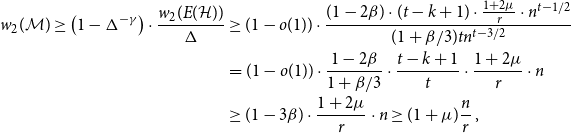 \begin{align*} w_2(\mathcal{M}) \ge \left (1-\Delta ^{-\gamma }\right ) \cdot \frac {w_2(E(\mathcal{H}))}{\Delta } & \ge (1-o(1)) \cdot \frac {(1-2\beta ) \cdot (t-k+1) \cdot \frac {1+2\mu }{r} \cdot n^{t-1/2}}{(1 + \beta /3) t n^{t-3/2}} \\ &= (1 - o(1)) \cdot \frac {1-2\beta }{1+\beta /3} \cdot \frac {t-k+1}{t} \cdot \frac {1+2\mu }{r} \cdot n \\ &\ge (1-3\beta ) \cdot \frac {1+2\mu }{r} \cdot n \ge (1+\mu )\frac {n}{r}\,, \end{align*}
where we used the bound on $w_2(E(\mathcal{H}))$
established above, the definition of
$w_2(E(\mathcal{H}))$
established above, the definition of $\Delta$
, together with
$\Delta$
, together with $1/t \ll \beta \ll \mu \ll 1/k$
.
$1/t \ll \beta \ll \mu \ll 1/k$
.
Therefore the matching $\mathcal{M}$
corresponds to a collection of vertex-disjoint paths of
$\mathcal{M}$
corresponds to a collection of vertex-disjoint paths of $G$
of order
$G$
of order $t$
such that their union covers all but at most
$t$
such that their union covers all but at most $\beta n$
vertices and the colour red appears on at least
$\beta n$
vertices and the colour red appears on at least $(1+\mu )\frac {n}{r}$
edges in the paths, as desired.
$(1+\mu )\frac {n}{r}$
edges in the paths, as desired.
7. Proof of the main theorem
We are now ready to prove our main result.
Proof of Theorem 1.1. Let
 \begin{equation*} 1/n \ll 1/t \ll \beta \ll \mu \ll {\varepsilon } \ll 1/k, 1/r\,, \end{equation*}
where we have assumed without loss of generality that $\varepsilon$
is sufficiently small. Let
$\varepsilon$
is sufficiently small. Let $G$
be an
$G$
be an $n$
-vertex
$n$
-vertex $k$
-graph with
$k$
-graph with $\delta (G) \ge (1/2+{\varepsilon })n$
whose edges are
$\delta (G) \ge (1/2+{\varepsilon })n$
whose edges are $r$
-coloured. By Lemma 3.2, there exists a tight path
$r$
-coloured. By Lemma 3.2, there exists a tight path $P_0$
such that
$P_0$
such that $|V(P_0)| \le \mu n$
and for each
$|V(P_0)| \le \mu n$
and for each $W \subseteq V(G) \setminus V(P_0)$
of size
$W \subseteq V(G) \setminus V(P_0)$
of size $|W| \le 3 \beta n$
there is a tight path covering
$|W| \le 3 \beta n$
there is a tight path covering $V(P_0) \cup W$
and with the same ends as
$V(P_0) \cup W$
and with the same ends as $P_0$
. Let
$P_0$
. Let $R$
be a random subset of
$R$
be a random subset of $V(G) \setminus V(P_0)$
obtained by including each vertex with probability
$V(G) \setminus V(P_0)$
obtained by including each vertex with probability $\beta$
independently. Then w.h.p. it holds that
$\beta$
independently. Then w.h.p. it holds that $\beta n/2 \leq |R| \leq 2\beta n$
and that
$\beta n/2 \leq |R| \leq 2\beta n$
and that $|N_G(S) \cap R| \ge (1/2+{\varepsilon }/2)|R|$
for every
$|N_G(S) \cap R| \ge (1/2+{\varepsilon }/2)|R|$
for every $(k-1)$
-subset
$(k-1)$
-subset $S \subseteq V(G)$
. Indeed, this can be shown by a standard application of Chernoff’s inequality (Lemma 3.4) and a union bound over
$S \subseteq V(G)$
. Indeed, this can be shown by a standard application of Chernoff’s inequality (Lemma 3.4) and a union bound over $S$
.
$S$
.
Let $G'\,:\!=\,G \setminus (V(P_0) \cup R)$
and observe that
$G'\,:\!=\,G \setminus (V(P_0) \cup R)$
and observe that $\delta (G') \ge \delta (G) - |V(P_0) \cup R| \ge (1/2+{\varepsilon }/2)n \ge (1/2+{\varepsilon }/2)|V(G')|$
. Then, by Lemma 6.1 (with
$\delta (G') \ge \delta (G) - |V(P_0) \cup R| \ge (1/2+{\varepsilon }/2)n \ge (1/2+{\varepsilon }/2)|V(G')|$
. Then, by Lemma 6.1 (with $4\mu$
playing the role of
$4\mu$
playing the role of $\mu$
),
$\mu$
), $G'$
contains a collection
$G'$
contains a collection $\mathcal{P}\,:\!=\,\{P_i\,{:}\,i \in [N]\}$
of vertex-disjoint tight paths of order
$\mathcal{P}\,:\!=\,\{P_i\,{:}\,i \in [N]\}$
of vertex-disjoint tight paths of order $t$
such that their union covers all but at most
$t$
such that their union covers all but at most $\beta n$
vertices, and there is a colour, say red, which appears on at least
$\beta n$
vertices, and there is a colour, say red, which appears on at least $(1+4\mu )|V(G')|/r \ge (1+4\mu )(1-\mu -2\beta )n/r \ge (1+\mu )n/r$
edges in the paths. Therefore, if we manage to connect the paths in
$(1+4\mu )|V(G')|/r \ge (1+4\mu )(1-\mu -2\beta )n/r \ge (1+\mu )n/r$
edges in the paths. Therefore, if we manage to connect the paths in $\mathcal{P}$
into a tight cycle while covering all the vertices then we are done. This connection can be achieved using the standard tools collected in Section 3.1. The details follow.
$\mathcal{P}$
into a tight cycle while covering all the vertices then we are done. This connection can be achieved using the standard tools collected in Section 3.1. The details follow.
Denote by $\overrightarrow {S_i}$
and
$\overrightarrow {S_i}$
and $\overrightarrow {T_i}$
the ends of
$\overrightarrow {T_i}$
the ends of $P_i$
for each
$P_i$
for each $0 \le i \le N$
. Add the uncovered vertices of
$0 \le i \le N$
. Add the uncovered vertices of $G'$
to
$G'$
to $R$
to get a set
$R$
to get a set $R'$
, and observe that
$R'$
, and observe that $|R| \leq |R'| \leq |R| + \beta n$
. Using multiple applications of the connecting lemma (Lemma 3.1), we can connect the path
$|R| \leq |R'| \leq |R| + \beta n$
. Using multiple applications of the connecting lemma (Lemma 3.1), we can connect the path $P_0$
and the paths in
$P_0$
and the paths in $\mathcal{P}$
into an almost-spanning tight cycle using vertices in
$\mathcal{P}$
into an almost-spanning tight cycle using vertices in $R'$
, as proved by the following claim.
$R'$
, as proved by the following claim.
Claim 5.
For each $0 \le i \le N$
, there is a tight path
$0 \le i \le N$
, there is a tight path $Q_i$
of order at most
$Q_i$
of order at most $2k/{\varepsilon }^2$
connecting
$2k/{\varepsilon }^2$
connecting $\overleftarrow {T_i}$
and
$\overleftarrow {T_i}$
and $\overleftarrow {S_{i+1}}$
(where indices are modulo
$\overleftarrow {S_{i+1}}$
(where indices are modulo $N+1$
), such that
$N+1$
), such that $V(Q_i) \setminus (T_i \cup S_{i+1}) \subseteq R'$
. Moreover, we can choose such paths to be pairwise vertex-disjoint.
$V(Q_i) \setminus (T_i \cup S_{i+1}) \subseteq R'$
. Moreover, we can choose such paths to be pairwise vertex-disjoint.
Proof.
Suppose we can find vertex-disjoint connecting paths $Q_0, \ldots, Q_{m-1}$
as in the statement of the claim, and let
$Q_0, \ldots, Q_{m-1}$
as in the statement of the claim, and let $m$
be as large as possible. If we are not done yet, then
$m$
be as large as possible. If we are not done yet, then $m \le N$
. The union of
$m \le N$
. The union of $Q_0, \ldots, Q_{m-1}$
covers at most
$Q_0, \ldots, Q_{m-1}$
covers at most $m \cdot 2k/{\varepsilon }^2 \le 2kn/({\varepsilon }^2 t)$
vertices of
$m \cdot 2k/{\varepsilon }^2 \le 2kn/({\varepsilon }^2 t)$
vertices of $R'$
, where we used that
$R'$
, where we used that $N \le n/t$
. Let
$N \le n/t$
. Let $R''$
denote the subset of
$R''$
denote the subset of $R'$
consisting of the uncovered vertices. Then for every
$R'$
consisting of the uncovered vertices. Then for every $(k-1)$
-subset
$(k-1)$
-subset $S \subseteq V(G)$
we have
$S \subseteq V(G)$
we have $|N_G(S) \cap R''| \ge (1/2 + {\varepsilon }/2)|R| - |R' \setminus R''| \geq (1/2+{\varepsilon }/4)|R'' \cup T_{m+1} \cup S_{m+2}|$
, where we used that
$|N_G(S) \cap R''| \ge (1/2 + {\varepsilon }/2)|R| - |R' \setminus R''| \geq (1/2+{\varepsilon }/4)|R'' \cup T_{m+1} \cup S_{m+2}|$
, where we used that $|R| \geq |R'| - \beta n$
,
$|R| \geq |R'| - \beta n$
, $|R' \setminus R''| \leq 2kn/({\varepsilon }^2 t)$
and
$|R' \setminus R''| \leq 2kn/({\varepsilon }^2 t)$
and $1/t \ll \beta \ll {\varepsilon }, 1/k$
. Therefore, we can apply Lemma 3.1 to
$1/t \ll \beta \ll {\varepsilon }, 1/k$
. Therefore, we can apply Lemma 3.1 to $G[R'' \cup T_{m+1} \cup S_{m+2}]$
to get a tight path of order at most
$G[R'' \cup T_{m+1} \cup S_{m+2}]$
to get a tight path of order at most $2k/{\varepsilon }^2$
connecting
$2k/{\varepsilon }^2$
connecting $\overleftarrow {T_{m+1}}$
and
$\overleftarrow {T_{m+1}}$
and $\overleftarrow {S_{m+2}}$
, which is vertex-disjoint from
$\overleftarrow {S_{m+2}}$
, which is vertex-disjoint from $Q_0, \ldots, Q_{m-1}$
. This contradicts the maximality of
$Q_0, \ldots, Q_{m-1}$
. This contradicts the maximality of $m$
.
$m$
.
Observe that $C\,:\!=\,\bigcup _{0 \le i \le N} (P_i \cup Q_i)$
is a tight cycle. Now let
$C\,:\!=\,\bigcup _{0 \le i \le N} (P_i \cup Q_i)$
is a tight cycle. Now let $W \subseteq R'$
be the subset of vertices not covered by
$W \subseteq R'$
be the subset of vertices not covered by $C$
and observe that clearly
$C$
and observe that clearly $|W| \le |R'| \le 3\beta n$
. By the property of the absorbing path
$|W| \le |R'| \le 3\beta n$
. By the property of the absorbing path $P_0$
, there exists a tight path
$P_0$
, there exists a tight path $\tilde {P_0}$
which covers
$\tilde {P_0}$
which covers $V(P_0) \cup W$
and has the same ends as
$V(P_0) \cup W$
and has the same ends as $P_0$
, i.e.
$P_0$
, i.e. $\overrightarrow {S_0}$
and
$\overrightarrow {S_0}$
and $\overrightarrow {T_0}$
. It follows that
$\overrightarrow {T_0}$
. It follows that $\tilde {C}\,:\!=\,\tilde {P_0} \cup \bigcup _{1 \le i \le N} (P_i \cup Q_i)$
is a tight Hamilton cycle of
$\tilde {C}\,:\!=\,\tilde {P_0} \cup \bigcup _{1 \le i \le N} (P_i \cup Q_i)$
is a tight Hamilton cycle of $G$
and, since each edge of
$G$
and, since each edge of $P_1 \cup \ldots \cup P_N$
is an edge of
$P_1 \cup \ldots \cup P_N$
is an edge of $\tilde {C}$
as well, then
$\tilde {C}$
as well, then $\tilde {C}$
has at least
$\tilde {C}$
has at least $(1+\mu )n/r$
red edges, as desired.
$(1+\mu )n/r$
red edges, as desired.
8. Concluding remarks
The main result of this paper offers a discrepancy version of the celebrated result of Rödl, Ruciński, and Szemerédi [Reference Rödl, Ruciński and Szemerédi29], and determines the minimum $(k-1)$
-degree threshold for high discrepancy of tight Hamilton cycles and perfect matchings; both of these thresholds equal
$(k-1)$
-degree threshold for high discrepancy of tight Hamilton cycles and perfect matchings; both of these thresholds equal $1/2$
, which is also the existence threshold for these structures. In the following we discuss some natural open problems for further research.
$1/2$
, which is also the existence threshold for these structures. In the following we discuss some natural open problems for further research.
-
• A very natural question is to study minimum-degree discrepancy thresholds for the
$j$
-degreeFootnote
1
with
$j \lt k-1$
. We remark that for this question, the existence threshold for perfect matchings (i.e. the minimum
$j$
-degree guaranteeing the existence of a perfect matching) is mostly not known. We wonder if, for
$k$
-uniform hypergraphs with
$k \geq 3$
, there is some
$j$
such that the
$j$
-degree discrepancy threshold is strictly larger than the corresponding existence threshold (as is the case for graphs).Remark added. This problem has been solved for each
$j \neq 1$
in a simultaneous work of Balogh, Treglown, and Zárate-Guerén [Reference Balogh, Treglown and Zárate-Guerén5], who also provided a construction showing that, for
$j=1$
and
$k=3$
, the discrepancy threshold is significantly larger than the existence threshold. The case
$j=1$
was then fully resolved by Lu, Ma and Xie [Reference Lu, Ma and Xie26], and, independently, by Hàn, Lang, Marciano, Pavez-Signé, Sanhueza-Matamala, Treglown, and Zárate-Guerén [Reference Hàn, Lang, Marciano, Pavez-Signé, Sanhueza-Matamala, Treglown and Zárate-Guerén20]. -
• Another natural question is to consider other notions of Hamilton cycles. As mentioned in the introduction, Theorem1.1 implies that minimum
$(k-1)$
-degree
$(1/2 + \varepsilon )n$
guarantees the existence of Hamilton
$\ell$
-cycles of high discrepancy, for every
$1 \leq \ell \leq k-1$
. However, unlike in the case of tight Hamilton cycles (namely,
$\ell = k-1$
), we do not have a matching lower bound. For example, it is known that the minimum
$(k-1)$
-degree threshold for the existence of loose Hamilton cycles in
$k$
-graphs is
$\frac {1}{2(k-1)}$
, see [Reference Keevash, Kühn, Mycroft and Osthus22, Reference Kühn and Osthus23]. We wonder if this is also the discrepancy threshold of loose Hamilton cycles. -
• As mentioned in the introduction,
$1/2$
is the minimum
$(k-1)$
-degree threshold for the existence of perfect matchings in
$k$
-graphs (see [Reference Kühn and Osthus24, Reference Rödl, Ruciński and Szemerédi30]), which shows that Corollary 1.2 is tight. However, it is also known [Reference Kühn and Osthus24, Reference Rödl, Ruciński and Szemerédi30] that a
$k$
-graph with minimum
$(k-1)$
-degree at least
$(1+o(1))\frac {n}{k}$
contains a near-perfect matching, i.e. a matching of size
$\frac {n}{k} - O_k(1)$
. For
$k=3$
and
$2$
colours, we have the following simple example showing that
$1/2$
is the discrepancy threshold of near-perfect matchings (which is larger than the existence threshold of
$1/3$
). Partition the vertices into two sets
$A$
and
$B$
of equal size and take
$G$
to be the hypergraph consisting of all edges which intersect both
$A$
and
$B$
. Colour in red the edges which intersect
$A$
in two vertices, and colour the remaining edges in blue. Every matching of size
$n/3 - t$
must have at least
$n/6-2t$
edges in each colour, meaning that there is no near-perfect matching with discrepancy
$\Omega (n)$
. It is therefore natural to ask, for general
$k \geq 3$
and
$r \geq 2$
, what is the minimum
$(k-1)$
-degree threshold guaranteeing a near-perfect matching of high discrepancy in every
$r$
-edge-colouring. -
• It would also be interesting to prove similar results for other spanning structures in hypergraphs, perhaps even of design-type, such as Steiner triple systems. We will return to this in a future work.
-
• Instead of studying minimum degree thresholds, one might also consider random hypergraphs. In the graph case, Gishboliner, Krivelevich, and Michaeli [Reference Gishboliner, Krivelevich and Michaeli16] showed that with high probability, the random graph
$G(n,p)$
has the following property: in every
$r$
-edge-colouring, there exists a Hamilton cycle which has at least roughly
$\frac {2n}{r+1}$
edges of the same colour and hence a perfect matching with at least roughly
$\frac {n}{r+1}$
edges of the same colour. The respective constants
$\frac {2}{r+1}$
and
$\frac {1}{r+1}$
are best possible even in the complete graph. This raises the question of whether the same phenomenon holds in hypergraphs. For example, as mentioned in the introduction, the result of Alon–Frankl–Lovász [Reference Alon, Frankl and Lovász1] implies that every
$2$
-edge-colouring of
$K_n^{(k)}$
has a perfect matching with at least roughly
$\frac {n}{k+1}$
edges of the same colour. Is the same true in a random
$k$
-graph (say, with edge probability above the existence threshold
$(\log n)/n^{k-1}$
)? -
• Generalising the previous item, it would be very interesting to prove a general result relating the threshold for containing a structure (in a random graph/hypergraph) to the threshold for having high discrepancy for this structure. Namely, for a family
$\mathcal{F}$
of graphs (or hypergraphs) on
$[n]$
, let
$p_0$
be the threshold for the event that
$G \sim G(n,p)$
contains a member from
$\mathcal{F}$
, and let
$p_1$
be the threshold for the event that in every
$2$
-edge-colouring of
$G \sim G(n,p)$
, there is a member
$F \in \mathcal{F}$
with high discrepancy, say of order
$\Theta (e(F))$
. Note that
$p_1$
is well-defined if (and only if)
$\mathcal{F}$
has high discrepancy in
$K_n$
. Clearly
$p_1 \geq p_0$
. Is there a general upper bound on
$p_1$
in terms of
$p_0$
? We wonder if the recent breakthroughs around the expectation-threshold conjecture are relevant to this question. -
• Even more generally, one can ask about the discrepancy of random subhypergraphs of general hypergraphs (not necessarily those arising from graphs). Namely, we return to the original definition of discrepancy, where
$\mathcal{H}$
is a hypergraph, and we colour the vertices of
$\mathcal{H}$
with two colours. How ‘robust’ is discrepancy? For instance, suppose
$\mathcal{H}$
has high discrepancy, and we take a random subset of vertices by including each vertex independently with probability
$p$
. Is the random induced subhypergraph likely to still have high discrepancy?


Acknowledgements
We thank the anonymous referees for their valuable comments. This research was initiated while AS was visiting the University of Passau; he would like to thank the University of Passau for the hospitality and the stimulating research environment.
When conducting this work, LG was supported by SNSF grant 200021_196965.
This research was conducted while AS was affiliated with University College London and supported by the Royal Society.


 Open access

