




1. Introduction
Let X be a K3 surface over a field k that admits a complete linear system $\mathcal{C}$
consisting of curves of genus g. Assume that the curves in
$\mathcal{C}$
consisting of curves of genus g. Assume that the curves in $\mathcal{C}$
are geometrically integral and belong to a primitive divisor class. It is well known that
$\mathcal{C}$
are geometrically integral and belong to a primitive divisor class. It is well known that $\mathcal{C}$
contains a finite number
$\mathcal{C}$
contains a finite number $n_g$
of rational curves. The starting point for this paper is the Yau–Zaslow formula from [Reference BeauvilleBea99, Reference Yau and ZaslowYZ96].
$n_g$
of rational curves. The starting point for this paper is the Yau–Zaslow formula from [Reference BeauvilleBea99, Reference Yau and ZaslowYZ96].
Theorem 1.1 (Complex Yau–Zaslow formula [Reference BeauvilleBea99, Reference Yau and ZaslowYZ96]). Let $k=\mathbb{C}$
. Then
$k=\mathbb{C}$
. Then $n_g$
depends only on g, not on the choice of K3 surface X or the choice of linear system of genus-g curves
$n_g$
depends only on g, not on the choice of K3 surface X or the choice of linear system of genus-g curves $\mathcal{C}$
. Moreover, there is a generating series for
$\mathcal{C}$
. Moreover, there is a generating series for $n_g$
in
$n_g$
in $\mathbb{Z}[[t]]$
:
$\mathbb{Z}[[t]]$
:
 \begin{align*}1+\sum_{g=1}^{\infty} n_g t^g = \prod_{n=1}^{\infty} (1-t^n)^{-24}.\end{align*}
Perhaps the historical significance of the above complex Yau–Zaslow formula is that it predicted certain genus-0 Gromov–Witten invariants; it counts the number of stable maps from $\mathbb P^1$
to a linear system
$\mathbb P^1$
to a linear system $|L|$
with
$|L|$
with $c_1(L)^2=2g-2$
. Curves in
$c_1(L)^2=2g-2$
. Curves in $|L|$
have arithmetic genus g so we can expect the number of rational curves to be finite, under the natural assumption that the rational curves are precisely those with g nodes, which is generically the case by Chen’s theorem [Reference ChenChe02, Theorem 1.1]. Beauville, whose work we follow closely in this paper, noted that under good conditions these curves are precisely the ones whose compactified Jacobian has non-zero Euler characteristic, and that the Euler characteristic is 1, so he proposed taking the Euler characteristic of the relative compactified Jacobian over the linear system as another way to compute this genus-0 Gromov–Witten invariant. There has been subsequent work (see, for example, [Reference Bryan and LeungBL00] and [Reference Fantechi, Göttsche and van StraatenFGvS99]), giving proofs in more general situations, while the state of the art is [Reference Klemm, Maulik, Pandharipande and ScheideggerKMP+10]. From the modern perspective, this equality between these genus-0 Gromov–Witten invariants and the Euler characteristic of the compactified Jacobian can be understood as a special case of the MNOP conjecture relating the Gromov–Witten and Donaldson–Thomas theories, with the latter simplifying to the Euler characteristic of the compactified Jacobian under good conditions. In this paper, we are concerned with giving arithmetic refinements of both sides of this equation with the aid of tools from motivic homotopy. It should be noted that another refinement is provided by [Reference Göttsche and ShendeGöt14] in a different setting. While we take a different approach to these, recent papers such as [Reference ViergeverVie25] and [Reference Espreafico and WalcherEW23] compute refined Donaldson–Thomas invariants for
$|L|$
have arithmetic genus g so we can expect the number of rational curves to be finite, under the natural assumption that the rational curves are precisely those with g nodes, which is generically the case by Chen’s theorem [Reference ChenChe02, Theorem 1.1]. Beauville, whose work we follow closely in this paper, noted that under good conditions these curves are precisely the ones whose compactified Jacobian has non-zero Euler characteristic, and that the Euler characteristic is 1, so he proposed taking the Euler characteristic of the relative compactified Jacobian over the linear system as another way to compute this genus-0 Gromov–Witten invariant. There has been subsequent work (see, for example, [Reference Bryan and LeungBL00] and [Reference Fantechi, Göttsche and van StraatenFGvS99]), giving proofs in more general situations, while the state of the art is [Reference Klemm, Maulik, Pandharipande and ScheideggerKMP+10]. From the modern perspective, this equality between these genus-0 Gromov–Witten invariants and the Euler characteristic of the compactified Jacobian can be understood as a special case of the MNOP conjecture relating the Gromov–Witten and Donaldson–Thomas theories, with the latter simplifying to the Euler characteristic of the compactified Jacobian under good conditions. In this paper, we are concerned with giving arithmetic refinements of both sides of this equation with the aid of tools from motivic homotopy. It should be noted that another refinement is provided by [Reference Göttsche and ShendeGöt14] in a different setting. While we take a different approach to these, recent papers such as [Reference ViergeverVie25] and [Reference Espreafico and WalcherEW23] compute refined Donaldson–Thomas invariants for $\mathbb{P}^3$
and
$\mathbb{P}^3$
and $\mathbb{A}^3$
, respectively, using motivic homotopy, providing evidence that it should be possible to refine this side in a general case. Similarly, in [Reference Kass, Levine, Solomon and WickelgrenKLS+23], the authors use a different approach to compute refinements of genus-0 Gromov–Witten invariants using tools from motivic homotopy.
$\mathbb{A}^3$
, respectively, using motivic homotopy, providing evidence that it should be possible to refine this side in a general case. Similarly, in [Reference Kass, Levine, Solomon and WickelgrenKLS+23], the authors use a different approach to compute refinements of genus-0 Gromov–Witten invariants using tools from motivic homotopy.
For the Yau–Zaslow formula, Kharlamov and Răsdeaconu also proved a version of the Yau–Zaslow formula over $\mathbb{R}$
in [Reference Kharlamov and RăsdeaconuKR15].
$\mathbb{R}$
in [Reference Kharlamov and RăsdeaconuKR15].
Theorem 1.2 (Real Yau–Zaslow formula [Reference Kharlamov and RăsdeaconuKR15]). Let $k=\mathbb{R}$
. Let
$k=\mathbb{R}$
. Let $n_+$
(respectively,
$n_+$
(respectively, $n_-$
) denote the number of rational curves in
$n_-$
) denote the number of rational curves in $\mathcal{C}$
with Welschinger number
$\mathcal{C}$
with Welschinger number $+$
(respectively,
$+$
(respectively, $-$
), and let
$-$
), and let $\mathbb{W}(X,g) := n_+ - n_-$
. Then
$\mathbb{W}(X,g) := n_+ - n_-$
. Then $\mathbb{W}(X,g)$
is given by the coefficient of
$\mathbb{W}(X,g)$
is given by the coefficient of $t^g$
in the power series
$t^g$
in the power series
 \begin{align*}\prod_{i=1}^{\infty}\big(1+(-t^i)\big)^{-a} \cdot \prod_{j=1}^{\infty}\big(1-t^{2j}\big)^{-b} \in \mathbb{Z}[[t]],\end{align*}
where a is the compactly supported Euler characteristic of $X(\mathbb{R})$
, and
$X(\mathbb{R})$
, and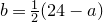 $b = \frac12 (24-a)$
.
$b = \frac12 (24-a)$
.
Recent papers show that for k any field of characteristic not 2, we can often refine results in enumerative geometry over $\mathbb{C}$
to obtain an element of the Grothendieck–Witt ring of our base field
$\mathbb{C}$
to obtain an element of the Grothendieck–Witt ring of our base field $\widehat{\mathrm{W}}(k)$
, a ring that is widely studied for its number-theoretic properties. The element we obtain is an arithmetic refinement in the sense that we may recover the integer obtained by the classical count over
$\widehat{\mathrm{W}}(k)$
, a ring that is widely studied for its number-theoretic properties. The element we obtain is an arithmetic refinement in the sense that we may recover the integer obtained by the classical count over $\mathbb{C}$
by applying a certain homomorphism out of this ring. Examples of such arithmetic refinements are an arithmetic refinement of the count of 27 lines on a smooth cubic surface in [Reference Kass and WickelgrenKW21], and an arithmetic refinement of the count of lines meeting four lines in
$\mathbb{C}$
by applying a certain homomorphism out of this ring. Examples of such arithmetic refinements are an arithmetic refinement of the count of 27 lines on a smooth cubic surface in [Reference Kass and WickelgrenKW21], and an arithmetic refinement of the count of lines meeting four lines in $\mathbb{P}^3$
in [Reference Srinivasan and WickelgrenSW21]. As a result of this paper, we obtain an arithmetic refinement of the Yau–Zaslow formula over any characteristic 0 field. To do this, we use a motivic Euler characteristic
$\mathbb{P}^3$
in [Reference Srinivasan and WickelgrenSW21]. As a result of this paper, we obtain an arithmetic refinement of the Yau–Zaslow formula over any characteristic 0 field. To do this, we use a motivic Euler characteristic $\chi^{\rm mot}$
taking values in
$\chi^{\rm mot}$
taking values in $\widehat{\mathrm{W}}(k)$
. The field of arithmetic curve counting has its origins in
$\widehat{\mathrm{W}}(k)$
. The field of arithmetic curve counting has its origins in $\mathbb{A}^1$
-homotopy theory and
$\mathbb{A}^1$
-homotopy theory and $\chi^{\rm mot}$
is no different. The original definition of
$\chi^{\rm mot}$
is no different. The original definition of $\chi^{\rm mot}$
comes from the categorical Euler characteristic in the stable motivic homotopy category over our base field. A theorem of Levine and Raksit in [Reference Levine and RaksitLR20] allows us to compute this Euler characteristic geometrically when our varieties are smooth and projective. By [Reference Arcila-Maya, Bethea, Opie, Wickelgren and ZakharevichABO+22, Theorem 2.13], this extends uniquely to a motivic measure on the ring of varieties, making it an excellent candidate for curve counting, and since the motivic Euler characteristic can be defined geometrically, we may use geometric techniques in our proofs.
$\chi^{\rm mot}$
comes from the categorical Euler characteristic in the stable motivic homotopy category over our base field. A theorem of Levine and Raksit in [Reference Levine and RaksitLR20] allows us to compute this Euler characteristic geometrically when our varieties are smooth and projective. By [Reference Arcila-Maya, Bethea, Opie, Wickelgren and ZakharevichABO+22, Theorem 2.13], this extends uniquely to a motivic measure on the ring of varieties, making it an excellent candidate for curve counting, and since the motivic Euler characteristic can be defined geometrically, we may use geometric techniques in our proofs.
To state our arithmetic Yau–Zaslow formula, we need some notation.
Notation 1.3. Let k be a characteristic 0 field, and let X and $\mathcal{C}$
be as above. Without loss of generality, we may assume that k is finitely generated over
$\mathcal{C}$
be as above. Without loss of generality, we may assume that k is finitely generated over $\mathbb{Q}$
, and let
$\mathbb{Q}$
, and let $k^{\rm const}$
denote the algebraic closure of
$k^{\rm const}$
denote the algebraic closure of $\mathbb{Q}$
in k. Suppose that the rational curves in
$\mathbb{Q}$
in k. Suppose that the rational curves in $\mathcal{C}$
are nodal, which is generically the case by Chen’s theorem [Reference ChenChe02, Theorem 1.1]. For C a curve, let
$\mathcal{C}$
are nodal, which is generically the case by Chen’s theorem [Reference ChenChe02, Theorem 1.1]. For C a curve, let $\mathcal S(C)$
be the set of singular points of C. Let
$\mathcal S(C)$
be the set of singular points of C. Let $p \in \mathcal S(C)$
be a nodal point so that the tangents to C at p are defined either over k(p) or over a quadratic extension, and write
$p \in \mathcal S(C)$
be a nodal point so that the tangents to C at p are defined either over k(p) or over a quadratic extension, and write $\alpha_p$
for the element of
$\alpha_p$
for the element of $k(p)^\times/(k(p)^\times)^2$
such that the tangents are defined over
$k(p)^\times/(k(p)^\times)^2$
such that the tangents are defined over $k(p)(\sqrt{\alpha_p})$
. For q a closed point of
$k(p)(\sqrt{\alpha_p})$
. For q a closed point of $\mathbb{P}^g$
, write
$\mathbb{P}^g$
, write $C_q$
for the curve lying over q and G(X) for the set of closed points of
$C_q$
for the curve lying over q and G(X) for the set of closed points of $\mathcal{C}$
such that
$\mathcal{C}$
such that $C_q$
is rational. Let
$C_q$
is rational. Let $X^{(m)}$
denote the
$X^{(m)}$
denote the $m{\text{th}}$
symmetric power of X. Let
$m{\text{th}}$
symmetric power of X. Let $\Delta(g)$
be the integer from Theorem 6.18. Let
$\Delta(g)$
be the integer from Theorem 6.18. Let $\Delta^{k^{\rm const}}_g$
be the group of order 2 characters of
$\Delta^{k^{\rm const}}_g$
be the group of order 2 characters of $\mathop{\mathrm{Gal}}\nolimits_{k^{\rm const}}$
that are unramified at all primes of
$\mathop{\mathrm{Gal}}\nolimits_{k^{\rm const}}$
that are unramified at all primes of $k^{\rm const}$
whose residue characteristic p satisfies
$k^{\rm const}$
whose residue characteristic p satisfies $p \gt \Delta(g)\cdot [k^{\rm const}:\mathbb{Q}]+1$
, and let
$p \gt \Delta(g)\cdot [k^{\rm const}:\mathbb{Q}]+1$
, and let $\Delta^k_g$
denote the image of
$\Delta^k_g$
denote the image of $\Delta_g^{k^{\rm const}}$
under the map
$\Delta_g^{k^{\rm const}}$
under the map $\mathop{\mathrm{Hom}}\nolimits(\mathop{\mathrm{Gal}}\nolimits_{k^{\rm const}}, \mathbb{Z}/2\mathbb{Z}) \to \mathop{\mathrm{Hom}}\nolimits(\mathop{\mathrm{Gal}}\nolimits_k, \mathbb{Z}/2\mathbb{Z})$
. Let
$\mathop{\mathrm{Hom}}\nolimits(\mathop{\mathrm{Gal}}\nolimits_{k^{\rm const}}, \mathbb{Z}/2\mathbb{Z}) \to \mathop{\mathrm{Hom}}\nolimits(\mathop{\mathrm{Gal}}\nolimits_k, \mathbb{Z}/2\mathbb{Z})$
. Let $J_g$
denote the subset of elements q of
$J_g$
denote the subset of elements q of $\widehat{\mathrm{W}}(k)$
such that
$\widehat{\mathrm{W}}(k)$
such that $\mathrm{rank}(q)=0$
,
$\mathrm{rank}(q)=0$
, $\mathrm{sign}(q)=0$
, and
$\mathrm{sign}(q)=0$
, and $\mathrm{disc}(q) \in \Delta^k_g$
, which is an ideal by Definition 6.20. For
$\mathrm{disc}(q) \in \Delta^k_g$
, which is an ideal by Definition 6.20. For $L/k$
a finite field extension, let
$L/k$
a finite field extension, let $\mathrm{Tr}_{L/k}: \widehat{\mathrm{W}}(L) \to \widehat{\mathrm{W}}(k)$
be the trace transfer map defined by taking a quadratic form q over L to
$\mathrm{Tr}_{L/k}: \widehat{\mathrm{W}}(L) \to \widehat{\mathrm{W}}(k)$
be the trace transfer map defined by taking a quadratic form q over L to $\mathrm{Tr}_{L/k} \circ q$
, where
$\mathrm{Tr}_{L/k} \circ q$
, where $\mathrm{Tr}_{L/k}$
denote the Galois trace. Let
$\mathrm{Tr}_{L/k}$
denote the Galois trace. Let $N_{L/k}: \widehat{\mathrm{W}}(L) \to \widehat{\mathrm{W}}(k)$
be Rost’s norm transfer map from [Reference RostRos03, Corollary 5]. Let
$N_{L/k}: \widehat{\mathrm{W}}(L) \to \widehat{\mathrm{W}}(k)$
be Rost’s norm transfer map from [Reference RostRos03, Corollary 5]. Let $\mathcal{J}$
be the ideal of
$\mathcal{J}$
be the ideal of $\widehat{\mathrm{W}}(k)[[t]]$
such that
$\widehat{\mathrm{W}}(k)[[t]]$
such that $t^g[q] \in \mathcal{J}$
if and only if
$t^g[q] \in \mathcal{J}$
if and only if $[q] \in J_g$
. Finally, define
$[q] \in J_g$
. Finally, define
 \begin{align*}\mathbf B^{\rm mot}_{\mathcal{C}}(X) := \sum_{q \in G(X)}\mathrm{Tr}_{k(q)/k} \bigg( \prod_{p\in\mathcal S(C_q)}( 1+N_{k(p)/k(q)}([\langle -2 \rangle] - [\langle 2\alpha_p \rangle]))\!\bigg)\! \in \widehat{\mathrm{W}}(k)/J_g.\end{align*}
Theorem 1.4 (Arithmetic Yau–Zaslow formula). The element $\mathbf{B}^{\rm mot}_{\mathcal{C}}(X)$
is given by
$\mathbf{B}^{\rm mot}_{\mathcal{C}}(X)$
is given by $\langle (-1)^g \rangle$
multiplied by the coefficient of
$\langle (-1)^g \rangle$
multiplied by the coefficient of $t^g$
in the power series
$t^g$
in the power series
 \begin{align*}\prod_{d=1}^\infty \sum_{m=0}^\infty \chi^{\rm mot}(X^{(m)})\langle(-1)^d \rangle t^{md} \in\widehat{\mathrm{W}}(k)[[t]]/\mathcal{J}.\end{align*}
Because the ideal $J_g$
is sufficiently small and because we compute
$J_g$
is sufficiently small and because we compute $\chi^{\rm mot}(X^{(m)})$
modulo J in Corollary 8.21, we recover both the complex Yau–Zaslow formula of [Reference BeauvilleBea99] and the real Yau–Zaslow formula of [Reference Kharlamov and RăsdeaconuKR15] by taking the rank and signature of the above formula, respectively. We also obtain a Yau–Zaslow type formula by taking the discriminant of the above equation, modulo a finite error term in
$\chi^{\rm mot}(X^{(m)})$
modulo J in Corollary 8.21, we recover both the complex Yau–Zaslow formula of [Reference BeauvilleBea99] and the real Yau–Zaslow formula of [Reference Kharlamov and RăsdeaconuKR15] by taking the rank and signature of the above formula, respectively. We also obtain a Yau–Zaslow type formula by taking the discriminant of the above equation, modulo a finite error term in $\Delta^k_g$
. Our proof closely follows the steps laid out in Beauville’s original proof (see [Reference BeauvilleBea99]) of the classical Yau–Zaslow formula, in that there are four main steps:
$\Delta^k_g$
. Our proof closely follows the steps laid out in Beauville’s original proof (see [Reference BeauvilleBea99]) of the classical Yau–Zaslow formula, in that there are four main steps:
-
(i) the computation of the motivic Euler characteristic of compactified Jacobians of curves, which captures both the number of rational curves on the surface as well as arithmetic information about their singularities;
-
(ii) applying a Fubini theorem, which says that the motivic Euler characteristic of the compactified Jacobian of the whole linear system is expressible in data that solely depend on the rational curves;
-
(iii) applying a Batyrev-Kontsevich type theorem to relate the motivic Euler characteristic of the compactified Jacobians to the motivic Euler characteristic of certain Hilbert schemes; and
-
(iv) applying a Göttsche formula to compute the motivic Euler characteristic of these Hilbert schemes in terms of the Euler characteristic of the surface.
Contents 1.5. The next three sections are dedicated to proving properties of the motivic Euler characteristic. In § 2, we define our motivic Euler characteristic, before showing its relationship to other invarants, including Levine’s categorical Euler characteristic from [Reference LevineLev20] and Saito’s determinant of cohomology from [Reference SaitoSai94]. In § 3, we show a Galois-descent-type result for the motivic Euler characteristic. Section 4 is concerned with changing the base field, and showing that the motivic Euler characteristic is compatible with the natural transfer maps on the Grothendieck ring of varieties and the Grothendieck–Witt ring, respectively, by using the results from § 3. Sections 5–9 are concerned with the proof strategy laid out above. In § 5, we prove our version of a Fubini theorem by using an argument of Saito from [Reference SaitoSai94]. The Fubini theorem that we obtain is not perfect: as well as information directly related to the motivic Euler characteristic of the singular curves, we also need to take into account the monodromy action around these curves. The monodromy action gives rise to a Saito $\epsilon$
factor for computing the discriminant of the motivic Euler characteristic. We therefore compute these Saito factors, and show that for a given g, these
$\epsilon$
factor for computing the discriminant of the motivic Euler characteristic. We therefore compute these Saito factors, and show that for a given g, these $\epsilon$
factors lie in
$\epsilon$
factors lie in $\Delta^k_g$
, so in particular there are only finitely many possibilities. In § 6, we use a stratification of compactified Jacobians of curves in terms of their partial normalisations in order to directly compute their motivic Euler characteristics, and then we can apply the Fubini theorem to obtain an expression for the whole compactified Jacobian. Section 7 is concerned with a Batyrev–Kontsevich type theorem, allowing us to relate the motivic Euler characteristic of the compactified Jacobian of the linear system to the Hilbert scheme of points of the K3 surface. We prove this over real closed fields by using a model-theoretic argument to reduce to the real case, which follows by [Reference Kharlamov and RăsdeaconuKR15, Proposition 3.1]. For the rank and discriminant, we adapt Batyrev’s original p-adic integration argument from [Reference BatyrevBat99]. In § 8, we derive a motivic Göttsche formula, which allows us to compute the motivic Euler characteristic of these Hilbert schemes in terms of the motivic Euler characterstic of the underlying K3 surface by showing that we can apply a result of de Cataldo and Migliorini from [Reference de Cataldo and MigliorinidCM02]. Finally, in § 9, we put these steps together to arrive at the arithmetic Yau–Zaslow formula, Theorem 1.4. We then show that Theorem 1.4 recovers the complex Yau–Zaslow formula of [Reference BeauvilleBea99] and the real Yau–Zaslow formula of [Reference Kharlamov and RăsdeaconuKR15], and we deduce a new formula for discriminants in Corollary 9.11.
$\Delta^k_g$
, so in particular there are only finitely many possibilities. In § 6, we use a stratification of compactified Jacobians of curves in terms of their partial normalisations in order to directly compute their motivic Euler characteristics, and then we can apply the Fubini theorem to obtain an expression for the whole compactified Jacobian. Section 7 is concerned with a Batyrev–Kontsevich type theorem, allowing us to relate the motivic Euler characteristic of the compactified Jacobian of the linear system to the Hilbert scheme of points of the K3 surface. We prove this over real closed fields by using a model-theoretic argument to reduce to the real case, which follows by [Reference Kharlamov and RăsdeaconuKR15, Proposition 3.1]. For the rank and discriminant, we adapt Batyrev’s original p-adic integration argument from [Reference BatyrevBat99]. In § 8, we derive a motivic Göttsche formula, which allows us to compute the motivic Euler characteristic of these Hilbert schemes in terms of the motivic Euler characterstic of the underlying K3 surface by showing that we can apply a result of de Cataldo and Migliorini from [Reference de Cataldo and MigliorinidCM02]. Finally, in § 9, we put these steps together to arrive at the arithmetic Yau–Zaslow formula, Theorem 1.4. We then show that Theorem 1.4 recovers the complex Yau–Zaslow formula of [Reference BeauvilleBea99] and the real Yau–Zaslow formula of [Reference Kharlamov and RăsdeaconuKR15], and we deduce a new formula for discriminants in Corollary 9.11.
1.1 Notation and conventions
We fix the following conventions for this paper.
-
– We let k denote the base field for our Yau–Zaslow formula. For this paper, we will often restrict to $\mathrm{char}(k)=0$
, and we will always restrict to
$\mathrm{char}(k) \neq 2$
.
$\mathrm{char}(k)=0$
, and we will always restrict to
$\mathrm{char}(k) \neq 2$
. -
– Fields denoted by
$\mathbb{F}$
will be finite fields that normally arise through looking at the reduction of a model of our variety. -
– The symbol
$\ell$
will always denote a prime number different from
$\mathrm{char}(k)$
and
$\mathrm{char}(\mathbb{F})$
. -
– If k is a field, a variety over k will mean a reduced separated scheme of finite type over
$\mathrm{Spec}(k)$
. We will not require varieties to be irreducible. We will consider the empty scheme
$\emptyset=\mathrm{Spec}(\{0\})$
to be a variety over k. -
– All orderings on fields will be assumed to be total orderings that are compatible with the operations on fields. A real closed field will mean a field equipped with an ordering such that no algebraic extension of the field can be equipped with an ordering.
-
– A Calabi–Yau variety will always mean a smooth projective variety with a trivial canonical bundle. In particular, a K3 surface is a two-dimensional, simply connected, Calabi–Yau variety.
-
– A morphism of varieties will always denote a finitely presented morphism
$f: X \to Y$
that is compatible with the structure maps to the base.




We also fix the following notation for the whole paper.

We should note that a choice of separable closure does not affect the results in this paper, since all results are isomorphism invariant.
2. The motivic Euler characteristic and related invariants
In this section, we first recall the definition of the motivic Euler characteristic from [Reference Arcila-Maya, Bethea, Opie, Wickelgren and ZakharevichABO+22] that forms the basis for our arithmetic curve counting before showing how it relates to three different invariants, namely, the complex compactly supported Euler characteristic, the real compactly supported Euler characteristic, and the determinant of the $\ell$
-adic cohomology.
$\ell$
-adic cohomology.
Definition 2.1. Let k be a field whose characteristic is different from 2. For every $a\in k$
, let
$a\in k$
, let $\langle a\rangle$
denote the quadratic form of rank 1 such that
$\langle a\rangle$
denote the quadratic form of rank 1 such that $\langle a \rangle(\alpha) = a\alpha^2$
for any
$\langle a \rangle(\alpha) = a\alpha^2$
for any $\alpha \in k$
. For every pair q,q’ of quadratic forms, let
$\alpha \in k$
. For every pair q,q’ of quadratic forms, let $q\oplus q',q\otimes q'$
denote the orthogonal direct sum and the tensor product of q and q’, respectively. The Grothendieck–Witt ring
$q\oplus q',q\otimes q'$
denote the orthogonal direct sum and the tensor product of q and q’, respectively. The Grothendieck–Witt ring $\widehat{\mathrm{W}}(k)$
of quadratic forms over k is the ring generated by symbols [q], where q is any quadratic form over k, subject to the relations
$\widehat{\mathrm{W}}(k)$
of quadratic forms over k is the ring generated by symbols [q], where q is any quadratic form over k, subject to the relations $[q]=[q']$
, when q and q’ are isomorphic, the relations
$[q]=[q']$
, when q and q’ are isomorphic, the relations $[q\oplus q']=[q]+[q']$
and
$[q\oplus q']=[q]+[q']$
and $[q\otimes q']=[q]\cdot[q']$
, when q,q’ are any pair of quadratic forms over k, and the relation
$[q\otimes q']=[q]\cdot[q']$
, when q,q’ are any pair of quadratic forms over k, and the relation $[\langle0\rangle]=0$
.
$[\langle0\rangle]=0$
.
Define $\mathbb{H} := \langle 1 \rangle + \langle -1 \rangle$
. The Witt ring, denoted by
$\mathbb{H} := \langle 1 \rangle + \langle -1 \rangle$
. The Witt ring, denoted by $\mathrm{W}(k)$
, is the quotient
$\mathrm{W}(k)$
, is the quotient $\widehat{\mathrm{W}}(k)/(\mathbb{H})$
. We say that an element
$\widehat{\mathrm{W}}(k)/(\mathbb{H})$
. We say that an element $q \in \widehat{\mathrm{W}}(k)$
is hyperbolic if it lies in the ideal generated by
$q \in \widehat{\mathrm{W}}(k)$
is hyperbolic if it lies in the ideal generated by $\mathbb{H}$
, which is the same as the abelian subgroup consisting of elements of the form
$\mathbb{H}$
, which is the same as the abelian subgroup consisting of elements of the form $n\mathbb{H}$
for
$n\mathbb{H}$
for $n \in \mathbb{Z}$
.
$n \in \mathbb{Z}$
.
For a non-degenerate quadratic form q, the rank of q is the dimension of the underlying vector space, denoted by rank(q). It extends uniquely to a ring homomorphism $\mathrm{rank}:\widehat{\mathrm{W}}(k)\to\mathbb Z$
. Write I for the kernel of this homomorphism. The subset
$\mathrm{rank}:\widehat{\mathrm{W}}(k)\to\mathbb Z$
. Write I for the kernel of this homomorphism. The subset $T\subset\widehat{\mathrm{W}}(k)$
of torsion elements is also an ideal, and we let
$T\subset\widehat{\mathrm{W}}(k)$
of torsion elements is also an ideal, and we let $J=I^2\cap T$
.
$J=I^2\cap T$
.
Definition 2.2. Let X be a smooth, irreducible projective variety over k of dimension n. Let $H_{\rm dR}^*(X/k)$
denote the de Rham cohomology of X over k. Then the composition of the cup-product square
$H_{\rm dR}^*(X/k)$
denote the de Rham cohomology of X over k. Then the composition of the cup-product square $a \mapsto a \cup a$
and the trace map
$a \mapsto a \cup a$
and the trace map $\mathrm{Tr}:H_{\rm dR}^*(X/k)\to k$
defines a quadratic form on the vector space
$\mathrm{Tr}:H_{\rm dR}^*(X/k)\to k$
defines a quadratic form on the vector space $H_{\rm dR}^{2*}(X/k)$
, which we may see is non-degenerate using Poincaré duality. Let
$H_{\rm dR}^{2*}(X/k)$
, which we may see is non-degenerate using Poincaré duality. Let $[H_{\rm dR}^{2*}(X/k)]$
denote the class of this quadratic form in
$[H_{\rm dR}^{2*}(X/k)]$
denote the class of this quadratic form in $\widehat{\mathrm{W}}(k)$
, and set
$\widehat{\mathrm{W}}(k)$
, and set
 \begin{align*}\chi^{\rm dR}(X)=[H_{\rm dR}^{2*}(X/k)]-\frac{1}{2}\bigg(\sum_{i\geq0}\mathop{\mathrm{dim}}\nolimits(H_{\rm dR}^{2i+1}(X/k))\!\bigg)\cdot\mathbb H\in\widehat{\mathrm{W}}(k),\end{align*}
which we will call the de Rham Euler characteristic of X.
In this paper, we will often work with the de Rham Euler characteristic due to its compatibility with results of Saito from [Reference SaitoSai94]. However, we may compare the de Rham Euler characteristic to other Euler characteristics taking values in $\widehat{\mathrm{W}}(k)$
.
$\widehat{\mathrm{W}}(k)$
.
Definition 2.3. Fix $X/k$
to be a smooth, irreducible projective variety of dimension n. Following [Reference Levine and RaksitLR20, Construction 1.2], we define the Hodge Euler characteristic of X as follows.
$X/k$
to be a smooth, irreducible projective variety of dimension n. Following [Reference Levine and RaksitLR20, Construction 1.2], we define the Hodge Euler characteristic of X as follows.
Consider the trace map $\mathrm{Tr}: H^d(X, \Omega^d_{X/k}) \to k$
. We can define a cohomologically bounded complex of k vector spaces
$\mathrm{Tr}: H^d(X, \Omega^d_{X/k}) \to k$
. We can define a cohomologically bounded complex of k vector spaces $\mathrm{Hdg}(X/k)$
such that differentials are all zero and the vector space in degree n is given by
$\mathrm{Hdg}(X/k)$
such that differentials are all zero and the vector space in degree n is given by $\bigoplus_{j=i+n} H^i(X, \Omega^j_{X/k})$
. The cup product composed with the trace map then furnishes a non-degenerate symmetric bilinear form Tr on
$\bigoplus_{j=i+n} H^i(X, \Omega^j_{X/k})$
. The cup product composed with the trace map then furnishes a non-degenerate symmetric bilinear form Tr on $\mathrm{Hdg}(X/k)$
, as with the de Rham Euler characteristic. This therefore defines a class in the
$\mathrm{Hdg}(X/k)$
, as with the de Rham Euler characteristic. This therefore defines a class in the $0{\text{th}}$
Grothendieck–Witt group of the exact category of cohomologically bounded cochain complexes of k vector spaces in the sense of [Reference SchlichtingSch10, § 2.2]. Since cochain complexes of k vector spaces are always split, we can identify this group with
$0{\text{th}}$
Grothendieck–Witt group of the exact category of cohomologically bounded cochain complexes of k vector spaces in the sense of [Reference SchlichtingSch10, § 2.2]. Since cochain complexes of k vector spaces are always split, we can identify this group with $\widehat{\mathrm{W}}(k)$
. We will write
$\widehat{\mathrm{W}}(k)$
. We will write $\chi^{\rm Hdg}(X)$
to mean the element
$\chi^{\rm Hdg}(X)$
to mean the element $(\mathrm{Hdg}(X/k), \mathrm{Tr}) \in \widehat{\mathrm{W}}(k)$
constructed above.
$(\mathrm{Hdg}(X/k), \mathrm{Tr}) \in \widehat{\mathrm{W}}(k)$
constructed above.
Lemma 2.4.
Let $X/k$
be an irreducible smooth projective variety over k. Then we may identify
$X/k$
be an irreducible smooth projective variety over k. Then we may identify $\chi^{\rm dR}(X)=\chi^{\rm Hdg}(X) \in \widehat{\mathrm{W}}(k)$
.
$\chi^{\rm dR}(X)=\chi^{\rm Hdg}(X) \in \widehat{\mathrm{W}}(k)$
.
The following elegant proof was suggested to us by one of the referees of this paper. There is an alternative, more complicated, proof of this statement based on an argument by Speyer [Reference SpeyerSpe15], by closely studying the Hodge–de Rham spectral sequence.
Proof. We proceed by considering $X \times_k \mathbb{A}^1_k$
, where we parameterise
$X \times_k \mathbb{A}^1_k$
, where we parameterise $\mathbb{A}^1_k$
by a coordinate t. Let
$\mathbb{A}^1_k$
by a coordinate t. Let $p_1: X \times_k \mathbb{A}^1_k \to X$
denote projection onto the first factor and let
$p_1: X \times_k \mathbb{A}^1_k \to X$
denote projection onto the first factor and let $p_2: X \times_k \mathbb{A}^1_k \to \mathbb{A}^1_k$
denote projection onto the second factor. Consider the de Rham complex
$p_2: X \times_k \mathbb{A}^1_k \to \mathbb{A}^1_k$
denote projection onto the second factor. Consider the de Rham complex $(\Omega^*_{X/k}, d)$
on X. The fibrewise cup product and the trace map furnish a quadratic form on
$(\Omega^*_{X/k}, d)$
on X. The fibrewise cup product and the trace map furnish a quadratic form on $Rp_{2*}(p_1^*\Omega^*_{X/k}, t\cdot d)$
in the category of cohomologically bounded cochain complexes of coherent sheaves on
$Rp_{2*}(p_1^*\Omega^*_{X/k}, t\cdot d)$
in the category of cohomologically bounded cochain complexes of coherent sheaves on $\mathbb{A}^1_k$
. This gives rise to an element of the
$\mathbb{A}^1_k$
. This gives rise to an element of the $0{\text{th}}$
Grothendieck–Witt group of this abelian category in the sense of [Reference SchlichtingSch10, § 2.2], which we denote by
$0{\text{th}}$
Grothendieck–Witt group of this abelian category in the sense of [Reference SchlichtingSch10, § 2.2], which we denote by $\widehat{\mathrm{W}}(\mathrm{Ch}^b\mathrm{Coh}(\mathcal{O}_{\mathbb{A}^1_k}))$
. Since
$\widehat{\mathrm{W}}(\mathrm{Ch}^b\mathrm{Coh}(\mathcal{O}_{\mathbb{A}^1_k}))$
. Since $\mathbb{A}^1_k$
is a separated noetherian scheme, we may argue, as in [Reference WeibelWei13, Theorem 8.2], to identify
$\mathbb{A}^1_k$
is a separated noetherian scheme, we may argue, as in [Reference WeibelWei13, Theorem 8.2], to identify $\widehat{\mathrm{W}}(\mathrm{Ch}^b\mathrm{Coh}(\mathcal{O}_{\mathbb{A}^1_k})) = \widehat{\mathrm{W}}(\mathbb{A}^1_k) := KO^{[0]}_0(\mathbb{A}^1_k)$
, where the Hermitian K-theory group
$\widehat{\mathrm{W}}(\mathrm{Ch}^b\mathrm{Coh}(\mathcal{O}_{\mathbb{A}^1_k})) = \widehat{\mathrm{W}}(\mathbb{A}^1_k) := KO^{[0]}_0(\mathbb{A}^1_k)$
, where the Hermitian K-theory group $KO^{[0]}_0(\mathbb{A}^1_k)$
is as defined as in [Reference Panin and WalterPW19, § 5]. Similarly, by the same logic as the previous definition, we can identify
$KO^{[0]}_0(\mathbb{A}^1_k)$
is as defined as in [Reference Panin and WalterPW19, § 5]. Similarly, by the same logic as the previous definition, we can identify $\widehat{\mathrm{W}}(\mathrm{Ch}^b\mathrm{Coh}(\mathcal{O}_{\mathrm{Spec}(k)})) = \widehat{\mathrm{W}}(k)$
, which in turn we may identify with
$\widehat{\mathrm{W}}(\mathrm{Ch}^b\mathrm{Coh}(\mathcal{O}_{\mathrm{Spec}(k)})) = \widehat{\mathrm{W}}(k)$
, which in turn we may identify with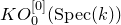 $KO^{[0]}_0(\mathrm{Spec}(k))$
by the definition of KO, as in [Reference Panin and WalterPW19, § 4].
$KO^{[0]}_0(\mathrm{Spec}(k))$
by the definition of KO, as in [Reference Panin and WalterPW19, § 4].
Let $i_j:\mathrm{Spec}(k)\to\mathbb A^1_K$
be the inclusion at the points
$i_j:\mathrm{Spec}(k)\to\mathbb A^1_K$
be the inclusion at the points $j=0,1$
. By the proper base-change theorem, we have an equality in the Grothendieck–Witt ring of k,
$j=0,1$
. By the proper base-change theorem, we have an equality in the Grothendieck–Witt ring of k,
 \begin{align*}\widehat{\mathrm{W}}(\mathrm{Ch}^b\mathrm{Coh}(\mathcal{O}_{\mathrm{Spec}(k)})) \ni i_1^* Rp_{2*}(p_1^*\Omega^*_{X/k}, t\cdot d)=\bigoplus_n H^n_{\rm dR}(X)[-n] = \chi^{\rm dR}(X) \in \widehat{\mathrm{W}}(k),\end{align*}
with cup product and trace form to k. Over $t=0$
, the differential vanishes and so
$t=0$
, the differential vanishes and so
 \begin{align*}\widehat{\mathrm{W}}(\mathrm{Ch}^b\mathrm{Coh}(\mathcal{O}_{\mathrm{Spec}(k)})) \ni i_0^* Rp_{2*}(p_1^*\Omega^*_{X/k}, t\cdot d)= \bigoplus_{p,q}H^p(X,\Omega^q)[-p-q] = \chi^{\rm Hdg}(X) \in \widehat{\mathrm{W}}(k),\end{align*}
again with cup product and trace form to k, where we note that there is a potential even shift in the grading in the second complex, but this does not affect the class in $\widehat{\mathrm{W}}(k)$
. Since the Hermitian K-theory groups are representable by a spectrum in the stable motivic homotopy category of k by [Reference Panin and WalterPW19, Theorem 1.1], they are
$\widehat{\mathrm{W}}(k)$
. Since the Hermitian K-theory groups are representable by a spectrum in the stable motivic homotopy category of k by [Reference Panin and WalterPW19, Theorem 1.1], they are $\mathbb A^1$
-invariant. Therefore,
$\mathbb A^1$
-invariant. Therefore, $\widehat{\mathrm{W}}(k) = KO^{[0]}_0(\mathrm{Spec}(k)) = KO^{[0]}_0(\mathbb{A}^1_k)$
, and
$\widehat{\mathrm{W}}(k) = KO^{[0]}_0(\mathrm{Spec}(k)) = KO^{[0]}_0(\mathbb{A}^1_k)$
, and $i^*_0, i^*_1$
induce identifications
$i^*_0, i^*_1$
induce identifications $KO^{[0]}_0(\mathbb{A}^1_k) = \widehat{\mathrm{W}}(k)$
with
$KO^{[0]}_0(\mathbb{A}^1_k) = \widehat{\mathrm{W}}(k)$
with $i_0^* = i_1^*$
. In particular, there is an equality in
$i_0^* = i_1^*$
. In particular, there is an equality in $\widehat{\mathrm{W}}(k)$
:
$\widehat{\mathrm{W}}(k)$
:
 \begin{align*}\chi^{\rm dR}(X) = i_0^*(Rp_{2*}(p_1^*\Omega^*_{X/k}, t\cdot d))=i_1^*(Rp_{2*}(p_1^*\Omega^*_{X/k}, t\cdot d)) = \chi^{\rm Hdg}(X),\end{align*}
as required.
Definition 2.5. In [Reference LevineLev20, Remark 2.1 (2)], the categorical Euler characteristic $\chi^{\rm cat}(X)$
is defined for an arbitrary algebraic variety X over k by using the infinite suspension spectrum
$\chi^{\rm cat}(X)$
is defined for an arbitrary algebraic variety X over k by using the infinite suspension spectrum $\Sigma_T^\infty X_+$
as an object of
$\Sigma_T^\infty X_+$
as an object of $\mathrm{SH}(k)$
, the stable motivic homotopy category over k. Since
$\mathrm{SH}(k)$
, the stable motivic homotopy category over k. Since $\Sigma_T^{\infty} X_+$
is dualisable, it gives us a canonical endomorphism of the unit object
$\Sigma_T^{\infty} X_+$
is dualisable, it gives us a canonical endomorphism of the unit object $\mathbb S_k$
:
$\mathbb S_k$
:
 \begin{align*}\chi^{\rm cat}(X)\in\mathrm{End}_{\mathrm{SH}(k)}(\mathbb S_k).\end{align*}
By Morel’s theorem [Reference MorelMor02, Theorem 6.4.1], we can identify $\mathrm{End}_{\mathrm{SH}(k)}(\mathbb S_k)\cong\widehat{\mathrm{W}}(k)$
when k has characteristic 0, and
$\mathrm{End}_{\mathrm{SH}(k)}(\mathbb S_k)\cong\widehat{\mathrm{W}}(k)$
when k has characteristic 0, and $\mathrm{End}_{\mathrm{SH}(k)}(\mathbb S_k)\cong\widehat{\mathrm{W}}(k)[\frac1p]$
when k has positive odd characteristic.
$\mathrm{End}_{\mathrm{SH}(k)}(\mathbb S_k)\cong\widehat{\mathrm{W}}(k)[\frac1p]$
when k has positive odd characteristic.
One of the main theorems of [Reference Levine and RaksitLR20] is the following.
Theorem 2.6 (Theorem 1.3 of [Reference Levine and RaksitLR20]). Let X be a smooth, projective variety over k. Then there is an equality of Euler characteristics $\chi^{\rm cat}(X)=\chi^{\rm Hdg}(X)$
.
$\chi^{\rm cat}(X)=\chi^{\rm Hdg}(X)$
.
Corollary 2.7.
Let X be a smooth, projective variety over k. Then there is an equality of Euler characteristics $\chi^{\rm cat}(X)=\chi^{\rm dR}(X)$
.
$\chi^{\rm cat}(X)=\chi^{\rm dR}(X)$
.
Proof. Combine the above theorem with Lemma 2.4.
Assume that $\mathrm{char}(k)=0$
for the rest of the paper, unless otherwise stated.
$\mathrm{char}(k)=0$
for the rest of the paper, unless otherwise stated.
Definition 2.8. Let k be any field. Let $K_0(\mathrm{Var}_k)$
denote the Grothendieck ring of varieties over k. This is the ring generated by symbols [X], where X is any variety over k, subject to the relation
$K_0(\mathrm{Var}_k)$
denote the Grothendieck ring of varieties over k. This is the ring generated by symbols [X], where X is any variety over k, subject to the relation $[X]=[X']$
when X and X’ are isomorphic, the relation
$[X]=[X']$
when X and X’ are isomorphic, the relation $[X]=[X-X']+[X']$
when X’ is a closed subvariety in X, and
$[X]=[X-X']+[X']$
when X’ is a closed subvariety in X, and $[X\times X']=[X]\cdot[X']$
when X,X’ are any pair of varieties over k. The 0 element of this ring is
$[X\times X']=[X]\cdot[X']$
when X,X’ are any pair of varieties over k. The 0 element of this ring is $[\emptyset]$
, and the multiplicative unit is
$[\emptyset]$
, and the multiplicative unit is $[\mathrm{Spec}(k)]$
.
$[\mathrm{Spec}(k)]$
.
A motivic measure is a ring homomorphism out of $K_0(\mathrm{Var}_k)$
.
$K_0(\mathrm{Var}_k)$
.
The above Euler characteristic does not give us a motivic measure; see Remark 2.10. However, [Reference Arcila-Maya, Bethea, Opie, Wickelgren and ZakharevichABO+22, Theorem 2.13] gives the following.
Theorem 2.9.
There is a unique ring homomorphism $\chi^{\rm mot}:K_0(\mathrm{Var}_k)\to\widehat{\mathrm{W}}(k)$
such that for every smooth, irreducible, projective variety
$\chi^{\rm mot}:K_0(\mathrm{Var}_k)\to\widehat{\mathrm{W}}(k)$
such that for every smooth, irreducible, projective variety $X/k$
,
$X/k$
,
 \begin{align*}\chi^{\rm mot}([X])=\chi^{\rm Hdg}(X) = \chi^{\rm dR}(X).\end{align*}
A key ingredient in the proof of the above is Bittner’s presentation of the ring of varieties [Reference BittnerBit04, Theorem 3.1], which tells us that the underlying abelian group of $K_0(\mathrm{Var}_k)$
can be generated by smooth projective varieties, subject to only a smooth blow-up excision relation. In particular, the above theorem requires us to restrict to characteristic 0.
$K_0(\mathrm{Var}_k)$
can be generated by smooth projective varieties, subject to only a smooth blow-up excision relation. In particular, the above theorem requires us to restrict to characteristic 0.
Remark 2.10. We can show that the categorical Euler characteristic is not a motivic measure. For example, consider $\mathbb{P}^1$
. Let
$\mathbb{P}^1$
. Let $\{\infty\}$
denote the closed point at infinity. Then
$\{\infty\}$
denote the closed point at infinity. Then $X \setminus \{\infty\} \cong \mathbb{A}^1$
, so in
$X \setminus \{\infty\} \cong \mathbb{A}^1$
, so in $K_0(\mathrm{Var}_k)$
,
$K_0(\mathrm{Var}_k)$
, $[\mathbb{P}^1] = [\mathbb{A}^1]+[\mathrm{Spec}(k)]$
. In [Reference LevineLev20, Proposition 2.5],
$[\mathbb{P}^1] = [\mathbb{A}^1]+[\mathrm{Spec}(k)]$
. In [Reference LevineLev20, Proposition 2.5], $\chi^{\rm cat}(\mathbb{P}^1) = \langle 1 \rangle + \langle -1 \rangle$
is computed, but since
$\chi^{\rm cat}(\mathbb{P}^1) = \langle 1 \rangle + \langle -1 \rangle$
is computed, but since $\mathbb{A}^1$
is clearly
$\mathbb{A}^1$
is clearly $\mathbb{A}^1$
-contractible, we have
$\mathbb{A}^1$
-contractible, we have $\chi^{\rm cat}(\mathbb{A}^1) = \chi^{\rm cat}(\mathrm{Spec}(k)) = \langle 1 \rangle$
. Therefore,
$\chi^{\rm cat}(\mathbb{A}^1) = \chi^{\rm cat}(\mathrm{Spec}(k)) = \langle 1 \rangle$
. Therefore, $\chi^{\rm cat}(\mathbb{P}^1) \neq \chi^{\rm cat}(\mathbb{A}^1) + \chi^{\rm cat}(\mathrm{Spec}(k))$
whenever
$\chi^{\rm cat}(\mathbb{P}^1) \neq \chi^{\rm cat}(\mathbb{A}^1) + \chi^{\rm cat}(\mathrm{Spec}(k))$
whenever $\langle -1 \rangle \neq \langle 1 \rangle$
, i.e. whenever
$\langle -1 \rangle \neq \langle 1 \rangle$
, i.e. whenever $-1$
is not a square in k.
$-1$
is not a square in k.
For the rest of the paper, we will write $\chi^{\rm mot}(X)$
for
$\chi^{\rm mot}(X)$
for $\chi^{\rm mot}([X])$
for every variety X over k and call this the motivic Euler characteristic of X. This is a slight abuse of notation, since
$\chi^{\rm mot}([X])$
for every variety X over k and call this the motivic Euler characteristic of X. This is a slight abuse of notation, since $\chi^{\rm mot}$
depends on k. When the base field is ambiguous, we will write
$\chi^{\rm mot}$
depends on k. When the base field is ambiguous, we will write $\chi^{\rm mot}_k$
; however, for the most part we will omit the subscript for readability.
$\chi^{\rm mot}_k$
; however, for the most part we will omit the subscript for readability.
Definition 2.11. Suppose that the dimension n of X is even. The composition of the cup product and the trace map $\mathrm{Tr}:H_{\rm dR}^{2n}(X/k)\to k$
defines a non-degenerate quadratic form on
$\mathrm{Tr}:H_{\rm dR}^{2n}(X/k)\to k$
defines a non-degenerate quadratic form on $H_{\rm dR}^{n}(X/k)$
. Let
$H_{\rm dR}^{n}(X/k)$
. Let $[H_{\rm dR}^{n}(X/k)]\in\widehat{\mathrm{W}}(k)$
denote the class of this quadratic form. Define integers
$[H_{\rm dR}^{n}(X/k)]\in\widehat{\mathrm{W}}(k)$
denote the class of this quadratic form. Define integers $b^+$
and
$b^+$
and $b^-$
by
$b^-$
by
 \begin{align*}b^{-}&:=\sum_{i\lt n}\mathop{\mathrm{dim}}\nolimits_k H_{\rm dR}^{i}(X/k),\\b^+ &:= \sum_{i \lt n} (-1)^i \mathop{\mathrm{dim}}\nolimits_k H_{\rm dR}^{i}(X/k).\end{align*}
Lemma 2.12. Suppose that X has even dimension n. Then
 \begin{align*}\chi^{\rm dR}(X)=b^{+}\cdot\mathbb H+[H_{\rm dR}^{n}(X/k)].\end{align*}
If X has odd dimension, then $\chi^{\rm dR}(X) = (b^+ -\frac{1}{2}\mathrm{dim}_k(H^n_{\rm dR}(X/k)))\cdot\mathbb{H}$
.
$\chi^{\rm dR}(X) = (b^+ -\frac{1}{2}\mathrm{dim}_k(H^n_{\rm dR}(X/k)))\cdot\mathbb{H}$
.
Proof. Suppose that n is even, and consider the quadratic form on $H_{\rm dR}^{2*}(X/k)$
. This decomposes as an orthogonal direct sum of the middle term
$H_{\rm dR}^{2*}(X/k)$
. This decomposes as an orthogonal direct sum of the middle term $H_{\rm dR}^{n}(X/k)$
and of
$H_{\rm dR}^{n}(X/k)$
and of $H_{\rm dR}^{2i}(X/k)\oplus H_{\rm dR}^{2n-2i}(X/k)$
, as the integer i runs between 0 and
$H_{\rm dR}^{2i}(X/k)\oplus H_{\rm dR}^{2n-2i}(X/k)$
, as the integer i runs between 0 and $n-1$
. For every such i, the direct sum
$n-1$
. For every such i, the direct sum $H_{\rm dR}^{2i}(X/k)\oplus H_{\rm dR}^{2n-2i}(X/k)$
is a non-degenerate subspace of
$H_{\rm dR}^{2i}(X/k)\oplus H_{\rm dR}^{2n-2i}(X/k)$
is a non-degenerate subspace of $H_{\rm dR}^{2*}(X/k)$
of rank
$H_{\rm dR}^{2*}(X/k)$
of rank $2\mathop{\mathrm{dim}}\nolimits(H_{\rm dR}^{2i}(X/k))$
and
$2\mathop{\mathrm{dim}}\nolimits(H_{\rm dR}^{2i}(X/k))$
and $H_{\rm dR}^{2i}(X/k)$
is an isotropic subspace of dimension
$H_{\rm dR}^{2i}(X/k)$
is an isotropic subspace of dimension $\mathop{\mathrm{dim}}\nolimits(H_{\rm dR}^{2i}(X/k))$
. Therefore, the quadratic form
$\mathop{\mathrm{dim}}\nolimits(H_{\rm dR}^{2i}(X/k))$
. Therefore, the quadratic form $H_{\rm dR}^{2i}(X/k)\oplus H_{\rm dR}^{2n-2i}(X/k)$
is hyperbolic, and so is isomorphic to the orthogonal sum of
$H_{\rm dR}^{2i}(X/k)\oplus H_{\rm dR}^{2n-2i}(X/k)$
is hyperbolic, and so is isomorphic to the orthogonal sum of $\mathop{\mathrm{dim}}\nolimits(H_{\rm dR}^{2i}(X/k))$
copies of
$\mathop{\mathrm{dim}}\nolimits(H_{\rm dR}^{2i}(X/k))$
copies of $\mathbb H$
, so the claim is clear in the even case. The odd case follows by an identical argument.
$\mathbb H$
, so the claim is clear in the even case. The odd case follows by an identical argument.
We are interested in recovering invariants related to quadratic forms from the Grothendieck–Witt ring. The motivic Euler characteristic encodes classical invariants on varieties, the first being the compactly supported Euler characteristic of the complex points.
Definition 2.13. For every variety X over k, let e(X) denote the compactly supported Euler characteristic of the base change $X_{\overline{k}}$
of X to
$X_{\overline{k}}$
of X to $\overline k$
.
$\overline k$
.
Theorem 2.14.
Let $\mathrm{rank}:\widehat{\mathrm{W}}(k) \to \mathbb Z$
be the rank homomorphism from Definition 2.1. We have
$\mathrm{rank}:\widehat{\mathrm{W}}(k) \to \mathbb Z$
be the rank homomorphism from Definition 2.1. We have $e(X)=\mathrm{rank}(\chi^{\rm mot}(X))$
for every algebraic variety X over k.
$e(X)=\mathrm{rank}(\chi^{\rm mot}(X))$
for every algebraic variety X over k.
Remark 2.15. We may use any Weil cohomology theory to compute the compactly supported Euler characteristic and we will get the same value; for example, we may work with $\ell$
-adic cohomology. Independence from the cohomology theory is underlined by Theorem 2.6, since
$\ell$
-adic cohomology. Independence from the cohomology theory is underlined by Theorem 2.6, since $\chi^{\rm mot}(X)$
only depends on
$\chi^{\rm mot}(X)$
only depends on $\chi^{\rm cat}(X)$
, an invariant that comes from the stable motivic homotopy category. For
$\chi^{\rm cat}(X)$
, an invariant that comes from the stable motivic homotopy category. For $\ell$
-adic cohomology, Laumon proved in [Reference LaumonLau81] that for any finite-type separated scheme over an algebraically closed field and any prime
$\ell$
-adic cohomology, Laumon proved in [Reference LaumonLau81] that for any finite-type separated scheme over an algebraically closed field and any prime $\ell$
different from the characteristic, the
$\ell$
different from the characteristic, the $\ell$
-adic Euler characteristic and the compactly supported
$\ell$
-adic Euler characteristic and the compactly supported $\ell$
-adic Euler characteristic are equal.
$\ell$
-adic Euler characteristic are equal.
Proof of Theorem 2.14. For X a projective variety over $\mathbb{C}$
, this is proven in [Reference LevineLev20, Remark 2.3 (1)]. The general case can be reduced to this case as follows. The assignment
$\mathbb{C}$
, this is proven in [Reference LevineLev20, Remark 2.3 (1)]. The general case can be reduced to this case as follows. The assignment $X\mapsto e(X)$
gives rise to a ring homomorphism
$X\mapsto e(X)$
gives rise to a ring homomorphism $ K_0(\mathrm{Var}_k) \to\mathbb Z$
. Since
$ K_0(\mathrm{Var}_k) \to\mathbb Z$
. Since $K_0(\mathrm{Var}_k)$
is generated by smooth projective varieties by [Reference BittnerBit04, Theorem 3.1], it is enough prove the claim for X smooth and projective. Let X be such a variety and let
$K_0(\mathrm{Var}_k)$
is generated by smooth projective varieties by [Reference BittnerBit04, Theorem 3.1], it is enough prove the claim for X smooth and projective. Let X be such a variety and let $F\subset k$
be a subfield that is finitely generated over
$F\subset k$
be a subfield that is finitely generated over $\mathbb{Q}$
such that X is already defined over F, i.e. there is a smooth projective variety Y over F whose base change to k is X. Fix an embedding of F into
$\mathbb{Q}$
such that X is already defined over F, i.e. there is a smooth projective variety Y over F whose base change to k is X. Fix an embedding of F into $\mathbb C$
, which exists since F is countable. Using the naturality of the categorical Euler characteristic with respect to base change, and the invariance of the rank function on the Grothendieck–Witt ring under base change, we obtain that
$\mathbb C$
, which exists since F is countable. Using the naturality of the categorical Euler characteristic with respect to base change, and the invariance of the rank function on the Grothendieck–Witt ring under base change, we obtain that
 \begin{align*}\mathrm{rank}(\chi^{\rm mot}(X))=\mathrm{rank}(\chi^{\rm mot}(Y\times_Fk))=\mathrm{rank}(\chi^{\rm mot}(Y))=\mathrm{rank}(\chi^{\rm mot}(Y\times_F\mathbb C)).\end{align*}
By proper base change for our choice of Weil cohomology theory, we have
 \begin{align*}e(X)=e(Y\times_Fk)=e(Y)=e(Y\times_F\mathbb C).\end{align*}
Applying [Reference LevineLev20, Remark 2.3 (1)] gives $\mathrm{rank}(\chi^{\rm mot}(Y\times_F\mathbb C))=e(Y\times_F\mathbb C)$
, as required.
$\mathrm{rank}(\chi^{\rm mot}(Y\times_F\mathbb C))=e(Y\times_F\mathbb C)$
, as required.
As well as the complex points of our variety, the motivic Euler characteristic allows us to recover information about the real points of our variety and natural generalisations of this.
Definition 2.16. Assume that k is a real closed field. Then, by Sylvester’s law of inertia, every non-degenerate quadratic form q over k is isomorphic to a diagonal form
 \begin{align*}\underbrace{\langle1\rangle\oplus\langle1\rangle\oplus\cdots\oplus\langle1\rangle}_m\oplus\underbrace{\langle-1\rangle\oplus\cdots\oplus\langle-1\rangle}_n,\end{align*}
and $m-n$
only depends on the isomorphism class of q. This is called the signature of q and we write
$m-n$
only depends on the isomorphism class of q. This is called the signature of q and we write $\mathrm{sign}(q)$
. It induces an isomorphism
$\mathrm{sign}(q)$
. It induces an isomorphism $\mathrm{sign}:\mathrm{W}(k)\to \mathbb Z.$
Now let k again be any field whose characteristic is not 2.
Definition 2.17. The real spectrum Spr(k) of k is the set of all orderings of the field k [Reference LamLam05, Definition 1.2, Chapter 8, § 1]. Note that we may have $\mathrm{Spr}(k)=\emptyset$
; for example, if
$\mathrm{Spr}(k)=\emptyset$
; for example, if $-1$
is the sum of squares in k. In particular,
$-1$
is the sum of squares in k. In particular, $\mathrm{Spr}(k)=\emptyset$
if k has positive characteristic. Consider Spr(k) as a topological space by equipping it with the Harrison topology, which may be a slight abuse of notation if
$\mathrm{Spr}(k)=\emptyset$
if k has positive characteristic. Consider Spr(k) as a topological space by equipping it with the Harrison topology, which may be a slight abuse of notation if $\mathrm{Spr}(k) = \emptyset$
. The definition can be found in [Reference LamLam05, Chapter 8, § 6], which we recall here for convenience. Let
$\mathrm{Spr}(k) = \emptyset$
. The definition can be found in [Reference LamLam05, Chapter 8, § 6], which we recall here for convenience. Let $S\subset k$
be a finite subset and let
$S\subset k$
be a finite subset and let $\prec$
be a total ordering on the set S. Let
$\prec$
be a total ordering on the set S. Let $U(S,\prec)\subset\mathrm{Spr}(k)$
be the set consisting of all orderings
$U(S,\prec)\subset\mathrm{Spr}(k)$
be the set consisting of all orderings $\lt$
on k such that
$\lt$
on k such that $\lt$
restricted to S is
$\lt$
restricted to S is $\prec$
. The sets
$\prec$
. The sets $U(S,\prec)$
form a sub-basis of the Harrison topology, which makes Spr(k) a compact and totally disconnected topological space.
$U(S,\prec)$
form a sub-basis of the Harrison topology, which makes Spr(k) a compact and totally disconnected topological space.
Definition 2.18. For a topological space X and a ring A, let $\mathcal C(X,A)$
denote the ring of continuous A-valued functions, where we give A the discrete topology. For
$\mathcal C(X,A)$
denote the ring of continuous A-valued functions, where we give A the discrete topology. For $\lt$
in
$\lt$
in $\mathrm{Spr}(k)$
, let
$\mathrm{Spr}(k)$
, let $k_\lt$
denote the real closure of the ordered field
$k_\lt$
denote the real closure of the ordered field $(k,\lt)$
. For every non-degenerate quadratic form q over k, let
$(k,\lt)$
. For every non-degenerate quadratic form q over k, let $\mathrm{sign}(q):\mathrm{Spr}(k)\to\mathbb Z$
be the function sending each
$\mathrm{sign}(q):\mathrm{Spr}(k)\to\mathbb Z$
be the function sending each $\lt$
in
$\lt$
in $\mathrm{Spr}(k)$
to the signature of the base change of q to
$\mathrm{Spr}(k)$
to the signature of the base change of q to $k_\lt$
. This is continuous with respect to the Harrison topology, so we obtain a ring homomorphism,
$k_\lt$
. This is continuous with respect to the Harrison topology, so we obtain a ring homomorphism,
 \begin{align*}\mathrm{sign}:\mathrm{W}(k)\to\mathcal C(\mathrm{Spr}(k),\mathbb Z),\vphantom{_{\big(}}\end{align*}
where we note that if $\mathrm{Spr}(k)=\emptyset$
, then
$\mathrm{Spr}(k)=\emptyset$
, then $\mathcal C(\mathrm{Spr}(k), \mathbb{Z}) = \{0\}$
, so sign is the trivial homomorphism. By slight abuse of notation, let sign
$\mathcal C(\mathrm{Spr}(k), \mathbb{Z}) = \{0\}$
, so sign is the trivial homomorphism. By slight abuse of notation, let sign $:\widehat{\mathrm{W}}(k)\to\mathcal C(\mathrm{Spr}(k),\mathbb Z)$
denote the composition of the quotient map
$:\widehat{\mathrm{W}}(k)\to\mathcal C(\mathrm{Spr}(k),\mathbb Z)$
denote the composition of the quotient map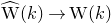 $\widehat{\mathrm{W}}(k)\to\mathrm{W}(k)$
with the map sign above.
$\widehat{\mathrm{W}}(k)\to\mathrm{W}(k)$
with the map sign above.
Definition 2.19. Again assume that k is a real closed field, and let X be an algebraic variety over k. Then X(k) is a semi-algebraic set over k, so its compactly supported Euler characteristic $\chi^{\rm rc}(X(k))\in\mathbb Z$
can be defined using real algebraic geometry (see, for example, [Reference Bochnak, Coste and RoyBCR98, § 11.2, pp. 266–67]). Now let k again be any field whose characteristic is not 2, and let X be as above. We will write
$\chi^{\rm rc}(X(k))\in\mathbb Z$
can be defined using real algebraic geometry (see, for example, [Reference Bochnak, Coste and RoyBCR98, § 11.2, pp. 266–67]). Now let k again be any field whose characteristic is not 2, and let X be as above. We will write $\epsilon(X):\mathrm{Spr}(k)\to\mathbb Z$
for the function that assigns each
$\epsilon(X):\mathrm{Spr}(k)\to\mathbb Z$
for the function that assigns each $\lt$
in
$\lt$
in $\mathrm{Spr}(k)$
to the compactly supported real Euler characteristic of
$\mathrm{Spr}(k)$
to the compactly supported real Euler characteristic of $X(k_\lt)$
.
$X(k_\lt)$
.
Theorem 2.20.
For every algebraic variety X over k, we have $\mathrm{sign}(\chi^{\rm mot}(X))=\epsilon(X)$
.
$\mathrm{sign}(\chi^{\rm mot}(X))=\epsilon(X)$
.
Proof. If k has positive characteristic, this is trivial, since it has no real closures, so without loss of generality, assume that k is characteristic 0. When $k=\mathbb R$
and X is projective, this is [Reference LevineLev20, Remark 2.3 (2)]. For k a general field, using the naturality of the motivic Euler characteristic with respect to base change, we may assume without loss of generality that k is real closed by passing to the real closure of
$k=\mathbb R$
and X is projective, this is [Reference LevineLev20, Remark 2.3 (2)]. For k a general field, using the naturality of the motivic Euler characteristic with respect to base change, we may assume without loss of generality that k is real closed by passing to the real closure of $(k,\lt)$
for every point
$(k,\lt)$
for every point $\lt$
in
$\lt$
in $\mathrm{Spr}(k)$
. Since the compactly supported Euler characteristic over real closed fields is a motivic measure, we may reduce to the case where X is smooth and projective, as in the proof of Theorem 2.14, so we can use the categorical Euler characteristic instead.
$\mathrm{Spr}(k)$
. Since the compactly supported Euler characteristic over real closed fields is a motivic measure, we may reduce to the case where X is smooth and projective, as in the proof of Theorem 2.14, so we can use the categorical Euler characteristic instead.
As we have already remarked, for every quasi-projective variety X over k, the set X(k) has the structure of a semi-algebraic set over k. Let $S_\bullet(X(k))$
denote the simplicial set of semi-algebraic singular simplexes of the semi-algebraic space X(k) of k-valued points of X as defined in [Pál22, Definition 2.5]. The assignment
$S_\bullet(X(k))$
denote the simplicial set of semi-algebraic singular simplexes of the semi-algebraic space X(k) of k-valued points of X as defined in [Pál22, Definition 2.5]. The assignment $X\mapsto S_\bullet(X(k))$
induces a functor
$X\mapsto S_\bullet(X(k))$
induces a functor $S_\bullet$
from the category of smooth quasi-projective varieties
$S_\bullet$
from the category of smooth quasi-projective varieties $Sm/k$
to
$Sm/k$
to $s\mathbf{Set}$
, the category of simplicial sets. Let SH denote the stable homotopy category of simplicial sets. The functor
$s\mathbf{Set}$
, the category of simplicial sets. Let SH denote the stable homotopy category of simplicial sets. The functor $S_\bullet$
gives rise to a realisation functor
$S_\bullet$
gives rise to a realisation functor $\mathrm{Re}_B:\mathrm{SH}(k)\to\mathrm{SH}$
that for
$\mathrm{Re}_B:\mathrm{SH}(k)\to\mathrm{SH}$
that for $X\in Sm/k$
sends the suspension spectrum
$X\in Sm/k$
sends the suspension spectrum $\Sigma_T^\infty X_+$
to the suspension spectrum
$\Sigma_T^\infty X_+$
to the suspension spectrum $\Sigma^{\infty}(S_\bullet(X(k)))$
. This induces a map
$\Sigma^{\infty}(S_\bullet(X(k)))$
. This induces a map $\sigma:\mathrm{End}_{\mathrm{SH}(k)}(\mathbb S_k)\to\mathrm{End}_{\mathrm{SH}}(\mathbb S_k)\cong\mathbb Z$
. We claim that
$\sigma:\mathrm{End}_{\mathrm{SH}(k)}(\mathbb S_k)\to\mathrm{End}_{\mathrm{SH}}(\mathbb S_k)\cong\mathbb Z$
. We claim that $\sigma$
is the signature map. It is enough to show that
$\sigma$
is the signature map. It is enough to show that $\langle-1\rangle$
goes to
$\langle-1\rangle$
goes to $-1$
. Using the naturality of the constructions, we only need to check this for any real closed subfield
$-1$
. Using the naturality of the constructions, we only need to check this for any real closed subfield $L \subseteq k$
. By taking L to be the algebraic closure of
$L \subseteq k$
. By taking L to be the algebraic closure of $\mathbb{Q}$
in k, assume without loss of generality that L is the real closure
$\mathbb{Q}$
in k, assume without loss of generality that L is the real closure $\mathbb{Q}^{\rm real}$
of
$\mathbb{Q}^{\rm real}$
of $\mathbb{Q}$
. Since
$\mathbb{Q}$
. Since $\mathbb R$
contains
$\mathbb R$
contains $\mathbb{Q}^{\rm real}$
, we may use naturality again to reduce to the case
$\mathbb{Q}^{\rm real}$
, we may use naturality again to reduce to the case $k=\mathbb R$
. In this case, [Reference LevineLev20, Remark 2.3 (2)] applies, since the forgetful map from the simplicial set of semi-algebraic singular simplexes to the usual simplicial set of continuous singular simplexes is a homotopy equivalence by [Pál22, Theorem 2.20(ii)].
$k=\mathbb R$
. In this case, [Reference LevineLev20, Remark 2.3 (2)] applies, since the forgetful map from the simplicial set of semi-algebraic singular simplexes to the usual simplicial set of continuous singular simplexes is a homotopy equivalence by [Pál22, Theorem 2.20(ii)].
Remark 2.21. By Pfister’s local–global principle (see [Reference LamLam05, § VIII, Theorems 3.2, 4.9, and 6.9]), the induced map
 \begin{align*}\mathrm{sign}\otimes\mathrm{id}_{\mathbb Z[\frac{1}{2}]}:\mathrm{W}(k)\otimes\mathbb Z[\tfrac{1}{2}]\to\mathcal C(\mathrm{Spr}(k),\mathbb Z[\tfrac{1}{2}])\end{align*}
is an isomorphism. Therefore, the invariants rank and sign compute the Grothendieck–Witt ring up to torsion, so the motivic Euler characteristic recovers both the algebraically closed Euler characteristic in the form of the rank as well as the real closed Euler characteristic in the form of the signature. Conversely, the motivic Euler characteristic, up to torsion, can be computed from these invariants. The full motivic Euler characteristic contains interesting torsion information that cannot be recovered from these invariants. We turn our attention to some torsion information about $\chi^{\rm mot}$
that also relates to a more classical invariant.
$\chi^{\rm mot}$
that also relates to a more classical invariant.
Definition 2.22. Assume that k is a field whose characteristic is not 2. Then every non-degenerate quadratic form q is isomorphic to a diagonal form
 \begin{align*}\langle a_1\rangle\oplus\langle a_2\rangle\oplus\cdots\oplus\langle a_n\rangle.\end{align*}
The discriminant disc(q) of the form q above is defined as the class of the product
 \begin{align*}a_1\cdot a_2\cdots a_n\;\mathrm{in}\;k^\times/k^{\times2}.\end{align*}
This is independent of the diagonalisation of q, since it is the determinant of the symmetric matrix defining the bilinear form associated to q. It induces a homomorphism of the underlying abelian groups
 \begin{align*}\mathrm{disc}:\widehat{\mathrm{W}}(k)\to k^\times/k^{\times2}.\end{align*}
We will freely use the identification $k^\times/k^{\times2} = \mathop{\mathrm{Hom}}\nolimits(\mathop{\mathrm{Gal}}\nolimits_k, \mathbb{Z}/2\mathbb{Z})$
.
$k^\times/k^{\times2} = \mathop{\mathrm{Hom}}\nolimits(\mathop{\mathrm{Gal}}\nolimits_k, \mathbb{Z}/2\mathbb{Z})$
.
For X a variety over k, we would like to relate $\mathrm{disc}(\chi^{\rm mot}(X))$
to other invariants on X.
$\mathrm{disc}(\chi^{\rm mot}(X))$
to other invariants on X.
Definition 2.23. Let $\ell$
be a prime number different from the characteristic of k, let U be a smooth scheme over k, and let
$\ell$
be a prime number different from the characteristic of k, let U be a smooth scheme over k, and let $\mathcal{F}$
be a smooth
$\mathcal{F}$
be a smooth $\ell$
-adic sheaf on U. Following Saito in [Reference SaitoSai94], we will consider the one-dimensional
$\ell$
-adic sheaf on U. Following Saito in [Reference SaitoSai94], we will consider the one-dimensional $\ell$
-adic representation of
$\ell$
-adic representation of $\mathop{\mathrm{Gal}}\nolimits_k$
given by the determinant
$\mathop{\mathrm{Gal}}\nolimits_k$
given by the determinant
 \begin{align*}\mathop{\mathrm{det}}\nolimits R\Gamma_c(U_{\overline{k}}, \mathcal{F}):=\bigotimes_i \mathop{\mathrm{det}}\nolimits H^i_c(U_{\overline{k}}, \mathcal{F})^{\otimes(-1)^i}.\end{align*}
The above representation is called the determinant of cohomology of $\mathcal F$
, and for
$\mathcal F$
, and for $\mathcal{F}=\mathbb{Q}_{\ell}$
, we will call it the
$\mathcal{F}=\mathbb{Q}_{\ell}$
, we will call it the $\ell$
-adic determinant of cohomology of X. This is a one-dimensional
$\ell$
-adic determinant of cohomology of X. This is a one-dimensional $\ell$
-adic representation, so we will view it as an element of the abelian group
$\ell$
-adic representation, so we will view it as an element of the abelian group $\mathop{\mathrm{Hom}}\nolimits(\mathop{\mathrm{Gal}}\nolimits_k, \mathbb{Q}_{\ell}^\times)$
. For
$\mathop{\mathrm{Hom}}\nolimits(\mathop{\mathrm{Gal}}\nolimits_k, \mathbb{Q}_{\ell}^\times)$
. For $\mathcal{F}=\mathbb{Q}_{\ell}$
, we will write
$\mathcal{F}=\mathbb{Q}_{\ell}$
, we will write $\mathrm{det}_\ell(U)$
to mean
$\mathrm{det}_\ell(U)$
to mean $\mathop{\mathrm{det}}\nolimits R\Gamma_c(U_{\overline{k}}, \mathbb{Q}_\ell)$
.
$\mathop{\mathrm{det}}\nolimits R\Gamma_c(U_{\overline{k}}, \mathbb{Q}_\ell)$
.
Let X be a smooth proper variety over k of dimension n. As shown in [Reference SaitoSai94, Lemma 5], Poincaré duality allows us to obtain the identity
 \begin{align*}\mathop{\mathrm{det}}\nolimits R\Gamma(X_{\overline{k}},\mathbb{Q}_{\ell})=\mathbb{Q}_{\ell}({-}\tfrac{1}{2}ne(X))\otimes \kappa(X),\end{align*}
where $\kappa(X)$
is a character of order at most 2 of
$\kappa(X)$
is a character of order at most 2 of $\mathop{\mathrm{Gal}}\nolimits_k$
, which is independent of
$\mathop{\mathrm{Gal}}\nolimits_k$
, which is independent of $\ell$
. Suppose that n is odd. As in [Reference SaitoSai94, Lemma 5], the existence of a non-degenerate alternating form on
$\ell$
. Suppose that n is odd. As in [Reference SaitoSai94, Lemma 5], the existence of a non-degenerate alternating form on $H^n_{\acute{e}t}(X_{\overline{k}},\mathbb{Q}_{\ell})$
given by the cup product allows us to obtain that
$H^n_{\acute{e}t}(X_{\overline{k}},\mathbb{Q}_{\ell})$
given by the cup product allows us to obtain that $\mathrm{det}( H^n_{\acute{e}t}(X_{\overline{k}}, \mathbb{Q}_{\ell}))=\mathbb{Q}_{\ell}( -j)$
where
$\mathrm{det}( H^n_{\acute{e}t}(X_{\overline{k}}, \mathbb{Q}_{\ell}))=\mathbb{Q}_{\ell}( -j)$
where $j=\frac12 \mathrm{dim}_{\mathbb{Q}_{\ell}} (H^n_{\acute{e}t}(X_{\overline{k}}, \mathbb{Q}_{\ell}))$
. In particular,
$j=\frac12 \mathrm{dim}_{\mathbb{Q}_{\ell}} (H^n_{\acute{e}t}(X_{\overline{k}}, \mathbb{Q}_{\ell}))$
. In particular, $\kappa(X)=1$
if
$\kappa(X)=1$
if $\mathrm{dim}(X)$
is odd.
$\mathrm{dim}(X)$
is odd.
Theorem 2.24. For every smooth projective variety X over k of dimension n, we have
 \begin{align*}\mathrm{disc}(\chi^{\rm cat}(X))=\mathrm{disc}(\chi^{\rm dR}(X))=(-1)^{(1/2) n \cdot e(X)}\cdot\kappa(X).\end{align*}
If n is odd, then e(X) is even, so $\frac12 n \cdot e(X)$
is always a positive integer. For X a K3 surface, this formula gives
$\frac12 n \cdot e(X)$
is always a positive integer. For X a K3 surface, this formula gives $\mathrm{disc}(\chi^{\rm mot}(X))=\kappa(X)$
. This result is essentially equivalent to a theorem of Saito from [Reference SaitoSai94]. First, we are going to formulate this as Saito did. The main result of Saito’s paper [Reference SaitoSai94] linking the determinant of cohomology with de Rham cohomology is the following.
$\mathrm{disc}(\chi^{\rm mot}(X))=\kappa(X)$
. This result is essentially equivalent to a theorem of Saito from [Reference SaitoSai94]. First, we are going to formulate this as Saito did. The main result of Saito’s paper [Reference SaitoSai94] linking the determinant of cohomology with de Rham cohomology is the following.
Theorem 2.25 (Saito’s theorem [Reference SaitoSai94]). Assume that X has even dimension n. Then
 \begin{align*}\kappa(X)=(-1)^{(1/2)e(X)+b^{-}}\cdot\mathrm{disc}([H_{\rm dR}^{n}(X/k)]).\end{align*}
Proof. This is [Reference SaitoSai94, Theorem 2, p. 412].
Proof of Theorem 2.24. By Lemma 2.12, the result is trivial if $\mathrm{dim}(X)$
is odd, since we have
$\mathrm{dim}(X)$
is odd, since we have $\chi^{\rm dR}(X) = \frac12 e(X) \cdot \mathbb{H}$
. Therefore, suppose that
$\chi^{\rm dR}(X) = \frac12 e(X) \cdot \mathbb{H}$
. Therefore, suppose that $\mathrm{dim}(X)$
is even.
$\mathrm{dim}(X)$
is even.
We can work with $\chi^{\rm dR}$
instead of
$\chi^{\rm dR}$
instead of $\chi^{\rm cat}$
, by Theorem 2.6. For all
$\chi^{\rm cat}$
, by Theorem 2.6. For all $q,q' \in \widehat{\mathrm{W}}(k)$
, we have that the discriminant
$q,q' \in \widehat{\mathrm{W}}(k)$
, we have that the discriminant $\mathrm{disc}(q+q')=\mathrm{disc}(q)\cdot\mathrm{disc}(q')$
. Applying the map disc to both sides of the equation in Lemma 2.12 therefore gives
$\mathrm{disc}(q+q')=\mathrm{disc}(q)\cdot\mathrm{disc}(q')$
. Applying the map disc to both sides of the equation in Lemma 2.12 therefore gives
 \begin{align*}\mathrm{disc}(\chi^{\rm cat}(X))=\mathrm{disc}(\chi^{\rm dR}(X))&=\mathrm{disc}(\mathbb H)^{b^{+}}\cdot\mathrm{disc}([H_{\rm dR}^{n}(X/k)])\\&=(-1)^{b^{-}}\cdot\mathrm{disc}([H_{\rm dR}^{n}(X/k)]),\end{align*}
where we use that $b^{-}\equiv b^{+}\!\!\mod2$
. The claim follows by Theorem 2.25.
$b^{-}\equiv b^{+}\!\!\mod2$
. The claim follows by Theorem 2.25.
We want to extend Theorem 2.24 to all varieties by replacing $\chi^{\rm dR}$
with
$\chi^{\rm dR}$
with $\chi^{\rm mot}$
, and we do this by showing that the terms in Theorem 2.24 extend to motivic measures. Assume that
$\chi^{\rm mot}$
, and we do this by showing that the terms in Theorem 2.24 extend to motivic measures. Assume that $\mathrm{char}(k)=0$
.
$\mathrm{char}(k)=0$
.
Lemma 2.26.
The $\ell$
-adic determinant of cohomology
$\ell$
-adic determinant of cohomology $\mathrm{det}_{\ell}: K_0(\mathrm{Var}_k)\to\mathrm{Hom}(\mathop{\mathrm{Gal}}\nolimits_k,\mathbb{Q}_{\ell}^\times)$
is a homomorphism of abelian groups.
$\mathrm{det}_{\ell}: K_0(\mathrm{Var}_k)\to\mathrm{Hom}(\mathop{\mathrm{Gal}}\nolimits_k,\mathbb{Q}_{\ell}^\times)$
is a homomorphism of abelian groups.
Proof. Let X be a variety over k, let $j:U\to X$
be an open immersion, and let
$j:U\to X$
be an open immersion, and let $i:Z\to X$
be the closed immersion, which is the complement of j. We claim that
$i:Z\to X$
be the closed immersion, which is the complement of j. We claim that $\mathrm{det}_{\ell}(X)=\mathrm{det}_{\ell}(U)\cdot\mathrm{det}_{\ell}(Z)$
. Consider the short exact sequence of sheaves on X:
$\mathrm{det}_{\ell}(X)=\mathrm{det}_{\ell}(U)\cdot\mathrm{det}_{\ell}(Z)$
. Consider the short exact sequence of sheaves on X:
 \begin{align*}0 \to j_!(\mathbb{Q}_{\ell}) \to\mathbb{Q}_{\ell} \to i_*(\mathbb{Q}_{\ell}) \to 0.\end{align*}
This short exact sequence gives rise to a distinguished triangle:
 \begin{align*}R_c\Gamma(X_{\overline{k}},j_!(\mathbb{Q}_{\ell}))\to R_c\Gamma(X_{\overline{k}}, \mathbb{Q}_{\ell})\to R_c\Gamma(X_{\overline{k}},i_*(\mathbb{Q}_{\ell}))\to R_c\Gamma(X_{\overline{k}},j_!(\mathbb{Q}_{\ell}))[1],\end{align*}
so taking the determinant gives
 \begin{align*}\mathop{\mathrm{det}}\nolimits R_c\Gamma(X_{\overline{k}}, \mathbb{Q}_{\ell})=\mathop{\mathrm{det}}\nolimits R_c\Gamma(X_{\overline{k}},j_!(\mathbb{Q}_{\ell}))\cdot\mathop{\mathrm{det}}\nolimits R_c\Gamma(X_{\overline{k}},i_*(\mathbb{Q}_{\ell})).\end{align*}
Since $j_!$
is exact, we have
$j_!$
is exact, we have $\mathop{\mathrm{det}}\nolimits R_c\Gamma(U_{\overline{k}},\mathbb{Q}_{\ell})=\mathop{\mathrm{det}}\nolimits R_c\Gamma(X_{\overline{k}},j_!(\mathbb{Q}_{\ell}))$
, and the proper base change theorem gives
$\mathop{\mathrm{det}}\nolimits R_c\Gamma(U_{\overline{k}},\mathbb{Q}_{\ell})=\mathop{\mathrm{det}}\nolimits R_c\Gamma(X_{\overline{k}},j_!(\mathbb{Q}_{\ell}))$
, and the proper base change theorem gives $\mathop{\mathrm{det}}\nolimits R_c\Gamma(Z_{\overline{k}}, \mathbb{Q}_{\ell})= \mathop{\mathrm{det}}\nolimits R_c\Gamma(X_{\overline{k}},i_*(\mathbb{Q}_{\ell}))$
, as required.
$\mathop{\mathrm{det}}\nolimits R_c\Gamma(Z_{\overline{k}}, \mathbb{Q}_{\ell})= \mathop{\mathrm{det}}\nolimits R_c\Gamma(X_{\overline{k}},i_*(\mathbb{Q}_{\ell}))$
, as required.
Proposition 2.27.
For each non-negative integer i, there is a unique homomorphism of abelian groups $b_i:K_0(\mathrm{Var}_k)\to\mathbb Z$
that extends the ith Betti number of smooth projective varieties.
$b_i:K_0(\mathrm{Var}_k)\to\mathbb Z$
that extends the ith Betti number of smooth projective varieties.
Proof. Theorem 4.5 of [Reference Nicaise and SebagNS11] gives rise to a ring homomorphism $P(-, t): K_0(\mathrm{Var}_k) \to \mathbb{Z}[t]$
such that if X is a smooth projective variety,
$P(-, t): K_0(\mathrm{Var}_k) \to \mathbb{Z}[t]$
such that if X is a smooth projective variety, $P(X,t) = \sum_{i=0}^{\infty} (-1)^i b_i(X) t^i$
, where
$P(X,t) = \sum_{i=0}^{\infty} (-1)^i b_i(X) t^i$
, where $b_i(X)$
denotes the
$b_i(X)$
denotes the $i{\text{th}}$
Betti number of X. Let
$i{\text{th}}$
Betti number of X. Let $c_i: \mathbb{Z}[t] \to \mathbb{Z}$
be the homomorphism of abelian groups given by taking
$c_i: \mathbb{Z}[t] \to \mathbb{Z}$
be the homomorphism of abelian groups given by taking $\sum_i \alpha_i t^i$
to
$\sum_i \alpha_i t^i$
to $(-1)^i \alpha_i$
. Defining
$(-1)^i \alpha_i$
. Defining $b_i$
to be the composition of
$b_i$
to be the composition of $P(-,t)$
with
$P(-,t)$
with $c_i$
gives the result.
$c_i$
gives the result.
Definition 2.28. Since $b_i(X)=0$
for
$b_i(X)=0$
for $i\gt2n$
for every smooth and projective of dimension n, every formal linear combination
$i\gt2n$
for every smooth and projective of dimension n, every formal linear combination $\sum_{i\in\mathbb N}c_ib_i$
where
$\sum_{i\in\mathbb N}c_ib_i$
where $c_i \in \mathbb{R}$
is also well defined and gives rise to a unique homomorphism of abelian groups
$c_i \in \mathbb{R}$
is also well defined and gives rise to a unique homomorphism of abelian groups $K_0(\mathrm{Var}_k) \to\mathbb R$
. When X is smooth and projective of dimension n, then
$K_0(\mathrm{Var}_k) \to\mathbb R$
. When X is smooth and projective of dimension n, then
 \begin{align*}\sum_{i\in\mathbb N}\frac{(-1)^ii}{2}b_i&=\frac{(-1)^nn}{2}b_n+\sum_{i\lt n}\bigg(\frac{(-1)^ii}{2}b_i+\frac{(-1)^{2n-i}(2n-i)}{2}b_{2n-i}\bigg)\\&=\frac{(-1)^nn}{2}b_n+\sum_{i\lt n}\bigg(\frac{(-1)^ii}{2}b_i+\frac{(-1)^{i}(2n-i)}{2}b_i\bigg)\\&=\frac{n}{2}\bigg((-1)^nb_n+\sum_{i\lt n}(-1)^i2b_i\bigg)=\frac{e(X)n}{2},\end{align*}
using Poincaré duality. This gives a unique homomorphism of abelian groups $w: K_0(\mathrm{Var}_k)\to\mathbb R$
extending the function
$w: K_0(\mathrm{Var}_k)\to\mathbb R$
extending the function $w(X) = [e(X)n]/2 $
on smooth projective varieties over k, which we call the total weight. Since
$w(X) = [e(X)n]/2 $
on smooth projective varieties over k, which we call the total weight. Since $[{e(X)n}]/{2}$
is an integer for X smooth and projective, [Reference BittnerBit04, Theorem 3.1] tells us that w(X) is always an integer.
$[{e(X)n}]/{2}$
is an integer for X smooth and projective, [Reference BittnerBit04, Theorem 3.1] tells us that w(X) is always an integer.
Theorem 2.29. For every algebraic variety X over k, we have
 \begin{align*}\mathrm{disc}(\chi^{\rm mot}(X))(-1)^{w(X)}=\mathrm{det}_{\ell}(X)\cdot\mathbb{Q}_{\ell}(w(X)) \in\mathop{\mathrm{Hom}}\nolimits(\mathop{\mathrm{Gal}}\nolimits_k,\mathbb{Q}_{\ell}^\times)._{\vphantom{\big(}}\end{align*}
Proof. The left-hand side lies in $k^\times/k^{\times2}$
, which we identify with
$k^\times/k^{\times2}$
, which we identify with $\mathop{\mathrm{Hom}}\nolimits(\mathop{\mathrm{Gal}}\nolimits_k, \{\pm1\})$
so that we may view it as a subgroup of
$\mathop{\mathrm{Hom}}\nolimits(\mathop{\mathrm{Gal}}\nolimits_k, \{\pm1\})$
so that we may view it as a subgroup of $\mathop{\mathrm{Hom}}\nolimits(\mathop{\mathrm{Gal}}\nolimits_k, \mathbb{Q}_{\ell}^\times)$
. By Theorem 2.24, the relation holds when X is smooth and projective. Since both sides of the equation are homomorphisms of abelian groups, the general case follows from the presentation of
$\mathop{\mathrm{Hom}}\nolimits(\mathop{\mathrm{Gal}}\nolimits_k, \mathbb{Q}_{\ell}^\times)$
. By Theorem 2.24, the relation holds when X is smooth and projective. Since both sides of the equation are homomorphisms of abelian groups, the general case follows from the presentation of $K_0(\mathrm{Var}_k)$
from [Reference BittnerBit04, Theorem 3.1].
$K_0(\mathrm{Var}_k)$
from [Reference BittnerBit04, Theorem 3.1].
Remark 2.30. The above gives us an alternative way of characterising w(X) when k is finitely generated over $\mathbb{Q}$
. In this case, the cyclotomic character has infinite order, so w(X) is the unique integer such that
$\mathbb{Q}$
. In this case, the cyclotomic character has infinite order, so w(X) is the unique integer such that $\mathrm{det}_\ell(X) \cdot \mathbb{Q}_\ell(w(X))$
is torsion. Theorem 2.29 then guarantees that this character is 2-torsion, so can be identified with an element of
$\mathrm{det}_\ell(X) \cdot \mathbb{Q}_\ell(w(X))$
is torsion. Theorem 2.29 then guarantees that this character is 2-torsion, so can be identified with an element of $k^\times/k^{\times2}$
, and we may recover
$k^\times/k^{\times2}$
, and we may recover $\mathrm{disc}(\chi^{\rm mot}(X))$
as
$\mathrm{disc}(\chi^{\rm mot}(X))$
as $(-1)^{w(X)}$
multiplied by this element. In particular, we may recover both
$(-1)^{w(X)}$
multiplied by this element. In particular, we may recover both $\mathrm{disc}(\chi^{\rm mot}(X))$
and w(X) from
$\mathrm{disc}(\chi^{\rm mot}(X))$
and w(X) from $\mathrm{det}_\ell(X)$
.
$\mathrm{det}_\ell(X)$
.
Corollary 2.31.
Assume that k is finitely generated over $\mathbb{Q}$
. Then, for every variety X over k, we have that
$\mathbb{Q}$
. Then, for every variety X over k, we have that $\mathop{\mathrm{det}}\nolimits_\ell(X)$
is trivial if and only if both w(X) and
$\mathop{\mathrm{det}}\nolimits_\ell(X)$
is trivial if and only if both w(X) and $\mathrm{disc}(\chi^{\rm cat}(X))$
are trivial.
$\mathrm{disc}(\chi^{\rm cat}(X))$
are trivial.
Proof. By Theorem 2.29, it will be sufficient to show that w(X) vanishes when $\mathop{\mathrm{det}}\nolimits_\ell(X)$
vanishes. Now assume the latter. By the observation in Definition 2.23, the composition of
$\mathop{\mathrm{det}}\nolimits_\ell(X)$
vanishes. Now assume the latter. By the observation in Definition 2.23, the composition of $\mathop{\mathrm{det}}\nolimits_\ell(X)$
and the map
$\mathop{\mathrm{det}}\nolimits_\ell(X)$
and the map $\mathbb{Q}^\times_{\ell}\to\mathbb{Q}^\times_{\ell}$
given by squaring each element is the character
$\mathbb{Q}^\times_{\ell}\to\mathbb{Q}^\times_{\ell}$
given by squaring each element is the character $\mathbb{Q}_{\ell}(-2w(X))$
when X is smooth and projective. Therefore, since
$\mathbb{Q}_{\ell}(-2w(X))$
when X is smooth and projective. Therefore, since $\mathrm{det}_{\ell}$
and
$\mathrm{det}_{\ell}$
and $w(-)$
are homomorphisms of abelian groups, this holds for general varieties by [Reference BittnerBit04, Theorem 3.1]. Since the cyclotomic character has infinite order when k is finitely generated over
$w(-)$
are homomorphisms of abelian groups, this holds for general varieties by [Reference BittnerBit04, Theorem 3.1]. Since the cyclotomic character has infinite order when k is finitely generated over $\mathbb{Q}$
, we obtain that
$\mathbb{Q}$
, we obtain that $-2w(X)=0$
, and hence
$-2w(X)=0$
, and hence $w(X)=0$
.
$w(X)=0$
.
Remark 2.32. It is often easier to prove results about the $\ell$
-adic determinant of cohomology than the motivic Euler characteristic. The remainder of this section is dedicated to showing that we can deduce results about the motivic Euler characteristic from the
$\ell$
-adic determinant of cohomology than the motivic Euler characteristic. The remainder of this section is dedicated to showing that we can deduce results about the motivic Euler characteristic from the $\ell$
-adic determinant of cohomology. To do this, we introduce the following terminology so that we obtain ring homomorphisms related to the discriminant, the
$\ell$
-adic determinant of cohomology. To do this, we introduce the following terminology so that we obtain ring homomorphisms related to the discriminant, the $\ell$
-adic determinant of cohomology, and the total weight.
$\ell$
-adic determinant of cohomology, and the total weight.
Definition 2.33. We say that a pair $(R,\epsilon)$
is an augmented ring if R is a commutative ring with unity and
$(R,\epsilon)$
is an augmented ring if R is a commutative ring with unity and $\epsilon$
is a ring homomorphism
$\epsilon$
is a ring homomorphism $R\to\mathbb Z$
such that the composition of the canonical ring homomorphism
$R\to\mathbb Z$
such that the composition of the canonical ring homomorphism $\mathbb Z\to R$
and
$\mathbb Z\to R$
and $\epsilon$
is an isomorphism. If, in addition,
$\epsilon$
is an isomorphism. If, in addition, $\mathrm{Ker}(\epsilon)^2=0$
, then we say that
$\mathrm{Ker}(\epsilon)^2=0$
, then we say that $ (R,\epsilon)$
is elementary.
$ (R,\epsilon)$
is elementary.
Notation 2.34. Let $\mathbf W(k)$
denote the quotient of
$\mathbf W(k)$
denote the quotient of $\widehat {\mathrm{W}}(k)$
by
$\widehat {\mathrm{W}}(k)$
by $I^2$
. Then
$I^2$
. Then $\mathrm{rank}: \widehat{\mathrm{W}}(k)\to\mathbb Z$
furnishes an augmentation
$\mathrm{rank}: \widehat{\mathrm{W}}(k)\to\mathbb Z$
furnishes an augmentation $\epsilon: \mathbf W(k)\to\mathbb Z$
. Since
$\epsilon: \mathbf W(k)\to\mathbb Z$
. Since $\mathrm{Ker}(\epsilon)^2=0$
, the pair
$\mathrm{Ker}(\epsilon)^2=0$
, the pair $ (\mathbf W(k),\epsilon)$
is elementary. Moreover, we can check that the discriminant function
$ (\mathbf W(k),\epsilon)$
is elementary. Moreover, we can check that the discriminant function $\widehat{\mathrm{W}}(k) \to \mathop{\mathrm{Hom}}\nolimits(\mathop{\mathrm{Gal}}\nolimits_k, \mathbb{Z}/2\mathbb{Z})$
factors through
$\widehat{\mathrm{W}}(k) \to \mathop{\mathrm{Hom}}\nolimits(\mathop{\mathrm{Gal}}\nolimits_k, \mathbb{Z}/2\mathbb{Z})$
factors through $\mathbf W(k)$
, and when restricted to
$\mathbf W(k)$
, and when restricted to $I/I^2$
, it furnishes a group isomorphism
$I/I^2$
, it furnishes a group isomorphism $\mathrm{Ker}(\epsilon)\cong I/I^2\to\mathrm{Hom}(\mathop{\mathrm{Gal}}\nolimits_k,\mathbb Z/2\mathbb Z)$
.
$\mathrm{Ker}(\epsilon)\cong I/I^2\to\mathrm{Hom}(\mathop{\mathrm{Gal}}\nolimits_k,\mathbb Z/2\mathbb Z)$
.
Example 2.35. For every $\mathbb Z$
-module M, let E(M) denote the ring with underlying additive group
$\mathbb Z$
-module M, let E(M) denote the ring with underlying additive group $\mathbb Z\oplus M$
and multiplication
$\mathbb Z\oplus M$
and multiplication $(a,m)\cdot(b,n)=(ab,an+bm)$
. If we let
$(a,m)\cdot(b,n)=(ab,an+bm)$
. If we let $\epsilon:E(M)\to\mathbb Z$
be the projection onto the first factor, then
$\epsilon:E(M)\to\mathbb Z$
be the projection onto the first factor, then $(E(M),\epsilon)$
is an elementary augmented ring. This construction is functorial; a group homomorphism
$(E(M),\epsilon)$
is an elementary augmented ring. This construction is functorial; a group homomorphism $E(M)\to E(N)$
induces a ring homomorphism
$E(M)\to E(N)$
induces a ring homomorphism $M\to N$
respecting the augmentations.
$M\to N$
respecting the augmentations.
Remark 2.36. For $(R,\epsilon)$
an augmented ring, we have a decomposition of the underlying additive group
$(R,\epsilon)$
an augmented ring, we have a decomposition of the underlying additive group $R=\mathbb Z\oplus\mathrm{Ker}(\epsilon)$
. When
$R=\mathbb Z\oplus\mathrm{Ker}(\epsilon)$
. When $(R,\epsilon)$
is elementary, the above decomposition is a natural isomorphism of augmented rings between R and
$(R,\epsilon)$
is elementary, the above decomposition is a natural isomorphism of augmented rings between R and $E(\mathrm{Ker}(\epsilon))$
. In particular, we obtain a natural isomorphism
$E(\mathrm{Ker}(\epsilon))$
. In particular, we obtain a natural isomorphism $\mathbf W(k)\cong E(\mathrm{Hom}(\mathop{\mathrm{Gal}}\nolimits_k,\mathbb Z/2\mathbb Z))$
. Write
$\mathbf W(k)\cong E(\mathrm{Hom}(\mathop{\mathrm{Gal}}\nolimits_k,\mathbb Z/2\mathbb Z))$
. Write $E_{\rm disc}$
for the quotient map
$E_{\rm disc}$
for the quotient map $\widehat{\mathrm{W}}(k) \to E(\mathrm{Hom}(\mathop{\mathrm{Gal}}\nolimits_k,\mathbb Z/2\mathbb Z))$
, and write
$\widehat{\mathrm{W}}(k) \to E(\mathrm{Hom}(\mathop{\mathrm{Gal}}\nolimits_k,\mathbb Z/2\mathbb Z))$
, and write $\chi^{\rm disc}: K_0(\mathrm{Var}_k) \to E(\mathrm{Hom}(\mathop{\mathrm{Gal}}\nolimits_k,\mathbb Z/2\mathbb Z))$
to denote the composition
$\chi^{\rm disc}: K_0(\mathrm{Var}_k) \to E(\mathrm{Hom}(\mathop{\mathrm{Gal}}\nolimits_k,\mathbb Z/2\mathbb Z))$
to denote the composition $E_{\rm disc} \circ \chi^{\rm mot}$
.
$E_{\rm disc} \circ \chi^{\rm mot}$
.
Definition 2.37. Let $\chi_{\ell}$
and
$\chi_{\ell}$
and $\chi_w$
denote the maps
$\chi_w$
denote the maps
 \begin{align*}\chi_{\ell}: K_0(\mathrm{Var}_k)\to E(\mathrm{Hom}(\mathop{\mathrm{Gal}}\nolimits_k,\mathbb{Q}_{\ell}^\times))\quad\mathrm{and}\quad\chi_w: K_0(\mathrm{Var}_k) \to E(\mathbb Z)\end{align*}
given by
 \begin{align*}[X]\mapsto(e(X),\mathrm{det}_{\ell}(X))\quad\mathrm{and}\quad[X]\mapsto(e(X),w(X)),\end{align*}
respectively. We will call $\chi_{\ell}$
and
$\chi_{\ell}$
and $\chi_w$
the augmented determinant of cohomology and the augmented total weight, respectively.
$\chi_w$
the augmented determinant of cohomology and the augmented total weight, respectively.
Proposition 2.38. The maps
 \begin{align*}\chi_{\ell}: K_0(\mathrm{Var}_k)\to E(\mathrm{Hom}(\mathop{\mathrm{Gal}}\nolimits_k,\mathbb{Q}_{\ell}^\times))\quad\textrm{and}\quad\chi_w: K_0(\mathrm{Var}_k)\to E(\mathbb Z)\end{align*}
are ring homomorphisms.
Proof. We may assume without loss of generality that k is finitely generated over $\mathbb{Q}$
. Define
$\mathbb{Q}$
. Define $s:E(\mathrm{Hom}(\mathop{\mathrm{Gal}}\nolimits_k,\mathbb{Q}_{\ell}^\times))\to E(\mathrm{Hom}(\mathop{\mathrm{Gal}}\nolimits_k,\mathbb{Q}_{\ell}^\times))$
to be the ring homomorphism induced by the group homomorphism
$s:E(\mathrm{Hom}(\mathop{\mathrm{Gal}}\nolimits_k,\mathbb{Q}_{\ell}^\times))\to E(\mathrm{Hom}(\mathop{\mathrm{Gal}}\nolimits_k,\mathbb{Q}_{\ell}^\times))$
to be the ring homomorphism induced by the group homomorphism $\mathrm{Hom}(\mathop{\mathrm{Gal}}\nolimits_k,\mathbb{Q}_{\ell}^\times)\to\mathrm{Hom}(\mathop{\mathrm{Gal}}\nolimits_k,\mathbb{Q}_{\ell}^\times)$
induced by the squaring map
$\mathrm{Hom}(\mathop{\mathrm{Gal}}\nolimits_k,\mathbb{Q}_{\ell}^\times)\to\mathrm{Hom}(\mathop{\mathrm{Gal}}\nolimits_k,\mathbb{Q}_{\ell}^\times)$
induced by the squaring map $\mathbb{Q}^\times_{\ell}\to\mathbb{Q}^\times_{\ell}$
. Let
$\mathbb{Q}^\times_{\ell}\to\mathbb{Q}^\times_{\ell}$
. Let $c:E(\mathbb Z)\to E(\mathrm{Hom}(\mathop{\mathrm{Gal}}\nolimits_k,\mathbb{Q}_{\ell}^\times))$
be the ring homomorphism induced by the unique group homomorphism
$c:E(\mathbb Z)\to E(\mathrm{Hom}(\mathop{\mathrm{Gal}}\nolimits_k,\mathbb{Q}_{\ell}^\times))$
be the ring homomorphism induced by the unique group homomorphism $\mathbb Z\to\mathrm{Hom}(\mathop{\mathrm{Gal}}\nolimits_k,\mathbb{Q}_{\ell}^\times)$
such that the image of
$\mathbb Z\to\mathrm{Hom}(\mathop{\mathrm{Gal}}\nolimits_k,\mathbb{Q}_{\ell}^\times)$
such that the image of $-1$
is the cyclotomic character. Then
$-1$
is the cyclotomic character. Then $c\circ\chi_w=s\circ\chi_{\ell}$
. Since c is injective, we obtain that
$c\circ\chi_w=s\circ\chi_{\ell}$
. Since c is injective, we obtain that $\chi_w$
is a ring homomorphism if
$\chi_w$
is a ring homomorphism if $\chi_{\ell}$
is. Since
$\chi_{\ell}$
is. Since $\chi_{\ell}$
is a group homomorphism, we only need that for any X,Y, we have
$\chi_{\ell}$
is a group homomorphism, we only need that for any X,Y, we have
 \begin{align*}\mathrm{det}_{\ell}(X\times Y)=\mathrm{det}_{\ell}(X)^{\otimes e(Y)}\otimes\mathrm{det}_{\ell}(Y)^{\otimes e(Y)}.\end{align*}
Using the Künneth formula,
 \begin{align*}\mathrm{det}_{\ell}(X\times Y)&=\bigotimes_n\mathop{\mathrm{det}}\nolimits H^n_c(X_{\overline{k}}\times Y_{\overline{k}},\mathbb{Q}_{\ell})^{\otimes(-1)^n}\\&=\bigotimes_n\bigotimes_{i+j=n}(\mathop{\mathrm{det}}\nolimits H^i_c(X_{\overline{k}},\mathbb{Q}_{\ell})\otimes H^j_c(Y_{\overline{k}},\mathbb{Q}_{\ell}))^{\otimes(-1)^n}\\&=\bigotimes_{i,j}\mathop{\mathrm{det}}\nolimits H^i_c(X_{\overline{k}},\mathbb{Q}_{\ell})^{\otimes(-1)^{i+j}b_j(Y)}\otimes\mathop{\mathrm{det}}\nolimits H^j_c(Y_{\overline{k}},\mathbb{Q}_{\ell})^{\otimes(-1)^{j+i}b_i(X)}\\&=\bigotimes_i\mathop{\mathrm{det}}\nolimits H^i_c(X_{\overline{k}},\mathbb{Q}_{\ell})^{\otimes(-1)^ie(Y)}\otimes\bigotimes_j\mathop{\mathrm{det}}\nolimits H^j_c(Y_{\overline{k}},\mathbb{Q}_{\ell})^{\otimes(-1)^je(X)},\end{align*}
so the claim is now clear.
Proposition 2.39.
Assume that k is finitely generated over $\mathbb{Q}$
. Let X,Y,Z be elements of
$\mathbb{Q}$
. Let X,Y,Z be elements of $K_0(\mathrm{Var}_k)$
such that
$K_0(\mathrm{Var}_k)$
such that $\chi_{\ell}(X)=\chi_{\ell}(Y)\cdot\chi_{\ell}(Z)$
. Then
$\chi_{\ell}(X)=\chi_{\ell}(Y)\cdot\chi_{\ell}(Z)$
. Then $\chi^{\rm mot}(x)=\chi^{\rm mot}(y)\cdot\chi^{\rm mot}(z)\mod I^2$
and
$\chi^{\rm mot}(x)=\chi^{\rm mot}(y)\cdot\chi^{\rm mot}(z)\mod I^2$
and $\chi_w(X) = \chi_w(Y)\chi_w(Z)$
.
$\chi_w(X) = \chi_w(Y)\chi_w(Z)$
.
Proof. Since $\chi_{\ell}(X) = \chi_{\ell}(Y) \chi_{\ell}(Z)$
, we have
$\chi_{\ell}(X) = \chi_{\ell}(Y) \chi_{\ell}(Z)$
, we have $e(X) = e(Y)e(Z)$
. This allows us to say the following:
$e(X) = e(Y)e(Z)$
. This allows us to say the following:
 \begin{align*}\chi_{\ell}(X)=\chi_{\ell}(Y)\cdot\chi_{\ell}(Z)&\Longleftrightarrow\mathrm{det}_{\ell}(X)=\mathrm{det}_{\ell}(Y)^{\otimes e(Z)}\otimes\mathrm{det}_{\ell}(Z)^{\otimes e(Y)},\\ \chi_w(X)=\chi_w(Y)\cdot\chi_w(Z)&\Longleftrightarrow w(X)=e(Z)w(Y)+e(Y)w(Z),\\ \chi^{\rm mot}(X)=\chi^{\rm mot}(Y)\cdot\chi^{\rm mot}(Z)\!\!\!\!\mod I^2&\Longleftrightarrow\\ \mathrm{disc}(\chi^{\rm mot}&(X))=\mathrm{disc}(\chi^{\rm mot}(Y))^{e(Z)}\cdot\mathrm{disc}(\chi^{\rm mot}(Z))^{e(Y)},\end{align*}
using that all three augmented rings $E(\mathrm{Hom}(\mathop{\mathrm{Gal}}\nolimits_k,\mathbb{Q}_{\ell}^\times)),E(\mathbb Z)$
, and
$E(\mathrm{Hom}(\mathop{\mathrm{Gal}}\nolimits_k,\mathbb{Q}_{\ell}^\times)),E(\mathbb Z)$
, and $\mathbf W(k)$
are elementary. By Theorem 2.29, it is enough to show that
$\mathbf W(k)$
are elementary. By Theorem 2.29, it is enough to show that $\chi_{\ell}(X)=\chi_{\ell}(Y)\cdot\chi_{\ell}(Z)$
implies
$\chi_{\ell}(X)=\chi_{\ell}(Y)\cdot\chi_{\ell}(Z)$
implies $\chi_w(X)=\chi_w(Y)\cdot\chi_w(Z)$
. Let c and s be the homomorphisms from the proof of Proposition 2.38. Since
$\chi_w(X)=\chi_w(Y)\cdot\chi_w(Z)$
. Let c and s be the homomorphisms from the proof of Proposition 2.38. Since $c\circ\chi_w=s\circ\chi_{\ell}$
and c is injective, the latter is clear.
$c\circ\chi_w=s\circ\chi_{\ell}$
and c is injective, the latter is clear.
The main reason why it is easier to work with the $\ell$
-adic determinant of cohomology rather than the determinant is that we may relate the
$\ell$
-adic determinant of cohomology rather than the determinant is that we may relate the $\ell$
-adic determinant of cohomology to the zeta functions of reductions of the variety over finite fields. For the purposes of this paper, it is often helpful to have a formulation of the
$\ell$
-adic determinant of cohomology to the zeta functions of reductions of the variety over finite fields. For the purposes of this paper, it is often helpful to have a formulation of the $\ell$
-adic determinant of cohomology of a variety in terms of
$\ell$
-adic determinant of cohomology of a variety in terms of $\zeta$
-functions of the reduction of the variety to finite fields.
$\zeta$
-functions of the reduction of the variety to finite fields.
Notation 2.40. Let F be a field finitely generated over $\mathbb{Q}$
. Let X and Y be two quasi-projective varieties defined over F. Let U be a smooth connected scheme of finite type over
$\mathbb{Q}$
. Let X and Y be two quasi-projective varieties defined over F. Let U be a smooth connected scheme of finite type over $\mathrm{Spec}(\mathbb Z)$
with function field F and choose models
$\mathrm{Spec}(\mathbb Z)$
with function field F and choose models $\mathcal X,\mathcal Y$
for X,Y over U, respectively.
$\mathcal X,\mathcal Y$
for X,Y over U, respectively.
Since U is of finite type over $\mathrm{Spec}(\mathbb{Z})$
, if s is a closed point of U, then the residue field
$\mathrm{Spec}(\mathbb{Z})$
, if s is a closed point of U, then the residue field $\mathbb{F}_s$
of s is finite. Write
$\mathbb{F}_s$
of s is finite. Write $\mathbb F_{s^n}$
to be the unique extension of
$\mathbb F_{s^n}$
to be the unique extension of $\mathbb F_s$
of degree n. Consider the variety
$\mathbb F_s$
of degree n. Consider the variety $\mathcal{X}_s/\mathbb{F}_s$
. Let
$\mathcal{X}_s/\mathbb{F}_s$
. Let $\zeta(\mathcal X_s, t) :=\mathrm{exp}\big( \sum_{n \geq 1} \# \mathcal X_s(\mathbb F_{s^n})t^n \big)$
.
$\zeta(\mathcal X_s, t) :=\mathrm{exp}\big( \sum_{n \geq 1} \# \mathcal X_s(\mathbb F_{s^n})t^n \big)$
.
By the proof of the Weil conjectures (see, for example, [Reference PoonenPoo17, § 7.5.7]), we have
 \begin{align*}\zeta(\mathcal X_s, t) =\prod_i\mathop{\mathrm{det}}\nolimits(\mathrm{Id}-t\cdot\mathrm{Frob}_s|_{H^i_c(\overline{\mathcal{X}_s}, \mathbb{Q}_{\ell})})^{(-1)^i},\end{align*}
where $\mathrm{Frob}_s$
denotes the geometric Frobenius at s acting on the compactly supported
$\mathrm{Frob}_s$
denotes the geometric Frobenius at s acting on the compactly supported $\ell$
-adic cohomology, and
$\ell$
-adic cohomology, and $\ell$
is any prime different from the characteristic of
$\ell$
is any prime different from the characteristic of $\mathbb F_s$
.
$\mathbb F_s$
.
We claim that the $\ell$
-adic determinant of cohomology of X is determined by the
$\ell$
-adic determinant of cohomology of X is determined by the $\zeta$
-functions of the reductions
$\zeta$
-functions of the reductions $\mathcal{X}_s$
. In order to prove this, we first need some linear algebra.
$\mathcal{X}_s$
. In order to prove this, we first need some linear algebra.
Notation 2.41. Let $V=\bigoplus_iV_i$
be a finite-dimensional graded vector space over a field L of characteristic 0, let
$V=\bigoplus_iV_i$
be a finite-dimensional graded vector space over a field L of characteristic 0, let $\phi:V\to V$
be an invertible L-linear map respecting the grading, and define
$\phi:V\to V$
be an invertible L-linear map respecting the grading, and define
 \begin{align*}\mathrm{Tr}(\phi) :=\sum_i(-1)^i\mathrm{Tr}(\phi|_{V_i}),\quad\mathop{\mathrm{det}}\nolimits(\phi):=\prod_i\mathop{\mathrm{det}}\nolimits(\phi|_{V_i})^{(-1)^i}.\end{align*}
Define $e(V) := \mathrm{Tr}(\mathrm{Id}_V)$
. Finally, define
$e(V) := \mathrm{Tr}(\mathrm{Id}_V)$
. Finally, define
 \begin{align*}\zeta(\phi,t)=\prod_i\mathop{\mathrm{det}}\nolimits(\mathrm{Id}_{V_i}-t\cdot\phi|_{V_i})^{(-1)^i}.\end{align*}
Lemma 2.42. We have
 \begin{align*}\zeta(\phi,t)=\mathrm{det}(\phi)(-t)^{e(V)}\cdot u\quad \text{where }u\in1+L[[t^{-1}]].\end{align*}
Proof. Since $\phi$
is the direct sum of the restrictions
$\phi$
is the direct sum of the restrictions $\phi|_{V_i}$
, and the terms
$\phi|_{V_i}$
, and the terms $\zeta(\phi,t),\mathrm{det}(\phi)$
and
$\zeta(\phi,t),\mathrm{det}(\phi)$
and $(-t)^{e(V)}$
are all multiplicative with respect to direct sums, we may assume without loss of generality that only one graded piece of V is non-zero. Shifting the grading by j changes these terms by raising them to the
$(-t)^{e(V)}$
are all multiplicative with respect to direct sums, we may assume without loss of generality that only one graded piece of V is non-zero. Shifting the grading by j changes these terms by raising them to the $(-1)^j$
th power, and the operation of raising to the
$(-1)^j$
th power, and the operation of raising to the $(-1)^j$
th power preserves power series in
$(-1)^j$
th power preserves power series in $L[[t^{-1}]]$
, so we may also assume that
$L[[t^{-1}]]$
, so we may also assume that $V=V_0$
. Note that
$V=V_0$
. Note that
 \begin{align*}\mathop{\mathrm{det}}\nolimits(\mathrm{Id}-t\cdot\phi) = (-t)^{\mathrm{dim}(V)} \cdot \mathop{\mathrm{det}}\nolimits(\phi - t^{-1}\mathrm{Id}) = (-t)^{\mathrm{dim}(V)} c_\phi(t^{-1}),\end{align*}
where $c_{\phi}$
denotes the characteristic polynomial of
$c_{\phi}$
denotes the characteristic polynomial of $\phi$
, and so
$\phi$
, and so $c_{\phi}(t^{-1}) = \mathrm{det}(\phi) + t^{-1}u'$
for some polynomial
$c_{\phi}(t^{-1}) = \mathrm{det}(\phi) + t^{-1}u'$
for some polynomial $u' \in L[t^{-1}]\subseteq L[[t^{-1}]]$
. Since
$u' \in L[t^{-1}]\subseteq L[[t^{-1}]]$
. Since $\phi$
is invertible, we may relabel
$\phi$
is invertible, we may relabel $u'' = ({1}/{\mathrm{det}{\phi}})u'$
and obtain
$u'' = ({1}/{\mathrm{det}{\phi}})u'$
and obtain
 \begin{align*}\mathop{\mathrm{det}}\nolimits(\mathrm{Id}-t\cdot\phi) = (-t)^{\mathrm{dim}(V)} \cdot \mathrm{det}(\phi) \cdot (1 + t^{-1}u''),\end{align*}
which gives the result.
Proposition 2.43.
Let X be a quasi-projective variety over a finite field $\mathbb F$
and let
$\mathbb F$
and let $\ell$
be a prime different from
$\ell$
be a prime different from $\mathrm{char}(\mathbb F)$
. Then
$\mathrm{char}(\mathbb F)$
. Then
 \begin{align*}\zeta(X,t)=\mathrm{det}_{\ell}(\mathrm{Frob}_{\mathbb{F}}) \cdot (-t)^{\chi(X)}\cdot u,\quad u\in1+\mathbb{Q}_{\ell}[[t^{-1}]],\end{align*}
where $\chi(X)$
is the compactly supported Euler characteristic of X,
$\chi(X)$
is the compactly supported Euler characteristic of X, $\mathrm{Frob}_{\mathbb{F}} \in\mathrm{Gal}(\overline{ \mathbb F}/\mathbb F)$
is the geometric Frobenius, and
$\mathrm{Frob}_{\mathbb{F}} \in\mathrm{Gal}(\overline{ \mathbb F}/\mathbb F)$
is the geometric Frobenius, and $\mathrm{det}_{\ell}(X)$
is the one-dimensional representation given by the determinant of cohomology of X as in Definition 2.23.
$\mathrm{det}_{\ell}(X)$
is the one-dimensional representation given by the determinant of cohomology of X as in Definition 2.23.
Proof. Let $V:= \bigoplus_i H^i_c(X_{\overline{k}}, \mathbb{Q}_\ell)$
be the compactly supported
$V:= \bigoplus_i H^i_c(X_{\overline{k}}, \mathbb{Q}_\ell)$
be the compactly supported $\ell$
-adic cohomology of X, which is a graded vector space over
$\ell$
-adic cohomology of X, which is a graded vector space over $\mathbb{Q}_{\ell}$
, and let
$\mathbb{Q}_{\ell}$
, and let $\phi$
be the action of the geometric Frobenius
$\phi$
be the action of the geometric Frobenius $\mathrm{Frob}_{\mathbb{F}}$
on V. Then
$\mathrm{Frob}_{\mathbb{F}}$
on V. Then $e(V)=\chi(X)$
,
$e(V)=\chi(X)$
, $\zeta(\phi,t)=\zeta(X,t)$
, and
$\zeta(\phi,t)=\zeta(X,t)$
, and $\mathop{\mathrm{det}}\nolimits(\phi)=\mathrm{det}_{\ell}(\mathrm{Frob}_{\mathbb{F}})$
, so the claim follows.
$\mathop{\mathrm{det}}\nolimits(\phi)=\mathrm{det}_{\ell}(\mathrm{Frob}_{\mathbb{F}})$
, so the claim follows.
Theorem 2.44.
Assume that for every closed point s of U, we have $\zeta(\mathcal X_s,t)=\zeta(\mathcal Y_s,t)$
. Then there is an equality of
$\zeta(\mathcal X_s,t)=\zeta(\mathcal Y_s,t)$
. Then there is an equality of $\mathop{\mathrm{Gal}}\nolimits_F$
representations
$\mathop{\mathrm{Gal}}\nolimits_F$
representations $\mathrm{det}_\ell(X) = \mathrm{det}_\ell(Y)$
.
$\mathrm{det}_\ell(X) = \mathrm{det}_\ell(Y)$
.
Proof. Let s be a closed point of U. By the proper base change theorem for $\ell$
-adic cohomology and the previous lemma, if we pick
$\ell$
-adic cohomology and the previous lemma, if we pick $\mathrm{Frob}_s \in \mathop{\mathrm{Gal}}\nolimits_F$
to be a lift of the Frobenius of
$\mathrm{Frob}_s \in \mathop{\mathrm{Gal}}\nolimits_F$
to be a lift of the Frobenius of $\mathbb{F}_s$
, we may obtain
$\mathbb{F}_s$
, we may obtain $\mathrm{det}_{\ell}(X)(\mathrm{Frob}_{\mathbb{F}_s})$
from
$\mathrm{det}_{\ell}(X)(\mathrm{Frob}_{\mathbb{F}_s})$
from $\zeta(\mathcal X_s,t)$
. Since
$\zeta(\mathcal X_s,t)$
. Since $\zeta(\mathcal X_s,t) = \zeta(\mathcal Y_s, t)$
, we see that
$\zeta(\mathcal X_s,t) = \zeta(\mathcal Y_s, t)$
, we see that $\mathrm{det}_{\ell}(X)(\mathrm{Frob}_{s}) = \mathrm{det}_{\ell}(Y)(\mathrm{Frob}_{s})$
. The Chebotarëv density theorem then shows that we have an equality of
$\mathrm{det}_{\ell}(X)(\mathrm{Frob}_{s}) = \mathrm{det}_{\ell}(Y)(\mathrm{Frob}_{s})$
. The Chebotarëv density theorem then shows that we have an equality of $\mathop{\mathrm{Gal}}\nolimits_F$
representations
$\mathop{\mathrm{Gal}}\nolimits_F$
representations $\mathrm{det}_\ell(X) = \mathrm{det}_\ell(Y)$
.
$\mathrm{det}_\ell(X) = \mathrm{det}_\ell(Y)$
.
We will often prove facts about the motivic Euler characteristic by proving results separately for the rank, signature, and discriminant, then combining them to obtain an element in $\widehat{\mathrm{W}}(k)/J$
. This is made possible by the following lemma.
$\widehat{\mathrm{W}}(k)/J$
. This is made possible by the following lemma.
Lemma 2.45.
Let $[q] \in \widehat{\mathrm{W}}(k)$
. Then
$[q] \in \widehat{\mathrm{W}}(k)$
. Then $[q] \in J$
if and only if all of the discriminant, signature, and rank vanish. In particular, if [q] is an element of
$[q] \in J$
if and only if all of the discriminant, signature, and rank vanish. In particular, if [q] is an element of $\widehat{\mathrm{W}}(k)$
, we can reconstruct the class of [q] in
$\widehat{\mathrm{W}}(k)$
, we can reconstruct the class of [q] in $\widehat{\mathrm{W}}(k)/J$
from
$\widehat{\mathrm{W}}(k)/J$
from $\mathrm{rank}([q]), \mathrm{sign}([q])$
, and
$\mathrm{rank}([q]), \mathrm{sign}([q])$
, and $\mathrm{disc}([q])$
.
$\mathrm{disc}([q])$
.
Proof. This is clear by definition of $J:=I^2 \cap T$
, since T is the intersection of
$J:=I^2 \cap T$
, since T is the intersection of $\mathrm{ker}(\mathrm{rank})$
and
$\mathrm{ker}(\mathrm{rank})$
and $\mathrm{ker}(\mathrm{sign})$
, and
$\mathrm{ker}(\mathrm{sign})$
, and $I^2 = \mathrm{ker}(\widehat{\mathrm{W}}(k) \to \mathbf{W}(k))$
, and q lies in this kernel if and only if
$I^2 = \mathrm{ker}(\widehat{\mathrm{W}}(k) \to \mathbf{W}(k))$
, and q lies in this kernel if and only if $\mathrm{rank}(q)$
and
$\mathrm{rank}(q)$
and $\mathrm{disc}(q)$
both vanish.
$\mathrm{disc}(q)$
both vanish.
Corollary 2.46. There is an injective ring homomorphism
 \begin{align*}\mathrm{rank} \times \mathrm{sign} \times E_{\rm disc}:\widehat{\mathrm{W}}(k)/J \to \mathbb Z \times\mathcal{C}(\mathrm{Spr}(k), \mathbb{Z}) \times E(\mathrm{Hom}(\mathop{\mathrm{Gal}}\nolimits_k, \mathbb Z/2\mathbb Z)).\end{align*}
Proof. This is essentially a restatement of the above lemma.
3. Galois descent for the motivic Euler characteristic
In this section, we give a detailed account of a Galois-descent-type result for $\chi^{\rm mot}$
. Fix
$\chi^{\rm mot}$
. Fix $K/k$
a finite Galois extension with Galois group
$K/k$
a finite Galois extension with Galois group $\mathop{\mathrm{Gal}}\nolimits(K/k)$
. If k has positive characteristic, assume further that
$\mathop{\mathrm{Gal}}\nolimits(K/k)$
. If k has positive characteristic, assume further that $[K:k]$
is coprime to
$[K:k]$
is coprime to $\mathrm{char}(k)$
.
$\mathrm{char}(k)$
.
Definition 3.1. Let $\mathrm{Var}_{K, \rm desc}$
denote the category of pairs
$\mathrm{Var}_{K, \rm desc}$
denote the category of pairs $(X,\varphi)$
of K-varieties X equipped with descent data
$(X,\varphi)$
of K-varieties X equipped with descent data $\varphi$
. Explicitly, the descent data
$\varphi$
. Explicitly, the descent data $\varphi$
form a group homomorphism
$\varphi$
form a group homomorphism $\mathop{\mathrm{Gal}}\nolimits(K/k) \to \mathrm{Aut}(X/k)$
such that for all
$\mathop{\mathrm{Gal}}\nolimits(K/k) \to \mathrm{Aut}(X/k)$
such that for all $\tau \in \mathop{\mathrm{Gal}}\nolimits(K/k)$
, we have a commutative diagram
$\tau \in \mathop{\mathrm{Gal}}\nolimits(K/k)$
, we have a commutative diagram

where the vertical arrows denote the structure morphism $X \to\mathrm{Spec}(K)$
. A morphism in
$X \to\mathrm{Spec}(K)$
. A morphism in $\mathrm{Var}_{K, \rm desc}$
,
$\mathrm{Var}_{K, \rm desc}$
, $f: (X, \varphi) \to (X', \varphi')$
is a morphism of K-varieties
$f: (X, \varphi) \to (X', \varphi')$
is a morphism of K-varieties $f: X \to X'$
that is compatible with the descent data in the sense that the obvious diagram commutes. We say that a morphism is an open (respectively, closed) immersion if the underlying morphism of varieties is an open (respectively, closed) immersion. This category also has a unit object with respect to the monoidal structure induced by the product: namely, the variety
$f: X \to X'$
that is compatible with the descent data in the sense that the obvious diagram commutes. We say that a morphism is an open (respectively, closed) immersion if the underlying morphism of varieties is an open (respectively, closed) immersion. This category also has a unit object with respect to the monoidal structure induced by the product: namely, the variety $\mathrm{Spec}(K)$
equipped with the identity as the structure morphism, with the only possible descent data. We will write
$\mathrm{Spec}(K)$
equipped with the identity as the structure morphism, with the only possible descent data. We will write $(\mathrm{Spec}(K), \mathrm{Id})$
for this unit object. This allows us to form the Grothendieck ring of K varieties with descent data,
$(\mathrm{Spec}(K), \mathrm{Id})$
for this unit object. This allows us to form the Grothendieck ring of K varieties with descent data, $K_0(\mathrm{Var}_{K, \rm desc})$
, which is the ring generated by symbols
$K_0(\mathrm{Var}_{K, \rm desc})$
, which is the ring generated by symbols $[(X, \varphi)]$
, where
$[(X, \varphi)]$
, where $(X,\varphi)$
is a K variety with descent data, subject to the relations:
$(X,\varphi)$
is a K variety with descent data, subject to the relations:
-
(1)
$[(X, \varphi)] = [(X', \varphi')]$
if
$(X,\varphi)$
and
$(X', \varphi')$
are isomorphic; -
(2)
$[(X, \varphi)] = [(U, \varphi|_U)] + [( X \setminus U, \varphi_{X\setminus U})]$
for
$(U, \varphi_U) \hookrightarrow (X, \varphi)$
an open immersion, where the descent data on
$X \setminus U$
are given by the restriction of the descent data on X; and -
(3)
$[(X, \varphi)] [(X', \varphi')] = [( X \times_K X', \varphi\times \varphi')]$
for any pair of K varieties with descent data.







By Galois descent (see, for example, [Reference PoonenPoo17, Corollary 4.4.6]), there is an equivalence of categories $\mathrm{Var}_{K, \rm desc} \cong \mathrm{Var}_k$
. This equivalence of categories preserves the unit object in the category since it sends
$\mathrm{Var}_{K, \rm desc} \cong \mathrm{Var}_k$
. This equivalence of categories preserves the unit object in the category since it sends $(\mathrm{Spec}(K), \mathrm{Id})$
to
$(\mathrm{Spec}(K), \mathrm{Id})$
to $\mathrm{Spec}(k)$
, where
$\mathrm{Spec}(k)$
, where $(\mathrm{Spec}(K), \mathrm{Id})$
. If
$(\mathrm{Spec}(K), \mathrm{Id})$
. If $(X, \varphi)$
is a K variety with descent data, write
$(X, \varphi)$
is a K variety with descent data, write $\mathrm{des}_{K/k}(X,\varphi)$
to mean the associated k variety, and similarly if
$\mathrm{des}_{K/k}(X,\varphi)$
to mean the associated k variety, and similarly if $Y/k$
is a variety, write
$Y/k$
is a variety, write $(Y_K, \phi_Y)$
to mean the associated K variety with descent data.
$(Y_K, \phi_Y)$
to mean the associated K variety with descent data.
This equivalence of categories preserves open and closed immersions (see [Reference PoonenPoo17, Theorem 4.3.7]), so it induces an isomorphism $K_0(\mathrm{Var}_{K, \rm desc}) \cong K_0(\mathrm{Var}_k)$
given on the level of quasi-projective varieties by sending
$K_0(\mathrm{Var}_{K, \rm desc}) \cong K_0(\mathrm{Var}_k)$
given on the level of quasi-projective varieties by sending $[(X, \varphi)] \mapsto [\mathrm{desc}_{K/k}(X, \varphi)]$
, with inverse
$[(X, \varphi)] \mapsto [\mathrm{desc}_{K/k}(X, \varphi)]$
, with inverse $[X] \mapsto [(X_K, \phi_X)]$
.
$[X] \mapsto [(X_K, \phi_X)]$
.
We would like to apply a Galois-descent-style result for the motivic Euler characteristic. In order to do this, we need a Galois-descent result for quadratic forms.
Definition 3.2. Let K be a finite Galois extension of k, let V be a vector space over K with a semilinear $\mathop{\mathrm{Gal}}\nolimits(K/k)$
action, and let
$\mathop{\mathrm{Gal}}\nolimits(K/k)$
action, and let $q: V \rightarrow K$
be a quadratic form. We say that q is Galois compatible if, for all
$q: V \rightarrow K$
be a quadratic form. We say that q is Galois compatible if, for all $\tau \in \mathop{\mathrm{Gal}}\nolimits(K/k)$
and
$\tau \in \mathop{\mathrm{Gal}}\nolimits(K/k)$
and $v \in V$
, we have
$v \in V$
, we have $q(\tau(v))=\tau(q(v)).$
Write $\varphi: \mathop{\mathrm{Gal}}\nolimits(K/k) \to\mathrm{Aut}_k(V)$
for the group homomorphism defining this semilinear action. We will write
$\varphi: \mathop{\mathrm{Gal}}\nolimits(K/k) \to\mathrm{Aut}_k(V)$
for the group homomorphism defining this semilinear action. We will write $(q, \varphi)$
to denote the quadratic form on V along with the semilinear
$(q, \varphi)$
to denote the quadratic form on V along with the semilinear $\mathop{\mathrm{Gal}}\nolimits(K/k)$
action on V induced by
$\mathop{\mathrm{Gal}}\nolimits(K/k)$
action on V induced by $\varphi$
. Let
$\varphi$
. Let $\widehat{\mathrm{W}}(K)^{\rm desc}$
denote the ring generated by the symbols
$\widehat{\mathrm{W}}(K)^{\rm desc}$
denote the ring generated by the symbols $[(q, \varphi)]$
, where
$[(q, \varphi)]$
, where $[(q, \varphi)]$
is a Galois-compatible quadratic form over K, subject to the relations:
$[(q, \varphi)]$
is a Galois-compatible quadratic form over K, subject to the relations:
-
(1)
$[(q,\varphi)] = [(q',\varphi')]$
if there is an isomorphism between the underlying vector spaces of q,q’ that is compatible with the quadratic forms and the semilinear
$\mathop{\mathrm{Gal}}\nolimits(K/k)$
actions; -
(2)
$[(q, \varphi)] + [(q', \varphi')] = [(q \oplus q', \varphi \oplus \varphi')]$
, where
$q \oplus q'$
(respectively,
$\varphi \oplus \varphi'$
) represents the natural quadratic form (respectively, semilinear
$\mathop{\mathrm{Gal}}\nolimits(K/k)$
action) on
$V \oplus V'$
; and -
(3)
$[(q, \varphi)]\cdot[(q',\varphi')] = [(q \otimes_K q', \varphi\otimes_K \varphi')]$
, where
$q \otimes_K q'$
(respectively,
$\varphi\otimes_K \varphi'$
) represents the natural quadratic form (respectively, semilinear
$\mathop{\mathrm{Gal}}\nolimits(K/k)$
action) on
$V \otimes_K V'$
.








For $a \in k^\times$
, write
$a \in k^\times$
, write $\langle a \rangle$
to mean the Galois-compatible quadratic form on K given by
$\langle a \rangle$
to mean the Galois-compatible quadratic form on K given by $x \mapsto ax^2$
, and write
$x \mapsto ax^2$
, and write $\mathbb{H} := \langle 1 \rangle + \langle -1 \rangle \in\widehat{\mathrm{W}}(K)^{\rm desc}$
.
$\mathbb{H} := \langle 1 \rangle + \langle -1 \rangle \in\widehat{\mathrm{W}}(K)^{\rm desc}$
.
Theorem 3.3. There is an equivalence of categories between the category of non-degenerate quadratic forms over k and the category of non-degenerate Galois-compatible quadratic forms over K.
Proof. This follows by Galois descent for vector spaces. If $q: V \rightarrow k$
is a quadratic form over k, we obtain a Galois-compatible quadratic form over K,
$q: V \rightarrow k$
is a quadratic form over k, we obtain a Galois-compatible quadratic form over K,
 \begin{align*}q \otimes Id_K: V \otimes_k K \rightarrow K,\end{align*}
where $\varphi: \mathop{\mathrm{Gal}}\nolimits(K/k) \to \mathrm{Aut}_k(V \otimes_k K)$
is given by
$\varphi: \mathop{\mathrm{Gal}}\nolimits(K/k) \to \mathrm{Aut}_k(V \otimes_k K)$
is given by $\tau \mapsto \mathrm{Id} \otimes \tau$
.
$\tau \mapsto \mathrm{Id} \otimes \tau$
.
If $(q', \varphi) : V' \rightarrow K$
is a Galois-compatible quadratic form over K, and
$(q', \varphi) : V' \rightarrow K$
is a Galois-compatible quadratic form over K, and $v' \in V'^{\mathop{\mathrm{Gal}}\nolimits(K/k)}$
, then for all
$v' \in V'^{\mathop{\mathrm{Gal}}\nolimits(K/k)}$
, then for all $\tau \in \mathop{\mathrm{Gal}}\nolimits(K/k)$
, we see that
$\tau \in \mathop{\mathrm{Gal}}\nolimits(K/k)$
, we see that $\tau(q'(v')) = q'(\tau(v')) = q'(v')$
, so
$\tau(q'(v')) = q'(\tau(v')) = q'(v')$
, so $q'(v') \in k$
. Restricting to the Galois-invariant subspace gives us a quadratic form over k:
$q'(v') \in k$
. Restricting to the Galois-invariant subspace gives us a quadratic form over k:
 \begin{align*}q'|_{V'^{\mathop{\mathrm{Gal}}\nolimits(K/k)}}: V'^{\mathop{\mathrm{Gal}}\nolimits(K/k)} \rightarrow k.\end{align*}
We claim that $q'|_{V'^{\mathop{\mathrm{Gal}}\nolimits(K/k)}}$
is non-degenerate. Let
$q'|_{V'^{\mathop{\mathrm{Gal}}\nolimits(K/k)}}$
is non-degenerate. Let $B: V' \otimes_K V' \to K$
be the underlying bilinear form, and let
$B: V' \otimes_K V' \to K$
be the underlying bilinear form, and let $v \in V'^{\mathop{\mathrm{Gal}}\nolimits(K/k)}$
. Since B’ is non-degenerate, pick
$v \in V'^{\mathop{\mathrm{Gal}}\nolimits(K/k)}$
. Since B’ is non-degenerate, pick $w \in V'$
such that
$w \in V'$
such that $B(v,w)=1$
. Let
$B(v,w)=1$
. Let $\hat{w} = \frac{1}{[K:k]} \sum_{\tau \in \mathop{\mathrm{Gal}}\nolimits(K/k)} \tau(w)$
. Then
$\hat{w} = \frac{1}{[K:k]} \sum_{\tau \in \mathop{\mathrm{Gal}}\nolimits(K/k)} \tau(w)$
. Then $\hat{w} \in V'^{\mathop{\mathrm{Gal}}\nolimits(K/k)}$
, and
$\hat{w} \in V'^{\mathop{\mathrm{Gal}}\nolimits(K/k)}$
, and $B'(v,\hat{w}) = 1$
, so
$B'(v,\hat{w}) = 1$
, so $B'|_{V'^{\mathop{\mathrm{Gal}}\nolimits(K/k)}}$
is non-degenerate. Finally, note that the functors
$B'|_{V'^{\mathop{\mathrm{Gal}}\nolimits(K/k)}}$
is non-degenerate. Finally, note that the functors $q \mapsto q \otimes Id_K$
and
$q \mapsto q \otimes Id_K$
and $q' \mapsto q'|_{V'^{\mathop{\mathrm{Gal}}\nolimits(K/k)}}$
are quasi-inverse, which completes the proof.
$q' \mapsto q'|_{V'^{\mathop{\mathrm{Gal}}\nolimits(K/k)}}$
are quasi-inverse, which completes the proof.
Corollary 3.4.
There is a canonical isomorphism $\widehat{\mathrm{W}}(K)^{\rm desc}\cong \widehat{\mathrm{W}}(k)$
, given on the level of quadratic forms by sending
$\widehat{\mathrm{W}}(K)^{\rm desc}\cong \widehat{\mathrm{W}}(k)$
, given on the level of quadratic forms by sending $(q, \varphi)$
to
$(q, \varphi)$
to $q|_{V^{\mathop{\mathrm{Gal}}\nolimits(K/k)}}$
.
$q|_{V^{\mathop{\mathrm{Gal}}\nolimits(K/k)}}$
.
Proof. Immediate by the above.
We claim that Galois descent for varieties is compatible with a Galois-descent result for the Galois-compatible quadratic forms on their de Rham cohomology. This is made exact in the following.
Lemma 3.5.
Let X be a smooth projective k variety. Then there is an isomorphism of graded vector spaces with a semilinear $\mathrm{Gal}(K/k)$
action:
$\mathrm{Gal}(K/k)$
action:
 \begin{align*}H^{*}_{\rm dR}(X/k) \otimes_k K \cong H^{*}_{\rm dR}(X_K/K).\end{align*}
Let $\cup_k$
denote the cup product on
$\cup_k$
denote the cup product on $H^{*}_{\rm dR}(X/k)$
, and let
$H^{*}_{\rm dR}(X/k)$
, and let $\cup_K$
denote the cup product on
$\cup_K$
denote the cup product on $H^{*}_{\rm dR}(X_K/K)$
. Let
$H^{*}_{\rm dR}(X_K/K)$
. Let $\alpha, \alpha' \in H^*_{\rm dR}(X/k)$
and
$\alpha, \alpha' \in H^*_{\rm dR}(X/k)$
and $\lambda, \lambda'$
in K. Then, under this isomorphism,
$\lambda, \lambda'$
in K. Then, under this isomorphism,
 \begin{align*}(\alpha \otimes \lambda) \cup_K (\alpha' \otimes \lambda') = (\alpha \cup_k \alpha') \otimes \lambda \lambda'\end{align*}
and $Tr_{X_K}(\alpha \otimes \lambda) = \lambda Tr_X(\alpha)$
.
$Tr_{X_K}(\alpha \otimes \lambda) = \lambda Tr_X(\alpha)$
.
Proof. By the Künneth formula, there is an isomorphism of K vector spaces,
 \begin{align*}H^*_{\rm dR}(X/k) \otimes_k H^*_{\rm dR}(\mathrm{Spec}(K)/k) \cong H^*_{\rm dR}(X_K/K),\end{align*}
which respects the cup product and the trace map. Moreover, we see that we can identify $H^*_{\rm dR}(\mathrm{Spec}(K)/k) \cong K$
. The left-hand side of the above isomorphism has a canonical semilinear action of
$H^*_{\rm dR}(\mathrm{Spec}(K)/k) \cong K$
. The left-hand side of the above isomorphism has a canonical semilinear action of $\mathrm{Gal}(K/k)$
on it, given by
$\mathrm{Gal}(K/k)$
on it, given by $\tau(x \otimes \alpha) = x \otimes \tau(\alpha)$
. The right-hand side has a left
$\tau(x \otimes \alpha) = x \otimes \tau(\alpha)$
. The right-hand side has a left $\mathrm{Gal}(K/k)$
action on it, induced by the right action on
$\mathrm{Gal}(K/k)$
action on it, induced by the right action on $X_K$
. We claim that these two actions are the same, which is enough to prove the theorem.
$X_K$
. We claim that these two actions are the same, which is enough to prove the theorem.
First, consider $\mathrm{Spec}(K)$
as a k variety. The
$\mathrm{Spec}(K)$
as a k variety. The $\mathrm{Gal}(K/k)$
action on
$\mathrm{Gal}(K/k)$
action on $\mathrm{Spec}(K)$
gives us a left action of
$\mathrm{Spec}(K)$
gives us a left action of $\mathrm{Gal}(K/k)$
on
$\mathrm{Gal}(K/k)$
on $H^*_{\rm dR}(K/k)\cong K$
, which corresponds to the standard action of
$H^*_{\rm dR}(K/k)\cong K$
, which corresponds to the standard action of $\mathrm{Gal}(K/k)$
on K. For
$\mathrm{Gal}(K/k)$
on K. For $\tau \in \mathop{\mathrm{Gal}}\nolimits(K/k)$
, write
$\tau \in \mathop{\mathrm{Gal}}\nolimits(K/k)$
, write $\hat{\tau}$
for the automorphism of
$\hat{\tau}$
for the automorphism of $X_K$
given by the commutative diagram
$X_K$
given by the commutative diagram

where $\hat{\tau}$
is the morphism induced by the universal property of the fibre product. Write
$\hat{\tau}$
is the morphism induced by the universal property of the fibre product. Write $p^*$
,
$p^*$
, $q^*$
,
$q^*$
, $\tau^*$
, and
$\tau^*$
, and $\hat{\tau}^*$
for the images of the morphisms p, q,
$\hat{\tau}^*$
for the images of the morphisms p, q, $\tau$
and
$\tau$
and $\hat{\tau}$
after applying the contravariant functor,
$\hat{\tau}$
after applying the contravariant functor, $H^*_{\rm dR}(-/k)$
. For
$H^*_{\rm dR}(-/k)$
. For $x \in H^*_{\rm dR}(X)$
and
$x \in H^*_{\rm dR}(X)$
and $y \in K$
, we have that
$y \in K$
, we have that
 \begin{align*}p^*(x) &= x \otimes 1 , \\q^*(y) &= 1 \otimes y , \\ \tau^*(y) &= \tau(y).\end{align*}
Therefore, the map $\hat{\tau}^*: H^*_{\rm dR}(X_K/k) \rightarrow H^*_{\rm dR}(X_K/k) \otimes_k K$
is
$\hat{\tau}^*: H^*_{\rm dR}(X_K/k) \rightarrow H^*_{\rm dR}(X_K/k) \otimes_k K$
is $x \otimes y \mapsto x \otimes \tau(y)$
.
$x \otimes y \mapsto x \otimes \tau(y)$
.
Note that $H^*_{\rm dR}(X_K/k)$
is the image of
$H^*_{\rm dR}(X_K/k)$
is the image of $H^*_{\rm dR}(X_K/K)$
under the forgetful functor from K vector spaces to k vector spaces, and the map
$H^*_{\rm dR}(X_K/K)$
under the forgetful functor from K vector spaces to k vector spaces, and the map $\hat{\tau}^*$
is the map on
$\hat{\tau}^*$
is the map on $H^*_{\rm dR}(X_K/K)$
induced by the semilinear
$H^*_{\rm dR}(X_K/K)$
induced by the semilinear $\mathop{\mathrm{Gal}}\nolimits(K/k)$
action. This gives that
$\mathop{\mathrm{Gal}}\nolimits(K/k)$
action. This gives that $H^*_{\rm dR}(X_K/k) \cong H^*_{\rm dR}(X) \otimes_k K$
, as required.
$H^*_{\rm dR}(X_K/k) \cong H^*_{\rm dR}(X) \otimes_k K$
, as required.
Definition 3.6. For $X/K$
a smooth projective variety over K of dimension n with descent data, there is a natural Galois-compatible quadratic form on
$X/K$
a smooth projective variety over K of dimension n with descent data, there is a natural Galois-compatible quadratic form on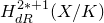 $H^{2*+1}_{\rm dR}(X/K)$
defined as follows. Note that
$H^{2*+1}_{\rm dR}(X/K)$
defined as follows. Note that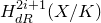 $H^{2i+1}_{\rm dR}(X/K)$
and
$H^{2i+1}_{\rm dR}(X/K)$
and $H^{2n-(2i+1)}_{\rm dR}(X/K)$
are canonically dual and both have a semilinear
$H^{2n-(2i+1)}_{\rm dR}(X/K)$
are canonically dual and both have a semilinear $\mathop{\mathrm{Gal}}\nolimits(K/k)$
action on them. If
$\mathop{\mathrm{Gal}}\nolimits(K/k)$
action on them. If $2i+1 \neq n$
, then
$2i+1 \neq n$
, then $2n-(2i+1) \neq 2i+1$
. Therefore, the canonical isomorphism
$2n-(2i+1) \neq 2i+1$
. Therefore, the canonical isomorphism $H^{2n-(2i+1)}_{\rm dR}(X/K) \cong H^{2i+1}_{\rm dR}(X/K)^\vee$
gives rise to a canonical Galois-compatible quadratic form on
$H^{2n-(2i+1)}_{\rm dR}(X/K) \cong H^{2i+1}_{\rm dR}(X/K)^\vee$
gives rise to a canonical Galois-compatible quadratic form on $H^{2i+1}_{\rm dR}(X/K)\oplus H^{2n-(2i+1)}_{\rm dR}(X)$
given by taking a pair
$H^{2i+1}_{\rm dR}(X/K)\oplus H^{2n-(2i+1)}_{\rm dR}(X)$
given by taking a pair $(\alpha, f)$
to
$(\alpha, f)$
to $f(\alpha)$
. If
$f(\alpha)$
. If $2i+1 = n$
, then
$2i+1 = n$
, then $H^n_{\rm dR}(X/K)$
is canonically self-dual. Writing
$H^n_{\rm dR}(X/K)$
is canonically self-dual. Writing $\phi: H^n_{\rm dR}(X/K) \to H^n_{\rm dR}(X/K)^\vee$
, we obtain a Galois-compatible quadratic form on
$\phi: H^n_{\rm dR}(X/K) \to H^n_{\rm dR}(X/K)^\vee$
, we obtain a Galois-compatible quadratic form on $H^n_{\rm dR}(X/K)$
by taking
$H^n_{\rm dR}(X/K)$
by taking $\alpha$
to
$\alpha$
to $\phi(\alpha)(\alpha)$
, which is hyperbolic since n is odd. This furnishes a Galois-compatible quadratic form on all of
$\phi(\alpha)(\alpha)$
, which is hyperbolic since n is odd. This furnishes a Galois-compatible quadratic form on all of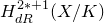 $H^{2*+1}_{\rm dR}(X/K)$
, and we will write
$H^{2*+1}_{\rm dR}(X/K)$
, and we will write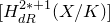 $[H^{2*+1}_{\rm dR}(X/K)]$
to be the corresponding element of
$[H^{2*+1}_{\rm dR}(X/K)]$
to be the corresponding element of $\widehat{\mathrm{W}}(K)^{\rm desc}$
. Note that if we forget the descent data, the quadratic form is clearly hyperbolic.
$\widehat{\mathrm{W}}(K)^{\rm desc}$
. Note that if we forget the descent data, the quadratic form is clearly hyperbolic.
Corollary 3.7.
Let $(X, \varphi)$
be a K variety with descent data
$(X, \varphi)$
be a K variety with descent data $\varphi$
. Then there is a natural Galois-compatible non-degenerate quadratic form on
$\varphi$
. Then there is a natural Galois-compatible non-degenerate quadratic form on $H^{2*}_{\rm dR}(X/K)$
with Galois action induced by
$H^{2*}_{\rm dR}(X/K)$
with Galois action induced by $\varphi$
given by the composition
$\varphi$
given by the composition $x \mapsto \mathrm{Tr}_{X}(x \cup x)$
.
$x \mapsto \mathrm{Tr}_{X}(x \cup x)$
.
Proof. Immediate, since $(X,\varphi)$
is given by the base change of
$(X,\varphi)$
is given by the base change of $\mathrm{desc}_{K/k}(X,\varphi)$
to K.
$\mathrm{desc}_{K/k}(X,\varphi)$
to K.
Theorem 3.8.
There is a unique ring homomorphism $\chi^{\rm mot, desc}_k: K_0(\mathrm{Var}_{K, \rm desc}) \to \widehat{\mathrm{W}}(K)^{\rm desc}$
such that if
$\chi^{\rm mot, desc}_k: K_0(\mathrm{Var}_{K, \rm desc}) \to \widehat{\mathrm{W}}(K)^{\rm desc}$
such that if $(X, \varphi)$
is a smooth projective variety, then
$(X, \varphi)$
is a smooth projective variety, then
 \begin{align*}\chi^{\rm mot, desc}_k( [(X,\varphi)]) = [H^{2*}_{\rm dR}(X/K)] - [H^{2*+1}_{\rm dR}(X/K)].\end{align*}
Proof. Define $\chi^{\rm mot, desc}$
to be the composition
$\chi^{\rm mot, desc}$
to be the composition $K_0(\mathrm{Var}_{K, \rm desc}) \cong K_0(\mathrm{Var}_k) \xrightarrow{\chi^{\rm mot}} \widehat{\mathrm{W}}(k) \to \widehat{\mathrm{W}}(K)^{\rm desc}$
. The above corollary guarantees that this satisfies the desired property. Uniqueness is also immediate by the above corollary, since if
$K_0(\mathrm{Var}_{K, \rm desc}) \cong K_0(\mathrm{Var}_k) \xrightarrow{\chi^{\rm mot}} \widehat{\mathrm{W}}(k) \to \widehat{\mathrm{W}}(K)^{\rm desc}$
. The above corollary guarantees that this satisfies the desired property. Uniqueness is also immediate by the above corollary, since if $\varphi$
is any other morphism as above, then the composition
$\varphi$
is any other morphism as above, then the composition
 \begin{align*}K_0(\mathrm{Var}_k) \to K_0(\mathrm{Var}_{K, \rm desc}) \xrightarrow{\varphi} \widehat{\mathrm{W}}(K)^{\rm desc} \cong \widehat{\mathrm{W}}(k)\end{align*}
is such that for a smooth projective variety X,
 \begin{align*}[X] \mapsto [H^{2*}_{\rm dR}(X/k)] - \tfrac12 \mathrm{dim}_k H^{2*+1}_{\rm dR}(X/k) \cdot \mathbb{H} = \chi^{\rm dR}(X),\end{align*}
so the composition is equal to $\chi^{\rm mot}$
. As noted in Theorem 2.9, the morphism
$\chi^{\rm mot}$
. As noted in Theorem 2.9, the morphism $\chi^{\rm mot}$
is unique with respect to this property, so
$\chi^{\rm mot}$
is unique with respect to this property, so $\chi^{\rm mot, desc}$
will also be unique.
$\chi^{\rm mot, desc}$
will also be unique.
Remark 3.9. An argument similar to the one above has been noted in [Reference Levine and RaksitLR20, § 8E].
4. The motivic Euler characteristic and transfer maps
Let $L/k$
be a finite separable field extension. We can define various transfer maps between the rings
$L/k$
be a finite separable field extension. We can define various transfer maps between the rings $K_0(\mathrm{Var}_L)$
and
$K_0(\mathrm{Var}_L)$
and $K_0(\mathrm{Var}_k)$
, given by base change, forgetting the base, and Weil restriction, and analogously for
$K_0(\mathrm{Var}_k)$
, given by base change, forgetting the base, and Weil restriction, and analogously for $\widehat{\mathrm{W}}(L)$
and
$\widehat{\mathrm{W}}(L)$
and $\widehat{\mathrm{W}}(k)$
by base change, the trace transfer, and Rost’s norm transfer from [Reference RostRos03]. In this section, we show that the motivic Euler characteristic is compatible with these transfer maps.
$\widehat{\mathrm{W}}(k)$
by base change, the trace transfer, and Rost’s norm transfer from [Reference RostRos03]. In this section, we show that the motivic Euler characteristic is compatible with these transfer maps.
Definition 4.1. Let $\iota: k \hookrightarrow L$
be a field extension. Then there is a natural ring homomorphism
$\iota: k \hookrightarrow L$
be a field extension. Then there is a natural ring homomorphism $\iota_*: \widehat{\mathrm{W}}(k) \to \widehat{\mathrm{W}}(L)$
given on the level of quadratic forms by sending a quadratic form
$\iota_*: \widehat{\mathrm{W}}(k) \to \widehat{\mathrm{W}}(L)$
given on the level of quadratic forms by sending a quadratic form $q: V \to k$
to
$q: V \to k$
to $q \otimes \mathrm{Id}: V \otimes_k L \to L$
. Similarly, there is a ring homomorphism
$q \otimes \mathrm{Id}: V \otimes_k L \to L$
. Similarly, there is a ring homomorphism $(\mathrm{Spec}(\iota))^*: K_0(\mathrm{Var}_k) \to K_0(\mathrm{Var}_L)$
, given by sending a variety X to
$(\mathrm{Spec}(\iota))^*: K_0(\mathrm{Var}_k) \to K_0(\mathrm{Var}_L)$
, given by sending a variety X to $X_L$
.
$X_L$
.
Lemma 4.2. The following diagram is commutative.

Proof. By [Reference BittnerBit04, Theorem 3.1], it is enough to prove this result for smooth projective varieties, so we may use de Rham cohomology. Flat base change for de Rham cohomology gives us an isomorphism $H^*_{\rm dR}(X_L/L) \cong H^*_{\rm dR}(X/k) \otimes_k L$
. Under this isomorphism, the cup product on
$H^*_{\rm dR}(X_L/L) \cong H^*_{\rm dR}(X/k) \otimes_k L$
. Under this isomorphism, the cup product on $H^*_{\rm dR}(X_L)$
is the extension of the cup product on
$H^*_{\rm dR}(X_L)$
is the extension of the cup product on $H^*_{\rm dR}(X/k)$
via L-linearity, so it only remains to examine what happens to the trace map.
$H^*_{\rm dR}(X/k)$
via L-linearity, so it only remains to examine what happens to the trace map.
Since $X/k$
is smooth and projective, there is a canonical isomorphism
$X/k$
is smooth and projective, there is a canonical isomorphism $H^{2n}_{\rm dR}(X/k) \cong H^n(X, \Omega^n_{X/k})$
via the cycle class map. The trace map
$H^{2n}_{\rm dR}(X/k) \cong H^n(X, \Omega^n_{X/k})$
via the cycle class map. The trace map $H^n(X, \Omega^n_{X/k}) \to k$
is defined to be the map given by the image of the identity under the isomorphism
$H^n(X, \Omega^n_{X/k}) \to k$
is defined to be the map given by the image of the identity under the isomorphism
 \begin{align*}Rp_{X/k,*} R\mathcal{H}\mathrm{om}_{\mathcal{O}_X}(\Omega_{X/k}, \Omega_{X/k})^0 \cong H^n(X, \Omega^n_{X/k})^\vee\end{align*}
induced by Grothendieck–Verdier duality (see [Reference HartshorneHar66, Chapter III, Corollary 11.2(f)]). In particular, we see that the trace map commutes with arbitrary base extension by [Reference HartshorneHar66, Corollary 11.2(c)], so the trace map $\mathrm{Tr}_{X/L}$
is given by
$\mathrm{Tr}_{X/L}$
is given by $\mathrm{Tr}_{X/k} \otimes_k \mathrm{Id}_L$
, which gives us the result.
$\mathrm{Tr}_{X/k} \otimes_k \mathrm{Id}_L$
, which gives us the result.
We now focus on two other natural transfer maps, which are maps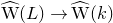 $\widehat{\mathrm{W}}(L) \to \widehat{\mathrm{W}}(k)$
for quadratic forms and maps
$\widehat{\mathrm{W}}(L) \to \widehat{\mathrm{W}}(k)$
for quadratic forms and maps $K_0(\mathrm{Var}_L) \to K_0(\mathrm{Var}_k)$
for varieties.
$K_0(\mathrm{Var}_L) \to K_0(\mathrm{Var}_k)$
for varieties.
Definition 4.3. Let $L/k$
be a finite separable field extension. Write
$L/k$
be a finite separable field extension. Write $N_{L/k}$
to be the norm map
$N_{L/k}$
to be the norm map $L^\times \to k^\times$
and
$L^\times \to k^\times$
and $\mathrm{Tr}_{L/k}$
to mean the trace map
$\mathrm{Tr}_{L/k}$
to mean the trace map $L \to k$
. We have a natural homomorphism of abelian groups
$L \to k$
. We have a natural homomorphism of abelian groups $\mathrm{Tr}_{L/k}: \widehat{\mathrm{W}}(L) \to \widehat{\mathrm{W}}(k)$
, given on the level of quadratic forms by sending the quadratic form
$\mathrm{Tr}_{L/k}: \widehat{\mathrm{W}}(L) \to \widehat{\mathrm{W}}(k)$
, given on the level of quadratic forms by sending the quadratic form $q: V \to L$
to the quadratic form
$q: V \to L$
to the quadratic form $\mathrm{Tr}_{L/k} \circ q$
. This is a widely studied homomorphism in quadratically enriched enumerative geometry, appearing, for example, in [Reference Kass and WickelgrenKW21, p. 19].
$\mathrm{Tr}_{L/k} \circ q$
. This is a widely studied homomorphism in quadratically enriched enumerative geometry, appearing, for example, in [Reference Kass and WickelgrenKW21, p. 19].
Write $\mathrm{disc}(L/k) := \mathrm{disc}(\mathrm{Tr}_{L/k}(\langle 1 \rangle))$
. This is not misleading: for
$\mathrm{disc}(L/k) := \mathrm{disc}(\mathrm{Tr}_{L/k}(\langle 1 \rangle))$
. This is not misleading: for $k=\mathbb{Q}$
, this agrees with the discriminant of the number field L. For
$k=\mathbb{Q}$
, this agrees with the discriminant of the number field L. For $w \in \widehat{\mathrm{W}}(k)$
, we have
$w \in \widehat{\mathrm{W}}(k)$
, we have $\mathrm{rank} (\mathrm{Tr}_{L/k}(w)) = [L:k] \mathrm{rank}(w)$
, so
$\mathrm{rank} (\mathrm{Tr}_{L/k}(w)) = [L:k] \mathrm{rank}(w)$
, so $\mathrm{Tr}_{L/k}$
is not a ring homomorphism.
$\mathrm{Tr}_{L/k}$
is not a ring homomorphism.
Analogously to the above, if we have a variety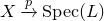 $X \xrightarrow{p} \mathrm{Spec}(L)$
, we can consider X as a variety over k with structure map
$X \xrightarrow{p} \mathrm{Spec}(L)$
, we can consider X as a variety over k with structure map $X \xrightarrow{p} \mathrm{Spec}(L) \to \mathrm{Spec}(k)$
. This induces a homomorphism of abelian groups
$X \xrightarrow{p} \mathrm{Spec}(L) \to \mathrm{Spec}(k)$
. This induces a homomorphism of abelian groups $K_0(\mathrm{Var}_L)\to K_0(\mathrm{Var}_k)$
, though not a ring homomorphism.
$K_0(\mathrm{Var}_L)\to K_0(\mathrm{Var}_k)$
, though not a ring homomorphism.
As in Remark 2.36, identify $\widehat{\mathrm{W}}(k)/I^2 = \mathbf{W}(k)$
with
$\widehat{\mathrm{W}}(k)/I^2 = \mathbf{W}(k)$
with $E(\mathop{\mathrm{Hom}}\nolimits(\mathop{\mathrm{Gal}}\nolimits_k, \mathbb{Z}/2\mathbb{Z}))$
. Let
$E(\mathop{\mathrm{Hom}}\nolimits(\mathop{\mathrm{Gal}}\nolimits_k, \mathbb{Z}/2\mathbb{Z}))$
. Let $E_{\rm disc}$
denote the quotient map
$E_{\rm disc}$
denote the quotient map
 \begin{align*}E_{\rm disc}:\widehat{\mathrm{W}}(k) &\to E(\mathop{\mathrm{Hom}}\nolimits(\mathop{\mathrm{Gal}}\nolimits_k, \mathbb{Z}/2\mathbb{Z})),\\w &\mapsto (\mathrm{rank}(w), \mathrm{disc}(w)).\end{align*}
Lemma 4.4.
Let $w \in \widehat{\mathrm{W}}(L)$
, such that
$w \in \widehat{\mathrm{W}}(L)$
, such that $E_{\rm disc}(w) = (\alpha, \beta)$
. Then
$E_{\rm disc}(w) = (\alpha, \beta)$
. Then $\mathrm{Tr}_{L/k}(w)$
satisfies
$\mathrm{Tr}_{L/k}(w)$
satisfies
 \begin{align*}E_{\rm disc}(\mathrm{Tr}_{L/k}(w)) = ([L:k]\alpha,\mathrm{disc}(L/k)^{\alpha}N_{L/k}(\beta))._{\vphantom{\big(}}\end{align*}
Proof. The statement about the rank is immediate, so we only need to show this for the discriminant. Since both disc and $\mathrm{Tr}_{L/k}$
are abelian group homomorphisms, it is enough to show the statement on generators of
$\mathrm{Tr}_{L/k}$
are abelian group homomorphisms, it is enough to show the statement on generators of $\widehat{\mathrm{W}}(L)$
, so assume that
$\widehat{\mathrm{W}}(L)$
, so assume that $w=\langle \beta \rangle$
. Let
$w=\langle \beta \rangle$
. Let $m_{\beta}$
be the matrix defining the k linear map on L given by multiplication by
$m_{\beta}$
be the matrix defining the k linear map on L given by multiplication by $\beta$
, so that
$\beta$
, so that $\mathrm{det}(m_\beta) = N_{L/k}(\beta)$
. Let A be a symmetric matrix representing the symmetric k-bilinear form on L given by
$\mathrm{det}(m_\beta) = N_{L/k}(\beta)$
. Let A be a symmetric matrix representing the symmetric k-bilinear form on L given by $(x,y) \mapsto \mathrm{Tr}_{L/k}(xy)$
for all
$(x,y) \mapsto \mathrm{Tr}_{L/k}(xy)$
for all $x, y \in L$
. Then A is a symmetric matrix such that
$x, y \in L$
. Then A is a symmetric matrix such that $\mathrm{det}(A) = \mathrm{disc}(L/k)$
. We obtain a matrix representing the quadratic form
$\mathrm{det}(A) = \mathrm{disc}(L/k)$
. We obtain a matrix representing the quadratic form $\mathrm{Tr}_{L/k}(\langle \beta \rangle)$
, given by
$\mathrm{Tr}_{L/k}(\langle \beta \rangle)$
, given by $Am_\beta$
. The result follows since
$Am_\beta$
. The result follows since
 \begin{eqnarray*}\mathrm{disc}(\mathrm{Tr}_{L/k}(\langle \beta \rangle)) =\mathrm{det}(Am_\beta) = \mathrm{det}(A)\mathrm{det}(m_\beta) =\mathrm{disc}(L/k)N_{L/k}(\beta).\\[-36pt]\end{eqnarray*}
Lemma 4.5. The following diagram is commutative.

Proof. We first note that we can reduce to the case where $X/L$
is smooth, projective, and connected, so that we may work with the de Rham Euler characteristic. Let
$X/L$
is smooth, projective, and connected, so that we may work with the de Rham Euler characteristic. Let $X/L$
be a smooth projective variety of dimension n. There is an isomorphism of k-vector spaces
$X/L$
be a smooth projective variety of dimension n. There is an isomorphism of k-vector spaces $H^*_{\rm dR}(X/L) \cong H^*_{\rm dR}(X/k)$
, and this isomorphism is compatible with cup products, so it only remains to check what happens to the trace map
$H^*_{\rm dR}(X/L) \cong H^*_{\rm dR}(X/k)$
, and this isomorphism is compatible with cup products, so it only remains to check what happens to the trace map $H^{2n}_{\rm dR}(X/k) \to k$
. From here, the proof is largely an application of [Reference HartshorneHar66, Chapter 3, Corollary 11.2], which we present here for the convenience of the reader.
$H^{2n}_{\rm dR}(X/k) \to k$
. From here, the proof is largely an application of [Reference HartshorneHar66, Chapter 3, Corollary 11.2], which we present here for the convenience of the reader.
After applying the cycle class isomorphism $H^{2n}_{\rm dR}(X/k)\cong H^n(X, \Omega^n_{X/k})$
, we see that the trace map
$H^{2n}_{\rm dR}(X/k)\cong H^n(X, \Omega^n_{X/k})$
, we see that the trace map $H^n(X, \Omega^n_{X/k}) \to k$
is the image of the identity under the isomorphism
$H^n(X, \Omega^n_{X/k}) \to k$
is the image of the identity under the isomorphism
 \begin{align*}Rp_{X/k,*}\mathcal{H}\mathrm{om}_{\mathcal{O}_X}(\Omega_{X/k}, \Omega_{X/k})^0 \cong H^n(X, \Omega^n_{X/k})^\vee\end{align*}
induced by Grothendieck–Verdier duality, and similarly if we replace k by L as above. By [Reference HartshorneHar66, Chapter 3, Corollary 11.2(e)], it is implied that the image of the identity under the isomorphism
 \begin{align*}Rp_{L/k,*}\mathcal{H}\mathrm{om}_{L}(\Omega_{L/k}, \Omega_{L/k})^0 \cong H^n(\mathrm{Spec}(L), \Omega^n_{L/k})^\vee\end{align*}
is given by the standard trace map $\mathrm{Tr}_{L/k}$
. Since
$\mathrm{Tr}_{L/k}$
. Since $p_{L/k}$
is étale,
$p_{L/k}$
is étale, $p^!_{L/k}=p^*_{L/k}$
is the left adjoint of
$p^!_{L/k}=p^*_{L/k}$
is the left adjoint of $Rp_{L/k,*}$
, and since it is finite,
$Rp_{L/k,*}$
, and since it is finite, $Rp_{L/k,*}=p_{L/k,*}$
. Moreover, since
$Rp_{L/k,*}=p_{L/k,*}$
. Moreover, since $p^!$
is right adjoint to
$p^!$
is right adjoint to $p_*$
, we have canonical isomorphisms
$p_*$
, we have canonical isomorphisms $p^!_{X/k}(\mathcal{O}_k) = \Omega^n_{X/k}[-n]$
, and similarly when replacing k with L. Similarly, we see that
$p^!_{X/k}(\mathcal{O}_k) = \Omega^n_{X/k}[-n]$
, and similarly when replacing k with L. Similarly, we see that
 \begin{align*}p^!_{X/k}(k) = p^!_{X/L}p^!_{L/k}(k) = p^!_{X/L}( p^*_{L/k}(k)) = p^!_{X/L}(L).\end{align*}
Using this, we have the following commutative diagram, in which all of the arrows are isomorphisms.

Again by [Reference HartshorneHar66, Chapter 3, Corollary 11.2(e) and (f)], the isomorphism $\Phi$
takes a morphism
$\Phi$
takes a morphism $f \in \mathop{\mathrm{Hom}}\nolimits_L( H^n(X, \Omega^n_{X/L}), L)$
to
$f \in \mathop{\mathrm{Hom}}\nolimits_L( H^n(X, \Omega^n_{X/L}), L)$
to $\mathrm{Tr}_{L/k} \circ f \in \mathop{\mathrm{Hom}}\nolimits_k(H^n(X, \Omega^n_{X/L}), k)$
. Consider the identity element
$\mathrm{Tr}_{L/k} \circ f \in \mathop{\mathrm{Hom}}\nolimits_k(H^n(X, \Omega^n_{X/L}), k)$
. Consider the identity element $\mathrm{Id} \in Rp_{X/k,*} {R}\mathcal{H}\mathrm{om}_{\mathcal{O}_X}(p^!_{X/k}(k), p^!_{X/k}(k))^0$
. Going clockwise around the above diagram maps the element Id to
$\mathrm{Id} \in Rp_{X/k,*} {R}\mathcal{H}\mathrm{om}_{\mathcal{O}_X}(p^!_{X/k}(k), p^!_{X/k}(k))^0$
. Going clockwise around the above diagram maps the element Id to $\mathrm{Tr}_{L/k} \circ \mathrm{Tr}_{X/L}$
. However, going counterclockwise maps Id to
$\mathrm{Tr}_{L/k} \circ \mathrm{Tr}_{X/L}$
. However, going counterclockwise maps Id to $\mathrm{Tr}_{X/k}$
, giving the desired equality.
$\mathrm{Tr}_{X/k}$
, giving the desired equality.
We now turn our attention to the norm and Weil restriction transfer maps. This first requires us to use the machinery of polynomial maps: while the transfer maps defined by the trace and forgetful functor are group homomorphisms, the transfer maps that we obtain by looking at Weil restrictions and norms have a different structure.
Definition 4.6. Let B be an abelian group, let A an abelian monoid, and let $P:A\to B$
be a function on the underlying sets. We say that P is a polynomial map of degree
$P:A\to B$
be a function on the underlying sets. We say that P is a polynomial map of degree $\leq -1$
if
$\leq -1$
if $P=0$
. For
$P=0$
. For $n\geq0$
, we say that P is a polynomial map of degree
$n\geq0$
, we say that P is a polynomial map of degree $\leq n$
if, for each
$\leq n$
if, for each $x\in A$
, the map
$x\in A$
, the map
 \begin{align*}\Delta_xP:A&\to B , \\ \Delta_xP(y)&=P(y+x)-P(y)\end{align*}
is a polynomial map of degree $\leq n-1$
. We say that P is a polynomial map if it is a polynomial map of degree
$\leq n-1$
. We say that P is a polynomial map if it is a polynomial map of degree $\leq n$
for some n. Note that P is a polynomial map of degree
$\leq n$
for some n. Note that P is a polynomial map of degree $\leq 0$
if and only if P is constant.
$\leq 0$
if and only if P is constant.
Now suppose that A and B are commutative rings. A polynomial map is called multiplicative if $P(1)=1$
and if for every
$P(1)=1$
and if for every $x,y \in A$
, we have
$x,y \in A$
, we have $P(xy)=P(x)P(y)$
. Note that a multiplicative polynomial map of degree
$P(xy)=P(x)P(y)$
. Note that a multiplicative polynomial map of degree $\leq 1$
is either identically 1 or a ring homomorphism.
$\leq 1$
is either identically 1 or a ring homomorphism.
Polynomial maps can be extended from monoids to rings by the following.
Lemma 4.7 (Proposition 1.6 of [Reference JoukhovitskiJou00]). Let $\tilde{A}$
be an abelian monoid, let
$\tilde{A}$
be an abelian monoid, let $\tilde{f}: \tilde{A} \to B$
be a polynomial map of degree
$\tilde{f}: \tilde{A} \to B$
be a polynomial map of degree $\leq n$
, and let A be the group completion of
$\leq n$
, and let A be the group completion of $\tilde{A}$
. Then there exists a unique polynomial map of degree
$\tilde{A}$
. Then there exists a unique polynomial map of degree $\leq n$ $f: A \to B$
that extends
$f: A \to B$
that extends $\tilde{f}$
.
$\tilde{f}$
.
The statement about the degree of the polynomial map is not in the statement of [Reference JoukhovitskiJou00, Proposition 1.6]; however, it follows from the proof.
For every finite separable extension $K/F$
of fields, let
$K/F$
of fields, let $\mathrm{N}_{K/F}:K\to F$
denote the norm map. The following proposition also serves as a definition of the norm map.
$\mathrm{N}_{K/F}:K\to F$
denote the norm map. The following proposition also serves as a definition of the norm map.
Proposition 4.8 (Corollary 5 of [Reference RostRos03]). Let F be a field of characteristic $\neq 2$
, and let
$\neq 2$
, and let $K/F$
be a finite separable field extension of degree n. Then there exists a unique multiplicative polynomial map
$K/F$
be a finite separable field extension of degree n. Then there exists a unique multiplicative polynomial map $\mathrm{N}_{K/F}:\widehat{\mathrm{W}}(K)\to\widehat{\mathrm{W}}(F)$
of degree
$\mathrm{N}_{K/F}:\widehat{\mathrm{W}}(K)\to\widehat{\mathrm{W}}(F)$
of degree $\leq n$
such that
$\leq n$
such that $\mathrm{N}_{K/F}(\langle b\rangle)=\langle\mathrm{N}_{K/F}(b)\rangle$
for all
$\mathrm{N}_{K/F}(\langle b\rangle)=\langle\mathrm{N}_{K/F}(b)\rangle$
for all $b \in k^\times$
.
$b \in k^\times$
.
This rest of this section is dedicated to proving Theorem 4.22, which says that this norm polynomial map computes the motivic Euler characteristic of the Weil restriction of a variety. In order to prove this, we first need some smaller lemmas.
Lemma 4.9.
Suppose that $f,g: A \to B$
are polynomial maps of degree
$f,g: A \to B$
are polynomial maps of degree $\leq n$
,
$\leq n$
, $\leq m$
, respectively. Then
$\leq m$
, respectively. Then $f+g$
is a polynomial map of degree
$f+g$
is a polynomial map of degree $\leq \mathrm{max}(n,m)$
. Similarly, if
$\leq \mathrm{max}(n,m)$
. Similarly, if $m=1$
and f,g are multiplicative, then fg is a multiplicative polynomial map of degree
$m=1$
and f,g are multiplicative, then fg is a multiplicative polynomial map of degree $\leq n+1$
.
$\leq n+1$
.
Proof. We prove the first statement by induction on the degree of f. If $\mathrm{deg}(f)=0$
, then f is constant, so
$\mathrm{deg}(f)=0$
, then f is constant, so $\Delta_x(f+g) = \Delta_x(g)$
. Suppose that
$\Delta_x(f+g) = \Delta_x(g)$
. Suppose that $\mathrm{deg}(f)=n$
. Then consider
$\mathrm{deg}(f)=n$
. Then consider $\Delta_x (f+g): A \to B$
. We compute
$\Delta_x (f+g): A \to B$
. We compute $\Delta_x(f+g)(y) = \Delta_x(f)(y) + \Delta_x(g)(y)$
. Since
$\Delta_x(f+g)(y) = \Delta_x(f)(y) + \Delta_x(g)(y)$
. Since $\Delta_x(f)$
and
$\Delta_x(f)$
and $\Delta_x(g)$
are polynomial maps of degree
$\Delta_x(g)$
are polynomial maps of degree $\leq n-1$
and
$\leq n-1$
and $\leq m-1$
, respectively, the result holds by induction.
$\leq m-1$
, respectively, the result holds by induction.
For the second part of the lemma, we proceed by induction on the degree of the polynomial map, with the case that f has degree $\leq 0$
being trivial, since f is then identically 1. We compute
$\leq 0$
being trivial, since f is then identically 1. We compute
 \begin{align*}\Delta_x(fg)(y) &= g(x+y)f(x+y) - g(y)f(y)\\&= g(x)f(x+y) + g(y)f(x+y) - g(y)f(y) \\&= g(x)f(x+y) + g(y) (\Delta_xf(y)).\end{align*}
By induction, we have that $g \cdot (\Delta_xf)$
is a polynomial map of degree
$g \cdot (\Delta_xf)$
is a polynomial map of degree $\leq n$
. Note that we have a polynomial map
$\leq n$
. Note that we have a polynomial map $y \mapsto g(x) f(x+y)$
of degree
$y \mapsto g(x) f(x+y)$
of degree $\leq n$
, since g(x) is constant, and
$\leq n$
, since g(x) is constant, and $f(x+y) = \Delta_xf + f$
is a polynomial map of degree
$f(x+y) = \Delta_xf + f$
is a polynomial map of degree $\leq n$
by the first part of the lemma. Therefore,
$\leq n$
by the first part of the lemma. Therefore, $\Delta_x(fg)$
is polynomial of degree
$\Delta_x(fg)$
is polynomial of degree $\leq n$
, so fg is polynomial of degree
$\leq n$
, so fg is polynomial of degree $\leq n+1$
. The fact that fg is multiplicative is immediate.
$\leq n+1$
. The fact that fg is multiplicative is immediate.
Corollary 4.10.
Let $g_1, \ldots, g_n: A \to B$
be ring homomorphisms. Then
$g_1, \ldots, g_n: A \to B$
be ring homomorphisms. Then $g = \prod_{i=1}^n g_i$
is a polynomial function of degree
$g = \prod_{i=1}^n g_i$
is a polynomial function of degree $\leq n$
.
$\leq n$
.
Proof. Proceed by induction on n, with the case $n=1$
being trivial, and the induction step following by the second part of the above lemma.
$n=1$
being trivial, and the induction step following by the second part of the above lemma.
The next few results are dedicated to showing that the Weil restriction functor from L to k gives rise to a polynomial map $K_0(\mathrm{Var}_L)\to K_0(\mathrm{Var}_k)$
.
$K_0(\mathrm{Var}_L)\to K_0(\mathrm{Var}_k)$
.
Definition 4.11. Let $L/k$
be a finite separable field extension. We let
$L/k$
be a finite separable field extension. We let $I_L := \{\iota: L \to \overline{k} \}$
be the set of embeddings of L into
$I_L := \{\iota: L \to \overline{k} \}$
be the set of embeddings of L into $\overline{k}$
with
$\overline{k}$
with $\iota|_k = \mathrm{id}_k$
. This set has a natural right action of the absolute Galois group
$\iota|_k = \mathrm{id}_k$
. This set has a natural right action of the absolute Galois group $\mathop{\mathrm{Gal}}\nolimits_k$
, given by
$\mathop{\mathrm{Gal}}\nolimits_k$
, given by $\iota \cdot \sigma = \sigma^{-1} \circ \iota$
.
$\iota \cdot \sigma = \sigma^{-1} \circ \iota$
.
If $K/k$
is a finite separable field extension with
$K/k$
is a finite separable field extension with $L \subseteq K$
, we have a
$L \subseteq K$
, we have a $\mathop{\mathrm{Gal}}\nolimits_k$
equivariant map
$\mathop{\mathrm{Gal}}\nolimits_k$
equivariant map $I_K \to I_L$
given by restriction, and the fibres of this map have cardinality
$I_K \to I_L$
given by restriction, and the fibres of this map have cardinality $[K:L]$
. From here, fix
$[K:L]$
. From here, fix $L/k$
a finite field extension, let K be the Galois closure of L in
$L/k$
a finite field extension, let K be the Galois closure of L in $\overline{k}$
, and let
$\overline{k}$
, and let $G=\mathop{\mathrm{Gal}}\nolimits(K/k)$
. If H is the subgroup of G such that
$G=\mathop{\mathrm{Gal}}\nolimits(K/k)$
. If H is the subgroup of G such that $L=K^H$
, then
$L=K^H$
, then $I_L = G/H$
as a G set.
$I_L = G/H$
as a G set.
Definition 4.12. Let X be a quasi-projective variety over L. Define a K variety $\mathrm{Ind}^K_LX$
by setting
$\mathrm{Ind}^K_LX$
by setting $\mathrm{Ind}^K_LX := \prod_{ \iota \in I_L} X_{\iota}$
, where
$\mathrm{Ind}^K_LX := \prod_{ \iota \in I_L} X_{\iota}$
, where $X_{\iota}$
is the pullback of
$X_{\iota}$
is the pullback of $X \to \mathrm{Spec}(L)$
along the inclusion
$X \to \mathrm{Spec}(L)$
along the inclusion $\mathrm{Spec}(K) \xrightarrow{\iota} \mathrm{Spec}(L)$
. We give
$\mathrm{Spec}(K) \xrightarrow{\iota} \mathrm{Spec}(L)$
. We give $\mathrm{Ind}^K_LX$
a canonical semilinear G action. Let
$\mathrm{Ind}^K_LX$
a canonical semilinear G action. Let $g \in G$
. Define a right G action on
$g \in G$
. Define a right G action on $\mathrm{Ind}^K_LX$
by
$\mathrm{Ind}^K_LX$
by $g: X_{g \circ \iota} \to X_{\iota}$
, where this morphism is the pullback.
$g: X_{g \circ \iota} \to X_{\iota}$
, where this morphism is the pullback.

This defines a semilinear action of G on $\mathrm{Ind}^K_LX$
, which we call
$\mathrm{Ind}^K_LX$
, which we call $\varphi_G$
. This in turn gives us a variety
$\varphi_G$
. This in turn gives us a variety $\mathrm{des}_{K/k}(\mathrm{Ind}^K_LX, \varphi_G)$
by Galois descent. By [Reference WeilWei12, Theorem 1.3.2], the variety
$\mathrm{des}_{K/k}(\mathrm{Ind}^K_LX, \varphi_G)$
by Galois descent. By [Reference WeilWei12, Theorem 1.3.2], the variety $\mathrm{des}_{K/k}(\mathrm{Ind}^K_LX, \varphi_G)$
is isomorphic to
$\mathrm{des}_{K/k}(\mathrm{Ind}^K_LX, \varphi_G)$
is isomorphic to $\mathrm{Res}_{L/k}(X)$
.
$\mathrm{Res}_{L/k}(X)$
.
Lemma 4.13.
The assignment $X \to \mathrm{Ind}^K_LX$
extends to a polynomial map of degree
$X \to \mathrm{Ind}^K_LX$
extends to a polynomial map of degree $\leq n$
, denoted
$\leq n$
, denoted $\mathrm{Ind}^K_L: K_0(\mathrm{Var}_L) \to K_0(\mathrm{Var}_K)$
.
$\mathrm{Ind}^K_L: K_0(\mathrm{Var}_L) \to K_0(\mathrm{Var}_K)$
.
Proof. For each $\iota \in I_L$
, note that
$\iota \in I_L$
, note that $g_{\iota}: [X] \mapsto [X \times_{L, \iota}K]$
is a ring homomorphism. Applying Corollary 4.10 gives us the result.
$g_{\iota}: [X] \mapsto [X \times_{L, \iota}K]$
is a ring homomorphism. Applying Corollary 4.10 gives us the result.
In order to show that maps into $K_0(\mathrm{Var}_k)$
are polynomial maps, it is helpful to note the following, which is probably well known.
$K_0(\mathrm{Var}_k)$
are polynomial maps, it is helpful to note the following, which is probably well known.
Lemma 4.14.
Let $Y/k$
be a variety. Then the class [Y] in
$Y/k$
be a variety. Then the class [Y] in $K_0(\mathrm{Var}_k)$
is trivial if and only if
$K_0(\mathrm{Var}_k)$
is trivial if and only if $Y=\emptyset$
.
$Y=\emptyset$
.
Proof. By naturality of $K_0(\mathrm{Var}_k)$
, it is enough to prove this in the case where k is algebraically closed. Suppose that Y is a non-empty variety, and let
$K_0(\mathrm{Var}_k)$
, it is enough to prove this in the case where k is algebraically closed. Suppose that Y is a non-empty variety, and let $\mathrm{dim}(Y) = d$
. As in Proposition 2.27, we have abelian group homomorphisms
$\mathrm{dim}(Y) = d$
. As in Proposition 2.27, we have abelian group homomorphisms $b_i:K_0(\mathrm{Var}_k) \to \mathbb{Z}$
, which, if
$b_i:K_0(\mathrm{Var}_k) \to \mathbb{Z}$
, which, if $X/k$
is a smooth projective variety, has that
$X/k$
is a smooth projective variety, has that $b_i(X)$
is the
$b_i(X)$
is the $i{\text{th}}$
Betti number of X. The proof of [Reference BittnerBit04, Theorem 3.1] shows that we may write
$i{\text{th}}$
Betti number of X. The proof of [Reference BittnerBit04, Theorem 3.1] shows that we may write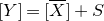 $[Y] = [\overline{X}] + S$
, where
$[Y] = [\overline{X}] + S$
, where $S \in K_0(\mathrm{Var}_k)$
can be written in terms of classes of smooth projective varieties of dimension
$S \in K_0(\mathrm{Var}_k)$
can be written in terms of classes of smooth projective varieties of dimension $\lt d$
. In particular,
$\lt d$
. In particular, $b_{2d}(Y) = b_{2d}(\overline{X}) + b_{2d}(S)$
. Since S can be written in terms of smooth projective varieties of dimension
$b_{2d}(Y) = b_{2d}(\overline{X}) + b_{2d}(S)$
. Since S can be written in terms of smooth projective varieties of dimension $\lt d$
, we see that
$\lt d$
, we see that $b_{2d}(S)=0$
. Moreover, since
$b_{2d}(S)=0$
. Moreover, since $\overline{X}$
is a smooth projective variety of dimension d, we see that
$\overline{X}$
is a smooth projective variety of dimension d, we see that $b_{2d}(\overline{X}) = \# \pi_0(\overline{X}) \neq 0$
. Therefore,
$b_{2d}(\overline{X}) = \# \pi_0(\overline{X}) \neq 0$
. Therefore, $b_{2d}(Y) \neq 0$
, so
$b_{2d}(Y) \neq 0$
, so $[Y] \neq 0$
.
$[Y] \neq 0$
.
Lemma 4.15.
There is a multiplicative polynomial map $K_0(\mathrm{Var}_L)\to K_0(\mathrm{Var}_k)$
, given on smooth quasi-projective varieties by
$K_0(\mathrm{Var}_L)\to K_0(\mathrm{Var}_k)$
, given on smooth quasi-projective varieties by $[X] \mapsto [\mathrm{Res}_{L/k}(X)]$
.
$[X] \mapsto [\mathrm{Res}_{L/k}(X)]$
.
Proof. By Lemma 4.7, we only need to define the polynomial map on the subset of $K_0(\mathrm{Var}_L)$
consisting of elements that are given by [X], where X is a smooth projective variety. As in Definition 4.12, we note that
$K_0(\mathrm{Var}_L)$
consisting of elements that are given by [X], where X is a smooth projective variety. As in Definition 4.12, we note that $\mathrm{des}_{K/k}(\mathrm{Ind}^K_LX, \varphi_G)$
. Therefore, as noted in Definition 3.1, it is enough to define a map
$\mathrm{des}_{K/k}(\mathrm{Ind}^K_LX, \varphi_G)$
. Therefore, as noted in Definition 3.1, it is enough to define a map $K_0(\mathrm{Var}_L) \to K_0(\mathrm{Var}_{K, \rm desc})$
such that for
$K_0(\mathrm{Var}_L) \to K_0(\mathrm{Var}_{K, \rm desc})$
such that for $X/L$
a quasi-projective variety, we have that
$X/L$
a quasi-projective variety, we have that $[X] \mapsto [(\mathrm{Ind}^K_LX, \varphi_G)]$
.
$[X] \mapsto [(\mathrm{Ind}^K_LX, \varphi_G)]$
.
By Lemma 4.7, it is enough to show that the assignment $\mathrm{Res}_{L/k}: [X] \mapsto [(\mathrm{Ind}^K_LX, \varphi_G)]$
satisfies the conditions to be a polynomial map whenever X is projective. That is, we need to show that for any projective varieties
$\mathrm{Res}_{L/k}: [X] \mapsto [(\mathrm{Ind}^K_LX, \varphi_G)]$
satisfies the conditions to be a polynomial map whenever X is projective. That is, we need to show that for any projective varieties $Y_0, \ldots, Y_n$
, we have
$Y_0, \ldots, Y_n$
, we have $\Delta_{Y_0} \Delta_{Y_1} \ldots \Delta_{Y_n} \mathrm{Res}_{L/k}([X]) = 0$
. Consider
$\Delta_{Y_0} \Delta_{Y_1} \ldots \Delta_{Y_n} \mathrm{Res}_{L/k}([X]) = 0$
. Consider $\Delta_Y\mathrm{Res}_{L/k}: [X] \mapsto [(\mathrm{Ind}^K_L(X \amalg Y), \varphi_G)] - [(\mathrm{Ind}^K_LX, \varphi_G)]$
. Note that
$\Delta_Y\mathrm{Res}_{L/k}: [X] \mapsto [(\mathrm{Ind}^K_L(X \amalg Y), \varphi_G)] - [(\mathrm{Ind}^K_LX, \varphi_G)]$
. Note that $\mathrm{Ind}^K_LX$
embeds as a closed subvariety into
$\mathrm{Ind}^K_LX$
embeds as a closed subvariety into $\mathrm{Ind}^K_L(X \amalg Y)$
in a way that is compatible with the descent data on both varieties. Therefore, we can write
$\mathrm{Ind}^K_L(X \amalg Y)$
in a way that is compatible with the descent data on both varieties. Therefore, we can write $\Delta_Y \mathrm{Res}_{L/k}([X]) = [(X_Y, \varphi_G)]$
, where
$\Delta_Y \mathrm{Res}_{L/k}([X]) = [(X_Y, \varphi_G)]$
, where $(X_Y, \varphi_G)$
is the K variety with descent data given by the complement of
$(X_Y, \varphi_G)$
is the K variety with descent data given by the complement of $(\mathrm{Ind}^K_L(X), \varphi_G)$
in
$(\mathrm{Ind}^K_L(X), \varphi_G)$
in $(\mathrm{Ind}^K_L(X \amalg Y), \varphi_G)$
.
$(\mathrm{Ind}^K_L(X \amalg Y), \varphi_G)$
.
Therefore, $\Delta_Y \mathrm{Res}_{L/k}([X])$
is represented by the class of an actual K variety with descent data
$\Delta_Y \mathrm{Res}_{L/k}([X])$
is represented by the class of an actual K variety with descent data $(X_Y, \varphi_G)$
and so gives us a k variety
$(X_Y, \varphi_G)$
and so gives us a k variety $\mathrm{des}_{K/k}(X_Y, \varphi_G)$
. Iterating this process, if
$\mathrm{des}_{K/k}(X_Y, \varphi_G)$
. Iterating this process, if $Y_0, \ldots, Y_n$
are L varieties, we can write
$Y_0, \ldots, Y_n$
are L varieties, we can write
 \begin{align*}\Delta_{Y_0} \Delta_{Y_1} \ldots \Delta_{Y_n} \mathrm{Res}_{L/k} ([X]) = [(X_{Y_0, \ldots, Y_n}, \varphi_G)],\end{align*}
where $(X_{Y_0, \ldots, Y_n}, \varphi_G)$
is a K variety with descent data. We claim that
$(X_{Y_0, \ldots, Y_n}, \varphi_G)$
is a K variety with descent data. We claim that $[(X_{Y_0, \ldots, Y_n}, \varphi_G)] = 0$
. Note that
$[(X_{Y_0, \ldots, Y_n}, \varphi_G)] = 0$
. Note that $[(X_{Y_0, \ldots, Y_n}, \varphi_G)]$
is identified with
$[(X_{Y_0, \ldots, Y_n}, \varphi_G)]$
is identified with $[\mathrm{des}_{K/k}((X_{Y_0, \ldots, Y_n}), \varphi_G)]$
under the isomorphism
$[\mathrm{des}_{K/k}((X_{Y_0, \ldots, Y_n}), \varphi_G)]$
under the isomorphism $K_0(\mathrm{Var}_{K, \rm desc}) \cong K_0(\mathrm{Var}_k)$
, so it is enough to show that
$K_0(\mathrm{Var}_{K, \rm desc}) \cong K_0(\mathrm{Var}_k)$
, so it is enough to show that $[\mathrm{des}_{K/k}((X_{Y_0, \ldots, Y_n}), \varphi_G)] = 0$
. Since this is the class of a k variety,
$[\mathrm{des}_{K/k}((X_{Y_0, \ldots, Y_n}), \varphi_G)] = 0$
. Since this is the class of a k variety, $\mathrm{des}_{K/k}((X_{Y_0, \ldots, Y_n}), \varphi_G)$
, this class vanishes if and only if the variety
$\mathrm{des}_{K/k}((X_{Y_0, \ldots, Y_n}), \varphi_G)$
, this class vanishes if and only if the variety $\mathrm{des}_{K/k}((X_{Y_0, \ldots, Y_n}), \varphi_G)$
is the empty variety by Lemma 4.14.
$\mathrm{des}_{K/k}((X_{Y_0, \ldots, Y_n}), \varphi_G)$
is the empty variety by Lemma 4.14.
We see that $\mathrm{des}_{K/k}((X_{Y_0, \ldots, Y_n}), \varphi_G) =\emptyset$
if and only if
$\mathrm{des}_{K/k}((X_{Y_0, \ldots, Y_n}), \varphi_G) =\emptyset$
if and only if $\mathrm{des}_{K/k}((X_{Y_0, \ldots, Y_n}),\varphi_G)_K$
is trivial as a K variety. However,
$\mathrm{des}_{K/k}((X_{Y_0, \ldots, Y_n}),\varphi_G)_K$
is trivial as a K variety. However, $[\mathrm{des}_{K/k}((X_{Y_0, \ldots, Y_n}), \varphi_G)_K] =[\Delta_{Y_0} \Delta_{Y_1} \ldots \Delta_{Y_n} \mathrm{Ind}^K_L(X)]$
, which vanishes since
$[\mathrm{des}_{K/k}((X_{Y_0, \ldots, Y_n}), \varphi_G)_K] =[\Delta_{Y_0} \Delta_{Y_1} \ldots \Delta_{Y_n} \mathrm{Ind}^K_L(X)]$
, which vanishes since $\mathrm{Ind}^K_L$
is a polynomial map of degree
$\mathrm{Ind}^K_L$
is a polynomial map of degree $\leq n$
. In particular,
$\leq n$
. In particular, $[\mathrm{des}_{K/k}((X_{Y_0, \ldots, Y_n}),\varphi_G)] = 0$
, and so
$[\mathrm{des}_{K/k}((X_{Y_0, \ldots, Y_n}),\varphi_G)] = 0$
, and so $\Delta_{Y_0} \Delta_{Y_1} \ldots\Delta_{Y_n} \mathrm{Res}_{L/k} ([X])=0$
, as required.
$\Delta_{Y_0} \Delta_{Y_1} \ldots\Delta_{Y_n} \mathrm{Res}_{L/k} ([X])=0$
, as required.
Definition 4.16. Let q be a quadratic form over L, on a vector space, V. For $\iota \in I_L$
, define
$\iota \in I_L$
, define $q_{\iota}$
to be the quadratic form on
$q_{\iota}$
to be the quadratic form on $V \otimes_{L, \iota} K$
given by
$V \otimes_{L, \iota} K$
given by $q \otimes_{L, \iota} \langle 1 \rangle$
, where we embed L into K by
$q \otimes_{L, \iota} \langle 1 \rangle$
, where we embed L into K by $\iota$
. It is clear that
$\iota$
. It is clear that $f_{\iota}: \widehat{\mathrm{W}}(L) \to \widehat{\mathrm{W}}(K)$
given by
$f_{\iota}: \widehat{\mathrm{W}}(L) \to \widehat{\mathrm{W}}(K)$
given by $[q] \mapsto [q_{\iota}]$
is a homomorphism. Define
$[q] \mapsto [q_{\iota}]$
is a homomorphism. Define $\mathrm{Ind}^K_L(q) := \otimes_{\iota} q_\iota$
as a quadratic form on K. Note that
$\mathrm{Ind}^K_L(q) := \otimes_{\iota} q_\iota$
as a quadratic form on K. Note that $\mathrm{Ind}^K_L(q)$
has underlying vector space
$\mathrm{Ind}^K_L(q)$
has underlying vector space $\bigotimes_{\iota \in I_L} (V \otimes_{\iota} K)$
and that we may give this space a semilinear G action, where
$\bigotimes_{\iota \in I_L} (V \otimes_{\iota} K)$
and that we may give this space a semilinear G action, where $g \in G$
acts by
$g \in G$
acts by
 \begin{align*}g(v \otimes \lambda)_{\iota} = (v \otimes g(\lambda))_{g \iota},\end{align*}
where $(v \otimes \lambda)_{\iota}$
means
$(v \otimes \lambda)_{\iota}$
means $v \otimes \lambda \in V \otimes_{\iota} K$
. We see that
$v \otimes \lambda \in V \otimes_{\iota} K$
. We see that $\mathrm{Ind}^K_L(q)$
is a Galois-compatible quadratic form on
$\mathrm{Ind}^K_L(q)$
is a Galois-compatible quadratic form on $\bigotimes_{\iota \in I_L} (V \otimes_{\iota} K)$
with respect to this Galois action. Write
$\bigotimes_{\iota \in I_L} (V \otimes_{\iota} K)$
with respect to this Galois action. Write $\mathrm{Ind}^K_L(q)$
for the Galois-compatible quadratic form on
$\mathrm{Ind}^K_L(q)$
for the Galois-compatible quadratic form on $\bigotimes_{\iota \in I_L} (V \otimes_{\iota} K)$
, and let
$\bigotimes_{\iota \in I_L} (V \otimes_{\iota} K)$
, and let $N_{L/k}(q)$
be the associated quadratic form over k that results from applying the equivalence of categories in Theorem 3.3 to
$N_{L/k}(q)$
be the associated quadratic form over k that results from applying the equivalence of categories in Theorem 3.3 to $\mathrm{Ind}^K_L(q)$
.
$\mathrm{Ind}^K_L(q)$
.
By the above work, it is clear that $\mathrm{rank}(N_{L/k}(q)) = \mathrm{rank}(q)^{[L:k]}$
.
$\mathrm{rank}(N_{L/k}(q)) = \mathrm{rank}(q)^{[L:k]}$
.
Remark 4.17.
A priori, it is not clear that $N_{L/k}(q)$
, as defined above, is equivalent to the norm as in Proposition 4.8. The following lemma shows that this is not something to be concerned about, and that the maps are the same.
$N_{L/k}(q)$
, as defined above, is equivalent to the norm as in Proposition 4.8. The following lemma shows that this is not something to be concerned about, and that the maps are the same.
Lemma 4.18.
Let $q=\langle \alpha \rangle$
for
$q=\langle \alpha \rangle$
for $\alpha \in L$
. Then
$\alpha \in L$
. Then $[N_{L/k}(q)] = \langle N_{L/k}(\alpha) \rangle \in \widehat{\mathrm{W}}(k)$
.
$[N_{L/k}(q)] = \langle N_{L/k}(\alpha) \rangle \in \widehat{\mathrm{W}}(k)$
.
Proof. Note that $g_{\iota}(\langle \alpha \rangle) = \langle \iota(\alpha)\rangle$
. Similarly, we see that
$g_{\iota}(\langle \alpha \rangle) = \langle \iota(\alpha)\rangle$
. Similarly, we see that $\bigotimes_{\iota \in I_L} k$
is the subspace of
$\bigotimes_{\iota \in I_L} k$
is the subspace of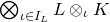 $\bigotimes_{\iota \in I_L} L \otimes_{\iota} K$
fixed by G. In particular,
$\bigotimes_{\iota \in I_L} L \otimes_{\iota} K$
fixed by G. In particular, $N_{L/k}( \langle \alpha \rangle ) (1\otimes \ldots \otimes 1) = \prod_{\iota \in I_L} \iota(\alpha) =N_{L/k}(\alpha)$
, which gives us that
$N_{L/k}( \langle \alpha \rangle ) (1\otimes \ldots \otimes 1) = \prod_{\iota \in I_L} \iota(\alpha) =N_{L/k}(\alpha)$
, which gives us that $N_{L/k}(\langle \alpha \rangle) = \langle N_{L/k} (\alpha) \rangle$
, as required.
$N_{L/k}(\langle \alpha \rangle) = \langle N_{L/k} (\alpha) \rangle$
, as required.
Corollary 4.19.
The map $N_{L/k}(q)$
from Proposition 4.8 and the map
$N_{L/k}(q)$
from Proposition 4.8 and the map $N_{L/k}(q)$
from Definition 4.16 agree.
$N_{L/k}(q)$
from Definition 4.16 agree.
Proof. This is immediate by the above lemma and Proposition 4.8.
Remark 4.20. Since $N_{L/k}: \widehat{\mathrm{W}}(L) \to \widehat{\mathrm{W}}(k)$
is a polynomial map, we obtain a polynomial map
$N_{L/k}: \widehat{\mathrm{W}}(L) \to \widehat{\mathrm{W}}(k)$
is a polynomial map, we obtain a polynomial map $\mathrm{Ind}^K_L: \widehat{\mathrm{W}}(L) \to \widehat{\mathrm{W}}(K)^{\rm desc}$
by composing with the isomorphism in Corollary 3.4.
$\mathrm{Ind}^K_L: \widehat{\mathrm{W}}(L) \to \widehat{\mathrm{W}}(K)^{\rm desc}$
by composing with the isomorphism in Corollary 3.4.
Corollary 4.21.
Let $w \in \widehat{\mathrm{W}}(L)$
with
$w \in \widehat{\mathrm{W}}(L)$
with $E_{\rm disc}(w) = (\alpha, \beta) \in E( (L^\times)/(L^\times)^2)$
. Then,
$E_{\rm disc}(w) = (\alpha, \beta) \in E( (L^\times)/(L^\times)^2)$
. Then,
 \begin{align*}E_{\rm disc}(N_{L/k}(w)) = (\alpha^{[L:k]}, N_{L/k}(\beta)).\end{align*}
Proof. We know that $E_{\rm disc} \circ N_{L/k}$
is a polynomial map of degree
$E_{\rm disc} \circ N_{L/k}$
is a polynomial map of degree $\leq n$
, so we can reduce to the case where w is a quadratic form, and the result will follow by Lemma 4.7. This is then a straightforward computation, similar to the lemma above.
$\leq n$
, so we can reduce to the case where w is a quadratic form, and the result will follow by Lemma 4.7. This is then a straightforward computation, similar to the lemma above.
Theorem 4.22. The following diagram is commutative.

In particular, if $X/L$
is a variety such that
$X/L$
is a variety such that $\mathrm{Res}_{L/k}(X)$
exists, then
$\mathrm{Res}_{L/k}(X)$
exists, then
 \begin{align*}\chi^{\rm mot}_k(\mathrm{Res}_{L/k}(X))= N_{L/k}(\chi^{\rm mot}_L(X)).\end{align*}
Proof. The composition of two multiplicative polynomial functions is again a multiplicative polynomial function. Therefore, if for X a smooth projective variety over L, we have
 \begin{align*}\chi^{\rm mot}(\mathrm{Res}_{L/k}(X)) = N_{L/k}(\chi^{\rm mot}(X)),\end{align*}
then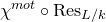 $\chi^{\rm mot} \circ \mathrm{Res}_{L/k}$
and
$\chi^{\rm mot} \circ \mathrm{Res}_{L/k}$
and $N_{L/k} \circ \chi^{\rm mot}$
define the same polynomial function from
$N_{L/k} \circ \chi^{\rm mot}$
define the same polynomial function from $K_0(\mathrm{Var}_L)$
to
$K_0(\mathrm{Var}_L)$
to $\widehat{\mathrm{W}}(k)$
by Lemma 4.7. Since
$\widehat{\mathrm{W}}(k)$
by Lemma 4.7. Since $\mathrm{Res}_{L/k}(X) = \mathrm{des}_{K/k}( (\mathrm{Ind}^K_L(X), \varphi_G))$
, and
$\mathrm{Res}_{L/k}(X) = \mathrm{des}_{K/k}( (\mathrm{Ind}^K_L(X), \varphi_G))$
, and $N_{L/k}(\chi^{\rm mot}_L(X))$
is the image of
$N_{L/k}(\chi^{\rm mot}_L(X))$
is the image of $\mathrm{Ind}^K_L( \chi^{\rm mot}_L(X)^{\rm desc})$
under the isomorphism
$\mathrm{Ind}^K_L( \chi^{\rm mot}_L(X)^{\rm desc})$
under the isomorphism $\widehat{\mathrm{W}}(k) \to \widehat{\mathrm{W}}(K)^{\rm desc}$
, the theorem follows if we can show that the following diagram is commutative.
$\widehat{\mathrm{W}}(k) \to \widehat{\mathrm{W}}(K)^{\rm desc}$
, the theorem follows if we can show that the following diagram is commutative.

Therefore, we need to show that
 \begin{align*}\chi^{\rm mot, desc}( \mathrm{Ind}^K_LX) = \prod_{\iota} g_{\iota}(\chi^{\rm mot}(X)) \in \widehat{\mathrm{W}}(k),\end{align*}
which is clear by naturality of the motivic Euler characteristic, the semilinear actions on both sides, and the fact that Galois descent is compatible with the motivic Euler characteristic as in Corollary 3.7.
5. Fubini theorems
Historically, since the motivic Euler characteristic is a motivic measure, we might think of it as a volume. Indeed, the motivic Gauss–Bonnet formula of [Reference Levine and RaksitLR20] says that we may obtain the motivic Euler characteristic as the integral of an Euler class across our space. Let X,Y be varieties over k, and suppose that we have a morphism $f: X \to Y$
. For the purposes of this paper, a Fubini theorem is a theorem that allows us to compute properties of
$f: X \to Y$
. For the purposes of this paper, a Fubini theorem is a theorem that allows us to compute properties of $\chi^{\rm mot}(X)$
from the motivic Euler characteristic
$\chi^{\rm mot}(X)$
from the motivic Euler characteristic $\chi^{\rm mot}(Y)$
as well as the motivic Euler characteristics of the fibres
$\chi^{\rm mot}(Y)$
as well as the motivic Euler characteristics of the fibres $\chi^{\rm mot}(X_y)$
. For example, suppose that our base field is
$\chi^{\rm mot}(X_y)$
. For example, suppose that our base field is $\mathbb{C}$
, so that
$\mathbb{C}$
, so that $\chi^{\rm mot}$
is the compactly supported Euler characteristic applied to the complex points. By the standard Fubini theorem,
$\chi^{\rm mot}$
is the compactly supported Euler characteristic applied to the complex points. By the standard Fubini theorem, $\chi_c(X_y(\mathbb{C}))=0$
for all y implies that
$\chi_c(X_y(\mathbb{C}))=0$
for all y implies that $\chi_c(X(\mathbb{C}))=0$
. This section is concerned with proving certain Fubini theorems for the motivic Euler characteristic modulo J. We first look at the situation where
$\chi_c(X(\mathbb{C}))=0$
. This section is concerned with proving certain Fubini theorems for the motivic Euler characteristic modulo J. We first look at the situation where $f: X \to Y$
satisfies that
$f: X \to Y$
satisfies that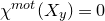 $\chi^{\rm mot}(X_y) = 0$
for every closed point y of Y. The principle that ‘if an invariant is zero on the fibres, then it is zero on the total space’ will be referred to as a naïve Fubini theorem. It does not tend to hold in our context, and we obtain a Fubini theorem for the
$\chi^{\rm mot}(X_y) = 0$
for every closed point y of Y. The principle that ‘if an invariant is zero on the fibres, then it is zero on the total space’ will be referred to as a naïve Fubini theorem. It does not tend to hold in our context, and we obtain a Fubini theorem for the $\ell$
-adic determinant of cohomology in Corollary 5.19, which does not satisfy this naïve property. However, in Corollary 5.27, we show that we may bound the ramification of the character that we obtain by looking at the
$\ell$
-adic determinant of cohomology in Corollary 5.19, which does not satisfy this naïve property. However, in Corollary 5.27, we show that we may bound the ramification of the character that we obtain by looking at the $\ell$
-adic determinant of cohomology of the total space, which allows us to restrict the possibilities of this character to a finite set. We then turn to looking at a different Fubini theorem, one for maps whose fibres are algebraic groups, where we can use the structure of algebraic groups in order to prove a naïve Fubini theorem for torsors in Corollary 5.31.
$\ell$
-adic determinant of cohomology of the total space, which allows us to restrict the possibilities of this character to a finite set. We then turn to looking at a different Fubini theorem, one for maps whose fibres are algebraic groups, where we can use the structure of algebraic groups in order to prove a naïve Fubini theorem for torsors in Corollary 5.31.
5.1 The Fubini theorem over real closed fields
The goal of this subsection is to prove the first part of our Fubini theorem.
Theorem 5.1.
Suppose that X and Y are varieties over k, and let $f: X \to Y$
be a morphism such that for every y a closed point of Y, we have that
$f: X \to Y$
be a morphism such that for every y a closed point of Y, we have that $\chi^{\rm mot}(X_y)$
is torsion. Then
$\chi^{\rm mot}(X_y)$
is torsion. Then $\chi^{\rm mot}(X)$
is torsion.
$\chi^{\rm mot}(X)$
is torsion.
We call this the real closed Fubini theorem as, by Pfister’s local–global principle, we have that $\chi^{\rm mot}(X)$
is torsion if and only if
$\chi^{\rm mot}(X)$
is torsion if and only if $\mathrm{rank}(\chi^{\rm mot}(X))=0$
and
$\mathrm{rank}(\chi^{\rm mot}(X))=0$
and $\mathrm{sign}(\chi^{\rm mot}(X))=0$
. This is therefore is a true naïve Fubini theorem. This holds if we can show the corresponding statement for the rank and sign of motivic Euler characteristics. We first prove this statement for real closed fields and their algebraic closures. Until specified otherwise, let k be either a real closed field or the algebraic closure of a real closed field.
$\mathrm{sign}(\chi^{\rm mot}(X))=0$
. This is therefore is a true naïve Fubini theorem. This holds if we can show the corresponding statement for the rank and sign of motivic Euler characteristics. We first prove this statement for real closed fields and their algebraic closures. Until specified otherwise, let k be either a real closed field or the algebraic closure of a real closed field.
Definition 5.2. Let $\mathcal{SAS}_k$
be the category of semi-algebraic sets over k. Define
$\mathcal{SAS}_k$
be the category of semi-algebraic sets over k. Define $K_0(\mathcal{SAS}_k)$
to be the ring generated by isomorphism classes of semi-algebraic sets over k subject to the relations:
$K_0(\mathcal{SAS}_k)$
to be the ring generated by isomorphism classes of semi-algebraic sets over k subject to the relations:
-
(1)
$[\emptyset]=0$
; -
(2) for U a closed semi-algebraic subset of X, we have
$[X] = [X \setminus U] + [U]$
; and -
(3)
$[X][Y] = [X \times Y]$
.



There are canonical homomorphisms $K_0(\mathrm{Var}_k) \rightarrow K_0(\mathcal{SAS}_k)$
, given by sending a variety X to X(k) or to
$K_0(\mathrm{Var}_k) \rightarrow K_0(\mathcal{SAS}_k)$
, given by sending a variety X to X(k) or to $X(\overline{k})$
.
$X(\overline{k})$
.
Let X be a semi-algebraic set. Write $H^i_c(X;k)$
to mean the
$H^i_c(X;k)$
to mean the $i{\text{th}}$
real closed singular cohomology with compact support, and coefficients in k. Note that the semi-algebraic simplicial cohomology is isomorphic to the sheaf cohomology with coefficients in the constant sheaf
$i{\text{th}}$
real closed singular cohomology with compact support, and coefficients in k. Note that the semi-algebraic simplicial cohomology is isomorphic to the sheaf cohomology with coefficients in the constant sheaf $\underline{k}$
. This is proven in the non-compactly supported case in [Reference Knebusch and DelfsKD82, Theorem 3.3]. This isomorphism extends to the compactly supported case, using that the compactly supported cohomology is given by
$\underline{k}$
. This is proven in the non-compactly supported case in [Reference Knebusch and DelfsKD82, Theorem 3.3]. This isomorphism extends to the compactly supported case, using that the compactly supported cohomology is given by
 \begin{align*}H^*_c(X; k) = \varinjlim H^*(X, X\setminus V; k),\end{align*}
where V runs over all of the compact subsets of X. Since we have canonical isomorphisms
 \begin{align*}H_{\rm sheaf}^*(X,X\setminus V; \underline{k}) \cong H_{\rm sing}^*(X, X\setminus V; k),\end{align*}
this isomorphism carries over to the limit.
Definition 5.3. Let X be a semi-algebraic set over k. Define the real closed Euler characteristic $\chi^{\rm rc}(X) := \sum_{i=0}^{\infty} (-1)^i \mathrm{dim}_k( H^i_c(X;k)) \in \mathbb{Z}$
.
$\chi^{\rm rc}(X) := \sum_{i=0}^{\infty} (-1)^i \mathrm{dim}_k( H^i_c(X;k)) \in \mathbb{Z}$
.
Lemma 5.4.
The real closed Euler characteristic $\chi^{\rm rc}$
, as defined above, furnishes a ring homomorphism
$\chi^{\rm rc}$
, as defined above, furnishes a ring homomorphism $\chi^{\rm rc}: K_0(\mathcal{SAS}_k) \rightarrow \mathbb{Z}$
.
$\chi^{\rm rc}: K_0(\mathcal{SAS}_k) \rightarrow \mathbb{Z}$
.
Proof. We only need to show that the three relations defining $K_0(\mathcal{SAS}_k)$
are satisfied. The relation that
$K_0(\mathcal{SAS}_k)$
are satisfied. The relation that $\chi^{\rm rc}([\emptyset])=0$
is trivial. By [Reference Edmundo and PrelliEP15, Theorem 4.1], we see that the sheaf cohomology with compact support and coefficients in
$\chi^{\rm rc}([\emptyset])=0$
is trivial. By [Reference Edmundo and PrelliEP15, Theorem 4.1], we see that the sheaf cohomology with compact support and coefficients in $\underline{R}$
satisfies the exactness and excision axioms. Therefore, for U an open subset of X, we have a long exact sequence
$\underline{R}$
satisfies the exactness and excision axioms. Therefore, for U an open subset of X, we have a long exact sequence
 \begin{align*}\ldots \rightarrow H^n_c(U;k) \rightarrow H^n_c(X;k) \rightarrow H^n_c(X \setminus U; k) \rightarrow H^{n+1}_c(U;k) \rightarrow \ldots.\end{align*}
This immediately tells us that $\chi^{\rm rc}(X) = \chi^{\rm rc}(U) +\chi^{\rm rc}(X \setminus U)$
. Multiplicativity of
$\chi^{\rm rc}(X) = \chi^{\rm rc}(U) +\chi^{\rm rc}(X \setminus U)$
. Multiplicativity of $\chi^{\rm rc}$
follows from the Künneth formula [Reference Edmundo and PrelliEP20, Theorem 3.40].
$\chi^{\rm rc}$
follows from the Künneth formula [Reference Edmundo and PrelliEP20, Theorem 3.40].
Theorem 5.5.
Let $f: W \to Z$
be a morphism of semi-algebraic sets over k. Suppose that for each
$f: W \to Z$
be a morphism of semi-algebraic sets over k. Suppose that for each $p \in Z$
, the real closed Euler characteristic of the fibre
$p \in Z$
, the real closed Euler characteristic of the fibre $\chi^{\rm rc}(W_p)=q$
. Then
$\chi^{\rm rc}(W_p)=q$
. Then $\chi^{\rm rc}(W) = q \chi^{\rm rc}(Z)$
.
$\chi^{\rm rc}(W) = q \chi^{\rm rc}(Z)$
.
Proof. By [Reference Bochnak, Coste and RoyBCR98, Lemma 9.3.2], there exists a stratification of Z into constructible subsets $Z_1, \ldots, Z_n$
, such that for each i, we have an isomorphism
$Z_1, \ldots, Z_n$
, such that for each i, we have an isomorphism $f^{-1}(Z_i) \cong F_i \times W_i$
for some
$f^{-1}(Z_i) \cong F_i \times W_i$
for some $F_i$
fitting into the commutative diagram
$F_i$
fitting into the commutative diagram

where the morphism $F_i \times Z_i \rightarrow Z_i$
is the canonical projection. This means that for
$F_i \times Z_i \rightarrow Z_i$
is the canonical projection. This means that for $p \in Z_i$
, there is an isomorphism
$p \in Z_i$
, there is an isomorphism $W_p \cong F_i$
, so
$W_p \cong F_i$
, so $\chi^{\rm rc}(F_i) = \chi^{\rm rc}(W_p)=q$
. In
$\chi^{\rm rc}(F_i) = \chi^{\rm rc}(W_p)=q$
. In $K_0(\mathcal{SAS}_k)$
we have
$K_0(\mathcal{SAS}_k)$
we have $[W] = \sum_{i=1}^n [F_i][Z_i]$
, so applying
$[W] = \sum_{i=1}^n [F_i][Z_i]$
, so applying $\chi^{\rm rc}$
and noting that
$\chi^{\rm rc}$
and noting that $\chi^{\rm rc}(F_i)=q$
, we obtain that
$\chi^{\rm rc}(F_i)=q$
, we obtain that $\chi^{\rm rc}(W)=q\chi^{\rm rc}(Z)$
.
$\chi^{\rm rc}(W)=q\chi^{\rm rc}(Z)$
.
Lemma 5.6.
For X a k variety, we have an equality in $\widehat{\mathrm{W}}(k)$
:
$\widehat{\mathrm{W}}(k)$
:
 \begin{align*}\chi^{\rm mot}(X) = \tfrac12 (\chi^{\rm rc}(X(\overline{k}))+\chi^{\rm rc}(X(k)) ) \langle 1 \rangle + \tfrac12 ( \chi^{\rm rc}(X(\overline{k}))-\chi^{\rm rc}(X(k))) \langle -1 \rangle.\end{align*}
Proof. By Theorem 2.14, we have that $\mathrm{rank}(\chi^{\rm mot}(X)) = e(X) = \chi^{\rm rc}(X(\overline{k}))$
. Moreover, we have that
$\mathrm{rank}(\chi^{\rm mot}(X)) = e(X) = \chi^{\rm rc}(X(\overline{k}))$
. Moreover, we have that $\mathrm{sign}(\chi^{\rm mot}(X)) = \epsilon(X) = \chi^{\rm rc}(X(k))$
by Theorem 2.20. The result follows since if q is any element of
$\mathrm{sign}(\chi^{\rm mot}(X)) = \epsilon(X) = \chi^{\rm rc}(X(k))$
by Theorem 2.20. The result follows since if q is any element of $\widehat{\mathrm{W}}(k)$
, we have that
$\widehat{\mathrm{W}}(k)$
, we have that
 \begin{align*} q = \tfrac12 (\mathrm{rank}(q) +\mathrm{sign}(q))\langle 1\rangle + \tfrac12 (\mathrm{rank}(q) -\mathrm{sign}(q))\langle-1\rangle.\end{align*}
Theorem 5.7.
Let X and Y be k varieties, and let $f: X \rightarrow Y$
be a morphism. For p a closed point of Y let
$f: X \rightarrow Y$
be a morphism. For p a closed point of Y let $X_p$
be the fibre of f over p. Then, if
$X_p$
be the fibre of f over p. Then, if $\chi^{\rm mot}_k(X_p)$
is trivial for all p, then so is
$\chi^{\rm mot}_k(X_p)$
is trivial for all p, then so is $\chi^{\rm mot}(X)$
.
$\chi^{\rm mot}(X)$
.
Proof. By Lemma 5.6,
 \begin{align*}\chi^{\rm mot}(X) = \tfrac12 (\chi^{\rm rc}(X(\overline{k}))+\chi^{\rm rc}(X(k)) ) \langle 1 \rangle + \tfrac12 (\chi^{\rm rc}(X(\overline{k}))-\chi^{\rm rc}(X(k)) ) \langle -1 \rangle,\end{align*}
so it is enough to prove the result for $\chi^{\rm rc}(X(\overline{k}))$
and
$\chi^{\rm rc}(X(\overline{k}))$
and $\chi^{\rm rc}(X)$
. First, suppose that k is a real closed field. If p has residue field k, then
$\chi^{\rm rc}(X)$
. First, suppose that k is a real closed field. If p has residue field k, then $\chi^{\rm rc}(X_p(k)) = \mathrm{sign}(\chi^{\rm mot}(X_p))=0$
by assumption. If p has residue field
$\chi^{\rm rc}(X_p(k)) = \mathrm{sign}(\chi^{\rm mot}(X_p))=0$
by assumption. If p has residue field $\overline{k}$
, then
$\overline{k}$
, then $X_p(k)=\emptyset$
, so
$X_p(k)=\emptyset$
, so $\chi^{\rm rc}(X_p(k))=0$
, and therefore
$\chi^{\rm rc}(X_p(k))=0$
, and therefore $\chi^{\rm rc}(X_p(k))=0$
for all p. Theorem 5.5 gives that
$\chi^{\rm rc}(X_p(k))=0$
for all p. Theorem 5.5 gives that $\chi^{\rm rc}(X(k))=0$
. Similarly,
$\chi^{\rm rc}(X(k))=0$
. Similarly, $\chi^{\rm rc}(X_p(\overline{k}))=\mathrm{rank}(\chi^{\rm mot}(X_p))$
, so Theorem 5.5 gives
$\chi^{\rm rc}(X_p(\overline{k}))=\mathrm{rank}(\chi^{\rm mot}(X_p))$
, so Theorem 5.5 gives $\chi^{\rm rc}(X(\overline{k}))=0$
, as required.
$\chi^{\rm rc}(X(\overline{k}))=0$
, as required.
If k is the algebraic closure of a real closed field, then $\chi^{\rm rc}(X(k))=\chi^{\rm mot}(X)$
, so we again apply Theorem 5.5 to X(k) and obtain
$\chi^{\rm rc}(X(k))=\chi^{\rm mot}(X)$
, so we again apply Theorem 5.5 to X(k) and obtain $\chi^{\rm mot}(X)=0$
.
$\chi^{\rm mot}(X)=0$
.
We wish to extend the above result to our real closed Fubini theorem for any field of characteristic 0. We first need the following lemma.
Lemma 5.8.
Let n be a non-negative integer. Then $\mathrm{Spr}(\mathbb{Q}(t_1, \ldots, t_n)) \neq \emptyset$
.
$\mathrm{Spr}(\mathbb{Q}(t_1, \ldots, t_n)) \neq \emptyset$
.
Proof. We prove this by induction, with the case $n=0$
being trivial. Suppose that it is true for
$n=0$
being trivial. Suppose that it is true for $n' \lt n$
, let
$n' \lt n$
, let $K = \mathbb{Q}(t_1,\ldots, t_{n-1})$
, and let
$K = \mathbb{Q}(t_1,\ldots, t_{n-1})$
, and let $\prec \in \mathrm{Spr}(K)$
. As in [Reference Bochnak, Coste and RoyBCR98, Example 1.1.2], we may define an order
$\prec \in \mathrm{Spr}(K)$
. As in [Reference Bochnak, Coste and RoyBCR98, Example 1.1.2], we may define an order $\lt $
on
$\lt $
on $K(t_n) =\mathbb{Q}(t_1, \ldots, t_n)$
as follows. Let
$K(t_n) =\mathbb{Q}(t_1, \ldots, t_n)$
as follows. Let $p(t_n) \in K[t_n]$
be non-zero. Then
$p(t_n) \in K[t_n]$
be non-zero. Then $p(t_n) = a_k t_n^k + \ldots + a_{m} t_n^m$
for some non-negative integers
$p(t_n) = a_k t_n^k + \ldots + a_{m} t_n^m$
for some non-negative integers $k\leq m$
with
$k\leq m$
with $a_k \neq 0$
. Then say
$a_k \neq 0$
. Then say $0 \lt p(t_n)$
if
$0 \lt p(t_n)$
if $0 \prec a_k$
. For a general element
$0 \prec a_k$
. For a general element $[{p(t_n)}]/[{q(t_n)}]$
of
$[{p(t_n)}]/[{q(t_n)}]$
of $K(t_n)$
, we say that
$K(t_n)$
, we say that $0 \lt [{p(t_n)}]/[{q(t_n)}]$
if and only if
$0 \lt [{p(t_n)}]/[{q(t_n)}]$
if and only if $0 \lt p(t_n)q(t_n)$
. As in [Reference Bochnak, Coste and RoyBCR98, Example 1.1.2], this defines a total order on
$0 \lt p(t_n)q(t_n)$
. As in [Reference Bochnak, Coste and RoyBCR98, Example 1.1.2], this defines a total order on $K(t_n)$
extending
$K(t_n)$
extending $\prec$
, as required.
$\prec$
, as required.
Now suppose that k is an arbitrary field of characteristic 0.
Lemma 5.9.
Let $f: X \to Y$
be a morphism such that for every y a closed point of Y, we have
$f: X \to Y$
be a morphism such that for every y a closed point of Y, we have $\mathrm{rank}(\chi^{\rm mot}_k(X_y))=0$
. Then
$\mathrm{rank}(\chi^{\rm mot}_k(X_y))=0$
. Then $\mathrm{rank}(\chi^{\rm mot}(X))=0$
.
$\mathrm{rank}(\chi^{\rm mot}(X))=0$
.
Proof. This lemma follows by reducing to the case of Theorem 5.7, and so we need to reduce to the case where k is the algebraic closure of a real closed field. We first reduce to the case where our base field is the algebraic closure of a finitely generated extension of $\mathbb{Q}$
.
$\mathbb{Q}$
.
Since X,Y are varieties over k, we may assume that X,Y are defined over a field F that is finitely generated over $\mathbb{Q}$
. Let
$\mathbb{Q}$
. Let $X_0$
and
$X_0$
and $Y_0$
be varieties over F such that
$Y_0$
be varieties over F such that $X = X_0 \times_F \mathrm{Spec}(k)$
and
$X = X_0 \times_F \mathrm{Spec}(k)$
and $Y=Y_0 \times_F \mathrm{Spec}(k)$
. Pick an algebraic closure
$Y=Y_0 \times_F \mathrm{Spec}(k)$
. Pick an algebraic closure $\overline{F}$
of F, and for every finite extension
$\overline{F}$
of F, and for every finite extension $F'/F$
, pick compatible embeddings
$F'/F$
, pick compatible embeddings $F' \hookrightarrow \overline{F}$
. Let
$F' \hookrightarrow \overline{F}$
. Let $\overline{X} := X_0 \times_F \mathrm{Spec}(\overline{F})$
, and similarly for
$\overline{X} := X_0 \times_F \mathrm{Spec}(\overline{F})$
, and similarly for $\overline{Y}$
. Then, by Lemma 4.2, we see that
$\overline{Y}$
. Then, by Lemma 4.2, we see that $\mathrm{rank}(\chi^{\rm mot}_k(X)) = \mathrm{rank}(\chi^{\rm mot}_F(X_0)) = \mathrm{rank}(\chi^{\rm mot}_{\overline{F}}(\overline{X}))$
. We claim that for every
$\mathrm{rank}(\chi^{\rm mot}_k(X)) = \mathrm{rank}(\chi^{\rm mot}_F(X_0)) = \mathrm{rank}(\chi^{\rm mot}_{\overline{F}}(\overline{X}))$
. We claim that for every $\overline{y}$
a closed point of
$\overline{y}$
a closed point of $\overline{Y}$
, we have
$\overline{Y}$
, we have $\mathrm{rank}( \chi^{\rm mot}_{\overline{F}}(\overline{X}_{\overline{y}}))=0$
. Let
$\mathrm{rank}( \chi^{\rm mot}_{\overline{F}}(\overline{X}_{\overline{y}}))=0$
. Let $y \in Y$
be the closed point of Y lying under
$y \in Y$
be the closed point of Y lying under $\overline{y}$
under the morphism
$\overline{y}$
under the morphism $\overline{Y} \to Y$
. Let
$\overline{Y} \to Y$
. Let $F_y$
denote the residue field at y, and let
$F_y$
denote the residue field at y, and let $n := [F_y:F]$
. Note that
$n := [F_y:F]$
. Note that $\overline{X}_{\overline{y}}$
is defined over
$\overline{X}_{\overline{y}}$
is defined over $F_y$
, and
$F_y$
, and $\overline{X}_{\overline{y}} = X_y \times_{\mathrm{Spec}(F_y)} \mathrm{Spec}(\overline{F})$
. By Lemma 4.2, we see that
$\overline{X}_{\overline{y}} = X_y \times_{\mathrm{Spec}(F_y)} \mathrm{Spec}(\overline{F})$
. By Lemma 4.2, we see that $\mathrm{rank}(\chi^{\rm mot}_{\overline{F}}(\overline{X}_{\overline{y}})) = \mathrm{rank}( \chi^{\rm mot}_{F_y}(X_y))$
. Lemma 4.5 then gives
$\mathrm{rank}(\chi^{\rm mot}_{\overline{F}}(\overline{X}_{\overline{y}})) = \mathrm{rank}( \chi^{\rm mot}_{F_y}(X_y))$
. Lemma 4.5 then gives $\chi^{\rm mot}_F(X_y) = \mathrm{Tr}_{F_y/F}(\chi^{\rm mot}_{F_y}(X_y))$
, so taking ranks, we see that
$\chi^{\rm mot}_F(X_y) = \mathrm{Tr}_{F_y/F}(\chi^{\rm mot}_{F_y}(X_y))$
, so taking ranks, we see that $0 = n_y \cdot \mathrm{rank}(\chi^{\rm mot}_{F_y}(X_y))$
. Therefore,
$0 = n_y \cdot \mathrm{rank}(\chi^{\rm mot}_{F_y}(X_y))$
. Therefore, $\mathrm{rank}( \chi^{\rm mot}_{F_y}(X_y))=0$
, as required.
$\mathrm{rank}( \chi^{\rm mot}_{F_y}(X_y))=0$
, as required.
Therefore, it suffices to prove the statement for $\overline{X} \to \overline{Y}$
, where
$\overline{X} \to \overline{Y}$
, where $\overline{X}$
and
$\overline{X}$
and $\overline{Y}$
are varieties over
$\overline{Y}$
are varieties over $\overline{F}$
such that the fibres of the morphism have trivial motivic Euler characteristic. Let n denote the transcendence degree of
$\overline{F}$
such that the fibres of the morphism have trivial motivic Euler characteristic. Let n denote the transcendence degree of $F/\mathbb{Q}$
. By Noether’s normalisation lemma (see, for example, [Reference LangLan02, Chapter 8, Theorem 2.1]), the field F is an finite extension of
$F/\mathbb{Q}$
. By Noether’s normalisation lemma (see, for example, [Reference LangLan02, Chapter 8, Theorem 2.1]), the field F is an finite extension of $\mathbb{Q}(t_1, \ldots, t_n)$
. By Lemma 5.8, we have
$\mathbb{Q}(t_1, \ldots, t_n)$
. By Lemma 5.8, we have $\mathrm{Spr}(\mathbb{Q}(t_1, \ldots, t_n)) \neq \emptyset$
. Pick
$\mathrm{Spr}(\mathbb{Q}(t_1, \ldots, t_n)) \neq \emptyset$
. Pick $\lt \in \mathrm{Spr}(\mathbb{Q}(t_1, \ldots, t_n))$
, and let
$\lt \in \mathrm{Spr}(\mathbb{Q}(t_1, \ldots, t_n))$
, and let $F^{\rm real}$
be the real closure of
$F^{\rm real}$
be the real closure of $\mathbb{Q}(t_1, \ldots, t_n)$
with respect to this ordering. Then
$\mathbb{Q}(t_1, \ldots, t_n)$
with respect to this ordering. Then $\overline{F}$
is the algebraic closure of
$\overline{F}$
is the algebraic closure of $F^{\rm real}$
, so the extension
$F^{\rm real}$
, so the extension $\overline{F}/F^{\rm real}$
is a degree-2 field extension. We may therefore think of
$\overline{F}/F^{\rm real}$
is a degree-2 field extension. We may therefore think of $\overline{X}, \overline{Y}$
and the fibres
$\overline{X}, \overline{Y}$
and the fibres $\overline{X}_y$
as varieties over
$\overline{X}_y$
as varieties over $F^{\rm real}$
. The result follows by Theorem 5.7.
$F^{\rm real}$
. The result follows by Theorem 5.7.
Corollary 5.10.
Let k now be any characteristic 0 field. Let X and Y be varieties over k, and let $f: X \rightarrow Y$
be a morphism. Let p be a closed point of Y, and let
$f: X \rightarrow Y$
be a morphism. Let p be a closed point of Y, and let $X_p$
be the fibre of f over p. If
$X_p$
be the fibre of f over p. If $\chi^{\rm mot}(X_p)$
is torsion in
$\chi^{\rm mot}(X_p)$
is torsion in $\widehat{\mathrm{W}}(k)$
for all p, then
$\widehat{\mathrm{W}}(k)$
for all p, then $\chi^{\rm mot}(X)$
is torsion.
$\chi^{\rm mot}(X)$
is torsion.
Proof. By Pfister’s local–global principle, we see that $\chi^{\rm mot}(X_p)$
is torsion if and only if we have
$\chi^{\rm mot}(X_p)$
is torsion if and only if we have $\mathrm{rank}(\chi^{\rm mot}(X_p))=0$
and
$\mathrm{rank}(\chi^{\rm mot}(X_p))=0$
and $\chi^{\rm mot}(X_{k_\lt , p})=0$
for all
$\chi^{\rm mot}(X_{k_\lt , p})=0$
for all $\lt \in\mathrm{Spr}(k)$
, and similarly for
$\lt \in\mathrm{Spr}(k)$
, and similarly for $\chi^{\rm mot}(X)$
. If
$\chi^{\rm mot}(X)$
. If $\mathrm{Spr}(k) = \emptyset$
, then the only conditions are on the rank, so the result follows by Lemma 5.9. Suppose then that
$\mathrm{Spr}(k) = \emptyset$
, then the only conditions are on the rank, so the result follows by Lemma 5.9. Suppose then that $\mathrm{Spr}(k) \neq \emptyset$
. Let
$\mathrm{Spr}(k) \neq \emptyset$
. Let $\lt \in \mathrm{Spr}(k)$
. Since
$\lt \in \mathrm{Spr}(k)$
. Since $\chi^{\rm mot}$
commutes with base change, we have
$\chi^{\rm mot}$
commutes with base change, we have $\chi^{\rm mot}(X_{k_\lt ,y})=0$
for all closed points y of Y. Theorem 5.7 gives
$\chi^{\rm mot}(X_{k_\lt ,y})=0$
for all closed points y of Y. Theorem 5.7 gives $\chi^{\rm mot}(X_{k_\lt })=0$
, as required.
$\chi^{\rm mot}(X_{k_\lt })=0$
, as required.
5.2 The determinant of cohomology
Now suppose that k is an arbitrary field of characteristic 0. In this subsection, we show a Fubini theorem for the $\ell$
-adic determinant of cohomology that is not a naïve Fubini theorem. Let U be a smooth scheme over k and
$\ell$
-adic determinant of cohomology that is not a naïve Fubini theorem. Let U be a smooth scheme over k and $\mathcal{F}$
be a smooth
$\mathcal{F}$
be a smooth $\ell$
-adic sheaf for
$\ell$
-adic sheaf for $\ell\neq\mathrm{char}(k)$
. Consider the one-dimensional
$\ell\neq\mathrm{char}(k)$
. Consider the one-dimensional $\ell$
-adic representation of
$\ell$
-adic representation of $\mathop{\mathrm{Gal}}\nolimits_k$
:
$\mathop{\mathrm{Gal}}\nolimits_k$
:
 \begin{align*}\mathop{\mathrm{det}}\nolimits R\Gamma_{c}(U_{\overline{k}}, \mathcal{F})=\bigotimes_{i}\mathop{\mathrm{det}}\nolimits H_{c}^{i}(U_{\overline{k}}, \mathcal{F})^{\otimes(-1)^i}.\end{align*}
In order to prove our Fubini theorem, we make use of the following theorem, which is the main theorem of [Reference SaitoSai94].
Theorem 5.11.
Assume that there is a smooth projective variety $X/k$
that contains U such that
$X/k$
that contains U such that $D= X \setminus U$
is a divisor with simple normal crossings. Moreover, assume that the ramification of
$D= X \setminus U$
is a divisor with simple normal crossings. Moreover, assume that the ramification of $\mathcal{F}$
on D is tame. Finally, assume that
$\mathcal{F}$
on D is tame. Finally, assume that $\mathcal{F}$
is defined on a model of U that is defined over a ring of finite type over
$\mathcal{F}$
is defined on a model of U that is defined over a ring of finite type over $\mathbb Z$
. Then we have
$\mathbb Z$
. Then we have
 \begin{align*}\mathop{\mathrm{det}}\nolimits R\Gamma_{c}(U_{\overline{k}},\mathcal{F})\otimes\mathop{\mathrm{det}}\nolimits R\Gamma_{c}(U_{\overline{k}}, \mathbb{Q}_{\ell})^{\otimes-\mathrm{rank}\mathcal F}=c_{X,U/k}^{*}(\mathop{\mathrm{det}}\nolimits \mathcal{F})\otimes J_{D,\mathcal{F}}^{\otimes(-1)}\end{align*}
as one-dimensional $\ell$
-adic representations of
$\ell$
-adic representations of $\mathrm{Gal}_k$
.
$\mathrm{Gal}_k$
.
The first term on the right-hand side is the pullback of the determinant character $\mathop{\mathrm{det}}\nolimits \mathcal{F}$
of
$\mathop{\mathrm{det}}\nolimits \mathcal{F}$
of $\pi^{\acute{e}t}_{1}(U)^{\rm ab,tame}$
to
$\pi^{\acute{e}t}_{1}(U)^{\rm ab,tame}$
to $\mathrm{Gal}_k$
by the pairing with the relative canonical class
$\mathrm{Gal}_k$
by the pairing with the relative canonical class $c_{X,U/k}\in CH_{0}(X, D)$
. In this paper, we only need that
$c_{X,U/k}\in CH_{0}(X, D)$
. In this paper, we only need that $c^*_{X,U/k}$
respects tensor products, and we will only ever consider this in the case when
$c^*_{X,U/k}$
respects tensor products, and we will only ever consider this in the case when $\mathrm{det}(\mathcal{F})$
is trivial, so this term will always vanish. We refer to the bottom of [Reference SaitoSai94, p. 414] for the precise construction of
$\mathrm{det}(\mathcal{F})$
is trivial, so this term will always vanish. We refer to the bottom of [Reference SaitoSai94, p. 414] for the precise construction of $c_{X,U/k}^*$
. We will, however, require the definition of
$c_{X,U/k}^*$
. We will, however, require the definition of $J_{D,\mathcal{F}}$
, as set out in the paragraph before [Reference SaitoSai94, Theorem 1, p. 424], as well as the definition on [Reference SaitoSai94, p. 416], and also [Reference SaitoSai94, Proposition 2, p. 417]. We will recall these below for the convenience of the reader.
$J_{D,\mathcal{F}}$
, as set out in the paragraph before [Reference SaitoSai94, Theorem 1, p. 424], as well as the definition on [Reference SaitoSai94, p. 416], and also [Reference SaitoSai94, Proposition 2, p. 417]. We will recall these below for the convenience of the reader.
Definition 5.12. Let A denote a regular noetherian ring, let $S=\mathrm{Spec}(A)$
, and suppose that S is connected with function field k. Following [Reference SaitoSai94], define a Jacobi datum on S to be a triple
$S=\mathrm{Spec}(A)$
, and suppose that S is connected with function field k. Following [Reference SaitoSai94], define a Jacobi datum on S to be a triple $(T, \chi, n)$
such that:
$(T, \chi, n)$
such that:
-
(1)
$T=(T_{i})_{i\in I}$
is a finite family of finite étale covers
$T_i \to S$
; -
(2)
$\chi=(\chi_{i})_{i\in I}$
is a family of characters
$\chi_{i}:\mu_{d_i}(T_i)\to \overline{\mathbb{Q}_{l}}^\times$
of the group of
$d_i$
th roots of unity for some integer
$d_i$
invertible in A such that
$\mu_{d_i}\simeq\mathbb Z/d_i\mathbb{Z}$
on
$T_i$
; and -
(3)
$n=(n_{i})_{i\in I}$
is a family of integers satisfying the norm condition below.





Write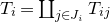 $T_i= \coprod_{j \in J_i} T_{ij}$
, where each
$T_i= \coprod_{j \in J_i} T_{ij}$
, where each $T_{ij}$
is connected. Let the norm
$T_{ij}$
is connected. Let the norm $N_{T_{ij}/S}(\chi_i)$
denote the product of the conjugates, and let the norm
$N_{T_{ij}/S}(\chi_i)$
denote the product of the conjugates, and let the norm $N_{T_i/S}$
be given by
$N_{T_i/S}$
be given by
 \begin{align*}N_{T_i/S}(\chi_i):\mu_{d_i}(T_i)&\to \overline{\mathbb{Q}_{\ell}}^\times\\ \zeta: &\mapsto \prod_{j} \chi_i(N_{T_{ij}/S}(\zeta)).\end{align*}
By construction, each $N_{T_i/S}(\chi_i)$
factors through some
$N_{T_i/S}(\chi_i)$
factors through some $\mu_{d_i'}(T_i)$
such that
$\mu_{d_i'}(T_i)$
such that $d_i' | d_i$
and
$d_i' | d_i$
and $\mu_{d_i'} = \mathbb{Z}/d_i'\mathbb{Z}$
on S. Let d be a common multiple of all of the
$\mu_{d_i'} = \mathbb{Z}/d_i'\mathbb{Z}$
on S. Let d be a common multiple of all of the $d'_i$
, and regard
$d'_i$
, and regard $N_{T_i/S}(\chi_i)$
as a character on
$N_{T_i/S}(\chi_i)$
as a character on $\mu_d$
via the composition
$\mu_d$
via the composition
 \begin{align*}\mu_d &\to \mu_{d'_i} , \\ \zeta &\mapsto \zeta^{\frac{d}{d'_i}}.\end{align*}
The norm condition for our Jacobi datum is that we require that $\prod_{i\in I}N_{T_i/S}(\chi_i)^{n_i}=1$
, where this product is considered as a product of characters of
$\prod_{i\in I}N_{T_i/S}(\chi_i)^{n_i}=1$
, where this product is considered as a product of characters of $\mu_d$
on S.
$\mu_d$
on S.
If A’ is another ring equipped with a morphism $f:\mathrm{Spec}(A') \to \mathrm{Spec}(A)$
, we may pull back the Jacobi datum
$f:\mathrm{Spec}(A') \to \mathrm{Spec}(A)$
, we may pull back the Jacobi datum $(T,\chi,n)$
on
$(T,\chi,n)$
on $\mathrm{Spec}(A)$
to
$\mathrm{Spec}(A)$
to $\mathrm{Spec}(A')$
to obtain
$\mathrm{Spec}(A')$
to obtain $f^*(T, \chi, n) = (f^*T, f^*\chi, n)$
, where
$f^*(T, \chi, n) = (f^*T, f^*\chi, n)$
, where $f^*(T) = (f^*T_i)$
is given by the pullback of the finite étale covers
$f^*(T) = (f^*T_i)$
is given by the pullback of the finite étale covers $T_i \to \mathrm{Spec}(A)$
along the morphism f, and
$T_i \to \mathrm{Spec}(A)$
along the morphism f, and $f^*\chi_i$
is the composition
$f^*\chi_i$
is the composition $\chi_i: \mu_{d_i}(f^*T_i) \to \mu_{d_i}(T_i) \to \mathbb{Q}_{\ell}^\times$
. We say that the Jacobi datum
$\chi_i: \mu_{d_i}(f^*T_i) \to \mu_{d_i}(T_i) \to \mathbb{Q}_{\ell}^\times$
. We say that the Jacobi datum $(T',\chi',n')$
on A’ is defined on A if there exists a Jacobi datum
$(T',\chi',n')$
on A’ is defined on A if there exists a Jacobi datum $(T,\chi,n)$
on A such that we may obtain
$(T,\chi,n)$
on A such that we may obtain $(T',\chi',n')$
by pulling back the Jacobi datum
$(T',\chi',n')$
by pulling back the Jacobi datum $(T,\chi,n)$
along the morphism
$(T,\chi,n)$
along the morphism $\mathrm{Spec}(A') \to \mathrm{Spec}(A)$
. If s is a closed point of A with residue field
$\mathrm{Spec}(A') \to \mathrm{Spec}(A)$
. If s is a closed point of A with residue field $\kappa(s)$
, we will say that the reduction of
$\kappa(s)$
, we will say that the reduction of $(T,\chi,n)$
at s is the Jacobi datum on
$(T,\chi,n)$
at s is the Jacobi datum on $\kappa(s)$
given by pulling back
$\kappa(s)$
given by pulling back $(T,\chi,n)$
along the closed immersion corresponding to s.
$(T,\chi,n)$
along the closed immersion corresponding to s.
Definition 5.13. Let $\mathbb{F}$
be a finite field of order q. Let
$\mathbb{F}$
be a finite field of order q. Let $\chi$
be a multiplicative character, i.e. a group homomorphism
$\chi$
be a multiplicative character, i.e. a group homomorphism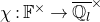 $\chi: \mathbb{F}^\times \to \overline{\mathbb{Q}_{l}}^\times$
. Let
$\chi: \mathbb{F}^\times \to \overline{\mathbb{Q}_{l}}^\times$
. Let $\psi$
be an additive character, i.e. a group homomorphism
$\psi$
be an additive character, i.e. a group homomorphism $\psi: \mathbb{F} \to \overline{\mathbb{Q}_{\ell}}^\times$
. Define the Gauss sum
$\psi: \mathbb{F} \to \overline{\mathbb{Q}_{\ell}}^\times$
. Define the Gauss sum
 \begin{align*}G_{\mathbb{F}}(\chi, \psi) := -\sum_{a \in \mathbb{F}^\times} \chi^{-1}(a)\psi(a).\end{align*}
Definition 5.14. Let $\mathbb{F}$
be a finite field of order q. Then, if we have a Jacobi datum
$\mathbb{F}$
be a finite field of order q. Then, if we have a Jacobi datum $(T, \chi, n)$
on
$(T, \chi, n)$
on $\mathrm{Spec}(\mathbb{F})$
, we see that each
$\mathrm{Spec}(\mathbb{F})$
, we see that each $T_i = \coprod_{j \in \overline{I}_i} \mathrm{Spec}(\mathbb{F}_{ij})$
for some
$T_i = \coprod_{j \in \overline{I}_i} \mathrm{Spec}(\mathbb{F}_{ij})$
for some $\mathbb{F}_{ij}/\mathbb{F}$
a finite extension and
$\mathbb{F}_{ij}/\mathbb{F}$
a finite extension and $\overline{I}_i$
a finite index set. Define the Jacobi sum
$\overline{I}_i$
a finite index set. Define the Jacobi sum $j_{\chi}=j_{T,\chi,n}$
for a Jacobi datum
$j_{\chi}=j_{T,\chi,n}$
for a Jacobi datum $(T, \chi, n)$
on
$(T, \chi, n)$
on $\mathrm{Spec}(\mathbb{F})$
by
$\mathrm{Spec}(\mathbb{F})$
by
 \begin{align*}j_{\chi}:= \prod_{i\in I} \prod_{j \in \overline{I}_i}(G_{\mathbb{F}_{ij}}(\overline{\chi}_{ij}, \psi_0\circ\mathrm{Tr}_{\mathbb{F}_{ij}/\mathbb{F}}))^{n_i}.\end{align*}
Here, $\psi_0$
is a non-trivial additive character of k, and if
$\psi_0$
is a non-trivial additive character of k, and if $\mathbb{F}_{ij}$
is of order
$\mathbb{F}_{ij}$
is of order $q_{ij}$
then
$q_{ij}$
then $\overline{\chi}_{ij}$
is a multiplicative character of
$\overline{\chi}_{ij}$
is a multiplicative character of $\mathbb{F}_i$
defined by
$\mathbb{F}_i$
defined by
 \begin{align*}\overline{\chi}_{i}(a):=\chi_{i}(a^{(q_{ij}-1)/d_i}).\end{align*}
As mentioned on [Reference SaitoSai94, p. 417], we can consider characters on $\mathbb{F}^\times$
as characters of
$\mathbb{F}^\times$
as characters of $\mu_{q-1}(\mathbb{F})$
. Moreover, as characters of
$\mu_{q-1}(\mathbb{F})$
. Moreover, as characters of $\mu_{q-1}(\mathbb{F})$
, we have
$\mu_{q-1}(\mathbb{F})$
, we have $\prod_{j \in \overline{I}_i} \overline{\chi}_i |_{\mathbb{F}^\times} = N_{T_i/\mathrm{Spec}(S)}(\chi_i)$
. As mentioned on [Reference SaitoSai94, p. 417], [Reference DeligneDel77, Proposition 4.15] tells us that the product
$\prod_{j \in \overline{I}_i} \overline{\chi}_i |_{\mathbb{F}^\times} = N_{T_i/\mathrm{Spec}(S)}(\chi_i)$
. As mentioned on [Reference SaitoSai94, p. 417], [Reference DeligneDel77, Proposition 4.15] tells us that the product $j_{\chi}$
is independent of our choice of
$j_{\chi}$
is independent of our choice of $\psi_{0}$
, since
$\psi_{0}$
, since $\prod_{i\in I}N_{\mathbb{F}_i/\mathbb{F}}(\chi_{i})^{n_i}=1$
.
$\prod_{i\in I}N_{\mathbb{F}_i/\mathbb{F}}(\chi_{i})^{n_i}=1$
.
Definition 5.15. As in [Reference SaitoSai94, Proposition 2], we can associate an $\ell$
-adic representation
$\ell$
-adic representation $J_{(T,\chi,n)}$
of
$J_{(T,\chi,n)}$
of $\mathop{\mathrm{Gal}}\nolimits_k$
to each Jacobi datum
$\mathop{\mathrm{Gal}}\nolimits_k$
to each Jacobi datum $(T, \chi, n)$
on a field k as follows. A Jacobi datum on k is defined on a regular ring A of finite type over
$(T, \chi, n)$
on a field k as follows. A Jacobi datum on k is defined on a regular ring A of finite type over $\mathbb Z$
, since each of the
$\mathbb Z$
, since each of the $T_i$
are varieties over k. The representation
$T_i$
are varieties over k. The representation $J_{(T,\chi,n)}$
is the pullback of the representation of
$J_{(T,\chi,n)}$
is the pullback of the representation of $\pi_{1}^{\acute{e}t}(\mathrm{Spec}(A))^{ab}$
characterised by the following condition: for each closed point s of
$\pi_{1}^{\acute{e}t}(\mathrm{Spec}(A))^{ab}$
characterised by the following condition: for each closed point s of $\mathrm{Spec}(A)$
, the action of the geometric Frobenius
$\mathrm{Spec}(A)$
, the action of the geometric Frobenius $\mathrm{Frob}_s$
at s is given by the multiplication by the Jacobi sum
$\mathrm{Frob}_s$
at s is given by the multiplication by the Jacobi sum $j_{\chi}(s)$
defined by the reduction of the Jacobi datum
$j_{\chi}(s)$
defined by the reduction of the Jacobi datum $(T, \chi, n)$
at s. By [Reference SaitoSai94, Proposition 2], this character both exists and is unique. Say that
$(T, \chi, n)$
at s. By [Reference SaitoSai94, Proposition 2], this character both exists and is unique. Say that $J_{(T,\chi,n)}$
is the associated
$J_{(T,\chi,n)}$
is the associated $\ell$
-adic character of the Jacobi datum
$\ell$
-adic character of the Jacobi datum $(T, \chi, n)$
.
$(T, \chi, n)$
.
Definition 5.16 (Saito [Reference SaitoSai94]). Let U and $\mathcal{F}$
be as in Theorem 5.11. We can define a Jacobi datum on k associated to the ramification of
$\mathcal{F}$
be as in Theorem 5.11. We can define a Jacobi datum on k associated to the ramification of $\mathcal{F}$
along D. Let
$\mathcal{F}$
along D. Let $D_i$
be the irreducible components of D with constant field
$D_i$
be the irreducible components of D with constant field $k_i$
. Let
$k_i$
. Let $\rho$
be the
$\rho$
be the $\ell$
-adic representation of
$\ell$
-adic representation of $\pi_1 (U,\overline{x})^{\rm tame}$
corresponding to
$\pi_1 (U,\overline{x})^{\rm tame}$
corresponding to $\mathcal{F}$
. The kernel
$\mathcal{F}$
. The kernel $\pi^{\acute{e}t}_1(U,\overline{x})^{\rm tame}\to\pi_{1}^{\acute{e}t}(X,\overline{x})$
is the normal subgroup topologically generated by the local monodromy groups
$\pi^{\acute{e}t}_1(U,\overline{x})^{\rm tame}\to\pi_{1}^{\acute{e}t}(X,\overline{x})$
is the normal subgroup topologically generated by the local monodromy groups $\widehat{\mathbb Z}'(1)_{D_i}$
along the
$\widehat{\mathbb Z}'(1)_{D_i}$
along the $D_{i}$
where
$D_{i}$
where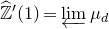 $\widehat{\mathbb Z}'(1)=\varprojlim\mu_d$
with d invertible in k. Let
$\widehat{\mathbb Z}'(1)=\varprojlim\mu_d$
with d invertible in k. Let $\rho_{i}$
be the restriction of
$\rho_{i}$
be the restriction of $\rho$
to
$\rho$
to $\widehat{\mathbb Z}'(1)_{D_{1}}\simeq\widehat{\mathbb Z}'(1)_{k_i}$
.
$\widehat{\mathbb Z}'(1)_{D_{1}}\simeq\widehat{\mathbb Z}'(1)_{k_i}$
.
Since we have a model of finite type over $\mathbb Z$
, Grothendieck’s monodromy theorem [Reference DeligneDel72, Thàreme de monodromie 1.2] tells us that the
$\mathbb Z$
, Grothendieck’s monodromy theorem [Reference DeligneDel72, Thàreme de monodromie 1.2] tells us that the $\rho_{i}$
are quasi-unipotent. Therefore, the action of
$\rho_{i}$
are quasi-unipotent. Therefore, the action of $\widehat{\mathbb Z}'(1)$
on the semi-simplification
$\widehat{\mathbb Z}'(1)$
on the semi-simplification $\rho_{i}^{\rm ss}$
factors through a finite quotient. This means that we can decompose
$\rho_{i}^{\rm ss}$
factors through a finite quotient. This means that we can decompose
 \begin{align*}\rho_{i}^{\rm ss}\simeq\bigoplus_{j\in I_{i}}\mathrm{Tr}_{k_{ij}/k_{i}}(\chi_{ij}).\end{align*}
Here, $k_{ij}$
is the finite extension of
$k_{ij}$
is the finite extension of $k_{i}$
obtained by adjoining the
$k_{i}$
obtained by adjoining the $d_{ij}$
th roots of unity,
$d_{ij}$
th roots of unity, $\chi_{ij}$
is a character of
$\chi_{ij}$
is a character of $\mu_{d_{ij}}(k_{ij})$
of order
$\mu_{d_{ij}}(k_{ij})$
of order $d_{ij}$
, and we define
$d_{ij}$
, and we define $\mathrm{Tr}_{k_{ij}/k_i}$
to be the
$\mathrm{Tr}_{k_{ij}/k_i}$
to be the $[k_{ij}:k_i]$
dimensional
$[k_{ij}:k_i]$
dimensional $\widehat{\mathbb Z}'(1)$
representation
$\widehat{\mathbb Z}'(1)$
representation
 \begin{align*}\mathrm{Tr}_{k_{ij}/k}(\chi_{ij}) := \bigoplus_{\sigma \in \mathop{\mathrm{Gal}}\nolimits(k_{ij}/k_i)} \chi_{ij} \circ \sigma.\end{align*}
For $i\in I$
, let
$i\in I$
, let $D_{i}^{*}=D_{i}- \bigcup_{J\neq i}D_{j}$
and let
$D_{i}^{*}=D_{i}- \bigcup_{J\neq i}D_{j}$
and let $c_{i}$
be the compactly supported Euler characteristic of
$c_{i}$
be the compactly supported Euler characteristic of $(D_{i}^{*}\times_{k_i} \mathrm{Spec}(\overline{k_i}))$
. Define our Jacobi datum
$(D_{i}^{*}\times_{k_i} \mathrm{Spec}(\overline{k_i}))$
. Define our Jacobi datum $(T, \chi, n)$
by
$(T, \chi, n)$
by $\overline{I}=\coprod_{i}I_{i},$ $T=(k_{ij}),$ $\chi=(\chi_{ij})$
and
$\chi=(\chi_{ij})$
and $n=(n_{ij})$
, with
$n=(n_{ij})$
, with $n_{ij}=c_{i}$
for
$n_{ij}=c_{i}$
for $i\in I$
and
$i\in I$
and $j\in I_{i}$
. Define the term
$j\in I_{i}$
. Define the term $J_{D,\mathcal{F}}$
to be the
$J_{D,\mathcal{F}}$
to be the $\ell$
-adic representation
$\ell$
-adic representation $J_{(T, \chi, n)}$
.
$J_{(T, \chi, n)}$
.
Definition 5.17. Let $f: W \to Y$
be a projective morphism of positive relative dimension. Assume that there is a smooth and projective variety Z over k containing Y such that the complement
$f: W \to Y$
be a projective morphism of positive relative dimension. Assume that there is a smooth and projective variety Z over k containing Y such that the complement $D=Z-Y$
is a divisor with simple normal crossings, that
$D=Z-Y$
is a divisor with simple normal crossings, that $R^if_*\mathbb{Q}_{\ell}$
is smooth over Y, and that the ramification along D is tame for all i. We define
$R^if_*\mathbb{Q}_{\ell}$
is smooth over Y, and that the ramification along D is tame for all i. We define
 \begin{align*}\prod_{i=0}^{2(\mathop{\mathrm{dim}}\nolimits(W)-\mathop{\mathrm{dim}}\nolimits(Y))}J_{D,R^if_*\mathbb{Q}_{\ell}}^{\otimes(-1)^{i+1}}\end{align*}
to be the Saito factor of f at D.
Theorem 5.18.
Let $f: W \to Y$
be a projective morphism of positive relative dimension. Assume that there is a projective and smooth variety Z over k containing Y such that the complement
$f: W \to Y$
be a projective morphism of positive relative dimension. Assume that there is a projective and smooth variety Z over k containing Y such that the complement $D=Z-Y$
is a divisor with simple normal crossings, that
$D=Z-Y$
is a divisor with simple normal crossings, that $R^if_*\mathbb{Q}_{\ell}$
is smooth, and that the ramification is tame for all i. Moreover, assume that
$R^if_*\mathbb{Q}_{\ell}$
is smooth, and that the ramification is tame for all i. Moreover, assume that $\sum_i (-1)^i \mathrm{rank}(R^if_*\mathbb{Q}_{\ell})=0$
,
$\sum_i (-1)^i \mathrm{rank}(R^if_*\mathbb{Q}_{\ell})=0$
, $\bigotimes_i \mathop{\mathrm{det}}\nolimits R^if_*\mathbb{Q}_{\ell}^{(-1)^i}$
is trivial, and f is defined on a model over a ring of finite type over
$\bigotimes_i \mathop{\mathrm{det}}\nolimits R^if_*\mathbb{Q}_{\ell}^{(-1)^i}$
is trivial, and f is defined on a model over a ring of finite type over $\mathbb{Z}$
. Then,
$\mathbb{Z}$
. Then,
 \begin{align*}\mathrm{det}_{\ell}(W)=\prod_{i=0}^{2(\mathop{\mathrm{dim}}\nolimits(W)-\mathop{\mathrm{dim}}\nolimits(Y))}J_{D,R^if_*\mathbb{Q}_{\ell}}^{\otimes(-1)^{i+1}}.\end{align*}
Proof. By the Leray spectral sequence,
 \begin{align*}\mathrm{det}_{\ell}(W)=\!\!\!\!\!\!\!\!\!\!\!\!\!\!\prod_{i=0}^{2(\mathop{\mathrm{dim}}\nolimits(W)-\mathop{\mathrm{dim}}\nolimits(Y))}\!\!\!\!\!\!\!\!\!\!\!\!\!\!\mathop{\mathrm{det}}\nolimits R\Gamma_c(Y_{\overline{k}},R^if_*\mathbb{Q}_{\ell})^{(-1)^i}.\end{align*}
Since f is defined on a model over a ring of finite type over $\mathbb Z$
, the same is true for the sheaves
$\mathbb Z$
, the same is true for the sheaves $R^if_*\mathbb{Q}_{\ell}$
, so we apply Saito’s theorem (Theorem 5.11) to obtain
$R^if_*\mathbb{Q}_{\ell}$
, so we apply Saito’s theorem (Theorem 5.11) to obtain
 \begin{align*}\prod_i (\mathop{\mathrm{det}}\nolimits R\Gamma_c(Y_{\overline{k}},R^if_*\mathbb{Q}_{\ell})^{(-1)^i} ) &\otimes\mathrm{det}_{\ell}(Y)^{\otimes-\sum_i(-1)^i\mathrm{rank}R^if_*\mathbb{Q}_{\ell}}=\\&\quad c_{Y,D/k}^{*}\Big(\bigotimes_i(\mathop{\mathrm{det}}\nolimits R^if_*\mathbb{Q}_{\ell})^{(-1)^i}\Big)\otimes\prod_iJ_{D,R^if_*\mathbb{Q}_{\ell}}^{\otimes(-1)^{i+1}},\end{align*}
using the bilinearity of the pairing $CH_{0}(X, D)\times\pi^{\acute{e}t}_{1}(U)^{\rm ab,tame}\to\mathrm{Gal}_k$
. By our assumptions on the rank and determinants of
$CH_{0}(X, D)\times\pi^{\acute{e}t}_{1}(U)^{\rm ab,tame}\to\mathrm{Gal}_k$
. By our assumptions on the rank and determinants of $R^if_*\mathbb{Q}_{\ell}$
, we see that
$R^if_*\mathbb{Q}_{\ell}$
, we see that
 \begin{align*}\mathrm{det}_{\ell}(Y)^{\otimes-\sum_i(-1)^i\mathrm{rank}R^if_*\mathbb{Q}_{\ell}} &= 1 , \\ c_{Y,D/k}^{*}\Big(\bigotimes_i(\mathop{\mathrm{det}}\nolimits R^if_*\mathbb{Q}_{\ell})^{(-1)^i}\Big)&=1,\end{align*}
where 1 denotes the trivial representation of $\mathop{\mathrm{Gal}}\nolimits_k$
. Since the sheaves
$\mathop{\mathrm{Gal}}\nolimits_k$
. Since the sheaves $R^if_*\mathbb{Q}_\ell$
vanish whenever
$R^if_*\mathbb{Q}_\ell$
vanish whenever $i \gt 2(\mathrm{dim}(W)-\mathrm{dim}(Y))$
, this gives the result.
$i \gt 2(\mathrm{dim}(W)-\mathrm{dim}(Y))$
, this gives the result.
Corollary 5.19.
Let $f: W \to Y$
be a projective morphism of positive relative dimension g. Assume that there is a projective and smooth variety Z over k containing Y such that the complement
$f: W \to Y$
be a projective morphism of positive relative dimension g. Assume that there is a projective and smooth variety Z over k containing Y such that the complement $D=Z-Y$
is a divisor with simple normal crossings, that
$D=Z-Y$
is a divisor with simple normal crossings, that $R^if_*\mathbb{Q}_{\ell}$
is smooth, and that the ramification along D is tame for all i. Moreover, assume that for every closed point of Y the fibre,
$R^if_*\mathbb{Q}_{\ell}$
is smooth, and that the ramification along D is tame for all i. Moreover, assume that for every closed point of Y the fibre, $W_y$
has
$W_y$
has $\chi^{\rm mot}(W_y) \equiv 0 \pmod{J}$
. Then the motivic Euler characteristic modulo J satisfies
$\chi^{\rm mot}(W_y) \equiv 0 \pmod{J}$
. Then the motivic Euler characteristic modulo J satisfies $\chi^{\rm mot}(W) \equiv \kappa_W \pmod{J}$
, where
$\chi^{\rm mot}(W) \equiv \kappa_W \pmod{J}$
, where $\kappa_W$
is an element of
$\kappa_W$
is an element of $\widehat{\mathrm{W}}(k)/J$
such that
$\widehat{\mathrm{W}}(k)/J$
such that $\mathrm{rank}(\kappa_W)=0$
,
$\mathrm{rank}(\kappa_W)=0$
, $\mathrm{sign}(\kappa_W)=0$
, and
$\mathrm{sign}(\kappa_W)=0$
, and $\mathrm{disc}(\kappa_W)=\mathrm{det}_{\ell}(W) = \prod_{i=0}^{2g}J_{D,R^if_*\mathbb{Q}_{\ell}}^{\otimes(-1)^{i+1}}$
.
$\mathrm{disc}(\kappa_W)=\mathrm{det}_{\ell}(W) = \prod_{i=0}^{2g}J_{D,R^if_*\mathbb{Q}_{\ell}}^{\otimes(-1)^{i+1}}$
.
Proof. The fact that $\mathrm{rank}(\kappa_{\mathcal{C}})$
and
$\mathrm{rank}(\kappa_{\mathcal{C}})$
and $\mathrm{sign}(\kappa_{\mathcal{C}})$
both vanish is due to our real closed Fubini theorem, Corollary 5.10. Consider the condition
$\mathrm{sign}(\kappa_{\mathcal{C}})$
both vanish is due to our real closed Fubini theorem, Corollary 5.10. Consider the condition $\chi^{\rm mot}(W_y) \equiv 0 \pmod{J}$
for all y. Taking ranks tells us that
$\chi^{\rm mot}(W_y) \equiv 0 \pmod{J}$
for all y. Taking ranks tells us that $\mathrm{rank}(\chi^{\rm mot}(W_y))=0$
for all y, and applying proper base change tells us that
$\mathrm{rank}(\chi^{\rm mot}(W_y))=0$
for all y, and applying proper base change tells us that $\sum_i (-1)^i \mathrm{rank}(R^if_*\mathbb{Q}_{\ell})=0$
. Similarly, we see that
$\sum_i (-1)^i \mathrm{rank}(R^if_*\mathbb{Q}_{\ell})=0$
. Similarly, we see that $\mathrm{det}_{\ell}(W_y)=0$
for all y, which is equivalent to saying that
$\mathrm{det}_{\ell}(W_y)=0$
for all y, which is equivalent to saying that $\bigotimes_i \mathop{\mathrm{det}}\nolimits (R^if_*\mathbb{Q}_{\ell})^{(-1)^i}$
is trivial as well. The above theorem gives us the result.
$\bigotimes_i \mathop{\mathrm{det}}\nolimits (R^if_*\mathbb{Q}_{\ell})^{(-1)^i}$
is trivial as well. The above theorem gives us the result.
Remark 5.20. This Fubini theorem reduces our computation of $\chi^{\rm mot}\pmod{J}$
to Saito factors associated to the boundary of our morphism, thought of as characters in
$\chi^{\rm mot}\pmod{J}$
to Saito factors associated to the boundary of our morphism, thought of as characters in $\mathop{\mathrm{Hom}}\nolimits(\mathop{\mathrm{Gal}}\nolimits_k, \overline{\mathbb{Q}}_{\ell}^\times)$
. Since
$\mathop{\mathrm{Hom}}\nolimits(\mathop{\mathrm{Gal}}\nolimits_k, \overline{\mathbb{Q}}_{\ell}^\times)$
. Since $\mathrm{disc}(\kappa_W)=\mathrm{det}_{\ell}(W) = \prod_{i=0}^{2g}J_{D,R^if_*\mathbb{Q}_{\ell}}^{\otimes(-1)^{i+1}}$
, and
$\mathrm{disc}(\kappa_W)=\mathrm{det}_{\ell}(W) = \prod_{i=0}^{2g}J_{D,R^if_*\mathbb{Q}_{\ell}}^{\otimes(-1)^{i+1}}$
, and $\mathrm{disc}(\kappa_W)$
is a character of order 2 by construction, the Saito factor
$\mathrm{disc}(\kappa_W)$
is a character of order 2 by construction, the Saito factor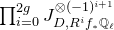 $\prod_{i=0}^{2g}J_{D,R^if_*\mathbb{Q}_{\ell}}^{\otimes(-1)^{i+1}}$
will also be a character of order 2. For the rest of this section, we show that these characters of
$\prod_{i=0}^{2g}J_{D,R^if_*\mathbb{Q}_{\ell}}^{\otimes(-1)^{i+1}}$
will also be a character of order 2. For the rest of this section, we show that these characters of $\mathop{\mathrm{Gal}}\nolimits_k$
naturally factor through the absolute Galois group of a number field, and we can control the ramification of these characters.
$\mathop{\mathrm{Gal}}\nolimits_k$
naturally factor through the absolute Galois group of a number field, and we can control the ramification of these characters.
Definition 5.21. For k a field, let $k^{\rm const}$
denote the algebraic closure of its prime subfield in k. In particular, if k is a field that is finitely generated over
$k^{\rm const}$
denote the algebraic closure of its prime subfield in k. In particular, if k is a field that is finitely generated over $\mathbb{Q}$
, the field
$\mathbb{Q}$
, the field $k^{\rm const}$
is a number field.
$k^{\rm const}$
is a number field.
Lemma 5.22.
Let $(T,\chi,n)$
be a Jacobi datum on k, a field of characteristic 0. Let d denote the lowest common multiple of the
$(T,\chi,n)$
be a Jacobi datum on k, a field of characteristic 0. Let d denote the lowest common multiple of the $d_j$
, and let
$d_j$
, and let $A := \mathrm{Spec}(\mathcal{O}_{k^{\rm const}}[\frac1d])$
. Then there exists a Jacobi datum
$A := \mathrm{Spec}(\mathcal{O}_{k^{\rm const}}[\frac1d])$
. Then there exists a Jacobi datum $(T',\chi',n')$
on
$(T',\chi',n')$
on $\mathrm{Spec}(A)$
such that the character
$\mathrm{Spec}(A)$
such that the character $J_{(T,\chi,n)}$
is given by the composition
$J_{(T,\chi,n)}$
is given by the composition
 \begin{align*}\mathop{\mathrm{Gal}}\nolimits_k \to \pi_1^{\acute{e}t}(\mathrm{Spec}(A)) \xrightarrow{J_{(T',\chi',n')}} \overline{\mathbb{Q}_{\ell}}^\times.\end{align*}
Proof. This follows instantly by the second half of the corollary on [Reference SaitoSai94, p. 418].
Corollary 5.23.
The character $J_{(T,\chi,n)}$
factors as a composition
$J_{(T,\chi,n)}$
factors as a composition $\mathop{\mathrm{Gal}}\nolimits_k \twoheadrightarrow \mathop{\mathrm{Gal}}\nolimits_{k^{\rm const}} \to \overline{\mathbb{Q}_{\ell}}^\times$
.
$\mathop{\mathrm{Gal}}\nolimits_k \twoheadrightarrow \mathop{\mathrm{Gal}}\nolimits_{k^{\rm const}} \to \overline{\mathbb{Q}_{\ell}}^\times$
.
Proof. First, note that the character $J_{(T,\chi,n)}$
factors through the map
$J_{(T,\chi,n)}$
factors through the map $\mathop{\mathrm{Gal}}\nolimits_k \to \pi_1^{\acute{e}t}(\mathrm{Spec}(A))$
, which in turn factors as
$\mathop{\mathrm{Gal}}\nolimits_k \to \pi_1^{\acute{e}t}(\mathrm{Spec}(A))$
, which in turn factors as $\mathop{\mathrm{Gal}}\nolimits_k \to \mathop{\mathrm{Gal}}\nolimits_{k^{\rm const}} \to \pi_1^{\acute{e}t}(\mathrm{Spec}(A))$
. The map
$\mathop{\mathrm{Gal}}\nolimits_k \to \mathop{\mathrm{Gal}}\nolimits_{k^{\rm const}} \to \pi_1^{\acute{e}t}(\mathrm{Spec}(A))$
. The map $\mathop{\mathrm{Gal}}\nolimits_k \to \mathop{\mathrm{Gal}}\nolimits_{k^{\rm const}}$
is surjective since
$\mathop{\mathrm{Gal}}\nolimits_k \to \mathop{\mathrm{Gal}}\nolimits_{k^{\rm const}}$
is surjective since $k^{\rm const}$
is algebraically closed in k by construction.
$k^{\rm const}$
is algebraically closed in k by construction.
Definition 5.24. Since $\mathop{\mathrm{Gal}}\nolimits_k \to \mathop{\mathrm{Gal}}\nolimits_{k^{\rm const}}$
is surjective, the character
$\mathop{\mathrm{Gal}}\nolimits_k \to \mathop{\mathrm{Gal}}\nolimits_{k^{\rm const}}$
is surjective, the character $\mathop{\mathrm{Gal}}\nolimits_{k^{\rm const}} \to \overline{\mathbb{Q}_{\ell}}^\times$
appearing in the above corollary is unique. Call this character
$\mathop{\mathrm{Gal}}\nolimits_{k^{\rm const}} \to \overline{\mathbb{Q}_{\ell}}^\times$
appearing in the above corollary is unique. Call this character $J_{(T,\chi,n)}^{\rm const}$
.
$J_{(T,\chi,n)}^{\rm const}$
.
Corollary 5.25.
Let p be a prime number coprime to $d_j$
for every j, and let
$d_j$
for every j, and let $\mathfrak{p}$
be a prime of
$\mathfrak{p}$
be a prime of $k^{\rm const}$
with residue characteristic p. Then the character
$k^{\rm const}$
with residue characteristic p. Then the character $J_{(T,\chi,n)}^{\rm const}$
is unramified at
$J_{(T,\chi,n)}^{\rm const}$
is unramified at $\mathfrak{p}$
.
$\mathfrak{p}$
.
Proof. By construction, $J_{(T,\chi,n)}^{\rm const}$
factors as
$J_{(T,\chi,n)}^{\rm const}$
factors as $\mathop{\mathrm{Gal}}\nolimits_{k^{\rm const}} \to \pi_1^{\acute{e}t}(\mathrm{Spec}(A)) \to \overline{\mathbb{Q}_{\ell}}^\times$
. For
$\mathop{\mathrm{Gal}}\nolimits_{k^{\rm const}} \to \pi_1^{\acute{e}t}(\mathrm{Spec}(A)) \to \overline{\mathbb{Q}_{\ell}}^\times$
. For $\mathfrak{p}$
as above, we see that
$\mathfrak{p}$
as above, we see that $\mathfrak{p} \in \mathrm{Spec}(A)$
. Therefore, the inertia group of
$\mathfrak{p} \in \mathrm{Spec}(A)$
. Therefore, the inertia group of $\mathfrak{p}$
is in the kernel of the morphism
$\mathfrak{p}$
is in the kernel of the morphism $\mathop{\mathrm{Gal}}\nolimits_{k^{\rm const}} \to \pi_1^{\acute{e}t}(\mathrm{Spec}(A))$
. In particular, it is in the kernel of
$\mathop{\mathrm{Gal}}\nolimits_{k^{\rm const}} \to \pi_1^{\acute{e}t}(\mathrm{Spec}(A))$
. In particular, it is in the kernel of $J_{(T,\chi,n)}^{\rm const}$
, as required.
$J_{(T,\chi,n)}^{\rm const}$
, as required.
Corollary 5.26.
Suppose that we are now in the situation of Theorem 5.11, and let $J_{D,\mathcal{F}}$
be the
$J_{D,\mathcal{F}}$
be the $\ell$
-adic character appearing in the theorem. Suppose that p is a prime number satisfying
$\ell$
-adic character appearing in the theorem. Suppose that p is a prime number satisfying
 \begin{align*}p \gt \mathrm{rank}(\mathcal{F}) \cdot [k^{\rm const}:\mathbb{Q}] + 1,\end{align*}
and let $\mathfrak{p}$
be a prime of
$\mathfrak{p}$
be a prime of $k^{\rm const}$
with residue characteristic p. Then
$k^{\rm const}$
with residue characteristic p. Then $J_{D,\mathcal{F}}^{\rm const}$
is unramified at
$J_{D,\mathcal{F}}^{\rm const}$
is unramified at $\mathfrak{p}$
.
$\mathfrak{p}$
.
Proof. By the above corollary, we only need to show that p does not divide any $d_j$
. The
$d_j$
. The $d_j$
appear through the decomposition of the semi-simplification of the monodromy representation associated to
$d_j$
appear through the decomposition of the semi-simplification of the monodromy representation associated to $\mathcal{F}$
,
$\mathcal{F}$
,
 \begin{align*}\rho^{\rm ss} = \bigoplus_j \mathrm{Tr}_{k_j/k}(\chi_j),\end{align*}
where $\chi_j$
is a representation on
$\chi_j$
is a representation on $\mu_{d_j}(k_j)$
and, moreover,
$\mu_{d_j}(k_j)$
and, moreover, $\mathrm{dim}(\rho^{\rm ss}) = \mathrm{rank}(\mathcal{F})$
. Note that
$\mathrm{dim}(\rho^{\rm ss}) = \mathrm{rank}(\mathcal{F})$
. Note that
 \begin{align*}\mathrm{dim}\mathrm{Tr}_{k_j/k}(\chi_j) = [k_j:k] \geq [k(\zeta_{d_j}):k] = [k^{\rm const}(\zeta_{d_j}):k^{\rm const}],\end{align*}
where $\zeta_{d_j}$
denotes a primitive
$\zeta_{d_j}$
denotes a primitive $d_j{\text{th}}$
root of unity. We also see that
$d_j{\text{th}}$
root of unity. We also see that
 \begin{align*} [k^{\rm const}(\zeta_p):\mathbb{Q}] &= [k^{\rm const}(\zeta_p):k^{\rm const}] \cdot [k^{\rm const}:\mathbb{Q}],\\ [k^{\rm const}(\zeta_p):\mathbb{Q}] &\geq [\mathbb{Q}(\zeta_p):\mathbb{Q}] = p-1. \end{align*}
Putting this together gives that $[k^{\rm const}(\zeta_p):k^{\rm const}] \geq \frac{p-1}{[ k^{\rm const}:\mathbb{Q}]}$
, and by the assumption on p, this gives
$[k^{\rm const}(\zeta_p):k^{\rm const}] \geq \frac{p-1}{[ k^{\rm const}:\mathbb{Q}]}$
, and by the assumption on p, this gives $[k^{\rm const}(\zeta_p):k^{\rm const}]\gt \mathrm{rank}(\mathcal{F})$
. Suppose that p divides
$[k^{\rm const}(\zeta_p):k^{\rm const}]\gt \mathrm{rank}(\mathcal{F})$
. Suppose that p divides $d_j$
for some
$d_j$
for some $d_j$
, seeking a contradiction. Then,
$d_j$
, seeking a contradiction. Then,
 \begin{align*}\mathrm{dim}(\mathrm{Tr}_{k_j/k}(\chi_j)) \geq [k^{\rm const}(\zeta_{d_j}):k^{\rm const}] \geq [k^{\rm const}(\zeta_p):k^{\rm const}] \gt \mathrm{rank}(\mathcal{F}) = \mathrm{dim}(\rho^{\rm ss}),\end{align*}
which is a contradiction, since $\mathrm{Tr}_{k_j/k}(\chi_j)$
is a factor in the direct-sum decomposition of
$\mathrm{Tr}_{k_j/k}(\chi_j)$
is a factor in the direct-sum decomposition of $\rho^{\rm ss}$
.
$\rho^{\rm ss}$
.
Corollary 5.27.
Suppose that we are in the situation of Corollary 5.19. Then the character $\mathrm{disc}(\kappa_W)$
factors as
$\mathrm{disc}(\kappa_W)$
factors as
 \begin{align*}\mathop{\mathrm{Gal}}\nolimits_k \twoheadrightarrow \mathop{\mathrm{Gal}}\nolimits_{k^{\rm const}} \xrightarrow{\kappa_W^{\rm const}} \{\pm 1\} \subseteq \mathbb{Q}_{\ell}^\times,\end{align*}
and the character $\mathrm{disc}(\kappa_W^{\rm const})$
is unramified at all primes of
$\mathrm{disc}(\kappa_W^{\rm const})$
is unramified at all primes of $k^{\rm const}$
whose residue characteristic is larger than
$k^{\rm const}$
whose residue characteristic is larger than $\mathrm{rank}(R^if_*\mathbb{Q}_{\ell}) \cdot [k^{\rm const}:\mathbb{Q}] + 1$
for all i.
$\mathrm{rank}(R^if_*\mathbb{Q}_{\ell}) \cdot [k^{\rm const}:\mathbb{Q}] + 1$
for all i.
Proof. We see that $\mathrm{disc}(\kappa_W^{\rm const})$
is given by
$\mathrm{disc}(\kappa_W^{\rm const})$
is given by $\prod_i J_{D,R^if_*\mathbb{Q}_{\ell}}^{(-1)^i}$
. Each
$\prod_i J_{D,R^if_*\mathbb{Q}_{\ell}}^{(-1)^i}$
. Each $J_{D,R^if_*,\mathbb{Q}_{\ell}}$
is unramified at primes whose residue characteristic is larger than
$J_{D,R^if_*,\mathbb{Q}_{\ell}}$
is unramified at primes whose residue characteristic is larger than $\mathrm{rank}(R^if_*\mathbb{Q}_{\ell}) \cdot [k^{\rm const}:\mathbb{Q}] + 1$
, so if a prime has residue characteristic larger than
$\mathrm{rank}(R^if_*\mathbb{Q}_{\ell}) \cdot [k^{\rm const}:\mathbb{Q}] + 1$
, so if a prime has residue characteristic larger than $\mathrm{rank}(R^if_*\mathbb{Q}_{\ell}) \cdot [k^{\rm const}:\mathbb{Q}] + 1$
for all i, it will be unramified for all of the characters
$\mathrm{rank}(R^if_*\mathbb{Q}_{\ell}) \cdot [k^{\rm const}:\mathbb{Q}] + 1$
for all i, it will be unramified for all of the characters $J_{D,R^if_*\mathbb{Q}_{\ell}}$
, and so will be unramified for
$J_{D,R^if_*\mathbb{Q}_{\ell}}$
, and so will be unramified for $\mathrm{disc}(\kappa_W)$
.
$\mathrm{disc}(\kappa_W)$
.
5.3 A naïve Fubini theorem for algebraic groups
In the case that $f: X \to Y$
is a torsor under an algebraic group, we can achieve a stronger Fubini theorem by using Lang’s theorem.
$f: X \to Y$
is a torsor under an algebraic group, we can achieve a stronger Fubini theorem by using Lang’s theorem.
Theorem 5.28.
Let G a connected algebraic group over k and let $f:X\to Y$
be such that for every closed point
$f:X\to Y$
be such that for every closed point $y \in Y$
with residue field
$y \in Y$
with residue field $\kappa(y)$
, the fibre
$\kappa(y)$
, the fibre $X_y$
over y is a torsor under
$X_y$
over y is a torsor under $G_{\kappa(y)}$
. Then,
$G_{\kappa(y)}$
. Then,
 \begin{align*}\chi^{\rm mot}(X)\equiv\chi^{\rm mot}(G)\cdot\chi^{\rm mot}(Y) \pmod{J}.\end{align*}
Proof. We prove this statement for the rank, signature, and discriminant. For the rank and signature, this follows by Theorem 5.7, so it only remains to show this for the discriminant. Without loss of generality, assume that k is finitely generated over $\mathbb{Q}$
. By Proposition 2.39, it is enough to show a similar claim for the augmented determinant of cohomology. We can assume that
$\mathbb{Q}$
. By Proposition 2.39, it is enough to show a similar claim for the augmented determinant of cohomology. We can assume that $X \to Y$
and G are defined on a ring of finite type over
$X \to Y$
and G are defined on a ring of finite type over $\mathbb{Z}$
, denoted by A, and let
$\mathbb{Z}$
, denoted by A, and let $\mathcal{X}, \mathcal{Y}$
denote smooth projective models for X,Y over
$\mathcal{X}, \mathcal{Y}$
denote smooth projective models for X,Y over $\mathrm{Spec}(A)$
. By Chebotarëv’s density theorem, it is enough to prove that for every s a closed point of
$\mathrm{Spec}(A)$
. By Chebotarëv’s density theorem, it is enough to prove that for every s a closed point of $\mathrm{Spec}(A)$
such that the fibre of X over s is smooth,
$\mathrm{Spec}(A)$
such that the fibre of X over s is smooth,
 \begin{align*}\mathrm{det}_{\ell}(X)(\mathrm{Frob}_s) = \mathrm{det}_{\ell}(G)(\mathrm{Frob}_s) \cdot \mathrm{det}_{\ell}(Y)(\mathrm{Frob}_s).\end{align*}
Theorem 2.44 tells us that $\mathrm{det}_{\ell}(X)(\mathrm{Frob}_s)$
is determined by the
$\mathrm{det}_{\ell}(X)(\mathrm{Frob}_s)$
is determined by the $\zeta$
-function of
$\zeta$
-function of $\mathcal X_s$
. Write
$\mathcal X_s$
. Write $X_s, Y_s$
, and
$X_s, Y_s$
, and $G_s$
for the reductions of
$G_s$
for the reductions of $\mathcal X, \mathcal Y$
, and G at s, respectively, and let
$\mathcal X, \mathcal Y$
, and G at s, respectively, and let $\mathbb{F}_s$
denote the residue field of s. The result reduces to showing that
$\mathbb{F}_s$
denote the residue field of s. The result reduces to showing that $\zeta(X_s, t) = \zeta(G_s \times Y_s,t)$
. Lang’s theorem [Reference LangLan56, Theorem 2] gives us
$\zeta(X_s, t) = \zeta(G_s \times Y_s,t)$
. Lang’s theorem [Reference LangLan56, Theorem 2] gives us $H^1(\mathbb{F}_s,G)=0$
, since
$H^1(\mathbb{F}_s,G)=0$
, since $\mathbb{F}_s$
is finite. Therefore, the fibres of
$\mathbb{F}_s$
is finite. Therefore, the fibres of $f_s: X_s \to Y_s$
are all isomorphic to a suitable base change of G. Let p be a closed point of
$f_s: X_s \to Y_s$
are all isomorphic to a suitable base change of G. Let p be a closed point of $Y_s$
with residue field
$Y_s$
with residue field $\mathbb{F}_p$
, and let
$\mathbb{F}_p$
, and let $X_p$
be the fibre of
$X_p$
be the fibre of $X_s$
over p. Then
$X_s$
over p. Then $X_p \cong G_{\mathbb{F}_p}$
. Counting the points of X gives an equality of zeta functions
$X_p \cong G_{\mathbb{F}_p}$
. Counting the points of X gives an equality of zeta functions $\zeta(X_s, t) = \zeta(Y_s \times_{\mathbb{F}_s} G,t)$
, as required.
$\zeta(X_s, t) = \zeta(Y_s \times_{\mathbb{F}_s} G,t)$
, as required.
Theorem 5.29.
Let X be a positive-dimensional abelian variety over k. Then $\chi^{\rm mot}(X)=0$
.
$\chi^{\rm mot}(X)=0$
.
Proof. Since X is smooth and proper, we have $\chi^{\rm mot}(X) = \chi^{\rm dR}(X)$
, so we may work with de Rham cohomology. By [Reference Milne, Cornell and SilvermanMil86, Lemma 15.2], we see that
$\chi^{\rm mot}(X) = \chi^{\rm dR}(X)$
, so we may work with de Rham cohomology. By [Reference Milne, Cornell and SilvermanMil86, Lemma 15.2], we see that $H^*_{\rm dR}(X) \cong \bigoplus_{i=0}^{2n} \bigwedge^i H^1_{\rm dR}(X)$
. Note that
$H^*_{\rm dR}(X) \cong \bigoplus_{i=0}^{2n} \bigwedge^i H^1_{\rm dR}(X)$
. Note that $\mathrm{rank}(\chi^{\rm dR}(X)) = \sum_{i=0}^{2n} (-1)^i {n \choose i} = 0$
. Choosing a basis of
$\mathrm{rank}(\chi^{\rm dR}(X)) = \sum_{i=0}^{2n} (-1)^i {n \choose i} = 0$
. Choosing a basis of $H^1_{\rm dR}(X)$
and taking the wedge product gives rise to a basis of
$H^1_{\rm dR}(X)$
and taking the wedge product gives rise to a basis of $H^n_{\rm dR}(X) = \bigwedge^n H^1_{\rm dR}(X)$
. With respect to this basis, the quadratic form on
$H^n_{\rm dR}(X) = \bigwedge^n H^1_{\rm dR}(X)$
. With respect to this basis, the quadratic form on $H^n_{\rm dR}(X)$
is clearly hyperbolic, so there is some m such that
$H^n_{\rm dR}(X)$
is clearly hyperbolic, so there is some m such that $[H^n_{\rm dR}(X)]=m\cdot \mathbb{H}$
. Applying the previous lemma tells us that
$[H^n_{\rm dR}(X)]=m\cdot \mathbb{H}$
. Applying the previous lemma tells us that $\chi^{\rm dR}(X) = (b^++m) \cdot \mathbb{H}$
. Finally, note that
$\chi^{\rm dR}(X) = (b^++m) \cdot \mathbb{H}$
. Finally, note that $\mathrm{rank}(\chi^{\rm dR}(X)) = 2(b^++m)$
. Since
$\mathrm{rank}(\chi^{\rm dR}(X)) = 2(b^++m)$
. Since $\mathrm{rank}(\chi^{\rm dR}(X)) = 0$
, this gives the result.
$\mathrm{rank}(\chi^{\rm dR}(X)) = 0$
, this gives the result.
Remark 5.30. Readers familiar with motivic homotopy theory should note that we may prove the above theorem directly using the categorical Euler characteristic and the motivic Gauss–Bonnet formula of [Reference Levine and RaksitLR20]. Let $p_X$
denote the structure morphism
$p_X$
denote the structure morphism $p_X: X \to \mathrm{Spec}(k)$
. Since X is smooth and projective, we have
$p_X: X \to \mathrm{Spec}(k)$
. Since X is smooth and projective, we have $\chi^{\rm mot}(X) = \chi^{\rm cat}(X)$
by Theorem 2.14. By [Reference Levine and RaksitLR20, p. 3], we can define an Euler class of the tangent bundle of X valued in the Hermitian K-theory spectrum of X, which we call
$\chi^{\rm mot}(X) = \chi^{\rm cat}(X)$
by Theorem 2.14. By [Reference Levine and RaksitLR20, p. 3], we can define an Euler class of the tangent bundle of X valued in the Hermitian K-theory spectrum of X, which we call $e^{\rm BO}(T_{X/k})$
. Since
$e^{\rm BO}(T_{X/k})$
. Since $X/k$
is an abelian variety,
$X/k$
is an abelian variety, $T_{X/k}$
is trivial, so this Euler class vanishes. The motivic Gauss–Bonnet formula [Reference Levine and RaksitLR20, Theorem 1.5] says that
$T_{X/k}$
is trivial, so this Euler class vanishes. The motivic Gauss–Bonnet formula [Reference Levine and RaksitLR20, Theorem 1.5] says that $\chi^{\rm cat}(X) = p_{X,*}( e^{\rm BO}(T_{X/k}))$
. This is akin to the classical Gauss–Bonnet formula in that it says that the Euler characteristic of a variety may be obtained by integrating the Euler class of the tangent bundle of the variety. The theorem follows since
$\chi^{\rm cat}(X) = p_{X,*}( e^{\rm BO}(T_{X/k}))$
. This is akin to the classical Gauss–Bonnet formula in that it says that the Euler characteristic of a variety may be obtained by integrating the Euler class of the tangent bundle of the variety. The theorem follows since $e^{\rm BO}(T_{X/k})$
is trivial.
$e^{\rm BO}(T_{X/k})$
is trivial.
Corollary 5.31.
Let A be a connected commutative algebraic group over k whose maximal proper quotient group variety has positive dimension. Then $\chi^{\rm mot}(A) \in J$
.
$\chi^{\rm mot}(A) \in J$
.
Proof. There is a short exact sequence of algebraic groups,
 \begin{align*}0 \to G \to A \xrightarrow{\pi} B\to 1,\end{align*}
where G is a connected linear algebraic group and B is the maximal proper quotient group variety of X. The map $\pi:A\to B$
is a principal G-bundle, so by Theorem 5.28, we see that
$\pi:A\to B$
is a principal G-bundle, so by Theorem 5.28, we see that $\chi^{\rm mot}(A)\equiv \chi^{\rm mot}(G)\cdot\chi^{\rm mot}(B) \pmod{J}$
. Since B is a positive-dimensional abelian variety, Theorem 5.29 gives
$\chi^{\rm mot}(A)\equiv \chi^{\rm mot}(G)\cdot\chi^{\rm mot}(B) \pmod{J}$
. Since B is a positive-dimensional abelian variety, Theorem 5.29 gives $\chi^{\rm mot}(B)=0$
, as required.
$\chi^{\rm mot}(B)=0$
, as required.
6. The motivic Euler characteristic of compactified Jacobians of curves
6.1 The motivic Euler characteristics of compactified Jacobians of nodal curves
Definition 6.1. Let G be a one-dimensional torus. The group of cocharacters is a $\mathop{\mathrm{Gal}}\nolimits_k$
-module that is isomorphic to
$\mathop{\mathrm{Gal}}\nolimits_k$
-module that is isomorphic to $\mathbb Z$
as a group. Let
$\mathbb Z$
as a group. Let $\chi_G:\mathop{\mathrm{Gal}}\nolimits_k\to\mathrm{Aut}(\mathbb Z)\cong\mathbb Z/2\mathbb Z$
denote the homomorphism corresponding to this group action. Since we can identify
$\chi_G:\mathop{\mathrm{Gal}}\nolimits_k\to\mathrm{Aut}(\mathbb Z)\cong\mathbb Z/2\mathbb Z$
denote the homomorphism corresponding to this group action. Since we can identify $k^\times/k^{\times2}$
with
$k^\times/k^{\times2}$
with $\mathrm{Hom}(\mathop{\mathrm{Gal}}\nolimits_k,\mathbb Z/2\mathbb Z)$
, there exists some
$\mathrm{Hom}(\mathop{\mathrm{Gal}}\nolimits_k,\mathbb Z/2\mathbb Z)$
, there exists some $\alpha\in k^\times/k^{\times2}$
corresponding to
$\alpha\in k^\times/k^{\times2}$
corresponding to $\chi_G$
. We will write
$\chi_G$
. We will write $\mathbb{G}_{m,k}^{[\alpha]}$
for the one-dimensional torus whose cocharacter lattice has
$\mathbb{G}_{m,k}^{[\alpha]}$
for the one-dimensional torus whose cocharacter lattice has $\mathop{\mathrm{Gal}}\nolimits_k$
action corresponding to the class
$\mathop{\mathrm{Gal}}\nolimits_k$
action corresponding to the class $\alpha \in k^\times/k^{\times2}$
. A model for
$\alpha \in k^\times/k^{\times2}$
. A model for $\mathbb{G}_{m,k}^{[\alpha]}$
is given by the subscheme
$\mathbb{G}_{m,k}^{[\alpha]}$
is given by the subscheme $x^2-\alpha y^2 = 1$
in
$x^2-\alpha y^2 = 1$
in $\mathbb{A}^2_k$
.
$\mathbb{A}^2_k$
.
Lemma 6.2.
We have $\chi^{\rm mot}(\mathbb{G}_{m,k}^{[\alpha]})=\mathbb H-[\langle2\rangle\oplus\langle2\alpha\rangle] = [\langle -2 \rangle] - [\langle 2\alpha \rangle]$
.
$\chi^{\rm mot}(\mathbb{G}_{m,k}^{[\alpha]})=\mathbb H-[\langle2\rangle\oplus\langle2\alpha\rangle] = [\langle -2 \rangle] - [\langle 2\alpha \rangle]$
.
Proof. Note that we have a smooth compactification of $\mathbb{G}_{m,k}^{[\alpha]}$
sitting inside
$\mathbb{G}_{m,k}^{[\alpha]}$
sitting inside $\mathbb{P}^1_k$
with complement
$\mathbb{P}^1_k$
with complement $\mathrm{Spec}(k(\sqrt{\alpha}))$
. Using the additivity of the motivic Euler characteristic, we obtain
$\mathrm{Spec}(k(\sqrt{\alpha}))$
. Using the additivity of the motivic Euler characteristic, we obtain
 \begin{align*}\chi^{\rm mot}(\mathbb{G}_{m,k}^{[\alpha]})=\chi^{\rm mot}(\mathbb P_k^1)-\chi^{\rm mot}(\mathrm{Spec}(k(\sqrt{\alpha})))=\mathbb H-[\mathrm{Tr}_{k(\sqrt{\alpha})/k}].\end{align*}
Computing the trace form in the basis $1,\sqrt{\alpha}$
gives
$1,\sqrt{\alpha}$
gives $[\mathrm{Tr}_{k(\sqrt{\alpha})/k}]=[\langle2\rangle\oplus\langle2\alpha\rangle]$
. The final part of the claim follows since
$[\mathrm{Tr}_{k(\sqrt{\alpha})/k}]=[\langle2\rangle\oplus\langle2\alpha\rangle]$
. The final part of the claim follows since $\mathbb{H} = \langle 1 \rangle + \langle -1 \rangle = \langle 2 \rangle + \langle -2 \rangle$
.
$\mathbb{H} = \langle 1 \rangle + \langle -1 \rangle = \langle 2 \rangle + \langle -2 \rangle$
.
Definition 6.3. Following [Reference Altman and KleimanAK80, Definition 5.9], let $f: Y \to S$
be a finitely presented morphism with integral geometric fibres. An
$f: Y \to S$
be a finitely presented morphism with integral geometric fibres. An $\mathcal{O}_Y$
module I is called relatively torsion free and rank 1 over S if I is locally finitely presented, S-flat, and the fibre
$\mathcal{O}_Y$
module I is called relatively torsion free and rank 1 over S if I is locally finitely presented, S-flat, and the fibre $I_s$
is a rank-1 torsion-free
$I_s$
is a rank-1 torsion-free $\mathcal{O}_{Y_s}$
module for every geometric point s of S.
$\mathcal{O}_{Y_s}$
module for every geometric point s of S.
For the rest of this subsection, let C denote a projective, geometrically integral curve over k. As in [Reference Altman and KleimanAK80, Definition 5.11 and Theorem 8.1], rank-1 torsion-free sheaves on C of degree n are parameterised by the compactified Jacobian $\overline{\mathrm{Pic}}^n(C)$
, which by [Reference Altman and KleimanAK80, Theorem 8.1] is a representable as an étale sheaf by a k scheme that we will also call
$\overline{\mathrm{Pic}}^n(C)$
, which by [Reference Altman and KleimanAK80, Theorem 8.1] is a representable as an étale sheaf by a k scheme that we will also call $\overline{\mathrm{Pic}}^n(C)$
. Similarly, by [Reference Altman and KleimanAK80, Theorem 8.1], if
$\overline{\mathrm{Pic}}^n(C)$
. Similarly, by [Reference Altman and KleimanAK80, Theorem 8.1], if $\mathcal{C} \to \mathbb{P}^g$
is a complete linear system of genus-g curves, then we may form the relative compactified Jacobian
$\mathcal{C} \to \mathbb{P}^g$
is a complete linear system of genus-g curves, then we may form the relative compactified Jacobian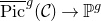 $\overline{\mathrm{Pic}}^g(\mathcal{C}) \to \mathbb{P}^g$
, whose fibres are the compactified Jacobians of the fibres of
$\overline{\mathrm{Pic}}^g(\mathcal{C}) \to \mathbb{P}^g$
, whose fibres are the compactified Jacobians of the fibres of $\mathcal{C} \to \mathbb{P}^g$
.
$\mathcal{C} \to \mathbb{P}^g$
.
Let C be a curve of genus g. The insight to prove the complex Yau–Zaslow formula is that $e(\overline{\mathrm{Pic}}^g(C))=0$
unless C is rational, in which case, if C is nodal this counts the appropriate multiplicity of rational curves. Therefore, counting the number of rational curves can be done by looking at the Euler characteristic of the compactified Jacobians of the linear system. Here, we compute
$e(\overline{\mathrm{Pic}}^g(C))=0$
unless C is rational, in which case, if C is nodal this counts the appropriate multiplicity of rational curves. Therefore, counting the number of rational curves can be done by looking at the Euler characteristic of the compactified Jacobians of the linear system. Here, we compute $\chi^{\rm mot}(\overline{\mathrm{Pic}}^g(C)) \pmod{J}$
instead. We do this by first showing that if C is not rational, then
$\chi^{\rm mot}(\overline{\mathrm{Pic}}^g(C)) \pmod{J}$
instead. We do this by first showing that if C is not rational, then $\chi^{\rm mot}(\overline{\mathrm{Pic}}^g(C))=0 \pmod{J}$
. For C a nodal and rational curve, we compute
$\chi^{\rm mot}(\overline{\mathrm{Pic}}^g(C))=0 \pmod{J}$
. For C a nodal and rational curve, we compute $\chi^{\rm mot}(\overline{\mathrm{Pic}}^g(C))$
by successively expressing
$\chi^{\rm mot}(\overline{\mathrm{Pic}}^g(C))$
by successively expressing $\chi^{\rm mot}(\overline{\mathrm{Pic}}^g(C)) \pmod{J}$
in terms of the motivic Euler characteristic of the compactified Jacobian of the normalisation of C at a singular point.
$\chi^{\rm mot}(\overline{\mathrm{Pic}}^g(C)) \pmod{J}$
in terms of the motivic Euler characteristic of the compactified Jacobian of the normalisation of C at a singular point.
Definition 6.4. A partial normalisation of C is a surjective map $f:C'\to C$
of integral projective curves that induces isomorphism between the function fields of C’ and C. Two such partial normalisations
$f:C'\to C$
of integral projective curves that induces isomorphism between the function fields of C’ and C. Two such partial normalisations $f_1:C_1\to C$
and
$f_1:C_1\to C$
and $f_2:C_2\to C$
are isomorphic if there is an isomorphism
$f_2:C_2\to C$
are isomorphic if there is an isomorphism $g:C_1\to C_2$
such that
$g:C_1\to C_2$
such that $f_1=f_2\circ g$
. Since every partial normalisation is dominated by the normalisation of C, the set
$f_1=f_2\circ g$
. Since every partial normalisation is dominated by the normalisation of C, the set $\mathcal N(C)$
of isomorphism classes of partial normalisations is finite.
$\mathcal N(C)$
of isomorphism classes of partial normalisations is finite.
There is a stratification of $\overline{\mathrm{Pic}}^n(C)$
by locally closed subvarieties
$\overline{\mathrm{Pic}}^n(C)$
by locally closed subvarieties
 \begin{align*}\overline{\mathrm{Pic}}^n(C)=\coprod_{f\in\mathcal N(C)}\overline{\mathrm{Pic}}^n_f(C).\end{align*}
Here, the morphism $f: C' \to C$
runs over all partial normalisations of C, and
$f: C' \to C$
runs over all partial normalisations of C, and $\overline{\mathrm{Pic}}^n_f(C)$
is such that the
$\overline{\mathrm{Pic}}^n_f(C)$
is such that the $\overline k$
-valued points of
$\overline k$
-valued points of $\overline{\mathrm{Pic}}^n_f(C)$
correspond exactly to those rank-1 sheaves
$\overline{\mathrm{Pic}}^n_f(C)$
correspond exactly to those rank-1 sheaves ${\mathcal L}$
on
${\mathcal L}$
on $C_{\overline k}$
such that the endomorphism ring of
$C_{\overline k}$
such that the endomorphism ring of $\mathcal L$
, as an
$\mathcal L$
, as an $\mathcal O_{C_{\overline k}}$
-subalgebra of the sheaf of rational functions on C, is
$\mathcal O_{C_{\overline k}}$
-subalgebra of the sheaf of rational functions on C, is $f_*(\mathcal O_{C'_{\overline k}})$
. Note that in the case where
$f_*(\mathcal O_{C'_{\overline k}})$
. Note that in the case where $C'=C$
and f is the identity, then
$C'=C$
and f is the identity, then $\overline{\mathrm{Pic}}^n_{\mathrm{Id}}(C) = \mathrm{Pic}^n(C)$
. More generally, if
$\overline{\mathrm{Pic}}^n_{\mathrm{Id}}(C) = \mathrm{Pic}^n(C)$
. More generally, if $f: C' \to C$
is a partial normalisation of the point p where the residue field
$f: C' \to C$
is a partial normalisation of the point p where the residue field $\kappa(p)$
is a degree-d extension of k, then
$\kappa(p)$
is a degree-d extension of k, then $\overline{\mathrm{Pic}}^n_{f}(C)$
is the image of
$\overline{\mathrm{Pic}}^n_{f}(C)$
is the image of $\mathrm{Pic}^{n-d}(C')$
under
$\mathrm{Pic}^{n-d}(C')$
under $f_*$
.
$f_*$
.
Lemma 6.5.
For every partial normalisation $f:C'\to C$
, the stratum
$f:C'\to C$
, the stratum $\overline{\mathrm{Pic}}^n_f(C)$
is equipped with the free action of the quotient group variety
$\overline{\mathrm{Pic}}^n_f(C)$
is equipped with the free action of the quotient group variety $\mathrm{Pic}^0(C)/\mathrm{Ker}(f^*)$
over k, where
$\mathrm{Pic}^0(C)/\mathrm{Ker}(f^*)$
over k, where $f^*:\mathrm{Pic}^0(C)\to\mathrm{Pic}^0(C')$
is the map induced by functoriality.
$f^*:\mathrm{Pic}^0(C)\to\mathrm{Pic}^0(C')$
is the map induced by functoriality.
Proof. There is an action
 \begin{align*}\mathrm{Pic}^0(C)\times\overline{\mathrm{Pic}}^n(C)\to\overline{\mathrm{Pic}}^n(C)\end{align*}
of $\mathrm{Pic}^0(C)$
on
$\mathrm{Pic}^0(C)$
on $\overline{\mathrm{Pic}}^n(C)$
, which at the level of represented functors is an action given by the rule
$\overline{\mathrm{Pic}}^n(C)$
, which at the level of represented functors is an action given by the rule $(\mathcal L,\mathcal G)\mapsto\mathcal L\otimes\mathcal G$
. This action of
$(\mathcal L,\mathcal G)\mapsto\mathcal L\otimes\mathcal G$
. This action of $\mathrm{Pic}^0(C)$
leaves the stratification invariant. By [Reference BeauvilleBea99, Lemma 2.1], the stabiliser of any geometric point of the stratum
$\mathrm{Pic}^0(C)$
leaves the stratification invariant. By [Reference BeauvilleBea99, Lemma 2.1], the stabiliser of any geometric point of the stratum $\overline{\mathrm{Pic}}^n_f(C)$
is
$\overline{\mathrm{Pic}}^n_f(C)$
is $\mathrm{Pic}^0(C)/\mathrm{Ker}(f^*)$
. The claim is now clear.
$\mathrm{Pic}^0(C)/\mathrm{Ker}(f^*)$
. The claim is now clear.
Proposition 6.6.
Assume that the geometric genus of C is non-zero. Then $\chi^{\rm mot}(\overline{\mathrm{Pic}}^n(C))$
lies in J for any n.
$\chi^{\rm mot}(\overline{\mathrm{Pic}}^n(C))$
lies in J for any n.
Proof. Using the additivity of $\chi^{\rm mot}$
, it is enough to show that
$\chi^{\rm mot}$
, it is enough to show that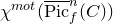 $\chi^{\rm mot}(\overline{\mathrm{Pic}}^n_f(C))$
lies in J for every partial normalisation
$\chi^{\rm mot}(\overline{\mathrm{Pic}}^n_f(C))$
lies in J for every partial normalisation $f:C'\rightarrow C$
. Let
$f:C'\rightarrow C$
. Let $\widetilde f:\widetilde C\rightarrow C$
denote the normalisation of C. There is a short exact sequence of algebraic groups,
$\widetilde f:\widetilde C\rightarrow C$
denote the normalisation of C. There is a short exact sequence of algebraic groups,
 \begin{align*}0 \to G \xrightarrow{\iota}\mathrm{Pic}^0(C) \xrightarrow{\widetilde f^*}\mathrm{Pic}^0(\widetilde C) \to 1,\end{align*}
where G is a connected linear algebraic group and $\widetilde f^*$
is induced by the pullback with respect to
$\widetilde f^*$
is induced by the pullback with respect to $\widetilde f$
. By Lemma 6.5, the algebraic group
$\widetilde f$
. By Lemma 6.5, the algebraic group $\mathrm{Pic}^0(C)/\mathrm{Ker}(f^*)$
acts freely on
$\mathrm{Pic}^0(C)/\mathrm{Ker}(f^*)$
acts freely on $\overline{\mathrm{Pic}}^n_f(C)$
. Since the genus of
$\overline{\mathrm{Pic}}^n_f(C)$
. Since the genus of $\widetilde C$
, which is the geometric genus of C, is positive, the dimension of the abelian variety
$\widetilde C$
, which is the geometric genus of C, is positive, the dimension of the abelian variety $\mathrm{Pic}^0(\widetilde C)$
is also positive. Moreover,
$\mathrm{Pic}^0(\widetilde C)$
is also positive. Moreover, $\mathrm{Ker}(f^*)\subseteq G$
as
$\mathrm{Ker}(f^*)\subseteq G$
as $\widetilde f$
factors through f. Therefore,
$\widetilde f$
factors through f. Therefore, $\chi^{\rm mot}(\overline{\mathrm{Pic}}^n_f(C))\in J$
by Corollary 5.31.
$\chi^{\rm mot}(\overline{\mathrm{Pic}}^n_f(C))\in J$
by Corollary 5.31.
Corollary 6.7.
Assume that the geometric genus of C is at least 1. Then both $\mathrm{det}_{\ell}(\overline{\mathrm{Pic}}^n(C))$
and
$\mathrm{det}_{\ell}(\overline{\mathrm{Pic}}^n(C))$
and $e(\overline{\mathrm{Pic}}^n(C))$
are trivial.
$e(\overline{\mathrm{Pic}}^n(C))$
are trivial.
Proof. This follows by showing that $\chi_{\ell}(C)=0$
, where
$\chi_{\ell}(C)=0$
, where $\chi_{\ell}$
is the ring homomorphism from Definition 2.38. Since
$\chi_{\ell}$
is the ring homomorphism from Definition 2.38. Since $\chi^{\rm mot}(\overline{\mathrm{Pic}}^n(C))\in J$
, this gives the result.
$\chi^{\rm mot}(\overline{\mathrm{Pic}}^n(C))\in J$
, this gives the result.
We now turn to computing the motivic Euler characteristics of the compactified Jacobian of nodal rational curves.
Lemma 6.8.
Let $f:C'\to C$
be a partial normalisation of C at the nodal point p of degree d. The morphism
$f:C'\to C$
be a partial normalisation of C at the nodal point p of degree d. The morphism $f_*:\overline{\mathrm{Pic}}^{n-d}(C')\to\overline{\mathrm{Pic}}^n(C)$
is a closed embedding.
$f_*:\overline{\mathrm{Pic}}^{n-d}(C')\to\overline{\mathrm{Pic}}^n(C)$
is a closed embedding.
Proof. See [Reference BeauvilleBea99, Lemma 3.1].
Let $\overline{\mathrm{Pic}}^n_b(C)$
denote the image of the morphism
$\overline{\mathrm{Pic}}^n_b(C)$
denote the image of the morphism $f_*$
above, and let
$f_*$
above, and let $\overline{\mathrm{Pic}}^n_o(C)$
be the complement of
$\overline{\mathrm{Pic}}^n_o(C)$
be the complement of $\overline{\mathrm{Pic}}^n_b(C)$
in
$\overline{\mathrm{Pic}}^n_b(C)$
in $\overline{\mathrm{Pic}}^n(C)$
.
$\overline{\mathrm{Pic}}^n(C)$
.
Notation 6.9. In the remainder of this section, we assume that C is semi-stable. Let $\mathcal S(C)$
denote the set of nodes of C. For every
$\mathcal S(C)$
denote the set of nodes of C. For every $p\in\mathcal S(C)$
, let k(p) denote the residue field of p and let
$p\in\mathcal S(C)$
, let k(p) denote the residue field of p and let $\deg(p)$
denote the degree of k(p) over k. Now let p be a node of C and pick a k(p)-rational point
$\deg(p)$
denote the degree of k(p) over k. Now let p be a node of C and pick a k(p)-rational point $\widetilde p$
of C whose set-theoretic image is exactly p. The formal completion of the base change of C to k(p) at
$\widetilde p$
of C whose set-theoretic image is exactly p. The formal completion of the base change of C to k(p) at $\widetilde p$
is isomorphic to the formal completion of
$\widetilde p$
is isomorphic to the formal completion of $x^2=\alpha_py^2$
at (0,0) for some
$x^2=\alpha_py^2$
at (0,0) for some $\alpha_p\in k(p)^\times$
. The element
$\alpha_p\in k(p)^\times$
. The element $\alpha_p$
is unique up to multiplication by an element of
$\alpha_p$
is unique up to multiplication by an element of $(k(p)^\times)^2$
, so the isomorphism class of the quadratic form
$(k(p)^\times)^2$
, so the isomorphism class of the quadratic form $\langle2\alpha_p\rangle$
over k(p) is unique and only depends on p.
$\langle2\alpha_p\rangle$
over k(p) is unique and only depends on p.
We have the following computation of the compactified Jacobians of normalisations, which serves as an arithmetic generalisation of [Reference Kharlamov and RăsdeaconuKR15, Proposition 2.8].
Proposition 6.10.
Let $f: C' \to C$
be the partial normalisation of C at the nodal point p. The pullback with respect to f induces a map
$f: C' \to C$
be the partial normalisation of C at the nodal point p. The pullback with respect to f induces a map
 \begin{align*}\overline{\mathrm{Pic}}^n_o(C) \to \overline{\mathrm{Pic}}^n(C'),\end{align*}
which exhibits $\overline{\mathrm{Pic}}^n_o$
as a torsor under
$\overline{\mathrm{Pic}}^n_o$
as a torsor under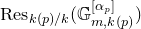 $\mathrm{Res}_{k(p)/k}(\mathbb{G}^{[\alpha_p]}_{m, k(p)})$
.
$\mathrm{Res}_{k(p)/k}(\mathbb{G}^{[\alpha_p]}_{m, k(p)})$
.
Proof. By naturality, we obtain $\overline{\mathrm{Pic}}_o^n(C) \times_k \overline{k} = \overline{\mathrm{Pic}}_o^n(C_{\overline{k}})$
. Therefore,
$\overline{\mathrm{Pic}}_o^n(C) \times_k \overline{k} = \overline{\mathrm{Pic}}_o^n(C_{\overline{k}})$
. Therefore, $\overline{\mathrm{Pic}}_o^n(C)$
is a variety, and so is determined by
$\overline{\mathrm{Pic}}_o^n(C)$
is a variety, and so is determined by $\overline{\mathrm{Pic}}_o^n(C)(\overline{k})$
along with its (right) action of
$\overline{\mathrm{Pic}}_o^n(C)(\overline{k})$
along with its (right) action of $\mathop{\mathrm{Gal}}\nolimits_k$
.
$\mathop{\mathrm{Gal}}\nolimits_k$
.
Let $d := [k(p):k]$
, and let
$d := [k(p):k]$
, and let $q,q' \in C'$
be the preimages of p in C’. Let
$q,q' \in C'$
be the preimages of p in C’. Let $p_1, \ldots, p_d$
be the points of
$p_1, \ldots, p_d$
be the points of $C(\overline{k})$
that lie over p and, similarly, let
$C(\overline{k})$
that lie over p and, similarly, let $q_1, \ldots, q_d$
be the points of
$q_1, \ldots, q_d$
be the points of $C'(\overline{k})$
lying over q and let
$C'(\overline{k})$
lying over q and let $q'_1, \ldots, q'_d$
be the points of
$q'_1, \ldots, q'_d$
be the points of $C'(\overline{k})$
lying over q’, so that the map
$C'(\overline{k})$
lying over q’, so that the map $C'(\overline{k}) \to C(\overline{k})$
sends
$C'(\overline{k}) \to C(\overline{k})$
sends $q_i$
and
$q_i$
and $q'_i$
to
$q'_i$
to $p_i$
. We also see that
$p_i$
. We also see that $\{p_1, \ldots, p_d\}$
is isomorphic as a right
$\{p_1, \ldots, p_d\}$
is isomorphic as a right $\mathop{\mathrm{Gal}}\nolimits_k$
set to
$\mathop{\mathrm{Gal}}\nolimits_k$
set to $I_{k(p)}$
.
$I_{k(p)}$
.
We explicitly construct an action of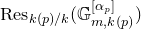 $\mathrm{Res}_{k(p)/k}(\mathbb{G}^{[\alpha_p]}_{m, k(p)})$
on
$\mathrm{Res}_{k(p)/k}(\mathbb{G}^{[\alpha_p]}_{m, k(p)})$
on $\overline{\mathrm{Pic}}^n_o(C)$
. That is, we construct a map
$\overline{\mathrm{Pic}}^n_o(C)$
. That is, we construct a map $\phi:\overline{\mathrm{Pic}}^n_o(C) \times_k\mathrm{Res}_{k(p)/k}(\mathbb{G}^{[\alpha_p]}_{m, k(p)}) \to \overline{\mathrm{Pic}}^n_o(C)$
that fits into the commutative diagram
$\phi:\overline{\mathrm{Pic}}^n_o(C) \times_k\mathrm{Res}_{k(p)/k}(\mathbb{G}^{[\alpha_p]}_{m, k(p)}) \to \overline{\mathrm{Pic}}^n_o(C)$
that fits into the commutative diagram

where $\mathrm{pr}_1$
is the projection onto the first factor and the unlabelled maps are those from the statement. Our map
$\mathrm{pr}_1$
is the projection onto the first factor and the unlabelled maps are those from the statement. Our map $\phi$
is therefore given by a
$\phi$
is therefore given by a $\mathop{\mathrm{Gal}}\nolimits_k$
equivariant map
$\mathop{\mathrm{Gal}}\nolimits_k$
equivariant map
 \begin{align*}\overline{\mathrm{Pic}}_o^n(C)(\overline{k}) \times\mathrm{Res}_{k(p)/k}(\mathbb{G}^{[\alpha_p]}_{m, k(p)})(\overline{k}) \to \overline{\mathrm{Pic}}_o^n(C)(\overline{k}).\end{align*}
Identify $\mathrm{Res}_{k(p)/k}(\mathbb{G}^{[\alpha_p]}_{m, k(p)})(\overline{k}) \cong (\overline{k}^\times)^{I_{k(p)}}$
, where the right action of
$\mathrm{Res}_{k(p)/k}(\mathbb{G}^{[\alpha_p]}_{m, k(p)})(\overline{k}) \cong (\overline{k}^\times)^{I_{k(p)}}$
, where the right action of $\mathop{\mathrm{Gal}}\nolimits_k$
on
$\mathop{\mathrm{Gal}}\nolimits_k$
on $(\overline{k}^\times)^{I_{k(p)}}$
is given by
$(\overline{k}^\times)^{I_{k(p)}}$
is given by
 \begin{align*}(\lambda_i)_{\iota_i} \cdot \sigma =(\sigma^{-1}(\lambda_i))_{\sigma^{-1} \circ \iota_i}\quad \text{if $q_i\cdot \sigma = q_j$}\end{align*}
and
 \begin{align*} (\lambda_i)_{\iota_i} \cdot \sigma = (\sigma^{-1}(\lambda_i)^{-1})_{\sigma^{-1} \circ \iota_i}\quad \text{if $q_i \cdot \sigma = q_j'$}.\end{align*}
Let $\mathcal{F} \in \overline{\mathrm{Pic}}_o^n(C)(\overline{k})$
, and let
$\mathcal{F} \in \overline{\mathrm{Pic}}_o^n(C)(\overline{k})$
, and let $\mathcal{G}$
be the image of
$\mathcal{G}$
be the image of $\mathcal{F}$
in
$\mathcal{F}$
in $\overline{\mathrm{Pic}}^n(C')(\overline{k})$
. The data of
$\overline{\mathrm{Pic}}^n(C')(\overline{k})$
. The data of $\mathcal{F}$
is given by
$\mathcal{F}$
is given by $\mathcal{G}$
, along with isomorphisms
$\mathcal{G}$
, along with isomorphisms $\psi_i: \mathcal{G}_{q_i} \cong \mathcal{G}_{q'_i}$
for every i. By the proof of [Reference Kharlamov and RăsdeaconuKR15, Lemma 2.5], we can canonically identify
$\psi_i: \mathcal{G}_{q_i} \cong \mathcal{G}_{q'_i}$
for every i. By the proof of [Reference Kharlamov and RăsdeaconuKR15, Lemma 2.5], we can canonically identify $\mathrm{Isom}(\mathcal{G}_{q_i}, \mathcal{G}_{q_i'}) \cong \overline{k}^\times$
, so that
$\mathrm{Isom}(\mathcal{G}_{q_i}, \mathcal{G}_{q_i'}) \cong \overline{k}^\times$
, so that $\psi_i, \psi_j \in \overline{k}^\times$
. There is a canonical
$\psi_i, \psi_j \in \overline{k}^\times$
. There is a canonical $\mathop{\mathrm{Gal}}\nolimits_k$
action on
$\mathop{\mathrm{Gal}}\nolimits_k$
action on $\prod_i \mathrm{Isom}(\mathcal{G}_{q_i}, \mathcal{G}_{q'_i})$
, which we can describe.
$\prod_i \mathrm{Isom}(\mathcal{G}_{q_i}, \mathcal{G}_{q'_i})$
, which we can describe.
Let $\sigma \in \mathop{\mathrm{Gal}}\nolimits_k$
be such that
$\sigma \in \mathop{\mathrm{Gal}}\nolimits_k$
be such that $p_i \cdot \sigma = p_j$
, and let
$p_i \cdot \sigma = p_j$
, and let $\psi_i \in \mathrm{Isom}(\mathcal{G}_{q_i}, \mathcal{G}_{q'_i})$
, be such that
$\psi_i \in \mathrm{Isom}(\mathcal{G}_{q_i}, \mathcal{G}_{q'_i})$
, be such that $\psi_i \cong \lambda_i \in \overline{k}^\times$
. Then
$\psi_i \cong \lambda_i \in \overline{k}^\times$
. Then $\psi_i \cdot \sigma = \sigma^{-1}(\lambda_i) \in \mathrm{Isom}(\mathcal{G}_{q_i \cdot \sigma}, \mathcal{G}_{q'_i \cdot \sigma})$
. There are now two cases.
$\psi_i \cdot \sigma = \sigma^{-1}(\lambda_i) \in \mathrm{Isom}(\mathcal{G}_{q_i \cdot \sigma}, \mathcal{G}_{q'_i \cdot \sigma})$
. There are now two cases.
In the case when $q_i \cdot \sigma = q_j$
, we have
$q_i \cdot \sigma = q_j$
, we have $ \mathrm{Isom}(\mathcal{G}_{q_i \cdot \sigma}, \mathcal{G}_{q'_i \cdot \sigma}) = \mathrm{Isom}(\mathcal{G}_{q_j}, \mathcal{G}_{q'_j})$
.
$ \mathrm{Isom}(\mathcal{G}_{q_i \cdot \sigma}, \mathcal{G}_{q'_i \cdot \sigma}) = \mathrm{Isom}(\mathcal{G}_{q_j}, \mathcal{G}_{q'_j})$
.
In the case when $q_i \cdot \sigma = q'_j$
, we have
$q_i \cdot \sigma = q'_j$
, we have $ \mathrm{Isom}(\mathcal{G}_{q_i \cdot \sigma}, \mathcal{G}_{q'_i \cdot \sigma}) = \mathrm{Isom}(\mathcal{G}_{q'_j}, \mathcal{G}_{q_j})$
. We can canonically identify this with
$ \mathrm{Isom}(\mathcal{G}_{q_i \cdot \sigma}, \mathcal{G}_{q'_i \cdot \sigma}) = \mathrm{Isom}(\mathcal{G}_{q'_j}, \mathcal{G}_{q_j})$
. We can canonically identify this with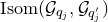 $\mathrm{Isom}(\mathcal{G}_{q_j}, \mathcal{G}_{q'_j})$
, under the isomorphism
$\mathrm{Isom}(\mathcal{G}_{q_j}, \mathcal{G}_{q'_j})$
, under the isomorphism $\lambda \mapsto \lambda^{-1}$
.
$\lambda \mapsto \lambda^{-1}$
.
Putting this together, we see that there is an isomorphism
 \begin{align*}\prod_i \mathrm{Isom}(\mathcal{G}_{q_i}, \mathcal{G}_{q'_i}) \cong \mathrm{Res}_{k(p)/k}(\mathbb{G}^{[\alpha_p]}_{m, k(p)})(\overline{k})\end{align*}
that is compatible with the $\mathop{\mathrm{Gal}}\nolimits_k$
actions on each side. Explicitly, if we identify
$\mathop{\mathrm{Gal}}\nolimits_k$
actions on each side. Explicitly, if we identify
 \begin{align*}\mathrm{Res}_{k(p)/k}(\mathbb{G}^{[\alpha_p]}_{m, k(p)})(\overline{k}) \cong (\overline{k}^\times)^{I_{k(p)}},\end{align*}
and each $\mathrm{Isom}(\mathcal{G}_{q_i}, \mathcal{G}_{q'_i}) \cong \overline{k}^\times$
, this isomorphism is given by
$\mathrm{Isom}(\mathcal{G}_{q_i}, \mathcal{G}_{q'_i}) \cong \overline{k}^\times$
, this isomorphism is given by $(\lambda_i)_{i} \mapsto (\lambda_i)_{\iota_i}$
and the action of
$(\lambda_i)_{i} \mapsto (\lambda_i)_{\iota_i}$
and the action of $\mathop{\mathrm{Gal}}\nolimits_k$
is given by
$\mathop{\mathrm{Gal}}\nolimits_k$
is given by $(\lambda_i)_i \cdot \sigma = (\sigma^{-1}(\lambda_i))_{\sigma^{-1} \circ \iota_i}$
if
$(\lambda_i)_i \cdot \sigma = (\sigma^{-1}(\lambda_i))_{\sigma^{-1} \circ \iota_i}$
if $q_i \cdot \sigma = q_j$
for some j, and
$q_i \cdot \sigma = q_j$
for some j, and $(\lambda_i)_i \cdot \sigma = (\sigma^{-1}(\lambda_i)^{-1})_{\sigma^{-1} \circ \iota_i}$
if
$(\lambda_i)_i \cdot \sigma = (\sigma^{-1}(\lambda_i)^{-1})_{\sigma^{-1} \circ \iota_i}$
if $q_i \cdot \sigma = q'_j$
for some j, which is exactly to say that
$q_i \cdot \sigma = q'_j$
for some j, which is exactly to say that $\prod_i \mathrm{Isom}(\mathcal{G}_{q_j}, \mathcal{G}_{q'_j}) \cong (\overline{k}^\times)^{I_{k(p)}}$
. Putting this together, we can write every
$\prod_i \mathrm{Isom}(\mathcal{G}_{q_j}, \mathcal{G}_{q'_j}) \cong (\overline{k}^\times)^{I_{k(p)}}$
. Putting this together, we can write every $\mathcal{F} \in \overline{\mathrm{Pic}}_o^n(C)(\overline{k})$
as a pair
$\mathcal{F} \in \overline{\mathrm{Pic}}_o^n(C)(\overline{k})$
as a pair $(\mathcal{G}, (\psi_i))$
, where
$(\mathcal{G}, (\psi_i))$
, where $\mathcal{G} \in \overline{\mathrm{Pic}}^n(C')(\overline{k})$
and
$\mathcal{G} \in \overline{\mathrm{Pic}}^n(C')(\overline{k})$
and $(\psi_i) \in (\overline{k}^\times)^{I_{k(p)}}$
.
$(\psi_i) \in (\overline{k}^\times)^{I_{k(p)}}$
.
Define the morphism
 \begin{align*}\phi: \overline{\mathrm{Pic}}_o^n(C)(\overline{k}) \times \mathrm{Res}_{k(p)/k}(\mathbb{G}^{[\alpha_p]}_{m, k(p)})(\overline{k}) \to \overline{\mathrm{Pic}}_o^n(C)(\overline{k})\end{align*}
as follows. Let $(\mathcal{G}, \{ \psi_i \}) \in \overline{\mathrm{Pic}}_o^n(C)(\overline{k}) $
, and let
$(\mathcal{G}, \{ \psi_i \}) \in \overline{\mathrm{Pic}}_o^n(C)(\overline{k}) $
, and let $\{\lambda_i\} \in \mathrm{Res}_{k(p)/k}(\mathbb{G}^{[\alpha_p]}_{m, k(p)})(\overline{k})$
. Define
$\{\lambda_i\} \in \mathrm{Res}_{k(p)/k}(\mathbb{G}^{[\alpha_p]}_{m, k(p)})(\overline{k})$
. Define
 \begin{align*}\phi ( (\mathcal{G}, \{\psi_i\}), \{\lambda_i\}) := (\mathcal{G}, \{ \lambda_i \psi_i \}).\end{align*}
We can check that $\phi$
is Galois equivariant and so gives us a map of the underlying k varieties, i.e. a
$\phi$
is Galois equivariant and so gives us a map of the underlying k varieties, i.e. a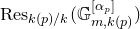 $\mathrm{Res}_{k(p)/k}(\mathbb{G}^{[\alpha_p]}_{m, k(p)})$
action on
$\mathrm{Res}_{k(p)/k}(\mathbb{G}^{[\alpha_p]}_{m, k(p)})$
action on $\overline{\mathrm{Pic}}_o^n(C)$
over
$\overline{\mathrm{Pic}}_o^n(C)$
over $\overline{\mathrm{Pic}}^n(C')$
. This action is Galois equivariant and acts freely and transitively on the fibres and so gives the result.
$\overline{\mathrm{Pic}}^n(C')$
. This action is Galois equivariant and acts freely and transitively on the fibres and so gives the result.
Corollary 6.11.
Let $f: C' \to C$
be a partial normalisation of C at the nodal point p of degree d. Then,
$f: C' \to C$
be a partial normalisation of C at the nodal point p of degree d. Then,
 \begin{align*}\chi^{\rm mot}(\overline{\mathrm{Pic}}^n(C)) \equiv\overline{\mathrm{Pic}}^{n-d}(C') + (N_{k(p)/k}(\langle -2 \rangle -\langle 2\alpha_p \rangle)) \chi^{\rm mot} (\overline{\mathrm{Pic}}^{n}(C')) \pmod{J}.\end{align*}
Proof. Lemma 6.8 tells us that
 \begin{align*}\chi^{\rm mot}(\overline{\mathrm{Pic}}^n(C)) = \chi^{\rm mot} (\overline{\mathrm{Pic}}^{n-d}(C')) + \chi^{\rm mot}(\overline{\mathrm{Pic}}_o^n(C)).\end{align*}
The above proposition, along with Theorem 5.28 allows us to compute
 \begin{align*}\chi^{\rm mot}(\overline{\mathrm{Pic}}_o^n(C)) \equiv \chi^{\rm mot}( \mathrm{Res}_{k(p)/k}(\mathbb{G}_{m,k(p)}^{[\alpha_p]})) \chi^{\rm mot}( \overline{\mathrm{Pic}}^{n}(C')) \pmod{J}.\end{align*}
Finally, Theorem 4.22 and Lemma 6.2 allow us to see that
 \begin{align*}\chi^{\rm mot}( \mathrm{Res}_{k(p)/k}(\mathbb{G}_{m,k(p)}^{[\alpha_p]})) = N_{k(p)/k}(\langle -2 \rangle - \langle 2\alpha_p \rangle),\end{align*}
as required.
Notation 6.12. The above corollary motivates the following definition. Let C be a nodal curve defined over k, and let $p \in \mathcal{S}(C)$
. Define
$p \in \mathcal{S}(C)$
. Define
 \begin{align*}\Phi_p := 1 + N_{k(p)/k}(\langle -2 \rangle - \langle 2\alpha_{p} \rangle) \in \widehat{\mathrm{W}}(k).\end{align*}
Corollary 6.13.
Assume that C has geometric genus 0 and arithmetic genus g. Then, for any integer n, there is an equality in $\widehat{\mathrm{W}}(k)/J$
:
$\widehat{\mathrm{W}}(k)/J$
:
 \begin{align*}\chi^{\rm mot}(\overline{\mathrm{Pic}}^n(C))=\prod_{p\in\mathcal S(C)}\Phi_p.\end{align*}
Proof. We prove the claim by induction on the cardinality of $\mathcal S(C)$
. When
$\mathcal S(C)$
. When $\mathcal S(C)$
is empty, then C is smooth and genus 0 and hence
$\mathcal S(C)$
is empty, then C is smooth and genus 0 and hence $\overline{\mathrm{Pic}}^n(C)$
is isomorphic to
$\overline{\mathrm{Pic}}^n(C)$
is isomorphic to $\mathrm{Spec}(k)$
for every n. Therefore, the claim holds in this case, since the product over an empty index is 1. Assume that the claim holds for every nodal curve C’ of geometric genus 0 such that
$\mathrm{Spec}(k)$
for every n. Therefore, the claim holds in this case, since the product over an empty index is 1. Assume that the claim holds for every nodal curve C’ of geometric genus 0 such that $|\mathcal S(C')|\lt |\mathcal S(C)|$
. Let
$|\mathcal S(C')|\lt |\mathcal S(C)|$
. Let $p' \in \mathcal S(C)$
be a point of degree d, and let C’ be the normalisation of C at p’, so that
$p' \in \mathcal S(C)$
be a point of degree d, and let C’ be the normalisation of C at p’, so that $\mathcal{S}(C) = \mathcal{S}(C') \cup \{p'\}$
. Then, by the previous corollary,
$\mathcal{S}(C) = \mathcal{S}(C') \cup \{p'\}$
. Then, by the previous corollary,
 \begin{align*}\chi^{\rm mot}(\overline{\mathrm{Pic}}^n(C)) \equiv \chi^{\rm mot} (\overline{\mathrm{Pic}}^{n-d}(C')) + (N_{k(p')/k}(\langle -2 \rangle - \langle 2\alpha_{p'} \rangle)\chi^{\rm mot} (\overline{\mathrm{Pic}}^{n}(C)) \pmod{J}.\end{align*}
The induction hypothesis gives
 \begin{align*}\chi^{\rm mot} (\overline{\mathrm{Pic}}^{n-d}(C')) \equiv \chi^{\rm mot} (\overline{\mathrm{Pic}}^{n}(C')) \equiv \prod_{p \in \mathcal{S}(C')} \Phi_p \pmod{J}.\end{align*}
Therefore,
 \begin{align*}\chi^{\rm mot}(\overline{\mathrm{Pic}}^n(C)) &\equiv \bigg(\prod_{p \in \mathcal{S}(C')} \Phi_p\bigg) (1 + (N_{k(p)/k}(\langle -2 \rangle - \langle 2\alpha_{p} \rangle)) \pmod{J} \\&\equiv \bigg(\prod_{p \in \mathcal{S}(C')} \Phi_p \bigg) \cdot \Phi_{p'} \pmod{J}\\&\equiv \prod_{p \in \mathcal{S}(C)} \Phi_p \pmod{J},\end{align*}
as required.
Corollary 6.14.
Suppose that $k=\mathbb{C}$
in the previous corollary. Then
$k=\mathbb{C}$
in the previous corollary. Then $e(\overline{\mathrm{Pic}}^g(C))=1$
.
$e(\overline{\mathrm{Pic}}^g(C))=1$
.
Proof. This follows immediately, as $\mathrm{rank}(\Phi_p)=1$
for every p.
$\mathrm{rank}(\Phi_p)=1$
for every p.
The above recovers [Reference BeauvilleBea99, Corollary 3.4]. Another corollary is the real closed case, which generalises [Reference Kharlamov and RăsdeaconuKR15, Proposition 1.8] to all real closed fields. Now suppose that k is a real closed field, and identify $k^\times/k^{\times2} \cong \{\pm 1\}$
.
$k^\times/k^{\times2} \cong \{\pm 1\}$
.
Corollary 6.15.
There is an equality $\mathrm{sign}( \chi^{\rm mot}(\overline{\mathrm{Pic}}^g(C))) = (-1)^r$
, where r is the number of points
$\mathrm{sign}( \chi^{\rm mot}(\overline{\mathrm{Pic}}^g(C))) = (-1)^r$
, where r is the number of points $p \in \mathcal{S}(C)$
such that
$p \in \mathcal{S}(C)$
such that $k(p)=k$
and
$k(p)=k$
and $\alpha_p= 1$
, i.e. the number of singular points that are both defined over k and have their tangent spaces defined over k.
$\alpha_p= 1$
, i.e. the number of singular points that are both defined over k and have their tangent spaces defined over k.
Proof. Let $p \in \mathcal{S}(C)$
be one of the singular points. If
$p \in \mathcal{S}(C)$
be one of the singular points. If $k(p)=\overline{k}$
, then we see that the corresponding factor at p is given by
$k(p)=\overline{k}$
, then we see that the corresponding factor at p is given by $\mathbb{H}- (\langle 2 \rangle + \langle 2 \alpha_p \rangle )$
, which is zero. Therefore,
$\mathbb{H}- (\langle 2 \rangle + \langle 2 \alpha_p \rangle )$
, which is zero. Therefore, $\mathrm{sign}(\Phi_p)=1$
. If
$\mathrm{sign}(\Phi_p)=1$
. If $k(p)=k$
, then the singular point p is a k point. If
$k(p)=k$
, then the singular point p is a k point. If $\alpha_p=-1$
, then the tangent spaces at p are not defined over k, and
$\alpha_p=-1$
, then the tangent spaces at p are not defined over k, and $\mathbb{H} - (\langle 2 \rangle + \langle 2 \alpha_p \rangle )=0$
, so
$\mathbb{H} - (\langle 2 \rangle + \langle 2 \alpha_p \rangle )=0$
, so $\mathrm{sign}(\Phi_p)=1$
. If
$\mathrm{sign}(\Phi_p)=1$
. If $\alpha_p=1$
, then
$\alpha_p=1$
, then $\mathbb{H} - (\langle 2 \rangle + \langle 2 \alpha_p \rangle ) = \langle -1 \rangle - \langle 1 \rangle$
, and we obtain
$\mathbb{H} - (\langle 2 \rangle + \langle 2 \alpha_p \rangle ) = \langle -1 \rangle - \langle 1 \rangle$
, and we obtain
 \begin{align*}N_{k/k}(\langle -1 \rangle - \langle 1 \rangle) = \langle -1 \rangle - \langle 1 \rangle,\end{align*}
which means that $\Phi_p = \langle -1 \rangle$
and so has sign
$\Phi_p = \langle -1 \rangle$
and so has sign $-1$
. Putting this together gives us
$-1$
. Putting this together gives us
 \begin{align*}\chi^{\rm mot}(\overline{\mathrm{Pic}}^g(C)) = (-1)^r,\end{align*}
where r is the number of singular points on C such that p and the tangent spaces to p are both defined over k.
Corollary 6.16. Let k be any field of characteristic 0. Then,
 \begin{align*}\mathrm{disc}(\chi^{\rm mot}(\overline{\mathrm{Pic}}^g(C))) = (-1)^g\prod_{p \in \mathcal{S}(C)}N_{k(p)/k}(\alpha_p) \in k^\times/k^{\times2}.\end{align*}
Proof. We obtain this by applying disc to Corollary 6.13. By definition,
 \begin{align*}\mathrm{disc}(\Phi_p) = \mathrm{disc}(1- N_{k(p)/k}(\mathbb{H}-(\langle 2\rangle + \langle 2 \alpha_p \rangle))= \mathrm{disc}(N_{k(p)/k}(\mathbb{H}-(\langle 2\rangle + \langle 2 \alpha_p \rangle)).\end{align*}
Note that $\mathrm{disc}(\mathbb{H}-(\langle 2\rangle + \langle 2 \alpha_p \rangle)) = -\alpha_p$
, so Corollary 4.21 gives us
$\mathrm{disc}(\mathbb{H}-(\langle 2\rangle + \langle 2 \alpha_p \rangle)) = -\alpha_p$
, so Corollary 4.21 gives us
 \begin{align*}\mathrm{disc}( N_{k(p)/k}(\mathbb{H}-(\langle 2\rangle + \langle 2 \alpha_p \rangle)) = (-1)^{[k(p):k]} N_{k(p)/k}(\alpha_p).\end{align*}
Multiplying all the $\Phi_p$
terms gives us
$\Phi_p$
terms gives us
 \begin{align*}\mathrm{disc}\bigg(\prod_{p \in \mathcal{S}(C)} \Phi_p\bigg) = \prod_{p \in \mathcal{S}(C)}(-1)^{[k(p):k]}N_{k(p)/k}(\alpha_p) = (-1)^g \prod_{p \in \mathcal{S}(C)}N_{k(p)/k}(\alpha_p),\end{align*}
as required.
6.2 Motivic Euler characteristics of the compactified Jacobian of the linear system
Let X be a polarised K3 surface equipped with a degree-2g polarisation and let $\mathcal{C}$
be the associated g-dimensional linear system of genus-g curves on X, as in § 1. Let
$\mathcal{C}$
be the associated g-dimensional linear system of genus-g curves on X, as in § 1. Let $\pi: \mathcal{C} \to \mathbb{P}^g$
be the associated morphism given by the linear system. We now combine the above results with our Fubini theorem to compute
$\pi: \mathcal{C} \to \mathbb{P}^g$
be the associated morphism given by the linear system. We now combine the above results with our Fubini theorem to compute $\chi^{\rm mot}(\overline{\mathrm{Pic}}^g(\mathcal{C}))$
.
$\chi^{\rm mot}(\overline{\mathrm{Pic}}^g(\mathcal{C}))$
.
Definition 6.17. For q a closed point of $\mathbb P^g_k$
, write k(q) to mean the residue field at q. As a slight abuse of notation, we also write
$\mathbb P^g_k$
, write k(q) to mean the residue field at q. As a slight abuse of notation, we also write $q: \mathrm{Spec}(k(q)) \to \mathbb P^g_k$
to be the corresponding closed immersion, and
$q: \mathrm{Spec}(k(q)) \to \mathbb P^g_k$
to be the corresponding closed immersion, and $\mathcal C_q$
to mean the fibre of
$\mathcal C_q$
to mean the fibre of $\mathcal{C} \xrightarrow{\pi} \mathbb P^g_k$
over q. Assume that the curves in
$\mathcal{C} \xrightarrow{\pi} \mathbb P^g_k$
over q. Assume that the curves in $\mathcal{C}$
belong to a primitive divisor class and are geometrically integral, which will hold if
$\mathcal{C}$
belong to a primitive divisor class and are geometrically integral, which will hold if $g\geq 2$
and X is of Picard rank 1 and the curves in the linear system belong to a primitive divisor class. Assume that the rational curves in
$g\geq 2$
and X is of Picard rank 1 and the curves in the linear system belong to a primitive divisor class. Assume that the rational curves in $\mathcal{C}$
are all nodal, which is generically the case by Chen’s theorem [Reference ChenChe02, Theorem 1.1]. Let G(X) be the set of closed points q of
$\mathcal{C}$
are all nodal, which is generically the case by Chen’s theorem [Reference ChenChe02, Theorem 1.1]. Let G(X) be the set of closed points q of $\mathbb P^g_k$
such that
$\mathbb P^g_k$
such that $C_q$
has geometric genus 0. We see that G(X) is finite, since the set of geometric points lying above G(X) is finite by the argument presented in [Reference BeauvilleBea99, Corollary 2.3], which holds over any algebraically closed field of characteristic 0. By slight abuse of notation, let G(X) also denote the reduced closed subscheme of
$C_q$
has geometric genus 0. We see that G(X) is finite, since the set of geometric points lying above G(X) is finite by the argument presented in [Reference BeauvilleBea99, Corollary 2.3], which holds over any algebraically closed field of characteristic 0. By slight abuse of notation, let G(X) also denote the reduced closed subscheme of $\mathbb P^g_k$
whose underlying set of closed points is G(X). Let
$\mathbb P^g_k$
whose underlying set of closed points is G(X). Let $\pi_g:\overline{\mathrm{Pic}}^g(\mathcal C)\to\mathbb P^g_k$
be the relative compactified Picard variety. Let
$\pi_g:\overline{\mathrm{Pic}}^g(\mathcal C)\to\mathbb P^g_k$
be the relative compactified Picard variety. Let $Y := \mathbb P^g_k \setminus G(X)$
and define
$Y := \mathbb P^g_k \setminus G(X)$
and define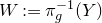 $W := \pi_g^{-1}(Y)$
. Write
$W := \pi_g^{-1}(Y)$
. Write $\pi_{g,W}: W \to Y$
for the restriction of
$\pi_{g,W}: W \to Y$
for the restriction of $\pi_g$
to W.
$\pi_g$
to W.
Theorem 6.18.
There exists an integer $\Delta(g)$
such that for any K3 surface as above,
$\Delta(g)$
such that for any K3 surface as above,
 \begin{align*}\mathrm{dim}_{\mathbb{Q}_\ell} H^i( \overline{\mathrm{Pic}}^g(C_q)_{\overline{k}}, \mathbb{Q}_\ell) \leq \Delta(g),\end{align*}
for all closed points q of $\mathbb{P}^g$
and for all i.
$\mathbb{P}^g$
and for all i.
Proof. Since this statement is only about the dimension of the cohomology groups, it is enough to prove this statement after base changing to the algebraic closure of the field, so that $k=\overline{k}$
. By [Reference HuybrechtsHuy16, Chapter 5, § 1], let
$k=\overline{k}$
. By [Reference HuybrechtsHuy16, Chapter 5, § 1], let $\mathcal{M}_g$
denote the moduli stack of K3 surfaces equipped with a polarisation of degree 2g (note that the construction in [Reference HuybrechtsHuy16] makes sense over any algebraically closed field of characteristic 0). This is a Deligne–Mumford stack by [Reference HuybrechtsHuy16, Chapter 5, Proposition 4.10], so there exists a
$\mathcal{M}_g$
denote the moduli stack of K3 surfaces equipped with a polarisation of degree 2g (note that the construction in [Reference HuybrechtsHuy16] makes sense over any algebraically closed field of characteristic 0). This is a Deligne–Mumford stack by [Reference HuybrechtsHuy16, Chapter 5, Proposition 4.10], so there exists a $\overline{k}$
variety
$\overline{k}$
variety $\mathbf{M}_g$
, equipped with an étale surjective morphism
$\mathbf{M}_g$
, equipped with an étale surjective morphism $\mathbf{M}_g \to \mathcal{M}_g$
. Since
$\mathbf{M}_g \to \mathcal{M}_g$
. Since $\mathcal{M}_g$
is the moduli stack representing polarised K3 surfaces over
$\mathcal{M}_g$
is the moduli stack representing polarised K3 surfaces over $\overline{k}$
, pulling back the universal family along this morphism equips
$\overline{k}$
, pulling back the universal family along this morphism equips $\mathbf{M}_g$
with a flat family
$\mathbf{M}_g$
with a flat family $\mathcal{X} \to \mathbf{M}_g$
of polarised K3 surfaces. Moreover, since
$\mathcal{X} \to \mathbf{M}_g$
of polarised K3 surfaces. Moreover, since $\mathbf{M}_g \to \mathcal{M}_g$
is surjective, every K3 surface equipped with a polarisation of degree 2g appears as a fibre over some point in the family
$\mathbf{M}_g \to \mathcal{M}_g$
is surjective, every K3 surface equipped with a polarisation of degree 2g appears as a fibre over some point in the family $\mathcal{X} \to \mathbf{M}_g$
.
$\mathcal{X} \to \mathbf{M}_g$
.
Consider $\mathbf{L} \in \mathrm{Pic}_{\mathcal{X}/\mathbf{M}_g}(\mathbf{M}_g)$
. This determines a linear system of divisors
$\mathbf{L} \in \mathrm{Pic}_{\mathcal{X}/\mathbf{M}_g}(\mathbf{M}_g)$
. This determines a linear system of divisors $\mathbf{C}_g$
on
$\mathbf{C}_g$
on $\mathcal{X}$
regarded as an
$\mathcal{X}$
regarded as an $\mathbf{M}_g$
variety, which in turn comes with a map
$\mathbf{M}_g$
variety, which in turn comes with a map $\mathbf{C}_g \to \mathbb{P}^g_{\mathbf{M}_g} \cong \mathbb{P}^g_{\overline{k}} \times_{\overline{k}} \mathbf{M}_g$
. Let
$\mathbf{C}_g \to \mathbb{P}^g_{\mathbf{M}_g} \cong \mathbb{P}^g_{\overline{k}} \times_{\overline{k}} \mathbf{M}_g$
. Let $\mathbf{q} \in \mathbb{P}^g_{\mathbf{M}_g}(\overline{k})$
, so that
$\mathbf{q} \in \mathbb{P}^g_{\mathbf{M}_g}(\overline{k})$
, so that $\mathbf{q}$
is given by a pair
$\mathbf{q}$
is given by a pair $(\alpha, q)$
, where
$(\alpha, q)$
, where $\alpha \in \mathbf{M}_g(\overline{k})$
and
$\alpha \in \mathbf{M}_g(\overline{k})$
and $q \in \mathbb{P}^g(\overline{k})$
. Then the fibre of
$q \in \mathbb{P}^g(\overline{k})$
. Then the fibre of $\mathbf{C}_g \to \mathbb{P}^g_{\mathbf{M}_g}$
over
$\mathbf{C}_g \to \mathbb{P}^g_{\mathbf{M}_g}$
over $\mathbf{q}$
is given by the fibre of
$\mathbf{q}$
is given by the fibre of $\mathcal{C}_{\alpha} \to \mathbb{P}^g$
over q, and so in particular is an integral curve of arithmetic genus g. Therefore, [Reference Altman and KleimanAK80, Theorem 8.1] allows us to form the relative compactified Jacobian
$\mathcal{C}_{\alpha} \to \mathbb{P}^g$
over q, and so in particular is an integral curve of arithmetic genus g. Therefore, [Reference Altman and KleimanAK80, Theorem 8.1] allows us to form the relative compactified Jacobian $\Pi_g: \overline{\mathrm{Pic}}^g(\mathbf{C}_g) \to \mathbb{P}^g_{\mathbf{M}_g}$
. The fibres of this morphism have dimension 2g, since the fibres are the relative compactified Jacobians of the curves as above.
$\Pi_g: \overline{\mathrm{Pic}}^g(\mathbf{C}_g) \to \mathbb{P}^g_{\mathbf{M}_g}$
. The fibres of this morphism have dimension 2g, since the fibres are the relative compactified Jacobians of the curves as above.
Consider the map $\Pi_g$
, which is proper, and let i be a positive integer. Since the
$\Pi_g$
, which is proper, and let i be a positive integer. Since the $\ell$
-adic sheaf
$\ell$
-adic sheaf $\mathbb{Q}_\ell$
is locally constant, the derived pushforward
$\mathbb{Q}_\ell$
is locally constant, the derived pushforward $R^i \Pi_{g,*}\mathbb{Q}_\ell$
is constructible by [Reference DeligneDel77, § XIV, Theorem 1]. If
$R^i \Pi_{g,*}\mathbb{Q}_\ell$
is constructible by [Reference DeligneDel77, § XIV, Theorem 1]. If $i \leq 2g$
, then since
$i \leq 2g$
, then since $R^i \Pi_{g,*} \mathbb{Q}_\ell$
is constructible, there exists a stratification
$R^i \Pi_{g,*} \mathbb{Q}_\ell$
is constructible, there exists a stratification $U^i_1, \ldots, U^i_n$
of
$U^i_1, \ldots, U^i_n$
of $\mathbb{P}^g_{\mathbf{M}_g}$
such that
$\mathbb{P}^g_{\mathbf{M}_g}$
such that $R^i\Pi_{g,*}\mathbb{Q}_\ell$
is locally constant on
$R^i\Pi_{g,*}\mathbb{Q}_\ell$
is locally constant on $U^i_j$
. Let
$U^i_j$
. Let $\Delta^{i,j}(g)$
denote the rank of
$\Delta^{i,j}(g)$
denote the rank of $R^i\Pi_{g,*}\mathbb{Q}_\ell$
on
$R^i\Pi_{g,*}\mathbb{Q}_\ell$
on $U^i_j$
, and let
$U^i_j$
, and let $\Delta^i(g) := \mathrm{max}_j \Delta^{i,j}(g)$
, which is finite since the stratification is finite. If
$\Delta^i(g) := \mathrm{max}_j \Delta^{i,j}(g)$
, which is finite since the stratification is finite. If $i\gt2g$
, then
$i\gt2g$
, then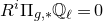 $R^i\Pi_{g,*}\mathbb{Q}_\ell = 0$
, so set
$R^i\Pi_{g,*}\mathbb{Q}_\ell = 0$
, so set $\Delta^i(g) = 0$
. Let
$\Delta^i(g) = 0$
. Let $\Delta(g) := \mathrm{max}_i \Delta^i(g)$
. Precisely by construction, if
$\Delta(g) := \mathrm{max}_i \Delta^i(g)$
. Precisely by construction, if $f: U \to \mathbb{P}^g_{\mathbf{M}_g}$
is such that
$f: U \to \mathbb{P}^g_{\mathbf{M}_g}$
is such that $f^*R^i\Pi_{g,*}\mathbb{Q}_\ell$
is locally constant, then
$f^*R^i\Pi_{g,*}\mathbb{Q}_\ell$
is locally constant, then $\mathrm{rank}(f^*R^i\Pi_{g,*}\mathbb{Q}_\ell)\leq \Delta(g)$
.
$\mathrm{rank}(f^*R^i\Pi_{g,*}\mathbb{Q}_\ell)\leq \Delta(g)$
.
Now suppose that X is our polarised K3 surface over $\overline{k}$
. Let
$\overline{k}$
. Let $\mathcal{C} \to \mathbb{P}^g$
denote the linear system on X, let
$\mathcal{C} \to \mathbb{P}^g$
denote the linear system on X, let $q \in \mathbb{P}^g(\overline{k})$
, and let
$q \in \mathbb{P}^g(\overline{k})$
, and let $C_q$
denote the curve over q. We claim that
$C_q$
denote the curve over q. We claim that $\mathrm{dim}_{\mathbb{Q}_\ell} H^i(\overline{\mathrm{Pic}}^g(C_q), \mathbb{Q}_\ell) \leq \Delta(g)$
.
$\mathrm{dim}_{\mathbb{Q}_\ell} H^i(\overline{\mathrm{Pic}}^g(C_q), \mathbb{Q}_\ell) \leq \Delta(g)$
.
By the definition of the moduli stack, X determines a point $[X] \in \mathcal{M}_g(\overline{k})$
. Pick
$[X] \in \mathcal{M}_g(\overline{k})$
. Pick $\alpha \in \mathbf{M}_g(\overline{k})$
lying over [X] under the morphism
$\alpha \in \mathbf{M}_g(\overline{k})$
lying over [X] under the morphism $\mathbf{M}_g(\overline{k}) \to \mathcal{M}_g(\overline{k})$
, which exists since
$\mathbf{M}_g(\overline{k}) \to \mathcal{M}_g(\overline{k})$
, which exists since $\mathbf{M}_g \to \mathcal{M}_g$
is étale and surjective. Then the fibre of
$\mathbf{M}_g \to \mathcal{M}_g$
is étale and surjective. Then the fibre of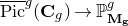 $\overline{\mathrm{Pic}}^g(\mathbf{C}_g) \to \mathbb{P}^g_{\mathbf{M_g}}$
over the point
$\overline{\mathrm{Pic}}^g(\mathbf{C}_g) \to \mathbb{P}^g_{\mathbf{M_g}}$
over the point $(\alpha, q)$
is isomorphic to
$(\alpha, q)$
is isomorphic to $\overline{\mathrm{Pic}}^g(C_q)$
by construction.
$\overline{\mathrm{Pic}}^g(C_q)$
by construction.
Fix an integer i and consider $H^i(\overline{\mathrm{Pic}}^g(C_q),\mathbb{Q}_\ell)$
. This vanishes for
$H^i(\overline{\mathrm{Pic}}^g(C_q),\mathbb{Q}_\ell)$
. This vanishes for $i \gt 2g$
, so assume that
$i \gt 2g$
, so assume that $i \leq 2g$
. Consider
$i \leq 2g$
. Consider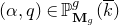 $(\alpha, q) \in \mathbb{P}^g_{\mathbf{M}_g}(\overline{k})$
. By construction, the fibre of
$(\alpha, q) \in \mathbb{P}^g_{\mathbf{M}_g}(\overline{k})$
. By construction, the fibre of $\Pi_g$
over
$\Pi_g$
over $(\alpha, q)$
is
$(\alpha, q)$
is $\overline{\mathrm{Pic}}^g(C_q)$
. Therefore, by the proper base change theorem (see [Reference Artin, Grothendieck and VerdierAGV72, § XII, Theorem 5.1(iii)]), we see that
$\overline{\mathrm{Pic}}^g(C_q)$
. Therefore, by the proper base change theorem (see [Reference Artin, Grothendieck and VerdierAGV72, § XII, Theorem 5.1(iii)]), we see that
 \begin{align*}\mathrm{dim}_{\mathbb{Q}_\ell}( H^i(\overline{\mathrm{Pic}}^g(C_q), \mathbb{Q}_\ell)) = \mathrm{rank} ( (\alpha, q)^* R^i\Pi_{g,*}\mathbb{Q}_\ell) \leq \Delta(g),\end{align*}
as required.
Remark 6.19. In the case that $C_q$
is a nodal curve, we may use Proposition 6.10 and the Leray–Serre spectral sequence to see that
$C_q$
is a nodal curve, we may use Proposition 6.10 and the Leray–Serre spectral sequence to see that $ \mathrm{dim}_{\mathbb{Q}_\ell}( H^i(\overline{\mathrm{Pic}}^g(C_q), \mathbb{Q}_\ell)) \leq {2g \choose g}$
, and if
$ \mathrm{dim}_{\mathbb{Q}_\ell}( H^i(\overline{\mathrm{Pic}}^g(C_q), \mathbb{Q}_\ell)) \leq {2g \choose g}$
, and if $C_q$
is smooth,
$C_q$
is smooth, $H^i(\overline{\mathrm{Pic}}^g(C_q), \mathbb{Q}_\ell) = {2i \choose i}$
. Therefore,
$H^i(\overline{\mathrm{Pic}}^g(C_q), \mathbb{Q}_\ell) = {2i \choose i}$
. Therefore, $\Delta(g) \geq {2g \choose g}$
.
$\Delta(g) \geq {2g \choose g}$
.
Definition 6.20. Let $\Delta(g)$
be the constant from Theorem 6.18. For
$\Delta(g)$
be the constant from Theorem 6.18. For $k^{\rm const}$
a number field, let
$k^{\rm const}$
a number field, let $\Delta^{k^{\rm const}}_g$
be the finite subgroup of
$\Delta^{k^{\rm const}}_g$
be the finite subgroup of $\mathop{\mathrm{Hom}}\nolimits(\mathop{\mathrm{Gal}}\nolimits_{\mathbb{Q}}, \mathbb{Z}/2\mathbb{Z})$
consisting of characters
$\mathop{\mathrm{Hom}}\nolimits(\mathop{\mathrm{Gal}}\nolimits_{\mathbb{Q}}, \mathbb{Z}/2\mathbb{Z})$
consisting of characters $\chi$
such that
$\chi$
such that $\chi$
is unramified at all primes
$\chi$
is unramified at all primes $\mathfrak{p}$
whose residue characteristic p satisfies
$\mathfrak{p}$
whose residue characteristic p satisfies $p\gt \Delta(g) \cdot [k^{\rm const}:\mathbb{Q}]+1$
. For k a finitely generated field over
$p\gt \Delta(g) \cdot [k^{\rm const}:\mathbb{Q}]+1$
. For k a finitely generated field over $\mathbb{Q}$
, let
$\mathbb{Q}$
, let $\Delta_g^k$
be the finite subgroup of
$\Delta_g^k$
be the finite subgroup of $\mathop{\mathrm{Hom}}\nolimits(\mathop{\mathrm{Gal}}\nolimits_k, \mathbb{Z}/2\mathbb{Z})$
consisting of elements in the image of
$\mathop{\mathrm{Hom}}\nolimits(\mathop{\mathrm{Gal}}\nolimits_k, \mathbb{Z}/2\mathbb{Z})$
consisting of elements in the image of $\Delta^{k^{\rm const}}_g$
under the map
$\Delta^{k^{\rm const}}_g$
under the map $\mathop{\mathrm{Hom}}\nolimits(\mathop{\mathrm{Gal}}\nolimits_{k^{\rm const}}, \mathbb{Z}/2\mathbb{Z}) \hookrightarrow \mathop{\mathrm{Hom}}\nolimits(\mathop{\mathrm{Gal}}\nolimits_k, \mathbb{Z}/2\mathbb{Z})$
. We will also think of
$\mathop{\mathrm{Hom}}\nolimits(\mathop{\mathrm{Gal}}\nolimits_{k^{\rm const}}, \mathbb{Z}/2\mathbb{Z}) \hookrightarrow \mathop{\mathrm{Hom}}\nolimits(\mathop{\mathrm{Gal}}\nolimits_k, \mathbb{Z}/2\mathbb{Z})$
. We will also think of $\Delta_g^k$
as a subgroup of
$\Delta_g^k$
as a subgroup of $\mathop{\mathrm{Hom}}\nolimits(\mathop{\mathrm{Gal}}\nolimits_k, \mathbb{Q}_{\ell}^\times)$
using the inclusion
$\mathop{\mathrm{Hom}}\nolimits(\mathop{\mathrm{Gal}}\nolimits_k, \mathbb{Q}_{\ell}^\times)$
using the inclusion $\mathbb{Z}/2\mathbb{Z} \hookrightarrow \mathbb{Q}_{\ell}^\times$
.
$\mathbb{Z}/2\mathbb{Z} \hookrightarrow \mathbb{Q}_{\ell}^\times$
.
The map $\widehat{\mathrm{W}}(k) \to E(\mathop{\mathrm{Hom}}\nolimits(\mathop{\mathrm{Gal}}\nolimits_k, (\mathbb{Z}/2\mathbb{Z})/ \Delta^k_g)$
given by
$\widehat{\mathrm{W}}(k) \to E(\mathop{\mathrm{Hom}}\nolimits(\mathop{\mathrm{Gal}}\nolimits_k, (\mathbb{Z}/2\mathbb{Z})/ \Delta^k_g)$
given by $[q] \mapsto (\mathrm{rank}(q), \mathrm{disc}(q)) \pmod{\Delta^k_g}$
is a ring homomorphism with kernel
$[q] \mapsto (\mathrm{rank}(q), \mathrm{disc}(q)) \pmod{\Delta^k_g}$
is a ring homomorphism with kernel $I_g$
containing
$I_g$
containing $I^2$
. Let
$I^2$
. Let $J_g := I_g \cap T$
. The homomorphisms rank and sign clearly both factor through
$J_g := I_g \cap T$
. The homomorphisms rank and sign clearly both factor through $\widehat{\mathrm{W}}(k)/J_g$
, so we can still recover these invariants after passing to this quotient.
$\widehat{\mathrm{W}}(k)/J_g$
, so we can still recover these invariants after passing to this quotient.
Remark 6.21. Let $k_g$
be the abelian extension of k corresponding to the fixed field of the subgroup
$k_g$
be the abelian extension of k corresponding to the fixed field of the subgroup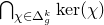 $\bigcap_{\chi \in \Delta^k_g}\mathrm{ker}(\chi)$
. The canonical map
$\bigcap_{\chi \in \Delta^k_g}\mathrm{ker}(\chi)$
. The canonical map $\widehat{\mathrm{W}}(k)/J \to \widehat{\mathrm{W}}(k_g)/J$
factors through
$\widehat{\mathrm{W}}(k)/J \to \widehat{\mathrm{W}}(k_g)/J$
factors through $J_g$
. We can therefore view
$J_g$
. We can therefore view $J_g$
as recovering a discriminant in
$J_g$
as recovering a discriminant in $k_g$
. However, we may lose information about sign by passing to
$k_g$
. However, we may lose information about sign by passing to $\widehat{\mathrm{W}}(k_g)/J$
. For example, if
$\widehat{\mathrm{W}}(k_g)/J$
. For example, if $-1$
is not a square in k, and if the character corresponding to
$-1$
is not a square in k, and if the character corresponding to $k(\sqrt{-1})$
lies in
$k(\sqrt{-1})$
lies in $\Delta^k_g$
, then
$\Delta^k_g$
, then $\mathrm{Spr}(k_g) = \emptyset$
, but this may not be the case for
$\mathrm{Spr}(k_g) = \emptyset$
, but this may not be the case for $\mathrm{Spr}(k)$
. However, we do not lose information about sign in the case that k is a real closed field.
$\mathrm{Spr}(k)$
. However, we do not lose information about sign in the case that k is a real closed field.
Lemma 6.22.
We have $\chi^{\rm mot}(W) \equiv 0 \pmod{J_g}$
.
$\chi^{\rm mot}(W) \equiv 0 \pmod{J_g}$
.
Proof. This proof is an application of Corollary 5.19 to this situation. We first show that this situation satisfies the properties for this result.
Let $i\geq0$
, and consider
$i\geq0$
, and consider $R^i\pi_{g,*} \mathbb{Q}_{\ell}$
. Since
$R^i\pi_{g,*} \mathbb{Q}_{\ell}$
. Since $\pi_g$
is proper, [Reference Artin, Grothendieck and VerdierAGV72, § XIV, Theorem 1] gives us that
$\pi_g$
is proper, [Reference Artin, Grothendieck and VerdierAGV72, § XIV, Theorem 1] gives us that $R^i\pi_{g,*}\mathbb{Q}_\ell$
is constructible, so there exists a stratification
$R^i\pi_{g,*}\mathbb{Q}_\ell$
is constructible, so there exists a stratification $Y^i_1, \ldots, Y^i_{n_i}$
of Y into locally closed subvarieties such that
$Y^i_1, \ldots, Y^i_{n_i}$
of Y into locally closed subvarieties such that $R^i\pi_*\mathbb{Q}_{\ell}$
is locally constant on
$R^i\pi_*\mathbb{Q}_{\ell}$
is locally constant on $Y^i_j$
for all j. Moreover, since
$Y^i_j$
for all j. Moreover, since $\pi_g$
has relative dimension 2g, this is the trivial sheaf whenever
$\pi_g$
has relative dimension 2g, this is the trivial sheaf whenever $i \gt 2g$
. Since the restriction of a locally constant sheaf is locally constant and each stratification is finite, we may find a common stratification
$i \gt 2g$
. Since the restriction of a locally constant sheaf is locally constant and each stratification is finite, we may find a common stratification $Y_1, \ldots, Y_n$
such that
$Y_1, \ldots, Y_n$
such that $R^i\pi_{g,W,*}\mathbb{Q}_\ell$
is locally constant on
$R^i\pi_{g,W,*}\mathbb{Q}_\ell$
is locally constant on $Y_j$
for all i and for all j. Define a partition of W by setting
$Y_j$
for all i and for all j. Define a partition of W by setting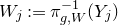 $W_j := \pi_{g,W}^{-1}(Y_j)$
, so
$W_j := \pi_{g,W}^{-1}(Y_j)$
, so $\chi^{\rm mot}(W) = \sum_j \chi^{\rm mot}(W_j)$
. It is therefore enough to show that
$\chi^{\rm mot}(W) = \sum_j \chi^{\rm mot}(W_j)$
. It is therefore enough to show that $\chi^{\rm mot}(W_j)\equiv 0 \pmod{J_g}$
for each
$\chi^{\rm mot}(W_j)\equiv 0 \pmod{J_g}$
for each $W_j$
.
$W_j$
.
By construction, for every i, $R^i\pi_{g, W_j,*}\mathbb{Q}_\ell$
is locally constant on each
$R^i\pi_{g, W_j,*}\mathbb{Q}_\ell$
is locally constant on each $Y_j$
, so they are smooth. We would like to apply Corollary 5.19 to each morphism
$Y_j$
, so they are smooth. We would like to apply Corollary 5.19 to each morphism $W_j \to Y_j$
. In order for this to hold, we first need
$W_j \to Y_j$
. In order for this to hold, we first need $Y_j$
to have a compactification
$Y_j$
to have a compactification $\overline{Y_j}$
such that
$\overline{Y_j}$
such that $\overline{Y_j} \setminus Y_j$
is a divisor with simple normal crossings and the ramification of
$\overline{Y_j} \setminus Y_j$
is a divisor with simple normal crossings and the ramification of $R^i\pi_{g,W_j,*}\mathbb{Q}_\ell$
on
$R^i\pi_{g,W_j,*}\mathbb{Q}_\ell$
on $\overline{Y_j} \setminus Y_j$
is tame. This follows immediately by taking
$\overline{Y_j} \setminus Y_j$
is tame. This follows immediately by taking $\overline{Y_j}'$
to be the closure of
$\overline{Y_j}'$
to be the closure of $Y_j$
in
$Y_j$
in $\mathbb{P}^g$
, and blowing up
$\mathbb{P}^g$
, and blowing up $\overline{Y_j}'$
at
$\overline{Y_j}'$
at $\overline{Y_j}' \setminus Y_j$
in order to obtain that the boundary is a divisor.
$\overline{Y_j}' \setminus Y_j$
in order to obtain that the boundary is a divisor.
The fibres of $\chi^{\rm mot}(W_j)$
are given by
$\chi^{\rm mot}(W_j)$
are given by $\overline{\mathrm{Pic}}^g(C)$
for C a non-rational curve, and so their motivic Euler characteristic lying in J by Proposition 6.6. Moreover, for all i,
$\overline{\mathrm{Pic}}^g(C)$
for C a non-rational curve, and so their motivic Euler characteristic lying in J by Proposition 6.6. Moreover, for all i, $\mathrm{rank}(R^i\pi_{g,W_j,*}\mathbb{Q}_{\ell}) \leq \Delta(g)$
by Theorem 6.18. Corollary 5.19 then gives that
$\mathrm{rank}(R^i\pi_{g,W_j,*}\mathbb{Q}_{\ell}) \leq \Delta(g)$
by Theorem 6.18. Corollary 5.19 then gives that $\chi^{\rm mot}(W_j)$
has rank 0, signature 0, and discriminant given by
$\chi^{\rm mot}(W_j)$
has rank 0, signature 0, and discriminant given by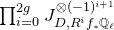 $\prod_{i=0}^{2g}J_{D,R^if_*\mathbb{Q}_{\ell}}^{\otimes(-1)^{i+1}}$
. Corollary 5.27 gives us the required bound on the ramification of this character, and so we see that
$\prod_{i=0}^{2g}J_{D,R^if_*\mathbb{Q}_{\ell}}^{\otimes(-1)^{i+1}}$
. Corollary 5.27 gives us the required bound on the ramification of this character, and so we see that $\chi^{\rm mot}(W) \in J_g$
.
$\chi^{\rm mot}(W) \in J_g$
.
Definition 6.23. Define the following element of $\widehat{\mathrm{W}}(k)$
:
$\widehat{\mathrm{W}}(k)$
:
 \begin{align*}\mathbf B^{\rm mot}_{\mathcal{C}}(X):= \sum_{q \in G(X)} \mathrm{Tr}_{k(q)/k} \bigg(\prod_{p\in\mathcal S(C_q)} \Phi_p \bigg) \in \widehat{\mathrm{W}}(k).\end{align*}
This element makes an appearance in our final arithmetic Yau–Zaslow formula. Note that $\mathrm{rank}(\Phi_p)=1$
, so
$\mathrm{rank}(\Phi_p)=1$
, so $\mathrm{rank}(\mathbf B^{\rm mot}_{\mathcal{C}}(X)) = \# G(X)(\overline{k})$
. In particular, we see that
$\mathrm{rank}(\mathbf B^{\rm mot}_{\mathcal{C}}(X)) = \# G(X)(\overline{k})$
. In particular, we see that $\mathbf B^{\rm mot}_{\mathcal{C}}(X)$
‘counts’ the number of rational curves in
$\mathbf B^{\rm mot}_{\mathcal{C}}(X)$
‘counts’ the number of rational curves in $\mathcal{C}$
, as well as providing arithmetic information about nodes of the rational curves.
$\mathcal{C}$
, as well as providing arithmetic information about nodes of the rational curves.
Lemma 6.24.
We have an equality modulo $J_g$
:
$J_g$
:
 \begin{align*}\mathbf{B}_{\mathcal{C}}^{\rm mot}(X) \equiv \chi^{\rm mot}(\overline{\mathrm{Pic}}^g(\mathcal{C})) \pmod{J_g}.\end{align*}
Proof. Note that $\overline{\mathrm{Pic}}^g(\mathcal C) = W \amalg \pi_g^{-1}(G(X))$
, so by the additivity of
$\overline{\mathrm{Pic}}^g(\mathcal C) = W \amalg \pi_g^{-1}(G(X))$
, so by the additivity of $\chi^{\rm mot}$
, we obtain
$\chi^{\rm mot}$
, we obtain
 \begin{align*}\chi^{\rm mot}(\overline{\mathrm{Pic}}^g(\mathcal C)) = \chi^{\rm mot}_k(W) + \chi^{\rm mot}_k( \pi_g^{-1}(G(X))),\end{align*}
and Lemma 6.22 gives $\chi^{\rm mot}_k(W)=0 \pmod {J_g}$
. By additivity of the motivic Euler characteristic,
$\chi^{\rm mot}_k(W)=0 \pmod {J_g}$
. By additivity of the motivic Euler characteristic,
 \begin{align*}\chi^{\rm mot}( \pi_g^{-1}(G(X))) = \sum_{q \in G(X)} \chi^{\rm mot}_k( \overline{\mathrm{Pic}}^g(C_q) ).\end{align*}
Note that $C_q \to \mathrm{Spec}(k(q))$
is a nodal curve of the geometric genus-0 curve over k(q), so applying Corollary 6.13 gives
$C_q \to \mathrm{Spec}(k(q))$
is a nodal curve of the geometric genus-0 curve over k(q), so applying Corollary 6.13 gives
 \begin{align*}\chi^{\rm mot}_{k(q)}(\overline{\mathrm{Pic}}^g(C_q))=\prod_{p\in\mathcal S(C_q)}\Phi_p \in \widehat{\mathrm{W}}(k(q))/J.\end{align*}
Applying Lemma 4.5 gives
 \begin{align*}\chi^{\rm mot}_k(\overline{\mathrm{Pic}}^g(C_q)) = \mathrm{Tr}_{k(q)/k}\bigg(\prod_{p\in\mathcal S(C_q)}\Phi_p\bigg) \in \widehat{\mathrm{W}}(k)/J,\end{align*}
so summing over $q \in G(X)$
gives the result as required.
$q \in G(X)$
gives the result as required.
7. The motivic Euler characteristic of Calabi–Yau varieties
Recall that X is a K3 surface admitting a g-dimensional linear system $\mathcal C$
of geometrically integral curves of genus g and that the curves in this linear system correspond to a primitive class in the Néron–Severi group. The assumption that the curves in
$\mathcal C$
of geometrically integral curves of genus g and that the curves in this linear system correspond to a primitive class in the Néron–Severi group. The assumption that the curves in $\mathcal{C}$
are geometrically integral allows us to apply [Reference MukaiMuk84, Example 0.5] to show that the relative compactified Picard varieties
$\mathcal{C}$
are geometrically integral allows us to apply [Reference MukaiMuk84, Example 0.5] to show that the relative compactified Picard varieties $\overline{\mathrm{Pic}}^g(\mathcal C)$
can be identified with connected components of the moduli space of simple sheaves on X. In particular,
$\overline{\mathrm{Pic}}^g(\mathcal C)$
can be identified with connected components of the moduli space of simple sheaves on X. In particular, $\overline{\mathrm{Pic}}^g(\mathcal C)$
is nonsingular and has a trivial canonical bundle, by [Reference MukaiMuk84, Theorem 0.1]. Note that if X has Picard rank 1 and
$\overline{\mathrm{Pic}}^g(\mathcal C)$
is nonsingular and has a trivial canonical bundle, by [Reference MukaiMuk84, Theorem 0.1]. Note that if X has Picard rank 1 and $g \geq 2$
, the assumption that the curves in
$g \geq 2$
, the assumption that the curves in $\mathcal C$
are geometrically integral is automatically satisfied and
$\mathcal C$
are geometrically integral is automatically satisfied and $\mathcal C$
will be unique with these properties.
$\mathcal C$
will be unique with these properties.
Proposition 7.1 (Beauville, Proposition 1.3 of [Reference BeauvilleBea99]). There exists a birational morphism from the relative compactified Picard variety $\overline{\mathrm{Pic}}^g(\mathcal C)$
to
$\overline{\mathrm{Pic}}^g(\mathcal C)$
to $X^{[g]}$
.
$X^{[g]}$
.
Remark 7.2. In [Reference BeauvilleBea99], the result is stated over $\mathbb C$
; however, the construction holds over any field.
$\mathbb C$
; however, the construction holds over any field.
In [Reference BatyrevBat99], it is shown that birational Calabi–Yau varieties have the same Betti numbers, and so also the same complex Euler characteristic. This section is dedicated to proving the required analogue of this theorem for the motivic Euler characteristic of the Calabi–Yau varieties that we are considering.
Theorem 7.3. In the situation as above, there is an equality of the motivic Euler characteristics modulo J:
 \begin{align*}\chi^{\rm mot}( \overline{\mathrm{Pic}}^g\mathcal{C}) \equiv \chi^{\rm mot}(X^{[g]}) \pmod{J}.\end{align*}
It is natural to conjecture that the above equality holds for the whole motivic Euler characteristic, rather than just modulo J. Note that if this theorem holds for the whole motivic Euler characteristic, then Theorems 2.14, 2.20, and 2.24 would imply Lemmas 7.4, 7.5, and 7.6, respectively. We begin with a lemma that allows us to use the result of Batyrev and Kontsevich in our context.
Lemma 7.4. Let X and Y be two birational Calabi–Yau varieties over k. Then,
 \begin{align*}\mathrm{rank}(\chi^{\rm mot}(X)) = \mathrm{rank}(\chi^{\rm mot}(Y)).\end{align*}
Proof. Over $\mathbb{C}$
, the motivic Euler characteristic
$\mathbb{C}$
, the motivic Euler characteristic $\chi^{\rm mot}$
is just the compactly supported topological Euler characteristic. The result follows by [Reference BatyrevBat99, Theorem 1.1], which says that two birational Calabi–Yau varieties over
$\chi^{\rm mot}$
is just the compactly supported topological Euler characteristic. The result follows by [Reference BatyrevBat99, Theorem 1.1], which says that two birational Calabi–Yau varieties over $\mathbb{C}$
have the same Betti numbers. Now suppose that
$\mathbb{C}$
have the same Betti numbers. Now suppose that $k \neq \mathbb{C}$
. As in Theorem 2.14, there exists a finitely generated field L such that X is defined over L, and therefore by enlarging L, the varieties X and Y are both defined over some L. Since L has finite transcendence degree over
$k \neq \mathbb{C}$
. As in Theorem 2.14, there exists a finitely generated field L such that X is defined over L, and therefore by enlarging L, the varieties X and Y are both defined over some L. Since L has finite transcendence degree over $\mathbb{Q}$
, we can embed L into
$\mathbb{Q}$
, we can embed L into $\mathbb{C}$
. The result holds for
$\mathbb{C}$
. The result holds for $X_{\mathbb{C}}$
, i.e.
$X_{\mathbb{C}}$
, i.e. $\mathrm{rank}(\chi^{\rm mot}(X)) = \mathrm{rank}(\chi^{\rm mot}(Y))$
. Since the motivic Euler characteristic commutes with base change and base changing preserves the rank, this gives the result.
$\mathrm{rank}(\chi^{\rm mot}(X)) = \mathrm{rank}(\chi^{\rm mot}(Y))$
. Since the motivic Euler characteristic commutes with base change and base changing preserves the rank, this gives the result.
We now wish to prove a lemma that allows us to use [Reference Kharlamov and RăsdeaconuKR15, Proposition 3.1] over any real closed field.
Lemma 7.5
For every real closure $k_\lt $
of k, we have an equality of real closed Euler characteristics
$k_\lt $
of k, we have an equality of real closed Euler characteristics
 \begin{align*}\chi^{\rm rc}( (\overline{\mathrm{Pic}}^g\mathcal{C})_{k_\lt }(k_\lt )) =\chi^{\rm rc}( (X^{[g]})_{k_\lt }(k_\lt )).\end{align*}
Proof. First, since $\overline{\mathrm{Pic}}^g(-)$
and
$\overline{\mathrm{Pic}}^g(-)$
and $(-)^{[g]}$
are representable functors, they commute with base change, so
$(-)^{[g]}$
are representable functors, they commute with base change, so $\overline{\mathrm{Pic}}^g(\mathcal{C}_{k_\lt }) \cong (\overline{\mathrm{Pic}}^g\mathcal{C})_{k_\lt }$
, and similarly
$\overline{\mathrm{Pic}}^g(\mathcal{C}_{k_\lt }) \cong (\overline{\mathrm{Pic}}^g\mathcal{C})_{k_\lt }$
, and similarly $(X^{[g]})_{k_\lt } \cong (X_{k_\lt })^{[g]}$
. It therefore suffices to show this statement in the case that k is a real closed field. For
$(X^{[g]})_{k_\lt } \cong (X_{k_\lt })^{[g]}$
. It therefore suffices to show this statement in the case that k is a real closed field. For $k=\mathbb{R}$
, the first equality follows by [Reference Kharlamov and RăsdeaconuKR15, Proposition 3.1], which says that our birational map
$k=\mathbb{R}$
, the first equality follows by [Reference Kharlamov and RăsdeaconuKR15, Proposition 3.1], which says that our birational map $\phi: \overline{\mathrm{Pic}^g\mathcal{C}}(\mathbb{R}) \dashrightarrow X^{[g]}(\mathbb{R})$
defined in [Reference BeauvilleBea99, Proposition 1.3] gives rise to a diffeomorphism
$\phi: \overline{\mathrm{Pic}^g\mathcal{C}}(\mathbb{R}) \dashrightarrow X^{[g]}(\mathbb{R})$
defined in [Reference BeauvilleBea99, Proposition 1.3] gives rise to a diffeomorphism $\overline{\phi}$
between these two real manifolds, which in turn tells us that they have the same Euler characteristic. We claim that we can choose
$\overline{\phi}$
between these two real manifolds, which in turn tells us that they have the same Euler characteristic. We claim that we can choose $\overline{\phi}$
to be semi-algebraic, so that
$\overline{\phi}$
to be semi-algebraic, so that $\overline{\phi}$
is a Nash diffeomorphism in the sense of [Reference Bochnak, Coste and RoyBCR98, Definition 2.9.9].
$\overline{\phi}$
is a Nash diffeomorphism in the sense of [Reference Bochnak, Coste and RoyBCR98, Definition 2.9.9].
We first claim that if $Y/\mathbb{R}$
is a smooth projective variety, then there exists a Nash diffeomorphism from
$Y/\mathbb{R}$
is a smooth projective variety, then there exists a Nash diffeomorphism from $Y(\mathbb{R})$
to a closed, bounded Nash submanifold of
$Y(\mathbb{R})$
to a closed, bounded Nash submanifold of $\mathbb{R}^N$
for some N. It is enough to show this in the special case when X is a projective space. In this case, this is [Reference Bochnak, Coste and RoyBCR98, Theorem 3.4.4, p. 72]. In particular,
$\mathbb{R}^N$
for some N. It is enough to show this in the special case when X is a projective space. In this case, this is [Reference Bochnak, Coste and RoyBCR98, Theorem 3.4.4, p. 72]. In particular, $\overline{\mathrm{Pic}^g\mathcal{C}}(\mathbb{R})$
(respectively,
$\overline{\mathrm{Pic}^g\mathcal{C}}(\mathbb{R})$
(respectively, $X^{[g]}(\mathbb{R})$
) is Nash diffeomorphic to closed, bounded Nash submanifolds of
$X^{[g]}(\mathbb{R})$
) is Nash diffeomorphic to closed, bounded Nash submanifolds of $\mathbb{R}^N$
, which we will call M (respectively, M’). By [Reference ShiotaShi83, Theorem 2], since M,M’ are closed bounded Nash submanifolds of
$\mathbb{R}^N$
, which we will call M (respectively, M’). By [Reference ShiotaShi83, Theorem 2], since M,M’ are closed bounded Nash submanifolds of $\mathbb{R}^N$
, there is a diffeomorphism between them if and only if there is a Nash diffeomorphism between them by [Reference ShiotaShi83, Theorem 2]. In particular, since
$\mathbb{R}^N$
, there is a diffeomorphism between them if and only if there is a Nash diffeomorphism between them by [Reference ShiotaShi83, Theorem 2]. In particular, since $\overline{\mathrm{Pic}^g\mathcal{C}}(\mathbb{R})$
and
$\overline{\mathrm{Pic}^g\mathcal{C}}(\mathbb{R})$
and $X^{[g]}$
are diffeomorphic, M and M’ are diffeomorphic, and so are Nash diffeomorphic. This in turn gives that
$X^{[g]}$
are diffeomorphic, M and M’ are diffeomorphic, and so are Nash diffeomorphic. This in turn gives that $\overline{\mathrm{Pic}^g\mathcal{C}}(\mathbb{R})$
and
$\overline{\mathrm{Pic}^g\mathcal{C}}(\mathbb{R})$
and $X^{[g]}$
are Nash diffeomorphic, which proves the claim.
$X^{[g]}$
are Nash diffeomorphic, which proves the claim.
To prove the statement in general, let k be a general real closed field. Note that if K is a real closed field containing k and $X/k$
is a variety, then the motivic Euler characteristic of the base change
$X/k$
is a variety, then the motivic Euler characteristic of the base change $\chi^{\rm mot}(X_K)=\chi^{\rm mot}(X) \in \mathbb{Z} \oplus \mathbb{Z}$
, where we identify
$\chi^{\rm mot}(X_K)=\chi^{\rm mot}(X) \in \mathbb{Z} \oplus \mathbb{Z}$
, where we identify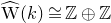 $\widehat{\mathrm{W}}(k) \cong \mathbb{Z} \oplus \mathbb{Z}$
by sending
$\widehat{\mathrm{W}}(k) \cong \mathbb{Z} \oplus \mathbb{Z}$
by sending $n\langle 1 \rangle + m \langle -1 \rangle$
to (n,m). Therefore, by base changing to an extension of k containing
$n\langle 1 \rangle + m \langle -1 \rangle$
to (n,m). Therefore, by base changing to an extension of k containing $\mathbb{R}$
, it suffices to prove the statement when k is a real closed field containing
$\mathbb{R}$
, it suffices to prove the statement when k is a real closed field containing $\mathbb{R}$
. We proceed by parameterising the K3 surfaces using moduli spaces over k. First, let
$\mathbb{R}$
. We proceed by parameterising the K3 surfaces using moduli spaces over k. First, let $\mathbb{Q}^{\rm real}$
denote the real closure of
$\mathbb{Q}^{\rm real}$
denote the real closure of $\mathbb{Q}$
. For
$\mathbb{Q}$
. For $d\geq0$
, define
$d\geq0$
, define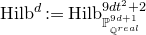 $\mathrm{Hilb}^d := \mathrm{Hilb}^{9dt^2 + 2}_{\mathbb{P}_{\mathbb{Q}^{\rm real}}^{9d + 1}}$
. Let
$\mathrm{Hilb}^d := \mathrm{Hilb}^{9dt^2 + 2}_{\mathbb{P}_{\mathbb{Q}^{\rm real}}^{9d + 1}}$
. Let $H^d$
denote the open subvariety of
$H^d$
denote the open subvariety of $\mathrm{Hilb}^{d}$
from [Reference HuybrechtsHuy16, Proposition 2.1]. It is defined by the universal property that a morphism
$\mathrm{Hilb}^{d}$
from [Reference HuybrechtsHuy16, Proposition 2.1]. It is defined by the universal property that a morphism $T \rightarrow \mathrm{Hilb}^d$
factors through
$T \rightarrow \mathrm{Hilb}^d$
factors through $H^d$
if and only if the pullback of the universal family
$H^d$
if and only if the pullback of the universal family $f: \mathcal{Z}_T \rightarrow T$
satisfies the following.
$f: \mathcal{Z}_T \rightarrow T$
satisfies the following.
-
(1) The morphism f is a smooth family and all the fibres are K3 surfaces.
-
(2) If we have
$p: \mathcal{Z}_T \rightarrow \mathbb{P}^{9d+1}$
is a projection, then
$p^*\mathcal{O}(1) \cong L^3 \otimes f^* L_0$
for
$L \in Pic(\mathcal{Z}_T)$
and
$L_0 \in \mathrm{Pic}(T)$
. -
(3) The line bundle L is primitive on each geometric fibre.
-
(4) For all fibres
$\mathcal{Z}_s$
of
$f: \mathcal{Z}_T \rightarrow T$
, the restriction map gives isomorphisms:
\begin{align*}H^0(\mathbb{P}^N_{k(s)}, \mathcal{O}(1)) \cong H^0(\mathcal{Z}_s, L_s^3).\end{align*}




Now let X be a K3 surface over k with a polarisation given by an ample line bundle L such that $\mathrm{deg}(L)=d$
. Then the discussion before [Reference HuybrechtsHuy16, Proposition 2.1] tells us that we can view X as a projective subvariety of
$\mathrm{deg}(L)=d$
. Then the discussion before [Reference HuybrechtsHuy16, Proposition 2.1] tells us that we can view X as a projective subvariety of $\mathbb{P}_{k}^{9d+1}$
, with Hilbert polynomial
$\mathbb{P}_{k}^{9d+1}$
, with Hilbert polynomial $9d t^2 + 2$
. By the definition of the Hilbert scheme, this corresponds to a morphism
$9d t^2 + 2$
. By the definition of the Hilbert scheme, this corresponds to a morphism $\mathrm{Spec}(k) \rightarrow \mathrm{Hilb}^d$
such that the pullback of the universal family is isomorphic to X. By the properties that
$\mathrm{Spec}(k) \rightarrow \mathrm{Hilb}^d$
such that the pullback of the universal family is isomorphic to X. By the properties that $H^d$
has, this morphism factors through H, so we obtain a morphism
$H^d$
has, this morphism factors through H, so we obtain a morphism $\mathrm{Spec}(k) \rightarrow H^d$
. Therefore, every K3 surface over k with an ample line bundle L is the pullback of the universal family of a morphism
$\mathrm{Spec}(k) \rightarrow H^d$
. Therefore, every K3 surface over k with an ample line bundle L is the pullback of the universal family of a morphism $f: \mathrm{Spec}(k) \rightarrow H^d$
for some d. We will abuse notation slightly and write
$f: \mathrm{Spec}(k) \rightarrow H^d$
for some d. We will abuse notation slightly and write $(X,L) \in \mathrm{Hom}(\mathrm{Spec}(k), H^d)$
to mean the K3 surface and line bundle specified by the morphism. This choice of (X,L) specifies a birational map
$(X,L) \in \mathrm{Hom}(\mathrm{Spec}(k), H^d)$
to mean the K3 surface and line bundle specified by the morphism. This choice of (X,L) specifies a birational map $\phi_{X,L}: \overline{\mathrm{Pic}}^g(\mathcal{C}) \rightarrow X^{[g]}$
, as defined in [Reference BeauvilleBea99, Proposition 1.3]. Consider the following statement.
$\phi_{X,L}: \overline{\mathrm{Pic}}^g(\mathcal{C}) \rightarrow X^{[g]}$
, as defined in [Reference BeauvilleBea99, Proposition 1.3]. Consider the following statement.
For $d \in \mathbb{Z}_{\gt0}$
and
$d \in \mathbb{Z}_{\gt0}$
and $(X,L) \in \mathrm{Hom}(\mathrm{Spec}(k), H^d)$
, there exists a Nash diffeomorphism
$(X,L) \in \mathrm{Hom}(\mathrm{Spec}(k), H^d)$
, there exists a Nash diffeomorphism
 \begin{align*}{\overline{\phi}_{(X,L)}: \overline{\mathrm{Pic}}^g(\mathcal{C})(k) \rightarrow X^{[g]}(k)}.\end{align*}
This can be written as a first-order formula, and we have seen that this formula is true for $k=\mathbb{R}$
. Therefore, by the model completeness of real closed fields, it is true for every real closed field k containing
$k=\mathbb{R}$
. Therefore, by the model completeness of real closed fields, it is true for every real closed field k containing $\mathbb{R}$
. The existence of such a Nash diffeomorphism means that these semi-algebraic sets have the same real closed Euler characteristic, as required.
$\mathbb{R}$
. The existence of such a Nash diffeomorphism means that these semi-algebraic sets have the same real closed Euler characteristic, as required.
Lemma 7.6.
Let X and Y be two birational Calabi–Yau varieties. Then $\mathrm{det}_{\ell}(X) = \mathrm{det}_{\ell}(Y)$
.
$\mathrm{det}_{\ell}(X) = \mathrm{det}_{\ell}(Y)$
.
Proof. This lemma essentially follows from the proof of [Reference BatyrevBat99, Theorem 1.1]. We recall the argument here for convenience. Assume without loss of generality that k is finitely generated over $\mathbb{Q}$
, since we can take k to be the smallest field over which both X and Y are defined. Let S be an integral scheme of finite type over
$\mathbb{Q}$
, since we can take k to be the smallest field over which both X and Y are defined. Let S be an integral scheme of finite type over $\mathrm{Spec}(\mathbb Z)$
whose function field is k. We may also assume that both X and Y have smooth projective models over S, denoted by
$\mathrm{Spec}(\mathbb Z)$
whose function field is k. We may also assume that both X and Y have smooth projective models over S, denoted by $\mathcal X$
and
$\mathcal X$
and $\mathcal Y$
, respectively. For every closed point s of S, let
$\mathcal Y$
, respectively. For every closed point s of S, let $\mathbb{F}_s$
,
$\mathbb{F}_s$
, $\mathcal X_s$
, and
$\mathcal X_s$
, and $\mathcal Y_s$
denote the residue field of s, and the fibre of
$\mathcal Y_s$
denote the residue field of s, and the fibre of $\mathcal X$
and
$\mathcal X$
and $\mathcal Y$
over s, respectively. Let
$\mathcal Y$
over s, respectively. Let $\mathbb{F}_{s^n}$
denote the unique extension of
$\mathbb{F}_{s^n}$
denote the unique extension of $\mathbb{F}_s$
with Galois group
$\mathbb{F}_s$
with Galois group $\mathbb Z/n\mathbb Z$
. As noted on p. 7 in the proof of [Reference BatyrevBat99, Theorem 1.1], since
$\mathbb Z/n\mathbb Z$
. As noted on p. 7 in the proof of [Reference BatyrevBat99, Theorem 1.1], since $\mathcal{X}_s$
and
$\mathcal{X}_s$
and $\mathcal{Y}_s$
are birational and Calabi–Yau, we have
$\mathcal{Y}_s$
are birational and Calabi–Yau, we have $|\mathcal X_s(\mathbb{F}_{s^n})|=|\mathcal Y_s(\mathbb{F}_{s^n})|$
for every s and n. This in turn gives us an equality of zeta functions
$|\mathcal X_s(\mathbb{F}_{s^n})|=|\mathcal Y_s(\mathbb{F}_{s^n})|$
for every s and n. This in turn gives us an equality of zeta functions $\zeta(\mathcal X_s,t)=\zeta(\mathcal Y_s,t)$
for every s. Theorem 2.44 then gives the result.
$\zeta(\mathcal X_s,t)=\zeta(\mathcal Y_s,t)$
for every s. Theorem 2.44 then gives the result.
Proof of Theorem 7.3. Example 0.5 of [Reference MukaiMuk84] says that $\overline{\mathrm{Pic}}^g(\mathcal{C})$
is Calabi–Yau, Example 0.4 of [Reference MukaiMuk84] says that
$\overline{\mathrm{Pic}}^g(\mathcal{C})$
is Calabi–Yau, Example 0.4 of [Reference MukaiMuk84] says that $X^{[g]}$
is also Calabi–Yau, and Proposition 7.1 says that these two varieties are birational. We can therefore apply Lemmas 7.4 and 7.6 to obtain that
$X^{[g]}$
is also Calabi–Yau, and Proposition 7.1 says that these two varieties are birational. We can therefore apply Lemmas 7.4 and 7.6 to obtain that $\chi^{\rm mot}( \overline{\mathrm{Pic}}^g\mathcal{C})$
and
$\chi^{\rm mot}( \overline{\mathrm{Pic}}^g\mathcal{C})$
and $\chi^{\rm mot}(X^{[g]})$
have the same rank and
$\chi^{\rm mot}(X^{[g]})$
have the same rank and $\ell$
-adic determinant of cohomology. Moreover, since they are birational, they also have the same dimension and hence the same total weight, so by Proposition 2.39, we have
$\ell$
-adic determinant of cohomology. Moreover, since they are birational, they also have the same dimension and hence the same total weight, so by Proposition 2.39, we have $\mathrm{disc}(\chi^{\rm mot}( \overline{\mathrm{Pic}}^g\mathcal{C})) = \mathrm{disc}(\chi^{\rm mot}(X^{[g]}))$
. Finally, by Lemma 7.5, we see that
$\mathrm{disc}(\chi^{\rm mot}( \overline{\mathrm{Pic}}^g\mathcal{C})) = \mathrm{disc}(\chi^{\rm mot}(X^{[g]}))$
. Finally, by Lemma 7.5, we see that $\overline{\mathrm{Pic}}^g\mathcal{C}$
and
$\overline{\mathrm{Pic}}^g\mathcal{C}$
and $X^{[g]}$
have the same signature. Therefore, by Lemma 2.45, they differ only by an element of J.
$X^{[g]}$
have the same signature. Therefore, by Lemma 2.45, they differ only by an element of J.
8. The motivic Göttsche formula
In this section, we prove a refinement of the Göttsche formula for the classical Euler characteristic, which is [Reference GöttscheGöt90, Theorem 0.1, p. 193]. This formula allows us to compute the motivic Euler characteristic of $X^{[g]}$
modulo J.
$X^{[g]}$
modulo J.
Notation 8.1. Let X be a smooth geometrically irreducible projective surface over k, let $X^{(n)}$
denote its nth symmetric product, and let
$X^{(n)}$
denote its nth symmetric product, and let $X^{[n]}$
be the Hilbert scheme of zero-dimensional subschemes of X of length n. Let
$X^{[n]}$
be the Hilbert scheme of zero-dimensional subschemes of X of length n. Let $\mathfrak P(n)$
denote the set of partitions of n. The elements of
$\mathfrak P(n)$
denote the set of partitions of n. The elements of $\mathfrak P(n)$
are sequences
$\mathfrak P(n)$
are sequences $\underline m=(m_1,m_2,\ldots,m_r)$
of non-negative integers such that
$\underline m=(m_1,m_2,\ldots,m_r)$
of non-negative integers such that $1m_1+2m_2+\cdots+rm_r=n$
. The length
$1m_1+2m_2+\cdots+rm_r=n$
. The length $l(\underline m)$
of the partition
$l(\underline m)$
of the partition $\underline m$
is defined as
$\underline m$
is defined as $l(\underline m)=m_1+m_2+\cdots+m_r$
.
$l(\underline m)=m_1+m_2+\cdots+m_r$
.
Notation 8.2. Let $\mathrm{Chow}(k)$
denote the category of rational Chow motives over k, and for every smooth projective variety X and idempotent correspondence
$\mathrm{Chow}(k)$
denote the category of rational Chow motives over k, and for every smooth projective variety X and idempotent correspondence $\alpha$
from X to X over k, let
$\alpha$
from X to X over k, let $(X,\alpha)$
denote the object of
$(X,\alpha)$
denote the object of $\mathrm{Chow}(k)$
corresponding to this pair. For every object A of
$\mathrm{Chow}(k)$
corresponding to this pair. For every object A of $\mathrm{Chow}(k)$
and integer n, let A(n) denote the nth Tate twist of A, and denote direct sums and tensor products in the category
$\mathrm{Chow}(k)$
and integer n, let A(n) denote the nth Tate twist of A, and denote direct sums and tensor products in the category $\mathrm{Chow}(k)$
by the usual symbols for sums and products, respectively. For X as above, let M(X) denote
$\mathrm{Chow}(k)$
by the usual symbols for sums and products, respectively. For X as above, let M(X) denote $(X,\Delta_X)$
, where
$(X,\Delta_X)$
, where $\Delta_X$
is the diagonal cycle on
$\Delta_X$
is the diagonal cycle on $X\times X$
.
$X\times X$
.
Theorem 8.3 (de Cataldo–Migliorini). There is an isomorphism of Chow motives with rational coefficients:
 \begin{align*}M(X^{[n]})(-n)\cong\!\!\!\!\!\!\!\!\!\!\!\!\!\sum_{\underline m=(m_1,m_2,\ldots,m_r)\in\mathfrak P(n)}\!\!\!\!\!\!\!\!\!\!\!\!\!M(X^{(m_1)})M(X^{(m_2)})\cdots M(X^{(m_r)})(-l(\underline m))\; \textrm{in}\;\mathrm{Chow}(k).\end{align*}
Proof. The claim follows immediately from [Reference de Cataldo and MigliorinidCM02, Theorem 6.2.5], and from [Reference de Cataldo and MigliorinidCM02, Remark 6.2.2], where the authors have mentioned that their result holds over any base field.
Definition 8.4. Define $K_0(\mathrm{Chow}(k))$
to be the Grothendieck ring of rational Chow motives, i.e. the ring generated by isomorphism classes of Chow motives over k subject to the obvious addition and multiplication relations coming from the direct sum and tensor product. Let
$K_0(\mathrm{Chow}(k))$
to be the Grothendieck ring of rational Chow motives, i.e. the ring generated by isomorphism classes of Chow motives over k subject to the obvious addition and multiplication relations coming from the direct sum and tensor product. Let $K_0(\mathrm{Var}_k)^{\rm Chow}$
denote the subring of
$K_0(\mathrm{Var}_k)^{\rm Chow}$
denote the subring of $K_0(\mathrm{Chow}(k))$
generated by classes of the form [M(X)(j)], where
$K_0(\mathrm{Chow}(k))$
generated by classes of the form [M(X)(j)], where $X/k$
is a smooth projective variety and j is an integer.
$X/k$
is a smooth projective variety and j is an integer.
Corollary 8.5.
There is an equality in $K_0(\mathrm{Var}_k)^{\rm Chow}$
:
$K_0(\mathrm{Var}_k)^{\rm Chow}$
:
 \begin{align*}[M(X^{[n]})(-n)]=\!\!\!\!\!\!\!\!\!\!\!\!\!\sum_{\underline m=(m_1,m_2,\ldots,m_r)\in\mathfrak P(n)}\prod_{i=1}^r ([M(X^{(m_i)})(-m_i)]).\end{align*}
Proof. As noted in [Reference de Cataldo and MigliorinidCM02, Remark 6.2.4], this follows immediately by Theorem 8.3 and the definition of $K_0(\mathrm{Var}_k)^{\rm Chow}$
, where we absorb the Tate twists into the appropriate terms to obtain the formula in the form shown above.
$K_0(\mathrm{Var}_k)^{\rm Chow}$
, where we absorb the Tate twists into the appropriate terms to obtain the formula in the form shown above.
Lemma 8.6.
There is a ring homomorphism $M: K_0(\mathrm{Var}_k) \to K_0(\mathrm{Var}_k)^{\rm Chow} \subseteq K_0(\mathrm{Chow}(k))$
such that if
$M: K_0(\mathrm{Var}_k) \to K_0(\mathrm{Var}_k)^{\rm Chow} \subseteq K_0(\mathrm{Chow}(k))$
such that if $X/k$
is a smooth projective variety,
$X/k$
is a smooth projective variety, $M([X]) = [M(X)]$
.
$M([X]) = [M(X)]$
.
Proof. We first check that this is a well-defined homomorphism of abelian groups. By [Reference BittnerBit04, Theorem 3.1], the ring $K_0(\mathrm{Var}_k)$
is generated as an abelian group by the classes of smooth projective varieties, subject to a single blow-up relation, given by
$K_0(\mathrm{Var}_k)$
is generated as an abelian group by the classes of smooth projective varieties, subject to a single blow-up relation, given by
 \begin{align*}[\mathrm{Bl}_Z(X)] + [Z] = [X] + [E],\end{align*}
for any smooth projective variety X and smooth closed subvariety Z, where $\mathrm{Bl}_Z(X)$
is the blow up of X along Z with exceptional divisor E. This same blow-up relation is satisfied in the category of Chow motives by the corollary on [Reference ManinMan68, p. 463]. This assignment therefore gives us a well-defined homomorphism of abelian groups, and the fact that it is a ring homomorphism follows instantly by the Künneth formula.
$\mathrm{Bl}_Z(X)$
is the blow up of X along Z with exceptional divisor E. This same blow-up relation is satisfied in the category of Chow motives by the corollary on [Reference ManinMan68, p. 463]. This assignment therefore gives us a well-defined homomorphism of abelian groups, and the fact that it is a ring homomorphism follows instantly by the Künneth formula.
In this section, we construct a ring homomorphism $\chi^{\rm Chow}:K_0(\mathrm{Var}_k)^{\rm Chow} \to \widehat{\mathrm{W}}(k)/J$
such that
$\chi^{\rm Chow}:K_0(\mathrm{Var}_k)^{\rm Chow} \to \widehat{\mathrm{W}}(k)/J$
such that $\chi^{\rm Chow} \circ M(X) = \chi^{\rm mot}(X)$
in
$\chi^{\rm Chow} \circ M(X) = \chi^{\rm mot}(X)$
in $\widehat{\mathrm{W}}(k)/J$
and examine how it applies to Tate twists. We construct
$\widehat{\mathrm{W}}(k)/J$
and examine how it applies to Tate twists. We construct $\chi^{\rm Chow}$
by constructing versions of the complex Euler characteristic, the real Euler characteristic, and the discriminant for elements of
$\chi^{\rm Chow}$
by constructing versions of the complex Euler characteristic, the real Euler characteristic, and the discriminant for elements of $K_0(\mathrm{Var}_k)^{\rm Chow}$
and then examining how they behave under Tate twists. We then appeal to Lemma 2.45 to recover an element of
$K_0(\mathrm{Var}_k)^{\rm Chow}$
and then examining how they behave under Tate twists. We then appeal to Lemma 2.45 to recover an element of $\widehat{\mathrm{W}}(k)$
. In Corollary 8.18, we apply
$\widehat{\mathrm{W}}(k)$
. In Corollary 8.18, we apply $\chi^{\rm Chow}$
to Theorem 8.3 in order to obtain a formula for the motivic Euler characteristic of
$\chi^{\rm Chow}$
to Theorem 8.3 in order to obtain a formula for the motivic Euler characteristic of $X^{[n]}$
modulo J.
$X^{[n]}$
modulo J.
Definition 8.7. Let M be a Chow motive over a field k. We will abuse notation slightly and use the same notation as for varieties. Let $e: K_0(\mathrm{Chow}(k)) \to \mathbb{Z}$
denote the Euler characteristic of M, i.e.
$e: K_0(\mathrm{Chow}(k)) \to \mathbb{Z}$
denote the Euler characteristic of M, i.e. $e(M) := \sum_i (-1)^i \mathrm{dim}( H^i_{\ell-{\rm adic}}(M))$
.
$e(M) := \sum_i (-1)^i \mathrm{dim}( H^i_{\ell-{\rm adic}}(M))$
.
When k is a real closed field, we may define its real Euler characteristic as
 \begin{align*}\epsilon(M):=\mathrm{Tr}(c^M),\end{align*}
where $c^M:H^*_{\rm Betti}(M)\to H^*_{\rm Betti}(M)$
is complex conjugation, and Tr denotes graded trace as in Notation 2.41. Similarly to in Definition 2.18, the above data furnish a ring homomorphism
$c^M:H^*_{\rm Betti}(M)\to H^*_{\rm Betti}(M)$
is complex conjugation, and Tr denotes graded trace as in Notation 2.41. Similarly to in Definition 2.18, the above data furnish a ring homomorphism $\chi^{\rm real}: K_0(\mathrm{Chow}(k)) \to \mathcal{C}(\mathrm{Spr}(k), \mathbb{Z})$
.
$\chi^{\rm real}: K_0(\mathrm{Chow}(k)) \to \mathcal{C}(\mathrm{Spr}(k), \mathbb{Z})$
.
We can also define the $\ell$
-adic determinant of cohomology
$\ell$
-adic determinant of cohomology $\mathrm{det}_\ell(M)$
to be the one-dimensional
$\mathrm{det}_\ell(M)$
to be the one-dimensional $\ell$
-adic representation
$\ell$
-adic representation $\prod_i ( \mathrm{det} ( H^i_{\ell-{\rm adic}}(M))^{(-1)^i})$
. Similarly to Definition 2.37, there is a ring homomorphism
$\prod_i ( \mathrm{det} ( H^i_{\ell-{\rm adic}}(M))^{(-1)^i})$
. Similarly to Definition 2.37, there is a ring homomorphism $\chi_l: K_0(\mathrm{Chow}(k)) \to E(\mathop{\mathrm{Hom}}\nolimits(\mathop{\mathrm{Gal}}\nolimits_k, \mathbb Q_\ell^\times))$
given by
$\chi_l: K_0(\mathrm{Chow}(k)) \to E(\mathop{\mathrm{Hom}}\nolimits(\mathop{\mathrm{Gal}}\nolimits_k, \mathbb Q_\ell^\times))$
given by $M \mapsto (e(M), \mathrm{det}_\ell(M))$
.
$M \mapsto (e(M), \mathrm{det}_\ell(M))$
.
Lemma 8.8.
The compactly supported Euler characteristic $e: K_0(\mathrm{Var}_k) \to \mathbb{Z}$
, the real closed compactly supported Euler characteristic
$e: K_0(\mathrm{Var}_k) \to \mathbb{Z}$
, the real closed compactly supported Euler characteristic $\chi^{\rm real}: K_0(\mathrm{Var}_k) \to \mathcal{C}( \mathrm{Spr}(k), \mathbb{Z})$
, and the
$\chi^{\rm real}: K_0(\mathrm{Var}_k) \to \mathcal{C}( \mathrm{Spr}(k), \mathbb{Z})$
, and the $\ell$
-adic determinant of cohomology
$\ell$
-adic determinant of cohomology $\mathrm{det}_{\ell}: K_0(\mathrm{Var}_k) \to \mathop{\mathrm{Hom}}\nolimits(\mathop{\mathrm{Gal}}\nolimits_k, \mathbb{Q}_{\ell}^\times)$
all factor through the map
$\mathrm{det}_{\ell}: K_0(\mathrm{Var}_k) \to \mathop{\mathrm{Hom}}\nolimits(\mathop{\mathrm{Gal}}\nolimits_k, \mathbb{Q}_{\ell}^\times)$
all factor through the map $M: K_0(\mathrm{Var}_k) \to K_0(\mathrm{Chow}(k))$
from the previous lemma.
$M: K_0(\mathrm{Var}_k) \to K_0(\mathrm{Chow}(k))$
from the previous lemma.
Proof. This is clear since all of these invariants for smooth projective varieties can be read off from the Galois representation on the underlying cohomology ring for our Weil cohomology theories. This means that $e(M(X)) = e(X)$
,
$e(M(X)) = e(X)$
, $\chi^{\rm real}(M(X)) = \chi^{\rm real}(X)$
, and
$\chi^{\rm real}(M(X)) = \chi^{\rm real}(X)$
, and $\mathop{\mathrm{det}}\nolimits_\ell(M(X)) = \mathop{\mathrm{det}}\nolimits_\ell(X)$
.
$\mathop{\mathrm{det}}\nolimits_\ell(M(X)) = \mathop{\mathrm{det}}\nolimits_\ell(X)$
.
Remark 8.9. The reason why the above lemma only applies to these invariants, rather than the whole motivic Euler characteristic, is that the definition of the motivic Euler characteristic using de Rham cohomology in Definition 2.2 makes essential use of Poincaré duality as well as the cohomology groups.
We now study how these homomorphisms out of $K_0(\mathrm{Chow}(k))$
behave under Tate twists.
$K_0(\mathrm{Chow}(k))$
behave under Tate twists.
Notation 8.10. Let G be a group, and let $\rho:G\to GL_L(V)$
an L-linear representation on a finite-dimensional graded vector space over the field L. Moreover, suppose that
$\rho:G\to GL_L(V)$
an L-linear representation on a finite-dimensional graded vector space over the field L. Moreover, suppose that $V = \bigoplus_i V_i$
is graded, and that
$V = \bigoplus_i V_i$
is graded, and that $\rho$
respects the grading. Let
$\rho$
respects the grading. Let $\chi:G\to L^\times$
be a one-dimensional representation. Define the twisted representation
$\chi:G\to L^\times$
be a one-dimensional representation. Define the twisted representation $\rho(\chi):G\to GL_L(V)$
by the formula
$\rho(\chi):G\to GL_L(V)$
by the formula
 \begin{align*}\quad(\forall g\in G), \rho(\chi)(g)=\chi(g)\mathrm{Id}_V\cdot\rho(g).\end{align*}
We can compute the character and the determinant of the representation $\rho(\chi)$
in terms of these invariants of
$\rho(\chi)$
in terms of these invariants of $\rho$
and
$\rho$
and $\chi$
.
$\chi$
.
Lemma 8.11. We have
 \begin{align*}\mathrm{Tr}(\rho(\chi)(g))=\chi(g)\cdot\mathrm{Tr}(\rho(g))\quad\textrm{and}\quad\mathop{\mathrm{det}}\nolimits((\rho(\chi)(g)))=\chi(g)^{e(V)}\cdot\mathrm{det}(\rho(g)),\end{align*}
where Tr and det denote the graded versions as in Notation 2.41.
Proof. We may view $\chi(g) \in L^\times$
as a scalar, and
$\chi(g) \in L^\times$
as a scalar, and $\rho(\chi)(g) = \chi(g) \cdot \rho(g)$
. Shifting the grading multiplies the trace by
$\rho(\chi)(g) = \chi(g) \cdot \rho(g)$
. Shifting the grading multiplies the trace by $-1$
and raises the determinant to the power of
$-1$
and raises the determinant to the power of $-1$
, so it is enough to prove an ungraded version for
$-1$
, so it is enough to prove an ungraded version for $V=V_0$
. This then follows immediately.
$V=V_0$
. This then follows immediately.
Proposition 8.12.
The functions $e,\chi^{\rm real}$
and
$e,\chi^{\rm real}$
and $\mathrm{det}_\ell$
out of
$\mathrm{det}_\ell$
out of $K_0(\mathrm{Chow}(k))$
satisfy the following formulae under Tate twists.
$K_0(\mathrm{Chow}(k))$
satisfy the following formulae under Tate twists.
-
(i) We have that
$e(M(j)) = e(M)$
. -
(ii) When k is real closed
$\epsilon(M(j))=(-1)^j \epsilon(M)$
and so
$\chi^{\rm real}(M(j)) = (-1)^j \chi^{\rm real}(M)$
. -
(iii) We have
$\mathrm{det}_\ell(M(j))=\mathrm{det}_\ell(M)\cdot \mathbb{Q}_\ell(j\cdot e(M))$
.




Proof. The first part is immediate, since the dimension of the Betti realisation does not change under the Tate twist.
For the second part, it suffices to prove the statement when k is real closed and we are looking at the real closed Euler characteristic $\epsilon$
. Define
$\epsilon$
. Define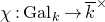 $\chi: \mathop{\mathrm{Gal}}\nolimits_k \to \overline{k}^\times$
by sending the non-trivial element of
$\chi: \mathop{\mathrm{Gal}}\nolimits_k \to \overline{k}^\times$
by sending the non-trivial element of $\mathop{\mathrm{Gal}}\nolimits_k$
to
$\mathop{\mathrm{Gal}}\nolimits_k$
to $-1 \in \overline{k}^\times$
. We may identify the vector spaces
$-1 \in \overline{k}^\times$
. We may identify the vector spaces $H^*_{\rm Betti}(M(j)) \cong H^*_{\rm Betti}(M)$
, and under this identification, we see that
$H^*_{\rm Betti}(M(j)) \cong H^*_{\rm Betti}(M)$
, and under this identification, we see that $c^{M(j)} = (-1)^j c^M$
. In particular,
$c^{M(j)} = (-1)^j c^M$
. In particular,
 \begin{align*}\epsilon(M(j)) = \mathrm{Tr}(c^{M(j)}) = (-1)^j \mathrm{Tr}(c^M) = (-1)^j \epsilon(M),\end{align*}
as required.
For the statement about $\mathrm{det}_\ell(M(j))$
, let
$\mathrm{det}_\ell(M(j))$
, let $g \in \mathrm{Gal}_k$
. Write
$g \in \mathrm{Gal}_k$
. Write $\rho^M$
for the representation of
$\rho^M$
for the representation of $\mathop{\mathrm{Gal}}\nolimits_k$
on
$\mathop{\mathrm{Gal}}\nolimits_k$
on $H^*_{\ell-{\rm adic}}(M)$
. We may identify the vector spaces
$H^*_{\ell-{\rm adic}}(M)$
. We may identify the vector spaces $H^*_{\ell-{\rm adic}}(M(j)) \cong H^*_{\ell-{\rm adic}}(M)$
, and under this identification, we see that
$H^*_{\ell-{\rm adic}}(M(j)) \cong H^*_{\ell-{\rm adic}}(M)$
, and under this identification, we see that $\rho^{M(j)}(g) = \chi(j) \cdot \rho^M(g)$
, where
$\rho^{M(j)}(g) = \chi(j) \cdot \rho^M(g)$
, where $\chi$
denotes the
$\chi$
denotes the $\ell$
-adic cyclotomic character on
$\ell$
-adic cyclotomic character on $\mathop{\mathrm{Gal}}\nolimits_k$
. By definition,
$\mathop{\mathrm{Gal}}\nolimits_k$
. By definition, $\mathrm{det}_\ell(M)(g) = \mathrm{det}( \rho^M(g))$
, so Lemma 8.11 gives the result.
$\mathrm{det}_\ell(M)(g) = \mathrm{det}( \rho^M(g))$
, so Lemma 8.11 gives the result.
The goal is to use these invariants to define a map $\chi^{\rm Chow}$
that extends the motivic Euler characteristic to Chow motives. While we can define the
$\chi^{\rm Chow}$
that extends the motivic Euler characteristic to Chow motives. While we can define the $\ell$
-adic determinant of cohomology for a general Chow motive, it is unclear how to define the discriminant in an analogous way. However, for elements of
$\ell$
-adic determinant of cohomology for a general Chow motive, it is unclear how to define the discriminant in an analogous way. However, for elements of $K_0(\mathrm{Var}_k)^{\rm Chow}$
, we can define the discriminant as follows.
$K_0(\mathrm{Var}_k)^{\rm Chow}$
, we can define the discriminant as follows.
Definition 8.13. Suppose that $k/\mathbb{Q}$
is finitely generated, and let M be a rational Chow motive over k such that
$k/\mathbb{Q}$
is finitely generated, and let M be a rational Chow motive over k such that $M = M(X)(j)$
for some variety
$M = M(X)(j)$
for some variety $X/k$
. Then
$X/k$
. Then $H^i_{\ell-{\rm adic}}(M) \cong H^i_{\acute{e}t}(X_{\overline{k}}, \mathbb{Q}_\ell) \cdot \mathbb{Q}_\ell(j)$
for each i. Putting this together gives
$H^i_{\ell-{\rm adic}}(M) \cong H^i_{\acute{e}t}(X_{\overline{k}}, \mathbb{Q}_\ell) \cdot \mathbb{Q}_\ell(j)$
for each i. Putting this together gives
 \begin{align*}\mathrm{det}_{\ell}(M) = \mathrm{det}_\ell(X) \cdot \mathbb{Q}_\ell(j \cdot e(X)).\end{align*}
Multiplying again by $\mathbb{Q}_\ell(w(X)- j\cdot e(X))$
gives
$\mathbb{Q}_\ell(w(X)- j\cdot e(X))$
gives
 \begin{align*}\mathrm{det}_{\ell}(M) \cdot \mathbb{Q}_\ell(w(X)-j\cdot e(X)) = \mathrm{det}_\ell(X) \cdot \mathbb{Q}_\ell(w(X)).\end{align*}
Theorem 2.29 implies that the above representation is a 2-torsion character whose class in $k^\times/k^{\times2}$
is
$k^\times/k^{\times2}$
is $(-1)^{w(X)} \mathrm{disc}(\chi^{\rm mot}(X))$
. As in Remark 2.30, define
$(-1)^{w(X)} \mathrm{disc}(\chi^{\rm mot}(X))$
. As in Remark 2.30, define $w(M) := w(X) - j \cdot e(X)$
, so that w(M) is the unique integer such that
$w(M) := w(X) - j \cdot e(X)$
, so that w(M) is the unique integer such that $\mathrm{det}_{\ell}(M) \cdot \mathbb{Q}_\ell(w(M))$
is torsion. For such Chow motives, define
$\mathrm{det}_{\ell}(M) \cdot \mathbb{Q}_\ell(w(M))$
is torsion. For such Chow motives, define $\mathrm{disc}(M)$
to be the element of
$\mathrm{disc}(M)$
to be the element of $k^\times/k^{\times2}$
such that
$k^\times/k^{\times2}$
such that
 \begin{align*}\mathrm{disc}(M) \cdot (-1)^{w(M)} := \mathrm{det}_{\ell}(M) \cdot \mathbb{Q}_\ell(w(M)).\end{align*}
We may also argue as in Remark 2.36 to obtain a ring homomorphism
 \begin{align*}\chi^{\rm disc}_k: K_0(\mathrm{Var}_k)^{\rm Chow} \to E(\mathrm{Hom}(\mathop{\mathrm{Gal}}\nolimits_k, \mathbb Z /2\mathbb Z))\end{align*}
given by $M \mapsto (e(M), \mathrm{disc}(M))$
.
$M \mapsto (e(M), \mathrm{disc}(M))$
.
If k is any field of characteristic 0, since k is a union of its finitely generated subfields, we have that $K_0(\mathrm{Var}_k)^{\rm Chow} = \varinjlim_{L' \subseteq k} K_0(\mathrm{Var}_L)^{\rm Chow}$
.
$K_0(\mathrm{Var}_k)^{\rm Chow} = \varinjlim_{L' \subseteq k} K_0(\mathrm{Var}_L)^{\rm Chow}$
.
For k an arbitrary field of characteristic 0, define $\chi^{\rm disc}_k: K_0(\mathrm{Var}_k)^{\rm Chow} \to E(\mathrm{Hom}(\mathop{\mathrm{Gal}}\nolimits_k, \mathbb Z /2\mathbb Z))$
to be the inductive limit of all of the
$\chi^{\rm disc}_k: K_0(\mathrm{Var}_k)^{\rm Chow} \to E(\mathrm{Hom}(\mathop{\mathrm{Gal}}\nolimits_k, \mathbb Z /2\mathbb Z))$
to be the inductive limit of all of the $\chi^{\rm disc}_L: K_0(\mathrm{Var}_L)^{\rm Chow} \to E(\mathrm{Hom}(\mathop{\mathrm{Gal}}\nolimits_L, \mathbb Z /2\mathbb Z))$
, where the fields L run over all finitely generated subfields of k. When the base field is clear, we will simply write
$\chi^{\rm disc}_L: K_0(\mathrm{Var}_L)^{\rm Chow} \to E(\mathrm{Hom}(\mathop{\mathrm{Gal}}\nolimits_L, \mathbb Z /2\mathbb Z))$
, where the fields L run over all finitely generated subfields of k. When the base field is clear, we will simply write $\chi^{\rm disc}$
.
$\chi^{\rm disc}$
.
Lemma 8.14.
For $X/k$
a smooth projective variety, the discriminant
$X/k$
a smooth projective variety, the discriminant $\mathrm{disc}(M(X)(j)) = \langle (-1)^{j\cdot e(M)} \rangle \cdot \mathrm{disc}(\chi^{\rm mot}(X))$
.
$\mathrm{disc}(M(X)(j)) = \langle (-1)^{j\cdot e(M)} \rangle \cdot \mathrm{disc}(\chi^{\rm mot}(X))$
.
Proof. This follows by the above definition, noting that $(-1)^{w(M(X)(j))} = (-1)^{w(X)} \cdot (-1)^{j\cdot e(M)}$
.
$(-1)^{w(M(X)(j))} = (-1)^{w(X)} \cdot (-1)^{j\cdot e(M)}$
.
Theorem 8.15. The homomorphism
 \begin{align*}e \times \chi^{\rm real} \times \chi^{\rm disc}: K_0(\mathrm{Var}_k)^{\rm Chow} \to \mathbb{Z} \times \mathcal{C}(\mathrm{Spr}(k), \mathbb Z) \times E( \mathrm{Hom}(\mathop{\mathrm{Gal}}\nolimits_k, \mathbb Z/2\mathbb Z))\end{align*}
factors through the inclusion $\widehat{\mathrm{W}}(k)/J \hookrightarrow \mathbb{Z} \times \mathcal{C}(\mathrm{Spr}(k), \mathbb Z) \times E( \mathrm{Hom}(\mathop{\mathrm{Gal}}\nolimits_k, \mathbb Z/2\mathbb Z))$
from Lemma 2.45.
$\widehat{\mathrm{W}}(k)/J \hookrightarrow \mathbb{Z} \times \mathcal{C}(\mathrm{Spr}(k), \mathbb Z) \times E( \mathrm{Hom}(\mathop{\mathrm{Gal}}\nolimits_k, \mathbb Z/2\mathbb Z))$
from Lemma 2.45.
Proof. It is enough to show that for X a variety and j an integer, there exists some $q \in \widehat{\mathrm{W}}(k)/J$
such that
$q \in \widehat{\mathrm{W}}(k)/J$
such that $e (M(X)(j))=\mathrm{rank}(q)$
,
$e (M(X)(j))=\mathrm{rank}(q)$
, $\chi^{\rm real}(M(X)(j))=\mathrm{sign}(q)$
and
$\chi^{\rm real}(M(X)(j))=\mathrm{sign}(q)$
and $\chi^{\rm disc}(M(X)(j)) = E_{\rm disc}(q)$
. Proposition 8.12 and Lemma 8.14 tell us that taking
$\chi^{\rm disc}(M(X)(j)) = E_{\rm disc}(q)$
. Proposition 8.12 and Lemma 8.14 tell us that taking $q= \langle (-1)^j \rangle \cdot \chi^{\rm mot}(X)$
gives us the result.
$q= \langle (-1)^j \rangle \cdot \chi^{\rm mot}(X)$
gives us the result.
Definition 8.16. In light of the above, define $\chi^{\rm Chow}: K_0(\mathrm{Var}_k)^{\rm Chow} \to \widehat{\mathrm{W}}(k)/J$
to be the unique homomorphism such that the following diagram is commutative.
$\chi^{\rm Chow}: K_0(\mathrm{Var}_k)^{\rm Chow} \to \widehat{\mathrm{W}}(k)/J$
to be the unique homomorphism such that the following diagram is commutative.

Corollary 8.17
For $X/k$
a variety and j an integer, we have
$X/k$
a variety and j an integer, we have
 \begin{align*}\chi^{\rm Chow}(M(X)(j)) = \langle (-1)^j \rangle \chi^{\rm mot}(X) \in \widehat{\mathrm{W}}(k)/J.\end{align*}
Proof. Note that the twist by j map $(j): K_0(\mathrm{Var}_k)^{\rm Chow} \to K_0(\mathrm{Var}_k)^{\rm Chow}$
given by sending M(X)(i) to
$(j): K_0(\mathrm{Var}_k)^{\rm Chow} \to K_0(\mathrm{Var}_k)^{\rm Chow}$
given by sending M(X)(i) to $M(X)(i+j)$
is a homomorphism of the underlying additive abelian group. Similarly, the map
$M(X)(i+j)$
is a homomorphism of the underlying additive abelian group. Similarly, the map $\widehat{\mathrm{W}}(k)/J \to \widehat{\mathrm{W}}(k)/J$
given by multiplication by
$\widehat{\mathrm{W}}(k)/J \to \widehat{\mathrm{W}}(k)/J$
given by multiplication by $\langle (-1)^j \rangle$
is a homomorphism on the underlying abelian group. Therefore, the compositions
$\langle (-1)^j \rangle$
is a homomorphism on the underlying abelian group. Therefore, the compositions
 \begin{align*}\chi^{\rm Chow} \circ (j) \circ M: K_0(\mathrm{Var}_k) \to \widehat{\mathrm{W}}(k)/J\end{align*}
and
 \begin{align*}(\langle (-1)^j \rangle \cdot) \circ \chi^{\rm mot}: K_0(\mathrm{Var}_k) \to \widehat{\mathrm{W}}(k)/J\end{align*}
are both homomorphisms of abelian groups. It therefore suffices that these homomorphisms are equal on generators of the abelian group $K_0(\mathrm{Var}_k)$
. Through [Reference BittnerBit04, Theorem 3.1], we can check this only for
$K_0(\mathrm{Var}_k)$
. Through [Reference BittnerBit04, Theorem 3.1], we can check this only for $X/k$
, a smooth projective variety. This is then immediate by the proof of Theorem 8.15.
$X/k$
, a smooth projective variety. This is then immediate by the proof of Theorem 8.15.
Corollary 8.18 (Motivic Gottsche formula). We have
 \begin{align*}1+\sum_{n=1}^{\infty}\chi^{\rm mot}(X^{[n]}) \langle (-1)^n \rangle t^n= \prod_{d=1}^{\infty}\bigg(\sum_{m = 0}^{\infty} \chi^{\rm mot}(X^{(m)}) \langle -1 \rangle^{m} t^{md}\bigg) \text{ in } (\widehat{\mathrm{W}}(k)/J )[[t]].\end{align*}
Proof. Fix n to be a positive integer. Applying the ring homomorphism $\chi^{\rm Chow}$
to the formula in Corollary 8.5 gives
$\chi^{\rm Chow}$
to the formula in Corollary 8.5 gives
 \begin{align*}\chi^{\rm Chow}(M(X^{[n]})(-n))=\!\!\!\!\!\!\!\!\!\!\!\!\!\!\!\!\sum_{(m_1,m_2,\ldots,m_r)\in\mathfrak P(n)} \prod_{i=1}^r (\chi^{\rm Chow}(M(X^{(m_i)})(-m_i))) \in \widehat{\mathrm{W}}(k)/J.\end{align*}
By Corollary 8.17, we may rewrite this as
 \begin{align*}\chi^{\rm mot}(X^{[n]})\langle (-1)^n \rangle = \!\!\!\!\!\!\!\!\!\!\!\!\!\!\!\!\sum_{(m_1,m_2,\ldots,m_r)\in\mathfrak P(n)} \bigg(\prod_{i=1}^r \chi^{\rm mot}(X^{(m_i)})\langle (-1)^{m_i} \rangle\bigg).\end{align*}
We claim that the right-hand side of this is the coefficient of $t^n$
in the power series
$t^n$
in the power series
 \begin{align*}\prod_{d=1}^{\infty}\bigg(\sum_{m = 0}^{\infty} \chi^{\rm mot}(X^{(m)})\langle (-1)^m \rangle t^{md}\bigg).\end{align*}
Relabeling the indices m by $m_d$
in order to keep track of where they appear in the product, the above series becomes
$m_d$
in order to keep track of where they appear in the product, the above series becomes
 \begin{align*}\prod_{d=1}^{\infty}\bigg( \sum_{m_d = 0}^{\infty} \chi^{\rm mot}(X^{(m_d)})\langle (-1)^{m_d} \rangle t^{m_dd}\bigg).\end{align*}
Expanding the product and looking at the coefficient of $t^n$
in the above power series, we see that the
$t^n$
in the above power series, we see that the $t^n$
term is given by
$t^n$
term is given by
 \begin{align*}\sum_{\{(m_1, \ldots, m_r): \sum dm_d = n\}}\bigg(\prod_{d=1}^r \chi^{\rm mot}(X^{(m_d)}) \langle (-1)^{m_d}\rangle t^{dm_d}\bigg).\end{align*}
As noted in Notation 8.2, we may identify $\mathfrak P(n)$
with
$\mathfrak P(n)$
with $\{(m_1,\ldots,m_r): \sum dm_d = n\}$
, which gives us that the coefficient of
$\{(m_1,\ldots,m_r): \sum dm_d = n\}$
, which gives us that the coefficient of $t^n$
is exactly given by
$t^n$
is exactly given by
 \begin{align*}\!\!\!\!\!\!\!\!\!\!\!\!\!\!\!\!\sum_{(m_1,m_2,\ldots,m_r)\in\mathfrak P(n)} \bigg(\prod_{d=1}^r \chi^{\rm mot}(X^{(m_d)}) \langle (-1)^{m_d} \rangle\bigg).\end{align*}
Putting all of this together, $\chi^{\rm mot}(X^{[n]}) \langle (-1)^n \rangle \in \widehat{\mathrm{W}}(k)/J$
is equal to the coefficient of
$\chi^{\rm mot}(X^{[n]}) \langle (-1)^n \rangle \in \widehat{\mathrm{W}}(k)/J$
is equal to the coefficient of $t^n$
in the generating series
$t^n$
in the generating series
 \begin{align*}\prod_{d=1}^{\infty} \bigg(\sum_{m = 0}^{\infty} \chi^{\rm mot}(X^{(m)})\langle (-1)^m \rangle t^{md}\bigg) \in (\widehat{\mathrm{W}}(k)/J)[[t]],\end{align*}
which gives the theorem.
We now show that we can recover the rank, sign, and discriminant of $\chi^{\rm mot}(X^{(m)})$
to extract other Göttsche formulae based on this.
$\chi^{\rm mot}(X^{(m)})$
to extract other Göttsche formulae based on this.
Lemma 8.19. Let X be a K3 surface. Then
 \begin{align*}e(X^{(m)})={ e(X)+m-1 \choose m}.\end{align*}
If k is a real closed field, then we may write $\chi^{\rm mot}(X) = b\mathbb{H} + a\langle \pm 1 \rangle$
for some non-negative integers a,b. Moreover,
$\chi^{\rm mot}(X) = b\mathbb{H} + a\langle \pm 1 \rangle$
for some non-negative integers a,b. Moreover,
 \begin{align*}\epsilon(X) = \mathrm{sign}(\chi^{\rm mot}(X^{(m)})) = \pm \sum_{j=0}^{\lfloor \frac{m}{2} \rfloor} {a + m-2j -1 \choose m-2j} {b + j - 1 \choose j},\end{align*}
where the sign is $(-1)^m$
if
$(-1)^m$
if $\mathrm{sign}(\chi^{\rm mot}(X))$
is negative, and 1 if
$\mathrm{sign}(\chi^{\rm mot}(X))$
is negative, and 1 if $\mathrm{sign}(\chi^{\rm mot}(X))$
is positive.
$\mathrm{sign}(\chi^{\rm mot}(X))$
is positive.
Proof. Since X is a K3 surface, the odd Betti numbers vanish, so $H^i_{\rm dR}(X/k)=0$
if i is odd. Therefore,
$H^i_{\rm dR}(X/k)=0$
if i is odd. Therefore, $\chi^{\rm mot}(X) = [H^{2*}_{\rm dR}(X/k)]$
is an actual quadratic form, so
$\chi^{\rm mot}(X) = [H^{2*}_{\rm dR}(X/k)]$
is an actual quadratic form, so $\chi^{\rm mot}(X)=b\mathbb{H} + a\langle \pm 1 \rangle$
for some
$\chi^{\rm mot}(X)=b\mathbb{H} + a\langle \pm 1 \rangle$
for some $a,b \geq 0$
. For the rank, we may use Theorem 2.14 to reduce this to a statement about symmetric powers of CW complexes. The main result of [Reference MacdonaldMac62] then gives the result.
$a,b \geq 0$
. For the rank, we may use Theorem 2.14 to reduce this to a statement about symmetric powers of CW complexes. The main result of [Reference MacdonaldMac62] then gives the result.
Suppose that k is a real closed field, and consider the complex $H^*_{\rm sing}(X^{(m)}(\overline{k}), k)$
, along with the action of
$H^*_{\rm sing}(X^{(m)}(\overline{k}), k)$
, along with the action of $\sigma$
, the non-trivial element of
$\sigma$
, the non-trivial element of $\mathop{\mathrm{Gal}}\nolimits_k$
. Moreover,
$\mathop{\mathrm{Gal}}\nolimits_k$
. Moreover, $\sigma$
is diagonalisable, so pick a basis of eigenvectors for
$\sigma$
is diagonalisable, so pick a basis of eigenvectors for $H^*_{\rm sing}(X^{(m)}(\overline{k}), k)$
, denoted by
$H^*_{\rm sing}(X^{(m)}(\overline{k}), k)$
, denoted by $v_1, \ldots, v_{e(X)}$
. As noted in the second part of [Reference LevineLev20, Remark 1.3], we apply the Lefschetz trace formula to compute
$v_1, \ldots, v_{e(X)}$
. As noted in the second part of [Reference LevineLev20, Remark 1.3], we apply the Lefschetz trace formula to compute $\mathrm{Trace}(\sigma)=\epsilon(X)=e(X(k))$
.
$\mathrm{Trace}(\sigma)=\epsilon(X)=e(X(k))$
.
Let q be a quadratic form on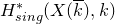 $H^*_{\rm sing}(X(\overline{k}), k)$
such that q is diagonal with respect to
$H^*_{\rm sing}(X(\overline{k}), k)$
such that q is diagonal with respect to $v_1, \ldots, v_{e(X)}$
, and such that
$v_1, \ldots, v_{e(X)}$
, and such that $\sigma(v_i) = q(v_i)v_i$
. This means that we obtain
$\sigma(v_i) = q(v_i)v_i$
. This means that we obtain $e(X) = \mathrm{rank}(q)$
and
$e(X) = \mathrm{rank}(q)$
and $\epsilon(X){\kern-1pt}={\kern-1pt}\mathrm{sign}(q)$
. By the Künneth formula, we can identify
$\epsilon(X){\kern-1pt}={\kern-1pt}\mathrm{sign}(q)$
. By the Künneth formula, we can identify $H^*_{\rm sing}(X^{(m)}(\overline{k}), k) {\kern-1pt}={\kern-1pt} S^m(H^*_{\rm sign}(X(\overline{k}), k))$
, where
$H^*_{\rm sing}(X^{(m)}(\overline{k}), k) {\kern-1pt}={\kern-1pt} S^m(H^*_{\rm sign}(X(\overline{k}), k))$
, where $S^m$
denotes the symmetric product, and where the action of
$S^m$
denotes the symmetric product, and where the action of $\sigma$
on the left-hand side is given by
$\sigma$
on the left-hand side is given by $S^m(\sigma)$
on the right-hand side. Therefore, the quadratic form we obtain from looking at the action of
$S^m(\sigma)$
on the right-hand side. Therefore, the quadratic form we obtain from looking at the action of $\sigma$
on both sides is the same and is given by
$\sigma$
on both sides is the same and is given by $S^m(q)$
, the symmetric power of the form q. Recall that
$S^m(q)$
, the symmetric power of the form q. Recall that $q= b\mathbb{H} + a\langle \pm 1 \rangle$
, where
$q= b\mathbb{H} + a\langle \pm 1 \rangle$
, where $a,b \geq 0$
and the
$a,b \geq 0$
and the $\pm$
comes from whether the 1 or
$\pm$
comes from whether the 1 or $-1$
eigenspace of
$-1$
eigenspace of $\sigma$
on
$\sigma$
on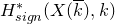 $H^*_{\rm sign}(X(\overline{k}), k)$
is larger. For now, suppose that the
$H^*_{\rm sign}(X(\overline{k}), k)$
is larger. For now, suppose that the $-1$
eigenspace is larger, as this is the more difficult case.
$-1$
eigenspace is larger, as this is the more difficult case.
We see that $S^m(q) = \bigoplus_{i=0}^m S^i(b\mathbb{H})S^{m-i}(a\langle - 1 \rangle)$
. By [Reference McGarraghyMcG05, Proposition 4.12], we see that if i is odd, then
$S^m(q) = \bigoplus_{i=0}^m S^i(b\mathbb{H})S^{m-i}(a\langle - 1 \rangle)$
. By [Reference McGarraghyMcG05, Proposition 4.12], we see that if i is odd, then $\mathrm{sign}(S^{m-i}(b\mathbb{H})) = 0$
, and
$\mathrm{sign}(S^{m-i}(b\mathbb{H})) = 0$
, and $\mathrm{sign}(S^{i}(b\mathbb{H})) = {b + j - 1 \choose j}$
if
$\mathrm{sign}(S^{i}(b\mathbb{H})) = {b + j - 1 \choose j}$
if $i=2j$
is even. We calculate
$i=2j$
is even. We calculate
 \begin{align*}S^{m-2j}(a\langle -1 \rangle) = \langle (-1)^{m-2j} \rangle {a + m-2j-1 \choose m-2j-1}.\end{align*}
Applying sign then gives
 \begin{align*}\mathrm{sign}(S^m(q)) = (-1)^m \sum_{j=0}^{\lfloor \frac{m}{2} \rfloor} {a + m-2j -1 \choose m-2j} {b + j - 1 \choose j}.\end{align*}
The argument for the case when the 1 eigenspace is larger is similar.
Lemma 8.20. Let X be a K3 surface. Then,
 \begin{align*}\mathrm{det}_{\ell}(X^{(m)}) = \mathrm{det}_{\ell}(X)^{ {m+e(X)-1 \choose m}}.\end{align*}
Proof. Since X is a K3 surface, we have $H^i_{\acute{e}t}(X, \mathbb{Q}_{\ell})=0$
for all i odd. Therefore,
$H^i_{\acute{e}t}(X, \mathbb{Q}_{\ell})=0$
for all i odd. Therefore,
 \begin{align*}\mathrm{det}_{\ell}(X) = \mathrm{det}(R\Gamma(X_{\overline{k}}, \mathbb{Q}_{\ell})) = \mathrm{det}(H^*(X_{\overline{k}}, \mathbb{Q}_{\ell})).\end{align*}
Note that $H^*(X_{\overline{k}}^{(m)}, \mathbb{Q}_{\ell}) = S^m(H^*(X_{\overline{k}}, \mathbb{Q}_{\ell}))$
. Since
$H^*(X_{\overline{k}}^{(m)}, \mathbb{Q}_{\ell}) = S^m(H^*(X_{\overline{k}}, \mathbb{Q}_{\ell}))$
. Since $X^{(m)}$
is proper, the compactly supported cohomology agrees with the normal cohomology, so
$X^{(m)}$
is proper, the compactly supported cohomology agrees with the normal cohomology, so $\mathrm{det}_{\ell}(X)$
is the determinant of the Galois representation
$\mathrm{det}_{\ell}(X)$
is the determinant of the Galois representation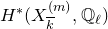 $H^*(X_{\overline{k}}^{(m)}, \mathbb{Q}_{\ell})$
. Therefore, for all
$H^*(X_{\overline{k}}^{(m)}, \mathbb{Q}_{\ell})$
. Therefore, for all $\sigma \in \mathop{\mathrm{Gal}}\nolimits_k$
, we have
$\sigma \in \mathop{\mathrm{Gal}}\nolimits_k$
, we have
 \begin{align*}\mathrm{det}_{\ell}(X^{(m)})(\sigma) = \mathrm{det}_{\ell}(X)^{ {m+e(X)-1 \choose m}},\end{align*}
since for $T: V \to V$
, the determinant of the symmetric power,
$T: V \to V$
, the determinant of the symmetric power,
 \begin{eqnarray*}\mathrm{det}(S^m(T)) = \mathrm{det}(T)^{ {\mathrm{dim}(V) + m - 1\choose m}}.\\[-35pt]\end{eqnarray*}
Corollary 8.21. Let X be a K3 surface, and let
 \begin{align*}w_m = {e(X)+m-1 \choose m}.\end{align*}
Then $\chi^{\rm mot}(X^{(m)})$
is the unique element of
$\chi^{\rm mot}(X^{(m)})$
is the unique element of $\widehat{\mathrm{W}}(k)/J$
satisfying the following properties.
$\widehat{\mathrm{W}}(k)/J$
satisfying the following properties.
-
(1) The rank is given by
$\mathrm{rank}(\chi^{\rm mot}(X^{(m)}))= w_m$
. -
(2) The signature is given by
for any choice of
\begin{align*}\mathrm{sign}(\chi^{\rm mot}(X^{(m)}_{k_\lt })) = \pm\sum_{j=0}^{\lfloor \frac{m}{2} \rfloor} {a + m-2j -1 \choose m-2j}{b + j - 1 \choose j},\end{align*}
$k_\lt \in \mathrm{Spr}(k)$
, where a is given by
$|\mathrm{sign}(\chi^{\rm mot}(X)_{k_\lt })|$
,
$b=\frac12(w_m-a)$
and the sign at the front is equal to 1 if
$\mathrm{sign}(\chi^{\rm mot}(X)_{k_\lt })$
is positive, and
$(-1)^m$
if
$\mathrm{sign}(\chi^{\rm mot}(X)_{k_\lt })$
is negative.
-
(3) The discriminant is
$\mathrm{disc}(\chi^{\rm mot}(X^{(m)})) = \mathrm{disc}(\chi^{\rm mot}(X))^{w_m} $
.




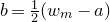




Proof. Uniqueness is immediate due to the definition of J. The first two equalities follow by the previous two lemmas. For the final equality, Lemma 8.20 applied to the $\ell$
-adic cohomology gives
$\ell$
-adic cohomology gives $\mathrm{det}_\ell(X^{(m)}) = \mathrm{det}_{\ell}(X)^{w_m}$
, and the result follows by Remark 2.30 and Theorem 2.29.
$\mathrm{det}_\ell(X^{(m)}) = \mathrm{det}_{\ell}(X)^{w_m}$
, and the result follows by Remark 2.30 and Theorem 2.29.
Remark 8.22. Applying the rank homomorphism to the equation in Corollary 8.18 and using Theorem 2.14 recovers Göttsche’s formula for Euler characteristics:
 \begin{align*}1+\sum_{n=1}^{\infty}e(X^{[n]})t^n=\prod_{d=1}^{\infty} \bigg(1+\sum_{m=1}^{\infty} {m + e(X) - 1 \choose m} t^{md}\bigg) =\prod_{d=1}^{\infty}\big(1-t^d\big)^{-e(X)}\;\mathrm{in}\;\mathbb Z[[t]].\end{align*}
Assume that k is real closed, so that $\mathrm{Spr}(k)$
is a single point and
$\mathrm{Spr}(k)$
is a single point and $\mathcal C(\mathrm{Spr}(k),\mathbb Z)=\mathbb Z$
.
$\mathcal C(\mathrm{Spr}(k),\mathbb Z)=\mathbb Z$
.
Corollary 8.23 (Real closed Gottsche formula). We have
 \begin{align*}1+\sum_{n=1}^{\infty}\epsilon(X^{[n]})t^n=\prod_{i=1}^{\infty}\big(1+(-t)^i)\big)^{-a}\cdot\prod_{j=1}^{\infty}\big(1-t^{2j}\big)^{-b}\;\textrm{in}\;\mathbb Z[[t]],\end{align*}
where $a=\epsilon(X)$
and
$a=\epsilon(X)$
and $b=\frac{1}{2}(e(X)-\epsilon(X))$
.
$b=\frac{1}{2}(e(X)-\epsilon(X))$
.
Proof. First, suppose that $a\geq0$
, so that
$a\geq0$
, so that $\chi^{\rm dR}(X) = b\mathbb{H}+ a\langle 1 \rangle$
, where both
$\chi^{\rm dR}(X) = b\mathbb{H}+ a\langle 1 \rangle$
, where both $a,b\geq0$
. Then, taking sign of both sides of the equation in Corollary 8.18 and using Corollary 8.21, we obtain
$a,b\geq0$
. Then, taking sign of both sides of the equation in Corollary 8.18 and using Corollary 8.21, we obtain
 \begin{align*}1+\sum_{n=1}^{\infty}\epsilon(X^{[n]})(-1)^n t^n&= \prod_{d=1}^{\infty} \sum_{m=0}^{\infty}\bigg( \sum_{j=0}^{\lfloor \tfrac{m}{2} \rfloor} {a + m-2j -1 \choose m-2j} {b + j - 1 \choose j} \bigg) (-1)^m t^{md} \\&= \prod_{d=1}^{\infty} \sum_{m=0}^{\infty}\bigg(\sum_{j=0}^{\lfloor \tfrac{m}{2} \rfloor} {a + m-2j -1 \choose m-2j} (-1)^{m-2j} t^{(m-2j)d} {b + j - 1 \choose j}t^{2jd} \bigg) \\&= \prod_{d=1}^{\infty} \bigg( \bigg( \sum_{i=0}^{\infty} {a+i-1 \choose i} (-1)^i t^{id} \bigg) \cdot \bigg(\sum_{j=0}^\infty {b + j - 1 \choose j} t^{2jd} \bigg)\bigg)\\&= \prod_{d=1}^{\infty} ( (1+t^d)^{-a} (1-t^{2d})^{-b})\\&=\prod_{i=1}^{\infty}\big(1+t^i\big)^{-a}\cdot \prod_{j=1}^{\infty}\big(1-t^{2j}\big)^{-b}.\end{align*}
Relabelling $t=-t$
, we obtain
$t=-t$
, we obtain
 \begin{align*}1+\sum_{n=1}^{\infty}\epsilon(X^{[n]}) t^n = \prod_{i=1}^{\infty}\big(1+(-t)^i)\big)^{-a}\cdot \prod_{j=1}^{\infty}\big(1-t^{2j}\big)^{-b},\end{align*}
as required. It remains to show the case when $a\lt 0$
. Let
$a\lt 0$
. Let $\tilde{a}=-a$
and
$\tilde{a}=-a$
and $\tilde{b}=\frac12(e(X)-\tilde{a})$
, so that
$\tilde{b}=\frac12(e(X)-\tilde{a})$
, so that $\tilde{b} = b-a$
. Taking sign gives
$\tilde{b} = b-a$
. Taking sign gives
 \begin{align*}\sum_{n=1}^{\infty}\epsilon(X^{[n]})(-1)^nt^n &= \prod_{d=1}^{\infty} \sum_{m=0}^{\infty}\bigg( \sum_{j=0}^{\lfloor \tfrac{m}{2} \rfloor} {\tilde{a} + m-2j -1 \choose m-2j} {\tilde{b} + j - 1 \choose j} \bigg)t^{md}\\&=\prod_{d=1}^{\infty} \sum_{m=0}^{\infty} \bigg(\sum_{j=0}^{\lfloor \tfrac{m}{2} \rfloor} {\tilde{a} + m-2j -1 \choose m-2j} t^{(m-2j)d} {\tilde{b} + j - 1 \choose j}t^{2jd} \bigg) \\&= \prod_{d=1}^{\infty} ((1-t^d)^{-\tilde{a}} (1-t^{2d})^{-\tilde{b}}).\end{align*}
Using that $(1-t^d) = (1-t^{2d}) \cdot (1+t^d)^{-1}$
, we can rewrite
$(1-t^d) = (1-t^{2d}) \cdot (1+t^d)^{-1}$
, we can rewrite
 \begin{align*}\prod_{d=1}^{\infty} ((1-t^d)^{-\tilde{a}} (1-t^{2d})^{-\tilde{b}}) =\prod_{d=1}^{\infty} ((1+t^d)^{\tilde{a}} \cdot(1-t^{2d})^{-\tilde{b} -\tilde{a}}).\end{align*}
Rewriting $\tilde{a}=-a$
and
$\tilde{a}=-a$
and $\tilde{b}=b-a$
gives
$\tilde{b}=b-a$
gives
 \begin{align*}\prod_{d=1}^{\infty} ((1+t^d)^{\tilde{a}} \cdot(1-t^{2d})^{-\tilde{b} -\tilde{a}}) = \prod_{i=1}^{\infty}\big(1+t^i\big)^{-a}\cdot \prod_{j=1}^{\infty}\big(1-t^{2j}\big)^{-b}.\end{align*}
Putting everything together and relabelling t for $-t$
gives the result.
$-t$
gives the result.
In the case that $k=\mathbb{R}$
, this exactly recovers the real Göttsche formula of [Reference Kharlamov and RăsdeaconuKR15, Theorem 1.2]. Let k again be an arbitrary field of characteristic 0. Identify
$k=\mathbb{R}$
, this exactly recovers the real Göttsche formula of [Reference Kharlamov and RăsdeaconuKR15, Theorem 1.2]. Let k again be an arbitrary field of characteristic 0. Identify $\widehat{\mathrm{W}}(k)/I^2 = E( k^\times/k^{\times2})$
as in Remark 2.36. Write
$\widehat{\mathrm{W}}(k)/I^2 = E( k^\times/k^{\times2})$
as in Remark 2.36. Write $\chi^{\rm disc}$
for the composition
$\chi^{\rm disc}$
for the composition $K_0(\mathrm{Var}_k) \xrightarrow{\chi^{\rm mot}} \widehat{\mathrm{W}}(k) \to \widehat{\mathrm{W}}(k)/I^2$
, so that after this identification
$K_0(\mathrm{Var}_k) \xrightarrow{\chi^{\rm mot}} \widehat{\mathrm{W}}(k) \to \widehat{\mathrm{W}}(k)/I^2$
, so that after this identification $\chi^{\rm disc}(X) = (e(X), \mathrm{disc}(\chi^{\rm mot}(X))$
.
$\chi^{\rm disc}(X) = (e(X), \mathrm{disc}(\chi^{\rm mot}(X))$
.
Theorem 8.24.
There is an equality in the ring $E( k^\times/k^{\times2})[[t]]$
:
$E( k^\times/k^{\times2})[[t]]$
:
 \begin{align*}1+\sum_{n=1}^\infty (\chi^{\rm disc}(X^{[n]}))t^n = \prod_{d=1}^{\infty} (1 - (1, \mathrm{disc}(\chi^{\rm mot}(X)))t^m)^{-e(X)}.\end{align*}
Proof. Note that by Corollary 8.21,
 \begin{align*}\chi^{\rm disc}(X^{(m)}) = \left( {m + e(X) - 1 \choose m}, \mathrm{disc}(\chi^{\rm mot}(X))^{ {m + e(X) - 1 \choose m}}\right) = {m + e(X) - 1 \choose m}(1, \mathrm{disc}(\chi^{\rm mot}(X))).\end{align*}
Applying the homomorphism $\chi^{\rm disc}$
to Corollary 8.18 gives
$\chi^{\rm disc}$
to Corollary 8.18 gives
 \begin{align*}1+\sum_{n=1}^\infty \chi^{\rm disc}(X^{[n]})(1, (-1))^nt^n &= \prod_{d=1}^\infty \sum_{m=0}^\infty {m + e(X) - 1 \choose m}(1, \mathrm{disc}(\chi^{\rm mot}(X)) \cdot (1,-1)^m t^{md} \\&=\prod_{d=1}^{\infty} (1, \mathrm{disc}(\chi^{\rm mot}(X))) \cdot \sum_{m=0}^{\infty} {m + e(X) - 1 \choose m}( (1,-1)t^d)^m \\&= \prod_{d=1}^{\infty} (1,\mathrm{disc}(\chi^{\rm mot}(X))) (1- (1,-1)t^d)^{-e(X)}.\end{align*}
Relabelling $t = (1,-1)t$
gives
$t = (1,-1)t$
gives
 \begin{align*}1+\sum_{n=1}^\infty \chi^{\rm disc}(X^{[n]})t^n = \prod_{d=1}^{\infty} (1,\mathrm{disc}(\chi^{\rm mot}(X))) (1- t^d)^{-e(X)},\end{align*}
as required.
9. The arithmetic Yau–Zaslow formula
Recall that X is a K3 surface admitting a complete g-dimensional linear system $\mathcal C$
of geometrically integral curves of genus g and that the curves in this linear system correspond to a primitive divisor class. Suppose that the rational curves in
$\mathcal C$
of geometrically integral curves of genus g and that the curves in this linear system correspond to a primitive divisor class. Suppose that the rational curves in $\mathcal C$
are all nodal, which is generically the case by Chen’s theorem [Reference ChenChe02, Theorem 1.1].
$\mathcal C$
are all nodal, which is generically the case by Chen’s theorem [Reference ChenChe02, Theorem 1.1].
Lemma 9.1.
The motivic Euler characteristic $\chi^{\rm mot}(\overline{\mathrm{Pic}}^g(\mathcal{C})) \pmod{J}$
is given by
$\chi^{\rm mot}(\overline{\mathrm{Pic}}^g(\mathcal{C})) \pmod{J}$
is given by $\langle (-1)^g \rangle$
multiplied by the coefficient of
$\langle (-1)^g \rangle$
multiplied by the coefficient of $t^g$
in the generating series
$t^g$
in the generating series
 \begin{align*}\prod_{d=1}^{\infty} \sum_{m = 0}^{\infty} \chi^{\rm mot}(X^{(m)})\langle (-1)^m \rangle t^{md} \in (\widehat{\mathrm{W}}(k)/J)[[t]].\end{align*}
Proof. By Theorem 7.3, we have that $\chi^{\rm mot}(\overline{\mathrm{Pic}}^g(\mathcal{C})) \equiv \chi^{\rm mot}(X^{[g]}) \pmod J$
, so applying Corollary 8.18 gives us the result.
$\chi^{\rm mot}(\overline{\mathrm{Pic}}^g(\mathcal{C})) \equiv \chi^{\rm mot}(X^{[g]}) \pmod J$
, so applying Corollary 8.18 gives us the result.
Corollary 9.2.
The element $\mathbf B^{\rm mot}_{\mathcal{C}}(X)$
from Definition 6.23 only depends on X and g modulo
$\mathbf B^{\rm mot}_{\mathcal{C}}(X)$
from Definition 6.23 only depends on X and g modulo $J_g$
, and not on
$J_g$
, and not on $\mathcal{C}$
itself.
$\mathcal{C}$
itself.
Proof. Lemma 6.24 gives that $\mathbf B^{\rm mot}_{\mathcal{C}}(X) \equiv \chi^{\rm mot}(\overline{\mathrm{Pic}}^g(\mathcal C)) \pmod{J_g}$
, so the result holds by the above lemma.
$\mathbf B^{\rm mot}_{\mathcal{C}}(X) \equiv \chi^{\rm mot}(\overline{\mathrm{Pic}}^g(\mathcal C)) \pmod{J_g}$
, so the result holds by the above lemma.
The above corollary allows us to write $\mathbf B^{\rm mot}_g(X) := \mathbf B^{\rm mot}_{\mathcal{C}}(X)$
. Our calculation of
$\mathbf B^{\rm mot}_g(X) := \mathbf B^{\rm mot}_{\mathcal{C}}(X)$
. Our calculation of $\overline{\mathrm{Pic}}^g(\mathcal{C})$
only holds modulo
$\overline{\mathrm{Pic}}^g(\mathcal{C})$
only holds modulo $J_g$
, so we need the following definition.
$J_g$
, so we need the following definition.
Definition 9.3. Let $\mathcal{J}$
denote the subset of
$\mathcal{J}$
denote the subset of $\widehat{\mathrm{W}}(k)[[t]]$
given by power series of the form
$\widehat{\mathrm{W}}(k)[[t]]$
given by power series of the form $\sum_{i=0}^\infty a_i t^i$
, where each
$\sum_{i=0}^\infty a_i t^i$
, where each $a_i \in J_i$
, where
$a_i \in J_i$
, where $J_i$
is the ideal from Definition 6.20. Since each
$J_i$
is the ideal from Definition 6.20. Since each $J_i$
is an ideal of
$J_i$
is an ideal of $\widehat{\mathrm{W}}(k)$
with
$\widehat{\mathrm{W}}(k)$
with $J_i \subseteq J_{i+1}$
, we see that
$J_i \subseteq J_{i+1}$
, we see that $\mathcal{J}$
is an ideal of
$\mathcal{J}$
is an ideal of $\widehat{\mathrm{W}}(k)[[t]]$
.
$\widehat{\mathrm{W}}(k)[[t]]$
.
Theorem 9.4 (Arithmetic Yau–Zaslow formula). Let $X, \mathcal{C}$
be as above. Then
$X, \mathcal{C}$
be as above. Then $\langle (-1)^g \rangle \mathbf{B}^{\rm mot}_g(X)$
is given by the coefficient of
$\langle (-1)^g \rangle \mathbf{B}^{\rm mot}_g(X)$
is given by the coefficient of $t^g$
in the power series
$t^g$
in the power series
 \begin{align*}\prod_{d=1}^{\infty} \sum_{m = 0}^{\infty} \chi^{\rm mot}(X^{(m)})\langle (-1)^m \rangle t^{md} \in \widehat{\mathrm{W}}(k)[[t]]/\mathcal{J}.\end{align*}
Proof. Apply Lemma 6.24 to the result of Theorem 9.1.
Remark 9.5. Consider the rank of $\mathbf B^{\rm mot}_g(X)$
:
$\mathbf B^{\rm mot}_g(X)$
:
 \begin{align*}\mathrm{rank}( \mathbf B^{\rm mot}_g(X)) = \mathrm{rank} \sum_{q \in G(X)} \mathrm{Tr}_{k(q)/k} \bigg(\prod_{p\in\mathcal S(C_q)}\Phi_p\bigg).\end{align*}
Note that $\mathrm{rank}( \mathrm{Tr}_{k(q)/k}(w)) = [k(q):k]\mathrm{rank}(q)$
, so since
$\mathrm{rank}( \mathrm{Tr}_{k(q)/k}(w)) = [k(q):k]\mathrm{rank}(q)$
, so since $\Phi_p$
has rank 1, this gives
$\Phi_p$
has rank 1, this gives
 \begin{align*}\mathrm{rank}( \mathbf B^{\rm mot}_g(X)) = \sum_{q \in G(X)}[k(q):k]=\# G(X)(\overline{k}).\end{align*}
That is, applying rank to $\mathbf B^{\rm mot}_g(X)$
recovers the number of rational curves in
$\mathbf B^{\rm mot}_g(X)$
recovers the number of rational curves in $\mathcal{C}$
after base changing to the algebraic closure. Applying Remark 8.22 to the right-hand side of the above theorem therefore recovers the complex Yau–Zaslow formula of [Reference BeauvilleBea99] when working over
$\mathcal{C}$
after base changing to the algebraic closure. Applying Remark 8.22 to the right-hand side of the above theorem therefore recovers the complex Yau–Zaslow formula of [Reference BeauvilleBea99] when working over $\mathbb{C}$
.
$\mathbb{C}$
.
Definition 9.6. Assume that k is real closed. Let C be a semi-stable curve over k. Following [Reference Kharlamov and RăsdeaconuKR15], we call $(-1)^s$
the Welschinger number W(C) of C, where s is the number of zero-dimensional semi-algebraic connected components of C(k). We set
$(-1)^s$
the Welschinger number W(C) of C, where s is the number of zero-dimensional semi-algebraic connected components of C(k). We set
 \begin{align*}\mathbb W(X, \mathcal{C}):=\sum_{q\in G(X)(k)}W(C_q)\in \mathbb Z.\end{align*}
Lemma 9.7.
For g the dimension of $\mathcal{C}$
, we have
$\mathcal{C}$
, we have
 \begin{align*}\mathbb W(X, \mathcal{C}) = (-1)^g\mathrm{sign}( \mathbf B^{\rm mot}_{\mathcal{C}}(X) ).\end{align*}
Proof. By Corollary 6.15, the signature $\mathrm{sign}(\prod_{p\in \mathcal{S}(C_q)} \Phi_p) = (-1)^{c_{C_q}}$
, where
$\mathrm{sign}(\prod_{p\in \mathcal{S}(C_q)} \Phi_p) = (-1)^{c_{C_q}}$
, where $c_{C_q}$
denotes the number of points in
$c_{C_q}$
denotes the number of points in $\mathcal{S}(C_q)$
such that both p and the tangent spaces at p are defined over k. Let
$\mathcal{S}(C_q)$
such that both p and the tangent spaces at p are defined over k. Let $s_{C_q}$
denote the number of points in
$s_{C_q}$
denote the number of points in $\mathcal{S}(C_q)$
which are defined over k, whose tangent spaces are not defined over k, and let
$\mathcal{S}(C_q)$
which are defined over k, whose tangent spaces are not defined over k, and let $n_{C_q}$
denote the number of complex points in
$n_{C_q}$
denote the number of complex points in $\mathcal{S}(C_q)$
. Note that
$\mathcal{S}(C_q)$
. Note that $s_{C_q} + c_{C_q} + 2n_{C_q} = g$
, so
$s_{C_q} + c_{C_q} + 2n_{C_q} = g$
, so $(-1)^{c_{C_q}} = (-1)^g W(C_q)$
. Therefore,
$(-1)^{c_{C_q}} = (-1)^g W(C_q)$
. Therefore,
 \begin{align*}\mathrm{sign}( \mathbf B^{\rm mot}_{\mathcal{C}}(X) ) = \sum_{q \in G(X)(k)} (-1)^g W(C_q) = (-1)^g \mathbb W(X, \mathcal{C}),\end{align*}
as required.
Corollary 9.8 (Real closed arithmetic Yau–Zaslow formula). The number $\mathbb W(X, \mathcal{C})$
depends only on g and X so we can write
$\mathbb W(X, \mathcal{C})$
depends only on g and X so we can write $\mathbb W(X, g)$
. Moreover,
$\mathbb W(X, g)$
. Moreover, $\mathbb W(X,g)$
is given by the coefficient of
$\mathbb W(X,g)$
is given by the coefficient of $t^g$
in the power series
$t^g$
in the power series
 \begin{align*}\prod_{i=1}^{\infty}\big(1+(-t^i)\big)^{-a} \cdot \prod_{j=1}^{\infty}\big(1-t^{2j}\big)^{-b} \in \mathbb{Z}[[t]],\end{align*}
where $a=e(X(k))$
and
$a=e(X(k))$
and $b=e(X(\overline{k}))-\frac{1}{2}e(X(k))$
.
$b=e(X(\overline{k}))-\frac{1}{2}e(X(k))$
.
Proof. Applying sign to the power series in Theorem 9.4, and using the Göttsche formula 8.23, gives that $(-1)^g \mathrm{sign}( \mathbf B^{\rm mot}_{\mathcal{C}}(X) ) = \mathbb W(X, \mathcal{C})$
is the coefficient of
$(-1)^g \mathrm{sign}( \mathbf B^{\rm mot}_{\mathcal{C}}(X) ) = \mathbb W(X, \mathcal{C})$
is the coefficient of $t^g$
in the power series
$t^g$
in the power series
 \begin{eqnarray*} \prod_{i=1}^{\infty}\big(1+(-t)^i)\big)^{-a}\cdot\prod_{j=1}^{\infty}\big(1-t^{2j}\big)^{-b}.\end{eqnarray*}
Remark 9.9. The above corollary generalises the main theorem of Kharlamov–Răsdeaconu from [Reference Kharlamov and RăsdeaconuKR15] to all real closed fields.
We now turn to the discriminant. Let k be an arbitrary field of characteristic 0. Define the integer $r_g := \mathrm{rank}(\mathbf{B}^{\rm mot}_{g}(X))$
, and let
$r_g := \mathrm{rank}(\mathbf{B}^{\rm mot}_{g}(X))$
, and let $\mathbb D^{\rm mot}_{g}(X) := \mathrm{disc}(\mathbf{B}^{\rm mot}_{g}(X)) \in k^\times/k^{\times2}$
.
$\mathbb D^{\rm mot}_{g}(X) := \mathrm{disc}(\mathbf{B}^{\rm mot}_{g}(X)) \in k^\times/k^{\times2}$
.
Lemma 9.10.
There is an equality in $\mathop{\mathrm{Hom}}\nolimits(\mathop{\mathrm{Gal}}\nolimits_k, \mathbb{Z}/2\mathbb{Z})/\Delta^k_g$
:
$\mathop{\mathrm{Hom}}\nolimits(\mathop{\mathrm{Gal}}\nolimits_k, \mathbb{Z}/2\mathbb{Z})/\Delta^k_g$
:
 \begin{align*}\mathbb{D}_{g}^{\rm mot}(X) = (-1)^{r_g}\prod_{q\in G(X)} \mathrm{disc}(k(q)/k)\prod_{p\in\mathcal S(\pi_g^{-1}(q))}\mathrm{N}_{k(p)/k}(\alpha_p) .\end{align*}
Proof. By Lemma 4.4 and Corollary 4.21, we obtain
 \begin{align*}\mathrm{disc}(\mathbf{B}^{\rm mot}_{g}(X)) = \prod_{q\in G(X)} \mathrm{disc}(k(q)/k) \cdot (-1)^{[k(q):k]}\prod_{p\in\mathcal S(\pi_g^{-1}(q))}\mathrm{N}_{k(p)/k}(\alpha_p),\end{align*}
which gives the result since $\sum_{q \in G(X)} [k(q):k] = r_g$
.
$\sum_{q \in G(X)} [k(q):k] = r_g$
.
This allows us to obtain the following Yau–Zaslow formula for discriminants.
Corollary 9.11.
Suppose that k is finitely generated over $\mathbb{Q}$
. Then the pair
$\mathbb{Q}$
. Then the pair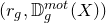 $(r_g, \mathbb D^{\rm mot}_g(X))$
, viewed as an element of
$(r_g, \mathbb D^{\rm mot}_g(X))$
, viewed as an element of $E((k^\times/k^{\times2})/\Delta^k_g)$
, is given by the coefficient of
$E((k^\times/k^{\times2})/\Delta^k_g)$
, is given by the coefficient of $t^g$
in the generating series
$t^g$
in the generating series
 \begin{align*}\prod_{d=1}^{\infty} (1,\mathrm{disc}(\chi^{\rm mot}(X))) (1-t^d)^{-e(X)} \in E((k^\times/k^{\times2})/\Delta^k_g)[[t]].\end{align*}
Proof. Theorem 7.3 gives $\chi^{\rm disc}(\overline{\mathrm{Pic}}^g(\mathcal{C}))=\chi^{\rm disc}( X^{[g]})$
. By the previous lemma, this is
$\chi^{\rm disc}(\overline{\mathrm{Pic}}^g(\mathcal{C}))=\chi^{\rm disc}( X^{[g]})$
. By the previous lemma, this is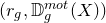 $(r_g, \mathbb D^{\rm mot}_{g}(X))$
. Applying Theorem 8.24 gives the result.
$(r_g, \mathbb D^{\rm mot}_{g}(X))$
. Applying Theorem 8.24 gives the result.
Remark 9.12. In particular, the above formula implies that $\mathbb D^{\rm mot}_g(X) \in k^\times/k^{\times2} \pmod{\Delta^k_g}$
is always either 1 or
$\mathbb D^{\rm mot}_g(X) \in k^\times/k^{\times2} \pmod{\Delta^k_g}$
is always either 1 or $\mathrm{disc}(\chi^{\rm mot}(X))$
.
$\mathrm{disc}(\chi^{\rm mot}(X))$
.
Acknowledgements
The first author wishes to thank Johannes Nicaise, Tomer Schlank, and Toby Gee for reading through early outlines of this work and giving helpful feedback, as well as the support of Imperial College London and the University of Canterbury. Parts of this work have appeared as part of the first author’s thesis, and the first author would also like to thank Kirsten Wickelgren and Kevin Buzzard for their careful reading of the thesis in their role as examiners. The second author wishes to thank Frank Neumann for several discussions about the contents of this work and for his interest. He also wishes to acknowledge the generous support of the Imperial College Mathematics Department’s Platform Grant that made the visit of Frank Neumann to Imperial College possible. We both thank the anonymous referees for their careful reading of the paper and the suggested proof of Lemma 2.4. We thank Stephen McKean and Dori Bejleri for helpful comments. We thank Richard Thomas for his discussions on the modern view of the complex Yau–Zaslow formula. We thank Marc Levine and the rest of the study group in Essen for pointing out some errors in earlier versions of this paper.
Conflicts of interest
None.
Financial support
This work was undertaken while the first author was supported by the London School of Geometry and Number Theory under the Engineering and Physical Sciences Research Council grant no. EP/S021590/1. Revisions to this paper were also carried out while the first author was supported by the Marsden Fund administered by the Royal Society of New Zealand.
Journal information
Compositio Mathematica is owned by the Foundation Compositio Mathematica and published by the London Mathematical Society in partnership with Cambridge University Press. All surplus income from the publication of Compositio Mathematica is returned to mathematics and higher education through the charitable activities of the Foundation, the London Mathematical Society and Cambridge University Press.


 Open access

