




1. Introduction
This article is a follow-up to [Reference Aschenbrenner, van den Dries and van der HoevenAvdDvdH24a], where the main result is that for any Hardy field H and countable subsets $A< B$
of H, there exists y in a Hardy field extension of H such that
$A< B$
of H, there exists y in a Hardy field extension of H such that $A \lt y \lt B$
. Equivalently, (the underlying ordered set of) any maximal Hardy field is
$A \lt y \lt B$
. Equivalently, (the underlying ordered set of) any maximal Hardy field is $\eta_1$
in the sense of Hausdorff. In this result we do not require
$\eta_1$
in the sense of Hausdorff. In this result we do not require $H\subseteq \mathcal{C}^{\omega}$
, and the glueing constructions in [Reference Aschenbrenner, van den Dries and van der HoevenAvdDvdH24a] do not give
$H\subseteq \mathcal{C}^{\omega}$
, and the glueing constructions in [Reference Aschenbrenner, van den Dries and van der HoevenAvdDvdH24a] do not give $y\in \mathcal{C}^{\omega}$
, even if
$y\in \mathcal{C}^{\omega}$
, even if $H\subseteq \mathcal{C}^{\omega}$
; see § 1.1 for the notation used here. We call a Hardy field H smooth if
$H\subseteq \mathcal{C}^{\omega}$
; see § 1.1 for the notation used here. We call a Hardy field H smooth if $H\subseteq \mathcal{C}^\infty$
and analytic if
$H\subseteq \mathcal{C}^\infty$
and analytic if $H\subseteq \mathcal{C}^{\omega}$
. By [Reference Aschenbrenner, van den Dries and van der HoevenAvdDvdH24d, Corollary 11.20] and [Reference Aschenbrenner, van den Dries and van der HoevenAvdDvdH17, 16.0.3 and 16.6.3], maximal Hardy fields, maximal smooth Hardy fields, and maximal analytic Hardy fields are all elementarily equivalent to the ordered differential field
$H\subseteq \mathcal{C}^{\omega}$
. By [Reference Aschenbrenner, van den Dries and van der HoevenAvdDvdH24d, Corollary 11.20] and [Reference Aschenbrenner, van den Dries and van der HoevenAvdDvdH17, 16.0.3 and 16.6.3], maximal Hardy fields, maximal smooth Hardy fields, and maximal analytic Hardy fields are all elementarily equivalent to the ordered differential field $ {\mathbb T} $
of transseries, and have no proper d-algebraic H-field extension with constant field
$ {\mathbb T} $
of transseries, and have no proper d-algebraic H-field extension with constant field $ {\mathbb R} $
. We shall tacitly use these facts throughout.
$ {\mathbb R} $
. We shall tacitly use these facts throughout.
Some may view non-analytic Hardy fields as artificial, since most Hardy fields that occur ‘in nature’ are analytic. (But see [Reference GokhmanGok97, Reference GrelowskiGre08] for Hardy fields $H\not\subseteq\mathcal{C}^\infty$
, and [Reference Rolin, Speissegger and WilkieRSW03] for Hardy fields
$H\not\subseteq\mathcal{C}^\infty$
, and [Reference Rolin, Speissegger and WilkieRSW03] for Hardy fields $H\subseteq\mathcal{C}^\infty$
,
$H\subseteq\mathcal{C}^\infty$
, $H\not\subseteq\mathcal{C}^\omega$
.) To conciliate this view and answer an obvious question, we prove in § 5 the analytic version of [Reference Aschenbrenner, van den Dries and van der HoevenAvdDvdH24a].
$H\not\subseteq\mathcal{C}^\omega$
.) To conciliate this view and answer an obvious question, we prove in § 5 the analytic version of [Reference Aschenbrenner, van den Dries and van der HoevenAvdDvdH24a].
Theorem A. If H is an analytic Hardy field with countable subsets $A<B$
, then there exists
$A<B$
, then there exists ${y\in \mathcal{C}^{\omega}}$
in a Hardy field extension of H such that
${y\in \mathcal{C}^{\omega}}$
in a Hardy field extension of H such that $A \lt y \lt B$
.
$A \lt y \lt B$
.
Equivalently, all maximal analytic Hardy fields are $\eta_1$
. The theorem goes through for smooth Hardy fields with
$\eta_1$
. The theorem goes through for smooth Hardy fields with $y\in \mathcal{C}^{\infty}$
in the conclusion; this can be obtained by refining the glueing constructions from [Reference Aschenbrenner, van den Dries and van der HoevenAvdDvdH24a] (as was actually done in an early version of that paper, at the cost of three extra pages). Here we take care of the smooth and analytic versions simultaneously. Compared with [Reference Aschenbrenner, van den Dries and van der HoevenAvdDvdH24a], the new tool we use is a powerful theorem due to Whitney on approximating any
$y\in \mathcal{C}^{\infty}$
in the conclusion; this can be obtained by refining the glueing constructions from [Reference Aschenbrenner, van den Dries and van der HoevenAvdDvdH24a] (as was actually done in an early version of that paper, at the cost of three extra pages). Here we take care of the smooth and analytic versions simultaneously. Compared with [Reference Aschenbrenner, van den Dries and van der HoevenAvdDvdH24a], the new tool we use is a powerful theorem due to Whitney on approximating any $\mathcal{C}^n$
-function or
$\mathcal{C}^n$
-function or $\mathcal{C}^{\infty}$
-function by an analytic function, where the approximation also takes derivatives into account. From that we obtain an analogue for germs, namely Corollary 2.8, which in turn we use to derive Theorem A from various results in the non-analytic setting of [Reference Aschenbrenner, van den Dries and van der HoevenAvdDvdH24a].
$\mathcal{C}^{\infty}$
-function by an analytic function, where the approximation also takes derivatives into account. From that we obtain an analogue for germs, namely Corollary 2.8, which in turn we use to derive Theorem A from various results in the non-analytic setting of [Reference Aschenbrenner, van den Dries and van der HoevenAvdDvdH24a].
In the course of establishing Theorem A in § 4 and 5, we revisit results on pc-sequences and on extensions of type (b) from [Reference Aschenbrenner, van den Dries and van der HoevenAvdDvdH24a]. In § 5 (see Theorem 5.15), this also leads to the following result.
Theorem B. If H is a maximal analytic Hardy field, then H is dense in any Hardy field extension of H.
If all maximal analytic Hardy fields are maximal Hardy fields, which seems to us implausible, then of course the theorems above would be trivially true. Can a maximal analytic Hardy field ever be a maximal Hardy field? For all we know, answering questions of this kind might involve set-theoretic assumptions such as the continuum hypothesis. In [Reference Aschenbrenner, van den Dries and van der HoevenAvdDvdH24a] and the present paper, we ran into other set-theoretic issues of this kind, and in § 9 we state some problems that arose this way.
Sections 6–8 prove embedding theorems about (not necessarily maximal) analytic Hardy fields. This is a special case of a result in § 8: the ordered differential field $ {\mathbb T} $
is isomorphic over
$ {\mathbb T} $
is isomorphic over $ {\mathbb R} $
to an analytic Hardy field extension of
$ {\mathbb R} $
to an analytic Hardy field extension of $ {\mathbb R} $
.
$ {\mathbb R} $
.
1.1 Notation and conventions
We take our notation and conventions from [Reference Aschenbrenner, van den Dries and van der HoevenAvdDvdH24a, end of introduction], but for the convenience of the reader we list here what is most needed.
We let i, j, k, l, m, n range over $ {\mathbb N} =\{0,1,2,\dots\}$
. We let
$ {\mathbb N} =\{0,1,2,\dots\}$
. We let $\mathcal{C}$
be the ring of germs at
$\mathcal{C}$
be the ring of germs at $+\infty$
of continuous functions
$+\infty$
of continuous functions ${(a,+\infty)\to {\mathbb R} }$
,
${(a,+\infty)\to {\mathbb R} }$
, ${a\in {\mathbb R} }$
. Let f, g range over
${a\in {\mathbb R} }$
. Let f, g range over $\mathcal{C}$
, with representatives
$\mathcal{C}$
, with representatives $(a,+\infty)\to {\mathbb R} $
(
$(a,+\infty)\to {\mathbb R} $
( $a\in {\mathbb R} $
) of f, g also denoted by f, g. Then on
$a\in {\mathbb R} $
) of f, g also denoted by f, g. Then on $\mathcal{C}$
we have binary relations
$\mathcal{C}$
we have binary relations $\leqslant$
,
$\leqslant$
, $<_{\mathrm{e}}$
given by
$<_{\mathrm{e}}$
given by $f\leqslant g :\Leftrightarrow f(t)\leqslant g(t)$
, eventually, and
$f\leqslant g :\Leftrightarrow f(t)\leqslant g(t)$
, eventually, and $f<_{\mathrm{e}} g :\Leftrightarrow f(t) \lt g(t)$
, eventually, as well as
$f<_{\mathrm{e}} g :\Leftrightarrow f(t) \lt g(t)$
, eventually, as well as $\preccurlyeq$
,
$\preccurlyeq$
, $\prec$
,
$\prec$
, $\asymp$
,
$\asymp$
, $\sim$
defined as follows:
$\sim$
defined as follows:
 \begin{align*} f\preccurlyeq g\quad &:\Longleftrightarrow\quad \text{$|f|\leqslant c|g|$ for some $c\in {\mathbb R} ^{>}$,}\\f\prec g\quad &:\Longleftrightarrow\quad \text{$g\in \mathcal{C}^\times$ and $\lvert f\rvert\leqslant c\lvert g\rvert$ for all $c\in {\mathbb R} ^>$},\\f\asymp g \quad &:\Longleftrightarrow\quad \text{$f\preccurlyeq g$ and $g\preccurlyeq f$,}\\f\sim g\quad &:\Longleftrightarrow\quad f-g\prec g.\end{align*}
For $r\in {\mathbb N} \cup\{\infty\}$
we let
$r\in {\mathbb N} \cup\{\infty\}$
we let $\mathcal{C}^r$
be the subring of
$\mathcal{C}^r$
be the subring of $\mathcal{C}$
consisting of the germs of r times continuously differentiable functions
$\mathcal{C}$
consisting of the germs of r times continuously differentiable functions $(a,+\infty)\to {\mathbb R} $
,
$(a,+\infty)\to {\mathbb R} $
, $a\in {\mathbb R} $
. Thus,
$a\in {\mathbb R} $
. Thus, $\mathcal{C}^{\lt \infty} := \bigcap_{n}\mathcal{C}^n$
is a differential ring with the obvious derivation, and has
$\mathcal{C}^{\lt \infty} := \bigcap_{n}\mathcal{C}^n$
is a differential ring with the obvious derivation, and has $\mathcal{C}^{\infty}$
as a differential subring. We let
$\mathcal{C}^{\infty}$
as a differential subring. We let $\mathcal{C}^{\omega}$
be the differential subring of
$\mathcal{C}^{\omega}$
be the differential subring of $\mathcal{C}^{\infty}$
consisting of the germs of real analytic functions
$\mathcal{C}^{\infty}$
consisting of the germs of real analytic functions $(a,+\infty)\to {\mathbb R} $
,
$(a,+\infty)\to {\mathbb R} $
, $a\in {\mathbb R} $
. A Hausdorff field is a subfield H of
$a\in {\mathbb R} $
. A Hausdorff field is a subfield H of $\mathcal{C}$
; it is naturally also an ordered and valued field (see [Reference Aschenbrenner, van den Dries and van der HoevenAvdDvdH24b, Section 2]), with the relations
$\mathcal{C}$
; it is naturally also an ordered and valued field (see [Reference Aschenbrenner, van den Dries and van der HoevenAvdDvdH24b, Section 2]), with the relations $\leqslant$
,
$\leqslant$
, $\preccurlyeq$
on
$\preccurlyeq$
on $\mathcal{C}$
restricting to the ordering of H and the dominance relation associated to the valuation of H, respectively. A Hardy field is a differential subfield of
$\mathcal{C}$
restricting to the ordering of H and the dominance relation associated to the valuation of H, respectively. A Hardy field is a differential subfield of $\mathcal{C}^{\lt \infty}$
. (Thus, every Hardy field is a Hausdorff field.)
$\mathcal{C}^{\lt \infty}$
. (Thus, every Hardy field is a Hausdorff field.)
The prefix ‘d’ abbreviates ‘differentially’, for example, ‘d-algebraic’ means ‘differentially algebraic’, and we use pc-sequence and c-sequence to abbreviate ‘pseudocauchy sequence’ and ‘cauchy sequence’, respectively.
2. Whitney’s approximation theorem
In this section we let $r\in {\mathbb N} \cup\{\infty\}$
and
$r\in {\mathbb N} \cup\{\infty\}$
and $a,b\in {\mathbb R} $
. We use the one-variable case of an approximation theorem due to Whitney [Reference WhitneyWhi34, Lemma 6] to upgrade various constructions of smooth functions to analytic functions. To formulate this theorem we introduce some notation. Let
$a,b\in {\mathbb R} $
. We use the one-variable case of an approximation theorem due to Whitney [Reference WhitneyWhi34, Lemma 6] to upgrade various constructions of smooth functions to analytic functions. To formulate this theorem we introduce some notation. Let ${U\subseteq {\mathbb R} }$
be open. Then
${U\subseteq {\mathbb R} }$
be open. Then $\mathcal{C}^m(U)$
denotes the
$\mathcal{C}^m(U)$
denotes the $ {\mathbb R} $
-algebra of
$ {\mathbb R} $
-algebra of $\mathcal{C}^m$
-functions
$\mathcal{C}^m$
-functions $U\to {\mathbb R} $
, with
$U\to {\mathbb R} $
, with $\mathcal{C}(U):=\mathcal{C}^0(U)$
and
$\mathcal{C}(U):=\mathcal{C}^0(U)$
and $\mathcal{C}^\infty(U):=\bigcap_m \mathcal{C}^m(U)$
, and
$\mathcal{C}^\infty(U):=\bigcap_m \mathcal{C}^m(U)$
, and $\mathcal{C}^\omega(U)$
denotes the
$\mathcal{C}^\omega(U)$
denotes the $ {\mathbb R} $
-algebra of analytic functions
$ {\mathbb R} $
-algebra of analytic functions $U\to {\mathbb R} $
, so
$U\to {\mathbb R} $
, so $\mathcal{C}^\omega(U)\subseteq\mathcal{C}^\infty(U)$
. Let
$\mathcal{C}^\omega(U)\subseteq\mathcal{C}^\infty(U)$
. Let $S\subseteq U$
be nonempty. For f in
$S\subseteq U$
be nonempty. For f in $\mathcal{C}(U)$
we set
$\mathcal{C}(U)$
we set
 $$\lVert f\rVert_S := \sup\{ \lvert f(s)\rvert:\, s\in S\} \in [0,\infty], $$
so for $f,g\in\mathcal{C}(U)$
and
$f,g\in\mathcal{C}(U)$
and $\lambda\in {\mathbb R} $
(and the convention
$\lambda\in {\mathbb R} $
(and the convention $0\cdot\infty=\infty\cdot 0=0$
), we have
$0\cdot\infty=\infty\cdot 0=0$
), we have
 $$\lVert f+g\rVert_S\leqslant \lVert f\rVert_S+\lVert g\rVert_S,\quad \lVert\lambda f\rVert_S=|\lambda|\cdot\lVert f\rVert_S,\quad\text{and}\quad\lVert fg\rVert_S\leqslant\lVert f\rVert_S\lVert g\rVert_S.$$
If $\emptyset\neq S'\subseteq S$
, then
$\emptyset\neq S'\subseteq S$
, then $\lVert f\rVert_{S'}\leqslant\lVert f\rVert_S$
. Next, let
$\lVert f\rVert_{S'}\leqslant\lVert f\rVert_S$
. Next, let $f\in\mathcal{C}^m(U)$
. We then put
$f\in\mathcal{C}^m(U)$
. We then put
 $$\lVert f\rVert_{S;\,m} := \max\{ \lVert f\rVert_S,\dots,\lVert f^{(m)}\rVert_S\}\in [0,\infty].$$
Then again for $f,g\in\mathcal{C}(U)$
and
$f,g\in\mathcal{C}(U)$
and $\lambda\in {\mathbb R} $
we have
$\lambda\in {\mathbb R} $
we have
 $$\lVert f+g\rVert_{S;m}\leqslant \lVert f\rVert_{S;m}+\lVert g\rVert_{S;m},\quad \lVert\lambda f\rVert_{S;m}=|\lambda|\cdot\lVert f\rVert_{S;m},$$
and
 \begin{equation}\lVert fg\rVert_{S;\,m}\ \leqslant\ 2^m \lVert f\rVert_{S;\,m}\lVert g\rVert_{S;\,m}.\end{equation}
Let $f\in \mathcal{C}(U)$
. For
$f\in \mathcal{C}(U)$
. For $U= {\mathbb R} $
we set
$U= {\mathbb R} $
we set $\lVert f\rVert_{m}:=\lVert f\rVert_{ {\mathbb R} ;\,m}$
. For
$\lVert f\rVert_{m}:=\lVert f\rVert_{ {\mathbb R} ;\,m}$
. For $k\leqslant m$
and
$k\leqslant m$
and $\emptyset\neq S'\subseteq S\subseteq U$
we have
$\emptyset\neq S'\subseteq S\subseteq U$
we have $\lVert f\rVert_{S';\,k} \leqslant \lVert f\rVert_{S;\,m}$
. Moreover,
$\lVert f\rVert_{S';\,k} \leqslant \lVert f\rVert_{S;\,m}$
. Moreover, $\lVert f\rVert_{S;\,m}$
does not change if S is replaced by its closure in U.
$\lVert f\rVert_{S;\,m}$
does not change if S is replaced by its closure in U.
Theorem 2.1 (Whitney). Let $(a_n)$
,
$(a_n)$
, $(b_n)$
, and
$(b_n)$
, and $(\varepsilon_n)$
be sequences in
$(\varepsilon_n)$
be sequences in $ {\mathbb R} $
and
$ {\mathbb R} $
and $(r_n)$
in
$(r_n)$
in $ {\mathbb N} $
such that
$ {\mathbb N} $
such that $a_0= b_0$
,
$a_0= b_0$
, $(a_n)$
is strictly decreasing,
$(a_n)$
is strictly decreasing, $(b_n)$
is strictly increasing, and
$(b_n)$
is strictly increasing, and $\varepsilon_n>0$
,
$\varepsilon_n>0$
, $r_n\leqslant r$
for all n. Set
$r_n\leqslant r$
for all n. Set $I:=\bigcup_n K_n$
, where
$I:=\bigcup_n K_n$
, where $K_n:=[a_n, b_n]$
. Then, for any
$K_n:=[a_n, b_n]$
. Then, for any $f\in \mathcal{C}^r(I)$
, there exists
$f\in \mathcal{C}^r(I)$
, there exists $g\in\mathcal{C}^\omega(I)$
such that for all n we have
$g\in\mathcal{C}^\omega(I)$
such that for all n we have $\lVert{f-g}\rVert_{K_{n+1}\setminus K_n;\,r_n}<\varepsilon_n$
.
$\lVert{f-g}\rVert_{K_{n+1}\setminus K_n;\,r_n}<\varepsilon_n$
.
For a self-contained proof of Theorem 2.1, see the appendix to this paper.
We let $\mathcal{C}^m_a$
be the
$\mathcal{C}^m_a$
be the $ {\mathbb R} $
-algebra of functions
$ {\mathbb R} $
-algebra of functions $f\colon[a,+\infty)\to {\mathbb R} $
which extend to a function in
$f\colon[a,+\infty)\to {\mathbb R} $
which extend to a function in $\mathcal{C}^m(U)$
for some open neighborhood
$\mathcal{C}^m(U)$
for some open neighborhood $U\subseteq {\mathbb R} $
of
$U\subseteq {\mathbb R} $
of $[a,+\infty)$
. Likewise, we define
$[a,+\infty)$
. Likewise, we define $\mathcal{C}^\infty_a$
and
$\mathcal{C}^\infty_a$
and $\mathcal{C}^\omega_a$
, and
$\mathcal{C}^\omega_a$
, and $\mathcal{C}_a:=\mathcal{C}_a^0$
; see [Reference Aschenbrenner, van den Dries and van der HoevenAvdDvdH24b, Section 3]. For
$\mathcal{C}_a:=\mathcal{C}_a^0$
; see [Reference Aschenbrenner, van den Dries and van der HoevenAvdDvdH24b, Section 3]. For $f\in\mathcal{C}_a^m$
and nonempty
$f\in\mathcal{C}_a^m$
and nonempty ${S\subseteq [a,+\infty)}$
, we put
${S\subseteq [a,+\infty)}$
, we put $\lVert f\rVert_{S;\,m}:=\lVert g\rVert_{S;\,m}$
where
$\lVert f\rVert_{S;\,m}:=\lVert g\rVert_{S;\,m}$
where $g\in\mathcal{C}^m(U)$
is any extension of f to an open neighborhood
$g\in\mathcal{C}^m(U)$
is any extension of f to an open neighborhood $U\subseteq {\mathbb R} $
of
$U\subseteq {\mathbb R} $
of $[a,+\infty)$
. We shall use the following special case of Theorem 2.1.
$[a,+\infty)$
. We shall use the following special case of Theorem 2.1.
Corollary 2.2. Let $f\in \mathcal{C}^r_b$
, and let
$f\in \mathcal{C}^r_b$
, and let $(b_n)$
be a strictly increasing sequence in
$(b_n)$
be a strictly increasing sequence in $ {\mathbb R} $
such that
$ {\mathbb R} $
such that $b_0=b$
and
$b_0=b$
and ${b_n\to\infty}$
as
${b_n\to\infty}$
as $n\to\infty$
, and let
$n\to\infty$
, and let $(\varepsilon_n)$
be a sequence in
$(\varepsilon_n)$
be a sequence in $ {\mathbb R} ^>$
and
$ {\mathbb R} ^>$
and $(r_n)$
be a sequence in
$(r_n)$
be a sequence in $ {\mathbb N} $
with
$ {\mathbb N} $
with $r_n\leqslant r$
for all n. Then there exists
$r_n\leqslant r$
for all n. Then there exists $g\in\mathcal{C}_b^\omega$
such that for all n we have
$g\in\mathcal{C}_b^\omega$
such that for all n we have $\lVert{f-g}\rVert_{[b_n,b_{n+1}];\,r_n}<\varepsilon_n$
.
$\lVert{f-g}\rVert_{[b_n,b_{n+1}];\,r_n}<\varepsilon_n$
.
Proof. Extend f to a function in $\mathcal{C}^r(I)$
, also denoted by f, where
$\mathcal{C}^r(I)$
, also denoted by f, where $I:=(a,+\infty)$
,
$I:=(a,+\infty)$
, ${a<b}$
, and take a strictly decreasing sequence
${a<b}$
, and take a strictly decreasing sequence $(a_n)$
in
$(a_n)$
in $ {\mathbb R} $
with
$ {\mathbb R} $
with $a_0=b_0$
and
$a_0=b_0$
and ${a_n\to a}$
as
${a_n\to a}$
as $n\to+\infty$
. Now apply Theorem 2.1.
$n\to+\infty$
. Now apply Theorem 2.1.
The following is a useful reformulation of Corollary 2.2.
Corollary 2.3. Let $f\in \mathcal{C}^r_b$
and
$f\in \mathcal{C}^r_b$
and $\varepsilon\in\mathcal{C}_b$
be such that
$\varepsilon\in\mathcal{C}_b$
be such that $\varepsilon>0$
on
$\varepsilon>0$
on $[b,+\infty)$
. Then there exists
$[b,+\infty)$
. Then there exists $g\in\mathcal{C}_b^\omega$
such that
$g\in\mathcal{C}_b^\omega$
such that $\lvert(f-g)^{(k)}(t)\rvert \lt \varepsilon(t)$
for all
$\lvert(f-g)^{(k)}(t)\rvert \lt \varepsilon(t)$
for all $t\geqslant b$
and
$t\geqslant b$
and $k\leqslant \min\{r,1/\varepsilon(t)\}$
.
$k\leqslant \min\{r,1/\varepsilon(t)\}$
.
Proof. Take a strictly increasing sequence $(b_n)$
in
$(b_n)$
in $ {\mathbb R} $
with
$ {\mathbb R} $
with $b_0=b$
and
$b_0=b$
and $b_n\to \infty$
as
$b_n\to \infty$
as $n\to\infty$
, and for each n, set
$n\to\infty$
, and for each n, set
 $$\varepsilon_n:=\min\{\varepsilon(t): t\in[b_n,b_{n+1}]\}\in {\mathbb R} ^>,\quad r_n:= \min\{ r, \lfloor \lVert1/\varepsilon\rVert_{[b_n,b_{n+1}]}\rfloor\}\in {\mathbb N} .$$
Corollary 2.2 yields $g\in\mathcal{C}^\omega_b$
such that
$g\in\mathcal{C}^\omega_b$
such that $\lVert f-g\rVert_{[b_n,b_{n+1}];\,r_n}<\varepsilon_n$
for all n. Then, for
$\lVert f-g\rVert_{[b_n,b_{n+1}];\,r_n}<\varepsilon_n$
for all n. Then, for $t\in [b_n,b_{n+1}]$
and
$t\in [b_n,b_{n+1}]$
and $k\leqslant \min\{r,1/\varepsilon(t)\}$
, we have
$k\leqslant \min\{r,1/\varepsilon(t)\}$
, we have $k\leqslant r_n$
and so
$k\leqslant r_n$
and so
 $$\lvert(f-g)^{(k)}(t)\rvert \leqslant \lVert f-g\rVert_{[b_n,b_{n+1}];\,r_n} \lt \varepsilon_n\leqslant \varepsilon(t).$$
This leads to an improved version of [Reference Aschenbrenner, van den Dries and van der HoevenAvdDvdH24a, Lemma 2.5] as follows.
Lemma 2.4. Let $f, g\in\mathcal{C}_b$
be such that
$f, g\in\mathcal{C}_b$
be such that $f \lt g$
on
$f \lt g$
on $[b,+\infty)$
. Then there exists
$[b,+\infty)$
. Then there exists $y\in\mathcal{C}^\omega_b$
such that
$y\in\mathcal{C}^\omega_b$
such that $f \lt y \lt g$
on
$f \lt y \lt g$
on $[b,+\infty)$
.
$[b,+\infty)$
.
Proof. Let $z:={1}/{2}(f+g)\in\mathcal{C}_b$
and
$z:={1}/{2}(f+g)\in\mathcal{C}_b$
and $\varepsilon:={1}/{2}(g-f)\in\mathcal{C}_b$
. Corollary 2.3 (with
$\varepsilon:={1}/{2}(g-f)\in\mathcal{C}_b$
. Corollary 2.3 (with $r=0$
) then yields
$r=0$
) then yields $y\in\mathcal{C}_{b}^\omega$
such that
$y\in\mathcal{C}_{b}^\omega$
such that $\lvert y-z\rvert \lt \varepsilon$
on
$\lvert y-z\rvert \lt \varepsilon$
on $[b,+\infty)$
, so
$[b,+\infty)$
, so $f< y \lt g$
on
$f< y \lt g$
on $[b,+\infty)$
.
$[b,+\infty)$
.
Thus, we can replace ‘ $\phi\in \mathcal{C}^{\infty}$
’ by ‘
$\phi\in \mathcal{C}^{\infty}$
’ by ‘ $\phi\in\mathcal{C}^\omega$
’ in the statements of Lemma 2.7 and Corollary 2.8 in [Reference Aschenbrenner, van den Dries and van der HoevenAvdDvdH24a]. We now present another consequence of Corollary 2.3.
$\phi\in\mathcal{C}^\omega$
’ in the statements of Lemma 2.7 and Corollary 2.8 in [Reference Aschenbrenner, van den Dries and van der HoevenAvdDvdH24a]. We now present another consequence of Corollary 2.3.
Corollary 2.5. Let $f\in\mathcal{C}^r$
and
$f\in\mathcal{C}^r$
and $\varepsilon\in\mathcal{C}$
,
$\varepsilon\in\mathcal{C}$
, $\varepsilon>_{\mathrm{e}} 0$
. Then there exists
$\varepsilon>_{\mathrm{e}} 0$
. Then there exists $g\in\mathcal{C}^\omega$
such that for all
$g\in\mathcal{C}^\omega$
such that for all $k\leqslant r$
we have
$k\leqslant r$
we have $\lvert{(f-g)^{(k)}}\rvert <_{\mathrm{e}} \varepsilon$
.
$\lvert{(f-g)^{(k)}}\rvert <_{\mathrm{e}} \varepsilon$
.
Proof. Pick a and representatives of f in $\mathcal{C}_a^r$
and of
$\mathcal{C}_a^r$
and of $\varepsilon$
in
$\varepsilon$
in $\mathcal{C}_a$
, also denoted by f,
$\mathcal{C}_a$
, also denoted by f, $\varepsilon$
, with
$\varepsilon$
, with $\varepsilon>0$
on
$\varepsilon>0$
on $[a,+\infty)$
. Take
$[a,+\infty)$
. Take $\varepsilon^*\in\mathcal{C}_a$
with
$\varepsilon^*\in\mathcal{C}_a$
with $0<\varepsilon^*\leqslant \varepsilon$
on
$0<\varepsilon^*\leqslant \varepsilon$
on $[a,+\infty)$
and
$[a,+\infty)$
and $\varepsilon^*\prec 1$
. Corollary 2.3 applied to
$\varepsilon^*\prec 1$
. Corollary 2.3 applied to $\varepsilon^*$
in place of
$\varepsilon^*$
in place of $\varepsilon$
yields
$\varepsilon$
yields $g\in \mathcal{C}_a^\omega$
such that
$g\in \mathcal{C}_a^\omega$
such that $\lvert(f-g)^{(k)}(t)\rvert \lt \varepsilon^*(t)$
for all
$\lvert(f-g)^{(k)}(t)\rvert \lt \varepsilon^*(t)$
for all $t\geqslant a$
and
$t\geqslant a$
and $k\leqslant \min\{r,1/\varepsilon^*(t)\}$
. Given
$k\leqslant \min\{r,1/\varepsilon^*(t)\}$
. Given $k\leqslant r$
, take
$k\leqslant r$
, take $b\geqslant a$
such that
$b\geqslant a$
such that $k\leqslant 1/\varepsilon^*(t)$
for all
$k\leqslant 1/\varepsilon^*(t)$
for all $t\geqslant b$
; then
$t\geqslant b$
; then $\lvert(f-g)^{(k)}(t)\rvert \lt \varepsilon(t)$
for such t.
$\lvert(f-g)^{(k)}(t)\rvert \lt \varepsilon(t)$
for such t.
Our next goal is to prove a version of Corollary 2.5 for approximating germs in $\mathcal{C}^{\lt \infty}$
by germs in
$\mathcal{C}^{\lt \infty}$
by germs in $\mathcal{C}^{\omega}$
: see Corollary 2.8. First we give a lemma about glueing two approximations
$\mathcal{C}^{\omega}$
: see Corollary 2.8. First we give a lemma about glueing two approximations $g_{-}$
and
$g_{-}$
and $g_{+}$
to a function f to make a single approximation g to f that combines properties of
$g_{+}$
to a function f to make a single approximation g to f that combines properties of $g_{-}$
and
$g_{-}$
and $g_{+}$
.
$g_{+}$
.
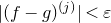
Lemma 2.6. Let $f\in \mathcal{C}_{a_0}$
and
$f\in \mathcal{C}_{a_0}$
and $a_0 \leqslant a \lt b$
. Suppose f is of class
$a_0 \leqslant a \lt b$
. Suppose f is of class $\mathcal{C}^n$
on
$\mathcal{C}^n$
on $[a,+\infty)$
and of class
$[a,+\infty)$
and of class $\mathcal{C}^{n+1}$
on
$\mathcal{C}^{n+1}$
on $[b,+\infty)$
. In addition, let functions
$[b,+\infty)$
. In addition, let functions $\varepsilon\in \mathcal{C}_{a_0}$
and
$\varepsilon\in \mathcal{C}_{a_0}$
and $g_{-}, g_{+}\in \mathcal{C}^{\infty}_{a_0}$
be given such that:
$g_{-}, g_{+}\in \mathcal{C}^{\infty}_{a_0}$
be given such that:
-
– $\varepsilon >0$
on
$[a_0,+\infty)$
;
$\varepsilon >0$
on
$[a_0,+\infty)$
; -
–
$|(f-g_{-})^{(j)}| \lt \varepsilon$
on
$[a,+\infty)$
for
$j=0,\dots,n$
; and -
–
$|(f-g_{+})^{(j)}| \lt \varepsilon$
on
$[b,+\infty)$
for
$j=0,\dots,n+1$
.








Then, for any $\delta\in {\mathbb R} ^{>}$
, there is a function
$\delta\in {\mathbb R} ^{>}$
, there is a function $g\in \mathcal{C}^{\infty}_{a_0}$
and a
$g\in \mathcal{C}^{\infty}_{a_0}$
and a $b'> b$
such that:
$b'> b$
such that:
-
(i)
$g=g_{-}$
on
$[a_0,b]$
and
$g=g_{+}$
on
$[b',+\infty)$
; -
(ii)
$|(f-g)^{(j)}| \lt (1+\delta)\varepsilon$
on
$[a,+\infty)$
for
$j=0,\dots,n$
; and -
(iii)
$|(f-g)^{(j)}| \lt \varepsilon$
on
$[b',+\infty)$
for
$j=0,\dots,n+1$
.







Proof. Let $b'>b$
, set
$b'>b$
, set $\beta:= \alpha_{b,b'}$
as in [Reference Aschenbrenner, van den Dries and van der HoevenAvdDvdH24a, (3.4)], and
$\beta:= \alpha_{b,b'}$
as in [Reference Aschenbrenner, van den Dries and van der HoevenAvdDvdH24a, (3.4)], and $g:= (1-\beta) g_{-}+\beta g_{+}$
on
$g:= (1-\beta) g_{-}+\beta g_{+}$
on $[a_0,+\infty)$
, so
$[a_0,+\infty)$
, so $g\in \mathcal{C}_{a_0}^{\infty}$
. Let
$g\in \mathcal{C}_{a_0}^{\infty}$
. Let $\delta>0$
; we show that if
$\delta>0$
; we show that if $b'-b$
is sufficiently large, then g satisfies conditions (i), (ii), and (iii). It is clear that condition (i) holds, and so condition (iii) holds as well. Then the inequality in condition (ii) holds on [a,b] and on
$b'-b$
is sufficiently large, then g satisfies conditions (i), (ii), and (iii). It is clear that condition (i) holds, and so condition (iii) holds as well. Then the inequality in condition (ii) holds on [a,b] and on $[b',+\infty)$
, so it suffices to consider what happens on [b,b’]. There we have, for
$[b',+\infty)$
, so it suffices to consider what happens on [b,b’]. There we have, for $j=0,\dots,n$
,
$j=0,\dots,n$
,
 $$(f-g)^{(j)} = f^{(j)}-((1-\beta) g_{-}^{(j)}+\beta g_{+}^{(j)})-\sum_{i=0}^{j-1}\binom{j}{i}\beta^{(j-i)}(g_{+}^{(i)}-g_{-}^{(i)}),$$
and
 $$f^{(j)}-((1-\beta) g_{-}^{(j)}+\beta g_{+}^{(j)})=(1-\beta)(f-g_{-})^{(j)} + \beta(f-g_{+})^{(j)},$$
so
 $$|f^{(j)}-((1-\beta) g_{-}^{(j)}+\beta g_{+}^{(j)})| \leqslant \max\{|(f-g_{-})^{(j)}|, |(f-g_{+})^{(j)}|\}<\varepsilon \text{ on [b,b'].}$$
By [Reference Aschenbrenner, van den Dries and van der HoevenAvdDvdH24a, (3.5)] we have reals $C_m\geqslant 1$
(independent of b’) with
$C_m\geqslant 1$
(independent of b’) with $\lvert\beta^{(m)}\rvert\leqslant C_m/(b'-b)^m$
. Hence, for
$\lvert\beta^{(m)}\rvert\leqslant C_m/(b'-b)^m$
. Hence, for $j=0,\dots,n$
, we have on [b,b’]
$j=0,\dots,n$
, we have on [b,b’]
 $$ \bigg|\sum_{i=0}^{j-1}\binom{j}{i}\beta^{(j-i)}(g_{+}^{(i)}-g_{-}^{(i)})\bigg| \leqslant \sum_{i=0}^{j-1} \binom{j}{i} \frac{C_{j-i}}{(b'-b)^{j-i}} \,|g_{+}^{(i)}-g_{-}^{(i)}|$$
and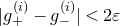 $|g_{+}^{(i)}-g_{-}^{(i)}|<2\varepsilon$
for
$|g_{+}^{(i)}-g_{-}^{(i)}|<2\varepsilon$
for $i=0,\dots,n$
. Thus, for
$i=0,\dots,n$
. Thus, for $b'-b$
so large that
$b'-b$
so large that
 $$\sum_{i=0}^{j-1}\binom{j}{i}\frac{C_{j-i}}{(b'-b)^{j-i}} \lt \delta/2,$$
condition (ii) is satisfied. (See also Figure 1.)
Constructing g from $g_-$
,
$g_-$
, $g_+$
.
$g_+$
.

Figure 1 Long description
The image depicts a line graph illustrating the construction of a function g from two other functions, g+ and g-. The graph features three distinct curves: a dotted line representing g+, a dashed line representing g-, and a solid line representing g. The x-axis is labeled t, and vertical dashed lines are drawn at specific points labeled a, b, and b'. The curves intersect at various points, demonstrating the relationships and differences between the functions over time.
Proposition 2.7. Suppose $f\in \mathcal{C}^{\lt \infty}$
and
$f\in \mathcal{C}^{\lt \infty}$
and $\varepsilon\in\mathcal{C}$
,
$\varepsilon\in\mathcal{C}$
, $\varepsilon>_{\mathrm{e}} 0$
. Then there exists
$\varepsilon>_{\mathrm{e}} 0$
. Then there exists $g\in \mathcal{C}^{\infty}$
such that
$g\in \mathcal{C}^{\infty}$
such that $|(f-g)^{(n)}| <_{\mathrm{e}} \varepsilon$
for all n.
$|(f-g)^{(n)}| <_{\mathrm{e}} \varepsilon$
for all n.
Proof. Represent f and $\varepsilon$
by continuous functions
$\varepsilon$
by continuous functions $ [a_0,+\infty)\to {\mathbb R} $
(
$ [a_0,+\infty)\to {\mathbb R} $
( $a_0\in {\mathbb R} $
), also denoted by f and
$a_0\in {\mathbb R} $
), also denoted by f and $\varepsilon$
, such that
$\varepsilon$
, such that $\varepsilon>0$
on
$\varepsilon>0$
on $[a_0,+\infty)$
. Next, take a strictly increasing sequence
$[a_0,+\infty)$
. Next, take a strictly increasing sequence $(a_n)$
of real numbers starting with the already given
$(a_n)$
of real numbers starting with the already given $a_0$
, such that
$a_0$
, such that $a_n\to \infty$
as
$a_n\to \infty$
as $n\to \infty$
, and f is of class
$n\to \infty$
, and f is of class $\mathcal{C}^n$
on
$\mathcal{C}^n$
on $[a_n,+\infty)$
, for each n. Then Corollary 2.3 gives, for each n, a function
$[a_n,+\infty)$
, for each n. Then Corollary 2.3 gives, for each n, a function $g_n\in \mathcal{C}_{a_0}^\infty$
such that
$g_n\in \mathcal{C}_{a_0}^\infty$
such that $|(f-g_n)^{(j)}|< \varepsilon/2$
on
$|(f-g_n)^{(j)}|< \varepsilon/2$
on $[a_n,+\infty)$
for
$[a_n,+\infty)$
for $j=0,\dots,n$
. All this remains true when increasing each
$j=0,\dots,n$
. All this remains true when increasing each $a_n$
while keeping
$a_n$
while keeping $a_0$
fixed and maintaining that
$a_0$
fixed and maintaining that $(a_n)$
is strictly increasing. Now use the lemma above to construct g as required: first glue
$(a_n)$
is strictly increasing. Now use the lemma above to construct g as required: first glue $g_0$
and
$g_0$
and $g_1$
and increase the
$g_1$
and increase the $a_n$
for
$a_n$
for $n\geqslant 1$
, then glue the resulting function with
$n\geqslant 1$
, then glue the resulting function with $g_2$
and increase the
$g_2$
and increase the $a_n$
for
$a_n$
for $n\geqslant 2$
, and so on, and arrange the product of the
$n\geqslant 2$
, and so on, and arrange the product of the $(1+\delta)$
-factors to be
$(1+\delta)$
-factors to be $<2$
.
$<2$
.
Now Corollary 2.5 (for $r=\infty$
) and Proposition 2.7 yield the following.
$r=\infty$
) and Proposition 2.7 yield the following.
Corollary 2.8. For any germs $f\in \mathcal{C}^{\lt \infty}$
and
$f\in \mathcal{C}^{\lt \infty}$
and $\varepsilon\in \mathcal{C}$
with
$\varepsilon\in \mathcal{C}$
with $\varepsilon>_{\mathrm{e}} 0$
, there exists a germ
$\varepsilon>_{\mathrm{e}} 0$
, there exists a germ $g\in \mathcal{C}^{\omega}$
such that
$g\in \mathcal{C}^{\omega}$
such that $|(f-g)^{(n)}| <_{\mathrm{e}} \varepsilon$
for all n.
$|(f-g)^{(n)}| <_{\mathrm{e}} \varepsilon$
for all n.
In the next section we apply Corollary 2.8 to bounded Hardy fields.
3. Bounded Hardy fields
As in [Reference Aschenbrenner, van den Dries and van der HoevenAvdDvdH24b, Section 5], a set $H\subseteq \mathcal C$
is called bounded if for some
$H\subseteq \mathcal C$
is called bounded if for some $\phi\in\mathcal C$
we have
$\phi\in\mathcal C$
we have $h\leqslant \phi$
for all
$h\leqslant \phi$
for all ${h\in H}$
, and unbounded otherwise. Every countable subset of
${h\in H}$
, and unbounded otherwise. Every countable subset of $\mathcal C$
is bounded, cf. [Reference Aschenbrenner, van den Dries and van der HoevenAvdDvdH24b, remarks after Lemma 5.17]. As a consequence, the union of countably many bounded subsets of
$\mathcal C$
is bounded, cf. [Reference Aschenbrenner, van den Dries and van der HoevenAvdDvdH24b, remarks after Lemma 5.17]. As a consequence, the union of countably many bounded subsets of $\mathcal C$
is also bounded.
$\mathcal C$
is also bounded.
In this section we first establish a few general facts about the class of bounded Hardy fields, notably an ‘analytification’ result (Corollary 3.4) needed for the proof of Proposition 4.5. We then focus on the subclass of Hardy fields with countable cofinality, and show it to be closed under natural differential-algebraic Hardy field extensions (Theorem 3.13). Some auxiliary results from this section (e.g. Lemmas 3.8, 3.15, and 3.16) are also used later, notably in § 6, where we continue our study of Hardy fields of countable cofinality.
3.1 Observations on bounded Hardy fields
In the rest of this section, H is a Hardy field. If H is bounded, then there is a $\phi\in\mathcal C$
with
$\phi\in\mathcal C$
with $\phi>_{\mathrm{e}}0$
and
$\phi>_{\mathrm{e}}0$
and $g\prec\phi$
for all
$g\prec\phi$
for all $g\in H$
, so
$g\in H$
, so $\varepsilon:=1/\phi\in\mathcal C^\times$
satisfies
$\varepsilon:=1/\phi\in\mathcal C^\times$
satisfies $\varepsilon>_{\mathrm{e}} 0$
and
$\varepsilon>_{\mathrm{e}} 0$
and $\varepsilon\prec h$
for all
$\varepsilon\prec h$
for all $h\in H^\times$
. A germ
$h\in H^\times$
. A germ $y\in\mathcal{C}$
is said to be H-hardian if it lies in a Hardy field extension of H, and hardian if it lies in some Hardy field (equivalently, it is
$y\in\mathcal{C}$
is said to be H-hardian if it lies in a Hardy field extension of H, and hardian if it lies in some Hardy field (equivalently, it is $ {\mathbb Q} $
-hardian). For
$ {\mathbb Q} $
-hardian). For $r\in\{\infty,\omega\}$
, if
$r\in\{\infty,\omega\}$
, if $H\subseteq\mathcal{C}^r$
and
$H\subseteq\mathcal{C}^r$
and $y\in\mathcal{C}^r$
is H-hardian, then
$y\in\mathcal{C}^r$
is H-hardian, then $H\langle y\rangle\subseteq\mathcal{C}^r$
; see [Reference Aschenbrenner, van den Dries and van der HoevenAvdDvdH24b, Section 4]. By [Reference Aschenbrenner, van den Dries and van der HoevenAvdDvdH24b, Lemmas 5.18, 5.19] we have the following.
$H\langle y\rangle\subseteq\mathcal{C}^r$
; see [Reference Aschenbrenner, van den Dries and van der HoevenAvdDvdH24b, Section 4]. By [Reference Aschenbrenner, van den Dries and van der HoevenAvdDvdH24b, Lemmas 5.18, 5.19] we have the following.
Lemma 3.1. If H is bounded, then any d-algebraic Hardy field extension of H is bounded, and for any H-hardian $f\in \mathcal{C}^{\lt \infty}$
, the Hardy field
$f\in \mathcal{C}^{\lt \infty}$
, the Hardy field $H\langle f \rangle $
is bounded.
$H\langle f \rangle $
is bounded.
Corollary 3.2. If H is bounded and F is a Hardy field extension of H and d-algebraic over $H\langle S \rangle $
for some countable
$H\langle S \rangle $
for some countable $S\subseteq F$
, then F is bounded.
$S\subseteq F$
, then F is bounded.
Lemma 3.3. Let $f,g\in\mathcal{C}^{\lt \infty}$
, where f is H-hardian, d-transcendental over H, and
$f,g\in\mathcal{C}^{\lt \infty}$
, where f is H-hardian, d-transcendental over H, and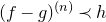 $({f-g})^{(n)}\prec h$
for all
$({f-g})^{(n)}\prec h$
for all $h\in H\langle f \rangle^{\times}$
and all n. Then the germ g is H-hardian, and there is a unique isomorphism
$h\in H\langle f \rangle^{\times}$
and all n. Then the germ g is H-hardian, and there is a unique isomorphism ${H\langle f\rangle\to H\langle g\rangle}$
of Hardy fields over H sending f to g.
${H\langle f\rangle\to H\langle g\rangle}$
of Hardy fields over H sending f to g.
Proof. Let $P\in H\{Y\}^{\neq}$
, so
$P\in H\{Y\}^{\neq}$
, so $P(f)\in H\langle f\rangle^\times$
. It suffices to show that then
$P(f)\in H\langle f\rangle^\times$
. It suffices to show that then ${P(f) \sim P(g)}$
. By Taylor expansion [Reference Aschenbrenner, van den Dries and van der HoevenAvdDvdH17, p. 210], with
${P(f) \sim P(g)}$
. By Taylor expansion [Reference Aschenbrenner, van den Dries and van der HoevenAvdDvdH17, p. 210], with $r:=\operatorname{order} P$
and
$r:=\operatorname{order} P$
and $\boldsymbol{i}$
ranging over
$\boldsymbol{i}$
ranging over $ {\mathbb N} ^{1+r}$
:
$ {\mathbb N} ^{1+r}$
:
 $$P(g) - P(f) = \sum_{\lvert\boldsymbol{i}\rvert\geqslant 1} P_{(\boldsymbol{i})}(f)(g-f)^{\boldsymbol{i}}\quad\text{where $P_{(\boldsymbol{i})}=\dfrac{P^{(\boldsymbol{i})}}{\boldsymbol{i}!}\in H\{Y\}$.}$$
If $\lvert\boldsymbol{i}\rvert\geqslant 1$
, then
$\lvert\boldsymbol{i}\rvert\geqslant 1$
, then $(g-f)^{\boldsymbol{i}}\prec h$
for all
$(g-f)^{\boldsymbol{i}}\prec h$
for all $h\in H\langle f\rangle^{\times}$
, and hence
$h\in H\langle f\rangle^{\times}$
, and hence $P_{(\boldsymbol{i})}(f)(g-f)^{\boldsymbol{i}} \prec P(f)$
. Therefore,
$P_{(\boldsymbol{i})}(f)(g-f)^{\boldsymbol{i}} \prec P(f)$
. Therefore, ${P(g)-P(f)\prec P(f)}$
as required.
${P(g)-P(f)\prec P(f)}$
as required.
With Corollary 2.8 we now obtain analytic ‘copies’ of certain H-hardian germs.
Corollary 3.4. Suppose H is bounded and f in a Hardy field extension of H is d-transcendental over H. Then there is an H-hardian $g\in\mathcal{C}^\omega$
and an isomorphism
$g\in\mathcal{C}^\omega$
and an isomorphism $H\langle f\rangle\to H\langle g\rangle$
of Hardy fields over H sending f to g.
$H\langle f\rangle\to H\langle g\rangle$
of Hardy fields over H sending f to g.
Proof. By Lemma 3.1, the Hardy field $H\langle f\rangle$
is bounded, so we can take
$H\langle f\rangle$
is bounded, so we can take $\varepsilon\in\mathcal{C}^\times$
with
$\varepsilon\in\mathcal{C}^\times$
with $\varepsilon>_{\mathrm{e}} 0$
and
$\varepsilon>_{\mathrm{e}} 0$
and $\varepsilon \prec h$
for all
$\varepsilon \prec h$
for all $h\in H\langle f\rangle^\times$
. Corollary 2.8 yields a
$h\in H\langle f\rangle^\times$
. Corollary 2.8 yields a $g\in\mathcal{C}^\omega$
such that
$g\in\mathcal{C}^\omega$
such that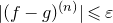 $\lvert(f-g)^{(n)}\rvert\leqslant \varepsilon$
for all n, and so it remains to appeal to Lemma 3.3.
$\lvert(f-g)^{(n)}\rvert\leqslant \varepsilon$
for all n, and so it remains to appeal to Lemma 3.3.
Recall from [Reference Aschenbrenner, van den Dries and van der HoevenAvdDvdH17, 10.6] that an H-field L is said to be Liouville closed if it is real closed and for all $f,g\in L$
there exists
$f,g\in L$
there exists $y\in L^\times$
with
$y\in L^\times$
with $y'+fy=g$
. If
$y'+fy=g$
. If $H\supseteq {\mathbb R} $
, then our Hardy field H is an H-field, and H has a smallest Liouville closed Hardy field extension
$H\supseteq {\mathbb R} $
, then our Hardy field H is an H-field, and H has a smallest Liouville closed Hardy field extension ${\operatorname{Li}}(H)$
. (See [Reference Aschenbrenner, van den Dries and van der HoevenAvdDvdH24b, Section 4].) We can now also strengthen [Reference Aschenbrenner, van den Dries and van der HoevenAvdDvdH24a, Theorem 5.1] as follows.
${\operatorname{Li}}(H)$
. (See [Reference Aschenbrenner, van den Dries and van der HoevenAvdDvdH24b, Section 4].) We can now also strengthen [Reference Aschenbrenner, van den Dries and van der HoevenAvdDvdH24a, Theorem 5.1] as follows.
Corollary 3.5. Suppose $H\supseteq {\mathbb R} $
is Liouville closed, and
$H\supseteq {\mathbb R} $
is Liouville closed, and $\phi\in\mathcal{C}$
,
$\phi\in\mathcal{C}$
, $\phi>_{\mathrm{e}}H$
. Then there is an H-hardian
$\phi>_{\mathrm{e}}H$
. Then there is an H-hardian $z\in\mathcal{C}^\omega$
with
$z\in\mathcal{C}^\omega$
with $z>_{\mathrm{e}}\phi$
.
$z>_{\mathrm{e}}\phi$
.
Proof. By [Reference Aschenbrenner, van den Dries and van der HoevenAvdDvdH24a, Theorem 5.1] we have an H-hardian $y\in\mathcal{C}^\infty$
with
$y\in\mathcal{C}^\infty$
with $y>_{\mathrm{e}}\phi +1$
. Then y is d-transcendental over H and
$y>_{\mathrm{e}}\phi +1$
. Then y is d-transcendental over H and $H\langle y \rangle$
is bounded, by [Reference Aschenbrenner, van den Dries and van der HoevenAvdDvdH24b, Lemma 5.1] and Lemma 3.1. This yields
$H\langle y \rangle$
is bounded, by [Reference Aschenbrenner, van den Dries and van der HoevenAvdDvdH24b, Lemma 5.1] and Lemma 3.1. This yields $\varepsilon\in\mathcal{C}$
such that
$\varepsilon\in\mathcal{C}$
such that $\varepsilon>_{\mathrm{e}} 0$
and
$\varepsilon>_{\mathrm{e}} 0$
and $\varepsilon \prec h$
for all
$\varepsilon \prec h$
for all $h\in H\langle y\rangle^\times$
. Now Corollary 2.8 gives
$h\in H\langle y\rangle^\times$
. Now Corollary 2.8 gives $z\in\mathcal{C}^\omega$
with
$z\in\mathcal{C}^\omega$
with $\lvert y^{(n)}-z^{(n)}\rvert \lt _{\mathrm{e}}\varepsilon$
for all n. Then z is H-hardian by Lemma 3.3, and
$\lvert y^{(n)}-z^{(n)}\rvert \lt _{\mathrm{e}}\varepsilon$
for all n. Then z is H-hardian by Lemma 3.3, and $z=y+(z-y)>_{\mathrm{e}}\phi$
.
$z=y+(z-y)>_{\mathrm{e}}\phi$
.
Thus, maximal Hardy fields, maximal $\mathcal{C}^\infty$
-Hardy fields, and maximal
$\mathcal{C}^\infty$
-Hardy fields, and maximal $\mathcal{C}^{\omega}$
-Hardy fields are unbounded. (See also [Reference Aschenbrenner, van den Dries and van der HoevenAvdDvdH24b, Corollary 5.23 and succeeding remarks].) The cofinality of a totally ordered set S (that is, the smallest ordinal isomorphic to a cofinal subset of S) is denoted by
$\mathcal{C}^{\omega}$
-Hardy fields are unbounded. (See also [Reference Aschenbrenner, van den Dries and van der HoevenAvdDvdH24b, Corollary 5.23 and succeeding remarks].) The cofinality of a totally ordered set S (that is, the smallest ordinal isomorphic to a cofinal subset of S) is denoted by $\operatorname{cf}(S)$
; likewise,
$\operatorname{cf}(S)$
; likewise, $\operatorname{ci}(S)$
denotes the coinitiality of S; cf. [Reference Aschenbrenner, van den Dries and van der HoevenAvdDvdH17, 2.1]. As [Reference Aschenbrenner, van den Dries and van der HoevenAvdDvdH24a, Theorem 5.1] gave rise to [Reference Aschenbrenner, van den Dries and van der HoevenAvdDvdH24a, Corollary 5.2], so Corollary 3.5 yields the following.
$\operatorname{ci}(S)$
denotes the coinitiality of S; cf. [Reference Aschenbrenner, van den Dries and van der HoevenAvdDvdH17, 2.1]. As [Reference Aschenbrenner, van den Dries and van der HoevenAvdDvdH24a, Theorem 5.1] gave rise to [Reference Aschenbrenner, van den Dries and van der HoevenAvdDvdH24a, Corollary 5.2], so Corollary 3.5 yields the following.
Corollary 3.6. If H is a maximal analytic Hardy field, then $\operatorname{cf}(H) \gt \omega$
, and thus
$\operatorname{cf}(H) \gt \omega$
, and thus
 $$\operatorname{ci}(H) = \operatorname{cf}(H^{\lt a}) = \operatorname{ci}(H^{>a})> \omega\ \text{ for all $a\in H$.}$$
Likewise with ‘smooth’ in place of ‘analytic’.
Call a subset F of $\mathcal{C}$
cofinal if, for each
$\mathcal{C}$
cofinal if, for each $\phi\in\mathcal C$
, there exists
$\phi\in\mathcal C$
, there exists $f\in F$
with
$f\in F$
with $\phi\leqslant f$
. If
$\phi\leqslant f$
. If $F_1,F_2\subseteq\mathcal{C}$
and for all
$F_1,F_2\subseteq\mathcal{C}$
and for all $f_1\in F_1$
there is an
$f_1\in F_1$
there is an $f_2\in F_2$
with
$f_2\in F_2$
with $f_1\leqslant f_2$
, and
$f_1\leqslant f_2$
, and $F_1$
is cofinal, then
$F_1$
is cofinal, then $F_2$
is cofinal. Clearly each cofinal subset of
$F_2$
is cofinal. Clearly each cofinal subset of $\mathcal{C}$
is unbounded. The following strengthens [Reference SjödinSjö70, Theorem 7].
$\mathcal{C}$
is unbounded. The following strengthens [Reference SjödinSjö70, Theorem 7].
Corollary 3.7. Assume the continuum hypothesis: $2^{\aleph_0}=\aleph_1$
. Then there is a cofinal analytic Hardy field.
$2^{\aleph_0}=\aleph_1$
. Then there is a cofinal analytic Hardy field.
Proof. Put $\mathfrak c:=2^{\aleph_0}$
, and let
$\mathfrak c:=2^{\aleph_0}$
, and let $\alpha$
,
$\alpha$
, $\alpha'$
,
$\alpha'$
, $\beta$
range over ordinals
$\beta$
range over ordinals $<\mathfrak c$
. Choose an enumeration
$<\mathfrak c$
. Choose an enumeration $(\phi_\alpha)_{\alpha<\mathfrak c}$
of
$(\phi_\alpha)_{\alpha<\mathfrak c}$
of $\mathcal{C}$
. Suppose
$\mathcal{C}$
. Suppose $((H_\alpha,h_\alpha))_{\alpha<\beta}$
is a family of bounded analytic Hardy fields
$((H_\alpha,h_\alpha))_{\alpha<\beta}$
is a family of bounded analytic Hardy fields $H_\alpha$
, each with an element
$H_\alpha$
, each with an element $h_\alpha\in H_\alpha$
, such that
$h_\alpha\in H_\alpha$
, such that
 \begin{equation}\alpha<\alpha'<\beta\ \Rightarrow\ H_{\alpha}\subseteq H_{\alpha'}\quad\text{and}\quad\alpha<\beta\ \Rightarrow\ \phi_\alpha <_{\mathrm{e}} h_\alpha.\end{equation}
Then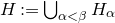 $H:=\bigcup_{\alpha<\beta}H_\alpha$
is an analytic Hardy field, and H is bounded, as the union of countably many bounded subsets of
$H:=\bigcup_{\alpha<\beta}H_\alpha$
is an analytic Hardy field, and H is bounded, as the union of countably many bounded subsets of $\mathcal C$
. By Lemma 3.1,
$\mathcal C$
. By Lemma 3.1, $H^*:={\operatorname{Li}}(H( {\mathbb R} ))$
is also bounded. Take
$H^*:={\operatorname{Li}}(H( {\mathbb R} ))$
is also bounded. Take $\phi\in\mathcal{C}$
with
$\phi\in\mathcal{C}$
with $\phi>_{\mathrm{e}} H^*$
and
$\phi>_{\mathrm{e}} H^*$
and $\phi\geqslant\phi_\beta$
. Corollary 3.5 yields an
$\phi\geqslant\phi_\beta$
. Corollary 3.5 yields an $H^*$
-hardian
$H^*$
-hardian $h_\beta\in\mathcal{C}^\omega$
with
$h_\beta\in\mathcal{C}^\omega$
with $h_\beta>_{\mathrm{e}}\phi$
. Then the analytic Hardy field
$h_\beta>_{\mathrm{e}}\phi$
. Then the analytic Hardy field $H_\beta:=H^*\langle h_\beta\rangle$
is bounded by Lemma 3.1, contains
$H_\beta:=H^*\langle h_\beta\rangle$
is bounded by Lemma 3.1, contains $H_\alpha$
for all
$H_\alpha$
for all $\alpha<\beta$
, and
$\alpha<\beta$
, and $\phi_\beta<_{\mathrm{e}}h_\beta$
.
$\phi_\beta<_{\mathrm{e}}h_\beta$
.
Now, transfinite recursion yields a family $((H_\alpha,h_\alpha))_{\alpha<\mathfrak c}$
, where
$((H_\alpha,h_\alpha))_{\alpha<\mathfrak c}$
, where $H_\alpha$
is a bounded analytic Hardy field and
$H_\alpha$
is a bounded analytic Hardy field and $h_\alpha\in H_\alpha$
such that (3.1) holds with
$h_\alpha\in H_\alpha$
such that (3.1) holds with $\mathfrak c$
in place of
$\mathfrak c$
in place of $\beta$
. Then
$\beta$
. Then $\bigcup_{\alpha<\mathfrak c} H_\alpha$
is a cofinal analytic Hardy field.
$\bigcup_{\alpha<\mathfrak c} H_\alpha$
is a cofinal analytic Hardy field.
See Corollary 5.14 for a strengthening of Corollary 3.7.
Remark. Vera Fischer suggested replacing the continuum hypothesis in Corollary 3.7 with $\mathfrak{b}=\mathfrak{d}$
, which is strictly weaker than the continuum hypothesis (provided, of course, that our base theory ZFC is consistent). Here,
$\mathfrak{b}=\mathfrak{d}$
, which is strictly weaker than the continuum hypothesis (provided, of course, that our base theory ZFC is consistent). Here, $\mathfrak{b}$
and
$\mathfrak{b}$
and $\mathfrak{d}$
are so-called cardinal characteristics of the continuum. See [Reference Blass, Foreman and KanamoriBla10, 2.1, 2.2] for their definitions, and [Reference Blass, Foreman and KanamoriBla10, 2.4] for the inequalities
$\mathfrak{d}$
are so-called cardinal characteristics of the continuum. See [Reference Blass, Foreman and KanamoriBla10, 2.1, 2.2] for their definitions, and [Reference Blass, Foreman and KanamoriBla10, 2.4] for the inequalities $\aleph_1\leqslant\mathfrak{b}\leqslant\mathfrak{d}\leqslant\mathfrak{c}$
. Martin’s axiom (MA) implies
$\aleph_1\leqslant\mathfrak{b}\leqslant\mathfrak{d}\leqslant\mathfrak{c}$
. Martin’s axiom (MA) implies $\mathfrak{b}=\mathfrak{d}=\mathfrak{c}$
; see [Reference Blass, Foreman and KanamoriBla10, 6.8, 6.9] and [Reference Rudin and BarwiseRud77, Corollary 8]. If ZFC is consistent, then MA is strictly weaker than the continuum hypothesis by [Reference Solovay and TennenbaumST71]. It is easy to check from their definitions that
$\mathfrak{b}=\mathfrak{d}=\mathfrak{c}$
; see [Reference Blass, Foreman and KanamoriBla10, 6.8, 6.9] and [Reference Rudin and BarwiseRud77, Corollary 8]. If ZFC is consistent, then MA is strictly weaker than the continuum hypothesis by [Reference Solovay and TennenbaumST71]. It is easy to check from their definitions that $\mathfrak{b}$
is the least cardinality of an unbounded subset of
$\mathfrak{b}$
is the least cardinality of an unbounded subset of $\mathcal{C}$
, and
$\mathcal{C}$
, and $\mathfrak{d}$
is the least cardinality of a cofinal subset of
$\mathfrak{d}$
is the least cardinality of a cofinal subset of $\mathcal{C}$
. Replacing
$\mathcal{C}$
. Replacing $\mathfrak{c}$
by
$\mathfrak{c}$
by $\mathfrak{d}$
in the proof above and taking
$\mathfrak{d}$
in the proof above and taking $(\phi_{\alpha})_{\alpha< \mathfrak{d}}$
to enumerate a cofinal subset of
$(\phi_{\alpha})_{\alpha< \mathfrak{d}}$
to enumerate a cofinal subset of $\mathcal{C}$
, the proof does indeed go through with
$\mathcal{C}$
, the proof does indeed go through with $\mathfrak{b}=\mathfrak{d}$
instead of the continuum hypothesis.
$\mathfrak{b}=\mathfrak{d}$
instead of the continuum hypothesis.
3.2 Hardy fields of countable cofinality
Hardy fields of countable cofinality are bounded. For later use we study here such Hardy fields in more detail. Given a valued differential field K, let C denote its constant field and $\Gamma$
its value group.
$\Gamma$
its value group.
Lemma 3.8. Let K be a pre-H-field with $\Gamma\neq\{0\}$
. Then
$\Gamma\neq\{0\}$
. Then $\operatorname{cf}(K)=\operatorname{cf}(\Gamma)$
.
$\operatorname{cf}(K)=\operatorname{cf}(\Gamma)$
.
Proof. Apply [Reference Aschenbrenner, van den Dries and van der HoevenAvdDvdH17, 2.1.4] to the increasing surjection $f\mapsto -vf\colon K^>\to\Gamma$
.
$f\mapsto -vf\colon K^>\to\Gamma$
.
In the next two lemmas, $\Gamma$
is an ordered abelian group. We recall from [Reference Aschenbrenner, van den Dries and van der HoevenAvdDvdH17, 2.4] that the archimedean class of
$\Gamma$
is an ordered abelian group. We recall from [Reference Aschenbrenner, van den Dries and van der HoevenAvdDvdH17, 2.4] that the archimedean class of $\alpha\in\Gamma$
is
$\alpha\in\Gamma$
is
 $$[\alpha] := \{ \beta\in\Gamma:\ \text{$\lvert\alpha\rvert\leqslant n\lvert\beta\rvert$ and $\lvert\beta\rvert\leqslant n\lvert\alpha\rvert$ for some $n\geqslant 1$} \}.$$
We write $[\alpha]_\Gamma$
instead of
$[\alpha]_\Gamma$
instead of $[\alpha]$
if we want to stress the dependence on
$[\alpha]$
if we want to stress the dependence on $\Gamma$
. We equip the set
$\Gamma$
. We equip the set $[\Gamma]=\{[\alpha]:\alpha\in\Gamma\}$
with the ordering satisfying
$[\Gamma]=\{[\alpha]:\alpha\in\Gamma\}$
with the ordering satisfying $[\alpha] \leqslant [\beta]$
if and only if
$[\alpha] \leqslant [\beta]$
if and only if $\lvert\alpha\rvert\leqslant n\lvert\beta\rvert$
for some
$\lvert\alpha\rvert\leqslant n\lvert\beta\rvert$
for some $n \geqslant 1$
. If
$n \geqslant 1$
. If $\Delta$
is an ordered subgroup of
$\Delta$
is an ordered subgroup of $\Gamma$
, then for each
$\Gamma$
, then for each $\delta\in\Delta$
we have
$\delta\in\Delta$
we have $[\delta]_\Delta=[\delta]_\Gamma\cap\Delta$
, and we have an embedding
$[\delta]_\Delta=[\delta]_\Gamma\cap\Delta$
, and we have an embedding ${[\delta]_\Delta\mapsto[\delta]_\Gamma\colon [\Delta] \to [\Gamma]}$
of ordered sets via which we identify
${[\delta]_\Delta\mapsto[\delta]_\Gamma\colon [\Delta] \to [\Gamma]}$
of ordered sets via which we identify $[\Delta]$
with an ordered subset of
$[\Delta]$
with an ordered subset of $[\Gamma]$
.
$[\Gamma]$
.
Lemma 3.9. Suppose $\Gamma\neq\{0\}$
. If
$\Gamma\neq\{0\}$
. If $[\Gamma]$
has no largest element, then
$[\Gamma]$
has no largest element, then $\operatorname{cf}(\Gamma)=\operatorname{cf}([\Gamma])$
; otherwise,
$\operatorname{cf}(\Gamma)=\operatorname{cf}([\Gamma])$
; otherwise, $\operatorname{cf}(\Gamma)=\omega$
.
$\operatorname{cf}(\Gamma)=\omega$
.
Proof. If $[\Gamma]$
has no largest element, then [Reference Aschenbrenner, van den Dries and van der HoevenAvdDvdH17, 2.1.4] applied to the increasing surjection
$[\Gamma]$
has no largest element, then [Reference Aschenbrenner, van den Dries and van der HoevenAvdDvdH17, 2.1.4] applied to the increasing surjection $\gamma\mapsto[\gamma]\colon\Gamma^{\geqslant}\to[\Gamma]$
yields
$\gamma\mapsto[\gamma]\colon\Gamma^{\geqslant}\to[\Gamma]$
yields $\operatorname{cf}(\Gamma)=\operatorname{cf}([\Gamma])$
. If
$\operatorname{cf}(\Gamma)=\operatorname{cf}([\Gamma])$
. If $\gamma\in\Gamma^{>}$
is such that
$\gamma\in\Gamma^{>}$
is such that $[\gamma]$
is the largest element of
$[\gamma]$
is the largest element of $[\Gamma]$
, then
$[\Gamma]$
, then $ {\mathbb N} \gamma$
is cofinal in
$ {\mathbb N} \gamma$
is cofinal in $\Gamma$
.
$\Gamma$
.
Let G be an abelian group, with divisible hull $ {\mathbb Q} G= {\mathbb Q} \otimes_{ {\mathbb Z} }G$
. Then
$ {\mathbb Q} G= {\mathbb Q} \otimes_{ {\mathbb Z} }G$
. Then $\operatorname{rank}_{ {\mathbb Q} } G:=\dim_{ {\mathbb Q} } {\mathbb Q} G$
(a cardinal) is the rational rank of G. (Note, in [Reference Aschenbrenner, van den Dries and van der HoevenAvdDvdH17, 1.7] we defined the rational rank of G to be
$\operatorname{rank}_{ {\mathbb Q} } G:=\dim_{ {\mathbb Q} } {\mathbb Q} G$
(a cardinal) is the rational rank of G. (Note, in [Reference Aschenbrenner, van den Dries and van der HoevenAvdDvdH17, 1.7] we defined the rational rank of G to be $\infty$
if the
$\infty$
if the $ {\mathbb Q} $
-linear space
$ {\mathbb Q} $
-linear space $ {\mathbb Q} G$
is not finitely generated.)
$ {\mathbb Q} G$
is not finitely generated.)
Lemma 3.10. Let $\Delta\ne\{0\}$
be an ordered subgroup of
$\Delta\ne\{0\}$
be an ordered subgroup of $\Gamma$
with
$\Gamma$
with ${\operatorname{rank}_{ {\mathbb Q} }(\Gamma/\Delta)\leqslant \aleph_0}$
. Then
${\operatorname{rank}_{ {\mathbb Q} }(\Gamma/\Delta)\leqslant \aleph_0}$
. Then $\operatorname{cf}(\Gamma)\leqslant\operatorname{cf}(\Delta)$
.
$\operatorname{cf}(\Gamma)\leqslant\operatorname{cf}(\Delta)$
.
Proof. By Lemma 3.9 we may assume that $[\Gamma]$
has no maximum. Let S be a well-ordered cofinal subset of
$[\Gamma]$
has no maximum. Let S be a well-ordered cofinal subset of $[\Delta]$
of order type
$[\Delta]$
of order type $\operatorname{cf}([\Delta])$
, so
$\operatorname{cf}([\Delta])$
, so $\lvert S\rvert=\operatorname{cf}([\Delta])$
. Then
$\lvert S\rvert=\operatorname{cf}([\Delta])$
. Then $\widetilde{S}:=S\cup( [\Gamma]\setminus[\Delta] )$
is cofinal in
$\widetilde{S}:=S\cup( [\Gamma]\setminus[\Delta] )$
is cofinal in $[\Gamma]$
, so
$[\Gamma]$
, so $\operatorname{cf}(\Gamma)=\operatorname{cf}([\Gamma])=\operatorname{cf}(\widetilde S)\leqslant\lvert\widetilde{S}\rvert$
by Lemma 3.9 and [Reference Aschenbrenner, van den Dries and van der HoevenAvdDvdH17, 2.1.2]. Since
$\operatorname{cf}(\Gamma)=\operatorname{cf}([\Gamma])=\operatorname{cf}(\widetilde S)\leqslant\lvert\widetilde{S}\rvert$
by Lemma 3.9 and [Reference Aschenbrenner, van den Dries and van der HoevenAvdDvdH17, 2.1.2]. Since $[\Gamma]\setminus [\Delta]$
is countable by [Reference Aschenbrenner, van den Dries and van der HoevenAvdDvdH17, 2.3.9], we have
$[\Gamma]\setminus [\Delta]$
is countable by [Reference Aschenbrenner, van den Dries and van der HoevenAvdDvdH17, 2.3.9], we have $\lvert\widetilde{S}\rvert\leqslant\max\{\lvert S\rvert,\omega\}=\max\{\operatorname{cf}([\Delta]),\omega\}$
. Now apply Lemma 3.9 to
$\lvert\widetilde{S}\rvert\leqslant\max\{\lvert S\rvert,\omega\}=\max\{\operatorname{cf}([\Delta]),\omega\}$
. Now apply Lemma 3.9 to $\Delta$
in place of
$\Delta$
in place of $\Gamma$
.
$\Gamma$
.
A valued differential field K has small derivation if, for all $f\in K$
:
$f\in K$
: $f\prec 1\Rightarrow f'\prec 1$
, and very small derivation if for all
$f\prec 1\Rightarrow f'\prec 1$
, and very small derivation if for all $f\in K$
:
$f\in K$
: $f\preccurlyeq 1\Rightarrow f'\prec 1$
. For more on this, see [Reference Aschenbrenner, van den Dries and van der HoevenAvdDvdH17, 4.4] and [Reference Aschenbrenner, van den Dries and van der HoevenAvdDvdH24d, Section 13], respectively.
$f\preccurlyeq 1\Rightarrow f'\prec 1$
. For more on this, see [Reference Aschenbrenner, van den Dries and van der HoevenAvdDvdH17, 4.4] and [Reference Aschenbrenner, van den Dries and van der HoevenAvdDvdH24d, Section 13], respectively.
Lemma 3.11. Let $K\subseteq L$
be an extension of pre-H-fields where
$K\subseteq L$
be an extension of pre-H-fields where $\operatorname{rank}_{ {\mathbb Q} }(\Gamma_L/\Gamma)$
is countable, and suppose
$\operatorname{rank}_{ {\mathbb Q} }(\Gamma_L/\Gamma)$
is countable, and suppose $\Gamma\neq\{0\}$
or L has very small derivation and archimedean residue field. Then
$\Gamma\neq\{0\}$
or L has very small derivation and archimedean residue field. Then $\operatorname{cf}(L)\leqslant\operatorname{cf}(K)$
.
$\operatorname{cf}(L)\leqslant\operatorname{cf}(K)$
.
Proof. If $\Gamma\neq\{0\}$
, then by Lemmas 3.8 and 3.10 we have
$\Gamma\neq\{0\}$
, then by Lemmas 3.8 and 3.10 we have $\operatorname{cf}(L)=\operatorname{cf}(\Gamma_L)\leqslant \operatorname{cf}(\Gamma)=\operatorname{cf}(K)$
. Suppose
$\operatorname{cf}(L)=\operatorname{cf}(\Gamma_L)\leqslant \operatorname{cf}(\Gamma)=\operatorname{cf}(K)$
. Suppose $\Gamma=\{0\}$
, so L has very small derivation and archimedean residue field. Then K is archimedean, so
$\Gamma=\{0\}$
, so L has very small derivation and archimedean residue field. Then K is archimedean, so $\operatorname{cf}(K)=\omega$
, and
$\operatorname{cf}(K)=\omega$
, and $\Gamma_L$
is countable, hence
$\Gamma_L$
is countable, hence $\operatorname{cf}(\Gamma_L)\leqslant\omega$
. Therefore, if
$\operatorname{cf}(\Gamma_L)\leqslant\omega$
. Therefore, if $\Gamma_L\neq\{0\}$
, then
$\Gamma_L\neq\{0\}$
, then $\operatorname{cf}(L)=\operatorname{cf}(\Gamma_L)\leqslant\omega=\operatorname{cf}(K)$
by Lemma 3.8 applied to L in place of K, and if
$\operatorname{cf}(L)=\operatorname{cf}(\Gamma_L)\leqslant\omega=\operatorname{cf}(K)$
by Lemma 3.8 applied to L in place of K, and if $\Gamma_L=\{0\}$
, then
$\Gamma_L=\{0\}$
, then $\operatorname{cf}(L)=\omega=\operatorname{cf}(K)$
.
$\operatorname{cf}(L)=\omega=\operatorname{cf}(K)$
.
By [Reference Aschenbrenner, van den Dries and van der HoevenAvdDvdH17, 3.1.10] the hypothesis on $\operatorname{rank}_{ {\mathbb Q} }(\Gamma_L/\Gamma)$
in Lemma 3.11 is satisfied if
$\operatorname{rank}_{ {\mathbb Q} }(\Gamma_L/\Gamma)$
in Lemma 3.11 is satisfied if $\operatorname{trdeg}(L|K)$
is countable. Hence this lemma yields the following result.
$\operatorname{trdeg}(L|K)$
is countable. Hence this lemma yields the following result.
Corollary 3.12. If F is a Hardy field extension of H such that $\operatorname{trdeg}(F|H)$
is countable, then
$\operatorname{trdeg}(F|H)$
is countable, then $\operatorname{cf}(F)\leqslant\operatorname{cf}(H)$
. Hence, if
$\operatorname{cf}(F)\leqslant\operatorname{cf}(H)$
. Hence, if $\operatorname{trdeg}(H|C_H)$
is countable, then
$\operatorname{trdeg}(H|C_H)$
is countable, then $\operatorname{cf}(H)=\omega$
(and so H is bounded).
$\operatorname{cf}(H)=\omega$
(and so H is bounded).
In [Reference Aschenbrenner, van den Dries and van der HoevenAvdDvdH24a, Corollary 3.13] we showed that if $H\supseteq {\mathbb R} $
and
$H\supseteq {\mathbb R} $
and $H^{> {\mathbb R} }$
has countable coinitiality, and
$H^{> {\mathbb R} }$
has countable coinitiality, and $H^{\operatorname{da}}$
is the d-closure of H in a maximal Hardy field extension of H, then
$H^{\operatorname{da}}$
is the d-closure of H in a maximal Hardy field extension of H, then $(H^{\operatorname{da}})^{> {\mathbb R} }$
also has countable coinitiality. The property of H having countable cofinality is equally robust.
$(H^{\operatorname{da}})^{> {\mathbb R} }$
also has countable coinitiality. The property of H having countable cofinality is equally robust.
Theorem 3.13. Let E be a differentially algebraic Hardy field extension of H with $\exp(E(x))\subseteq E(x)$
. Then
$\exp(E(x))\subseteq E(x)$
. Then $\operatorname{cf}(E) \leqslant \operatorname{cf}(H)$
, with equality if
$\operatorname{cf}(E) \leqslant \operatorname{cf}(H)$
, with equality if $\exp(H(x))\subseteq H(x)$
.
$\exp(H(x))\subseteq H(x)$
.
There is an immediate consequence as follows.
Corollary 3.14. If H has countable cofinality, then so does ${\operatorname{Li}}(H( {\mathbb R} ))$
as well as the d-closure of H in any maximal Hardy field extension of H.
${\operatorname{Li}}(H( {\mathbb R} ))$
as well as the d-closure of H in any maximal Hardy field extension of H.
We precede the proof of Theorem 3.13 by a few lemmas. In Lemmas 3.15 and 3.16 we let K be a pre-d-valued field of H-type with asymptotic couple $(\Gamma,\psi)$
, where
$(\Gamma,\psi)$
, where ${\Gamma\ne\{0\}}$
. By [Reference Aschenbrenner, van den Dries and van der HoevenAvdDvdH17, 10.3.1], K has a d-valued extension
${\Gamma\ne\{0\}}$
. By [Reference Aschenbrenner, van den Dries and van der HoevenAvdDvdH17, 10.3.1], K has a d-valued extension $\operatorname{dv}(K)$
of H-type, the d-valued hull of K, such that any embedding of K into any d-valued field L of H-type extends uniquely to an embedding
$\operatorname{dv}(K)$
of H-type, the d-valued hull of K, such that any embedding of K into any d-valued field L of H-type extends uniquely to an embedding $\operatorname{dv}(K) \to L$
.
$\operatorname{dv}(K) \to L$
.
Lemma 3.15. The value group $\Gamma$
is cofinal in
$\Gamma$
is cofinal in $\Gamma_{\operatorname{dv}(K)}$
.
$\Gamma_{\operatorname{dv}(K)}$
.
Proof. This is clear if $\Gamma=\Gamma_{\operatorname{dv}(K)}$
. Otherwise,
$\Gamma=\Gamma_{\operatorname{dv}(K)}$
. Otherwise, $\Gamma_{\operatorname{dv}(K)} = \Gamma+ {\mathbb Z} \alpha$
, where
$\Gamma_{\operatorname{dv}(K)} = \Gamma+ {\mathbb Z} \alpha$
, where $0<n\alpha<\Gamma^>$
for all
$0<n\alpha<\Gamma^>$
for all $n\geqslant 1$
, by [Reference Aschenbrenner, van den Dries and van der HoevenAvdDvdH17, 10.3.2], so
$n\geqslant 1$
, by [Reference Aschenbrenner, van den Dries and van der HoevenAvdDvdH17, 10.3.2], so $\Gamma$
is cofinal in
$\Gamma$
is cofinal in $\Gamma_{\operatorname{dv}(K)}$
.
$\Gamma_{\operatorname{dv}(K)}$
.
For the proof of the next lemma we recall that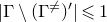 ${\lvert\Gamma\setminus (\Gamma^{\ne})'\rvert\leqslant 1}$
, and for
${\lvert\Gamma\setminus (\Gamma^{\ne})'\rvert\leqslant 1}$
, and for $\beta\in\Gamma$
we have
$\beta\in\Gamma$
we have $\beta\in \Gamma\setminus (\Gamma^{\ne})'$
if and only if
$\beta\in \Gamma\setminus (\Gamma^{\ne})'$
if and only if $\beta=\max\Psi$
or
$\beta=\max\Psi$
or $\Psi<\beta<(\Gamma^>)'$
, by [Reference Aschenbrenner, van den Dries and van der HoevenAvdDvdH17, 9.2.1 and 9.2.16]. We say that K has asymptotic integration if
$\Psi<\beta<(\Gamma^>)'$
, by [Reference Aschenbrenner, van den Dries and van der HoevenAvdDvdH17, 9.2.1 and 9.2.16]. We say that K has asymptotic integration if $\Gamma=(\Gamma^{\ne})'$
and K is grounded if
$\Gamma=(\Gamma^{\ne})'$
and K is grounded if $\Psi$
has a largest element. A gap in K is a
$\Psi$
has a largest element. A gap in K is a $\beta\in\Gamma$
such that
$\beta\in\Gamma$
such that $\Psi<\beta<(\Gamma^>)'$
. (Thus, there is at most one gap in K, and K has asymptotic integration or is grounded if and only if it has no gap.) For all this, see [Reference Aschenbrenner, van den Dries and van der HoevenAvdDvdH17, 9.1 and 9.2].
$\Psi<\beta<(\Gamma^>)'$
. (Thus, there is at most one gap in K, and K has asymptotic integration or is grounded if and only if it has no gap.) For all this, see [Reference Aschenbrenner, van den Dries and van der HoevenAvdDvdH17, 9.1 and 9.2].
Lemma 3.16. Let $s\in K$
and
$s\in K$
and $y'=s$
, y in a pre-d-valued extension of K of H-type. Then
$y'=s$
, y in a pre-d-valued extension of K of H-type. Then $\Gamma$
is cofinal in
$\Gamma$
is cofinal in $\Gamma_{K(y)}$
.
$\Gamma_{K(y)}$
.
Proof. Set $L:=K(y)$
and
$L:=K(y)$
and $M:=\operatorname{dv}(L)$
. Lemma 3.15 allows us to replace K by its d-valued hull inside M to arrange that K is d-valued. Using [Reference Aschenbrenner, van den Dries and van der HoevenAvdDvdH17, 10.5.15 and the remark preceding 4.6.16], we replace K by
$M:=\operatorname{dv}(L)$
. Lemma 3.15 allows us to replace K by its d-valued hull inside M to arrange that K is d-valued. Using [Reference Aschenbrenner, van den Dries and van der HoevenAvdDvdH17, 10.5.15 and the remark preceding 4.6.16], we replace K by $K(C_M)$
to arrange L to also be d-valued with
$K(C_M)$
to arrange L to also be d-valued with $C=C_L$
. Finally, replacing K by its algebraic closure inside an algebraic closure of L, we arrange K to be algebraically closed. We may assume
$C=C_L$
. Finally, replacing K by its algebraic closure inside an algebraic closure of L, we arrange K to be algebraically closed. We may assume $y\notin K$
, so y is transcendental over K. Then
$y\notin K$
, so y is transcendental over K. Then
 $$S := \{ v(s-a') : a\in K\} \subseteq \Gamma.$$
Assume for now that S has a maximum $\beta$
. Then
$\beta$
. Then $\beta\notin (\Gamma^{\neq})'$
by [Reference Aschenbrenner, van den Dries and van der HoevenAvdDvdH17, 10.2.5(i)], so
$\beta\notin (\Gamma^{\neq})'$
by [Reference Aschenbrenner, van den Dries and van der HoevenAvdDvdH17, 10.2.5(i)], so $\beta=\max\Psi$
or
$\beta=\max\Psi$
or $\beta$
is a gap in K. If
$\beta$
is a gap in K. If $\beta=\max\Psi$
, then
$\beta=\max\Psi$
, then $\Gamma_{L}=\Gamma+ {\mathbb Z} \alpha$
with
$\Gamma_{L}=\Gamma+ {\mathbb Z} \alpha$
with $\Gamma^{\lt} \lt n\alpha \lt 0$
for all
$\Gamma^{\lt} \lt n\alpha \lt 0$
for all $n\geqslant 1$
, so
$n\geqslant 1$
, so $\Gamma$
is cofinal in
$\Gamma$
is cofinal in $\Gamma_{L}$
. Suppose
$\Gamma_{L}$
. Suppose $\beta$
is a gap in K. Take
$\beta$
is a gap in K. Take $a\in K$
with
$a\in K$
with $\beta=v(s-a')$
and set
$\beta=v(s-a')$
and set $z:= y-a$
, so
$z:= y-a$
, so $z'=s-a'$
. We arrange
$z'=s-a'$
. We arrange $z\not\asymp 1$
by replacing a with
$z\not\asymp 1$
by replacing a with $a+c$
for suitable
$a+c$
for suitable $c\in C_L=C$
. If
$c\in C_L=C$
. If $z\prec 1$
, then [Reference Aschenbrenner, van den Dries and van der HoevenAvdDvdH17, 10.2.1 and its proof] gives
$z\prec 1$
, then [Reference Aschenbrenner, van den Dries and van der HoevenAvdDvdH17, 10.2.1 and its proof] gives $\Gamma_{L}=\Gamma+ {\mathbb Z} \alpha$
with
$\Gamma_{L}=\Gamma+ {\mathbb Z} \alpha$
with $0 \lt n\alpha \lt \Gamma^{>}$
for all
$0 \lt n\alpha \lt \Gamma^{>}$
for all $n\geqslant 1$
, so
$n\geqslant 1$
, so $\Gamma$
is cofinal in
$\Gamma$
is cofinal in $\Gamma_{L}$
. If
$\Gamma_{L}$
. If $z\succ 1$
, then [Reference Aschenbrenner, van den Dries and van der HoevenAvdDvdH17, 10.2.2 and its proof] gives likewise that
$z\succ 1$
, then [Reference Aschenbrenner, van den Dries and van der HoevenAvdDvdH17, 10.2.2 and its proof] gives likewise that $\Gamma$
is cofinal in
$\Gamma$
is cofinal in $\Gamma_{L}$
.
$\Gamma_{L}$
.
If S does not have a largest element, then L is an immediate extension of K: this holds by [Reference Aschenbrenner, van den Dries and van der HoevenAvdDvdH17, 10.2.6] if $S<(\Gamma^>)'$
; otherwise, take
$S<(\Gamma^>)'$
; otherwise, take $a\in K$
with
$a\in K$
with $v(s-a')\in(\Gamma^>)'$
and
$v(s-a')\in(\Gamma^>)'$
and $y-a\not\asymp 1$
, and apply [Reference Aschenbrenner, van den Dries and van der HoevenAvdDvdH17, 10.2.4 and 10.2.5(iii)] to
$y-a\not\asymp 1$
, and apply [Reference Aschenbrenner, van den Dries and van der HoevenAvdDvdH17, 10.2.4 and 10.2.5(iii)] to $s-a'$
,
$s-a'$
, $y-a$
in place of s, y, respectively.
$y-a$
in place of s, y, respectively.
Lemmas 3.8 and 3.16 and [Reference Aschenbrenner, van den Dries and van der HoevenAvdDvdH24b, Proposition 4.2(iv)] yield the following.
Lemma 3.17. If $H\subseteq {\mathbb R} $
, then
$H\subseteq {\mathbb R} $
, then $x^ {\mathbb N} $
is cofinal in H(x), and if
$x^ {\mathbb N} $
is cofinal in H(x), and if $H\not\subseteq {\mathbb R} $
, then H is cofinal in H(x). Hence,
$H\not\subseteq {\mathbb R} $
, then H is cofinal in H(x). Hence, $\operatorname{cf}(H)=\operatorname{cf}(H(x))$
.
$\operatorname{cf}(H)=\operatorname{cf}(H(x))$
.
We can now give the proof of Theorem 3.13. First, replacing E, H by E(x), H(x), respectively, and using the last lemma, we arrange $x\in H$
. Let S be a well-ordered cofinal subset of H of order type
$x\in H$
. Let S be a well-ordered cofinal subset of H of order type $\operatorname{cf}(H)$
. For
$\operatorname{cf}(H)$
. For $\phi\in \mathcal{C}$
, define
$\phi\in \mathcal{C}$
, define $\exp_n(\phi)\in\mathcal{C}$
by recursion:
$\exp_n(\phi)\in\mathcal{C}$
by recursion: $\exp_0(\phi):=\phi$
and
$\exp_0(\phi):=\phi$
and $\exp_{n+1}(\phi):=\mathrm{e}^{\exp_n(\phi)}$
. Then
$\exp_{n+1}(\phi):=\mathrm{e}^{\exp_n(\phi)}$
. Then $\lvert S\rvert=\operatorname{cf}(H)$
, and
$\lvert S\rvert=\operatorname{cf}(H)$
, and $\widetilde S:=\bigcup_n \exp_n(S)$
is a cofinal subset of E, by [Reference Aschenbrenner, van den Dries and van der HoevenAvdDvdH24b, Lemma 5.1]. Thus,
$\widetilde S:=\bigcup_n \exp_n(S)$
is a cofinal subset of E, by [Reference Aschenbrenner, van den Dries and van der HoevenAvdDvdH24b, Lemma 5.1]. Thus, $\operatorname{cf}(E)=\operatorname{cf}(\widetilde S)\leqslant\lvert\widetilde S\rvert=\lvert S\rvert=\operatorname{cf}(H)$
as claimed. If
$\operatorname{cf}(E)=\operatorname{cf}(\widetilde S)\leqslant\lvert\widetilde S\rvert=\lvert S\rvert=\operatorname{cf}(H)$
as claimed. If $\exp(H)\subseteq H$
, then
$\exp(H)\subseteq H$
, then $\widetilde S\subseteq H$
, hence
$\widetilde S\subseteq H$
, hence $\operatorname{cf}(E)=\operatorname{cf}(H)$
.
$\operatorname{cf}(E)=\operatorname{cf}(H)$
.
The following corollary of Lemma 3.15 is not used later. If K is a pre-H-field, then by [Reference Aschenbrenner, van den Dries and van der HoevenAvdDvdH17, 10.5.13] there is a unique field ordering on $\operatorname{dv}(K)$
making it a pre-H-field extension of K. Equipped with this ordering,
$\operatorname{dv}(K)$
making it a pre-H-field extension of K. Equipped with this ordering, $\operatorname{dv}(K)$
is an H-field, the H-field hull of K, which embeds uniquely over K into any H-field extension of K, notation: H(K) (not to be confused with the Hardy field
$\operatorname{dv}(K)$
is an H-field, the H-field hull of K, which embeds uniquely over K into any H-field extension of K, notation: H(K) (not to be confused with the Hardy field $H( {\mathbb R} )$
generated over the Hardy field H by
$H( {\mathbb R} )$
generated over the Hardy field H by $ {\mathbb R} $
).
$ {\mathbb R} $
).
Corollary 3.18. The Hardy field H is cofinal in $H( {\mathbb R} )$
.
$H( {\mathbb R} )$
.
Proof. This is clear if $H\subseteq {\mathbb R} $
; assume
$H\subseteq {\mathbb R} $
; assume $H\not\subseteq {\mathbb R} $
. Let E be the H-field hull of H, taken as an H-subfield of the Hardy field extension
$H\not\subseteq {\mathbb R} $
. Let E be the H-field hull of H, taken as an H-subfield of the Hardy field extension $H( {\mathbb R} )$
of H. Then H is cofinal in E (Lemma 3.15), so replacing H by E we arrange that H is an H-field. Now use that
$H( {\mathbb R} )$
of H. Then H is cofinal in E (Lemma 3.15), so replacing H by E we arrange that H is an H-field. Now use that $\Gamma_{H( {\mathbb R} )}=\Gamma_H\neq\{0\}$
by [Reference Aschenbrenner, van den Dries and van der HoevenAvdDvdH17, 10.5.15 and the remark preceding 4.6.16].
$\Gamma_{H( {\mathbb R} )}=\Gamma_H\neq\{0\}$
by [Reference Aschenbrenner, van den Dries and van der HoevenAvdDvdH17, 10.5.15 and the remark preceding 4.6.16].
For use in § 6 we include the following cofinality result, which is immediate from Lemma 3.9 and [Reference Aschenbrenner, van den Dries and van der HoevenAvdDvdH17, 10.4.5(i)].
Lemma 3.19. Let K be a d-valued field of H-type with divisible asymptotic couple $(\Gamma,\psi)$
,
$(\Gamma,\psi)$
, $\Gamma\neq\{0\}$
, and let
$\Gamma\neq\{0\}$
, and let $s\in K$
be such that
$s\in K$
be such that
 $$S:=\{ v(s-a^\dagger): a\in K^\times\} \lt (\Gamma^>)'$$
and S has no largest element. Let f be an element of an H-asymptotic field extension of K, transcendental over K, with $f^\dagger = s$
. Then
$f^\dagger = s$
. Then $[\Gamma]=[\Gamma_{K(f)}]$
, so
$[\Gamma]=[\Gamma_{K(f)}]$
, so $\Gamma$
is cofinal in
$\Gamma$
is cofinal in $\Gamma_{K(f)}$
.
$\Gamma_{K(f)}$
.
4. Pseudoconvergence in analytic Hardy fields
We complement the material on pc-sequences from [Reference Aschenbrenner, van den Dries and van der HoevenAvdDvdH24a, Sections 3 and 4] by criteria for germs in $\mathcal{C}^{\lt \infty}$
to be pseudolimits of pc-sequences in Hardy fields, and then use this to show that each pc-sequence of countable length in an analytic Hardy field has an analytic pseudolimit. The main results to this effect are Propositions 4.3, 4.4, and 4.5. In this section H is a Hardy field.
$\mathcal{C}^{\lt \infty}$
to be pseudolimits of pc-sequences in Hardy fields, and then use this to show that each pc-sequence of countable length in an analytic Hardy field has an analytic pseudolimit. The main results to this effect are Propositions 4.3, 4.4, and 4.5. In this section H is a Hardy field.
4.1 Revisiting pseudoconvergence in Hardy fields
Let $H\supseteq {\mathbb R} (x)$
be real closed with asymptotic integration and
$H\supseteq {\mathbb R} (x)$
be real closed with asymptotic integration and $(f_\rho)$
a pc-sequence in H of d-transcendental type over H (cf. [Reference Aschenbrenner, van den Dries and van der HoevenAvdDvdH17, 4.4]) with pseudolimit f in a Hardy field extension of H. Then the valued field extension
$(f_\rho)$
a pc-sequence in H of d-transcendental type over H (cf. [Reference Aschenbrenner, van den Dries and van der HoevenAvdDvdH17, 4.4]) with pseudolimit f in a Hardy field extension of H. Then the valued field extension $H\langle f\rangle\supseteq H$
is immediate by [Reference Aschenbrenner, van den Dries and van der HoevenAvdDvdH17, 11.4.7 and 11.4.13]. In [Reference Aschenbrenner, van den Dries and van der HoevenAvdDvdH24a] we only considered pc-sequences of countable length, but here we do not assume
$H\langle f\rangle\supseteq H$
is immediate by [Reference Aschenbrenner, van den Dries and van der HoevenAvdDvdH17, 11.4.7 and 11.4.13]. In [Reference Aschenbrenner, van den Dries and van der HoevenAvdDvdH24a] we only considered pc-sequences of countable length, but here we do not assume $(f_{\rho})$
has countable length (to be exploited in the proof of Theorem B). We begin by deriving a sufficient condition on
$(f_{\rho})$
has countable length (to be exploited in the proof of Theorem B). We begin by deriving a sufficient condition on $y\in \mathcal{C}^{\lt \infty}$
to be H-hardian with
$y\in \mathcal{C}^{\lt \infty}$
to be H-hardian with ${f_\rho\leadsto y}$
. This will enable us to find such y in
${f_\rho\leadsto y}$
. This will enable us to find such y in $\mathcal{C}^{\omega}$
. (Another possible use is to find such y with oscillating
$\mathcal{C}^{\omega}$
. (Another possible use is to find such y with oscillating $y-f$
, so that
$y-f$
, so that $H\langle y \rangle $
and
$H\langle y \rangle $
and $H\langle f \rangle $
are ‘incompatible’ Hardy field extensions of H.) To simplify notation, set
$H\langle f \rangle $
are ‘incompatible’ Hardy field extensions of H.) To simplify notation, set $t:= x^{-1}$
. Let
$t:= x^{-1}$
. Let $\phi\in H^\times$
. Recall from [Reference Aschenbrenner, van den Dries and van der HoevenAvdDvdH17, 11.1] that
$\phi\in H^\times$
. Recall from [Reference Aschenbrenner, van den Dries and van der HoevenAvdDvdH17, 11.1] that $\phi$
is said to be active in H if
$\phi$
is said to be active in H if $\phi\succcurlyeq h^\dagger$
for some
$\phi\succcurlyeq h^\dagger$
for some $h\in H^\times$
,
$h\in H^\times$
, $h\not\asymp 1$
. Denoting by
$h\not\asymp 1$
. Denoting by $\partial$
the derivation of the differential ring
$\partial$
the derivation of the differential ring $\mathcal{C}^{\lt \infty}$
, we let
$\mathcal{C}^{\lt \infty}$
, we let $(\mathcal{C}^{\lt \infty})^\phi$
be the ring
$(\mathcal{C}^{\lt \infty})^\phi$
be the ring $\mathcal{C}^{\lt \infty}$
equipped with the derivation
$\mathcal{C}^{\lt \infty}$
equipped with the derivation $\delta:=\phi^{-1}\partial$
and
$\delta:=\phi^{-1}\partial$
and $H^\phi$
be the ordered valued field H equipped with the restriction of
$H^\phi$
be the ordered valued field H equipped with the restriction of $\delta$
to H; we then have a ring isomorphism
$\delta$
to H; we then have a ring isomorphism $P\mapsto P^\phi\colon \mathcal{C}^{\lt \infty}\{Y\}\to(\mathcal{C}^{\lt \infty})^\phi\{Y\}$
with
$P\mapsto P^\phi\colon \mathcal{C}^{\lt \infty}\{Y\}\to(\mathcal{C}^{\lt \infty})^\phi\{Y\}$
with $P(y)=P^\phi(y)$
for each
$P(y)=P^\phi(y)$
for each $y\in\mathcal{C}^{\lt \infty}$
. We first observe the following.
$y\in\mathcal{C}^{\lt \infty}$
. We first observe the following.
Lemma 4.1. Let $\phi$
be active in H,
$\phi$
be active in H, $0< \phi\prec 1$
, let
$0< \phi\prec 1$
, let $\delta:=\phi^{-1}\partial$
be the derivation of
$\delta:=\phi^{-1}\partial$
be the derivation of $(\mathcal{C}^{\lt \infty})^\phi$
, and let
$(\mathcal{C}^{\lt \infty})^\phi$
, and let $z\in\mathcal{C}^{\lt \infty}$
satisfy
$z\in\mathcal{C}^{\lt \infty}$
satisfy $z^{(i)}\prec t^j$
for all i, j. Then
$z^{(i)}\prec t^j$
for all i, j. Then $\delta^k(z)\prec 1$
for all k.
$\delta^k(z)\prec 1$
for all k.
Proof. This is clear for $k=0$
. Suppose
$k=0$
. Suppose $k\geqslant 1$
. The identity (3.1) in [Reference Aschenbrenner, van den Dries and van der HoevenAvdDvdH24a] gives
$k\geqslant 1$
. The identity (3.1) in [Reference Aschenbrenner, van den Dries and van der HoevenAvdDvdH24a] gives
 $$\delta^k(z)=\phi^{-k}\sum_{j=1}^kR^k_j(-\phi^\dagger)z^{(j)}\quad\text{where $R^k_j(Z)\in {\mathbb Q} \{Z\}$ for $j=1,\dots,k$.}$$
This yields $\delta^k(z)\prec 1$
in view of
$\delta^k(z)\prec 1$
in view of $\phi^\dagger\preccurlyeq 1$
and
$\phi^\dagger\preccurlyeq 1$
and $z^{(j)}\prec t^{2k}\prec \phi^k$
for
$z^{(j)}\prec t^{2k}\prec \phi^k$
for $j=1,\dots,k$
.
$j=1,\dots,k$
.
The proof of the next result uses various items from [Reference Aschenbrenner, van den Dries and van der HoevenAvdDvdH17]: for $P_{+h}$
,
$P_{+h}$
, $P_{\times h}$
see [Reference Aschenbrenner, van den Dries and van der HoevenAvdDvdH17, 4.3]; for
$P_{\times h}$
see [Reference Aschenbrenner, van den Dries and van der HoevenAvdDvdH17, 4.3]; for $\operatorname{ddeg}_{\prec {\mathfrak v}}P$
, see [Reference Aschenbrenner, van den Dries and van der HoevenAvdDvdH17, 6.6]; for
$\operatorname{ddeg}_{\prec {\mathfrak v}}P$
, see [Reference Aschenbrenner, van den Dries and van der HoevenAvdDvdH17, 6.6]; for $\operatorname{ndeg}_{\prec {\mathfrak v}}P$
, see [Reference Aschenbrenner, van den Dries and van der HoevenAvdDvdH17, 11.1]; and for Z(H,f), see [Reference Aschenbrenner, van den Dries and van der HoevenAvdDvdH17, 11.4].
$\operatorname{ndeg}_{\prec {\mathfrak v}}P$
, see [Reference Aschenbrenner, van den Dries and van der HoevenAvdDvdH17, 11.1]; and for Z(H,f), see [Reference Aschenbrenner, van den Dries and van der HoevenAvdDvdH17, 11.4].
Lemma 4.2. Let $y\in\mathcal{C}^{\lt \infty}$
be such that for all
$y\in\mathcal{C}^{\lt \infty}$
be such that for all $h\in H$
,
$h\in H$
, ${\mathfrak m}\in H^\times$
with
${\mathfrak m}\in H^\times$
with $f-h\preccurlyeq{\mathfrak m}$
and all n there is an active
$f-h\preccurlyeq{\mathfrak m}$
and all n there is an active $\phi_0$
in H such that for all active
$\phi_0$
in H such that for all active $\phi>0$
in H with
$\phi>0$
in H with $\phi\preccurlyeq \phi_0$
we have
$\phi\preccurlyeq \phi_0$
we have $\delta^n(({y-h})/{{\mathfrak m}})\preccurlyeq 1$
for
$\delta^n(({y-h})/{{\mathfrak m}})\preccurlyeq 1$
for ${\delta=\phi^{-1}\partial}$
. Then y is H-hardian and there is a Hardy field isomorphism
${\delta=\phi^{-1}\partial}$
. Then y is H-hardian and there is a Hardy field isomorphism ${H\langle y\rangle \to H\langle f\rangle}$
over H sending y to f.
${H\langle y\rangle \to H\langle f\rangle}$
over H sending y to f.
Proof. First, $Z(H,f)=\emptyset$
by [Reference Aschenbrenner, van den Dries and van der HoevenAvdDvdH17, 11.4.13], since
$Z(H,f)=\emptyset$
by [Reference Aschenbrenner, van den Dries and van der HoevenAvdDvdH17, 11.4.13], since $(f_{\rho})$
is of d-transcendental type over H and
$(f_{\rho})$
is of d-transcendental type over H and $f_{\rho}\leadsto f$
. It is enough to show that
$f_{\rho}\leadsto f$
. It is enough to show that $Q(y) \sim Q(f)$
for all
$Q(y) \sim Q(f)$
for all ${Q\in H\{Y\}\setminus H}$
. Let
${Q\in H\{Y\}\setminus H}$
. Let $Q\in H\{Y\}\setminus H$
. Then
$Q\in H\{Y\}\setminus H$
. Then $Q\notin Z(H,f)$
, so we have
$Q\notin Z(H,f)$
, so we have $h\in H$
and
$h\in H$
and ${\mathfrak v}\in H^\times$
such that
${\mathfrak v}\in H^\times$
such that ${h-f\prec {\mathfrak v}}$
and
${h-f\prec {\mathfrak v}}$
and $\operatorname{ndeg}_{\prec {\mathfrak v}}Q_{+h}=0$
. Since
$\operatorname{ndeg}_{\prec {\mathfrak v}}Q_{+h}=0$
. Since $H\langle f \rangle \supseteq H$
is immediate, we have
$H\langle f \rangle \supseteq H$
is immediate, we have ${{\mathfrak m}\in H^\times}$
with
${{\mathfrak m}\in H^\times}$
with $f-h\asymp {\mathfrak m}$
. Let
$f-h\asymp {\mathfrak m}$
. Let $r:=\operatorname{order} Q$
and choose active
$r:=\operatorname{order} Q$
and choose active $\phi_0$
in H such that for all active
$\phi_0$
in H such that for all active $\phi>0$
in H with
$\phi>0$
in H with $\phi\preccurlyeq \phi_0$
we have
$\phi\preccurlyeq \phi_0$
we have $\delta^{{\kern1pt}j}({y-h}/{{\mathfrak m}})\preccurlyeq 1$
for
$\delta^{{\kern1pt}j}({y-h}/{{\mathfrak m}})\preccurlyeq 1$
for ${\delta=\phi^{-1}\partial}$
and
${\delta=\phi^{-1}\partial}$
and $j=0,\dots,r$
. Now take any
$j=0,\dots,r$
. Now take any ${\mathfrak w}\in H^\times$
with
${\mathfrak w}\in H^\times$
with ${\mathfrak m}\prec{\mathfrak w}\prec{\mathfrak v}$
. Then
${\mathfrak m}\prec{\mathfrak w}\prec{\mathfrak v}$
. Then $\operatorname{ndeg} Q_{+h,\times{\mathfrak w}}=0$
, so we can choose an active
$\operatorname{ndeg} Q_{+h,\times{\mathfrak w}}=0$
, so we can choose an active $\phi>0$
in H with
$\phi>0$
in H with $\phi\preccurlyeq\phi_0$
and
$\phi\preccurlyeq\phi_0$
and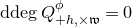 $\operatorname{ddeg} Q^\phi_{+h,\times{\mathfrak w}}=0$
. Then
$\operatorname{ddeg} Q^\phi_{+h,\times{\mathfrak w}}=0$
. Then $\operatorname{ddeg}_{\prec{\mathfrak w}} Q^\phi_{+h}=0$
, so renaming
$\operatorname{ddeg}_{\prec{\mathfrak w}} Q^\phi_{+h}=0$
, so renaming ${\mathfrak w}$
as
${\mathfrak w}$
as ${\mathfrak v}$
we arrange
${\mathfrak v}$
we arrange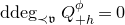 $\operatorname{ddeg}_{\prec{\mathfrak v}} Q^\phi_{+h}=0$
.
$\operatorname{ddeg}_{\prec{\mathfrak v}} Q^\phi_{+h}=0$
.
Using $(\phantom{-})^\circ$
as explained in [Reference Aschenbrenner, van den Dries and van der HoevenAvdDvdH24d, Section 8], we have the Hardy field
$(\phantom{-})^\circ$
as explained in [Reference Aschenbrenner, van den Dries and van der HoevenAvdDvdH24d, Section 8], we have the Hardy field $H\langle f\rangle^\circ$
and the H-field isomorphism
$H\langle f\rangle^\circ$
and the H-field isomorphism $h\mapsto h^\circ\colon H\langle f\rangle^\phi\to H\langle f\rangle^\circ$
. Put
$h\mapsto h^\circ\colon H\langle f\rangle^\phi\to H\langle f\rangle^\circ$
. Put $u:=(y-h)/{\mathfrak m}\in \mathcal{C}^{\lt \infty}$
. Then
$u:=(y-h)/{\mathfrak m}\in \mathcal{C}^{\lt \infty}$
. Then $\operatorname{ddeg}_{\prec{\mathfrak v}^\circ} Q^{\phi\circ}_{+h^\circ}=0$
and
$\operatorname{ddeg}_{\prec{\mathfrak v}^\circ} Q^{\phi\circ}_{+h^\circ}=0$
and $(u^\circ)^{(j)}\preccurlyeq 1$
for
$(u^\circ)^{(j)}\preccurlyeq 1$
for ${j=0,\dots,r}$
, hence
${j=0,\dots,r}$
, hence $Q^{\phi\circ}(y^\circ)\sim Q^{\phi\circ}(f^\circ)$
by [Reference Aschenbrenner, van den Dries and van der HoevenAvdDvdH24d, Lemma 11.7] with
$Q^{\phi\circ}(y^\circ)\sim Q^{\phi\circ}(f^\circ)$
by [Reference Aschenbrenner, van den Dries and van der HoevenAvdDvdH24d, Lemma 11.7] with $H^\circ$
,
$H^\circ$
, $H\langle f\rangle^\circ$
,
$H\langle f\rangle^\circ$
, $h^\circ$
,
$h^\circ$
, $f^\circ$
,
$f^\circ$
, ${\mathfrak m}^\circ$
,
${\mathfrak m}^\circ$
, $Q^{\phi\circ}$
,
$Q^{\phi\circ}$
, ${\mathfrak v}^\circ$
, and
${\mathfrak v}^\circ$
, and $y^\circ$
in place of H,
$y^\circ$
in place of H, $\widehat H$
, h,
$\widehat H$
, h, $\widehat h$
,
$\widehat h$
, ${\mathfrak m}$
, Q,
${\mathfrak m}$
, Q, ${\mathfrak v}$
, and y, respectively. This yields
${\mathfrak v}$
, and y, respectively. This yields $Q(y) \sim Q(f)$
, since
$Q(y) \sim Q(f)$
, since $Q^{\phi\circ}(g^\circ)=Q(g)^\circ$
for
$Q^{\phi\circ}(g^\circ)=Q(g)^\circ$
for $g\in\mathcal{C}^{\lt \infty}$
.
$g\in\mathcal{C}^{\lt \infty}$
.
Proposition 4.3. Suppose $0\in v(f-H)$
and
$0\in v(f-H)$
and $y\in \mathcal{C}^{\lt \infty}$
is such that for all
$y\in \mathcal{C}^{\lt \infty}$
is such that for all ${\mathfrak m}\in H^\times$
with
${\mathfrak m}\in H^\times$
with $v{\mathfrak m}\in v(f-H)$
and all i, j, k we have
$v{\mathfrak m}\in v(f-H)$
and all i, j, k we have
 $$y^{(i)}-f^{(i)}\ \prec\ {\mathfrak m}^j t^k\quad \text{in $\mathcal{C}^{\lt \infty}$.}$$
Then y is H-hardian and there is an isomorphism $H\langle y\rangle \to H\langle f\rangle$
of Hardy fields over H sending y to f (and thus
$H\langle y\rangle \to H\langle f\rangle$
of Hardy fields over H sending y to f (and thus $f_\rho\leadsto y$
).
$f_\rho\leadsto y$
).
Proof. Let $\phi$
be active in H,
$\phi$
be active in H, $0<\phi\prec 1$
, and
$0<\phi\prec 1$
, and $\delta=\phi^{-1}\partial$
the derivation of
$\delta=\phi^{-1}\partial$
the derivation of $(\mathcal{C}^{\lt \infty})^\phi$
. In addition, let
$(\mathcal{C}^{\lt \infty})^\phi$
. In addition, let $h\in H$
and
$h\in H$
and ${\mathfrak m}\in H^\times$
with
${\mathfrak m}\in H^\times$
with $f-h\preccurlyeq {\mathfrak m}$
, and put
$f-h\preccurlyeq {\mathfrak m}$
, and put $z:=(y-f)/{{\mathfrak m}}$
. By Lemma 4.2 it suffices to show that then
$z:=(y-f)/{{\mathfrak m}}$
. By Lemma 4.2 it suffices to show that then $\delta^k( ({y-h})/{{\mathfrak m}} )\preccurlyeq 1$
for all k; equivalently,
$\delta^k( ({y-h})/{{\mathfrak m}} )\preccurlyeq 1$
for all k; equivalently, $\delta^k (z)\preccurlyeq 1$
for all k (thanks to
$\delta^k (z)\preccurlyeq 1$
for all k (thanks to $({y-h})/{{\mathfrak m}}-z = ({f-h})/{{\mathfrak m}}\preccurlyeq 1$
and the smallness of the derivation of
$({y-h})/{{\mathfrak m}}-z = ({f-h})/{{\mathfrak m}}\preccurlyeq 1$
and the smallness of the derivation of $H\langle f\rangle^\phi$
).
$H\langle f\rangle^\phi$
).
Claim 1. Suppose ${\mathfrak m}\preccurlyeq 1$
. Then
${\mathfrak m}\preccurlyeq 1$
. Then $z^{(n)} \prec {\mathfrak m}^jt^k$
for all n, j, k.
$z^{(n)} \prec {\mathfrak m}^jt^k$
for all n, j, k.
This holds for $n=0$
because
$n=0$
because ${\mathfrak m} z\prec {\mathfrak m}^{j+1}t^k$
for all j, k. Let
${\mathfrak m} z\prec {\mathfrak m}^{j+1}t^k$
for all j, k. Let $n\geqslant 1$
and assume inductively that
$n\geqslant 1$
and assume inductively that $z^{(i)}\prec {\mathfrak m}^jt^k$
for
$z^{(i)}\prec {\mathfrak m}^jt^k$
for $i=0,\dots, n-1$
and all j, k. Now
$i=0,\dots, n-1$
and all j, k. Now $({\mathfrak m} z)^{(n)}= y^{(n)}-f^{(n)}\prec {\mathfrak m}^jt^k$
for all j, k, and
$({\mathfrak m} z)^{(n)}= y^{(n)}-f^{(n)}\prec {\mathfrak m}^jt^k$
for all j, k, and
 $$({\mathfrak m} z)^{(n)}\ =\ \ {\mathfrak m}^{(n)}z + \cdots + {\mathfrak m} z^{(n)}.$$
Since ${\mathfrak m}\preccurlyeq 1$
, the smallness of the derivation of H and the inductive assumption gives
${\mathfrak m}\preccurlyeq 1$
, the smallness of the derivation of H and the inductive assumption gives ${\mathfrak m}^{(n-i)}z^{(i)}\preccurlyeq z^{(i)}\prec{\mathfrak m}^jt^k$
for
${\mathfrak m}^{(n-i)}z^{(i)}\preccurlyeq z^{(i)}\prec{\mathfrak m}^jt^k$
for $i=0,\dots,n-1$
and all j, k, so
$i=0,\dots,n-1$
and all j, k, so ${\mathfrak m} z^{(n)} \prec {\mathfrak m}^jt^k$
for all j, k, and thus
${\mathfrak m} z^{(n)} \prec {\mathfrak m}^jt^k$
for all j, k, and thus $z^{(n)}\prec {\mathfrak m}^jt^k$
for all j, k.
$z^{(n)}\prec {\mathfrak m}^jt^k$
for all j, k.
Claim 2. We claim that $\delta^k (z)\prec 1$
for all k.
$\delta^k (z)\prec 1$
for all k.
If ${\mathfrak m}\preccurlyeq 1$
, then this holds by Claim 1 and Lemma 4.1. In general, take
${\mathfrak m}\preccurlyeq 1$
, then this holds by Claim 1 and Lemma 4.1. In general, take $h_1\in H$
with
$h_1\in H$
with $f-h_1\prec f-h$
and
$f-h_1\prec f-h$
and $f-h_1\preccurlyeq 1$
, and then
$f-h_1\preccurlyeq 1$
, and then ${\mathfrak m}_1\in H^\times$
with
${\mathfrak m}_1\in H^\times$
with $f-h_1\asymp{\mathfrak m}_1$
. By the special case just proved, with
$f-h_1\asymp{\mathfrak m}_1$
. By the special case just proved, with $h_1$
,
$h_1$
, ${\mathfrak m}_1$
in place of h,
${\mathfrak m}_1$
in place of h, ${\mathfrak m}$
, we have
${\mathfrak m}$
, we have $\delta^k ( ({y-f})/{{\mathfrak m}_1} )\prec 1$
for all k. Now
$\delta^k ( ({y-f})/{{\mathfrak m}_1} )\prec 1$
for all k. Now $z = (({y-f})/{{\mathfrak m}_1})({{\mathfrak m}_1}/{{\mathfrak m}})$
and
$z = (({y-f})/{{\mathfrak m}_1})({{\mathfrak m}_1}/{{\mathfrak m}})$
and ${{\mathfrak m}_1}/{{\mathfrak m}} \prec 1$
(in H), so the claim follows using the product rule for the derivation of
${{\mathfrak m}_1}/{{\mathfrak m}} \prec 1$
(in H), so the claim follows using the product rule for the derivation of $(\mathcal{C}^{\lt \infty})^\phi$
and the smallness of the derivation of
$(\mathcal{C}^{\lt \infty})^\phi$
and the smallness of the derivation of $H^\phi$
.
$H^\phi$
.
The following is a more useful variant for the case $0\notin v(f-H)$
.
$0\notin v(f-H)$
.
Proposition 4.4. Suppose $0\notin v(f-H)$
, and
$0\notin v(f-H)$
, and $y\in \mathcal{C}^{\lt \infty}$
is such that
$y\in \mathcal{C}^{\lt \infty}$
is such that
 $$y^{(i)}-f^{(i)}\ \prec\ t^k \text{ for all i, k.}$$
Then y is H-hardian and there is an isomorphism $H\langle y\rangle \to H\langle f\rangle$
of Hardy fields over H sending y to f.
$H\langle y\rangle \to H\langle f\rangle$
of Hardy fields over H sending y to f.
Proof. Let $\phi$
, h,
$\phi$
, h, ${\mathfrak m}$
, z be as in the proof of Proposition 4.3; as in that proof, it suffices to show that
${\mathfrak m}$
, z be as in the proof of Proposition 4.3; as in that proof, it suffices to show that $\delta^k (z)\preccurlyeq 1$
for all k. Now
$\delta^k (z)\preccurlyeq 1$
for all k. Now $v(f-H)$
is downward closed, so
$v(f-H)$
is downward closed, so $v(f-H)<0$
, which gives
$v(f-H)<0$
, which gives $1\prec f-h\preccurlyeq{\mathfrak m}$
. Thus,
$1\prec f-h\preccurlyeq{\mathfrak m}$
. Thus, ${\mathfrak m}\succ 1$
, hence with
${\mathfrak m}\succ 1$
, hence with $\mathfrak{n}:= {\mathfrak m}^{-1}\in H^\times$
we have
$\mathfrak{n}:= {\mathfrak m}^{-1}\in H^\times$
we have $z=\mathfrak{n}(y-f)$
and
$z=\mathfrak{n}(y-f)$
and $\mathfrak{n}\prec 1$
, so in view of
$\mathfrak{n}\prec 1$
, so in view of $z^{(i)}=\mathfrak{n}^{(i)}(y-f)+\cdots + \mathfrak{n}(y-f)^{(i)}$
we obtain
$z^{(i)}=\mathfrak{n}^{(i)}(y-f)+\cdots + \mathfrak{n}(y-f)^{(i)}$
we obtain $z^{(i)}\prec t^j$
for all i, j, and Lemma 4.1 then yields
$z^{(i)}\prec t^j$
for all i, j, and Lemma 4.1 then yields $\delta^k (z)\prec 1$
for each k.
$\delta^k (z)\prec 1$
for each k.
Multiplicative conjugation gives a reduction to Proposition 4.4, except when $(f_{\rho})$
is a cauchy sequence, not just a pc-sequence. We shall exploit this several times.
$(f_{\rho})$
is a cauchy sequence, not just a pc-sequence. We shall exploit this several times.
4.2 Constructing analytic pseudolimits in Hardy field extensions
Let $(f_{\rho})$
be a pc-sequence in H. Corollary 3.2 from [Reference Aschenbrenner, van den Dries and van der HoevenAvdDvdH24a] says that if
$(f_{\rho})$
be a pc-sequence in H. Corollary 3.2 from [Reference Aschenbrenner, van den Dries and van der HoevenAvdDvdH24a] says that if $(f_\rho)$
has countable length, then
$(f_\rho)$
has countable length, then $(f_{\rho})$
pseudoconverges in some Hardy field extension of H. Using Corollary 2.8 and Proposition 4.4 we now deduce smooth and analytic versions of this key fact. We say that an H-field with real closed constant field is closed if it has no proper d-algebraic H-field extension with the same constant field. (This is not how ‘closed’ was introduced in [Reference Aschenbrenner, van den Dries and van der HoevenAvdDvdH24a], but it is equivalent to it in view of [Reference Aschenbrenner, van den Dries and van der HoevenAvdDvdH17, 16.0.3 and the proof of 16.4.8].) By [Reference Aschenbrenner, van den Dries and van der HoevenAvdDvdH24d, Corollary 11.20], every maximal Hardy field is a closed H-field; likewise with ‘maximal smooth’ or ‘maximal analytic’ in place of ‘maximal’. Every closed H-field is Liouville closed, by [Reference Aschenbrenner, van den Dries and van der HoevenAvdDvdH17, 10.6.13 and 10.6.14], and every divergent pc-sequence in a closed H-field is of d-transcendental type over it, by [Reference Aschenbrenner, van den Dries and van der HoevenAvdDvdH17, 11.4.8 and 11.4.13].
$(f_{\rho})$
pseudoconverges in some Hardy field extension of H. Using Corollary 2.8 and Proposition 4.4 we now deduce smooth and analytic versions of this key fact. We say that an H-field with real closed constant field is closed if it has no proper d-algebraic H-field extension with the same constant field. (This is not how ‘closed’ was introduced in [Reference Aschenbrenner, van den Dries and van der HoevenAvdDvdH24a], but it is equivalent to it in view of [Reference Aschenbrenner, van den Dries and van der HoevenAvdDvdH17, 16.0.3 and the proof of 16.4.8].) By [Reference Aschenbrenner, van den Dries and van der HoevenAvdDvdH24d, Corollary 11.20], every maximal Hardy field is a closed H-field; likewise with ‘maximal smooth’ or ‘maximal analytic’ in place of ‘maximal’. Every closed H-field is Liouville closed, by [Reference Aschenbrenner, van den Dries and van der HoevenAvdDvdH17, 10.6.13 and 10.6.14], and every divergent pc-sequence in a closed H-field is of d-transcendental type over it, by [Reference Aschenbrenner, van den Dries and van der HoevenAvdDvdH17, 11.4.8 and 11.4.13].
Proposition 4.5. Suppose H is an analytic Hardy field and $(f_\rho)$
pseudoconverges in some Hardy field extension of H. Suppose also that H is bounded or
$(f_\rho)$
pseudoconverges in some Hardy field extension of H. Suppose also that H is bounded or $(f_\rho)$
does not have width
$(f_\rho)$
does not have width $\{\infty\}$
in the valued field H. Then
$\{\infty\}$
in the valued field H. Then $(f_\rho)$
pseudoconverges in an analytic Hardy field extension of H. Likewise with ‘smooth’ in place of ‘analytic’.
$(f_\rho)$
pseudoconverges in an analytic Hardy field extension of H. Likewise with ‘smooth’ in place of ‘analytic’.
Proof. Assume H is analytic; the smooth case goes the same way. As in [Reference Aschenbrenner, van den Dries and van der HoevenAvdDvdH24a], we can pass from H to an extension of H and reduce to the case that $H\supseteq {\mathbb R} $
, H is closed, and
$H\supseteq {\mathbb R} $
, H is closed, and $(f_{\rho})$
has no pseudolimit in H. Take f in a Hardy field extension of H such that
$(f_{\rho})$
has no pseudolimit in H. Take f in a Hardy field extension of H such that $f_{\rho}\leadsto f$
. Then
$f_{\rho}\leadsto f$
. Then $f\notin H$
, so f is d-transcendental over H. If H is bounded, then Corollary 3.4 yields an H-hardian
$f\notin H$
, so f is d-transcendental over H. If H is bounded, then Corollary 3.4 yields an H-hardian $y\in \mathcal{C}^{\omega}$
with
$y\in \mathcal{C}^{\omega}$
with ${f_{\rho}\leadsto y}$
.
${f_{\rho}\leadsto y}$
.
Suppose $(f_\rho)$
does not have width
$(f_\rho)$
does not have width $\{\infty\}$
. Then take
$\{\infty\}$
. Then take $h\in H^\times$
with
$h\in H^\times$
with ${v(hf-hf_{\rho})} \lt 0$
for all
${v(hf-hf_{\rho})} \lt 0$
for all $\rho$
. Take
$\rho$
. Take $\varepsilon\in \mathcal{C}$
such that
$\varepsilon\in \mathcal{C}$
such that $\varepsilon>_{\mathrm{e}} 0$
and
$\varepsilon>_{\mathrm{e}} 0$
and $\varepsilon \prec t^k$
for all k, for example,
$\varepsilon \prec t^k$
for all k, for example, $\varepsilon= \mathrm{e}^{-x}$
. Now Corollary 2.8 gives
$\varepsilon= \mathrm{e}^{-x}$
. Now Corollary 2.8 gives $y\in \mathcal{C}^{\omega}$
such that
$y\in \mathcal{C}^{\omega}$
such that $(hf)^{(i)}-y^{(i)}\prec t^k$
for all k. Then y is H-hardian and
$(hf)^{(i)}-y^{(i)}\prec t^k$
for all k. Then y is H-hardian and $hf_{\rho}\leadsto y$
by Proposition 4.4, hence
$hf_{\rho}\leadsto y$
by Proposition 4.4, hence $h^{-1}y\in \mathcal{C}^{\omega}$
is H-hardian and
$h^{-1}y\in \mathcal{C}^{\omega}$
is H-hardian and $f_{\rho}\leadsto h^{-1}y$
.
$f_{\rho}\leadsto h^{-1}y$
.
Corollary 4.6. If H is an analytic Hardy field, then every pc-sequence in H of countable length pseudoconverges in an analytic Hardy field extension of H. Likewise with ‘smooth’ in place of ‘analytic’.
Proof. Suppose $(f_\rho)$
has countable length. Then
$(f_\rho)$
has countable length. Then $(f_\rho)$
pseudoconverges in a Hardy field extension of H, by [Reference Aschenbrenner, van den Dries and van der HoevenAvdDvdH24a, Corollary 3.2]. Moreover, if
$(f_\rho)$
pseudoconverges in a Hardy field extension of H, by [Reference Aschenbrenner, van den Dries and van der HoevenAvdDvdH24a, Corollary 3.2]. Moreover, if $(f_\rho)$
has width
$(f_\rho)$
has width $\{\infty\}$
, then
$\{\infty\}$
, then $(v(f-f_\rho))$
is cofinal in
$(v(f-f_\rho))$
is cofinal in $\Gamma_H$
, so
$\Gamma_H$
, so $\operatorname{cf}(H)=\operatorname{cf}(\Gamma_H)=\omega$
by Lemma 3.8, hence H is bounded. Now use Proposition 4.5.
$\operatorname{cf}(H)=\operatorname{cf}(\Gamma_H)=\omega$
by Lemma 3.8, hence H is bounded. Now use Proposition 4.5.
Arguing as in the proof of [Reference Aschenbrenner, van den Dries and van der HoevenAvdDvdH24a, Corollary 4.8], using Corollary 4.6 instead of [Reference Aschenbrenner, van den Dries and van der HoevenAvdDvdH24a, Corollary 3.2], yields the following
Corollary 4.7. If H is a maximal analytic or maximal smooth Hardy field, then $\operatorname{ci}(H^{> {\mathbb R} })>\omega$
.
$\operatorname{ci}(H^{> {\mathbb R} })>\omega$
.
Recall from [Reference Aschenbrenner, van den Dries and van der HoevenAvdDvdH24a,§ 6] that the H-couple $(\Gamma,\psi)$
of H is said to be countably spherically complete if in the valued abelian group
$(\Gamma,\psi)$
of H is said to be countably spherically complete if in the valued abelian group $(\Gamma,\psi)$
, every pc-sequence of length
$(\Gamma,\psi)$
, every pc-sequence of length $\omega$
in it pseudoconverges in it. In view of [Reference Aschenbrenner, van den Dries and van der HoevenAvdDvdH24a, remark preceding Corollary 8.1], Corollaries 3.6, 4.6, and 4.7 yield a version of [Reference Aschenbrenner, van den Dries and van der HoevenAvdDvdH24a, Corollary 8.1] for maximal analytic Hardy fields as follows.
$\omega$
in it pseudoconverges in it. In view of [Reference Aschenbrenner, van den Dries and van der HoevenAvdDvdH24a, remark preceding Corollary 8.1], Corollaries 3.6, 4.6, and 4.7 yield a version of [Reference Aschenbrenner, van den Dries and van der HoevenAvdDvdH24a, Corollary 8.1] for maximal analytic Hardy fields as follows.
Corollary 4.8. If H is a maximal analytic or maximal smooth Hardy field, then its H-couple $(\Gamma,\psi)$
is countably spherically complete and
$(\Gamma,\psi)$
is countably spherically complete and
 $$\operatorname{cf}(\Gamma^{\lt}) = \operatorname{ci}(\Gamma^{>})\ >\ \omega, \quad \operatorname{ci}(\Gamma) = \operatorname{cf}(\Gamma)\ >\ \omega.$$
5. Proofs of Theorems A and B
We begin with revisiting case (b) extensions, then prove Theorem A and use it to characterize the possible gaps in maximal analytic Hardy fields. We also determine the number of maximal analytic Hardy fields. Next we prove Theorem B, and finish this section with two subsections on dense pairs of closed H-fields.
5.1 Case (b) extensions
Let $H\supseteq {\mathbb R} $
be a Liouville closed Hardy field with H-couple
$H\supseteq {\mathbb R} $
be a Liouville closed Hardy field with H-couple $(\Gamma,\psi)$
over
$(\Gamma,\psi)$
over $ {\mathbb R} $
. Suppose
$ {\mathbb R} $
. Suppose $\beta$
in an H-couple
$\beta$
in an H-couple $(\Gamma^*,\psi^*)$
over
$(\Gamma^*,\psi^*)$
over $ {\mathbb R} $
extending
$ {\mathbb R} $
extending $(\Gamma,\psi)$
falls under case (b), that is, with
$(\Gamma,\psi)$
falls under case (b), that is, with $(\Gamma\langle \beta \rangle , \psi_{\beta})$
the H-couple over
$(\Gamma\langle \beta \rangle , \psi_{\beta})$
the H-couple over $ {\mathbb R} $
generated by
$ {\mathbb R} $
generated by $\beta$
over
$\beta$
over $(\Gamma, \psi)$
in
$(\Gamma, \psi)$
in $(\Gamma^*, \psi^*)$
.
$(\Gamma^*, \psi^*)$
.
(b) We have a sequence $(\alpha_i)$
in
$(\alpha_i)$
in $\Gamma$
and a sequence
$\Gamma$
and a sequence $(\beta_i)$
in
$(\beta_i)$
in $\Gamma^*$
that is
$\Gamma^*$
that is $ {\mathbb R} $
-linearly independent over
$ {\mathbb R} $
-linearly independent over $\Gamma$
, such that
$\Gamma$
, such that $\beta_0=\beta-\alpha_0$
and
$\beta_0=\beta-\alpha_0$
and $\beta_{i+1}=\beta_i^\dagger-\alpha_{i+1}$
for all i, and such that
$\beta_{i+1}=\beta_i^\dagger-\alpha_{i+1}$
for all i, and such that $\Gamma\langle \beta \rangle =\Gamma \oplus \bigoplus_{i=0}^\infty {\mathbb R} \beta_i$
.
$\Gamma\langle \beta \rangle =\Gamma \oplus \bigoplus_{i=0}^\infty {\mathbb R} \beta_i$
.
Unlike in key parts of [Reference Aschenbrenner, van den Dries and van der HoevenAvdDvdH24a, Section 9], we do not assume $\beta$
is of countable type over
$\beta$
is of countable type over $\Gamma$
, and this will be exploited in the proof of Theorem B. (Recall from [Reference Aschenbrenner, van den Dries and van der HoevenAvdDvdH24a, Section 8] that an element
$\Gamma$
, and this will be exploited in the proof of Theorem B. (Recall from [Reference Aschenbrenner, van den Dries and van der HoevenAvdDvdH24a, Section 8] that an element $\gamma$
of an ordered vector space over
$\gamma$
of an ordered vector space over $ {\mathbb R} $
extending
$ {\mathbb R} $
extending $\Gamma$
has countable type over
$\Gamma$
has countable type over $\Gamma$
if
$\Gamma$
if $\gamma\notin\Gamma$
and
$\gamma\notin\Gamma$
and $\operatorname{cf}(\Gamma^{\lt \gamma}),\operatorname{ci}(\Gamma^{>\gamma})\leqslant\omega$
.) By [Reference Aschenbrenner, van den Dries and van der HoevenAvdDvdH24a, Corollary 8.15],
$\operatorname{cf}(\Gamma^{\lt \gamma}),\operatorname{ci}(\Gamma^{>\gamma})\leqslant\omega$
.) By [Reference Aschenbrenner, van den Dries and van der HoevenAvdDvdH24a, Corollary 8.15], $\beta$
also falls under case (b) with the same sequences
$\beta$
also falls under case (b) with the same sequences $(\alpha_i)$
,
$(\alpha_i)$
, $(\beta_i)$
when
$(\beta_i)$
when $(\Gamma,\psi)$
and
$(\Gamma,\psi)$
and $(\Gamma^*,\psi^*)$
are viewed as H-couples over
$(\Gamma^*,\psi^*)$
are viewed as H-couples over $ {\mathbb Q} $
; see [Reference Aschenbrenner, van den Dries and van der HoevenAvdDvdH24a, Section 8] for the relevant definitions.
$ {\mathbb Q} $
; see [Reference Aschenbrenner, van den Dries and van der HoevenAvdDvdH24a, Section 8] for the relevant definitions.
In the next proposition and its corollary we assume $y\in\mathcal{C}^{\lt \infty}$
is H-hardian,
$y\in\mathcal{C}^{\lt \infty}$
is H-hardian, $y>0$
, and vy realizes the same cut in
$y>0$
, and vy realizes the same cut in $\Gamma$
as
$\Gamma$
as $\beta$
. Then by [Reference Aschenbrenner, van den Dries and van der HoevenAvdDvdH24a, Remark 8.21] we have a unique isomorphism over
$\beta$
. Then by [Reference Aschenbrenner, van den Dries and van der HoevenAvdDvdH24a, Remark 8.21] we have a unique isomorphism over $\Gamma$
of the H-couple over
$\Gamma$
of the H-couple over $ {\mathbb Q} $
generated by
$ {\mathbb Q} $
generated by $\Gamma\cup\{\beta\}$
in
$\Gamma\cup\{\beta\}$
in $(\Gamma^*, \psi^*)$
with the H-couple of the Hardy field
$(\Gamma^*, \psi^*)$
with the H-couple of the Hardy field $H\langle y \rangle ^{\operatorname{rc}}$
over
$H\langle y \rangle ^{\operatorname{rc}}$
over $ {\mathbb Q} $
sending
$ {\mathbb Q} $
sending $\beta$
to vy. Moreover, if
$\beta$
to vy. Moreover, if $z\in\mathcal{C}^{\lt \infty}$
is also H-hardian with
$z\in\mathcal{C}^{\lt \infty}$
is also H-hardian with $z>0$
and vz realizes the same cut in
$z>0$
and vz realizes the same cut in $\Gamma$
as
$\Gamma$
as $\beta$
, then we have a unique Hardy field isomorphism
$\beta$
, then we have a unique Hardy field isomorphism $H\langle y \rangle \to H\langle z \rangle $
over H sending y to z, by [Reference Aschenbrenner, van den Dries and van der HoevenAvdDvdH24a, Proposition 8.20]. The problem here is to find such z in
$H\langle y \rangle \to H\langle z \rangle $
over H sending y to z, by [Reference Aschenbrenner, van den Dries and van der HoevenAvdDvdH24a, Proposition 8.20]. The problem here is to find such z in $\mathcal{C}^{\omega}$
(in which case
$\mathcal{C}^{\omega}$
(in which case $H\langle z \rangle $
is smooth, respectively analytic, if H is). This can always be done, in view of Corollary 2.8 and the following.
$H\langle z \rangle $
is smooth, respectively analytic, if H is). This can always be done, in view of Corollary 2.8 and the following.
Proposition 5.1. There exists $\varepsilon\in \mathcal{C}$
such that
$\varepsilon\in \mathcal{C}$
such that $\varepsilon >_{\mathrm{e}} 0$
and for all
$\varepsilon >_{\mathrm{e}} 0$
and for all $z\in \mathcal{C}^{\lt \infty}$
, if
$z\in \mathcal{C}^{\lt \infty}$
, if $(z-y)^{(i)}\prec \varepsilon$
for all i, then z is H-hardian and vz realizes the same cut in
$(z-y)^{(i)}\prec \varepsilon$
for all i, then z is H-hardian and vz realizes the same cut in $\Gamma$
as
$\Gamma$
as $\beta$
.
$\beta$
.
Proof. Let the sequences $(\alpha_i)$
,
$(\alpha_i)$
, $(\beta_i)$
be as in case (b). Take
$(\beta_i)$
be as in case (b). Take $f_i\in H^{>}$
with
$f_i\in H^{>}$
with $vf_i=\alpha_i$
, and recursively we set
$vf_i=\alpha_i$
, and recursively we set $y_0:= y/f_0$
,
$y_0:= y/f_0$
,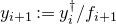 $y_{i+1}:=y_i^\dagger/f_{i+1}$
. Then
$y_{i+1}:=y_i^\dagger/f_{i+1}$
. Then $vy_i$
realizes the same cut in
$vy_i$
realizes the same cut in $\Gamma$
as
$\Gamma$
as $\beta_i$
, and
$\beta_i$
, and $H\langle y \rangle =H(y_0, y_1, y_2,\dots)$
, by [Reference Aschenbrenner, van den Dries and van der HoevenAvdDvdH24a, proof of Proposition 8.20]. Next set
$H\langle y \rangle =H(y_0, y_1, y_2,\dots)$
, by [Reference Aschenbrenner, van den Dries and van der HoevenAvdDvdH24a, proof of Proposition 8.20]. Next set $K:= {\mathbb R} \langle f_0, f_1, f_2,\dots \rangle $
and note that
$K:= {\mathbb R} \langle f_0, f_1, f_2,\dots \rangle $
and note that $K\langle y \rangle =K(y_0, y_1, y_2,\dots)$
, using that the right-hand side contains all
$K\langle y \rangle =K(y_0, y_1, y_2,\dots)$
, using that the right-hand side contains all $y_n'$
. Suppose
$y_n'$
. Suppose ${z\in \mathcal{C}^{\lt \infty}}$
is such that
${z\in \mathcal{C}^{\lt \infty}}$
is such that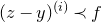 $(z-y)^{(i)}\prec f$
for all i and all
$(z-y)^{(i)}\prec f$
for all i and all $f\in K\langle y\rangle^{\times}$
. Then z is K-hardian and d-transcendental over K by Lemma 3.3, and the proof of that lemma also shows that
$f\in K\langle y\rangle^{\times}$
. Then z is K-hardian and d-transcendental over K by Lemma 3.3, and the proof of that lemma also shows that $P(y)\sim P(z)$
for every
$P(y)\sim P(z)$
for every ${P\in K\{Y\}^{\ne}}$
. Thus, we have elements
${P\in K\{Y\}^{\ne}}$
. Thus, we have elements $z_i\in K\langle z \rangle $
defined recursively by
$z_i\in K\langle z \rangle $
defined recursively by $z_0:= z/f_0$
,
$z_0:= z/f_0$
,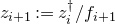 $z_{i+1}:=z_i^\dagger/f_{i+1}$
, and then
$z_{i+1}:=z_i^\dagger/f_{i+1}$
, and then ${y_i\sim z_i}$
for all i. For the Hausdorff field
${y_i\sim z_i}$
for all i. For the Hausdorff field $H_n:=H(y_0,\dots,y_n)$
we have
$H_n:=H(y_0,\dots,y_n)$
we have $v(H_n^\times)=\Gamma\oplus {\mathbb Z} vy_0\oplus\cdots\oplus {\mathbb Z} vy_n$
by [Reference Aschenbrenner, van den Dries and van der HoevenAvdDvdH24a, proof of Proposition 8.20], and for
$v(H_n^\times)=\Gamma\oplus {\mathbb Z} vy_0\oplus\cdots\oplus {\mathbb Z} vy_n$
by [Reference Aschenbrenner, van den Dries and van der HoevenAvdDvdH24a, proof of Proposition 8.20], and for $h\in H^\times$
and
$h\in H^\times$
and $i_0,\dots,i_n\in {\mathbb N} $
we have
$i_0,\dots,i_n\in {\mathbb N} $
we have $hy_0^{i_0}\cdots y_n^{i_n} \sim h z_0^{i_0}\cdots z_n^{i_n}$
(in
$hy_0^{i_0}\cdots y_n^{i_n} \sim h z_0^{i_0}\cdots z_n^{i_n}$
(in $\mathcal{C}$
). Hence,
$\mathcal{C}$
). Hence, $z_0,\dots,z_n$
generate a Hausdorff field over H with an isomorphism
$z_0,\dots,z_n$
generate a Hausdorff field over H with an isomorphism $H_n\to H(z_0,\dots,z_n)$
over H sending
$H_n\to H(z_0,\dots,z_n)$
over H sending $y_i$
to
$y_i$
to $z_i$
for
$z_i$
for $i=0,\dots,n$
. These isomorphisms therefore have a common extension to an isomorphism
$i=0,\dots,n$
. These isomorphisms therefore have a common extension to an isomorphism $H\langle y \rangle \to H\langle z \rangle $
of Hardy fields over H. In particular, z is H-hardian, and vz realizes the same cut in
$H\langle y \rangle \to H\langle z \rangle $
of Hardy fields over H. In particular, z is H-hardian, and vz realizes the same cut in $\Gamma$
as
$\Gamma$
as $\beta$
. Now, by Lemma 3.2 and the remarks preceding it, there exists
$\beta$
. Now, by Lemma 3.2 and the remarks preceding it, there exists $\varepsilon\in \mathcal{C}$
such that
$\varepsilon\in \mathcal{C}$
such that $\varepsilon >_{\mathrm{e}} 0$
and
$\varepsilon >_{\mathrm{e}} 0$
and $\varepsilon \prec f$
for all
$\varepsilon \prec f$
for all $f\in K\langle y \rangle ^\times$
, so any such
$f\in K\langle y \rangle ^\times$
, so any such $\varepsilon$
has the desired property.
$\varepsilon$
has the desired property.
Combining Corollary 2.8 with Proposition 5.1 yields the following.
Corollary 5.2. There exists an H-hardian $z\in\mathcal{C}^\omega$
such that
$z\in\mathcal{C}^\omega$
such that $z>0$
and vz realizes the same cut in
$z>0$
and vz realizes the same cut in $\Gamma$
as
$\Gamma$
as $\beta$
.
$\beta$
.
We can now use [Reference Aschenbrenner, van den Dries and van der HoevenAvdDvdH24a, Theorem 9.2] to obtain an analytic strengthening of this result as follows.
Corollary 5.3. Suppose $\beta$
is of countable type over
$\beta$
is of countable type over $\Gamma$
and
$\Gamma$
and $\beta_i^\dagger \lt 0$
for all i. Then for some H-hardian
$\beta_i^\dagger \lt 0$
for all i. Then for some H-hardian $z\in \mathcal{C}^{\omega}$
:
$z\in \mathcal{C}^{\omega}$
: $z \gt 0$
and vz realizes the same cut in
$z \gt 0$
and vz realizes the same cut in $\Gamma$
as
$\Gamma$
as $\beta$
.
$\beta$
.
Proof. Theorem 9.2 of [Reference Aschenbrenner, van den Dries and van der HoevenAvdDvdH24a] gives H-hardian $y>0$
such that vy realizes the same cut in
$y>0$
such that vy realizes the same cut in $\Gamma$
as
$\Gamma$
as $\beta$
. Then Corollary 5.2 gives a z as required.
$\beta$
. Then Corollary 5.2 gives a z as required.
5.2 Proof of Theorem A
First we give an analytic/smooth version of [Reference Aschenbrenner, van den Dries and van der HoevenAvdDvdH24a, Lemma 9.1].
Lemma 5.4. Let H be a maximal analytic or maximal smooth Hardy field with H-couple $(\Gamma,\psi)$
over
$(\Gamma,\psi)$
over $ {\mathbb R} $
. Then no element in any H-couple over
$ {\mathbb R} $
. Then no element in any H-couple over $ {\mathbb R} $
extending
$ {\mathbb R} $
extending $(\Gamma,\psi)$
has countable type over
$(\Gamma,\psi)$
has countable type over $\Gamma$
.
$\Gamma$
.
Proof. By Corollary 4.8, $(\Gamma,\psi)$
is countably spherically complete, and both
$(\Gamma,\psi)$
is countably spherically complete, and both $\Gamma$
and
$\Gamma$
and $\Gamma^<$
have uncountable cofinality. By [Reference Aschenbrenner, van den Dries and van der HoevenAvdDvdH24a, Lemma 8.11], any element of any H-couple over
$\Gamma^<$
have uncountable cofinality. By [Reference Aschenbrenner, van den Dries and van der HoevenAvdDvdH24a, Lemma 8.11], any element of any H-couple over $ {\mathbb R} $
extending
$ {\mathbb R} $
extending $(\Gamma,\psi)$
and of countable type over
$(\Gamma,\psi)$
and of countable type over $\Gamma$
falls under case (b). Now argue as in the proof of [Reference Aschenbrenner, van den Dries and van der HoevenAvdDvdH24a, Lemma 9.1], using Corollary 5.3 in place of [Reference Aschenbrenner, van den Dries and van der HoevenAvdDvdH24a, Theorem 9.2], that there are no such elements.
$\Gamma$
falls under case (b). Now argue as in the proof of [Reference Aschenbrenner, van den Dries and van der HoevenAvdDvdH24a, Lemma 9.1], using Corollary 5.3 in place of [Reference Aschenbrenner, van den Dries and van der HoevenAvdDvdH24a, Theorem 9.2], that there are no such elements.
Theorem A from the introduction and its smooth version follow from Corollary 4.6 and Lemma 5.4, just as the main theorem in [Reference Aschenbrenner, van den Dries and van der HoevenAvdDvdH24a] is derived in the beginning of [Reference Aschenbrenner, van den Dries and van der HoevenAvdDvdH24a, Section 9] from the non-smooth analogues of that corollary and lemma. We now use this to characterize gaps in maximal analytic Hardy fields: see Corollary 5.9.
5.3 Characters of gaps in maximal Hardy fields
Let S be an ordered set (as in [Reference Aschenbrenner, van den Dries and van der HoevenAvdDvdH24a] this means linearly ordered set) and C a cut in S, that is a downward closed subset of S. We define the character of C (in S) to be the pair $(\alpha,\beta^*)$
where
$(\alpha,\beta^*)$
where $\alpha:=\operatorname{cf}(C)$
and
$\alpha:=\operatorname{cf}(C)$
and $\beta^*$
is the set
$\beta^*$
is the set $\beta:=\operatorname{ci}(S\setminus C)$
equipped with the reversed ordering. We then also call C an
$\beta:=\operatorname{ci}(S\setminus C)$
equipped with the reversed ordering. We then also call C an $(\alpha,\beta^*)$
-cut (in S); see [Reference HarzheimHar05,§ 3.2]. The characters of the cuts
$(\alpha,\beta^*)$
-cut (in S); see [Reference HarzheimHar05,§ 3.2]. The characters of the cuts $\emptyset$
and S in S are
$\emptyset$
and S in S are $(0,\operatorname{ci}(S)^*)$
and
$(0,\operatorname{ci}(S)^*)$
and $({\operatorname{cf}}(S),0)$
, respectively. Note that S is
$({\operatorname{cf}}(S),0)$
, respectively. Note that S is $\eta_1$
if and only if no cut in S has character
$\eta_1$
if and only if no cut in S has character $(\alpha,\beta^*)$
with
$(\alpha,\beta^*)$
with ${\alpha,\beta\leqslant\omega}$
. A gap
${\alpha,\beta\leqslant\omega}$
. A gap $A<B$
in S is a pair (A,B) of subsets of S such that
$A<B$
in S is a pair (A,B) of subsets of S such that $A<B$
and there is no
$A<B$
and there is no $s\in S$
with
$s\in S$
with $A<s<B$
. The character of such a gap
$A<s<B$
. The character of such a gap $A<B$
is defined to be the character
$A<B$
is defined to be the character $(\alpha,\beta^*)$
of the cut
$(\alpha,\beta^*)$
of the cut $A^{\downarrow}=S\setminus B^\uparrow$
in S, and then
$A^{\downarrow}=S\setminus B^\uparrow$
in S, and then $A<B$
is also called an
$A<B$
is also called an $(\alpha,\beta^*)$
-gap in S.
$(\alpha,\beta^*)$
-gap in S.
Let G be an ordered abelian group. If $v\colon G\to S_\infty$
is a surjective convex valuation on G (see [Reference Aschenbrenner, van den Dries and van der HoevenAvdDvdH17, p. 99]) and
$v\colon G\to S_\infty$
is a surjective convex valuation on G (see [Reference Aschenbrenner, van den Dries and van der HoevenAvdDvdH17, p. 99]) and $A<B$
is an
$A<B$
is an $(\alpha,\beta^*)$
-gap in S where
$(\alpha,\beta^*)$
-gap in S where $\alpha,\beta\geqslant\omega$
, then
$\alpha,\beta\geqslant\omega$
, then $(v^{-1}(A)\cap G^<, v^{-1}(B)\cap G^{\lt })$
is a
$(v^{-1}(A)\cap G^<, v^{-1}(B)\cap G^{\lt })$
is a $(\alpha,\beta^*)$
-gap in G. If H is an ordered field, then
$(\alpha,\beta^*)$
-gap in G. If H is an ordered field, then $\operatorname{cf}(H^<)=\operatorname{ci}(H^>)=\operatorname{cf}(H)$
, and the cuts
$\operatorname{cf}(H^<)=\operatorname{ci}(H^>)=\operatorname{cf}(H)$
, and the cuts $H^{\lt h}$
and
$H^{\lt h}$
and $H^{\leqslant h}$
(
$H^{\leqslant h}$
( $h\in H$
) in H have character
$h\in H$
) in H have character $({\operatorname{cf}}(H),1)$
and
$({\operatorname{cf}}(H),1)$
and $(1,\operatorname{cf}(H)^*)$
, respectively.
$(1,\operatorname{cf}(H)^*)$
, respectively.
Corollary 5.5. Let H be a maximal Hardy field, or a maximal analytic Hardy field, or a maximal smooth Hardy field. Set $\kappa:=\operatorname{ci}(H^{> {\mathbb R} })$
. Then
$\kappa:=\operatorname{ci}(H^{> {\mathbb R} })$
. Then $\omega<\kappa\leqslant\mathfrak c$
, and H has gaps of character
$\omega<\kappa\leqslant\mathfrak c$
, and H has gaps of character $(\omega,\kappa^*)$
,
$(\omega,\kappa^*)$
, $(\kappa,\omega^*)$
, and
$(\kappa,\omega^*)$
, and $(\kappa,\kappa^*)$
.
$(\kappa,\kappa^*)$
.
Proof. Corollary 4.7 and [Reference Aschenbrenner, van den Dries and van der HoevenAvdDvdH24a, Corollary 4.8] give $\omega<\kappa\leqslant\mathfrak c$
. The gaps
$\omega<\kappa\leqslant\mathfrak c$
. The gaps ${ {\mathbb R} \lt H^{> {\mathbb R} }}$
and
${ {\mathbb R} \lt H^{> {\mathbb R} }}$
and ${H^{\lt {\mathbb R} } \lt {\mathbb R} }$
in H have character
${H^{\lt {\mathbb R} } \lt {\mathbb R} }$
in H have character $(\omega,\kappa^*)$
and
$(\omega,\kappa^*)$
and $(\kappa,\omega^*)$
, respectively. To obtain a
$(\kappa,\omega^*)$
, respectively. To obtain a $(\kappa,\kappa^*)$
-gap in H, take a coinitial sequence
$(\kappa,\kappa^*)$
-gap in H, take a coinitial sequence $(\ell_\rho)_{\rho<\kappa}$
in
$(\ell_\rho)_{\rho<\kappa}$
in $H^{> {\mathbb R} }$
with
$H^{> {\mathbb R} }$
with $\ell_{\rho}\succ \ell_{\rho'}$
for all
$\ell_{\rho}\succ \ell_{\rho'}$
for all ${\rho \lt \rho'<\kappa}$
. Put
${\rho \lt \rho'<\kappa}$
. Put $\gamma_\rho:=\ell_\rho^\dagger \gt 0$
, so
$\gamma_\rho:=\ell_\rho^\dagger \gt 0$
, so $(1/\ell_\rho)' = (1/\ell_\rho)^\dagger/\ell_\rho = -\gamma_\rho/\ell_\rho \lt 0$
. Set
$(1/\ell_\rho)' = (1/\ell_\rho)^\dagger/\ell_\rho = -\gamma_\rho/\ell_\rho \lt 0$
. Set $A:=\{\gamma_\rho/\ell_\rho:\rho<\kappa\}$
,
$A:=\{\gamma_\rho/\ell_\rho:\rho<\kappa\}$
, $B:=\{\gamma_\rho:\rho<\kappa\}$
. With
$B:=\{\gamma_\rho:\rho<\kappa\}$
. With $(\Gamma,\psi)$
the asymptotic couple of H, v(A) is coinitial in
$(\Gamma,\psi)$
the asymptotic couple of H, v(A) is coinitial in $(\Gamma^>)'$
and has no smallest element, and v(B) is cofinal in
$(\Gamma^>)'$
and has no smallest element, and v(B) is cofinal in $\Psi=(\Gamma^{\ne})^\dagger$
and has no largest element. Now H has asymptotic integration, so there is no
$\Psi=(\Gamma^{\ne})^\dagger$
and has no largest element. Now H has asymptotic integration, so there is no $\gamma\in\Gamma$
with
$\gamma\in\Gamma$
with $\Psi<\gamma<(\Gamma^>)'$
. Hence,
$\Psi<\gamma<(\Gamma^>)'$
. Hence, $A<B$
is a
$A<B$
is a $(\kappa,\kappa^*)$
-gap in H.
$(\kappa,\kappa^*)$
-gap in H.
Now let G be an ordered abelian group. Assume $G\ne \{0\}$
and
$G\ne \{0\}$
and $G^>$
has no smallest element, so
$G^>$
has no smallest element, so $\operatorname{ci}(G^>)\geqslant\omega$
. A gap
$\operatorname{ci}(G^>)\geqslant\omega$
. A gap $A<B$
in G is said to be cauchy if
$A<B$
in G is said to be cauchy if $A,B\neq\emptyset$
, A has no largest element, B has no smallest element, and for each
$A,B\neq\emptyset$
, A has no largest element, B has no smallest element, and for each $\varepsilon\in G^>$
there are
$\varepsilon\in G^>$
there are $a\in A$
,
$a\in A$
, $b\in B$
with
$b\in B$
with $b-a<\varepsilon$
. If
$b-a<\varepsilon$
. If $A<B$
is a cauchy gap in G, then so is
$A<B$
is a cauchy gap in G, then so is $-B<-A$
.
$-B<-A$
.
Lemma 5.6. Let $A<B$
be a cauchy gap in G and
$A<B$
be a cauchy gap in G and $(a_\rho)$
be an increasing cofinal well-indexed sequence in A. Then
$(a_\rho)$
be an increasing cofinal well-indexed sequence in A. Then $(a_\rho)$
is a divergent c-sequence in G.
$(a_\rho)$
is a divergent c-sequence in G.
Proof. Let $\varepsilon\in G^>$
and take
$\varepsilon\in G^>$
and take $a\in A$
,
$a\in A$
, $b\in B$
with
$b\in B$
with $b-a<\varepsilon$
. Take
$b-a<\varepsilon$
. Take $\rho_0$
such that
$\rho_0$
such that $a\leqslant a_\rho$
for all
$a\leqslant a_\rho$
for all $\rho>\rho_0$
. Then
$\rho>\rho_0$
. Then $0< a_{\rho'}-a_\rho<b-a<\varepsilon$
for
$0< a_{\rho'}-a_\rho<b-a<\varepsilon$
for $\rho_0<\rho<\rho'$
. Hence
$\rho_0<\rho<\rho'$
. Hence $(a_\rho)$
is a c-sequence in G, and there is no
$(a_\rho)$
is a c-sequence in G, and there is no $a\in G$
with
$a\in G$
with $a_\rho\to a$
.
$a_\rho\to a$
.
Lemma 5.7. Every cauchy gap in G has character $({\operatorname{cf}}(G^<),\operatorname{cf}(G^<)^*)$
. Moreover, G is complete if and only if G has no cauchy gap.
$({\operatorname{cf}}(G^<),\operatorname{cf}(G^<)^*)$
. Moreover, G is complete if and only if G has no cauchy gap.
Proof. The first claim follows from Lemma 5.6 and [Reference Aschenbrenner, van den Dries and van der HoevenAvdDvdH17, 2.4.11]. It also follows from this lemma that if G is complete, then G has no cauchy gap. Conversely, suppose G has no cauchy gap. Let $(a_\rho)$
be a c-sequence in G. For each
$(a_\rho)$
be a c-sequence in G. For each $\varepsilon\in G^>$
, take
$\varepsilon\in G^>$
, take $\rho_\varepsilon$
such that
$\rho_\varepsilon$
such that $\lvert a_\rho-a_{\rho'}\rvert<\varepsilon$
for all
$\lvert a_\rho-a_{\rho'}\rvert<\varepsilon$
for all $\rho,\rho'\geqslant\rho_\varepsilon$
, and set
$\rho,\rho'\geqslant\rho_\varepsilon$
, and set
 $$A := \{ a_{\rho_\varepsilon}-\varepsilon:\ \varepsilon\in G^>\}, \quad B := \{ a_{\rho_\delta}+\delta:\ \delta\in G^>\}.$$
Then $A<B$
and for all
$A<B$
and for all $\varepsilon\in G^{>}$
there are
$\varepsilon\in G^{>}$
there are $a\in A$
and
$a\in A$
and $b\in B$
with
$b\in B$
with $b-a<\varepsilon$
. However,
$b-a<\varepsilon$
. However, $A< B$
is no cauchy gap, so we have
$A< B$
is no cauchy gap, so we have $g\in G$
with
$g\in G$
with $A\leqslant g\leqslant B$
. Then
$A\leqslant g\leqslant B$
. Then $a_{\rho} \to g$
.
$a_{\rho} \to g$
.
Corollary 5.8. Let H be a maximal, or maximal analytic, or maximal smooth Hardy field, and $\lambda:=\operatorname{cf}(H)$
. Then
$\lambda:=\operatorname{cf}(H)$
. Then $\omega<\lambda\leqslant\mathfrak c$
, and H has gaps of character
$\omega<\lambda\leqslant\mathfrak c$
, and H has gaps of character $(0,\lambda^*)$
,
$(0,\lambda^*)$
, $(\lambda,0)$
,
$(\lambda,0)$
, $(1,\lambda^*)$
,
$(1,\lambda^*)$
, $(\lambda,1)$
, and if H is not complete, then H has a
$(\lambda,1)$
, and if H is not complete, then H has a $(\lambda,\lambda^*)$
-gap.
$(\lambda,\lambda^*)$
-gap.
Proof. Lemma 3.8 yields $\lambda=\operatorname{cf}(\Gamma)$
, so
$\lambda=\operatorname{cf}(\Gamma)$
, so $\omega<\lambda\leqslant\mathfrak c$
by [Reference Aschenbrenner, van den Dries and van der HoevenAvdDvdH24a, Corollary 8.1] and Corollary 4.8. For the rest, use the remarks before Corollary 5.5 and Lemma 5.7.
$\omega<\lambda\leqslant\mathfrak c$
by [Reference Aschenbrenner, van den Dries and van der HoevenAvdDvdH24a, Corollary 8.1] and Corollary 4.8. For the rest, use the remarks before Corollary 5.5 and Lemma 5.7.
The main result of [Reference Aschenbrenner, van den Dries and van der HoevenAvdDvdH24a], Theorem A, and Corollaries 5.5 and 5.8 now gives us the following.
Corollary 5.9. Assume that the continuum hypothesis holds. If H is a maximal Hardy field, a maximal analytic Hardy field, or a maximal smooth Hardy field, then the characters of gaps in H are
 $$(0,\omega_1^*),\ (\omega_1,0),\ (1,\omega_1^*),\ (\omega_1,1),\ (\omega,\omega_1^*),\ (\omega_1,\omega^*),\mbox{ and }(\omega_1,\omega_1^*).$$
5.4 The number of maximal analytic Hardy fields
We recall some definitions from [Reference Aschenbrenner, van den Dries and van der HoevenAvdDvdH24a]. A germ $\phi\in\mathcal{C}$
is said to be overhardian if
$\phi\in\mathcal{C}$
is said to be overhardian if $\phi$
is hardian and
$\phi$
is hardian and $\phi>_{\mathrm{e}} \exp_n(x)$
for all n; see [Reference Aschenbrenner, van den Dries and van der HoevenAvdDvdH24a, Corollary 5.11]. Let
$\phi>_{\mathrm{e}} \exp_n(x)$
for all n; see [Reference Aschenbrenner, van den Dries and van der HoevenAvdDvdH24a, Corollary 5.11]. Let $H\supseteq {\mathbb R} $
be a Hardy field. Then
$H\supseteq {\mathbb R} $
be a Hardy field. Then
 $$H^{\operatorname{te}} := \{f\in H:\text{$f \gt \exp_n(x)$ for each n}\}$$
denotes the set of overhardian (or transexponential) elements of H. We let $*H^{\operatorname{te}}$
be the set of equivalence classes of the equivalence relation
$*H^{\operatorname{te}}$
be the set of equivalence classes of the equivalence relation $\sim_{\exp}$
on
$\sim_{\exp}$
on $H^{\operatorname{te}}$
given by
$H^{\operatorname{te}}$
given by
 $$f\sim_{\exp} g\quad:\Longleftrightarrow\quad\text{$f\leqslant\exp_n(g)$ and $g\leqslant\exp_n(f)$ for some n}\quad (f,g\in H^{\operatorname{te}}).$$
Denoting the equivalence class of $f\in H^{\operatorname{te}}$
by
$f\in H^{\operatorname{te}}$
by $*f$
, we linearly order
$*f$
, we linearly order $H^{\operatorname{te}}$
by
$H^{\operatorname{te}}$
by
 $$*f \lt *g\quad:\Longleftrightarrow\quad \text{$\exp_n(f) \lt g$ for all n} \quad (f,g\in H^{\operatorname{te}}).$$
We now establish analytic and smooth versions of Theorem 7.1 from [Reference Aschenbrenner, van den Dries and van der HoevenAvdDvdH24a].
Corollary 5.10. The number of maximal analytic Hardy fields is $2^{\mathfrak c}$
, where
$2^{\mathfrak c}$
, where $\mathfrak c=2^{\aleph_0}$
. Likewise with ‘smooth’ in place of ‘analytic’.
$\mathfrak c=2^{\aleph_0}$
. Likewise with ‘smooth’ in place of ‘analytic’.
Proof. We treat the number of maximal analytic Hardy fields; the smooth case is similar, using the smooth version of Theorem A. In the argument following the statement of [Reference Aschenbrenner, van den Dries and van der HoevenAvdDvdH24a, Proposition 7.4], we replace $\mathcal H$
by the set of all analytic Hardy fields
$\mathcal H$
by the set of all analytic Hardy fields $H\supseteq {\mathbb R} $
with
$H\supseteq {\mathbb R} $
with $\lvert*H^{\operatorname{te}}\rvert \lt \mathfrak{c}$
. Thus modified, this argument shows that it is enough to prove that in [Reference Aschenbrenner, van den Dries and van der HoevenAvdDvdH24a, Proposition 7.4] we can choose
$\lvert*H^{\operatorname{te}}\rvert \lt \mathfrak{c}$
. Thus modified, this argument shows that it is enough to prove that in [Reference Aschenbrenner, van den Dries and van der HoevenAvdDvdH24a, Proposition 7.4] we can choose $f_0$
,
$f_0$
, $f_1$
to be analytic whenever the Hardy field H is analytic. For this we first note that if H in [Reference Aschenbrenner, van den Dries and van der HoevenAvdDvdH24a, Lemma 7.7] is analytic, then we can take y there to be analytic, by appealing to Theorem A instead of [Reference Aschenbrenner, van den Dries and van der HoevenAvdDvdH24a, Section 5 and Corollary 6.7]. Now argue as in the remarks following [Reference Aschenbrenner, van den Dries and van der HoevenAvdDvdH24a, Lemma 7.10] using this analytic version of [Reference Aschenbrenner, van den Dries and van der HoevenAvdDvdH24a, Lemma 7.7].
$f_1$
to be analytic whenever the Hardy field H is analytic. For this we first note that if H in [Reference Aschenbrenner, van den Dries and van der HoevenAvdDvdH24a, Lemma 7.7] is analytic, then we can take y there to be analytic, by appealing to Theorem A instead of [Reference Aschenbrenner, van den Dries and van der HoevenAvdDvdH24a, Section 5 and Corollary 6.7]. Now argue as in the remarks following [Reference Aschenbrenner, van den Dries and van der HoevenAvdDvdH24a, Lemma 7.10] using this analytic version of [Reference Aschenbrenner, van den Dries and van der HoevenAvdDvdH24a, Lemma 7.7].
Corollary 7.8 of [Reference Aschenbrenner, van den Dries and van der HoevenAvdDvdH24a] has an analytic version as follows with a similar proof.
Corollary 5.11. If H is a maximal analytic Hardy field, then the ordered set $*H^{\operatorname{te}}$
is
$*H^{\operatorname{te}}$
is $\eta_1$
, and
$\eta_1$
, and $\lvert*H^{\operatorname{te}}\rvert=\mathfrak{c}$
.
$\lvert*H^{\operatorname{te}}\rvert=\mathfrak{c}$
.
We now improve Corollary 3.7: assuming that the continuum hypothesis holds, there are as many cofinal maximal analytic Hardy fields as there are maximal analytic Hardy fields, by Corollary 5.14.
Lemma 5.12. Let $\phi\in\mathcal{C}^\omega$
be overhardian. Then there is a set
$\phi\in\mathcal{C}^\omega$
be overhardian. Then there is a set $\mathcal H_\phi$
of analytic Hardy field extensions of
$\mathcal H_\phi$
of analytic Hardy field extensions of $ {\mathbb R} \langle\phi\rangle$
with
$ {\mathbb R} \langle\phi\rangle$
with $\lvert\mathcal H_\phi\rvert=2^{\mathfrak c}$
such that for each
$\lvert\mathcal H_\phi\rvert=2^{\mathfrak c}$
such that for each $H\in\mathcal H_\phi$
,
$H\in\mathcal H_\phi$
, $*\phi$
is the largest element of
$*\phi$
is the largest element of $*H^{\operatorname{te}}$
, and each Hardy field contains at most one
$*H^{\operatorname{te}}$
, and each Hardy field contains at most one $H\in\mathcal H_\phi$
.
$H\in\mathcal H_\phi$
.
Proof. By [Reference Aschenbrenner, van den Dries and van der HoevenAvdDvdH24a, Lemma 7.7] we have $* {\mathbb R} \langle\phi\rangle^{\operatorname{te}}=\{*\phi\}$
. Let
$* {\mathbb R} \langle\phi\rangle^{\operatorname{te}}=\{*\phi\}$
. Let $H\supseteq {\mathbb R} \langle\phi\rangle$
be an analytic Hardy field with
$H\supseteq {\mathbb R} \langle\phi\rangle$
be an analytic Hardy field with $*\phi=\max *H^{\operatorname{te}}$
, and let
$*\phi=\max *H^{\operatorname{te}}$
, and let $P<Q$
be a countable gap in
$P<Q$
be a countable gap in $*H^{\operatorname{te}}$
with
$*H^{\operatorname{te}}$
with $Q<*\phi$
. Then [Reference Aschenbrenner, van den Dries and van der HoevenAvdDvdH24a, Proposition 7.4] and the argument in the proof of Corollary 5.10 yields analytic Hardy fields
$Q<*\phi$
. Then [Reference Aschenbrenner, van den Dries and van der HoevenAvdDvdH24a, Proposition 7.4] and the argument in the proof of Corollary 5.10 yields analytic Hardy fields $H_0=H\langle f_0\rangle$
and
$H_0=H\langle f_0\rangle$
and $H_1=H\langle f_1\rangle$
without a common Hardy field extension such that for
$H_1=H\langle f_1\rangle$
without a common Hardy field extension such that for $j=0,1$
, we have
$j=0,1$
, we have $f_j\in H_j^{\operatorname{te}}$
,
$f_j\in H_j^{\operatorname{te}}$
, $P<*f_j<Q\cup\{*\phi\}$
, and
$P<*f_j<Q\cup\{*\phi\}$
, and $*H_j^{\operatorname{te}}=*H^{\operatorname{te}}\cup\{*f_j\}$
(thus,
$*H_j^{\operatorname{te}}=*H^{\operatorname{te}}\cup\{*f_j\}$
(thus,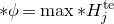 $*\phi=\max *H_j^{\operatorname{te}}$
).
$*\phi=\max *H_j^{\operatorname{te}}$
).
We now follow the argument after the statement of [Reference Aschenbrenner, van den Dries and van der HoevenAvdDvdH24a, Proposition 7.4], with $\mathcal H$
now the set of all analytic Hardy fields
$\mathcal H$
now the set of all analytic Hardy fields $H\supseteq {\mathbb R} \langle\phi\rangle$
such that
$H\supseteq {\mathbb R} \langle\phi\rangle$
such that $\lvert*H^{\operatorname{te}}\rvert \lt \mathfrak{c}$
and
$\lvert*H^{\operatorname{te}}\rvert \lt \mathfrak{c}$
and $*\phi=\max*H^{\operatorname{te}}$
. For an ordinal
$*\phi=\max*H^{\operatorname{te}}$
. For an ordinal $\lambda$
we let
$\lambda$
we let $2^{\lambda}$
be the set of functions
$2^{\lambda}$
be the set of functions ${\lambda\to\{0,1\}}$
. With s ranging over
${\lambda\to\{0,1\}}$
. With s ranging over $\bigcup_{\lambda<\mathfrak c} 2^\lambda$
, we construct a tree
$\bigcup_{\lambda<\mathfrak c} 2^\lambda$
, we construct a tree $(H_s)$
in
$(H_s)$
in $\mathcal H$
with
$\mathcal H$
with $\lvert*H^{\operatorname{te}}\rvert\leqslant\lvert{\lambda+1}\rvert$
for
$\lvert*H^{\operatorname{te}}\rvert\leqslant\lvert{\lambda+1}\rvert$
for $s\in 2^\lambda$
, as follows. For
$s\in 2^\lambda$
, as follows. For $\lambda=0$
the function s has empty domain and we take
$\lambda=0$
the function s has empty domain and we take $H_s= {\mathbb R} \langle\phi\rangle$
. If
$H_s= {\mathbb R} \langle\phi\rangle$
. If $s\in 2^\lambda$
(
$s\in 2^\lambda$
( $\lambda<\mathfrak c$
) and
$\lambda<\mathfrak c$
) and $H_s\in \mathcal{H}$
are given with
$H_s\in \mathcal{H}$
are given with $\lvert*H_s^{\operatorname{te}}\rvert\leqslant \lvert\lambda+1\rvert$
, then [Reference Aschenbrenner, van den Dries and van der HoevenAvdDvdH24a, Lemma 7.2] provides a countable gap P, Q in
$\lvert*H_s^{\operatorname{te}}\rvert\leqslant \lvert\lambda+1\rvert$
, then [Reference Aschenbrenner, van den Dries and van der HoevenAvdDvdH24a, Lemma 7.2] provides a countable gap P, Q in ${*H_s^{\operatorname{te}}\setminus\{*\phi\}}$
, and we let
${*H_s^{\operatorname{te}}\setminus\{*\phi\}}$
, and we let $H_{s0}, H_{s1}\in \mathcal{H}$
be obtained from
$H_{s0}, H_{s1}\in \mathcal{H}$
be obtained from $H_s$
as
$H_s$
as $H_0$
,
$H_0$
, $H_1$
are obtained from H in the remark above. Suppose
$H_1$
are obtained from H in the remark above. Suppose $\lambda< \mathfrak{c}$
is an infinite limit ordinal,
$\lambda< \mathfrak{c}$
is an infinite limit ordinal, $s\in 2^\lambda$
, and that for every
$s\in 2^\lambda$
, and that for every $\alpha< \lambda$
we are given
$\alpha< \lambda$
we are given $H_{s|\alpha}\in \mathcal{H}$
with
$H_{s|\alpha}\in \mathcal{H}$
with $H_{s|\alpha}\subseteq H_{s|\beta}$
whenever
$H_{s|\alpha}\subseteq H_{s|\beta}$
whenever $\alpha\leqslant \beta \lt \lambda$
. Then we set
$\alpha\leqslant \beta \lt \lambda$
. Then we set $H_s:= \bigcup_{\alpha<\lambda} H_{s|\alpha}\in\mathcal{H}$
. Assuming also inductively that
$H_s:= \bigcup_{\alpha<\lambda} H_{s|\alpha}\in\mathcal{H}$
. Assuming also inductively that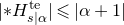 $\lvert*H_{s|\alpha}^{\operatorname{te}}\rvert\leqslant \lvert\alpha+1\rvert$
for all
$\lvert*H_{s|\alpha}^{\operatorname{te}}\rvert\leqslant \lvert\alpha+1\rvert$
for all $\alpha<\lambda$
, we have
$\alpha<\lambda$
, we have $\lvert*H_s^{\operatorname{te}}\rvert\leqslant \lvert\lambda\rvert\cdot \lvert\lambda+1\rvert=\lvert\lambda+1\rvert$
, as desired. This finishes the construction of our tree. Then for each
$\lvert*H_s^{\operatorname{te}}\rvert\leqslant \lvert\lambda\rvert\cdot \lvert\lambda+1\rvert=\lvert\lambda+1\rvert$
, as desired. This finishes the construction of our tree. Then for each $s\in 2^{\mathfrak c}$
we have an analytic Hardy field
$s\in 2^{\mathfrak c}$
we have an analytic Hardy field $H_s:=\bigcup_{\lambda<\mathfrak{c}} H_{s|\lambda}$
such that if
$H_s:=\bigcup_{\lambda<\mathfrak{c}} H_{s|\lambda}$
such that if $s, s'\in 2^{\mathfrak c}$
are different, then
$s, s'\in 2^{\mathfrak c}$
are different, then $H_s$
,
$H_s$
, $H_{s'}$
have no common Hardy field extension. Hence,
$H_{s'}$
have no common Hardy field extension. Hence, $\mathcal H_\phi:=\{H_s:s\in 2^{\mathfrak c}\}$
has the required properties.
$\mathcal H_\phi:=\{H_s:s\in 2^{\mathfrak c}\}$
has the required properties.
Lemma 5.13. Assume that the continuum hypothesis holds. Let H be a bounded analytic Hardy field. Then H extends to a cofinal analytic Hardy field.
Proof. By Lemma 3.1 we can replace H by ${\operatorname{Li}}(H( {\mathbb R} ))$
to arrange that
${\operatorname{Li}}(H( {\mathbb R} ))$
to arrange that $H\supseteq {\mathbb R} $
and H is Liouville closed. Next, take an enumeration
$H\supseteq {\mathbb R} $
and H is Liouville closed. Next, take an enumeration $(\phi_\alpha)_{\alpha<\mathfrak c}$
of
$(\phi_\alpha)_{\alpha<\mathfrak c}$
of $\mathcal{C}$
with
$\mathcal{C}$
with $\phi_0>_{\mathrm{e}} H$
. Corollary 3.5 yields an H-hardian
$\phi_0>_{\mathrm{e}} H$
. Corollary 3.5 yields an H-hardian $h_0\in\mathcal{C}^\omega$
with
$h_0\in\mathcal{C}^\omega$
with $h_0>_{\mathrm{e}} \phi_0$
, and then the analytic Hardy field
$h_0>_{\mathrm{e}} \phi_0$
, and then the analytic Hardy field $H_0:=H\langle h_0\rangle$
is bounded by Lemma 3.1. Now a transfinite recursion as in the proof of Corollary 3.7, beginning with
$H_0:=H\langle h_0\rangle$
is bounded by Lemma 3.1. Now a transfinite recursion as in the proof of Corollary 3.7, beginning with $(H_0,h_0)$
, yields a cofinal analytic Hardy field extension of
$(H_0,h_0)$
, yields a cofinal analytic Hardy field extension of $H_0$
and thus of H.
$H_0$
and thus of H.
Corollary 3.5 gives an overhardian $\phi\in\mathcal{C}^\omega$
. For such
$\phi\in\mathcal{C}^\omega$
. For such $\phi$
and
$\phi$
and $\mathcal H_\phi$
as in Lemma 5.12, all
$\mathcal H_\phi$
as in Lemma 5.12, all $H\in\mathcal H_\phi$
are bounded. With Lemma 5.13 we can now improve Corollary 3.7 as follows.
$H\in\mathcal H_\phi$
are bounded. With Lemma 5.13 we can now improve Corollary 3.7 as follows.
Corollary 5.14. Assuming that the continuum hypothesis holds, there are $2^{\mathfrak c}$
cofinal maximal analytic Hardy fields.
$2^{\mathfrak c}$
cofinal maximal analytic Hardy fields.
5.5 Maximal analytic Hardy fields approximate maximal Hardy fields
A maximal analytic Hardy field is an $\infty\omega$
-elementary substructure of any maximal Hardy field extension, by Corollary 8.5. Maximal analytic Hardy fields are also very close to maximal Hardy fields in the following way.
$\infty\omega$
-elementary substructure of any maximal Hardy field extension, by Corollary 8.5. Maximal analytic Hardy fields are also very close to maximal Hardy fields in the following way.
Theorem 5.15. Let H be a maximal analytic Hardy field or a maximal smooth Hardy field. Then H is dense in any Hardy field extension of H.
Proof. We establish two claims.
Claim 1. If $f\in \mathcal{C}^{\lt \infty}$
is H-hardian and
$f\in \mathcal{C}^{\lt \infty}$
is H-hardian and $H\langle f \rangle $
is an immediate extension of H, then H is dense in
$H\langle f \rangle $
is an immediate extension of H, then H is dense in $H\langle f \rangle $
.
$H\langle f \rangle $
.
To prove this, assume $f\in \mathcal{C}^{\lt \infty}$
is H-hardian,
$f\in \mathcal{C}^{\lt \infty}$
is H-hardian, $(f_{\rho})$
is a divergent pc-sequence in H, and
$(f_{\rho})$
is a divergent pc-sequence in H, and $f_{\rho}\leadsto f$
. By [Reference Aschenbrenner, van den Dries and van der HoevenAvdDvdH17, 16.0.3 and Section 11.4],
$f_{\rho}\leadsto f$
. By [Reference Aschenbrenner, van den Dries and van der HoevenAvdDvdH17, 16.0.3 and Section 11.4], $(f_{\rho})$
is of d-transcendental type over H. If the sequence
$(f_{\rho})$
is of d-transcendental type over H. If the sequence $(v(f-f_{\rho}))$
is cofinal in
$(v(f-f_{\rho}))$
is cofinal in $\Gamma:=v(H^\times)$
, then
$\Gamma:=v(H^\times)$
, then $(f_{\rho})$
is a cauchy sequence, and so H is indeed dense in
$(f_{\rho})$
is a cauchy sequence, and so H is indeed dense in $H\langle f \rangle $
, by [Reference Aschenbrenner, van den Dries and van der HoevenAvdDvdH24c, Corollary 4.1.6]. Suppose
$H\langle f \rangle $
, by [Reference Aschenbrenner, van den Dries and van der HoevenAvdDvdH24c, Corollary 4.1.6]. Suppose $(v(f-f_{\rho}))$
is not cofinal in
$(v(f-f_{\rho}))$
is not cofinal in $\Gamma$
. Then we have
$\Gamma$
. Then we have $h\in H^\times$
such that
$h\in H^\times$
such that $0\notin v({hf-H})$
, so Corollary 2.8 and Proposition 4.4 yield an H-hardian pseudolimit of
$0\notin v({hf-H})$
, so Corollary 2.8 and Proposition 4.4 yield an H-hardian pseudolimit of $(hf_{\rho})$
in
$(hf_{\rho})$
in $\mathcal{C}^{\omega}$
, contradicting the maximality of H. This proves Claim 1.
$\mathcal{C}^{\omega}$
, contradicting the maximality of H. This proves Claim 1.
Claim 2. For any Hardy field extension K of H, we have $\Gamma_K=\Gamma$
.
$\Gamma_K=\Gamma$
.
Towards a contradiction, suppose K is a Hardy field extension of H and ${\beta\in \Gamma_K\setminus\Gamma}$
. We arrange that K is Liouville closed. Let
${\beta\in \Gamma_K\setminus\Gamma}$
. We arrange that K is Liouville closed. Let $(\Gamma,\psi)$
and
$(\Gamma,\psi)$
and $(\Gamma_K, \psi_K)$
be the H-couples of H and K over
$(\Gamma_K, \psi_K)$
be the H-couples of H and K over $ {\mathbb R} $
, respectively, and let
$ {\mathbb R} $
, respectively, and let $(\Gamma\langle \beta \rangle ,\psi_{\beta})$
be the H-couple over
$(\Gamma\langle \beta \rangle ,\psi_{\beta})$
be the H-couple over $ {\mathbb R} $
generated by
$ {\mathbb R} $
generated by $\beta$
over
$\beta$
over $(\Gamma,\psi)$
in
$(\Gamma,\psi)$
in $(\Gamma_K, \psi_K)$
. There are several cases to consider, and we show that each is impossible. For closed H-couples and H-couples of Hahn type mentioned in the following, see [Reference Aschenbrenner, van den Dries and van der HoevenAvdDvdH22, p. 536].
$(\Gamma_K, \psi_K)$
. There are several cases to consider, and we show that each is impossible. For closed H-couples and H-couples of Hahn type mentioned in the following, see [Reference Aschenbrenner, van den Dries and van der HoevenAvdDvdH22, p. 536].
First the case that $(\Gamma\langle \beta \rangle ,\psi_{\beta})$
is an immediate extension of
$(\Gamma\langle \beta \rangle ,\psi_{\beta})$
is an immediate extension of $(\Gamma,\psi)$
. Then we have a divergent pc-sequence
$(\Gamma,\psi)$
. Then we have a divergent pc-sequence $(\gamma_{\rho})$
in
$(\gamma_{\rho})$
in $(\Gamma,\psi)$
with
$(\Gamma,\psi)$
with $\gamma_{\rho}\leadsto \beta$
. As in the beginning of [Reference Aschenbrenner, van den Dries and van der HoevenAvdDvdH24a, Section 8], we take
$\gamma_{\rho}\leadsto \beta$
. As in the beginning of [Reference Aschenbrenner, van den Dries and van der HoevenAvdDvdH24a, Section 8], we take $g_{\rho}\in H$
with
$g_{\rho}\in H$
with $vg_{\rho}=\gamma_{\rho}$
so that
$vg_{\rho}=\gamma_{\rho}$
so that $(g_{\rho}^\dagger)$
is a pc-sequence in H, and arguing as in [Reference Aschenbrenner, van den Dries and van der HoevenAvdDvdH24a, Section 8] (using
$(g_{\rho}^\dagger)$
is a pc-sequence in H, and arguing as in [Reference Aschenbrenner, van den Dries and van der HoevenAvdDvdH24a, Section 8] (using $H^\dagger=H$
) we see that
$H^\dagger=H$
) we see that $(g_{\rho}^\dagger)$
has no pseudolimit in H (because then
$(g_{\rho}^\dagger)$
has no pseudolimit in H (because then $(\gamma_{\rho})$
would have one in
$(\gamma_{\rho})$
would have one in $\Gamma$
). Now take
$\Gamma$
). Now take $g\in K$
with
$g\in K$
with $vg=\beta$
. Then
$vg=\beta$
. Then $v(g^\dagger-g_{\rho}^\dagger)=(\beta-\gamma_{\rho})^\dagger$
, and the latter is eventually strictly increasing as a function of
$v(g^\dagger-g_{\rho}^\dagger)=(\beta-\gamma_{\rho})^\dagger$
, and the latter is eventually strictly increasing as a function of $\rho$
, and so
$\rho$
, and so $g_{\rho}^\dagger\leadsto g^\dagger$
. Moreover,
$g_{\rho}^\dagger\leadsto g^\dagger$
. Moreover, $(v(g^\dagger-g_{\rho}^\dagger))$
is not cofinal in
$(v(g^\dagger-g_{\rho}^\dagger))$
is not cofinal in $\Gamma$
. As at the end of the proof of Claim 1, with
$\Gamma$
. As at the end of the proof of Claim 1, with $g^\dagger$
and
$g^\dagger$
and $(g_{\rho}^\dagger)$
in the role of f and
$(g_{\rho}^\dagger)$
in the role of f and $(f_{\rho})$
, this contradicts the maximality assumption on H.
$(f_{\rho})$
, this contradicts the maximality assumption on H.
Since the H-field H is Liouville closed with constant field $ {\mathbb R} $
, its H-couple
$ {\mathbb R} $
, its H-couple $(\Gamma,\psi)$
over
$(\Gamma,\psi)$
over $ {\mathbb R} $
is closed. Hence, by [Reference Aschenbrenner, van den Dries and van der HoevenAvdDvdH22, Proposition 4.1] and the remark following its proof, the vector
$ {\mathbb R} $
is closed. Hence, by [Reference Aschenbrenner, van den Dries and van der HoevenAvdDvdH22, Proposition 4.1] and the remark following its proof, the vector $\beta$
falls under case (a), case (b), or case
$\beta$
falls under case (a), case (b), or case $\textrm{(c)}_n$
for a certain n. In case (a) we have
$\textrm{(c)}_n$
for a certain n. In case (a) we have $(\Gamma+ {\mathbb R} \beta)^\dagger=\Gamma^\dagger$
and so
$(\Gamma+ {\mathbb R} \beta)^\dagger=\Gamma^\dagger$
and so $\Gamma\langle \beta \rangle =\Gamma+ {\mathbb R} \beta$
; but
$\Gamma\langle \beta \rangle =\Gamma+ {\mathbb R} \beta$
; but $(\Gamma_K, \psi_K)$
is of Hahn type, an immediate extension of
$(\Gamma_K, \psi_K)$
is of Hahn type, an immediate extension of $(\Gamma,\psi)$
, and we have just excluded that possibility. Case
$(\Gamma,\psi)$
, and we have just excluded that possibility. Case $\textrm{(c)}_n$
gives an element
$\textrm{(c)}_n$
gives an element $\beta_n\in \Gamma\langle \beta \rangle $
with
$\beta_n\in \Gamma\langle \beta \rangle $
with $\beta_n^\dagger\notin \Gamma$
and
$\beta_n^\dagger\notin \Gamma$
and $\beta_n^\dagger$
falling under case (a), and so this is also impossible.
$\beta_n^\dagger$
falling under case (a), and so this is also impossible.
Finally, suppose $\beta$
falls under case (b). Take
$\beta$
falls under case (b). Take $y\in K^{>}$
with
$y\in K^{>}$
with $vy=\beta$
. Then Corollary 37 gives an H-hardian
$vy=\beta$
. Then Corollary 37 gives an H-hardian $z\in \mathcal{C}^{\omega}$
with vz realizing the same cut in
$z\in \mathcal{C}^{\omega}$
with vz realizing the same cut in $\Gamma$
as
$\Gamma$
as $\beta$
, contradicting the maximality assumption on H. This finishes the proof of Claim 2.
$\beta$
, contradicting the maximality assumption on H. This finishes the proof of Claim 2.
To finish the proof of the theorem, let $f\in \mathcal{C}^{\lt \infty}$
be H-hardian; it suffices to show that H is then dense in
$f\in \mathcal{C}^{\lt \infty}$
be H-hardian; it suffices to show that H is then dense in $H\langle f \rangle $
. Now, by Claim 2,
$H\langle f \rangle $
. Now, by Claim 2, $H\langle f \rangle $
is an immediate extension of H, and hence H is indeed dense in
$H\langle f \rangle $
is an immediate extension of H, and hence H is indeed dense in $H\langle f \rangle $
by Claim 1.
$H\langle f \rangle $
by Claim 1.
Question. Is every maximal Hardy field dense in every Hausdorff field extension?
5.6 Dense pairs of closed H-fields
Let $\mathcal L=\{0,1,{-},{+},{\,\cdot\,},{\partial},{\leqslant},{\preccurlyeq}\}$
be the language of ordered valued differential rings; cf. [Reference Aschenbrenner, van den Dries and van der HoevenAvdDvdH17, p. 678]. We view each ordered valued differential field as an
$\mathcal L=\{0,1,{-},{+},{\,\cdot\,},{\partial},{\leqslant},{\preccurlyeq}\}$
be the language of ordered valued differential rings; cf. [Reference Aschenbrenner, van den Dries and van der HoevenAvdDvdH17, p. 678]. We view each ordered valued differential field as an $\mathcal L$
-structure in the natural way. We let
$\mathcal L$
-structure in the natural way. We let $\mathcal L^2$
extend
$\mathcal L^2$
extend $\mathcal L$
by a new unary predicate symbol U. The
$\mathcal L$
by a new unary predicate symbol U. The $\mathcal L^2$
-structures are presented as pairs (K,F), where K is an
$\mathcal L^2$
-structures are presented as pairs (K,F), where K is an $\mathcal L$
-structure and U names the subset F of K. Let T be the
$\mathcal L$
-structure and U names the subset F of K. Let T be the $\mathcal L$
-theory of closed H-fields with small derivation. Recall from [Reference Aschenbrenner, van den Dries and van der HoevenAvdDvdH17] that T is complete and model-complete. We announce the following result here.
$\mathcal L$
-theory of closed H-fields with small derivation. Recall from [Reference Aschenbrenner, van den Dries and van der HoevenAvdDvdH17] that T is complete and model-complete. We announce the following result here.
Theorem 5.16. The following requirements on $\mathcal L^2$
-structures (K,F) axiomatize a complete
$\mathcal L^2$
-structures (K,F) axiomatize a complete $\mathcal L^2$
-theory
$\mathcal L^2$
-theory $T^{\mathrm{d}}$
:
$T^{\mathrm{d}}$
:
-
(1)
$K\models T$
, that is, K is a closed H-field with small derivation; -
(2) F is the underlying set of a closed H-subfield of K; and
-
(3)
$F\neq K$
and F is dense in the ordered field K.


Moreover, each $\mathcal L^2$
-formula
$\mathcal L^2$
-formula $\varphi(x)$
, where
$\varphi(x)$
, where $x=(x_1,\dots,x_m)$
, is
$x=(x_1,\dots,x_m)$
, is $T^{\mathrm{d}}$
-equivalent to a boolean combination of formulas of the form
$T^{\mathrm{d}}$
-equivalent to a boolean combination of formulas of the form
 \begin{equation}\exists y_1\cdots\exists y_n( U(y_1)\ \&\ \cdots\ \&\ U(y_n)\ \&\ \psi(x,y)),\end{equation}
where $\psi(x,y)$
with
$\psi(x,y)$
with $y=(y_1,\dots,y_n)$
is an
$y=(y_1,\dots,y_n)$
is an $\mathcal L$
-formula.
$\mathcal L$
-formula.
This follows from Fornasiero [Reference FornasieroFor11, Theorems 8.3 and 8.5], with details of how it follows to appear in future work (by AschenbrennerPlease supply full reference details for Aschenbrenner et al. (in preparation) if now available. et al., More on dimension in transseries, in preparation). Note that by this theorem the $\mathcal L^2$
-theory
$\mathcal L^2$
-theory $T^{\mathrm{d}}$
is decidable. Moreover, no pair
$T^{\mathrm{d}}$
is decidable. Moreover, no pair $(K,F)\models T^{\mathrm{d}}$
induces ‘new structure’ on F.
$(K,F)\models T^{\mathrm{d}}$
induces ‘new structure’ on F.
Corollary 5.17. Let $(K,F)\models T^{\mathrm{d}}$
, and let
$(K,F)\models T^{\mathrm{d}}$
, and let $S\subseteq K^m$
be A-definable in (K,F), where
$S\subseteq K^m$
be A-definable in (K,F), where $A\subseteq F$
. Then
$A\subseteq F$
. Then $S\cap F^m$
is A-definable in the
$S\cap F^m$
is A-definable in the $\mathcal{L}$
-substructure F of K.
$\mathcal{L}$
-substructure F of K.
Proof. By the theorem this reduces to the case where S is defined in (K,F) by a formula as in (5.1), where, however, $\psi(x,y)$
is now an
$\psi(x,y)$
is now an $\mathcal L_A$
-formula. Then
$\mathcal L_A$
-formula. Then $S\cap F^m$
is defined in F by the
$S\cap F^m$
is defined in F by the $\mathcal L_A$
-formula
$\mathcal L_A$
-formula $\exists y\psi(x,y)$
.
$\exists y\psi(x,y)$
.
Note that if M is a maximal analytic or maximal smooth Hardy field and N a maximal Hardy field with $M\subseteq N$
,
$M\subseteq N$
, $M\neq N$
, then
$M\neq N$
, then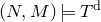 $(N,M)\models T^{\mathrm{d}}$
by Theorem 50. However, strictly speaking, we do not know whether there exist such M, N.
$(N,M)\models T^{\mathrm{d}}$
by Theorem 50. However, strictly speaking, we do not know whether there exist such M, N.
To secure a model of the complete theory $T^{\mathrm{d}}$
, we proceed as follows. Let F be an H-field. Then the completion
$T^{\mathrm{d}}$
, we proceed as follows. Let F be an H-field. Then the completion $F^{\mathrm{c}}$
of the ordered valued differential field F is an H-field extension of F, and F is dense in
$F^{\mathrm{c}}$
of the ordered valued differential field F is an H-field extension of F, and F is dense in $F^{\mathrm{c}}$
; see [Reference Aschenbrenner, van den Dries and van der HoevenAvdDvdH17, 10.5.9]. If F is closed and of countable cofinality, then
$F^{\mathrm{c}}$
; see [Reference Aschenbrenner, van den Dries and van der HoevenAvdDvdH17, 10.5.9]. If F is closed and of countable cofinality, then $F^{\mathrm{c}}$
is closed, by [Reference Aschenbrenner, van den Dries and van der HoevenAvdDvdH17, 14.1.6], so if, in addition, F has small derivation and
$F^{\mathrm{c}}$
is closed, by [Reference Aschenbrenner, van den Dries and van der HoevenAvdDvdH17, 14.1.6], so if, in addition, F has small derivation and $F\neq F^{\mathrm{c}}$
, then
$F\neq F^{\mathrm{c}}$
, then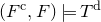 $(F^{\mathrm{c}},F)\models T^{\mathrm{d}}$
. Now
$(F^{\mathrm{c}},F)\models T^{\mathrm{d}}$
. Now $ {\mathbb T} $
is not complete: set
$ {\mathbb T} $
is not complete: set $\mathrm{e}_0=x$
and
$\mathrm{e}_0=x$
and $\mathrm{e}_{i+1}=\exp\mathrm{e}_i$
for all i; then
$\mathrm{e}_{i+1}=\exp\mathrm{e}_i$
for all i; then $(\sum_{i=0}^n 1/{\mathrm{e}_i})_{n=0}^\infty$
is a cauchy sequence in
$(\sum_{i=0}^n 1/{\mathrm{e}_i})_{n=0}^\infty$
is a cauchy sequence in $ {\mathbb T} $
but has no limit in
$ {\mathbb T} $
but has no limit in $ {\mathbb T} $
. Therefore,
$ {\mathbb T} $
. Therefore, $( {\mathbb T} ^{\mathrm{c}}, {\mathbb T} )\models T^{\mathrm{d}}$
.
$( {\mathbb T} ^{\mathrm{c}}, {\mathbb T} )\models T^{\mathrm{d}}$
.
6. Analytic Hardy fields of countable cofinality
Generalizing the terminology introduced in [Reference Aschenbrenner, van den Dries and van der HoevenAvdDvdH24a, Section 8], call a valued abelian group countably spherically complete if every pc-sequence in it of length $\omega$
pseudoconverges in it. Any
$\omega$
pseudoconverges in it. Any $\eta_1$
-ordered abelian group with a convex valuation is countably spherically complete, by [Reference Aschenbrenner, van den Dries and van der HoevenAvdDvdH17, 2.4.2]. Thus, maximal analytic and maximal smooth Hardy fields are countably spherically complete. In the first subsection we use this fact to realize the completion of an analytic Hardy field of countable cofinality as an analytic Hardy field: Corollary 6.10. Another main result of this section is a realization of the H-field
$\eta_1$
-ordered abelian group with a convex valuation is countably spherically complete, by [Reference Aschenbrenner, van den Dries and van der HoevenAvdDvdH17, 2.4.2]. Thus, maximal analytic and maximal smooth Hardy fields are countably spherically complete. In the first subsection we use this fact to realize the completion of an analytic Hardy field of countable cofinality as an analytic Hardy field: Corollary 6.10. Another main result of this section is a realization of the H-field $ {\mathbb T} _{\log}$
of logarithmic transseries from [Reference Aschenbrenner, van den Dries and van der HoevenAvdDvdH17, Appendix A] as an analytic Hardy field. This is obtained in Corollary 6.25, preceded by some observations on short ordered sets.
$ {\mathbb T} _{\log}$
of logarithmic transseries from [Reference Aschenbrenner, van den Dries and van der HoevenAvdDvdH17, Appendix A] as an analytic Hardy field. This is obtained in Corollary 6.25, preceded by some observations on short ordered sets.
6.1 Completing analytic Hardy fields of countable cofinality
Lemma 6.1 concerns H-asymptotic fields, and we recall from [Reference Aschenbrenner, van den Dries and van der HoevenAvdDvdH17, Chapter 9] the definition: an asymptotic field is a valued differential field K such that for all $f,g\in K^\times$
with
$f,g\in K^\times$
with $f,g \prec~1$
we have:
$f,g \prec~1$
we have: ${f\prec g \Leftrightarrow f'\prec g'}$
; an H-asymptotic field is an asymptotic field K such that for all
${f\prec g \Leftrightarrow f'\prec g'}$
; an H-asymptotic field is an asymptotic field K such that for all $f,g\in K^\times$
with
$f,g\in K^\times$
with $f,g \prec~1$
we have
$f,g \prec~1$
we have $f\prec g \Rightarrow f^\dagger\succcurlyeq g^\dagger$
. Every pre-H-field is an H-asymptotic field, by [Reference Aschenbrenner, van den Dries and van der HoevenAvdDvdH17, 9.1 and 10.5]. We shall also mention certain properties an H-asymptotic field may have: being, respectively,
$f\prec g \Rightarrow f^\dagger\succcurlyeq g^\dagger$
. Every pre-H-field is an H-asymptotic field, by [Reference Aschenbrenner, van den Dries and van der HoevenAvdDvdH17, 9.1 and 10.5]. We shall also mention certain properties an H-asymptotic field may have: being, respectively, $\lambda$
-free,
$\lambda$
-free, $\omega$
-free, newtonian, and asymptotically d-algebraically maximal. For these, see Sections 11.6 and 11.7 and Chapter 14 of [Reference Aschenbrenner, van den Dries and van der HoevenAvdDvdH17], or the summary in the introduction of [Reference Aschenbrenner, van den Dries and van der HoevenAvdDvdH24c]. For H-fields, being Liouville closed,
$\omega$
-free, newtonian, and asymptotically d-algebraically maximal. For these, see Sections 11.6 and 11.7 and Chapter 14 of [Reference Aschenbrenner, van den Dries and van der HoevenAvdDvdH17], or the summary in the introduction of [Reference Aschenbrenner, van den Dries and van der HoevenAvdDvdH24c]. For H-fields, being Liouville closed, $\omega$
-free, and newtonian is equivalent to being closed.
$\omega$
-free, and newtonian is equivalent to being closed.
Now let K be an asymptotic field. Equip the completion $K^{\mathrm{c}}$
of the valued field K with the unique extension of the derivation of K to a continuous derivation on
$K^{\mathrm{c}}$
of the valued field K with the unique extension of the derivation of K to a continuous derivation on $K^{\mathrm{c}}$
; cf. [Reference Aschenbrenner, van den Dries and van der HoevenAvdDvdH17, 4.4.11 and 9.1.5]. Then
$K^{\mathrm{c}}$
; cf. [Reference Aschenbrenner, van den Dries and van der HoevenAvdDvdH17, 4.4.11 and 9.1.5]. Then $K^{\mathrm{c}}$
is asymptotic by [Reference Aschenbrenner, van den Dries and van der HoevenAvdDvdH17, 9.1.6], and if K is a pre-H-field (H-field, respectively), then so is
$K^{\mathrm{c}}$
is asymptotic by [Reference Aschenbrenner, van den Dries and van der HoevenAvdDvdH17, 9.1.6], and if K is a pre-H-field (H-field, respectively), then so is $K^{\mathrm{c}}$
by [Reference Aschenbrenner, van den Dries and van der HoevenAvdDvdH17, 10.5.9]. Let L be an asymptotic field extension of K such that
$K^{\mathrm{c}}$
by [Reference Aschenbrenner, van den Dries and van der HoevenAvdDvdH17, 10.5.9]. Let L be an asymptotic field extension of K such that $\Gamma$
is cofinal in
$\Gamma$
is cofinal in $\Gamma_L$
. By [Reference Aschenbrenner, van den Dries and van der HoevenAvdDvdH17, 3.2.20], the natural inclusion
$\Gamma_L$
. By [Reference Aschenbrenner, van den Dries and van der HoevenAvdDvdH17, 3.2.20], the natural inclusion ${K\to L}$
extends uniquely to an embedding
${K\to L}$
extends uniquely to an embedding $K^{\mathrm{c}}\to L^{\mathrm{c}}$
of valued fields, and it is easily checked that this is an embedding of valued differential fields. If K is dense in L, then there is a unique valued field embedding
$K^{\mathrm{c}}\to L^{\mathrm{c}}$
of valued fields, and it is easily checked that this is an embedding of valued differential fields. If K is dense in L, then there is a unique valued field embedding $L\to K^{\mathrm{c}}$
over K, by [Reference Aschenbrenner, van den Dries and van der HoevenAvdDvdH17, 3.2.13], and this is also an embedding of valued differential fields.
$L\to K^{\mathrm{c}}$
over K, by [Reference Aschenbrenner, van den Dries and van der HoevenAvdDvdH17, 3.2.13], and this is also an embedding of valued differential fields.
Whenever in §§ 5–7 we are given valued differential fields K and L (e.g. asymptotic fields), an embedding $K\to L$
means: an embedding of valued differential fields. If, in addition, K and L are given as pre-H-fields (e.g. Hardy fields), such an embedding should also preserve the ordering, that is, be an embedding of ordered valued differential fields.
$K\to L$
means: an embedding of valued differential fields. If, in addition, K and L are given as pre-H-fields (e.g. Hardy fields), such an embedding should also preserve the ordering, that is, be an embedding of ordered valued differential fields.
Lemma 6.1. Let K be an $\omega$
-free H-asymptotic field whose value group
$\omega$
-free H-asymptotic field whose value group $\Gamma_K$
has countable cofinality. Let M be a newtonian H-asymptotic field with asymptotic integration, and suppose M is countably spherically complete. Then any embedding
$\Gamma_K$
has countable cofinality. Let M be a newtonian H-asymptotic field with asymptotic integration, and suppose M is countably spherically complete. Then any embedding $K\to M$
extends to an embedding
$K\to M$
extends to an embedding $K^{\mathrm{c}}\to M$
.
$K^{\mathrm{c}}\to M$
.
Proof. Let $\iota\colon K\to M$
be an embedding; we need to extend
$\iota\colon K\to M$
be an embedding; we need to extend $\iota$
to an embedding
$\iota$
to an embedding ${K^{\mathrm{c}}\to M}$
. The d-valued hull
${K^{\mathrm{c}}\to M}$
. The d-valued hull $L:=\operatorname{dv}(K)$
of K is
$L:=\operatorname{dv}(K)$
of K is $\omega$
-free by [Reference Aschenbrenner, van den Dries and van der HoevenAvdDvdH17, remark after 13.6.1], and
$\omega$
-free by [Reference Aschenbrenner, van den Dries and van der HoevenAvdDvdH17, remark after 13.6.1], and $\Gamma_L=\Gamma_K$
by [Reference Aschenbrenner, van den Dries and van der HoevenAvdDvdH17, 10.3.2(i)]. By [Reference Aschenbrenner, van den Dries and van der HoevenAvdDvdH17, 14.2.5], M is d-valued; let
$\Gamma_L=\Gamma_K$
by [Reference Aschenbrenner, van den Dries and van der HoevenAvdDvdH17, 10.3.2(i)]. By [Reference Aschenbrenner, van den Dries and van der HoevenAvdDvdH17, 14.2.5], M is d-valued; let $\iota_L$
be the extension of
$\iota_L$
be the extension of $\iota$
to an embedding
$\iota$
to an embedding ${L\to M}$
. Using a remark before the lemma, we see that it is enough to show that
${L\to M}$
. Using a remark before the lemma, we see that it is enough to show that $\iota_L$
extends to an embedding
$\iota_L$
extends to an embedding $L^{\mathrm{c}}\to M$
. Hence, replacing K,
$L^{\mathrm{c}}\to M$
. Hence, replacing K, $\iota$
by L,
$\iota$
by L, $\iota_L$
, we arrange that K is d-valued. Take an immediate asymptotically d-algebraically maximal d-algebraic extension L of K; by a remark following the statement of [Reference Aschenbrenner, van den Dries and van der HoevenAvdDvdH17, Theorem 14.0.1], such L exists and is
$\iota_L$
, we arrange that K is d-valued. Take an immediate asymptotically d-algebraically maximal d-algebraic extension L of K; by a remark following the statement of [Reference Aschenbrenner, van den Dries and van der HoevenAvdDvdH17, Theorem 14.0.1], such L exists and is $\omega$
-free and newtonian. Then, by [Reference Pynn-CoatesPC19, Theorem 3.5], L is a newtonization of K (as defined in [Reference Aschenbrenner, van den Dries and van der HoevenAvdDvdH17, p. 643]), so embeds into M over K. Passing to this newtonization we arrange that K is newtonian. Then
$\omega$
-free and newtonian. Then, by [Reference Pynn-CoatesPC19, Theorem 3.5], L is a newtonization of K (as defined in [Reference Aschenbrenner, van den Dries and van der HoevenAvdDvdH17, p. 643]), so embeds into M over K. Passing to this newtonization we arrange that K is newtonian. Then $K^{\mathrm{c}}$
is
$K^{\mathrm{c}}$
is $\omega$
-free by [Reference Aschenbrenner, van den Dries and van der HoevenAvdDvdH17, 11.7.20] and newtonian by [Reference Aschenbrenner, van den Dries and van der HoevenAvdDvdH17, 14.1.5].
$\omega$
-free by [Reference Aschenbrenner, van den Dries and van der HoevenAvdDvdH17, 11.7.20] and newtonian by [Reference Aschenbrenner, van den Dries and van der HoevenAvdDvdH17, 14.1.5].
Suppose $f\in K^{\mathrm{c}}\setminus K$
. It suffices to show that
$f\in K^{\mathrm{c}}\setminus K$
. It suffices to show that $\iota$
then extends to an embedding
$\iota$
then extends to an embedding $\iota_f\!\colon K\langle f\rangle \to M$
. Here is why:
$\iota_f\!\colon K\langle f\rangle \to M$
. Here is why: $K\langle f \rangle $
is
$K\langle f \rangle $
is $\omega$
-free by the remark before [Reference Aschenbrenner, van den Dries and van der HoevenAvdDvdH17, 11.7.20], so
$\omega$
-free by the remark before [Reference Aschenbrenner, van den Dries and van der HoevenAvdDvdH17, 11.7.20], so $K\langle f \rangle $
has a newtonization E in
$K\langle f \rangle $
has a newtonization E in $K^{\mathrm{c}}$
by [Reference Pynn-CoatesPC19, Theorem B]; by the same remark, E is
$K^{\mathrm{c}}$
by [Reference Pynn-CoatesPC19, Theorem B]; by the same remark, E is $\omega$
-free; moreover,
$\omega$
-free; moreover, $\iota_f$
extends to an embedding
$\iota_f$
extends to an embedding $E\to M$
. Hence, we can transfinitely iterate this extension process to obtain an embedding
$E\to M$
. Hence, we can transfinitely iterate this extension process to obtain an embedding $K^{\mathrm{c}}\to M$
extending
$K^{\mathrm{c}}\to M$
extending $\iota$
.
$\iota$
.
To construct $\iota_f$
, take a c-sequence
$\iota_f$
, take a c-sequence $(f_\rho)$
in K with
$(f_\rho)$
in K with $f_\rho\to f$
(in
$f_\rho\to f$
(in $K^{\mathrm{c}}$
). By [Reference Aschenbrenner, van den Dries and van der HoevenAvdDvdH17, 2.2.25], the index set of
$K^{\mathrm{c}}$
). By [Reference Aschenbrenner, van den Dries and van der HoevenAvdDvdH17, 2.2.25], the index set of $(f_\rho)$
has cofinality
$(f_\rho)$
has cofinality $\omega$
, so by passing to a cofinal subsequence we arrange that
$\omega$
, so by passing to a cofinal subsequence we arrange that $(f_\rho)$
is a divergent pc-sequence in K of length
$(f_\rho)$
is a divergent pc-sequence in K of length $\omega$
and width
$\omega$
and width $\{\infty\}$
such that
$\{\infty\}$
such that $f_\rho\leadsto f$
. Take
$f_\rho\leadsto f$
. Take $g\in M$
such that
$g\in M$
such that $\iota(f_\rho)\leadsto g$
. Now, K is asymptotically d-algebraically maximal by [Reference Pynn-CoatesPC19, Theorem A], so
$\iota(f_\rho)\leadsto g$
. Now, K is asymptotically d-algebraically maximal by [Reference Pynn-CoatesPC19, Theorem A], so $(f_\rho)$
is of d-transcendental type over K by [Reference Aschenbrenner, van den Dries and van der HoevenAvdDvdH17, 11.4.8 and 11.4.13], hence [Reference Aschenbrenner, van den Dries and van der HoevenAvdDvdH17, 11.4.7] yields an embedding
$(f_\rho)$
is of d-transcendental type over K by [Reference Aschenbrenner, van den Dries and van der HoevenAvdDvdH17, 11.4.8 and 11.4.13], hence [Reference Aschenbrenner, van den Dries and van der HoevenAvdDvdH17, 11.4.7] yields an embedding $K\langle f\rangle\to M$
extending
$K\langle f\rangle\to M$
extending $\iota$
and sending f to g.
$\iota$
and sending f to g.
Lemma 6.1 yields the following pre-H-field version of it without the $\omega$
-free hypothesis on K.
$\omega$
-free hypothesis on K.
Proposition 6.2. Let K be a pre-H-field with $\operatorname{cf}(\Gamma_K)=\omega$
and M a countably spherically complete closed H-field. Then every embedding
$\operatorname{cf}(\Gamma_K)=\omega$
and M a countably spherically complete closed H-field. Then every embedding $K\to M$
extends to an embedding
$K\to M$
extends to an embedding $K^{\mathrm{c}}\to M$
.
$K^{\mathrm{c}}\to M$
.
Before we begin the proof, from [Reference Aschenbrenner, van den Dries and van der HoevenAvdDvdH17, 16.3.21] we recall that a pre- $\Lambda \Omega$
-field
$\Lambda \Omega$
-field $\mathbf K= (K, I, \Lambda, \Omega)$
is a pre-H-field K equipped with a
$\mathbf K= (K, I, \Lambda, \Omega)$
is a pre-H-field K equipped with a $\Lambda \Omega$
-cut
$\Lambda \Omega$
-cut $(I, \Lambda, \Omega)$
of K as defined in [Reference Aschenbrenner, van den Dries and van der HoevenAvdDvdH17, p. 691]. A
$(I, \Lambda, \Omega)$
of K as defined in [Reference Aschenbrenner, van den Dries and van der HoevenAvdDvdH17, p. 691]. A $\Lambda \Omega$
-field is a pre-
$\Lambda \Omega$
-field is a pre- $\Lambda \Omega$
-field
$\Lambda \Omega$
-field $\mathbf K = (K; \dots)$
, where K is an H-field. If
$\mathbf K = (K; \dots)$
, where K is an H-field. If $\mathbf M = (M; \dots)$
is a pre-
$\mathbf M = (M; \dots)$
is a pre- $\Lambda \Omega$
-field and K is a pre-H-subfield of M, then K has a unique expansion to a pre-
$\Lambda \Omega$
-field and K is a pre-H-subfield of M, then K has a unique expansion to a pre- $\Lambda \Omega$
-field
$\Lambda \Omega$
-field $\mathbf K$
such that
$\mathbf K$
such that ${\mathbf K \subseteq \mathbf M}$
. Given a pre-
${\mathbf K \subseteq \mathbf M}$
. Given a pre- $\Lambda \Omega$
-field
$\Lambda \Omega$
-field $\mathbf K=(K,\dots)$
, we denote the value group and residue field of K by
$\mathbf K=(K,\dots)$
, we denote the value group and residue field of K by $\Gamma_{\mathbf K}$
,
$\Gamma_{\mathbf K}$
, $\operatorname{res}\mathbf K$
, and
$\operatorname{res}\mathbf K$
, and $\mathbf K$
is said to have some given property of pre-H-fields if its underlying pre-H-field K does. Given pre-
$\mathbf K$
is said to have some given property of pre-H-fields if its underlying pre-H-field K does. Given pre- $\Lambda \Omega$
-fields
$\Lambda \Omega$
-fields $\boldsymbol K$
and
$\boldsymbol K$
and $\boldsymbol L$
, an embedding
$\boldsymbol L$
, an embedding $\boldsymbol K \to \boldsymbol L$
is an embedding in the usual model-theoretic sense.
$\boldsymbol K \to \boldsymbol L$
is an embedding in the usual model-theoretic sense.
To show Proposition 6.2, let K, M be as in the proposition. We arrange that M extends K and then have to find an embedding $K^{\mathrm{c}}\to M$
over K. Take any expansion
$K^{\mathrm{c}}\to M$
over K. Take any expansion $\mathbf M$
of M to a
$\mathbf M$
of M to a $\Lambda \Omega$
-field and expand K to a pre-
$\Lambda \Omega$
-field and expand K to a pre- $\Lambda \Omega$
-field
$\Lambda \Omega$
-field $\mathbf K$
such that
$\mathbf K$
such that ${\mathbf K\subseteq\mathbf M}$
. Then the following proposition applied to
${\mathbf K\subseteq\mathbf M}$
. Then the following proposition applied to $\mathbf M$
in place of
$\mathbf M$
in place of $\mathbf L$
yields an
$\mathbf L$
yields an $\omega$
-free H-field extension
$\omega$
-free H-field extension $K^*$
of K such that K is cofinal in
$K^*$
of K such that K is cofinal in $K^*$
and an embedding
$K^*$
and an embedding $\iota^*\colon K^*\to M$
over K. Lemma 6.1 gives an extension of
$\iota^*\colon K^*\to M$
over K. Lemma 6.1 gives an extension of $\iota^*$
to an embedding
$\iota^*$
to an embedding $(K^*)^{\mathrm{c}}\to M$
, and by a remark before that lemma, this yields an embedding
$(K^*)^{\mathrm{c}}\to M$
, and by a remark before that lemma, this yields an embedding $K^{\mathrm{c}}\to M$
as required.
$K^{\mathrm{c}}\to M$
as required.
It remains to establish the following ‘cofinality’ refinement of [Reference Aschenbrenner, van den Dries and van der HoevenAvdDvdH17, 16.4.1]. Here we recall that a Liouville closed H-field K is said to be Schwarz closed if, for all $a\in K$
, the linear differential operator
$a\in K$
, the linear differential operator $\partial^2-a$
splits over the algebraic closure
$\partial^2-a$
splits over the algebraic closure $K[i]$
of K, and for all
$K[i]$
of K, and for all $a,b\in K$
, if
$a,b\in K$
, if $a\leqslant b$
, and
$a\leqslant b$
, and $\partial^2-a$
splits over K, then so does
$\partial^2-a$
splits over K, then so does $\partial^2-b$
; cf. [Reference Aschenbrenner, van den Dries and van der HoevenAvdDvdH17, 5.2 and 11.8]. Every closed H-field is Schwarz closed [Reference Aschenbrenner, van den Dries and van der HoevenAvdDvdH17, 14.2.20].
$\partial^2-b$
; cf. [Reference Aschenbrenner, van den Dries and van der HoevenAvdDvdH17, 5.2 and 11.8]. Every closed H-field is Schwarz closed [Reference Aschenbrenner, van den Dries and van der HoevenAvdDvdH17, 14.2.20].
Proposition 6.3. Let $\mathbf K$
be a pre-
$\mathbf K$
be a pre- $\Lambda \Omega$
-field with
$\Lambda \Omega$
-field with $\Gamma_{\mathbf K}\neq\{0\}$
. Then there exists an
$\Gamma_{\mathbf K}\neq\{0\}$
. Then there exists an $\omega$
-free
$\omega$
-free $\Lambda \Omega$
-field extension
$\Lambda \Omega$
-field extension $\mathbf K^*$
of
$\mathbf K^*$
of $\mathbf K$
such that:
$\mathbf K$
such that:
-
(i)
$\operatorname{res}\mathbf K^*$
is algebraic over
$\operatorname{res}\mathbf K$
; -
(ii)
$\mathbf K$
is cofinal in
$\mathbf K^*$
; and -
(iii) any embedding of
$\mathbf K$
into a Schwarz closed
$\Lambda \Omega$
-field
$\mathbf L$
extends to an embedding
$\mathbf K^*\to\mathbf L$
.


We revisit the proof of [Reference Aschenbrenner, van den Dries and van der HoevenAvdDvdH17, 16.4.1], which consists of several lemmas and a corollary. Recall that a differential field F is said to be closed under logarithms if, for all $f\in F$
, there is a
$f\in F$
, there is a $y\in F^\times$
such that
$y\in F^\times$
such that $y^\dagger=f'$
, and F is closed under integration if, for all
$y^\dagger=f'$
, and F is closed under integration if, for all $g\in F$
, there is a
$g\in F$
, there is a $z\in F$
such that
$z\in F$
such that $z'=g$
. Let
$z'=g$
. Let $\mathbf K=(K,I,\Lambda,\Omega)$
be a pre-
$\mathbf K=(K,I,\Lambda,\Omega)$
be a pre- $\Lambda \Omega$
-field with
$\Lambda \Omega$
-field with $\Gamma:=\Gamma_K\neq\{0\}$
.
$\Gamma:=\Gamma_K\neq\{0\}$
.
Lemma 6.4. Suppose K is grounded, or there exists $b\asymp 1$
in K such that v(b’) is a gap in K. Then
$b\asymp 1$
in K such that v(b’) is a gap in K. Then $\mathbf K$
has an
$\mathbf K$
has an $\omega$
-free
$\omega$
-free $\Lambda \Omega$
-field extension
$\Lambda \Omega$
-field extension $\mathbf K^*$
such that
$\mathbf K^*$
such that $\operatorname{res}\mathbf K=\operatorname{res}\mathbf K^*$
,
$\operatorname{res}\mathbf K=\operatorname{res}\mathbf K^*$
, $\mathbf K$
is cofinal in
$\mathbf K$
is cofinal in $\mathbf K^*$
, and any embedding of
$\mathbf K^*$
, and any embedding of $\mathbf K$
into a
$\mathbf K$
into a $\Lambda \Omega$
-field
$\Lambda \Omega$
-field $\mathbf L$
closed under logarithms extends to an embedding
$\mathbf L$
closed under logarithms extends to an embedding ${\mathbf K^*\to\mathbf L}$
.
${\mathbf K^*\to\mathbf L}$
.
Proof. By Lemma 3.15, K is cofinal in the H-field hull $F:=H(K)$
of K, and hence by Lemma 24, K is also cofinal in the H-field extension
$F:=H(K)$
of K, and hence by Lemma 24, K is also cofinal in the H-field extension $F_{\omega}$
of F constructed in [Reference Aschenbrenner, van den Dries and van der HoevenAvdDvdH17, 11.7]. Thus the lemma follows from the proof of [Reference Aschenbrenner, van den Dries and van der HoevenAvdDvdH17, 16.4.2].
$F_{\omega}$
of F constructed in [Reference Aschenbrenner, van den Dries and van der HoevenAvdDvdH17, 11.7]. Thus the lemma follows from the proof of [Reference Aschenbrenner, van den Dries and van der HoevenAvdDvdH17, 16.4.2].
Lemma 6.5. Suppose K has gap $\beta$
and
$\beta$
and $v(b')\neq\beta$
for all
$v(b')\neq\beta$
for all $b\asymp 1$
in K. Then there exists a grounded pre-
$b\asymp 1$
in K. Then there exists a grounded pre- $\Lambda \Omega$
-field extension
$\Lambda \Omega$
-field extension $\mathbf K_1$
of
$\mathbf K_1$
of $\mathbf K$
such that
$\mathbf K$
such that $\operatorname{res}\mathbf K=\operatorname{res}\mathbf K^*$
,
$\operatorname{res}\mathbf K=\operatorname{res}\mathbf K^*$
, $\mathbf K$
is cofinal in
$\mathbf K$
is cofinal in $\mathbf K_1$
, and any embedding of
$\mathbf K_1$
, and any embedding of $\mathbf K$
into a
$\mathbf K$
into a $\Lambda \Omega$
-field
$\Lambda \Omega$
-field $\mathbf L$
closed under integration extends to an embedding
$\mathbf L$
closed under integration extends to an embedding $\mathbf K_1\to\mathbf L$
.
$\mathbf K_1\to\mathbf L$
.
Proof. Take $s\in K$
such that
$s\in K$
such that $vs=\beta$
. Recall from [Reference Aschenbrenner, van den Dries and van der HoevenAvdDvdH17, 14.2] that
$vs=\beta$
. Recall from [Reference Aschenbrenner, van den Dries and van der HoevenAvdDvdH17, 14.2] that $\operatorname{I}(K)$
denotes the
$\operatorname{I}(K)$
denotes the $\mathcal O$
-submodule of K generated by
$\mathcal O$
-submodule of K generated by $\partial\mathcal O$
. Following the proof of [Reference Aschenbrenner, van den Dries and van der HoevenAvdDvdH17, 16.4.3], suppose
$\partial\mathcal O$
. Following the proof of [Reference Aschenbrenner, van den Dries and van der HoevenAvdDvdH17, 16.4.3], suppose ${s\notin \operatorname{I}(K)}$
, and take
${s\notin \operatorname{I}(K)}$
, and take $K_1$
as in case 1 of that proof, so
$K_1$
as in case 1 of that proof, so $K_1=H(K)(y)$
where
$K_1=H(K)(y)$
where ${y'=s}$
. Now use that
${y'=s}$
. Now use that $\Gamma_{H(K)}=\Gamma$
, and that
$\Gamma_{H(K)}=\Gamma$
, and that $\Gamma_{H(K)}$
is cofinal in
$\Gamma_{H(K)}$
is cofinal in $\Gamma_{H_1}$
by Lemma 3.16. If
$\Gamma_{H_1}$
by Lemma 3.16. If ${s\in \operatorname{I}(K)}$
and
${s\in \operatorname{I}(K)}$
and $K_1$
is as in case 2, then
$K_1$
is as in case 2, then $K_1=K(y)$
where
$K_1=K(y)$
where $y'=s$
, so again K is cofinal in
$y'=s$
, so again K is cofinal in $K_1$
by Lemma 3.16.
$K_1$
by Lemma 3.16.
These two lemmas yield the following ‘cofinality’ refinement of [Reference Aschenbrenner, van den Dries and van der HoevenAvdDvdH17, 16.4.4].
Corollary 6.6. Suppose K does not have asymptotic integration. Then $\mathbf K$
has an
$\mathbf K$
has an $\omega$
-free
$\omega$
-free $\Lambda \Omega$
-field extension
$\Lambda \Omega$
-field extension $\mathbf K^*$
such that
$\mathbf K^*$
such that $\operatorname{res}\mathbf K^* = \operatorname{res}\mathbf K$
,
$\operatorname{res}\mathbf K^* = \operatorname{res}\mathbf K$
, $\mathbf K$
is cofinal in
$\mathbf K$
is cofinal in $\mathbf K^*$
, and any embedding of
$\mathbf K^*$
, and any embedding of $\mathbf K$
into a
$\mathbf K$
into a $\Lambda \Omega$
-field
$\Lambda \Omega$
-field $\mathbf L$
closed under integration extends to an embedding
$\mathbf L$
closed under integration extends to an embedding $\mathbf K^*\to\mathbf L$
.
$\mathbf K^*\to\mathbf L$
.
The next three lemmas are ‘cofinality’ refinements of [Reference Aschenbrenner, van den Dries and van der HoevenAvdDvdH17, 16.4.5, 16.4.6, and 16.4.7] and take care of the case where K has asymptotic integration.
Lemma 6.7. Assume K has asymptotic integration and is not $\lambda$
-free. Then
$\lambda$
-free. Then $\mathbf K$
extends to an
$\mathbf K$
extends to an $\omega$
-free
$\omega$
-free $\Lambda \Omega$
-field
$\Lambda \Omega$
-field $\mathbf K^*$
such that
$\mathbf K^*$
such that $\operatorname{res}\mathbf K^* = (\operatorname{res}\mathbf K)^{\operatorname{rc}}$
,
$\operatorname{res}\mathbf K^* = (\operatorname{res}\mathbf K)^{\operatorname{rc}}$
, $\mathbf K$
is cofinal in
$\mathbf K$
is cofinal in $\mathbf K^*$
, and any embedding of
$\mathbf K^*$
, and any embedding of $\mathbf K$
into a Liouville closed
$\mathbf K$
into a Liouville closed $\Lambda \Omega$
-field
$\Lambda \Omega$
-field $\mathbf L$
extends to an embedding
$\mathbf L$
extends to an embedding $\mathbf K^*\to\mathbf L$
.
$\mathbf K^*\to\mathbf L$
.
Proof. As in the proof of [Reference Aschenbrenner, van den Dries and van der HoevenAvdDvdH17, 16.4.5], it is enough, by Corollary 6.6, to show that $\mathbf K$
has a
$\mathbf K$
has a $\Lambda \Omega$
-field extension
$\Lambda \Omega$
-field extension $\mathbf K_1=(K_1,\dots)$
with a gap such that
$\mathbf K_1=(K_1,\dots)$
with a gap such that $\operatorname{res}\mathbf K_1 = (\operatorname{res}\mathbf K)^{\operatorname{rc}}$
, K is cofinal in
$\operatorname{res}\mathbf K_1 = (\operatorname{res}\mathbf K)^{\operatorname{rc}}$
, K is cofinal in $K_1$
, and any embedding of
$K_1$
, and any embedding of $\mathbf K$
into a Liouville closed
$\mathbf K$
into a Liouville closed $\Lambda \Omega$
-field
$\Lambda \Omega$
-field $\mathbf L$
extends to an embedding
$\mathbf L$
extends to an embedding $\mathbf K_1\to\mathbf L$
. Take
$\mathbf K_1\to\mathbf L$
. Take $\mathbf K_1$
as in the proof of [Reference Aschenbrenner, van den Dries and van der HoevenAvdDvdH17, 16.4.5]. Put
$\mathbf K_1$
as in the proof of [Reference Aschenbrenner, van den Dries and van der HoevenAvdDvdH17, 16.4.5]. Put $E:=H(K)^{\operatorname{rc}}$
. Then
$E:=H(K)^{\operatorname{rc}}$
. Then $\Gamma_{E}= {\mathbb Q} \Gamma$
, so K is cofinal in E. If E has a gap, then
$\Gamma_{E}= {\mathbb Q} \Gamma$
, so K is cofinal in E. If E has a gap, then $K_1=E$
, and we are done. Suppose E has no gap. Then
$K_1=E$
, and we are done. Suppose E has no gap. Then $K_1=E(f)$
where
$K_1=E(f)$
where $f\in K_1^\times$
and
$f\in K_1^\times$
and $\lambda:=-f^\dagger\in K$
, and
$\lambda:=-f^\dagger\in K$
, and $s:=-\lambda$
creates a gap over E (as defined in [Reference Aschenbrenner, van den Dries and van der HoevenAvdDvdH17, p. 503]). By the proof of case 2 in [Reference Aschenbrenner, van den Dries and van der HoevenAvdDvdH17, 16.4.5], the hypothesis of Lemma 3.19 holds for E in place of K, so E is cofinal in
$s:=-\lambda$
creates a gap over E (as defined in [Reference Aschenbrenner, van den Dries and van der HoevenAvdDvdH17, p. 503]). By the proof of case 2 in [Reference Aschenbrenner, van den Dries and van der HoevenAvdDvdH17, 16.4.5], the hypothesis of Lemma 3.19 holds for E in place of K, so E is cofinal in $K_1$
, and hence so is K.
$K_1$
, and hence so is K.
Lemma 6.8. Suppose K is $\lambda$
-free but not
$\lambda$
-free but not $\omega$
-free. Then
$\omega$
-free. Then $\mathbf K$
has an
$\mathbf K$
has an $\omega$
-free
$\omega$
-free $\Lambda \Omega$
-field extension
$\Lambda \Omega$
-field extension $\mathbf K^*$
such that
$\mathbf K^*$
such that $\operatorname{res}\mathbf K^*$
is algebraic over
$\operatorname{res}\mathbf K^*$
is algebraic over $\operatorname{res}\mathbf K$
,
$\operatorname{res}\mathbf K$
, $\mathbf K$
is cofinal in
$\mathbf K$
is cofinal in $\mathbf K^*$
, and any embedding of
$\mathbf K^*$
, and any embedding of $\mathbf K$
into a Schwarz-closed
$\mathbf K$
into a Schwarz-closed $\Lambda \Omega$
-field
$\Lambda \Omega$
-field $\mathbf L$
extends to an embedding of
$\mathbf L$
extends to an embedding of $\mathbf K^*$
into
$\mathbf K^*$
into $\mathbf L$
.
$\mathbf L$
.
Proof. For the definition of the pc-sequence $(\omega_\rho)$
in K and the d-rational functions
$(\omega_\rho)$
in K and the d-rational functions $\omega$
,
$\omega$
, $\sigma$
and their role in
$\sigma$
and their role in $\omega$
-freeness as used in this proof, see [Reference Aschenbrenner, van den Dries and van der HoevenAvdDvdH17, 11.7 and 11.8]. Take
$\omega$
-freeness as used in this proof, see [Reference Aschenbrenner, van den Dries and van der HoevenAvdDvdH17, 11.7 and 11.8]. Take $\omega\in K$
with
$\omega\in K$
with $\omega_\rho\leadsto\omega$
. Let
$\omega_\rho\leadsto\omega$
. Let $\mathbf K^*$
be as in the proof of [Reference Aschenbrenner, van den Dries and van der HoevenAvdDvdH17, 16.4.6]. That proof shows that
$\mathbf K^*$
be as in the proof of [Reference Aschenbrenner, van den Dries and van der HoevenAvdDvdH17, 16.4.6]. That proof shows that $\Omega=\omega(K)^\downarrow$
or
$\Omega=\omega(K)^\downarrow$
or $\Omega=K\setminus\sigma(\gamma(K)){}^\uparrow$
. Suppose first that
$\Omega=K\setminus\sigma(\gamma(K)){}^\uparrow$
. Suppose first that $\Omega=\omega(K)^\downarrow$
. With
$\Omega=\omega(K)^\downarrow$
. With $\mathbf K_{\gamma}=(K_{\gamma},\dots)$
as in case 1 of that proof, we have
$\mathbf K_{\gamma}=(K_{\gamma},\dots)$
as in case 1 of that proof, we have $K_{\gamma}=K\langle\gamma\rangle$
where
$K_{\gamma}=K\langle\gamma\rangle$
where $\gamma\neq 0$
,
$\gamma\neq 0$
, $\sigma(\gamma)=\omega$
, and
$\sigma(\gamma)=\omega$
, and $v\gamma$
is a gap in
$v\gamma$
is a gap in $K_{\gamma}$
. The remarks before [Reference Aschenbrenner, van den Dries and van der HoevenAvdDvdH17, 13.7.7] give
$K_{\gamma}$
. The remarks before [Reference Aschenbrenner, van den Dries and van der HoevenAvdDvdH17, 13.7.7] give $[\Gamma]=[\Gamma_{K_{\gamma}}]$
, so K is cofinal in
$[\Gamma]=[\Gamma_{K_{\gamma}}]$
, so K is cofinal in $K_{\gamma}$
. Now follow the argument in case 1 of [Reference Aschenbrenner, van den Dries and van der HoevenAvdDvdH17], using Corollary 6.6 instead of [Reference Aschenbrenner, van den Dries and van der HoevenAvdDvdH17, 16.4.4]. If
$K_{\gamma}$
. Now follow the argument in case 1 of [Reference Aschenbrenner, van den Dries and van der HoevenAvdDvdH17], using Corollary 6.6 instead of [Reference Aschenbrenner, van den Dries and van der HoevenAvdDvdH17, 16.4.4]. If $\Omega=K\setminus\sigma(\gamma(K)){}^\uparrow$
, then we argue as in case 2 of [Reference Aschenbrenner, van den Dries and van der HoevenAvdDvdH17], using Lemma 6.7 instead of [Reference Aschenbrenner, van den Dries and van der HoevenAvdDvdH17, 16.4.5].
$\Omega=K\setminus\sigma(\gamma(K)){}^\uparrow$
, then we argue as in case 2 of [Reference Aschenbrenner, van den Dries and van der HoevenAvdDvdH17], using Lemma 6.7 instead of [Reference Aschenbrenner, van den Dries and van der HoevenAvdDvdH17, 16.4.5].
Lemma 6.9. Suppose K is $\omega$
-free. Then
$\omega$
-free. Then $\mathbf K$
has an
$\mathbf K$
has an $\omega$
-free
$\omega$
-free $\Lambda \Omega$
-field extension
$\Lambda \Omega$
-field extension $\mathbf K^*$
such that
$\mathbf K^*$
such that $\operatorname{res}\mathbf K^* = \operatorname{res}\mathbf K$
,
$\operatorname{res}\mathbf K^* = \operatorname{res}\mathbf K$
, $\mathbf K$
is cofinal in
$\mathbf K$
is cofinal in $\mathbf K^*$
, and any embedding of
$\mathbf K^*$
, and any embedding of $\mathbf K$
into a
$\mathbf K$
into a $\Lambda \Omega$
-field
$\Lambda \Omega$
-field $\mathbf L$
extends to an embedding of
$\mathbf L$
extends to an embedding of $\mathbf K^*$
into
$\mathbf K^*$
into $\mathbf L$
.
$\mathbf L$
.
Proof. Take $\mathbf K^*=(K^*,\dots)$
as in the proof of [Reference Aschenbrenner, van den Dries and van der HoevenAvdDvdH17, 16.4.7]. Then
$\mathbf K^*=(K^*,\dots)$
as in the proof of [Reference Aschenbrenner, van den Dries and van der HoevenAvdDvdH17, 16.4.7]. Then $K^*=H(K)$
, and by Lemma 3.15, K is cofinal in H(K).
$K^*=H(K)$
, and by Lemma 3.15, K is cofinal in H(K).
This concludes the proof of Propositions 6.3 and 6.2. Combining the latter with [Reference Aschenbrenner, van den Dries and van der HoevenAvdDvdH24a, Corollary 3.2] and Corollary 4.6 yields the following.
Corollary 6.10. Let H be a Hardy field of countable cofinality and $M\supseteq H$
a maximal Hardy field. Then there is an embedding
$M\supseteq H$
a maximal Hardy field. Then there is an embedding $H^{\mathrm{c}}\to M$
over H. Likewise, if
$H^{\mathrm{c}}\to M$
over H. Likewise, if $M\supseteq H$
is a maximal analytic Hardy field or a maximal smooth Hardy field.
$M\supseteq H$
is a maximal analytic Hardy field or a maximal smooth Hardy field.
As a consequence of Corollary 6.10, with $t:=x^{-1}$
, each maximal analytic Hardy field contains a Hardy field extending
$t:=x^{-1}$
, each maximal analytic Hardy field contains a Hardy field extending $ {\mathbb R} (t)$
and isomorphic over
$ {\mathbb R} (t)$
and isomorphic over $ {\mathbb R} (t)$
to the ordered field
$ {\mathbb R} (t)$
to the ordered field $ {\mathbb R} ((t))$
of Laurent series over
$ {\mathbb R} ((t))$
of Laurent series over $ {\mathbb R} $
equipped with the continuous
$ {\mathbb R} $
equipped with the continuous $ {\mathbb R} $
-linear derivation given by
$ {\mathbb R} $
-linear derivation given by $t'=-t^2$
. (This may be viewed as a Hardy field version of Besicovitch’s strengthening [Reference BesikowitschBes24] of Borel’s theorem on
$t'=-t^2$
. (This may be viewed as a Hardy field version of Besicovitch’s strengthening [Reference BesikowitschBes24] of Borel’s theorem on $\mathcal{C}^\infty$
-functions with prescribed Taylor series [Reference BorelBor95].) In Corollary 8.10 we show that even the ordered differential field
$\mathcal{C}^\infty$
-functions with prescribed Taylor series [Reference BorelBor95].) In Corollary 8.10 we show that even the ordered differential field $ {\mathbb T} $
of transseries, which vastly extends
$ {\mathbb T} $
of transseries, which vastly extends $ {\mathbb R} ((t))$
, embeds into any given maximal analytic Hardy field. As a first step, we accomplish this in the following for the H-subfield
$ {\mathbb R} ((t))$
, embeds into any given maximal analytic Hardy field. As a first step, we accomplish this in the following for the H-subfield $ {\mathbb T} _{\log}$
of
$ {\mathbb T} _{\log}$
of $ {\mathbb T} $
of logarithmic transseries (cf. [Reference Aschenbrenner, van den Dries and van der HoevenAvdDvdH17, p. 722]). For this it is useful to have available some facts about short ordered sets, also needed in § 7.
$ {\mathbb T} $
of logarithmic transseries (cf. [Reference Aschenbrenner, van den Dries and van der HoevenAvdDvdH17, p. 722]). For this it is useful to have available some facts about short ordered sets, also needed in § 7.
6.2 Short ordered sets
Let S be an ordered set. (As in [Reference Aschenbrenner, van den Dries and van der HoevenAvdDvdH24a], this means ‘linearly ordered set’.) Let $S^*$
denote S equipped with the reverse ordering. Then the following are equivalent:
$S^*$
denote S equipped with the reverse ordering. Then the following are equivalent:
-
(S1) all well-ordered subsets of S and of
$S^*$
are countable; -
(S2) there are no embeddings of
$\omega_1$
into S or
$S^*$
; -
(S3)
$\operatorname{cf}(A),\operatorname{ci}(A) \leqslant\omega$
for all ordered subsets A of S.



Call S short if any of the equivalent conditions (S1)–(S3) holds; cf. [Reference Dales and WoodinDW96, 1.7(i)] and [Reference RosensteinRos82, pp. 88, 170–171]. If S is short, then so are $S^*$
and every ordered subset of S. If S is countable, then it is short; more generally, if S is a union of countably many short ordered subsets, then S is short. If
$S^*$
and every ordered subset of S. If S is countable, then it is short; more generally, if S is a union of countably many short ordered subsets, then S is short. If $S\to S'$
is a surjective increasing map between ordered sets and S is short, then so is S’; similarly with ‘decreasing’ instead of ‘increasing’. Shortness enters our story via the following observation.
$S\to S'$
is a surjective increasing map between ordered sets and S is short, then so is S’; similarly with ‘decreasing’ instead of ‘increasing’. Shortness enters our story via the following observation.
Lemma 6.11. Let (G,S,v) be a valued abelian group where S is short, and let $(a_\rho)$
be a pc-sequence in (G,S,v). Then some final segment of
$(a_\rho)$
be a pc-sequence in (G,S,v). Then some final segment of $(a_\rho)$
has countable length.
$(a_\rho)$
has countable length.
Proof. Put $s_\rho:=v(a_{\rho+1}-a_\rho)$
, where
$s_\rho:=v(a_{\rho+1}-a_\rho)$
, where $\rho+1$
is the successor of
$\rho+1$
is the successor of $\rho$
. After deleting an initial segment of
$\rho$
. After deleting an initial segment of $(a_\rho)$
, we arrange that the sequence
$(a_\rho)$
, we arrange that the sequence $(s_\rho)$
in S is strictly increasing. Then the image of the index set of
$(s_\rho)$
in S is strictly increasing. Then the image of the index set of $(a_\rho)$
under the embedding
$(a_\rho)$
under the embedding $\rho\mapsto s_\rho$
of ordered sets is a well-ordered subset of S and hence countable.
$\rho\mapsto s_\rho$
of ordered sets is a well-ordered subset of S and hence countable.
Lemma 6.12. If the order topology of S is second countable, then S is short.
Proof. Suppose $i\colon \omega_1\to S$
is strictly increasing. With
$i\colon \omega_1\to S$
is strictly increasing. With $\lambda$
ranging over the limit ordinals
$\lambda$
ranging over the limit ordinals $<\omega_1$
, we then have uncountably many nonempty pairwise disjoint open intervals
$<\omega_1$
, we then have uncountably many nonempty pairwise disjoint open intervals $(i(\lambda),i(\lambda+2))$
in S, so S is not second countable. An embedding
$(i(\lambda),i(\lambda+2))$
in S, so S is not second countable. An embedding $\omega_1\to S^*$
yields the same conclusion.
$\omega_1\to S^*$
yields the same conclusion.
In particular, the real line (the ordered set of real numbers) is short. (In fact, by [Reference Harrington, Shelah, van Dalen, Lascar and SmileyHS82, Theorem 2], each Borel ordered set is short.) The following observation is due to Hausdorff [Reference HausdorffHau07, p. 133] and Urysohn [Reference UrysohnUry24].
Lemma 6.13. Suppose S is short and T is an $\eta_1$
-ordered set. Then any embedding of an ordered subset of S into T extends to an embedding
$\eta_1$
-ordered set. Then any embedding of an ordered subset of S into T extends to an embedding ${S\to T}$
. In particular, there exists an embedding
${S\to T}$
. In particular, there exists an embedding ${S\to T}$
.
${S\to T}$
.
Proof. Let A be an ordered subset of S and $i\colon A\to T$
an embedding. Suppose
$i\colon A\to T$
an embedding. Suppose $s\in S\setminus A$
. Then
$s\in S\setminus A$
. Then $\operatorname{cf}(A^{\lt s}),\operatorname{ci}(A^{>s})\leqslant\omega$
, so we have
$\operatorname{cf}(A^{\lt s}),\operatorname{ci}(A^{>s})\leqslant\omega$
, so we have $t\in T$
with
$t\in T$
with $i(A^{\lt s})\lt t<i(A^{\gt s})$
. Thus, i extends to an embedding
$i(A^{\lt s})\lt t<i(A^{\gt s})$
. Thus, i extends to an embedding $A\cup\{s\}\to T$
sending s to t. Zorn does the rest.
$A\cup\{s\}\to T$
sending s to t. Zorn does the rest.
Corollary 6.14. Every $\eta_1$
-ordered set has cardinality
$\eta_1$
-ordered set has cardinality $\geqslant\mathfrak c$
. There is an
$\geqslant\mathfrak c$
. There is an $\eta_1$
-ordered set of cardinality
$\eta_1$
-ordered set of cardinality $\mathfrak c$
.
$\mathfrak c$
.
Proof. For the first claim, apply Lemma 6.13 to $S=\text{the real line}$
. The second claim follows from the first together with [Reference Aschenbrenner, van den Dries and van der HoevenAvdDvdH17, B.9.6].
$S=\text{the real line}$
. The second claim follows from the first together with [Reference Aschenbrenner, van den Dries and van der HoevenAvdDvdH17, B.9.6].
Combining Lemma 6.13 and Corollary 6.14, we obtain the following.
Corollary 6.15 (Urysohn [Reference UrysohnUry23, Reference UrysohnUry24]). Every short ordered set has cardinality $\leqslant\mathfrak c$
.
$\leqslant\mathfrak c$
.
For (ordered) Hahn products, see [Reference Aschenbrenner, van den Dries and van der HoevenAvdDvdH17, 2.2 and 2.4]. Shortness of $ {\mathbb R} $
is at the root of the following result due to Esterle [Reference EsterleEst77, Lemme 2.2 and the remark after it].
$ {\mathbb R} $
is at the root of the following result due to Esterle [Reference EsterleEst77, Lemme 2.2 and the remark after it].
Lemma 6.16. If S is short, then so is the Hahn product $H[S, {\mathbb R} ]$
.
$H[S, {\mathbb R} ]$
.
From Lemma 6.16 and the Hahn embedding theorem [Reference Aschenbrenner, van den Dries and van der HoevenAvdDvdH17, 2.4.19], we obtain a characterization of short ordered abelian groups as follows.
Lemma 6.17. For an ordered abelian group $\Gamma$
, the following are equivalent:
$\Gamma$
, the following are equivalent:
-
(i)
$\Gamma$
is short; -
(ii) the ordered set
$[\Gamma]$
is short; -
(iii)
$\Gamma$
embeds into
$H[S, {\mathbb R} ]$
for some short S.


Corollary 6.18. Let $\Delta\subseteq\Gamma$
be an extension of ordered abelian groups. Then
$\Delta\subseteq\Gamma$
be an extension of ordered abelian groups. Then
 $$\text{$\Gamma$ is short} \quad\Longleftrightarrow\quad \text{$\Delta$ and $[\Gamma]\setminus[\Delta]$ are short.}$$
In particular, if $\operatorname{rank}_{ {\mathbb Q} }(\Gamma/\Delta)\leqslant \aleph_0$
, then
$\operatorname{rank}_{ {\mathbb Q} }(\Gamma/\Delta)\leqslant \aleph_0$
, then $\Gamma$
is short if and only if
$\Gamma$
is short if and only if $\Delta$
is short, and if
$\Delta$
is short, and if $\Delta$
is convex, then
$\Delta$
is convex, then $\Gamma$
is short if and only if
$\Gamma$
is short if and only if $\Delta$
and
$\Delta$
and $\Gamma/\Delta$
are short.
$\Gamma/\Delta$
are short.
Proof. The direction $\Rightarrow$
is clear from Lemma 6.17. For the converse, note that if
$\Rightarrow$
is clear from Lemma 6.17. For the converse, note that if $\Delta$
and
$\Delta$
and ${[\Gamma]\setminus [\Delta]}$
are short, then so is
${[\Gamma]\setminus [\Delta]}$
are short, then so is $[\Gamma]$
, and hence
$[\Gamma]$
, and hence $\Gamma$
as well by Lemma 6.17. Next, use that if
$\Gamma$
as well by Lemma 6.17. Next, use that if $\operatorname{rank}_{ {\mathbb Q} }(\Gamma/\Delta)\leqslant \aleph_0$
, then
$\operatorname{rank}_{ {\mathbb Q} }(\Gamma/\Delta)\leqslant \aleph_0$
, then $[\Gamma]\setminus [\Delta]$
is countable by [Reference Aschenbrenner, van den Dries and van der HoevenAvdDvdH17, 2.3.9]. For convex
$[\Gamma]\setminus [\Delta]$
is countable by [Reference Aschenbrenner, van den Dries and van der HoevenAvdDvdH17, 2.3.9]. For convex $\Delta$
, see [Reference Aschenbrenner, van den Dries and van der HoevenAvdDvdH17, p. 102].
$\Delta$
, see [Reference Aschenbrenner, van den Dries and van der HoevenAvdDvdH17, p. 102].
Lemma 6.19. Let K be an ordered field equipped with a convex valuation whose residue field is archimedean. Then K is short if and only if its value group $\Gamma$
is short.
$\Gamma$
is short.
Proof. Suppose $\Gamma$
is short. Then
$\Gamma$
is short. Then $ {\mathbb Q} \Gamma$
is also short, by the previous corollary, and the real closure of
$ {\mathbb Q} \Gamma$
is also short, by the previous corollary, and the real closure of $\operatorname{res} K$
remains archimedean; hence, to show that K is short we may replace K by its real closure to arrange that K is real closed. Using [Reference Aschenbrenner, van den Dries and van der HoevenAvdDvdH17, 3.3.32, 3.3.42, 3.5.1, and 3.5.12], we obtain an ordered field embedding of K into the ordered Hahn field
$\operatorname{res} K$
remains archimedean; hence, to show that K is short we may replace K by its real closure to arrange that K is real closed. Using [Reference Aschenbrenner, van den Dries and van der HoevenAvdDvdH17, 3.3.32, 3.3.42, 3.5.1, and 3.5.12], we obtain an ordered field embedding of K into the ordered Hahn field $ {\mathbb R} ((t^\Gamma))$
. The underlying ordered additive group of
$ {\mathbb R} ((t^\Gamma))$
. The underlying ordered additive group of $ {\mathbb R} ((t^\Gamma))$
is isomorphic with the ordered Hahn product
$ {\mathbb R} ((t^\Gamma))$
is isomorphic with the ordered Hahn product $H[t^{\Gamma}, {\mathbb R} ]$
; see [Reference Aschenbrenner, van den Dries and van der HoevenAvdDvdH17, p. 114]. Hence, K is short by Lemma 6.17. Conversely, if K is short, then so is its ordered subset
$H[t^{\Gamma}, {\mathbb R} ]$
; see [Reference Aschenbrenner, van den Dries and van der HoevenAvdDvdH17, p. 114]. Hence, K is short by Lemma 6.17. Conversely, if K is short, then so is its ordered subset $K^>$
, and then so is the image
$K^>$
, and then so is the image $\Gamma$
of
$\Gamma$
of $K^>$
under the decreasing map
$K^>$
under the decreasing map $f\mapsto vf\colon K^>\to\Gamma$
.
$f\mapsto vf\colon K^>\to\Gamma$
.
Hence, if an ordered field is short, then so is its real closure. If K as in Lemma 6.19 is short and L is an ordered field extension of K with a convex valuation that makes it an immediate extension of K, then L is short. (Note that the ordered fraction field of a short ordered integral domain may fail to be short [Reference CiesielskiCie88, Reference CiesielskiCie91].) The following is from [Reference van den Dries, Macintyre and MarkerDMM01,§ 2.10].
Corollary 6.20. The ordered differential field $ {\mathbb T} $
is short.
$ {\mathbb T} $
is short.
Proof. We recall some features of the construction of $ {\mathbb T} $
from [Reference Aschenbrenner, van den Dries and van der HoevenAvdDvdH17, Appendix A]. We have the ordered subfield
$ {\mathbb T} $
from [Reference Aschenbrenner, van den Dries and van der HoevenAvdDvdH17, Appendix A]. We have the ordered subfield $ {\mathbb T} _{\exp}=\bigcup_m E_m$
of
$ {\mathbb T} _{\exp}=\bigcup_m E_m$
of $ {\mathbb T} $
, where
$ {\mathbb T} $
, where $E_m= {\mathbb R} [[G_m]]$
for certain ordered subgroups
$E_m= {\mathbb R} [[G_m]]$
for certain ordered subgroups $G_m$
of
$G_m$
of $ {\mathbb T} ^>$
, with
$ {\mathbb T} ^>$
, with $G_0=x^{ {\mathbb R} }$
and
$G_0=x^{ {\mathbb R} }$
and $G_{m+1}=G_m\exp(A_m)$
for some subgroup
$G_{m+1}=G_m\exp(A_m)$
for some subgroup $A_m$
of the additive group of
$A_m$
of the additive group of $E_m$
, with
$E_m$
, with $G_m$
a convex subgroup of
$G_m$
a convex subgroup of $G_{m+1}$
. An easy induction on m shows that each
$G_{m+1}$
. An easy induction on m shows that each $E_m$
is short, and thus
$E_m$
is short, and thus $ {\mathbb T} _{\exp}$
is short. Now
$ {\mathbb T} _{\exp}$
is short. Now $ {\mathbb T} =\bigcup_n ( {\mathbb T} _{\exp}){\downarrow^n}$
, where
$ {\mathbb T} =\bigcup_n ( {\mathbb T} _{\exp}){\downarrow^n}$
, where $f\mapsto f{\downarrow^n}$
is the nth compositional iterate of the automorphism
$f\mapsto f{\downarrow^n}$
is the nth compositional iterate of the automorphism $f\mapsto f{\downarrow}=f\circ\log x$
of the ordered field
$f\mapsto f{\downarrow}=f\circ\log x$
of the ordered field $ {\mathbb T} $
, hence
$ {\mathbb T} $
, hence $ {\mathbb T} $
is also short.
$ {\mathbb T} $
is also short.
Question. Are d-algebraic Hardy field extensions of short Hardy fields also short?
Next we give two algebraic variants of Lemma 6.13, attributed to Esterle in [Reference Dales and WoodinDW96, 2.37].
Lemma 6.21. Let $\Delta$
be a short ordered abelian group and
$\Delta$
be a short ordered abelian group and $\Gamma$
a divisible
$\Gamma$
a divisible $\eta_1$
-ordered abelian group. Then any embedding of an ordered subgroup of
$\eta_1$
-ordered abelian group. Then any embedding of an ordered subgroup of $\Delta$
into
$\Delta$
into $\Gamma$
extends to an embedding
$\Gamma$
extends to an embedding ${\Delta\to \Gamma}$
.
${\Delta\to \Gamma}$
.
Proof. Let $\Delta_0$
be an ordered subgroup of
$\Delta_0$
be an ordered subgroup of $\Delta$
and
$\Delta$
and $i\colon \Delta_0\to \Gamma$
an embedding. The divisible hull
$i\colon \Delta_0\to \Gamma$
an embedding. The divisible hull $ {\mathbb Q} \Delta\subseteq \Gamma$
of
$ {\mathbb Q} \Delta\subseteq \Gamma$
of $\Delta$
is short, by Corollary 6.18. Replace
$\Delta$
is short, by Corollary 6.18. Replace $\Delta_0$
,
$\Delta_0$
, $\Delta$
by
$\Delta$
by $ {\mathbb Q} \Delta_0$
,
$ {\mathbb Q} \Delta_0$
, $ {\mathbb Q} \Delta$
(and i accordingly) to arrange
$ {\mathbb Q} \Delta$
(and i accordingly) to arrange $\Delta_0$
,
$\Delta_0$
, $\Delta$
to be divisible. Given
$\Delta$
to be divisible. Given ${\delta\in \Delta\setminus \Delta_0}$
, Lemma 6.13 yields
${\delta\in \Delta\setminus \Delta_0}$
, Lemma 6.13 yields $\gamma\in\Gamma$
with
$\gamma\in\Gamma$
with $i(\Delta_0^{\lt \delta}) \lt \gamma \lt i(\Delta_0^{\gt \delta})$
, and then i extends to an embedding of the ordered subgroup
$i(\Delta_0^{\lt \delta}) \lt \gamma \lt i(\Delta_0^{\gt \delta})$
, and then i extends to an embedding of the ordered subgroup $\Delta_0\oplus {\mathbb Q} \delta$
of
$\Delta_0\oplus {\mathbb Q} \delta$
of $\Delta$
into
$\Delta$
into $\Gamma$
sending
$\Gamma$
sending $\delta$
to
$\delta$
to $\gamma$
. Zorn does the rest.
$\gamma$
. Zorn does the rest.
In the same way, taking real closures instead of divisible hulls in the proof, we have the following.
Lemma 6.22. Any embedding of an ordered subfield of a short ordered field K into a real closed $\eta_1$
-ordered field L extends to an embedding
$\eta_1$
-ordered field L extends to an embedding $K\to L$
.
$K\to L$
.
Combining Corollary 6.20 and the previous lemma yields the following.
Corollary 6.23. The ordered field $ {\mathbb T} $
embeds into each real closed
$ {\mathbb T} $
embeds into each real closed $\eta_1$
-ordered field.
$\eta_1$
-ordered field.
Lemma 8.8 is an analogue of Lemma 6.22 for H-fields with small derivation.
6.3 Realizing
$ {\mathbb T} _{\log}$
as an analytic Hardy field

This uses the following variant of Lemma 6.1 for embedding $\omega$
-free immediate extensions.
$\omega$
-free immediate extensions.
Lemma 6.24. Let K be an H-asymptotic field with short value group, L an $\omega$
-free immediate extension of K, and M a newtonian H-asymptotic field with asymptotic integration. Suppose M is countably spherically complete. Then any embedding
$\omega$
-free immediate extension of K, and M a newtonian H-asymptotic field with asymptotic integration. Suppose M is countably spherically complete. Then any embedding $K\to M$
extends to an embedding
$K\to M$
extends to an embedding ${L\to M}$
.
${L\to M}$
.
Proof. Let $\iota\colon K\to M$
be an embedding; we shall extend
$\iota\colon K\to M$
be an embedding; we shall extend $\iota$
to an embedding
$\iota$
to an embedding ${L\to M}$
. Now L is pre-d-valued by [Reference Aschenbrenner, van den Dries and van der HoevenAvdDvdH17, 10.1.3], and as
${L\to M}$
. Now L is pre-d-valued by [Reference Aschenbrenner, van den Dries and van der HoevenAvdDvdH17, 10.1.3], and as $\operatorname{dv}(L)$
is
$\operatorname{dv}(L)$
is $\omega$
-free by [Reference Aschenbrenner, van den Dries and van der HoevenAvdDvdH17, remark after 13.6.1] and
$\omega$
-free by [Reference Aschenbrenner, van den Dries and van der HoevenAvdDvdH17, remark after 13.6.1] and $\Gamma_{\operatorname{dv}(L)}=\Gamma$
by [Reference Aschenbrenner, van den Dries and van der HoevenAvdDvdH17, 10.3.2(i)], we can replace L by
$\Gamma_{\operatorname{dv}(L)}=\Gamma$
by [Reference Aschenbrenner, van den Dries and van der HoevenAvdDvdH17, 10.3.2(i)], we can replace L by $\operatorname{dv}(L)$
to arrange that L is d-valued. Then L has an immediate d-algebraic newtonian
$\operatorname{dv}(L)$
to arrange that L is d-valued. Then L has an immediate d-algebraic newtonian $\omega$
-free extension by [Reference Aschenbrenner, van den Dries and van der HoevenAvdDvdH17, the remark after 14.0.1], which is then a newtonization of L by [Reference Pynn-CoatesPC19, Theorem 3.5]. Replacing L by this newtonization, we also arrange that L is newtonian. Using Zorn, we further arrange that
$\omega$
-free extension by [Reference Aschenbrenner, van den Dries and van der HoevenAvdDvdH17, the remark after 14.0.1], which is then a newtonization of L by [Reference Pynn-CoatesPC19, Theorem 3.5]. Replacing L by this newtonization, we also arrange that L is newtonian. Using Zorn, we further arrange that $\iota$
does not extend to any embedding into M of any valued differential subfield of L properly containing K. Note that K is
$\iota$
does not extend to any embedding into M of any valued differential subfield of L properly containing K. Note that K is $\omega$
-free by [Reference Aschenbrenner, van den Dries and van der HoevenAvdDvdH17, the remark preceding 11.7.20]. Now M is d-valued by [Reference Aschenbrenner, van den Dries and van der HoevenAvdDvdH17, 14.2.5], hence so is K by the universal property of
$\omega$
-free by [Reference Aschenbrenner, van den Dries and van der HoevenAvdDvdH17, the remark preceding 11.7.20]. Now M is d-valued by [Reference Aschenbrenner, van den Dries and van der HoevenAvdDvdH17, 14.2.5], hence so is K by the universal property of $\operatorname{dv}(K)$
. Likewise, K is newtonian, by the semiuniversal property of the newtonization of K (which exists by the same arguments as we used for L). Hence, K is asymptotically d-algebraically maximal by [Reference Pynn-CoatesPC19, Theorem A]. It remains to show that
$\operatorname{dv}(K)$
. Likewise, K is newtonian, by the semiuniversal property of the newtonization of K (which exists by the same arguments as we used for L). Hence, K is asymptotically d-algebraically maximal by [Reference Pynn-CoatesPC19, Theorem A]. It remains to show that $K=L$
. Suppose towards a contradiction that
$K=L$
. Suppose towards a contradiction that $f\in L\setminus K$
. Take a divergent pc-sequence
$f\in L\setminus K$
. Take a divergent pc-sequence $(f_\rho)$
in K with pseudolimit f. By Lemma 6.11 we arrange that
$(f_\rho)$
in K with pseudolimit f. By Lemma 6.11 we arrange that $(f_\rho)$
has length
$(f_\rho)$
has length $\omega$
, and hence we can take
$\omega$
, and hence we can take $g\in M$
with
$g\in M$
with $\iota(f_\rho)\leadsto g$
. As in the proof of Lemma 6.1, we then obtain an embedding
$\iota(f_\rho)\leadsto g$
. As in the proof of Lemma 6.1, we then obtain an embedding $K\langle f\rangle\to M$
extending
$K\langle f\rangle\to M$
extending $\iota$
and sending f to g, a contradiction.
$\iota$
and sending f to g, a contradiction.
Set $\ell_0:=x\in {\mathbb T} $
and
$\ell_0:=x\in {\mathbb T} $
and $\ell_{n+1}:=\log\ell_n$
. Recall that
$\ell_{n+1}:=\log\ell_n$
. Recall that $ {\mathbb T} _{\log}=\bigcup_n {\mathbb R} [[\mathfrak L_n]]$
, where
$ {\mathbb T} _{\log}=\bigcup_n {\mathbb R} [[\mathfrak L_n]]$
, where $\mathfrak L_n:=\ell_0^{ {\mathbb R} }\cdots\ell_n^{ {\mathbb R} }$
is the subgroup of the monomial group
$\mathfrak L_n:=\ell_0^{ {\mathbb R} }\cdots\ell_n^{ {\mathbb R} }$
is the subgroup of the monomial group $G^{\operatorname{LE}}$
of
$G^{\operatorname{LE}}$
of $ {\mathbb T} $
generated by the real powers of the
$ {\mathbb T} $
generated by the real powers of the $\ell_i$
(
$\ell_i$
( $i=0,\dots,n$
). The ordered subgroup
$i=0,\dots,n$
). The ordered subgroup $\mathfrak L:=\bigcup_n\mathfrak L_n$
of
$\mathfrak L:=\bigcup_n\mathfrak L_n$
of $G^{\operatorname{LE}}$
is divisible and short,
$G^{\operatorname{LE}}$
is divisible and short, $ {\mathbb T} _{\log}$
is real closed,
$ {\mathbb T} _{\log}$
is real closed, $\omega$
-free, and an immediate H-field extension of its H-subfield
$\omega$
-free, and an immediate H-field extension of its H-subfield $ {\mathbb R} (\mathfrak L)$
. Identify
$ {\mathbb R} (\mathfrak L)$
. Identify $ {\mathbb R} (\mathfrak L)$
with an H-subfield of the analytic Hardy field
$ {\mathbb R} (\mathfrak L)$
with an H-subfield of the analytic Hardy field ${\operatorname{Li}}( {\mathbb R} (x))$
in the obvious way. From [Reference Aschenbrenner, van den Dries and van der HoevenAvdDvdH24a, Corollary 3.2], Corollary 4.6, and Lemma 6.24, we obtain the following.
${\operatorname{Li}}( {\mathbb R} (x))$
in the obvious way. From [Reference Aschenbrenner, van den Dries and van der HoevenAvdDvdH24a, Corollary 3.2], Corollary 4.6, and Lemma 6.24, we obtain the following.
Corollary 6.25. The H-field $ {\mathbb T} _{\log}$
embeds over
$ {\mathbb T} _{\log}$
embeds over $ {\mathbb R} (\mathfrak{L})$
into any maximal Hardy field. Likewise with maximal analytic and with maximal smooth in place of maximal.
$ {\mathbb R} (\mathfrak{L})$
into any maximal Hardy field. Likewise with maximal analytic and with maximal smooth in place of maximal.
By Corollary 6.10, every embedding $i\colon {\mathbb T} _{\log}\to M$
as in Corollary 6.25 extends to an embedding of the completion of
$i\colon {\mathbb T} _{\log}\to M$
as in Corollary 6.25 extends to an embedding of the completion of $ {\mathbb T} _{\log}$
into M. In the next section we show that i even extends to an embedding of every immediate H-field extension of
$ {\mathbb T} _{\log}$
into M. In the next section we show that i even extends to an embedding of every immediate H-field extension of $ {\mathbb T} _{\log}$
into M.
$ {\mathbb T} _{\log}$
into M.
6.4 Implications between ‘short’, ‘countable cofinality’, and ‘bounded’
The first two notions are defined for ordered sets, and ‘bounded’ is defined for subsets of $\mathcal{C}$
. It is clear that for ordered sets,
$\mathcal{C}$
. It is clear that for ordered sets,
 $$\text{short}\ \Longrightarrow\ \text{countable cofinality},$$
and that for Hausdorff fields,
 $$\text{ countable cofinality}\ \Longrightarrow\ \text{bounded}.$$
These implications cannot be reversed for analytic Hardy fields. Let H be a maximal analytic Hardy field. Corollary 5.11 gives a sequence $(h_{\lambda})$
in H, indexed by the ordinals
$(h_{\lambda})$
in H, indexed by the ordinals $\lambda \leqslant \omega_1$
, such that all
$\lambda \leqslant \omega_1$
, such that all $h_\lambda$
are transexponential and
$h_\lambda$
are transexponential and $*h_\lambda \lt *h_\mu$
for all
$*h_\lambda \lt *h_\mu$
for all ${\lambda \lt \mu\leqslant \omega_1}$
. It follows that
${\lambda \lt \mu\leqslant \omega_1}$
. It follows that $ {\mathbb R} \langle h_\lambda:\, \lambda< \omega_1 \rangle $
is a bounded analytic Hardy field (bounded by
$ {\mathbb R} \langle h_\lambda:\, \lambda< \omega_1 \rangle $
is a bounded analytic Hardy field (bounded by $h_{\omega_1}$
) with cofinality
$h_{\omega_1}$
) with cofinality $\omega_1$
, and so
$\omega_1$
, and so $ {\mathbb R} \langle h_\lambda:\, \lambda\leqslant \omega_1 \rangle $
is an analytic Hardy field of cofinality
$ {\mathbb R} \langle h_\lambda:\, \lambda\leqslant \omega_1 \rangle $
is an analytic Hardy field of cofinality $\omega$
that is not short. (We thank Philip Ehrlich and Elliot Kaplan for a useful email discussion on this topic.)
$\omega$
that is not short. (We thank Philip Ehrlich and Elliot Kaplan for a useful email discussion on this topic.)
7. Embeddings of immediate extensions
The goal of this section is to prove the following theorem, which partly generalizes Lemma 6.24 beyond the $\omega$
-free setting.
$\omega$
-free setting.
Theorem 7.1. Let K be a short pre-H-field with archimedean residue field, and suppose K is $\omega$
-free or not
$\omega$
-free or not $\lambda$
-free. Let
$\lambda$
-free. Let $\widehat{K}$
be an immediate pre-H-field extension of K and let M be a countably spherically complete closed H-field. Then every embedding
$\widehat{K}$
be an immediate pre-H-field extension of K and let M be a countably spherically complete closed H-field. Then every embedding $K\to M$
extends to an embedding
$K\to M$
extends to an embedding $\widehat{K}\to M$
.
$\widehat{K}\to M$
.
Using also [Reference Aschenbrenner, van den Dries and van der HoevenAvdDvdH24a, Corollary 3.2] and Corollary 4.6, this yields the following.
Corollary 7.2. Let K be a short Hardy field which is $\omega$
-free or not
$\omega$
-free or not $\lambda$
-free, and let M be a maximal Hardy field extending K. Then every immediate Hardy field extension of K embeds into M over K. Likewise with ‘maximal analytic’ as well as with ‘maximal smooth’ in place of ‘maximal’.
$\lambda$
-free, and let M be a maximal Hardy field extending K. Then every immediate Hardy field extension of K embeds into M over K. Likewise with ‘maximal analytic’ as well as with ‘maximal smooth’ in place of ‘maximal’.
The main steps towards the proof of Theorem 7.1 are Propositions 7.3 and 7.10. This requires us to revisit the topic of pre- $\Lambda \Omega$
-fields once again.
$\Lambda \Omega$
-fields once again.
We note also that by [Reference Aschenbrenner, van den Dries and van der HoevenAvdDvdH18] and [Reference Aschenbrenner, van den Dries and van der HoevenAvdDvdH17, 10.5.8], each pre-H-field has an immediate strict pre-H-field extension that is spherically complete.
7.1 Immediate pairs of pre-
$\Lambda \Omega$
-fields

Here we generalize [Reference Aschenbrenner, van den Dries and van der HoevenAvdDvdH17, 16.4.1] to certain pairs of pre- $\Lambda \Omega$
-fields. A pre-
$\Lambda \Omega$
-fields. A pre- $\Lambda \Omega$
-pair is a pair
$\Lambda \Omega$
-pair is a pair $(\mathbf K,\widehat{\mathbf K})$
of pre-
$(\mathbf K,\widehat{\mathbf K})$
of pre- $\Lambda \Omega$
-fields with
$\Lambda \Omega$
-fields with ${\mathbf K \subseteq \widehat{\mathbf K}}$
. Let
${\mathbf K \subseteq \widehat{\mathbf K}}$
. Let $(\mathbf K,\widehat{\mathbf K})$
be a pre-
$(\mathbf K,\widehat{\mathbf K})$
be a pre- $\Lambda \Omega$
-pair, with
$\Lambda \Omega$
-pair, with $\mathbf K=(K,\dots)$
and
$\mathbf K=(K,\dots)$
and $\widehat{\mathbf K}=(\widehat{K},\dots)$
. We call
$\widehat{\mathbf K}=(\widehat{K},\dots)$
. We call $(\mathbf K,\widehat{\mathbf K})$
a
$(\mathbf K,\widehat{\mathbf K})$
a $\Lambda \Omega$
-pair if both
$\Lambda \Omega$
-pair if both $\mathbf K$
,
$\mathbf K$
, $\widehat{\mathbf K}$
are
$\widehat{\mathbf K}$
are $\Lambda \Omega$
-fields, and we say that
$\Lambda \Omega$
-fields, and we say that $(\mathbf K,\widehat{\mathbf K})$
is immediate if the valued field extension
$(\mathbf K,\widehat{\mathbf K})$
is immediate if the valued field extension $K\subseteq \widehat K$
is immediate. We also call
$K\subseteq \widehat K$
is immediate. We also call $(\mathbf K,\widehat{\mathbf K})$ $\omega$
-free if both K,
$\omega$
-free if both K, $\widehat{K}$
are
$\widehat{K}$
are $\omega$
-free, and similarly for other properties of pre-H-fields. A pre-
$\omega$
-free, and similarly for other properties of pre-H-fields. A pre- $\Lambda \Omega$
-pair
$\Lambda \Omega$
-pair $(\mathbf K^*,\widehat{\mathbf K}^*)$
extends
$(\mathbf K^*,\widehat{\mathbf K}^*)$
extends $(\mathbf K,\widehat{\mathbf K})$
if
$(\mathbf K,\widehat{\mathbf K})$
if $\mathbf K\subseteq\mathbf K^*$
and
$\mathbf K\subseteq\mathbf K^*$
and $\widehat{\mathbf K}\subseteq\widehat{\mathbf K}^*$
.
$\widehat{\mathbf K}\subseteq\widehat{\mathbf K}^*$
.
Proposition 7.3. Suppose $(\mathbf K,\widehat{\mathbf K})$
is an immediate pre-
$(\mathbf K,\widehat{\mathbf K})$
is an immediate pre- $\Lambda \Omega$
-pair such that if K is
$\Lambda \Omega$
-pair such that if K is $\omega$
-free (
$\omega$
-free ( $\lambda$
-free, respectively), then so is
$\lambda$
-free, respectively), then so is $\widehat K$
. Then
$\widehat K$
. Then $(\mathbf K,\widehat{\mathbf K})$
extends to an immediate
$(\mathbf K,\widehat{\mathbf K})$
extends to an immediate $\omega$
-free
$\omega$
-free $\Lambda \Omega$
-pair
$\Lambda \Omega$
-pair $(\mathbf K^*,\widehat{\mathbf K}^*)$
such that
$(\mathbf K^*,\widehat{\mathbf K}^*)$
such that $\operatorname{res}{\mathbf K}^*$
is algebraic over
$\operatorname{res}{\mathbf K}^*$
is algebraic over $\operatorname{res}{\mathbf K}$
and any embedding of
$\operatorname{res}{\mathbf K}$
and any embedding of $\mathbf K$
into a Schwarz closed
$\mathbf K$
into a Schwarz closed $\Lambda \Omega$
-field
$\Lambda \Omega$
-field $\mathbf L$
extends to an embedding
$\mathbf L$
extends to an embedding $\mathbf K^*\to\mathbf L$
.
$\mathbf K^*\to\mathbf L$
.

Moreover, if $\mathbf K$
is short and
$\mathbf K$
is short and $\operatorname{res}\mathbf K$
is archimedean, then we can choose such a pair
$\operatorname{res}\mathbf K$
is archimedean, then we can choose such a pair $(\mathbf K^*$
,
$(\mathbf K^*$
, $\widehat{\mathbf K}^*)$
where
$\widehat{\mathbf K}^*)$
where $\mathbf K^*$
is also short.
$\mathbf K^*$
is also short.
As with Proposition 6.3, we adapt the proof of [Reference Aschenbrenner, van den Dries and van der HoevenAvdDvdH17, 16.4.1]. We assume $(\mathbf K,\widehat{\mathbf K})$
is an immediate pre-
$(\mathbf K,\widehat{\mathbf K})$
is an immediate pre- $\Lambda \Omega$
-pair and
$\Lambda \Omega$
-pair and $\mathbf K=(K,I,\Lambda,\Omega)$
,
$\mathbf K=(K,I,\Lambda,\Omega)$
, $\widehat{\mathbf K}=(\widehat K,\widehat I,\widehat \Lambda,\widehat \Omega)$
. We identify H(K) in the usual way with an H-subfield of
$\widehat{\mathbf K}=(\widehat K,\widehat I,\widehat \Lambda,\widehat \Omega)$
. We identify H(K) in the usual way with an H-subfield of $H(\widehat K)$
, and for ungrounded K we tacitly use that the sequences
$H(\widehat K)$
, and for ungrounded K we tacitly use that the sequences $(\lambda_\rho)$
,
$(\lambda_\rho)$
, $(\omega_\rho)$
in K also serve for
$(\omega_\rho)$
in K also serve for $\widehat K$
. (See [Reference Aschenbrenner, van den Dries and van der HoevenAvdDvdH17, 11.5–11.7] for the definition and basic properties of
$\widehat K$
. (See [Reference Aschenbrenner, van den Dries and van der HoevenAvdDvdH17, 11.5–11.7] for the definition and basic properties of $(\lambda_\rho)$
,
$(\lambda_\rho)$
, $(\omega_\rho)$
.)
$(\omega_\rho)$
.)
Lemma 7.4. Suppose K is grounded, or there exists $b\asymp 1$
in K such that v(b’) is a gap in K. Then
$b\asymp 1$
in K such that v(b’) is a gap in K. Then $(\mathbf K,\widehat{\mathbf K})$
extends to an immediate
$(\mathbf K,\widehat{\mathbf K})$
extends to an immediate $\omega$
-free
$\omega$
-free $\Lambda \Omega$
-pair
$\Lambda \Omega$
-pair $(\mathbf K^*,\widehat{\mathbf K}^*)$
such that
$(\mathbf K^*,\widehat{\mathbf K}^*)$
such that $\operatorname{res}\mathbf K^* = \operatorname{res}\mathbf K$
and any embedding of
$\operatorname{res}\mathbf K^* = \operatorname{res}\mathbf K$
and any embedding of $\mathbf K$
into a
$\mathbf K$
into a $\Lambda \Omega$
-field
$\Lambda \Omega$
-field $\mathbf L$
closed under logarithms extends to an embedding
$\mathbf L$
closed under logarithms extends to an embedding $\mathbf K^*\to\mathbf L$
.
$\mathbf K^*\to\mathbf L$
.
Proof. Note that if K is grounded, then so is $\widehat K$
, and any gap in K remains a gap in
$\widehat K$
, and any gap in K remains a gap in $\widehat K$
. Put
$\widehat K$
. Put $E:=H(K)$
and
$E:=H(K)$
and $F:=H(\widehat K)$
, and note that the H-field extension
$F:=H(\widehat K)$
, and note that the H-field extension $E\subseteq F$
is immediate by [Reference Aschenbrenner, van den Dries and van der HoevenAvdDvdH17, 10.3.2 and the remark preceding it]. Next, take
$E\subseteq F$
is immediate by [Reference Aschenbrenner, van den Dries and van der HoevenAvdDvdH17, 10.3.2 and the remark preceding it]. Next, take $e\in E$
with
$e\in E$
with $e\succ 1$
and
$e\succ 1$
and $v(e^\dagger)=\max\Psi_E=\max\Psi_F$
. We now construct
$v(e^\dagger)=\max\Psi_E=\max\Psi_F$
. We now construct $K^*:=E_\omega$
and
$K^*:=E_\omega$
and $\widehat K^*:=F_\omega$
as in [Reference Aschenbrenner, van den Dries and van der HoevenAvdDvdH17, 11.7], with E, e and F, e in the role of F, f there, so
$\widehat K^*:=F_\omega$
as in [Reference Aschenbrenner, van den Dries and van der HoevenAvdDvdH17, 11.7], with E, e and F, e in the role of F, f there, so $E_\omega=\bigcup_n E_n$
,
$E_\omega=\bigcup_n E_n$
, $F_{\omega}=\bigcup_n F_n$
,
$F_{\omega}=\bigcup_n F_n$
, $E_0=E$
,
$E_0=E$
, $F_0=F$
. We take care to do that in such a way that, by induction on n using [Reference Aschenbrenner, van den Dries and van der HoevenAvdDvdH17, 10.2.3 and its proof], we have for all n an immediate extension
$F_0=F$
. We take care to do that in such a way that, by induction on n using [Reference Aschenbrenner, van den Dries and van der HoevenAvdDvdH17, 10.2.3 and its proof], we have for all n an immediate extension $E_n\subseteq F_n$
of grounded H-fields with a distinguished element
$E_n\subseteq F_n$
of grounded H-fields with a distinguished element $e_n\in E_n^\times$
such that
$e_n\in E_n^\times$
such that $e_0=e$
,
$e_0=e$
, ${e_n\succ 1}$
,
${e_n\succ 1}$
, $v(e_n^\dagger)=\max\Psi_{E_n}=\max\Psi_{F_n}$
, and
$v(e_n^\dagger)=\max\Psi_{E_n}=\max\Psi_{F_n}$
, and
 $$E_{n+1} = E_n(e_{n+1}),\quad F_{n+1} = F_n(e_{n+1}), \quad e'_{n+1} = e_n^\dagger.$$
This yields an immediate extension $E_{\omega}\subseteq F_{\omega}$
of
$E_{\omega}\subseteq F_{\omega}$
of $\omega$
-free H-fields. Expanding
$\omega$
-free H-fields. Expanding $K^*, \widehat{K}^*$
uniquely to
$K^*, \widehat{K}^*$
uniquely to $\Lambda \Omega$
-fields gives a pair
$\Lambda \Omega$
-fields gives a pair $(\mathbf K^*,\widehat{\mathbf K}^*)$
with the required properties.
$(\mathbf K^*,\widehat{\mathbf K}^*)$
with the required properties.
Lemma 7.5. Suppose K has gap $\beta$
and
$\beta$
and $v(b')\neq\beta$
for all
$v(b')\neq\beta$
for all $b\asymp 1$
in K. Then
$b\asymp 1$
in K. Then $(\mathbf K,\widehat{\mathbf K})$
extends to an immediate grounded
$(\mathbf K,\widehat{\mathbf K})$
extends to an immediate grounded $\Lambda \Omega$
-pair
$\Lambda \Omega$
-pair $(\mathbf K_1,\widehat{\mathbf K}_1)$
such that
$(\mathbf K_1,\widehat{\mathbf K}_1)$
such that $\operatorname{res}\mathbf K_1 = \operatorname{res}\mathbf K$
and any embedding of
$\operatorname{res}\mathbf K_1 = \operatorname{res}\mathbf K$
and any embedding of $\mathbf K$
into a
$\mathbf K$
into a $\Lambda \Omega$
-field
$\Lambda \Omega$
-field $\mathbf L$
closed under integration extends to an embedding
$\mathbf L$
closed under integration extends to an embedding $\mathbf K_1\to\mathbf L$
.
$\mathbf K_1\to\mathbf L$
.
Proof. Note that $\beta$
is a gap in
$\beta$
is a gap in $\widehat K$
, and
$\widehat K$
, and $v(b')\neq\beta$
for all
$v(b')\neq\beta$
for all $b\asymp 1$
in
$b\asymp 1$
in $\widehat K$
. By [Reference Aschenbrenner, van den Dries and van der HoevenAvdDvdH17, 10.3.2 and the remark preceding it], H(K) is an immediate extension of K, and
$\widehat K$
. By [Reference Aschenbrenner, van den Dries and van der HoevenAvdDvdH17, 10.3.2 and the remark preceding it], H(K) is an immediate extension of K, and $H(\widehat K)$
of
$H(\widehat K)$
of $\widehat K$
, so
$\widehat K$
, so $H(\widehat K)$
is an immediate extension of H(K).
$H(\widehat K)$
is an immediate extension of H(K).
Take $s\in K$
with
$s\in K$
with $vs=\beta$
and follow the proof of [Reference Aschenbrenner, van den Dries and van der HoevenAvdDvdH17, 16.4.3]. Suppose
$vs=\beta$
and follow the proof of [Reference Aschenbrenner, van den Dries and van der HoevenAvdDvdH17, 16.4.3]. Suppose $s\notin I$
. Then
$s\notin I$
. Then $s\notin\widehat I$
also. Take
$s\notin\widehat I$
also. Take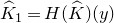 $\widehat K_1=H(\widehat K)(y)$
as in case 1 of that proof applied to
$\widehat K_1=H(\widehat K)(y)$
as in case 1 of that proof applied to $\widehat{\mathbf K}$
in place of
$\widehat{\mathbf K}$
in place of $\mathbf K$
. We have the H-subfield
$\mathbf K$
. We have the H-subfield $K_1:=H(K)(y)$
of
$K_1:=H(K)(y)$
of $\widehat K_1$
, and
$\widehat K_1$
, and $\widehat K_1$
is an immediate extension of
$\widehat K_1$
is an immediate extension of $K_1$
by [Reference Aschenbrenner, van den Dries and van der HoevenAvdDvdH17, 10.2.2 and its proof]. Expanding
$K_1$
by [Reference Aschenbrenner, van den Dries and van der HoevenAvdDvdH17, 10.2.2 and its proof]. Expanding $K_1$
,
$K_1$
, $\widehat K_1$
uniquely to pre-
$\widehat K_1$
uniquely to pre- $\Lambda \Omega$
-fields gives a pair
$\Lambda \Omega$
-fields gives a pair $(\mathbf K_1,\widehat{\mathbf K}_1)$
with the required property. If
$(\mathbf K_1,\widehat{\mathbf K}_1)$
with the required property. If ${s\in I}$
, proceed as before, but following instead case 2 of the proof of [Reference Aschenbrenner, van den Dries and van der HoevenAvdDvdH17, 16.4.3] and with H(K) and
${s\in I}$
, proceed as before, but following instead case 2 of the proof of [Reference Aschenbrenner, van den Dries and van der HoevenAvdDvdH17, 16.4.3] and with H(K) and $H(\widehat K)$
instead of K and
$H(\widehat K)$
instead of K and $\widehat K$
, using [Reference Aschenbrenner, van den Dries and van der HoevenAvdDvdH17, 10.2.1 and its proof].
$\widehat K$
, using [Reference Aschenbrenner, van den Dries and van der HoevenAvdDvdH17, 10.2.1 and its proof].
Corollary 7.6. Suppose K does not have asymptotic integration. Then $(\mathbf K,\widehat{\mathbf K})$
extends to an immediate
$(\mathbf K,\widehat{\mathbf K})$
extends to an immediate $\omega$
-free
$\omega$
-free $\Lambda \Omega$
-pair
$\Lambda \Omega$
-pair $(\mathbf K^*,\widehat{\mathbf K}^*)$
such that
$(\mathbf K^*,\widehat{\mathbf K}^*)$
such that $\operatorname{res}\mathbf K^* = \operatorname{res}\mathbf K$
, and any embedding of
$\operatorname{res}\mathbf K^* = \operatorname{res}\mathbf K$
, and any embedding of $\mathbf K$
into a
$\mathbf K$
into a $\Lambda \Omega$
-field
$\Lambda \Omega$
-field $\mathbf L$
closed under integration extends to an embedding
$\mathbf L$
closed under integration extends to an embedding $\mathbf K^*\to\mathbf L$
.
$\mathbf K^*\to\mathbf L$
.
In the next three lemmas we treat the case where K has asymptotic integration. For the first we adapt the proof of [Reference Aschenbrenner, van den Dries and van der HoevenAvdDvdH17, 16.4.5] and use parts of it.
Lemma 7.7. Assume K has asymptotic integration and is not $\lambda$
-free. Then
$\lambda$
-free. Then $(\mathbf K,\widehat{\mathbf K})$
extends to an immediate
$(\mathbf K,\widehat{\mathbf K})$
extends to an immediate $\omega$
-free
$\omega$
-free $\Lambda \Omega$
-pair
$\Lambda \Omega$
-pair $(\mathbf K^*,\widehat{\mathbf K}^*)$
such that
$(\mathbf K^*,\widehat{\mathbf K}^*)$
such that $\operatorname{res}\mathbf K^* = (\operatorname{res}\mathbf K)^{\operatorname{rc}}$
, and every embedding of
$\operatorname{res}\mathbf K^* = (\operatorname{res}\mathbf K)^{\operatorname{rc}}$
, and every embedding of $\mathbf K$
into a Liouville closed
$\mathbf K$
into a Liouville closed $\Lambda \Omega$
-field
$\Lambda \Omega$
-field $\mathbf L$
extends to an embedding
$\mathbf L$
extends to an embedding $\mathbf K^*\to\mathbf L$
.
$\mathbf K^*\to\mathbf L$
.
Proof. By Corollary 7.6 it is enough to show that the pair $(\mathbf K,\widehat{\mathbf K})$
extends to an immediate
$(\mathbf K,\widehat{\mathbf K})$
extends to an immediate $\Lambda \Omega$
-pair
$\Lambda \Omega$
-pair $(\mathbf K_1,\widehat{\mathbf K}_1)$
with a gap such that
$(\mathbf K_1,\widehat{\mathbf K}_1)$
with a gap such that $\operatorname{res}\mathbf K_1 = (\operatorname{res}\mathbf K)^{\operatorname{rc}}$
and every embedding of
$\operatorname{res}\mathbf K_1 = (\operatorname{res}\mathbf K)^{\operatorname{rc}}$
and every embedding of $\mathbf K$
into a Liouville closed
$\mathbf K$
into a Liouville closed $\Lambda \Omega$
-field
$\Lambda \Omega$
-field $\mathbf L$
extends to an embedding
$\mathbf L$
extends to an embedding $\mathbf K_1\to\mathbf L$
. Let
$\mathbf K_1\to\mathbf L$
. Let
 $$E := H(K)^{\operatorname{rc}} \subseteq F:=H(\widehat K)^{\operatorname{rc}}.$$
Then $\Gamma_E= {\mathbb Q} \Gamma$
, and F is an immediate H-field extension of E. We distinguish two cases.
$\Gamma_E= {\mathbb Q} \Gamma$
, and F is an immediate H-field extension of E. We distinguish two cases.
Case 1 (E has a gap). Take $s\in E^\times$
and
$s\in E^\times$
and $n\geqslant 1$
such that vs is a gap in E and
$n\geqslant 1$
such that vs is a gap in E and $s^n\in K$
. Then E has exactly two
$s^n\in K$
. Then E has exactly two $\Lambda \Omega$
-cuts
$\Lambda \Omega$
-cuts $(I_1,\Lambda_1,\Omega_1)$
and
$(I_1,\Lambda_1,\Omega_1)$
and $(I_2,\Lambda_2,\Omega_2)$
, where
$(I_2,\Lambda_2,\Omega_2)$
, where $I_1=\{{y\in E:y\prec s}\}$
,
$I_1=\{{y\in E:y\prec s}\}$
, $I_2=\{y\in E:y\preccurlyeq s\}$
, and F has exactly two
$I_2=\{y\in E:y\preccurlyeq s\}$
, and F has exactly two $\Lambda \Omega$
-cuts
$\Lambda \Omega$
-cuts $(\widehat I_1,\widehat \Lambda_1,\widehat \Omega_1)$
and
$(\widehat I_1,\widehat \Lambda_1,\widehat \Omega_1)$
and $(\widehat I_2,\widehat \Lambda_2,\widehat \Omega_2)$
, with
$(\widehat I_2,\widehat \Lambda_2,\widehat \Omega_2)$
, with $\widehat I_1=\{y\in F:y\prec s\}$
,
$\widehat I_1=\{y\in F:y\prec s\}$
, $\widehat I_2=\{{y\in F:y\preccurlyeq s}\}$
(so
$\widehat I_2=\{{y\in F:y\preccurlyeq s}\}$
(so $I_j=\widehat I_j\cap E$
for
$I_j=\widehat I_j\cap E$
for $j=1,2$
). Take
$j=1,2$
). Take $\mathbf K_1$
as in Case 1 of the proof of [Reference Aschenbrenner, van den Dries and van der HoevenAvdDvdH17, 16.4.5]: if
$\mathbf K_1$
as in Case 1 of the proof of [Reference Aschenbrenner, van den Dries and van der HoevenAvdDvdH17, 16.4.5]: if $-s^\dagger\in\Lambda$
, then
$-s^\dagger\in\Lambda$
, then $\mathbf K_1:=(E,I_1,\Lambda_1,\Omega_1)$
, and if
$\mathbf K_1:=(E,I_1,\Lambda_1,\Omega_1)$
, and if $-s^\dagger\notin\Lambda$
, then
$-s^\dagger\notin\Lambda$
, then $\mathbf K_1:=(E,I_2,\Lambda_2,\Omega_2)$
. Similarly, if
$\mathbf K_1:=(E,I_2,\Lambda_2,\Omega_2)$
. Similarly, if $-s^\dagger\in \Lambda$
, then
$-s^\dagger\in \Lambda$
, then $\widehat{\mathbf K}_1:=(F,\widehat I_1,\widehat \Lambda_1,\widehat \Omega_1)$
, and if
$\widehat{\mathbf K}_1:=(F,\widehat I_1,\widehat \Lambda_1,\widehat \Omega_1)$
, and if $-s^\dagger\notin \Lambda$
, then
$-s^\dagger\notin \Lambda$
, then $\widehat{\mathbf K}_1:=(F,\widehat I_2,\widehat \Lambda_2,\widehat \Omega_2)$
. Then
$\widehat{\mathbf K}_1:=(F,\widehat I_2,\widehat \Lambda_2,\widehat \Omega_2)$
. Then $(\mathbf K_1,\widehat{\mathbf K}_1)$
is an immediate
$(\mathbf K_1,\widehat{\mathbf K}_1)$
is an immediate $\Lambda \Omega$
-pair with the desired property.
$\Lambda \Omega$
-pair with the desired property.
Case 2 (E has no gap). Then E, F have asymptotic integration, and the sequence $(\lambda_\rho)$
for K also serves for E and for F. Take
$(\lambda_\rho)$
for K also serves for E and for F. Take $\lambda\in K$
such that
$\lambda\in K$
such that $\lambda_\rho\leadsto\lambda$
. Then
$\lambda_\rho\leadsto\lambda$
. Then $-\lambda$
creates a gap over E and over F by [Reference Aschenbrenner, van den Dries and van der HoevenAvdDvdH17, 11.5.14]. Take an element
$-\lambda$
creates a gap over E and over F by [Reference Aschenbrenner, van den Dries and van der HoevenAvdDvdH17, 11.5.14]. Take an element $f\neq 0$
in some Liouville closed H-field extension of F such that
$f\neq 0$
in some Liouville closed H-field extension of F such that $f^\dagger=-\lambda$
. Then F(f) is an H-field and E(f) is an H-subfield of F(f) with
$f^\dagger=-\lambda$
. Then F(f) is an H-field and E(f) is an H-subfield of F(f) with $\operatorname{res} E(f)=\operatorname{res} E=\operatorname{res} F=\operatorname{res} F(f)$
. Moreover, vf is a gap in F(f) and in E(f), and F(f) is an immediate extension of E(f), by the remark after [Reference Aschenbrenner, van den Dries and van der HoevenAvdDvdH17, 11.5.14] and the uniqueness part of [Reference Aschenbrenner, van den Dries and van der HoevenAvdDvdH17, 10.4.5]. Now E(f) has exactly two
$\operatorname{res} E(f)=\operatorname{res} E=\operatorname{res} F=\operatorname{res} F(f)$
. Moreover, vf is a gap in F(f) and in E(f), and F(f) is an immediate extension of E(f), by the remark after [Reference Aschenbrenner, van den Dries and van der HoevenAvdDvdH17, 11.5.14] and the uniqueness part of [Reference Aschenbrenner, van den Dries and van der HoevenAvdDvdH17, 10.4.5]. Now E(f) has exactly two $\Lambda \Omega$
-cuts
$\Lambda \Omega$
-cuts $(I_1,\Lambda_1,\Omega_1)$
and
$(I_1,\Lambda_1,\Omega_1)$
and $(I_2,\Lambda_2,\Omega_2)$
, where
$(I_2,\Lambda_2,\Omega_2)$
, where
 $$I_1=\{{y\in E(f):y\prec f}\},\quad I_2=\{y\in E(f):y\preccurlyeq f\},$$
and F(f) has exactly two $\Lambda \Omega$
-cuts
$\Lambda \Omega$
-cuts $(\widehat I_1,\widehat \Lambda_1,\widehat \Omega_1)$
and
$(\widehat I_1,\widehat \Lambda_1,\widehat \Omega_1)$
and $(\widehat I_2,\widehat \Lambda_2,\widehat \Omega_2)$
, with
$(\widehat I_2,\widehat \Lambda_2,\widehat \Omega_2)$
, with
 $$\widehat I_1=\{y\in F(f):y\prec f\},\quad \widehat I_2=\{{y\in F(f):y\preccurlyeq f}\}.$$
Therefore,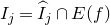 $I_j=\widehat I_j\cap E(f)$
for
$I_j=\widehat I_j\cap E(f)$
for $j=1,2$
. We set
$j=1,2$
. We set $\mathbf K_1:=(E(f),I_1,\Lambda_1,\Omega_1)$
,
$\mathbf K_1:=(E(f),I_1,\Lambda_1,\Omega_1)$
, $\widehat{\mathbf K}_1:=(F(f),\widehat I_1,\widehat\Lambda_1,\widehat\Omega_1)$
if
$\widehat{\mathbf K}_1:=(F(f),\widehat I_1,\widehat\Lambda_1,\widehat\Omega_1)$
if $\lambda\in\Lambda$
, and
$\lambda\in\Lambda$
, and $\mathbf K_1:=(E(f),I_2,\Lambda_2,\Omega_2)$
,
$\mathbf K_1:=(E(f),I_2,\Lambda_2,\Omega_2)$
, $\widehat{\mathbf K}_1:=(F(f),\widehat I_2,\widehat \Lambda_2,\widehat \Omega_2)$
if
$\widehat{\mathbf K}_1:=(F(f),\widehat I_2,\widehat \Lambda_2,\widehat \Omega_2)$
if $\lambda\notin\Lambda$
. Then
$\lambda\notin\Lambda$
. Then $\mathbf K_1\subseteq\widehat{\mathbf K}_1$
, and the immediate
$\mathbf K_1\subseteq\widehat{\mathbf K}_1$
, and the immediate $\Lambda \Omega$
-pair
$\Lambda \Omega$
-pair $(\mathbf K_1,\widehat{\mathbf K}_1)$
is as required.
$(\mathbf K_1,\widehat{\mathbf K}_1)$
is as required.
Lemma 7.8. Suppose K is not $\omega$
-free and
$\omega$
-free and $\widehat K$
is
$\widehat K$
is $\lambda$
-free. Then
$\lambda$
-free. Then $(\mathbf K,\widehat{\mathbf K})$
extends to an immediate
$(\mathbf K,\widehat{\mathbf K})$
extends to an immediate $\omega$
-free
$\omega$
-free $\Lambda \Omega$
-pair
$\Lambda \Omega$
-pair $(\mathbf K^*,\widehat{\mathbf K}^*)$
such that
$(\mathbf K^*,\widehat{\mathbf K}^*)$
such that $\operatorname{res}\mathbf K^*$
is algebraic over
$\operatorname{res}\mathbf K^*$
is algebraic over $\operatorname{res}\mathbf K$
and any embedding
$\operatorname{res}\mathbf K$
and any embedding $\mathbf K\to\mathbf L$
into a Schwarz closed
$\mathbf K\to\mathbf L$
into a Schwarz closed $\Lambda \Omega$
-field
$\Lambda \Omega$
-field $\mathbf L$
extends to an embedding
$\mathbf L$
extends to an embedding $\mathbf K^*\to\mathbf L$
.
$\mathbf K^*\to\mathbf L$
.
Proof. We adapt and use the proof of [Reference Aschenbrenner, van den Dries and van der HoevenAvdDvdH17, 16.4.6]. Take $\omega\in K$
with
$\omega\in K$
with $\omega_\rho\leadsto\omega$
. Then we have
$\omega_\rho\leadsto\omega$
. Then we have $\omega(\Lambda(K)){}^\downarrow<\omega<\sigma(\Gamma(K)){}^\uparrow$
and either
$\omega(\Lambda(K)){}^\downarrow<\omega<\sigma(\Gamma(K)){}^\uparrow$
and either $\Omega=\omega(K)^\downarrow$
or
$\Omega=\omega(K)^\downarrow$
or $\Omega=K\setminus \sigma(\Gamma(K)){}^\uparrow$
. Likewise with
$\Omega=K\setminus \sigma(\Gamma(K)){}^\uparrow$
. Likewise with $\widehat K$
in place of K. In addition,
$\widehat K$
in place of K. In addition, $\omega\notin \omega(K)^\downarrow,\ \omega\notin \omega(\widehat K)^\downarrow$
. There are two cases.
$\omega\notin \omega(K)^\downarrow,\ \omega\notin \omega(\widehat K)^\downarrow$
. There are two cases.
Case 1 ( $\Omega=\omega(K)^{\downarrow}$
). Then
$\Omega=\omega(K)^{\downarrow}$
). Then $\omega\notin\widehat\Omega$
and so
$\omega\notin\widehat\Omega$
and so $\widehat\Omega=\omega(\widehat K)^{\downarrow}$
. Take a pre-H-field extension
$\widehat\Omega=\omega(\widehat K)^{\downarrow}$
. Take a pre-H-field extension $\widehat K_{\gamma}$
of
$\widehat K_{\gamma}$
of $\widehat K$
as in Case 1 of the proof of [Reference Aschenbrenner, van den Dries and van der HoevenAvdDvdH17, 16.4.6] with
$\widehat K$
as in Case 1 of the proof of [Reference Aschenbrenner, van den Dries and van der HoevenAvdDvdH17, 16.4.6] with $\widehat K$
in place of K. Then
$\widehat K$
in place of K. Then $\operatorname{res} \widehat K_{\gamma}=\operatorname{res} \widehat K=\operatorname{res} K$
. Put
$\operatorname{res} \widehat K_{\gamma}=\operatorname{res} \widehat K=\operatorname{res} K$
. Put $K_{\gamma}:=K\langle\gamma\rangle$
, a pre-H-subfield of
$K_{\gamma}:=K\langle\gamma\rangle$
, a pre-H-subfield of $\widehat K_{\gamma}$
with
$\widehat K_{\gamma}$
with $\operatorname{res} K_{\gamma}=\operatorname{res} K$
. Then
$\operatorname{res} K_{\gamma}=\operatorname{res} K$
. Then $v\gamma$
is a gap in
$v\gamma$
is a gap in $K_{\gamma}$
and in
$K_{\gamma}$
and in $\widehat K_{\gamma}$
, so by [Reference Aschenbrenner, van den Dries and van der HoevenAvdDvdH17, 13.7.6],
$\widehat K_{\gamma}$
, so by [Reference Aschenbrenner, van den Dries and van der HoevenAvdDvdH17, 13.7.6], $\widehat K_{\gamma}$
is an immediate extension of
$\widehat K_{\gamma}$
is an immediate extension of $K_{\gamma}$
. Expanding
$K_{\gamma}$
. Expanding $K_{\gamma}$
to a pre-
$K_{\gamma}$
to a pre- $\Lambda \Omega$
-field
$\Lambda \Omega$
-field $\mathbf K_{\gamma}$
as in case 1 of the proof of [Reference Aschenbrenner, van den Dries and van der HoevenAvdDvdH17, 16.4.6], and similarly expanding
$\mathbf K_{\gamma}$
as in case 1 of the proof of [Reference Aschenbrenner, van den Dries and van der HoevenAvdDvdH17, 16.4.6], and similarly expanding $\widehat K_{\gamma}$
to a pre-
$\widehat K_{\gamma}$
to a pre- $\Lambda \Omega$
-field
$\Lambda \Omega$
-field $\widehat{\mathbf K}_{\gamma}$
, we thus obtain the immediate pre-
$\widehat{\mathbf K}_{\gamma}$
, we thus obtain the immediate pre- $\Lambda \Omega$
-pair
$\Lambda \Omega$
-pair $(\mathbf K_{\gamma},\widehat{\mathbf K}_{\gamma})$
extending
$(\mathbf K_{\gamma},\widehat{\mathbf K}_{\gamma})$
extending $(\mathbf K,\widehat{\mathbf K})$
. Take an immediate
$(\mathbf K,\widehat{\mathbf K})$
. Take an immediate $\omega$
-free
$\omega$
-free $\Lambda \Omega$
-pair
$\Lambda \Omega$
-pair $(\mathbf K^*,\widehat{\mathbf K}^*)$
extending
$(\mathbf K^*,\widehat{\mathbf K}^*)$
extending $(\mathbf K_{\gamma},\widehat{\mathbf K}_{\gamma})$
as in Corollary 7.6 applied to
$(\mathbf K_{\gamma},\widehat{\mathbf K}_{\gamma})$
as in Corollary 7.6 applied to $(\mathbf K_{\gamma},\widehat{\mathbf K}_{\gamma})$
in place of
$(\mathbf K_{\gamma},\widehat{\mathbf K}_{\gamma})$
in place of $(\mathbf K,\widehat{\mathbf K})$
. Then
$(\mathbf K,\widehat{\mathbf K})$
. Then $(\mathbf K^*,\widehat{\mathbf K}^*)$
has the required property.
$(\mathbf K^*,\widehat{\mathbf K}^*)$
has the required property.
Case 2 ( $\Omega=K\setminus \sigma(\Gamma(K)){}^\uparrow$
). Then
$\Omega=K\setminus \sigma(\Gamma(K)){}^\uparrow$
). Then $\omega\in\Omega\subseteq \widehat \Omega$
, so
$\omega\in\Omega\subseteq \widehat \Omega$
, so $\widehat\Omega=\widehat K\setminus \sigma(\Gamma(\widehat K)){}^\uparrow$
. As in the proof of [Reference Aschenbrenner, van den Dries and van der HoevenAvdDvdH17, 16.4.6], we obtain an immediate pre-H-field extension
$\widehat\Omega=\widehat K\setminus \sigma(\Gamma(\widehat K)){}^\uparrow$
. As in the proof of [Reference Aschenbrenner, van den Dries and van der HoevenAvdDvdH17, 16.4.6], we obtain an immediate pre-H-field extension $\widehat K_{\lambda}:=\widehat K(\lambda)$
of
$\widehat K_{\lambda}:=\widehat K(\lambda)$
of $\widehat K$
with
$\widehat K$
with $\lambda_\rho\leadsto\lambda$
and
$\lambda_\rho\leadsto\lambda$
and ${\omega(\lambda)=\omega}$
. Put
${\omega(\lambda)=\omega}$
. Put $K_{\lambda}:=K(\lambda)$
, an immediate pre-H-field extension of K. Expand
$K_{\lambda}:=K(\lambda)$
, an immediate pre-H-field extension of K. Expand $K_\lambda$
to a pre-
$K_\lambda$
to a pre- $\Lambda \Omega$
-field
$\Lambda \Omega$
-field $\mathbf K_{\lambda}$
as in case 2 of the proof of [Reference Aschenbrenner, van den Dries and van der HoevenAvdDvdH17, 16.4.6], and similarly expand
$\mathbf K_{\lambda}$
as in case 2 of the proof of [Reference Aschenbrenner, van den Dries and van der HoevenAvdDvdH17, 16.4.6], and similarly expand $\widehat K_{\lambda}$
to a pre-
$\widehat K_{\lambda}$
to a pre- $\Lambda \Omega$
-field
$\Lambda \Omega$
-field $\widehat{\mathbf K}_{\lambda}$
. Then
$\widehat{\mathbf K}_{\lambda}$
. Then $\mathbf K_{\lambda}\supseteq\mathbf K$
and
$\mathbf K_{\lambda}\supseteq\mathbf K$
and ${\widehat{\mathbf K}_{\lambda}\supseteq\widehat{\mathbf K}}$
, and from
${\widehat{\mathbf K}_{\lambda}\supseteq\widehat{\mathbf K}}$
, and from $\lambda\notin \Lambda(K_\lambda)^\downarrow$
and
$\lambda\notin \Lambda(K_\lambda)^\downarrow$
and $\lambda\in (\widehat K_{\lambda}\setminus \Delta(\widehat K_{\lambda})^\uparrow)\cap K_{\lambda}$
we obtain
$\lambda\in (\widehat K_{\lambda}\setminus \Delta(\widehat K_{\lambda})^\uparrow)\cap K_{\lambda}$
we obtain $\widehat{\mathbf K}_{\lambda}\supseteq\mathbf K_{\lambda}$
. Thus,
$\widehat{\mathbf K}_{\lambda}\supseteq\mathbf K_{\lambda}$
. Thus, $(\mathbf K_{\lambda},\widehat{\mathbf K}_{\lambda})$
is an immediate pre-
$(\mathbf K_{\lambda},\widehat{\mathbf K}_{\lambda})$
is an immediate pre- $\Lambda \Omega$
-pair and extends
$\Lambda \Omega$
-pair and extends $(\mathbf K,\widehat{\mathbf K})$
. Take an immediate
$(\mathbf K,\widehat{\mathbf K})$
. Take an immediate $\omega$
-free
$\omega$
-free $\Lambda \Omega$
-pair
$\Lambda \Omega$
-pair $(\mathbf K^*,\widehat{\mathbf K}^*)$
extending
$(\mathbf K^*,\widehat{\mathbf K}^*)$
extending $(\mathbf K_{\lambda},\widehat{\mathbf K}_{\lambda})$
obtained from Lemma 7.7 applied to
$(\mathbf K_{\lambda},\widehat{\mathbf K}_{\lambda})$
obtained from Lemma 7.7 applied to $(\mathbf K_{\lambda},\widehat{\mathbf K}_{\lambda})$
in place of
$(\mathbf K_{\lambda},\widehat{\mathbf K}_{\lambda})$
in place of $(\mathbf K,\widehat{\mathbf K})$
. Then
$(\mathbf K,\widehat{\mathbf K})$
. Then $(\mathbf K^*,\widehat{\mathbf K}^*)$
has the required property.
$(\mathbf K^*,\widehat{\mathbf K}^*)$
has the required property.
Lemma 7.9. Suppose $\widehat K$
is
$\widehat K$
is $\omega$
-free. Then the pre-
$\omega$
-free. Then the pre- $\Lambda \Omega$
-pair
$\Lambda \Omega$
-pair $(\mathbf K,\widehat{\mathbf K})$
extends to an immediate
$(\mathbf K,\widehat{\mathbf K})$
extends to an immediate $\omega$
-free
$\omega$
-free $\Lambda \Omega$
-pair
$\Lambda \Omega$
-pair $(\mathbf K^*,\widehat{\mathbf K}^*)$
such that any embedding of
$(\mathbf K^*,\widehat{\mathbf K}^*)$
such that any embedding of $\mathbf K$
into a
$\mathbf K$
into a $\Lambda \Omega$
-field
$\Lambda \Omega$
-field $\mathbf L$
extends to an embedding of
$\mathbf L$
extends to an embedding of $\mathbf K^*$
into
$\mathbf K^*$
into $\mathbf L$
.
$\mathbf L$
.
Proof. As $\widehat K$
is
$\widehat K$
is $\omega$
-free, so is K. By [Reference Aschenbrenner, van den Dries and van der HoevenAvdDvdH17, 13.6.1], H(K) is
$\omega$
-free, so is K. By [Reference Aschenbrenner, van den Dries and van der HoevenAvdDvdH17, 13.6.1], H(K) is $\omega$
-free, and by [Reference Aschenbrenner, van den Dries and van der HoevenAvdDvdH17, 10.3.2 and the remark (a) before it], H(K) is an immediate extension of K, and likewise with
$\omega$
-free, and by [Reference Aschenbrenner, van den Dries and van der HoevenAvdDvdH17, 10.3.2 and the remark (a) before it], H(K) is an immediate extension of K, and likewise with $\widehat K$
in place of K. Let
$\widehat K$
in place of K. Let $\mathbf K^*$
,
$\mathbf K^*$
, $\widehat{\mathbf K}^*$
be the unique expansions of H(K),
$\widehat{\mathbf K}^*$
be the unique expansions of H(K), $H(\widehat K)$
, respectively, to
$H(\widehat K)$
, respectively, to $\Lambda \Omega$
-fields. Then
$\Lambda \Omega$
-fields. Then $(\mathbf K^*,\widehat{\mathbf K}^*)$
has the required properties, by the proof of [Reference Aschenbrenner, van den Dries and van der HoevenAvdDvdH17, 16.4.7].
$(\mathbf K^*,\widehat{\mathbf K}^*)$
has the required properties, by the proof of [Reference Aschenbrenner, van den Dries and van der HoevenAvdDvdH17, 16.4.7].
The first claim of Proposition 7.3 now follows. As to the shortness part, one checks that for the pair $(\mathbf K^*,\widehat{\mathbf K}^*)$
as constructed previously, we have
$(\mathbf K^*,\widehat{\mathbf K}^*)$
as constructed previously, we have $\operatorname{rank}_{ {\mathbb Q} }(\Gamma_{K^*}/\Gamma_K)\leqslant \aleph_0$
, hence if K is short and
$\operatorname{rank}_{ {\mathbb Q} }(\Gamma_{K^*}/\Gamma_K)\leqslant \aleph_0$
, hence if K is short and $\operatorname{res} K$
is archimedean, then
$\operatorname{res} K$
is archimedean, then $K^*$
is short by Corollary 6.18 and Lemma 6.19.
$K^*$
is short by Corollary 6.18 and Lemma 6.19.
7.2 Immediate extensions and
$\Lambda \Omega$
-cuts

Let $K\subseteq\widehat K$
be an extension of pre-H-fields. Given a
$K\subseteq\widehat K$
be an extension of pre-H-fields. Given a $\Lambda \Omega$
-cut
$\Lambda \Omega$
-cut $(\widehat I,\widehat\Lambda,\widehat\Omega)$
in
$(\widehat I,\widehat\Lambda,\widehat\Omega)$
in $\widehat K$
, we obtain the
$\widehat K$
, we obtain the $\Lambda \Omega$
-cut
$\Lambda \Omega$
-cut
 $$(\widehat I,\widehat\Lambda,\widehat\Omega)\cap K:=(\widehat I\cap K, \widehat\Lambda\cap K, \widehat\Omega\cap K)$$
in K. Recall from [Reference Aschenbrenner, van den Dries and van der HoevenAvdDvdH17, the remark before 16.3.19] that a pre-H-field has at least one and at most two $\Lambda \Omega$
-cuts. In the rest of this subsection we assume that
$\Lambda \Omega$
-cuts. In the rest of this subsection we assume that $K\subseteq\widehat K$
is immediate and
$K\subseteq\widehat K$
is immediate and $(I,\Lambda,\Omega)$
is a
$(I,\Lambda,\Omega)$
is a $\Lambda \Omega$
-cut in K, and we ask when there is a
$\Lambda \Omega$
-cut in K, and we ask when there is a $\Lambda \Omega$
-cut
$\Lambda \Omega$
-cut $(\widehat I,\widehat\Lambda,\widehat\Omega)$
in
$(\widehat I,\widehat\Lambda,\widehat\Omega)$
in $\widehat K$
such that
$\widehat K$
such that $(I,\Lambda,\Omega)=(\widehat I,\widehat\Lambda,\widehat\Omega)\cap K$
.
$(I,\Lambda,\Omega)=(\widehat I,\widehat\Lambda,\widehat\Omega)\cap K$
.
Proposition 7.10. The following are equivalent:
-
(i) there is a
$\Lambda \Omega$
-cut
$(\widehat I,\widehat\Lambda,\widehat\Omega)$
in
$\widehat K$
with
$(I,\Lambda,\Omega)=(\widehat I,\widehat\Lambda,\widehat\Omega)\cap K$
; -
(ii) K is not
$\lambda$
-free, K is
$\omega$
-free,
$\widehat K$
is
$\lambda$
-free, or
$\Omega\neq\omega(K)^\downarrow$
.





This is a consequence of Lemmas 7.11–7.15, which also address the uniqueness of the $\Lambda \Omega$
-cut in
$\Lambda \Omega$
-cut in $\widehat K$
in part (i) of the proposition. For the next two labeled displays, let K be ungrounded. Then by [Reference Aschenbrenner, van den Dries and van der HoevenAvdDvdH17, 11.8.14] we have
$\widehat K$
in part (i) of the proposition. For the next two labeled displays, let K be ungrounded. Then by [Reference Aschenbrenner, van den Dries and van der HoevenAvdDvdH17, 11.8.14] we have
 \begin{equation} \Lambda(K)^\downarrow = \Lambda(\widehat K)^\downarrow\cap K, \quad \Delta(K)^\uparrow = \Delta(\widehat K)^\uparrow \cap K, \quad \Gamma(K)^\uparrow = \Gamma(\widehat K)^\uparrow \cap K,\end{equation}
and by [Reference Aschenbrenner, van den Dries and van der HoevenAvdDvdH17, 11.8.14, the remark before 11.8.21, and 11.8.29]:
 \begin{equation}\omega(\Lambda(\widehat K)){}^\downarrow\cap K = \omega(\Lambda(K)){}^\downarrow, \quad (\widehat K\setminus\sigma(\Gamma(\widehat K)){}^\uparrow)\cap K = K\setminus\sigma(\Gamma(K)){}^\uparrow.\end{equation}
By [Reference Aschenbrenner, van den Dries and van der HoevenAvdDvdH17, 11.8.2] we also have $\operatorname{I}(K)=\operatorname{I}(\widehat K)\cap K$
if K has asymptotic integration.
$\operatorname{I}(K)=\operatorname{I}(\widehat K)\cap K$
if K has asymptotic integration.
Lemma 7.11. Suppose K does not have asymptotic integration or $\widehat K$
is
$\widehat K$
is $\omega$
-free. Then there is a unique
$\omega$
-free. Then there is a unique $\Lambda \Omega$
-cut
$\Lambda \Omega$
-cut $(\widehat I,\widehat\Lambda,\widehat\Omega)$
in
$(\widehat I,\widehat\Lambda,\widehat\Omega)$
in $\widehat K$
with
$\widehat K$
with $(I,\Lambda,\Omega)=(\widehat I,\widehat\Lambda,\widehat\Omega)\cap K$
.
$(I,\Lambda,\Omega)=(\widehat I,\widehat\Lambda,\widehat\Omega)\cap K$
.
Proof. Note that K has asymptotic integration if and only if $\widehat K$
has, and if K has a gap
$\widehat K$
has, and if K has a gap $\beta$
and
$\beta$
and $v(a')\neq\beta$
for all
$v(a')\neq\beta$
for all $a\asymp 1$
in K, then
$a\asymp 1$
in K, then $\beta$
remains a gap in
$\beta$
remains a gap in $\widehat K$
and
$\widehat K$
and $v(b')\neq\beta$
for all
$v(b')\neq\beta$
for all $b\asymp 1$
in
$b\asymp 1$
in $\widehat K$
. If
$\widehat K$
. If $\widehat K$
is
$\widehat K$
is $\omega$
-free, then so is K. Now use [Reference Aschenbrenner, van den Dries and van der HoevenAvdDvdH17, 16.3.11–16.3.14].
$\omega$
-free, then so is K. Now use [Reference Aschenbrenner, van den Dries and van der HoevenAvdDvdH17, 16.3.11–16.3.14].
Lemma 7.12. Suppose K is $\omega$
-free, but
$\omega$
-free, but $\widehat K$
is not. Then there are exactly two
$\widehat K$
is not. Then there are exactly two $\Lambda \Omega$
-cuts
$\Lambda \Omega$
-cuts $(\widehat I,\widehat\Lambda,\widehat\Omega)$
in
$(\widehat I,\widehat\Lambda,\widehat\Omega)$
in $\widehat K$
with
$\widehat K$
with $(I,\Lambda,\Omega)=(\widehat I,\widehat\Lambda,\widehat\Omega)\cap K$
.
$(I,\Lambda,\Omega)=(\widehat I,\widehat\Lambda,\widehat\Omega)\cap K$
.
Proof. By [Reference Aschenbrenner, van den Dries and van der HoevenAvdDvdH17, 16.3.14], $(I,\Lambda,\Omega)$
is the unique
$(I,\Lambda,\Omega)$
is the unique $\Lambda \Omega$
-cut in K, so
$\Lambda \Omega$
-cut in K, so $(I,\Lambda,\Omega)=(\widehat I,\widehat\Lambda,\widehat\Omega)\cap K$
for every
$(I,\Lambda,\Omega)=(\widehat I,\widehat\Lambda,\widehat\Omega)\cap K$
for every $\Lambda \Omega$
-cut
$\Lambda \Omega$
-cut $(\widehat I,\widehat\Lambda,\widehat\Omega)$
in
$(\widehat I,\widehat\Lambda,\widehat\Omega)$
in $\widehat K$
. Moreover,
$\widehat K$
. Moreover, $\widehat K$
has exactly two
$\widehat K$
has exactly two $\Lambda \Omega$
-cuts, by [Reference Aschenbrenner, van den Dries and van der HoevenAvdDvdH17, 16.3.16] if
$\Lambda \Omega$
-cuts, by [Reference Aschenbrenner, van den Dries and van der HoevenAvdDvdH17, 16.3.16] if $\widehat K$
is
$\widehat K$
is $\lambda$
-free, and by [Reference Aschenbrenner, van den Dries and van der HoevenAvdDvdH17, 16.3.17 and 16.3.18] if not.
$\lambda$
-free, and by [Reference Aschenbrenner, van den Dries and van der HoevenAvdDvdH17, 16.3.17 and 16.3.18] if not.
In particular, if K has no asymptotic integration or K is $\omega$
-free, then we have a
$\omega$
-free, then we have a $\Lambda \Omega$
-cut
$\Lambda \Omega$
-cut $(\widehat I,\widehat\Lambda,\widehat\Omega)$
in
$(\widehat I,\widehat\Lambda,\widehat\Omega)$
in $\widehat K$
with
$\widehat K$
with $(I,\Lambda,\Omega)=(\widehat I,\widehat\Lambda,\widehat\Omega)\cap K$
. The next lemmas deal with the case where K has asymptotic integration and K is not
$(I,\Lambda,\Omega)=(\widehat I,\widehat\Lambda,\widehat\Omega)\cap K$
. The next lemmas deal with the case where K has asymptotic integration and K is not $\omega$
-free.
$\omega$
-free.
Lemma 7.13. Suppose K has asymptotic integration and is not $\lambda$
-free. Then there is exactly one
$\lambda$
-free. Then there is exactly one $\Lambda \Omega$
-cut
$\Lambda \Omega$
-cut $(\widehat I,\widehat\Lambda,\widehat\Omega)$
in
$(\widehat I,\widehat\Lambda,\widehat\Omega)$
in $\widehat K$
with
$\widehat K$
with $(I,\Lambda,\Omega)=(\widehat I,\widehat\Lambda,\widehat\Omega)\cap K$
.
$(I,\Lambda,\Omega)=(\widehat I,\widehat\Lambda,\widehat\Omega)\cap K$
.
Proof. Suppose first that $2\Psi$
has no supremum in
$2\Psi$
has no supremum in $\Gamma$
. Then by [Reference Aschenbrenner, van den Dries and van der HoevenAvdDvdH17, 16.3.17] there are exactly two
$\Gamma$
. Then by [Reference Aschenbrenner, van den Dries and van der HoevenAvdDvdH17, 16.3.17] there are exactly two $\Lambda \Omega$
-cuts
$\Lambda \Omega$
-cuts $(I_1,\Lambda_1,\Omega_1)$
,
$(I_1,\Lambda_1,\Omega_1)$
, $(I_2,\Lambda_2,\Omega_2)$
in K, with
$(I_2,\Lambda_2,\Omega_2)$
in K, with $\Lambda_1=\Lambda(K)^\downarrow$
,
$\Lambda_1=\Lambda(K)^\downarrow$
, $\Lambda_2=K\setminus\Delta(K)^\uparrow$
, and
$\Lambda_2=K\setminus\Delta(K)^\uparrow$
, and $\Lambda_1\neq\Lambda_2$
. Similarly, there are exactly two
$\Lambda_1\neq\Lambda_2$
. Similarly, there are exactly two $\Lambda \Omega$
-cuts
$\Lambda \Omega$
-cuts $(\widehat I_1,\widehat \Lambda_1,\widehat \Omega_1)$
,
$(\widehat I_1,\widehat \Lambda_1,\widehat \Omega_1)$
, $(\widehat I_2,\widehat \Lambda_2,\widehat \Omega_2)$
in
$(\widehat I_2,\widehat \Lambda_2,\widehat \Omega_2)$
in $\widehat K$
, with
$\widehat K$
, with $\widehat \Lambda_1=\Lambda(\widehat K)^\downarrow$
,
$\widehat \Lambda_1=\Lambda(\widehat K)^\downarrow$
, $\widehat \Lambda_2=\widehat K\setminus\Delta(\widehat K)^\uparrow$
. Now use that by (7.1) we have
$\widehat \Lambda_2=\widehat K\setminus\Delta(\widehat K)^\uparrow$
. Now use that by (7.1) we have $\lambda(K)^\downarrow = \Lambda(\widehat K)^\downarrow\cap K$
and
$\lambda(K)^\downarrow = \Lambda(\widehat K)^\downarrow\cap K$
and $K\setminus\Delta(K)^\uparrow = (\widehat K\setminus\Delta(\widehat K)^\uparrow)\cap K$
. The case where
$K\setminus\Delta(K)^\uparrow = (\widehat K\setminus\Delta(\widehat K)^\uparrow)\cap K$
. The case where $2\Psi$
has a supremum in
$2\Psi$
has a supremum in $\Gamma$
is similar, using [Reference Aschenbrenner, van den Dries and van der HoevenAvdDvdH17, 16.3.18] instead of [Reference Aschenbrenner, van den Dries and van der HoevenAvdDvdH17, 16.3.17].
$\Gamma$
is similar, using [Reference Aschenbrenner, van den Dries and van der HoevenAvdDvdH17, 16.3.18] instead of [Reference Aschenbrenner, van den Dries and van der HoevenAvdDvdH17, 16.3.17].
Lemma 7.14. Suppose K is not $\omega$
-free and
$\omega$
-free and $\widehat K$
is
$\widehat K$
is $\lambda$
-free. Then there is exactly one
$\lambda$
-free. Then there is exactly one $\Lambda \Omega$
-cut
$\Lambda \Omega$
-cut $(\widehat I,\widehat\Lambda,\widehat\Omega)$
in
$(\widehat I,\widehat\Lambda,\widehat\Omega)$
in $\widehat K$
such that
$\widehat K$
such that $(I,\Lambda,\Omega)=(\widehat I,\widehat\Lambda,\widehat\Omega)\cap K$
.
$(I,\Lambda,\Omega)=(\widehat I,\widehat\Lambda,\widehat\Omega)\cap K$
.
Proof. By [Reference Aschenbrenner, van den Dries and van der HoevenAvdDvdH17, 16.3.16], K being $\lambda$
-free, but not
$\lambda$
-free, but not $\omega$
-free, it has exactly two
$\omega$
-free, it has exactly two $\Lambda \Omega$
-cuts, namely
$\Lambda \Omega$
-cuts, namely $(\operatorname{I}(K), \Lambda(K)^{\downarrow}, \omega(\Lambda(K)){}^\downarrow)$
and
$(\operatorname{I}(K), \Lambda(K)^{\downarrow}, \omega(\Lambda(K)){}^\downarrow)$
and $(\operatorname{I}(K), \Lambda(K)^{\downarrow}, K\setminus \sigma(\Gamma(K)){}^\uparrow)$
, and similarly with
$(\operatorname{I}(K), \Lambda(K)^{\downarrow}, K\setminus \sigma(\Gamma(K)){}^\uparrow)$
, and similarly with $\widehat K$
in place of K. Now use (7.1) and (7.2).
$\widehat K$
in place of K. Now use (7.1) and (7.2).
Lemma 7.15. Suppose K is $\lambda$
-free, but not
$\lambda$
-free, but not $\omega$
-free, and
$\omega$
-free, and $\widehat K$
is not
$\widehat K$
is not $\lambda$
-free. Then there is a
$\lambda$
-free. Then there is a $\Lambda \Omega$
-cut
$\Lambda \Omega$
-cut $(\widehat I,\widehat\Lambda,\widehat\Omega)$
in
$(\widehat I,\widehat\Lambda,\widehat\Omega)$
in $\widehat K$
such that
$\widehat K$
such that $(I,\Lambda,\Omega)=(\widehat I,\widehat\Lambda,\widehat\Omega)\cap K$
if and only if
$(I,\Lambda,\Omega)=(\widehat I,\widehat\Lambda,\widehat\Omega)\cap K$
if and only if $\Omega\neq\omega(K)^\downarrow$
, and in this case there are exactly two such
$\Omega\neq\omega(K)^\downarrow$
, and in this case there are exactly two such $\Lambda \Omega$
-cuts in
$\Lambda \Omega$
-cuts in $\widehat K$
.
$\widehat K$
.
Proof. By [Reference Aschenbrenner, van den Dries and van der HoevenAvdDvdH17, 16.3.16], K has exactly two $\Lambda \Omega$
-cuts
$\Lambda \Omega$
-cuts $(I_1,\Lambda_1,\Omega_1)$
,
$(I_1,\Lambda_1,\Omega_1)$
, $(I_2,\Lambda_2,\Omega_2)$
, where
$(I_2,\Lambda_2,\Omega_2)$
, where
 $$I_1 = I_2 = \operatorname{I}(K),\quad \Lambda_1 = \Lambda_2\ =\Lambda(K)^{\downarrow},\quad\Omega_1 = K\setminus \sigma(\Gamma(K)){}^\uparrow \ne \Omega_2 = \omega(K)^{\downarrow}.$$
Now K is $\lambda$
-free, so
$\lambda$
-free, so $2\Psi$
has no supremum in
$2\Psi$
has no supremum in $\Gamma$
by [Reference Aschenbrenner, van den Dries and van der HoevenAvdDvdH17, 9.2.17 and 11.6.8], hence by [Reference Aschenbrenner, van den Dries and van der HoevenAvdDvdH17, 16.3.17],
$\Gamma$
by [Reference Aschenbrenner, van den Dries and van der HoevenAvdDvdH17, 9.2.17 and 11.6.8], hence by [Reference Aschenbrenner, van den Dries and van der HoevenAvdDvdH17, 16.3.17], $\widehat K$
has exactly two
$\widehat K$
has exactly two $\Lambda \Omega$
-cuts
$\Lambda \Omega$
-cuts $(\widehat I_1,\widehat\Lambda_1,\widehat\Omega_1)$
,
$(\widehat I_1,\widehat\Lambda_1,\widehat\Omega_1)$
, $(\widehat I_2,\widehat\Lambda_2,\widehat\Omega_2)$
, where
$(\widehat I_2,\widehat\Lambda_2,\widehat\Omega_2)$
, where
 $$\widehat I_1= \widehat I_2 = \operatorname{I}(\widehat K),\quad \widehat\Lambda_1 = \Lambda(\widehat K)^{\downarrow}, \quad \widehat\Lambda_2 = \widehat K\setminus \Delta(\widehat K)^{\uparrow}, \quad \widehat\Omega_1 = \widehat\Omega_2 = \widehat K\setminus \sigma(\Gamma(\widehat K)){}^{\uparrow}.$$
Thus, $(\widehat I_j,\widehat\Lambda_j,\widehat\Omega_j)\cap K=(I_1,\Lambda_1,\Omega_1)$
for
$(\widehat I_j,\widehat\Lambda_j,\widehat\Omega_j)\cap K=(I_1,\Lambda_1,\Omega_1)$
for $j=1,2$
by (7.2). This yields the lemma.
$j=1,2$
by (7.2). This yields the lemma.
7.3 Proof of Theorem 7.1
Let K, $\widehat K$
, M be as in the statement of the theorem, and let
$\widehat K$
, M be as in the statement of the theorem, and let $i\colon K\to M$
be an embedding. If
$i\colon K\to M$
be an embedding. If $\widehat K$
is
$\widehat K$
is $\omega$
-free, then Lemma 6.24 and [Reference Aschenbrenner, van den Dries and van der HoevenAvdDvdH17, 10.5.8] give an extension of i to an embedding
$\omega$
-free, then Lemma 6.24 and [Reference Aschenbrenner, van den Dries and van der HoevenAvdDvdH17, 10.5.8] give an extension of i to an embedding ${\widehat{K}\to M}$
as required.
${\widehat{K}\to M}$
as required.
In the rest of the proof we therefore assume that $\widehat K$
is not
$\widehat K$
is not $\omega$
-free. If
$\omega$
-free. If $\widehat K$
is
$\widehat K$
is $\lambda$
-free, then, taking
$\lambda$
-free, then, taking $\omega\in\widehat K$
with
$\omega\in\widehat K$
with $\omega_\rho\leadsto\omega$
, [Reference Aschenbrenner, van den Dries and van der HoevenAvdDvdH17, 11.7.13] yields an immediate pre-H-field extension
$\omega_\rho\leadsto\omega$
, [Reference Aschenbrenner, van den Dries and van der HoevenAvdDvdH17, 11.7.13] yields an immediate pre-H-field extension $\widehat K_{\lambda}:=\widehat K(\lambda)$
of
$\widehat K_{\lambda}:=\widehat K(\lambda)$
of $\widehat K$
with
$\widehat K$
with $\lambda_\rho\leadsto\lambda$
and
$\lambda_\rho\leadsto\lambda$
and $\omega(\lambda)=\omega$
, so that replacing
$\omega(\lambda)=\omega$
, so that replacing $\widehat K$
by
$\widehat K$
by $\widehat K_{\lambda}$
we arrange that
$\widehat K_{\lambda}$
we arrange that $\widehat K$
is not even
$\widehat K$
is not even $\lambda$
-free.
$\lambda$
-free.
Suppose K is not $\lambda$
-free. Let
$\lambda$
-free. Let $\mathbf M$
be the unique expansion of M to a
$\mathbf M$
be the unique expansion of M to a $\Lambda \Omega$
-field, and expand K to a pre-
$\Lambda \Omega$
-field, and expand K to a pre- $\Lambda \Omega$
-field
$\Lambda \Omega$
-field $\mathbf K$
such that i is an embedding
$\mathbf K$
such that i is an embedding $\mathbf K\to\mathbf M$
of pre-
$\mathbf K\to\mathbf M$
of pre- $\Lambda \Omega$
-fields. Proposition 7.10 yields an expansion of
$\Lambda \Omega$
-fields. Proposition 7.10 yields an expansion of $\widehat K$
to a pre-
$\widehat K$
to a pre- $\Lambda \Omega$
-field
$\Lambda \Omega$
-field $\widehat{\mathbf K}$
such that
$\widehat{\mathbf K}$
such that ${\mathbf K\subseteq\widehat{\mathbf K}}$
, and then Proposition 7.3 gives an immediate
${\mathbf K\subseteq\widehat{\mathbf K}}$
, and then Proposition 7.3 gives an immediate $\omega$
-free short
$\omega$
-free short $\Lambda \Omega$
-pair
$\Lambda \Omega$
-pair $(\mathbf K^*,\widehat{\mathbf K}^*)$
extending
$(\mathbf K^*,\widehat{\mathbf K}^*)$
extending $(\mathbf K,\widehat{\mathbf K})$
with
$(\mathbf K,\widehat{\mathbf K})$
with $\operatorname{res}\mathbf K^*$
algebraic over
$\operatorname{res}\mathbf K^*$
algebraic over $\operatorname{res}\mathbf K$
and an extension of i to an embedding
$\operatorname{res}\mathbf K$
and an extension of i to an embedding $i^*:\mathbf K^*\to\mathbf M$
. The case of
$i^*:\mathbf K^*\to\mathbf M$
. The case of $\omega$
-free
$\omega$
-free $\widehat K$
treated earlier applied instead to
$\widehat K$
treated earlier applied instead to $\widehat{K}^*$
now yields an extension of
$\widehat{K}^*$
now yields an extension of $i^*$
to an embedding
$i^*$
to an embedding $\widehat{K}^*\to M$
.
$\widehat{K}^*\to M$
.
Next, suppose K is $\omega$
-free. Then the pc-sequence
$\omega$
-free. Then the pc-sequence $(\lambda_\rho)$
in K is of d-transcendental type over K, by [Reference Aschenbrenner, van den Dries and van der HoevenAvdDvdH17, 13.6.3]. Take
$(\lambda_\rho)$
in K is of d-transcendental type over K, by [Reference Aschenbrenner, van den Dries and van der HoevenAvdDvdH17, 13.6.3]. Take $\lambda\in\widehat K$
such that
$\lambda\in\widehat K$
such that $\lambda_\rho\leadsto\lambda$
. Now K is short and M is countably spherically complete, so by Lemma 6.11 we have
$\lambda_\rho\leadsto\lambda$
. Now K is short and M is countably spherically complete, so by Lemma 6.11 we have $\lambda^*\in M$
with
$\lambda^*\in M$
with ${i(\lambda_\rho)\leadsto\lambda^*}$
. By [Reference Aschenbrenner, van den Dries and van der HoevenAvdDvdH17, 11.4.7, 11.4.13, and 10.5.8] we obtain a unique extension of i to an embedding
${i(\lambda_\rho)\leadsto\lambda^*}$
. By [Reference Aschenbrenner, van den Dries and van der HoevenAvdDvdH17, 11.4.7, 11.4.13, and 10.5.8] we obtain a unique extension of i to an embedding $j\colon K\langle\lambda\rangle\to M$
such that
$j\colon K\langle\lambda\rangle\to M$
such that $j(\lambda)=\lambda^*$
. The case of non-
$j(\lambda)=\lambda^*$
. The case of non- $\lambda$
-free K applied instead to
$\lambda$
-free K applied instead to $K\langle\lambda\rangle$
yields an extension of j to an embedding
$K\langle\lambda\rangle$
yields an extension of j to an embedding $\widehat K\to M$
.
$\widehat K\to M$
.
8. Embeddings into analytic Hardy fields
In this section we use Theorem A to derive results about back-and-forth equivalence, $\infty\omega$
-elementary equivalence, and isomorphism for maximal analytic Hardy fields, as was done in [Reference Aschenbrenner, van den Dries and van der HoevenAvdDvdH24a, Section 10] for maximal Hardy fields. (For the relation of back-and-forth equivalence to infinitary logic, see [Reference Barwise and MorleyBar73].) We also strengthen Corollary 6.25 by showing in Corollary 8.10 that the ordered differential field
$\infty\omega$
-elementary equivalence, and isomorphism for maximal analytic Hardy fields, as was done in [Reference Aschenbrenner, van den Dries and van der HoevenAvdDvdH24a, Section 10] for maximal Hardy fields. (For the relation of back-and-forth equivalence to infinitary logic, see [Reference Barwise and MorleyBar73].) We also strengthen Corollary 6.25 by showing in Corollary 8.10 that the ordered differential field $ {\mathbb T} $
embeds into every maximal analytic Hardy field.
$ {\mathbb T} $
embeds into every maximal analytic Hardy field.
Let No be the ordered field of surreal numbers equipped with the derivation $\partial_{\operatorname{BM}}$
of Berarducci and Mantova [Reference Berarducci and MantovaBM18]. Then No is a closed H-field, by [Reference Aschenbrenner, van den Dries and van der HoevenAvdDvdH19]. Moreover, given an uncountable cardinal
$\partial_{\operatorname{BM}}$
of Berarducci and Mantova [Reference Berarducci and MantovaBM18]. Then No is a closed H-field, by [Reference Aschenbrenner, van den Dries and van der HoevenAvdDvdH19]. Moreover, given an uncountable cardinal $\kappa$
, the surreal numbers of length
$\kappa$
, the surreal numbers of length $<\kappa$
form an ordered differential subfield
$<\kappa$
form an ordered differential subfield $\boldsymbol{No} (\kappa)$
of No with
$\boldsymbol{No} (\kappa)$
of No with $\boldsymbol{No}(\kappa)\preccurlyeq \boldsymbol{No}$
, by [Reference Aschenbrenner, van den Dries and van der HoevenAvdDvdH19, Corollary 4.6]. As in the argument leading up to [Reference Aschenbrenner, van den Dries and van der HoevenAvdDvdH24a, Corollary 10.4], combining Theorem A and [Reference Aschenbrenner, van den Dries and van der HoevenAvdDvdH24a, Corollary 10.3] yields the following.
$\boldsymbol{No}(\kappa)\preccurlyeq \boldsymbol{No}$
, by [Reference Aschenbrenner, van den Dries and van der HoevenAvdDvdH19, Corollary 4.6]. As in the argument leading up to [Reference Aschenbrenner, van den Dries and van der HoevenAvdDvdH24a, Corollary 10.4], combining Theorem A and [Reference Aschenbrenner, van den Dries and van der HoevenAvdDvdH24a, Corollary 10.3] yields the following.
Corollary 8.1. Let M be a maximal analytic or maximal smooth Hardy field. Then the ordered differential fields M and $\boldsymbol{No}(\omega_1)$
are back-and-forth equivalent. Hence,
$\boldsymbol{No}(\omega_1)$
are back-and-forth equivalent. Hence, $M \equiv_{\infty\omega} \boldsymbol{No}(\omega_1)$
, and assuming that the continuum hypothesis holds,
$M \equiv_{\infty\omega} \boldsymbol{No}(\omega_1)$
, and assuming that the continuum hypothesis holds, $M\cong \boldsymbol{No}(\omega_1)$
.
$M\cong \boldsymbol{No}(\omega_1)$
.
The ordered field $\boldsymbol{No}(\omega_1)$
is not complete. Set
$\boldsymbol{No}(\omega_1)$
is not complete. Set $a_{\nu}:=\sum_{\mu< \nu} \omega^{-\mu}$
with
$a_{\nu}:=\sum_{\mu< \nu} \omega^{-\mu}$
with $\mu$
,
$\mu$
, $\nu$
ranging over countable ordinals. Then
$\nu$
ranging over countable ordinals. Then $(a_{\nu})$
is a cauchy sequence in
$(a_{\nu})$
is a cauchy sequence in $\boldsymbol{No}(\omega_1)$
without a limit in
$\boldsymbol{No}(\omega_1)$
without a limit in $\boldsymbol{No}(\omega_1)$
. Thus, assuming that the continuum hypothesis holds, no real closed
$\boldsymbol{No}(\omega_1)$
. Thus, assuming that the continuum hypothesis holds, no real closed $\eta_1$
-ordered field extension of
$\eta_1$
-ordered field extension of $ {\mathbb R} $
of cardinality
$ {\mathbb R} $
of cardinality $\mathfrak{c}$
is complete, in particular, no maximal Hardy field is complete. (This also follows from [Reference Dales and WoodinDW96, Theorem 3.12(ii)]: if G is a complete
$\mathfrak{c}$
is complete, in particular, no maximal Hardy field is complete. (This also follows from [Reference Dales and WoodinDW96, Theorem 3.12(ii)]: if G is a complete $\eta_1$
-ordered abelian group, then
$\eta_1$
-ordered abelian group, then $\lvert G\rvert>\aleph_1$
.)
$\lvert G\rvert>\aleph_1$
.)
Let K be an H-field with small derivation and constant field $ {\mathbb R} $
. Then [Reference Aschenbrenner, van den Dries and van der HoevenAvdDvdH19, Theorem 3] yields an embedding
$ {\mathbb R} $
. Then [Reference Aschenbrenner, van den Dries and van der HoevenAvdDvdH19, Theorem 3] yields an embedding $K\to \boldsymbol{No}$
of ordered differential fields. The argument in the proof of [Reference Aschenbrenner, van den Dries and van der HoevenAvdDvdH19, Theorem 3] shows that if
$K\to \boldsymbol{No}$
of ordered differential fields. The argument in the proof of [Reference Aschenbrenner, van den Dries and van der HoevenAvdDvdH19, Theorem 3] shows that if $\kappa>\lvert K\rvert$
is a regular cardinal, then we can choose
$\kappa>\lvert K\rvert$
is a regular cardinal, then we can choose $\iota$
so that
$\iota$
so that $\iota(K)\subseteq \boldsymbol{No}(\kappa)$
. If
$\iota(K)\subseteq \boldsymbol{No}(\kappa)$
. If $\operatorname{trdeg}(K| {\mathbb R} )$
is countable, then K actually embeds into
$\operatorname{trdeg}(K| {\mathbb R} )$
is countable, then K actually embeds into $\boldsymbol{No}(\omega_1)$
. This is a consequence of the next lemma, a variant of [Reference Aschenbrenner, van den Dries and van der HoevenAvdDvdH24a, Lemma 10.1].
$\boldsymbol{No}(\omega_1)$
. This is a consequence of the next lemma, a variant of [Reference Aschenbrenner, van den Dries and van der HoevenAvdDvdH24a, Lemma 10.1].
Lemma 8.2. Let K be a pre-H-field with very small derivation, archimedean residue field, and $\operatorname{trdeg}(K|C)\leqslant \aleph_0$
. Let L be a closed
$\operatorname{trdeg}(K|C)\leqslant \aleph_0$
. Let L be a closed $\eta_1$
-ordered H-field with small derivation and
$\eta_1$
-ordered H-field with small derivation and $C_L= {\mathbb R} $
. Then K embeds into L.
$C_L= {\mathbb R} $
. Then K embeds into L.
Proof. Passing to H(K), we arrange that K is an H-field. Without loss, $C_K$
is an ordered subfield of
$C_K$
is an ordered subfield of $ {\mathbb R} $
, and then adjoining new constants if necessary, we arrange
$ {\mathbb R} $
, and then adjoining new constants if necessary, we arrange $C_K= {\mathbb R} $
. Take a closed H-field
$C_K= {\mathbb R} $
. Take a closed H-field $\widehat K$
extending K. Next, take a countable set
$\widehat K$
extending K. Next, take a countable set $S\subseteq K$
such that
$S\subseteq K$
such that $K= {\mathbb R} \langle S\rangle$
and then a countable closed H-subfield
$K= {\mathbb R} \langle S\rangle$
and then a countable closed H-subfield $K_0\supseteq S$
of
$K_0\supseteq S$
of $\widehat K$
. Let E be a copy of the prime model of the theory of closed H-fields with small derivation inside
$\widehat K$
. Let E be a copy of the prime model of the theory of closed H-fields with small derivation inside $K_0$
. Applying [Reference Aschenbrenner, van den Dries and van der HoevenAvdDvdH24a, Lemma 10.1] to an H-field embedding
$K_0$
. Applying [Reference Aschenbrenner, van den Dries and van der HoevenAvdDvdH24a, Lemma 10.1] to an H-field embedding $E\to L$
with
$E\to L$
with $K_0$
in place of K yields an H-field embedding
$K_0$
in place of K yields an H-field embedding $i\colon K_0\to L$
. Then i is the identity on
$i\colon K_0\to L$
. Then i is the identity on $C_{K_0}\subseteq {\mathbb R} $
, and then [Reference Aschenbrenner, van den Dries and van der HoevenAvdDvdH17, 10.5.15 and 10.5.16] yield an extension of i to an H-field embedding
$C_{K_0}\subseteq {\mathbb R} $
, and then [Reference Aschenbrenner, van den Dries and van der HoevenAvdDvdH17, 10.5.15 and 10.5.16] yield an extension of i to an H-field embedding $K_0( {\mathbb R} ) \to L$
that is the identity on
$K_0( {\mathbb R} ) \to L$
that is the identity on $ {\mathbb R} $
, and the restriction of this embedding to K is a pre-H-field embedding
$ {\mathbb R} $
, and the restriction of this embedding to K is a pre-H-field embedding ${K\to L}$
.
${K\to L}$
.
Using also Theorem A and its smooth version, we obtain from Lemma 8.2.
Corollary 8.3. Let K be as in Lemma 8.2 and let M be a maximal Hardy field. Then K embeds into M. Likewise if M is a maximal analytic Hardy field or a maximal smooth Hardy field.
The following immediate consequence of the last corollary is worth recording.
Corollary 8.4. Every Hardy field of countable transcendence degree over its constant field is isomorphic to an analytic Hardy field.
The next corollary strengthens [Reference Aschenbrenner, van den Dries and van der HoevenAvdDvdH24d, Corollary 12.4].
Corollary 8.5. Let M be a maximal analytic or maximal smooth Hardy field, and let N be a maximal Hardy field with $M\subseteq N$
. Then
$M\subseteq N$
. Then $M \preccurlyeq_{\infty\omega} N$
.
$M \preccurlyeq_{\infty\omega} N$
.
Proof. By Theorem A and its smooth version, M is $\eta_1$
, and by Theorem A of [Reference Aschenbrenner, van den Dries and van der HoevenAvdDvdH24a], N is
$\eta_1$
, and by Theorem A of [Reference Aschenbrenner, van den Dries and van der HoevenAvdDvdH24a], N is $\eta_1$
. It remains to use [Reference Aschenbrenner, van den Dries and van der HoevenAvdDvdH24a, Lemma 10.5].
$\eta_1$
. It remains to use [Reference Aschenbrenner, van den Dries and van der HoevenAvdDvdH24a, Lemma 10.5].
At the heart of the proof of [Reference Aschenbrenner, van den Dries and van der HoevenAvdDvdH24a, Lemma 10.1] is [Reference Aschenbrenner, van den Dries and van der HoevenAvdDvdH17, 16.2.3], of which we now give a version with the cofinality hypothesis replaced by a shortness assumption.
Proposition 8.6. Let E be an $\omega$
-free H-field and K be a closed short H-field extending E such that
$\omega$
-free H-field and K be a closed short H-field extending E such that $C_{E}=C_K$
. Let
$C_{E}=C_K$
. Let $i\colon E\to L$
be an embedding where L is a closed
$i\colon E\to L$
be an embedding where L is a closed $\eta_1$
-ordered H-field. Then i extends to an embedding
$\eta_1$
-ordered H-field. Then i extends to an embedding $K\to L$
.
$K\to L$
.
Proof. Suppose $E\neq K$
; it is enough to show that i extends to an embedding of some
$E\neq K$
; it is enough to show that i extends to an embedding of some $\omega$
-free H-subfield F of K into L, where F properly contains E.
$\omega$
-free H-subfield F of K into L, where F properly contains E.
Consider first the case $\Gamma_E^<$
is not cofinal in
$\Gamma_E^<$
is not cofinal in $\Gamma^<$
. Then we have
$\Gamma^<$
. Then we have $y\in K^>$
such that
$y\in K^>$
such that $\Gamma_E^< \lt vy \lt 0$
. Now E is short, so we have
$\Gamma_E^< \lt vy \lt 0$
. Now E is short, so we have $y^*\in L^>$
such that
$y^*\in L^>$
such that $\Gamma^{\lt}_{iE} \lt vy^* \lt 0$
. As in the proof of [Reference Aschenbrenner, van den Dries and van der HoevenAvdDvdH17, 16.2.3], we then obtain an
$\Gamma^{\lt}_{iE} \lt vy^* \lt 0$
. As in the proof of [Reference Aschenbrenner, van den Dries and van der HoevenAvdDvdH17, 16.2.3], we then obtain an $\omega$
-free H-subfield F of K with
$\omega$
-free H-subfield F of K with $F\supseteq E\langle y\rangle$
and an extension of i to an embedding
$F\supseteq E\langle y\rangle$
and an extension of i to an embedding $F\to L$
.
$F\to L$
.
For the rest of the proof we assume $\Gamma_E^<$
is cofinal in
$\Gamma_E^<$
is cofinal in $\Gamma^<$
. Then every differential subfield of K containing E is an
$\Gamma^<$
. Then every differential subfield of K containing E is an $\omega$
-free H-subfield of K.
$\omega$
-free H-subfield of K.
Subcase 1 (E is not closed) This goes like subcase 1 in the proof of [Reference Aschenbrenner, van den Dries and van der HoevenAvdDvdH17, 16.2.3].
Subcase 2 (E is closed, and $E\langle y\rangle$
is an immediate extension of for some
$E\langle y\rangle$
is an immediate extension of for some $y\in K\setminus E$
) For such y, Lemma 6.24 yields an extension of i to an embedding
$y\in K\setminus E$
) For such y, Lemma 6.24 yields an extension of i to an embedding $E\langle y\rangle\to L$
.
$E\langle y\rangle\to L$
.
Subcase 3 (E is closed, and there is no $y\in K\setminus E$
such that
$y\in K\setminus E$
such that $E\langle y\rangle$
is an immediate extension of E) Take any
$E\langle y\rangle$
is an immediate extension of E) Take any $f\in K\setminus E$
. Since E is short and L is
$f\in K\setminus E$
. Since E is short and L is $\eta_1$
, we have
$\eta_1$
, we have $g\in L$
such that for all
$g\in L$
such that for all $a\in E$
,
$a\in E$
, $a<f\Leftrightarrow i(a)<g$
. Now [Reference Aschenbrenner, van den Dries and van der HoevenAvdDvdH17, 16.1.5] gives an H-field embedding
$a<f\Leftrightarrow i(a)<g$
. Now [Reference Aschenbrenner, van den Dries and van der HoevenAvdDvdH17, 16.1.5] gives an H-field embedding $E\langle f\rangle\to L$
extending i which sends f to g.
$E\langle f\rangle\to L$
extending i which sends f to g.
Corollary 8.7. Let E, K, L, i be as in Proposition 8.6, with ‘ $C_E=C_K$
’ replaced by ‘
$C_E=C_K$
’ replaced by ‘ $C_K$
is archimedean and
$C_K$
is archimedean and $C_L= {\mathbb R} $
’. Then i extends to an embedding
$C_L= {\mathbb R} $
’. Then i extends to an embedding $K\to L$
.
$K\to L$
.
Proof. The ordered field embedding $i|_{C_E}\colon C_E\to C_L= {\mathbb R} $
extends uniquely to an ordered field embedding
$i|_{C_E}\colon C_E\to C_L= {\mathbb R} $
extends uniquely to an ordered field embedding $j\colon C_K\to C_L$
. Now argue as in the proof of [Reference Aschenbrenner, van den Dries and van der HoevenAvdDvdH17, 16.2.4], using Proposition 8.6 in place of [Reference Aschenbrenner, van den Dries and van der HoevenAvdDvdH17, 16.2.3].
$j\colon C_K\to C_L$
. Now argue as in the proof of [Reference Aschenbrenner, van den Dries and van der HoevenAvdDvdH17, 16.2.4], using Proposition 8.6 in place of [Reference Aschenbrenner, van den Dries and van der HoevenAvdDvdH17, 16.2.3].
Proposition 8.6 leads to the following version of Lemma 94 for short closed H-fields.
Lemma 8.8. Let K be a short closed H-field with small derivation and archimedean constant field, and L a closed $\eta_1$
-ordered H-field with small derivation and
$\eta_1$
-ordered H-field with small derivation and $C_L= {\mathbb R} $
. Then K embeds into L.
$C_L= {\mathbb R} $
. Then K embeds into L.
Proof. Take $x\in K$
with
$x\in K$
with $x'=1$
. Now K has small derivation, so
$x'=1$
. Now K has small derivation, so ${x\succ 1}$
, the H-field
${x\succ 1}$
, the H-field $C_K(x)$
is grounded, and we have an embedding
$C_K(x)$
is grounded, and we have an embedding $i\colon C_K(x)\to L$
extending the unique ordered field embedding
$i\colon C_K(x)\to L$
extending the unique ordered field embedding $C_K\to C_L$
. By [Reference Aschenbrenner, van den Dries and van der HoevenAvdDvdH17, 10.6.23] we have a Liouville closure E of
$C_K\to C_L$
. By [Reference Aschenbrenner, van den Dries and van der HoevenAvdDvdH17, 10.6.23] we have a Liouville closure E of $C_K(x)$
in K and i extends to an embedding
$C_K(x)$
in K and i extends to an embedding $E \to L$
. Moreover, E is
$E \to L$
. Moreover, E is $\omega$
-free, by [Reference Aschenbrenner, van den Dries and van der HoevenAvdDvdH24c, Lemma 1.3.18], so we can use Proposition 8.6.
$\omega$
-free, by [Reference Aschenbrenner, van den Dries and van der HoevenAvdDvdH24c, Lemma 1.3.18], so we can use Proposition 8.6.
With $K= {\mathbb T} $
and L a maximal analytic Hardy field in Lemma 100, we conclude as follows.
$K= {\mathbb T} $
and L a maximal analytic Hardy field in Lemma 100, we conclude as follows.
Corollary 8.9. The ordered differential field $ {\mathbb T} $
is isomorphic over
$ {\mathbb T} $
is isomorphic over $ {\mathbb R} $
to an analytic Hardy field containing
$ {\mathbb R} $
to an analytic Hardy field containing $ {\mathbb R} $
.
$ {\mathbb R} $
.
We upgrade this as follows.
Corollary 8.10. Let E be a pre-H-subfield of $ {\mathbb T} $
, M be a maximal Hardy field, and
$ {\mathbb T} $
, M be a maximal Hardy field, and ${i\colon E\to M}$
be an embedding. Then i extends to an embedding
${i\colon E\to M}$
be an embedding. Then i extends to an embedding $ {\mathbb T} \to M$
. Likewise with ‘maximal analytic’ and with ‘maximal smooth’ instead of ‘maximal’.
$ {\mathbb T} \to M$
. Likewise with ‘maximal analytic’ and with ‘maximal smooth’ instead of ‘maximal’.
Proof. Expand E, M (uniquely) to pre- $\Lambda \Omega$
-fields
$\Lambda \Omega$
-fields $\mathbf E$
,
$\mathbf E$
, $\mathbf M$
, respectively, such that i is an embedding
$\mathbf M$
, respectively, such that i is an embedding $\mathbf E\to\mathbf M$
, and expand
$\mathbf E\to\mathbf M$
, and expand $ {\mathbb T} $
(uniquely) to a pre-
$ {\mathbb T} $
(uniquely) to a pre- $\Lambda \Omega$
-field
$\Lambda \Omega$
-field $\mathbf T$
. Then
$\mathbf T$
. Then ${\mathbf E\subseteq\mathbf T}$
by [Reference Aschenbrenner, van den Dries and van der HoevenAvdDvdH24d, Lemma 12.1, Corollary 12.9]. Now [Reference Aschenbrenner, van den Dries and van der HoevenAvdDvdH17, 16.4.1] yields an
${\mathbf E\subseteq\mathbf T}$
by [Reference Aschenbrenner, van den Dries and van der HoevenAvdDvdH24d, Lemma 12.1, Corollary 12.9]. Now [Reference Aschenbrenner, van den Dries and van der HoevenAvdDvdH17, 16.4.1] yields an $\omega$
-free
$\omega$
-free $\Lambda \Omega$
-field
$\Lambda \Omega$
-field $\mathbf E^*$
with
$\mathbf E^*$
with $\mathbf E\subseteq\mathbf E^*\subseteq\mathbf T$
and an extension of i to an embedding
$\mathbf E\subseteq\mathbf E^*\subseteq\mathbf T$
and an extension of i to an embedding $E^*\to M$
, which in turn extends to an embedding
$E^*\to M$
, which in turn extends to an embedding $ {\mathbb T} \to M$
by Corollary 8.7.
$ {\mathbb T} \to M$
by Corollary 8.7.
Remark. If $\widehat {\mathbb T} $
is an immediate H-field extension of
$\widehat {\mathbb T} $
is an immediate H-field extension of $ {\mathbb T} $
, then any embedding of
$ {\mathbb T} $
, then any embedding of $ {\mathbb T} $
into a maximal Hardy field M extends to an embedding
$ {\mathbb T} $
into a maximal Hardy field M extends to an embedding $\widehat {\mathbb T} \to M$
, by Theorem 7.1. Likewise for M a maximal smooth or maximal analytic Hardy field. With No in place of M we can also take strong additivity into account. To see this, recall from [Reference Aschenbrenner, van den Dries and van der HoevenAvdDvdH19, Proposition 5.1 and subsequent remarks] that the unique strongly additive embedding
$\widehat {\mathbb T} \to M$
, by Theorem 7.1. Likewise for M a maximal smooth or maximal analytic Hardy field. With No in place of M we can also take strong additivity into account. To see this, recall from [Reference Aschenbrenner, van den Dries and van der HoevenAvdDvdH19, Proposition 5.1 and subsequent remarks] that the unique strongly additive embedding $\iota\colon {\mathbb T} \to \boldsymbol{No}$
over
$\iota\colon {\mathbb T} \to \boldsymbol{No}$
over $ {\mathbb R} $
of exponential ordered fields which sends
$ {\mathbb R} $
of exponential ordered fields which sends ${x\in {\mathbb T} }$
to
${x\in {\mathbb T} }$
to $\omega\in \boldsymbol{No}$
is also an embedding of differential fields, with
$\omega\in \boldsymbol{No}$
is also an embedding of differential fields, with ${\iota( {\mathbb T} )\subseteq \boldsymbol{No}(\omega_1)}$
by [Reference Aschenbrenner, van den Dries and van der HoevenAvdDvdH19, Proposition 5.2(3)]. By [Reference Aschenbrenner, van den Dries and van der HoevenAvdDvdH19, Proposition 5.2(1)],
${\iota( {\mathbb T} )\subseteq \boldsymbol{No}(\omega_1)}$
by [Reference Aschenbrenner, van den Dries and van der HoevenAvdDvdH19, Proposition 5.2(3)]. By [Reference Aschenbrenner, van den Dries and van der HoevenAvdDvdH19, Proposition 5.2(1)], $\iota(G^{\operatorname{LE}})={\mathfrak M}\cap\iota( {\mathbb T} )$
, where
$\iota(G^{\operatorname{LE}})={\mathfrak M}\cap\iota( {\mathbb T} )$
, where $G^{\operatorname{LE}}$
is the group of logarithmic-exponential-monomials (cf. [Reference Aschenbrenner, van den Dries and van der HoevenAvdDvdH17, p. 718]) and
$G^{\operatorname{LE}}$
is the group of logarithmic-exponential-monomials (cf. [Reference Aschenbrenner, van den Dries and van der HoevenAvdDvdH17, p. 718]) and ${\mathfrak M}$
is the class of monomials in No (cf. [Reference Aschenbrenner, van den Dries and van der HoevenAvdDvdH19,§ 1]), hence
${\mathfrak M}$
is the class of monomials in No (cf. [Reference Aschenbrenner, van den Dries and van der HoevenAvdDvdH19,§ 1]), hence $\iota$
extends uniquely to a strongly additive ordered field embedding
$\iota$
extends uniquely to a strongly additive ordered field embedding $\widehat\iota\colon {\mathbb R} [[G^{\operatorname{LE}}]]\to \boldsymbol{No}$
. The derivation of No is strongly additive, so
$\widehat\iota\colon {\mathbb R} [[G^{\operatorname{LE}}]]\to \boldsymbol{No}$
. The derivation of No is strongly additive, so ${\widehat\iota( {\mathbb R} [[G^{\operatorname{LE}}]])= {\mathbb R} [[\iota(G^{\operatorname{LE}})]]}$
is a differential subfield of No. The derivation on
${\widehat\iota( {\mathbb R} [[G^{\operatorname{LE}}]])= {\mathbb R} [[\iota(G^{\operatorname{LE}})]]}$
is a differential subfield of No. The derivation on $ {\mathbb R} [[G^{\operatorname{LE}}]]$
that makes
$ {\mathbb R} [[G^{\operatorname{LE}}]]$
that makes $\widehat\iota$
a differential field embedding is then the unique strongly additive derivation on
$\widehat\iota$
a differential field embedding is then the unique strongly additive derivation on $ {\mathbb R}[[G^{\operatorname{LE}}]]$
extending the derivation of
$ {\mathbb R}[[G^{\operatorname{LE}}]]$
extending the derivation of $ {\mathbb T}$
. It also makes
$ {\mathbb T}$
. It also makes $ {\mathbb R} [[G^{\operatorname{LE}}]]$
a spherically complete immediate H-field extension of
$ {\mathbb R} [[G^{\operatorname{LE}}]]$
a spherically complete immediate H-field extension of $ {\mathbb T}$
, so the result stated at the beginning of this extended remark applies to the H-field
$ {\mathbb T}$
, so the result stated at the beginning of this extended remark applies to the H-field $ {\mathbb R} [[G^{\operatorname{LE}}]]$
in the role of
$ {\mathbb R} [[G^{\operatorname{LE}}]]$
in the role of $\widehat {\mathbb T} $
.
$\widehat {\mathbb T} $
.
9. Some set-theoretic issues
We finish with some questions of a set-theoretic nature that others might be better prepared to answer. We assume our base theory ZFC is consistent, and these are questions about relative consistency with ZFC.
-
(1) Is it consistent that there are non-isomorphic maximal Hardy fields?
-
(2) Is it consistent that no maximal Hardy field is isomorphic to
$\boldsymbol{No}(\omega_1)$
? -
(3) Is it consistent that there is a complete maximal Hardy field?

Positive answers would mean (at least) that we cannot drop the assumption of the continuum hypothesis in some results we proved under this hypothesis. Note also that with the continuum hypothesis we have $\operatorname{cf}(H)=\operatorname{ci}(H^{> {\mathbb R} })=\omega_1$
for all maximal Hardy fields. This suggests the following.
$\operatorname{cf}(H)=\operatorname{ci}(H^{> {\mathbb R} })=\omega_1$
for all maximal Hardy fields. This suggests the following.
-
(4) Is it consistent that
$\operatorname{cf}(H_1)\ne \operatorname{cf}(H_2)$
for some maximal Hardy fields
$H_1$
,
$H_2$
? The same with
$\operatorname{ci}(H_i^{> {\mathbb R} })$
instead of
$\operatorname{cf}(H_i)$
. -
(5) Is it consistent that
$\operatorname{cf}(H)\ne \operatorname{ci}(H^{> {\mathbb R} })$
for some maximal Hardy field H? -
(6) Is it consistent that there is a maximal Hardy field H and a gap in H of character
$(\alpha,\beta^*)$
with
$\alpha,\beta\geqslant\omega$
, not equal to one of
$(\omega,\kappa^*)$
,
$(\kappa,\omega^*)$
,
$(\kappa,\kappa^*)$
,
$(\lambda,\lambda^*)$
, where
$\kappa:=\operatorname{ci}(H^{> {\mathbb R} })$
,
$\lambda:=\operatorname{cf}(H)$
?






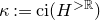

One can also ask these questions for maximal analytic Hardy fields and maximal smooth Hardy fields instead of maximal Hardy fields. We can even ask them for maximal Hausdorff fields (containing at least $ {\mathbb R} $
, say) instead of maximal Hardy fields. As with Corollary 3.7, might some weaker assumption such as
$ {\mathbb R} $
, say) instead of maximal Hardy fields. As with Corollary 3.7, might some weaker assumption such as $\mathfrak{b}=\mathfrak{d}$
be enough for some results where we assumed that the continuum hypothesis holds?
$\mathfrak{b}=\mathfrak{d}$
be enough for some results where we assumed that the continuum hypothesis holds?
If H is a Hardy field with $H^{> {\mathbb R} }$
closed under compositional inversion, then
$H^{> {\mathbb R} }$
closed under compositional inversion, then
 $$h\mapsto h^{\operatorname{inv}}\colon H^{> {\mathbb R} }\to H^{> {\mathbb R} }$$
is a strictly decreasing bijection, so $\operatorname{cf}(H)=\operatorname{ci}(H^{> {\mathbb R} })$
. However, we do not know if there is a maximal Hardy field H with
$\operatorname{cf}(H)=\operatorname{ci}(H^{> {\mathbb R} })$
. However, we do not know if there is a maximal Hardy field H with $H^{> {\mathbb R} }$
closed under compositional inversion.
$H^{> {\mathbb R} }$
closed under compositional inversion.
Acknowledgements
We thank the anonymous referee for suggestions as to how to improve the readability of the paper.
Conflicts of interest
None.
Journal information
Compositio Mathematica is owned by the Foundation Compositio Mathematica and published by the London Mathematical Society in partnership with Cambridge University Press. All surplus income from the publication of Compositio Mathematica is returned to mathematics and higher education through the charitable activities of the Foundation, the London Mathematical Society and Cambridge University Press.
Appendix. A proof of Whitney’s approximation theorem
For the convenience of the reader, we include here a proof of Theorem 2.1, adapting the exposition in [Reference NarasimhanNar73, §1.6]. Throughout this appendix, $r\in {\mathbb N} \cup\{\infty\}$
and
$r\in {\mathbb N} \cup\{\infty\}$
and $a,b\in {\mathbb R} $
.
$a,b\in {\mathbb R} $
.
Recall that the support $\operatorname{supp} f$
of a function
$\operatorname{supp} f$
of a function $f\colon {\mathbb R} \to {\mathbb R} $
is the closure in
$f\colon {\mathbb R} \to {\mathbb R} $
is the closure in $ {\mathbb R} $
of the set
$ {\mathbb R} $
of the set $ {\mathbb R} \setminus f^{-1}(0)$
. We begin with two lemmas, where
$ {\mathbb R} \setminus f^{-1}(0)$
. We begin with two lemmas, where $f\in\mathcal{C}^m( {\mathbb R} )$
is such that
$f\in\mathcal{C}^m( {\mathbb R} )$
is such that $\operatorname{supp} f$
is bounded; also let
$\operatorname{supp} f$
is bounded; also let $\lambda$
range over
$\lambda$
range over $ {\mathbb R} ^>$
. From the Gaussian integral
$ {\mathbb R} ^>$
. From the Gaussian integral $\int_{-\infty}^\infty \mathrm{e}^{-s^2}\,ds=\pi^{1/2}$
we get
$\int_{-\infty}^\infty \mathrm{e}^{-s^2}\,ds=\pi^{1/2}$
we get $(\lambda/\pi)^{1/2}\int_{-\infty}^\infty \mathrm{e}^{-\lambda s^2}\,ds=1$
. Consider
$(\lambda/\pi)^{1/2}\int_{-\infty}^\infty \mathrm{e}^{-\lambda s^2}\,ds=1$
. Consider ${f_\lambda\colon {\mathbb R} \to {\mathbb R} }$
given by
${f_\lambda\colon {\mathbb R} \to {\mathbb R} }$
given by
 \begin{equation}f_\lambda(t) := (\lambda/\pi)^{1/2}\int_{-\infty}^\infty f(s)\mathrm{e}^{-\lambda (s-t)^2}\,ds.\end{equation}
Note that we could have replaced here the bounds $-\infty$
,
$-\infty$
, $\infty$
in this integral by any a, b such that
$\infty$
in this integral by any a, b such that $\operatorname{supp}(f)\subseteq [a,b]$
. A change of variables gives
$\operatorname{supp}(f)\subseteq [a,b]$
. A change of variables gives
 $$f_\lambda(t) = (\lambda/\pi)^{1/2}\int_{-\infty}^\infty f(t-s)\mathrm{e}^{-\lambda s^2}\,ds.$$
As in [Reference DieudonnéDie60, (8.12), Exercise 2(b)], one obtains that $f_\lambda\in\mathcal{C}^\infty( {\mathbb R} )$
and for
$f_\lambda\in\mathcal{C}^\infty( {\mathbb R} )$
and for $k\leqslant m$
:
$k\leqslant m$
:
 $$f_\lambda^{(k)}(t)=(\lambda/\pi)^{1/2}\int_{-\infty}^\infty f^{(k)}(s) \mathrm{e}^{-\lambda (s-t)^2}\,ds=(\lambda/\pi)^{1/2}\int_{-\infty}^\infty f^{(k)}(t-s) \mathrm{e}^{-\lambda s^2}\,ds.$$
Moreover, we have the following.
Lemma A.1. We have that $f_\lambda$
extends to an entire function; in particular,
$f_\lambda$
extends to an entire function; in particular, $f_\lambda\in\mathcal{C}^\omega( {\mathbb R} )$
.
$f_\lambda\in\mathcal{C}^\omega( {\mathbb R} )$
.
Proof. Take $a< b$
such that
$a< b$
such that $\operatorname{supp} f\subseteq[a,b]$
and consider
$\operatorname{supp} f\subseteq[a,b]$
and consider $g\colon [a,b]\times\mathbb C\to \mathbb C$
given by
$g\colon [a,b]\times\mathbb C\to \mathbb C$
given by $g(s,z):=f(s)\mathrm{e}^{-\lambda(s-z)^2}$
. Then g is continuous, for each
$g(s,z):=f(s)\mathrm{e}^{-\lambda(s-z)^2}$
. Then g is continuous, for each $s\in [a,b]$
the function
$s\in [a,b]$
the function $g(s,{-})\colon\mathbb C\to\mathbb C$
is analytic, and
$g(s,{-})\colon\mathbb C\to\mathbb C$
is analytic, and $\partial g/\partial z\colon [a,b]\times\mathbb C\to\mathbb C$
is continuous. Hence,
$\partial g/\partial z\colon [a,b]\times\mathbb C\to\mathbb C$
is continuous. Hence, $z\mapsto \int_a^b g(s,z)\,ds\colon\mathbb C\to\mathbb C$
is analytic by [Reference DieudonnéDie60, (9.10), Exercise 3].
$z\mapsto \int_a^b g(s,z)\,ds\colon\mathbb C\to\mathbb C$
is analytic by [Reference DieudonnéDie60, (9.10), Exercise 3].
Lemma A.2. We have $\lVert f_\lambda-f\rVert_m\to 0$
as
$\lVert f_\lambda-f\rVert_m\to 0$
as $\lambda\to\infty$
.
$\lambda\to\infty$
.
Proof. For $k\leqslant m$
we have
$k\leqslant m$
we have
 \begin{align*}f_\lambda^{(k)}(t)-f^{(k)}(t) &= (\lambda/\pi)^{1/2}\int_{-\infty}^\infty (f^{(k)}(t-s)-f^{(k)}(t))\mathrm{e}^{-\lambda s^2}\,ds \\&= (\lambda/\pi)^{1/2}\int_{-\infty}^\infty (f^{(k)}(s)-f^{(k)}(t))\mathrm{e}^{-\lambda (s-t)^2}\,ds.\end{align*}
Let $\varepsilon\in {\mathbb R} ^>$
be given, and choose
$\varepsilon\in {\mathbb R} ^>$
be given, and choose $\delta>0$
such that
$\delta>0$
such that
 $$\lvert f^{(k)}(s)-f^{(k)}(t)\rvert \leqslant \varepsilon/2\quad\text{whenever $\lvert s-t\rvert\leqslant \delta$ and $k\leqslant m$.}$$
For $s\leqslant t-\delta$
and for
$s\leqslant t-\delta$
and for $s\geqslant t+\delta$
we have
$s\geqslant t+\delta$
we have $\mathrm{e}^{-\lambda(s-t)^2}\leqslant \mathrm{e}^{-(\lambda/2)\delta^2} \mathrm{e}^{-(\lambda/2)(s-t)^2}$
, so
$\mathrm{e}^{-\lambda(s-t)^2}\leqslant \mathrm{e}^{-(\lambda/2)\delta^2} \mathrm{e}^{-(\lambda/2)(s-t)^2}$
, so
 \begin{align*}\int_{-\infty}^{t-\delta} \mathrm{e}^{-\lambda(s-t)^2}\,ds + \int_{t+\delta}^{\infty} \mathrm{e}^{-\lambda(s-t)^2}\,ds & \leqslant \mathrm{e}^{-(\lambda/2)\delta^2}\int_{-\infty}^\infty \mathrm{e}^{-(\lambda/2)(s-t)^2}\,ds \\ & = \mathrm{e}^{-(\lambda/2)\delta^2} (2\pi/\lambda)^{1/2}.\end{align*}
Set $M:=\lVert f\rVert_{m}\in {\mathbb R} ^\geqslant$
. For
$M:=\lVert f\rVert_{m}\in {\mathbb R} ^\geqslant$
. For $k\leqslant m$
we have
$k\leqslant m$
we have
 $$\int_{-\infty}^\infty (f^{(k)}(s)-f^{(k)}(t))\mathrm{e}^{-\lambda (s-t)^2}\,ds =\int_{-\infty}^{t-\delta}(\dots)\,ds +\int_{t-\delta}^{t+\delta} (\dots)\,ds +\int^{\infty}_{t+\delta} (\dots)\,ds,$$
hence,
 \begin{align*}\lvert f_\lambda^{(k)}(t)-f^{(k)}(t)\rvert & \leqslant(\lambda/\pi)^{1/2} \bigg(M \int_{-\infty}^{t-\delta} \mathrm{e}^{-\lambda(s-t)^2}\,ds + \\ &\quad\quad\qquad\qquad (\varepsilon/2)\int_{-\infty}^\infty \mathrm{e}^{-\lambda(s-t)^2}\,ds + M \int^{\infty}_{t+\delta} \mathrm{e}^{-\lambda(s-t)^2}\,ds\bigg) \\ & \leqslant (\varepsilon/2)+\sqrt{2} M \mathrm{e}^{-(\lambda/2)\delta^2}.\end{align*}
Thus, if $\lambda$
is so large that
$\lambda$
is so large that $\sqrt{2} M \mathrm{e}^{-(\lambda/2)\delta^2}\leqslant \varepsilon/2$
, then
$\sqrt{2} M \mathrm{e}^{-(\lambda/2)\delta^2}\leqslant \varepsilon/2$
, then $\lVert f_\lambda-f\rVert_m\leqslant\varepsilon$
.
$\lVert f_\lambda-f\rVert_m\leqslant\varepsilon$
.
In the next lemma we let $U\subseteq {\mathbb R} $
be nonempty and open and let K range over nonempty compact subsets of U and m over the natural numbers
$U\subseteq {\mathbb R} $
be nonempty and open and let K range over nonempty compact subsets of U and m over the natural numbers $\leqslant r$
.
$\leqslant r$
.
Lemma A.3. Let $(f_n)$
be a sequence in
$(f_n)$
be a sequence in $\mathcal{C}^r(U)$
which, for all K, m, is a cauchy sequence with respect to
$\mathcal{C}^r(U)$
which, for all K, m, is a cauchy sequence with respect to $\lVert\,\cdot\,\rVert_{K;\,m}$
. Then there exists
$\lVert\,\cdot\,\rVert_{K;\,m}$
. Then there exists $f\in\mathcal{C}^r(U)$
such that for all K, m we have
$f\in\mathcal{C}^r(U)$
such that for all K, m we have $\lVert f_n-f\rVert_{K;\,m}\to 0$
as
$\lVert f_n-f\rVert_{K;\,m}\to 0$
as $n\to \infty$
.
$n\to \infty$
.
Proof. For all K, m, $(f_n^{(m)})$
is a cauchy sequence with respect to
$(f_n^{(m)})$
is a cauchy sequence with respect to $\lVert\,\cdot\,\rVert_K$
. Hence, for each m we obtain an
$\lVert\,\cdot\,\rVert_K$
. Hence, for each m we obtain an $f^m\in\mathcal{C}(U)$
such that for all K,
$f^m\in\mathcal{C}(U)$
such that for all K, $\lVert f_n^{(m)}-f^m\rVert_K\to 0$
as
$\lVert f_n^{(m)}-f^m\rVert_K\to 0$
as ${n\to\infty}$
; cf. [Reference DieudonnéDie60, (7.2.1)]. Set
${n\to\infty}$
; cf. [Reference DieudonnéDie60, (7.2.1)]. Set $f:=f^0$
. By induction on
$f:=f^0$
. By induction on $m\leqslant r$
we show that
$m\leqslant r$
we show that ${f\in\mathcal{C}^m(U)}$
and
${f\in\mathcal{C}^m(U)}$
and $f^{(m)}=f^m$
. This is clear for
$f^{(m)}=f^m$
. This is clear for $m=0$
, so suppose
$m=0$
, so suppose $0<m\leqslant r$
and
$0<m\leqslant r$
and $f\in\mathcal{C}^{m-1}(U)$
,
$f\in\mathcal{C}^{m-1}(U)$
, $f^{(m-1)}=f^{m-1}$
. Let
$f^{(m-1)}=f^{m-1}$
. Let $a\in U$
, and take
$a\in U$
, and take $\varepsilon>0$
such that
$\varepsilon>0$
such that $K:=[a-\varepsilon,a+\varepsilon]\subseteq U$
. Let
$K:=[a-\varepsilon,a+\varepsilon]\subseteq U$
. Let $t\in K\setminus\{a\}$
. Then for each n we have
$t\in K\setminus\{a\}$
. Then for each n we have $s_n$
with
$s_n$
with $\lvert a-s_n\rvert\leqslant \lvert a-t\rvert$
such that
$\lvert a-s_n\rvert\leqslant \lvert a-t\rvert$
such that
 $$f_n^{(m-1)}(t)-f_n^{(m-1)}(a) = f_n^{(m)}(s_n)\cdot (t-a).$$
Take a subsequence $(s_{n_k})$
of
$(s_{n_k})$
of $(s_n)$
and
$(s_n)$
and $s=s(t)$
with
$s=s(t)$
with $\lim_{k\to\infty} s_{n_k} = s$
. Then
$\lim_{k\to\infty} s_{n_k} = s$
. Then ${\lvert a-s\rvert}\leqslant\lvert a-t\rvert\leqslant \varepsilon$
and
${\lvert a-s\rvert}\leqslant\lvert a-t\rvert\leqslant \varepsilon$
and
 $$\lim_{k\to\infty} (f_{n_k}^{(m-1)}(t)-f_{n_k}^{(m-1)}(a)) = f^{m-1}(t)-f^{m-1}(a) = f^{(m-1)}(t)-f^{(m-1)}(a)$$
and $\lim_{k\to\infty} f_{n_k}^{(m)}(s_{n_k})=f^m(s)$
, since
$\lim_{k\to\infty} f_{n_k}^{(m)}(s_{n_k})=f^m(s)$
, since $\lim_{n\to\infty}\lVert f_n^{(m)}-f^m\rVert_{K} = 0$
. Hence,
$\lim_{n\to\infty}\lVert f_n^{(m)}-f^m\rVert_{K} = 0$
. Hence,
 $$f^{(m-1)}(t)-f^{(m-1)}(a)=f^m(s)\cdot (t-a),$$
where $f^m(s(t))\to f^m(a)$
as
$f^m(s(t))\to f^m(a)$
as $t\to a$
, since
$t\to a$
, since $f^m$
is continuous at a.
$f^m$
is continuous at a.
We now prove Theorem 2.1. Let $(a_n)$
,
$(a_n)$
, $(b_n)$
,
$(b_n)$
, $(\varepsilon_n)$
be sequences in
$(\varepsilon_n)$
be sequences in $ {\mathbb R} $
and
$ {\mathbb R} $
and $(r_n)$
in
$(r_n)$
in $ {\mathbb N} $
such that
$ {\mathbb N} $
such that $a_0= b_0$
,
$a_0= b_0$
, $(a_n)$
is strictly decreasing,
$(a_n)$
is strictly decreasing, $(b_n)$
is strictly increasing, and
$(b_n)$
is strictly increasing, and $\varepsilon_n>0$
,
$\varepsilon_n>0$
, $r_n\leqslant r$
for all n. Set
$r_n\leqslant r$
for all n. Set $I:=\bigcup_n K_n$
, where
$I:=\bigcup_n K_n$
, where $K_n:=[a_n, b_n]$
, and let
$K_n:=[a_n, b_n]$
, and let $f\in \mathcal{C}^r(I)$
. We need to show the existence of a
$f\in \mathcal{C}^r(I)$
. We need to show the existence of a $g\in\mathcal{C}^\omega(I)$
such that
$g\in\mathcal{C}^\omega(I)$
such that $\lVert{f-g}\rVert_{K_{n+1}\setminus K_n;\,r_n}<\varepsilon_n$
for each n. Replacing
$\lVert{f-g}\rVert_{K_{n+1}\setminus K_n;\,r_n}<\varepsilon_n$
for each n. Replacing $\varepsilon_n$
by
$\varepsilon_n$
by $\min\{\varepsilon_n, {1}/{n+1}\}$
and
$\min\{\varepsilon_n, {1}/{n+1}\}$
and $r_n$
by
$r_n$
by $\max\{r_0,\dots,r_n\}$
we first arrange that
$\max\{r_0,\dots,r_n\}$
we first arrange that $\varepsilon_n\to 0$
as
$\varepsilon_n\to 0$
as $n\to\infty$
and
$n\to\infty$
and $r_n\leqslant r_{n+1}$
for all n. Set
$r_n\leqslant r_{n+1}$
for all n. Set
 $$L_n := K_{n+1}\setminus K_n = [a_{n+1},a_n)\cup(b_n,b_{n+1}],$$
and take $\varphi_n\in\mathcal{C}^\infty( {\mathbb R} )$
such that
$\varphi_n\in\mathcal{C}^\infty( {\mathbb R} )$
such that $\varphi_n=0$
on a neighborhood of
$\varphi_n=0$
on a neighborhood of $K_{n-1}$
(satisfied automatically for
$K_{n-1}$
(satisfied automatically for $n=0$
, by convention),
$n=0$
, by convention), $\varphi_n=1$
on a neighborhood of
$\varphi_n=1$
on a neighborhood of $\operatorname{cl}(L_n)=[a_{n+1},a_n]\cup[b_n,b_{n+1}]$
, and
$\operatorname{cl}(L_n)=[a_{n+1},a_n]\cup[b_n,b_{n+1}]$
, and $\operatorname{supp}\varphi_n\subseteq K_{n+2}$
. For example, for
$\operatorname{supp}\varphi_n\subseteq K_{n+2}$
. For example, for $n\geqslant 1$
,
$n\geqslant 1$
, $\alpha_{a,b}\in\mathcal{C}^\infty( {\mathbb R} )$
as in [Reference Aschenbrenner, van den Dries and van der HoevenAvdDvdH24a, (3.4)], and sufficiently small positive
$\alpha_{a,b}\in\mathcal{C}^\infty( {\mathbb R} )$
as in [Reference Aschenbrenner, van den Dries and van der HoevenAvdDvdH24a, (3.4)], and sufficiently small positive $\varepsilon=\varepsilon(n)$
, set
$\varepsilon=\varepsilon(n)$
, set
 $$\alpha_n(t):=\begin{cases}\alpha_{a_{n+2}+\varepsilon,a_{n+1}-\varepsilon}(t) &\text{if $t\leqslant a_n$,} \\1-\alpha_{a_{n}+\varepsilon,a_{n-1}-\varepsilon}(t) &\text{otherwise,}\end{cases}$$
and
 $$\beta_n(t):=\begin{cases}\alpha_{b_{n-1}+\varepsilon,b_n-\varepsilon}(t) &\text{if $t\leqslant b_n$,} \\1-\alpha_{b_{n+1}+\varepsilon,b_{n+2}-\varepsilon}(t) &\text{otherwise,}\end{cases}$$
and put $\varphi_n:=\alpha_n+\beta_n$
. (See Figure A.1.)
$\varphi_n:=\alpha_n+\beta_n$
. (See Figure A.1.)
The hump function $\beta_n$
.
$\beta_n$
.

Figure A.1 Long description
The line graph illustrates the hump function beta n, which rises sharply from zero at b n minus 1, reaches a plateau at beta n between b n and b n plus 1, and then falls back to zero at b n plus 2. The x axis represents the variable t, while the y axis represents the value of the function beta n. All values are approximated.
With $M_n:=1+2^{r_n}\lVert\varphi_n\rVert_{r_n}$
, choose
$M_n:=1+2^{r_n}\lVert\varphi_n\rVert_{r_n}$
, choose $\delta_n\in {\mathbb R} ^>$
so that for all n,
$\delta_n\in {\mathbb R} ^>$
so that for all n,
 \begin{equation}2\delta_{n+1} \leqslant \delta_n,\quad \sum_{m = n}^\infty \delta_m M_{m+1}\leqslant \varepsilon_n/4.\end{equation}
Given $g\in\mathcal{C}( {\mathbb R} )$
with bounded support and
$g\in\mathcal{C}( {\mathbb R} )$
with bounded support and $\lambda\in {\mathbb R} ^>$
, let
$\lambda\in {\mathbb R} ^>$
, let $I_\lambda(g):=g_\lambda$
be as in (A.1), with g in place of f. Next, let
$I_\lambda(g):=g_\lambda$
be as in (A.1), with g in place of f. Next, let $f\in \mathcal{C}^r(I)$
be given. Then we inductively define sequences
$f\in \mathcal{C}^r(I)$
be given. Then we inductively define sequences $(\lambda_n)$
in
$(\lambda_n)$
in $ {\mathbb R} ^>$
and
$ {\mathbb R} ^>$
and $(g_n)$
in
$(g_n)$
in $\mathcal{C}^\omega( {\mathbb R} )$
as follows. Let
$\mathcal{C}^\omega( {\mathbb R} )$
as follows. Let $\lambda_m\in {\mathbb R} ^{>}$
and
$\lambda_m\in {\mathbb R} ^{>}$
and $g_m\in \mathcal{C}^{\omega}$
for
$g_m\in \mathcal{C}^{\omega}$
for $m<n$
, then consider the function
$m<n$
, then consider the function $h_n\in\mathcal{C}^r( {\mathbb R} )$
given by
$h_n\in\mathcal{C}^r( {\mathbb R} )$
given by
 $$h_n(t) := \begin{cases} \varphi_n(t)\cdot (f(t)-(g_0(t)+\cdots+g_{n-1}(t)))& \text{if $t\in I$,} \\0 & \text{otherwise.}\end{cases}$$
Thus, $\operatorname{supp} h_n\subseteq\operatorname{supp}\varphi_n$
is bounded. Put
$\operatorname{supp} h_n\subseteq\operatorname{supp}\varphi_n$
is bounded. Put $g_n:=I_{\lambda_n}(h_n)\in\mathcal{C}^\omega( {\mathbb R} )$
where we take
$g_n:=I_{\lambda_n}(h_n)\in\mathcal{C}^\omega( {\mathbb R} )$
where we take $\lambda_n\in {\mathbb R} ^>$
such that
$\lambda_n\in {\mathbb R} ^>$
such that $\lVert g_n-h_n\rVert_{r_n}<\delta_n$
(any sufficiently large
$\lVert g_n-h_n\rVert_{r_n}<\delta_n$
(any sufficiently large $\lambda_n$
will do, by Lemma A.2). Then we have
$\lambda_n$
will do, by Lemma A.2). Then we have $\lVert{g_{n+1}-h_{n+1}}\rVert_{K_{n};\,r_{n+1}}<\delta_{n+1}$
, and since
$\lVert{g_{n+1}-h_{n+1}}\rVert_{K_{n};\,r_{n+1}}<\delta_{n+1}$
, and since $\varphi_{n+1}$
and thus also
$\varphi_{n+1}$
and thus also $h_{n+1}$
vanish on a neighborhood of
$h_{n+1}$
vanish on a neighborhood of $K_{n}$
, this yields
$K_{n}$
, this yields
 \begin{equation}\lVert g_{n+1}\rVert_{K_{n};\, r_{n+1}}<\delta_{n+1}.\end{equation}
Likewise, since $\varphi_n=1$
on a neighborhood of
$\varphi_n=1$
on a neighborhood of $\operatorname{cl}(L_n)$
,
$\operatorname{cl}(L_n)$
,
 \begin{equation}\lVert f-(g_0+\cdots+g_n)\rVert_{L_n;\, r_n}<\delta_n.\end{equation}
In addition,
 $$\lVert g_{n+1}-h_{n+1}\rVert_{L_n;\,r_{n}}\leqslant\lVert g_{n+1}-h_{n+1}\rVert_{r_{n+1}}<\delta_{n+1},$$
 \begin{align*}\lVert g_{n+1}\rVert_{L_n;\,r_{n}}\ & \leqslant \lVert g_{n+1}-h_{n+1}\rVert_{L_n;\,r_{n}}+\lVert\varphi_{n+1}\cdot(f-(g_0+\cdots+g_n))\rVert_{L_n;\,r_{n}} \\& \leqslant \delta_{n+1} + 2^{r_n}\lVert\varphi_{n+1}\rVert_{L_n;\,r_{n}} \cdot \lVert f-(g_0+\cdots+g_n)\rVert_{L_n;\,r_{n}} \\& \leqslant \delta_{n+1}+ M_{n+1}\delta_n.\end{align*}
Moreover, by (A.3) and $r_n\leqslant r_{n+1}$
we have
$r_n\leqslant r_{n+1}$
we have $\lVert g_{n+1}\rVert_{K_n;\, r_n}<\delta_{n+1}$
. Hence, by (A.2):
$\lVert g_{n+1}\rVert_{K_n;\, r_n}<\delta_{n+1}$
. Hence, by (A.2):
 \begin{equation}\lVert g_{n+1}\rVert_{K_{n+1};\,r_n} \leqslant \delta_{n+1}+ M_{n+1}\delta_n+\delta_{n+1} \leqslant M_{n+1}\delta_n+\delta_n \leqslant 2\delta_n M_{n+1}.\end{equation}
Let $K\subseteq I$
be nonempty and compact, and let
$K\subseteq I$
be nonempty and compact, and let $m\leqslant r_n$
for some n. We claim that
$m\leqslant r_n$
for some n. We claim that $({g_0+\cdots+g_i})$
is a cauchy sequence with respect to
$({g_0+\cdots+g_i})$
is a cauchy sequence with respect to $\lVert\,\cdot\,\rVert_{K;\,m}$
. To see this, let
$\lVert\,\cdot\,\rVert_{K;\,m}$
. To see this, let $\varepsilon\in {\mathbb R} ^>$
be given, and take n such that
$\varepsilon\in {\mathbb R} ^>$
be given, and take n such that $K\subseteq K_{n+1}$
,
$K\subseteq K_{n+1}$
, $m\leqslant r_n$
, and
$m\leqslant r_n$
, and $\varepsilon_n\leqslant 2\varepsilon$
. Then by (A.2) and (A.5) we have for
$\varepsilon_n\leqslant 2\varepsilon$
. Then by (A.2) and (A.5) we have for $j \gt i\geqslant n$
:
$j \gt i\geqslant n$
:
 \begin{align*}\lVert g_{i+1}+\cdots+g_j\rVert_{K;\,m} & \leqslant \lVert g_{i+1}\rVert_{K;\,m}+\cdots+\lVert g_j\rVert_{K;\,m} \\& \leqslant \lVert g_{i+1}\rVert_{K_{i+1};\,r_i}+\cdots+\lVert g_j\rVert_{K_{j};\,r_{j-1}} \\& \leqslant 2\delta_iM_{i+1}+\cdots+2\delta_{j-1}M_j \leqslant \varepsilon_i/2 \leqslant \varepsilon.\end{align*}
Thus, Lemma A.3 yields a function $g\colon I\to {\mathbb R} $
such that
$g\colon I\to {\mathbb R} $
such that $g(t)=\sum_{i=0}^\infty g_i(t)$
for all
$g(t)=\sum_{i=0}^\infty g_i(t)$
for all $t\in I$
and
$t\in I$
and $g\in \mathcal{C}^{r_n}(I)$
for all n. In the same way, using (A.2) and (A.5) and denoting the restriction of
$g\in \mathcal{C}^{r_n}(I)$
for all n. In the same way, using (A.2) and (A.5) and denoting the restriction of $g_i$
to I also by
$g_i$
to I also by $g_i$
, we obtain
$g_i$
, we obtain
 $$\lVert g-(g_0+\cdots+g_n)\rVert_{L_n;\,r_n} = \bigg\|\sum_{i=n+1}^\infty g_i\bigg\|_{L_n;\,r_n} \leqslant \varepsilon_n/2$$
 \begin{align*}\lVert f-g\rVert_{L_n;\,r_n} & \leqslant \lVert f-(g_0+\cdots+g_n)\rVert_{L_n;\,r_n} +\lVert g-(g_0+\cdots+g_n)\rVert_{L_n;\,r_n}\\& \leqslant \delta_n+\tfrac{1}{2}\varepsilon_n\ <\ \varepsilon_n.\end{align*}
To complete the proof we are going to choose sequences $(g_n)$
and
$(g_n)$
and $(\lambda_n)$
as before so that g is analytic. Now for
$(\lambda_n)$
as before so that g is analytic. Now for $t\in {\mathbb R} $
we have
$t\in {\mathbb R} $
we have
 $$g_n(t) = (\lambda_n/\pi)^{1/2}\int_{-\infty}^{\infty} h_n(s)\mathrm{e}^{-\lambda_n(s-t)^2} \, ds = (\lambda_n/\pi)^{1/2}\int_{a_{n+2}}^{b_{n+2}} h_n(s)\mathrm{e}^{-\lambda_n(s-t)^2} \, ds$$
and $g_n$
is the restriction to
$g_n$
is the restriction to $ {\mathbb R} $
of the entire function
$ {\mathbb R} $
of the entire function $\widehat g_n$
given by
$\widehat g_n$
given by
 $$\widehat g_n(z) = (\lambda_n/\pi)^{1/2}\int_{a_{n+2}}^{b_{n+2}} h_n(s)\mathrm{e}^{-\lambda_n(s-z)^2}ds\quad (z\in\mathbb C).$$
(See the proof of Lemma A.1.) Put
 $$\rho_n := \tfrac{1}{2}\min\{ (a_n-a_{n+1})^2,(b_{n+1}-b_{n})^2\}\in {\mathbb R} ^>$$
and
 $$U_n := \{z\in \mathbb C:\, a_{n+1} \lt \operatorname{Re} z \lt b_{n+1},\operatorname{Re}((z-a_{n+1})^2),\ \operatorname{Re}((z-b_{n+1})^2)>\rho_n \}, $$
an open subset of $\mathbb C$
containing
$\mathbb C$
containing $K_n$
such that
$K_n$
such that $\operatorname{Re}((s-z)^2)>\rho_n$
for all
$\operatorname{Re}((s-z)^2)>\rho_n$
for all $s\in {\mathbb R} \setminus K_{n+1}$
and
$s\in {\mathbb R} \setminus K_{n+1}$
and $z\in U_n$
(cf. Figure A.2).
$z\in U_n$
(cf. Figure A.2).
The domain $U_n$
.
$U_n$
.

Figure A.2 Long description
The image shows a complex plane with the imaginary axis labeled Im and the real axis labeled Re. A shaded region labeled U_n is depicted in the center, bounded by vertical dashed lines labeled a_{n+1}, a_n, b_n, and b_{n+1}. The shaded region is symmetric about both axes and has a diamond-like shape with curved edges.
We also set
 $$H_m := 2(\lambda_m/\pi)^{1/2}\,\lVert h_m\rVert_{K_{m+2}} \,(b_{m+2}-a_{m+2})\in {\mathbb R} ^\geqslant.$$
Recall that $h_m$
only depends on the
$h_m$
only depends on the $g_j$
with
$g_j$
with $j<m$
. Fix a sequence
$j<m$
. Fix a sequence $(c_m)$
of positive reals such that
$(c_m)$
of positive reals such that $\sum_m c_m <\infty$
. Then we can and do choose the sequences
$\sum_m c_m <\infty$
. Then we can and do choose the sequences $(g_m)$
,
$(g_m)$
, $(\lambda_m)$
so that in addition
$(\lambda_m)$
so that in addition
 $$H_m \exp(-\lambda_m/m) \leqslant c_m\quad\text{for all $m\geqslant 1$.}$$
Then
 \begin{equation}\sum_m H_m\exp(-\lambda_m\rho)\ <\infty\ \quad\text{for all ${\rho\in {\mathbb R} ^>}$.}\end{equation}
It is enough that for each n the series $\sum_m \widehat g_m$
converges uniformly on compact subsets of
$\sum_m \widehat g_m$
converges uniformly on compact subsets of $U_n$
, because then by [Reference DieudonnéDie60, (9.12.1)] we have a holomorphic function
$U_n$
, because then by [Reference DieudonnéDie60, (9.12.1)] we have a holomorphic function
 $$ z\mapsto \sum_m \widehat g_m(z)\ :\ U:=\bigcup_n U_n\to\mathbb C $$
whose restriction to I is g. To prove such convergence, fix n and let $m\geqslant n+2$
. Then
$m\geqslant n+2$
. Then $\operatorname{supp} h_m \subseteq K_{m+2} \setminus K_{m-1} \subseteq K_{m+2} \setminus K_{n+1}$
. Hence,
$\operatorname{supp} h_m \subseteq K_{m+2} \setminus K_{m-1} \subseteq K_{m+2} \setminus K_{n+1}$
. Hence, $\lvert\widehat g_m(z)\rvert \leqslant H_m\mathrm{e}^{-\lambda_m\rho_n}$
for
$\lvert\widehat g_m(z)\rvert \leqslant H_m\mathrm{e}^{-\lambda_m\rho_n}$
for ${z\in U_n}$
. Together with (A.6) this now yields that
${z\in U_n}$
. Together with (A.6) this now yields that $\sum_m \widehat g_m$
converges uniformly on compact subsets of
$\sum_m \widehat g_m$
converges uniformly on compact subsets of $U_n$
. In the remainder of this appendix we discuss how to control the domain of the holomorphic function
$U_n$
. In the remainder of this appendix we discuss how to control the domain of the holomorphic function $\widehat g$
in the proof of Theorem 2.1. This leads to improvements of Corollaries 2.2 and 2.3, which might be useful elsewhere: see Corollaries A.6 and A.7. For the next corollary we are in the setting of that theorem and
$\widehat g$
in the proof of Theorem 2.1. This leads to improvements of Corollaries 2.2 and 2.3, which might be useful elsewhere: see Corollaries A.6 and A.7. For the next corollary we are in the setting of that theorem and $f\in \mathcal{C}^r(I)$
. With
$f\in \mathcal{C}^r(I)$
. With $\alpha\in {\mathbb R} \cup\{-\infty\}$
and
$\alpha\in {\mathbb R} \cup\{-\infty\}$
and $\beta\in {\mathbb R} \cup\{+\infty\}$
such that
$\beta\in {\mathbb R} \cup\{+\infty\}$
such that $I=(\alpha,\beta)$
, put
$I=(\alpha,\beta)$
, put
 $$V := \{z\in\mathbb C:\ \operatorname{Re}(z)\in I,\ \lvert\operatorname{Im} z\rvert \lt \operatorname{Re}(z)-\alpha,\,\beta-\operatorname{Re}(z)\},$$
an open subset of $\mathbb C$
containing I.
$\mathbb C$
containing I.
Corollary A.4. Suppose $a_n-a_{n+1}\to 0$
and
$a_n-a_{n+1}\to 0$
and $ b_{n+1}-b_n\to 0$
as
$ b_{n+1}-b_n\to 0$
as $n\to \infty$
. Then there is a holomorphic
$n\to \infty$
. Then there is a holomorphic $\widehat g\colon V\to\mathbb C$
, real-valued on
$\widehat g\colon V\to\mathbb C$
, real-valued on $ {\mathbb R} $
, such that
$ {\mathbb R} $
, such that $g:=\widehat g|_I\in\mathcal{C}^\omega(I)$
satisfies
$g:=\widehat g|_I\in\mathcal{C}^\omega(I)$
satisfies
 $$\lVert{f-g}\rVert_{K_{n+1}\setminus K_n;\,r_n} \lt \varepsilon_n, \text{ for all n}.$$
Proof. It suffices to show that the open set $U\subseteq\mathbb C$
in the proof of Theorem 2.1 contains V. Note that
$U\subseteq\mathbb C$
in the proof of Theorem 2.1 contains V. Note that $\rho_n\to 0$
as
$\rho_n\to 0$
as $n\to \infty$
. Let
$n\to \infty$
. Let $z=x+y i \in V$
(
$z=x+y i \in V$
( $x,y\in {\mathbb R} $
). Then
$x,y\in {\mathbb R} $
). Then
 $$ (x-a_{n+1})^2-y^2-\rho_n \to (x-\alpha)^2-y^2 \gt 0 \text{ as }n\to \infty,$$
and, thus, $\operatorname{Re}((z-a_{n+1})^2)=(x-a_{n+1})^2-y^2 \gt \rho_n$
for all sufficiently large n. Likewise,
$\operatorname{Re}((z-a_{n+1})^2)=(x-a_{n+1})^2-y^2 \gt \rho_n$
for all sufficiently large n. Likewise, ${\operatorname{Re}((z-b_{n+1})^2) \gt \rho_n}$
for all sufficiently large n. Therefore,
${\operatorname{Re}((z-b_{n+1})^2) \gt \rho_n}$
for all sufficiently large n. Therefore, $z\in U_n$
for sufficiently large n.
$z\in U_n$
for sufficiently large n.
Corollary A.5. Suppose $r\in {\mathbb N} $
,
$r\in {\mathbb N} $
, $f\in\mathcal{C}^r( {\mathbb R} )$
,
$f\in\mathcal{C}^r( {\mathbb R} )$
, $\varepsilon\in\mathcal{C}( {\mathbb R} )$
, and
$\varepsilon\in\mathcal{C}( {\mathbb R} )$
, and $\varepsilon>0$
on
$\varepsilon>0$
on $ {\mathbb R} $
. Then there is an entire function
$ {\mathbb R} $
. Then there is an entire function $g\colon\mathbb C\to\mathbb C$
such that
$g\colon\mathbb C\to\mathbb C$
such that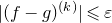 ${\lvert(f-g)^{(k)}\rvert\leqslant\varepsilon}$
on
${\lvert(f-g)^{(k)}\rvert\leqslant\varepsilon}$
on $ {\mathbb R} $
for all
$ {\mathbb R} $
for all $k\leqslant r$
.
$k\leqslant r$
.
Proof. Set $b_n:=\log(n+1)$
,
$b_n:=\log(n+1)$
, $a_n:=-b_n$
, and
$a_n:=-b_n$
, and $K_n:=[a_n,b_n]$
. Then
$K_n:=[a_n,b_n]$
. Then $\bigcup_n K_n= {\mathbb R} $
and
$\bigcup_n K_n= {\mathbb R} $
and $a_n-a_{n+1}\to 0$
and
$a_n-a_{n+1}\to 0$
and $ b_{n+1}-b_n\to 0$
as
$ b_{n+1}-b_n\to 0$
as $n\to \infty$
. Set
$n\to \infty$
. Set $\varepsilon_n:=\min\{\varepsilon(t): t\in K_{n+1}\}$
and
$\varepsilon_n:=\min\{\varepsilon(t): t\in K_{n+1}\}$
and $r_n:=r$
. Then
$r_n:=r$
. Then $V=\mathbb C$
and we apply Corollary A.4.
$V=\mathbb C$
and we apply Corollary A.4.
Remark. Corollary A.5 is due to Carleman [Reference CarlemanCar27] for $r=0$
, to Kaplan [Reference KaplanKap55] for
$r=0$
, to Kaplan [Reference KaplanKap55] for ${r=1}$
, and to Hoischen [Reference HoischenHoi73, Satz 2] in general; see [Reference BurckelBur79, Chapter VIII, pp. 273–276, 291]. In a similar way, Corollary A.4 also yields the
${r=1}$
, and to Hoischen [Reference HoischenHoi73, Satz 2] in general; see [Reference BurckelBur79, Chapter VIII, pp. 273–276, 291]. In a similar way, Corollary A.4 also yields the $\mathcal{C}^\infty$
-version of Corollary A.5 in [Reference HoischenHoi73, Satz 1]. For a multivariate version of these facts, see [Reference Andradas, Aneiros, Díaz-Cano, Castrillón López, Garrido, Jaramillo, Ansemil and RojoAADC12].
$\mathcal{C}^\infty$
-version of Corollary A.5 in [Reference HoischenHoi73, Satz 1]. For a multivariate version of these facts, see [Reference Andradas, Aneiros, Díaz-Cano, Castrillón López, Garrido, Jaramillo, Ansemil and RojoAADC12].
Given any a we now consider the open sector $V_a$
in the complex plane given by
$V_a$
in the complex plane given by
 $$V_a := \{z\in\mathbb C: \lvert\operatorname{Im} (z)\rvert \lt \operatorname{Re}(z)-a\} = a+\Big\{z\in\mathbb C^\times: -\dfrac{\pi}{4}<\arg z<\dfrac{\pi}{4} \Big\}.$$
Corollary A.6. Let f, $(b_n)$
,
$(b_n)$
, $(\varepsilon_n)$
,
$(\varepsilon_n)$
, $(r_n)$
be as in Corollary 2.2. Then there are
$(r_n)$
be as in Corollary 2.2. Then there are $a<~b$
and a holomorphic function
$a<~b$
and a holomorphic function $\widehat g\colon V_a\to\mathbb C$
which is real-valued on
$\widehat g\colon V_a\to\mathbb C$
which is real-valued on $ {\mathbb R} $
such that
$ {\mathbb R} $
such that $g:=\widehat g|_{ {\mathbb R} ^{\geqslant b}}\in\mathcal{C}^\omega_b$
satisfies
$g:=\widehat g|_{ {\mathbb R} ^{\geqslant b}}\in\mathcal{C}^\omega_b$
satisfies $\lVert{f-g}\rVert_{[b_n,b_{n+1}];\,r_n}<\varepsilon_n$
for all n.
$\lVert{f-g}\rVert_{[b_n,b_{n+1}];\,r_n}<\varepsilon_n$
for all n.
Proof. We first arrange that $b_{n+1}-b_n\to 0$
as
$b_{n+1}-b_n\to 0$
as $n\to\infty$
. For this, let
$n\to\infty$
. For this, let $(b_m^*)$
be the strictly increasing sequence in
$(b_m^*)$
be the strictly increasing sequence in $ {\mathbb R} $
such that
$ {\mathbb R} $
such that
 $$\{b_0^*,b_1^*,\dots\} = \{b_0,b_1,\dots\}\cup\{b+\log 1,b+\log 2,\dots\}.$$
For each m, set $\varepsilon_m^*:=\varepsilon_n$
,
$\varepsilon_m^*:=\varepsilon_n$
, $r_m^*:=r_n$
with n such that
$r_m^*:=r_n$
with n such that $[b_{m}^*,b_{m+1}^*]\subseteq [b_n,b_{n+1}]$
, and replace
$[b_{m}^*,b_{m+1}^*]\subseteq [b_n,b_{n+1}]$
, and replace $(b_n)$
,
$(b_n)$
, $(\varepsilon_n)$
,
$(\varepsilon_n)$
, $(r_n)$
by
$(r_n)$
by $(b_m^*)$
,
$(b_m^*)$
, $(\varepsilon_m^*)$
,
$(\varepsilon_m^*)$
, $(r_m^*)$
. Now we argue as in the proof of Corollary 2.2, using Corollary A.4 instead of Theorem 2.1.
$(r_m^*)$
. Now we argue as in the proof of Corollary 2.2, using Corollary A.4 instead of Theorem 2.1.
Now the proof of Corollary 2.3, using Corollary A.6 instead of Corollary 2.2, gives the following.
Corollary A.7. Let f, $\varepsilon$
be as in Corollary 2.3. Then there are
$\varepsilon$
be as in Corollary 2.3. Then there are $a<b$
and a holomorphic function
$a<b$
and a holomorphic function $\widehat g\colon V_a\to\mathbb C$
, real-valued on
$\widehat g\colon V_a\to\mathbb C$
, real-valued on $ {\mathbb R} $
, such that
$ {\mathbb R} $
, such that $g:=\widehat g|_{ {\mathbb R} ^{\geqslant b}}\in\mathcal{C}^\omega_b$
satisfies
$g:=\widehat g|_{ {\mathbb R} ^{\geqslant b}}\in\mathcal{C}^\omega_b$
satisfies ${\lvert(f-g)^{(k)}(t)\rvert} \lt \varepsilon(t)$
for all
${\lvert(f-g)^{(k)}(t)\rvert} \lt \varepsilon(t)$
for all $t\geqslant b$
and
$t\geqslant b$
and $k\leqslant \min\{r,1/\varepsilon(t)\}$
.
$k\leqslant \min\{r,1/\varepsilon(t)\}$
.


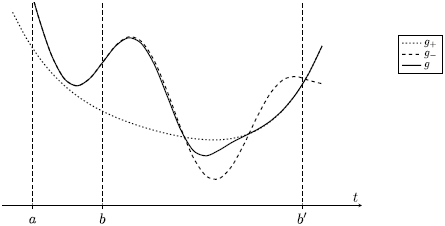
 g−
g− g+
g+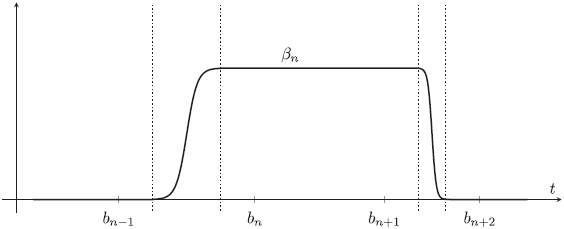
 βn
βn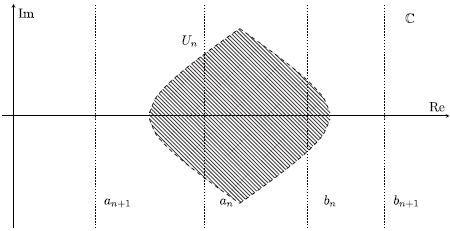
 Un
Un
 Open access

