




1. Introduction
Design-intensive companies are more valued in the stock market than engineering-focused ones (Rae Reference Rae2016; Sheppard, Yeon & London Reference Sheppard, Yeon and London2018). This fact has attracted more companies to embrace design as a strategic differentiator and innovation driver to become more viable. More design-related activities in companies are observable by nondesigners when companies lack designers. Many companies have started cultivating a design thinking (DT) culture (Seidel & Fixson Reference Seidel and Fixson2013; Kolko Reference Kolko2015; Elsbach & Stigliani Reference Elsbach and Stigliani2018). A large study conducted by the Hasso Plattner Institute (HPI) indicates that more than 40% of participants in DT engagements need professional DT training before. Forty percentage receive help from external innovation agencies, internal DT facilitators or are subscribed to internal DT projects. Only 20% learn it without professional assistance (Schmiedgen et al. Reference Schmiedgen, Spille, Köppen, Rhinow and Meinel2016).
Nondesigners face challenges when adding design aspects to their work or are being involved in codesign. Nondesigners typically have a certain subject matter expertise and hence use methods and domain-specific languages from their expertise area. Nondesigners may also have biases associating the term design purely with visualisation and aesthetics and less with functional design, nonconstructional architectures or problem-solving (Alway-Rosenstock Reference Alway-Rosenstock2011). The reasons for prejudice can lie in organisational silo-thinking, where employees concentrate on their business areas, functions or departments. Another reason might be the lack of design relevance in academic education (Dunne & Martin Reference Dunne and Martin2006). Leadership typically has its own goals and incentives to cascade its interests in the organisation and even promote silo-thinking (Elsbach & Stigliani Reference Elsbach and Stigliani2018). Nondesigner may also have had difficulties entering the protected design domain. Studies from design research also indicate designer sovereignty until the mid-2000s. Until then, the design domain has been protected by both designers and design researchers.
DT brought about democratisation in the early 2000s. Design agencies, innovation consultancies and design-driven entrepreneurs that applied DT started inviting nondesigners to joint design activities for a higher purpose of solving typically human-centric problems (Kimbell & Street Reference Kimbell and Street2009; Seidel & Fixson Reference Seidel, Fixson, Scott Swan, Luchs and Griffin2015; Dell’Era et al. Reference Dell’Era, Magistretti, Cautela, Verganti and Zurlo2020). Products, services or even overarching combinatory innovations resulted from these engagements to add value to the consumer or user (Gloppen Reference Gloppen2009). Entrepreneurs and thought leaders from business, like Hasso Plattner, discovered the potential and promoted the opening of the design profession to also nondesigners.
DT has since been found as an interdisciplinary method in academia and practice, particularly suitable for codesign. Human-centric design challenges foresee a higher degree of codesign with stakeholders than generic design challenges. DT, in general, is open to nondesigners and novices disregarding the design challenge type (Plattner, Meinel & Leifer. Reference Plattner, Meinel and Leifer2010).
Historically, DT is a semi-nondesigner-friendly innovation, codesign and problem-solving approach rooted in practice and academia. Many DT methods and representations that exist are based on similar principles, mindset and method construction (Kelley Reference Kelley2001; Cross Reference Cross2006; Dunne & Martin Reference Dunne and Martin2006; Brown Reference Brown2008; Plattner et al. Reference Plattner, Meinel and Weinberg2009; Seidel & Fixson Reference Seidel and Fixson2013; Dosi et al. Reference Dosi, Rosati and Vignoli2018). Existing research around DT takes those as given as if they were best practices. Only a few researchers have investigated the methodological construction of DT from a method engineering perspective to understand its rationale and efficacy (Thoring & Müller Reference Thoring and Müller2011b). Research on method experience for DT with nondesigners is limited (Seidel & Fixson Reference Seidel and Fixson2013, Reference Seidel, Fixson, Scott Swan, Luchs and Griffin2015). Research around need-finding-based designing with nondesigners and design novices relates to a large extent to the research discourses of participatory design, open innovation and lead user research (Lüthje & Herstatt Reference Lüthje and Herstatt2004; Spinuzzi Reference Spinuzzi2005; Chesbrough Reference Chesbrough2006; Von Hippel Reference Von Hippel2006; Schreier & Prügl Reference Schreier and Prügl2008; Gassmann, Enkel & Chesbrough Reference Gassmann, Enkel and Chesbrough2010; West & Bogers Reference West and Bogers2014; Hienerth & Lettl Reference Hienerth and Lettl2017).
This study sheds light on how nondesigners are involved in an efficient layperson design or codesign process with an application-friendly DT method that attracts both designers and nondesigners. Many DT novices struggle to overcome their design capability concerns. The requirements of nondesigners, like design guidance, time capacity, method language and intuition, are considered. The lack of time and design-specific expertise demand a DT method (and a toolbox) that efficiently leads to outcomes. Gericke, Eckert & Stacey (Reference Gericke, Eckert and Stacey2022) argue that the acceptance of a design method lies in its understandability, the applicants’ needs and their expected benefit. They open perspectives to reusing existing design methods through customisation or improvement. The expectation is to improve both method simplicity and outcome production for a higher design efficiency (Gericke et al. Reference Gericke, Eckert and Stacey2022). The outcomes and artefacts produced by this DT method should respond to the design challenge and provide at least the same value that classic DT methods would bring.
The research objective is to design and validate a DT method instance for novices that improves the applicability and adoption of DT for nondesigner by revising and redesigning the leading DT method for better efficacy. Design Science Research (DSR)-based approach is applied to redesign a leading DT method for nondesigners. The reconfigured and redesigned DT method must intuitively equip and empower nondesigners to costart or even self-start design activities, ensuring compliance with DT principles. This can be achieved by reducing method complexity and language, taking capacity and time issues of nondesigners into account so that design-led problem-solving and innovation can be cultivated in individuals or organisations. The central research question, therefore, is ‘How can an intuitive DT method help novices overcome design capability concerns for problem-solving based on their personal and operational needs?’
First, we evaluate existing sequential and circular representations and determine the leading and potentially most qualifying DT method for optimisation and redesign with a particular focus and qualification criteria relevant to nondesigners, DT novices or occasional designers. Second, we survey DT experts on the applicability, improvement and efficiency of the leading DT method with nondesigners. Then, we propose a more nondesigner-friendly and intuitive DT redesign based on expert insights. Third, we evaluate its suitability and efficiency in a real-life case study. This case study concludes the applicability and intuitiveness of the redesigned DT method with nondesigners and DT novices.
2. Theory
DT is a problem-solving and innovation method frequently used in codesigning artefacts and prototypes. It leverages principles of design and a designer’s mindset when systematically approaching the so-called design challenges. The approach is primarily human-centric, building empathy for an individual’s specific situation that they are exposed to. DT aims to provide a value-adding solution, not necessarily an optimal solution for the individual (Dunne & Martin Reference Dunne and Martin2006; Owen Reference Owen2006; Brown Reference Brown2008; Plattner et al. Reference Plattner, Meinel and Weinberg2009). The method originated from academia and practice. Kelley, a Stanford University professor, taught design at Stanford University and owned a design agency. Kelley bridged design research and promoted interdisciplinary engagements in practice. The method has been open to nondesigners since its beginnings (Kelley Reference Kelley2001; Brown Reference Brown2008). As an inclusive and participatory method, it even demands this heterogeneity and codesign. DT calls for participating designers and nondesigners from varying fields to draw synergies. Participants with a certain subject matter expertise become codesigning contributors. DT is equally targeted at designers and nondesigner who complement each other. They use abstraction, visualisation and reframing as a common language. The focus is on the systematised designing of solutions than on sole visuality (Cross Reference Cross2006; Brown Reference Brown2008; Plattner et al. Reference Plattner, Meinel and Leifer2010).
The interest in design research grew more substantial from the 1990s onwards, with an increasing focus on cognitive design capabilities and the wickedness of design problems. The focus, however, was still on the designer’s capability of designing than on the mindset (Cross Reference Cross1982; Buchanan Reference Buchanan1992).
With DT’s introduction in the early 2000s, DT was primarily adopted by nondesigners as it argued that designing is an everybody’s capability (Brown Reference Brown2009; Kimbell Reference Kimbell2011). This enabled DT to find its way even into management schools, equipping future executives with a new mindset (Martin Reference Martin2009). According to Badke-Schaub, Roozenburg & Cardoso (Reference Badke-Schaub, Roozenburg and Cardoso2010), DT is a managerial task and is also applicable by all types of people. Proponents of this method argue that design skills can be cultivated with DT (Brown Reference Brown2008; Verganti Reference Verganti2008; Brown & Katz Reference Brown and Katz2011; Liedtka Reference Liedtka2011). Brown & Katz (Reference Brown and Katz2011) even feel that ‘design has become too important to be left to designers’. Martin (Reference Martin2009) proposes to make DT a mandatory part of management education.
Designing as a practice can follow a given goal but does not require any as a starting point. It does not require any given limitations, specifications or boundaries. The expectation of designing essentially responds to desirability, irrespective of the value contribution. DT, however, demands for feasibility and viability and narrows the corridor of solution options compared to the proclaimed design activity. The intersection of these three sets is considered an innovation sweet spot, but in fact, they are three boundary conditions to ‘designing with value’ (Dym et al. Reference Dym, Agogino, Eris, Frey and Leifer2005; Owen Reference Owen2006; Brown Reference Brown2009; Kimbell Reference Kimbell2009).
DT does ask for design skills, but it also expects more than just design-related capabilities. It asks the design thinker to carry the mindset of intentional change through design. The increasing practical emergence of DT led many academics, unfortunately, to connect it back to classical design research and design management. These researchers rarely discuss the potential disconnect between design research and ‘DT’. Differences between design research and ‘DT’ research exist as interpreted by practitioners and the most recent interpretations of scholars (Johansson-Sköldberg, Woodilla & Cetinkaya Reference Johansson-Sköldberg, Woodilla and Çetinkaya2013). Johansson-Sköldberg et al. (Reference Johansson-Sköldberg, Woodilla and Çetinkaya2013) propose distinguishing between DT and designerly thinking. Designerly thinking is rooted in classic design research. There are common characteristics valid for both designerly thinking and DT. The theory of design research and DT’s ontology can be traced to the late sixties, when design was primarily related to the creation of artefacts (Simon Reference Simon1969). Then came the era of design competence, where understanding how artefacts were created and what could be learned from their creation was in focus (Schön Reference Schön1983). The problem-solving and sense-making era of design had the most influence on DT. The focus was more on the value generation and meaning (Buchanan Reference Buchanan1992; Cross Reference Cross2006; Krippendorff Reference Krippendorff2005; Verganti Reference Verganti2008; Johansson-Sköldberg et al. Reference Johansson-Sköldberg, Woodilla and Çetinkaya2013).
Especially, the problem-solving, innovation and value perspective find relevance in social sciences and the managerial discourse of academia, where DT has its typical applications in product, service, business innovation or solving societal problems. DT research in the managerial discourse investigates its broader organisational impact, draws learnings and new knowledge from DT-based innovation projects or even considers DT as a practice for management (Johansson-Sköldberg et al. Reference Johansson-Sköldberg, Woodilla and Çetinkaya2013; Ben Mahmoud‐Jouini, Midler & Silberzahn. Reference Ben Mahmoud‐Jouini, Midler and Silberzahn2016; Carlgren, Rauth & Elmquist Reference Carlgren, Rauth and Elmquist2016; Liedtka Reference Liedtka2017; Bouwman et al. Reference Bouwman, Voorendt, Eisenbart and McKilligan2019).
A wide range of stakeholders and nondesigner participants can come from an organisational environment with DT’s value proposition to businesses (Kimbell Reference Kimbell2009). Participant profiles from companies are tendentially executives, product managers, functional experts, IT people, customers, technology specialists, engineers, marketing experts, management consultants or thought leaders. These roles typically have not been exposed to ongoing design activities, if at all were somewhat indirectly involved (Camillus Reference Camillus2008; Kimbell Reference Kimbell2009, Reference Kimbell2012; Liedtka Reference Liedtka2015; Carlgren et al. Reference Carlgren, Rauth and Elmquist2016; Dell’Era et al. Reference Dell’Era, Magistretti, Cautela, Verganti and Zurlo2020). The cross-functional synergetic effects of codesigning with nondesigners who bring their subject matter expertise and experiences can be measured (Micheli et al. Reference Micheli, Wilner, Bhatti, Mura and Beverland2019).
Seidel & Fixson (Reference Seidel and Fixson2013, Reference Seidel, Fixson, Scott Swan, Luchs and Griffin2015) conducted early research on using DT specifically with nondesigners and novices. They studied nondesigners and multidisciplinary teams applying DT and compared their work with earlier studies on multidisciplinary teams in design research. The comparative case study research identifies the application characteristics of various high- and low-performing teams in product innovation (Seidel & Fixson Reference Seidel and Fixson2013). The study compares how different multidisciplinary teams cope with DT’s major phases of need-finding, brainstorming and prototyping. A correlation between higher-performing DT novice teams and the use of the formal DT method exists (Seidel & Fixson Reference Seidel and Fixson2013).
The two major representation forms of DT methods are widespread, which are either circular or sequential. Sequential representations are also referred to as linear or DT processes. Early thoughts of schools in DT preferred circular representation. The circular illustration can easier reflect the iteration capabilities of the method (Dunne & Martin Reference Dunne and Martin2006; Brown Reference Brown2008). Later, especially through the academic institutionalisation of DT at Stanford, the first sequential representations were defined. The procedural representation allows understanding the DT method like a step-by-step activity leading likely to a success state once followed pragmatically. Linearity creates confidence, and progress can be tracked in a process flow, and iterations back are allowed as per ‘process definition’. The first sequential representation came shortly after Tim Brown’s circular representation through Stanford’s d.school (Plattner et al. Reference Plattner, Meinel and Weinberg2009).
DT has, therefore, similarities to processes, procedures and workflows with its systematic and guided approach inherent to the method. The method is often referred to as the DT process (Tschimmel Reference Tschimmel2012; Efeoglu et al. Reference Efeoglu, Møller, Sérié and Boer2013; Seidel & Fixson Reference Seidel and Fixson2013). The DT-renowned HPI refers to it as a DT process (HPI Academy 2021). Indeed, as a guided procedure, DT is represented in a process-oriented manner depicting sequential activities and phases. The output of one phase or activity is often used as input for the next, especially when converging activities follow diverging activities in neighbouring phases (Plattner et al. Reference Plattner, Meinel and Weinberg2009; Thoring & Müller Reference Thoring and Müller2011a; Waloszek Reference Waloszek2012).
Thoring & Müller (Reference Thoring and Müller2011b) previously demonstrated how DT can be represented in a workflow or process description using the business process modelling notation, as shown in Figure 1.
Process model of design thinking (Thoring & Müller Reference Thoring and Müller2011b).

The leading DT methods originate from design agencies like IDEO or are instantiations of leading design or business schools such as Stanford, Rotman or the University of St. Gallen. While circular representations are better at visually illustrating the iteration capability of DT, sequential representations are better at illustrating the method’s guided and workflow orientation, especially from a didactic perspective (Efeoglu et al. Reference Efeoglu, Møller, Sérié and Boer2013). In the past decade, sequential representations depicted as processes, procedures or workflows have dominated the practices and literature. The linearity of these representations allows nondesigners to track the design progress (Thoring & Müller Reference Thoring and Müller2011b; Tschimmel Reference Tschimmel2012; Efeoglu et al. Reference Efeoglu, Møller, Sérié and Boer2013). Also, in business, where stakeholders are from the management, the linear representation finds wider acceptance for control reasons and tracking of overall project progress (Liedtka Reference Liedtka2011; Dell’Era et al. Reference Dell’Era, Magistretti, Cautela, Verganti and Zurlo2020).
3. Method
Our research uses the DSR method to ‘build’ and ‘evaluate’ the design of a more intuitive DT method aimed at design novices and nondesigners (Hevner et al. Reference Hevner, March, Park and Ram2004). There has been very limited research using the DSR method in the domain of DT that explicitly changes variables of the method, ingredients or principles to have an effect on the overall outcome. The researcher takes an active role in the research process by building and evaluating the artefact for a real-world challenge. Artefacts produced through DSR can be in the form of constructs, models, methods or instantiations. Design research typically considers DT methods as given and rarely challenges them, neither by academia nor by practitioners, for their construction, applicability and efficiency (Seidel & Fixson Reference Seidel and Fixson2013).
DSR demands that a problem be addressed in the real world while utilising from and adding to the knowledge base in a coevolutionary way. The DSR artefact produced in this research is a redesigned DT method for nondesigners. The redesign is then evaluated, ensuring relevance and rigour (March & Smith Reference March and Smith1995; Hevner et al. Reference Hevner, March, Park and Ram2004). In the ‘build’ or, respectively, artefact design phase of the research, the DT method from the HPI is redesigned using insights from an expert survey. The artefact is then evaluated by probing the DT method artefact in a case study with nondesigners and designers (Hevner et al. Reference Hevner, March, Park and Ram2004; Pries-Heje, Baskerville & Venable Reference Pries-Heje, Baskerville and Venable2008; Venable, Pries-Heje & Baskerville Reference Venable, Pries-Heje and Baskerville2016).
In the last decade, many DT method representations have emerged, including some further institution or company-specific occurrences titled as DT method (Efeoglu et al. Reference Efeoglu, Møller, Sérié and Boer2013; Seidel & Fixson Reference Seidel, Fixson, Scott Swan, Luchs and Griffin2015). A comparison and assessment of leading circular and sequential representations of DT methods conclude the predominance of three major approaches by IDEO, Stanford and the HPI. These methods appear as evolvements of each other (Efeoglu et al. Reference Efeoglu, Møller, Sérié and Boer2013). The HPI’s DT method is qualified from a didactic, linearity, evolution and documentation perspective. The HPI DT method, with its linear representation, has the largest adoption in the market. It embraces a constantly growing community of both designers and nondesigners. Increasingly, business executives have shown an interest in design-led management (Plattner et al. Reference Plattner, Meinel and Weinberg2009; Melles, Howard & Thompson-Whiteside Reference Melles, Howard and Thompson-Whiteside2012; Efeoglu et al. Reference Efeoglu, Møller, Sérié and Boer2013;). The HPI values bridging academia and practice, also emphasising on making DT research attractive to practitioners and vice versa (Melles et al. Reference Melles, Howard and Thompson-Whiteside2012; Leifer & Meinel Reference Leifer and Meinel2016, Reference Leifer and Meinel2019). Our work builds on the HPI DT evolvement and further advances the method to comfort nondesigners and novices equally.
3.1. Building the DT method artefact
Developing a survey in a research process requires significant expertise and knowledge on the subject. Existing subject matter knowledge enables one to ask specific questions related to the research gaps and bring new knowledge to the research phenomenon deriving new or adding to the body of knowledge. The research aims need to be clear along with the knowledge to develop a specific survey (Hart Reference Hart1998). A well-defined approach, carefully designed questions, an appropriate sample size and a focused population can lead to high validity and accuracy in research (Fowler Reference Fowler2013).
The redesign of the artefact, respectively, the DT method for nondesigners, will be conducted with a survey among DT experts. The surveyed DT experts are at the same time also facilitators of DT engagements. DT experts have the necessary theoretical and practical experience. They not only conduct DT engagements but also train new facilitators. Some have also contributed to academia. DT facilitators work with both designers and nondesigners in DT codesign engagements and observe their behaviours. DT facilitators must not necessarily be designers themselves but can instead be trained on the DT method, facilitation, planning and execution. Experts who apply DT with nondesigners and novices can observe their challenges (Moseley et al. Reference Mosely, Wright and Wrigley2018; Starostka et al. Reference Starostka, Evald, Clarke and Hansen2021).
The survey insights can inform design decisions and provide prescriptive indications for redesigning the method (Pries-Heje et al. Reference Pries-Heje, Baskerville and Venable2008). The survey also identifies the characteristics and critical success factors of a DT method for novices while unveiling gaps in current designs. Expert surveys have the advantage of systematically generating insights through structured questions. Survey-taking is anonymous and timewise flexible. The motivation for research participation is higher than with other qualitative research techniques. The survey population consisted of a large sample size of experienced DT experts from a large international DT-affine enterprise software company (>170). The survey offered the benefit of reaching out to the global pool of DT experts simultaneously, allowing us to ask numerous questions related to DT methods and nondesigners in a structured and standardised way. Notably, the structured and standardised approach, combined with the large sample size of DT experts, promised high research validity and reliability. The standardisation of data collection was also a significant factor in substantiating the understanding of present and future methodological constructions.
DT experts shared their experience of accommodating DT engagements with novices with an engagement length of 1–5 days. For research reliability, the group of DT experts selected for the survey had conducted an average of 21 engagements. Many of the senior DT experts have led even more than 50 codesign engagements. The experts also commonly used the DT method from the HPI. Experts and facilitators who plan and conduct DT engagements are applicants of DT, while nondesigners can be considered consumers or exponents of the method until DT autonomy is reached.
The survey comprises 37 questions with also subquestions and conditional questions in the study for deeper insights. The survey combines open and closed questions to capture potential response contradictions and increase survey robustness and reliability.
The survey questions concentrated on the methodologic design, applicability, principles and efficiency criteria. Sample questions on methodology referred to key components such as design challenge types, phases, methodologic construction and its success factors. Questions on applicability mainly referred to engagement planning, conduction, engagement cycle, method simplification, tools and techniques and outcome productivity. The survey also included specific questions on codesign, nondesigner behaviour and expertise, constructive team sizes and DT enablement.
The study is agnostic to industry, business, product, service and persona type. The survey has mixed quantitative and qualitative question sets and can be analysed statistically and qualitatively. The qualitative analysis can be performed on the cycle time, organisational aspects of engagements, the design challenge type and prioritisation of phases in the related problem or solution space for engagements with novices with time capacity limitations. Statistically, the data can also be analysed for their frequency distributions.
3.2. Evaluating the DT method artefact
In accordance with DSR, the DT method artefact will be probed under real-life circumstances (Hevner et al. Reference Hevner, March, Park and Ram2004). It is essential to explore a phenomenon in its natural context (Eisenhardt Reference Eisenhardt1989). Case study research is suitable for probing in real life and is also suitable for finding answers to research questions about the ‘How’, ‘Why’ and ‘What’ of the research subject and research questions to be answered (Yin Reference Yin2013). It also supports theory building and the addition of new knowledge to the knowledge base.
The evaluative case study further assesses the validity of the research question on whether a redesigned and intuitive DT method can better suffice the needs of design novices and nondesigners. The redesigned DT method will be applied in a full cycle to a design challenge of an organisation with many DT novices and nondesigners. The units of analysis of the case study are the phases, activities and techniques of the DT method. Product- or human-centric design challenges suit well for codesign. They will be analysed using the parameters of DT principles, rules, engagement set-up and participants’ profiles. The input and results of each phase were evaluated for DT conformance. The success of the solution design was determined through solution validation and acceptance by participating nondesigners and novices. An additional participant debriefing on the method experience concluded the evaluation.
4. Results
The survey results among DT experts with facilitation experience aimed to find an inclusive DT method for use with nondesigners and design novices in codesign engagements, considering their specific needs. The DT experts who participated in this research are globally spread and have significant facilitation experience with both nondesigners and designers. They are employed with an enterprise software vendor that utilises DT to codesign business and software solutions with its clients. Some of the DT experts may be designers themselves, but all bring coaching or consulting expertise, along with specific subject matter expertise from industry, business or theoretical domains.
The DT expert survey reveals insights for DT with nondesigners and suggests redesigning DT to make it more intuitive and appealing to nondesigners. The aggregation of insights and experiences concluded defines critical success factors with nondesigners in codesign and goes beyond the methodological construction. The redesigned DT method was then probed with one group of nondesigners and DT novices. On average, a DT expert has conducted more than 21 engagements. These also include the so-called blackbelt DT experts (14%) who have typically led over 50 engagements and are highly experienced. They may also train new DT experts or even educate other DT trainers.
The results from the expert survey study indicate a strong potential for redesigning a more intuitive DT method conducted with nondesigners and novices. Figure 2 shows the original HPI DT method that has been underlying for the redesign. Expert insights are valuable as they go beyond the procedural perspective of DT and include core DT principles, engagement lengths, engagement planning, team sizes, the behaviour of novices, challenge types and techniques used within the phases. A respective categorisation is used for presenting research results from the expert survey.
Hasso Plattner Institute’s design thinking method (Plattner et al. Reference Plattner, Meinel and Weinberg2009).

4.1. Phases and techniques in DT
The survey results reveal that some phases and activities are considered more critical than others and that for the first completed DT cycle, the results from one phase mainly serve as input to the next phase (87%). Ideation is considered the most critical phase, followed by the Understand phase.
From the problem space, the Understand phase is deterministic for the DT outcome due to its scoping and common understanding characteristics. Around three-fourths of the facilitators do not skip the Understand phase even if the Design Challenge is defined well enough. Reframing a problem statement or Design Challenge over the course of Understand ensures that team members (participants) understand the problem and constraints. The experts also observed that nondesigners and novices commit to building the solution design when the design challenge is clearly understood. A discussion and reframing helped calibrate the DT workshop in the right direction from the beginning. Nearly half (45%) of the senior coaches combine the Understand and Observe phases.
When the time of an engagement is a significant constraint for data collection, the knowledge of nondesigners with relevant subject matter expertise on the design challenge serves for data collection as part of the wisdom of the crowd. Around 80% of the experienced DT coaches rely on the knowledge and experience of the participants during an engagement. Ninety percentage of the DT experts believe that the inclusion of objective subject matter experts helps derive better results from DT, especially when the subject matter expertise of the facilitating DT expert is limited to a specific subject.
The success of an engagement is determined through its built artefact, the tangible or sometimes intangible output developed from an idea or idea parts. The experts believe that the act of creating a physical representation of an idea makes DT participants commit to the developed solution, irrespective of their design experience. It can serve to evolve an idea further. Thereby, the fidelity or maturity level of the solution design or, in HPI-terms, prototype is not crucial. The prototype can serve as a means of design communication in codesign and decision-making basis for design evaluation with nondesigners.
The experts commonly believe that the DT method needs to be in balance with selected techniques, team size and timing. The method efficiency has significance, as time is a variable that leads DT facilitators to deviate from the norm with novices. In time-scarce set-ups, facilitators tend to skip activities, accelerate and falsely apply inadequate techniques. Facilitators tend to force fitness of DT-obligatory techniques like persona, customer journey map and point of view and promote these together with an ideation session as DT. An adequate coverage of the problem space is often missing and fast-forwarding to the solution space is recognisable. The time constraint is the primary determinant for inadequate technique selection.
4.2. Method applicability and engagement cycle
According to the study, novices increase their attention to DT theory to understand the method and language, unknowingly defocusing from the design objective. Over 60% of the experts believe that simple method terminologies, rather than DT-specific terminologies, are fundamental for achieving ‘design’ success with first timers and nondesigners. In addition to method validation, our study concludes that the facilitator is an integral part of the approach. Experienced facilitators know the techniques and their complexity and are therefore also capable of managing the varying design experience levels of DT participants. They are aware that applying too many complex techniques stresses novices and nondesigners.
The insights also show that team sizes of six to eight are ideal for discussion and codesigning. Team sizes of less than six lead to missing substance in diverging and converging activities. Team sizes of above eight lead to an increasing complexity in facilitation and communication, with partially conflicting interests arising from discussions. Experts believe that the most critical component for a successful DT engagement with nondesigners and novices is the design challenge, which is the starting point for all engagements by phrasing the design problem with respective constraints.
Our research results from the survey conducted among DT experts reveal that the median length of a DT engagement with nondesigners and novices is 2 days. Engagements with novices thereby range between 1 and a maximum of 5 days. The experts also rate that less than 2 days is suboptimal for conducting DT with nondesigners and novices (61%). More than three-fourths of the respondents also think that the design challenge type is suitable not only for human-centric design challenges but also for holistic challenges. Since many engagements with nondesigners have a duration of 1–5 days, they also come with some generality in the design challenge. A duration beyond 2 days is exceptional, as many nondesigners are typically pulled from their operational work without creating a significant backlog.
4.3. Implications for redesigning DT
Based on the experience of DT experts with nondesigners and novices, engagements tend to be shorter in duration. This has implications for explaining and conducting shorter-cycle DT engagements with nondesigners. The demand for more self-explanatory and intuitive DT methods emerges.
The shortness of DT engagements leads to insufficient method explanations to nondesigners and DT novices. More than half of the experts (59%) do not have the time to explain the method in detail before starting the engagement. The lack of time also forces some experts to skip, eliminate or join phases to achieve at least one consecutive DT cycle. Only a few find sufficient time for iteration when required.
DT separates problem space and solution space. Phases and respective activities must be considered in their individual spaces (Dorst Reference Dorst2011; Lindberg, Meinel & Wagner Reference Lindberg, Meinel and Wagner2011). The design criticality for the solution space is not as high as with the problem space and requires no further sequential reconstruction in the solution space. The insights imply increasing the method experience through additional visualisation, guidance and term simplification.
The research results indicate a high potential for combining phases, especially regarding DT’s dualistic principle of diverging and converging. Any combining of phases can only happen in the respective problem or solution space. There is also a potential for acceleration and shortening implied by the dualistic application of divergent and convergent activities (Eris Reference Eris2003; Thoring & Müller Reference Thoring and Müller2011a). Acceleration of DT phases is possible through the wise selection of techniques but should not be made at the expense of the quality and intention of the relevant phase or DT activity. From a phase elimination perspective, our research shows that the HPI DT method already contains all elementary phases and that eliminating one or more phases would invalidate DT or lead to logical inconsistencies. The short-cycle characteristic of engagements with nondesigners typically demands a shorter exploration range of the problem space compared to classical DT. This requires the revision of phase length and magnitude for divergent problem exploration in the Understand phase, as illustrated in Figure 3.
Normal-cycle DT versus shorter-cycle DT exploration activity.

The effort distribution becomes an important part of a DT engagement with nondesigners and novices and should be balanced through time boxing and preparation. The research results from the survey indicate that the effort distribution between the problem space and solution space should be slightly higher for the problem space (50%–55%).
Earlier research by Kolko (Reference Kolko2010) also argued for an inseparable dual activity of data collection and sense-making, combining diverging and converging activities. Our study also shows that DT experts combine divergent and convergent activities. More than 90% of the experts find it meaningful to combine the Understand with Observe phases and the Ideate and Prototype phases.
4.4. Redesigning design thinking for codesign with nondesigners
The redesign proposal for DT for nondesigners considers the cycle time and intuitiveness of the method with self-explanatory visual and terminological representations. Figure 4 depicts the redesigned DT method for novices with inherent logic to phases, shape types, sizes and naming. The shape details, such as colour and boldness, indicate the required overall effort and criticality of a phase or activity. Terminologies are also simplified for nondesigners and novices coming from outside the design or R&D domain.
Design thinking method for novices and nondesigners.

The redesign conforms with DT’s dualism of divergence and convergence with every divergent activity followed by a convergent one. Divergent and convergent thought processes remain focused on creating the ultimate problem-solving artefact. The proposed design artefact, the DT method for novices, can be considered a semi-evolution of the established HPI DT method with a focus on novices and nondesigners in shorter design engagements.
The redesign foresees a visible method simplification through a three-phased approach that subsumes the respective problem and solution space activities, appearing more compact and encapsulating activities into fewer phases for orientation purposes.
The DT redesign uses simple terms and verbs like activities, being more self-explanatory. The problem space is covered in a single phase called Insight that comprises three consecutive activities: Agree, Understand and Conclude, targeted towards understanding for DT beginners and nondesigners. The solution space consists of two phases: Ideation and Embodiment. The Ideation phase covers the activities: Ideate and Select. The Embodiment phase includes the Build and Test activities. The design of the phases uses nouns from everyday language, while the activities underneath use verbs to illustrate actions.
DT methods, in general, do not have an indicator for novices on the effort to be spent per activity. DT novices lack the experience to assess the effort–value ratio of a phase or activity. Survey results of the research indicate an effort distribution per space and phase. The phase-based effort distribution is inherently designed into the DT method for novices using dedicated shapes, sizes, colouring and accentuation.
The redesigned DT method for novices starts with the Agree activity, which covers the common understanding and implies the consensus-driven objective of achieving a joint solution with the engagement participants. Regarding the design scope and challenge, the Agree activity implies both scoping-in and scoping-out. The Understand activity indicates that relevant information, experience and knowledge related to the design challenge need to be collected, not only through observational user behaviour or usage data. The term ‘Observe’ from the HPI DT method connotes passive observation to nondesigners, but DT’s principle relies equally on actively exploring and empathising (Efeoglu et al. Reference Efeoglu, Møller, Sérié and Boer2013). Out-tasking is partially possible but is only recommended when participants, in this case, designers and nondesigners, have acquired the sufficient understanding to interpret externally generated research information. Such out-tasking activities could involve user research or information collection with the help of specialised agencies. The explorative activity of Understand can use automation through data science tools like artificial intelligence or data mining to aggregate and synthesise data into patterns and information.
The term Conclude is used as an appropriate term for the convergent activity that follows the Understand activity. A convergent thought process follows explorative thinking, and the human brain synthesises dependent data into a mental model or information to make sense of the data and derive conclusions. While this activity ‘concludes’ the problem space, it is, at the same time, the starting event for the solution space. The solution-seeking process does not start before a satisfactory insight into the problem has been explored (Brown Reference Brown2008; Dorst Reference Dorst2011). In many DT engagements, this phase is characterised by summarising data into information through a framework, followed by defining a so-called How-Might-We question or Point-of-View. The latter technique emphasises the human centricity of DT. DT novices, therefore, tend to mistakenly individualise generic challenges, where the DT method guides them to develop a solution for only one persona, although the design challenge might be societal or not human-related at all.
The research insights led to the design decision to explicitly add an idea selection activity in the Ideate phase, guiding DT novices towards focusing and prioritising value-adding ideas before they are converted into tangible or intangible artefacts. The qualitative research also shows that the term ‘Prototype’ from the HPI DT method also confuses occasional DT practitioners, novices and nondesigners. Prototyping is an engineering term and is, therefore, widely known to designers and R&D employees in the first place. The term also tends to set high expectations for novices and nondesigners. As an alternative to the ‘Prototype’ activity, the Build activity in the Embodiment phase reflects the potentially tangible conversion of a selected idea. The validation of the design artefact in the Embodiment phase is concluded with the Test activity.
4.5. Success factors in DT with nondesigners
The right balance between method, tools and techniques, preparation, coaching and willingness to contribute generally determines the success of a DT engagement with nondesigners and novices. Therefore, the success of DT engagement depends not only on going through the DT phases and the full cycle but also on the attendance of nondesigners with significant expertise in a domain relevant to the solution of the design challenge. The active participation of nondesigners and novices from the beginning is critical for successfully developing a solution design. Acceptance and confidence can start in the first seconds when people meet and engage. A pattern emerges for engagements with novices and nondesigners, especially for those coming outside of the R&D or design domain. The duration of a DT engagement with nondesigners usually does not exceed 5 days when a business-related design challenge is approached in an organisation where nondesigners have other operational obligations. Time as a constraint in engagements with nondesigners needs to be managed efficiently.
The simplicity and intuition of the method are, therefore, even more important. Experts also favour the flexibility over dogmatism of DT application. The definition and rephrasing of the design challenge are essential so that all DT participants have the same shared understanding of the problem to be solved and the same design objective. The efficiency can also be increased when the DT expert conducting the engagement brings subject matter expertise. The engagement design can be planned accordingly, especially in short- or single-cycle engagements. The selection and usage of appropriate techniques add further effectiveness potential to solution design. Studies on facilitation and their respective technique selection confirm the increased DT effectiveness (Moseley et al. Reference Mosely, Wright and Wrigley2018; Starostka et al. Reference Starostka, Evald, Clarke and Hansen2021). The commitment and engagement will of the participants are critical to the solution’s success, especially with those lacking design skills or DT experience. The study also reveals that adherence to the DT principles as part of the overall DT approach is more important than the application of the sole DT method. Recent research confirms that the balance of DT components is critical for a successful DT engagement. The study also accentuates the complementary interplay between method and mindset (Bouwman et al. Reference Bouwman, Voorendt, Eisenbart and McKilligan2019).
4.6. Case study: probing the DT redesign
The case study evaluates the fitness of the method for codesign under real-life circumstances. The case study is based on an engagement with DT novices and nondesigners simultaneously. Participants have not experienced DT before, nor have they been designers. The case study was conducted with a leading paper and packaging supply company from Europe that employs more than 20,000 employees and generates revenue of over 6 billion Euros. The seven participants met in an innovation hub for 1 day, offsite from their company, with a complete focus on codesigning a solution to the design challenge of ‘How does the Box 2020 support the future digital business model?’
The company wants to elaborate on what their business-to-business customers, primarily manufacturers of goods (not end-consumers), request from the future box and is also interested in exploring what capabilities the customer will pay for an intelligent package in the future.
The Insight phase representing the problem space covers the activities around Agree, Understand and Conclude in full scope. Agree was used to find a joint discussion basis and agreement on the design challenge. The Agree activity guided the participants from the beginning to focus on the key challenge by eliminating and filtering out potential contextual topics that are of secondary importance. The Understand phase explored various organisational dimensions from a high-level perspective, such as the customer, organisational set-up, technological capabilities, costs and revenues. The Understand phase also included activities for assessing the competitive situation and the future trends in the packaging and paper industry. Thereby, aspects like storage, handling, safety, compliance, sustainability, the intelligence of packaging and marketing were analysed. These facts were confronted against potential risks to have a clearer understanding of the future of packaging. The goal is to predict better the requirements of the increasingly digitised future of business.
The scope of the design challenge indicated that the DT engagement would primarily design the features of a future box that would comply with a future business model. As such, the engagement was design object-oriented on the one hand and entrepreneurial on the other hand. Expectedly, the Understand and Conclude activities focused less on a single end-user type. The openness of the DT method for novices did not falsely force the participants to run through the DT-associated creation of a persona, customer journey map or point of view. This path would have led to a disconnect from the future business model. Trend charts, structured models and synthesis frameworks were created that reflected the consolidation of insights.
The Ideation phase included applying multiple ideation techniques to push analytic people to their creative boundaries. Product, service and business model-related ideas were generated. Ideas that promised to be feasible and linked to the future digital business model were selected for embodiment. The Build activity resulted in the collaborative design of a future box with function and features, but interestingly, it also outlined its wandering in a logistic process chain. The process flow perspective includes digitisation dimensions. Exemplary solutions were generated, such as life-cycle data tracking in the delivery chain, component, biotech and sensor-based data collection. As the embodiment was primarily conceptual with a paper mock-up, the testing was focused on the value dimension and digitisation.
The Build activity brought new insights for the company, revealing that the ownership of personal data in the supply and delivery chain would be of significant value for the production and design of future-oriented packaging products. The solution from the DT engagement also partially creates and validates a future digital business model where coinnovation and cocreation with software companies, technology suppliers and consumers in an open innovation mode may be more relevant than in the past. The participants were excited to experience DT, and at the same time, very satisfied to exceed their objective of finding a conceptual solution to their design challenge that may shape their organisation’s future. Exceeding expectations, especially for the engagement outcome, indicates a working, applicable and accepted DT method for nondesigners and novices.
The debrief with participants on their experience with DT on this particularly applied (redesigned) DT method confirmed the natural and intuitive method wording. Participants highlighted that the method brought new perspectives to their thinking and allowed them to derive new business insights. The method apparently allowed the participants to have a more holistic view of the tighter inclusion of their business network. The overall response was that this DT method representation allowed the identification of new business opportunities that were believed not derivable with conservative business methods in such a short engagement and that the method naturally guided them to their solution design.
5. Discussion
This study found that a simplified method design and terminology make a significant difference to novices and nondesigners in codesign engagements. A DT method design for novices and occasional designers is proposed and validated, considering their needs and lack of design experience. The survey-based expert insights from classic DT are used to redesign and tailor for a more intuitive DT method that remains conformant to DT principles. The redesign is mainly targeted at the methodological flow with self-explanatory phases and activities that guide nondesigners intuitively and efficiently to the solution design. The redesign of the phases and activities is performed in their local context as well as in the holistic method flow. The redesigned DT method is then assessed for suitability through a case study with nondesigners solving their real-life corporate design challenge. As a result of the redesigned DT method engagement, the solution design is one success criterion for evaluating the method’s suitability, in addition to the nondesigners method experience. Our research insights also conclude that, in addition to methodological efficiencies, the effectiveness of DT can also be increased through technique selection and orchestration.
Dell’Era et al. (Reference Dell’Era, Magistretti, Cautela, Verganti and Zurlo2020) define four types of theories to which the DT practice can be grouped: (i) creative problem-solving, (ii) sprint execution, (iii) creative confidence and (iv) innovation of meaning. The sprint execution theory is thereby an evolution of creative problem-solving (Dell’Era et al. Reference Dell’Era, Magistretti, Cautela, Verganti and Zurlo2020). Considering that designing is an intentional change, our research contributes to the theories of creative problem-solving and sprint execution, where the proposed method would allow efficient problem-solving and intuitive application that leads to the acceleration of DT-based codesign with nondesigners.
Novices and nondesigners can initially have difficulties understanding the phase and activity dependencies in DT. The wide range of tools and technique openness in DT and the appropriate situation-based selection of techniques can overwhelm beginners. This can then lead to questioning DT (Seidel & Fixson Reference Seidel, Fixson, Scott Swan, Luchs and Griffin2015). Didactically, nondesigners and novices equally feel more confident with a guided, seemingly unidirectional, self-explanatory, simple-worded and incremental approach. Liedtka, Salzman & Azer (Reference Liedtka, Salzman and Azer2017) outline the importance of encouraging nondesigners through the creation of ‘psychological safety’. We found that the first iteration has the characteristics of cognitive fixation to present problem insights and solution generation. The study by Seidel & Fixson (Reference Seidel and Fixson2013) similarly indicates that the number of applied techniques or their iterations is not as significant as the logic behind combining techniques to draw synergies. According to their study insights, too many rounds of brainstorming can reduce the effectiveness of outcomes (Seidel & Fixson Reference Seidel and Fixson2013). The method design and tool selection both impact the efficacy of DT. Since they are interconnected, the method design as a driver for efficiency has implications for the effectiveness of technique selection (Elsbach & Stigliani Reference Elsbach and Stigliani2018). Therefore, the research also contributes to the problem-solving and innovation method discourse of DT, where method efficiency also leads to the effective use of tools and techniques (Seidel & Fixson Reference Seidel and Fixson2013; Liedtka Reference Liedtka2014; Elsbach & Stigliani, Reference Elsbach and Stigliani2018). The efficacy gains with DT novices are even more significant.
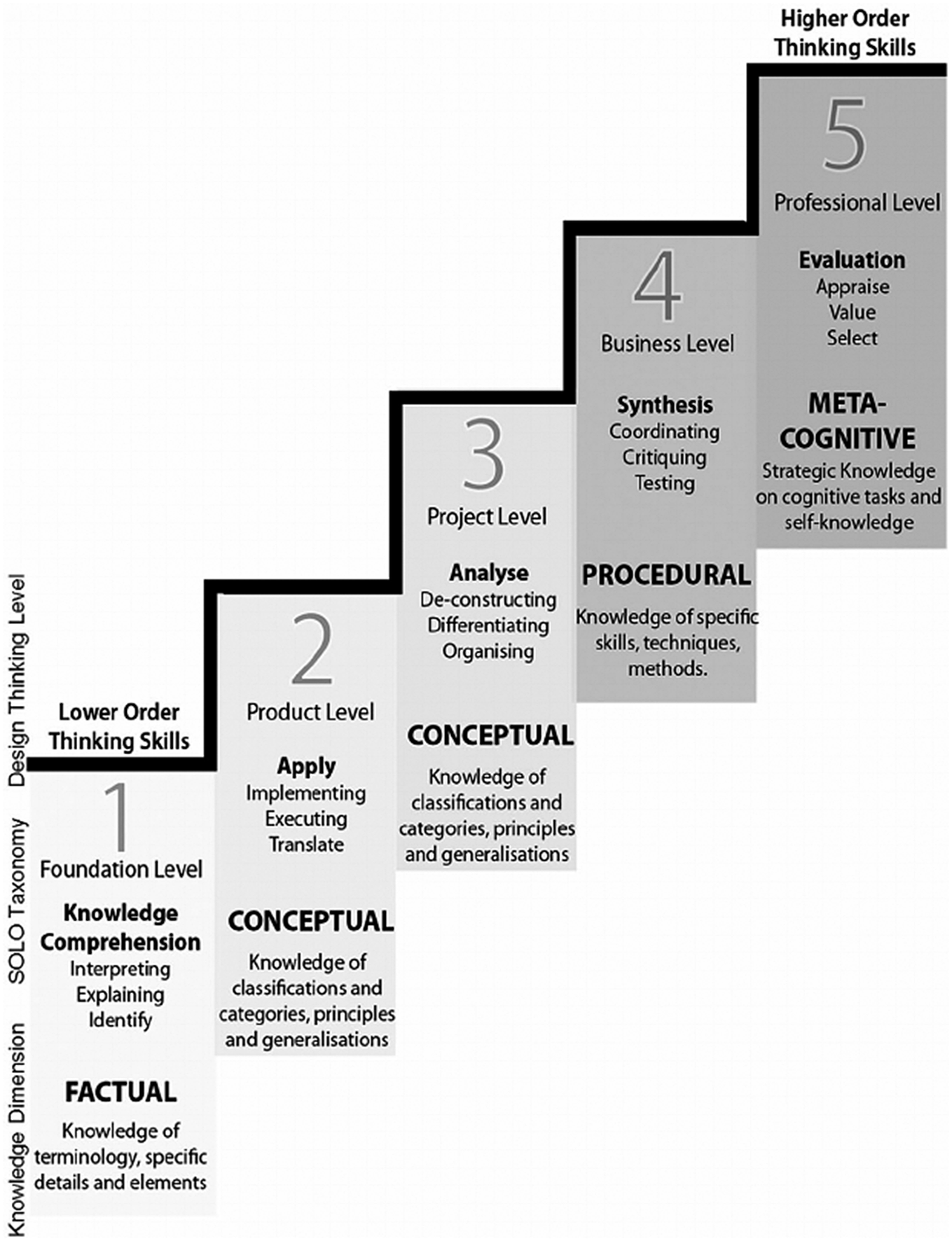
Our research insights also confirm the theory of the educational design ladder. The pedagogic and didactic educational design ladder of Wrigley & Straker (Reference Wrigley and Straker2017) explains how a nondesigner progressively adopts the cognition and language of designers. Figure 5 illustrates the five skill levels of the education design ladder. The lower levels of design cognition initially cope with comprehension before maturing to higher-order thinking skills that show signs of deconstruction, testing and value assessments through intentional change. The proposed DT method for novices particularly supports the development of design cognition and routine at the lower levels of the ladder. Our study confirms the observations of Wrigley & Straker (Reference Wrigley and Straker2017) on how the nondesigners rhetoric changes, bringing design activities, subjects, used verbs and learning modes into context. Gero & Milovanovic (Reference Gero and Milovanovic2020) proposed a framework for measuring design cognition processes.
The educational design ladder.
The experiential learning cycle with an intuitive DT method and the associated learning curve of nondesigners, particularly in codesign, determines the acceptance and adoption of DT. This can be essential for organisations that adopt DT at scale and planning to involve further nondesigners and occasional designers in cross-functional codesign engagements (Kimbell Reference Kimbell2009; Kolb Reference Kolb2014; Buchanan Reference Buchanan2015; Elsbach & Stigliani Reference Elsbach and Stigliani2018).
The proposed method follows the recurring pattern of DT methods with the major need-finding, brainstorming and prototyping stages. The techniques used are typically attributed to one of these three stages (Seidel & Fixson Reference Seidel, Fixson, Scott Swan, Luchs and Griffin2015). DT, or more specifically, the problem spaces of almost all DT methods, propagates the use of three typical techniques applied in a sequence (Efeoglu et al. Reference Efeoglu, Møller, Sérié and Boer2013). This typically starts by defining a persona, then creating the respective customer journey map, and concluding with the how-might-we question or the point of view. This pattern indicates a strong human centricity of DT, although it is also designed to solve generic design challenges. DT novices tend to mistakenly individualise generic design challenges like social or business challenges and force a fit to these human-centric techniques. The redesigned DT method focuses on better illustrating its generic problem-solving and innovation capability, going beyond the sole aspects of human centricity. Our research agrees with human centricity mostly when the design challenges are explicit of human-centric, product or service nature. Still, it raises concerns that DT must embrace holistic design challenges more strongly. A human-centricity dilemma remains in DT with designing for people compared to designing with people for a larger purpose (Shapira et al. Reference Shapira, Ketchie and Nehe2017; Elsbach & Stigliani Reference Elsbach and Stigliani2018).
While an intuitive DT method supports overcoming nondesigners’ design capability concerns, it is surprising that time constraints, capacity issues and operational work obligations are hidden arguments for DT resistance or rejection.
Further research on the intuitiveness and efficacy of the redesigned DT, especially with nondesigners and novices, is recommended. Research thereby can be conducted not only on method experience but also on its iteration capabilities. A comparative study between classic and redesigned DT with the same underlying design challenge and the same team size with nondesigners can be conducted to measure method efficiencies. A validation framework based on a DT metamodel can ensure measuring comparable embedded units of analysis (Yin 2003). Effectiveness research can also investigate the impact of technique orchestration on solution design effectiveness.
6. Conclusion
DT per se can be more efficient and effective. An intuitive DT method design that responds to nondesigners’ needs is significant for the design success, especially in codesign engagements when nondesigners are facilitated to express and infuse their expertise into the design. The DT method redesign leads to design efficiency, while the wise orchestration of techniques increases design effectiveness. Hence, the success of the method goes beyond the design of the method and its applicability. The method redesign helps frame and guide nondesigners. However, the orchestration of intuitive techniques is equally important in the engagement success of DT with novices.
The time constraint in codesigning with DT novices has emerged as a research result that deserves more investigation. The time capacity constraint is a risk for codesign engagements and an opportunity to derive more effective results under time pressure. More research is needed on design acceleration and design acting. The shortage of time can lead to a sharper focus on the design challenge, faster consensus-building and reflexive design acting based on the synthesis of insights. Overall, it can be concluded that design and method experience lead to broader acceptance among its users and facilitators, and interestingly, the adoption of the mindset of abductive thinking.


 Open access

